




Abstract
This longitudinal study explores the associations between children’s executive functions at the beginning of preschool and their learning behaviors, namely competence motivation and attentional persistence, at the end of preschool. Participants were 218 Portuguese children (Mage = 40.4 months, SD = 4.2; 52% boys) and their preschool teachers (n = 29). The children’s executive functions (specifically attention shifting, working memory, and response inhibition) were individually assessed when they were 3 years of age. Teachers’ perceptions about the children’s competence motivation and attentional persistence were assessed with the Preschool Learning Behaviors Scale (PLBS) when the children were 6 years old. Results showed positive associations between children’s executive functions and attentional persistence, but not competence motivation, after controlling for covariates (age, gender, and expressive vocabulary). These findings contribute to current evidence about the links between early executive functions and later behavioral indicators of child persistence in learning tasks.
A growing body of empirical and meta-analytical studies underscores that executive functions (EFs) in early childhood are crucial for children’s social skills, school engagement, and academic performance in key domains of learning (Korucu et al., 2017; McClelland et al., 2014; Robson et al., 2020). Accordingly, from a theoretical standpoint, EFs are essential for future school readiness in its broadest conceptualization—not only for literacy and math skills but also for learning-related social and emotional skills (Blair & Raver, 2015; Calkins & Williford, 2009). However, most empirical work has focused on the association between EFs and academic knowledge, leaving a knowledge gap about the long-term contributions of EFs to specific learning behaviors, namely competence motivation and attentional persistence. In the current longitudinal study, we explore whether children’s EFs are associated with learning behaviors during the preschool years—a widely acknowledged critical and sensitive period for child development.
EFs
EF refers to a set of interrelated cognitive processes in service of goal-directed behavior (Blair, 2016; Diamond, 2013). EF subcomponents are the specific skills that allow children to deliberately hold information and integrate and organize competing information and stimuli (Blair & Ursache, 2011). Usually, EF is conceptualized as comprising the following cognitive processes as sub-components: attention shifting, working memory, and response inhibition (Miyake et al., 2000). Attention shifting can be defined as the child’s ability to switch back and forth between multiple mental sets or tasks (Blair & Ursache, 2011). Working memory refers to the child’s ability to actively monitor and update information during a short time (Blair & Ursache, 2011). Response inhibition denotes the child’s ability to inhibit automatic prepotent responses in favor of more adaptive responses to specific situations (Blair & Ursache, 2011). EF sub-components start developing during the first year of life (Diamond, 2013) and have a remarkable evolution throughout toddlerhood and the preschool period, when developmental plasticity is at its greatest (Hughes et al., 2009). For example, during the preschool years, children become progressively better at focusing their attention on specific tasks, ignoring irrelevant information, shifting attention between internal representation and environmental cues, planning behaviors to match the expectations of particular situations, inhibiting prepotent responses, and delaying gratification for more extended periods (Murray et al., 2015). Seminal conceptual frameworks such as the developmental psychobiological perspective (Blair & Raver, 2015) and several empirical studies (e.g., Blair & Razza, 2007; McClelland et al., 2007) have established the importance of the core processes of EFs for children’s readiness skills tied directly to academic performance in literacy and math.
Learning Behaviors
Children’s learning behaviors are crucial for children’s social (Veziroglu-Celik & Acar, 2018), literacy, and math competencies (Beisly et al., 2020; Meng, 2014; Yen et al., 2004). Learning behaviors refer to children’s behavioral manifestations of motivation, attention, persistence in learning tasks, strategic planning, cooperation in group tasks, and attitudes toward novelty and risk (McDermott et al., 2002, 2012, 2018). Children navigate learning processes through this set of goal-directed behaviors (McDermott et al., 2018).
Studies have shown that competence motivation and attentional persistence are two specific learning behaviors that are essential for children’s future achievement and adjustment (McDermott et al., 2012; Rikoon et al., 2012), with important links to children’s reading, language, and math (McDermott et al., 2012). Competence motivation encompasses behaviors related to children’s motivation in learning tasks, as well as their ability to deal with novelty and to show initiative. Attentional persistence encompasses behaviors such as children’s ability to pay attention, tolerate frustration, and consider consequences before responding to a specific situation (McDermott et al., 2018). These skills are progressively more important as children move from preschool to first grade, when they are expected to navigate the classroom context and take advantage of learning opportunities and activities.
EFs and Learning Behaviors
The conceptual rationale for this study stems from the integrated model of regulation for applied settings proposed by Bailey and Jones (2019), which is based on three main features. The first is that the core processes of EFs (such as working memory and response inhibition) are domain-general core processes that support the development of a broad range of skills across various domains (Bailey & Jones, 2019). The second is that regulation-related skills can be organized according to a hierarchy of complexity and its developmental sequence (Bailey & Jones, 2019). In practical terms, this means that the core processes of EFs develop early in infancy and are the foundation for domain-specific, complex, and higher-order skills that emerge and come into use later as children face progressively more complex challenges (Bailey & Jones, 2019). The third and last feature of the model is that, over time, domain-general and domain-specific regulatory skills build up to assemble a “regulatory gestalt,” which is essentially a holistic and multidimensional system that enables children to show progressively more sophisticated regulatory behaviors in response to different demands and settings, with important repercussions for a wide range of outcomes (Bailey & Jones, 2019).
From a neurobiological perspective, by the end of preschool, children start to take the best advantage of their EF skills, capitalizing on them to engage in learning tasks in an adaptive way (Blair & Raver, 2015). In line with conceptual considerations that highlight the importance of early EF for children’s later adjustment to school and engagement in learning tasks, we propose that children’s early EFs are also of great value for learning behaviors, which are another relevant set of readiness skills that put children in a favorable position to benefit the most from learning opportunities (Blair & Raver, 2015). In addition, children’s learning behaviors may constitute an important mechanism to explain the link between EF and academic performance (Sung & Wickrama, 2018). However, very few empirical studies have focused on studying the longitudinal specificities of the dynamic relations between the core processes of EF—those which start to develop from infancy onward—and the sophisticated classroom learning behaviors that children exhibit in a later stage of early childhood when they are expected to show motivation and persistence in learning tasks. Taking this literature gap into consideration and drawing from the integrated model of regulation for applied settings (Bailey & Jones, 2019), in this study, we suggest that EF core processes are elaborated through domain-specific skills during early childhood for children to ultimately produce a more mature response to classroom demands, which manifest, in practical terms, in specific learning behaviors that concern how children motivate to complete a difficult assignment and persist in their efforts to pay attention during learning tasks.
Some studies have focused on the environmental factors associated with competence motivation and attentional persistence, pointing, for instance, to the importance of teacher–child interactions (Hu et al., 2020). Nevertheless, as highlighted by Blair (2002), there is a knowledge gap about the developmental outset and those children’s characteristics associated with the learning behaviors that refer to children’s motivation and engagement in learning.
The few empirical studies that have focused on the association between preschoolers’ EF and learning behaviors yielded mixed findings: while some studies reported a significant association between children’s EF and their learning-related behaviors (Acar et al., 2021; Brock et al., 2009; Sung & Wickrama, 2018; Vitiello et al., 2011), others failed to find significant links (Beisly et al., 2019). For instance, a cross-sectional study and a longitudinal study with preschoolers indicate that EFs are linked to child learning behaviors (Acar et al., 2021; Brock et al., 2009). Another longitudinal study conducted with a large sample of kindergarteners showed that children’s initial level and growth rate of approaches to learning mediated the association between EF and academic competencies (Sung & Wickrama, 2018). In contrast, a cross-sectional study found no associations between children’s EFs and their learning behaviors (Beisly et al., 2019).
A possible explanation for these mixed findings is that most studies have operationalized learning behaviors using different components and subscales. For instance, one study measured learning behaviors as an average score of children’s organization, eagerness to learn, attentiveness, learning independence, persistence, and adaptation to change (Sung & Wickrama, 2018), whereas another study measured learning behaviors as a composite score of competence motivation, attentional persistence, and attitudes toward learning (Acar et al., 2021). In addition, studies have used a single composite score (Acar et al., 2021) or latent variable (Beisly et al., 2019) to represent overall learning behaviors rather than separately examining associations between EF, competence motivation, and attentional persistence.
There is initial evidence pointing to substantial longitudinal variation in competence motivation and attentional persistence during preschool (Hu et al., 2020). Previous research has also suggested that, although interrelated, these two learning behaviors may be predicted by different characteristics. For example, a cross-sectional study with a large sample of Chinese preschoolers reported that children’s socioeconomic status and teacher–child interactions were associated with attentional persistence but not competence motivation (Hu et al., 2017). Given the specificities of competence motivation and attentional persistence, it is possible that EF links to each of these learning behaviors are unique and specific and that the pattern of associations fluctuates across the development trajectory. Regarding child-level variables, cognitive flexibility has been identified as a crucial factor in understanding the development of children’s competence motivation and attentional persistence during early childhood (Vitiello et al., 2011). Nevertheless, only one study revealed preliminary findings on these associations. As acknowledged by the authors, the study was cross-sectional and focused on one single sub-component of EFs (Vitiello et al., 2011). Thus, it is essential to further explore how early EF supports the emergence of important learning behaviors such as competence motivation and attentional persistence.
This study intends to shed additional light on the longitudinal associations between EF at preschool entrance (age 3) and the learning behaviors of competence motivation and attentional persistence at preschool exist (age 6). In addition, children’s initial vocabulary is taken into account as a proxy for verbal IQ, allowing us to make conclusions about EF after controlling for children’s verbal ability, which is an essential component of general cognitive competence (Coolen et al., 2021; Fuhs et al., 2014). This longitudinal study adds to the existing literature by examining the early development of EFs and their links to children’s learning behaviors upon preschool end, over and above children’s verbal ability.
Method
Participants
This study is part of a larger research project that aimed to investigate the associations among activity settings, teacher–child interactions, peer interactions, and self-regulation development in Portuguese daycare facilities. In Portugal, center-based daycares are licensed facilities for children from 4 months to 3 years of age, while preschool serves children from 3 to 6 years old. Mandatory school (first grade) starts when children are 6 years old. To ensure geographic variability, daycare facilities located in two large urban areas and one rural area in Portugal were selected. To take part in the larger project, daycare facilities had to meet the following criteria: (a) be considered high quality according to experts on early childhood education and care (ECEC), such as by innovating practices and collaborating with universities, and (b) meet national guidelines regarding structural characteristics such as group size and teachers’ minimum qualification.
Participating children (n = 218; 52% boys) were, on average, 40.4 months old (SD = 4.2) at the first wave of data collection and 71.8 months old (SD = 4.1) at the second wave of data collection (see Table 1 for descriptive statistics). Most children had Portuguese nationality (n = 137; 95.8%), 2.1% (n = 3) had dual nationality, one was of French nationality, one was of Brazilian nationality, and one was of Angolan nationality (0.7% each). Regarding the mothers’ education level, 76.2% (n = 138) had a higher education degree, and 23.8% (n = 43) had attended high school or less. Most mothers worked outside the home (n = 154; 85.1%).
Descriptive Statistics for the Study Variables.
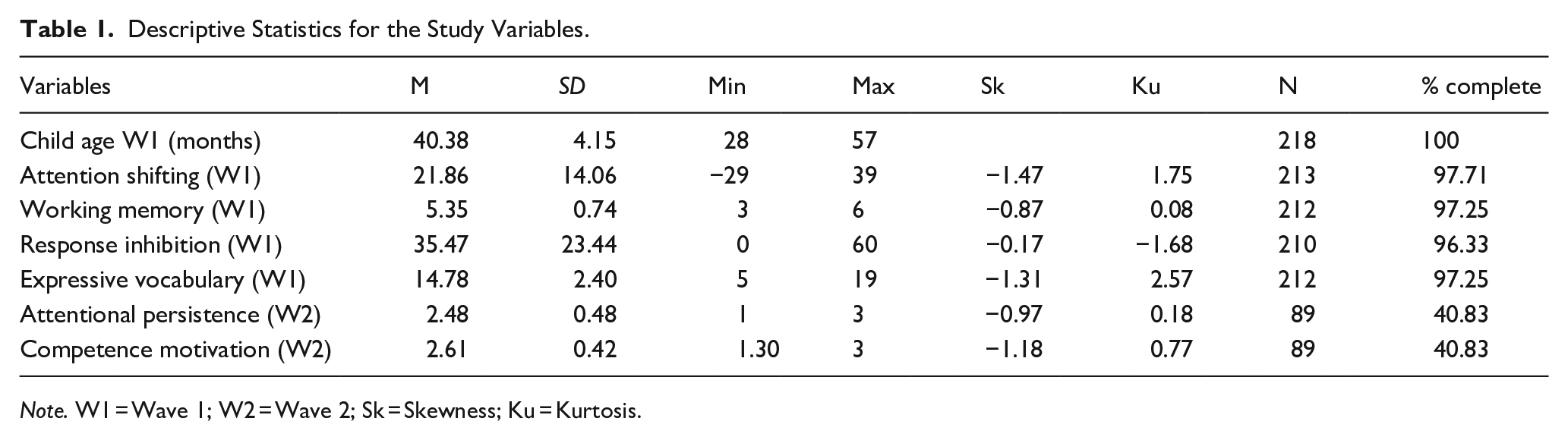
Note. W1 = Wave 1; W2 = Wave 2; Sk = Skewness; Ku = Kurtosis.
Participating teachers were the lead classroom teachers when the children were 6 years old (n = 29). The 29 participating classrooms were distributed across 17 schools. All participating teachers were women, with an average age of 44.7 years (SD = 8.9; n = 21) and an average teaching experience of 18.4 years (SD = 7.3; n = 22). The majority of the teachers had a bachelor’s degree (n = 16; 69.6%), while the rest had a master’s degree (n = 5; 21.7%) or a postgraduate degree (n = 2; 8.7%) in early childhood education. The group size of the classrooms ranged from 17 to 25 children, with an average of 22 children enrolled per classroom (SD = 2.6; n = 23). On average, there were five participating children per classroom.
Measures
EFs
To assess attention shifting, we used the visual attention task from the developmental neuropsychological assessment NEPSY (Korkman et al., 1998). The task comprises two trials. In each trial, children are asked to search and stamp targets (bunnies in the first trial and cats in the second, among other distracting pictures) as quickly as possible. The time limit is 3 minutes for each trial. This task is preceded by a practice trial during which children use the stamp freely on a blank sheet of paper. The number of correct items and incorrect items is counted for each trial. Final scores were calculated by subtracting the mean of incorrect answers from the mean of correct answers for both trials. The task has shown good psychometric properties with preschoolers (Visu-Petra et al., 2012) and has recently been shown to adequately assess toddlers’ attention shifting (Salminen et al., 2021).
To measure working memory, we used the Hidden Boxes Task (Mulder et al., 2014). First, the examiner hides six wooden animals inside six identical blue boxes displayed on a board. The examiner asks the child to uncover the boxes and find all of the animals, one at a time. Each time the child finds an animal, it is removed and the box is left empty. Between each trial, the child is distracted for 6 seconds. The task is preceded by two practice trials with two boxes and two toys. The test comprises six items, each coded as 1 if the child can find one animal and 0 if the child fails to do so by opening an empty box. The maximum possible score for this task is 6. The task, which was designed to assess working memory in very young children, shows good reliability with toddlers (Mulder et al., 2014). In this sample, skewness and kurtosis values were, respectively, −0.87 and 0.08, which are acceptable values according to suggested clear-cut standards of|skewness| ⩽ 3 and|kurtosis| ⩽ 10 (Kline, 2016). Standard deviation, range, and minimum and maximum values indicated enough variation in the current sample for this task. There was no evidence of ceiling effects, with 1.4% of children scoring 3 and 48.2% scoring 6.
We used the Toy Wrap task from the Preschool Self-Regulation Assessment (PSRA; Smith-Donald et al., 2007) to assess response inhibition. In this task, the researcher asks the child to look away and not peek while the researcher wraps a surprise to play with the child. The researcher records the child’s latency to peek (number of seconds) while the gift is wrapped. The time limit is 60 seconds, and a score of 60 seconds was assigned to children who did not peek. This task has been used in Portugal and has shown good psychometric properties (e.g., Cadima et al., 2016). Although the task is usually used with children from age 3 onwards, research has indicated its validity among toddler samples (Carlson, 2005; Caughy et al., 2013; Kochanska et al., 2000).
EF was entered into the models as a single latent variable. The confirmatory factor analysis (CFA) loadings were .71 for attention shifting, .45 for working memory, and .51 for response inhibition. Model fit information is not presented because the CFA model was saturated.
Expressive Vocabulary
Expressive vocabulary was assessed with one task from the Griffiths Language subscale (Griffiths, 2007). In this task, children are asked to name the objects and animals depicted in 20 pictures (e.g., spoon, bed, and cup). The pictures are presented on small cards, one at a time. A score of 1 was assigned to correct answers, and a score of 0 to incorrect answers, resulting in a maximum possible score of 20. Griffiths is a widely known and used measure of development with good reliability for this age group (e.g., Griffiths, 1996).
Learning Behaviors
The Preschool Learning Behaviors Scale (PLBS; McDermott et al., 2002) was used to assess teachers’ perceptions of children’s competence motivation and attentional persistence. In the PLBS, teachers are asked to report the frequency of children’s learning-related behaviors on a scale ranging from 1 (never) to 3 (frequently). All the negatively worded items were reverse coded so that higher scores on all items would indicate higher rates of attentional persistence and competence motivation. Its measurement validity with preschoolers has been established (McDermott et al., 2002). The PLBS has been adapted to the Portuguese population, and previous studies in Portugal have supported its two-factor structure through preschool teachers’ reports (Lemos et al., 2017; Lourenço, 2020). The two subscales refer to children’s Attentional Persistence (eight items, including, for example, “Sticks to an activity for as long as can be expected for a child of this age”) and Competence Motivation (10 items, including, for example, “Accepts new activities without fear or resistance”). Following previous studies conducted with Portuguese preschoolers (Lourenço, 2020), we tested, through a CFA, a latent construct for the PLBS using a two-factor solution: attentional persistence and competence motivation. CFA models testing the structure of PLBS through a two-factor solution showed adequate fit: χ²(117) = 138.37; p = .0865, comparative fit index (CFI) = .963, Tucker–Lewis Index (TLI) = .957, root mean square error of approximation (RMSEA) = .045, standardized root mean square residuals (SRMR) = .066. Factor loadings ranged from .38 to .84 on the competence motivation subscale and .57 to .85 on the attentional persistence subscale. In the current sample, the PLBS showed good internal consistency for both the competence motivation subscale (α = 0.88) and the attention persistence subscale (α = 0.90).
Procedure
This study was approved by the Portuguese National Commission of Data Protection (Project “Quality Matters”; Portuguese Foundation for Science and Technology Grant PTDC/MHC-CED/5913/2014) and by the Ethics Committee of the Faculty of Psychology and Education Sciences of the University of Porto (reference 2019/11-01; Portuguese Foundation for Science and Technology Grant SFRH/BD/138821/2018). In both data collection waves, teachers and parents gave informed consent by signing letters containing detailed information about the project. Data collection occurred in two waves: the first occurred in the fall of the school year 2017–18, shortly after the children transitioned from daycare to preschool, and the second wave occurred in the spring of the school year 2019–20, just before the children enrolled in first grade.
Children’s attention shifting, working memory, and response inhibition were individually assessed in the first data collection wave. Although there was a pre-set order to present the measures (Hidden Boxes task, followed by the NEPSY Selective Attention task, the Griffiths Language Subscale task, and the Toy Wrap task), this varied occasionally to ensure the children’s engagement during the assessment session. Assessments were conducted in quiet rooms located in daycare facilities. Each assessment lasted approximately 20 minutes and was usually completed in a single session. Four research assistants were trained to conduct the individual assessments. Meetings were held to discuss and agree on consistent procedures to deal with cases that raised doubts about coding. Preschool teachers were asked to fill out the PLBS in the second data collection wave.
Data Analysis
To answer our research question, a series of structural equation models were estimated to examine the contributions of children’s EF (age 3) for their competence motivation and attentional persistence (age), controlling for the children’s age, sex, expressive vocabulary, and for the effects of age and sex on EF and expressive vocabulary. Given that preliminary analysis showed similar results when controlling for mothers’ education, and considering the low rate of mothers’ responses to sociodemographic questionnaires, this variable was not included as a control variable in the final models. Children’s EF, competence motivation, and attentional persistence were entered into the models as latent variables. Each outcome was estimated in separate models. All models were computed with Mplus 6.1 (Muthén & Muthén, 1998/2012) using the MLR estimator, which is robust to nonnormality. We used the cut-off criteria proposed by Little (2013) to assess model fit in longitudinal models, namely the CFI (CFI > .90 indicates acceptable fit, and CFI > .95 indicates very good fit) and the RMSEA (RMSEA < .08 indicates acceptable fit and <.05 indicates good fit). Because children were nested in classrooms, the intraclass correlation coefficients (ICC) were computed to check the proportion of variance at the classroom level for each outcome. ICCs were .18 and .20 for PLBS competence motivation and attentional persistence subscales, respectively, pointing to some classroom-level variance. While similar results were obtained with and without using the complex option in Mplus, because the inclusion of children’s clusters in the second wave of data collection resulted in a significant loss of power in the analysis, all models were run without the complex option.
EF and expressive vocabulary measures had approximately 2% to 4% missing data at wave 1. At wave 2, about 59% of the data were missing on all outcome measures. Logistic regression analyses were conducted to determine if the missing data at wave 2 were related to demographic and study variables. Missing data on outcome variables were unrelated to the school’s type (private for-profit or non-profit; b = .07, p = .81, odds ratio [OR] = 1.07), mother’s education level (b = .02, p = .89, OR = 1.02), children’s age (b = .00, p = .97, OR = 1.00), gender (b = −.34, p = .29, OR = 0.71), and initial skills (b = .00, p = .80, OR = 1.00 for attention shifting; b = .08, p = .64, OR = 1.08 for working memory; b = .01, p = .64, OR = 1.01 for response inhibition). In addition, analysis of the missing data patterns suggests that data were missing mainly due to attrition. Little’s missing completely at random (MCAR) test was not significant, suggesting that data were MCAR, χ2 (28) = 35.326, p = .161. To handle missing data, we used the full information maximum likelihood estimation (FIML) (Enders & Bandalos, 2001). FIML estimates parameters with all available information, preventing sample size reduction and consequently increasing statistical power (Enders & Bandalos, 2001).
Based on recent approaches regarding analytical power calculations for structural equation modeling (Jak et al., 2020), the fit index RMSEA was used to compute the minimum sample size required to achieve a power level of 0.80. For the competence motivation model and the attentional persistence model, the minimum required sample sizes were, respectively, 135 and 168 to achieve a power level of 0.80 for α = 0.05, which was exceeded by our sample size.
Results
Simple correlations are presented in Table 2. Older children performed better on all EF and vocabulary measures. Girls scored higher than boys on response inhibition and competence motivation. As expected, all EF measures were correlated with each other, and children’s attentional persistence was highly correlated with competence motivation. Moreover, expressive vocabulary was correlated with all EF and outcome measures.
Summary of Zero-Order Correlations for the Study Variables.
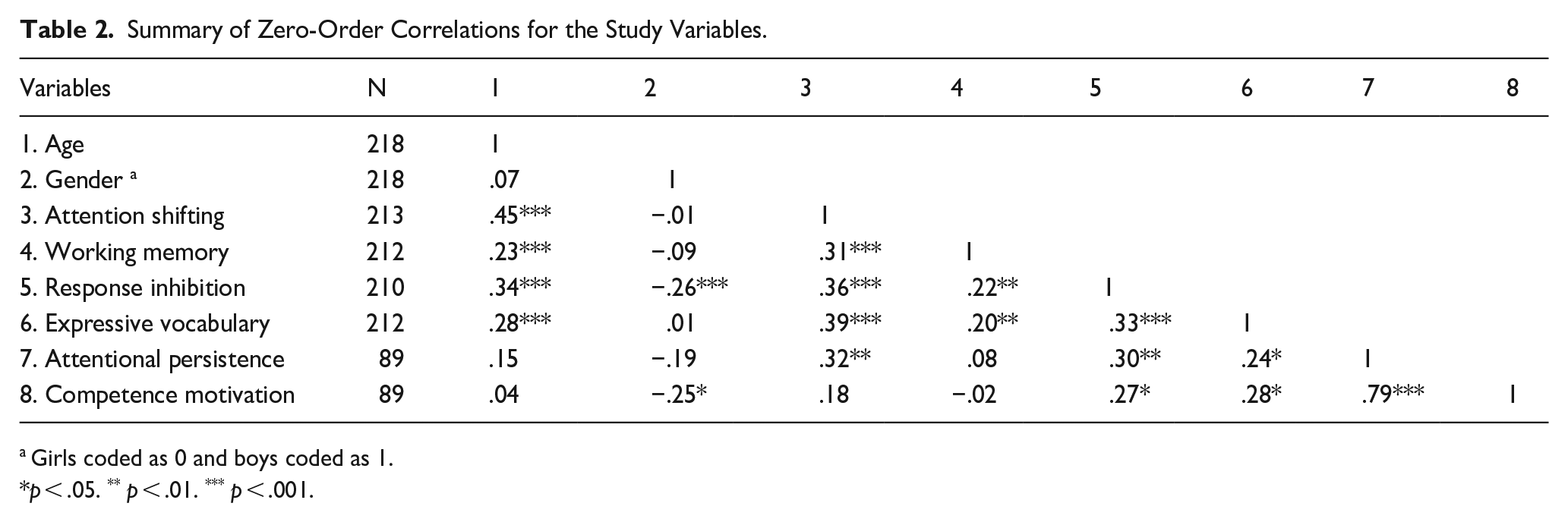
Girls coded as 0 and boys coded as 1.
p < .05. ** p < .01. *** p < .001.
Two models were tested for children’s attentional persistence and competence motivation, with both models showing acceptable fit, respectively: χ²(70) = 106.22, p = .0034, CFI = .933, TLI = .914, RMSEA = .049, SRMR = .066; and χ²(97) = 129.909, p = .0144, CFI = .933, TLI = .917, RMSEA = .039, SRMR = .073.
The results showed that, after controlling for child age, gender, expressive vocabulary, and for the effects of age and gender on EF and expressive vocabulary, EF at the beginning of preschool (age 3) was associated with children’s attentional persistence, β = .865, SE = .344, p = .012 (Figure 1), but not with competence motivation (Figure 2), by the end of preschool (age 6).
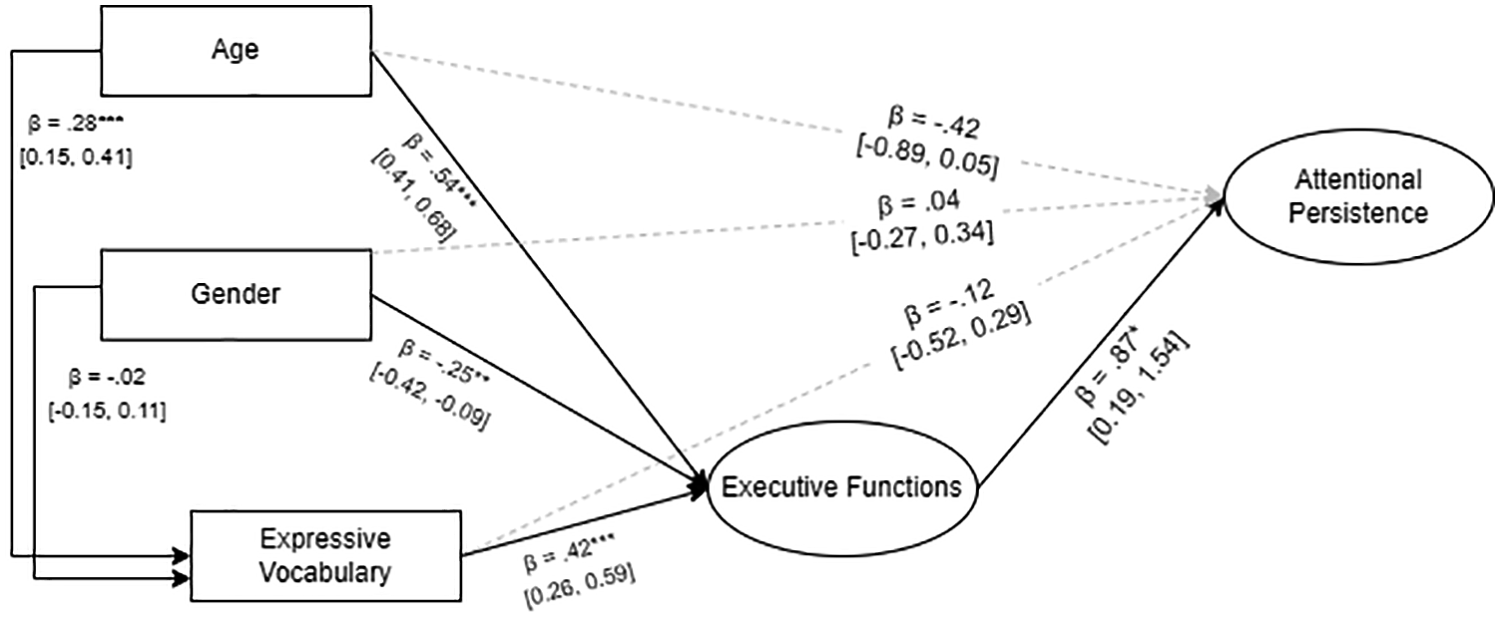
Summary of the Structural Equation Model Results, With Executive Functions at Age 3 Predicting Children’s Attentional Persistence at Age 6. The structural equation model in the diagram specifies the paths from age, sex, expressive vocabulary, and executive functions to children’s attentional persistence, as well as the paths from age, sex, expressive vocabulary to executive functions. Gender is coded 0 for girls and 1 for boys. Dotted lines represent nonsignificant relations; bold lines represent significant associations. The diagram displays standardized estimates and 95% Confidence intervals in square brackets. N = 218.
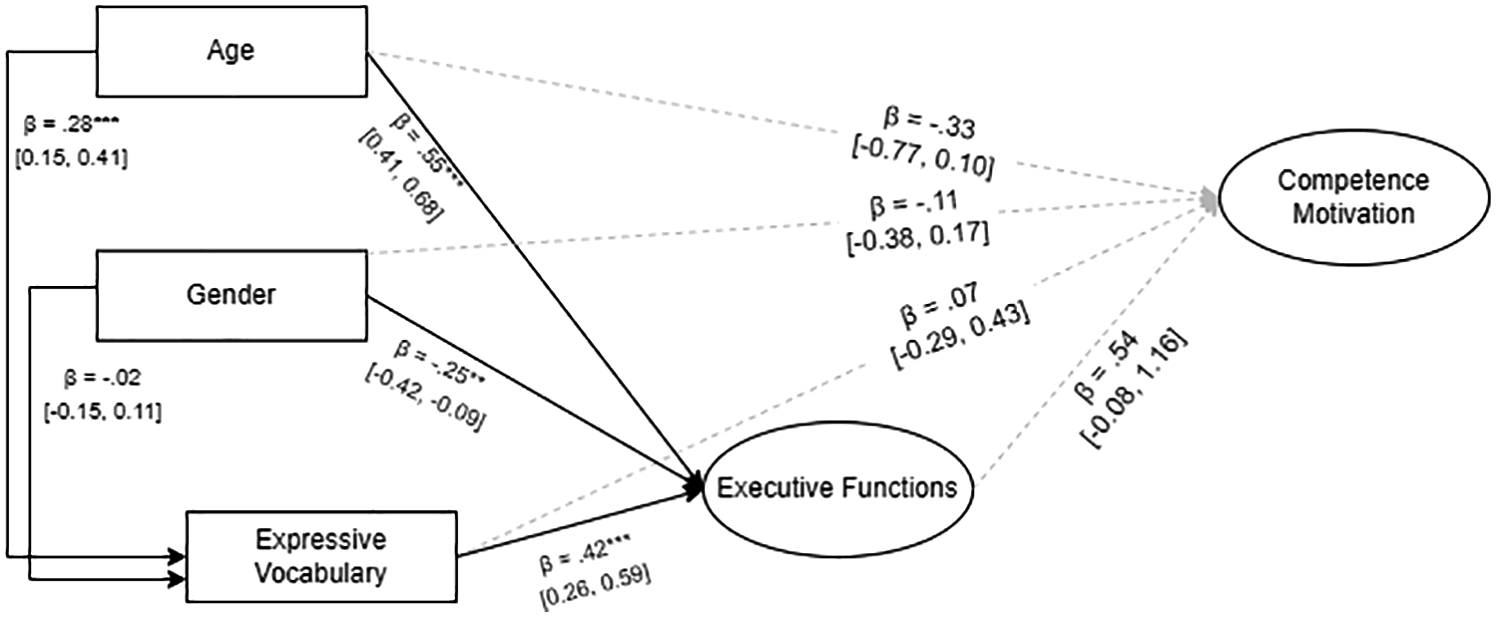
Summary of the Structural Equation Model Results, With Executive Functions at Age 3 Predicting Children’s Competence Motivation at Age 6. The structural equation model in the diagram specifies the paths from age, sex, expressive vocabulary, and executive functions to children’s competence motivation, as well as the paths from age, sex, expressive vocabulary to executive functions. Gender is coded 0 for girls and 1 for boys. Dotted lines represent nonsignificant relations; bold lines represent significant associations. The diagram displays standardized estimates and 95% Confidence intervals in square brackets. N = 218.
Discussion
This study explored the associations between preschoolers’ early EF (age 3) and their later learning behaviors of attentional persistence and competence motivation (age 6). The results showed that children with higher levels of EF—measured as a latent variable of attention shifting, working memory, and response inhibition—at age 3 were considered by their teachers to have higher attention persistence in learning tasks by the age of 6. In contrast, the results showed no significant associations between children’s EF at age 3 and their competence motivation at age 6 after controlling for child-level variables such as age, gender, and verbal ability. These results point to the critical specificities of attention persistence and competence motivation, highlighting the importance of studying learning behaviors separately. Previous research has suggested this by providing evidence that children’s socioeconomic status and teacher–child interactions are positively associated with attentional persistence but not competence motivation (Hu et al., 2017). Along these lines, this study adds to the field by providing initial evidence that child-level variables, namely EF, have different relevance for children’s later competence motivation and attentional persistence. Thus, an important conclusion of this study is that there are benefits to studying specific subsets of learning behaviors in isolation, such as competence motivation and attentional persistence, rather than studying learning behaviors as a broad skill.
Our results partially align with previous research that suggested associations between EF and attention persistence (Acar et al., 2021; Vitiello et al., 2011). Despite being conceptually related, EF and attentional persistence are not identical. While EF comprises a set of sub-components used to regulate attention and guide goal-directed behavior, attention persistence is a resource activated according to situational demands and is directed by EF skills (Chang & Burns, 2005; Posner et al., 2006). This longitudinal study adds to previous evidence showing that the association between both skills is not only concurrent, as suggested by Vitiello and colleagues (2011), but also develops across time.
Contrary to previous research (Acar et al., 2021; Vitiello et al., 2011), EF was not associated with children’s competence motivation. To the best of our knowledge, there is a lack of studies aiming to investigate which child-level or environmental variables influence children’s competence motivation development. The few studies that have examined the predictors of learning behaviors focused on the outcome as a composite or latent factor (e.g., Buek, 2019), precluding conclusions about specific predictors of competence motivation. In addition, children’s age may play an important role in explaining why we failed to find links between EF and competence motivation while previous cross-sectional studies with younger preschoolers have reported such an association. It is possible that attentional persistence and competence motivation overlap more for younger children and are two constructs that become progressively differentiated during the preschool years. Given the importance of competence motivation for child development (Beisly et al., 2020; Meng, 2014; Veziroglu-Celik & Acar, 2018; Yen et al., 2004), future longitudinal studies should strive to identify which child-level variables are important predictors of children’s competence motivation. Overall, our findings contribute to current evidence about the links between early EF and later behavioral indicators of child persistence in learning tasks and point out the need to further explore what child-level variables contribute to children’s competence motivation.
There are several limitations to the current study that should be outlined. First, due to the settings selection criteria of our study, our sample is not representative of Portuguese preschoolers. Second, our sample had a medium to high sociocultural and economic status, as evidenced by the mothers’ education levels and employment status, which makes us cautious about generalizing the results. However, data show that compared to families where the mothers have lower educational levels, Portuguese families where the mothers have high levels of education are more likely to enroll their children in educational settings from birth to age 2 (Organisation for Economic Co-operation and Development [OECD], 2016). Third, although longitudinal, our study was correlational; thus, no strict causality links can be drawn from our findings. Fourth, we could not control for children’s initial competence motivation and attentional persistence. Finally, this study has a substantial percentage of missing data at wave 2, mainly due to the pandemic and children moving schools, making them untraceable at wave 2. Nevertheless, logistic regression analysis, analysis of missing data, and the MCAR test suggest that the missing data were unrelated to either children’s, families,’ or schools’ variables.
Despite these limitations, this study also has several strengths. First, its longitudinal design, with two time points during critical periods for child development (ages 3 and 6), provides room to expand its conclusions beyond a cross-sectional design. Second, children’s EFs were measured directly, and different subsets of EF were evaluated and entered into the models as a latent variable, following recent evidence indicating that young children’s EF may be best represented through a single latent factor (Guedes & Cadima, 2022). Finally, vocabulary was used as a proxy for verbal IQ and entered into all models as a control variable. This allowed us to make conclusions about the associations between EF and the learning behaviors of competence motivation and attentional persistence over and beyond verbal IQ.
This study fills an important literature gap by adding evidence about the links between early EF and later behavioral indicators of children’s competence motivation and attention persistence. Our results can also function as a first step in informing theoretical approaches regarding the longitudinal associations between early core EF and later school readiness skills that, although not directly related to children’s academic performance, are of great importance for child development and school adjustment. In addition, the results further support the importance of explicitly addressing and targeting EF in early childhood education curricula and targeting interventions to enhance children’s school readiness. Given the current lack of educational guidelines for working with children from birth to age 3, this can be particularly informative for Portuguese daycare teachers.
Footnotes
Data Availability Statement
The data that support the findings of this study and the study analysis code are available from the corresponding author, Joana Cadima, upon reasonable request. This study is not preregistered.
Funding
The author(s) disclosed receipt of the following financial support for the research, authorship, and/or publication of this article: This research was supported by the Portuguese Foundation for Science and Technology (research project “Quality Matters” grant PTDC/MHC-CED/5913/2014, and PhD scholarship “Crossing the Boundaries between Toddlerhood and Preschool” grant SFRH/BD/138821/2018) and by the Center for Psychology at the University of Porto, Portuguese Science Foundation (FCT UIDB/00050/2020).
