




Abstract
The gender gap in job burnout research indicates that women score higher on job burnout. However, this gender difference has rarely been studied from developmental perspectives. Moreover, the underlying gender differences in job resources—driven by gendered socialization in early career years—have been under-investigated. The present study examined the trajectory of early career job burnout, gender differences in job burnout development, and gendered job resources. Results from latent growth curve modeling (N = 619, 65.3% women, ages 26–34), using the longitudinal data from three time points (2013–2020), showed that the trajectory of job burnout was decreasing in early career years, and this pattern did not vary between genders. As expected, women scored higher in job burnout. Gender differences in job resources were found: parenthood status only prevented job burnout for women, whereas income and partner support only prevented job burnout for men. Belongingness to the workplace prevented job burnout for both genders. Findings suggest that young adults make use of job resources from their socialization in early career years and experience a decreasing pattern of job burnout. The current gender gap in job burnout may be explained by gender differences in socialization and roles in early career transitions.
Introduction
Job burnout is among the more crucial predictors of occupational wellbeing, because it could lead to negative work outcomes (Bakker et al., 2000; Demerouti et al., 2009; Ten Brummelhuis et al., 2011). Consequently, how job burnout developed has been a central question in the research, and early career stage stood out as a crucial period of turbulence in wellbeing. Previous studies showed that younger employees experienced more variations in the development of job burnout when compared with older employees (Mäkikangas et al., 2016). Early career adults also make various transitions and face increasing responsibilities, and they are more likely to experience job burnout due to change and unfamiliarity (Lorentzen et al., 2019; Maslach et al., 2001; Stelling et al., 2023). However, findings regarding job burnout trajectories have largely been inconsistent so far, and show stable, increasing, or heterogeneous patterns (e.g., Demerouti et al., 2004; Lizano & Mor Barak, 2012; Salmela-Aro et al., 2011). Research that focuses on early career adults is lacking, so in this study, we aimed to address early career job burnout development by undertaking longitudinal research over a 7-year period.
Previous research has consistently found gender differences, with women scoring higher on job burnout than men (Purvanova & Muros, 2010). Yet, developmental work on this topic has been limited in terms of methods and designs. Consequently, inconsistent results regarding gender differences in the development of job burnout have been produced (Klassen & Durksen, 2014; Lebares et al., 2018; Ronen & Malach-Pines, 2008). In addition to noting the main gender difference in job burnout, Eagly (1995) called for investigations of the underlying gendered job burnout mechanisms. However, research in this regard has been barely sufficient or adequate, especially considering how women and men may vary in their use of job resources. Therefore, in this study we used the job demands and resources model (JD-R; Demerouti et al., 2001) and examined the differential roles of three job resources—work, family, and financial resources—in women and men’s job burnout.
Job Burnout and Development in Early Career Years
Job burnout refers to a negative psychological state due to work-related strains. It is usually characterized by a combination of exhaustion, cynicism, and lack of self-efficacy caused by job-related matters (Maslach, 1982). Previous research has found that job burnout predicts employees’ occupational wellbeing and is positively associated with higher rates of job turnover, less engagement at work, and increased rates of depression (Bakker et al., 2000; Ten Brummelhuis et al., 2011). Therefore, understanding the occurrence of job burnout has been a central focus in the field. As job burnout is closely related to the context within which work occurs (Schaufeli et al., 2009), and individuals experience job burnout in parallel to their own development, it is crucial to recognize job burnout as a developmental concept with respect to the time-specific life stages and social environments.
Previous research on job burnout development has shown mixed results. On one hand, studies have found that job burnout development was stable (De Cuyper et al., 2012; Demerouti et al., 2004, 2009; Taris et al., 2005). On the other hand, research has also shown that job burnout development was heterogeneous, that is, the same cohort showed stable, increasing, decreasing, and curvilinear profiles of burnout (Capel, 1991; Dunford et al., 2012; Salmela-Aro et al., 2011; Schaufeli et al., 2011). In addition, Lizano and Mor Barak (2012) found that burnout increased over time in the same cohort of American public child welfare workers. Conclusively, research on job burnout development has so far displayed inconclusive results.
While more developmental work in job burnout research is needed, investigations within the scope of early career are especially essential. The most common career trajectory in Finland is a “medium education into work” trajectory, meaning that most Finnish young adults finish their education at the age of 22–23 years, experience a period of unstable work, and enter a stable job at the age of 27–28 years (Lorentzen et al., 2019). Early career is also the time when young adults establish families and experience the turbulences generated by life changes. Furthermore, Mäkikangas et al. (2016) concluded in their systematic review of 40 longitudinal studies, that young employees tended to experience bigger fluctuations in job burnout, job satisfaction, work engagement compared with older employees, suggesting early career as a time of turbulence in wellbeing. Although the early career stage is unique in the context of job burnout research, this specific stage has rarely been studied. The present study thus put a special focus on this life stage, targeting people in the age range of 26–34 years.
Gender Difference in Job Burnout
The move toward job burnout does not develop uniformly for women and men, and previous studies have shown gender differences. Purvanova and Muros (2010) concluded in their meta-analysis consisting of 183 studies, that women scored higher in overall job burnout. This gender difference suggests different job burnout experience for women and men. However, most of these studies used cross-sectional data. Investigation of gender differences in the development of job burnout is lacking.
Among the scant research that investigated both gender and burnout development, Ronen and Malach-Pines (2008) indicated that job burnout showed a stable pattern over the course of 7 months, and gender difference was not found in the development. Another small-scale study found that burnout scores increased more for male surgery interns comparing to female surgery interns over the course of 1 year (Lebares et al., 2018). A study of teachers showed that female teachers scored higher in job burnout, but job burnout developed at the same rate for female and male teachers (Klassen & Durksen, 2014). To sum up, first, these studies yielded mixed results (see Appendix, Table 1). Second, these studies were limited with either a small sample size, a focused target group, or an inadequate time span for capturing the development of job burnout with respect to workers’ changing contexts. Hence, further work is needed to understand how job burnout develops, and how it differs between genders.
Gender is also crucial in job burnout development in the early career phase because women and men go through multiple transitions (e.g., employment, parenthood), carry different responsibilities, and nuances in roles expected in early career (Krüger & Levy, 2001). These distinguishing factors may have different consequences for the development of job burnout in women and men. However, as indicated above, most of the studies were done using cross-sectional data. There has been a lack of direct research on the gendered job burnout trajectories, particularly during early career years. The present study thus investigated gender differences in the development of early career job burnout.
Job Demands, Job Resources, and Job Burnout
Given the negative impacts of job burnout, how to prevent it has become an important topic. According to the JD-R model (Demerouti et al., 2001), job demands refer to work aspects that require psychological or physical effort, which exacerbate job burnout; job resources refer to work aspects that help to promote personal growth, reduce job demands, or achieve occupational goals, which mitigate job burnout.
This study focused on assessing job resources, specifically, three job resources: (1) work resources (i.e., belongingness to the work community), (2) family resources (i.e., partner support, parenthood status), and (3) financial resources (i.e., monthly income). These three resources together cover relevant factors in early career transitions, including employment, partnership, and parenthood. They also complete early career adults’ socialization, including socializing with the work community, their partner, and their offspring.
One of the important work resources is belongingness to the work community, which is defined as perceived connectedness to the work community, representing socialization with colleagues. It predicts favorable occupational outcomes (Walton & Cohen, 2007). Previous studies have shown that belongingness to the workplace was one of the stronger predictors of reduced job burnout, and it led to higher levels of job satisfaction (Pathak & Srivastava, 2020; Somoray et al., 2017).
Regarding family resources, we paid particular attention to partner support and parenthood status. Representing socialization with a partner, partner support is relevant in the transition to partnership or marriage. Partner support is defined as the help provided by one’s partner (Schwarzer & Knoll, 2007). Previous studies have shown that partner support was associated with reduced job burnout (Gabbe et al., 2002; Rath et al., 2015). Representing socialization with offspring, parenthood status marks the transition to the role of being a parent. On one hand, parenthood has been studied as a job demand in parental burnout studies (Upadyaya & Salmela-Aro, 2021), while in job burnout studies, it has repeatedly been found to be associated with reduced burnout (Cañadas-De la Fuente et al., 2018; Maslach & Jackson, 1985). On the other hand, previous research suggested that quality time spent with children was positively related to a parent’s sense of work–family balance and emotional wellbeing (Milkie et al., 2010; Offer, 2014). Parenthood also provided adults with a general sense of purpose and meaning in life (Nelson et al., 2014). Because offspring has been treated as the receiver but not the provider of social support, the positive side of parenthood has not been studied in job burnout research. Therefore, the current study treated parenthood as a family job resource and examined the benefit of having offspring.
For financial resources, we focused on the monthly income, which is relevant in one’s transition to employment. Previous research indicated that limited financial resources led to higher rates of job burnout; income was also found to be one of the main predictors of job burnout (Dima et al., 2021; Guo et al., 2018).
In conclusion, each of the work, family, and financial resources has been found in previous studies to be related to reduced job burnout. Yet, a study that combines them using the JD-R model is absent. The current study thus aimed to examine the effect of job resources by each agent in young adults’ social context (i.e., work community, partner, offspring), as well as the effects of job resources relevant in the gendered early career transitions (i.e., caregiving responsibilities, economic responsibilities), and provided a full picture of the job resources in early career stage.
Gender and Job Resources
While job resources are critical for preventing burnout, their effects differ between genders. Within the scope of the job resources included in the current study, past research has suggested gender differences in parenthood status, monthly income, and partner support.
On one hand, women and men differ in their roles in early career transitions. Parenthood status and income have different connotations in women and men’s job burnout experience. Despite the increasing number of working women, the role of the caregiver is still more strongly associated with women, and the role of the home-provider with men (Krüger & Levy, 2001). The identity of a parent is more salient for women, and the identity of a worker is more salient for men (Mannerström et al., 2019). Consistent with this notion, Artz et al. (2022) found that the mismatch between working women’s worker identity and their socially expected role of caregiver contributed to their higher level of job burnout. Past research also showed that low self-perceived occupational status was predictive only of men’s job burnout (Buunk et al., 2007); men were more vulnerable toward financial stress (González & Vives, 2019). Therefore, parenthood, standing for a fit between the expected and the actual role, may serve as a protective job resource for women; income, standing for the economic ability of being a good home-provider, may serve as a protective job resource for men (Artz et al., 2022). On the other hand, women and men vary in their ways of socializing. Partner support and parenthood thus are of different salience to women and men due to gendered socialization. Women tended to have wider social support networks, receiving social and emotional support from their friends and children, whereas men seek social support mostly from their partners (Tifferet, 2020). Therefore, partner support, as the primary form of social support received, may be a more salient job resource for men, and parenthood, as a source of social support from offspring, may be a job resource for women. In addition, belongingness to the work community as a form of shared and gender-neutral social support should benefit young adults regardless of gender (Somoray et al., 2017).
Despite the gender differences in job resources and the importance of such a research focus, the current literature lacks work on this topic. A holistic investigation that considers gender differences in socialization is needed. Hence, an aim of the present study was to examine women and men’s job resource functions, accounting for early career socialization and transitions, allowing a more systemic understanding of current gender gap in job burnout, as suggested by previous research (Eagly, 1995).
Aims and Hypotheses
In the present study, we used a longitudinal design to investigate job burnout, offering new knowledge regarding early career job burnout trajectories. The present study also examined gender differences in the development of job burnout, filling the knowledge gap in gendered job burnout. In addition, this study investigated the relationship between various job resources and job burnout at different age, providing new directions for future burnout interventions targeting at different genders and age groups.
In sum, three main research questions were investigated in this study:
Does job burnout increase, decrease, or stay stable throughout early career years? Given the previous research on job burnout, we do not have any hypothesis on the direction of job burnout trajectory.
Does gender have any major effects on early career job burnout trajectory? That is, whether gender shows any significant association with the intercept or slope of job burnout? Given findings from the previous cross-sectional research, we hypothesized that women will have higher job burnout scores (H1); we did not have a hypothesis on the slope.
What do job resource functions look like in the early career stage and are they gendered? a. Is family resources (parenthood) negatively related to job burnout for women? Parenthood is a fulfillment of women’s traditional gender role. Thus, we hypothesized that parenthood status will be related to reduced job burnout for women (H2a). b. Is family resources (partner support) negatively related to job burnout for men? While women identify multiple confidants from their social surroundings, men more often identify their partner as the only confidant. Thus, we hypothesized that partner support may be a more prominent resource for men, meaning that it may be significant in more time points in men’s job burnout development (H2b). c. Is financial resources (income) negatively related to job burnout for men? Having higher income is a fulfillment of men’s role as the home-provider. Thus, we hypothesized that income would be related to reduced job burnout for men (H2c). d. Is work resources (belongingness to the work community) negatively related to job burnout for both women and men? Both women and men benefit from feeling connected to workplaces. Thus, we hypothesize that belongingness to the work community will be related to reduced job burnout regardless of gender (H2d).
Method
Participants and Procedure
The current study used data from the Finnish Educational Transitions (FinEdu) study, which focuses on adolescents and young adults’ life transitions and wellbeing. The data were collected from all the school districts in a city in central Finland. The sample from this cohort was recruited during their second year of upper secondary school (17–18 years old) and followed across eight waves between 2003 and 2020. Because the study was a noninvasive survey research with adult participants, ethical review by an institutional review board (IRB) was not required in the Finnish context. This research project followed the general ethical guidelines established in Finland. All participants provided informed consent and could opt out of the study at any time.
The final sample included adults (N = 619) who were surveyed in 2013 (sixth wave: ages 26–27), in 2016 (seventh wave: ages 29–30), and 2020 (eighth wave: ages 33–34). These three waves were selected because they were the most recent waves that fit the early career scope (26–34 years old) of the present study. This sample consisted of 380 women (65.3%), 196 men (34.0%), and 43 missing (6.9%). In the sixth wave, 396 participants had a partner (75.0%), 381 participants were working (72.2%), and 100 participants had offspring (19.2%). In the seventh wave, 345 participants had a partner (73.1%), 354 participants were working (75.0%), and 143 participants had offspring (30.3%). In the eighth wave, 312 participants had a partner (78.2%), 309 participants were working (77.4%), and 171 participants had offspring (42.9%). The employment rates of the current sample were close to the Organization for Economic Cooperation and Development (OECD) data on the Finnish working population: 74.8% (OECD, 2023b).
Measurement
Job Burnout was measured using the 10-item Finnish School/Work Burnout Inventory (SBI; Salmela-Aro et al., 2009). The Job Burnout Inventory consists of three dimensions of job burnout, including exhaustion, cynicism, and the feeling of inadequacy at work. Each item was rated on a 6-point Likert-type scale (1 = Completely disagree; 6 = Completely agree). Cronbach’s alphas of the scale were .89 (sixth wave), .89 (seventh wave), and .88 (eighth wave). Previous work has supported the validity of using a sum score as an overall burnout indicator, hence sums of job burnout score were used in this study (Schaufeli et al., 2002).
Partner support was measured with one question on support received from a participant’s partner (i.e., “To what extent are you able to discuss all things in your relationship”). The responses were rated on a 5-point Likert-type scale (1 = Not at all; 5 = Very much).
Belongingness to the work community was measured with one statement. Participants were asked to rate their belongingness to 16 separate communities (e.g., “How firmly do you feel that you belong to your work community”; see Appendix, Table 2). The responses were rated on a 5-point Likert-type scale (1 = Not at all; 5 = Very much).
Parenthood status was sought with one question. Participants were asked whether they had a child or children at the time of the study.
Income was gathered through an open-ended question regarding participants’ monthly income.
Gender was gathered by asking participants to circle the alternative between binary genders (i.e., 0 = Woman; 1 = Man).
Missing Data Reporting
This study had complete data on 528 participants from the sixth wave, 472 participants from the seventh wave, and 399 participants from the eighth wave. Cohen’s d was selected for assessing the magnitude of the observed difference between groups. The participants who stayed in both the sixth and the seventh waves (N = 432) and the participants who stayed only in the sixth wave (N = 96), did not differ in terms of gender (d = .01; p = .720), partner support (d = .12; p = .281), parenthood (d = .13; p = .912), belongingness to a workplace (d = .01; p = .388), or income (d = .01; p = .930). Participants who participated in both the sixth and seventh waves reported higher job burnout at the sixth wave; the effect size was small (d = .13; p < .01). Young adults who stayed in both the seventh and eighth waves (N = 354) and the participants who stayed in the seventh wave only (N = 118), did not differ in terms of gender (d = .06; p = .481), partner support (d = .14; p = .297), belongingness to the workplace (d = .14; p = .129), income (d = .19; p = .643), or job burnout (d = .02; p = .822). Those who participated in both the seventh and eighth waves were more likely to be a parent at the seventh wave, but the effect size was small (d = .06; p = .038).
Gender information was collected repeatedly and coded with the most consistent answer. Before 2020, participants were offered two options (i.e., woman, man). From 2020, participants were offered a third option (i.e., other). In the current study, four participants answered “other” in 2020; all of these had answered “woman” in 2013 and 2016. We used the more consistent answer of “woman” for these participants. One participant answered “man” in 2013, “woman” in 2016, and did not answer in 2020. Their gender was coded as missing. Due to the small number of non-binary genders, we established our analysis on binary gender only.
Analysis Strategy
To answer our research questions, latent growth curve modeling was used (LGCM; Muthén & Muthén, 1998-2017). In general, LGCM allows us to investigate different growth components, including the mean level of job burnout and the average rate of growth of job burnout. In the current study, two types of LGCM were applied to specify the trajectory of job burnout: gender difference in job burnout development, and gendered job resources. The commonly used three-wave longitudinal design was employed (Demerouti et al., 2004, 2009; Schaufeli et al., 2011).
The first two research questions were related to the early career job burnout trajectory pattern and whether the trajectory patterns differ between genders. These research questions were examined by testing an LGCM (M1) that consists of the level of job burnout, the linear trend of job burnout, and gender as a time-invariant predictor. In this analysis, the loading of the observed variables across three waves were fixed to 0, 1, and 2 on the linear factor. To investigate time-specific job resource functions, income, partner support, parenthood, and belongingness to the work community were added as covariates at each wave. Income at the eighth wave was allowed to correlate with job burnout at the sixth and seventh waves due to its big variance.
The secondary research question investigates the relationship between job burnout and resources for men and women separately. Based on M1, a multigroup LGCM (M2) was used to investigate women and men’s job resource functions. Gender was used as a grouping variable. To investigate gendered job resource functions, income, partner support, parenthood, and belongingness to the workplace were added as covariates at each wave.
All the analyses were performed by using the Mplus statistical package (Version 8.6, Muthén & Muthén, 1998-2017) with the missing data method, which estimates the models with full information maximum likelihood (FIML). Due to the skewed distribution, the model parameters were estimated using the maximum likelihood with robust standard errors (MLR). The MLR estimator produces standard errors and a chi-square test statistic that are robust to abnormal observations. The goodness-of-fit of the estimated models was evaluated with five indicators: χ2-test, Comparative Fit Index (CFI), Tucker-Lewis Index (TLI), root mean square error of approximation (RMSEA), and root mean square residual (SRMR). For evaluation of the analytic models, a value of less than .05 for RMSEA typically indicates a good model fit; a value greater than .95 for CFI/TLI generally indicates a good model fit; a value less than .08 is considered a good fit for SRMR (Kenny, 2015). According to the post hoc power analysis, with a sample size of 619, a small effect size (i.e., .10) could be detected with the power of .91 (α error probability = .05).
Results
Correlation
Means, variances, and correlations are presented in Table 1 (see Appendix for separate correlation tables for women and men). Consistent with the theory, most of the job resources included in this study were negatively associated with job burnout. Belongingness to the workplace and partner support were strongly related to job burnout. Parenthood status and income had weaker correlations to job burnout.
Correlation Table of the Studied Variables (N = 619).
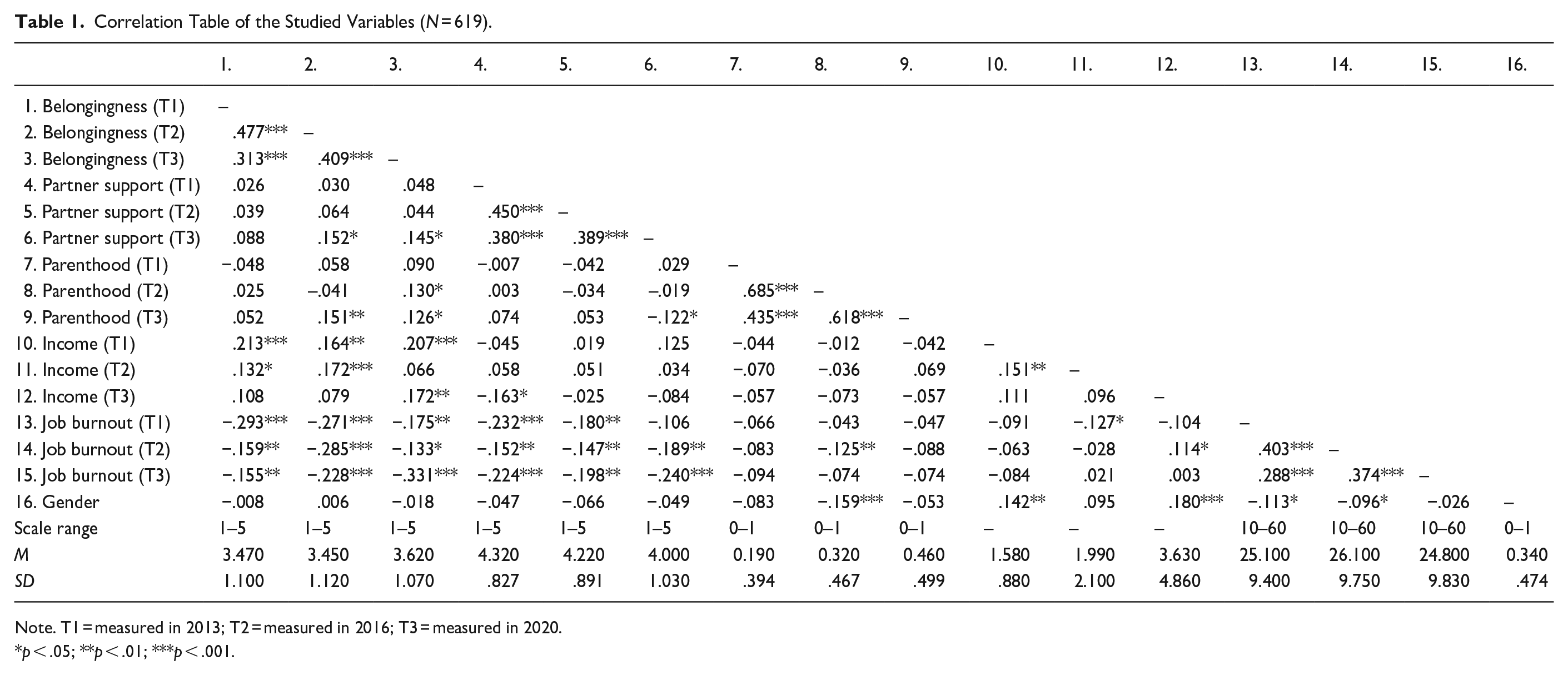
Note. T1 = measured in 2013; T2 = measured in 2016; T3 = measured in 2020.
p < .05; **p < .01; ***p < .001.
Job Burnout Trajectory
The first aim of the present study was to examine the trajectory of early career job burnout. Two secondary goals were to examine whether there was any major gender difference in job burnout development, and to explore whether resources from work, family, and financial dimensions buffered job burnout.
The results of M1 (χ2(24) = 29.73, p = .19; CFI = .98, TLI = .96; RMSEA = .02; SRMR = .03) showed that the model had a good fit (see Figure 1). The results showed that the mean levels of job burnout decreased significantly over time (Estimateslope = −4.63, p = .038), suggesting that the job burnout trajectory during early career years showed a decreasing pattern. The variances of the intercept and slope of job burnout trajectory were significant (Estimateintercept = .96, p < .001; Estimateslope = .99, p < .001), suggesting that there were individual differences in early career job burnout trajectories. In addition, the results showed a significant negative association between the intercept and the slope (Estimate = −.58, SE = .12, p < .001), indicating that early career adults with higher initial burnout scores experienced more dramatic declines.
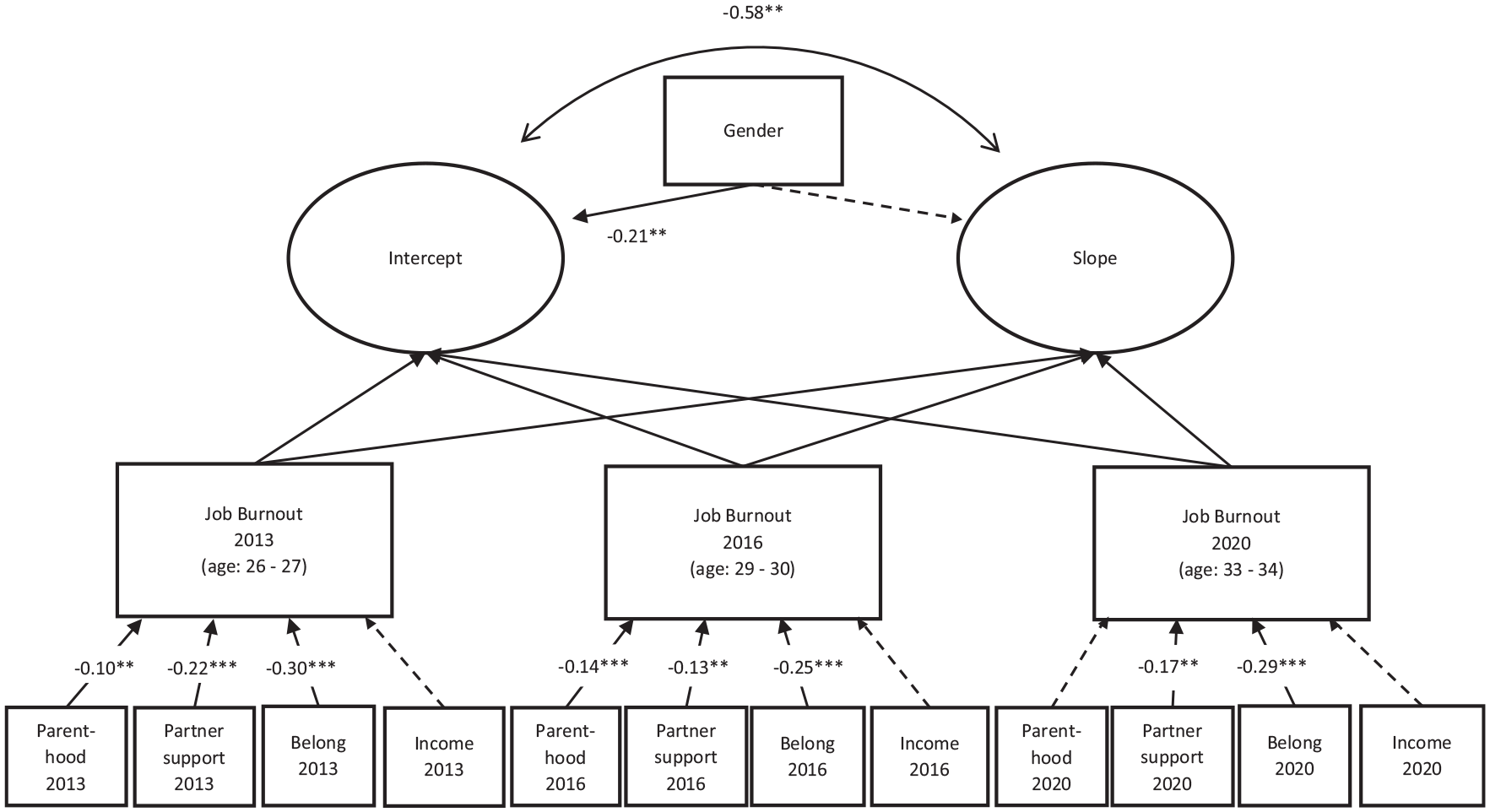
Latent Growth Curve Model (M1) for Job Burnout Development (N = 619).
The results of M1 also showed that gender had a main effect on the intercept of job burnout development (Estimate = −.21, SE = .06, p < .001), indicating that women scored higher in job burnout scores, confirming our H1. The association between gender and job burnout slope was not significant (Estimate = .10, SE = .09, p = .230), implying that women and men did not vary in the rate of decline in job burnout over early career years.
Covariate analysis of work, family, and financial resources for the whole sample showed that partner support was related to reduced job burnout at the ages of 26–27 (Estimate = −.22, p < .001), 29–30 (Estimate = −.13, p = .002), and 33–34 (Estimate = −.17, p = .003). Belongingness to the workplace, too, was related to reduced job burnout at the ages of 26–27 (Estimate = −.30, p < .001), 29–30 (Estimate = −.25, p < .001), and 33–34 (Estimate = −.29, p < .001). Parenthood status was negatively related to job burnout at the ages of 26–27 (Estimate = −.10, p = .006) and 29–30 (Estimate = −.14, p < .001). Income did not show any significant relationship with job burnout.
Overall, early career adults experienced declines in job burnout from the ages of 26–34. The main gender difference indicated that women experienced higher job burnout. However, job burnout declined similarly for women and men. For early career adults, partner support and belongingness to the workplace showed consistent relationships with reduced job burnout; parenthood status was negatively related to job burnout before the ages of 33–34; income was not related to job burnout when gender was not considered.
Gender Difference in Job Resources
Another important aim of this study was to explore women and men’s job burnout trajectories. A secondary goal was to explore women and men’s job resource functions. Based on the main gender difference found in M1, a multigroup LGCM (M2) with gender as a group classifier was used.
The results of the M2 showed that the model had a good fit (χ2(2) = .15, p = .93; CFI = 1.00, TLI = 1.00; RMSEA = .00; SRMR = .002). For both groups, the slopes of job burnout were negative, but not significant (for women: Estimateslope = −2.71, p = .210; for men: Estimateslope = −1.47, p = .370) (see Figure 2). The negative associations between the intercept and the slope stayed significant for both genders, indicating that regardless of gender, young adults who started with lower rates of job burnout experienced more dramatic declines in job burnout in the following years (for women: Estimate = −.64, SE = .09, p < .001; for men: Estimate = −.54, SE = .17, p = .001).
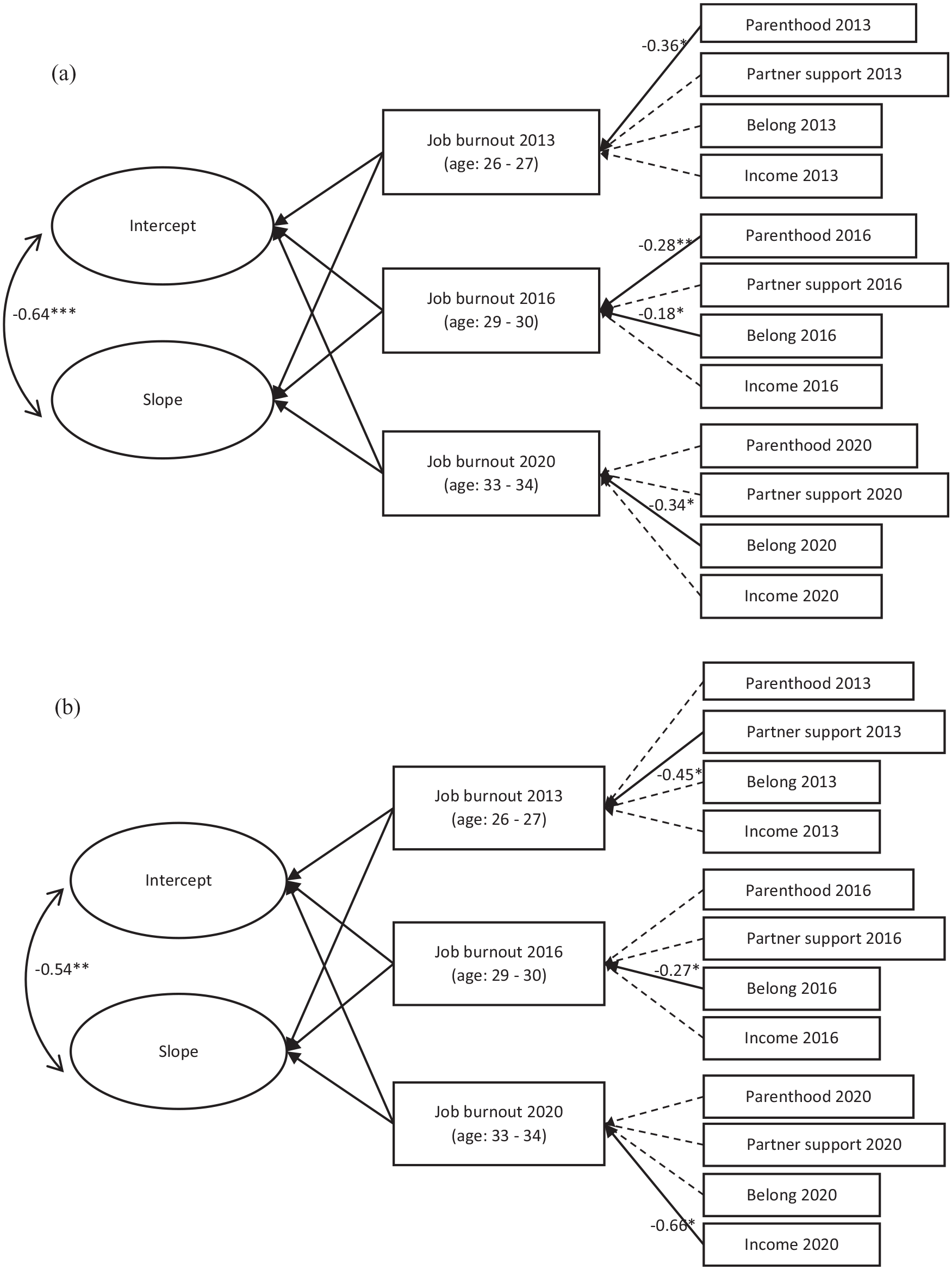
Multi-Group Latent Growth Curve Models for Job Burnout Development. (a) Group = Women (n=377) and (b) Group = Men (n=198).
For women, the covariate analysis showed that belongingness to the workplace was related to reduced job burnout at the ages of 29–30 (Estimate = −.18, p = .015) and 33–34 (Estimate = −.34, p = .020); parenthood status was negatively related to job burnout at the ages of 26–27 (Estimate = −.36, p = .037) and 29–30 (Estimate = −.28, p = .001); partner support and income did not show any significant relationship with job burnout (see Figure 2(a)).
For men, the covariate analysis showed that belongingness to the workplace was negatively related to job burnout at the ages of 29–30 (Estimate = −.27, p = .029); partner support was related to reduced job burnout at the ages of 26–27 (Estimate = −.45, p = .031); higher income was related to reduced job burnout at the ages of 33–34 (Estimate = −.66, p = .022); and parenthood status did not show any significant relationship with job burnout (see Figure 2(b)).
Conclusively, we found that women and men drew from different job resources. Consistent with women’s role as the caregiver and men’s role as the home-provider, parenthood served as a job resource for women from the ages of 26–30, but it was not a significant resource for men (H2a); higher income became as a job resource for men at the ages of 33–34, but it was not a job resource for women (H2c). In addition, partner support was related to reduced job burnout at the beginning of early career years only for men (H2b). Belongingness to the workplace was related to reduced job burnout regardless of gender, which confirmed our H2c.
Alternate Model Testing
Given that job resources may have impacted women and men’s job burnout development, alternative LGCM without allowing effects of job resources on job burnout was carried out. The results of the model (χ2(2) = 6.43, p = .04; CFI = .96, TLI = .88; RMSEA = .06; SRMR = .03) showed that gender’s main effect remained significant on the intercept (Estimate = −.15, SE = .06, p = .007) but not on the slope of job burnout (Estimate = .012, SE = .09, p = .210).
Discussion
The present longitudinal study examined the trajectory of job burnout in early career years, gender differences in job burnout development, and the function of job resources accounting for socialization and transitions. We investigated not only the main gender differences in job burnout trajectory, but also gender differences in job resources, offering explanations to gender gap in job burnout. The results showed that, first, job burnout among young adults decreased over early career years. Second, a main gender difference in job burnout trajectory was found, showing that women scored higher in job burnout, but job burnout development did not differ by gender. Third, work, family, and financial resources functioned differently for men and women, suggesting that women and men have distinct job resources mechanisms, through gendered roles and experience in early career socialization and transitions.
Early Career Job Burnout Trajectories
A primary goal of this study was to investigate the trajectory of early career job burnout. We found that the job burnout trajectory showed a decreasing pattern in early career years. This finding is consistent with the notion that job burnout changes during early career years (Mäkikangas et al., 2016). With a focus of early career stage, this finding may also provide some explanations for the different directions of job burnout development found in previous research (e.g., Demerouti et al., 2004; Salmela-Aro et al., 2011).
There are several explanations for the decreasing pattern of the job burnout trajectory despite the possible increasing responsibilities in early career years (Elder & Shanahan, 2007). First, young adults may be more skilled and integrated as their working experience increases; they become better equipped to cope with job-related stress. This is supported by previous research which showed that older employees who were better integrated into their work community were more capable of coping with job burnout (Mauno et al., 2013; Scheibe & Zacher, 2013). Second, as young adults gradually make their transition to stable employment, partnership, marriage, and parenthood, they may receive increasing support from wider and more stable social networks. The growing social support leads to more job resources. This is aligned with previous work, which showed that people who have more social support from partners and families are more capable of coping with job stress (Baruch-Feldman et al., 2002). Finally, young adults become more vocationally mature as they age (Isaacowitz & Blanchard-Fields, 2012). In accordance with the career development theory (Super & Jordaan, 1973), vocational maturity also increases as adults go through life transitions and assists them in coping with job burnout. Consequently, young adults advance in their ability to draw on resources and deal with job burnout. The developing ability to use job resources may result in the decreasing job burnout trajectory.
The results of this study marked the importance of the early career stage in job burnout research, as young adults experience not only fluctuating occupational wellbeing but also rapidly changing life situations. The decreasing pattern of job burnout development suggests early career adults’ developing abilities to use resources to buffer the effects of growing demands at this life stage.
Gender Difference in Job Burnout Trajectories
A secondary aim of this study was to investigate whether gender has any influence on the development of job burnout. The results indicated that gender had a major effect on early career job burnout: women scored higher in job burnout. This is consistent with previous research (Purvanova & Muros, 2010). However, we did not find any gender difference regarding the slope of job burnout trajectory.
The major gender difference of women scoring higher in job burnout may have two distinct interpretations. First, women experience a mismatch between their traditional and actual roles. This agrees with a recent study carried out by Artz et al. (2022), in which the authors indicated that women’s traditional role as caregivers augmented their experience of job burnout. Widmer and Spini (2017) also argued that the traditional division of labor—gender-based—no long fits the current economic and social environment, and it is limiting people’s ability to cope with stress. People try to align with their traditional social roles; this process is ambiguous for women because of the need to be the caregiver and the home-provider at the same time (Krüger & Levy, 2001). While women experience a mismatch between their tradition social roles and their worker identities, men do not experience such a mismatch (Artz et al., 2022). Consequently, the gender difference in the “working mother dilemma” yields the result of women experiencing more burnout from the work domain. Second, Finland is considered to be a progressive nation in gender equality, being one of the first countries to introduce paternity and paternal leave (Haataja, 2009). Yet, gender inequality is still prevalent in several aspects of work life, including both the economic and the work–home balance side. According to the OECD data, Finland had a gender wage gap of 15.3%, which was considerately higher than the OECD average of 11.9% (OECD, 2023a). This means that a Finnish woman earns around 85 cents for every euro a Finnish man earns. Finnish culture ideals also agree with the social role theory (Eagly & Wood, 2012; Eagly, 1978) and assume the caregiver role by women (Eerola & Mykkänen, 2015). Compared with women, Finnish men had greater liberty in deciding their involvement in the home domain and took parental leave less often (Eerola & Mykkänen, 2015; Haataja, 2009). Thus, on top of the mismatch, women are socially and economically discouraged in their role as the worker, which may in turn augment work-related stress for women, causing higher level of job burnout.
Although women scored higher in job burnout, job burnout decreased similarly for both women and men, suggesting similarity between women and men in their ability to use job resources. This similarity is crucial as it points out that major gender difference is only one of many aspects in investigating gender and job burnout (Eagly, 1995). The relationship between gender and job burnout could be driven by many other aspects, such as different socially prescribed roles and expectations that follow (Eagly & Wood, 2012).
The current study showed results that were consistent with those in the previous literature, in which women were found to experience higher rates of job burnout. The findings also offered new knowledge on the job burnout trajectories of young women and men—no gender difference was found in the rate of change—suggesting that women and men are both capable of using the job resources available to them to buffer the effects of job demands.
Early Career Job Resources
The present study examined job resources accounting for early career socialization during the time of transitions. Results showed that work resources (i.e., belongingness to the work community) and family resources (i.e., parenthood, partner support) were negatively related to young adults’ job burnout, but financial resource was not related to job burnout (i.e., monthly income; except for men in 2020). These findings not only suggest that people draw on resources from their social environment, but they also lend support to the idea that during early career years, young adults may be improving in their ability to use job resources.
In the work dimension, our results showed that belongingness to the work community was consistently related to reduced job burnout and aligned with the literature (Somoray et al., 2017). Young adults who felt that they belonged to their work community may be better integrated into their work community and more likely to receive support from their colleagues, and might therefore experience lower rates of job burnout (Mauno et al., 2013).
In the family dimension, our findings showed that having partner support and parenthood status were related to reduced job burnout. These findings were aligned with the previous literature (Cañadas-De la Fuente et al., 2018; Gabbe et al., 2002; Maslach & Jackson, 1985; Rath et al., 2015). People use the social support from their partner to reduce job burnout. However, the protecting effect of parenthood status may be counterintuitive despite it being found repeatedly. An explanation may lie in the identity theory (Stryker & Serpe, 1982), in which the authors proposed that various identities are ranked hierarchically based on salience, and people are willing to invest more time and effort into the identity of higher salience (Thoits, 2012). Previous research found that parenthood was a stronger predictor of identity comparing to employment and offered young adults a sense of stability, meaning, and predictability (Mannerström et al., 2019). Hence, in the context of early career years, the salience of parenthood may exceed the salience of employment, leading young adults to commit more to the family domain, perceive a reduced salience of work, and experience less burnout from the work domain. On top of the salient identity of being a parent, young adults may receive extra social support from their offspring. Previous studies have found that time spent in fun activities with children was positively related to parent’s sense of work–family balance (Milkie et al., 2010). Doing enrichment activities with children also led to better overall emotional wellbeing of the parent (Offer, 2014).
In the financial dimension, our result showed that monthly income was not related to job burnout in the whole sample. This result was expected as financial resources were included to represent men’s traditional home-provider role.
Results from this study supported that people draw on resources from their social environment. Young adults’ abilities to make use of job resources and cope with job burnout improve during early career years. These findings offer new directions for future studies on transfer and spillover between burnout from different domains.
Gender Difference in Job Resource Functions
The present study investigated gender differences in work, family, and financial resources. The results showed that for women, parenthood served as a job resource, whereas for men, income and partner support served as job resources. Regardless of gender, belongingness to the work community served as a job resource. The results showed consistency with current gender inequality in paid work and family responsibility (Krüger & Levy, 2001). These gender differences in job resources offer several new explanations to the current gender gap in job burnout.
For job resources specific to women, protecting effect of parenthood status against job burnout is coherent with women’s traditional caregiving duties (Krüger & Levy, 2001). This result implied that the salience of being a caregiver was higher for women. From the social perspective, the expectation of women as caregivers and the identity of a parent may lead to women focusing more on fulfilling the traditional gender role of a caregiver, which lowers the salience of their roles in the work settings, resulting in lower job burnout (Mannerström et al., 2019). In addition, women usually have wider social support networks and are more likely to seek and receive social support from family, partner, and offspring (Tifferet, 2020). Thus, women may benefit from the social support their offspring provide.
For job resources unique to men, the protective effect of monthly income against job burnout is coherent with men’s traditional economic duties; the protective effect of partner support against job burnout is consistent with men’s social support network. On one hand, the expectation of men as home-providers may make the fulfillment of economic duties more important for men. A higher income in such premises serves as a job resource and reduces job burnout (Buunk et al., 2007; Krüger & Levy, 2001). On the other hand, men have smaller and more focused social support networks compared with women and often identify their partner as the sole confidant (Tifferet, 2020). Hence, partner support may be more salient in coping with job burnout for men.
For non-gendered job resources, belongingness to the work community prevented job burnout for both genders. This finding suggests that when the socialization or social expectation is not gendered, women and men use job resources in similar ways.
To conclude, women and men differ in their use of job resources as their socialization and social roles differ in their early career years. The present study offered a new direction on gendered job resource functions, accounting for the interaction between one’s job burnout and the gendered socialization.
The COVID-19 Pandemic
It is important to note that in the present study, the eighth wave was collected at the beginning of the COVID-19 pandemic, during which time pandemic policy varied in Finland. Out of the studied constructs, belongingness to the work community, income, and job burnout may have been prone to the influence of the changing work context. Research showed that working from home was largely adopted as a new mode of work, and around 50% of Europeans were working remotely in 2020 (Eurofound, 2020). It was also found that workers’ subjective wellbeing stayed unchanged from December 2019 to March 2020, but decreased from March to May 2020 (Zacher & Rudolph, 2021). However, our study found that job burnout decreased over time; the average income and belongingness to the work community were higher in 2020. Since only one wave of data was involved, more data were needed to understand the role of COVID-19 in job burnout for this study.
Limitations
Several limitations should be considered when generalizing the results of this study. First, the current study used self-report data from a larger longitudinal project, which poses a risk of common-method bias and had limitations on constructs included (Podsakoff et al., 2003); the current sample was slightly skewed and more female-dominant, which might have some influence on the results. Second, the current study included only binary genders, thus the generalizability of the findings may be limited. Third, the present study sought to investigate the development of job burnout of early career adults with different occupations and from various workplaces. There might be nuances in such development across different occupations or workplaces. Previous research has focused on the type of occupation or workplace, gender, and job burnout, covering topics such as gendered experience in different types of occupation or workplace (e.g., Rudman & Phelan, 2008), gender and STEM disciplines (e.g., Wang & Degol, 2017), and gender role’s association with job burnout (e.g., Artz et al., 2022). Consequently, there is an evident need for future research to examine the role of gender in job burnout development, in specific occupational contexts. Finally, as most longitudinal studies, the current study suffers from missing data over the years. However, the use of the maximum likelihood method and comparisons between participants of different participation patterns suggested that the attribution did not have a great impact on our conclusions.
Conclusion
The current study found that job burnout development showed a decreasing pattern in the early career years, while family and work resources prevented job burnout. This finding suggests that young adults are able to develop and use more job resources to buffer the effects of work-related stress. In job burnout development, a major gender difference was found: women scored higher in job burnout. Along with the gender differences that were found in job resource functions, it can be concluded that gender acts on job burnout through multiple vessels, including but not limited to socialization, social roles, and gendered social expectations. Thus, the present study provided a comprehensive perspective of gender and job burnout development in the social environment, accounting for the interaction between one’s gender and their ways of socializing and integrating oneself into society.
Supplemental Material
sj-docx-1-jbd-10.1177_01650254241266107 – Supplemental material for Early career gender differences in job burnout trajectories in Finland: Roles of work, family, and financial resources
Supplemental material, sj-docx-1-jbd-10.1177_01650254241266107 for Early career gender differences in job burnout trajectories in Finland: Roles of work, family, and financial resources by Yirou Fang, Xin Tang and Katariina Salmela-Aro in International Journal of Behavioral Development
Footnotes
Funding
The author(s) disclosed receipt of the following financial support for the research, authorship, and/or publication of this article: This project has received funding from the European Union’s Horizon 2020 Research and Innovation Programme under the Marie Skłodowska-Curie Grant Agreement No. 953326. This study uses data from the ongoing FinEdu Project, funded by grants from the Academy of Finland (210319) and the Jacobs Foundation.

Supplemental Material
Supplemental material for this article is available online.
References
Supplementary Material
Please find the following supplemental material available below.
For Open Access articles published under a Creative Commons License, all supplemental material carries the same license as the article it is associated with.
For non-Open Access articles published, all supplemental material carries a non-exclusive license, and permission requests for re-use of supplemental material or any part of supplemental material shall be sent directly to the copyright owner as specified in the copyright notice associated with the article.
