




Abstract
The study aimed to find out which differences and similarities emerge in the self-concepts of early and late adolescents and young, middle-aged, and older adults. A total of 822 participants, including 530 adolescents aged 9–19 (over 50% were girls) and 292 adults aged 20–71 (over 80% were women), from Estonia provided their spontaneous self-descriptions. Early adolescents described their preferences, appearance, family, peers, and peripheral attributes more frequently and traits, identity, and global attributes less frequently than other age groups. Late adolescents’ self-descriptions included significantly more traits and fewer social roles, identity, and family mentions than those of adults. The three adult groups were similar in the use of different attributes to describe themselves. Overall, the study suggests that early adolescents describe themselves mainly through concrete, objective attributes, late adolescents through abstract psychological attributes, and adults through social–psychological attributes.
The self-concept is a structured set of “perceptions that the person has about himself, the set of characteristics, attributes, qualities and deficiencies, capacities and limits, values and relationships that the subject knows to be descriptive of him” (Magdalena, 2015, p. 619). Studies have shown significant changes in the content of the self-concept during the transition to adolescence (Damon & Hart, 1982). There is, however, a scarcity of up-to-date research and a limited understanding of whether and how the self-concept changes in later developmental periods. The present study contributes to filling this gap by comparing the spontaneous self-concepts of early and late adolescents and young, middle-aged, and older adults.
Our study is guided by the life-course perspective claiming that there is stability and continuity, but also change and discontinuity in the way individuals define themselves over the life course (Bush & Simmons, 1981; Demo, 1992; Gordon, 1976). Various biological, developmental, and social processes interact in shaping the self-concept (Demo, 1992). This means that at different developmental periods, people may use somewhat different attributes to define themselves.
In previous studies, researchers have adopted different frameworks for assessing which attributes individuals use to define self. Some have set the focus on how individuals represent themselves at the individual (personal self), interpersonal (relational self), and group (collective self) levels (Brewer & Gardner, 1996; Turner & Reynolds, 2012). It is not clear, however, whether, how, and why adolescents as well as adults of different ages should differ or be similar on those self-concept levels. Damon and Hart (1982) outlined the development of the self-concept: the physical facet dominates in early childhood, the activity-related facet in middle and late childhood, the social facet becomes prominent in early adolescence, and the highest—psychological—facet dominates from late adolescence onwards. This framework may thus not enable us to capture and explain potential differences between late adolescents and adults and between adults of different ages. The current state of research seems to suggest that age differences exist in the more specific categories such as the description of traits, preferences, identity, and possessions (Griffo et al., 2021; Komolova et al., 2017; Montemayor & Eisen, 1977). We thus rely on those studies that have differentiated between multiple specific attributes (Griffo et al., 2021; Komolova et al., 2017; Rhee et al., 1995).
Self-Concept of Adolescents and Adults
Conceptualizing self-concept as a cognitive process highlights the key role of cognitive development in self-understanding (Benninger & Savahl, 2017; Damon & Hart, 1982; Demo, 1992; Gecas, 1982). According to the major theories of cognitive development, early adolescents are about to make the transition from the stage of concrete reality-based thinking to the stage of abstract thinking (Piaget & Inhelder, 1969; Vygotsky, 1978). Their thinking and reasoning may still center around concrete objects and ideas, but also include elements of abstract and metacognitive thinking (Piaget & Inhelder, 1969). Concrete thinking is reflected in the use of concrete, objective attributes, such as address, appearance, possessions, and activities to define self (Bernstein, 1980; Magdalena, 2015; Montemayor & Eisen, 1977; Wang, 2004). Along with cognitive development, the self-concept becomes more abstract and adolescents become able to conceptualize themselves from perspectives that were cognitively unavailable at earlier ages (Bernstein, 1980; Komolova et al., 2017; Montemayor & Eisen, 1977; Wang, 2004). Adolescents start to describe themselves more in terms of personal traits and psychological states (Damon & Hart, 1982; Komolova et al., 2017; Magdalena, 2015). Nevertheless, at all ages, the self-concept is multidimensional and contains various elements (Magdalena, 2015). Some concrete descriptions (e.g., sex, name, activities) retain their importance in adolescence (Montemayor & Eisen, 1977). Similarly, younger children already refer to some psychological aspects, aspirations, and assimilate groups to their self-concept (Bennett & Sani, 2008; Komolova et al., 2017; Magdalena, 2015).
Social processes and interactions that vary across different developmental periods are also associated with the self-concept (Demo, 1992). Categorization and perspective-taking abilities enable early adolescents to compare themselves with others. They are sensitive to peer evaluation and use others’ feedback and information obtained through social comparison for self-definition and self-evaluation more than at earlier ages (Blakemore & Mills, 2014; Demo, 1992; Ruble et al., 1980). Adolescents are highly oriented toward peer relationships, and this social orientation also is reflected in their self-concept—they describe their relationships and group memberships (Damon & Hart, 1982; Komolova et al., 2017; Magdalena, 2015; Tanti et al., 2008). There is some evidence that family and peer relationships are more strongly embedded into early adolescents than late adolescents’ self-concepts and late adolescents describe themselves through group memberships more often than early adolescents (Tanti et al., 2008). Moreover, in accordance with a more active identity search in adolescence (Erikson, 1968), the self-concept becomes more self-reflective and may contain more references to identity exploration and commitments (Damon & Hart, 1982; Komolova et al., 2017).
Adults have been found to define themselves most often in terms of traits and social roles, followed by specific attributes such as preferences, aspirations, and activities (Azoulay et al., 2022; Griffo et al., 2021; Rhee et al., 1995). References to other people and relationships are also common (Griffo et al., 2021). There is still, however, little understanding of how the self-concept changes during the transition from adolescence to early adulthood and during adulthood. There is reason to expect that various social, but to some extent, also cognitive changes during adulthood lead to reconsiderations of self (Demo, 1992). Namely, it is known that abstract thinking continues to develop in early adulthood (Fischer & Pruyne, 2003). Socio-cognitive changes are emphasized in Erikson’s (1968) psychosocial theory that posits that individuals face unique developmental tasks in early, middle, and late adulthood that may raise questions about their self. Events, such as getting a job or career change, finding a partner, becoming a parent, children moving out, and retirement may alter one’s self-concept. Studies suggest that during these crises, individuals engage in higher self-exploration (Robinson et al., 2017). Individuals see adulthood as a dynamic process encompassing constant personal growth and changes in social roles and relationships (Hartmann & Swartz, 2006). Describing oneself in terms of change and transformation has been found to increase in early adulthood and peak in middle adulthood (Labouvie-Vief et al., 1995).
The Present Study
In this explorative study, we assess spontaneous self-concepts—we ask adolescents and adults to freely describe themselves. This allows the respondents to decide which attributes are meaningful. Questionnaires with researcher-defined dimensions often omit important categories and thus the same questionnaire may not be equally suitable to adolescents and adults (Tatlow-Golden & Guerin, 2017). The multidimensional nature of the self-concept (Benninger & Savahl, 2017; Bernstein, 1980; McConnell, 2011) may also be better captured by having participants spontaneously describe themselves.
Our aim is to find out which similarities and differences emerge in the self-concepts of early and late adolescents and young, middle-aged, and older adults. We are guided by the following research questions: Which attributes are most often described by the individuals in the five age groups? How many different attributes do participants of different ages use to describe themselves?
Method
Sample
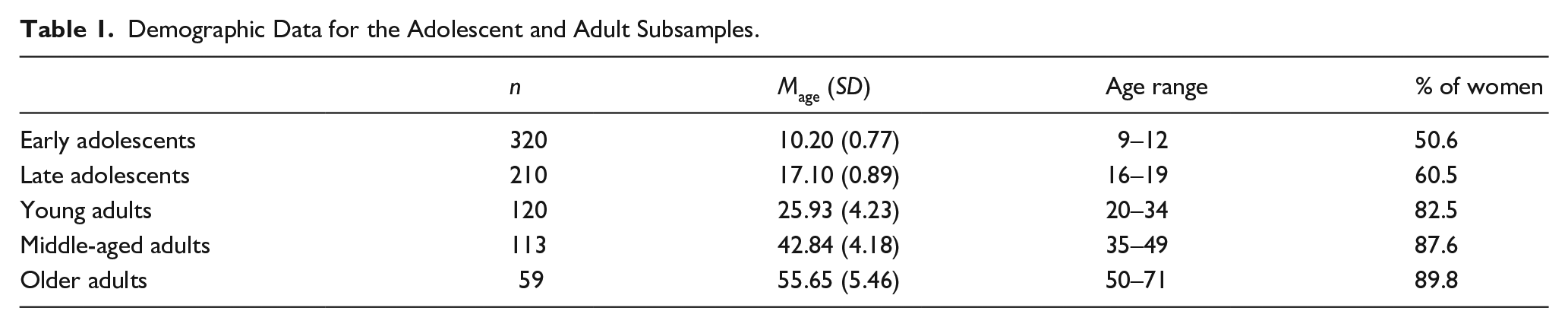
The sample included 822 adolescents and adults from Estonia: 38.9% were early adolescents, 25.6% were late adolescents, 14.6% were young adults, 13.8% were middle-aged adults, and 7.2% were older adults. The demographic data for each age group is presented in Table 1. Early adolescents were 9–12 years old and late adolescents were 16–19 years old. Young adult subsample included 20- to 34-year-olds, middle-aged adult subsample included 35- to 49-year-olds, and older adult sample included adults 50- to 71-year-olds. Over 80% of adults were women. Over 50% (57.7%) of adults had higher education and 42.3% had secondary education or lower.
Demographic Data for the Adolescent and Adult Subsamples.
Procedure and Measures
Spontaneous self-descriptions were collected in a written format as part of a larger study on autobiographical memory and self. The data from early adolescents were collected in 2014–2015 and the data from the late adolescent and adult samples in 2019–2022. Adolescents were recruited through schools. Parental consent to participate in the study was obtained for adolescents. Late adolescents responded on an online platform at school and early adolescents provided their self-descriptions on paper at school. The survey invite for adults was shared on social media and posted on the university’s website. Adults responded on an online platform. The participation in the study was voluntary and participants remained anonymous. Participants were prompted to provide a description of themselves that would give an adequate impression of them to someone who does not know them. The procedure for the study was approved by the Ethics Committee of the University of Tartu (no. 294/T-4 and 361/M-1).
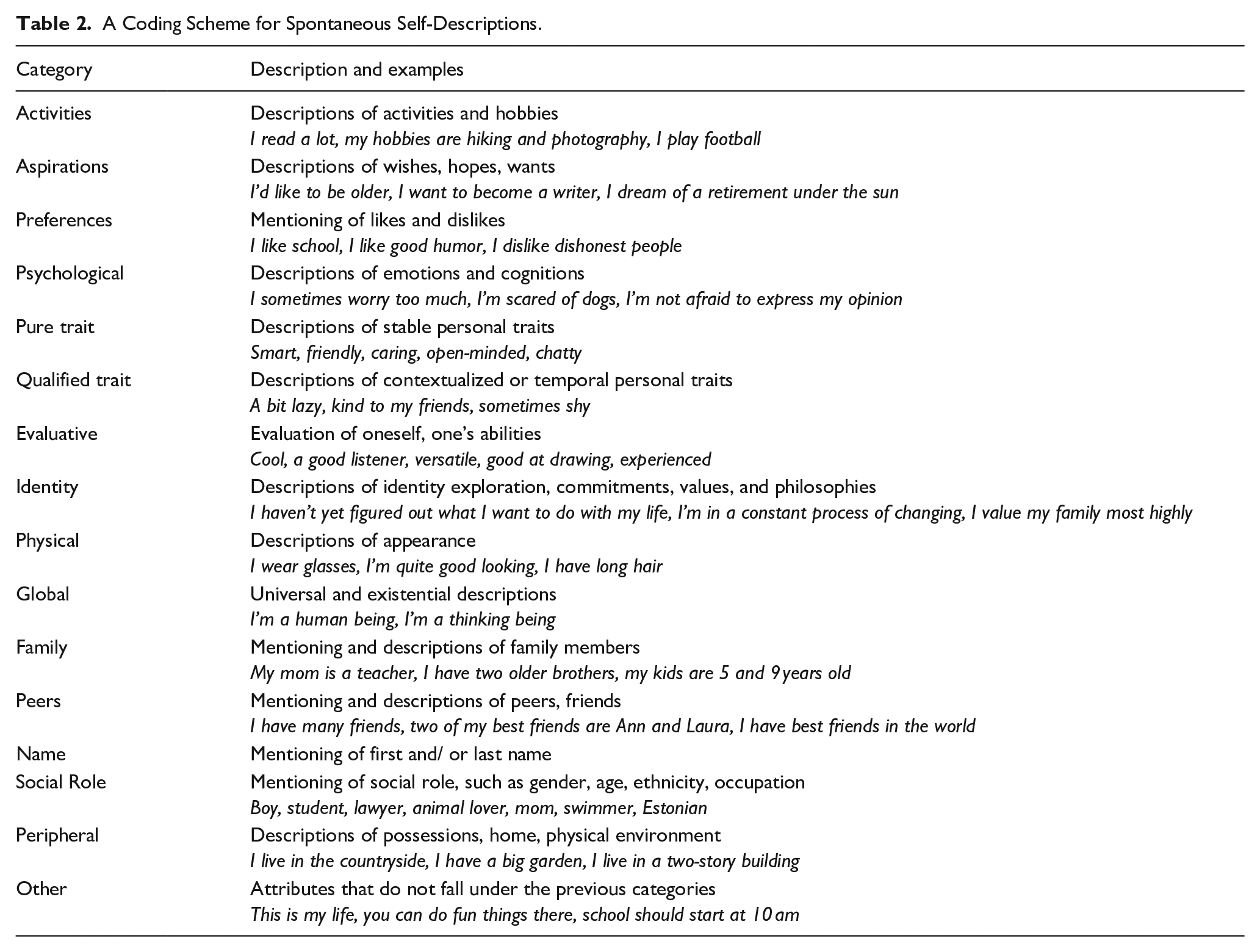
The coding scheme for spontaneous self-descriptions was developed by reviewing the coding schemes of previous studies and selecting the categories that adolescents and adults have used for defining oneself. The categories for coding adolescents and adults’ self-descriptions were largely overlapping in the studies (Griffo et al., 2021; Rhee et al., 1995). Altogether, we distinguished 16 categories presented in Table 2. Most categories were derived from the study of Rhee et al. (1995). We added the categories for family, peers, and identity based on the studies of Griffo et al. (2021) and Komolova et al. (2017). Each meaningful unit in participants’ self-description was coded. For example, the description “I am a friendly girl” included two meaningful units and was coded for traits (friendly) and social role (girl). A total of 20% of early adolescents, late adolescents, and adults’ self-descriptions were coded by two of the authors to determine the interrater reliability. Cohen’s kappa was .90 for coding early adolescents’ self-descriptions, .96 for late adolescents, and .89 for adults’ self-descriptions. Disagreements were resolved in a discussion after which one coder proceeded to code the rest of the material. To compare the length and variability of self-descriptions across age groups, we calculated the total number of attributes mentioned (i.e., the length) and the number of different attributes mentioned (i.e., the variability).
A Coding Scheme for Spontaneous Self-Descriptions.
Results
One-way ANOVA showed that the length of self-descriptions differed between the age groups, F(4, 817) = 52.08, p < .001, η2 = .20. A Bonferroni post hoc test indicated that the self-descriptions of early adolescents were significantly longer than those of other age groups. The self-descriptions of late adolescents were significantly shorter than those of young and middle-aged adults. The variability was strongly correlated with the length, r = .81, p < .001. To compare the age groups, we calculated how many unique attributes there were per one listed item by dividing the variability with the length. One-way ANOVA showed a significant difference in the variability of the self-description between the age groups, F(4, 791) = 17.30, p < .001, η2 = .80. Early adolescents’ self-descriptions were lower in variability than those of late adolescents, middle-aged adults, and older adults. Late adolescents’ self-descriptions contained a higher number of different attributes than the self-descriptions of young and middle-aged adults.
As the length of the self-descriptions varied greatly between the age groups, we did not compare the mean numbers of each category use, but looked at the proportional use of each category. As the data had a non-normal distribution, a Kruskal–Wallis test was used to examine differences between the age groups. The findings are presented in Table 3 and in Figure 1. There were significant differences between the subsamples in the percentage of activities, H(4) = 23.35, p < .001, preferences, H(4) = 147.73, p < .001, pure traits, H(4) = 135.40, p < .001, qualified traits, H(4) = 52.45, p < .001, identity, H(4) = 98.59, p < .001, physical, H(4) = 112.74, p < .001, global, H(4) = 29.76, p < .001, family, H(4) = 116.14, p < .001, peers, H(4) = 107.14, p < .001, name, H(4) = 53.08, p < .001, social role, H(4) = 27.44, p < .001, peripheral, H(4) = 91.27, p < .001, and “other” attributes, H(4) = 66.68, p < .001 used to describe oneself.
Descriptive Data for Self-Descriptions of Each Age Group.
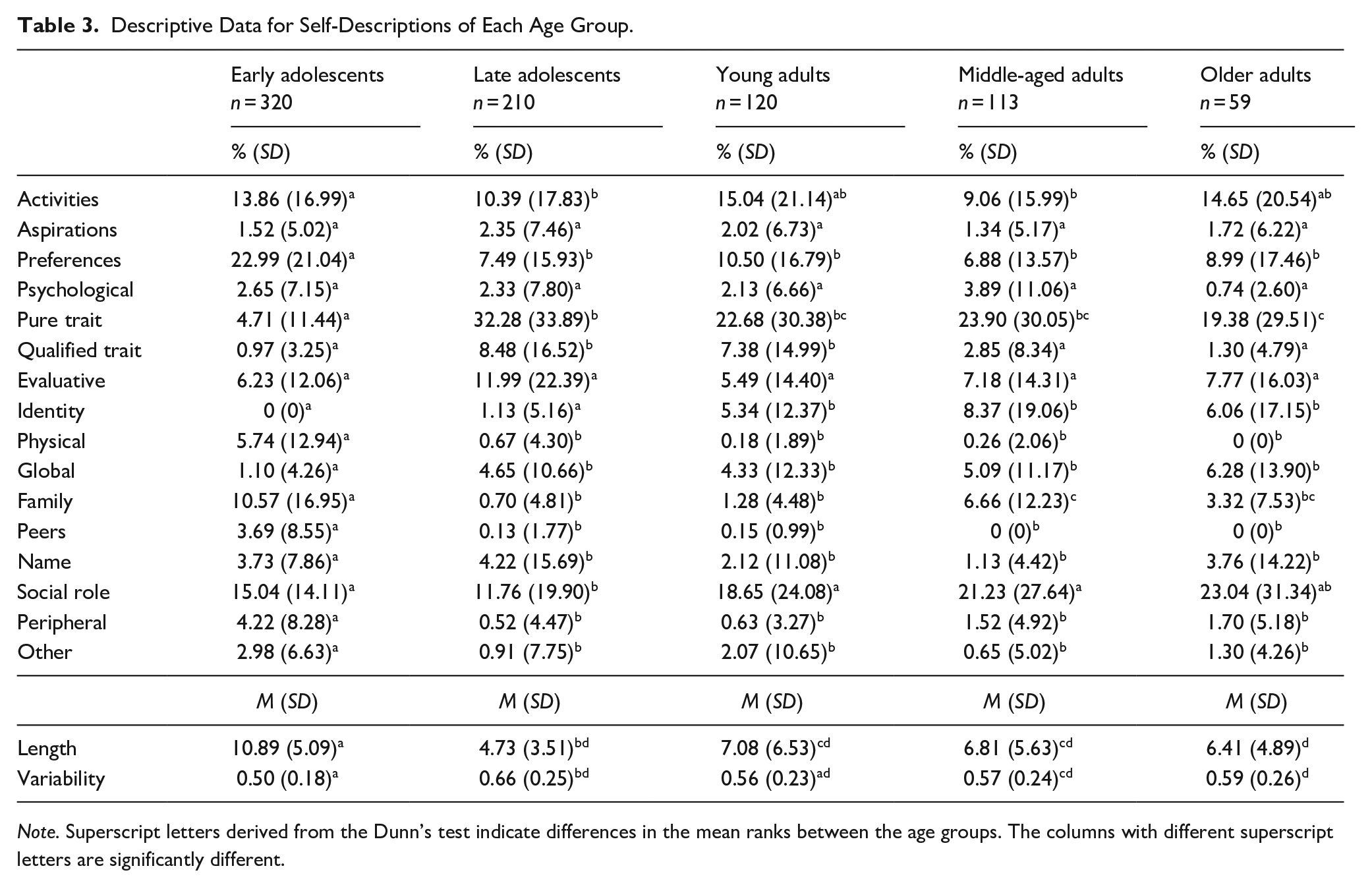
Note. Superscript letters derived from the Dunn’s test indicate differences in the mean ranks between the age groups. The columns with different superscript letters are significantly different.
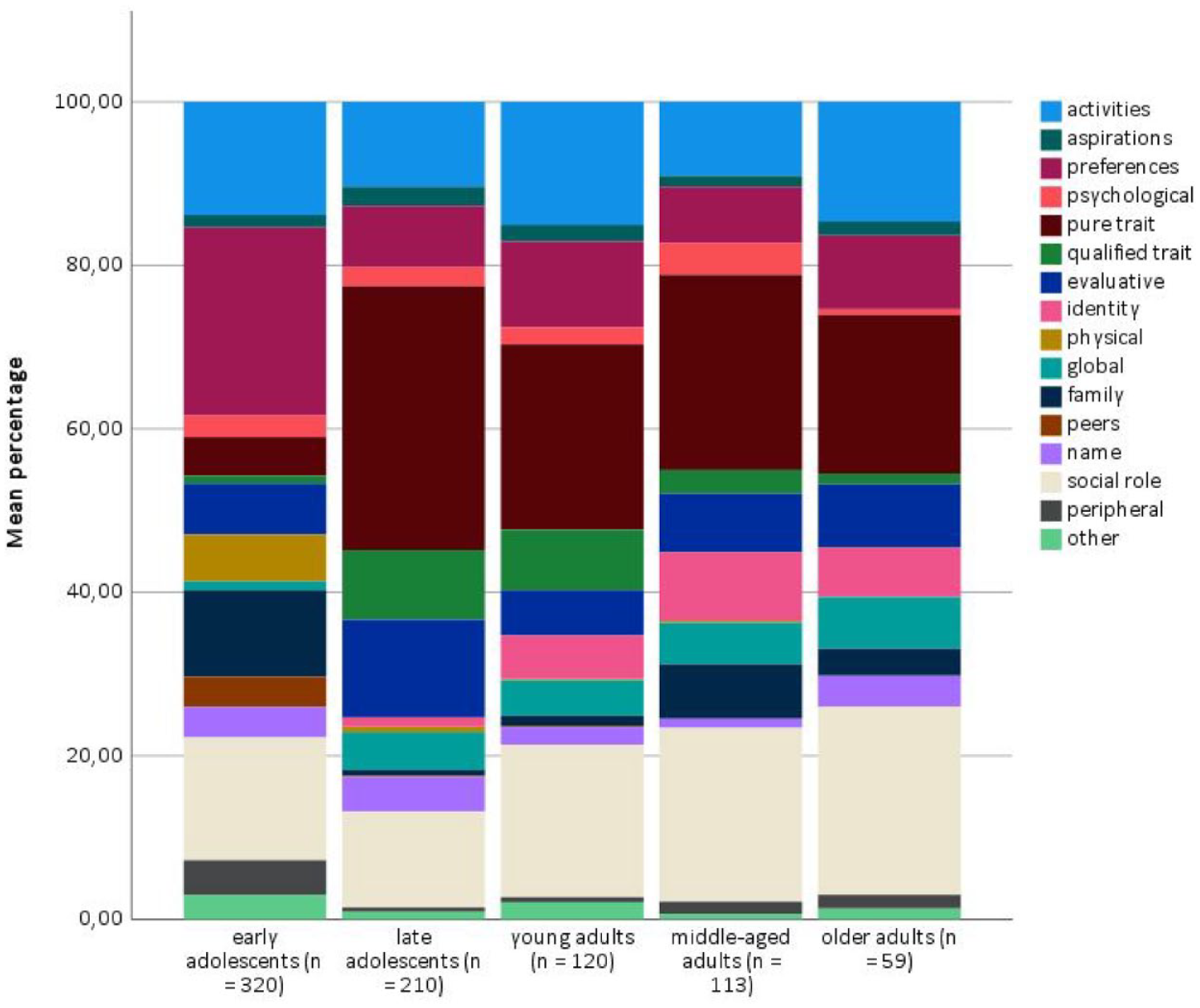
The Proportional Use of Different Attributes for Self-Description in Five Age Groups.
To determine which age groups differ, pairwise comparisons were conducted using Dunn’s test. We used an adjusted p-value to account for the multiple comparisons run at once. Early adolescents differed from all other age groups by using a higher percentage of preferences, physical, peers, and peripheral attributes to describe themselves and a lower percentage of pure traits and global attributes. Early adolescents used more activity attributes than late adolescents and middle-aged adults, more family descriptions than late adolescents and young and older adults, more social role attributes than late adolescents, and more attributes categorized as “other” than late adolescents and young and middle-aged adults. Early adolescents described their qualified traits less than late adolescents and young adults and identity less than all three adult groups.
Late adolescents differed from the three adult groups by using a lower percentage of identity attributes. Compared with young adults, late adolescents made fewer references to activities and preferences. Late adolescents described their pure traits more than older adults and qualified traits and peripheral attributes less than middle-aged and older adults. Descriptions of social roles were less frequent among late adolescents than young and middle-aged adults. Family was described less by late adolescents than middle-aged adults.
The three adult groups used similar attributes to describe themselves. Young adults differed from middle-aged and older adults by describing qualified traits more. Young adults described their family less than middle-aged adults.
Sex differences are not the focus of this article. Nevertheless, as adult groups consisted of significantly more women than men, we examined sex differences in each age group separately. Among early adolescents, girls used more psychological, U = 10,925, p < .001, physical, U = 11,027.5, p = .006, and family attributes, U = 9,532, p < .001 to describe themselves. Among late adolescents, girls described qualified traits more, U = 3,641.5, p < .001 and social roles, U = 4,023.5, p = .038 less than boys. Young adult women described qualified traits more frequently than men, U = 605.5, p = .009. Middle-aged adult women described identity more frequently than men, U = 435.5, p = .031. No sex differences appeared among older adults.
Discussion
The study explored similarities and differences in spontaneous self-concepts of early and late adolescents and young, middle-aged, and older adults. The findings showed that while early adolescents described themselves mainly through multiple objective and observable attributes, subjective personal inner traits dominated in late adolescents’ self-concepts. Adults described themselves largely through personal traits as well as the social roles they fill.
Our findings demonstrate that the self-concept is indeed multidimensional. Adolescents and adults of different ages used various attributes to describe themselves: their inner qualities, hopes and dreams, preferences, likes and dislikes, relationships, activities, and social roles. The last two—activities and social roles—were the two categories that were frequent in all age groups. While early adolescents provided the lengthiest self-descriptions, the variability of those descriptions was the lowest. Our findings thus partially confirm those of previous studies (Bernstein, 1980; Komolova et al., 2017; Wang, 2004) that there is an increase with age in the variability of the self-concept. Our cross-sectional results that need to be confirmed in longitudinal studies suggest, however, that this increase is not necessarily linear. Namely, the number of different attributes in one’s self-concept seem to increase from early to late adolescence, drop in adulthood, but remain higher than in early adolescence.
There were significant age differences also in which attributes were most prominent in one’s self-description. Early adolescents frequently described themselves through concrete, objective, observable attributes: what they do, where they live, what they look like, who their friends and family members are. This is in accordance with previous studies (Bakx et al., 2021; Magdalena, 2015; Tanti et al., 2008; Tatlow-Golden & Guerin, 2017) and Piaget’s theory of cognitive development indicating that 9- to 11-year-olds are in the stage of concrete operations and about to make the transition to formal operations (Piaget & Inhelder, 1969). The most popular category in early adolescence was preferences. Preferences may also be considered concrete attributes. At the same time, they may be an age-appropriate way of describing one’s inner characteristics. Mentioning of traits was relatively infrequent among early adolescents. Preferences, however, were described much less often by older groups. It may be that the description of one’s likes and dislikes transforms into the description of one’s traits after one has acquired the ability to make inferences about stable inner qualities from one’s behavior (Montemayor & Eisen, 1977). For example, early adolescents’ “I like to be with my friends” may become “I am social and friendly” in late adolescence.
Some of the categories used by early adolescents dropped out of late adolescents’ and adults’ self-descriptions. Namely, appearance and friends were no longer described by late adolescents and adults. With age, individuals seem to rely more on internal attributes and not consider external, physical characteristics at the core of their self-concept. Global self-descriptions appeared only after early adolescence. It may be that early adolescents’ descriptions such as “I am a girl/boy” that were categorized under social role category are replaced by statements such as “I am a human being” in late adolescence. The development of the self-concept is thus not a simple additive process whereby older adolescents add more abstract attributes to earlier ones (Montemayor & Eisen, 1977). Instead, some categories may no longer be relevant, some may emerge along socio-cognitive development, and some may transform into more complex and abstract ones.
Although it has been previously found that family and peer relationships are more relevant for self-definition in early adolescence (Tanti et al., 2008), it was somewhat surprising that late adolescents hardly mentioned their family and friends. Group memberships were also described significantly less often by late adolescents than young and middle-aged adults. Our findings suggest that personal traits are at the center of late adolescents’ self-concepts. Late adolescents as well as young adults also made the most references to their qualified traits—they described contextualized and temporal qualities. For late adolescents, the true understanding of self may be most tied to what they are like in terms of inner traits and less to who they relate to and which social roles they fill. It has been suggested that late adolescents start to resolve contradictions in self-concept by constructing coordinating principles (Bernstein, 1980). Younger adolescents also recognize their diverse and even somewhat contradictory characteristics, but do not yet integrate them into a coherent system (Bernstein, 1980). Late adolescents likely focus more on inner traits that are fairly stable and help to unify their different qualities (Bernstein, 1980; Komolova et al., 2017).
Adults described themselves mostly through personal traits and social roles, as also found earlier (Griffo et al., 2021; Rhee et al., 1995). It is likely that the developmental tasks and major life events shape one’s self-concept (Demo, 1992). It may be that adults fill more social roles, especially in relation to work and family, and hence, the relevance of social roles in describing oneself increases. While we expected identity-related descriptions to appear already in adolescents’ self-concepts, those were only in adults’ self-descriptions. This does not necessarily indicate that adolescents do not actively search identity, but rather reflect socio-cognitive development. Narrative identity that encompasses an ability to describe one’s identity formation and change continues to develop throughout adolescence and early adulthood (McAdams, 1988).
Our findings suggest that adults of different ages use similar attributes to describe themselves. Young adults did, however, differ slightly from middle-aged and older adults by describing qualified traits more and family less. This, again, likely stems from socio-cognitive development. Family mentions probably increase as one becomes a parent—it may be hypothesized that there are more parents among middle-aged than young adults. Family mentions may start to decrease once children have grown up and moved out—this is likely among older adults.
Limitations and Future Directions
It should be taken into consideration that our sample of older adults included mostly adults between ages 50 and 60. Thus, our study does not provide a clear answer to whether and how the self-concept changes in late adulthood when individuals may face major socio-cognitive, but also health-related changes. Some studies point to the decreases in self-concept clarity in late adulthood (Lodi-Smith & Roberts, 2010). This may also be reflected in which attributes are most used and emphasized in self-description. Besides the low number of adults over the age of 70, the study was limited by small adult subsamples that included predominantly women. Our analyses did not show many sex differences in adults’ self-descriptions, but due to the low number of men, these findings need to be interpreted with caution. It should also be kept in mind that the sample included only Estonians. Not all findings may be generalizable to other cultural contexts as cultural values have been found to exert strong influence on how individuals define themselves (Benninger & Savahl, 2017; Rhee et al., 1995; Wang, 2004). In cultures where dominating values emphasize autonomy, people describe themselves more in terms of personal traits and make fewer references to group memberships and relational aspects compared with people from cultures oriented to relatedness (Bochner, 1994; Cousins, 1989; Rhee et al., 1995; Trafimow et al., 1991; Wang, 2004). The Estonian socio-cultural context can be characterized as rapidly changing where values associated with both autonomy and relatedness coexist and are considered important (Tamm et al., 2016; Tulviste et al., 2012).
With our cross-sectional study, we were able to examine differences between age groups. Longitudinal studies are needed to provide an overview of the developmental processes and their underlying factors in the self-concept. It is yet to be examined, for instance, whether mentioning some attributes is a precursor to other attributes appearing in self-descriptions at a later age. For example, whether description of preferences is a precursor to description of traits and description of traits is a precursor to identity talk. The stability and change of the self-concept over time and across situations need to be better understood. Moreover, while the assessment of adolescents’ and adults’ spontaneous self-concepts enabled us to show the multidimensionality of the self-concept and allowed respondents to decide which categories are meaningful, our study falls short in determining the exact importance of the listed attributes. Studies should look beyond quantitative changes. For example, not all group memberships may be equally important for the person: some may be “empty” labels, while others refer to deeply meaningful identification with the group (Bennett & Sani, 2008).
More attention should also be paid to the context-specificity of the self-concept. Studies show that selective self-presentation increases with age (Aloise-Young, 1993). Adolescents’ and adults’ self-descriptions are thus likely shaped to some degree by the context in which they filled in the questionnaire and their perception of the researchers’ expectations and what would be appropriate to write about themselves.
Conclusion
Our findings provide further support to the multidimensional nature of the self-concept. Most importantly, being informed by the life-course perspective, the study helps to understand how the self-concept develops during adolescence and adulthood. The results suggest that the way individuals describe themselves changes through adolescence and early adulthood. The main differences were in the variability of the self-concept and in which attributes were most prominent. Early adolescents used a significantly lower number of attributes to describe themselves than late adolescents and adults. The specific attributes individuals most frequently mentioned in their self-descriptions changed from concrete, more objective ones in early adolescence to abstract psychological ones in late adolescence and social–psychological attributes in adulthood.
These findings have implications for understanding several intrapersonal and interpersonal processes in adolescence and adulthood. The way individuals define themselves affects, for example, the way they perceive others, their behavior, processing of self-relevant information, and reactions to received feedback (Markus & Wurf, 1987). Understanding age differences in self-descriptions also carries important implications for improving individuals’ well-being outcomes. Knowing which attributes are most important for self-definition for people in a particular age group helps to better promote their self-esteem and general self-worth. For example, specialists working with early adolescents need to understand that it may be too early to concentrate on stable personal traits, but for late adolescents’ self-understanding, talking about traits would be highly relevant. Focusing on social roles may not, however, be as meaningful for late adolescents as it would be for adults.
