




Abstract
Emotion regulation (ER) is a source of risk and resilience for psychological development and everyday functioning. Despite extensive research on various early contextual predictors of child ER capacity, few studies have integrated them into the same study. Therefore, our longitudinal study investigated the joint and independent contributions of several prominent contextual predictors of child ER capacity. We followed typically developing children and their caregivers (N = 118, 47% girls) at three time points (children ages 10, 12, and 18 months). At 10 months, mothers reported household chaos, social support, and parenting stress, and maternal sensitivity was observed and coded with the Ainsworth’s Maternal Sensitivity Scales. At 12 months, child–mother attachment security was assessed using the Strange Situation Procedure. Finally, at 18 months, child ER was obtained with a Laboratory Temperament Assessment Battery frustration task. Correlational analyses revealed that household chaos and maternal sensitivity were significantly positively associated with child ER. Multiple regression analyses showed independent effects of household chaos and maternal sensitivity on child ER. Our partly counterintuitive results underscore the significance of cumulative risk and protective factors for ER development and suggest that household chaos and maternal sensitivity may contribute uniquely to better ER in typical toddlerhood.
Keywords
Introduction
Adequate emotion regulation (ER) at a young age is associated with social competence and academic success later in life (Robson et al., 2020; Smithers et al., 2018). Conversely, difficulties with ER are associated with internalizing and externalizing problems (Brocki et al., 2019; Forslund et al., 2016; Frick et al., 2022). In fact, problems with ER are present across psychological disorders, and ER capacity may thus constitute a transdiagnostic source of risk or resilience (Aldao et al., 2016; Ros & Graziano, 2020).
Individual differences in child ER have been linked to various early contextual factors such as the social and psychological resources of the mother (maternal SPR). Particularly, parenting stress, household chaos, and social support have repeatedly emerged as significant factors in child ER development (Crnic et al., 1983; Planalp et al., 2022; Raver et al., 2015). Furthermore, maternal sensitivity and child–mother attachment security are considered relevant predictors (Kim et al., 2014; Leerkes & Wong, 2012; Samdan et al., 2020; Spinrad & Stifter, 2002). Yet, there is a lack of research examining their joint and independent contributions to child ER capacity, leaving the question of their relative importance unanswered. We, therefore, examine the longitudinal relations between maternal SPR, maternal sensitivity, child attachment security, and child ER. In light of the ecological framework of general child development and family functioning (e.g., Bronfenbrenner, 1986), we aim to provide new empirical knowledge about the main and mediating effects of the early context on child ER.
Emotion Regulation
ER is examined from different theoretical perspectives and a consensus regarding its definition is therefore lacking (Crowell et al., 2020; Gross & Feldman Barrett, 2011). Nevertheless, integral components of ER involve emotional reactivity and the regulation thereof (Calkins & Hill, 2007; Calkins & Perry, 2016; Rothbart & Bates, 2006; Thompson, 2014). Emotional reactivity refers to characteristics of internal arousal elicited by internal and external stimuli and regulation involves strategies that monitor, evaluate, and modify these emotional responses (Rothbart & Bates, 2006; Thompson, 1994). Reactivity and regulation are difficult to disentangle, especially behaviorally, as they can co-occur and have covert features. For instance, a behavioral latency to reactivity may indicate a higher threshold for emotional arousal, effective internal regulation covert to the eye, or both. Reactivity and regulation are also thought to interact dynamically (Buss & Goldsmith, 1998; Stifter & Braungart, 1995; Thompson, 2014). For example, specific emotional reactions (e.g., frustration) evoke certain regulatory behaviors. Conversely, turning away from frustrating stimuli (i.e., regulation) will affect the level of reactivity. These ER processes lie on a continuum, ranging from automatic and unconscious to effortful and conscious (Gross, 2014). For these reasons, reactivity and regulation both refer to the overarching concept of ER in this study.
According to certain functionalist accounts, ER serves the purpose of achieving personal goals in specific situations (e.g., finishing a task, getting parental attention) and is adaptive to the environment, such as to parental behavior and the broader emotional climate of the family (Beauchaine & Haines, 2020; Cassidy, 1994; Thompson, 2014).
While reactivity and regulation emerge early in life, the regulatory aspects undergo clearer developmental changes. Regulation shifts from a strong reliance on rudimentary strategies (e.g., self-soothing) and extrinsic regulation (e.g., caregiver helps to regulate the child), to dyadic and more self-regulatory processes (Fox & Calkins, 2003; Kopp, 1982; Rothbart & Posner, 1985; Sroufe, 1989). These shifts go hand in hand with socialization, the development of motor skills, cognitive functions (e.g., attention), and the attachment relationship (Ainsworth et al., 1978/2015; Bowlby, 1969/1982; Garon et al., 2008; Thompson, 2014). This will gradually enable the child to cultivate more complex ER, progressing from self-soothing (e.g., sucking thumb) to attention disengagement (e.g., turning away from emotionally evocative stimuli), purposeful help-seeking (e.g., signaling to others for support), and initiating different types of play (e.g., self-distractive or social play) (Braungart-Rieker et al., 2010; Deichmann & Ahnert, 2021; Stifter & Braungart, 1995).
One way to assess individual differences in children’s reactivity and adaptive application of regulation in a lab setting is to expose them to a frustration-evoking stimulus while restrained and receiving no support. This setup allows for observational measures of adaptive ER behaviors in the situation at hand (i.e., child strategies for reducing reactivity). Meta-analytical research indicates that, in the second year of life and under certain conditions, attention disengagement is the most effective strategy for reducing emotional reactivity (for an overview, see Gennis et al., 2022). This may be especially true when the child is restrained and receives no support (Braungart-Rieker et al., 2010; Buss & Goldsmith, 1998), and thus has limited access to their full ER repertoire.
Maternal SPR
Parenting stress arises from conflicts between caregiving demands and the internal and external resources available for managing those demands (Deater-Deckard, 1998). It covers feelings of parental incompetence, role limitation, social isolation, and physical health issues. There is a robust link between parenting stress and suboptimal child ER (Barroso et al., 2018; Crnic et al., 2005; Planalp et al., 2022). Furthermore, parenting stress may influence child ER indirectly by affecting maternal sensitivity and the attachment relationship (Booth et al., 2018; McIntosh et al., 2021; Tharner et al., 2012).
Social support is a multidimensional construct and lacks a uniform definition (Verhage et al., 2022). It includes the quantity, adequacy, availability of, and satisfaction with socioemotional and instrumental support by others. Cochran and Brassard (1979) proposed direct and indirect influences of social support on child emotional development, with satisfaction considered particularly relevant (e.g., Robinson & Weiss, 2020). Indeed, high social support has positive links with child ER-related behaviors, such as fewer behavioral problems and good cognitive and social–emotional development (Andresen & Telleen, 1992; Shin et al., 2019). However, its relationship with observed child ER is less clear. Furthermore, while there is evidence for potential indirect relations of social support through maternal sensitivity and attachment security (Atkinson et al., 2000; Crnic et al., 1983; Crnic & Greenberg, 1990), measurement discrepancies raise concern as indicated by conflicting findings and effect size heterogeneity (Atkinson et al., 2000; MacMillan et al., 2021).
Household chaos concerns the degree of disorganization and environmental confusion at home and includes ambient noise, crowdedness, and comings and goings (Matheny et al., 1995). In this realm, household chaos can be seen as a direct, or indirect, stressor that compromises child ER development. For example, consistent direct effects on ER problems have been reported (Jaffee et al., 2012; Miller et al., 2017; Raver et al., 2015). In addition, indirect effects have been observed, through negative effects on parental sensitivity (Mills-Koonce et al., 2016; Vernon-Feagans et al., 2016; Whitesell et al., 2015). Yet, no study has investigated household chaos in relation to child attachment security. Since both household chaos and attachment are related to maternal sensitivity (Mills-Koonce et al., 2016; van IJzendoorn et al., 2023), and to behavioral problems (Groh et al., 2017; Jaffee et al., 2012; Raver et al., 2015), child attachment security is important to consider.
The theory and research outlined earlier suggest a prominent role of maternal SPR in facilitating or compromising children’s ER development. Yet, longitudinal research with typically developing children is scarce, with the majority of studies focusing on constructs adjacent to ER or behavioral problems, and relying heavily on American or U.K. samples (Crnic et al., 2005; Jaffee et al., 2012; Planalp et al., 2022; Raver et al., 2015; Shin et al., 2019; Tharner et al., 2012). As such, individual variations in ER strategies have been inferred via indirect measures or consequences of emotion dysregulation. Thus, questions remain regarding joint and independent contributions of maternal SPR to typically developing ER.
Maternal Sensitivity and Attachment Security to the Mother
Maternal sensitivity and child attachment security can be seen as partly inter-related precursors of individual differences in child ER (Groh et al., 2017; McIntosh et al., 2021; Samdan et al., 2020; Zimmer-Gembeck et al., 2015). Sensitivity concerns the degree to which a caregiver (e.g., mother or father) perceives, interprets, and responds timely and appropriately to the child’s signals (Ainsworth, 1969), and is the main predictor of individual differences in child attachment (in)security (van IJzendoorn et al., 2023). In turn, child attachment (in)security captures children’s representations of their caregiver’s availability and responsivity. This interaction between child representations and the caregiving environment underscores that the attachment relationship is fundamentally a relational construct, and is thought to influence attention, displays of affect, and behavior (Ainsworth et al., 1978/2015; Bowlby, 1969/1982; Forslund et al., 2022). From this perspective, and in line with ecological and functionalist accounts, child ER is partly shaped by regular exposure to parenting behavior and adaptation to the caregiving environment (Calkins & Hill, 2007; Cassidy, 1994).
Empirical work, including our own, has repeatedly found maternal sensitivity predictive of child ER around 18 months (Braungart-Rieker et al., 2010; Frick et al., 2018). This is illustrated through lower levels of anger or fear, longer latencies to distress, more effective adaptation to changes, and higher cooperation skills in children who have been exposed to more sensitive parenting (for an overview, see Samdan et al., 2020). Similarly, consistent associations have been reported between child attachment security and effective ER (Braungart & Stifter, 1991; Kochanska, 2001). Few longitudinal studies have, however, examined maternal sensitivity and child attachment security in relation to child ER simultaneously (Kim et al., 2014; Leerkes & Wong, 2012). While a couple of extant studies demonstrate significant associations between attachment security and child ER (e.g., less reactivity, more attention disengagement), findings concerning maternal sensitivity have been contradictory. Whereas Leerkes and Wong (2012) found a main effect of higher sensitivity on child ER (i.e., lower distress, more physical soothing), Kim et al. (2014) only found effects of sensitivity on child ER when taking child temperament into account. In addition, the potential overlap between maternal sensitivity and attachment security has not been controlled for, leaving questions about independent contributions unanswered. Finally, research on the roles of maternal sensitivity and child attachment security for child ER has not accounted for other prominent contextual factors, such as maternal SPR.
The Present Study
The general aim was to examine the longitudinal contributions of maternal SPR, maternal sensitivity, and child attachment security to the mother, and child ER in typically developing toddlers. Specifically, our first aim was to investigate associations between maternal SPR and maternal sensitivity at 10 months, child attachment security at 12 months, and child ER at 18 months. The second aim was to simultaneously assess if these predictors contribute independently to better child ER (i.e., longer latencies to emotional reactivity and a higher incidence of attention disengagement). By controlling for their potential overlap, this analysis provides insight into which of them are specifically predictive in explaining variance in child ER. If the predictors are significantly associated with each other and with child ER, the third aim would be to explore potential mediation effects, with maternal sensitivity and attachment as potential mediators.
Based on the theory and research reviewed earlier, we predicted that (1) maternal SPR (i.e., high social support, low parenting stress, and household chaos) would positively associate with maternal sensitivity, attachment security, and child ER. Furthermore, we expected that (2) maternal sensitivity would positively associate with attachment security and child ER. Finally, we expected that (3) attachment security would positively associate with child ER. Due to insufficient research, (4) potential independent or mediating effects of maternal SPR, maternal sensitivity, and attachment security on child ER formed an open question.
Method
Participants
Between August 2013 and June 2014, all families with newborns in the Uppsala region, Sweden, were sent a letter with information about the project and asking about interest in participating. The 146 families (30% response rate) that expressed interest were then contacted by mail and phone. Exclusion criteria for participating were (1) atypical development, (2) child was born preterm (fewer than 37 weeks gestational age), and (3) parents did not speak Swedish with the child. See Figure 1 for details on exclusion criteria and reasons for exclusion or withdrawal from the study at each stage.
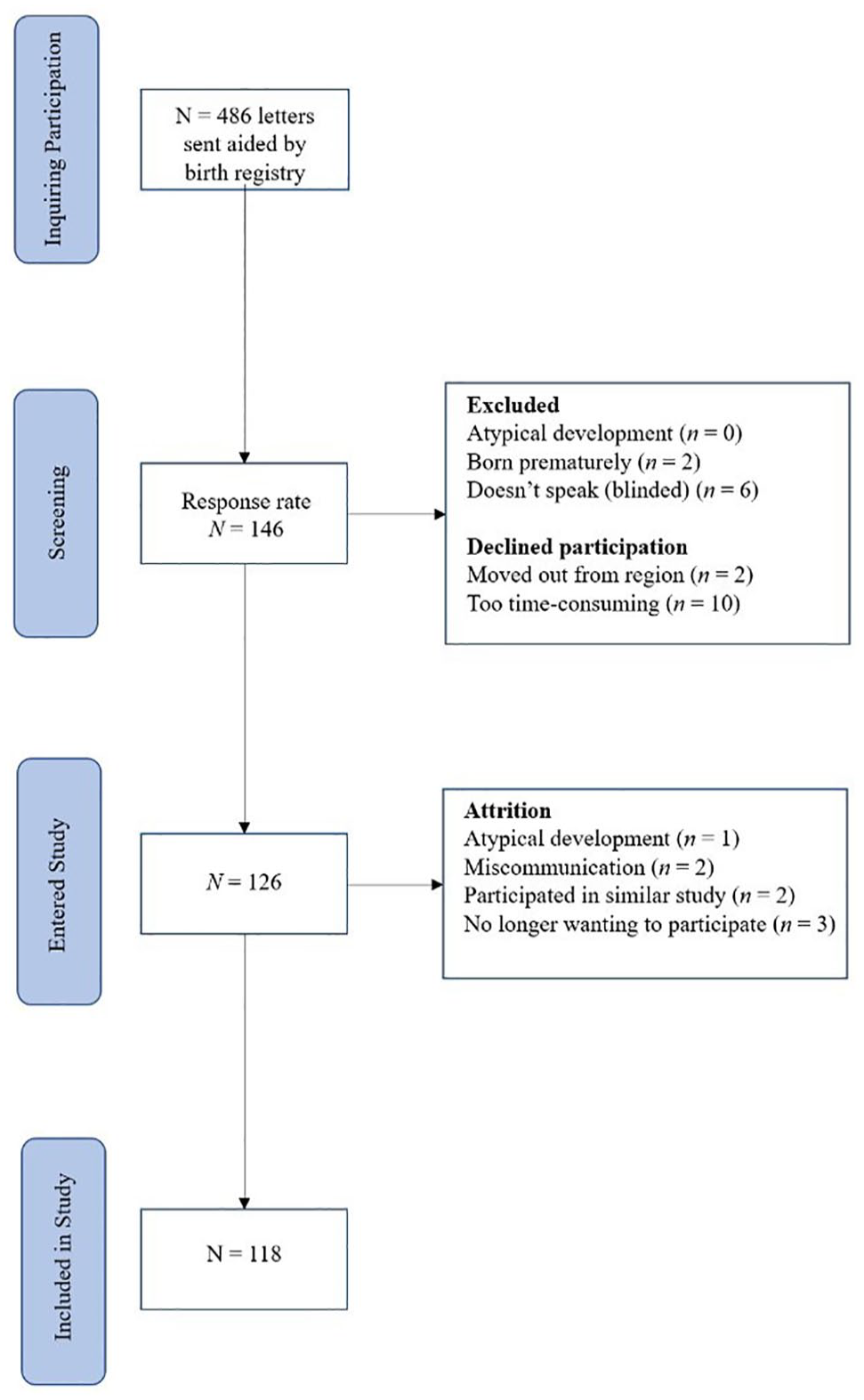
Flow Diagram Participant Inclusion.
The sample for this study ultimately included 118 typically developing children at time point one (n = 58 girls; 49%). There were no statistically significant differences between completers (n = 118) and noncompleters (n = 126) on any predictor variable or socioeconomic status (SES; independent samples t-test; ps .74 to .94). Sample sizes and participant demographics are shown in Table 1.
Sample Sizes and Sociodemographic Characteristics of Families Included in the Study.
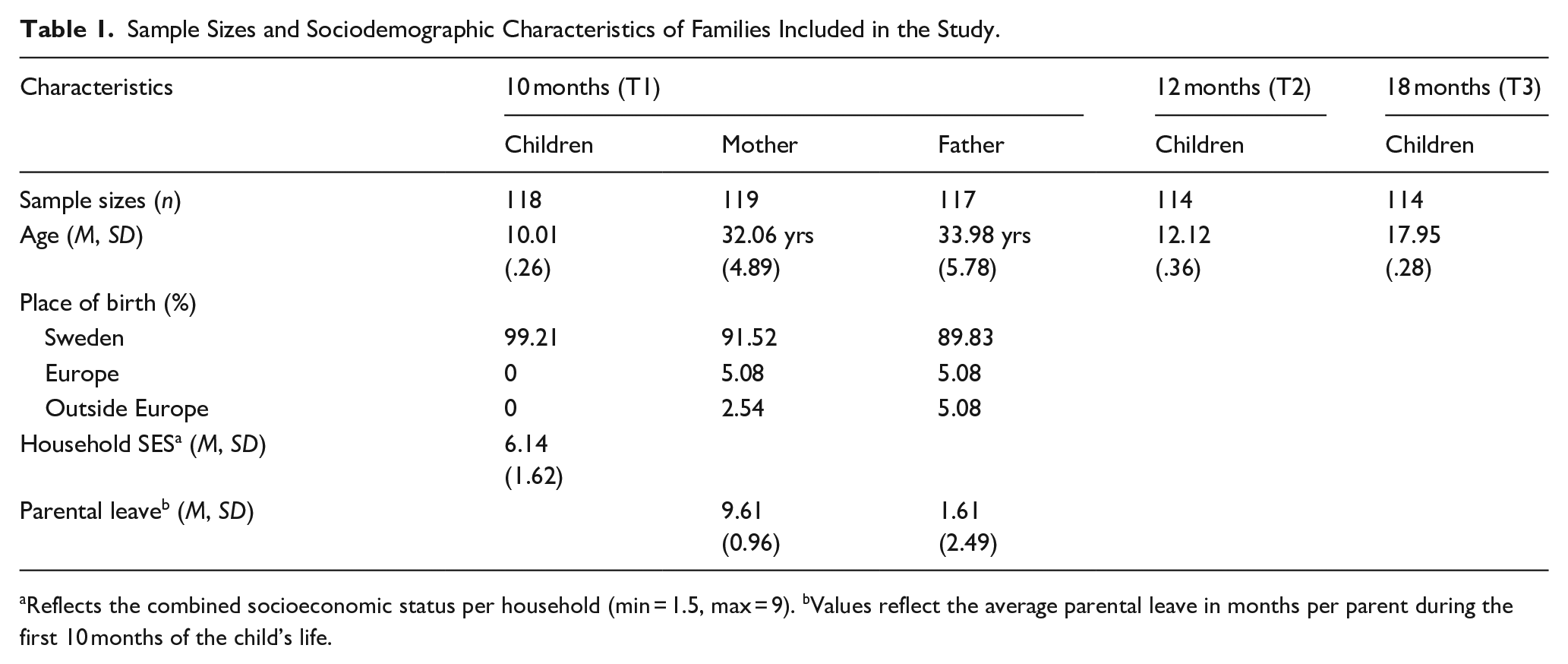
Reflects the combined socioeconomic status per household (min = 1.5, max = 9). bValues reflect the average parental leave in months per parent during the first 10 months of the child’s life.
Procedures
At 10 months (T1), maternal sensitivity was assessed through semi-structured observations, and mothers reported on social support, parental stress, and household chaos. At 12 months (T2), child attachment security to the mother was examined with a semi-structured observational procedure. At 18 months (T3), child ER was assessed with a structured frustration-evoking task, with either the mother or the father present. The assessments were conducted in the lab and video-recorded. See Supplemental Material S1 for an extended description of the procedure.
The study was approved by Uppsala’s Regional Ethical Review Board, approval number 2013/241, and informed consent was obtained at each time point in accordance with the Declaration of Helsinki.
Measurements at 10 Months (T1)
Maternal SPR
Social support was measured with the Swedish Social Support Scale (Lindberg et al., 1994) originally developed by Crnic et al. (1983). One item was added to the original 27 items, asking about satisfaction with governmental health care support. In total, mothers answered 28 items covering general social support (e.g., availability of babysitters, neighbors, wider communities), family support (partner, grandparents), and emotional support (possibility of sharing personal matters). The items were answered on a 5-point Likert-type scale and concerned the size of the social network (0 = “no one” to 4 = “more than 6 people”), frequency (0 = “never” to 4 = “more than 6 times”), quantity of social support (0 = “not at all” to 4 = “a lot”), and level of satisfaction (0 = “very dissatisfied” to 4 = “very satisfied”). Items included were for example: “Are you satisfied with the number of people that can babysit for you?” and “Are you satisfied with the help you can get from your partner?” In this study, the satisfaction items (13 in total) were used to indicate social support, with high scores indicating greater levels of satisfaction (Lindberg et al., 1994). Internal consistency for satisfaction with social support was good (Cronbach’s α = .87).
Household chaos was measured with the Swedish translation of the Confusion, Hubbub, and Order Scale long version (CHAOS; Matheny et al., 1995), which is preferred over the CHAOS short form (Larsen et al., 2023). Mothers completed all 15 items on a 5-point Likert-type scale (0 = “fully disagree” to 4 = “fully agree”). Items covered routines and organization (e.g., “We can usually find things when we need them”; reverse coded), and disorganization, confusion, and noise (e.g., “It’s a real zoo in our home”). The total score is the mean of all 15 items, with a higher score indicating greater levels of perceived household chaos. The scale has demonstrated good test–retest reliability over a 12-month period (r = .74) and good construct validity across diverse samples (Dumas et al., 2005). The internal consistency was good (Cronbach’s α = .81).
Maternal parental stress was measured with the Swedish Parental Stress Index (S-PSI; Östberg et al., 1997), derived from the Parental Stress Index (Abidin, 1995). Mothers completed all 34 items on a 5-point Likert-type scale (0 = “fully disagree” to 4 = “fully agree”). Items covered the five cross-validated factors: incompetence (Cronbach’s α = .83), role restriction (Cronbach’s α = .80), social isolation (Cronbach’s α = .71), problems with spouse (Cronbach’s α = .67), and health problems (Cronbach’s α = .70). Questions included in the S-PSQ were for example: “Being a parent is more difficult than expected” and “My life is often controlled by my child’s needs.” The total score on maternal parental stress was calculated by averaging the scores on all five subscales (Cronbach’s α = .88), with a higher score indicating more parenting stress. The S-PSI has good validity and test–retest reliability over a 30-day period for Swedish samples with a wide range in SES (Östberg et al., 1997).
Maternal sensitivity was observed during semi-structured, 26 min play sessions and coded with Ainsworth’s (1969) Maternal Sensitivity Scales. A detailed description of the sessions can be found in the Supplemental Material S2. The scales have predictive validity for infant attachment security and criterion-related validity with other measures of maternal sensitivity (Ainsworth et al., 1978/2015; Mesman & Emmen, 2013).
The degree of maternal sensitivity was indexed on the original 9-point scale according to Ainsworth’s (1969) global scale of sensitivity versus insensitivity to the infant’s signals (8 = highly sensitive, 6 = sensitive, 4 = inconsistently sensitive, 2 = insensitive, and 0 = highly insensitive). Thus, a single sensitivity score was attributed spanning over the entire observation.
The third author coded all observations, and two independent reliability coders rated 25 randomly selected videos (21%). Inter-rater reliability was good (two-way mixed, consistency, single measures intraclass coefficient [ICC] = .74).
Measurements at 12 Months (T2)
Attachment security with the mother was examined with the Strange Situation Procedure (SSP; Ainsworth et al., 1978/2015). The SSP is a semi-structured laboratory observation task designed to trigger the child’s attachment system through mild stressors, including a new environment, a stranger, and two brief child-caregiver separations. The SSP consists of eight episodes, most of which are 3 min each. The separations are, however, curtailed if children exhibit distress (e.g., crying), to prevent overstress (Granqvist et al., 2016). The SSP distinguishes between four main attachment classifications (secure, avoidant, ambivalent, and disorganized). The second author, trained for reliability, coded all SSPs. For this study, a dichotomous variable was created, comparing children classified as secure and insecure (avoidant, ambivalent, and disorganized). Inter-rater agreement on attachment secure/insecure classification over 25 random cases was excellent (92% agreement, Cohen’s unweighted k = .86, 95% CI [.67–1.00]).
Measurements at 18 Months (T3)
Child emotion regulation was examined with the attractive toy placed behind a barrier task (Goldsmith & Rothbart, 1999). The task enables the joint assessment of the reactive and regulatory dimensions of ER and is part of the laboratory temperament assessment battery (Lab-TAB). The task is designed to elicit frustration and is considered an appropriate method of assessment of ER for a 2-year-old due to its structured nature (Samdan et al., 2020). While the attractive toy placed behind a barrier task allows for the assessment of numerous ER behaviors, we selected latency to distress, attentional disengagement, contact with parent and experimenter, and self-soothing, to build upon our previous findings regarding predictors of child ER at 18 months (Frick et al., 2018).
The frustration task went as follows: The child was placed in a high chair and handed an attractive toy. After 15 s of play, the toy was placed behind a plastic barrier so that the child could see but not reach it. The parent (either mother or father, depending on their availability) and experimenter were seated next to the child and instructed not to provide any help. After 30 s, the toy was returned and the procedure was then repeated twice more, resulting in three trials. A detailed description of the task and information on the coding manual can be found in Supplemental Material S3.
The three 30-s trials were divided into eighteen 5-s epochs and coded for reactivity (i.e., latency to distress) and regulatory (attentional disengagement, contact with parent or experimenter, and self-soothing). Latency to distress is the sum of intervals, in seconds, for all three trials (0–90 s), from the first toy removal to the first sign of distress (facial, postural, vocal). If children did not show signs of distress, the maximum number of seconds per trial was attributed (i.e., 30 s). Thus, low scores indicate higher levels of reactivity. Regarding the regulatory behaviors, attention disengagement involves the child looking away from the stimulus. Seeking contact with the parent or experimenter entails the child looking at, or reaching for them. Self-soothing refers to the child manipulating a body part to regulate distress (e.g., sucking thumb). For each category, the number of seconds a behavior occurred per 5-s epoch was coded. The total score per category was then calculated by taking the mean number of seconds across all eighteen 5-s epochs (range 0–5). Thus, higher scores indicate more frequent or longer displays of ER behaviors. Due to a procedural error, data from the first 39 participants had to be excluded. Furthermore, the regulatory behavior of self-soothing was excluded from the analysis due to a floor effect, which would generate unreliable estimates because of a lack of variance.
The third author coded all observations and one independent coder rated 21 randomly selected cases (30%). Inter-rater reliability between the two coders was assessed using two-way mixed, consistency, single-measures ICC. Agreement was high, suggesting minimal measurement error (ICCs .86 to .98, p ⩽ .001). See the detailed inter-rater reliability results in Supplemental Material S4.
Control Variables
We controlled for child biological sex, family SES, and biological sex of the parent present at ER task at T3 (mothers n = 80). Family SES, obtained at study entry, reflects the average of the parents’ educational levels (range 0 = “elementary school” to 4 = “college or university degree”) and yearly incomes (range 0 = “0–10000 euros” to 5 = “more than 50000 euros”).
Data Management and Statistical Analyses
The study was preregistered at the Open Science Framework before analysis of the data (https://osf.io/me87f/). All analyses were conducted in R statistical software version 4.3.1 (R Core Team, 2022).
Regarding data carpentry, the three regulatory behaviors (i.e., attention disengagement, contact with parent, and contact with experimenter) were treated as independent constructs, as were parenting stress, social support, and household chaos. Next, we converted the raw data to z-scores and screened for outliers (z > 3). Five outliers were detected within the three regulation variables and replaced once, with the second most extreme value not constituting an outlier (Field, 2018). No multivariate outliers were detected. Finally, we examined the distributions of our variables (see Table 2). Social support, household chaos, parenting stress, and the regulatory behavior contact with the experimenter were normally distributed, the remaining variables showed signs of non-normality.
Descriptive Statistics of Predictor and Outcome Measures.
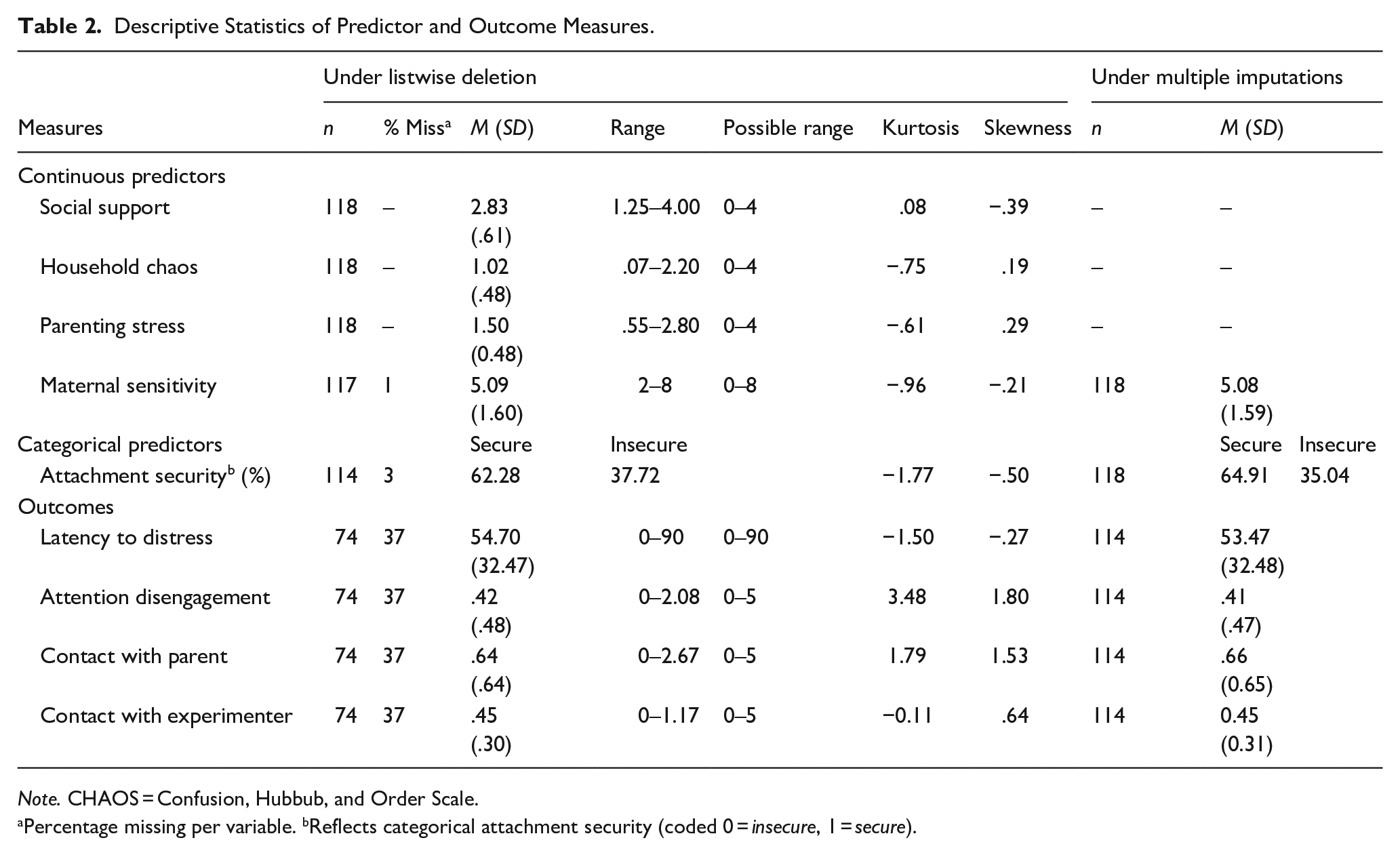
Note. CHAOS = Confusion, Hubbub, and Order Scale.
Percentage missing per variable. bReflects categorical attachment security (coded 0 = insecure, 1 = secure).
We addressed the missingness in our data with multiple imputations by chained equations (MICE; Buuren & Groothuis-Oudshoorn, 2011). The percentage missing per variable is displayed in Table 2. Good convergence and precision were achieved with m = 60 imputations, the default burn-in iterations of 5,000, and a maximum of 50 iterations. Imputed values, means, and standard deviations compared very well to observed values. Therefore, we performed all analyses on the multiple imputed datasets, which were pooled according to Rubin’s (1987) rules. See a detailed description of the imputation process in Supplemental Material S5.
To address the relationship between all included variables (Study Aim 1), Pearson’s rs were used when variables were normally distributed, or were both categorical variables (point-biserial). Spearman’s Rhos were used when at least one variable was non-normally distributed. Independent contributions (Study Aim 2) between all predictors (i.e., social support, household chaos, parenting stress, maternal sensitivity, and attachment security) and outcome variables (i.e., latency to distress, attention disengagement, contact with parent, and contact with experimenter) were then examined with regression analysis (unadjusted and adjusted models). Due to a lack of statistically significant correlations between potential mediators (maternal sensitivity and attachment security) and the outcome variables, no mediation analysis was performed (Aim 3).
Results
Descriptive Statistics and Bivariate Correlations
Descriptive statistics for all predictor and outcome variables are presented in Table 2. To enable comparison, we report means and standard deviations for both listwise deletion and multiple imputations. Bivariate correlations between predictor and outcome variables ranged from small to moderate and are depicted in Table 3. In contrast to our expectations, higher household chaos at T1 was statistically significantly related to attachment security at T2, and to a longer latency to distress at T3. Social support and parenting stress at T1 were not statistically significantly related to any outcome variable. In line with our expectations, higher levels of maternal sensitivity at T1 were statistically significantly related to a longer latency to distress and more attention disengagement at T3, as previously reported by Frick et al. (2018). The associations between maternal sensitivity, attachment security at T2, and the regulatory behaviors contact with parent and experimenter at T3 were very small and not statistically significant. This was only partially in line with our expectations. As for the control variables, biological sex was not statistically significantly correlated with any outcome measure, with the largest effect size being r = −.18, 95% CI = [−.37, −.03], p = .097 for latency to distress. SES had a negative relationship with attachment security (r = −.35, 95% CI = [−.50, −.18], p < .001), and the effect sizes with the ER outcomes ranged from .04 to .16. Moreover, the effect sizes between parent present at T3 and the ER outcomes were small to moderate, with a statistically significant correlation to latency to distress (r = .26, 95% CI [.03, .46], p = .030). Specifically, children showed a longer latency to distress if their fathers were present during the frustration task. Correlations between the control variables and predictors and outcomes are presented in Supplemental Material S6.
Bivariate Correlations With 95% Confidence Intervals Between Predictors and Child ER Outcome Variables.
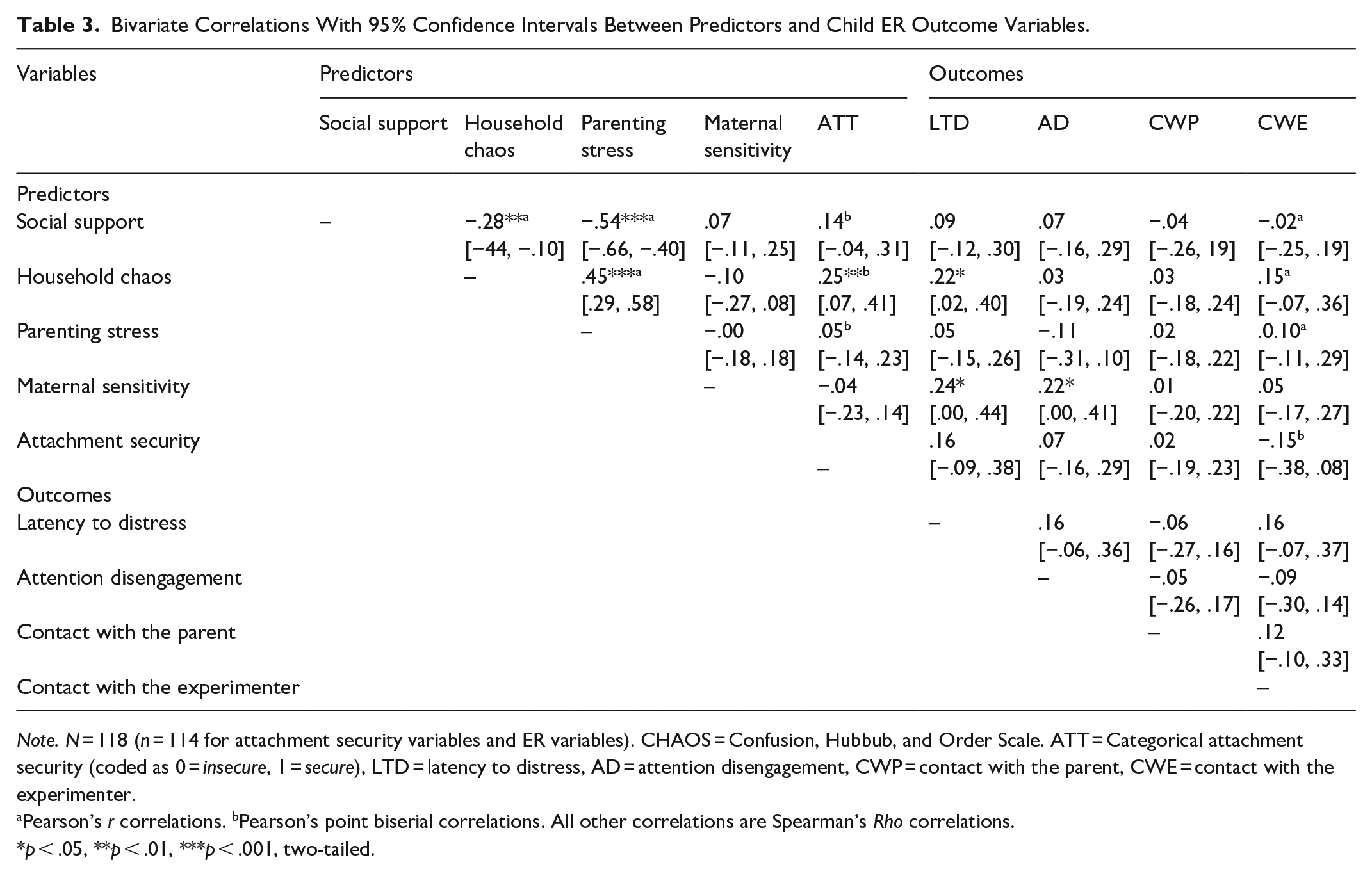
Note. N = 118 (n = 114 for attachment security variables and ER variables). CHAOS = Confusion, Hubbub, and Order Scale. ATT = Categorical attachment security (coded as 0 = insecure, 1 = secure), LTD = latency to distress, AD = attention disengagement, CWP = contact with the parent, CWE = contact with the experimenter.
Pearson’s r correlations. bPearson’s point biserial correlations. All other correlations are Spearman’s Rho correlations.
p < .05, **p < .01, ***p < .001, two-tailed.
Independent Contributions
Table 4 presents unstandardized results of the unadjusted and adjusted multiple regression analyses for all predictors and child ER variables. In the unadjusted models, household chaos and maternal sensitivity at T1 independently predicted latency to distress at T3. After adjustment for child biological sex, SES, and parent present at T3, both remained independent predictors. Maternal sensitivity at T1 showed (unadjusted and adjusted) independent effects on attention disengagement at T3, as previously reported by Frick et al. (2018). In contrast, independent contributions of social support, parental stress, and attachment security were not observed for any of the child ER variables.
Multiple Linear Regression Analysis Results for All Predictor and Child ER Outcome Variables.
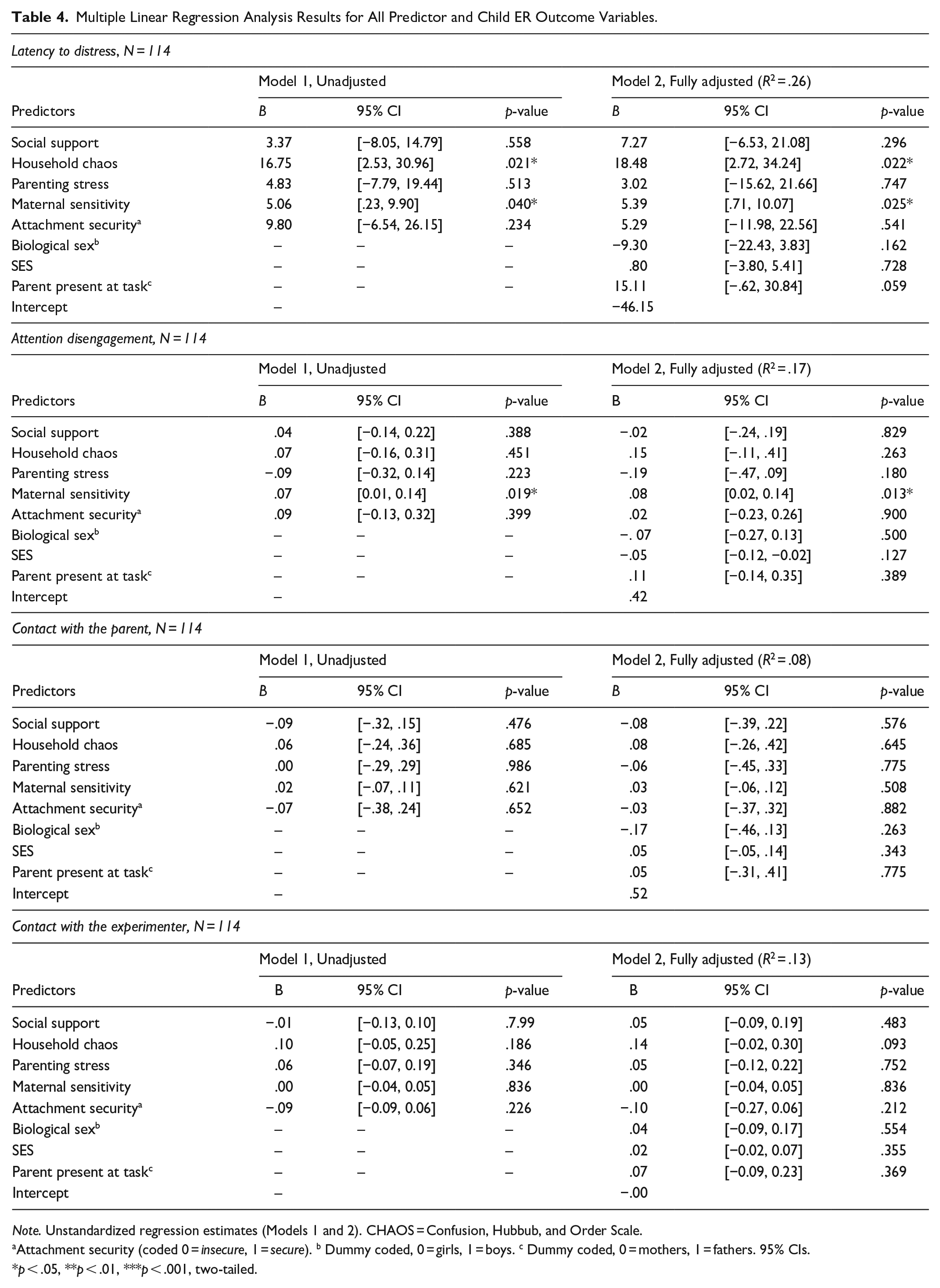
Note. Unstandardized regression estimates (Models 1 and 2). CHAOS = Confusion, Hubbub, and Order Scale.
Attachment security (coded 0 = insecure, 1 = secure). b Dummy coded, 0 = girls, 1 = boys. c Dummy coded, 0 = mothers, 1 = fathers. 95% CIs.
p < .05, **p < .01, ***p < .001, two-tailed.
Discussion
This study examined longitudinal associations between various prominent contextual predictors—maternal SPR, maternal sensitivity, and attachment security to the mother—and ER (both the reactive and regulatory dimensions) in typically developing toddlers. Studying these predictors simultaneously informs our understanding of their joint and unique contributions to child ER. This is crucial, as ER serves as both a source of risk and resilience in child development. Regarding the joint contributions, the results revealed small to moderate effect sizes between our predictor and outcome variables, sometimes in unexpected directions. Higher levels of household chaos and maternal sensitivity constituted statistically significant joint contributors to better child ER capacity (i.e., longer latency to emotional reactivity or a higher incidence of attention disengagement during a frustration task). Furthermore, higher levels of household chaos and maternal sensitivity both independently predicted a longer latency to emotional reactivity. Maternal sensitivity additionally predicted regulation independently, in that children with more sensitive mothers exhibited a higher incidence of attention disengagement.
The Role of Maternal SPR
We hypothesized that higher levels of maternal SPR at T1 (e.g., high social support, low parenting stress, and household chaos) would predict better child ER at T3. The results were counterintuitive since higher levels of household chaos were related to, and independently predicted, better child ER (i.e., longer latency to emotional reactivity). This is in contrast to previous research that has consistently reported negative links between household chaos and child ER (for an overview, see Marsh et al., 2020). It is important to note, however, that previous studies have mainly investigated the effect of household chaos on ER problems. In this study, we observed ER directly, rather than inferring its role via indirect measures or behavioral problems. Furthermore, it is important to consider chaos in context, since its effect is thought to depend on the accumulation, timing, duration, and presence of other stressors and resources (Evans & English, 2002; Fiese & Winter, 2010; Wachs & Evans, 2010). Crucially, previous links between household chaos and child ER mainly pertain to children facing chronic or cumulative risk or low SES contexts (Marsh et al., 2020). This is in stark contrast to the families in our sample, who report compensating resources (e.g., high SES and social support). Under such circumstances, moderate levels of chaos could conceivably capture levels of stimulation that facilitate ER development (Wachs & Evans, 2010). This interpretation is in line with studies indicating that exposure to chaotic environments may in fact, under certain conditions, be beneficial (Wohlwill & Heft, 1987).
Considering the positive link between household chaos and child ER, it is perhaps unsurprising that chaos did not have statistically significant negative relationships with maternal sensitivity and attachment security. In fact, our findings revealed a moderate positive relationship between chaos and attachment security. Yet, these findings are in contrast to theory and research indicating a significant negative link between chaos and both maternal sensitivity and child development (Matheny et al., 1995; Mills-Koonce et al., 2016; Vernon-Feagans et al., 2016; Whitesell et al., 2015). Notably, a vast amount of previous studies have utilized a method to asses household chaos that recently was criticized for its low reliability and predictive validity, and for potential issues capturing the full construct (i.e., CHAOS short form; (Larsen et al., 2023; Marsh et al., 2020). Furthermore, household chaos alone may not be enough to substantially affect maternal sensitivity in otherwise high-functioning families. Alternatively, we may have captured beneficial levels of stimulation rather than chaos, which enables the mother to respond to children’s signals constructively as a safe haven. This interpretation is perhaps strengthened by the finding that the families who reported higher levels of household chaos had more securely attached children.
Unexpectedly, social support and parenting stress at T1 neither predicted maternal sensitivity, child attachment security nor child ER. These findings are inconsistent with theory, empirical research, and our own expectations (Cochran & Brassard, 1979; Crnic et al., 1983, 2005; Deater-Deckard, 1998). It should be noted that social support was high in this study, and there is some evidence that low social support may be more impactful (for discussion, see Lincoln, 2000). Furthermore, low variation could have contributed to the null results. Yet, social support was strongly associated with parenting stress: the higher social support mothers reported, the less parenting stress they experienced. This finding lends validity to our measures and is in line with the buffering hypothesis, with social support thought to buffer against the negative effects of parenting stress (Cohen & McKay, 1984). This may, in part, explain why we did not find an effect of parenting stress on child ER.
The Role of Maternal Sensitivity and Attachment Security to the Mother
We hypothesized that maternal sensitivity at T1 and attachment security at T2 would predict better child ER at T3. Only maternal sensitivity at T1 was a statistically significant joint contributor to better ER capacity in typically developing toddlers (i.e., a longer latency to emotional reactivity and more attention disengagement). These findings are only partially in line with a functionalist notion that child ER is influenced by caregiving behavior and attachment experiences (e.g., Cassidy, 1994), and do not corroborate the findings of previous observational research that reports less emotional reactivity and more attention disengagement in secure compared to avoidant children (Kim et al., 2014; Leerkes & Wong, 2012). Maternal sensitivity further contributed independently to reactivity together with household chaos, beyond the other predictors. Moreover, maternal sensitivity was the sole independent predictor of attention disengagement, which may constitute the most effective independent ER strategy in toddlerhood (Gennis et al., 2022). This link between global maternal sensitivity and child ER observed in the lab may lay the groundwork for future studies. Specifically, future research could examine specific aspects of their relation, such as cumulative or interactive effects with household chaos, and potential varying predictive value of sensitivity in low versus high distress contexts.
Our findings concerning the roles of sensitivity and child attachment security contribute new knowledge. Previous research has rarely examined these constructs simultaneously in relation to ER and has not controlled for their overlap (Kim et al., 2014; Leerkes & Wong, 2012). It should be noted that maternal sensitivity is considered a predictor of both child attachment security and child ER (Samdan et al., 2020; van IJzendoorn et al., 2023). As such, links between child attachment security and ER should, to some extent, reflect joint influences by sensitivity. While maternal sensitivity and child attachment security were not significantly associated, they may nonetheless have contributed to shared variance in ER. Whereas our findings do not indicate unique effects of attachment security on ER, sensitivity levels were high in this study as well as the percentage of securely attached children compared to global levels (Madigan et al., 2023). Furthermore, attachment security may influence child ER through, for instance, stress response systems (Gunnar et al., 1996) or emotion socialization (DeOliveira et al., 2004). In addition, the attachment system is linked to the fear system, with threat signals triggering proximity seeking and contact maintenance (Bowlby, 1969/1982). Yet, our task was designed to trigger frustration, and future research would hence do well to use fear-eliciting situations to further investigate this (Buss & Goldsmith, 1998; Leerkes & Wong, 2012). However, there is a scarcity of research showing that attachment security contributes to child development beyond caregiver sensitivity (Groh et al., 2017). Thus, while attachment security is an important developmental construct, more research is needed concerning potential effects beyond caregiver sensitivity.
Limitations and Future Directions
As with all research, our study has limitations. First, the study was constrained by a sample with high family SES and an overrepresentation of mothers. Therefore, this study should be replicated in more diverse populations, preferably with larger sample sizes. Second, although we acknowledge the role of intrinsic factors (e.g., heritability and temperament), we focused exclusively on contextual aspects contributing to child ER. Future research should integrate intrinsic factors (e.g., temperament) to provide a more comprehensive understanding of child ER capacity and its development. Third, our laboratory-based measure of child ER involved controlled conditions, including child restraint and receiving no extrinsic support. It is important to note that child ER encompasses a broader range of behaviors beyond those examined in this study, such as problem-solving and distraction through substitutive play. Furthermore, it might be that the predictors included in this study are more strongly related to emotional dysregulation rather than adaptive regulation. Therefore, while ensuring high internal validity, some caution is warranted regarding the generalization of findings to naturalistic contexts. Fourth, our methods differed slightly from those used in previous studies on child ER and contextual determinants. These differences encompass for example (1) measuring other ER behaviors or the same under different conditions (children were unrestrained or received help), or (2) attachment was analyzed using the three or four-class approach, or (3) variations of questionnaire versions (e.g., long versus short forms). This measurement heterogeneity is a common problem in developmental psychology and complicates comparing results across studies. Finally, we chose to mainly focus on maternal predictors of child ER. Our results and those of others indicate a unique role for fathers in children’s emotional development that is worth investigating further in future research.
This study treated both emotional reactivity and regulation as integral components of child ER. Although there is a prevailing understanding of their dynamic interaction, few studies have assessed how changes or variations in one affect change in the other (Buss & Goldsmith, 1998). Time-series data obtained by the attractive toy placed behind a barrier task ideally allows for such lagged-effects analysis, but this was not feasible due to the amount of missing data and, consequently, the small sample size, as well as the insufficient inter- and intra-variance within trials. Future work could profitably examine these interactions between reactivity and regulation across various time intervals.
Conclusion
We investigated joint and independent influences of well-established early contextual determinants of child ER in typically developing children. Our unique findings suggest that ER is partially malleable and that two distinct contextual factors play a role in its development. Specifically, household chaos and maternal sensitivity may contribute to better ER among typically developing toddlers. The somewhat counterintuitive finding that higher household chaos predicted better child ER may be attributed to the protective environment in which the children in our sample were encapsulated. This underscores the significance of cumulative risk and protective factors for ER development. Future research may well explore potential cumulative risks between, for example, low sensitivity and household versus high sensitivity and household chaos. As regards household chaos, we hasten to add that higher levels were still moderate, and possibly captured beneficial levels of stimulation rather than true chaos. Social support, parenting stress, and attachment security did not predict child ER. The high levels of social support reported by the mothers may have buffered against the effects of parenting stress on child ER.
The current study uniquely integrated several well-established contextual factors known to be associated with child ER. Our findings align partially with an ecological perspective on general child development and family functioning, as well as functionalist accounts of child ER. However, the limited variability within our high-functioning sample may have contributed to the null findings and restricted generalization to children at risk. Therefore, replication is warranted. If replicated, the results can have practical implications for early prevention and treatment methods that foster child mental health.
Supplemental Material
sj-docx-1-jbd-10.1177_01650254241239956 – Supplemental material for Predicting emotion regulation in typically developing toddlers: Insights into the joint and unique influences of various contextual predictors
Supplemental material, sj-docx-1-jbd-10.1177_01650254241239956 for Predicting emotion regulation in typically developing toddlers: Insights into the joint and unique influences of various contextual predictors by Emma J. Heeman, Tommie Forslund, Matilda A. Frick, Andreas Frick, Lilja K. Jónsdóttir and Karin C. Brocki in International Journal of Behavioral Development
Footnotes
Acknowledgements
The authors thank all participants in the EFFECT-I Study, Malva Hjertson and Gunilla Bohlin for behavioral coding, and Loretta Platts for advice.
Data Availability Statement
A synthetic dataset can be generated and analysis code shared upon request.
Declaration of Conflicting Interests
The author(s) declared no potential conflicts of interest with respect to the research, authorship, and/or publication of this article.
Funding
The author(s) disclosed receipt of the following financial support for the research, authorship, and/or publication of this article: Our work was funded by the Swedish Research Council [2021-01222] and the Center for Women’s Mental Health during the Reproductive Lifespan—WOMHER [UFV 2021/1318].

Supplemental Material
Supplemental material for this article is available online.
References
Supplementary Material
Please find the following supplemental material available below.
For Open Access articles published under a Creative Commons License, all supplemental material carries the same license as the article it is associated with.
For non-Open Access articles published, all supplemental material carries a non-exclusive license, and permission requests for re-use of supplemental material or any part of supplemental material shall be sent directly to the copyright owner as specified in the copyright notice associated with the article.
