




Abstract
This study examined mothers’ tendency to base their self-esteem on their children’s accomplishments (i.e., child-based worth) and its potential implications for their parenting practices. Child-based worth was assessed in three domains of development: virtue, academic competence, and physical appearance. Participants were 302 mothers (age range: 21–69) of early to middle adolescents (age range: 10–17; 59% girls) in the United States. Mothers completed a survey about their child-based self-worth and use of autonomy-supportive and controlling practices. Results showed that mothers of adolescents tended to base their self-worth on children’s academic competence to a greater extent, compared to virtue and physical appearance. Child-based worth in virtue and physical appearance were associated with heightened psychological control, after adjusting for covariates. In addition, mothers who based their self-worth on their children’s physical appearance tended to show dampened autonomy support. Findings suggest that the implications of mothers’ child-based worth for their parenting practices may vary depending on the domain of children’s development.
Some parents view their children’s accomplishments as an important source of their own self-worth. For example, parents may experience a boost in self-esteem when their children come first in a competition but suffer a loss in self-esteem when they misbehave. The gaining and losing self-esteem through children’s successes and failures, known as child-based worth, may have implications for how parents interact with their children (e.g., Grolnick et al., 2007), as the pursuit of self-esteem can often serve self-regulatory functions (Crocker & Park, 2004). Research indicates that when parents’ self-worth is hinged on children’s academic success, they tend to use controlling parenting practices, such as shaming, to ensure that children do not fall short of their expectations (e.g., Ng et al., 2014). Although the role of child-based self-worth in controlling parenting has been documented, several gaps in the literature remain. First, it is unclear whether parents’ self-worth is contingent upon children’s success in one life domain more than others. Second, scant research examined the associations between child-based worth and autonomy-supportive parenting, another important dimension of parenting behaviors. Third, the extent to which the associations between child-based self-worth and parenting practices vary across domains of child development (e.g., academic competence vs. physical appearance) has not been explored. The current research addresses these gaps by focusing on mothers of children in early to middle adolescence, a period marked by heightened autonomy issues within parent–child relationships (Benito-Gomez et al., 2020).
Implications of Child-Based Worth for Parents’ Behaviors
In addition to global self-esteem, an overall evaluation of oneself, researchers have considered the concept of contingent self-worth (Crocker & Wolfe, 2001; Schwinger et al., 2017). This framework posits that individuals’ self-esteem can fluctuate depending on their successes and failures in certain life domains. Specifically, according to Crocker and Wolfe (2001), individuals’ self-esteem can be garnered through experiences such as approval from others, physical appearance, or one’s moral character. Notably, these domains extend beyond the individual, reflecting the social nature of self-evaluation. This expanded form of self-evaluation is often shaped by individuals who hold significance in one’s life, such as a romantic partner, where the accomplishments or status of close others can affect their self-evaluation (e.g., Aron et al., 2022). Within the family context, when parents base their self-worth on their children’s achievements, their self-esteem may be bolstered by their children’s successes, while their children’s failures can have the opposite effect.
Crocker and Park (2004) argue that contingent self-esteem serves regulatory functions such that individuals often aspire to succeed and avoid failure in the domains of their self-worth. Thus, contingent self-esteem can guide individuals’ behaviors—particularly to maximize success and minimize failure (Crocker & Wolfe, 2001). Striving for self-worth may also have social consequences, as it prioritizes success in a particular domain over fostering or maintaining interpersonal relationships (Ward et al., 2020). For example, when an individual’s self-esteem is based on academic competence, one may act in a less supportive and caring way toward others, as they may be preoccupied with the promotion of their own self-worth (Park & Crocker, 2005). Indeed, research shows that parents’ tendency to uphold their child-based self-worth is associated with their use of conditional regard (e.g., Otterpohl et al., 2020; Steffgen et al., 2022) and psychological control (e.g., Ng et al., 2014; Wuyts et al., 2015).
Research indicates that child-based worth can lead parents to endorse psychologically controlling parenting practices that undermine children’s socioemotional and academic adjustment (e.g., Wang et al., 2007). However, it is unclear whether child-based worth may be a precursor of other types of parenting behaviors that hold a particular significance during adolescence, such as autonomy support. Autonomy-supportive parenting, which involves the promotion of children’s self-expression and decision-making (Silk et al., 2003), is often associated with positive child outcomes (e.g., psychological well-being and academic achievement; Benito-Gomez et al., 2020). Notably, psychological control and autonomy support are not necessarily two opposite ends of a continuum such that the absence of autonomy support does not necessarily connote the presence of psychological control (Silk et al., 2003; Van der Kaap-Deeder et al., 2019). Given that autonomy support requires psychological energy to perceive and understand children’s perspectives (Silk et al., 2003), and that child-based self-worth may deplete psychological resources to do so (Grolnick et al., 2007), it is conceivable that child-based worth may discourage parents’ use of autonomy support.
Domain-Specific Child-Based Worth and Parenting
Parents’ beliefs about their role in children’s lives are often domain-specific (Smetana, 2017) such that they may view their influence in certain life domains as more instrumental (e.g., conventional vs. moral issues). In a similar vein, it is possible that parents may garner their self-esteem from one life domain more than others, given that parenting is bounded by the situation or domain of child development (e.g., Smetana, 2017). As such, parents’ child-based worth may not be constant across domains of development. Despite the uniqueness of the multiple domains of contingent self-esteem (Crocker & Wolfe, 2001), prior research on child-based worth has primarily focused on domain-general child-based worth with only a handful of studies incorporating domain-specific items, such as academic achievement, in global measures of child-based self-worth (Ng et al., 2014; Wuyts et al., 2015). In addition, given that parents may view certain domains of development as more important than others, which may in turn drive their interactions with children in such contexts, it is important to examine how parenting behaviors are driven by various domains of child-based worth. Notably, Crocker et al. (2003) noted that the costs of contingent self-esteem to well-being and interpersonal relationships are more pronounced when self-esteem stems from external (e.g., others’ approval) than internal sources (e.g., God’s love). Given that events in external domains are less controllable, they can lead to greater detriments in individuals’ evaluation of their self-worth (Crocker & Wolfe, 2001). Thus, it is possible that when parents anchor their self-worth in less controllable, external domains of child development (e.g., physical appearance), they may be more inclined to endorse less optimal parenting approaches. Although a domain-specific approach has not been applied to research on child-based worth, some research has investigated child-based worth in specific contexts. For example, Grolnick et al. (2007) found that mothers with higher contingent self-esteem in children’s social competence were more controlling in the context of a social problem-solving task.
Overview of the Current Study
The current research examined the levels of child-based worth across domains of child development and whether the associations between child-based worth and parenting practices vary across domains. Within the seven domains of contingent self-esteem postulated by Crocker and Wolfe (2001), we focused on three: virtue, academic competence, and physical appearance. While the virtue domain encompasses children’s adherence to moral principles and engagement in ethical behaviors, the physical appearance domain concerns the perception of children looking good or attractive. The academic domain focuses on children’s accomplishments in academics. These domains were selected, as they are deemed important in child socialization during this developmental period, and children’s achievement in these domains is readily observable by others, including parents (e.g., Lessard et al., 2021; Ng et al., 2014; Smetana, 2017). Based on the notion that the pursuit of self-worth based on external contingencies may be related to suboptimal psychosocial functioning (Crocker et al., 2003), we hypothesized that parents would be most likely to endorse more controlling and less autonomy-supportive practices when they base their self-worth in their children’s physical appearance, compared to the virtue and academic domains. Given that much prior research on child-based worth has included mothers (e.g., Grolnick et al., 2007), the current study followed suit, as a first step to begin this line of inquiry.
Method
Participants
Participants (N = 302) reported having at least a child aged between 10 and 17 years (Mage = 13.84, SDage = 2.21; 59% girls) and were predominantly White (79%), with the majority (73%) having education beyond some college. Over half (58%) were employed either full- or part-time, and 52% indicated that their annual household income was below $60,000. Those who reported currently being in a married or an unmarried relationship were 67%. Data for the current study are available from the corresponding author upon request.
Procedure
Participants were recruited from the Qualtrics panel, an online research platform. The inclusion criteria included: being over 18 years old, identifying as a mother of at least one child between 10 and 17 years old, residing in the United States, and being proficient in English. Our criteria did not preclude mothers with adopted children or stepchildren. Eligible participants were identified and invited to be redirected to the online survey upon the agreement to participate. Participants were compensated at a rate determined by Qualtrics. The study procedures were approved by the institutional review board of the University of California, Riverside (#HS 21-108). At the start of the survey, screening items were used to determine whether participants were mothers with at least one child between the ages of 10 and 17 years. If participants responded no to these items, the survey would conclude automatically. Participants with multiple children were instructed to base their responses on one child within the age range of 10 and 17 years while completing the survey. Detailed descriptions of the procedure and data quality checks can be found in the Supplementary Material S1.
Measures
All survey items were presented to the participants in English. For all study variables, except sociodemographic information, averages were taken before they were entered into the analyses.
Sociodemographic Information
Participants responded to an array of questions about their personal, work, and family background, including their age, race, employment status, marital status, and family income. They also indicated the target child’s race, gender, and grade level.
Child-Based Worth
To assess domain-specific child-based worth, items adapted from the Contingencies of Self-Worth Scale (Crocker et al., 2003) were used. Participants indicated the extent to which they feel their self-worth is contingent upon their children’s moral adequacy (five items; e.g., “My self-esteem would suffer if my child did something unethical”), academic performance (five items; e.g., “My child doing well in school gives me a sense of self-respect”), and physical appearance (five items; e.g., “My sense of self-worth suffers whenever I think my child doesn’t look good”). Participants indicated their agreement with the statements on a 7-point scale (1 = Strongly disagree to 7 = Strongly agree; Cronbach’s α = .82 for Virtue, .74 for Academic Competence, and .71 for Physical Appearance).
Psychological Control
Psychological control was measured using eight items from Ng et al. (2014), which is adapted from Wang et al. (2007). Because the measure was originally created to reflect children’s views of their parents’ psychological control, Ng et al. (2014) made minor changes to minimize social desirability concerns (e.g., “When my child does not behave as I wish” was changed to “When my child does something I think is wrong”). Participants indicated the extent to which they endorse psychological control (e.g., “I tell my child that I know what is best for her or him and she or her should not question it”) on a 5-point scale (1 = Not at all true to 5 = Very true; Cronbach’s α = .87).
Autonomy Support
Autonomy support was measured using eight items adopted from McPartland and Epstein (1977) and Steinberg et al. (1992). Since the items were created to reflect children’s perceptions (e.g., “My parents allow me to make choices whenever possible”), modifications were made to reflect mothers’ perspectives (e.g., “I allow my child to make choices about her or him whenever possible”). Participants indicated the extent to which they endorse autonomy-supportive practices (e.g., “I allow my child to decide things for herself/himself”) on a 5-point scale (1 = Not at all true to 5 = Very true; Cronbach’s α = .74).
Covariates
COVID-19 Stress
Given the study was conducted during the COVID-19 pandemic, stress related to the pandemic was measured, as it may influence mothers’ attitudes and behaviors (e.g., Wissemann et al., 2021). The three-item Perceived Coronavirus Threat scale (e.g., “I am afraid of the Coronavirus [COVID-19]”) and the Coronavirus Impacts Questionnaires were used (Conway et al., 2022). The latter measure includes three subscales: Financial (e.g., “The Coronavirus has impacted me negatively from a financial point of view”), Resource (e.g., “It has been difficult for me to get the things I need due to the Coronavirus”), and Psychological (e.g., “I have become depressed because of the Coronavirus”). Participants indicated the extent to which they agree with the statements using a 7-point scale (1 = Not at all true of me to 7 = Very true of me). A composite score based on responses across the two questionnaires was computed (Cronbach’s α = .89).
Parental Psychological Availability
To measure mothers’ cognitive and emotional availability, one of the precursors of autonomy support (Van der Kaap-Deeder et al., 2019), the Psychological Availability scale (Danner-Vlaardingerbroek et al., 2013) was used. Following Van der Kaap-Deeder et al. (2019), three items from the scale were included (e.g., “When I spent time with my son/daughter today, I was fully available for activities with my child”). Participants indicated the extent to which they agree with the statements using a 5-point scale (1 = Totally disagree to 5 = Totally agree; Cronbach’s α = .80).
Social Desirability
To statistically adjust for potential self-report bias, participants’ overall social desirability was assessed by a five-item Socially Desirable Response Set (SDRS-5; Hays et al., 1989) scale (e.g., “I am always courteous even to people who are disagreeable”). Participants indicated their agreement with each statement on a 5-point scale (1 = Definitely false to 5 = Definitely true). Extreme responses (i.e., Definitely true or Definitely false for reversed items) were coded as “1” and summed (Cronbach’s α = .66).
Results
Preliminary Analyses
Missingness
Among the 302 participants, 92% had complete data for all of the study variables. While 25 participants (8%) had one or more missing items, no participant missed more than five items (4% of the entire survey). Little’s (1988) MCAR test indicated that the pattern of missingness was completely random, χ2(980) = 1040.08, p = .089. For the main analyses, full information maximum likelihood (FIML) estimation was used to account for missingness, which produces less biased estimates than traditional approaches (e.g., listwise deletion; Graham, 2009).
Descriptive Statistics
Table 1 shows the descriptive statistics and zero-order correlations. There was no violation of the normality assumption in all variables included in the study. Psychological control and autonomy support were negatively correlated, r = −.13, p = .026. Psychological control was positively associated with the three domains of child-based worth, rs > .48, ps < .001, while autonomy support was only associated with the physical appearance domain of child-based worth, r = −.15, p = .010.
Descriptive Statistics and Bivariate Correlations Among the Main Study Variables.
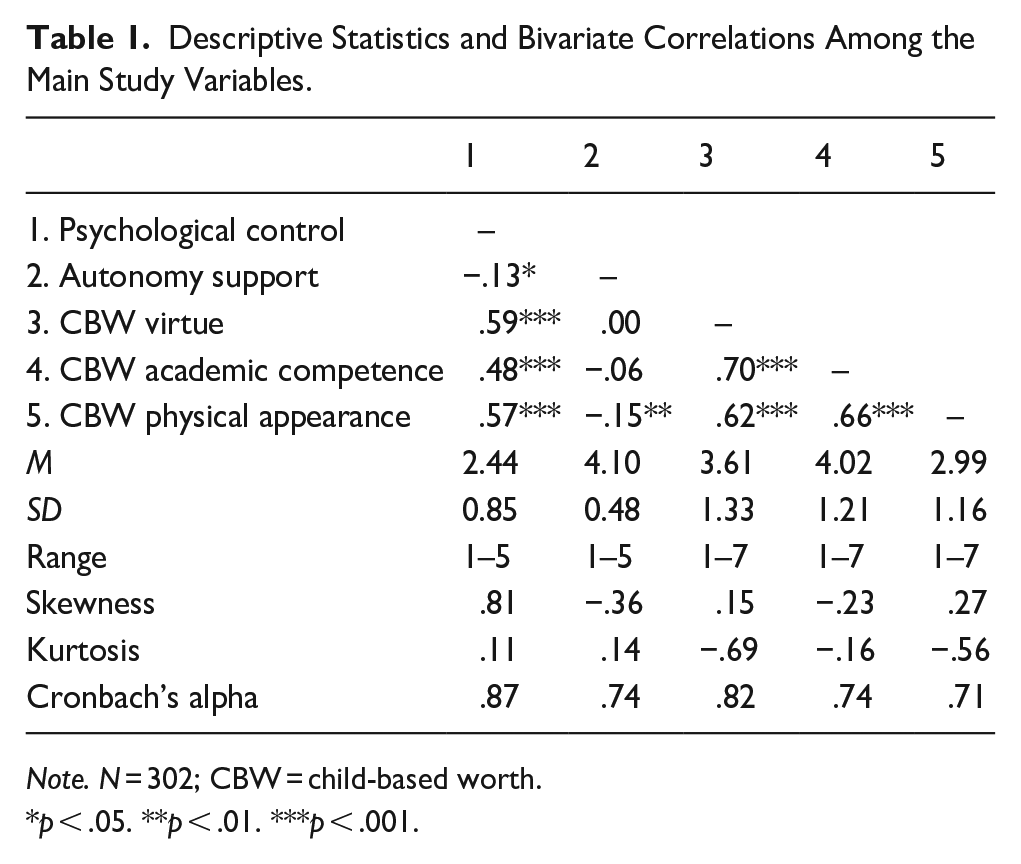
Note. N = 302; CBW = child-based worth.
p < .05. **p < .01. ***p < .001.
Selection of Covariates
Based on analysis of the correlation between the covariates and predictors (see Supplementary Material S2), mothers’ age, income, and COVID-19 stress were included as covariates in the models predicting psychological control. Children’s age, income, mothers’ race, psychological availability, and social desirability were included as covariates in the models to predict autonomy support.
Main Analyses
The sample size of the current research was determined by an a priori power analysis using G*Power 3.1 (Faul et al., 2009). Results indicated that a minimum sample size of 291 was required to detect a small effect size (f2 = 0.06) in the linear multiple regression (fixed model, R2 increase, α = .05, power = .80). Our sample exceeded the minimum requirement and consisted of 302 mothers aged between 21 and 69 years (Mage = 42.16, SDage = 8.54).
Child-Based Worth in Different Life Domains
To address the first research question of whether mothers based their self-esteem in one domain of child development more than others, a repeated-measures analysis of variance (ANOVA) was performed. Covariates related to child-based worth (i.e., mothers’ age, educational attainment, employment status, marital status, social desirability, and income) were included in the model. Mauchly’s test of sphericity indicated a violation of the assumption of sphericity, χ2(2) = 7.67, p = .022. Given that the sphericity (ε) was above .75, the Huynh-Feldt correction was used (Girden, 1992). Significant within-person differences across the domains were evident, F(2, 586) = 4.14, p = .016, ηp2 = .01. Bonferroni-corrected pairwise comparisons showed that mothers reported the highest level of child-based worth in academic competence (M = 4.02, SE = 0.07), followed by virtue (M = 3.62, SE = 0.07) and physical appearance (M = 2.99, SE = 0.07), ps < .001.
Associations Between Child-Based Worth Domains and Parenting Practices
Regression analyses were performed using path analysis in Mplus 7.31 (Muthén & Muthén, 1998–2012). Model fit was evaluated based on the Comparative Fit Index (CFI), the Tucker–Lewis Index (TLI), and the Root-Mean-Square Error of Approximation (RMSEA). To examine the associations between child-based worth and parenting practices, incremental analytic approaches were utilized. First, separate models were used to evaluate the unique implications of each domain of child-based worth for parenting practices. Next, a single path model was used to examine the simultaneous associations between child-based worth in all three life domains and parenting practices. For this second approach, collinearity diagnostics were performed, which indicated no serious multicollinearity (see Supplementary Material S3). As a supplementary analysis, we conducted a multigroup comparison to explore potential child gender effects. Gender did not appear to moderate the associations between child-based worth and parenting practices (see Supplementary Material S4).
Unique Implications Within Each Domain
All models showed a good model fit, χ2s(6) < 12.64, ps > .049, CFIs > .97, TLIs > .91, RMSEAs < .06. Child-based worth in virtue was positively associated with psychological control (γ = .45, p < .001, 95% CI = [.35, .54]); however, it did not predict autonomy support (γ = −.02, p = .800, 95% CI = [−.13, .10]). For the academic competence domain, child-based worth in this domain was positively associated with psychological control (γ = .35, p < .001, 95% CI = [.26, .44]). However, child-based worth in the academic domain did not predict autonomy support (γ = −.06, p = .256, 95% CI = [−.17, .05]). Child-based worth in the physical appearance domain was positively associated with psychological control (γ = .43, p < .001, 95% CI = [.35, .52]) and negatively with autonomy support (γ = −.14, p = .008, 95% CI = [−.25, −.04]).
Joint Contribution of the Three Domains
For the model evaluating the simultaneous contributions of all three child-based worth domains in parenting, the model fit was good, χ2(6) = 12.13, p = .059, CFI = .98, TLI = .91, RMSEA = .06. As shown in Figure 1, findings were largely consistent with those in the previous step, with only one discrepancy found for the path linking the academic competence domain to psychological control. That path coefficient, previously significant, was no longer the case in this model, γ = .02, p = .770, 95% CI = [−.11, .15].
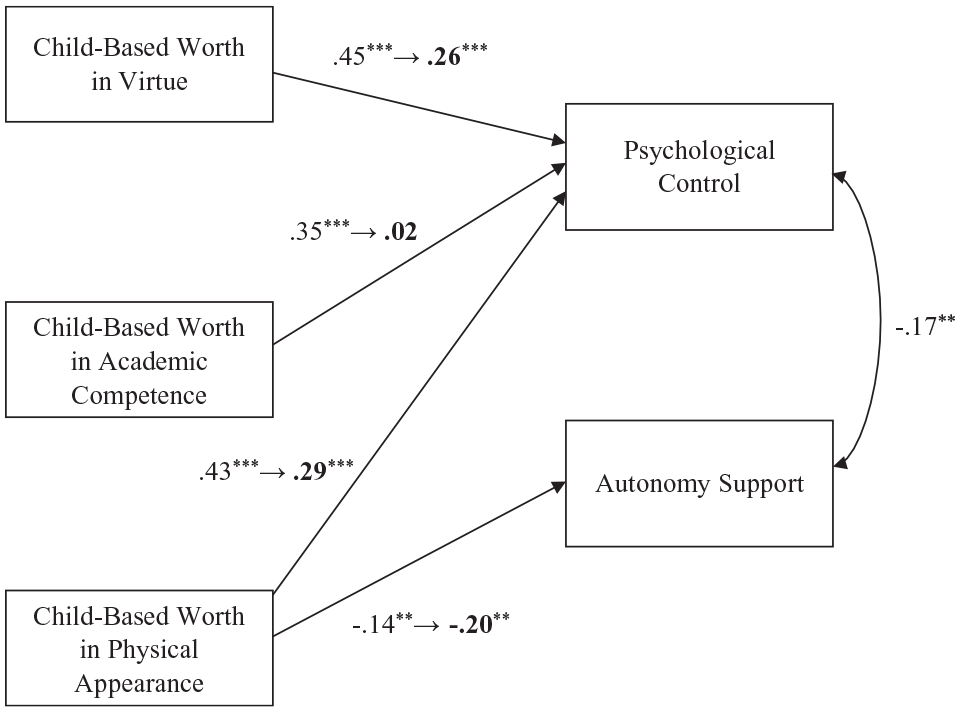
Associations Between Child-Based Worth Domains and Parenting Practices.
Discussion
The current research examined the relationship between child-based worth and parenting practices of mothers of early to middle adolescents in the United States. A domain-specific approach was used to understand the implications of child-based worth in three domains of child development. Findings indicated that, among the three life domains, mothers’ child-based self-worth stems primarily from children’s academic competence. In addition, the associations between child-based worth and the parenting practices of psychological control and autonomy support vary across the three domains of child development.
Mothers showed the highest level of child-based worth in the academic domain, followed by virtue and physical appearance. These findings may reflect the heightened importance parents place on academic success and the evaluative pressure involved in children’s schoolwork during adolescence (Eccles & Wigfield, 2020). With regard to the virtue and physical appearance domains, mothers tended to base their self-worth on virtue to a greater extent than physical appearance. Parents’ perceptions about their roles in these domains may contribute to such a difference. For example, parents may deem physical appearance as an issue within children’s jurisdiction, whereas morality should fall under parents’ reign (Smetana, 2017). As such, their self-worth may be more strongly tied to the morality domain.
Unlike the other two domains, child-based worth in physical appearance was associated with heightened psychological control and dampened autonomy support. As such, parents who base their self-worth on their children’s physical appearance may experience a reduction in psychological resources, thereby leading them to be less autonomy-supportive. These findings denote the unique significance of this domain, as physical appearance entails the most direct social recognition and may be seen as a relatively fixed quality in children, compared to competence in the virtue and academic domains. When parents perceive their children as falling short in this domain, such a view may prompt negative emotions (e.g., shame; Scarnier et al., 2009) or a dampened sense of control, which may increase their tendency to endorse psychologically controlling practices (e.g., Mills et al., 2007). The finding that child-based worth in the virtue domain was positively associated with psychological control corroborates with prior research on moral socialization. Given the perceived shared identity between parents and children, parents may experience shame or guilt following children’s transgressions (Scarnier et al., 2009). Consequently, parents may view their children’s moral behaviors as a reflection of their reputation and may resort to using controlling strategies to ensure compliance (e.g., Scarnier et al., 2009). Notably, the association between child-based worth in academic competence and psychological control became nonsignificant when the simultaneous contributions of child-based worth in the two other life domains were included in the model. This finding is surprising given the robust associations between child-based worth and controlling behaviors (e.g., Wuyts et al., 2015). It is possible that the associations documented in prior research were driven by other domains of child outcomes (e.g., physical appearance), as global measures of child-based worth were often used in conjunction with items tapping on academic success. Alternatively, the two other child-based self-worth domains may take precedence over academic competence in determining the types of parenting practices parents endorse in general.
An intriguing observation from the current work is that child-based worth explained a greater portion of the variance in controlling (vs. autonomy-supportive) behaviors. With the exception of physical appearance, dimensions of child-based worth were uncorrelated with autonomy support. As such, although the presence of child-based worth may instigate psychological control, low levels of this tendency may not be a sufficient condition for autonomy support. The differential findings across the two types of behaviors further corroborate the view that they are two distinct rather than two opposite dimensions of parenting practices (Silk et al., 2003; Van der Kaap-Deeder et al., 2019).
Limitations and Future Directions
The present study has several limitations. First, although studies have found that samples drawn from the Qualtrics panel are similar to a national probability sample in the United States in terms of sociodemographic variability (e.g., education, income, race/ethnicity; Boas et al., 2020), our sample does not fully represent the population of the country. In particular, our sample overrepresents White individuals, and given the nature of the data collection methodology (i.e., online survey), participation was limited to individuals who have access to the internet. Second, the current research assessed general parenting behaviors and did not measure domain-specific parenting behaviors. Social domain theory (e.g., Smetana, 2017) posits that a domain-specific approach to parenting behaviors is informative, as parents and children may hold distinct beliefs about the legitimacy of parental control across different life domains. It is possible that the associations between child-based worth and parenting practices vary depending on the domains in which parenting practices are evaluated. Third, given the cross-sectional nature of the current work, it remains unclear whether and how parents’ child-based worth changes over the course of children’s development or following children’s success or failure. Future longitudinal research can explore its (in)stability across domains, as well as the reciprocal associations between child-based worth and a child’s performance events. Finally, the current study is limited in that only mothers’ self-report measures were used. Although this study included a social desirability measure to account for potential self-report bias, future work utilizing multiple informants including child reports or observational assessments in measuring parenting practices would be informative.
Conclusion
Despite these limitations, the current research enriched the extant understanding of child-based worth by examining variations across multiple domains of child outcomes, including the less studied domains of virtue and physical appearance. The finding that child-based worth consistently predicted psychological control across all domains suggests that mothers may be compelled to engage in controlling practices when they are overly concerned about gaining self-esteem through their children’s success. Together, our findings highlight the value of examination of domain-specific child-based worth in understanding the connection between mothers’ cognitions and their behaviors.
Supplemental Material
sj-docx-1-jbd-10.1177_01650254241236459 – Supplemental material for The role of mothers’ child-based self-worth in their parenting practices
Supplemental material, sj-docx-1-jbd-10.1177_01650254241236459 for The role of mothers’ child-based self-worth in their parenting practices by Yena Kyeong and Cecilia Cheung in International Journal of Behavioral Development
Footnotes
Funding
The author(s) disclosed receipt of the following financial support for the research, authorship, and/or publication of this article: This research was supported by a University of California Riverside Committee on Research (CoR) Grant.

Supplemental material
Supplemental material for this article is available online.
References
Supplementary Material
Please find the following supplemental material available below.
For Open Access articles published under a Creative Commons License, all supplemental material carries the same license as the article it is associated with.
For non-Open Access articles published, all supplemental material carries a non-exclusive license, and permission requests for re-use of supplemental material or any part of supplemental material shall be sent directly to the copyright owner as specified in the copyright notice associated with the article.
