




Abstract
The goal of this study was to track the progress of Italian children at risk for school failure enrolled in preschools based on the Reggio-Emilia approach. Risk factors considered included family socioeconomic status (SES), child receptive language, and child gender. Participants were 211 children (Mage = 60.8 months, 116 girls) in Reggio-inspired preschools in Genoa, Italy. The sample was followed over six time points starting from the last year of preschool (ages 5–6 years) through the end of the second year of elementary school. We examined trajectories of school liking, teacher–child relationships, and teacher-rated language/mathematics. Trajectories of at-risk children were predominantly indistinguishable from those of the full sample. Children at risk because of lower SES and poorer receptive language (but not gender) were rated by teachers as more dependent than children not identified as at risk. Contrary to expectations, children of mothers from low-SES backgrounds liked school more than the rest of the sample.
The world-famous Reggio-Emilia approach to early childhood education, pioneered in the public preschools of the Italian community of the same name, emphasizes self-expression through multiple media, including verbal language, art, and music. With teachers’ guidance, children learn by working on projects of their interest. Children are encouraged to question, experiment, and develop hypotheses about their experiences (Harris, 2021).
Biroli et al. (2018) conducted a retrospective cohort longitudinal study with a sample of adults who had attended preschools at various times from the 1950s (i.e., before the formal endorsement of the Reggio approach in Reggio-Emilia in 1972) through 2012. Groups of children enrolled in Reggio-Emilia preschools were compared to those who attended preschools located in other Northern Italian communities and those not enrolled in preschool programs. Decades later, graduates of the Reggio schools fared better in life than adults who did not receive any preschool education in terms of subsequent education, socio-emotional adjustment, civic participation, and maintenance of healthy personal weight. The researchers assumed that the Reggio approach was implemented in Reggio-Emilia but not in Parma. However, differences between the Reggio schools and schools in Parma were mostly non-significant. The researchers subsequently questioned their earlier assumption of differences between the communities in preschool educational philosophy. They speculated that these non-significant findings were due to a spillover effect (i.e., unofficial implementation of some features of the Reggio philosophy in nearby communities), which was verified with a survey completed by school administrators. Results indicated that provisions made for at-risk children overlapped in these communities. These provisions included: full-day school opening (all three); full-time specialists in creative arts (Reggio and Padua); joint training for all school staff, parental advisory boards (all three); full-time curriculum consultants (all three communities); professional development activities every 1 to 2 weeks (all three); provisions in the teachers’ schedules for regular family meetings (all three); two co-teachers for each incoming cohort of 3-year olds, one of which continues with the same cohort for two successive years (Reggio and Parma); endorsement of the philosophies of Bloom, Bruner, Piaget, and Vygotsky (all three); and narrative documentation by the teachers of the children’s learning (all three). Of the features included in the study, only multi-age classrooms, with at least one teacher remaining with the same group of children for several years, were unique to Reggio-Emilia.
This study was conducted in Genoa, where the Reggio-Emilia approach is the guiding philosophy. All the aforementioned indicators of the Reggio approach considered by Biroli et al. (2018) were present in the Genoa preschools at the time of our study. The two emblematic Genoa preschools included on the current website of the City of Genoa explicitly list the philosophy of Loris Malaguzzi (a pioneer of the Reggio-Emilia approach) as the cornerstone of their programming (Municipality of Genoa, 2022). Active consultation and in-service training in the Reggio approach are provided by the curriculum consultants of the regional school authority, complementing the familiarity with the approach acquired during initial teacher training.
Early Childhood Risk Factors for School Failure
Children with special learning needs are mentioned in the literature of the Reggio-Emilia philosophy, with an emphasis on finding the strengths in every child. Specific accommodations include enhanced teacher–parent communication and a letter of intent between the school and the local health authority, in which some special pedagogical approaches and materials are described (although perhaps not in the detail typical of individualized educational plans, prescribed by US law; Vakil et al., 2003).
In this study, we explored three variables commonly identified as risk factors for school failure in early childhood. First, teacher–child relationships are an important feature of our study because of the very active role of the teacher in the Reggio approach and the cruciality of the teacher’s skill in implementing the Reggio philosophy. Conflict with teachers is clearly associated with poor adjustment and low achievement. Dependency has been found to predict low levels of classroom participation and victimization by bullies (Spilt et al., 2018; Troop-Gordon & Kopp, 2011).
Socioeconomic status (SES) has also been widely linked to school performance in early childhood (see Liu et al., 2022, for a recent review). Researchers have struggled to precisely define the mechanisms that drive this relation. Parental education, a component of SES, seems to be particularly consequential to the child’s performance (e.g., Józsa et al., 2022). Parents of lower SES typically have less free time outside of work than other families, which may restrict opportunities for one-on-one interactions with their children. This lack of rewarding interaction and its likely associated cognitive stimulation could play roles in the relatively low performance in early school settings of children from low SES households (e.g., Casey et al., 2018), as could lower expectations for academic success (Dearing et al., 2006).
Children from low SES backgrounds experience less-positive and more-conflictual relationships with their teachers as compared to their higher SES counterparts (Murray & Zvoch, 2011). Olsen and Huang (2022) found that the lower school achievement of children from low SES backgrounds was mitigated by close teacher–student relationships. Teacher–student relationships are particularly consequential in the Reggio-Emilia approach because of the distinct role of the teacher. As detailed by Rinaldi (2021), the teacher is an active bottom-up creator of the optimal learning situation for each individual child and an applied researcher who documents the success of the progetti (projects) they have recreated. This involves thorough knowledge of the background theory, keen appreciation of the individual strengths and weaknesses of each child and the skills needed to form a collaborative learning relationship with them.
Language proficiency may be a particularly important prerequisite of achievement in the Reggio-Emilia system, where learning through interaction with teachers and other children is highly emphasized (Corsaro & Rizzo, 1988). In these social exchanges, there is an emphasis on discussione—thinking out loud, inquiring to understand a situation better, and acquiring multiple perspectives on a situation or problem (e.g., Pontecorvo et al., 1991).
SES is often seen as the most prominent indicator of the degree to which a child’s language ability develops. Allee-Herndon et al. (2022) found that children from low-SES backgrounds demonstrate significantly lower vocabularies, literacy, and reading comprehension skills than others. Parent–child reading habits and parental teaching of literacy are powerful mediators of SES effects (Hood et al., 2008). Particularly relevant to this study, Allee-Herndon et al. (2022) reported that kindergarteners from low-income homes in play-based classrooms showed higher levels of literacy and receptive vocabulary compared to their agemates in classrooms featuring a didactic approach.
Finally, child gender is another established risk factor for academic difficulties, with rates of school failure, behavioral problems, and academic difficulties higher for boys than girls. Boys also exhibit more negative attitudes toward both their classrooms and schools than girls (Hamilton & Jones, 2016). Girls also obtain significantly higher marks in all stages of education from elementary school to graduate school (Voyer & Voyer, 2014).
Another contributor to these gender effects may be that the overwhelming majority of preschool teachers are female (“Italy—Percentage of Teachers in Pre-Primary Education who are Female,” n.d.). Dee (2007) suggests that preschool boys perform better when taught by males, who serve as same-sex role models. On average, girls also enter the education system with higher attentiveness, task persistence, eagerness to learn, independence, flexibility, and organization than boys (DiPrete & Jennings, 2012). Boys’ peer groups may not reinforce attempts at in-school achievement (Legewie & DiPrete, 2012). Teachers are involved in more negative interactions with boys than with girls (Jones & Dindia, 2004).
School Transition as a Compound Stressor for Children at Risk
The transition from preschool to elementary school can be considered an important and impactful developmental milestone. The transition involves developmental changes within the child in counterpoint with marked interpersonal and environmental changes. Research from the United States indicates that the transition is particularly problematic for children from economically disadvantaged families, who tend to suffer in terms of academic achievement in particular (e.g., Gutman et al., 2003).
These results may not transpose fully to Reggio-inspired school systems. In common with schools in other countries, the transition to elementary school brings a somewhat more academic focus, larger physical plant, and a larger network of adults and children. The Reggio approach also embodies intensive practices aimed at promoting smooth transitions, designed to ensure that children and parents experiencing the transition get to know the people and physical space they will encounter afterwards (Schneider et al., 2014). The Northern Italian transition is from preschools in which the preschoolers been together with the same classmates and teachers for three preschool years, which could make the transition more challenging.
The Present Study
In this study, we focused on children in Reggio-inspired preschools who may be at increased risk for school failure. We speculated that the staff-student ratio and child-centered approach in Reggio-Emilia may protect at-risk children. The approach is steeped in language and emphasizes learning through active discussion and questioning, processes relatively unfamiliar to preschoolers from lower-SES homes, at least in the United States (Gullo, 1981). There is also evidence to suggest that Italian parents of lower SES tend to be uninvolved with their children’s schooling and uncooperative in interactions with their children’s schools (Pepe & Addimando, 2014); such interactions are fundamental in the Reggio approach.
We collaborated with a school system that implements the Reggio-Emilia approach but applies it to a more diverse urban population than had been included in previous research. Inspired by research in other countries, our overarching research question was: Do low SES, limited language proficiency, and the male gender affect child adjustment in the Reggio-inspired schools in our study? Our specific hypotheses were that: (1) children from lower SES will display lower academic achievement, less liking of school, and less positive pupil–teacher relationships than children from more privileged homes; (2) boys will display lower academic achievement, less liking of school, and less positive pupil–teacher relationships than girls; and (3) children with lower receptive language scores will display lower academic achievement, less liking of school and less positive pupil–teacher relationships than children with higher language scores. We expected these effects to be evident at the preschool level and to continue into the first 2 years of elementary school.
Method
Participants
The initial participant pool was composed of 288 children from 24 preschools within the cities of Genoa and La Spezia, Italy. These cities are economically driven by industry and seaport activities. Participating families represented a broad range of socioeconomic backgrounds. Less than one-fifth of the children’s parents held university degrees, roughly half held secondary or technical-school diplomas, and approximately one-fourth had only completed middle school. About 5% of children were first- or second-generation immigrants. The final sample was N = 211 participants (112 girls) aged 54–67 (M = 60.8) months, for whom at least some data were available at all time points. At Time 1, children were enrolled in what is typically the third year of preschool education in Italy.
Attrition among participants who continued in the same school was approximately 1% at each time point. For these participants, missing data were handled using a full information maximum likelihood procedure in Mplus analyses and substitution of adjacent values in SPSS analysis. About 30% of the original preschool participants transferred to primary schools that were not participating in the study. These participants were found to be missing at random, and their data were not included in subsequent analyses.
Procedure
The study was approved by the Research Ethics Board of the University of Ottawa (approval #06-04-10), the school authorities of Genoa, and, according to Italian custom, the principals and parents’ councils of all participating schools. The consent rate was 91%. Trained, university-based researchers and student research assistants administered the individual child-based measures at the schools. Parents were contacted by their children’s schools to learn about the study and provide consent, usually when they came for their children at the end of the school day.
Data collection occurred at two time points (the third and ninth months of each school year) in each of 3 years, starting in the last year of preschool and continuing for 2 years after the transfer to elementary school (see Electronic Supplement). All measures were collected and repeated at all six of these times. However, only the Time 1 Peabody data were used to delineate these risk factors. Teachers completed the instruments for all participating children in their classes. The data were collected individually in small rooms at the children’s schools. The research assistants obtained child assent personally before proceeding. In selecting the schools to invite, the local members of the research time sought to include schools that represent the socioeconomic and demographic diversity of Genoa.
Measures
School Liking and Avoidance
We assessed perceptions of school using the School Liking and Avoidance Scale (SLAS; Ladd & Price, 1987). This scale includes 14 questions rated on a three-point Likert-type scale gauging positive child outlook on school (nine items) and the tendency of a child to feel and/or exhibit school avoidance characteristics (five items). The first and second authors completed a translation/back-translation procedure to maximize the quality of the translation from English to Italian.
The original two-factor structure failed to replicate in the current Italian sample, with comparative fit index (CFI) reaching only .84, root mean square error of approximation (RMSEA) of .09, and the single School Avoidance factor had α = .60. In the current sample, the original nine-item school-liking factor emerged (α = .89, e.g., “Do you like being in school?”). However, contrary to previous results, a separate school-dislike (three items, e.g., “Do you hate school?”; α = .78) and school-avoidance (two items, α = .71, e.g., “Do you ask your parents to say home from school?”) sub-scales were evident. Confirmatory factor analysis revealed a good fit for this three-factor structure: χ2(95) = 804.12, CFI = .96, and RMSEA = .031.
Student–Teacher Relationships
We used the 28-item long form of the Student–Teacher Relationship Scale (Pianta, 2001) to measure teachers’ perceptions of their relationships with participating children. Extensive reliability and validity data are reported in the original manual and many subsequent studies, including some conducted in European countries (e.g., Sette et al., 2016). The three-factor structure reported in the original U.S. manual replicated satisfactorily: χ2(187) = 790.45, CFI = .95, and RMSEA = .044. Internal reliabilities were acceptable for all three scales, including Closeness (11-items; e.g., “My interactions with this child make me feel effective and comfortable,” α = .71), Conflict (e.g., 12-items; e.g., “This child and I always seem to be struggling with each other,” α = .69), and Dependency, (5-items; e.g., “This child is overly dependent on me,” α = .71).
Teacher Ratings of Progress in Language Arts and Mathematics
Grades for pupils and achievement tests are explicitly incompatible with the Reggio-Emilia approach. In that approach, learning must be assessed in the learning context, considering the individuals involved, the characteristics of the individual child and their relationship with the teacher (Rinaldi, 2021). Therefore, we asked teachers to assess students’ language and mathematical achievement by rating items on a 5-point scale. There is considerable precedent for this brief procedure. In their review of teacher-based assessments of pupil academic achievement, Hoge and Coladarci (1989) found that ratings displayed satisfactory correlations, averaging r = .61 with objective scores of academic achievement (e.g., achievement tests administered to pupils).
Receptive Language
We used the standard, published Italian version (Stella et al., 2000) of the well-established Peabody Picture Vocabulary Test (Dunn et al., 1965) as an assessment of receptive language ability (as opposed to the language achievement ratings which assess the teachers’ perception of the children’s progress in classroom language arts instruction). This is an individually administered measure in which respondents are asked to choose from several pictures that correspond to the word read to them. We used a cutoff of −1 standard deviation to delineate the language risk group.
Socio-Economic Status
As advocated by most authorities on SES in Italy (e.g., Bertuccio et al., 2018), we included parents’ education and occupation as separate indicators. Following common practice, we classified the parents’ self-reported occupations using the seven-category Erikson-Goldthorpe seven-category class scheme (Erikson & Goldthorpe, 1992), with a kappa coefficient of .91 among independent raters.
Results
Analytical Plan
We conducted latent growth curve modeling on the factors of the self-report school liking data. We attempted also to conduct latent growth modeling with ratings provided by teachers about their relationships with the children. However, when trying to fit the models, issues arose: (1) convergence issues with negative residuals or correlations greater than one, indicating severe estimation problems; and (2) poor model fit. The most likely reason for this is that there was insufficient variability in some of the data. This also somewhat applied to the school-liking data, although we were able to estimate the models specified. Academic achievement ratings were negatively skewed, and the distribution did not improve after attempts at statistical transformation. Given these constraints, we opted for repeated-measures analysis of variance (ANOVA) for both teacher–pupil relationship data and academic achievement ratings, considered relatively robust to violations of the assumption of normality (e.g., Schmider et al., 2010).
Latent Growth Models
We analyzed the data using latent growth modeling of the six waves of measurement in Mplus 8.4 (Muthén & Muthén, 1998-2017). We fit a sequence of latent growth models (LGMs) for each of the dimensions of the SLAQ (School Liking, School Avoidance, School Dislike). To assess which of the three models (intercept only with no rate of change; linear rate of change; quadratic rate of change) best characterized the data, we employed the following sequence of steps:
Growth model with intercept but no slope. This model hypothesizes that there is inter-individual variability at the beginning of the study (significant intercept variance) but no change over time.
Growth model with intercept, no slope, and correlated errors among time points, which is commonly tested and usually improves fit. If needed, 2a, eliminating statistically non-significant correlated errors.
A linear latent slope is added to the best-fitting model from Steps 1 and 2 (linear growth model). This model hypothesizes that there is inter-individual variability at the beginning (significant intercept variance) and that the rate of change shows a linear pattern.
Using the best fitting model of steps 1 and 2, adding a quadratic trend to the slope (quadratic growth model). In this model, the rate of change is assumed to be quadratic while linear change is modified (reduced or increased) over time.
We used robust full information maximum likelihood estimation to estimate the models and deal with missing data. Using Hu and Bentler’s (1999) recommendations for determining adequate fit, we evaluated model fit with several statistics and indexes: Satorra-Bentler corrected chi-square statistic, the Comparative Fit Index (CFI), the Standardized Root-Mean-Square Residual (SRMR) and the Root Mean Square Error of Approximation with its 90% Confidence Interval. Regarding the cut-off for these fit statistics, Hu and Bentler consider a reasonable fit to the observed data if the CFI has a value close to .90, a value close to .08 for SRMR, and one close to .06 for RMSEA.
School Liking
The correlations between the variables appear in Table 1; Table 2 displays descriptive statistics for school liking data. A sequence of models was estimated for the school-liking dimension. Table 3 shows model fit indexes for all tested models. The best model fit for unconditional (no covariates) LGMs was the linear and quadratic LGM. However, the quadratic model improved the fit of the linear LGM. Considering that both the mean and variance of the quadratic term were not statistically significant and that there was no correlation among this term, the intercept, and linear slopes, we retained the linear LGM for school liking, as a better and simpler representation of the observed data. In this model, the mean and variance of the intercept were statistically significant (M = 4.774, p < .001; V = 0.203, p < .001). This indicates that the level of the sample in the first time point was 4.77, and that there is variability between children. However, the linear slope mean was negative and very small and did not reach statistically significant results (M = −0.012, p = .288); the same happened with its variance (V = 0.009, p = .211). Finally, a significant negative correlation was found between the linear slope and the intercept (r = −.804, p < .001), indicating that children who scored higher at Time 1 demonstrated less subsequent decline than others. When covariates were included in the LGM with the best fit, that is, when a conditional LGM was estimated, the fit was still adequate but the only covariate (risk) that had a significant effect on the initial level of School Liking was Maternal Working-Class status (β = .197, p = .042), with working-class status associated with higher levels of School Liking. The other covariates (risks), low parental education (father and mother), and the risk associated with language had no significant association (p > .05).
Intercorrelations of Measures at T1 and T6.
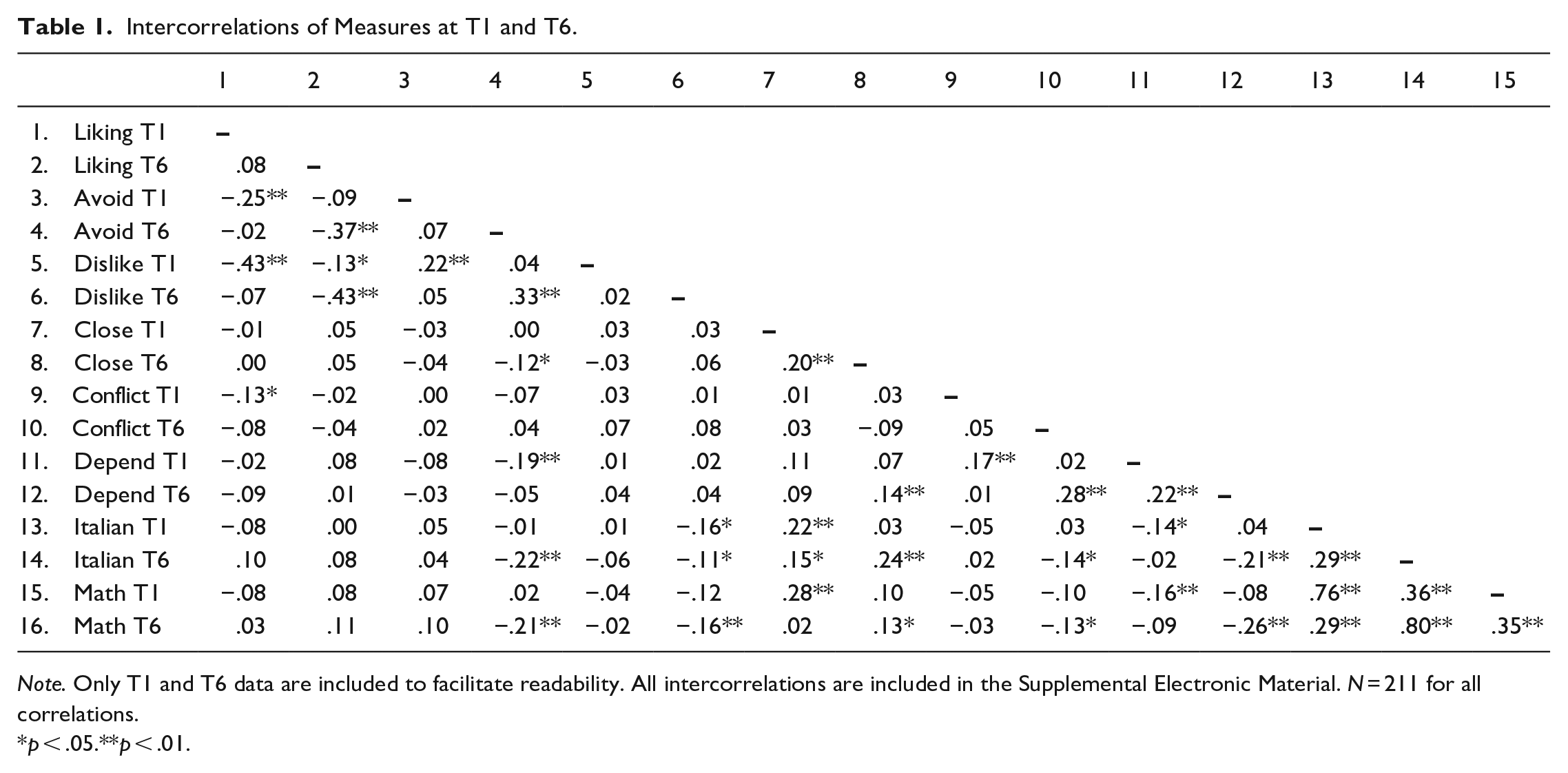
Note. Only T1 and T6 data are included to facilitate readability. All intercorrelations are included in the Supplemental Electronic Material. N = 211 for all correlations.
p < .05.**p < .01.
Descriptive Statistics for School Liking.
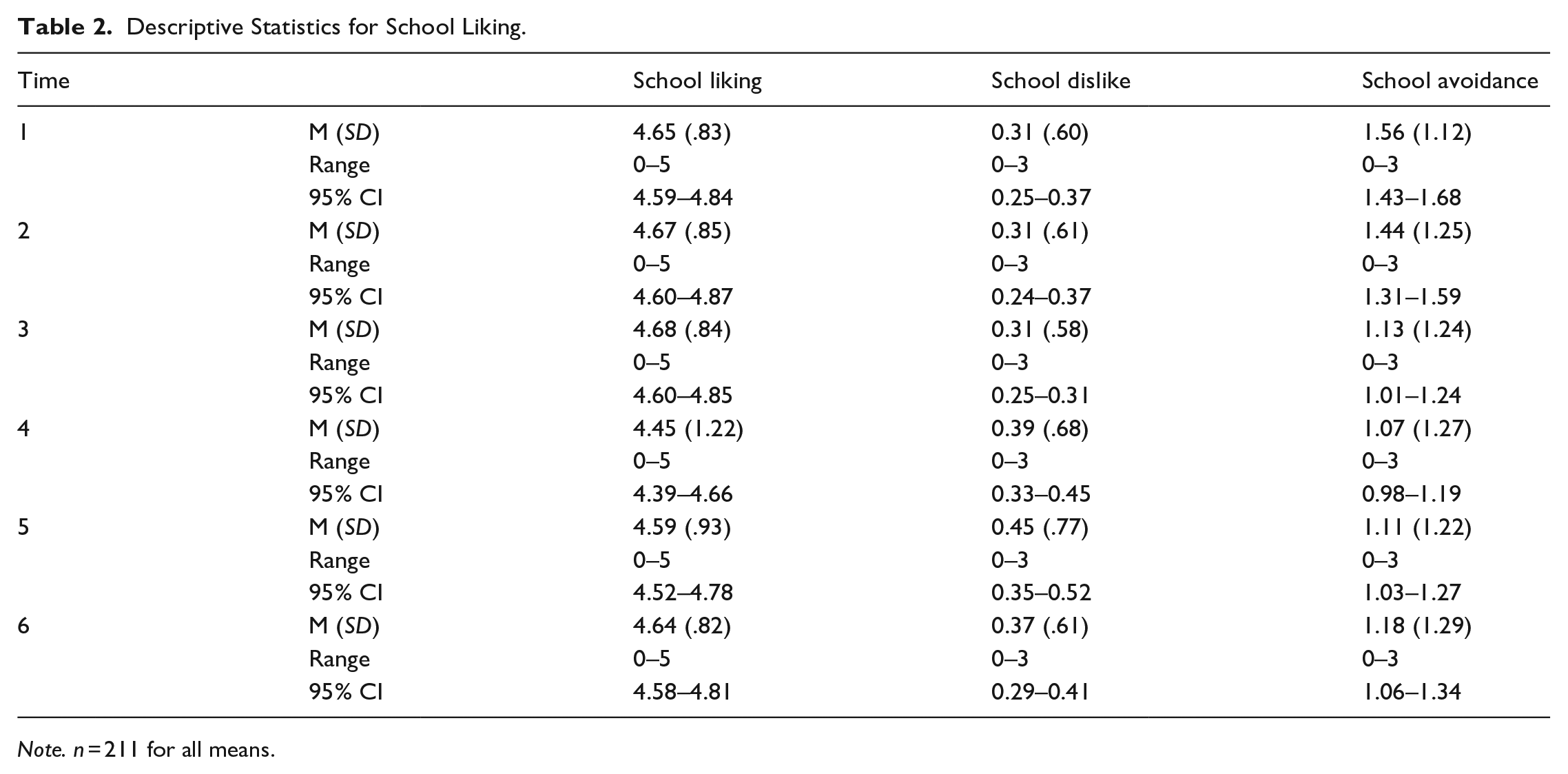
Note. n = 211 for all means.
Fit Indexes for the Sequence of Latent Growth Models for School Liking.
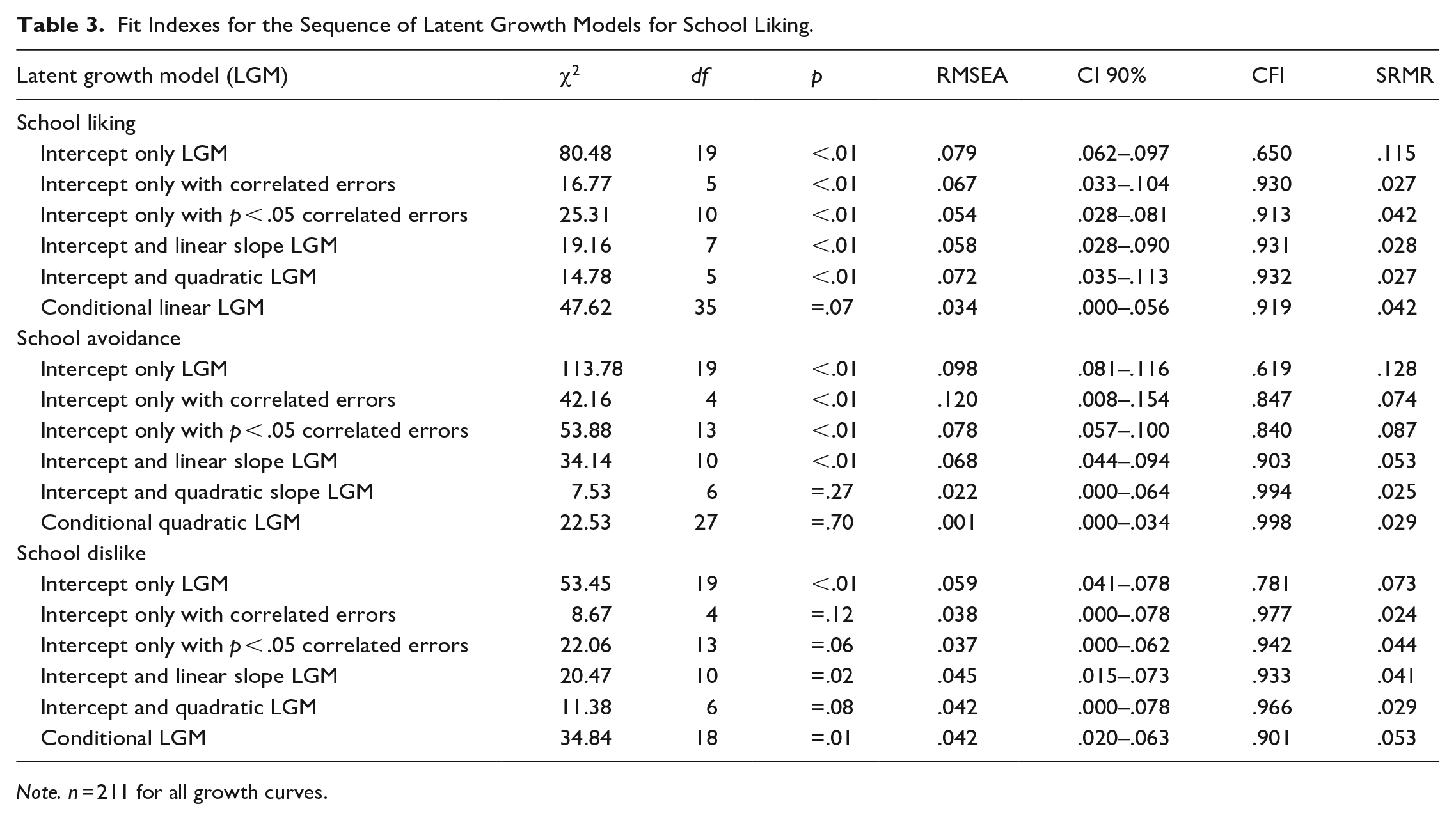
Note. n = 211 for all growth curves.
School Avoidance
We estimated the same sequence of unconditional and conditional LG models for School Avoidance. The best-fitting unconditional (no covariates) model was a quadratic LGM. This model had significant means in the intercept, the linear slope, and the quadratic term. Specifically, the mean for the intercept was 1.544 (p < .001), which estimates the mean school avoidance at Time 1, and the mean linear slope was −0.267 (p < .001), which indicates a decrease in the level of school avoidance during the time span of measurement. The quadratic term mean was 0.04 (p < .001), which may be interpreted as an exponential relation in which the level of avoidance tends to slightly increase again toward the end of measurement time points. No variance for the three terms (random part of the model) was statistically significant (p > .05) which means that these relations were quite homogeneous for all children. No other parameters (correlations among intercept, linear, and quadratic terms) were statistically significant. When risk factors were included in this last model, estimating a conditional LGM, only maternal low level of education had a significant effect on the quadratic term (β = 0.060, p = .019). This result means that the quadratic component is larger for families in which the mother has a lower education level, and therefore, the means of school avoidance increase more rapidly at the final stages of measurement.
School Dislike
Finally, we estimated the sequence of unconditional and conditional LG models for school dislike. In the sequence of unconditional (no covariates) LGMs, the best-fitting models are the intercept-only model with some correlated errors and the corresponding quadratic unconditional model. However, in the quadratic LGM, neither linear slope nor quadratic trend had significant means, variances, or covariances (p > .05). Therefore, the intercept-only LGM was retained as a better and simpler representation of the observed data. This model had a significant mean intercept (M = 0.324, p < .001), with significant variance indicating variability among children (V = .043, p < .001). Given that there is no linear or quadratic trend in the data, levels of school dislike remain constant across the different measurement times. When the conditional model is estimated, only the covariate Maternal Working Class has a significant and negative effect on school dislike (β = −.324, p < .001), indicating that children with working-class mothers tended to score lower in school dislike than others, the opposite of what we expected.
Repeated-Measures ANOVAs: Teacher–Child Relationships
We conducted repeated-measures ANOVA separately for each subscale, with Time as the within-subjects factor and individual risk factors (Low Receptive Language, Male Sex, Working-Class Father, Working-Class Mother, Low Paternal Education, Low Maternal Education) as a between-subjects factor in each of a series of analyses. Power was insufficient to include all these risk factors in a single analysis. Mauchly’s test of sphericity yielded significant results for all variables, so Greenhouse-Geisser corrected statistics were employed to avoid biased results. Table 2 displays means and standard deviations for school liking. Fit indexes are indicated in Table 3.
In summary, our LGMs indicated few significant differences between the at-risk children and their peers. There were a few interesting exceptions, however. The children of mothers of low-SES backgrounds reported more school avoidance than their classmates who were not at risk, especially at the intermediate and final data-collection points. Children of working-class mothers reported higher levels of school liking and lower levels of school dislike than other children, opposite to our hypotheses.
Within-Subjects (Time) Effects
Descriptive statistics for the child–teacher relationship and academic achievement data appear in Table 4, followed by the results for within-subjects (time effects). We report both linear and quadratic effects. Quadratic effects are logical because a transition from preschool to elementary school occurred between the second and third of the six-time points in our study. A quadratic effect would indicate a setback, especially a temporary setback, at the first data-collection point after the transition.
Descriptive Statistics and ANOVA Results for Within-Subjects (Time) Effects.
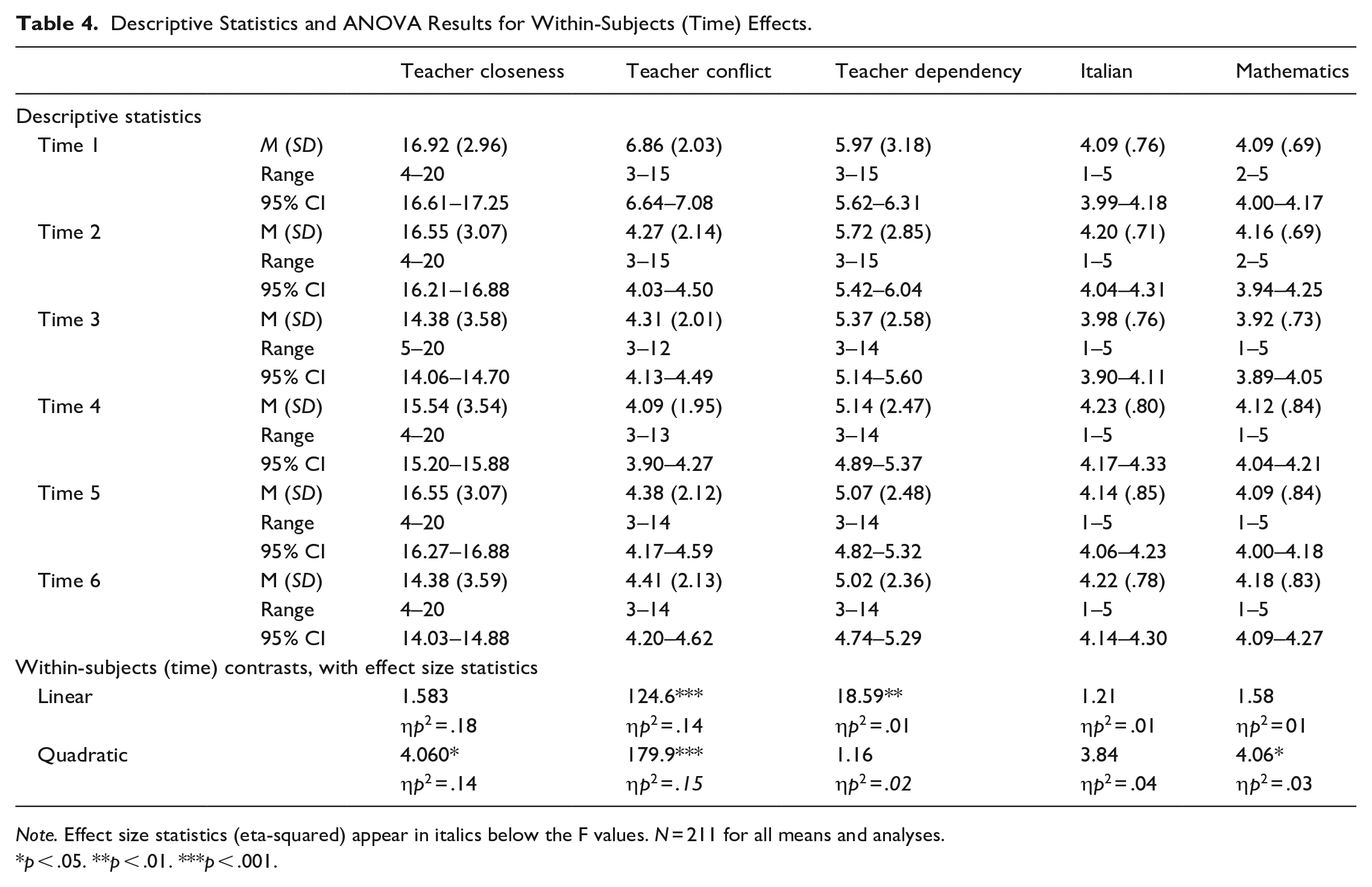
Note. Effect size statistics (eta-squared) appear in italics below the F values. N = 211 for all means and analyses.
p < .05. **p < .01. ***p < .001.
For teacher–child closeness, there was a significant quadratic time effect, but not a significant linear time effect. As corroborated by significant (p < .05) pairwise comparisons, teacher closeness was highest in the final year of preschool and lowest just after the transition at Time 3. This is probably attributable to the fact that, at Time 1 in our study, the children were in the third year of contact with the same teachers. Positive relationships rebounded at the remaining three time points but never to pre-transition levels.
For teacher–child conflict, both the linear and quadratic contrasts were significant. Pairwise comparisons indicated large (p < .001) differences between the high levels of conflict at Time 1 and all subsequent time points. There was another significant (p < .001) decrease in conflict between the beginning and end of the first year after the school transition (Times 3 and 4), with significant (p < .001) rebound, though not to the earliest levels at the beginning of the following year, the final year of the study.
For teacher–child dependency, there was only a significant (p < .01) linear effect. There were several significant (p < .001) pairwise comparisons, consistent with the general picture of a steady decline in teacher–child dependency: between Time 1 and all other time points as well as between Time 2 and Times 3, 4, and 5.
For academic performance in Italian, neither the linear nor quadratic contrasts reached statistical significance, although the quadratic effect was only slightly weaker than conventional levels of significance (p = .052). Several of the fluctuations were significant at the pairwise level, but it is probably best not to over-interpret these changes because of the relatively weak overall effect.
Finally, for academic performance in mathematics, the linear effect was again non-significant, whereas the quadratic effect was significant at the .05 level. Pairwise comparisons reveal significantly (p < .01) lower mathematics ratings at Time 3, after the school transition, than at either of the time points in Year 1. This decline was only temporary, as indicated by significantly higher ratings at Time 4 and at Time 6 than at Time 3.
Between-Subjects Effects (Main Effects)
As shown in Table 5, children at risk in terms of receptive language and the indices of parents’ SES—but not gender—were significantly more dependent on their teachers than were other participants. There was also significantly more conflict between teachers and boys than between teachers and girls. In contrast, teachers reported greater closeness to boys than to girls. There were no other significant main effects of Teacher–Child conflict for receptive language and SES. Participants with lower levels of receptive language were not as close to their teachers as others.
Results of Repeated-Measures ANOVAs: Between-Subjects Main Effects (n = 211).
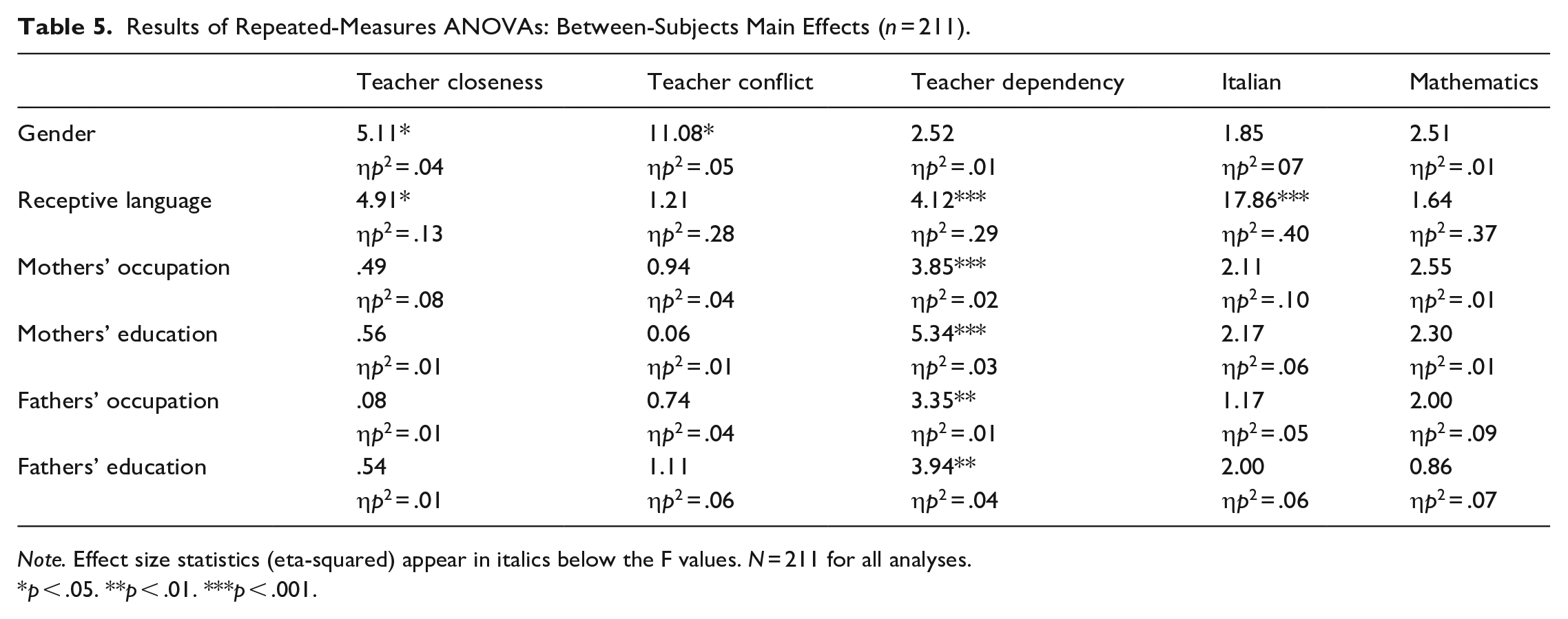
Note. Effect size statistics (eta-squared) appear in italics below the F values. N = 211 for all analyses.
p < .05. **p < .01. ***p < .001.
The final analyses tested interactions between Time and Risk Factors. Of note, only 2 of the 30 analyses resulted in significant interactions. Inspection of the data revealed that the gap between participants of lower SES and other participants decreased significantly (p < .05) over time in two isolated cases: Mother’s Education as a predictor of closeness to the teacher (F = 3.18; p < .05) and Mother’s Occupational Status as a predictor of dependence on the teacher (F = 2.14; p < .01). However, given the number of analyses performed, these effects may be entirely spurious.
Discussion
The goal of this study was to track the progress of Italian children at risk for school failure enrolled in preschools based on the Reggio-Emilia approach into elementary school. Risk factors considered included family SES, child-receptive language, and child gender. Trajectories of at-risk children were predominantly indistinguishable from those of the full sample. Of note, children at risk because of lower SES and poorer receptive language (but not gender) were rated by teachers as more dependent than children not identified by these risk factors. As well, contrary to expectations, children of mothers from lower-SES backgrounds reported liking school more than their higher-SES counterparts. Although at-risk children trailed their peers in some respects, they generally had good relations with their teachers and felt positive about their school experience. They emerged as being more dependent on their teachers than other participants according to most of the indicators of risk we considered. However, the general pattern of findings does not indicate wholesale failure.
The restricted range of scores on many of our measures and the negative skewness of some suggest that most at-risk children are doing well, though it complicated our ability to use conventional statistical procedures.
The Viability of the Reggio Approach for Children at Risk for School Failure
Very little previous research on the Reggio approach pertains to at-risk children (but see Dorfman & Kenney, 2020). Qualitative data on at-risk children participating in Reggio-oriented early childhood education illustrates the potential of the approach but cannot indicate how generalizable the benefits might be to participating at-risk children in general. Our results indicate the viability of the approach for children at risk for school failure because of low SES, limited language development, and male gender. However, the present findings do not speak to the superiority of the Reggio approach compared to others. Such claims would require the inclusion of a control group, with random assignment of schools to educational approaches. However, in this case, such a design is essentially unfeasible, as it would require systematic implementation of some other approach alien to the philosophy of early childhood education that has most pervaded Italian thinking. Unless parents forego their right to choose preschools for their children, there could be substantial self-selection bias.
The present findings support the efficacy of the Reggio-Emilia approach to the degree that the approach is implemented in the daily classroom activities in Genoa schools. Of note, the Reggio approach is complex and multifaceted and is not easily reduced to a discreet set of markers that are easy to enumerate. Prospective teachers must fully learn and understand the approach they use to understand the individual child and devise probing questions and individualized projects that stimulate their intellect and curiosity. The Reggio curriculum is not tightly prescribed and there are no pre-packaged learning materials. Proper probing by the teacher requires not just asking questions of the children but skillfully asking questions in a way that truly stimulates their thinking skills.
Links between At-Risk Status and Teacher–Child Relationships
Across the entire sample, we found a sharp reduction in teacher–child conflict and children’s dependency on their teachers after the first of the six data-collection points. This mirrors general trends reported in the developmental literature (Dodge et al., 2006) and may speak to the effectiveness of the Reggio approach in promoting positive relationships between teachers and children. This improvement over time and across a school transition is likely attributable to the heavy investment in the Reggio approach in preparing both children and parents for upcoming school transitions, as described by Schneider et al. (2014).
Teachers’ relationships with boys were characterized by greater conflict than their relationships with girls, although the teachers reported closer relationships with boys. This is somewhat counterintuitive, results from previous research have indicated that teacher–child relationships can be jointly characterized by both aspects of closeness and conflict (Roorda et al., 2021).
Children from lower SES families and with poorer receptive vocabulary were also found to be more dependent on their teachers as compared to their lower-risk counterparts. This too is consistent with previous research (Murray & Zvoch, 2011; Spilt et al., 2015). At-risk children are likely to require more direct assistance from their teachers than others—which could contribute to the formation of more dependent and less close relationships. Excessive dependence, although not necessarily desirable, may emanate naturally from a need for assistance at school. Results from a recent meta-analysis indicate that child–teacher dependence is generally associated with negative outcomes, with stronger findings for at-risk pupils (Roorda et al., 2021). However, the findings for studies with preschool pupils were not as strong as those with older participants. It is possible that a stage of dependence in early childhood may give way to greater self-reliance later. This was an important tenet of Blatz’s (1966) classic security theory, a forerunner of contemporary attachment theory. Security theory places at least equal emphasis on the achievement of security by becoming self-reliant as on security achieved in close relationships. This is embodied in the definition of security as the ability to accept the consequences of one’s own behavior. Immature dependent security is seen as a transitional mechanism on the way to both mature dependent security and independent security.
Our results also indicated that pupils entering the system with relatively low levels of receptive vocabulary trailed others in language achievement, which is consistent with previous findings (Townsend et al., 2012). However, despite the language-rich school environment afforded by the Reggio approach (Pontecorvo et al., 1991), this lag in language skills does not seem to be reflected in serious difficulty.
SES and School Liking
Finally, and surprisingly, children of mothers from low-SES backgrounds appeared to enjoy school more than their higher-SES counterparts. We can only speculate as to the mechanisms that may underlie this association. Native Italian participants from low-SES homes were less satisfied with their school experience than the general sample. However, the opposite occurred with the sample of immigrant adolescents, who greatly valued their school experience. We could not test this in our sample as only four of the participants of low-SES backgrounds were from immigrant families. The combined exploration of immigration and poverty could be profitable in future research.
Limitations and Future Directions
Although we wanted to use measures recognizable to the international research community, we recognize that our instruments were not developed in Italy. The Italian version of the Peabody Picture Vocabulary Test, thoroughly adapted to the Italian language and well-validated, is the best available instrument for preschool children although alternatives exist for older children. Although we carefully verified the accuracy of the translation of the imported instruments and demonstrated the applicability of their dimensional structures, we, unfortunately, did not have the resources to develop these instruments from scratch in Italy.
We have already mentioned the difficulties in verifying that the Reggio-Emilia approach was implemented as intended in Genoa. This is an inherent limitation that stems from the complexity and multidimensional nature of the approach. Short of arranging in some way for observers well-schooled in the multiple facets of the Reggio approach to attend classrooms in each locality it is virtually impossible to establish how fully the approach is replicated in each location, including but not limited to Genoa. Hence, it is difficult to know whether the implementation of the Reggio approach by the teachers who participated in our study is different in any way from its implementation in the Reggio-Emilia region itself or any other location. As mentioned earlier, the specific projects and other daily activities may vary considerably from one location to another but may still be consistent with the Reggio approach.
In terms of future directions, attention should be paid to the fidelity of cross-cultural adaptations as the Reggio-Emilia approach garners popularity among early childhood educators worldwide. There remains skepticism among U.S. educators about the applicability of the Reggio philosophy to American urban children of low SES (Scheinfeld et al., 2008). However, there is growing evidence of the successful applications of the Reggio approach in the United States. For example, using ethnographic methods (e.g., field notes, video recordings), Acevedo (2019) found that a global enquiry-based curriculum allowed a sample of U.S. Head Start students from different cultural backgrounds to make connections beyond their immediate lives and explore their understandings about the world through play.
More recently, Dorfman and Kenney (2020) describe another successful application of the Reggio approach in Flint Michigan, a U.S. community that suffers from widespread disadvantage and is widely known for its poverty compounded by contaminated water. The staff studied and implemented the Teaching Circle featured in documents from Reggio. The children’s drawings and excerpts of the teachers’ and children’s dialogue indicate that the children’s cognitive and language development benefited. Thus, the challenge of learning the complex, multifaceted Reggio approach may be surmountable even for teachers who were not initially trained in it.
Taken together, these findings suggest that the Reggio-Emilia approach might “level the playing field” in terms of potentially reducing the impact of early childhood risk factors. Despite the sporadic indications of a post-transition lag by at-risk preschoolers, we found little difference between the post-transition adjustment of participants designated as at-risk and others. This may be explainable by other findings, such as the high level of school liking reported by children from families of low SES. Perhaps the dependence on their teachers that at-risk children display is a useful transition mechanism that might be emulated elsewhere. We have no reason to suspect that the experiential approach to academic learning compromises the progress of at-risk children in any way. The substantial investment in activities that facilitate successful transition using a relationship approach could bring benefits to at-risk preschoolers in other parts of the world, as might greater individualization of the content and methods of learning and of the physical space.
Supplemental Material
sj-docx-1-jbd-10.1177_01650254231202705 – Supplemental material for A longitudinal study of school adjustment among children attending Reggio-inspired preschools
Supplemental material, sj-docx-1-jbd-10.1177_01650254231202705 for A longitudinal study of school adjustment among children attending Reggio-inspired preschools by Barry H. Schneider, Mara Manetti, Nadia Rania, José Manuel Tomas, Amparo Oliver, Robert J. Coplan and Quinlan Taylor in International Journal of Behavioral Development
Footnotes
Acknowledgements
Thanks to Angela Yuan and Kha Dinh for their help with the manuscript preparation.
Funding
The author(s) disclosed receipt of the following financial support for the research, authorship, and/or publication of this article: This research was funded by a grant from the Social Sciences and Humanities Research Council of Canada.

Supplemental Material
Supplemental material for this article is available online.
References
Supplementary Material
Please find the following supplemental material available below.
For Open Access articles published under a Creative Commons License, all supplemental material carries the same license as the article it is associated with.
For non-Open Access articles published, all supplemental material carries a non-exclusive license, and permission requests for re-use of supplemental material or any part of supplemental material shall be sent directly to the copyright owner as specified in the copyright notice associated with the article.
