




Abstract
The internet constitutes an important platform for parents to find information. How online information searching is linked to parental self-efficacy (PSE)—defined as parents’ perceptions about their abilities to have a positive impact on their children—is still unknown. This two-wave study examined cross-lagged associations between PSE and parents’ online information searching, as well as the prospective effect of perceived information overload on PSE and online information searching. Moreover, we examined whether these associations differed depending on the online context (governmental-run or nongovernmental-run websites). We used a sample of 214 parents of children (equal number of boys and girls) <4 years (85% of the parents were mothers and 93% were born in Sweden), who completed an online survey twice, 1 year apart. The results showed that parents who felt more efficacious at T1 reported a decrease in online information searching over time. The frequency of parents online searching, however, did not predict changes in PSE. In addition, the effects of information overload depended on the type of websites parents used. Among parents who used both types of websites to search for information, higher information overload was linked with increases in information searching and decreases in PSE over time. The results suggest that perceptions of low self-efficacy and feelings of overload might motivate parents to use the internet more to search for information.
Introduction
Parents today face an increasing amount of information about parenting available to them online. For example, a 2022 search of “parenting” in Google resulted in 1,850,000,000 million results. Searching for information about parenting-related issues has been listed as the most important reason for parents to use the internet (e.g., Haslam et al., 2017; Pretorius et al., 2019; Strange et al., 2018) and most parents use the internet for this reason everyday (e.g., Baker et al., 2017; Laws et al., 2019). For example, mothers start searching for parenting-related information already during pregnancy, and this increases even more at the end of the pregnancy and a couple of weeks after giving birth (Plantin & Daneback, 2010). Many parents value the internet as it provides support and information on various parenting issues (Lupton, 2016; Lupton et al., 2016; Porter & Ispa, 2013; Valan et al., 2018). From a developmental perspective, searching for information online might help parents in the transition to parenthood—a phase that begins at conception and continues into the child’s first years of life (Demick, 2002)—and this information might play a role in parents’ identity formation and development (Madge & O’Connor, 2006).
How online information is linked to parents’ self-efficacy (PSE)—defined as parents’ perceived ability to positively influence their child’s wellbeing and adjustment (Bandura, 1977, 1997)—is not clear. More online parenting information may make parents feel more efficacious in their parenting role, as they might either receive validation for their present parenting practices or find out about other practices that could be better suited to their specific situation (Price et al., 2017). However, online parenting information may also be overwhelming, confusing, or stressful for parents, leading to less confidence in their parenting. In addition, parents might be more or less active in their information searching depending on their level of self-efficacy, that is, PSE might not only be a consequence but also a predictor of online information searching. Yet, the association between parents’ online information searching about parenting and PSE has not been tested empirically. It is unknown whether online information searching increases or decreases PSE and whether this might depend on other factors. Such knowledge is important because parents with higher PSE are more likely to effectively parent their children, with positive benefits for child (and parent) wellbeing (e.g., Glatz & Buchanan, 2015b).
A useful model to understand individuals’ online information searching behaviors is Knight and Spink’s interdisciplinary model of Web-based information seeking and searching behavior (Knight & Spink, 2008). In line with this model, online information searching about parenting should be understood in the context of (1) parents’ need for information, (2) parents’ psychological processes leading to and occurring during information searching (e.g., the individual’s cognitions and emotions), and (3) the complex electronic information environment such as characteristics of websites (Knight & Spink, 2008). Guided by this model, in this longitudinal study, we examine the bidirectional associations among parents’ online information searching and PSE, as well as the prospective effect of parents’ perceived information overload on these effects. In addition, we examine how these relationships may vary depending on whether parents retrieve information from websites run by the government or by other nongovernmental organizations.
PSE as a Predictor of Parents’ Online Information Searching
PSE might work as a predictor of parents’ use of the internet to search for parenting information. According to Knight and Spink’s (2008) model, parents’ online searching behavior starts with a perceived need for information about parenting that is manifested in the use of specific internet information seeking behaviors (i.e., searching strategies), but this process might depend on parents’ cognitions, such as beliefs about their efficacy (i.e., their self-efficacy PSE).
On one hand, PSE might negatively predict the frequency of online searches. Being relatively new in their role, parents of young children are developing their identity as parents, and the internet can play an important role in this process (Price et al., 2017). Parents who feel less efficacious might feel a stronger need to seek and retrieve online information about how to deal with parenting difficulties, such as child behaviors that they have never experienced before. Some studies have indeed indicated that parents’ feelings of insecurity can drive them to seek information on the internet (Valan et al., 2018). In contrast, parents who feel efficacious in their parenting role might be less likely to seek out parenting-related information, as they might not need validation on their current decisions and parenting practices. In other words, it is possible that parents who feel more efficacious use the internet less to search for parenting information than parents who feel less efficacious.
On the other hand, it is possible that PSE positively predicts online information searching. According to social cognitive theory (Bandura, 1997), higher PSE might make parents continue trying to find solutions to any challenges and problems they face. Therefore, parents with high PSE may be more likely to search for parenting information to get new ideas. In contrast, parents with low PSE may give up when faced with parenting challenges, resulting in fewer searches. Thus, it is possible that parents who feel more efficacious search for parenting information online more frequently than do parents who feel less efficacious.
Parents’ Online Information Searching as a Predictor of PSE
People tend to seek information and use it to make sense of new situations. Parents are likely to do the same for situations related to their parenting role. Online information can be used to learn a certain skill or reach a goal, to generate ideas on certain topics, and as a guide for decisions (Wilson, 1999). Information gained from searching online might also help parents who feel insecure about their parenting, by offering multiple ideas on how to handle challenging situations, and, thus, leading parents to feel more efficacious once they do face these challenges. As such, online information could be a determinant of PSE, as described by Bandura (1997), specifically as a point of reference to model against (i.e., vicarious experiences) and get ideas from. Furthermore, information found online can make parents feel validated in their parenting strategies, thus sending them the message that they are in control and acting “correctly.” Therefore, online information might increase PSE, as it offers new ideas or provides confirmation that already practiced behaviors are appropriate.
Information Overload and PSE
Although information in general can influence parents, how different parents feel about, and handle information from internet searches might have an additional and unique impact on their PSE. In line with Knight and Spink’s (2008) Web search information behavior model, parents’ inner processing of the information (i.e., how they understand and think about the information they retrieve) may also affect their PSE and searching behavior. This means that, in addition to the identified need for information, parents’ way of interpreting the information they retrieve matters for how useful it will be. Some parents might lack the tools to deal with the information they find online, which can cause confusion or stress (Valan et al., 2018). As people tend to interpret symptoms of stress as indicators of dysfunction, which can have a negative impact on self-efficacy beliefs (Bandura, 1997), having negative experiences in relation to online parenting information might weaken PSE, rather than strengthen it. In this study, we use the concept of information overload to explore parents’ ways of dealing with online parenting information.
Information overload is defined as the tipping point when the information input exceeds an individual’s processing capacity (e.g., Jackson & Farzaneh, 2012; Roetzel, 2019; Speier et al., 2007). Information overload involves feeling overwhelmed and stressed by the information one retrieves, which can result in feeling more confused than knowledgeable about the topic. When individuals are faced with too much information, information that is too complex or information that is contradicting, the quality of the individual’s decision-making is reduced because of the individual’s limited resources to process the information (Roetzel, 2019). In this study, we explore parents’ information overload as a concept distinct from information searching and examine its effect on PSE and parents’ continued online information searching.
The Online Context
As the last piece in Knight and Spink’s (2008) Web-based information model, the online context itself (i.e., type of website) needs to be considered. Most often, people start searching for information using search engines, which leads them to visit different websites (Purcell et al., 2012). These websites vary in the credibility and accuracy of the information they contain. Many studies have found issues with the quality of the information presented on websites, and many sites contain inconsistent, incomplete, and inaccurate information (Eysenbach et al., 2002). Nonetheless, parents appreciate the convenience and speed of the internet for obtaining information, and many are unaware of misinformation and perceive the information on the internet as accurate (Moon et al., 2019; Valan et al., 2018; Whyte & Hunter, 2008). Given the plethora of online information, parents often must sift through many websites, evaluate their credibility, and decide which information to trust (Briggs et al., 2002, 2004), which many find overwhelming (Moon et al., 2019), and lead to information overload. Parents often do not pay attention to indicators of credibility, but sites that are run by experts or respected organizations, such as governmental websites, are more likely to be trusted and are also more likely to contain accurate information (Morahan-Martin, 2004).
One categorization that might be important to take into account is whether the website is governmental-run or not (i.e., any sites that are not run by the government, including searches on general search engines like Google). In Sweden, where the data collection took place, there is one dominant governmental-run webpage: 1177 (http://1177.se) that aims to offer citizens information and advice about their health and their need of care. All information on the webpage is quality-secured and user-friendly, and the information is produced in collaboration with experts who work in different healthcare-related contexts. During 2020, the monthly visits to the webpage were between 15,000,000 and 20,000,000. One nongovernmental website that is used frequently in Sweden is familjeliv.se (translated to “family life”). It focuses on questions regarding pregnancy, children, and parenting, and contains blogs and discussion boards. These are two examples of governmental and nongovernmental websites, which might differ on the information being posted.
The type of website (i.e., governmental vs. nongovernmental run websites) may moderate the associations among online information searching, information overload, and PSE. First, because government-run sites are perceived as more trustworthy and are more likely to be accurate, retrieving information from government-run websites might be associated with higher PSE. In contrast, when general searches and information from nongovernmental sites are conducted, inconsistent information may be found, and searches may lead to reductions in PSE. In line with this, we expected that the association between information searching and PSE would be positive for parents who use only governmental websites, and negative for parents who use both types of websites. Second, given that information on websites with lower creditability might more often be a source of information overload, we expected that information overload would be higher and the negative effect on PSE would be stronger among parents who conduct general searches, as compared with government-specific searches. Third, high information overload might lead to more frequent internet searching for parents who use general searches, as they may continue searching to try and reconcile inconsistent information and reduce confusion.
The Present Study
In this two-wave study, we examined cross-lagged associations between PSE and online information searching. In addition, we examined parents’ perceived information overload as a predictor of changes in PSE and online information searching. The aim was to get a better understanding of the reasons behind parents’ information searching behaviors as well as their consequences. We used a sample of parents of children <5 years of age at T1, as this is a time when many parents use the internet to find parenting information, and it can play an important role in their parent identity process (Madge & O’Connor, 2006; Plantin & Daneback, 2010). We also examined the potential effect of the online context from which parents retrieved the information. Specifically, we divided parents into two groups depending on whether they used only governmental-run websites or also other sites to retrieve parent-related information. In Figure 1, we present our conceptual model, which illustrates our research questions and hypotheses.
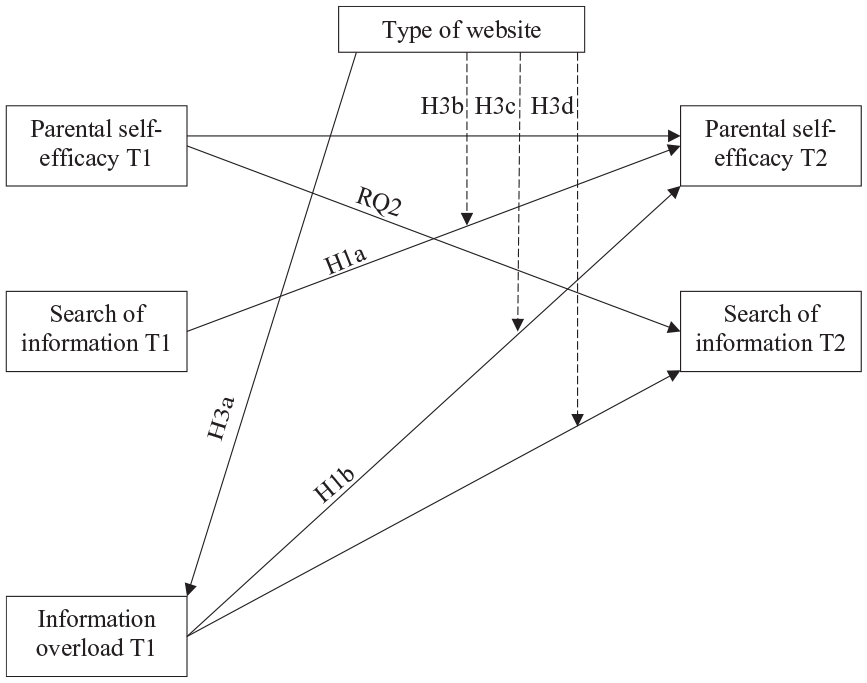
Conceptual Model of Associations Among Parents’ Online Information Searching, Perceived Information Overload, Parental Self-Efficacy, and Type of Website.
RQ1: What is the effect of parents’ online information searching and information overload on PSE? – We hypothesized that parents who search more often for information online would increase in PSE in comparison to parents who use the internet less often to search for parenting information (Hypothesis 1a). – We also expected that parents who experience more information overload would report lower levels of PSE than parents who experience less information overload (Hypothesis 1b).
RQ2: What is the longitudinal effect of PSE on parents’ searching of information online? As theory and research suggest that PSE might either predict increases or decreases in searches for parenting information online, we investigated this question in an exploratory way with no directional hypothesis.
RQ3: Do parents differ depending on the type of websites (i.e., governmental and nongovernmental websites) they use to search for parenting information? – We hypothesized that parents who use both governmental and nongovernmental websites to search for information would report more information overload than parents who use only governmental-run websites (Hypothesis 3a). – We expected that for parents who use only governmental websites, the association between information searching and PSE would be positive, but the same association would be negative for parents who use both governmental and nongovernmental websites (Hypothesis 3b). – We hypothesized that the negative effect of information overload on PSE would be stronger among parents using both governmental and nongovernmental websites compared with parents using only governmental websites (Hypothesis 3c). – We expected that more information overload would be associated with more internet searching especially for parents who use both governmental and nongovernmental websites (Hypothesis 3d).
Method
Participants and Procedures
The sample of this study was drawn from a larger project on parents’ use of the internet and social media (for detailed information on the procedures for data collection, see Glatz et al., 2023). This project received ethical approval from the Swedish National Board (Dnr: 2019-04790) and in this study we used data collected at the first two time points (beginning of 2020 [T1] and beginning of 2021 [T2]). In compensation for participation, parents received 50 Swedish crowns (approximately US$5). Parents were recruited both online (at local family support centers) and offline (on parenting sites and forums, parenting blogs, and in Facebook-groups for parents). All parents, independent of recruitment context, responded to the same survey via a secure online platform handled by the university. The survey took approximately 20–30 min to complete, and parents could fill it out either on their smartphone or a computer.
The sample included 214 parents (85% mothers) of children <5 years of age (Mage = 1.78, SD = 0.91). Parents had either one (46%), two (42%), or more than two (2%) children. Most of the parents were born in the country of data collection (Sweden, 93%) and the majority were living with a partner at the time of the data collection (94%). Most parents (80%) had a post-secondary education and only 3% were unemployed at the time of the data collection. Among the children, there was an equal number of boys (50%) and girls.
We focused our analyses on parents who completed both waves of data collection (50% of the total sample at T1). This sample was used because (1) we were interested in changes over time in PSE and information searches, and (2) information about the type of websites used for information searching was only asked at the second time point (see “Measures” section below). We compared parents in our sample (n = 214) with parents who had data only at T1 (n = 205), on PSE, online information searching, and online information overload—all at T1. The results from an independent sample t-test showed that parents in our sample reported significantly more online information searching (M = 2.94; SD = 0.96) than did parents who provided data only at T1 (M = 2.66; SD = 0.96), t(418) = 3.04; p = .002. No significant differences were found between our sample and parents excluded from the study on PSE or information overload.
Measures
Online Information Searching
Parents answered one question at both T1 and T2: “How often do you search for information online that is connected to your parenting role or your child?” This question was used as a single-item measure of frequency of information searching and was developed for the larger project. Response options ranged from 1 (never) to 6 (several times a day).
Parents’ Perceived Online Information Overload
Four items were used to examine parents’ information overload at T1 (Jackson & Farzaneh, 2012; Roetzel, 2019; Speier et al., 2007). These questions were based on earlier qualitative research on parents’ ways of dealing with online information (Strange et al., 2018; Valan et al., 2018) and have been used in studies on parents’ internet use (Glatz et al., 2023). The aspects covered in the questions overlapped with the three aspects introduced by Roetzel (2019) and were specific to situations that can cause information overload: when the amount of information is too much, too complex, or contradictory. The questions about information overload used in this study are also similar to earlier scales of information overload that have been used in other populations (e.g., Jensen et al., 2014; Williamson & Eaker, 2012).
The following were the four information overload questions: “Do you ever find so much information online about a certain topic related to your parenting role that you do not have the ability to prioritize what information is more relevant,” “Do you ever find information online related to your parenting role or your child that makes you confused,” “Do you ever find online information that deals with the same aspect, but suggest different solutions,” and “Do you ever get stressed by the parent-related information you find online?” Response options ranged from 1 (never/almost never) to 4 (always/almost always). Items were averaged to develop an overall scale, where higher scores indicate more information overload (α = .70).
Parental Self-Efficacy
We used the Karitane Parenting Confidence Scale (KPCS; Črnčec et al., 2008) to measure PSE. The original measure consists of 15 items, but for this study, we excluded two questions given their focus on support from a partner. Examples of the 13 questions are: “I’m confident in helping my child to establish a good sleep routine,” “I can soothe my baby when he/she is distressed,” and “Other people think I am doing a good job as mother/father.” Some changes were made to the wordings on three items at T2 to adapt to the child’s increasing age (e.g., “I’m confident in feeding my baby” was changed to “I’m confident in making my child eat well”). Response options ranged from 1 (no, almost never) to 4 (yes, most of the time). Items were averaged to develop an overall scale, where higher scores indicate higher PSE. These measures were used at both time points (α = .70 at T1 and α = .73, at T2).
Governmental-Run Versus Nongovernmental-Run Websites
At T2, parents were asked two questions about their online information searches: “How often do you search for parenting-related information on pages that are run by non-governmental actors (e.g., Familjeliv, Libero)?” and “How often do you search for parenting-related information on sites run by the government (e.g., 1177.se)?” Response options for all questions ranged from 1 (never) to 6 (several times a day). These two questions were used to identify the type of websites parents most often used to search for information (rather than only the frequency of information searching above). Using these questions, we divided parents into two groups based on whether they had answered never or any of the other response options: (1) both nongovernmental and governmental (n = 117) and (2) only governmental and not nongovernmental (n = 97).
Statistical Analyses
All analyses were performed using Mplus 7.11 (Muthén & Muthén, 1998–2012) with the Maximum Likelihood estimator. To evaluate model fit, we used three indices: Comparative Fit Index (CFI), Tucker–Lewis Index (TLI), and Root Mean Square Error of Approximation (RMSEA). CFI and TLI values closer to 1.00 and RMSEA values closer to .00 are preferrable, but CFI and TLI values between .90 and .95, and RMSEA values between .05 and .08 are considered indicators of an acceptable fit (Byrne, 2012).
We ran two cross-lagged panel models with observed variables, controlling for stability in all measures and estimating within-time associations. In the first model, we examined the bidirectional relations between PSE and online information searching. In the second model, we added information overload as an additional predictor. In both models, we used group comparison tests to examine moderation by type of website that parents used (i.e., differences in the cross-lagged paths depending on whether they used both nongovernmental and governmental websites vs. only governmental websites). This was done by comparing models with parameters kept equal between these two groups to models with parameters free to vary. In all models, we used gender of the parent as a control variable (coded as 1 = fathers and 2 = mothers), as results showed that mothers reported significantly higher PSE and more frequent information searching than did fathers at both T1 and T2.
Results
Descriptive Statistics
Table 1 reports means, standard deviations, and correlations for all study variables. Among parents who used governmental websites only, higher level of PSE at T1 was associated with lower information searching at T2. Among parents who used both governmental and nongovernmental websites, more information overload at T1 was significantly associated with more information searching and lower PSE at T2. The two groups differed significantly on online information overload at T1, t(212) = 3.03; p = .003, and information searching at T2, t(212) = 5.27; p < .001. Parents who used both governmental and nongovernmental websites reported more information overload and more information searching at T2 than parents who used governmental websites only.
Means, Standard Deviations, and Correlations for Study Variables.
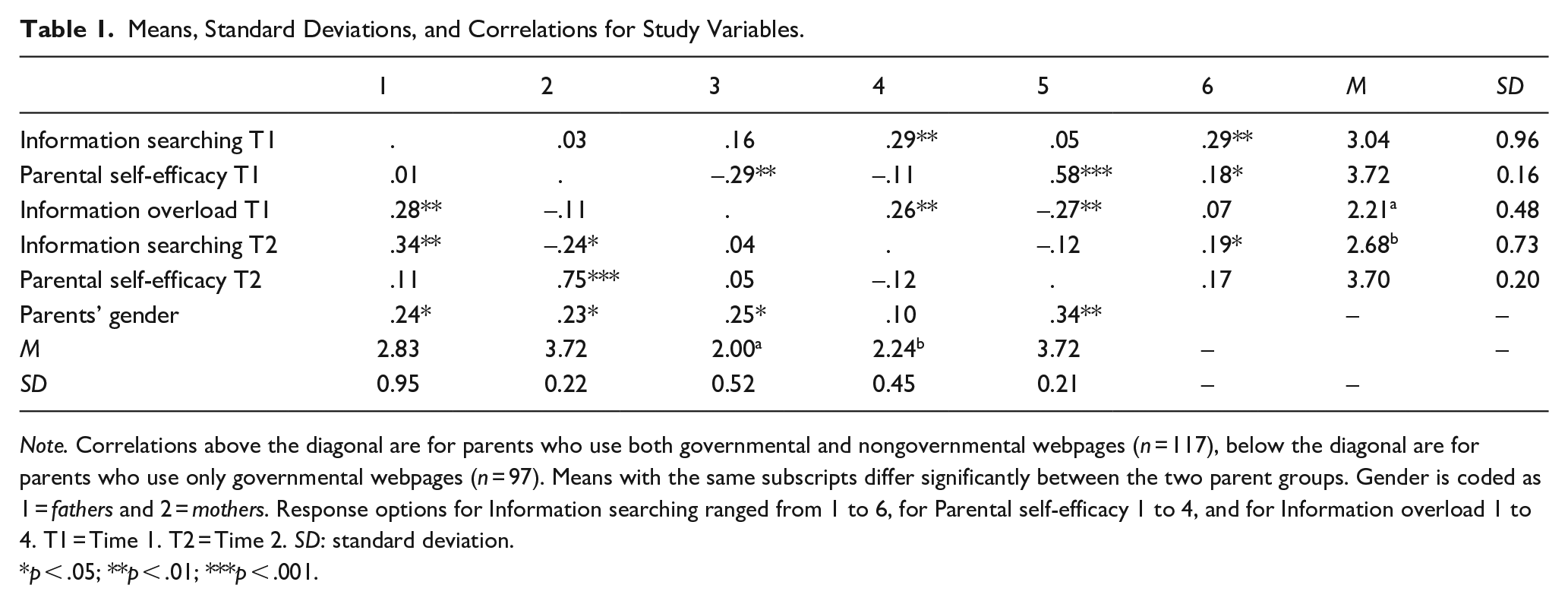
Note. Correlations above the diagonal are for parents who use both governmental and nongovernmental webpages (n = 117), below the diagonal are for parents who use only governmental webpages (n = 97). Means with the same subscripts differ significantly between the two parent groups. Gender is coded as 1 = fathers and 2 = mothers. Response options for Information searching ranged from 1 to 6, for Parental self-efficacy 1 to 4, and for Information overload 1 to 4. T1 = Time 1. T2 = Time 2. SD: standard deviation.
p < .05; **p < .01; ***p < .001.
Associations Between PSE and Online Information Searching
In the first model (see Table 2) we tested the cross-lagged paths between PSE and information searching. The main estimates of interest did not differ significantly in strength between parents who used only governmental websites to search for information and parents who used both nongovernmental and governmental websites, ∆χ²(1) = 0.31, p = .575 and ∆χ²(1) = 0.00, p = .976, suggesting that the relations between PSE and online information searching did not significantly differ based on the type of website (i.e., governmental run vs. nongovernmental run). For this reason, the relationships between PSE and information searching were set to be equal across the groups. The final model fitted the data very well, χ²(2) = 0.35, p < .839; CFI = 1.00; TLI = 1.00; RMSEA = .00 (95% CI = .00 to .11). Higher levels of PSE at T1 were associated with a lower frequency of online information searching at T2. Searching for information online, however, did not significantly predict the level of PSE.
Estimates From Cross-Lagged Path Model With PSE and Online Information Searching.
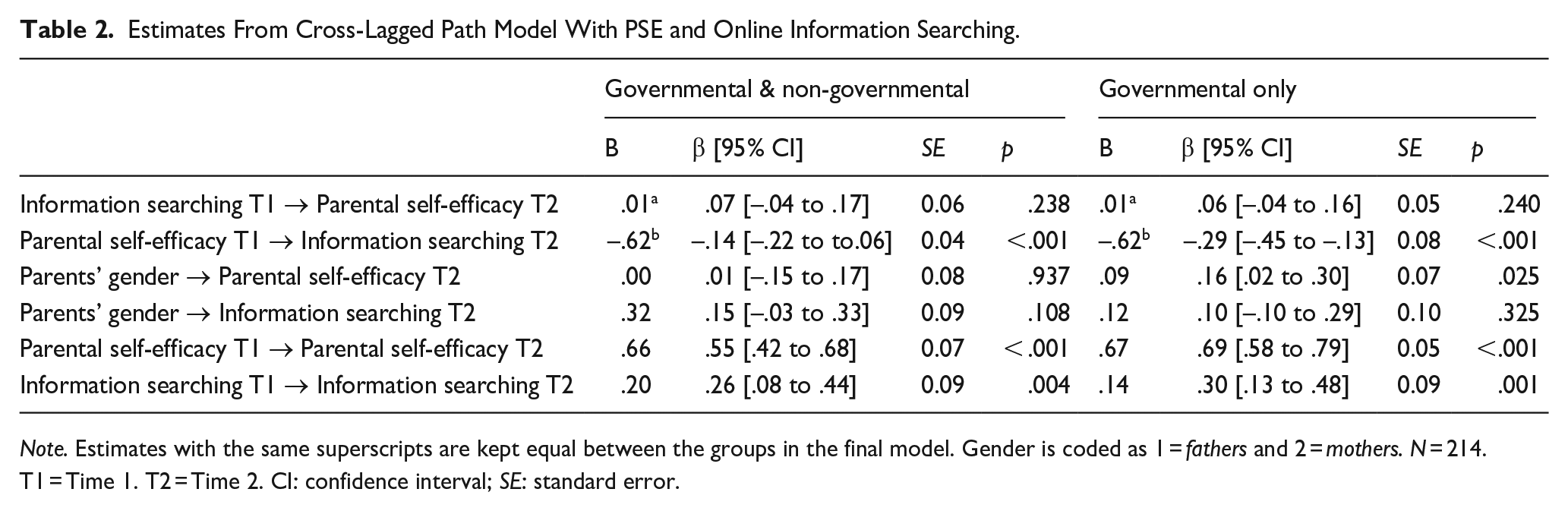
Note. Estimates with the same superscripts are kept equal between the groups in the final model. Gender is coded as 1 = fathers and 2 = mothers. N = 214.
T1 = Time 1. T2 = Time 2. CI: confidence interval; SE: standard error.
The Effect of Parents’ Perceived Information Overload
In Model 2, we examined the effect of parents’ perceived information overload on their PSE and online information searching at T2 (see Table 3), while still examining the association between information searching online and PSE. Differences were found between the groups regarding the predictive effect of perceived information overload on PSE, ∆χ²(1) = 5.26, p = .022, and online information searching, ∆χ²(1) = 5.50, p = .019. The final model in which these two estimates were free to vary between the two parent groups (but the equality constraints were kept for the estimates involving PSE and information searching as was estimated in the model above) showed a very good fit to the data, χ²(2) = 0.51, p < .777; CFI = 1.00; TLI = 1.00; RMSEA = .00 (95% CI = .00 to .13).
Estimates From Cross-Lagged Path Model Including Information Overload.
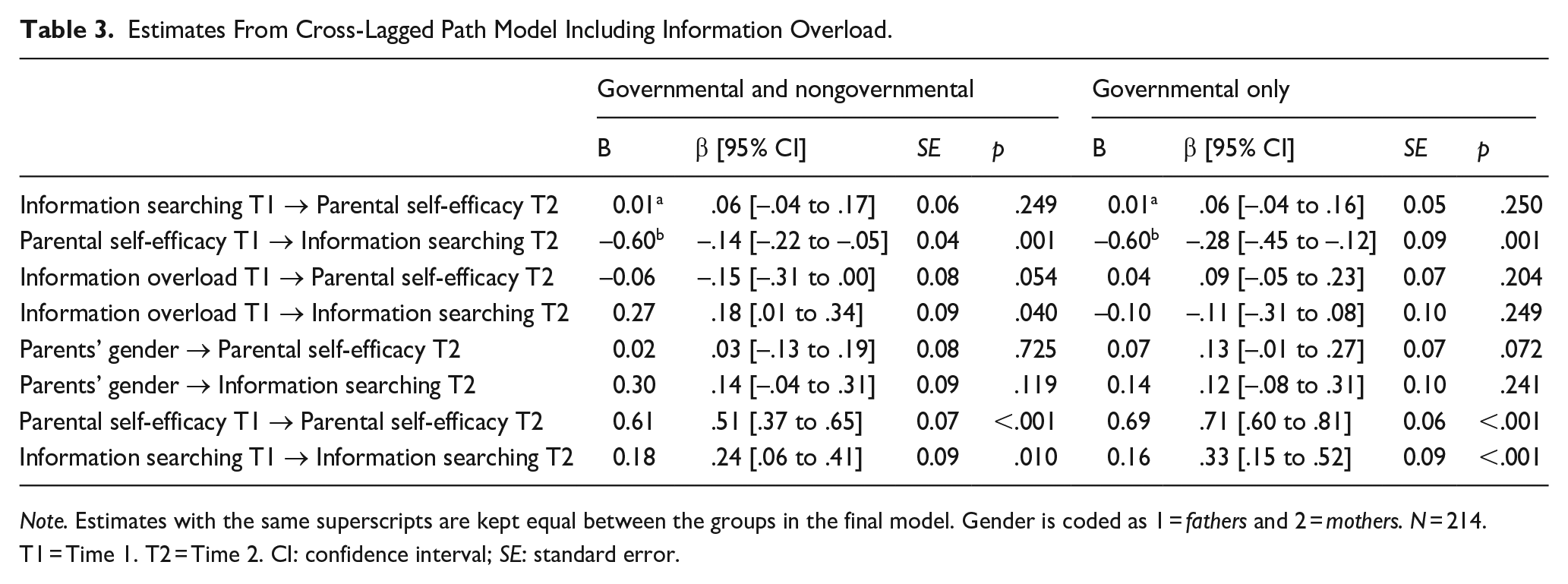
Note. Estimates with the same superscripts are kept equal between the groups in the final model. Gender is coded as 1 = fathers and 2 = mothers. N = 214.
T1 = Time 1. T2 = Time 2. CI: confidence interval; SE: standard error.
However, the effects of information overload on both PSE and information searching differed based on the type of websites and were stronger among parents who used both types of websites than among parents who used only governmental run websites. Among parents who used governmental websites only, information overload did not significantly predict PSE (β = .09, p = .204) or information searching (β = –.11, p = .249) at T2. However, among parents who used both governmental and nongovernmental sites, online information overload was a significant predictor of the frequency of information searching at T2 (β = .18, p = .040), and a marginally significant predictor of the level of PSE at T2 (β = –.15, p = .054).
Discussion
The internet constitutes an important platform for parents, and especially parents of younger children (Demick, 2002; Madge & O’Connor, 2006). Most parents value the internet as an accessible source of information and support about parenting (Haslam et al., 2017; Lupton, 2016; Lupton et al., 2016; Porter & Ispa, 2013; Pretorius et al., 2019; Strange et al., 2018). Although we may assume that information gained online has a positive influence on parents, and strengthen them in their parenting role, the association between online information searching and PSE had never been empirically examined. Guided by the model of Web-based information seeking and searching behavior (Knight & Spink, 2008), we examined the cross-lagged associations between parents’ online information searching and PSE. We also examined the prospective effect of parents’ perceived information overload on PSE and online information searching. As the larger online context may play a role in these effects (Knight & Spink, 2008), we examined the moderating effect of the type of websites parents use on these prospective associations.
PSE Predicts More Frequent Information Searching, but Not Vice Versa
Results showed that parents who had lower levels of PSE searched for online information more frequently, but no evidence was found for the reverse effect: information searching did not significantly predict the level of PSE. This indicates that parents’ perceptions about their efficacy seemed to influence how often they searched the internet to find parenting information: the more efficacious they felt, the less they used the internet to search for information. This result supports the idea that the internet is used as a source of information for insecure parents who are in need of support and validation in their parenting practices (Valan et al., 2018). Specifically, insecure parents might go online with the purpose of learning new skills or to discover new ideas on how to handle certain parenting-related challenges (Wilson, 1999). In contrast, parents with higher self-efficacy might not see the need to search for information as they already feel confident about their parenting. It is also possible that parents with lower PSE search more frequently for information online because they have limited social support offline. A lack of social support has been related to lower PSE (Fang et al., 2021) and to extensive internet use in other populations (e.g., Lu et al., 2023). Therefore, parents who feel less efficacious and who have limited social support offline might actively use the internet to get informational support (and perhaps to some degree emotional support) in their parenting role. These ideas need to be empirically tested. To conclude, the internet may play an important role for parents who feel insecure about their parenting role.
Although parents may search for parenting information online with the goal of feeling more in control and becoming more competent, searching and retrieving information online might not have a positive effect on their self-efficacy. The association between information searching and PSE was nonsignificant. It is possible that information in itself is not enough to influence PSE, and perhaps not as effective as offline social support. In addition, parents might need help to digest, understand, and apply the information gathered online for it to strengthen their PSE. More research is needed to understand under what circumstances and for whom more frequent online information searching can either positively or negatively affect PSE.
The Role of Information Overload
In addition to generic online information searching, we examined the effect of information overload. The results showed that information overload was more important for parents’ level of PSE (higher levels of overload significantly predicted lower levels of PSE) than was online information searching frequency (higher levels of online information searching were associated with lower PSE, although not significantly). Parents who lack the tools to deal with online information might feel overwhelmed by it, and the confusion and stress it generates (Valan et al., 2018) may lower their feelings of self-efficacy. Information overload happens when the information input exceeds an individual’s processing capacity (e.g., Jackson & Farzaneh, 2012; Roetzel, 2019; Speier et al., 2007). When the information is too complex, too extensive, or contradictory, the individual might not be able to process and use the information in an effective way (Roetzel, 2019). All in all, searching for information might not be enough to improve PSE, but if the online information is understandable and logical (i.e., if parents report low information overload), it might benefit their self-efficacy. For parents who experience much overload, however, this might harm their self-efficacy.
The Importance of the Online Context
Following our conceptual model (Knight & Spink, 2008), we explored the possible moderating effect of the online context for information searching. In line with our expectations, the association between information overload and PSE was different depending on whether parents used only governmental-run websites or other sites. Parents who used both governmental and nongovernmental-run sites reported more information overload than did parents who used only governmental-run websites (consistent with H3a), and they also searched for more information at T1. These findings support earlier findings that the use of numerous sources of information can be overwhelming (Moon et al., 2019) and suggests that a more targeted use of sites that are trustworthy may be more beneficial for parents. The information overload might also be a result of the content of the websites. It is possible that the information on governmental websites is more practical and offers more support for parents in their everyday parenting practices. Information on nongovernmental websites, however, might be based on non-scientific material and may be more likely to promote some societal norms about parenting, such as the “intensive parenting” norm (Hays, 1986; Rizzo et al., 2013). This norm can be stressful for parents because it places high demands on being a “perfect” parent, without offering clear advice that can be helpful. These are speculations, and future research should disentangle what types of parenting norms are illustrated on different websites. Taken together, our results suggest that information on governmental-run websites that are deemed as credible sources might reduce parents’ experiences of information overload.
The effects of information overload on PSE and online information searching differed significantly in strength between parents depending on what websites they used. Among parents who used both types of websites, higher information overload marginally predicted lower levels of PSE over time (partly consistent with H3c) and significantly predicted more information searching over time (consistent with H3d). Yet, these associations were not significant among parents who used only the government site. These results suggest that searching on all types of websites can create a negative cycle, where information overload leads to more searching, but, in line with Bandura’s (1997) social cognitive theory, not higher self-efficacy. This may have negative implications for parents and children, as inefficacious parents more often use less effective and less warm parenting practices (e.g., Glatz & Buchanan, 2015b).
Interestingly, although the effects of information overload on PSE and on information searching differed based on the type of site parents used, the effect of PSE on information searching did not. Thus, for both groups, parents who felt less efficacious were more likely to search for information, regardless of the type of website they used. This suggests that parents who feel insecure seek out a broad range of websites, and that the searching itself may not affect PSE, rather it is the type of website used that seems to determine whether information overload will negatively influence PSE. More studies are needed in this area to understand the reasons why information from different websites sometimes strengthen PSE beliefs and sometimes not.
Limitations and Strengths
This study has limitations that should be discussed. First, this was a somewhat small convenience sample, and the size of the sample might have reduced the power of our analyses to detect smaller effects. The sample also included mostly highly educated mothers and the results might not generalize outside this group. Future studies should use a larger sample with a more balanced distribution of fathers and mothers to replicate our findings. The sample was also biased to some extent because the participants who were included in the study initially searched for more information online than did participants who were excluded. Therefore, the results should be interpreted with some caution, as they might be more applicable to parents who use the internet to a higher degree to search for information.
Second, we did not collect data on parents’ challenges in their parenting role. Parents’ reports of the child’s behavior might have been an especially important factor. Earlier studies have shown that parents who report more problematic child behaviors decrease in self-efficacy over time (e.g., Glatz & Buchanan, 2015a, 2015b, 2023; Morrissey & Gondoli, 2012; Slagt et al., 2012; van Eldik et al., 2017). It is possible that the child’s behavior predicted parents’ information searching, as parents might use the internet more to search for information if they face many challenges in their parenting of the child. Consequently, the child’s behavior might be an important factor in the model proposed and tested in this study.
Third, we made use of self-reported measures of information searching and information overload, rather than an objective measure from computer or phones. This means that the results are based on parents’ recalls of their internet use, which may be biased by memory issues and over- or under-reporting. Behavioral data on individuals’ online searches for information is scarce (Morahan-Martin, 2004; Scharkow, 2016). The few studies in which behavioral data and self-reported data have been used report that individuals tend to overestimate their generic internet use (Scharkow, 2016), and, thus, tend to think they spend more time on the internet than they actually do. It is therefore possible that parents in our sample overestimate how much they used the internet to search for information, but it is unclear whether and how this influenced the results. The information searching measure was also based on a single item, which can have consequences for the reliability and validity of the measure. Observational data, such as search history, in addition to self-reports, could be used for a stronger measurement of the constructs of interest in this study.
A fourth limitation of this study is the context and time of the data collection: The data were collected in one country (Sweden) and during the COVID-19 pandemic. The internet context might differ between countries and there are reasons to be careful when generalizing the findings to other countries. More studies in other contexts are needed. Furthermore, the data at T1 were collected before the pandemic (beginning of 2020), and the data at T2 were collected during the pandemic (beginning of 2021). It is possible that internet behaviors changed during the pandemic, as many families were more isolated and many parents spent more time with their children than usual. Potential changes in internet behaviors during the pandemic were not explored in this study.
Strengths of this study involves a strong theoretical framework and a design allowing for examinations of changes over time. This study is based on ideas from Bandura’s (1997) social cognitive theory, and the model of Web-based information seeking and searching behavior developed by Knight and Spink (2008) that integrates important aspects from several disciplines to understand people’s online behaviors. The conceptual model offered a holistic approach to study parents’ use of the internet to search for parent information and how this might influence parents’ psychological processes leading to and during information searching (e.g., the individual’s cognitions and emotions). Moreover, we used longitudinal data from parents, which allowed us to examine reciprocal relations between PSE and information searching, and how feelings of overload might influence both their continued search for information and their self-efficacy. A final strength of our study is that, in line with Knight and Spink’s model, we examined the importance of the online context. Our results suggest that the online context is indeed important, as some of the associations differed depending on parents’ use of governmental or nongovernmental websites.
Conclusion and Future Directions
Our conceptual model encompassed parents’ need for information that is involved in decisions to search for information online, their cognitions and emotions, and, finally, how these processes are embedded in a larger online context. The results of our study suggest that parents’ psychological processes are important for their information searching behaviors. Specifically, perceptions of not being in control in the parenting (i.e., low self-efficacy) motivate parents to use the internet more to search for information. Furthermore, for parents who rely on information from both governmental and nongovernmental websites, their feelings of being overwhelmed by online information also predict more use of the internet to find information. This study integrates theory and research from multiple fields, such as psychology, parenting, and media, and provides a better understanding of the reasons for parents’ information searching behaviors, as well as their consequences.
Our study suggests that parents who feel less efficacious may be more likely to use the internet. The extent to which the information found is overwhelming or confusing may affect parents’ feelings of efficacy and whether or not they keep searching for information. Interventions that help parents feel less overwhelmed by information online can be beneficial, as well as ensuring that parents have knowledge and access to websites that are helpful to use in their parenting role (Morahan-Martin, 2004). These interventions should help give parents the tools for developing their critical thinking about online information and prioritize the information they retrieve. Such interventions could help parents understand and notice when website searches are leading to overload, which might help interrupt negative cycles of increased information overload and lower self-efficacy over time.
Footnotes
Authors’ Note
The data that support the findings of this study are available on request from the corresponding author. This study was not preregistered.
Declaration of Conflicting Interests
The author(s) declared no potential conflicts of interest with respect to the research, authorship, and/or publication of this article.
Funding
The author(s) received no financial support for the research, authorship, and/or publication of this article.
