




Abstract
Previous studies have linked higher generativity with better mental well-being. However, most of these studies investigated the predictive role of generativity in well-being, while the converse relation, that is, how mental well-being contributes to generativity, has been ignored. This study first investigated the structure and stability of multidimensional mental well-being, that is, emotional (including happiness, life satisfaction, and positive and negative mood), psychological, and social well-being and the absence of depressive feelings, from age 42 to 61. Second, longitudinal associations between mental well-being and generativity were examined. The data (n = 301) utilized in this study were drawn from the Jyväskylä Longitudinal Study of Personality and Social Development and were collected using self-report questionnaires and psychological interviews at the ages of 42, 50, and 61. Using structural equation modeling, the multidimensional structure of mental well-being showed partial strong factorial invariance and high stability from age 42 to 61. The associations between mental well-being (both the multidimensional factor and the single indicators) and generativity were tested using the random intercept cross-lagged panel model. Stable, trait-like associations were found between multidimensional, emotional, and psychological well-being and generativity. The longitudinal results showed that social well-being at age 42 predicted generativity at age 50. To conclude, multidimensional mental well-being seemed to remain stable from middle adulthood to the beginning of late adulthood. Furthermore, mental well-being and generativity may be linked at both the between- and within-person levels. In particular, social well-being appeared to be a resource through which individuals could increase their generativity.
Introduction
Middle adulthood and the beginning of late adulthood are periods characterized by multiple roles, life transitions (e.g., retirement), gains (e.g., grandparenthood), and challenges (e.g., health concerns) (Infurna et al., 2020). They are also times to take care of family members and contribute to the community (Erikson, 1963; Infurna et al., 2020). These diverse features of middle adulthood and the beginning of the late adulthood may influence the individual’s mental well-being, which is further associated with better physical functioning (Howell et al., 2007) and longevity (Chida & Steptoe, 2008). In this study, we first aimed to investigate the structure and stability of multidimensional mental well-being from middle adulthood to the beginning of late adulthood, that is, from age 42 to 61, with data drawn from the Jyväskylä Longitudinal Study of Personality and Social Development (JYLS). Second, we examined the longitudinal associations between mental well-being and generativity, of which the latter refers to a concern to support and promote the well-being of the next generation (Erikson, 1963).
While diverse conceptualizations of mental well-being have been used in the literature, we utilized the tripartite model of mental well-being (Keyes, 2005), which includes emotional, psychological, and social well-being (Gallagher et al., 2009; Keyes, 2005). While closely related, each of these dimensions captures distinct features of mental well-being. Emotional (i.e., hedonic) well-being consists of cognitive and affective domains, that is, life satisfaction as well as the presence of positive affect and the absence of negative affect (Diener et al., 1999). Psychological (i.e., eudaimonic) well-being reflects self-acceptance, positive relations with others, autonomy, environmental mastery, purpose in life, and personal growth (Ryff, 1989). Social well-being adds the interindividual domain to the model and involves social integration, contribution, coherence, actualization, and acceptance (Keyes, 1998). According to Keyes (2005), a high level of mental well-being measured alongside the aforementioned domains is called flourishing, whereas a low level of well-being is termed languishing. The most optimal functioning can be achieved when a high level of mental well-being is combined with the absence of mental illness, which is distinct from having low levels of well-being (Keyes, 2005). Thus, when mental well-being is measured multidimensionally, a lack of mental ill-being is also an essential addition to the model (Keyes, 2005; Kokko, Korkalainen, et al., 2013).
The multidimensional mental well-being, when measured as a latent factor that includes emotional, psychological, social well-being, and low depressive feelings, has shown high stability (rank-order stability) from age 36 to 50 (Kokko et al., 2015); however, there is no information about its stability thereafter. In separate investigations of different indicators of mental well-being in middle and late adulthood, moderate to high stability has been found in emotional (Fujita & Diener, 2005; Joshanloo, 2019; Weiss & Kunzmann, 2020), psychological (Joshanloo, 2019; Ryff et al., 2015), and social well-being (Joshanloo et al., 2018; Mann et al., 2021) over a 10-year period. Symptoms of anxiety and depression have also indicated high stability during adulthood (Nivard et al., 2015). However, age-related differences have been found in the stability of single mental well-being indicators (Mann et al., 2021). Thus, follow-up of samples of same-age participants is beneficial in terms of possible age or cohort differences.
In relation to mental well-being in different phases of adulthood, Erikson (1963) argued that the accomplishment of eight developmental stages over the lifespan is necessary for optimal psychosocial development. According to the theory (Erikson, 1963), generativity is the seventh developmental stage, which covers the majority of adulthood, and resolving the stage of generativity is a prerequisite for a favorable transition to the developmental stage of late adulthood, namely ego integrity. For example, being a parent, mentor, worker, or volunteer provides individuals with the opportunity to share care, advice, and inspiration with younger generations (McAdams, 2001; McAdams et al., 1993). Empirical studies have indicated moderate to high stability in generativity during adulthood (Einolf, 2014; Lodi-Smith et al., 2021).
Supporting the well-being of others (i.e., expressing generativity) may also benefit individuals’ own well-being (McAdams, 2001). Consequently, both cross-sectional and longitudinal studies have mainly investigated the contributions of generativity to individuals’ mental well-being, while the converse relation has generally been ignored. Higher generativity has been linked to better emotional (Ackerman et al., 2000; Cox et al., 2010; Shilo-Levin et al., 2021), psychological (An & Cooney, 2006; Cox et al., 2010; Keyes & Ryff, 1998; Rothrauff & Cooney, 2008), and social well-being (Keyes & Ryff, 1998) in cross-sectional studies. Furthermore, longitudinal studies have linked generativity to better well-being. These studies have been based mainly on data from Midlife in the United States (MIDUS) (Grossman & Gruenewald, 2020; Serrat et al., 2018; Weiss & Kunzmann, 2020). One study found that generative contributions and expected future generative contributions predict positive affect and life satisfaction after an 8-year follow-up in 30- to 84-year-old participants (Grossman & Gruenewald, 2020). These studies also found mean-level changes in generativity over 8 years to be associated with individual changes in positive and negative affects in 40- to 84-year-old participants (Weiss & Kunzmann, 2020) and that generativity predicts over 50-year olds’ psychological well-being, albeit not positive affect or life satisfaction, after a 9- to 18-year follow-up (Serrat et al., 2018). One study did, however, observe that the baseline level of generativity did not predict the change occurring in psychological well-being, or vice versa, in 31- to 71-year-old participants followed for 12 years, although the changes correlated in both variables over time (Lodi-Smith et al., 2021). Taken together, most previous studies have supported the associations between different mental well-being indicators and generativity. However, there have been no studies, at least to our knowledge, where longitudinal relationships between multidimensional mental well-being and generativity have been of interest. Furthermore, there are few studies in which multiple indicators of mental well-being would have been investigated.
Some studies have proposed possible mechanics of generativity in relation to better well-being. For example, generativity may function as a buffer in challenging life situations and protect against harmful consequences (Grossman & Gruenewald, 2017). Also, prosocial and contributory activity, that is, volunteering or mentoring, may accumulate personal resources such as enhanced social connections and self-worth (Grossman & Gruenewald, 2020; Moen et al., 1992). Furthermore, meeting one’s generative goals (Grossman & Gruenewald, 2020) and having a sense of meaning (Serrat et al., 2018; Shilo-Levin et al., 2021) are possible mechanisms operating between generativity and better well-being.
However, the aforementioned converse relation—from mental well-being to generativity—may be evident. Previous studies, based on the JYLS data (Kekäläinen et al., 2020; Kokko & Feldt, 2018) and other datasets (e.g., Kim et al., 2020), have shown that mental well-being predicts better resources in many areas of life such as success in the labor market, better health, and a more physically active lifestyle. Individuals with low levels of mental well-being may find it challenging to be productive and contribute to the good of others and the community. In particular, higher emotional well-being and lower depressive feelings may serve as resources to draw attention to the needs of others (Aknin et al., 2018). Psychological well-being reflects the realization of one’s potential and the pursuit of one’s goals (Ryff, 1989); therefore, higher psychological well-being may drive one to also pursue generative goals. Social well-being is defined as seeing society’s potential and assuming feelings of responsibility to contribute to society (Keyes, 1998), which may function as antecedents to expressing generativity.
The association between generativity and mental well-being could also vary with age. For example, the association between generative failure and lower life satisfaction was found to be more relevant in middle adulthood than in late adulthood (Grossman & Gruenewald, 2020), which is in line with the initial theory by Erikson (1963) and suggests that generativity is a central developmental stage in middle adulthood. Also, the middle and the beginning of late adulthood are characterized by multiple changes in the domains of work and family (Infurna et al., 2020), which may also contribute to the possibility of generativity expression as well as an individual’s well-being, potentially influencing the links between mental well-being and generativity. Nevertheless, individuals may not develop in the same way in terms of generativity and mental well-being, and there may be stable, trait-like individual differences, which should be taken into account (Hamaker et al., 2015). Taken together, it is meaningful to study the longitudinal associations between mental well-being and generativity among the same people during adulthood and test whether the links actually reflect differences between individuals or the within-person associations.
Present Study
This study first aimed to investigate the structure and rank-order stability of multidimensional mental well-being (including emotional, psychological, and social well-being and the lack of depressive feelings) from middle adulthood to the beginning of late adulthood. On the basis of previous JYLS findings (e.g., Kokko et al., 2015), we expected high stability in the multidimensional mental well-being across time. Second, we used the random intercept cross-lagged panel model (RI-CLPM) to study longitudinal associations of the latent factor of mental well-being and generativity between the ages of 42 and 61. In addition, we tested longitudinal associations between single mental well-being indicators and generativity. The RI-CLPM enabled us to examine autoregressive and cross-lagged paths while simultaneously differentiating the between-person associations (trait-like stability) from the within-person associations (within-person fluctuations) (Hamaker et al., 2015).
Based on the literature reviewed above, we expected at least moderate between-person associations between the latent factor of mental well-being and generativity and between the single indicators of mental well-being and generativity. The converse relation, that is, from mental well-being to generativity has only once been studied longitudinally (Lodi-Smith et al., 2021), with nonsignificant results. However, these paths could be observed as previous research based on the JYLS data has shown mental well-being to be a resource in individual functioning during adulthood (e.g., engagement in physical activity) (Kekäläinen et al., 2020). It is also important to note that fewer studies have distinguished between- and within-person levels. To our knowledge, only one study (Lodi-Smith et al., 2021) has investigated individual changes in mental well-being and generativity and the associations between these changes. Thus, the within-person associations are the explorative part of the study without hypotheses.
Methods
Study Design and Participants
The data utilized in this study were part of the JYLS (Pulkkinen, 2017). The initial sample consisted of 369 eight-year olds, native Finns, from randomly selected school classes from the town of Jyväskylä, Finland (the initial participation rate was 100%) (Pulkkinen, 2017, p. 17). Following the year 1968, these participants have been followed every 6–11 years until the age of 61. In this study, we utilized data from 42-, 50-, and 61-year-old participants, which were collected in 2001, 2009, and 2020–2021, respectively. Informed consent was obtained from all JYLS participants in each data collection phase. The Ethical Committee of the Central Finland Health District ethically approved the data collection phases of the JYLS conducted in 2001 and 2009 (No. 42/2000 and No. 10E/2008, respectively). Regarding the most recent phase of data collection, which was conducted in 2020–2021, ethical approval was granted by the Ethical Committee of the University of Jyväskylä (December 13, 2019). The sample of this study included 301 individuals (women: n = 137, men: n = 164) who participated in at least one data collection phase at age 42, 50, or 61. Of the 301 individuals, 63% (women: n = 103, men: n = 88) participated in all three rounds of data collection, 23% (women: n = 20, men: n = 48) in two, and 14% (women: n = 14, men: n = 28) in one. Women participated more often in all three data collections compared to men: 75% of women and 54% of men participated in all three data collections. At the age of 42, 80% of the participants had attained vocational education (i.e., had completed vocational school, vocational college or polytechnic, or university), and 85% were parents. Among those who continued to participate in the study up to the age of 61, the parental or vocational education statuses changed in only four cases.
Over time, the JYLS sample has represented the general population of Finland of the same age in terms of several demographical factors such as employment and the number of children (Pulkkinen et al., 2003; Pulkkinen & Kokko, 2010). At the age of 61, the participants still represented the same-age population of Finland in terms of work situation and mortality, with some slight differences in family variables in men and education variables in women (Kokko et al., 2023). Compared to the same-aged population of Finland, the male participants had more biological children and were more often married, and the female participants had more often attained higher education. Also, the JYLS sample studied in middle adulthood represents well the initial random sample (Pulkkinen, 2017, p. 20).
The rounds of data collection during adulthood included the mailed Life Situation Questionnaire (LSQ), psychological interviews with self-report inventories, and health examinations (Pulkkinen, 2017, p. 22). During the follow-up, measures of mental well-being were collected using the LSQ as well as during interviews with self-rated items and self-report questionnaires (Pulkkinen, 2017, pp. 33–34). The Generativity Questionnaire formed part of the interviews with the 42-year olds as well as part of the LSQ in the data collection phases of the 50- and 61-year olds.
Measures
Mental Well-Being
Mental well-being was assessed with three dimensions of the tripartite model of mental well-being (Keyes, 2005), that is, emotional, psychological, and social well-being, combined with a lack of depressive feelings (Kokko et al., 2015). The measures of emotional well-being included happiness, positive and negative mood, and satisfaction with life. Happiness was measured with one item (“How happy or satisfied have you been during the different stages in your life?”) (Perho & Korhonen, 1993). The age stages being assessed were from 40 to 42 years at age 42 and the current ages at age 50 and 61. The 7-point response scale ranged from −3 = very unhappy or dissatisfied to 3 = very happy or satisfied. Both positive and negative mood were measured with the Brief Mood Introspection Scale (Feldman, 1995; Mayer & Gaschke, 1988). Positive mood was assessed with two items (e.g., “My present mood is happy”), while negative mood was measured with five items (e.g., “My present mood is frightened”) (Kokkonen, 2001). The responses were given on a 4-point scale ranging from 1 = describes my mood not at all to 4 = describes my mood very well. The mean scores of the two items for positive mood and the five items for negative mood were calculated. Cronbach’s alphas for positive mood ranged from .79 (at age 61) to .84 (at age 42) and for negative mood from .64 (at age 42) to .71 (at age 61). Life satisfaction was also self-rated and contained questions regarding the participants’ satisfaction with seven areas of life (housing, financial situation, choice of occupation, present occupational situation, present intimate relationship or lack of one, and present state of friendships) (Kokko, Tolvanen, & Pulkkinen, 2013). The response scale ranged from 1 = very dissatisfied to 4 = very satisfied. The mean score for satisfaction with the seven life areas was computed to represent overall life satisfaction. Cronbach’s alphas for life satisfaction ranged from .65 (at age 42) to .68 (at age 61). Psychological well-being was measured with a shortened form of the Scales of Psychological Well-being (Ryff, 1989). The self-report scale with 18 items covers the six components of psychological well-being (autonomy, environmental mastery, personal growth, positive relationships with others, purpose in life, and self-acceptance). The 4-point response scale ranged from 1 = strongly disagree to 4 = strongly agree, with higher scores representing higher psychological well-being. The mean score of the 18 items was calculated. Cronbach’s alphas for psychological well-being ranged from .76 (at age 61) to .79 (at age 50). Social well-being was measured with the self-report Scales of Social Well-being (Keyes, 1998), which included 15 items covering the five components of social well-being (acceptance, actualization, coherence, contribution, and integration). The response scale ranged from 1 = strongly disagree to 4 = strongly agree, with higher scores indicating higher social well-being. The mean value of the 15 items was computed. Cronbach’s alphas were between .77 (at age 61) and .79 (at age 50). Depressive feelings were measured with the General Behavior Inventory (Depue, 1987), which contained 16 items (e.g., “Have you become sad, depressed, or irritable for several days or more without really understanding why?”). The 4-point response scale ranged from 1 = never to 4 = very often. The mean score of the 16 items was calculated. Cronbach’s alphas ranged from .91 (at age 61) to .93 (at age 50). Cronbach’s alphas for the mental well-being variables at ages 42 and 50 have been reported in the results of previous research (Kokko et al., 2015; Kokko, Korkalainen, et al., 2013; Kokko, Tolvanen, & Pulkkinen, 2013).
Generativity
Generativity was measured with a 10-item version of the Generativity Scale (Ryff & Heincke, 1983), a self-report scale that included items regarding generative demands, concern, and behavior (e.g., “I am concerned about providing guidance and direction to younger people” and “I spend a good deal of time sharing my experience and know-how with younger people”). The response scale ranged from 1 = strongly disagree to 4 = strongly agree, with higher scores indicating higher generativity. The average score for the 10 items was computed, with Cronbach’s alpha being .72 at the various time points.
Data Analysis
Descriptive analyses were conducted with IBM SPSS Statistics 26. Furthermore, using the Pearson correlation test, we investigated the cross-sectional correlations and rank-order stability of the mental well-being indicators and generativity between the time points. The mean-level changes in the study variables between the time points were analyzed with the paired samples t test. To make sure that participants with missing values in later time points did not differ from those with available information at all three time points; we used the independent samples t test to examine possible differences in mental well-being and generativity.
Structural equation modeling (SEM) was performed using the Mplus statistical package, version 8.2 (Muthén & Muthén, 2017). In the estimation of the models, we utilized the full information maximum likelihood method with robust standard error and the scale corrected chi-square value (MLR estimator). The investigation of the structure and stability of multidimensional mental well-being began with the measurement invariance tests. We followed the same steps as Kokko, Korkalainen, et al. (2013) in the investigation of the measurement invariance of the latent factor of mental well-being across time. The first step was the baseline model, where no equality constraints were enforced. In the next step, factor loadings were set to equal between the time points to test for weak factorial invariance. Finally, the intercepts were set to equal across time to test for strong factorial invariance. Following measurement invariance testing, the stability of multidimensional mental well-being from age 42 to 61 was tested with the stability model, where mental well-being at age 50 and 61 was predicted by the previous levels at age 42 and 50, respectively. We conducted the same steps for the latent factor of emotional well-being since the associations between generativity and the latent factor of emotional well-being were investigated using the RI-CLPM. In terms of the use of the RI-CLPM, weak factorial invariance was acceptable since we did not want to compare the means of the latent variables over time (Hamaker, 2018).
The RI-CLPM (Hamaker et al., 2015; Mulder & Hamaker, 2021) was used to investigate the longitudinal associations between mental well-being and generativity. The model enabled the investigation of reciprocal associations between the mental well-being variables (including multidimensional mental well-being, emotional, psychological, social well-being, and depressive feelings) and generativity—that is, predictive paths from mental well-being to generativity and from generativity to mental well-being—while distinguishing the between- and within-person levels (see Figure 1). In other words, at the between-person level, we investigated the stable trait-like associations between mental well-being and generativity captured by the random intercepts (r1, Figure 1). At the within-person level, we investigated the autoregressive (i.e., stability) paths in mental well-being (a1–a2) and generativity (b1–b2) and the cross-lagged paths from mental well-being to generativity (c1–c2) and from generativity to mental well-being (d1–d2) on 8- to 11-year intervals. We also investigated the within-person correlation between mental well-being and generativity at age 42 (r2) and the correlated change in these variables (r3–r4) (Hamaker et al., 2015; Mulder & Hamaker, 2021). Previous JYLS-based studies have shown measurement invariance in the latent structure of mental well-being between genders (Kokko et al., 2015; Kokko, Korkalainen, et al., 2013). Also, gender-based differences have not been evident in the development of generativity (Einolf, 2014; Lodi-Smith et al., 2021). Thus, the analyses were conducted for the whole sample.
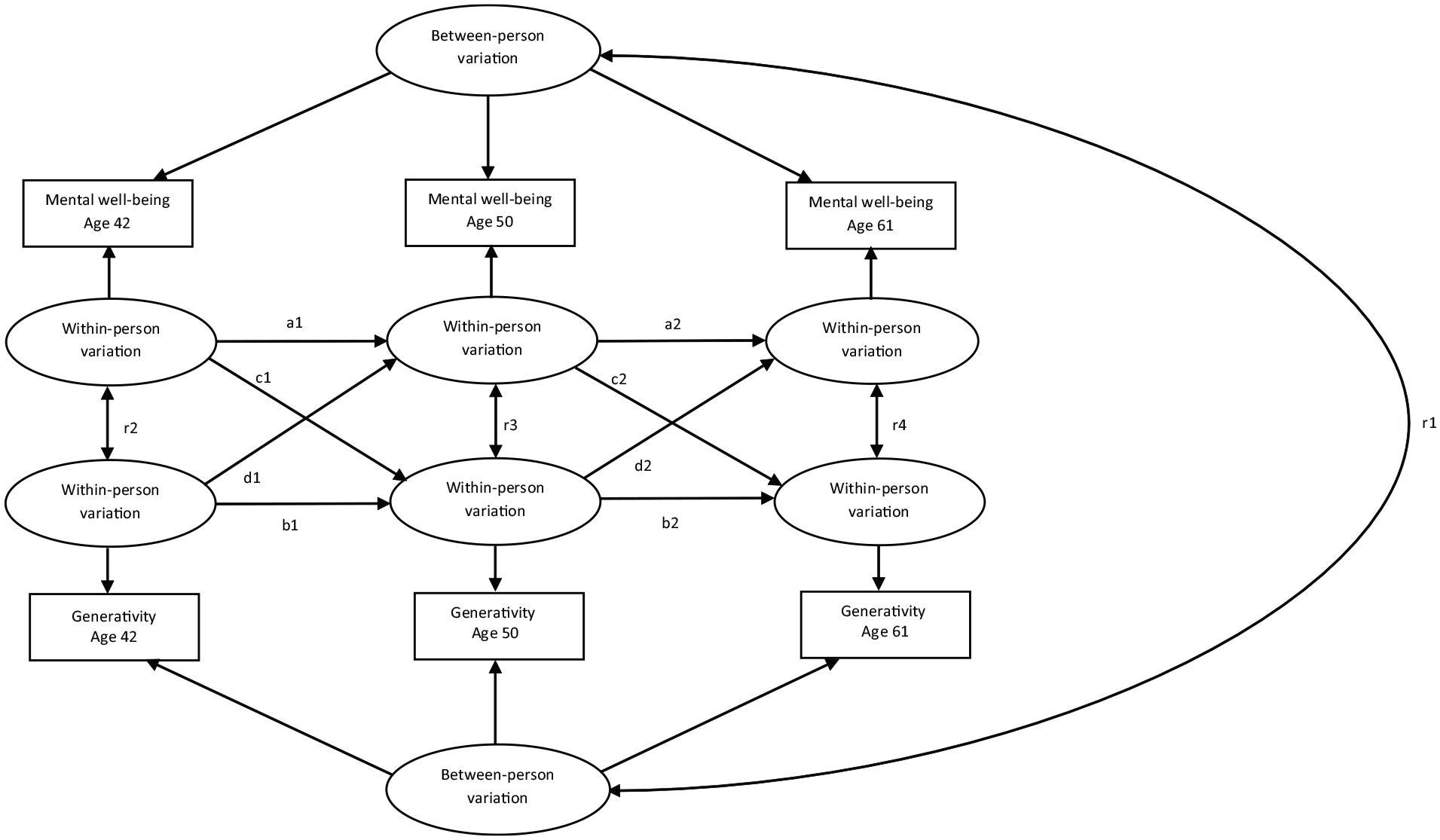
The Random Intercept Cross-Lagged Panel Model (RI-CLPM) Describing the Between- and Within-Person Associations Between Mental Well-Being and Generativity.
We used the chi-square test, the comparative fit index (CFI), and the root mean square error of approximation (RMSEA) to assess whether the model fit the data. The values indicating acceptable model fit were statistically nonsignificant (p > .05) chi-square test values, CFI values > .95, and RMSEA values < .08 (Schermelleh-Engel et al., 2003; Schreiber et al., 2006). Despite the frequent use of the chi-square test in the studies, it has some shortcomings such as sensitivity regarding sample size, model complexity, and normality (Schermelleh-Engel et al., 2003). Thus, we emphasized the CFI and RMSEA in the evaluation of model fit. We also used the chi-square difference test in testing the measurement invariance of the latent factor of mental well-being across time. If the reduction in the chi-square value (∆χ2) was nonsignificant, then the more constrained model would be acceptable.
Results
Descriptive Statistics
The descriptive results are presented in Table 1. Some indicators of mental well-being increased, some decreased, while others did not significantly change with age (Table 1). On average, social well-being and happiness increased from age 42 to 50 (social well-being: p < .001; happiness: p = .002). Life satisfaction (p < .001) and negative mood (p = .009) increased between the ages of 50 and 61, while positive mood decreased from age 50 to 61 (p = .027). Generativity decreased from ages 42 to 50 and 50 to 61 (both p < .001). No between-age mean-level changes were observed in psychological well-being and depressive feelings. For sensitivity purposes, we conducted a separate investigation for individuals who only participated at age 42 and compared the results to those who provided data in all three data collection phases. The groups did not differ in terms of average levels of mental well-being indicators and generativity measured at age 42, except for positive mood, which was lower in individuals who participated only at age 42 (see Supplemental material, Table S1).
Means (Ms) and Standard Deviations (SDs) for Study Variables at Ages 42, 50, and 61.
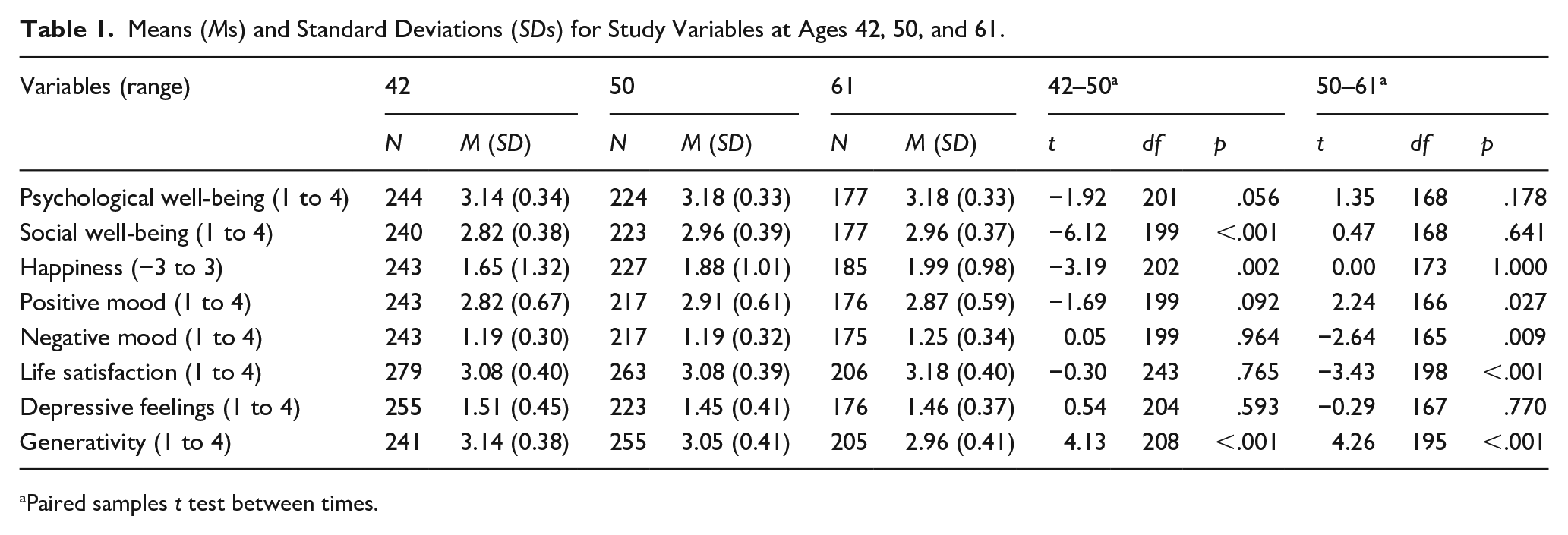
Paired samples t test between times.
Low to moderate rank-order stability was observed between the measurement times in relation to happiness, r = .31–.44, p < .001; positive mood, r = .30–.38, p < .001; negative mood, r = .36–.48, p < .001; life satisfaction, r = .43–.57, p < .001; and generativity, r = .50–.65, p < .001. Moderate to high rank-order stability was found in relation to psychological well-being, r = .66–.73, p < .001; social well-being, r = .53–.72, p < .001; and depressive feelings, r = .63–.75, p < .001 (see Supplemental material, Table S2).
The Structure and Stability of Mental Well-Being
We used SEM to test the stability in the multidimensional mental well-being across time. The higher-order latent factor of well-being included emotional, psychological, social well-being, and low depressive feelings. Emotional well-being was itself a latent factor consisting of happiness, life satisfaction, and positive and negative mood. To test for measurement invariance of the latent factor of multidimensional mental well-being, the unconstrained baseline model was first compared to the constrained model in regards to the equality of the factor loadings across time. The error terms of the mental well-being indicators were allowed to correlate between the measurement times. The stability model of mental well-being with equal factor loadings between time points, χ2(176) = 250.23, p = .0002; CFI = .96; RMSEA = .037, showed an adequate fit to the data. In comparison to the baseline model where the factor loadings were allowed to vary, χ2(166) = 242.13, p = .0001; CFI = .96; RMSEA = .039, the chi-square difference test supported the selection of a more restricted model, ∆χ2(10) = 9.39, p = .4958. In the next step, the intercepts were set to equal across time, χ2(186) = 307.54, p < .0001; CFI = .94; RMSEA = .047, but the model comparison with the chi-square difference test supported the model where only the factor loadings were set to equal, ∆χ2(10) = 62.00, p < .0001. We then tested partial factorial invariance by allowing some of the intercepts to be unequal between time points. Based on the model indices, the intercepts of social well-being, life satisfaction, and negative mood were allowed to vary across time, χ2(180) = 255.75, p = .0002; CFI = .96; RMSEA = .037. The chi-square difference test accepted the more constrained model, ∆χ2(4) = 5.52, p = .2381, and partial strong factorial invariance was supported. Consequently, it was possible to competently investigate the stability of the latent structure of mental well-being.
The final stability model with equal factor loadings and intercepts over time is presented in Figure 2. Emotional and psychological well-being had the highest loadings on the latent factor of mental well-being, whereas social well-being and low depressive feelings loaded slightly lower on the latent factor at all ages (42, 50, and 61). The stability coefficient was .86 from age 42 to 50 and .89 from age 50 to 61. Mental well-being at age 42 explained 75% of the variance of mental well-being at age 50, which further explained the variance of mental well-being at age 61 by 80%. These results were similar to those obtained in the study by Kokko et al. (2015).
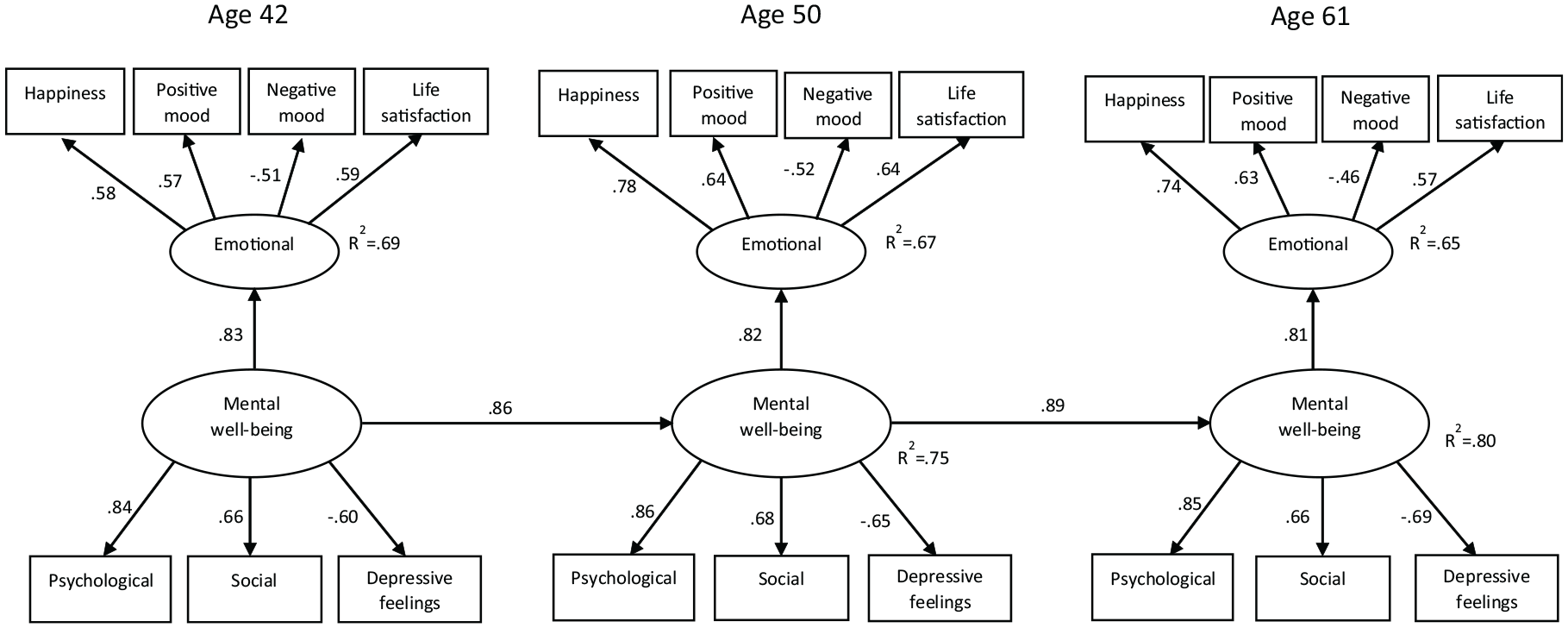
The Stability of Multidimensional Mental Well-Being (n = 301). Structural equation model with standardized coefficients. All factor loadings and regression coefficients statistically significant (p < .001). Error terms are not shown for ease of reading.
Invariance testing was also conducted for the latent factor of emotional well-being considering the requirements of the following analyzes. The chi-square difference test showed that weak factorial invariance in the latent factor of emotional well-being was supported, ∆χ2(6) = 6.79, p = .341. The requirements for testing the latent factors of multidimensional and emotional well-being were thus met to continue to use the RI-CLPM.
Longitudinal Associations Between Mental Well-Being and Generativity
The results of the RI-CLPM models (Figure 1) regarding the longitudinal associations between multidimensional or single indicators of mental well-being and generativity are shown in Table 2. The fit indices of the separate RI-CLPMs were acceptable (Table 2).
Standardized Estimates From RI-CLPM Linking Generativity and Mental Well-Being.
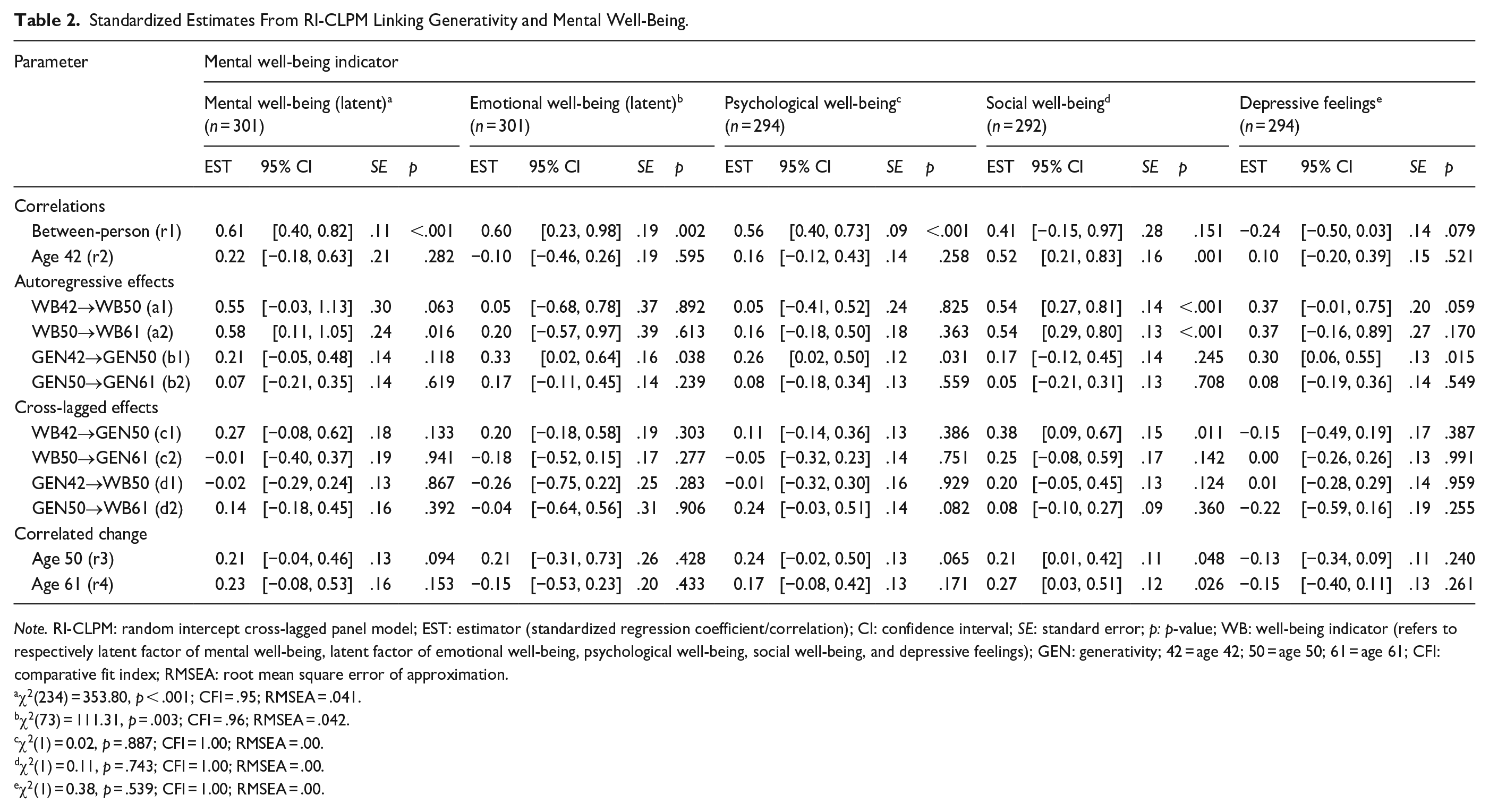
Note. RI-CLPM: random intercept cross-lagged panel model; EST: estimator (standardized regression coefficient/correlation); CI: confidence interval; SE: standard error; p: p-value; WB: well-being indicator (refers to respectively latent factor of mental well-being, latent factor of emotional well-being, psychological well-being, social well-being, and depressive feelings); GEN: generativity; 42 = age 42; 50 = age 50; 61 = age 61; CFI: comparative fit index; RMSEA: root mean square error of approximation.
χ2(234) = 353.80, p < .001; CFI = .95; RMSEA = .041.
χ2(73) = 111.31, p = .003; CFI = .96; RMSEA = .042.
χ2(1) = 0.02, p = .887; CFI = 1.00; RMSEA = .00.
χ2(1) = 0.11, p = .743; CFI = 1.00; RMSEA = .00.
χ2(1) = 0.38, p = .539; CFI = 1.00; RMSEA = .00.
At the between-person level, positive associations between mental well-being and generativity were observed (Table 2). Individuals who reported higher levels of multidimensional mental well-being also reported higher levels of generativity (p < .001). Similar associations were found between emotional (p = .002) and psychological well-being (p < .001) and generativity but not between social well-being or depressive feelings and generativity.
At the within-person level, no longitudinal associations were observed between multidimensional well-being and generativity. Regarding the single indicators of mental well-being, social well-being was associated with generativity. Concurrent positive correlations indicated that deviation from an individual’s own expected score in social well-being was linked with deviation from their expected score in generativity at age 42 (p = .001). Correlated change (i.e., correlated residuals) was also observed in reflecting the extent to which within-person change in social well-being was associated with within-person change in generativity (age 50: p = .048; age 61: p = .026). In other words, individuals whose level of social well-being changed between measurements tended to have changed level of generativity. A cross-lagged association was found between social well-being and generativity, suggesting that deviations from the expected score in social well-being at age 42 predicted the within-person change in generativity at age 50 after controlling for the deviations from the expected generativity score at age 42 (p = .011). Thus, individuals with a higher-than-expected level of social well-being at age 42 had a higher-than-expected level of generativity at age 50.
In addition, we observed autoregressive associations in the latent factors of mental well-being (from age 50 to 61; p = .016), social well-being (from age 42 to 61; p < .001), and generativity (from age 42 to 50; p = .015–.038). These stability paths indicated that within-person deviations in a mental well-being variable or generativity at an earlier measurement point predicted the within-person deviations in the same variable at the subsequent measurement point.
Discussion
This study aimed to investigate the structure and the stability of the multidimensional mental well-being in middle adulthood and the beginning of late adulthood as well as the longitudinal associations between mental well-being and generativity. Analyzing data obtained from the same Finnish adults from age 42 to 61, we found high stability in multidimensional mental well-being. In addition, the results of the RI-CLPM suggest between-person associations of multidimensional mental well-being and the single indicators of mental well-being and generativity. A longitudinal, within-person association was found between social well-being at age 42 and generativity at age 50.
This study adds knowledge to previous results based on the JYLS (Kokko et al., 2015) regarding the structure of multidimensional mental well-being—including emotional, psychological, social well-being, and low depressive feelings—up to the beginning of late adulthood. The multidimensional factor of mental well-being showed partial strong factorial invariance, suggesting that all four aspects (reflecting both well- and ill-being) remained relevant at the turn of middle and late adulthood. Regarding the rank-order stability of multidimensional mental well-being up to late adulthood, high stability in multidimensional mental well-being was supported in similar ways as in previous JYLS-based studies (Kekäläinen et al., 2020; Kokko et al., 2015; Kokko, Korkalainen, et al., 2013). The results indicated that most of the variance (75%–80%) in mental well-being was explained by earlier levels of well-being, suggesting that an individual’s mental well-being could be considered more as a trait-like feature than a dynamic process. It has been proposed that the high stability of mental well-being is at least partially due to the close linkage to personality traits (Anglim et al., 2020; Kokko et al., 2015; Kokko, Tolvanen, & Pulkkinen, 2013).
Similarly to previous studies (e.g., Joshanloo, 2019; Nivard et al., 2015; Ryff et al., 2015; Weiss & Kunzmann, 2020), psychological well-being, social well-being, and depressive feelings indicated high correlations between the measurements, whereas separate emotional well-being indicators showed moderate rank-order stability. Information about stability at the within-person level was obtained with the RI-CLPM. The results showed positive stability paths in relation to multidimensional mental well-being and social well-being, indicating that individuals who recorded higher levels of mental and social well-being at an earlier age also recorded higher levels of mental and social well-being later on in their lives. This suggests that although high to moderate rank-order stability (measured with correlations) was observed in the emotional well-being indicators, psychological well-being, and depressive feelings, the interpretation of the stability paths may not be transferred to the within-person level due to individuals’ variability and fluctuation around their expected level of well-being. Fluctuations in emotional well-being seemed generally understandable since these cover individuals’ moods and feelings.
Regarding the between-person level, stable trait-like associations showed that individuals who had higher levels of multidimensional well-being as well as of the single mental well-being indicators of emotional and psychological well-being tended to have higher levels of generativity across measurements. Accordingly, if individuals are satisfied with their lives, experience positive feelings, and see potential and purpose in themselves and life, they may have a greater propensity to be concerned with others.
Although multidimensional mental well-being was not associated with generativity longitudinally on the basis of the within-person-level analyses, social well-being at age 42 predicted generativity at age 50. Generativity, however, did not predict any of the mental well-being indicators. These results partly contradicted the hypotheses, as suggested in previous studies (Grossman & Gruenewald, 2017; Serrat et al., 2018; Weiss & Kunzmann, 2020), that generativity predicted single mental well-being indicators. The predictive path from social well-being to generativity observed in this study potentially reflects the importance of social well-being as a resource for individuals to act generatively and be concerned with the well-being of subsequent generations. Although this direction of the association has rarely been studied (except for Lodi-Smith et al., 2021), it is not completely unprecedented. According to the World Health Organization (2018), mental health is a state of well-being where, among other things, individuals can contribute to their communities. Interestingly, no other single indicator or multidimensional mental well-being had longitudinal associations with generativity. Social well-being, however, is closely related to the premises of generativity as it is characterized by care for society and the community, beliefs about their potential, feelings of the value of one’s contributions to society, and being a part of society (Ryff, 1989).
As mentioned earlier, a significant cross-lagged association was found between social well-being at age 42 and generativity at age 50, though not at later ages. The observed mean-level decrease in generativity from age 42 to 61 may also suggest that the relevance of generativity is emphasized in middle adulthood, which is in line with Erikson’s (1963) initial theory. However, there may be other more meaningful explanatory factors regarding generativity at the beginning of late adulthood besides the earlier levels of mental well-being and generativity. Since family and work are central environments in which to express generativity (McAdams et al., 1993), the explanatory factors may be related to changes in these domains (e.g., career development, retirement planning, maturation of children, and grandparenthood). Concerning the lack of significant predictive paths from the other well-being indicators to generativity, than from social well-being to generativity, associations could be seen in shorter intervals than in 8- to 10-year intervals. Similarly, it may be that the prediction of subsequent well-being following generative contributions could be captured with shorter measurement frequencies.
There are some limitations to be acknowledged. The sample size of this study was relatively small, especially in comparison with that of large national studies such as MIDUS (Grossman & Gruenewald, 2020; Serrat et al., 2018; Weiss & Kunzmann, 2020). Second, more frequent measurement points within the follow-up could have enabled the deeper investigation of the dynamics between mental well-being and generativity. Third, somewhat low Cronbach’s alphas were found in life satisfaction (.65–.68). Nonetheless, life satisfaction loaded appropriately on the latent factor of emotional well-being and correlated with other indicators of mental well-being to the same extent as other indicators (see Supplemental material, Table S2). Fourth, the measure of generativity used in this study (The Generativity Scale; Ryff & Heincke, 1983) has not been frequently deployed in generativity research. Fifth, it should be acknowledged that there may be some overlapping in terms of the items measuring generativity and one social well-being dimension, that is, social contribution. However, social contribution indicates a more general contribution to society, while generativity focuses on contribution to younger generations. The social contribution was only one of the dimensions of social well-being as the measure also involves four other dimensions such as social integration and acceptance.
This study has strengths in terms of its longitudinal dataset, the variety of mental well-being indicators examined, and the novel method (RI-CLPM) in the investigation of between- and within-person associations between mental well-being and generativity. We used a sample of the JYLS, which followed a sample of same-aged individuals from the age of eight, without weakening the representativeness of the sample to the Finnish age cohort born in 1959 (Pulkkinen et al., 2003; Pulkkinen & Kokko, 2010). Furthermore, this study sheds light on the longitudinal associations between generativity and mental well-being outside the United States, the setting of previous longitudinal studies (Grossman & Gruenewald, 2020; Lodi-Smith et al., 2021; Serrat et al., 2018; Weiss & Kunzmann, 2020), while recognizing the limited generalizability of this study to other cultures. We utilized a multidimensional perspective in assessing mental well-being, with multiple positive indicators based on Keyes’ (2005) model, and Cronbach’s alphas indicated mostly good internal consistency in these variables. We also conducted additional analyses to investigate the longitudinal associations of single indicators of mental well-being with generativity. Most importantly, with the recognition of the paths from mental well-being to generativity, this study extends the current knowledge about the relationship between mental well-being and generativity.
To conclude, the multidimensional structure of mental well-being—including emotional, psychological, social well-being, and low depressive feelings—shows high stability up to the beginning of late adulthood. Multidimensional mental well-being and emotional and psychological well-being showed between-level associations with generativity. However, only social well-being was linked to generativity longitudinally as social well-being at age 42 predicted generativity at age 50, although not vice versa. It seems that although the increase in multidimensional well-being or emotional or psychological well-being did not necessarily contribute to increased generativity—at least not with relatively long measurement intervals—lower well-being at the individual level may be an indicator of low generativity. However, the observed within-person associations between social well-being and generativity suggest that promoting the social well-being of individuals can further increase their generativity, which can eventually lead to evolving and more sustainable and caring societies (McAdams, 2001). Thus, future research investigating ways in which to promote social well-being would be of interest.
Supplemental Material
sj-docx-1-jbd-10.1177_01650254231165837 – Supplemental material for The structure of mental well-being and its relationship with generativity in middle adulthood and the beginning of late adulthood
Supplemental material, sj-docx-1-jbd-10.1177_01650254231165837 for The structure of mental well-being and its relationship with generativity in middle adulthood and the beginning of late adulthood by Emmi Reinilä, Tiia Kekäläinen, Milla Saajanaho and Katja Kokko in International Journal of Behavioral Development
Footnotes
Acknowledgements
The authors are grateful to professor Lea Pulkkinen who initiated the Jyväskylä Longitudinal Study of Personality and Social Development (JYLS) in 1968 and directed it until 2012. They also thank Anna Kankaanpää for her support in data analysis.
Declaration of Conflicting Interests
The author(s) declared no potential conflicts of interest with respect to the research, authorship, and/or publication of this article.
Funding
The author(s) disclosed receipt of the following financial support for the research, authorship, and/or publication of this article: This work was supported by the grant awarded by the Academy of Finland to K. Kokko (grant no. 323541) for the latest JYLS data collection conducted in 2020–2021. The Academy of Finland have funded the previous data collections through grants in 2001 (grant nos. 40166 and 44858) and 2009 (grant nos. 127125 and 118316).

Supplemental Material
Supplemental material for this article is available online.
References
Supplementary Material
Please find the following supplemental material available below.
For Open Access articles published under a Creative Commons License, all supplemental material carries the same license as the article it is associated with.
For non-Open Access articles published, all supplemental material carries a non-exclusive license, and permission requests for re-use of supplemental material or any part of supplemental material shall be sent directly to the copyright owner as specified in the copyright notice associated with the article.
