




Abstract
Previous research debated whether and to which extent normative views and own resource distribution behavior in childhood are dissociated or aligned. The present study aims to advance this debate by examining the relation from two different methodological viewpoints within the same study. Here, 4–6-year-old children’s (N = 91) normative views and distribution behavior when confronted with a rich friend and a poor non-friend were assessed. Children’s spontaneous protest and affirmation toward distributors, evaluations, and punishment judgments served as normative indicators. Looking at average normative views and behavior, preschoolers held a normative view toward rectifying inequalities while favoring the rich friend themselves. Looking at the consistency of interindividual differences, preschooler’s normative view correlated with behavior. The study highlights that the relation between normative views and behavior is characterized by both dissociation and coherence.
Children’s developing appreciation of norms was examined long-since (Piaget, 1932/1997) and continues to be a prevalent topic in current research (Berger et al., 2022; Friedrich & Schmidt, 2022; Rizzo et al., 2020; Roughley & Bayertz, 2019; Tomasello, 2018). In preschool years, children increasingly conceive of behavior in normative terms, that is, they have a representation of what one ought to do and should not do. But do children behave accordingly to their moral norms? This question is topic of a long-standing theoretical debate (Blake, 2018; Blasi, 1983; Turiel, 2003). The present study aims to reconcile different theoretical views, proposing both coherence and dissociation, and thereby contributes to the debate on this intriguing question. Evidence of this study pertains to children’s resource distribution, when contrasting fairness considerations and the inclination to favor friends. This is an excellent context to investigate our question, because previous separate studies at the normative and behavioral levels revealed conflicting evidence.
Children’s norms apply to a wide range of behaviors. Next to conventional rules (e.g., Rakoczy et al., 2008) and norms on the omission of antisocial behavior (e.g., Kenward & Östh, 2015; Vaish et al., 2011), recent research has explored the ontogeny of fairness norms in resource distribution or sharing situations. A solid body of evidence supports preschoolers’ normative view that resources ought to be distributed equally, even when their own resources are not affected. For example, young children protest against unequal distributions (Rakoczy et al., 2016) and they evaluate equal distribution most positively (e.g., Cooley & Killen, 2015; Elenbaas, 2019). Beyond that, children’s principles become increasingly differentiated when they take into account other factors, such as the recipient’s wealth (Wörle & Paulus, 2018), the group context (Cooley & Killen, 2015), and a principle of merit (Baumard et al., 2012). That is, although a preference for equal distribution mostly prevails, children consider a deviation from equal distribution acceptable when it serves, for example, to balance out unequal endowments or to consider individuals’ merit. Normative views are expressed through a variety of means. For example, preschoolers enforce a behavior in others by protesting against norm-transgressions and by affirming norm-compliant behavior (e.g., Rakoczy et al., 2016; Vaish et al., 2011; Wörle & Paulus, 2018), they express their normative view in evaluating a behavior (e.g., Cooley & Killen, 2015; McCrink et al., 2010), and they even punish a transgressor (e.g., Kenward & Östh, 2015; McAuliffe et al., 2015). Preschool years thus mark a period when children start to hold normative views regarding resource allocation behavior. This developmental pattern gives reason to investigate dissociation and coherence between normative views and behavior in this age range.
The Relation between Normative Views and Actual Behavior
While the early emergence of normative views is well underpinned, a vivid debate centers on the question of whether normative views translate to actual behavior. The origin of this question dates back to Aristotle’s famous critique of Plato’s assumption that one will do what is right if one knows what is right. The debate on the relation between moral norms and behavior (or the lack thereof) has been a central force in the history of moral psychology (Gibbs, 2019). It remains central for current debates and has advanced theorizing in developmental science.
On one hand, long-standing developmental theories suggest that moral judgments relate to behavior, as considering a behavior as morally relevant should be intrinsically motivating (Killen & Dahl, 2018; Turiel, 2003). Accordingly, studies evidenced a similar developmental timeline of moral reasoning and behavior (Elenbaas & Killen, 2016; Schmidt et al., 2016). Similarly, research has reported a link between adults’ moral reasoning and moral behavior (for review see Villegas de Posada & Vargas-Trujillo, 2015). In addition, previous research demonstrated relations of single normative indicators and value orientations with behavior (Abramson et al., 2018; Paulus et al., 2018; Rizzo et al., 2020). Thus, there are theoretical reasons and empirical evidence suggesting that normative views regarding morally relevant behavior mostly relate to actual behavior.
On the other hand, theories suggest that moral judgments are not directly related to behavior, pointing to a gap between the two (Blake, 2018; Blasi, 1983). This has given rise to investigations of the so-called judgment–behavior gap. Studies support this view by demonstrating that normative views about how one ought to share and own sharing behavior diverge in children (Kogut, 2012; Smith et al., 2013) and also in adults (Keller et al., 2013). In addition, a recent study has reported no relation between preschoolers’ evaluation of morally relevant actions and sharing behavior (Tan et al., 2021). In conclusion, some theoretical considerations and previous research suggest that normative views do not consistently relate to behavior.
Thus, opposing sets of evidence characterize the situation, partly suggesting coherence and partly suggesting dissociation between morally relevant normative views and behavior. Empirical evidence is therefore inconclusive. Yet, while previous research differed in methodological approaches and focused on either of the possibilities, there is little systematic investigation on how both, dissociation and alignment, might characterize different aspects of this complex relation. Our study aims at advancing this ongoing debate by integrating two approaches for investigating dissociation and coherence between preschooler’s normative views and behavior.
More precisely, previous studies differed in how they addressed the alignment of normative views and behavior. On one hand, some studies examined whether the level of a normative view correlates with actual behavior across individuals (e.g., Abramson et al., 2018; Paulus et al., 2018; Rizzo et al., 2020; Tan et al., 2021). Correlations between normative views and behavior suggest that individual tendencies in considering a behavior as normatively required and behaving accordingly are related. That is, the more individuals, for example, judge a deviation from equal distribution in favor of a poor recipient as positive, the more resources they allocate to a poor recipient versus a rich recipient when distributing resources themselves (Paulus et al., 2018). Thus, these studies account for interindividual differences, assuming that these differences between people might be consistent across the normative and behavioral levels. This approach resonates with the theoretical idea that both children’s normative view and behavior are grounded in stable individual dispositions. We will refer to this view on the question as dissociation/coherence when looking at the individual.
On the other hand, some studies compared the average normative view and average behavior across a group of individuals. This allows us to examine whether, on average, normative views on behaviors and actual behavior are aligned or dissociated (e.g., Elenbaas & Killen, 2016; Kogut, 2012; Schmidt et al., 2016; Smith et al., 2013). For example, while 3–4-year-old children on average verbally state that one should share half of the resources one received, in their own behavior they actually keep most for themselves (Smith et al., 2013). In these analyses looking at the group, interindividual differences within normative views and within behavior are disregarded. Instead, the focus is on how children, on average, think that one ought to behave and how, on average, they actually behave. From a developmental perspective, a question in this type of studies is whether normative views and actual behavior of a particular age group show a similar pattern or diverge. Comparing the pattern of a normative view and behavior across age groups allows, for example, to infer whether the developmental pathway of a normative view and behavior is similar. In the following, we will refer to this view on the question as dissociation/coherence when looking at the group.
Each approach allows thus for particular conclusions. The present study aims to advance the outlined dispute by integrating both methodological approaches within one study to systematically examine dissociation and coherence between normative views and behavior. In particular, we propose that there can be dissociation between normative views and behavior when looking at mean differences, while there is meaningful coherence when looking at interindividual differences in normative views and behavior. We precisely explain our rationale after having introduced the context in which this study is seated.
To address the relation between normative views and behavior, this study focuses on a situation in which two motives are at conflict, namely fairness considerations and an inclination to favor one’s friends. As we will outline, this offers an interesting context to assess our hypothesis. In the following, we will first focus on children’s developing fairness conceptions before turning to their sharing behavior.
Fairness Concerns and Friendship Favoritism in Children’s Sharing
A principle of equality marks children’s sense of fairness from early on (Elenbaas, 2019; Rakoczy et al., 2016; Smith et al., 2013). Yet, other principles gain in importance as well. An increasing line of evidence supports the early endorsement of fairness by rectifying inequalities. Preschoolers differentiate between recipients who are characterized by resource disparity (henceforth labeled as relatively poor or rich recipients). Studies reported that preschoolers share more resources with a poor recipient than with a rich recipient (e.g., Li et al., 2014; Malti et al., 2016; Sabato & Kogut, 2018). Likewise, a normative view that one ought to rectify inequalities emerges in preschool years (Rizzo & Killen, 2016; Wörle & Paulus, 2018) and becomes stronger across childhood (Elenbaas & Killen, 2016). For example, a recent study has reported that older preschoolers protest against an agent who distributes more items to a wealthy recipient and affirm an agent who gives more to a poor recipient (Wörle & Paulus, 2018). Preschool children thus consider the wealth of a recipient in their resource distribution behavior and, most importantly for the aims of the present study, appreciate a norm toward rectifying inequalities.
In contrast, when distributing resources themselves, children’s behavior seems sometimes to be driven by other considerations than fairness, in particular, the underlying social relationship. Previous studies underpin that preschoolers prefer to help or share more with friends compared with non-friends or strangers (e.g., Birch & Billman, 1986; Engelmann et al., 2019; Lenz & Paulus, 2021; Moore, 2009; Paulus & Moore, 2014). This tendency also becomes evident in how they guide others to distribute resources between a friend and a stranger (Olson & Spelke, 2008). Importantly, preschoolers give priority to the recipient to whom they have a positive social relationship despite his or her greater material wealth (Paulus, 2016). That means, preschoolers allocate more resources to a rich friend than to a poor non-friend or poor stranger. Preschoolers thus favor their friends when allocating resources and, therefore, even transgress a norm of equal allocation or a norm that one ought to give more to a poor than to a rich recipient.
Overall, this evidence highlights the dominance of positive social relationships for sharing behavior. Yet, it conflicts with research demonstrating that preschoolers increasingly endorse a norm of rectifying inequalities. This set of findings indicates a judgment–behavior gap. While current studies on this phenomenon have mostly focused on a gap in the context of costly sharing (Blake, 2018), its original notion describes all instances in which persons do not act in line with what they normatively regard as the best behavior (Blasi, 1983). Taken together, in the context of sharing with friends and non-friends, findings at the behavioral levels stand in contrast to the findings at the normative level and, thus, offer an excellent paradigm for studying the coherence and dissociations between normative views and sharing behavior.
Normative views and behavior might not either be dissociated or coherent. Instead, they might align differently when looking at the individual and when looking at the group. Following the notion that moral judgments are coordinated with moral action (Turiel, 2003), normative views and behavior should be integrated within the individual. Thus, interindividual differences in normative views should align with interindividual differences in actual behavior. Yet, normative views and engaging in actual behavior likely depend on additional different processes. While both are rooted in early interactional experiences (Carpendale et al., 2013; Dahl & Killen, 2018), normative views likely result from reflecting on normative issues and reaching agreement in social interactions. The inclination to share and allocate resources, however, might additionally depend on self-control competencies to handle immediate desires (Blake, 2018), on affective preferences (Li et al., 2014), and on strategic considerations (Leimgruber, 2018). Situational demands (e.g., observer presence, relationship context, self-interest involvement) might thus affect how children weigh different principles when distributing resources, without impairing the intrinsic relation between a normative view and behavior. For the context of the present study, the outlined factors might affect how need- and friendship-considerations are weighed across individuals when asked to distribute resources, while retaining meaningful relations of interindividual differences in normative views and behavior. This would become evident in an apparent discrepancy of normative views and behavior when looking at normative views and behavior of the group on average, while finding coherence when looking at the interindividual differences. Our study investigated this hypothesis.
The Present Study
With the present study, we aim at contributing to this long-standing debate. We investigated whether both coherence and dissociation between preschooler’s normative view and behavior can be found when distinguishing between relations when looking at the group and when looking at the individual. For that purpose, we assessed children’s normative views and own resource distribution behavior when contrasting unequal resource distributions and friendship. We built on previous research on these issues (e.g., Moore, 2009; Rakoczy et al., 2016) and, therefore, focused on preschool years, a period when children start to take different factors in their fairness-related normative standards and behavior into account. To assess normative views, children observed puppets who distributed resources between a rich friend and poor non-friend (third-person task). Children’s protest against and affirmation of the puppets’ behavior were assessed (Rakoczy et al., 2016; Wörle & Paulus, 2018). Moreover, children explicitly evaluated the puppets’ behavior and were asked to justify their evaluation to assess how they reason about fairness in these contexts. Finally, children rated whether a puppet deserves to be punished (Killen et al., 2011). To assess actual behavior, children were asked to allocate resources to a rich friend and a poor non-friend in three different types of forced-choice trials (first-person task). These trials served to directly contrast the inclination to give more due to friendship or neediness against each other (uneven trials) and to pit the tendency to favor one recipient against equal distribution, the prevalent norm in preschool years (e.g., Elenbaas, 2019; even-rich trials; even-poor trials). To prevent transfer effects, we assessed normative views and own resource distribution behavior on separate days (first normative views, later own behavior).
The study advances our knowledge in two ways. First, it examined the relation between normative views and behavior at the group level within one sample. Previous evidence on dissociations stems from separate studies that investigated either the normative view toward rectifying inequalities (e.g., Rizzo & Killen, 2016; Wörle & Paulus, 2018) or the behavioral inclination to favor friends in resource distribution contexts (e.g., Moore, 2009; Paulus, 2016), and differed in methodological details. Our study made a novel step in this research program by assessing these different indicators in one and the same sample. We could thereby examine whether there indeed appears a kind of dissociation at the group level. That is, we hypothesized preschoolers to endorse a norm of rectifying inequalities based on the early importance of fairness, while, at the same time, to favor a rich friend and thereby amplify inequality in their own allocation behavior. Second, the present study examined whether normative views and behavior are related when looking at the individual, although they might differ when looking at the group. Following the theoretical notion that moral judgments are linked to action (Killen & Dahl, 2018; Turiel, 2003), we expect the normative view and own behavior to be related at the level of the individual.
Method
Participants
The final sample for the third-person task, which was administered in the first testing session, consisted of 91 4–6-year-old participants (M = 69.29 months, range = 58–81 months, SD = 5.31, 43 girls). Seven additionally tested participants were excluded from the analyses of the third-person task because they failed to answer the control questions correctly (see procedure). Out of the 98 participants who were tested in the third-person task, 75 participants constituted the final sample for the first-person task, administered in a second testing session (M = 69.48 months, range = 59–81 months, SD = 5.01, 37 girls). One additionally tested participant was excluded from the analyses of the first-person task due to an experimental error. The overlap between the final samples of the third-person task and the first-person task represented the basis for the correlational analyses across tasks. This subset of analyses included 70 participants (M = 69.61 months, range = 59–81 months, SD = 5.09, 35 girls), because five children from the final sample of the first-person task were excluded based on the control questions from the third-person task. For determining the sample size using an a priori power analysis, we estimated the expected effect size based on previous research on the relation between normative indices and resource distribution behavior (Abramson et al., 2018; Paulus et al., 2018). A power analysis with α = .05 and a power of .90 revealed a required sample size of 63 to detect a relation of r = .35 with one-tailed testing. All participants were typically developing children from day-care centers and preschools located in a larger European city, in areas of typically middle socioeconomic background. All except for one participating child were White. Children’s caregivers provided informed written consent for participation. The local ethics committee (Faculty of Psychology and Educational Sciences, University of Munich) had approved the study (Feb 09, 2015). Children received little gifts for participating in the study.
Materials
In the third-person task, participants were presented with two 65 cm tall male hand puppets (agents) played by the experimenter and pictures of another four male puppets (recipients). In each condition, an agent was paired with two recipients: a rich friend and a poor non-friend. The agent puppets were randomly assigned to the two conditions, one agent acting out the friendship condition (allocating resources in favor of the rich friend) and one agent acting out the neediness condition (allocating resources in favor of the poor non-friend). Recipient puppets were randomly assigned to being the friend or the non-friend of any agent. These random assignments served to prevent any systematic puppet-related effects. Friendship statuses were illustrated by additional pictures of the agent and the recipient either playing together (friend) or looking in different directions and playing for themselves (non-friend). In the first-person task, two pictures drawn by the participant represented the friend and non-friend.
For the warm-up trials of the third-person task a ball, two puzzles, a paper and pencil, and a wind-up toy were used. Stickers and colorful erasers served as items for the resource allocations in the third-person task (counterbalanced between conditions), stickers were used in the first-person task. In both tasks, the relative wealth of the recipients was represented through their possessions, which were either a large (rich recipients) or a small amount of items (poor recipients). To ensure that none of the resource allocation trials could equalize the difference between rich and poor, an obvious difference of items was chosen (e.g., three stickers vs 50 stickers). A 5-point smiley scale (ranging from very bad to very good) was used for the evaluation in the third-person task.
Experimental Design and Procedure
Children were tested individually in a quiet room of their preschool. Experimental sessions were videotaped. Participants were presented with the third-person task first and with the first-person task after an interval of 5 days to 6 months due to different availabilities of the preschools and holiday breaks. We kept the order and thus potential order effects constant across participants because we were interested in the correlation between the two tasks. The third-person task was administered first because we expected potential carryover effects (in case children remember the first session) to be larger from spontaneous own behavior to the evaluation of others’ behavior than vice versa. Children might remember their own actual behavior better than an evaluative judgment and, if so, they might adjust their subsequent evaluation to support and defend their previous behavior. At least, remembering own but not others’ previous good behavior seems to influence children’s prosocial behavior (Tasimi & Young, 2016).
Third-Person Resource Allocation Task
Ahead of the resource distribution, we administered a set of warm-up trials with the agents. Then, each participant was presented with two conditions (order of presentation counterbalanced between participants) in which an agent distributed resources between a rich friend and a poor non-friend respectively: whereas in the friendship condition resources were allocated in favor of the rich friend, in the neediness condition resources were allocated in favor of the poor non-friend. After children had seen both conditions, an evaluation and a punishment phase followed. These measures served to assess children’s normative view toward fairness when faced with two conflicting factors that might demand favoritism—friendship and neediness. By examining how children evaluate, punish, affirm, and protest against favoring a rich friend compared with favoring a poor non-friend, we can infer which behavior children deem to be required and thus whether they assign more normative force to social relationships or unequal endowments. To contrast friendship and neediness, the friend was always introduced as having many resources (rich friend) and the non-friend was always introduced as having little resources (poor non-friend).
First-Person Resource Allocation Task
The procedure of the first-person task was adapted from previous work (Moore, 2009; Paulus, 2016) and based on a mini-dictator game approach (Gummerum et al., 2010). To assess children’s own behavior toward an actual friend and non-friend, participants named and drew a friend (child they like to play with) and a non-friend (child they do not like to play with) as recipients for the resource allocation. Then, the experimenter introduced the recipients’ respective possessions by showing the recipients’ sticker books which either contained a little or a large amount of stickers. Parallel to the third-person task, the role of the rich recipient was always assigned to the friend and the role of the poor recipient to the non-friend. To ensure that participants correctly reported their social relations and understood the difference in the recipients’ relative wealth, control questions were asked (“Who is that? Do you like to play with him or her?,” “Who is that? Do you know him or her?,” ”Who has a lot of stickers?,” “Who has few stickers?”). All children answered the control questions correctly. Thereafter, children could distribute stickers between the two recipients in 12 forced-choice trials distributed over 4 blocks. We used three different trial types to assess children’s distribution tendency in different contexts. The trial types differed in the forced choice options. In particular, uneven trials directly contrasted children’s tendency to allocate resources in favor of a rich friend or poor non-friend (three stickers for the rich friend and 1 for the poor non-friend vs vice versa). That is, children had to decide between two uneven distributions, namely between giving more to a rich friend or a poor non-friend. These trials were of primary interest to address how children weigh different considerations that each might allow favoring one recipient over the other. Given the prevalence of a norm of equal distribution in preschool years (e.g., Elenbaas, 2019; Rakoczy et al., 2016), we additionally included even-rich and even-poor trial. These trial types pitted the option of an equal distribution against favoring one of the recipients (even-rich: two stickers for both recipients vs three stickers for the rich friend and 1 for the poor non-friend; even-poor: two stickers for both recipients vs three stickers for the poor non-friend and 1 for the rich friend). Each block contained one trial of each type (i.e., three trials per block and 12 trials overall). The order of trial types was counterbalanced within blocks and participants. Finally, the same control questions as prior to the resource allocation were asked to test children’s memory. All children gave a correct answer.
Coding and Data Analysis
Third-Person Resource Allocation Task
For the correlational analyses, we computed difference scores for protest, affirmation, evaluation, and punishment between the two conditions (friendship/Rich F-more puppet, neediness/Poor NF-more puppet). We computed the difference scores in the way that they reflect children’s normative views toward favoring the rich friend, that is, selective protest against the Poor NF-more puppet (vs Rich F-more puppet), selective affirmation of the Rich F-more puppet (vs Poor NF-more puppet), better evaluation of the Rich F-more puppet (vs Poor NF-more puppet), and selective punishment of the Poor NF-more Puppet (vs Rich F-more puppet). Thus, a positive score reflects favoring the behavior of the Rich F-more puppet over the Poor NF-more puppet.
First-Person Resource Allocation Task
The mean number of trials in which participants allocated resources in favor of their rich friend was computed for each trial type and across trial types.
Data for this study are available on https://osf.io/4hd79/ (DOI: 10.17605/OSF.IO/4HD79).
Results
The data-analysis followed a stepwise plan. In a first step, we analyzed the third-person task and the first-person task separately. Thereby, we looked at participants’ normative responses (protest/affirmation, evaluation, punishment) to others’ resource allocation decisions (third-person task) and own resource allocation behavior (first-person task) across participants. In a second step, we looked at interrelations between participants’ own behavior and their normative responses. For each measure, we first computed preliminary analyses to examine any effects of age (in months) and sex (dummy-coded with 0 = female and 1 = male). In a final step, we exploratively split the sample into groups of children based on their level of consistency and compared these groups regarding demographics and correlations. This analysis helps to shed light on interindividual differences in consistency at that age.
Third-Person Resource Allocation Task
Protest
See Figure 1 for the descriptive statistics. Children’s protest in both conditions was unrelated to age (Spearman’s correlations: rs < .12, ps > .247) and did not differ between sex (Mann–Whitney U-Test: ps > .330). To examine whether participants protested more against the behavior of the agent in the friendship condition or the agent in the neediness condition, Wilcoxon tests for two related samples have been performed. Wilcoxon tests served as a nonparametric test to compare protest between conditions. In a first analysis, every form of protest (e/i/n) was analyzed and, in a second, a more conservative analysis of only imperative and normative protest (i/n) was included. Both analyses revealed that participants protested against both agents equally often (protest (e/i/n): Z = −0.17, N = 91, p = .862; protest (i/n): Z = −0.51, N = 91, p = .609).
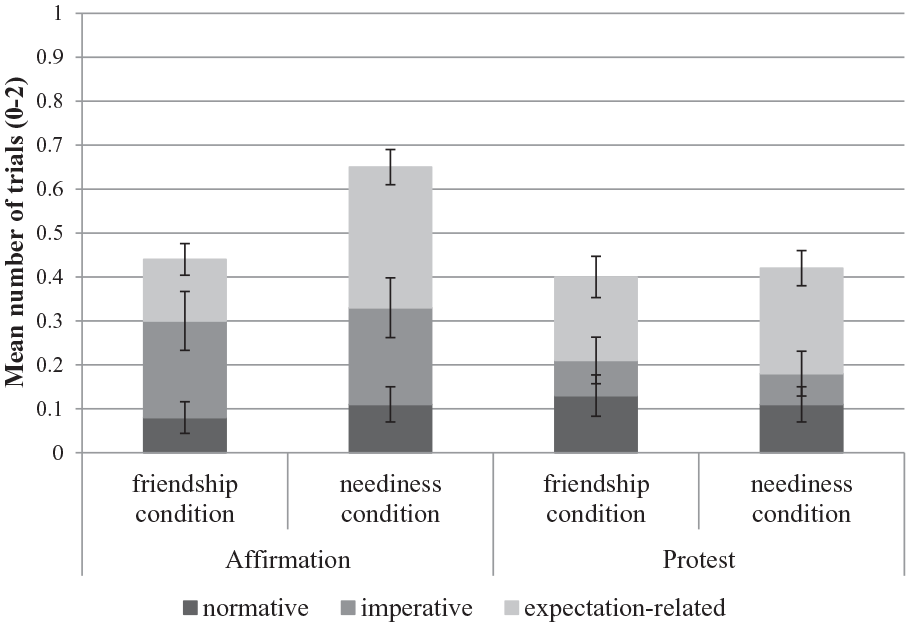
Third-Person Task (n = 91): Protest/Affirmation.
Affirmation
See Figure 1 for the descriptive statistics. Children’s affirmation in both conditions was unrelated to age (Spearman’s correlations: rs < .18, ps > .083) and did not differ between sex (Mann–Whitney U-Test: ps > .178). Affirmation was analyzed the same way as their protest behavior. The analyses revealed that when including all forms of affirmation, participants showed higher affirmation rates in the neediness condition than in the friendship condition (affirmation (e/i/n): Z = −2.34, N = 91, p = .019). Thus, they more strongly affirmed to allocate more resources to a poor non-friend over a rich friend than vice versa. This was not the case when a more conservative measure of affirmation was used (affirmation (i/n): Z = −0.42, N = 91, p = .672).
Across conditions, 27 children did not protest or affirm in any of the four trials (two trials per condition), while 64 children protested or affirmed the behavior in at least one trial.
Evaluation
First, we analyzed the frequencies of children who evaluated the behavior in the neediness condition or in the friendship condition as better. Age did not differ between groups of children who favored the one or other behavior (independent-samples t-test: p = .811). To test whether the proportions of children favoring one behavior over the other were independent of sex and equal for both behaviors, χ²-tests were computed. It revealed that sex had no effect on the proportion of children favoring the one or other behavior (p = .122). The number of participants who rated the behavior of the agent in the neediness condition as better (N = 57) was significantly higher than the number of participants who rated the behavior of the agent in the friendship condition as better (N = 34), χ² = 5.813, N = 91, p = .016. That means, the majority of children preferred the behavior of the agent, who gave more resources to the poor non-friend.
Second, we analyzed the mean evaluations of the two agents on the 5-point smiley scale (see Figure 2). Children’s evaluation of both behaviors was unrelated to age (Pearson’s correlations: rs < .03, ps > .754) and did not differ between sex (independent-samples t-tests: ps > .159). To test whether children’s evaluation of the behavior differed between conditions, a related-samples t-test was computed. The analysis revealed a significant difference between conditions, t(90) = −3.04, p = .003, d = 0.53, showing that participants evaluated the agent in the neediness condition (M = 3.78, SE = 0.16) more positively than the agent in the friendship condition (M = 2.95, SE = 0.17). Thus, children evaluated it more positively to favor the poor non-friend than to favor the rich friend. To test whether children’s evaluation of each behavior deviated positively or negatively from the scale midpoint (3 on the 5-point scale), one-sample t-tests against the scale midpoint were computed. The findings revealed that children’s evaluation of the agent in the neediness condition was above midpoint, t(90) = 4.79, p < .001, d = 0.50, while the evaluation of the agent in the friendship condition did not differ from midpoint, t(90) = −0.33, p = .741, d = 0.03. For descriptive analysis of children’s evaluation justifications, see supplemental material.
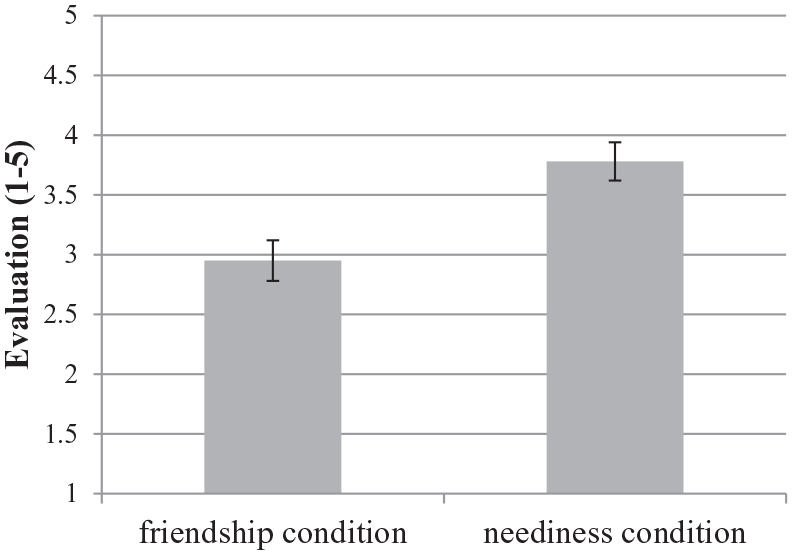
Third-Person Task (n = 91): Evaluation of the Agent in the friendship condition and the Agent in the neediness condition.
Punishment
Children’s punishment in both conditions was unrelated to age (Pearson’s correlations: rs < .08, ps > .461) and did not differ between sex (independent-samples t-tests: ps > .080; tendency of boys requesting more punishment in the neediness condition than girls). A related-samples t-test, comparing children’s punishment judgments between conditions, revealed that participants requested significantly more punishment for the agent in the friendship condition (M = 0.99, SE = 0.08) than for the agent in the neediness condition (M = 0.73, SE = 0.08), t(90) = 2.22, p = .029, d = 0.35. That means, children considered it more punishable to favor a rich friend than to favor a poor non-friend.
Taken together, children differentiated between the neediness condition and the friendship condition in three regards: They expressed more affirmation of the agent who favored the poor non-friend over the rich friend, they evaluated this agent more positively, and they requested more punishment for the agent who favored the rich friend. Overall, these findings indicate that children hold a normative view toward allocating resources in favor of a poor non-friend rather than a rich friend.
First-Person Resource Allocation Task
See Figure 3 for descriptive statistics. Across all trials, children’s behavior was unrelated to age, r = −.22, p = .059, yet, showing a trend of favoring the rich friend less with increasing age. This trend was driven by the even-rich trials, r = −.34, p = .003. That is, with increasing age, children decided less often to favor the rich friend when the alternative option was to distribute resources equally. In the other trials, behavior was unrelated to age (uneven: r = −.09, p = .443; even-poor: r = .01, p = .946). Independent-sample t-test revealed no sex differences in children’s allocation decisions in any trial type (ps > .112).
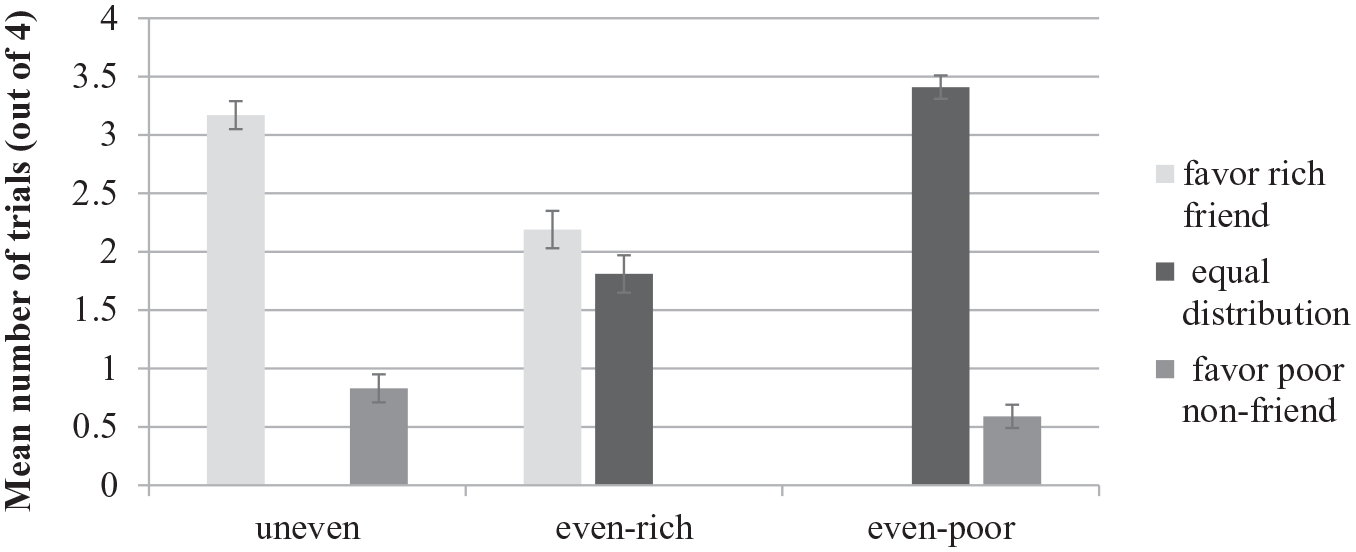
First Person Task (n = 75).
To test whether children predominantly chose one allocation decision, we computed t-tests against chance (first across trial types, then separately for each trial type). Across trial types, participants allocated resources in favor of their rich friend in more than half of the 12 trials (M = 8.77, SE = 0.30), t(74) = 9.21, p < .001, d = 1.06. Looking into the different trial types separately, this effect was significant for the uneven trials, t(74) = 9.50, p < .001, d = 1.10. That means, when children had to decide whether to favor the rich friend or the poor non-friend, they decided for the rich friend in more than half of the four trials (M = 3.17, SE = 0.12). In addition, children allocated resources in favor of the rich friend in the even-poor trials, meaning that children mostly chose the equal distribution when the alternative option was to favor the poor non-friend, t(74) = 13.57, p < .001, but not in the even-rich trials, t(74) = 1.17, p = .246.
Taken together, the findings of the third-person and first-person task reveal a divided picture. Children themselves allocated resources predominantly in favor of their rich friend. When observing this behavior in others, however, they evaluated it as more negative and requested more punishment for it compared with allocating more resources in favor of the poor non-friend. These analyses were based on all children who completed the respective tasks (third-person task: N = 91; first-person task: N = 75). When considering only children who passed both tasks (final sample for the following analyses on interrelations, N = 70), the pattern of results remains by and large the same with the following exceptions: For children’s affirmation and punishment, the difference between conditions did not reach a significance level of p < .05 (affirmation (e/i/n): Z = −1.48, N = 70, p = .140; punishment: t(69) = 1.85, p = .069). Nevertheless, the discrepancy remains as children of this smaller sample overall favored the rich friend in their own behavior while evaluating this behavior more negatively in others compared with favoring the poor non-friend.
Interrelation of Measures of Normativity and First-Person Resource Allocation
To examine whether normative views and own allocation behavior were related, we correlated participants’ reactions in the third-person task with their own resource allocation decisions across all trial types in the first-person task. Preliminary analyses revealed no significant relation of the difference scores of normative indicators with age (Pearson’s correlation: rs < .16, ps > .208) or any difference between sex (independent-samples t-test: ps > .121). In all correlational analyses, we controlled for age (i.e., run partial correlations) to assure that significant relations between normative views and behavior are not reducible to age-related effects. In a second step, we additionally controlled for sex and time passed between the two measurements, that is, between assessing normative views and behavior, to examine the robustness of the findings. Given the clearly directional nature of our hypothesis, one-tailed tests were used (notably, significant results would remain the same even when using two-sided tests). To examine the relation between a general normative view and behavior, we aggregated the four normative indicators to one score. For that purpose, we computed the mean across the standardized difference scores of protest (e/i/n), affirmation (e/i/n), evaluation, and punishment. The aggregated score correlated positively with the number of sharing decisions in favor of the rich friend, r = .28, p = .009. That means, the stronger children expressed the view that one ought to favor a rich friend over a poor non-friend, the more often they decided to allocate resources in favor of a rich friend. Note, when partialing out sex and time passed between measurements additionally, the correlation remained comparable, r = .27, p = .015.
To provide a more fine-grained analysis of the interrelations, we additionally computed separate correlations for each normative expression and sharing behavior (see Table 1). The results indicate that the more participants selectively affirmed the behavior of the agent who gave more to the rich friend and the more they selectively protested against the behavior of the agent who relatively favored the poor non-friend, the more items children gave to the rich recipient themselves. The pattern of results was similar when considering the—theoretically most interesting—uneven trials only, with significant correlations with protest (rs > .25) and affirmation (rs > .35). Notably, when applying Benjamini–Hochberg procedure to control for the false discovery rate, the correlations of protest (e/i/n; i/n) and affirmation (e/i/n; i/n) with sharing behavior remain significant. When additionally controlling for sex and time passed between assessing the third-person and first-person task, the pattern of results remained the same with significant correlations of children’s protest and affirmation with overall allocation behavior, rs > .25, ps < .019. Overall, across several measures there are clear relations between children’s third-party evaluations and their first-person resource sharing.
Partial, One-Tailed Correlations between Participants’ (n = 70) Reactions in the Third-Person Task (Difference Scores between Conditions) and Their Own Resource Distribution Behavior.
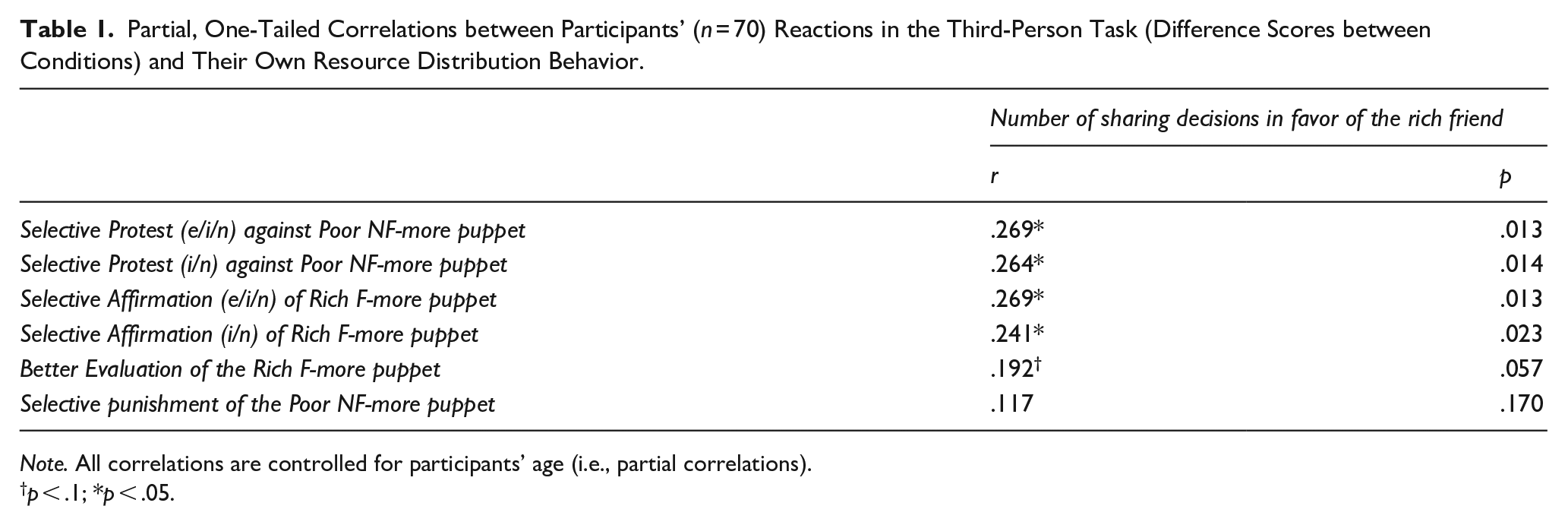
Note. All correlations are controlled for participants’ age (i.e., partial correlations).
p < .1; *p < .05.
To examine whether the correlation between normative views and behavior was affected by the time passed between tasks, we additionally computed a multiple linear regression, examining the interaction between normative view and time passed when predicting children’s overall allocation behavior. For the aggregated normativity score as well as for the single normative indicators, the interaction was not significant, ps > .260, suggesting that the differences in time that has passed had no effect on children’s consistency.
Explorative Group Analyses Based on Individual Coherence
In a follow-up analysis, we split the sample (N = 70) into four subgroups based on children’s consistency to examine interindividual differences in coherence. That is, we created groups based on children’s normative view, relying on the binary question of which behavior they think was better, and their own behavior, based on which agent they favored in more than half of the allocation trials (children who decided equally often for the friend and non-friend were excluded for this analysis, n = 5). Group 1 (n = 22) comprises children who favored giving more to a rich friend and behaved accordingly. Group 2 (n = 6) comprises children who favored giving more to a poor non-friend and behaved accordingly. Group 3 (n = 35) comprised children who acted inconsistently, favoring giving more to a poor non-friend, but giving more to a rich friend themselves. Group 4 (n = 2) comprises children who acted inconsistently, favoring giving more to a rich friend, but giving more to a poor non-friend themselves.
To account for the small sample sizes, we combined children who behaved consistently (Group 1 + 2, n = 28) and children who behaved inconsistently (Group 3 + 4, n = 37) for further analyses. Independent sample t-tests revealed no differences between the consistent and inconsistent group regarding age, t(55.8) = −0.86, p = .393, and time passed between measurement points, t(58.6) = 1.18, p = .243. A χ²-test revealed that the proportion of (in)consistent children was independent of sex, Χ2(1, N = 65) = 1.31, p = .252. We examined interrelations between normative views and behavior separately for the two groups. As in our main analysis, we computed partial one-tailed correlations, controlling for participants’ age. In the group of consistent children, children’s overall behavior across trials correlated with all normative expressions (selective protest e/i/n: r = .58, p < .001; selective protest i/n: r = .48, p = .006; selective affirmation e/i/n: r = .57, p < .001; selective affirmation i/n: r = .46, p = .008; better evaluation: r = .55, p = .001; selective punishment: r = .35, p = .039). In the group of inconsistent children, all correlations were non-significant (ps > .080). Taken together, the coherence between normative views and behavior was driven by a subgroup of children who behaved consistently.
Discussion
A key debate in moral development centers on the relation between normative views and behavior. Previous theories and empirical evidence suggested either coherence between the two (Killen & Dahl, 2018; Paulus et al., 2018; Rizzo et al., 2020; Turiel, 2003) or a discrepancy (Blake, 2018; Blasi, 1983; Smith et al., 2013; Tan et al., 2021). The present study aims to go beyond this dichotomy of dissociation or coherence by investigating the relation at the group level and at the individual level when contrasting fairness considerations with the inclination to favor friends. The results demonstrated that preschoolers hold normative views toward rectifying inequalities, that is, they express that one ought to give more to a poor non-friend than to a rich friend. Yet, when allocating resources themselves, children favored the rich friend over the poor non-friend. At the same time, this discrepancy at the group level stands against a relation at the individual level. The more children protested against a puppet who favored a poor non-friend or affirmed a puppet who favored a rich friend, the more resources they allocated themselves to a rich friend.
Overall, this study advances the debate about the relation between normative views and behavior by integrating evidence for dissociation and coherence at an empirical and a theoretical level. In particular, this study supports the notion that normative views are related to actual behavior at the individual level (Killen & Dahl, 2018; Turiel, 2003). Beyond that, children’s general inclination to share or to allocate resources across individuals seems to be affected by additional factors—in the present study, triggered by the friendship status of recipients. This resulted in a shift of the normative view and behavior when looking at the group, while maintaining a relation when looking at the individual. This discrepancy when looking at the group aligns with the notion of a gap between normative views and behavior (Blake, 2018). The present study thus allows us to reconcile theoretical views that suggest either coherence or dissociation. Research on the relation between normative views and behavior might benefit from more differentiated examinations in the future, investigating relations at the group level, the individual level, and factors that might lead to a shift between the two.
Children expressed a normative view toward rectifying inequalities in their spontaneous affirmation of the observed behaviors, evaluation, and punishment judgments. These findings support the notion that preschoolers endorse fairness considerations and enforce norm-conforming behavior in third parties (e.g., McAuliffe et al., 2015; Rakoczy & Schmidt, 2013). Preschooler’s view that one ought to give more to a poor than to a rich recipient aligns with previous evidence (Rizzo & Killen, 2016; Wörle & Paulus, 2018). The finding that children protested with similar frequency against favoring a rich friend and favoring a poor non-friend suggests that children do not spontaneously prevent others from giving particularly more to a rich friend. The rich recipient being the best friend of the distributor might have rendered the behavior more acceptable, despite his greater wealth. Children’s affirmation differed only when considering the more liberal score, including expectation-related comments. This suggests that while children express a preference for one behavior over the other and have an expectation on how one would behave, they might not clearly differentiate between the observed behaviors in normative terms. Yet, when being asked to reflect on the goodness of a behavior and deserved punishment, children considered favoring a rich friend as worse than favoring a poor non-friend. Children’s justifications underpin the conclusion that their evaluations build on reasoning about the different social relationship and initial endowment of protagonists. While children’s protest and affirmation revealed interesting findings, almost a third of participants did not spontaneously comment in any trials. Despite a set of warm-up trials, it could be that some of these children were too shy to intervene, while others might not have had a strong normative stance either way. On the whole, these findings corroborate that preschoolers hold normative views toward fairness and rectifying inequalities.
Preschooler’s favoring of the rich friend in their own resource allocation behavior fits evidence that highlights the role of social relationships for sharing behavior (Birch & Billman, 1986; Fehr et al., 2008; Moore, 2009; Paulus, 2016). Importantly, even when children had to decide between giving more to a rich friend or a poor non-friend (uneven trials), they decided for the rich friend in more than half of the trials. Children’s strong tendency to favor a friend is underpinned by their behavior in the even-rich trials: Children decided to favor the rich friend in around half of the trials, although the alternative option would both fulfill a principle of equal distribution and a principle of relatively allocating more to a poor recipient. These findings extend previous research by demonstrating a strong inclination of favoring a friend in the presence of conflicting, prevalent demands and thus inform about the weighting of different motivations for prosocial behavior (Martin & Olson, 2015). The preference to favor the friend despite contrasting normative views relates well to findings that sharing with friends is related to a specialized neural network (Schreuders et al., 2019) and plays an important role in human social functioning and health (Carlo et al., 2010). Interestingly, as evidenced by the even-rich trials, children more often opted for distributing resources equally over favoring the rich friend with increasing age. This finding aligns with previous studies showing a preference of equality over partiality in children (Paulus et al., 2020) and an increasingly positive evaluation of equal distribution across childhood (Elenbaas, 2019). In general, the findings add to a recent line of research demonstrating preschool children’s expectation of a relation between partiality and friendship (e.g., Afshordi, 2019; Liberman & Shaw, 2017).
Yet, children’s behavioral tendency stands in contrast to their normative view. When looking at the average responses of the group, preschoolers favor a rich friend although they express that one ought to favor a poor non-friend. This discrepancy suggests that children’s distribution behavior is affected by factors that are independent of their normative view. For example, being confronted with a friend as potential recipient might trigger reciprocal considerations (Laursen & Hartup, 2002). In addition, friendships are typically characterized by shared positive affect and affiliation (Newcomb & Bagwell, 1995). Hence, preschoolers might be inclined to favor friends, irrespective of their wealth, because they like them, feel close to them, or expect reciprocal behavior. These affective and reciprocal factors might trigger particularly spontaneous behavior, while normative views might be more reflective and rooted in children’s fairness-based reasoning. This moves children to behave generously toward a rich friend, although they hold an opposed normative view.
Importantly, this discrepancy when looking at the group stands against coherence when looking at the individual. Children’s normative view correlated with their distribution behavior. This finding fits the theoretical notion that moral judgments are intrinsically motivating (Killen & Dahl, 2018; Turiel, 2003). It seems to be still the case that some children do not completely follow their moral judgment. Importantly, however, the stronger children endorsed a norm, as expressed in their selective protest and affirmation of one behavior over the alternative behavior, the more they behaved accordingly. Even though own behavior might be shifted, it seems to be related to children’s own normative view. This finding builds on previous studies, suggesting that judgments about resource allocations align with own behavior (Paulus et al., 2018; Rizzo & Killen, 2016), and extends these by demonstrating individual coherence in the face of dissociation at the group level. The correlation at the individual level was positive for a composite normative score, and strongest for spontaneous protest and affirmation. All normative indicators that we assessed reflect established operationalizations of normative/moral views (e.g., Cooley & Killen, 2015; Rakoczy et al., 2016). But contributing to recent debates on the nature of young children’s emerging normativity (Killen & Dahl, 2018; McAuliffe et al., 2015), this pattern suggests that different normative indicators reflect slightly different aspects of normativity. Spontaneous expressions of normative views might most closely reflect own behavioral tendencies. When being explicitly asked to make an evaluation or punishment judgment, children might start to reflect more on the observed behavior. This might lead children to integrate different considerations, such as obligations stemming from resource disparities, resulting in a judgment that differs more from own spontaneous behavior. Overall, relations of both spontaneous and more reflective normative indicators and across normative indicators suggest that normative views are relevant for own behavior.
The view that differences at the group level stem from shifted behavioral tendencies within an age group fits to previous research on costly sharing behavior. Children up to around 7–8 years express that one ought to share half of ones resources, but act rather selfishly when sharing resources themselves (Kogut, 2012; Smith et al., 2013). Lacking self-control competencies have been suggested as an explanation for this gap at the group level (Blake, 2018). In contrast, the present study assessed normative views and behavior in a non-costly resource distribution scenario. One could argue that this procedure renders an explanation of lacking self-control for the discrepancy at the group level unlikely, as children’s own resources were never at stake. The current approach thus allows us to examine discrepant normative views and behavior outside a context in which children’s self-interest is concerned. However, when using a broader concept of self-interest, one could argue that preferring friends is a kind of self-focused behavior. Friends could be considered as part of the self because children engage in close, reciprocal interactions with friends and describe themselves with reference to their friendships (Harter, 2007; Laursen & Hartup, 2002). Following this argumentation, it is possible that the increased weighting of friendship-considerations in own resource distribution stems from a bias toward self-interest. It might be an interesting avenue for further research to examine the role of behavioral control for preferential sharing with friends.
Considerations such as self-interest might not only lead to a discrepancy at the group level, but also lower correlations between normative views and behavior. Some individuals might strive more to be consistent and have greater self-control competencies, others less. Investigating subgroups of children revealed that around half of the children acted inconsistently. The discrepancy between normative views and behavior that we found at the group level thus seems to stem mostly from a subgroup of children, who evaluated it more positively to rectify inequality but followed friendship considerations in their behavior. For these children, friendship considerations might trigger spontaneous behavior against their normative view, as explained above. Consistency, however, seems to stem mostly from children who favored the rich friend. Although differential findings between groups have to be interpreted with caution due to limited sample sizes, they present some interesting perspectives and avenues for future research. For example, one open question concerns why some children follow their normative view to rectify inequalities while others disregard their normative stance and give more to friends. A deeper investigation of this question would further our understanding of how normative views impact behavior.
Beyond addressing the relation between normative views and behavior, this study speaks to the question how children handle conflicting normative demands. Previous studies and theoretical considerations suggest that friendships carry normative obligations (e.g., Keller et al., 1998) and affect judgments of moral values (Marshall et al., 2020). Accordingly, preschoolers expect others to share more with a friend (Paulus & Moore, 2014), and also guide others to distribute resources accordingly (Olson & Spelke, 2008). Yet, the present study suggests that in preschool years, the normative view that one ought to favor friends is subordinate to a normative view of rectifying inequalities. Interestingly, children seem to take friendship contexts into account when evaluating moral transgressions, but evaluations seem to remain primarily based on welfare considerations and differ not fundamentally depending on the relationship context (Smetana & Ball, 2018). The present study indicates how demands resulting from social relationships are handled in the face of conflicting, fairness-based demands.
Limitations and Future Directions
This study advances the debate about the relation between normative views and behavior by integrating evidence for dissociation and coherence. It relies on a situation when contrasting fairness considerations and the inclination to favor friends. This context is particularly interesting, because previous separate studies thereto suggest conflicting evidence at the behavioral and normative levels (Paulus, 2016; Rizzo & Killen, 2016). Yet, future research should investigate whether the coexistence of dissociation and coherence characterizes the relation between normative views and behavior in other contexts as well. For example, it would be interesting to examine whether the current findings are replicated when contrasting a friend with a stranger rather than a non-friend. Moreover, weighing of justice-based and relationship-based considerations might be culturally dependent (Miller & Bersoff, 1992). As the current sample mostly stems from Western cultural background, it remains an open question whether the pattern of a dominating norm of rectifying inequalities while generally favoring a friend is universal. In addition, the order of the first-person and third-person task was fixed across participants. We thus cannot exclude the possibility that the findings of these tasks are generally affected by this order. Furthermore, normative views are suggested to be perceived as more personally binding around middle childhood (Nunner-Winkler, 2007). While the current findings already suggest relations with behavior in preschool years, it would be interesting to examine how these develop across childhood. On one hand, an increasing sense of personal obligation might generally lead to more adherence to the norm of giving more to the poor non-friend (cf. Rizzo & Killen, 2016). On the other hand, social relationships might receive increasing normative force, because friendships become more complex and social-communicative across childhood and provide a context for children to construct their view of the social world (Carpendale et al., 2013; Laursen & Hartup, 2002). A third alternative could be that children develop individually different with regard to how they weigh conflicting principles (cf. Abramson et al., 2018).
Conclusion
In summary, the present study reconciles evidence for coherence and dissociation between normative views and behavior in preschool years. While normative views and behavior seem to differ when looking at the group, individual tendencies seem to align. From an applied point of view, these findings underscore the relevance of constructing and fostering normative views about social behavior. Although a normative view might not be directly expressed in a child’s behavior, as other driving factors can prevail, individual tendencies at the normative and behavioral levels align when viewed relative to others. From a theoretical perspective, the study highlights that differentiating between relations at the group level and the individual level is important to reach a comprehensive picture of the relation between normative views and behavior.
Supplemental Material
sj-docx-1-jbd-10.1177_01650254221096813 – Supplemental material for Normative views and resource distribution behavior in childhood: Dissociated at the group level, but associated at the individual level
Supplemental material, sj-docx-1-jbd-10.1177_01650254221096813 for Normative views and resource distribution behavior in childhood: Dissociated at the group level, but associated at the individual level by Natalie Christner, Monika Wörle and Markus Paulus in International Journal of Behavioral Development
Footnotes
Funding
The author(s) disclosed receipt of the following financial support for the research, authorship, and/or publication of this article: This work was supported by a James S. McDonnell Foundation 21st Century Science Initiative in Understanding Human Cognition-Scholar Award (No. 220020511) to MP.

Supplemental Material
Supplemental material for this article is available online.
References
Supplementary Material
Please find the following supplemental material available below.
For Open Access articles published under a Creative Commons License, all supplemental material carries the same license as the article it is associated with.
For non-Open Access articles published, all supplemental material carries a non-exclusive license, and permission requests for re-use of supplemental material or any part of supplemental material shall be sent directly to the copyright owner as specified in the copyright notice associated with the article.
