




Abstract
Two studies examine the convergence between measures of friendship and measures of liking in the assessment of friendship and peer acceptance. In the first study, 551 (301 boys and 250 girls) Canadian primary school children (ages 8–11) nominated friends and liked-most classmates. In the second study, 282 (127 boys and 155 girls) US primary school children (ages 9–11) nominated friends and rated classmates on a sociometric preference scale. The results revealed considerable convergence in the assessment of friendship. Most first, second, and third ranked friends were also nominated and rated as liked-peers, suggesting that when measures of liking are used to identify friends, few top-ranked friendships are overlooked. There was less convergence in assessments of peer acceptance. Peer acceptance scores derived from friend nominations were more strongly correlated with peer acceptance scores derived from liking nominations than with those derived from sociometric preference ratings. We conclude that liking nominations accurately capture friendships, particularly best friendships. Friend nominations may be a suitable substitute for assessments of liking, but they are a poor substitute for assessments of sociometric preference.
Friendship and peer acceptance among school-aged children are almost always assessed with peer nominations or ratings. Beyond this similarity, the constructs differ in important ways. Friendship describes an affective bond between two children, whereas peer acceptance describes the degree to which a child is liked by members of the peer group (Bukowski & Hoza, 1989). Friend assessments typically ask “who is your friend?” whereas peer acceptance assessments ask “who do you like?” Variants of each, however, are often used interchangeably. This study examines whether responses to these questions are truly interchangeable. We do not seek to settle the debate as to whether the construct of friendship should only be gauged with questions that explicitly mention friends or whether the construct of peer acceptance should only be assessed with specific reference to liking. Instead, our goal is to describe the extent to which the different procedures (a) identify the same friends and (b) yield similar peer acceptance scores. To this end, we examined convergence in assessments of friendship and liking in two studies.
Liking Measures
Peer acceptance describes the degree to which a child is liked by peers. It reflects the child’s position within a reference group (i.e., those providing the liking nominations, usually classmates but sometimes grademates or schoolmates). As an index of group status derived from the affection of others, peer acceptance forecasts psychosocial adjustment. Well-liked children enjoy a host of advantages in domains that include academic involvement and achievement (e.g., Kingery et al., 2011) as well as the development of social skills (e.g., Blandon et al., 2010). Children who are not liked by peers usually present higher levels of loneliness, health risk behaviors, and internalizing problems than liked-peers (Prinstein et al., 2018).
Sociometric assessments of peer acceptance date back to Moreno’s (1934) groundbreaking work on peer reputations, in which children nominated liked and disliked classmates. The number of liking nominations received provided a continuous peer acceptance score for each child in the group. In recent years, limited nomination procedures, where children usually identify one, three, or four classmates, have given way to unlimited nominations (Bukowski et al., 2012). Measurement particulars vary but commonly used assessment items include “who do you like the most?” (e.g., van den Berg et al., 2015), “who do you like to play with the most?” (e.g., Eivers et al., 2012), “who do you like to hang out with” (e.g., Hawley et al., 2007), and “who do you like to spend time with the most” (e.g., Prinstein et al., 2003). Individual peer acceptance scores represent the total of the number of liked nominations received. In the related roster-rating procedure (Singleton & Asher, 1977), each participant rates every other member of the reference group on a Likert-type scale. Examples include ratings of how much the child: “likes to play with NAME” (e.g., Asher & Dodge, 1986), “likes to work with NAME” (e.g., Lemerise, 1997), “likes to spend time with NAME” (e.g., Glick & Rose, 2011), and “likes NAME” (e.g., Singleton & Asher, 1977). Individual peer acceptance ratings represent the average of ratings received on a scale with only a positive pole (e.g., “how much do you like NAME”) that typically ranges from not at all or a little on one end to a lot on the other end.
Individual sociometric preference (also known as likeability or social preference) provide a different means of gauging the child’s standing in the peer group. Sociometric preference encompasses measures of both peer acceptance and peer rejection. It is typically measured by subtracting the number of liked-least (e.g., who do you like the least?) or disliked (e.g., who do you dislike the most?) nominations received from the number of liked nominations received. Sociometric preference can also be measured using the average of ratings received on a scale that includes positive and negative poles that typically range from do not like to like a lot (Bukowski et al., 2000; Persram et al., 2021). Sometimes scholars apply the term preference to measures of peer acceptance, which can be a source of confusion. In this article, we reserve the use of the term sociometric preference for indices that capture both liking and disliking dimensions of peer status.
Friendship Measures
Friendships are dyadic relationships defined by reciprocated liking and mutuality. Friends are usually affectionate, trusting, and loyal toward one another, and engage in frequent, mutually beneficial social exchanges (Laursen & Hartup, 2002). Friendship participation forecasts individual well-being. Although the number of friends is occasionally a significant predictor of childhood outcomes (e.g., Ladd, 1990), most findings center on the advantages of having—as opposed to not having—a friend. Friendless children report long-term adjustment difficulties such as trouble in school, low self-worth, and emotional distress (Ladd & Troop-Gordon, 2003; Wentzel et al., 2004). Moreover, children who become friendless report increases in depressive symptoms, whereas friendless children who make a new friend report decreases in symptoms (Bukowski et al., 2010). Long-term associations have also been reported such that friendlessness in middle childhood forecasts declining self-worth and social competence, and elevated depressive symptoms 12 years later (Bagwell et al., 1998).
Neugarten (1946) was one of the first to measure friendship using a nomination procedure, asking school-aged children to name others in the community who best fit descriptions such as “these boys and girls are my best friends” and “they are the ones I play with most of the time.” The first use of reciprocated nominations to designate friendships occurred around the same time: Frankel and Potashin (1944) identified friends as highest ranked mutually nominated liked partners, and Bonney (1946) identified friends on the basis of mutually high ratings on items such as “remain in the room if all others have to leave,” “seating companion,” and “partner for a trip.” Here too, participants may be given a limited (typically one, three, or four) or unlimited number of nomination opportunities. It is common for children to be asked to list their friends in rank order. Sometimes, especially in the case of young children, investigators ask participants to identify those with whom they “spend the most time” (e.g., Laursen et al., 2007) rather than specifically inquiring about friends, with the goal of concretizing the construct of friendship for those at an age when it is neither well-understood nor reliably self-reported (Hartup, 1989; Renshaw, 1981). Friendship may be defined in terms of reciprocated (both children nominate one another as friends) or unilateral (outgoing or incoming nominations that are not reciprocated) nominations.
The Interchangeability of Liking and Friendship Measures
Scholars do not agree as to whether liking nominations and friend nominations can be used interchangeably to assess peer acceptance or friendship. Some argue that observed companionship (Hinde et al., 1985) and expressed affection (Bukowski & Hoza, 1989) are valid indicators of friendship. Many scholars have adopted this logic, maintaining that questions about liking can be used to assess friendship (e.g., Echols & Graham, 2013; Hartup et al., 1988; Salmivalli & Isaacs, 2005; Schwartz et al., 2000) and that questions about friendship can be used to assess peer acceptance (e.g., Bukowski et al., 1996; Bukowski & Newcomb, 1984; Hoza et al., 2005; Newcomb & Bukowski, 1983). Not everyone agrees, however, asserting that because friendship is more exclusive than liking, the two should be assessed with construct-specific questions (e.g., Parker & Asher, 1993).
Few studies have directly addressed the degree to which measures of liking and measures of friendship are interchangeable. Two studies revealed no difference in correlations between participation in a reciprocal friendship and various measures of peer acceptance calculated from friend nominations and liking ratings, leading the authors to conclude that the different assessment techniques yielded comparable measures of peer acceptance (Bukowski et al., 1994, 1996). In a study of friendship assessment, most primary school-aged children gave their highest ranked reciprocal friend a liking rating, leading the authors to conclude that the two procedures are equally likely to capture friendships (Yugar & Shapiro, 2001). To our knowledge, however, no study has directly compared the degree to which friend nominations and liking nominations or ratings identify the same friends and yield similar peer acceptance scores.
The Present Study
Our study has two aims. The first aim was to describe the convergence between measures of liking or sociometric preference and measures of friendship in the identification of friend dyads in two different samples using two different methods. The following two forms of convergence were examined: (a) between outgoing limited friend nominations and outgoing limited liking nominations (Study 1) and (b) between outgoing unlimited friend nominations and outgoing unlimited sociometric preference ratings (Study 2). The second aim was to describe the convergence between measures of liking or sociometric preference and measures of friendship in the assessment of peer acceptance. The following two forms of convergence were examined: (a) between the number of limited friend nominations received and the number of limited liking nominations received (Study 1) and (b) between the number of friend nominations received and sociometric preference ratings received (Study 2).
Method
Study 1
Participants and Procedure
Participants included 551 children (301 boys, 250 girls) from a longitudinal study who contributed data at least once during the third (M = 8.17 years), fourth (M = 9.95 years), or fifth (M = 10.95 years) grades. The participants were French-Canadian students who attended five elementary schools in a small community in northwestern Quebec, Canada. Of these students, 80% lived with both biological parents, 12% lived with mothers, and 8% lived in other family configurations. Of these parents, 18% completed high school, 47% had at least some post-high school education, and 35% had not graduated from high school. School records indicated that 96% identified as European American.
Parent consent and child assent were required for participation. The project was approved by school officials and the university IRB (approval number 410-92-1690). Participation rates (M = 90.0%) in all 19 classes were at or above 70%. The data were collected in classrooms by trained research assistants in the spring of 1989 for the third grade, and in the spring of 1990 and 1991 for the fourth and fifth grades. All instruments were administered in French. Bilingual translators verified the semantic similarity of the original and the back-translated questionnaires. Students completed the surveys in the same order. Liking nominations were completed before friend nominations, with 25 questions in between.
Of the 445 students who completed questionnaires during the third grade, 77 did not nominate any friends, 24 did not nominate any liked classmates, and 22 neither nominated friends nor liked classmates. Of the 449 students who completed questionnaires during the fourth grade, 69 did not nominate any friends, 20 did not nominate any liked classmates, and 19 nominated neither. Of the 381 students who completed questionnaires during the fifth grade, 27 did not nominate any friends, 19 did not nominate any liked classmates, and 12 nominated neither. We excluded participants who failed to make nominations on either variable because their scores inflated agreement without shedding light on the interchangeability of friend and liking nominations, which was the goal of the study.
Measures
Limited Liking Nominations.
Participants completed a standard sociometric nomination procedure using rosters that included the names of all students in the classroom. Liking was assessed with the question “who do you like to play with the most?” Participants circled the names of up to three classmates, in rank order. On average, participants nominated 1.38 (SD = 0.98) liked classmates during the third grade, 2.70 (SD = 0.24) liked classmates during the fourth grade, and 2.96 (SD = 0.22) liked classmates during the fifth grade.
Limited Friend Nominations.
Participants completed a friend nomination procedure using rosters that included the names of all students in the classroom. Friendship was assessed with the question “who are your best friends?” Participants circled the names of up to four classmates, in rank order. On average, participants nominated 1.68 (SD = 1.30) friends in the third grade, 2.41 (SD = 1.19) friends in the fourth grade, and 1.73 (SD = 1.35) friends in the fifth grade. This study focuses on the top three ranked friends, so that the number of friend nominations was comparable to the number of liking nominations.
Study 2
Participants and Procedure
Participants included 282 (127 boys, 155 girls) fourth (M = 9.45 years) and fifth (M = 10.52 years) grade students attending two public schools required to represent the state of Florida public school population in terms of ethnicity and family income. School records indicated that 51% identified as European American, 21% as African American, 2% as Asian-American, and 26% as Hispanic-American.
Parent consent and child assent were required for participation. The project was approved by school officials and the university IRB (approval number 702335-1). Participation rates were acceptable (M = 77.0%) in all but one of 23 classes. The class with low participation rates (i.e., 54%) was not included in the study. The data were collected in classrooms by trained research assistants during the winter of the 2013–2014 academic year. Sociometric preference ratings were completed before friend nominations, with 34 questions in between. All participants nominated friends. Of the 282 students who completed questionnaires, seven did not complete likeability ratings. Participants who did not make likeability ratings were excluded from the analyses.
Measures
Sociometric Preference Ratings.
Using a roster-rating procedure (Singleton & Asher, 1977), participants rated all same-sex classmates (“how much do you like this person”) on a scale ranging from 1 (do not like this person) to 5 (like this person very much). The average individual sociometric preference rating made by fourth graders was 3.92 (SD = 0.64). The average individual sociometric preference rating made by fifth graders was 3.84 (SD = 0.64). Sociometric preference ratings were converted to dichotomous liking nominations (see, for example, Cillessen et al., 1992; Erdley et al., 1998). In the inclusive conversion procedure, ratings of 4 (like this person) or 5 (like this person very much) were scored as a liked-most nomination. In the restrictive procedure, only ratings of 5 (like this person very much) were scored as a liked-most nomination. Fourth grade participants identified an average of 5.23 (SD = 1.84) classmates as liked using the inclusive procedure; and 3.13 (SD = 2.13) classmates using the restrictive procedure. Fifth grade participants identified an average of 5.22 (SD = 2.08) classmates as liked using the inclusive procedure; and 2.89 (SD = 2.09) classmates using the restrictive procedure.
Unlimited Friend Nominations.
Participants identified and rank-ordered an unlimited number of friends from a roster of same-sex classmates. On average, fourth-grade participants nominated 5.38 (SD = 2.12) friends. Fifth-grade participants nominated an average of 5.71 (SD = 2.24) friends.
Plan of Analysis
The first set of analyses describes the concordance between assessments of liking or sociometric preference and assessments of friendship in the identification of friends. We present Kappa coefficients and percentage agreement because the results describe concordance between two dichotomous scores, both describing whether a target classmate received a friend/liking nomination or not. For Study 1, the results describe the concordance between outgoing liking nominations and outgoing friend nominations. Scores describe the proportion of (a) first ranked nominated friends who were also nominated as a liked peer; (b) the proportion of first and second ranked nominated friends who were also nominated as a liked peer; and (c) the proportion of first, second, and third ranked nominated friends who were also nominated as a liked peer. For Study 2, the results describe the concordance between outgoing friend nominations and outgoing sociometric preference ratings. Scores describe the proportion of (a) first ranked nominated friends who were also rated as a liked peer; (b) the proportion of first and second ranked nominated friends who were also rated as a liked peer; and (c) the proportion of first, second, and third ranked nominated friends who were also rated as a liked peer. Separate analyses were conducted with data from the inclusive procedure for converting ratings to nominations and with data from the restrictive procedure. Because of the round robin nature of the nomination procedure, all classmate pairings were included in the analyses twice (e.g., Child B as a nomination target of Child A and Child A as a nomination target of Child B) using a split-half procedure (i.e., assigning one randomly selected set of scores from each dyad to one subsample and scores from the other member of the dyad to another subsample). Analyses were also conducted separately by grade.
Supplemental analyses were conducted to determine whether incongruence could be traced to friend nominations that were not accompanied by liking nominations (false negatives) or liking nominations that were not accompanied by friend nominations (false positives).
The second set of analyses describes the concordance between assessments of friendship and assessments of liking or sociometric preference in the identification of peer acceptance. We present interclass correlations because the results describe associations between two continuous scores, both describing the number of nominations an individual received. For Study 1, the results describe the concordance between the number of friend nominations received and the number of liking nominations received. For Study 2, the results describe the concordance between the number of friend nominations received and the number of liking nominations (converted from sociometric preference ratings) received. Analyses describe the extent to which liking (derived from friend nominations received) correlates with (a) average sociometric preference rating received, (b) number of liking nominations received using the inclusive procedure of converting sociometric preference ratings to liking nominations, and (c) number of liking nominations received using the restrictive procedure of converting sociometric preference ratings to liking nominations. All analyses were conducted separately by grade to identify age-related trends.
Results
Concordance Between Friend Nominations and Liking Nominations to Assess Friendship
Table 1 presents results from Study 1, describing the concordance between friend nominations and liking nominations in the identification of friends. All measures of concordance were statistically significant (p < .001) at each grade. Individuals tend to nominate their friends as liked-peers. Confidence interval comparisons (Cumming & Finch, 2005) indicated that within each grade, adjusted Kappa coefficients were highest for best friends; the top two ranked friends were less likely to be nominated as liked than were first ranked friends, but were more likely to be nominated as liked than the top three ranked friends. In each case, concordance was higher in the fourth grade than in the third or the fifth grade. The same pattern of statistically significant results emerged using a split-half procedure (i.e., assigning one randomly selected set of scores from each dyad to one subsample and scores from the other member of the dyad to another subsample).
Concordance (Adjusted Kappa) Between Friend Nominations and Liking Nominations to Assess Friendship: Study 1.
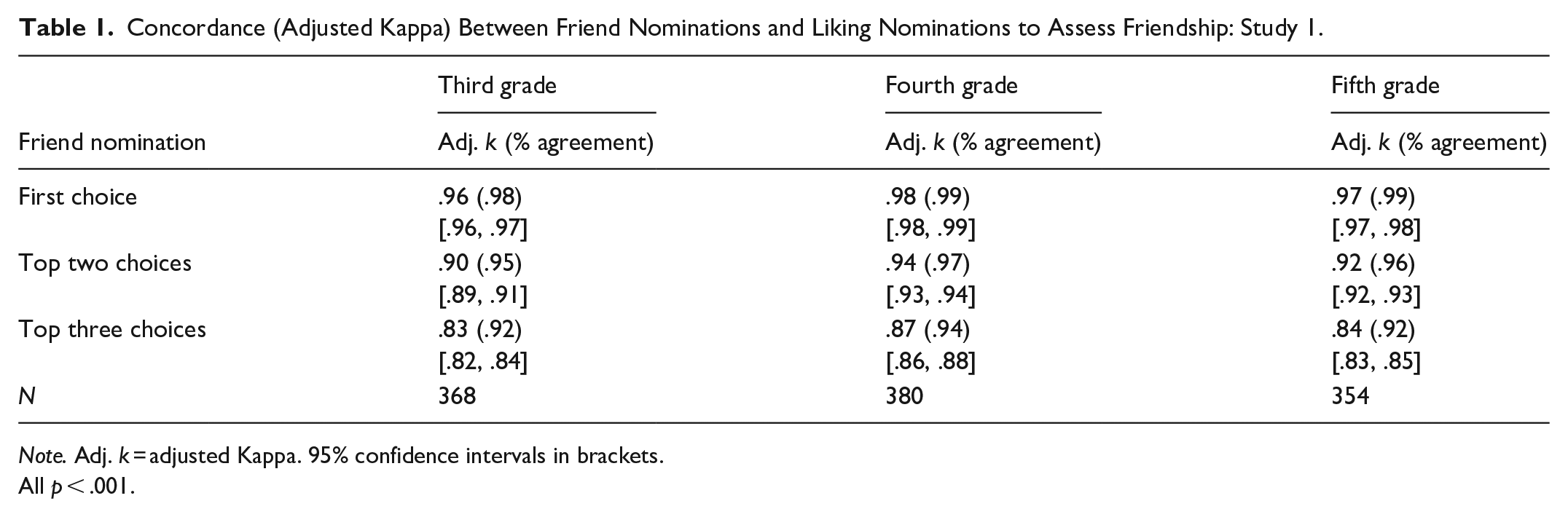
Note. Adj. k = adjusted Kappa. 95% confidence intervals in brackets.
All p < .001.
Supplemental analyses (see Table S1) were conducted to determine whether incongruence could be traced to friend nominations that were not accompanied by liking nominations (false negatives) or liking nominations that were not accompanied by friend nominations (false positives). The standardized residuals indicated that both false positives (range = −20.01 to −12.59) and false negatives (range = −22.05 to −12.77) occurred less often than expected by chance. Incongruence was more often a product of false negatives than false positives. The false negative standardized residual was greater than the false positive standardized residual in seven analyses (Mdifference = 1.18, range = 0.13−2.20) whereas the false positive standardized residual was greater than the false negative standardized residual in two analyses (Mdifference = 0.36, range = 0.11–0.61). The false negative standardized residual was also greater in lower ranked friendships than the false positive, whereas the false positive and the false negative standardized residual were similar in the top-ranked friendships.
Concordance Between Friend Nominations and Likeability Ratings to Assess Friendship
Table 2 presents results from Study 2, describing the concordance between friend nominations and sociometric preference ratings in the identification of friends. All measures of concordance were statistically significant (p < .001). Individuals nominated as friends also tended to be rated as liked-peers.
Concordance (Adjusted Kappa) Between Friend Nominations and Sociometric Preference Ratings to Assess Friendship: Study 2.
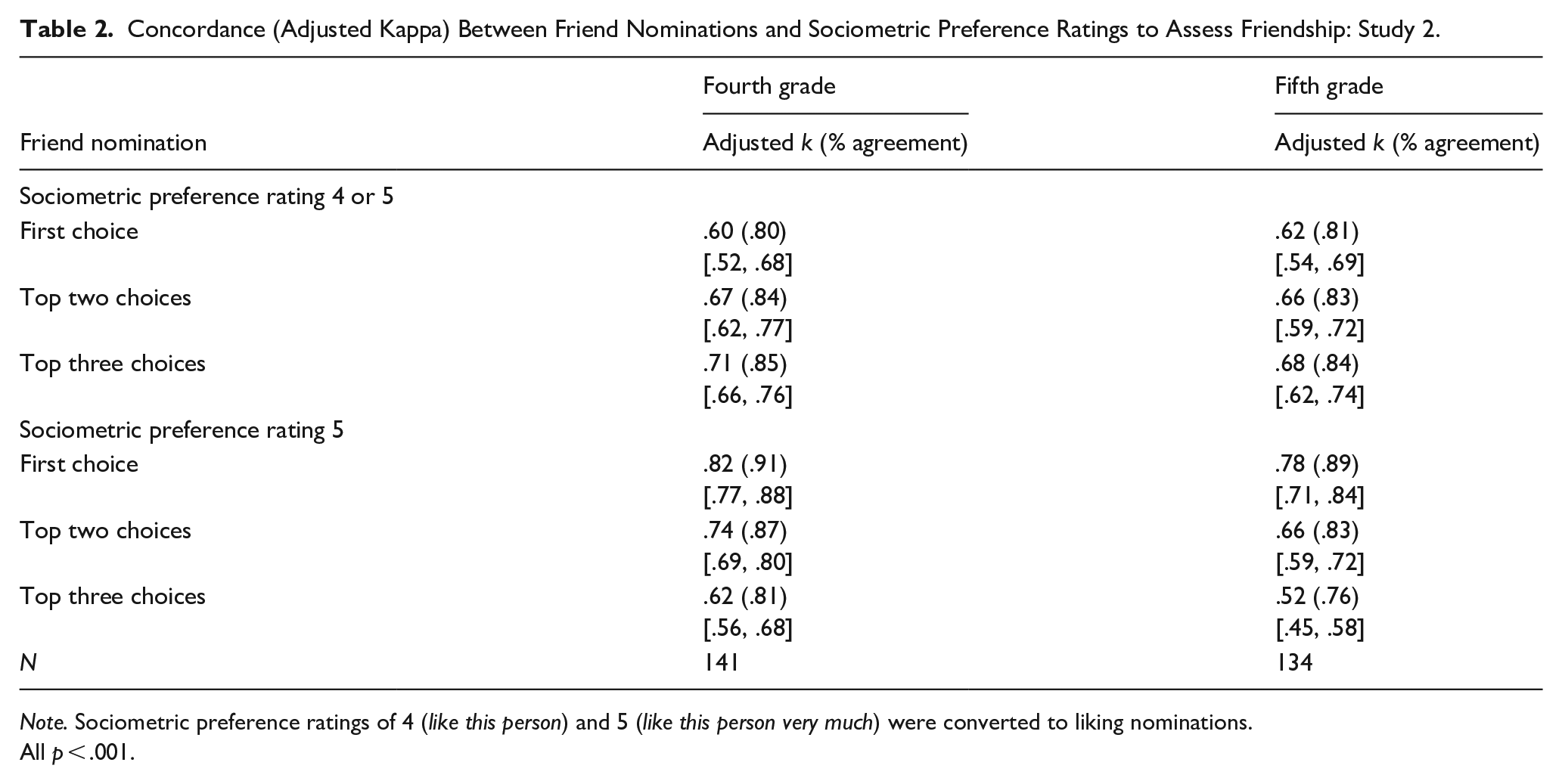
Note. Sociometric preference ratings of 4 (like this person) and 5 (like this person very much) were converted to liking nominations.
All p < .001.
Results for inclusive procedure (ratings of 4 or 5) for converting sociometric preference ratings to liking nominations, indicated that adjusted Kappa coefficients were higher for the top three ranked friends than for first ranked friends; the top two ranked friends fell in between. In the fourth grade, confidence interval comparisons indicated that differences between the top three ranked friends and first ranked friends were statistically significant, but those involving the top two ranked friends were not. In the fifth grade, confidence intervals comparisons did not reveal statistically significant differences in concordance. There were no differences between fourth and fifth graders.
Results for restrictive procedure (ratings of five only) for converting sociometric preference ratings to liking nominations indicated that adjusted Kappa coefficients were highest for first ranked friends; the top two ranked friends were less likely to be nominated as liked than first ranked friends, but more likely to be nominated as liked than the top 3 ranked friends. Confidence interval comparisons indicated that all contrasts were statistically significant within grades. There were statistically significant differences between fourth and fifth graders for third-ranked friends only. The same pattern of statistically significant results emerged using a split-half procedure (i.e., assigning one randomly selected set of scores from each dyad to one subsample and scores from the other member of the dyad to another subsample).
Supplemental analyses (see Tables S2 and S3) were conducted to determine whether incongruence could be traced to friend nominations that were not accompanied by liking nominations (false negatives) or liking nominations that were not accompanied by friend nominations (false positives). The standardized residuals indicated that both false positives (inclusive conversion strategy range = −7.72 to −5.20; restrictive conversion strategy range = −9.39 to −6.98) and false negatives (inclusive conversion strategy range = −9.27 to −7.45; restrictive conversion strategy range = −8.06 to −5.87) occurred less often than expected by chance. Using the inclusive strategy, incongruence was more often a product of false negatives than false positives: The false negative standardized residual was greater than the false positive standardized residual in all six analyses (Mdifference = 1.77, range = 1.03–2.32). Using the restrictive strategy, incongruence was more often a product of false positives than false negatives; the false positive standardized residual was greater than the false negative standardized residual in all six analyses (Mdifference = 1.26, range = 0.04–2.55).
In the inclusive strategy, the false negative standardized residual was greater in all friendships than the false positive standardized residual. In the restrictive strategy, the false positive standardized residual was greater in lower ranked friendships than the false negative standardized residual. The false positive and the false negative standardized residual were similar in the top-ranked friendships.
Concordance Between Friend Nominations and Liking Nominations to Assess Peer Acceptance
Table 3 presents results from Study 1, describing the concordance between friend nominations received and liking nominations received in the assessment of peer acceptance. All measures of concordance were statistically significant (p < .001) at each grade. There was considerable agreement (r = .66–.78) between peer acceptance scores calculated from liked-most nominations and peer acceptance scores calculated from friend nominations. Correlation contrasts indicated that concordance rates among fifth graders were significantly (p < .01) higher than those among third and fourth graders.
Concordance (Interclass r) Between Friend Nominations and Liking Nominations to Assess Peer Acceptance: Study 1.
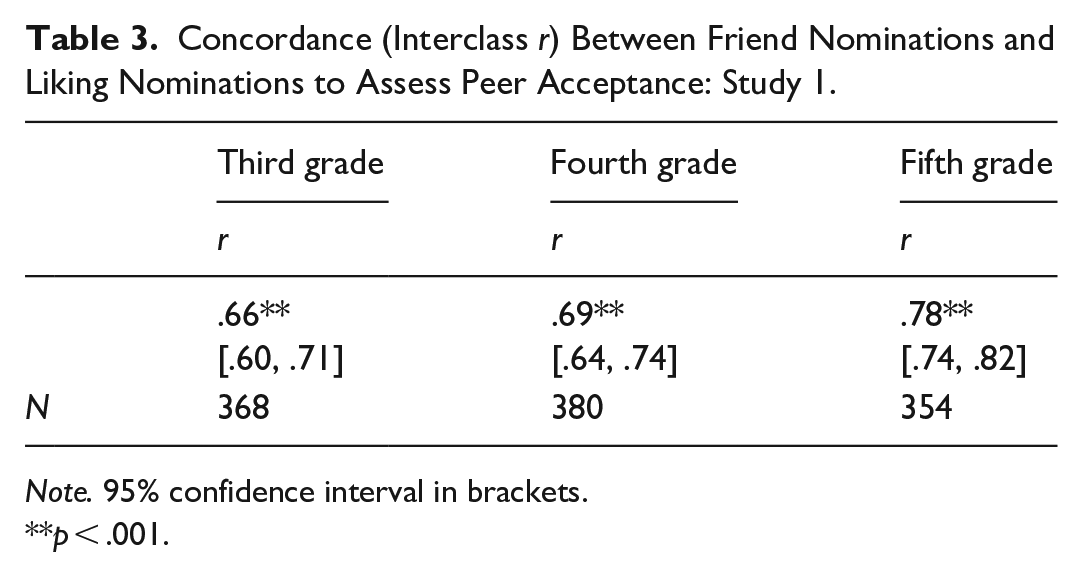
Note. 95% confidence interval in brackets.
p < .001.
Concordance Between Friend Nominations and Sociometric Preference Ratings to Assess Peer Acceptance
Table 4 presents results from Study 2, describing the concordance between friend nominations received and sociometric preference ratings received in the assessment of peer acceptance. All measures of concordance were statistically significant (p < .001) at each grade. There was agreement between peer acceptance scores calculated from liked-most nominations and peer acceptance scores calculated from (a) average sociometric preference ratings (r = .25–.57), (b) inclusive (i.e., the number of times a child received a rating of 4 or 5) procedure for converting sociometric preference ratings to liked nominations (r = .30–.48), and (c) restrictive (i.e., the number of times a child received a rating of 5) procedure for converting sociometric preference ratings to liked nominations (r = .36–.37). Within-grade correlation contrasts indicated that in the fifth grade, concordance rates were significantly (p < .05) lower for the restrictive measure than for either the inclusive measure or the average likeability rating. There were no statistically significant differences between assessments in the fourth grade. Between-grade correlation contrasts indicated that concordance rates for average sociometric preference scores were significantly (p < .01) higher among fifth graders than among fourth graders; there were no statistically significant grade differences on the restrictive and inclusive measures.
Concordance (Interclass r) Between Friend Nominations and Sociometric Preference Ratings to Assess Peer Acceptance: Study 2.
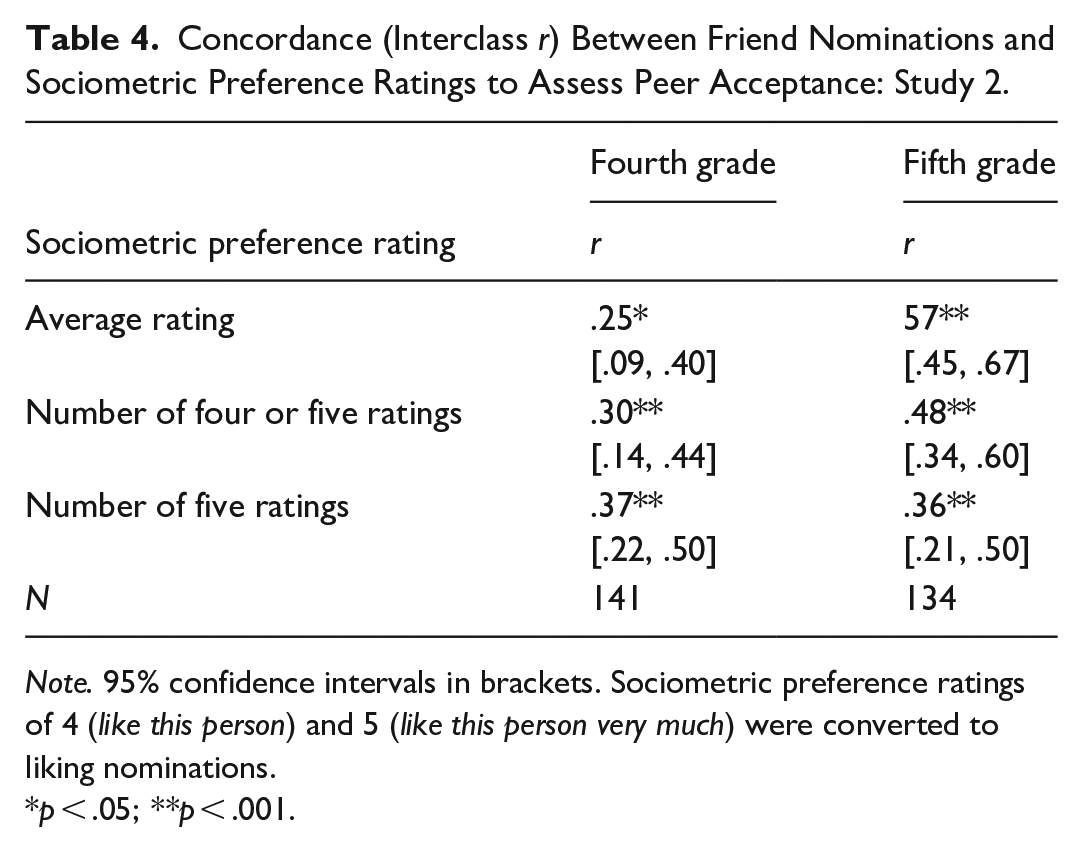
Note. 95% confidence intervals in brackets. Sociometric preference ratings of 4 (like this person) and 5 (like this person very much) were converted to liking nominations.
p < .05; **p < .001.
Discussion
Two studies were conducted to examine the convergence between measures of friendship and measures of liking in the assessment of friendship and peer acceptance. Results indicated that most top-ranked friends were also nominated and rated as liked-peers, suggesting that measures of liking can also be used to identify best friendships. Peer acceptance calculated from friend nominations had stronger associations with peer acceptance calculated from liking nominations than with peer acceptance calculated from sociometric preference ratings, suggesting that friend nominations may be reasonable tools to measure peer acceptance but they are not a good gauge of sociometric preference.
The results revealed considerable convergence across strategies in the assessment of friendship. Most first, second, and third ranked friends were also nominated or rated as liked-peers. When measures of liking are used to identify friends, best friends, in particular, tend not to be overlooked. Affective bonds are a hallmark of friendships; children care about, feel positive toward, and appreciate their friends, especially their closest friends (Bagwell & Bukowski, 2018). Children report positive feelings and experiences with top-rated friends, even for those with adjustment problems (Mikami, 2010). The results expand on previous findings of best friendships, which indicated that young children almost always assign a liked-most rating to their top-ranked reciprocal friend (Yugar & Shapiro, 2001). Together, the findings validate the common practice of identifying friendships from liking ratings and nominations (e.g., Echols & Graham, 2013; Hartup et al., 1988; Salmivalli & Isaacs, 2005; Schwartz et al., 2000).
What are the potential downsides of using liking nominations to identify friendship? The primary concern hinges on the argument that because liking is a broader and more inclusive construct than friendship, the former is apt to generate more nominations than the latter (Parker & Asher, 1993). From middle childhood onward, the characteristics of friendships extend beyond affection to encompass intimacy, loyalty, and trust (Berndt, 2002). It is possible, therefore, that liking nominations may encompass all of a child’s friends plus other classmates whom the child feels positive toward but does not have a relationship with. Put another way, friends are a subset of liked-peers, raising the prospect of overidentification errors when liking nominations are used to determine friendships. A few friends will be missed in the process, but some well-liked non-friends could be mistakenly categorized as friends, particularly when reciprocated nominations are not required. The supplemental analyses addressed this argument (see Table S1). False positives (liking nomination without friend nomination) and false negatives (friend nomination without liking nomination) were roughly comparable for top-ranked friends but the former were greater than the latter among lesser ranked friends. We conclude that there is merit to the concern that liking nominations mistakenly classify some liked non-friends as friends, although probably not as best friends or even among the closest friends. We suspect that both classification errors can be reduced by asking children to rank their liked classmates, on the assumption that friends will be ranked above non-friends. The requirement of reciprocity may also reduce classification errors.
Do sociometric preference ratings reliably identify friends? The short answer is yes, within limits (see Tables S2 and S3). Sociometric preference ratings of 5 (like this person very much) on a five-point scale aligned well with best friend nominations. However, the inclusive strategies (ratings of 4 or 5) produced lower levels of convergence for top-ranked friends, with errors on the side of commission. Thus, the problem of overidentification was more common than the problem of underidentification when sociometric preference ratings of 4 were included as markers of friendship, because not every moderately liked classmate was a good friend. In contrast, convergence declined appreciably in the restrictive strategy with the assessment of lower ranked friends. False positives and false negatives occurred at a similar rate among top-ranked friends, but the false negative rate grew (and the false positive rate did not) with the inclusion of second and third ranked nominated friends. Thus, restrictive strategies to identify friends from sociometric preference ratings increasingly erred on the side of omission. Underidentification errors occurred because not all lower ranked friends received the highest possible sociometric preference rating.
It is fair to say that the use of friend nominations to measure peer acceptance is not a common practice and the use friend nominations to gauge sociometric preference is almost unprecedented (but see Hoza et al., 2005). The results explain why. Correlations between liking nominations received and friend nominations received were strong, but not overwhelming, accounting for 44%–61% of the variance. Although expressed liking and friendship have considerable conceptual overlap, the same cannot be said for peer acceptance and friendship. Peer acceptance is the degree to which a child is liked by others and reflects the child’s standing in the group. In contrast, friendships are dyadic affiliations that encompass only a fraction of the peer group. Well-liked children do not necessarily have friends in proportion to their group status. Children like peers who are not their friends and many children have affection for high-status peers who are nice, prosocial, and trustworthy (Parkhurst & Hopmeyer, 1998). The use of friend nominations to determine peer acceptance is likely to result in non-random underidentification errors. Although most children without friends have low peer acceptance scores (Ladd & Troop-Gordon, 2003), well-liked children do not befriend everyone who likes them, meaning that friend nominations received probably underestimate the peer acceptance of higher status but not lower status members of the peer group. Testing this hypothesis is not a straightforward proposition and we look forward to learning how others address this challenge.
Sociometric preference ratings encompass liking and disliking. Average sociometric preference rating scores are akin to scores derived from both liking and disliking nominations (i.e., rejection scores subtracted from acceptance scores). Conceptually, friendship and liking overlap; both encompass positive affective bonds. Not so with friendship and disliking; non-friends are not necessarily rejected peers. This fact is in line with reports indicating that friendship participation is less strongly correlated with sociometric preference than with peer acceptance (Bukowski et al., 1996). The low correlation between average sociometric preference scores and friend nominations received is consistent with previous findings indicating that children with many friends are nevertheless disliked by a few and children with a few friends are not necessarily disliked by many (Parker & Asher, 1993). The upshot is that because sociometric preference scores encompass a range of sentiments from antipathy to affection, they should not (and do not) closely align with acceptance scores derived from reports of friendship. Converting sociometric preference ratings to liking nominations, using inclusive (by counting scores of 4 or 5) or restrictive (by only counting scores of 5) procedures did not appreciably change the association between friend nominations and sociometric preference ratings in the assessment of peer acceptance. This is less easily explained and contrary to our expectations. We conclude that friend nominations can be used to assess peer acceptance (in a pinch), particularly among older children, but they ought not be used to assay sociometric preference.
This study is the first, to our knowledge, to directly compare the degree to which friend nominations and liking nominations or sociometric preference ratings identify the same friends and yield similar peer acceptance scores. The findings have theoretical and practical implications for scholars engaged in sociometric research. These assets do not mean that our study is without limitations. First, the sample encompassed a fairly narrow age period. Recent meta-analytic findings indicate that correlations between peer acceptance and popularity differ with age (van den Berg et al., 2020), suggesting that sociometric and friendship constructs become more distinct as children get older. The same study indicated that associations differ across cultural contexts, which has important implications for our work too. Finally, our results do not consider order effects, single- versus multiple-item construct distinctions, or subtle differences in question wording. Recent discussions surrounding the unique reputational salience of being perceived as fun (Laursen et al., 2020) and about the consequences of selective missingness (i.e., the inclusion or exclusion of non-participants as potential nomination targets; Babcock et al., 2018; Bukowski et al., 2019) underscore that there is still much about sociometry that we do not understand. We also acknowledge differences in the methods employed in the two studies. The participation rates were lower in the second study than in the first, although both were in an acceptable range. It is therefore not clear if higher rates of participation might alter the findings. The first study permitted other-sex nominations, whereas the second study limited nominations to same-sex classmates. The wording of liking nominations also differed, as did the number of nominations permitted. However, these differences can be viewed as a strength, rather than a weakness. Indeed, despite these differences, there was considerable continuity across the results, providing evidence of replicability and generalizability across the methodological variations that are common in sociometric research.
Conclusion
Sociometric procedures can be costly for investigators and time-consuming for participants. Findings from this study should serve as a guideline for efforts to reduce the burden of data collection, pointing to when it is reasonable to interchangeably deploy liking and friendship measures and when it is not. Three recommendations follow. First, measures of liking can be used to identify top-ranked friends. However, we recommend that (a) liking nominations should be accompanied by rankings to help discriminate best friends from other friends and (b) restrictive procedures should be applied to rating scales to minimize overidentification error. Second, scholars should be cautious about using friend nominations to measure peer acceptance. Although the associations between the scores derived from the two procedures were strong, they were not without error and there is a good reason to suspect that friend nominations may underestimate peer acceptance scores for those who are particularly well-liked. Third, friend nominations are a poor proxy for sociometric preference. The two ought not be used interchangeably.
Supplemental Material
sj-docx-1-jbd-10.1177_01650254221084097 – Supplemental material for The interchangeability of liking and friend nominations to measure peer acceptance and friendship
Supplemental material, sj-docx-1-jbd-10.1177_01650254221084097 for The interchangeability of liking and friend nominations to measure peer acceptance and friendship by Fanny-Alexandra Guimond, Robert Altman, Frank Vitaro, Mara Brendgen and Brett Laursen in International Journal of Behavioral Development
Footnotes
Declaration of Conflicting Interests
The author(s) declared no potential conflicts of interest with respect to the research, authorship, and/or publication of this article.
Funding
The author(s) disclosed receipt of the following financial support for the research, authorship, and/or publication of this article: This work was supported by the US National Institute of Child Health and Human Development (HD096457).

Supplemental Material
Supplemental material for this article is available online.
References
Supplementary Material
Please find the following supplemental material available below.
For Open Access articles published under a Creative Commons License, all supplemental material carries the same license as the article it is associated with.
For non-Open Access articles published, all supplemental material carries a non-exclusive license, and permission requests for re-use of supplemental material or any part of supplemental material shall be sent directly to the copyright owner as specified in the copyright notice associated with the article.
