




Abstract
The present study investigated (1) how social relationships with teachers and peers and self-esteem of students with social–emotional and behavioral difficulties (SEBD) in inclusive regular education (regular schools) and students with SEBD in exclusive special education (special schools) develop over time in comparison with each other and in comparison with their typically developing peers and (2) whether factors—present before students with SEBD received special education services—predicted social–emotional development in either educational setting. Thirty-six students with SEBD in regular schools, 15 students with SEBD in special schools, and 1,270 typically developing peers participated. We collected data when students with SEBD resided in regular education without additional support, and we followed the development of students with SEBD for 1.5 years with three additional measurements in either school setting. Data of typically developing peers were collected when they resided in a classroom of a participating student with SEBD. Using Bayesian statistics, we found that students with SEBD in special schools had more conflictual relationships with their teachers than typically developing peers, but these relationships improved over time. Students with SEBD in regular schools were less accepted among peers than typically developing students and peer acceptance was stable over time for all three groups. Self-esteem and development in self-esteem over time did not differ between groups. The current study shows that students with SEBD show different developmental trajectories in regular or special schools and that it is difficult to predict their social–emotional development by factors present before students with SEBD received special education services.
Keywords
Schools play an important role in fostering students’ learning and social–emotional development (Crnic & Neece, 2015). Research shows that education has many positive effects, such as better educational opportunities, fewer psychological problems, higher well-being, and better physical and mental health in later life (Dijkstra, 2012). Three important factors for students’ psychosocial adjustment in school and in later life are students’ social relationships with teachers and peers and high self-esteem (Hosogi et al., 2012; Ladd & Burgess, 2001; Pianta & Stuhlman, 2004). Specifically, positive student–teacher relationships are associated with positive student outcomes, such as the development of social skills (Cornelius-White, 2007), and negative student–teacher relationships with undesirable outcomes, such as disruptive student behavior (Spilt et al., 2011). Positive peer relationships provide an important source of social support and a context in which students learn to manage social relationships (Carr, 2006). Negative peer relationships put students at risk for the development of academic problems and psychological difficulties (Carr, 2006; Snyder et al., 2003). Furthermore, healthy self-esteem is for instance associated with psychological stability and positive social activity and low self-esteem with social withdrawal and depression (Carr, 2006; Hosogi et al., 2012).
A group that is particularly at risk for negative relationships with teachers and peers and low self-esteem, and consequently poor psychosocial adjustment in school and in later life (Furlong et al., 2004; Gresham & Kern, 2004; Hosogi et al., 2012), is students with social–emotional and behavioral difficulties (SEBD). Because of their behavior problems, problems in social functioning, and impaired academic performance, they face the worst prospects of any student group during and after their school career (Bradley et al., 2008). Without intervention, these adversities will stay stable or even deteriorate over time (e.g., Breeman et al., 2015), which indicates that these students seriously are at risk.
In many countries, parents and schools can apply for additional special education services for these students. In the Netherlands, eligibility for special education services is determined by independent committees. Subsequently, parents and schools agree on where these special education services will be provided. Generally, services are either provided to students within their own regular education classroom (regular school) or the students get excluded from regular education and will receive special education services in an exclusive school for special education (special school).
Researchers and practitioners have arguments both in favor of inclusion in regular schools and in favor of additional support in special schools (Crnic & Neece, 2015; Lane et al., 2005). Reasons for inclusion are that the regular curriculum facilitates learning and skill improvement and that students with SEBD have ample opportunities to learn from their social encounters with typically developing peers. When students with SEBD, however, need an individualized approach that a regular school cannot offer, this results in placement in a special school. Hence, in the Netherlands, special education services provided in special schools are assumed to be more extensive than special education services provided in regular schools. Specifically, in special schools, students may benefit from the more structured daily educational program that is provided, the smaller classroom sizes, the support from teachers that are trained to predict, understand, and replace disruptive and inappropriate behavior, and the professional and paraprofessional support that is available within the school (Lane et al., 2005). In these schools, however, students with SEBD are surrounded by peers with SEBD, and we do not know how this affects their social–emotional development.
Although the international political tendency in the last decades has been to include students with SEBD in the regular classroom (Ledoux et al., 2012; Oh-Young & Filler, 2015), there is no agreement on which educational context is best for their development. Research on the development of students with SEBD in various educational settings could inform future decisions on the provision of special education services, but this research is sparse and most has focused on academic progress (Oh-Young & Filler, 2015; Schneider & Leroux, 1994). Even less is known about students’ social–emotional development (Breeman et al., 2015; Useche et al., 2014).
Present Study
The current study aims to shed more light on the social–emotional development of students with SEBD in regular and special schools and aims to answer two research questions: How do social relationships with teachers and peers and self-esteem of students with SEBD in inclusive regular education (regular schools) and students with SEBD in exclusive special education (special schools) develop over time in comparison with each other and in comparison with their typically developing peers in regular education? Can factors, such as sex, age, emotional and behavioral problems (i.e., internalizing and externalizing behavior problems and attention-deficit hyperactivity problems), academic performance (i.e., reading, spelling, and math achievement), and levels of student–teacher conflict, peer acceptance, and self-esteem—present before students with SEBD received special education services—predict social–emotional development in either educational setting (i.e., regular schools or special schools)?
We had the following expectations: Students with SEBD have more conflicts with their teacher than typically developing students (e.g., Ledoux et al., 2012). Student–teacher conflict is stable over time for all subgroups (e.g., Eisenhower et al., 2015; McGrath & Van Bergen, 2015). Students with SEBD in regular schools are less accepted by peers than students with SEBD in special schools and typically developing students (e.g., Mikami et al., 2015). Students with SEBD in special schools and typically developing peers show a stable pattern of acceptance, while acceptance of students with SEBD in regular schools decreases over time (e.g., Mikami et al., 2012). Typically developing students have the highest initial levels of self-esteem, followed by students with SEBD in special schools and in regular schools (e.g., Hosogi et al., 2012; Ledoux et al., 2012). Self-esteem decreases over time for typically developing students and increases over time for both groups of students with SEBD as a consequence of the support they are provided with (e.g., Hosogi et al., 2012; Sukumaran et al., 2003).
Method
Procedure
This study is part of a larger project on the development of students with SEBD in primary education. A complete description of procedures and participants can be found in the Supplementary Materials (see https://tinyurl.com/yyhcvgua) and a brief summary will be provided here.
Two institutions who determined eligibility for additional support invited parents to participate in our study. Parents agreed by signing a consent form. Subsequently, we invited the schools of the students with SEBD to participate. After schools consented verbally, they sent out informative letters in which parents of classmates of the students with SEBD were asked to give passive consent for their child to participate in a classroom survey on social–emotional development.
The first author and/or trained (under)graduate students collected data between 2012 and 2015 during four subsequent (a) classroom survey sessions and (b) individual testing sessions with the student with SEBD over a period of approximately 2 years. Teacher-reported scores for behavioral functioning and diagnoses were retrieved from the students’ application files. All procedures accord with the ethical standards of the institutional and/or national research committee and with the 1964 Helsinki declaration and its later amendments or comparable ethical standards.
The first measurement time was when students with SEBD still resided in regular education without additional support. After eligibility for additional support was determined by independent committees, parents and schools decided whether the student would receive special education services in a regular or in a special school. Students with SEBD were then divided into two subgroups: students with SEBD in regular schools and students with SEBD in special schools. We followed students’ development for approximately 1.5 years with three additional measurements in either educational context. Data of typically developing peers and peers with SEBD were only collected when they resided in a classroom of a participating student with SEBD.
Participants
We included three subgroups of students in our study: students with SEBD in regular schools (n = 36), students with SEBD in special schools (n = 15), and typically developing classmates in regular schools (n = 1,270; present during at least one measurement time). Classmates with SEBD in special education (n = 279; present during at least one measurement time) who had previously been considered eligible for special education services were included in part of the analyses to increase the sample size of the subgroup of students with SEBD in special schools. Descriptive statistics of each subsample are depicted in Table 1.
Descriptive Statistics of the Student Samples at T4.a
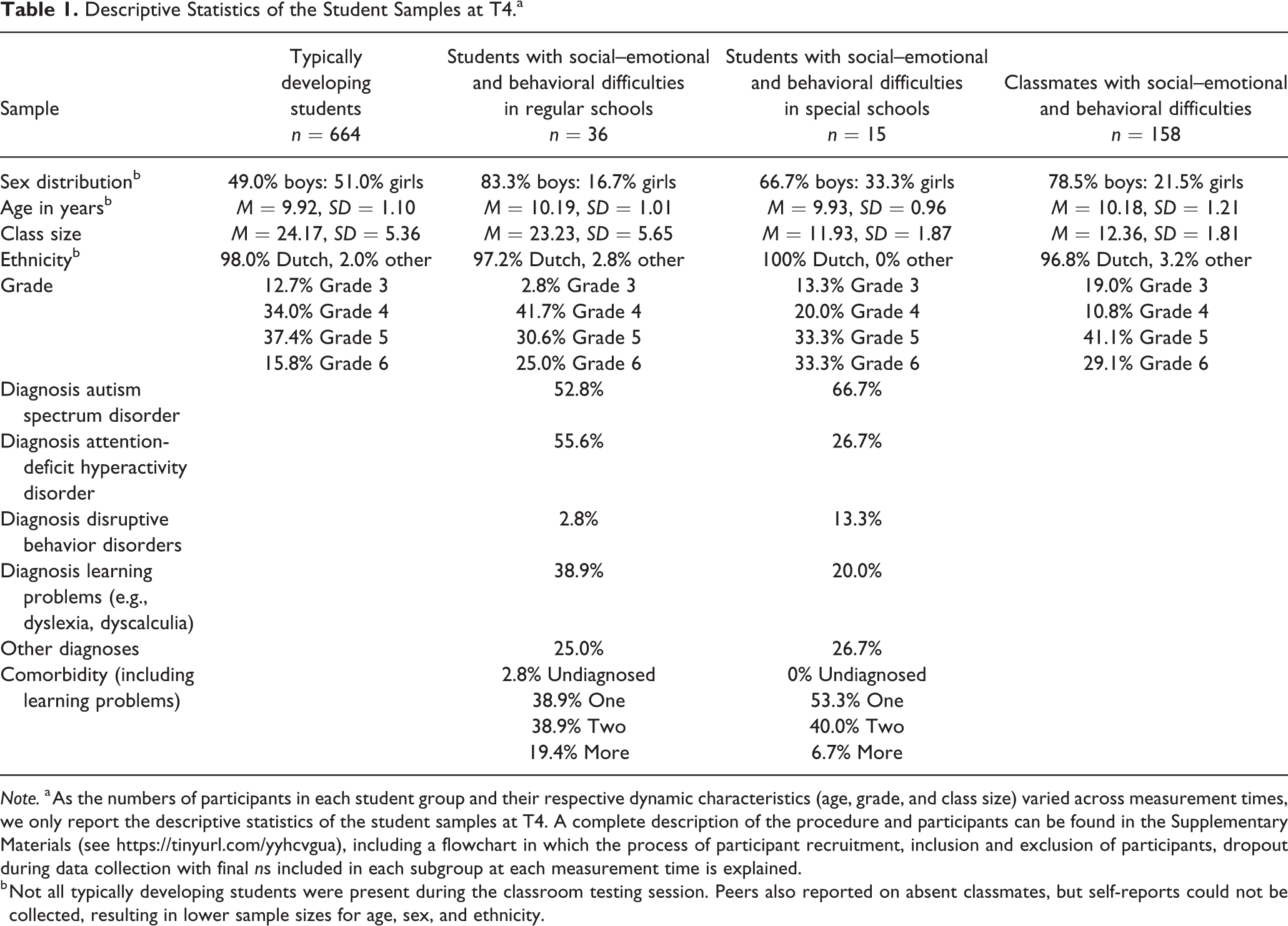
Note. a As the numbers of participants in each student group and their respective dynamic characteristics (age, grade, and class size) varied across measurement times, we only report the descriptive statistics of the student samples at T4. A complete description of the procedure and participants can be found in the Supplementary Materials (see https://tinyurl.com/yyhcvgua), including a flowchart in which the process of participant recruitment, inclusion and exclusion of participants, dropout during data collection with final ns included in each subgroup at each measurement time is explained.
b Not all typically developing students were present during the classroom testing session. Peers also reported on absent classmates, but self-reports could not be collected, resulting in lower sample sizes for age, sex, and ethnicity.
Measures
Student–teacher relationship
We measured student-reported student–teacher relationship with the Conflict dimension of the Dutch Student Perception of Affective Relationship with Teacher Scale (SPARTS), reflecting “the degree of negativity, discordance, unpredictability, and unpleasantness” of the relationship (Koomen & Jellesma, 2015, p. 480). The SPARTS has been shown reliable and valid in previous research with typically developing elementary school students and students with internalizing problem behavior (Jellesma et al., 2015; Zee & De Bree, 2017). Children had to rate on a 5-point Likert-type scale (ranging from 1 = no, that is not true to 5 = yes, that is true) to what extent they thought each of 10 statements (e.g., I easily have quarrels with my teacher) applied to their relationship with the teacher. Reliability of the scale was satisfactory: Cronbach’s α ranged from .74 to .84 for the four measurements.
Peer acceptance
Peer-reported peer acceptance was measured using sociometric ratings (Cillessen, 2009), which has been shown to provide valid and stable information on students’ peer status in classrooms (Maassen et al., 2005). Students had to rate all their classmates individually on a 5-point Likert-type scale (ranging from −2 = not at all to 2 = very much) with respect to how well they liked that particular student. A minimum class participation rate of 60% was set in order to obtain acceptable sociometric scores (Marks et al., 2013). We summed the scores received by each pupil and divided this score by the number of raters (−1 because we disregard self-scores in these measures) to control for the unequal number of scores of pupils within classes. These final scores indicate the level of peer acceptance among classmates.
Self-esteem
We measured student-reported self-esteem with the Self-Esteem subscale of the Dutch school monitoring instrument for social–emotional development (Volginstrument voor sociaal-emotionele ontwikkeling [VISEON]; Citogroep, 2004). The VISEON has been shown reliable and valid in previous research with typically developing students and students with special educational needs in elementary school and according to the criteria of the Commissie Testaangelegenheden Nederland (Dutch committee of test affairs; Citogroep, 2004; Evers et al., 2010). Students had to rate on a 4-point Likert-type scale (ranging from 1 = not true to 4 = true) to what extent seven statements apply to them (e.g., I get good grades for tests). The reliability of the scale was satisfactory: Cronbach’s α ranged from .78 to .82 for the four measurements.
Emotional and behavioral problems
We derived scores for students’ emotional and behavioral problems from their application files. Students’ behavior problems in school were measured with either the Teacher Report Form (TRF; Verhulst & van der Ende, 2013) or the Dutch Sociaal-Emotionele Vragenlijst (SEV [social emotional questionnaire]; Scholte & van der Ploeg, 2007). Both the TRF and the SEV have been shown reliable and valid in previous studies, with internal consistency coefficients ranging from .75 to .99 for the various subscales of the TRF and from .83 to .96 for the SEV (Scholte & van der Ploeg, 2007; Verhulst & van der Ende, 2013). In addition, subscales of both questionnaires that measure corresponding social–emotional problems have been shown to correlate with each other (Scholte & van der Ploeg, 2007). While not all application files contained the raw TRF and SEV scores, most of them (91.8%) contained classification scores for “normal” (TRF percentiles 0–92, SEV percentiles 0–89), “subclinical” (TRF percentiles 93–96, SEV percentiles 90–94), and “clinical” behavior (TRF percentiles 97–100, SEV percentiles 95–100). We disregarded the small differences in cutoff criteria because both TRF and SEV subclinical and clinical categories concern very high percentiles. To accommodate both sources of info, we created new classification scores on a 3-point scale (0 = normal, 1 = subclinical, 2 = clinical) based on the rounded average classifications on corresponding TRF and SEV subscales. For internalizing behavior problems, we used TRF Anxious-Depressed and Withdrawn-Depressed subscales and SEV Anxiety, Social Anxiety, and Anxious-Depressed subscales. For externalizing behavior problems, we used TRF Aggressive and Rule-Breaking subscales and SEV Oppositional-Defiant, Aggressive, and Antisocial subscales. For attention-deficit hyperactivity problems, we used TRF Attention Problems subscale and SEV Attention-Deficit, Hyperactivity, and Impulsivity subscales.
Academic performance
We measured academic performance during individual testing sessions with established Dutch school achievement tests. Reading, spelling, and math were measured with the Brus Één-Minuut-Test (1-min reading fluency test; Brus & Voeten, 2006), the PI-dictee (spelling dictation task; Geelhoed & Reitsma, 2004), and the Tempo Test Automatiseren (arithmetic processing speed test; De Vos, 2011), respectively. Children’s individual scores for each skill were converted to norm scores with tables of norm data of students in the same grade.
Data Analyses
We set up a three-phase growth curve model for student–teacher conflict, which we explain below (also see Figure 1), but similar models were for peer acceptance and self-esteem. In Phase 1, we set up a growth curve model for the total group. Individual growth trajectories were captured by a single growth trajectory for the total sample with an intercept (initial levels) and a slope (development over time), indicating overall rate of change across participants. The observed variables are represented as squares and the latent growth factors of the overall estimated growth trajectory (intercept and slope) are represented as circles. That is, we see three measures of student–teacher conflict, representing measurement times two to four in the study, and two growth factors (intercept and slope), representing the overall growth trajectory across all students. In Phase 2, we set up separate growth curve models for students with SEBD in regular schools, students with SEBD in special schools, and typically developing peers. That is, we modeled separate growth trajectories for each student group to see whether the student groups differed in their initial levels and/or development over time. In Phase 3, we zoomed in on the two subgroups of students with SEBD only, to see whether we could find factors—present before students with SEBD received special education services—that could predict development in student–teacher conflict, peer acceptance, and self-esteem. In addition to separate growth trajectories for students with SEBD in regular and special schools, we modeled observed predictors (indicated by squares) to examine which factors could predict initial levels and development in student–teacher conflict.
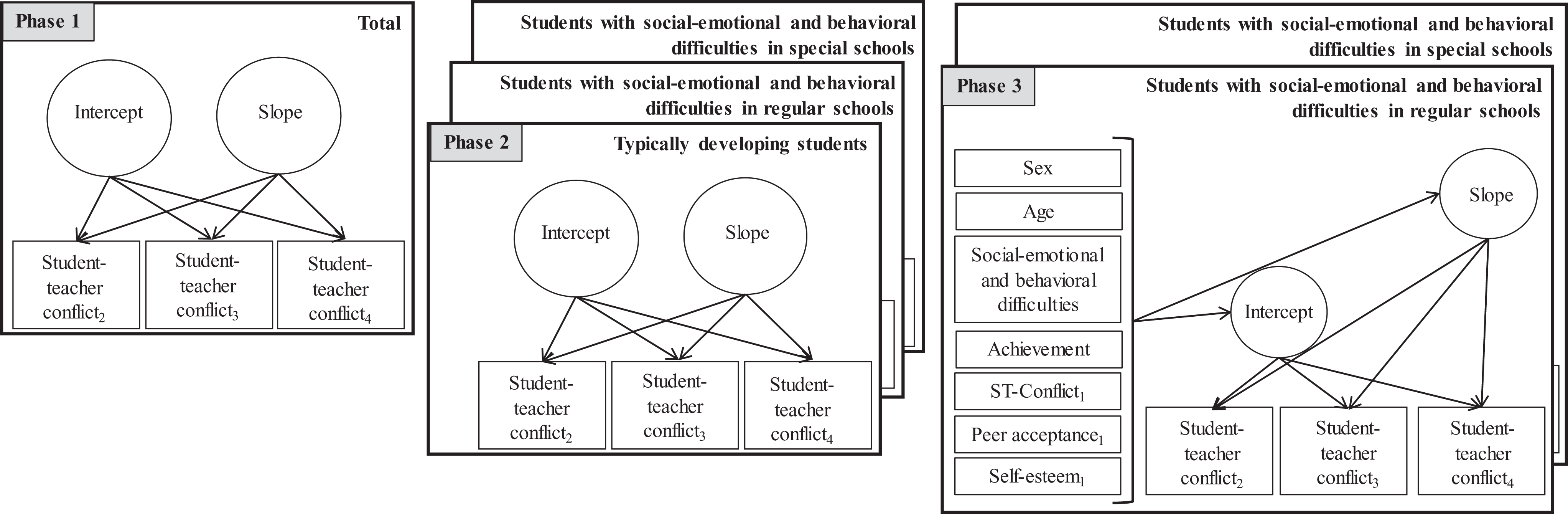
Three-Phase Growth Curve Model for Student–Teacher Conflict Examining Initial Levels (i.e., Intercepts) and Development Over Time (i.e., Slope) for the Total Sample (Phase 1), the Three Student Samples (Phase 2), and the Two Samples of Students With Social-Emotional and Behavioral Difficulties Including Predictors (Phase 3).
Bayesian statistics
As the subgroups of students with SEBD in regular and special schools comprise small numbers, conventional statistics cannot be used to examine development over time (McNeish, 2016; van de Schoot et al., 2015). To this end, we used Bayesian statistics to analyze our data in which prior knowledge about probable relationships between variables is incorporated in the analyses to aid in the estimation of our models (see van de Schoot et al., 2014, for a gentle introduction to Bayesian statistics). For each parameter in the model, for instance, an intercept or a slope, the researcher specifies a distribution of likely values (i.e., a prior distribution), with the variance of the distribution reflecting the researcher’s level of (un)certainty about the hypothesized value of the parameter of interest. Next, the prior distribution is combined with the data that the researcher has collected, using an iterative sampling procedure. The result is a posterior distribution that reflects the researcher’s updated knowledge, balancing background knowledge with observed data. We used Bayesian estimation in the statistical software Mplus version 7.4 (Muthén & Muthén, 1998–2015). To ensure proper implementation and reporting of Bayesian methods, we followed the When to worry and how to Avoid the Misuse of Bayesian Statistics (WAMBS)-checklist of Depaoli and van de Schoot (2017). Given that this is an extensive procedure comprising 10 steps, a complete description of the data analyses procedure and its results can be found in the Supplementary Materials (see https://tinyurl.com/yyhcvgua).
Results
In each model (i.e., student–teacher conflict, peer acceptance, and self-esteem), we had to set up an overall growth curve based on the data of the total sample (Phase 1) before latent growth curves for the different subgroups could be distinguished (Phase 2). As this overall growth curve models the average development of all students in our study (i.e., all students with SEBD in regular schools and their typically developing classmates and all students with SEBD in special schools and their classmates with SEBD), it cannot be interpreted unambiguously. To this end, final model estimates for student–teacher conflict, peer acceptance, and self-esteem for the total sample (phase one) were not interpreted and only are presented in Tables S38, S40, and S42 in the Supplementary Materials (see https://tinyurl.com/yyhcvgua).
In Phase 2, we examined the growth curve models for each subgroup separately to see whether students with SEBD in regular and special schools and typically developing peers differed in their initial levels (intercepts) and/or development over time (slopes). Final model estimates for student–teacher conflict, peer acceptance, and self-esteem for each subgroup (Phase 2) are presented in Tables S38, S40, and S42 in the Supplementary Materials. Below, we summarize and interpret these results in terms of Bayesian 95% credibility intervals and we show the developmental trajectories (i.e., estimated growth trajectories) for each student group for student–teacher conflict, peer acceptance, and self-esteem in Figures 2 to 4, respectively.
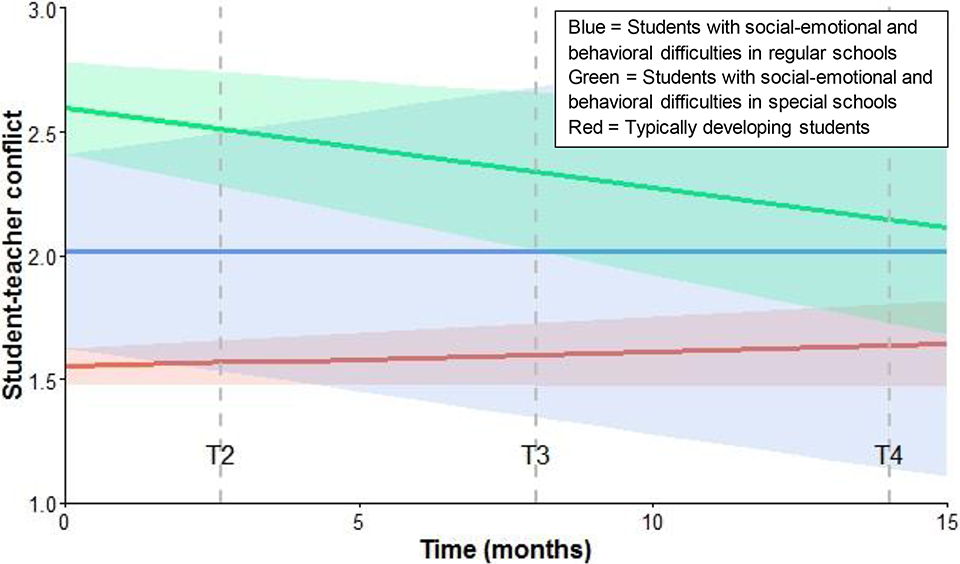
Estimated Growth Trajectories for Student–Teacher Conflict in Each Student Group With 95% Confidence Bands Showing Uncertainty Associated With the Average Trajectory.
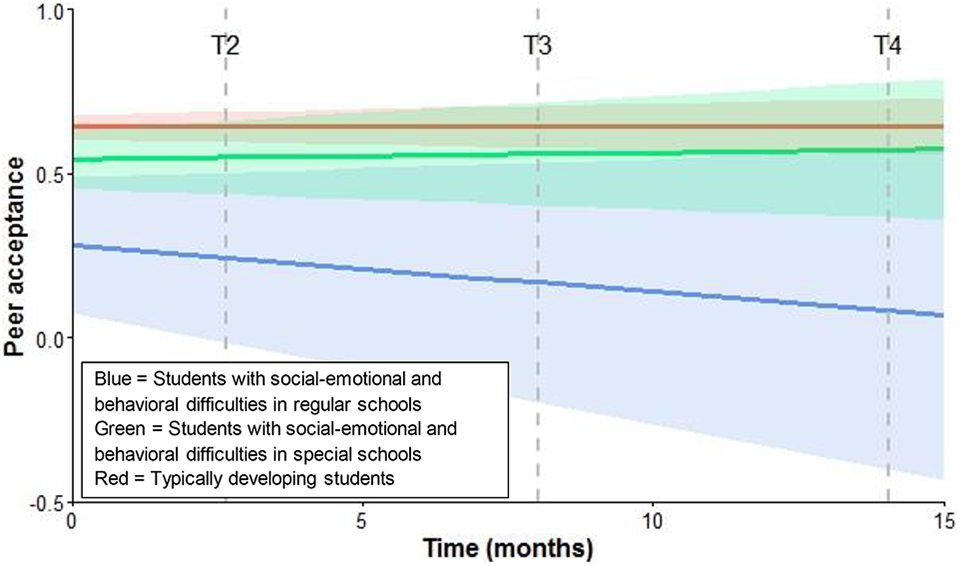
Estimated Growth Trajectories for Peer Acceptance in Each Student Group With 95% Confidence Bands Showing Uncertainty Associated With the Average Trajectory.
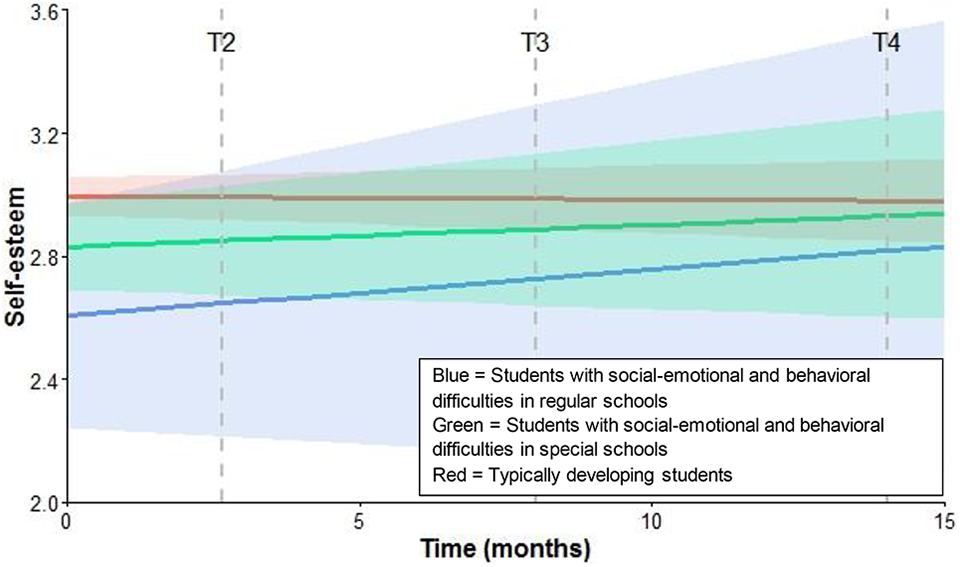
Estimated Growth Trajectories for Self-Esteem in Each Student Group With 95% Confidence Bands Showing Uncertainty Associated With the Average Trajectory.
In Phase 3, we zoomed in on the two subgroups of students with SEBD to see whether we could find predictors for initial levels and/or development in student–teacher conflict, peer acceptance, and self-esteem. Final model estimates for these models with standardized predictors for student–teacher conflict, peer acceptance, and self-esteem for the two subgroups of students with SEBD are presented in Tables S39, S41, and S43 in the Supplementary Materials. Below, we summarize and interpret these results in terms of Bayesian 95% credibility intervals.
Student–Teacher Conflict
The 95% Bayesian credible intervals of the intercepts and variances of the intercepts of students with SEBD in special schools (95% CI [2.373, 2.818] and 95% CI [1.070, 2.103], respectively) and typically developing students (95% CI [1.464, 1.640] and 95% CI [0.571, 0.983]) did not overlap. This indicated that students with SEBD in special schools had higher initial levels of student–teacher conflict with a higher variability between students than typically developing students. Students with SEBD in regular schools did not significantly differ from either group with respect to initial levels (95% CI [1.544, 2.482]) and variability (95% CI [0.542, 2.730]) between students. Yet, for students with SEBD in special schools, student–teacher conflict decreased over time (95% CI [−0.051, −0.012]), while student–teacher conflict of typically developing students stayed stable over time (95% CI [−0.002, 0.014]). Again, students with SEBD in regular schools (95% CI [−0.041, 0.042]) did not significantly differ from either group. Figure 2 shows the developmental trajectories for participants in each student group.
We found two predictors for initial levels in student–teacher conflict among both groups of students with SEBD: previous student–teacher conflict and sex (95% CI [0.240, 1.839] and 95% CI [0.289, 4.146] for each predictor, respectively). That is, higher levels of student–teacher conflict in regular schools, before students with SEBD were provided with additional support, predicted higher levels of student–teacher conflict after students with SEBD were provided with special education services in regular and special schools. Furthermore, girls with SEBD had more conflictual relationships with teachers than boys. Age, emotional and behavioral problems (i.e., internalizing and externalizing behavior problems and attention-deficit hyperactivity problems), academic performance (i.e., reading, spelling, and math achievement), and levels of peer acceptance and self-esteem prior to receiving special education services did not predict initial levels and/or development in student–teacher conflict.
Peer Acceptance
Students with SEBD in regular schools (95% CI [0.027, 0.525]) had lower initial levels of peer acceptance than typically developing students (95% CI [0.598, 0.688]), while no differences in variability between students within groups were found (95% CI [0.029, 0.627] and 95% CI [0.347, 0.455] for students with SEBD in regular schools and typically developing students, respectively). Students with SEBD in special schools did not significantly differ from either group with respect to initial levels (95% CI [0.437, 0.652]) or variability between students (95% CI [0.282, 0.665]). Moreover, peer acceptance appeared to be stable over time for all three student groups (students with SEBD in regular schools = 95% CI [−0.037, 0.009], students with SEBD in special schools = 95% CI [−0.007, 0.012], and typically developing students = 95% CI [−0.003, 0.003]). Figure 3 shows the developmental trajectories for participants in each student group.
We found no significant predictors of initial levels of peer acceptance, but previous self-esteem predicted development in peer acceptance over time (95% CI [−0.055, 0.000]). That is, higher levels of self-esteem in regular schools—before students with SEBD were provided with additional support—predicted less development in peer acceptance after students with SEBD were provided with special education services in regular and special schools. Sex, age, emotional and behavioral problems, academic performance, and levels of student–teacher conflict and peer acceptance prior to receiving special education services did not predict development in peer acceptance.
Self-Esteem
The three student groups showed similar initial levels of self-esteem (students with SEBD in regular schools = 95% CI [2.165, 3.045], students with SEBD in special schools = 95% CI [2.663, 3.002], and typically developing students = 95% CI [2.921, 3.067]), which were all stable over time (students with SEBD in regular schools = 95% CI [−0.014, 0.046], students with SEBD in special schools = 95% CI [−0.009, 0.022], and typically developing students = 95% CI [−0.007, 0.005]). Figure 4 illustrates the developmental trajectories for participants in each student group.
We found that initial levels and/or development of self-esteem over time were not predicted by sex, age, emotional and behavioral problems, academic performance, and levels of student–teacher conflict, peer acceptance, and self-esteem prior to receiving special education services.
Discussion
The current study aimed to shed more light on the social–emotional development of students with SEBD in regular and special schools and aimed to answer two research questions: How do social relationships with teachers and peers and self-esteem of students with SEBD in regular and special schools develop over time in comparison with each other and in comparison with their typically developing peers in regular schools? Can factors—present before students with SEBD received special education services—predict social–emotional development in either educational setting (i.e., regular schools or special schools)?
We first compared the initial levels and development of student–teacher conflict, peer acceptance, and self-esteem of students with SEBD in regular schools with students with SEBD in special schools and their typically developing peers in regular schools. In line with previous research (e.g., Ledoux et al., 2012), students with SEBD in special schools had more conflictual relationships with their teachers than typically developing students. Students with SEBD in regular schools, however, did not differ from either group with respect to student–teacher conflict. These results were stable from a sensitivity analysis, and they might relate to the commonly found difference in severity of the problem behavior between the two subgroups of students with SEBD. That is, students with SEBD who are placed in special schools generally show more severe problem behavior than students with SEBD in regular schools (e.g., Ledoux et al., 2012). While the latter group also shows severe problem behavior that teachers find difficult to deal with (Buttner et al., 2015), this behavior may still be manageable in a regular classroom, which may make them more similar to their typically developing peers.
Student–teacher conflict of students with SEBD in special schools decreased over time, while previous research has indicated that student–teacher relationships are highly stable over time (e.g., Eisenhower et al., 2015; McGrath & Van Bergen, 2015), which indeed was found for typically developing students and students with SEBD in regular schools. The results were stable from a sensitivity analysis, pointing at a promising result for students with SEBD special schools: these students with SEBD seem to develop a more positive student–teacher relationship over time. A possible explanation for this result is that teachers in special schools are better trained to predict, understand, and replace disruptive and inappropriate behavior of students with SEBD (e.g., Lane et al., 2005), whereas teachers in regular schools may feel unprepared to support students with SEBD (e.g., Jones & Chronis-Tuscano, 2008). Another possibility is that the smaller classrooms in special schools provide teachers with more opportunities for individual attention for students with SEBD, which may positively impact their student–teacher relationship as well.
For acceptance among peers, we found that, in line with previous research (e.g., Mikami et al., 2015), students with SEBD in regular schools were less accepted among peers than typically developing students, while students with SEBD in special schools did not differ from either group. The results were stable from a sensitivity analysis and may be explained by the theory of social comparison processes (Festinger, 1954). In regular schools, students with SEBD are surrounded by typically developing peers and their disruptive and rule-breaking behavior can be seen as deviant in this educational setting. Exactly those deviations from peers are associated with lower peer acceptance or even peer rejection. Students with SEBD special schools, in contrast, are surrounded by peers with SEBD. In such a setting, disruptive and rule-breaking behavior is more common and may not be associated with low peer acceptance (e.g., Useche et al., 2014).
Furthermore, we found peer acceptance to be stable over time in all student groups. For typically developing students and students with SEBD in special schools, this is in line with previous research (e.g., Breeman et al., 2015; Mikami et al., 2012), but for students with SEBD in regular schools, previous research has shown decreased peer acceptance over time (Mikami et al., 2012; Useche et al., 2014). Our results were stable from a sensitivity analysis, indicating that although students with SEBD in regular schools were low in peer acceptance, their social status did not deteriorate over time. An explanation could be that development in peer acceptance over time is affected by factors that were beyond the scope of our study. For instance, Mikami et al. (2012) found that although students with SEBD tended to be less accepted over the course of a school year, teacher practices could attenuate this development. Future research examining peer acceptance of larger groups of students with SEBD in regular schools and/or over larger time periods could shed more light on this issue.
For self-esteem, we found no differences between student groups, which contrasts with previous research showing that students with SEBD had lower self-esteem than typically developing students, with students with SEBD in regular schools having the lowest self-esteem levels (e.g., Sukumaran et al., 2003). The results were stable from a sensitivity analysis and paint a more positive picture than expected: Students with SEBD in regular and special schools have similar initial levels of self-esteem as typically developing peers. One explanation might be that students with SEBD experience enough opportunities for accomplishments in academic, social, and emotional areas, like typically developing students, leading to higher self-esteem. Another possibility is that students with SEBD experience fewer opportunities for accomplishments due to the SEBDs that they face, but that they evaluate the goals that they accomplish more positively than their typically developing peers. That is, they may value their achievements higher because they have to put more effort into tasks.
Furthermore, we found self-esteem to be stable over time for all student groups. In contrast with our expectations, the provision of special education services does not increase students with SEBD’s self-esteem. Yet, given that self-esteem levels of students with SEBD were as high as among typically developing peers, it might be possible that the special education services were not directly aimed at increasing self-esteem. An alternative explanation might be that special education services would be more effective in improving observable behavior (e.g., decrease in disruptive and rule-breaking behavior and increase in task-related behavior) than altering subjective or internal phenomena such as self-esteem (Ogier & Hornby, 1996). Another possibility might be that changes in self-esteem will only occur as a consequence of improvements in other areas, such as improved performance in academic subjects, and therefore should be examined over longer time periods.
With regard to the question whether we could find factors that predict initial levels and/or social–emotional development of students with SEBD in both regular and special schools, we specifically zoomed in on these two subgroups. We found predictors for initial levels of student–teacher conflict and for development of peer acceptance and no predictors for self-esteem.
Students with SEBD who had higher levels of student–teacher conflict when they were still in their regular school without additional support also had higher levels of student–teacher conflict after they were provided with special education services. Girls had higher levels of student–teacher conflict than boys. The latter result is remarkable because boys usually have been found to have higher student–teacher conflict than girls (e.g., McGrath & Van Bergen, 2015). Yet, the studies that we derived our priors from all concerned typically developing students. It may be that student–teacher conflict is perceived differently for girls with SEBD. That is, in elementary school, externalizing behavior is to some extent considered more normative for boys than for girls (e.g., Björkqvist et al., 1992). Disruptive and rule-breaking behavior displayed by girls may thus be perceived more deviant by teachers than when similar behavior is displayed by a boy. Girls with SEBD, who break through these sex-typical normative behavior patterns, may consequently end up having higher levels of student–teacher conflict as compared to boys, whereas among typically developing students one might observe the opposite pattern. Another explanation might be that since externalizing behavior is less common among girls (e.g., Crick & Zahn-Waxler, 2003), teachers may find this behavior more difficult to handle. Yet, the sensitivity analyses showed posterior parameter estimates were less stable between informative and uninformative priors for these special subsamples. Hence, results should be interpreted with caution.
For peer acceptance, we found that students with SEBD who had higher levels of self-esteem before they were provided with special education services showed less development in peer acceptance over time after they were provided with special education services. This finding may be explained by the tendency of some aggressive children to idealize and to inflate ratings of competence (e.g., Orobio de Castro et al., 2007). That is, although students with SEBD may fail to experience accomplishments in academic, social, and emotional areas, they may still experience high self-esteem as a protective defense against the reality of persistent failure. Consequently, this distorted high self-esteem may interfere with the ability to adjust maladaptive behavior, which could be associated with decreased peer acceptance over time. Another explanation may be that these inflated ratings of competence may be perceived negatively by peers. Research has indeed found that reactions to self-enhancers were increasingly negative over time (Paulhus, 1998). Yet, our results were less stable from a sensitivity analysis, indicating that results should be interpreted with caution.
Limitations
Some limitations need to be considered. Sex effects (i.e., a limited number of girls with SEBD participated), ethnicity effects (i.e., a limited number of participants from various backgrounds participated), and the restricted region where data were collected (i.e., only the northern and middle part of the Netherlands participated) limited the generalizability of our results. Directions for future research are to include a larger and more diverse sample in which variations across sexes, ethnicities, and geographical regions could also be examined.
Implications for Practice
Several implications for practice can be derived from this study. First, the social–emotional development of students with SEBD in regular and special schools generally is stable over time. Given that decisions to provide special education services are predominantly based on the learning development and behavioral functioning of students with SEBD in school, without knowing the consequences for students’ social–emotional development, we may conclude that being identified as a student with SEBD in need of additional support does not necessarily lead to worse social–emotional development over time. That is, at least no worse social–emotional development over time that cannot be countered by the special education services provided to the student. Although we cannot draw conclusions about causality, our results suggest that both forms of additional support prevent that the problems in social–emotional functioning of students with SEBD will escalate over time. In fact, for students with SEBD in special schools—who seem to start off worse than students with SEBD in regular schools—their student–teacher relationships even improved over time, which may be an argument to sustain special education services in special schools for some students with SEBD. Moreover, the decreasing levels of student–teacher conflict could indicate that students with SEBD in special schools may show increasingly manageable behavior in the classroom over time, which may signal one of the first steps to a tentative perspective of return to the original regular school. Yet, the fact that student–teacher relationships slowly improve over time and only seem to reach levels similar to those of students with SEBD in regular schools may indicate that prolonged provision of special education services is needed in case of these persistent problems.
Second, the social context in which students with SEBD are educated appears to influence their social–emotional development in school. As described above, student–teacher relationships show a different developmental pattern for students with SEBD in regular or special schools, but peer relationships differ as well. That is, the fact that students with SEBD in regular schools show lower peer acceptance than typically developing peers or students with SEBD in special schools suggests that for students with SEBD in regular schools, a transition to a special school may be associated with increased peer acceptance and improved peer relations, which again may be an argument to sustain special education services in special schools for some students with SEBD. Yet, decisions about the provision of special education services in regular or special schools should always be made in line with what is best for the student’s educational development.
Third, although we were only able to draw tentative conclusions about the predictors of initial levels of student–teacher conflict and development in self-esteem, directions for future research can be derived from our results. That is, girls seem to comprise a special group of students with SEBD, and more research should focus on these girls to examine to what extent they differ from boys with SEBD. Furthermore, future research could shed more light on the relationship between self-esteem and social–emotional development in students with SEBD.
Conclusions
All in all, the current study adds to the limited literature base on development of students with SEBD in various educational settings by providing insight into the developmental trajectories of social relationships and self-esteem among students with SEBD in both regular and special schools in comparison with their typically developing peers. Students with SEBD in regular schools were less accepted by peers than typically developing students. Also, while students with SEBD in special schools initially had more conflicts with teachers than typically developing students, which seemed a continuation of their conflictual teacher relationships before placement, over time these conflicts tended to decrease. This may indicate that placing students with SEBD in special schools is associated with improvements in their social well-being over time. It is, however, important to note that, although different developmental trajectories for student–teacher conflict, peer acceptance, and self-esteem can be estimated for students within different educational contexts, still a great deal of variance still cannot be explained.
Furthermore, the implementation of Bayesian statistics enabled us to explore which factors could predict social–emotional development of students with SEBD in regular and special schools. Although we found several predictors for initial levels and development over time in student–teacher conflict, peer acceptance, and self-esteem, the results appeared not very stable from a sensitivity analysis. This indicates a mismatch between the prior information and the observed data. Therefore, both the representativeness of the prior information, used to derive the hypotheses for our developmental models from, and the sample data should be carefully considered when drawing conclusions on what factors may determine students’ development. Apparently, there are many factors that influence the social–emotional development of students with SEBD in school that go beyond the scope of our study, which emphasizes not only the need for more research into these mechanisms but also the need for a careful examination of which factors are important for each individual student within their individual educational context.
Footnotes
Declaration of Conflicting Interests
The author(s) declared the following potential conflicts of interest with respect to the research, authorship, and/or publication of this article: The first and seventh authors were employed by the institutions for special education services in the Netherlands in which the data for this study were collected. They do not have any financial or nonfinancial interest in these services or placement choices made by these services.
Funding
The author(s) disclosed receipt of the following financial support for the research, authorship, and/or publication of this article: This research was supported by De Ambelt. De Ambelt had no involvement in the conduct of the research and/or preparation of the article. The second author was supported by a grant from the Netherlands Organization for Scientific Research: NWO-VIDI-452-14-006.
