




Abstract
The association between relational victimization and risk-taking development in children is understudied. Also, it is not clear how the social classroom norm may affect this link. The aim of this study was, therefore, to investigate the link between relational victimization and risk-taking behavior in elementary schoolchildren, and the potential moderating role of the classroom norm salience toward risk-taking. We expected that relationally victimized children would show an increase in risk-taking behavior in classrooms that are unfavorable toward risk-taking as a way to provoke and act against the classroom norm. However, alternatively, relationally victimized children could show an increase in risk-taking behavior in classrooms that are favorable toward risk-taking as a way to fortify the feeling of belonging to the classroom. Participants were 1,009 children (50% boys) in 69 classrooms of 13 mainstream elementary schools, followed annually across ages 7–11 (Grade 1–5). Risk-taking was assessed using the Balloon Analogue Risk Task. Relational victimization was assessed using teacher reports. The classroom norm salience toward risk-taking was based on the within-classroom correlation of risk-taking with children’s social preference score among peers. Results from multilevel modeling showed that there was no significant main effect of relational victimization on risk-taking behavior. However, the classroom norm salience toward risk-taking significantly moderated the effect of relational victimization on risk-taking. Relational victimization was related to relative increases in risk-taking when classroom norms were unfavorable toward risk-taking. In classrooms where risk-taking was favored, relational victimization was related to relative decreases in risk-taking. These findings suggest that children who are relationally victimized may engage in norm-defying behavior in their classroom. Implications for further research are discussed.
Children, on average, show increases in risk-taking behavior across the elementary school period (MacPherson, Magidson, Reynolds, Kahler, & Lejuez, 2010; Tieskens, Buil, Koot, Krabbendam, & van Lier, 2018). Risk-taking is defined as voluntary behavior that involves a certain chance of negative outcomes, such as harm or a loss of resources, but also provides the opportunity to obtain a reward (Aklin, Lejuez, Zvolensky, Kahler, & Gwadz, 2005; Leigh, 1999). Elevated levels of childhood risk-taking behavior, both assessed as physical risky behavior and risk-taking on a computerized task, are related to outcomes such as aggression and oppositional defiant behavior (Humphreys & Lee, 2011; Schwebel, Speltz, Jones, & Bardina, 2002; Tieskens et al., 2018). Studies conducted among adolescents report a link between relational victimization and various forms of risk-taking, including poor health choices (Zadro, Arriaga, & Williams, 2008), substance use (Tharp-Taylor, Haviland, & D’Amico, 2009), and taking irrational, self-defeating risks (Peake, Dishion, Stormshak, Moore, & Pfeifer, 2013). Even though relational victimization emerges in elementary school years (Wolke, Woods, Stanford, & Schulz, 2001), studies on the association between relational victimization and the development of risk-taking behavior in elementary schoolchildren are lacking. In addition, there is growing recognition that the social norm of classrooms needs to be considered to get a better understanding of the impact of victimization on behavioral development (Brendgen & Troop-Gordon, 2015; Veenstra, Dijkstra, & Kreager, 2018). Therefore, the aim of this study is to investigate the impact of relational victimization on the development of risk-taking behavior in elementary schoolchildren in the context of the classroom norm toward risk-taking.
A motive underlying human behavior is the fundamental need to be accepted and recognized by others and to have a feeling of belonging to a peer group (Baumeister & Leary, 1995). Relational victimization may obstruct this need for acceptance and recognition as it encompasses behaviors intended to damage victims’ relationships with peers or the social reputation of the victim, for example, by socially excluding the victim, or by manipulating victims’ relationships (Cullerton-Sen & Crick, 2005).
The established positive association between relational victimization and risk-taking behavior can be explained in light of the thwarted fundamental needs framework. On the one hand, it is proposed that following the experiences of relational victimization, children will try to adapt their behavior adhering to the norms of their peers, in order to fortify their social bonds and re-establish their feeling of belonging (Maner, DeWall, Baumeister, & Schaller, 2007; Williams, 2007, 2009). In line with this theory, children with threatened or unmet social needs may engage in risky behavior to conform to their peer group norms as a way of getting recognized and (re)accepted. Within the context of the classroom, this implies that heightened risk-taking behavior among relationally victimized children may be found especially in those classrooms where the peer group favors risk-taking behavior.
On the other hand, and according to the same theoretical notions (Williams, 2007), relationally victimized children may engage in provocative behavior, also described as norm-defying behavior (Rudolph, Troop-Gordon, Monti, & Miernicki, 2014). Specifically, it is proposed that reoccurring experiences of relational victimization may monopolize cognitive resources needed for, among others, self-regulation (Baumeister, DeWall, Ciarocco, & Twenge, 2005; Baumeister, Twenge, & Nuss, 2002; Baumeister, Vohs, & Tice, 2007; Williams, 2007). This affected self-regulation may thwart a child’s ability to re-establish social bonds (Baumeister et al., 2005; Mead, Alquist, & Baumeister, 2010) resulting in the child’s feeling of (further) loss of control. The difficulty to re-establish social bonds and to regain control over the situation may result in the child’s engagement in provocative behavior (Warburton, Williams, & Cairns, 2006; Williams, 2007), possibly as an alternative attempt to exert control. This resulting provocative behavior has also been described as norm-defying behavior intended to “move against the world” (Rudolph, Troop-Gordon, et al., 2014). In the classroom context, this would imply that heightened risk-taking behavior among relationally victimized children may be found especially in classrooms where the peer group does not favor but rather sanctions risk-taking behavior.
A classroom norm can be defined as an unwritten standard about whether specific behavior is accepted or not in the classroom. Studies have shown that the behavior of children with a high social status in the classroom largely determines the “norm salience” (Dijkstra & Gest, 2015; Henry et al., 2000; Laninga-Wijnen, Harakeh, Dijkstra, Veenstra, & Vollebergh, 2018). Norm salience is typically operationalized as the within-classroom correlation between children’s social status among peers, and specific behavior. This norm salience differs from the descriptive norm, which refers to behavior that is considered typical in a classroom (Dijkstra & Gest, 2015; Henry et al., 2000), and the injunctive norm, which refers to attitudes toward behavior (Veenstra et al., 2018). In the present study, we will focus on the role of the norm salience toward risk-taking because we are especially interested in whether the engagement in risk-taking is associated with prestige or sanctions in the classroom, rather than the average level of risk-taking or the attitude toward risk-taking in the classroom. Also, previous studies showed that the norm salience has a particularly strong influence on behavioral adjustments in elementary schoolchildren (Dijkstra & Gest, 2015; Henry et al., 2000).
Most studies investigating the link between relational victimization and risk-taking used adolescent samples (Peake et al., 2013; Telzer, Miernicki, & Rudolph, 2018; Tharp-Taylor et al., 2009; Zadro et al., 2008) and did not consider the norm salience of the peer group. There is only one study that investigated the link between an indicator of relational victimization (peer rejection) and risk-taking behavior in children (Nesdale & Lambert, 2008). That study failed to find such a link and did not consider the peer group norm. Several studies on the association of victimization and behavioral (mal)adjustment in elementary schoolchildren considered the classroom norm. Some of these studies explored how deviating from the norm increases the likelihood to become victimized (Guimond, Brendgen, Correia, Turgeon, & Vitaro, 2018), whereas other studies examined whether classroom descriptive norms affected the individual consequences of victimization (Bellmore, Witkow, Graham, & Juvonen, 2004; Huitsing, Veenstra, Sainio, & Salmivalli, 2012). Yet, a cross-sectional study among fourth-grade children found that in classrooms with an unfavorable norm salience toward aggression (referring to a negative within-classroom correlation between aggression and social preference), victims, on average, showed higher levels of aggression (Brendgen, Girard, Vitaro, Dionne, & Boivin, 2015). In contrast, in classrooms with a favorable norm salience toward aggression (referring to a positive within-classroom correlation between social preference and relational aggression), no association between victimization and aggressive behavior was found (Brendgen et al., 2015). These findings suggest that compared to their non-victimized peers, victimized children may, in the presence of an unfavorable norm salience toward aggression, engage in heightened norm-defying behavior (Brendgen et al., 2015). However, it is yet unknown whether the norm salience also affects the link between relational victimization and the development of risk-taking across elementary school grades.
In the present study, we examined the potential moderating role of the classroom norm salience toward risk-taking on the association between relational victimization and risk-taking behavior across elementary school years. To this end, we followed 1,009 children attending classrooms in Dutch mainstream elementary schools annually across Grade 1–5 (Dutch Grade 3–7). In accordance with theory, it is hypothesized that relationally victimized children would show an increase in risk-taking behavior in classrooms that are unfavorable toward risk-taking (referring to classrooms with a negative correlation between risk-taking and social preference) as a way to provoke and act against the classroom norm. Alternatively, also based on theory, it is hypothesized that relationally victimized children would change their risk-taking toward the norm of the classroom as a way to fortify the feeling of belonging to the classroom. According to this hypothesis, relationally victimized children would increase their risk-taking behavior especially in classrooms that favor risk-taking.
Method
Participants
In the present study, we used data from a longitudinal research project—‘Happy children, happy adolescents?’—aimed at assessing the behavioral, social-emotional, cognitive, and biopsychological development of elementary schoolchildren. Participating schools were mainstream elementary schools situated in an urban area in the central part of the Netherlands and a rural area in the eastern part of the Netherlands. Parents were informed about the project and active consent was obtained for their child to participate in the study. Parents could revoke their consent and children could decline participation at any time during the study. Of the parents whose children were invited to participate in the study, 93.1% consented to their child’s participation in this project. For a more detailed description of the inclusion of schools, see De wilde et al., 2016.
The sample consists of three cohorts of children who were in Grades 1 (Cohort 1), 2 (Cohort 2), or 3 (Cohort 3) at baseline. Children’s mean ages at baseline were Mage = 6.96 years (standard deviation [SD] = 0.39) in Cohort 1, Mage = 8.01 years (SD = 0.41) in Cohort 2, and Mage = 9.07 years (SD = 0.41) in Cohort 3. Data were collected in the spring of 2014 (baseline; T1), 2015 (T2), and 2016 (T3). Of the children whose parents granted their participation in the project, children were included in the present study if they met two criteria. The first inclusion criterion was that only those children who had at least one repeated assessment of relational victimization and risk-taking were included. The second criterion was that only children who shared a classroom membership profile with at least one other child were included. Classroom membership profiles were computed because in the Netherlands, schools may mix students in classrooms across grades, resulting in changing classroom compositions over the years. We computed a classroom membership profile for each child to capture the pattern of classrooms across the studied years that each child was part of (see measures). Membership profiles comprised of only one child were not informative due to the absence of individual differences within such a membership profile. Therefore, children who did not share a membership profile with at least one other child were excluded from the analyses.
The two criteria resulted in exclusion of 212 children (135 and 77 as a result of criterion 1 and 2, respectively) and a final sample of 1,009 (50% boys) children in the analyses. Children in the final sample came from 13 schools and were situated in 60 classrooms in T1 (Msize = 19.27 children; mode = 19; range = 6–29 children), 69 classrooms in T2 (Msize = 18.03; mode = 18; range = 6–28), and 68 classrooms in T3 (Msize = 18.45; mode = 21; range = 6–28).
Children in the final sample did not differ significantly from excluded children with regard to gender distribution, χ2(1) = 2.92, p = .09, η2 = .002; ethnicity, χ2(1) = 2.17, p = .14, η2 = .002; or socioeconomic status (SES), χ2(1) = 0.37, p = .54, η2 = .001. Included children also did not differ significantly from excluded children on mean age, t(1,217) = 0.22, p = .83, η2 = .000, or risk-taking, t(889) = 1.11, p = .27, η2 = .001. In addition, norm saliences toward risk-taking of the classrooms at baseline did not significantly differ for excluded and included children, t(955) = 0.13, p = .90, η2 = .000. However, excluded children had significantly higher rates of teacher-reported relational victimization, t(991) = 2.70, p < .01, and physical victimization, t (990) = 2.28, p < .05, η2 = .005. Eleven percent of the children came from low SES families. This percentage is lower than that of the general Dutch population of 29.5% (Statistics Netherlands, 2017b). Of the participating children, 19% were not born in the Netherlands or had one or both parents that were foreign-born. This percentage is comparable to the Dutch population, where 21.7% was not born in the Netherlands or had one or both parents that were foreign-born (Statistics Netherlands, 2017a).
Procedure
The study procedures were approved by the Medical Ethical Committee of the Vrije Universiteit Medical Centre (protocol no. NL37788.029.11). Children were assessed during one school day. Typically, children completed the questionnaires on tablets in their classrooms in the morning. Children were supervised by trained research assistants. The computerized risk-taking task was performed in the afternoon. This task was administered in a separate room, where children were tested individually. Children’s teachers completed questionnaires on students’ victimization experiences online, in the same week the child assessments took place.
Measures
Risk-taking
The Balloon Analogue Risk Task (BART; Lejuez et al., 2002) was used to assess risk-taking behavior. The BART was performed on an Apple iPad 2. Children were instructed that they had to inflate a balloon that was shown on the screen in order to gain points, but that the balloon could eventually explode, resulting in a loss of the collected points. Every child had to inflate 15 balloons. With every inflation the balloon became larger and points were added to a saving-box. This saving-box was also projected on the screen. After a random frequency of pumps the balloon could explode and when this happened the points earned for that specific balloon were retracted. Children were told that they could decide at any moment before the explosion to stop inflating and cash the points. Children were also instructed to gain as much points as possible. On the screen, next to the saving-box, the accumulated points that were earned up to that point were shown. Apart from the total number of points that the children could earn, there was no reward offered after completing the BART. Risk-taking behavior was assessed by the average amount of pumps per balloon for balloons that did not explode (adjusted average). The adjusted average was used because the number of pumps on exploded balloons are not a good representation of the risk-taking propensity of the child. Balloons could explode at a random moment. A score on such an explosion trial then represents the constraints set by the program, not the number of pumps a child was willing to move to. The adjusted average is therefore the most common outcome measure of the BART (Lejuez et al., 2002; White, Lejuez, & de Wit, 2008).
Teacher reports of children’s relational victimization
Questions were assessed annually using items based on the Social Experience Questionnaire, Teacher Report (Cullerton-Sen & Crick, 2005). In this questionnaire, 3 items (“gets left out of the group when classmates are mad at him or her,” “classmates threaten to end friendship when he or she does not do what classmates want him or her to do,” “gets ignored when classmates are mad at him or her”) tap into children’s experiences of relational victimization by classmates. Teachers were asked to rate the items on a 5-point Likert-type scale ranging from 0 (certainly not true) to 4 (certainly true). The item scores were summed and divided by the number of items into a total relational victimization score. Cronbach’s α ranged from .92 to .94 over the assessments.
Classroom norm salience toward risk-taking
Each participating child in the class completed peer nominations. A social preference score was used for the classroom norm. Social preference scores were based on the number of nominations children received from their classmates on the questions: “who in your classroom do you like?” and “who in your classroom do you dislike?” The number of nominations on those questions were z-standardized within each classroom. The standardized “dislike” score was subtracted from their standardized “like” score to compute the social preference score. This social preference score was again z-standardized within the classroom (Coie, Dodge, & Coppotelli, 1982).
To obtain the norm salience per classroom, we adopted the procedure used in previous studies (Brendgen et al., 2015; Henry et al., 2000). To this end, the correlation coefficient between social preference and risk-taking was obtained for each classroom. This correlation coefficient between social preference and risk-taking within classrooms could range from −1 (indicating that there is a perfect linear association between risk-taking and having a low social preference score in that specific classroom) to 1 (indicating that there is a perfect linear association between risk-taking and having a high social preference score in that specific classroom). In the present study, the classroom norm salience ranged from r = −.85 to .76, with mean rs of .00 (SD = 0.25), .03 (SD = 0.26), and .08 (SD = 0.28) at T1, T2, and T3, respectively. This indicated that risk-taking behavior ranged from unfavorable (referring to a negative correlation between risk-taking and social preference) in some classrooms to favorable in other classrooms (referring to a positive correlation between risk-taking and social preference).
Classroom membership profile
As the composition of a child’s classroom could change over the years, we computed a classroom membership profile for each child. For every child, we monitored whether they remained with the same classmates when transitioning from one grade to the next, or whether the child changed to a different class with new classmates. All children that made the same transition from one class to the next across the studied period were categorized into the same classroom membership profile, which we used as the cluster variable in our multilevel model. The average number of children in a classroom membership profile was 12 (range = 2–28, mode = 18).
Control Variables: Individual Level
Teacher ratings of physical peer victimization
Our hypotheses were based on the described impact of relational victimization. However, because relationally victimized children may also be physically victimized, we account path estimates for possible co-occurring physical victimization. Questions were assessed annually using items based on the Social Experience Questionnaire, Teacher Report (Cullerton-Sen & Crick, 2005). In this questionnaire, 3 items (“gets pushed or shoved by peers,” “gets hit or kicked by peers,” “gets physically threatened by peers”) tap into children’s physical victimization by classmates. Answers were on a 5-point Likert-type scale ranging from 0 (certainly not true) to 4 (certainly true). Cronbach’s α was .86–.89.
Children’s gender
Gender was dummy coded: 0 = girls and 1 = boys.
Children’s age
Because this sample consisted of multiple cohorts of children with different ages, path estimates were controlled for age (in years).
Household SES
SES was based on the current or most recent jobs held by the parents. Jobs were classified based on the Dutch working population classification of occupations scheme (Statistics Netherlands, 2010) which is based on the International Standard Classification of Occupations (International Labour Organization, 2012). The highest SES score of the two parents was taken as the household SES. SES was dummy coded (0 = low SES and 1 = moderate to high SES), with low SES defined as being unemployed or holding a lower or elementary level job.
Control Variable: Classroom Level
Classroom size
The classroom size was calculated by the sum of all children in the classroom participating in the study, at that time point.
Statistical Analyses
A two-level (children nested in classroom membership profiles) autoregressive cross-lagged panel model was used (Snijders & Bosker, 2012). Classroom membership profile was specified as the cluster variable in the models. The predictor variables at the individual level (relational victimization and the control variable physical victimization) were z-standardized within the classroom prior to estimating the models. All individual-level control variables (age, gender, and SES) as well as the classroom-level variables (the norm saliences at each wave and the classroom sizes) were z-standardized based on the entire sample. To test the possible main effect of relational victimization on the development of risk-taking, a cross-lagged autoregressive model was fitted. In this model, the cross-lagged paths from relational victimization at Tx to risk-taking at Tx +1 were estimated, as well as the autoregressive paths for relational victimization (Tx to Tx +1) and for risk-taking (Tx to Tx +1) over the three consecutive waves. Paths estimates were controlled for age, gender, SES, and physical victimization. In addition, paths from risk-taking at Tx to relational victimization at Tx +1 were estimated to control for possible reverse effects from risk-taking to relational victimization. To attain a parsimonious model, we tested whether the associations between relational victimization and risk-taking were similar across time by comparing the unconstrained model to the model in which the main effects were constrained over time, using the Satorra–Bentler χ2 difference test (Satorra, 2000).
To address the hypothesized effect of the classroom norm salience on the effect of relational victimization on the development of risk-taking, random slopes of the lagged associations between relational victimization at Tx on risk-taking at Tx +1 were considered. To test for cross-level interaction effects, the random slopes (referring to the effect of relational victimization at Tx on risk-taking at Tx +1) were regressed on the classroom norm saliences. Paths from the classroom norm saliences on risk-taking at the classroom level were controlled for classroom size. When we find a significant moderation by classroom norm salience, we will estimate the region of significance of this moderation. This region of significance refers to the smallest value of the moderator (lower boundary) and the largest value of the moderator (upper boundary) outside which a predictor is significantly associated with the outcome (Preacher, Curran, & Bauer, 2006).
Models were fitted in Mplus version 7.0 (Muthén & Muthén, 2012), using the robust maximum likelihood estimator (MLR) to account for non-normal distributions of study variables. Monte Carlo integration was used to estimate the random slope model. Model fit was determined using the comparative fit index (CFI, critical value ≥ .90), the root mean square error of approximation (RMSEA, critical value ≤ .06), and the standardized root mean square residual (SRMR, critical value ≤ .08) (Marsh, Hau, & Wen, 2004). Relative comparison of the main effect model with the cross-level interaction model was done using the Akaike’s information criterion (Akaike, 1998), Bayesian information criterion (BIC; Schwarz, 1978), and the sample-size-adjusted BIC (aBIC; Sclove, 1987). For all three comparison criteria, smaller values indicate improved model fit.
Results
Descriptive Statistics
The means, SDs, and range of all study variables are in Table 1, and correlations between the study variables are in Table 2. Correlations between relational victimization and risk-taking were either nonsignificant or—when significant—inconsistent and of small magnitude (Cohen, 1988). The correlations between adjacent years for relational victimization as well as for risk-taking were significant and of small to modest magnitude.
Unstandardized Means, SDs, and Range of Study—and Control Variables.
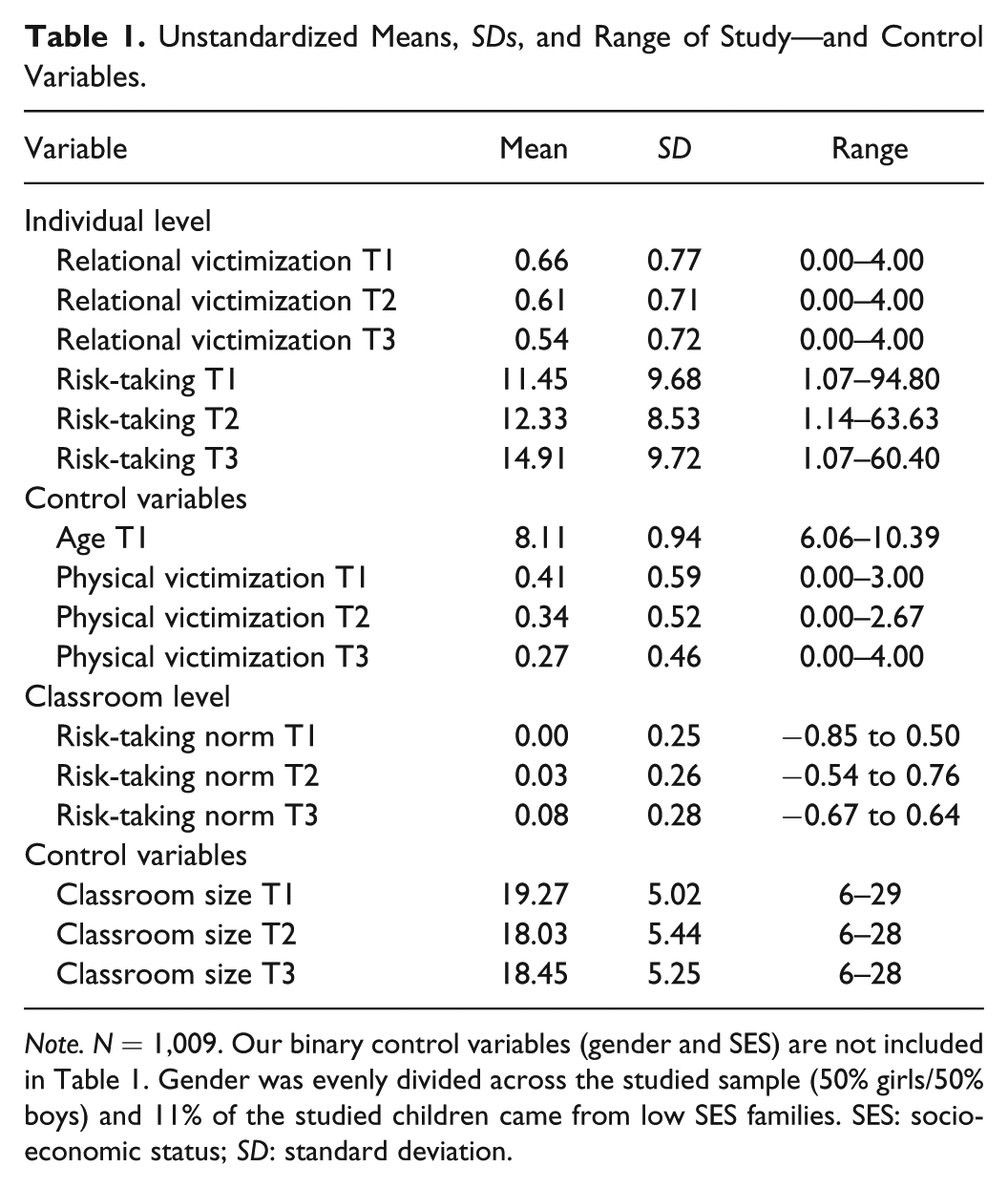
Note. N = 1,009. Our binary control variables (gender and SES) are not included in Table 1. Gender was evenly divided across the studied sample (50% girls/50% boys) and 11% of the studied children came from low SES families. SES: socioeconomic status; SD: standard deviation.
Correlations Between Study Variables.
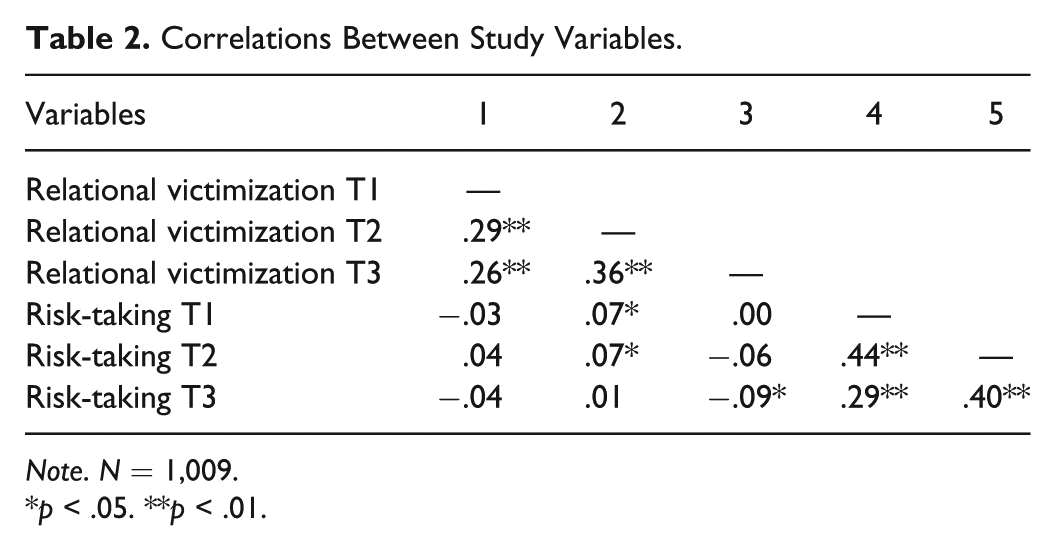
Note. N = 1,009.
*p < .05. **p < .01.
Classroom Norm, Relational Victimization, and the Development of Risk-Taking
Before testing our hypotheses on the moderating role of the classroom norm salience, we tested for possible main effects of relational victimization on children’s risk-taking behavior development. A multilevel autoregressive cross-lagged model was fitted. At the first level, autoregressive paths between relational victimization at Tx and Tx +1 and between risk-taking at Tx and Tx +1 were estimated. To test the main effect of relational victimization on risk-taking, cross-lagged paths between relational victimization at Tx and risk-taking at Tx +1 were estimated. We tested whether the lagged regression paths of relational victimization at Tx to risk-taking at Tx +1 could be constrained to be equal across time. This was the case, Δχ2 = 0.10, Δdf = 1, p = .75, indicating that the regression paths did not differ. Results in Table 3 (main effects; Step 1) showed no significant association between relational victimization and the development of risk-taking (B = −0.09, SE = 0.27, p = .746, 95% CI [−0.62, 0.44]). This model had an acceptable fit to the data, χ2(76) = 223.9, p < .001, RMSEA = .04, SRMR = .07, CFI = .92.
Results of the Multilevel Cross-Lagged Cross-Level Interaction Model.
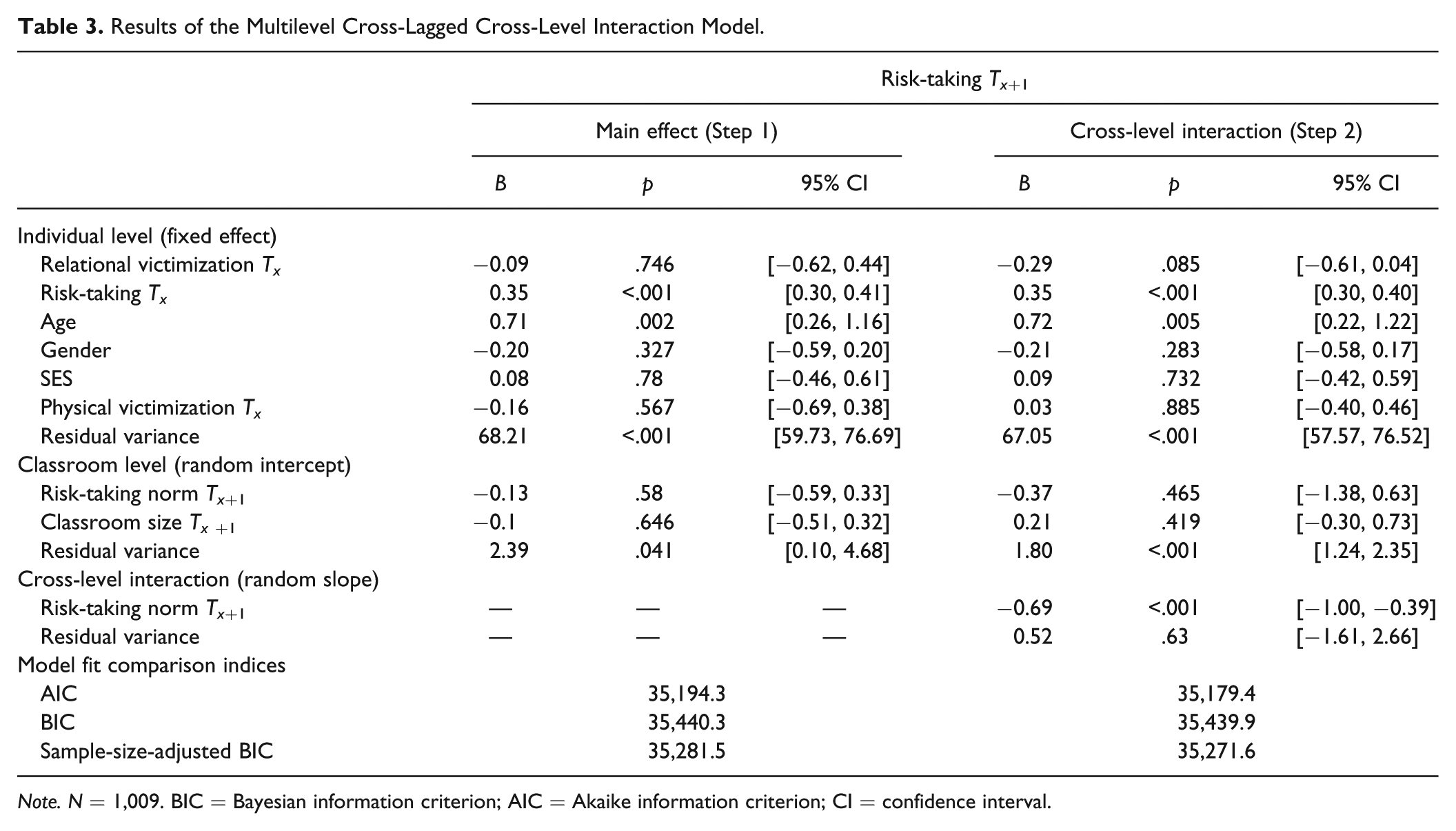
Note. N = 1,009. BIC = Bayesian information criterion; AIC = Akaike information criterion; CI = confidence interval.
In Step 2, we tested our research hypotheses by exploring the potential moderating role of the classroom norm salience toward risk-taking (Level 2) on the random slope of the association between relational victimization and risk-taking. To this end, random slopes of the association between relational victimization and risk-taking were estimated. A significant variance estimate (var. = .49, SE = 0.13, p < .01) showed that the association between relational victimization and risk-taking behavior varied across clusters (i.e., classroom membership profiles) at the two time intervals. To test for a cross-level interaction, we regressed the random slope (referring to the link between relational victimization and risk-taking) on the classroom norm salience at the classroom level. The generally lower values of the CFIs indicated that this model fitted the data better than the main effect model (see Table 3).
Results of the cross-level interaction are depicted in Table 3 (cross-level interaction; Step 2) and Figure 1. Results showed a significant effect of the norm salience on the random slope, B = −0.69, SE = 0.16, p < .001, 95% CI [−1.00, −0.39], showing that the classroom norm of risk-taking significantly moderated the individual-level association between relational victimization and risk-taking behavior at the two time intervals. We tested whether the associations at the two time points could be constrained to be equal across time, which was the case indicated by increased model fit of the constrained model. This suggests that the moderation by classroom norm salience of the association between relational victimization and the development of risk-taking was statistically similar across time.
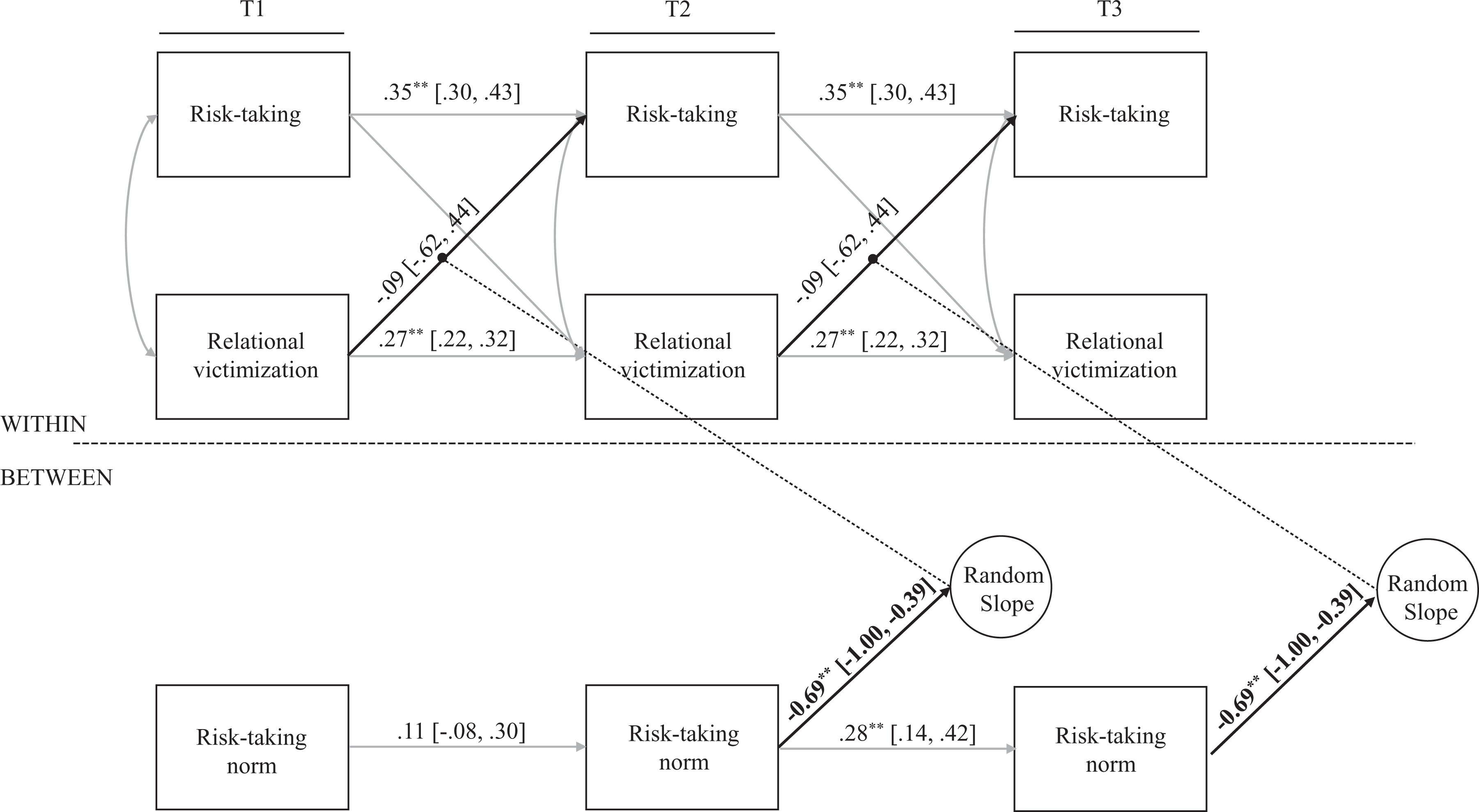
Graphical Representation of the Model With Cross-Level Interaction of the Classroom Norms on the Random Slopes of the Association Between Relational Victimization and Risk-Taking Development.
We then explored the region of significance for the moderation of the association between relational victimization and risk-taking by the classroom norm (Preacher et al., 2006). The region of significance of the norm salience ranged from −0.83 SD to +0.08 SD. This indicates that when the social classroom norm toward risk-taking was 0.83 SD below the mean (referring to a within-classroom correlation r < −.15) or lower, individual exposure of relational victimization at Tx predicted increases in risk-taking from Tx to Tx +1 (at −0.83 SD estimates were: B = 0.29, SE = 0.15, p = .05). When the classroom norm toward risk-taking was 0.08 SD above the mean (referring to a within-classroom correlation r > .10) or higher, the association between relational victimization at Tx and risk-taking at Tx +1 became negative (at +0.08 SD estimates were: B = −0.34, SE = 0.17, p = .05). Figure 2 depicts the slopes between relational victimization and risk-taking behavior in classrooms with unfavorable norm saliences toward risk-taking (1 SD below the mean; B = 0.41, SE = 0.16, p < .01, 95% CI [0.10, 0.72]) and with favorable norm saliences toward risk-taking (1 SD above the mean; B = −0.98, SE = 0.28, p < .001, 95% CI [−1.54, −0.42]).
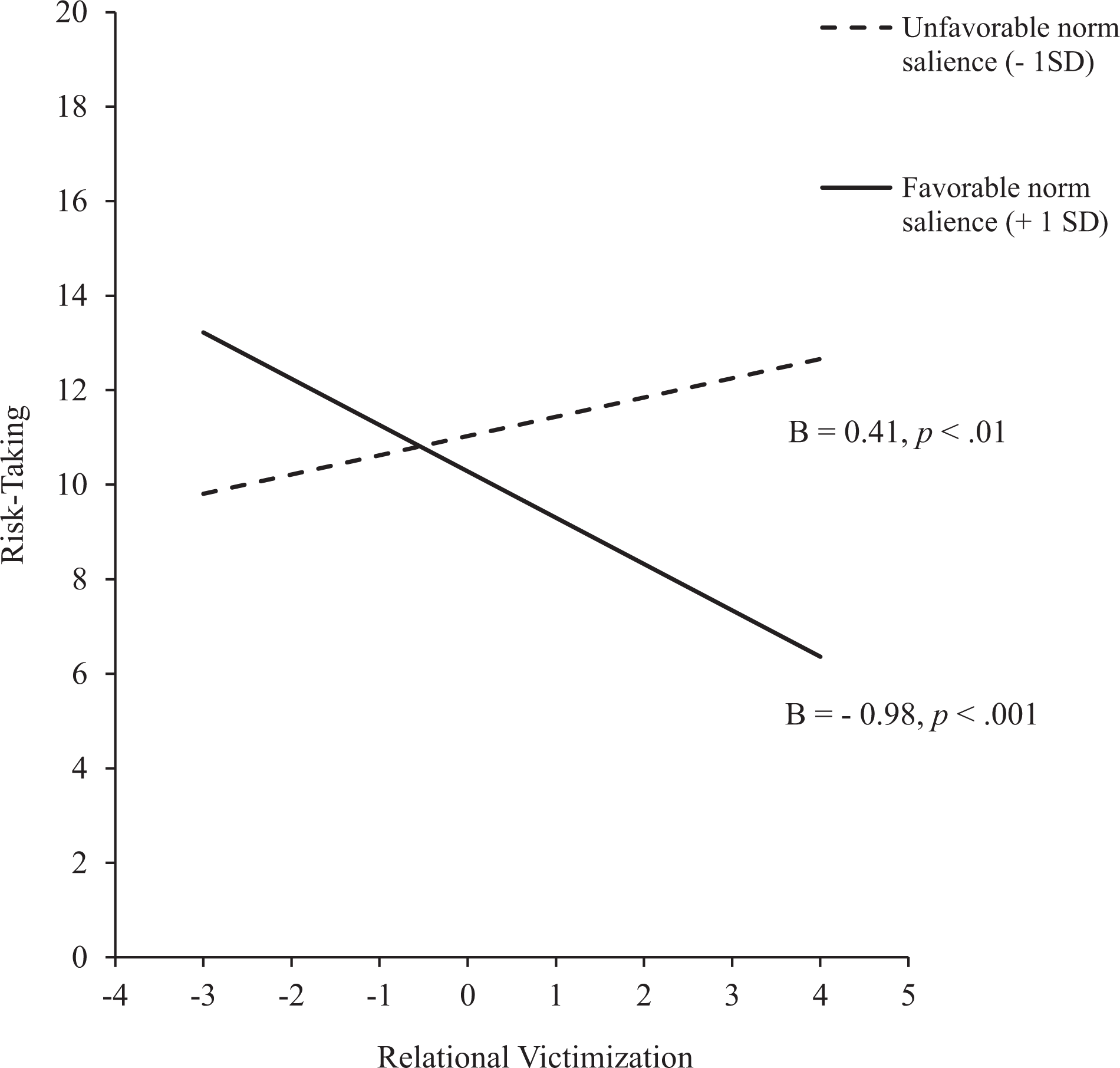
The Regression Lines for the Association Between Relational Victimization and Risk-Taking for Children in Classrooms With Favorable (+1 SD) and Unfavorable (−1 SD) Norm Saliences.
Discussion
The aim of this study was to examine whether the longitudinal association between relational victimization and the development of risk-taking behavior in elementary schoolchildren was moderated by the classroom norm salience toward risk-taking. We found no significant main effect of relational victimization on the development of risk-taking one school year later across the studied years. However, we found that the link between relational victimization and risk-taking behavior was moderated by the classroom norm salience. Specifically, when the classroom norm salience was unfavorable toward risk-taking, we found that relationally victimized children showed relative increases in risk-taking. In contrast, when the classroom norm salience was favorable toward risk-taking, relationally victimized children showed relative decreases in risk-taking behavior. Overall, this suggests that relationally victimized children may not adjust their risk-taking behavior in order to conform to what is set as favorable in the classroom but rather show relative increases in risk-taking behavior in classrooms where this behavior defies the norm.
Our results are (partly) in line with the earlier findings of a cross-sectional study (Brendgen et al., 2015), where it was found that aggression was positively related to victimization when the classroom norm salience was unfavorable toward aggression. However, in our study we also found a significant effect of the favorable norm toward risk-taking on the link between victimization and risk-taking, which was not the case in an earlier study (Brendgen et al., 2015).
We extended earlier studies into the norm salience to a new outcome domain, namely children’s risk-taking behavior. Also, in earlier studies into the classroom norms it was not explored whether victimized children generally adjust their behavior toward or contrary to the social classroom norm. Studies explored whether deviating from the classroom norm increased the chance of becoming victimized (Brendgen et al., 2015; Guimond et al., 2018) and another study investigated whether classroom levels of victimization affected the individual consequences of victimization (Huitsing et al., 2012). However, our results suggest that in addition to the previous found associations, victimized children may be at risk to engage in behaviors that are not approved of by their classmates. This was studied in a longitudinal design, while accounting for possible reverse effects from risk-taking to victimization. Regardless of the underlying processes that may explain the behavioral adjustments of victimized children, ours and the previous studies collectively show that the negative consequences of adverse social experiences cannot be understood without taking the classroom norm into account.
Our findings provide unique insights in the link between relational victimization and risk-taking behavior within elementary school classrooms. The results suggest that victimized children become entrapped in a serious plight of worsening their situation by showing exactly those behaviors that are not likely to lead to social inclusion. However, in interpreting these behavioral changes, it is necessary to distinguish between classrooms with unfavorable versus favorable norm saliences. The relative increases in risk-taking linked to experiences of relational victimization in classrooms with unfavorable norm saliences only followed when the classroom norm was (almost) 1 SD below the mean. This finding of relative increases in risk-taking behavior of the victims only in classrooms with (relative) strong unfavorable classroom norm saliences is in line with our hypothesis that victimized children may show provocative and norm-defying behavior. However, it is important to note that this study did not explore the underlying internal processes that may explain why these victimized children show provocative behavior. A potential explanation may be that in such classrooms, relationally victimized children think re-inclusion with those who set the norm—likely the high socially preferred peers—is no longer feasible. As a result, they may use their provocative behavior toward seeking affiliation or inclusion with peers with a lower social status (Rudolph, Lansford, et al., 2014).
The relative decreases in risk-taking of relationally victimized children were found in classrooms that favored risk-taking regardless of the strength of the norm salience. In those classrooms, provocation may not be the most plausible interpretation of the relative decreases in risk-taking among the victimized children. Other factors, like for example anxiety, could be related to the relative decreases in risk-taking in these victimized children. That is, children who become victimized in such classrooms might not dare to show risk-taking behavior like the socially preferred children in the classroom and instead affiliate with the more disliked peers who may be similarly anxious in showing risk-taking behavior. In an adult sample, it was indeed shown that decreases in risk-taking behavior were related to anxiety symptoms (Lorian & Grisham, 2010). However, further research into the underlying internal mechanisms is necessary to draw more conclusive interpretations on these findings.
This study is not without limitations. First, relational victimization was rated by the teacher. Teachers may not be aware of all experiences of victimization that take place at school (Oldenburg, Bosman, & Veenstra, 2016). However, previous research has shown that teacher reports of relational victimization predicted similar maladaptive outcomes compared to peer- and self-reports of relational victimization (Cullerton-Sen & Crick, 2005). Moreover, teacher reports showed these associations even when accounted for peer- and self-reports of relational victimization in elementary schoolchildren (Cullerton-Sen & Crick, 2005). In addition, a strength of the use of teacher reports is that we accounted for potential inflated associations due to shared method variance as our norm saliences were based on peer reports and risk-taking behavior was based on individual children’s test scores. Second, although the BART is a validated measure of risk-taking (Lejuez et al., 2007), risk-taking encompasses behaviors that are broader than assessed with the BART. For instance, it was shown that BART risk-taking scores were related to risk-taking scores on the Risk Propensity Scale (Meertens & Lion, 2008) but not to physical risk-taking (Morrongiello, Kane, McArthur, & Bell, 2012). Future studies should therefore include additional measures of risk-taking, to further assess the association between relational victimization and the development of risk-taking behavior in the context of the classroom norm. Finally, in our study we calculated the norm salience by the within-classroom correlation between social preference and risk-taking. Although this is a frequently used approach for norm salience calculations (Brendgen et al., 2015; Guimond et al., 2018; Henry et al., 2000), another way to assess the norm salience is by calculating the within-classroom correlation between perceived popularity and behavior (Dijkstra & Gest, 2015; Laninga-Wijnen et al., 2018). Our study had no data on perceived popularity, however it is important for future studies to examine whether our findings can be replicated if norm saliences regarding risk-taking are calculated by the within-classroom correlation between perceived popularity and risk-taking.
In conclusion, this study showed that relational victimization was related to both relative increases as well as relative decreases in risk-taking in elementary schoolchildren and that this association was moderated by the norm salience toward risk-taking. It seems worrisome that relationally victimized children tend to adjust their risk-taking behavior contrary to what is normative in the classroom, because it may further impede the victimized child’s possibility to steer away from their poor social position in the classroom. This, in the end, could contribute to the further development of norm-deviating behavior and to long-lasting maladaptive consequences of relational victimization. Our results support the idea that programs focusing on preventing or reducing (the negative consequences of) victimization may achieve additional impact by accentuating the importance of recognizing the social norm within a classroom (Espelage, 2015). For example, more group discussions in the classroom about acceptable and non-acceptable behavior and the consequences of such behaviors could be helpful for the victimized child to not further engage in behaviors that defy the social norm of the classroom.
Footnotes
Funding
The author(s) disclosed receipt of the following financial support for the research, authorship, and/or publication of this article: This project was funded by the European Research Council (ERC) under the European Union’s Horizon 2020 research and innovation programme (grant agreement no. 646594); the Netherlands Organization for Scientific Research, program medium sized investments, nr: 480-13-006; and the Netherlands Organization for Health Research and Development, program Youth, nr: 15700.4001.
