




Abstract
Achieving a clear view of one’s personality is a challenging but crucial developmental task during adolescence, which has enduring influences. This task might be harder if significant others see individuals differently from how the adolescents see themselves. Supporting this, the looking-glass-self theory suggests that significant others constitute a social mirror into which the individual gazes to form his/her self-view. The present study was the first to longitudinally examine whether self–other agreement in personality during adolescence (i.e., self–parent and self–friend agreement at age 12 and self–mother and self–father agreement at age 17) promote self-esteem development from age 17 to 29 years (N =186, 53% boys). Results for girls consistently confirmed the hypothesized beneficial effect of self–parent agreement, while the picture was more complicated for boys. That is, for girls, self–parent agreement at age 12 and age 17 both predicted steeper increases in self-esteem. For boys, steeper self-esteem development was predicted by higher self–parent agreement at age 12, but unexpectedly, also by lower self–parent agreement at age 17. All these results remained after controlling for (self-rated) personality. Moreover, self–friend agreement did not show any effects on self-esteem development, suggesting that the influence of peers’ convergence with self-views during early adolescence may not be as prominent as parents’. Results are discussed from the perspective of self-view formation and maintenance during adolescence and young adulthood. The present study sheds light on the longitudinal effect of one’s own view of personality being shared by important others on self-esteem development.
A crucial developmental task during adolescence is to achieve a relatively clear and confident self-view, which has enduring influences on individuals’ development across the lifespan (Erikson, 1994). An important part of this task is achieving a clear concept of one’s personality. According to the looking-glass-self theory (Cooley, 1902), individuals form their self-views by internalizing the views of their significant others. Metaphorically, the looking-glass-self theory suggests that significant others constitute a social mirror into which individuals gaze to form and evaluate self-views. The opinions of significant others are thus incorporated into one’s sense of self (Cooley, 1902).
However, research has shown discrepancies between adolescents’ self-viewed personality and their personality as viewed by their significant others (e.g., parents and siblings). On average, self–other agreement in personality during adolescence between adolescents and their family members were moderate (Göllner et al., 2016; Luan, Hutteman, Denissen, Asendorpf, & van Aken, 2016). The developmental task of forming a clear and confident self-view may be much more difficult if significant others see individuals’ personality in different ways from how individuals see themselves (Koepke & Denissen, 2012; Srivastava, 2012). Contrarily, high agreement between an individual and significant others regarding his/her personality might ease the fulfillment of this task, and in turn boost individuals’ subsequent positive development. The aim of the present study was to investigate whether self–other agreement in personality during adolescence promotes self-esteem development from adolescence to young adulthood, using longitudinal data that spans 18 years.
Self–other agreement in personality and self-esteem
Parents and peers are among the most significant relationships of adolescents. Parents’ views on their children’s personality plausibly constitute the very first feedback children receive and thus might maintain long-lasting influences on children’s formation and development of self-views. In addition, peer influences on the self-development have been shown to become increasingly important during late childhood to adolescence (Harter, 2007). Therefore, adolescents’ agreement with their parents and peers regarding adolescents’ personality could promote the formation of a clear and confident self-view. A clear self-view, in turn, has been found to be associated with higher self-esteem (Campbell, 1990; Campbell & Lavallee, 1993; Campbell et al., 1996), this may be because a clear and confident self-view provides a sense of stability and predictability of the self, as well as a base for guiding behaviors and understanding the world (Srivastava, 2012; Swann, 2011; Swann & Read, 1981).
In contrast, when significant others hold different opinions from adolescents themselves, this might cause confusion and concern within the adolescents regarding which characteristics represent their true self (Harter, 2007). The lack of a clear and confident self-view during adolescence, in turn, has been found to be both concurrently and longitudinally associated with internalizing problems, such as depressive and anxiety symptoms (van Dijk et al., 2014). Previous studies have shown that adolescents were much more psychologically affected by unstable and unclear self-representations than younger children (Harter, 2007), this is possibly due to their heightened self-reflection and need for self-view cohesion, which in turn could be detrimental for their self-esteem development.
Although reasonable, the direct link between self–other agreement in personality and self-esteem development has rarely been examined. Exceptions include a cross-sectional study which showed that adolescents’ agreement with their significant others regarding their personality was associated with higher concurrent self-esteem (van Aken, van Lieshout, & Haselager, 1995). To date, however, no studies have looked into the effect of self–parent and self–friend agreement on longer-term self-esteem development.
Moreover, previous research has shown that individual differences in self-esteem development can be partly explained by other personality traits (Wagner, Lüdtke, Jonkmann, & Trautwein, 2013). To the extent that Big Five traits overlap with self-esteem, any beneficial effects of self–other agreement in personality might thus be explained, at least partly, by personality per se. For instance, more agreeable, conscientious, and emotionally stable individuals show high self–other agreement in personality (Human & Biesanz, 2013) as well as other preferable characteristics, such as higher self-esteem (Robins, Tracy, Trzesniewski, Potter, & Gosling, 2001). Therefore, associations between self–other agreement in personality and self-esteem development is clearer after controlling for the Big Five traits.
The present study
The present study was the first to longitudinally investigate whether self–other agreement in personality during adolescence promotes self-esteem development from age 17 to 29 years, beyond the main effects of Big Five traits. We tested self–parent agreement and self–friend (same-sex best friend) agreement in early adolescence (age 12) as well as self–mother and self–father agreement in late adolescence (age 17; friends’ perceptions of adolescents’ personality were not available at that age).
There are different types of self–other agreement in literature. The profile-based approach (i.e., rank order of traits within each individual) and trait-based approach (i.e., rank order of individuals for each trait) have been outlined as two key applications with different focuses. The choice between a profile-based or a trait-based approach depends on the conceptual focus of the research (Back & Nestler, 2016; Borkenau & Leising, 2016). The present study focused on the profile-based self–other agreement because it more straightforwardly reflects the agreement regarding which personality trait is more central to an adolescent and which trait is less central. High self–parent profile agreement suggests that a person is for example, perceived as more curious than friendly by both herself and her parent.
There are different types of self–other agreement in literature. The profile-based approach (i.e., rank order of traits within each individual) and trait-based approach (i.e., rank order of individuals for each trait) have been outlined as two key applications with different focuses. The choice between a profile-based or a trait-based approach depends on the conceptual focus of the research (Back & Nestler, 2016; Borkenau & Leising, 2016). The present study focused on the profile-based self–other agreement because it more straightforwardly reflects the agreement regarding which personality trait is more central to an adolescent and which trait is less central. High self–parent profile agreement suggests that a person is for example, perceived as more curious than friendly by both herself and her parent.
We expected that self–parent and self–friend agreement during early adolescence (age 12) would predict steeper self-esteem increases from age 17 to 29. During late adolescence (age 17), we expected that self–parent agreement would still show influences on self-esteem development from age 17 to 29. Moreover, we expected that, even after controlling for (self-rated) personality, self–other agreement at age 12 and at age 17 would predict steeper self-esteem increases from age 17 to 29. As to the comparative predictive validity of self–other agreement at age 12 versus age 17, we formulated no hypothesis due to the limited current knowledge.
Furthermore, we explored whether the effect of self–other agreement in personality on self-esteem development differs for boys and girls. Although previous studies suggested a fundamental need for individuals’ self-views to be validated by important others, even when the self-views are negative (Kwang & Swann, 2010; Swann, 2011), it remains unclear whether this effect is equally strong for boys and girls. We formulated no hypothesis due to the limited current knowledge.
Method
Participants
Participants were from the Munich Longitudinal Study on the Genesis of Individual Competencies (LOGIC; Weinert & Schneider, 1999) that was started in 1984. The LOGIC sample initially contained 230 children who started to attend 20 preschools in the Munich area (on average 3–4 years old; 52% boys). Their first language was German. Schools were selected from a broad spectrum of neighborhoods, and more than 90% of parents asked gave consent for their child’s participation.
The present study included four waves of measurements, when participants were on average 12, 17, 23, and 29 years old. At age 12, 186 participants still participated in the study (53% boys). Scores of self–parent and self–friend agreement in personality were available for 155 and 125 participants, respectively. At age 17, scores of self–mother and self–father agreement were available for 146 and 128 participants, respectively. Scores of self-esteem were available for 174 participants at age 17 and dropped to 153 participants by age 29. We conducted attrition analyses to compare participants with complete cases and participants with missingness, for all research variables. Results showed that the 95% confidence interval for the two group means overlapped for all research variables, indicating that attrition did not result in a bias in the present study (see Supplementary Table S1 for details).
Measures
Big Five personality traits
At age 12, personality traits were judged by participants themselves, one of their parents (mainly mothers), and one same-sex best-friend. At age 17, personality traits were judged by participants themselves, their mothers, and their fathers. Emotional stability, extraversion, openness, agreeableness, and conscientiousness were rated using 40 bipolar adjective pairs that were obtained from Ostendorf (1990) on a 5-point scale (from 1 = totally agree with the adjective word on the left side, to 5 = totally agree with the adjective word on the right side); see Asendorpf and van Aken (2003) for details. The eight items per personality dimension were parceled into three indicators to improve reliability (Little, Cunningham, Shahar, & Widaman, 2002). Cronbach’s alphas were satisfactory for all judges at both ages, ranging from .67 to .93.
Self–other agreement in personality
Self–other agreement was operationalized as the profile correlation between self- and other-ratings on the 40 items of personality. That is, data were transformed into a format in which each participant had 40 lines of data (i.e., 40 personality items) and six variables (i.e., self-, parent-, and friend-ratings at age 12, and self-, mother-, and father-ratings at age 17). For each participant, four correlation coefficients were calculated based on the scores on the 40 personality items (i.e., self–parent and self–friend agreement at age 12, as well as self–mother and self–father agreement at age 17). Considering its correlational nature, the self–other agreement could, in theory, range from −1 (i.e., totally disagreed) to 1 (i.e., totally agreed).
Self-esteem
At age 17, 23, and 29, global self-esteem was measured by a subscale of the German short version of the SDQIII (Marsh & O’Neill, 1984). The six items with the highest corrected item-scale correlations in the original questionnaire were selected. Adolescents judged items on a 5-point scale (from 1 = totally disagree, to 5 = totally agree). Sample items include “Overall, I have a lot of self-confidence.” The six items were parceled into three indicators. Cronbach’s alphas ranged from .76 to .78 across ages 17 to 29.
Analytic strategy
Missing data handling and model fit
Data analyses were conducted with Mplus Version 7.31(Muthén & Muthén, 2015). Missing data were handled using full information maximum likelihood (FIML) estimation, thereby making optimal use of the available data. Model fit was assessed using the comparative fit indices (CFIs) and the root-mean-square error of approximation (RMSEA). CFI values of .90 and higher and RMSEA values of .08 and lower reflect an acceptable fit to the data (Marsh, Hau, & Grayson, 2005).
Measurement invariance from age 17 to 29
We conducted a Confirmatory Factor Analysis (CFA) with the specification of measurement invariance for self-esteem from age 17 to 29. A strict measurement invariance model still showed good model fit, χ2(28) = 37.13, p = .116, RMSEA = 0.04, CFI = 0.98, and was therefore selected as the baseline model for further analyses (see Supplementary Table S2 for detailed results of model comparison).
Mean-level change of self-esteem from age 17 to 29
Mean-level change of self-esteem was tested by adding the estimation of the intercept and slope from age 17 to 29 to the aforementioned strict measurement invariance model (Latent Growth Curve Models; McArdle & Bell, 2000). We set up two models—a linear model and a flexible model—that differed only in whether the factor loading of the slope at age 29 was fixed or freely estimated. Model fit of both models were acceptable and did not differ significantly (see Supplementary Table S3 for details), therefore the more parsimonious linear model was chosen for further models.
Predicting self-esteem development by self–other agreement at age 12 and 17
At age 12, predictive effects of self–parent agreement and self–friend agreement were tested in separate models (Model 1–4 for the four steps of self–parent agreement, and Model 5–8 for self–friend agreement). In Step 1, the predictive validity of self–other agreement was tested without covariates, by regressing the intercept and slope of self-esteem from age 17 to 29 on self–other agreement. In Step 2, it was to test whether the predictive validity of self–other agreement would still hold after controlling for self-rated personality, by entering self–other agreement and self-rated Big Five personality traits into the model simultaneously. In Step 3, the model was further controlled for gender, by entering self–other agreement, personality traits, and gender (0 = boy, 1 = girl) into the model simultaneously. In Step 4, the interaction between self–other agreement and gender was explored, by entering the interaction term (predictors were grand-mean centered prior to calculating the interaction term) and the aforementioned predictors to the model simultaneously. Residuals were allowed to correlate to improve model fit. Similarly, at age 17, predictive effects of self–mother agreement (Model 9–12) and self–father agreement (Model 13–16) on self-esteem development were tested in separate models.
Results
Means, standard deviations, and inter-correlations of all research variables can be found in Supplementary Table S4 of the online supporting information. Self-esteem on average showed linear increases from age 17 to 29, with significant individual differences in both the intercepts and slopes (see Supplementary Table S3 for details).
Self–other agreement during early adolescence (age 12)
We examined whether self–parent agreement at age 12 could explain these individual differences in the intercepts and slopes of self-esteem from age 17 to 29 (see Table 1). Self–parent agreement at age 12 (Model 1) predicted steeper self-esteem increases from age 17 to 29. That is, those adolescents whose parents judged their child’s personality to be similar to the adolescents’ own judgments at age 12 showed a stronger increase in self-esteem from age 17 to 29. This effect still held after controlling for personality (Model 2), speaking against the possibility that this effect is purely an artifact of the highly adaptive personality of the target person (i.e., highly conscientious, agreeable, and emotionally stable). The positive effect of self–parent agreement in personality became marginally significant after controlling for both personality and gender (Model 3).
Models predicting self-esteem development by self–parent agreement in personality at age 12.
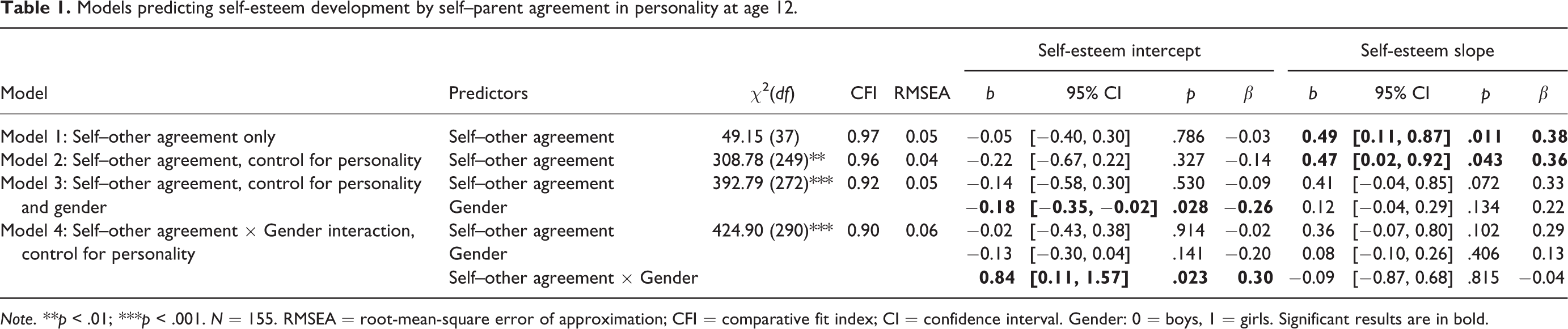
Note. **p < .01; ***p < .001. N = 155. RMSEA = root-mean-square error of approximation; CFI = comparative fit index; CI = confidence interval. Gender: 0 = boys, 1 = girls. Significant results are in bold.
Next, we explored the self–parent agreement × gender interaction. The interaction was significant only for the intercept of self-esteem, but not for the slope (Model 4). We probed the simple trajectory of self-esteem development from age 17 to 29 for boys and girls with 1SD higher or lower than the mean, following Curran, Bauer, and Willoughby (2004). As shown in Figure 1, high self–parent agreement at age 12 predicted higher self-esteem at age 17 for girls, but unexpectedly, lower self-esteem at age 17 for boys.
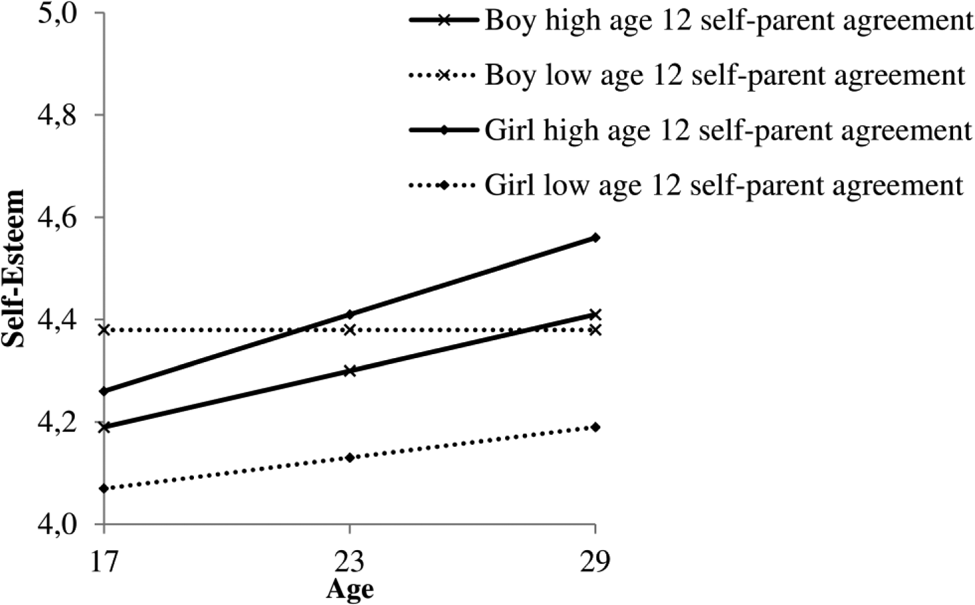
Self-esteem development of individuals with high or low (mean ± 1 standard deviation) self–parent agreement at age 12.
Similarly, we examined whether self–friend agreement at age 12 predicted self-esteem development (see Table 2). The predictive effects of self–friend agreement were non-significant for both intercepts and slopes, both before (Model 5) and after (Models 6 and 7) controlling for personality and gender. The self–friend agreement × gender interaction was also non-significant (Model 8). Thus, the extent to which adolescents agreed with their friends in their personality at age 12 did not predict their self-esteem development from age 17 to 29.
Models predicting self-esteem development by self–friend agreement in personality at age 12.
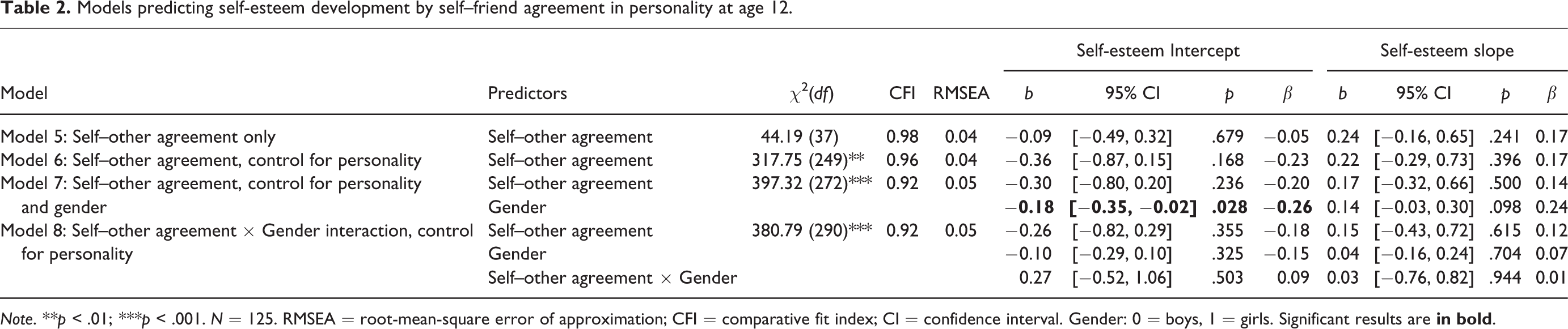
Note. **p < .01; ***p < .001. N = 125. RMSEA = root-mean-square error of approximation; CFI = comparative fit index; CI = confidence interval. Gender: 0 = boys, 1 = girls. Significant results are
Self–other agreement during late adolescence (age 17)
We examined whether self–parent agreement at age 17 could explain the individual differences in intercepts and slopes of self-esteem from age 17 to 29 (see Table 3). Self–mother agreement at age 17 predicted a higher intercept of self-esteem at age 17, but did not predict the slope from age 17 to 29 (Model 9). However, after controlling for personality (Model 10), and further controlling for personality and gender (Model 11), self–mother agreement in personality at age 17 no longer predicted the intercept of self-esteem. Thus, those 17-year-old adolescents whose mothers’ views of their personality were more congruent with their self-views, showed a higher concurrent level of self-esteem than other adolescents, but this main effect can fully be explained by personality.
Models predicting self-esteem development by self–mother agreement in personality at age 17.
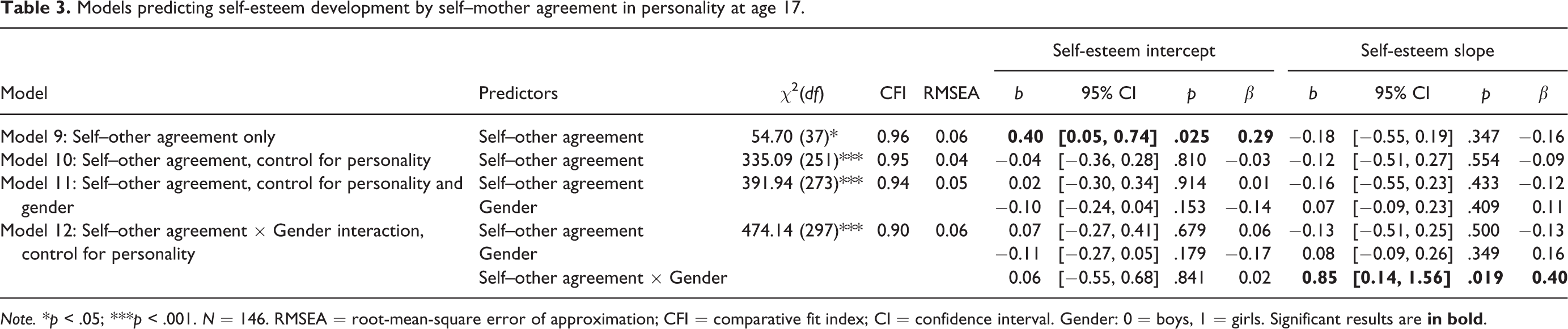
Note. *p < .05; ***p < .001. N = 146. RMSEA = root-mean-square error of approximation; CFI = comparative fit index; CI = confidence interval. Gender: 0 = boys, 1 = girls. Significant results are
The self–mother agreement × gender interaction was significant only for the slope of self-esteem from age 17 to 29, but not the intercept (Model 12). Simple trajectory analysis demonstrated that (see Figure 2), as expected, girls with higher self–mother agreement at age 17 showed increases in self-esteem (p = .028), while girls with lower self–mother agreement showed no changes (p = .806). Unexpectedly, boys with lower self–mother agreement showed increases in self-esteem (p = .047), while boys with higher self–mother agreement showed no changes (p = .248). Examining the region of significance revealed that the slope of self-esteem was significant when self–mother agreement at age 17 was higher than 0.61 for girls, and lower than 0.30 for boys. Corresponding to the present sample, these results indicate that the highest 56% girls and lowest 22% boys of our sample showed significant self-esteem increases, while the remaining participants showed no changes.
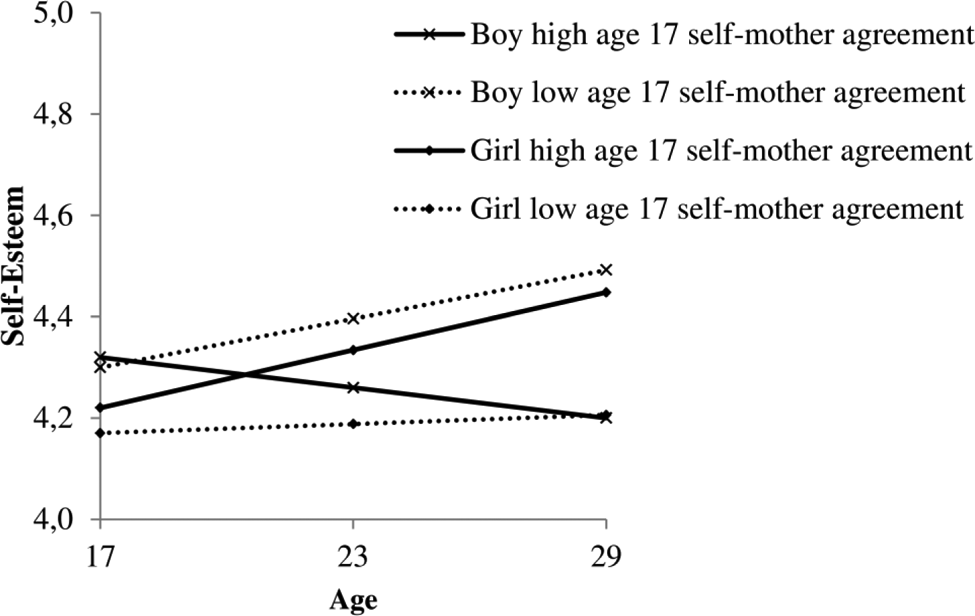
Self-esteem development of individuals with high or low (mean ± 1 standard deviation) self–mother agreement at age 17.
Self–father agreement at age 17 (see Table 4) showed the same pattern as self–mother agreement in predicting self-esteem development (i.e., a positive effect of self–father agreement on the intercept of self-esteem without covariates, and the interaction effect on the slope of self-esteem). However, both effects were only marginally significant (both p values = .066).
Models predicting self-esteem development by self–father agreement in personality at age 17.
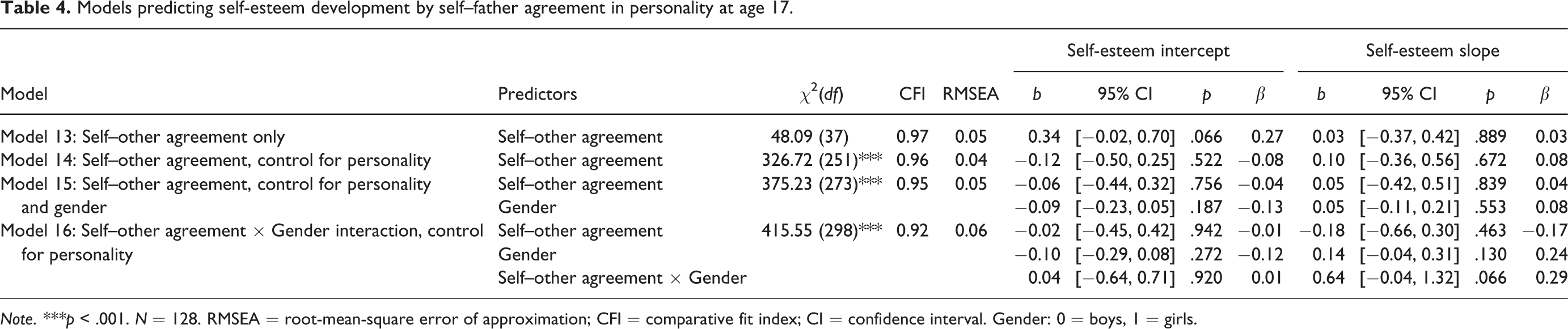
Note. ***p < .001. N = 128. RMSEA = root-mean-square error of approximation; CFI = comparative fit index; CI = confidence interval. Gender: 0 = boys, 1 = girls.
Discussion
The present study longitudinally investigated whether adolescents’ agreement with important others concerning their personality during early and late adolescence promotes self-esteem development from adolescence to young adulthood. We examined whether the predictive validity of self–other agreement still held after controlling for personality, and explored whether this effect of self–other agreement differed for boys and girls.
The looking-glass-self theory advocates that individuals form their self-views by internalizing how significant others perceive them (Cooley, 1902). High self–other agreement in personality might ease the process of adolescents in committing to a clear and confident self-view, which in turn has been positively linked with self-esteem (Campbell, 1990; Campbell & Lavallee, 1993; van Aken et al., 1995). In the present study, we filled the gap in the literature by longitudinally testing the direct link between self–other agreement and self-esteem development from adolescence to young adulthood, and controlling for Big Five personality traits. The hypothesized positive link was consistently confirmed by our data regarding self–parent agreement for girls, but the picture was more complicated for boys.
Specifically, confirming our hypothesis, girls’ higher self–parent agreement at age 12 predicted higher self-esteem at age 17 and steeper increases from age 17 to 29. In addition, girls’ higher self–parent agreement at age 17 also predicted steeper self-esteem increases from age 17 to 29. These effects all remained after controlling for personality, contradicting the notion that the favorable developmental consequence of self–other agreement in personality is only a by-product of the highly adaptive personality of the target person (i.e., highly conscientious, agreeable, and emotionally stable).
At least for girls, self–parent agreement in personality during early adolescence may thus serve as a preferable base for adolescents’ identity exploration and commitment to start from. When parents and their children agree concerning the adolescents’ personality, this may be helpful in committing to a clear and confident self-view by the end of adolescence. Having a clear self-view provides individuals a sense of predictability of the self and the world (Swann, 2011), which in turn facilitates self-esteem development during emerging and young adulthood (Campbell, 1990; Erikson, 1994).
Findings for boys were less congruent. Boys’ higher self–parent agreement at age 12 predicted lower self-esteem at age 17, but steeper self-esteem increases from age 17 to 29 (even after controlling for personality). Unexpectedly, boys’ higher self–parent agreement at age 17 predicted less self-esteem increases from age 17 to 29.
With respect to this gender difference in the effect of self–parent agreement at age 17, we can provide one speculative explanation. By late adolescence, adolescents have already formed their relatively clear self-views, and parents’ opinions become less influential (Meeus, Iedema, Maassen, & Engels, 2005). Therefore, the positive link between self–parent agreement and self-esteem development via clarity in self-view may be largely weakened. This might be especially true for boys, as a previous study has shown that boys become less upset concerning their conflicting attributes across adolescence, while girls become more upset (Harter, Bresnick, Bouchey, & Whitesell, 1997). Therefore, low clarity in their self-view possibly bothers boys to a lesser degree than girls. At the same time, gender identity has also become clearer by late adolescence, with girls being socialized more towards communion (“getting along”) and boys being socialized towards more agency (“getting ahead”; Richards & Larson, 1989). This communion vs. agency difference in primary psychological needs from late adolescence onwards might play a prominent role of mediating the link of self–parent agreement at age 17 with self-esteem development.
More specifically, self–parent agreement at age 17 continues promoting girls’ self-esteem development, as self–other agreement has been found to nurture interpersonal relationship during adulthood (e.g., intimacy, smooth communication, relationship satisfaction; Human & Biesanz, 2013; Kwang & Swann, 2010), fulfilling girls’ primary need for communion. In comparison, boys have been socialized in such a way that harmonious relationships become less important for men’s self-esteem than women’s (Cross, Bacon, & Morris, 2000). Lower self–parent agreement might even become a way for boys to show their gained independence and autonomy from their parents, as this sense of masculinity and control could fulfill boys’ primary need for agency, which in turn facilitates their self-esteem development. However, these speculations certainly await verification by further studies.
Self–friend agreement at age 12 showed no effects on self-esteem development. This might be because a friend’s influence at this early phase in adolescence is not as prominent as during late adolescence (Berndt, 1996)—at least when it comes to the effect of personality agreement on self-esteem development. Unfortunately, we did not have data on self–friend agreement at age 17 in the present study, so this explanation awaits future research to verify. Future studies could shed more light on this matter.
Limitations and future directions
The present longitudinal study was the first to investigate the effects of adolescent’s personality agreement with important others concerning their self-esteem development from adolescence to young adulthood. A number of questions await future studies to shed more light on them. First, it would be interesting for future studies to examine whether the influence of friends’ personality agreement increases and the influence of parents’ decreases during adolescence and young adulthood. Larger sample sizes and more measurement points would be needed to clearly address this question.
Second, it would have been interesting to depict the trajectory of self-esteem development from age 12 to 29. Unfortunately, in our study, self-esteem at age 12 was measured with a different scale (i.e., the German version of the Self-Perception Profile for Children; Harter, 1985). We could not establish measurement invariance even after transforming the 4-point scale score into a 5-point scale score and testing measurement invariance at parcel level. Therefore, we could not include this measure in our analyses. It would be interesting for future studies to examine whether the effect of self–other agreement remains the same or changes during other life periods (e.g., when adolescents later become the parents of adolescents).
Third, we did not include a stringent test of the direction of causality. While it is plausible that self–other agreement influences self-esteem, the effect might also flow in the reverse direction or be due to unaccounted third factors. For example, previous research has proposed that individuals are highly motivated to self-verify when they are confronted with discrepant self-views (Kwang & Swann, 2010). Such situations trigger a process of identity negotiation, in which individuals try to convince interaction partners of the validity of their self-view. It might be that individuals with higher self-esteem levels are more successful at this process. More research is needed to address the antecedents of self–other agreement in personality. For example, self–other agreement might change as a function of relationship quality.
Fourth, some people might intuitively expect that when others see adolescents in a more favorable way than his/her self-view, low self–other agreement might benefit self-esteem development. However, a meta-analysis has shown that people desire to be seen by important others in the same way as they see themselves, even when their self-view is negative. This self-verifying motive is rather strong as long as important others’ perceptions of them are not so negative that it leads to the dissolution of their relationships (Kwang & Swann, 2010). More studies with different operationalization of self–other agreement in personality are needed to draw a convergent conclusion (Schriber & Robins, 2012). For instance, the present study focused on the profile agreement based on 40 personality items to increase the usage of available information, future studies could shed more light on this matter with other approaches, such as profile agreement based on more aggregated information, or response surface analysis (Nestler, Grimm, & Schönbrodt, 2015).
Moreover, the present study focused on the self–other agreement, yet other-other agreement in personality might also influence self-esteem development. For instance, when parents’ opinions differ from friends’ opinions regarding adolescents’ personality, reconciling multiple diverging perspectives could also be highly challenging and confusing. Future studies could directly examine this interesting question.
Conclusion
The present 18-year longitudinal study has shown that self–parent agreement (but not self–friend agreement) in personality during early adolescence promotes self-esteem increases from adolescence to young adulthood. This effect remained after controlling for self-rated personality. The same positive effect exists for self–parent agreement during late adolescence, but only for girls. For boys, the effect became negative by late adolescence. The present study increased our knowledge by demonstrating the longitudinal effect of one’s own view of personality being shared by important others on self-esteem development.
Footnotes
Funding
The authors disclosed receipt of the following financial support for the research, authorship, and/or publication of this article: Support for this research was provided by the International Society for the Study of Behavioral Development and Jacobs Foundation (ISSBD-JF) Mentored Fellowship Program for Early Career Scholars to Ziyan Luan.
Supplemental material
Supplementary material for this article is available online.
References
Supplementary Material
Please find the following supplemental material available below.
For Open Access articles published under a Creative Commons License, all supplemental material carries the same license as the article it is associated with.
For non-Open Access articles published, all supplemental material carries a non-exclusive license, and permission requests for re-use of supplemental material or any part of supplemental material shall be sent directly to the copyright owner as specified in the copyright notice associated with the article.
