



Abstract
Engagement in the arts has shown promise as a nonpharmacological approach for mitigating age-related cognitive decline. In this study, we report on feasibility and acceptability of a remote and self-administered observational drawing intervention that deliberately engages cognition, including spatial reasoning, hand-eye coordination, and awareness of the present moment. Thirty-four participants aged 65-87 completed our randomized controlled trial. The training consisted of 10 online lessons and daily practice in which participants acquired drawing techniques that improved their drawing skills by > 0.5 SD (d = 1.27). Over 80% who completed the course rated it positively and found the online format accessible, although we observed considerable attrition (47%). Baseline drawing skills were related to mental transformation (r = 0.47), yet transfer to cognitive stills at post-test was limited. Intervention-related improvements emerged in mindfulness (d(net) = 0.81). Our study illustrates that drawing skills can be improved in older adulthood and highlights the potential of visual arts training in promoting cognition and wellbeing.
Introduction
The arts are ubiquitous and integral activities that can act as a source of expression, understanding, and pleasure. Arts engagement in older adulthood can provide a pathway towards successful aging in cognitive, socioemotional, and physical domains (Fancourt & Finn, 2019; Noice et al., 2014). While positive effects of performance art interventions (e.g., theater, music, dance) have been demonstrated (Alves, 2013; Noice et al., 2014), investigation of visual arts-based interventions to support aging is sparse, in part due to a lack of conceptualization of what such interventions should entail. One visual artform clearly defined and extensively studied is observational drawing. Drawing from observation engages perceptual, motor, and attentional processes, leading to a new way of seeing (Chamberlain, 2013; Cohen & Bennett, 1997). Drawing skills are developed through knowledge of useful drawing techniques and strengthening the hand-eye connection. Yet, these properties remain largely unexplored in the context of arts engagement for cognitive enrichment in older adulthood. The current study leveraged the fields of drawing education and cognitive engagement to test the feasibility and explore the preliminary effects of a drawing-based intervention.
Arts Engagement and Successful Aging
Successful aging has been defined as a state of functioning in older age that is free of major diseases (Rowe & Kahn, 1997). It encompasses physical, psychological, functional, and social dimensions of health, and the main focus of successful aging is to expand healthy and functional years of life (Urtamo et al., 2019). Different activities and lifestyle factors, such as engagement in the arts, have shown promise as a means to promote successful aging. For example, longitudinal studies have found higher frequency of receptive and participatory arts engagement, such as attending concerts, or playing musical instruments, to relate to higher odds of healthy aging (Gow et al., 2014; Rena et al., 2023; Verghese et al., 2003). Specifically, Gow and colleagues (2014) found that a factor of activity engagement correlated with cognitive function in older age, and attending concerts, music, and other arts-related events loaded most highly on this factor out of 15 activities. Additionally, positive effects of various forms of arts engagement on cognition and wellbeing have been well-established through large-scale studies and systematic reviews (Abraha et al., 2017; Fancourt & Finn, 2019; Noice et al., 2014). The cognitive engagement hypothesis of successful aging suggests that ongoing investment of personal resources, such as time and attention, in stimulating activities—such as the arts—can positively impact aging trajectories by fostering cognitive adaptability and neural efficiency in later adulthood (Stine-Morrow & Manavbasi, 2022).
With respect to interventional research, music-based therapy is among the best established evidence-based non-pharmacological interventions for treating behavioral and cognitive symptoms of dementia (Abraha et al., 2017; Fusar-Poli et al., 2018). Additionally, acting classes have shown robust effects on memory, attention, and processing speed in diverse older persons in various community settings (Noice et al., 2004; Noice & Noice, 2008, 2013). Yet, visual arts have gone mostly unstudied, with only very few studies focusing on visual arts interventions. Out of 31 studies identified in a 2014 review of participatory arts benefits, only 3 involved the visual arts (Noice et al., 2014). Since then, one study compared effects of two 10-week museum-based interventions involving art production and cognitive art evaluation with a group of 28 older adults. Participation in the art production course (n = 14) resulted in a positive effect on the association between self-reported cognitive resilience and connectivity and differentiation of sensory and motor cortices at rest (Bolwerk et al., 2014). The participatory visual arts intervention involved drawing different subjects and learning about color and composition. This study did not evaluate changes in drawing skills or cognition behaviorally. Another arts intervention study assessed the effects of three months (1 hour three times a week) of music (n = 17) and visual arts (n = 19) training on cognition and visuomotor coordination (Alain et al., 2019). The visual arts group acquired and practiced drawing and painting techniques, as well as analyzed famous artworks. Although not showing any behavioral changes at the post-test, the visual arts group (in contrast with to the comparison groups) had a significant increase in neural activation as measured by EEG during a visual Go-No-Go Task, a measure of cognitive control. Limitations of existing visual arts intervention studies with older adults include lack of focus on deliberate skill development (e.g., drawing skills), unclear understanding of which outcomes may be most impacted by training, and minimal descriptions of implemented interventions. Critically, even though the visual art intervention studies described above showed positive benefits for mental wellbeing, including reduced negative affect, increased perception of life as meaningful, and higher self-esteem, none of them reported cognitive outcomes, even though cognition is a key component of successful aging.
Observational Drawing and its Benefits
The goal of observational drawing is to render an object as realistically as possible. This can be achieved through training a new way of looking at within- and between-object relationships (Kozbelt & Ostrofsky, 2018; Kozbelt & Seeley, 2007). Drawing skills are supported by visuospatial reasoning, memory, attention, and processing speed, albeit mechanistic studies, both cognitive and neurobiological (e.g., eye tracking and neuroimaging), have mainly tested associations in young adults (Chamberlain & Wagemans, 2016; Drake et al., 2021; Kozbelt, 2001; Perdreau, 2014). Drawing enhances mindful attention, promotes abstract thinking, and builds hand-eye connection (Brew, 2015; Fava, 2017; Greenhalgh, 2015). Developing drawing skills leads to attentional and perceptual changes that arise from strengthening of the connection between the eye, hand, and mind (Brew, 2015; Edwards & Edwards, 2012; Kozbelt & Seeley, 2007). Given these properties, observational drawing could provide both cognitive engagement and mental wellbeing in older adulthood. Importantly, novel and enjoyable activities are a key component of successful cognitive aging (Park et al., 2014). Studies with young adults suggest that training drawing skills can enhance fluid cognitive processes and such potential improvements are particularly useful in older adulthood (Chamberlain et al., 2021; Sorby, 1999).
Developing Drawing Skills
Drawing skills are facilitated by explicit domain-specific knowledge such as different techniques. For example, in portraiture, knowing that the eyes are positioned halfway down the face helps avoid the common mistake of drawing them higher than they appear in real life. Teaching this technique within a single session significantly enhanced novices’ representational drawing abilities of faces (Ostrofsky et al., 2014). Other drawing techniques promote visuospatial processing through guiding attention to intersections and the space around objects (Biederman & Kim, 2008; Cavanagh, 2005; Chamberlain, 2013). Contour drawing and gesture drawing are two techniques that facilitate understanding of local scene details and global structure, respectively (Kozbelt & Seeley, 2007; Nicolaïdes, 1991). Specifically, contour drawing focuses on observing fine detail and tracing edges of objects, often without looking at the paper (cf. Table S1, Techniques 1 and 2). Gesture drawing, in contrast, uses quick and loose strokes to capture the overall gist of a subject (cf. Table S1, Techniques 5 and 6). When drawing a still life, such as a vase of flowers, the gesture technique will help lay down the overall shapes and the contour technique will refine details, such as the outlines of individuals leaves. Using deliberate techniques is linked to better drawing skills and higher performance on cognitive tasks involving visuospatial construction and reasoning (Chamberlain et al., 2015; Vodyanyk & Jaeggi, 2023).
Furthermore, practicing drawing techniques described above, artists can enter an altered state of perception and full immersion in the present moment – a state related to mindfulness. Components of mindfulness have emerged in artists’ writings and teachings over time (Franck, 1993; Greenhalgh, 2015; Nicolaïdes, 1991). This ability to engage full attention may be related to positive outcomes. For example, visual art therapies engaging mindfulness are linked to enhanced wellbeing in older adults with dementia, including decreased anxiety, enhanced mood, and improved self-esteem (Chancellor et al., 2014). While visual arts interventions show promise in improving wellbeing, such interventions do not focus on a cognitive training component. In this pilot study, we tested the feasibility and acceptability of an observational drawing course that deliberately engages underlying cognitive domains.
Current Study
To advance research on visual arts interventions in aging populations, we developed a structured observational drawing training program with a specific objective of engaging cognition. Our goals were to test usability, feasibility, and acceptability of a remote implementation, and the extent to which the course might improve drawing accuracy. Additionally, we gathered preliminary effect sizes on cognitive and wellbeing outcomes associated with drawing. The insights gained from the developed materials and participant feedback will be instrumental in refining the intervention, determining the underlying mechanisms of drawing skills, and testing effects in larger scale randomized controlled trials.
Method
Participants
Adults 65+ residing mainly in Orange County, Southern California, were recruited through mailing lists, recruitment databases, Facebook advertisements, and word-of-mouth. Interested individuals completed an online survey pre-screening survey to determine eligibility. Those without neurogenerative disorders, depression (Geriatric Depression Scale (GDS-15), Yesavage & Sheikh, 1986), or formal training in visual art were screened with an auditory Montreal Cognitive Assessment (MoCA; Nasreddine et al., 2005) by one of two certified researchers. Individuals who scored 18 or above (or 17 if less than or equal to 12 years of education) on the MoCA were randomized into one of two conditions – treatment or waitlist control. When a participant dropped out of one group, another spot for randomization into that group was added. We recruited 34 treatment participants and 15 control participants. Two of the treatment participants switched to the control group before beginning the intervention due to time availability issues, resulting in 17 participants in the control group. These participants were retained to maximize power and including them in the analyses did not change the results. Control group participants showed up to both testing sessions and did not receive any intervention in-between. They were offered the intervention after completing the second testing session, but their progress was not tracked. Of the remaining 32 participants who were randomized into the treatment group, 17 completed the intervention and 15 dropped out. Three participants were missing half of one session’s data due to technical issues, such as a program bug which was subsequently resolved.
Procedure
The study was a single-blinded randomized controlled trial with two groups. The pre- and post-test sessions were conducted in a private laboratory space at University of California, Irvine or on Zoom. The first session involved informed consent, tablet-based testing, receiving intervention instructions (treatment only) and scheduling the post-test. Treatment group participants were provided supplies for the intervention (zipped bag with a spiral-bound sketchbook, black marker pen, pencil and sharpener). Participants selected a 10- or 5-week schedule to complete 10 lessons and participants’ post-test sessions were scheduled six or 11 weeks from the pre-test. Control participants also selected a post-test session that was either six or 11 weeks after the pre-test. At the post-test, participants completed the same tablet-based testing and debriefed on their participation. All participants received a $50 Amazon gift-card as compensation via e-mail after their second testing session. Note that the payment compensated participants for the assessment sessions but not the intervention. Although this may have contributed to attrition, the intervention is comparable to courses that are often offered for a fee.
Materials
Intervention
The training consisted of lessons and practice sessions. The 5-week schedule required completing two lessons per week and daily practice, and the 10-week schedule required completing one lesson per week and practicing two to three times a week. On average, participants were asked to complete two to three practice sessions per lessons. We tried to maximize engagement such that participants selected the schedule that best fit their availability during the training period. All course materials were stored on a Google Site. An introductory page included a tutorial video of the study and course components. The first nine lessons covered new drawing techniques, and the last lesson provided a course overview. In the second lesson, participants learned specific information about four cognitive domains—visuospatial reasoning, attention, processing speed, and memory. Participants received simple definitions of each domain, as well as examples of how each domain is used in drawing. The explicit focus on these domains was meant to facilitate a deeper understanding of the daily drawing prompts. Lessons were administered in Qualtrics and consisted of reading, examples, videos, multiple choice and short answer questions, and occasional matching and ranking questions. In each lesson, participants completed two to three timed exercises practicing the new techniques using reference photos presented on-screen. The techniques taught in each lesson and their descriptions are illustrated in Table S1 and the cognitive domains are listed in Table S2.
Daily Practice
Participants drew from their environment using prompts that build skills and deliberately engage at least one of four domains: visuospatial reasoning, attention, memory, and processing speed. An example of a prompt requiring processing speed is drawing the same composition in five minutes, three minutes and one minute (cf. Table S2). More examples of practice prompts can be found in the online materials.
Logging Progress
Participants logged daily progress, including time spent, through a Google Form and sent photos of their drawings to a study email. In the form, participants recorded how long they practiced, which techniques, and which cognitive domains. We extracted the number of times participants engaged different techniques and cognitive domains. Prototypical drawings were extracted. Progress data were collected from 21 participants. Some participants who finished the course were missing log data due to technical issues or misunderstanding of the training requirements.
Feedback Form
After the course, participants were invited to complete a feedback form about further usability, acceptability, and feasibility. Questions asked about course content and course structure, specific topics including the general impressions, lesson format and content, and course administration. Responses included short text entries and sentiment ratings from strongly agree to strongly disagree.
Assessments
At the pre- and post-test sessions, participants completed the same battery of assessments. The assessment sessions took approximately two hours, with one mandatory short break in between. The testing sessions were completed on the lab’s Amazon Fire 10 tablets or participants’ iPads. The first half of the session used the BGC Science app (BGC Science, 2023; Jayakumar et al., 2024) and the second half was completed through Qualtrics. Participants completed a battery of cognitive tasks, questionnaires, and a drawing task. Note that the experimental tasks were not normed, and thus, the scores were not norm corrected.
Drawing Task
Participants had seven minutes to draw a still life photo on the screen (Bravo Direct View, (Carson, 2012)). Drawings were photographed and digitally processed to increase contrast for easier scoring. Each drawing was scored using two methods – angle-based scoring and rubric-based scoring. The two scoring methods are outlined below.
Rubric-based Scoring
A rubric scored each of the five items in the composition on four features. Two features assessed within-object representation (distortion and orientation) and two assessed between-object representation (location and size). Each category was scored from 0 to 2, with 2 signifying high representational accuracy. Each drawing was scored by two independent raters who established inter-rater reliability prior to scoring and were blind to the participants’ condition. The raters rescored all ratings with a discrepancy of two and reviewed ratings of a discrepancy of one (kappa = 0.87). Average scores of the two raters in each category were summed into a total score (Cronbach’s α = 0.88).
Angle-based Scoring
10 points of intersection were compared between the reference photo and each drawing. Each of the drawings was scored by two independent raters and each of the angles measured was recalculated by the raters as needed until all angles reached an inter-rater consistency of five degrees (ICC = 0.99). The two raters’ scores were averaged for each angle and across the 10 angles (Cronbach’s α = 0.60). Each drawing had a final measure of angle error, with smaller error meaning higher drawing accuracy.
Drawing Composite
Rubric-based and angle-based scores were standardized, and angle-based z-scores were reversed given that higher accuracy means lower angle error. The two z-scores were averaged into a composite score of accuracy that addresses both lower-level and higher-level perceptual features related to drawing.
Cognitive Tasks
Visuospatial Reasoning
Visuospatial Construction and Memory
A
Visuospatial Working Memory
Corsi span is a mobile block-tapping task administered through BGC Science (BGC Science, 2023), modeled after the original Corsi Blocks task (Arce & McMullen, 2021). The task contains nine squares that light up in a sequence. In the
Executive Function
An
Quality of Life
Wellbeing (WEMWBS)
The Warwick-Edinburgh Mental Well-being Scale measures positive aspects mental wellbeing (Tennant et al., 2007). The questionnaire has 14 statements asking participants to select the rating best describing their experience over the past two weeks. The scale ranges from 1 (None of the time) to 5 (All of the time). Example statements are “I’ve been feeling cheerful” and “I’ve been thinking clearly”. The final measure was an average of ratings on each question with 1 signifying lowest mental wellbeing and 5 signifying the highest (Cronbach’s α = 0.85).
Mindfulness
An adapted version of the Solloway Mindfulness Survey assessed mindful awareness during drawing from observation (Solloway & Fisher, 2007). Participants were asked to select ‘True’, ‘False, or ‘Not Sure’ for 30 statements phrased as “Practicing drawing from observation makes me…” with some example statements being “observe things objectively”, “feel peaceful” and “feel like I’m seeing for the first time”. Participants were given a score of 1 for each question they answered “True” and otherwise they were given a 0. Scores were totaled and divided by the number of questions for a final measure of the proportion of questions for which “True” was selected (Cronbach’s α = 0.87).
Demographic Measures
We collected demographic information including gender, age, handedness, race/ethnicity, number of languages spoken, years of education and subjective social status using the MacArthur Scale of Subjective Social Standing (Adler et al., 2000) as a proxy for socioeconomic status (SES). In the MacArthur Scale, participants are asked to select 1-10 on whether they are best off (10) or worst off (1) relative to people in their community and country. The MacArthur Scale has shown to correlate more strongly with physiological and psychological measures of wellbeing than objective socioeconomic measures, such as years of education and yearly income (Adler et al., 2000).
Statistical Procedures
Descriptive statistics and t-tests were used to address the main research aims pertaining to feasibility and usability, as well as to test the preliminary effects of the intervention on drawing skill, cognition, and wellbeing. Analyses were conducted in R 4.1.2 and JASP (JASP Team, 2023). Baseline correlations were calculated across all participants between the outcomes of interest, as well as age. JASP was used to calculate both frequentists and Bayesian effect sizes (Cohen’s d and Bayes Factor (BF10)). Effect sizes were calculated for differences between pre-test and post-test separately for the treatment and control groups.
Results
Demographic Information.
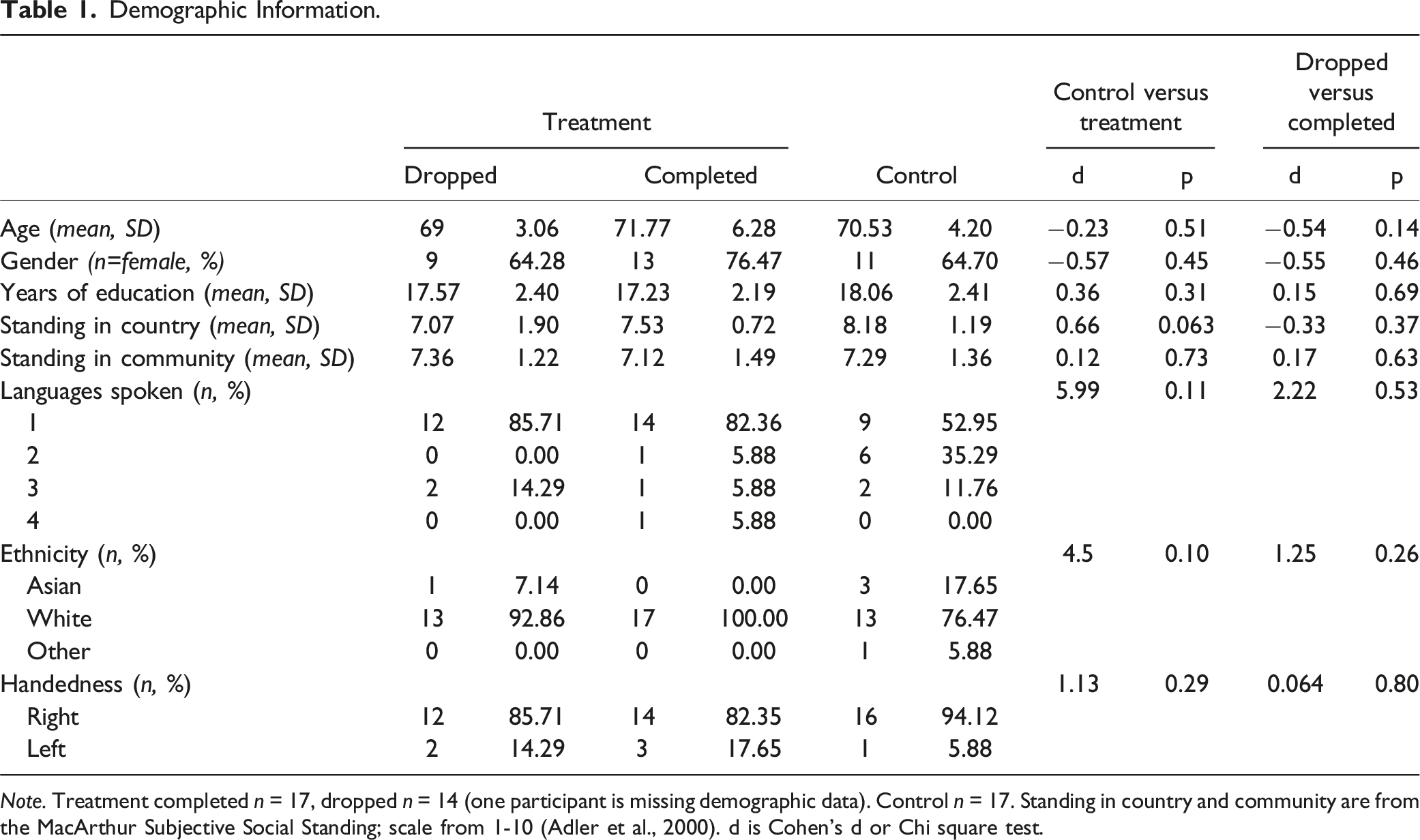
Note. Treatment completed n = 17, dropped n = 14 (one participant is missing demographic data). Control n = 17. Standing in country and community are from the MacArthur Subjective Social Standing; scale from 1-10 (Adler et al., 2000). d is Cohen’s d or Chi square test.
Primary Outcomes - Usability, Feasibility, and Acceptability of the Intervention
Usability
Of those participants who completed the course, 90% felt that the course lessons contained an adequate amount of reading. When asked about implementation preferences, 10% expressed a preference for paper-and-pencil, while 70% were satisfied with the online format. Further, 72% of participants found it easy to navigate the website and 50% were satisfied with the course length, whereas 30% of participants felt that the course was both too long and too time consuming. 90% of the participants felt comfortable with texting photos and logging progress log after each session. 62% of the participants who logged progress completed the course. The average number of training sessions per participant was 30 (SD = 18.6, range = 3–61), with the average participant completing two practice sessions per lesson. The average time spent per lesson was 58 minutes (SD = 14.0, range = 22–85 minutes) and 36 minutes per practice session (SD = 7.5, range = 22–53 minutes). There were no significant differences between participants who completed the course and those who dropped out in time spent on lessons and practice.
Feasibility
Retention
Over the course of six months, 49 people were recruited into the study. Retention of the control participants was 100%, whereas the attrition of the treatment group was 47% (i.e., 15 dropouts). The most common reasons for dropout included time commitment (n = 7), health-related issues (n = 6), difficulty with the materials (n = 3), and disinterest (n = 1). Three participants reported both health- and time-related reasons for withdrawing. One participant did not report a reason. Three participants completed the pre-test but did not begin the intervention, five dropped out after the first lesson, three dropped out after the third lesson, and the rest later in course (lessons four through seven). Later dropouts were more frequently due to health-related issues, whereas difficulties with the course and time commitment led to earlier dropouts. Upon withdrawing, multiple participants explicitly reported enjoying the course regardless of their decision. Still, two participants who withdrew reported challenge and dissatisfaction with the products from their blind contour drawings. One participant expressed feeling overwhelmed by the number of drawing prompts in each week’s lesson. Finally, two participants reported that drawing is not something they felt they will ever be good at.
Engagement
The most frequently practiced techniques were the modified contour (mean = 17 times, range = 11–26), blind contour (mean = 9 times, range = 3–17), gesture (mean = 10 times, range = 5–18), perspective (mean = 9 times, range = 3–33), and negative space (mean = 6 times, range = 2–14). Figure 1 shows a participant’s progress in the blind contour with four iterations of drawing their hand. The most practiced cognitive domain was visuospatial reasoning (mean = 20 times, range = 9-40 times), followed by attention (mean = 16 times, range = 1–40), memory (mean = 10 times, range = 4–22), then processing speed (mean = 5 times, range = 0–15). Figure S1 shows progression of drawings for an attention prompt involving the negative space technique. Blind contour exercise. Note. Four consecutive blind contour drawings of the hand by a prototypical participant.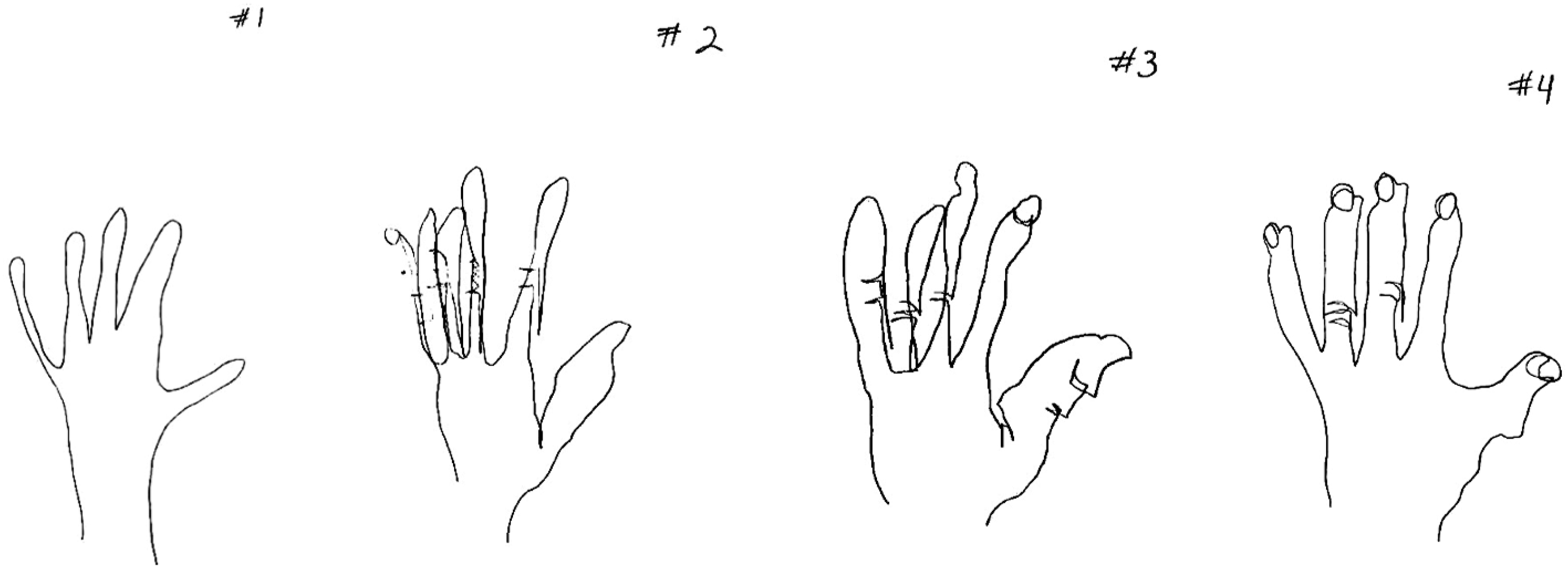
Acceptability
Of participants who completed the feedback form, 71% participants reported feeling a state of flow during their drawing practice and the rest were unsure. Gesture, contour, negative space, and texture techniques helped participants enter a state of flow. One individual reported feeling fully focused on both their eye and hand movements. Another reported feeling a flow state more easily when they enjoyed the subject matter.
70% of the participants felt positively about the drawing techniques, order in which they were presented, and clarity of their explanations (cf. Figure 2). In free responses, seven participants explicitly mentioned enjoying the build up from blind contour drawing. 80% of participants felt that both the techniques and daily practice were useful for developing their skills (cf. Figure 2). 100% of the participants felt comfortable modifying the practice prompts to suit their needs. The most polarizing techniques included blind contour and Y and T joints, although participants generally agreed that despite the difficulty, they were useful in building observational skills. Feasibility and Acceptability of the Drawing Course. Note. Participants were asked to indicate how clearly the drawing techniques were defined and how useful they were. Regarding the practice sessions, participants were asked to indicate how useful the sessions were for building their skill and how engaging the practice prompts were. N = 10.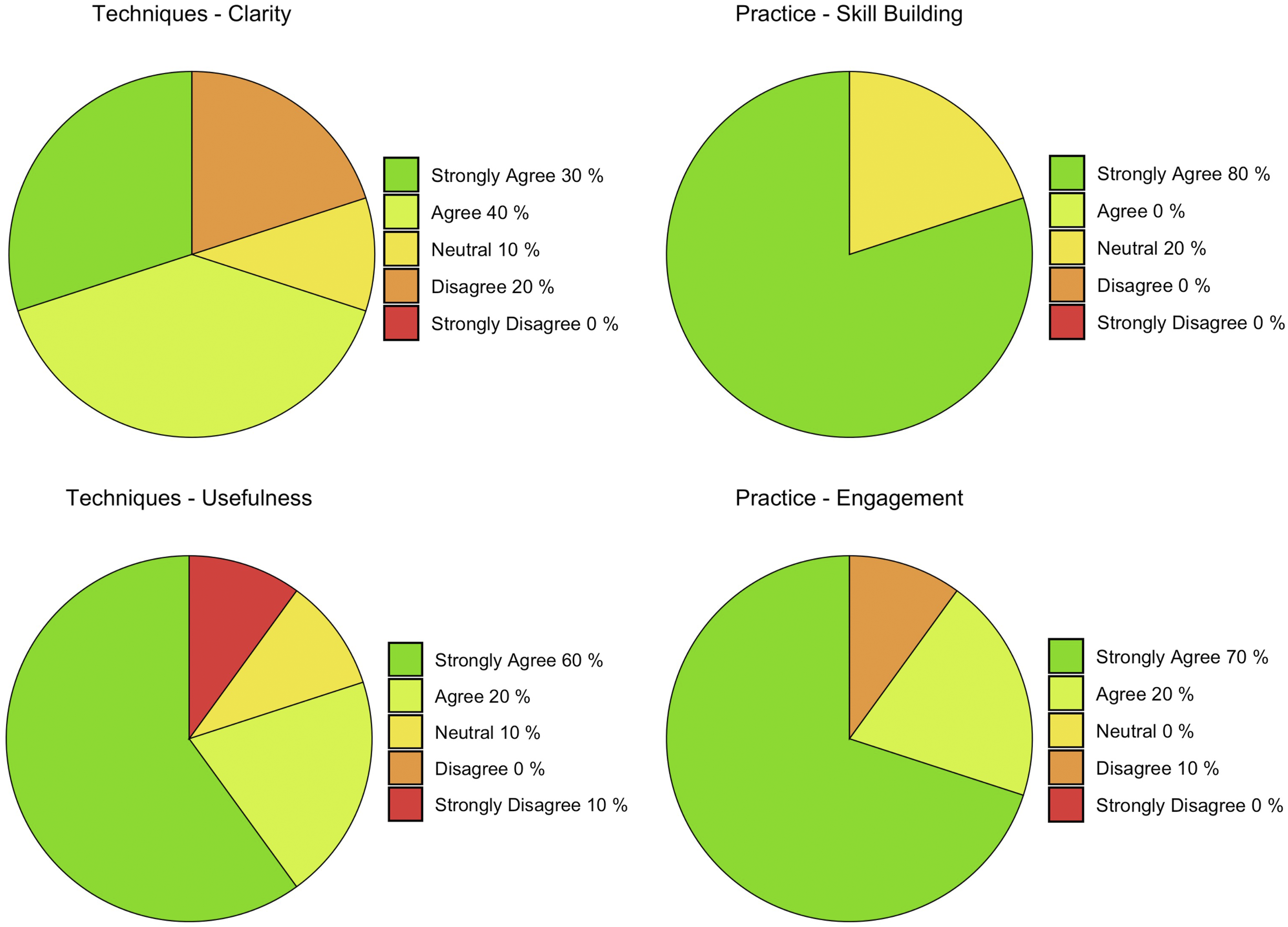
Understanding of the cognitive prompts was lower, with 40% of participants reporting feeling neutral and one participant feeling negative about these exercises. Participants found it difficult to put the domains into words, were unsure of how they related to the lessons, and their relevance to the course. A few participants suggested reducing jargon associated with the cognitive domains. One participant suggested highlighting the importance of engaging these domains and doing novel activities in the context of health promotion. Another participant suggested shifting the focus from reflecting on how cognition is engaged during the practice to how the techniques facilitate representation.
Participants found it useful to receive feedback on their progress, such as suggestions on ways to apply techniques to new subjects and including terms used throughout the course. 70% of the participants felt that they could benefit from more feedback. 30% of the participants felt that the course was too time consuming and too long, and one suggestion included removing the time requirement for daily practice so participants can more easily fit drawing into their schedule. One participant felt that 10–15 minutes of practice would have been more enjoyable, whereas another felt that 30 minutes were not enough to ‘do justice’ to their drawing skill development.
Preliminary Effects on Drawing Skills and Other Outcomes
Descriptive Statistics
Baseline Group Comparisons
There were no statistically significant differences between treatment and control group at baseline (cf. Table S3). That said, the treatment group reported higher wellbeing (d = 0.50) and selected a lower proportion of mental cutting foils (d = 0.35). None of the other measures exceeded d > 0.30.
Correlations
Pearson correlations between all variables of interest can be found in the supplementary materials in Table S4. The relevant significant findings are summarized below.
Drawing
The composite rating of accuracy on the drawing task was positively correlated with both the rubric-based accuracy (r(48) = 0.73, p < .001) and the angle-based accuracy (r(48) = 0.80, p < .001). The drawing accuracy composite was also positively correlated with the mental transformation composite (r(48) = 0.47, p < .001; cf. Figure S2) mental folding (r(48) = 0.45, p = .001), and mental cutting (r(48) = 0.37, p < .001), as well as negatively with the number of mental cutting foils (r(48) = -0.34, p = .001). Rubric-based and angle-based scoring did not correlate with each other (r(49) = 0.18, p = .22). Higher performance in angle-based accuracy correlated positively with the mental transformation composite (r(48) = 0.35, p = .02) and mental cutting (r(48) = 0.31, p = .03). Rubric-based accuracy was positively correlated with the mental transformation composite (r(48) = 0.38, p = .008) and mental folding (r(48) = 0.42, p = .003).
Age
Age negatively correlated with mental folding (r(48) = -0.34, p = .02), backward corsi (r(34) = -0.40, p = .020), as well as the executive function composite (r(34) = -0.54, p < .001) and each of the executive function tasks (trail making (r(34) = -0.42, p = .013), cancellation (r(34) = -0.41, p = .015), and rule switch (r(34) = 0.41, p = .016).
Other Outcomes
Neither mindfulness nor wellbeing were correlated with any other measure. Many of the cognitive measures were positively correlated, such as the mental transformation measures and the executive function measures (cf. Table S4). Self-reported SES (MacArthur Scale; standing in country) was positively correlated with years of education (r(48) = 0.37, p = .01) and negatively with mindfulness (r(47) = -0.32, p = .02). Years of education was also positively correlated with UCancellation (r(47) = 0.37, p = .03).
Effect Sizes
Descriptive data (i.e., means, standard deviations), within-group pre- versus post-test changes (t-tests), effect sizes, and sample sizes can be found in Table S5 for the treatment group, and Table S6 for the control group. Table S6 also reports effect sizes for the 5- and 10-week separately.
Drawing
A robust and significant effect of the intervention was present in drawing accuracy (treatment d = 1.27, BF10 = 224.60; control d = 0.35, BF10 = 0.61; cf. Figure 3). The effect was large for both 5- and 10-week schedules (5-week d = 1.44, BF10 = 18.92; 10-week d = 1.11, BF10 = 3.22 ). The difference in gain scores was 0.45 SD, reflecting the true effects of the intervention. Breaking down the composite measure, a large-sized effect on rubric-based accuracy (treatment d = 1.77, BF10 = 5498; control d = 0.37, BF10 = 0.65; cf. Figure S3) a small-to-medium-sized, yet insignificant, effect of the intervention on post-test angle-accuracy was observed (treatment d = 0.44, BF10 = 0.90; control d = 0.13, BF10 = 0.29; cf. Figure S4). On average, the treatment group showed an 9% increase in angle accuracy, as compared to 4% in the control. In the rubric-based scoring, the treatment group showed a 23% increase compared to control group’s 6%. Pre- and post-intervention drawings of one of the participants who scored lowest at pre-test are pictured in Figure S5. Changes in observational drawing accuracy. Note. Drawing scores are an average of rubric-based and angle-based accuracy. Treatment Cohen’s d = 1.27 (pre vs. post); control Cohen’s d = 0.35 (pre vs. post). Lines represent individual participants’ trajectories.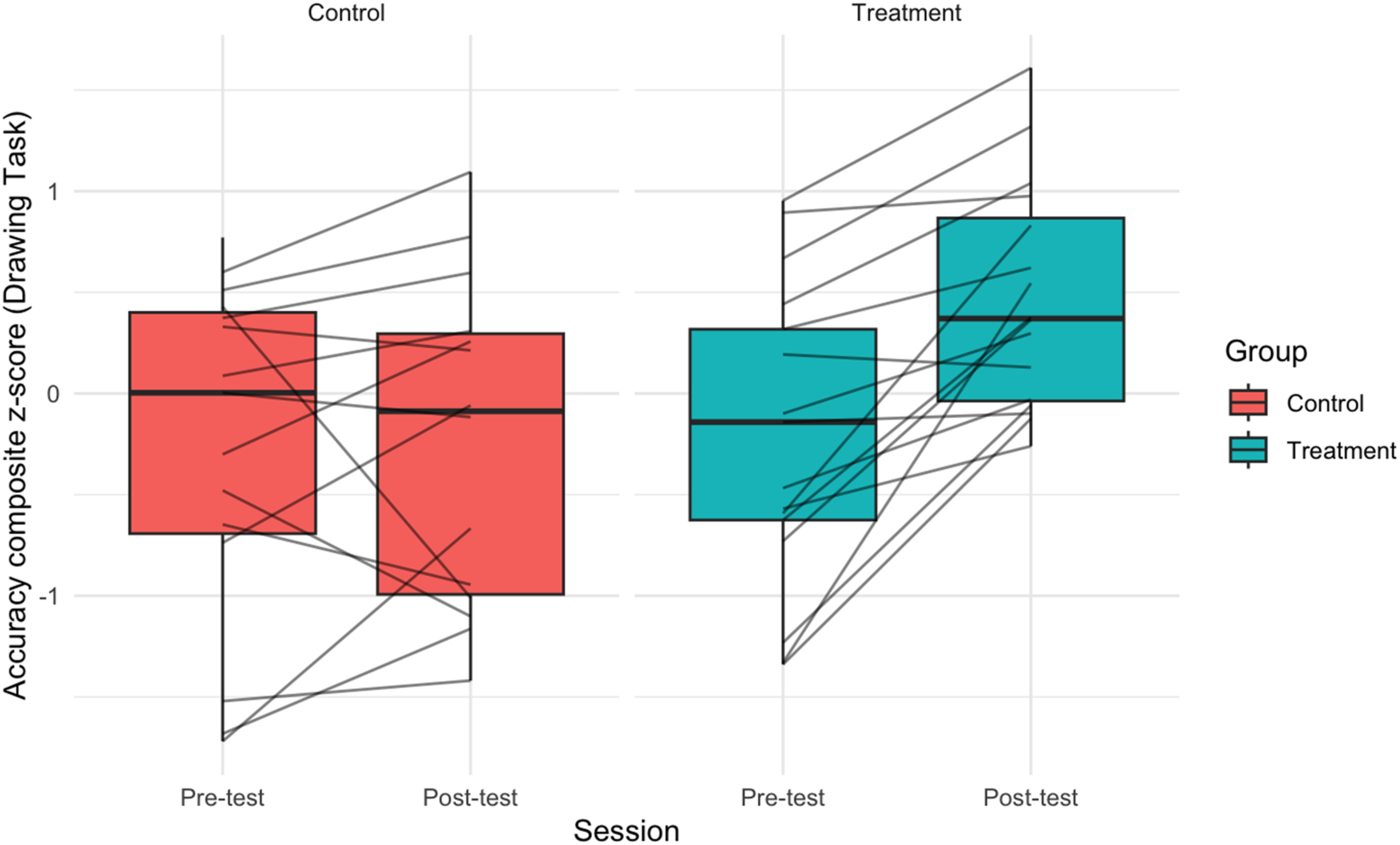
Cognitive Outcomes
None of the effect sizes reached significance in the treatment group and all other effects were either significant in both groups or only significant in the control group, pointing towards test-retest effects and/or regression to the mean. Despite some large effect sizes in the control group, including mental transformation and complex figure copy tasks, their post-test averages were similar to the treatment group.
Wellbeing Outcomes
The effects for wellbeing and mindfulness did not reach significance (cf. Table S5). Still, after the intervention, the treatment group reported an 8% increase in mindfulness through drawing, indicating that they felt that drawing from observation helped them stay present. In contrast, the control group experienced an 8% decrease in the same measure. The effect size for the difference between the two groups at post-test was substantial, with a net Cohen’s d of 0.81 (treatment d = 0.34, BF10 = 0.58; control d = −0.47, BF10 = 0.99).
Discussion
This study examined the acceptability, feasibility, usability, and preliminary effects of a drawing-based visual arts intervention with older adults targeting cognitive engagement through deliberate practice. The intervention improved drawing skills through teaching drawing techniques that engage both top-down (attentional) and bottom-up (perceptual) visual and spatial processing. The intervention was well-received overall among those who completed, but the dropout rate was almost 50%. Although the difference was not statistically significant, participants who selected the 10-week schedule were 17% more likely to complete the training compared to the 5-week schedule. Common reasons for withdrawal included time constraints, lack of engagement, and health issues. Participants actively trained attention, visuospatial reasoning, processing speed, and memory through targeted exercises, although the sample was too small to detect significant effects on cognition. These findings suggest that further research is warranted to test the impact of developing drawing skills on older adults’ wellbeing and cognition.
Visual Arts Engagement Facilitated by the Development of Drawing Skills
The intervention’s impact on drawing skills was evident, reflected by a 0.45 SD increase in drawing accuracy after accounting for the control group’s changes. Although some techniques, such as the blind contour and Y and T joints, were met with mixed reactions, participants acknowledged their importance for skill development. Large improvements in drawing spatial relationships were reflected by significant effects in the rubric-based accuracy, and more modest effects were observed in changes to lower-level features of drawing accuracy measured by the angle-based scoring. Collectively, improvements in drawing accuracy at different levels suggest engagement of different levels of perceptual and attentional processing. Deliberate practice through the techniques not only improves drawing skills, but also engages cognitive function (Chamberlain et al., 2015; Vodyanyk & Jaeggi, 2023). These changes are facilitated by training the hand-eye connection, which should be considered in future mechanistic investigations (Brew, 2015; Kozbelt & Seeley, 2007). The activation of perceptual, attentional, and motor processes through drawing aligns with the cognitive engagement hypothesis, highlighting the mechanisms through which arts-based activities can promote successful aging (Stine-Morrow & Manavbasi, 2022).
Learning to draw involves a shift in perception and attention through immersion in the present moment, which was supported by the participants’ modest increase in mindfulness through drawing (Franck, 1993; Greenhalgh, 2015). Although not assessed in depth, we found that multiple participants experienced a flow state during drawing, characterized as intense focus and engagement at an optimal intersection of challenge and skill level (Csikszentmihalyi, 1993). The process of drawing can induce a shift in visual perception and immersion in the present moment, which has been described by artists as both mindful awareness and a flow state (Franck, 1993; Montarou, 2013). Further, arts engagement in older adulthood can more broadly promote positive feelings of growth and challenge akin to the flow state (Groot et al., 2021). Future drawing-based interventions should consider the potential mediating role of flow.
Baseline Correlations and Treatment Effects
Baseline drawing skills were most prominently associated with visuospatial reasoning. These correlations are similar to, if not stronger than, those found in previous research with younger populations (Chamberlain et al., 2021; Vodyanyk & Jaeggi, 2023). The positive association between drawing accuracy and cognitive flexibility assessed by a visual rule switch task underscores the importance of attentional regulation and cognitive flexibility during drawing (Kozbelt & Seeley, 2007). This association is supported by the strong correlation to rubric-based drawing accuracy, which emphasizes between- and within-object relationships. Interestingly, angle-based drawing accuracy, which assesses lower-level features, did not correlate with the visuospatial tasks. Larger studies should consider a range of outcomes that have been linked to enhanced drawing skills, ranging from lower-level perception to abstracted visuospatial reasoning.
We also observed that age (which ranged from 65 to 87) significantly correlated with multiple outcomes, most notably executive function, aligning with well-documented accelerated declines in late adulthood (Hartshorne & Germine, 2015; Nyberg & Pudas, 2019). The association between drawing skills and cognitive flexibility, a critical component of executive function, highlights the potential of this intervention to address age-relate declines (cf. Figure S6). Contrary, age was not related to visuospatial construction, specifically the drawing and complex figure copy/recall tasks. This suggests that constructional skills, including drawing abilities, remain stable in older age, making a drawing intervention particularly useful for targeting domains that do decline with age. Given the observed associations with cognition, we suggest that developing drawing skills may counter typical age-related declines (Noice et al., 2014).
While potential transfer effects to other outcomes including cognition remain tentative given the underpowered sample size, past studies with undergraduate populations point towards potential advantages for tasks involving visuospatial construction, memory, and mental transformation (Chamberlain et al., 2015). Despite the strong baseline correlation between drawing skills and mental transformation, performance in these domains did not change post-intervention, especially after considering larger effects in the control group. The large effect sizes in the control group pointing towards regression to the mean, test-retest effects, or performance anxiety. For example, one treatment group participant noted feeling pressure to perform higher in the post-test, which hindered focusing abilities. Small to medium test-retest effects are commonly present in cognitive tasks (Scharfen et al., 2018). Future work with larger sample sizes will allow for detection of effects on visuospatial cognition.
Addressing Engagement and Retention Challenges
Attrition occurred exclusively in the treatment group. Participants cited time constraints, health issues, difficulty level (course contents, navigation of online materials), and lack of interest as reasons for withdrawing. Several participants did not even begin the course, reporting time commitment issues. Withdrawing early (lessons 1 or 2) was related to time constraints, lack of interest, or challenges. Health-related dropouts were more common towards the middle. Interestingly, the treatment group participants who dropped out were moderately younger and reported lower SES than those who continued. This points towards demographic factors that may affect availability, and one solution may be to provide higher compensation. A larger completion rate for the 10-week schedule suggests that a more spaced training schedule may also help with adherence. Other strategies to address dropouts include keeping the training materials simple, yet comprehensive, and highlighting the balance of both process and outcomes. Further, encouraging participants to develop a habit of sketching in their free time may not only increase adherence, but also sense of purpose and the level of cognitive engagement. This strategy may be particularly useful for time-constrained participants. Early dropouts might be prevented by providing participants who feel challenged or confused with more personalized feedback. Increasing direct interaction with instructors or a social component that may enhance engagement and support participants with difficulties. Interestingly, those who found the course too challenging had moderate baseline drawing skills, suggesting individual differences, motivational factors, and expectations influence perseverance (Chamberlain, 2018; Jaeggi et al., 2014). Encouraging a growth mindset during learning may improve not only drawing skills but also engage cognition more deeply (Jaeggi et al., 2023).
Additional Limitations of a Feasibility Study
Although the course aimed to introduce deliberate training of the cognitive domains most related to observational drawing, a few participants were confused by the domains’ relevance to their training. If arts-based interventions include a cognitive training component, the terminology’s relevance to the course should be explicitly addressed. Concepts should be presented simply, clearly, and approachably. Further, processing speed was the least practiced cognitive domain, with some participants reporting no engagement in this area. Given the link between processing speed and generalized cognitive decline (Salthouse, 1996), future interventions would benefit from more timed drawing exercises. Finally, as a feasibility study, the ability to detect causal effects is limited. Past work, however, supports the notion that arts-based interventions promote cognition and socioemotional wellbeing (Fancourt & Finn, 2019; Noice et al., 2014). For drawing, these benefits are likely to fall within the visuospatial domain. One goal of the current study was to illustrate how a remote drawing-based intervention may be implemented in aging research. A larger sample size will allow for a more nuanced understanding of the relationship between deliberate practice, time spent, and changes in skills, cognition and quality of life. Future studies should consider potential mechanisms of change driven by the drawing techniques and daily practice. Deliberate training strengthens hand-eye coordination, engages different modes of attention, and supports understanding objects’ three-dimensional structure; such processes are also critical for navigating daily life.
Contributions to the Field and Implications for Successful Aging
Conceptualizing visual arts engagement as the development of observational drawing skills allows for a critical assessment of impacts on successful cognitive aging. The potential of arts engagement to promote health and wellbeing has garnered increasing attention, yet most research has focused on other art forms. Remote arts interventions such as the one developed here can be implemented in diverse settings to allow for larger-scale testing with different populations. Future research can also compare visual art interventions with other modalities, such as music or theater and use double-dissociation paradigms to investigate gains in respective cognitive domains. By refining the conceptualization and implementation of visual arts interventions, this study lays the groundwork for exploring the causal mechanisms and potential enriching effects of the development of drawing skills.
Conclusion
Our results show that this self-guided and online drawing training is effective at improving drawing skills. Further, it is engaging and scalable, making the course suitable for larger-scale testing following some modifications to increase retention. By identifying effective techniques for improving drawing skills, researchers and practitioners can develop more successful visual art-based interventions. Given the cognitive, physical, and socioemotional dimensions of arts engagement, such interventions hold promise for multimodal prevention of cognitive declines.
Supplemental Material
Supplemental Material - Promoting Successful Cognitive Aging Through Observational Drawing: A Feasibility Study
Supplemental Material for Promoting Successful Cognitive Aging Through Observational Drawing: A Feasibility Study by Mariya M. Vodyanyk and Susanne M. Jaeggi in Research on Aging
Footnotes
Acknowledgements
Thank you to all the older adults who were patient and eager to test out the intervention materials and provide useful feedback. Thank you to Graham Horowitz for helping with the rubric-based drawing scoring and KH, TR, and SA for helping with the angle-based drawing scoring.
Declaration of Conflicting Interests
The author(s) declared no potential conflicts of interest with respect to the research, authorship, and/or publication of this article.
Funding
The author(s) disclosed receipt of the following financial support for the research, authorship, and/or publication of this article: The current study was funded by the Susan Samueli Integrative Health Institute Pilot Studies Award at the University of California, Irvine.
IRB Statement
The study was approved by the University of California – Irvine Institutional Review Board (UCI IRB #20141165) and complied with the APA Ethical Principles.

Supplemental Material
Supplemental material for this article is available online.
Author Biographies
References
Supplementary Material
Please find the following supplemental material available below.
For Open Access articles published under a Creative Commons License, all supplemental material carries the same license as the article it is associated with.
For non-Open Access articles published, all supplemental material carries a non-exclusive license, and permission requests for re-use of supplemental material or any part of supplemental material shall be sent directly to the copyright owner as specified in the copyright notice associated with the article.
