



Abstract
The first years of retirement have often been seen as a typical time window to take up (or intensify) voluntary work. Due to the changing context of retirement and historical differences in resources, the role of retirement for volunteering may have changed with historical time. We compared individuals aged 60–70 in five cross-sectional waves (1999, 2004, 2009, 2014, 2019) of the German Survey on Volunteering (Deutscher Freiwilligensurvey: FWS) to investigate how the association of retirement status and volunteering has changed. We found a negative association of retirement and volunteering, which was not significant once controlling for age, education, gender and region. While engagement levels seem to have increased with historical time, voluntary work seems to have become less time consuming. There were no historical differences in the association of retirement and volunteering. Our results highlight the role of historical time and contextual factors when investigating volunteering and post-retirement activities.
Introduction
Volunteering has important functions for the society (Alscher, 2021) and individuals, especially around retirement age (Müller et al., 2014). For example, voluntary work has been associated with higher well-being (Greenfield & Marks, 2004; Kahana et al., 2013; Morrow-Howell et al., 2003), better cognitive health (Kail & Carr, 2020), and better physical health (Piliavin & Siegl, 2007) among older adults, although the causal direction has been questioned and selection effects can play a role (Bjälkebring et al., 2021; Kail & Carr, 2020). Whereas many studies have investigated the role of retirement status for engagement in voluntary work, little research has considered the historical context in this relation. Both the meaning of retirement (James et al., 2020), as well as resources of older adults (Gerstorf et al., 2015) have changed with historical time. Therefore, the association of retirement and volunteering may have changed as well, if the contextual and individual developments affect the likelihood of being engaged in retirement.
Studying this question is important to understand the future of volunteering in an ageing society. Furthermore, given well-known social inequalities in access to and structure of volunteering (Simonson et al., 2022b), it is important to see if the gap between lower and higher educated older adults may be widening with historical time (Infurna et al., 2021). In the current study, we use five cross-sectional waves of the German Survey on Volunteering (Simonson et al., 2022a) to study how the association of retirement and volunteering has changed with historical time. We further investigate educational differences in these developments.
The German Context
In the present study, we studied volunteering in Germany between 1999 and 2019. The definition of volunteering in the German Survey on Volunteering was, in line with criteria by the German Enquete Commission on the Future of Civic Engagement in 2002 (Deutscher Bundestag, 2002): The activity is voluntary, it is public or takes place in a public space, it is cooperatively, it is not aimed at material gain and is oriented towards the common good (Simonson et al., 2021). Fives common areas of voluntary engagement in Germany were distinguished (Karnick et al., 2022): a) engagement in clubs and societies (e.g., sport clubs or charity organizations), which are very common in Germany (Zimmer et al., 2004), b) in a religious context, c) in state-run organizations, d) other formally organized associations such as parties or unions, or e) individually organized, less formal groups (e.g., in the neighbourhood context). In 2019, the largest group of volunteers (around 50%) was engaged in clubs and societies. Such activities may, for example, include training children in a (non-professional) sports club with no or only a small, rather symbolic, representation allowance, or organizing club meetings. Lower educated individuals and those with a migrant background were less likely to volunteer (Simonson, Kelle et al., 2022b). For a long time, men have been more engaged than women, and the gender gap has closed only very recently, with men still being more likely to be in leadership positions in volunteering organizations (Karnick et al., 2022) which often have a very hierarchical structure in Germany. Leadership positions usually require a long-term commitment and are tied to resources such as time, experience, networking, and family and professional compatibility (Karnick et al., 2022). At the same time, however, they also entail opportunities to make decisions, for example about personnel or resources (Karnick et al., 2022).
The Retirement-Volunteering Nexus from a Life-Course Perspective
The frequency and content of voluntary engagement is comparably stable over the life course (Lancee & Radl, 2014), but nevertheless shows some age differences, partly due to different motivations, opportunities and challenges to be engaged (Bjälkebring et al., 2021; Li & Ferraro, 2006; Simonson, Kelle, Kausmann, & Tesch-Römer, 2022; Tang, 2006). In Germany, volunteering happens at all ages but is comparably lower in the age group of people aged 65 or older (Simonson et al., 2022). Researchers have previously investigated if life events can be followed by changes in the patterns and frequency of volunteering (Eibich et al., 2022; Lancee & Radl, 2014; Nesbit, 2011). One of these life events is retirement (Erlinghagen, 2010). In Germany, public pensions have been the central (and often only) source of retirees’ income for most of recent history (Börsch-Supan & Wilke, 2004). For most of the period investigated here, the retirement age in Germany (i.e., the age when workers are eligible for full pensions) was 65. Earlier retirement was and is possible under certain circumstances, but often only when accepting pension cuts. Nevertheless, the majority of the population left the labour market in their late 50s or early 60s and took out pensions earlier than 65 (Hess, 2016; D. Hofäcker & Naumann, 2015). Since 2012, the full retirement age is gradually raised, from 65 to 67 in 2031 (Brussig et al., 2016).
When individuals retire, they usually have more time available to engage in non-work related activities (Arriagada & Karnick, 2022). Furthermore, volunteering may be of specific importance around retirement age (Bjälkebring et al., 2021; Müller et al., 2014): When people age and disengage from the work role, engaging in voluntary work can provide an additional source for identity and self-esteem and an alternative role to account for the loss of work (Ryser & Wernli, 2017). Previous studies showed that the retirement transition period can be a life phase when levels of volunteering increase (Bjälkebring et al., 2021; Mutchler et al., 2003; Zhu, 2021), although other factors seem to play a larger role in determining who volunteers in older age (Erlinghagen, 2010; Lancee & Radl, 2014; Van den Bogaard et al., 2014). Instead of retirement leading to voluntary engagement, there is also the possibility of reverse causation. Role theory argues that non-work roles facilitate to disengage from the work role (Ryser & Wernli, 2017), and therefore those already before retirement engaged in voluntary organizations may find it easier to decide to retire.
The Retirement-Volunteering Nexus in a Historical (Cohort) Perspective
With historical time, the patterns and frequency of volunteering is changing, but these changes seem to differ by subgroups of the population, are non-linear and are not easily comparable between countries (Chambré, 2020; Clifford, 2020; Van Ingen & Dekker, 2011). According to previous waves of the German Survey on Volunteering, the rate of volunteers in the German population has increased from ∼31% in 1999 to ∼40% in 2019. The increase was particularly strong among those aged 65 and older as well as higher educated individuals and pupils (Simonson et al., 2022). Furthermore, the amount of time spent on voluntary work as well as the frequency have changed over time, with rates of volunteers with less time consuming and less frequent engagement increasing and more time consuming and more frequent types of engagement decreasing (Kelle et al., 2022). Historical differences also vary by area of engagement (Kausmann & Hagen, 2022).
The role of historical time has rarely been considered in studies on retirement and volunteering. It has been argued, however, that the face of retirement is changing over the last decades (Henning, Johansson, Lindwall, & Huxhold, 2022; James et al., 2020). In the current study, we investigate the cross-sectional association of retirement and volunteering, over and above age differences. There are two reasons why this relation may have changed with historical time: First, retirees and retirement have changed and thus challenges and opportunities to volunteer in this life phase for later-born cohorts of retirees may differ from those in earlier birth cohorts. Second, with pension and labour market reforms and macro-economic changes, selection into retirement may be different today, compared to earlier years. Therefore, who is and who is not retired in a cross-section of the population may be different today, compared to earlier years, which may also change the association of retirement and voluntary engagement. In line with previous studies in the field (Drewelies et al., 2019; Henning, Segel-Karpas, Stenling, & Huxhold, 2022; Huxhold, 2019), we assumed linear effects of historical time in our hypotheses and did not focus on potential period effects, because “[…] in times of relative stability (i.e., time periods without major historical events such wars or major economic disasters), historical changes are more likely to be gradual than instantaneous and differences between birth cohorts are rather quantitative than qualitative in nature.” (Drewelies et al., 2019, p. 1022).
Retirees nowadays differ in many important aspects from earlier retirees: Studies have shown prominent cohort differences, with later-born older adults often showing better physical health (M. König et al., 2018), better cognitive health (Karlsson et al., 2015), better social integration (Huxhold, 2019) and higher feelings of internal control (Gerstorf et al., 2019) than earlier born older adults. As physical health (Parkinson et al., 2010), cognitive health (Kail & Carr, 2020), social contacts (Dury et al., 2015) and perceived control (Son & Wilson, 2017) also seem to determine who volunteers, retirees may be increasingly able to use their free time for voluntary engagement. Commonly, cohort differences (i.e., how different birth cohorts differ) and period effects (i.e., how individuals at different historical time points differ from each other) have not been disentangled, and the reported historical differences most likely constitute a mix of both (Huxhold, 2019). However, as positive historical trends seem to be especially pronounced among older, compared to younger adults (Drewelies et al., 2018), post-retirement volunteering may be more affected than pre-retirement volunteering. Furthermore, at least in Germany, age stereotypes seem to have decreased with historical time (Beyer et al., 2017). Retirement is seen as the frontier to old age (Laslett, 1991) and therefore these changing views on aging may have consequences in terms of what individuals feel they can and should do in their daily lives. However, please note that the subjective aging experience (e.g., how old people feel at a certain age or how positive they experience their own aging process) does not seem to have changed (Wahl et al., 2022).
As mentioned above, apart from changing contexts of retirement transitions and cohort differences, there may also be changes in the predictors of retirement over historical time, which would result in changing associations of retirement and volunteering as well. A number of new pension laws in Germany and many other countries have been aimed at promoting longer work lives and delay retirement (Hofäcker et al., 2016). The statutory retirement age was raised and early retirement has become harder to realize for older workers: Previous exceptions in the retirement age for special groups of the populations such as women or workers with a very long career have been abolished (Brussig et al., 2016). On the one hand, this led to later retirement transitions, on the other hand, indirect transitions (i.e., being unemployed or receiving disability pensions before starting to take out one’s old age pension) became more common (Engstler & Romeu Gordo, 2017) and in particular lower educated workers are often not able to work until the statutory retirement age and have to accept pension cuts (Hess, 2016). Therefore, those who are retired at a certain age in 2019 may differ in important characteristics (e.g., health, education, gender) from those who were retired at that very age in 1999, and these characteristics may further determine who does and who does not volunteer.
For the Netherlands, van Ingen and Dekker (Van Ingen & Dekker, 2011) showed that retirement became a stronger predictor of volunteering between 1975 and 2005. In Germany, results from the German Survey on Volunteering (Simonson et al., 2022a) showed that, although individuals aged 65 and above still constitute the age group with lowest rates of volunteering, they showed the strongest historical improvements. Nevertheless, it is not clear if there is a specific increase among retired persons compared to those at the end of their working life, in line with a proposed changing face of retirement.
Based on earlier research, we assume:
H1: Among individuals aged 60–70, retired participants are more likely to volunteer than those not retired.
H2: The association of retirement and volunteering has become stronger in recent years.
Social Inequalities
Volunteering is an important form of social participation, but not all parts of the population have the same level of access to voluntary engagement (Simonson, Kelle et al., 2022b). In particular, lower educated individuals are less likely to volunteer. Social inequalities in resources influence who volunteers, which again increases social inequalities, as particular parts of the population will not benefit from the advantages of volunteering (Lambert & Rutherford, 2020; Simonson et al., 2015; Southby et al., 2019). This pattern is an example of cumulative inequality theory, which states that those with earlier advantages have more opportunities (e.g., to volunteer), whereas those with disadvantages have more risks (Ferraro & Shippee, 2009), which increases the difference between different socioeconomic groups in important aspects over the life course. After retirement, these differences may increase in particular ways (Dannefer, 1988): Higher educated individuals usually find it easier to adjust to retirement (König, Lindwall, Henning, & Johansson, 2018; Wetzel et al., 2016) and therefore may also find easier access to opportunities to volunteer. Several studies have shown support for cumulative disadvantages of lower educated individuals over the life course, leading to health problems in older age (Hiesinger & Tophoven, 2019; Mirowsky & Ross, 2005; Seabrook & Avison, 2012). Although retirement may come as a relief for those individuals (van den Bogaard et al., 2016), they may still be hindered from volunteering by their health status. Moreover, lower educated individuals may experience financial problems in retirement. All in all, retirement may bring less opportunities for volunteering for lower educated individuals. We therefore assume
H3: The association of retirement and volunteering is not significant among lower educated individuals.
Previous studies further pointed out that positive secular changes are not necessarily present in all social classes, leading to increasing social inequalities in some aspects over the last decades. Positive cohort differences have been found mostly among higher educated parts of the population, whereas among those with lower education, historical developments were more likely to be negative (Infurna et al., 2021). Results from the German Survey on Volunteering showed that the rising rates of volunteering among the German population between 1999 and 2019 were mostly caused by increases among higher educated individuals (Simonson et al., 2022b). In the present study, we were interested if this was also true for individuals around retirement age (60–70).
H4: The historical increase in the association of retirement and volunteering is only present among higher educated individuals.
The Present Study
In the present paper, we compared rates of volunteering, as well as associations with retirement, among participants aged 60–70 in five samples of the German Survey of Volunteering, spanning from 1999 to 2019. Using all five waves of the German Survey on Volunteering (Simonson et al., 2022a) we tested if retirement is associated with higher participation rates in Germany, and if this association has increased with historical time. We controlled for potential confounding factors that were available at all waves (age, education, gender, region, citizenship). However, some other factors (e.g., health, marital status) were not available in all waves and could therefore not be included. We further tested if the historical increase is not significant among lower educated but mainly present among higher educated individuals.
Method
Sample
Our analyses were based on the five cross-sectional waves of the German Survey on Volunteering (Simonson, Kelle et al., 2022a). The German Survey on Volunteering is aimed at illustrating the voluntary activities in Germany and was conducted in 1999, 2004, 2009, 2014 and 2019. For the first three waves (1999–2009), the survey was conducted by TNS Infratest Sozialforschung (Infratest). The German Centre of Gerontology was responsible for the waves in 2014 and 2019, and the data collection was conducted by infas Institute for Applied Social Sciences (infas Institut für angewandte Sozialwissenschaft).
At each wave, representative samples of the population aged 14 and above were interviewed via phone interviews on sociodemographic information as well as the extent and content of their voluntary engagement, or reasons for their non-engagement. In the first three waves, interviews were conducted exclusively via landline and the telephone numbers were generated using the random digit dialling method. The samples in 2014 and 2019 were drawn using a dual frame approach. For both waves, one sub-sample was composed of randomly generated landline and mobile telephone numbers scattered nationwide. The second sub-sample consisted of an additional sample for selected federal states in order to enable regional analyses at federal state level.
Sample sizes were n = 14,922 in 1999, n = 15,000 in 2004, n = 20,005 in 2009, n = 28,690 in 2014, and n = 27,762 in 2019. The response rates were 54.7% in 1999, 50.2% in 2004, 50.7% in 2009, 19.3% in 2014, and 18.6% in 2019 (Simonson, Hameister & Vogel, 2017; Simonson et al., 2022). The response rates are not fully comparable as there is no documentation of the way they were computed prior to 2014, and they seem to differ from the later waves (Simonson et al., 2013). However, the decline in response rates may represent a general drop in the willingness in the German population to participate in telephone surveys, assumedly because the increased rate of marketing calls, disguised as telephone surveys (Simonson et al., 2013). Compared to the German population, older and higher educated participant as well as women were overrepresented in all waves (Simonson, Hameister, & Vogel, 2017; Simonson, Karnick et al., 2022).
For every sample, we included only individuals aged 60–70. This age range was chosen to focus on people close to the statutory retirement age for most of the study period (65 years). We only included individuals without missing data, therefore our sample size was reduced by 197 participants across all waves. The resulting sample sizes for our analyses were n = 4151 in 1999, n = 3498 in 2004, n = 6154 in 2009, n = 10,494 in 2014, and n = 12,277 in 2019.
Measures
Volunteering
Individuals were asked if they were volunteering in 14 possible areas of engagement (e.g., sport and exercise, culture and music, leisure and social interaction). It was possible to be engaged in several activities in several areas. If they were involved, they were asked if they had been volunteering in these areas within the last 12 months. Further questions discussed content and extent of the individual engagement. After the interview, the research teams checked the reported voluntary activities for plausibility. For the present analyses, we only focused on the engagement per se, and did not differentiate the areas or the extent of volunteering. Our dependent variable was engagement yes/no (1/0). For the sensitivity analysis on time spent volunteering, we used a categorical variable that was available for all waves and assessed hours per week spent volunteering (categories: 0–5 hours, 6–10 hours, 11–15 hours, more than 15 hours). As two thirds of the whole sample were engaged 5 hours or less, we distinguished between doing 0–5 hours of volunteering (=0) and doing more (=1).
Time of Assessment
Timing of assessment (1999, 2004, 2009, 2014, 2019) was included based on four dummy variables for the waves 2004–2019 (coded 0 / 1, compared to 1999).
Retirement
Participants were asked about their work status with different response options. We distinguished between working participants, retired participants and participants not working for other reasons. We used two dummy variables (coded 0 = no, 1 = yes) for “retirement” and “not working for other reasons”.
Education
We distinguished between individuals with high education and those with low or middle education. Only school degree, not further education was included in all waves. In Germany, there have been two or three types of schools over the last decades, of which only the highest degree (“Abitur”) enables to study at a university. We distinguished those with Abitur (high education = 1) from those without (low and middle education = 0).
Covariates
We controlled for age, gender (0 = female or diverse, 1 = male), living in former West/East Germany (0 = East Germany, 1 = West Germany), and citizenship (0 = German, 1 = other). Please note that adding an additional age2 effect did not change the results.
Analysis
We predicted volunteering in a logistic regression model in STATA, using robust standard errors. Voluntary engagement at the individual level was predicted stepwise. In the first model, we only included retirement and wave. Next, we added wave × retirement interaction effects. In a second step, we repeated these models and further included covariates to see if potential interaction effects were due to changing compositions of retired versus non-retired population (e.g., because people retired at a later age in later waves). Age was centered at age 65 (the retirement age) in the analyses. We repeated the analyses separately for two educational groups: Individuals with high education on the one hand and low or middle education on the other. In the following, the second group was labelled “low education” to avoid confusion.
As mentioned earlier, there are not only historical time trends in the rates of volunteering, but also in the amount of time spent volunteering among those who are volunteers. Van Ingen and Dekker (2011) found that historical change in predictors of volunteering and time spent volunteering differed, with predictors of time spent volunteering being more historically stable. Furthermore, previous research has sometimes shown that retirement does not affect taking up voluntary work much, as it is mostly a question of previous experience with voluntary activity (Di Gessa & Grundy, 2017; Mutchler et al., 2003) – instead, time devoted to volunteering may be what differs between workers and retirees instead. Therefore, in a sensitivity analysis, we further repeated the initial three models among those who were volunteering, to test if the association of retirement and time spent volunteering has changed with historical time as well. In these analyses, the sample was reduced to n = 7441 because we could only include those who volunteered (n = 7951) and for further n = 510 individuals (∼7%), data on time spent volunteering was not available.
To prevent potential differences in representativeness from distorting the results of our analyses, we used population weights available in the scientific use files, which were constructed based on a comparison of the study participants of each wave with respective official statistics of the German population (German Mikrozensus) on federal state, community size class, gender and age group (15–29, 30–49, 50–64, 65+), as well as education (Hameister et al., 2023). This procedure improves the comparability as each sample got more representative and while a smaller degree of overrepresentation of higher educated individuals remained, the weighted samples are very representative in terms of age, gender and migration background (Hameister et al., 2023). All inferential statistics reported below are therefore based on weighted data.
Results
Descriptive Statistics.
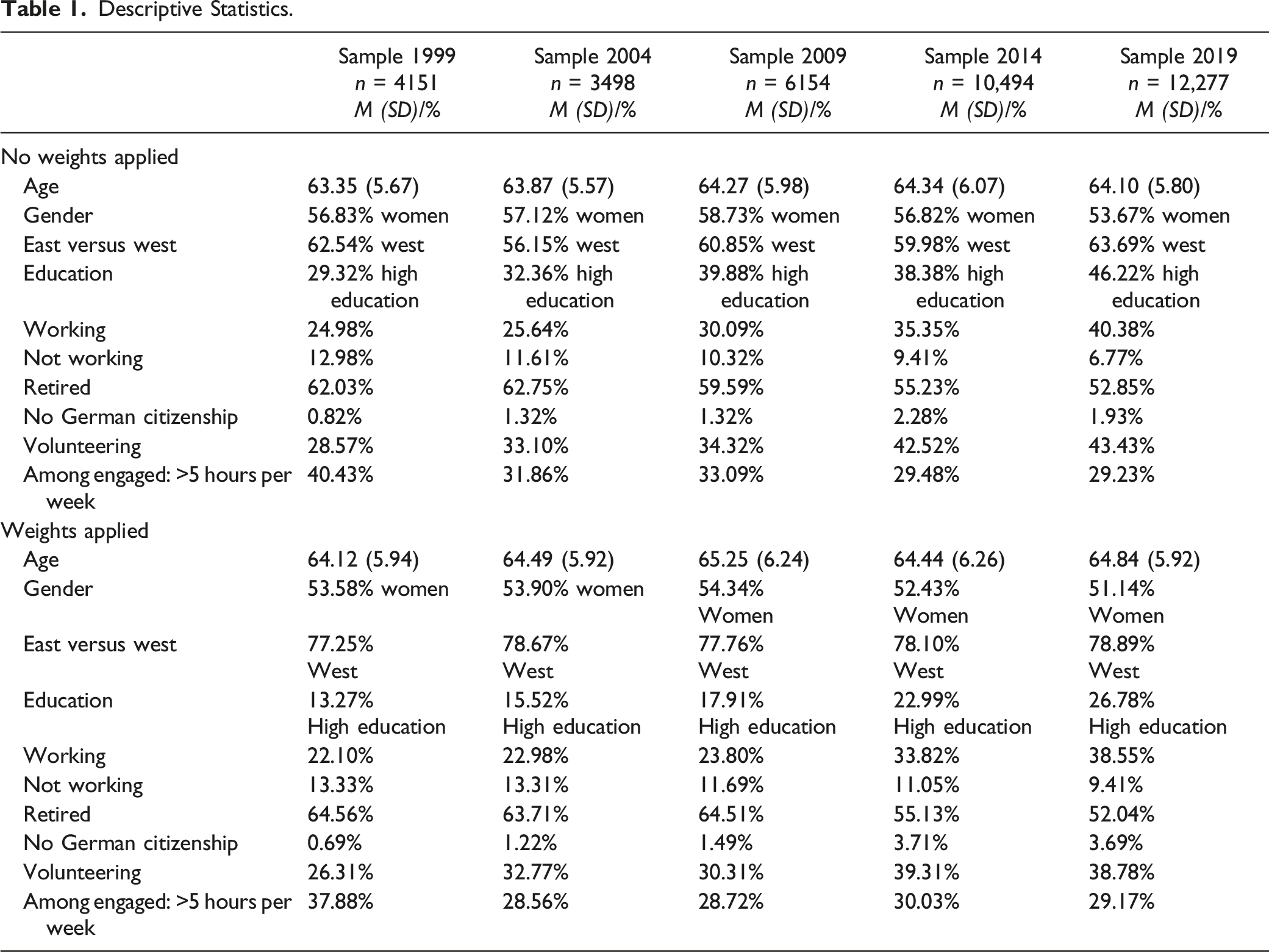
To give a better picture of the multifaceted volunteering landscape in Germany, we further inspected in which areas people were volunteering. The dataset includes 14 areas of voluntary engagement (e.g., sports, cultural, church, …). We found that in all waves, the most frequent area to be engaged in was sports – between 18.07% and 21.85% said that their most time intensive volunteering activity was in this area. Other important topics were culture (11.06%–14.46%), leisure (9.88%–14.51%), social area (14.53–20.92%) and church (9.00%–14.55%). Volunteering in the area of “culture” may include activities such as leading an amateur choir, whereas volunteering in the area of “leisure” may, for example, mean to organize meetings in one’s fishing club, and volunteering in the social area may mean to engage in a homeless charity (Simonson, Vogel, & Tesch-Römer, 2017). The other areas were reported by less than 6% in all waves. Over time, engagement in the areas of church/religion (r = −.07, p < .001) and leisure (r = −.04, p < .001) became less frequent among those engaged, but engagement in the social area got more frequent (r = .06, p < .001).
Retirement and Volunteering through Historical Time
Logistic Regression, Predicting Volunteering.
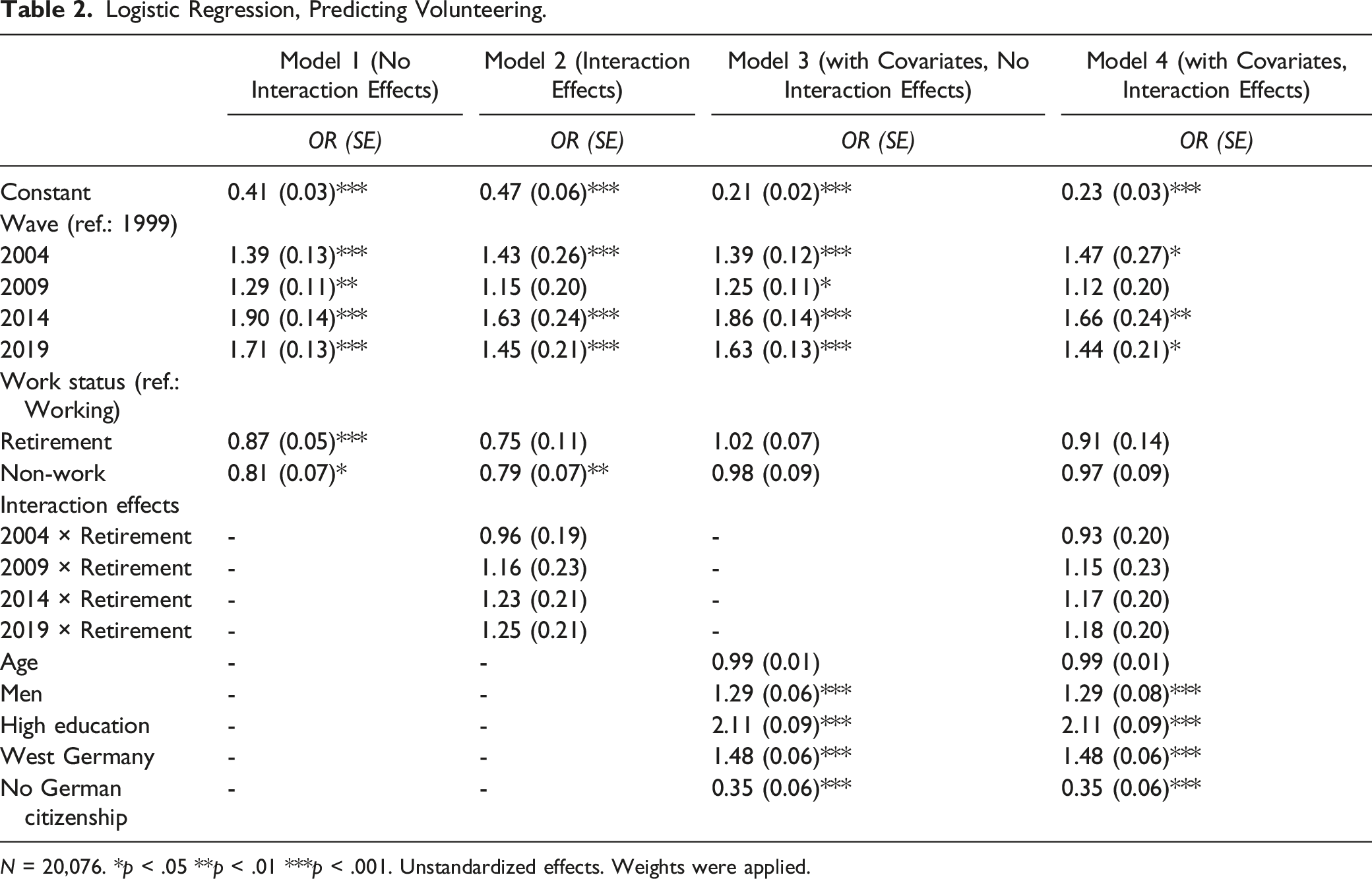
N = 20,076. *p < .05 **p < .01 ***p < .001. Unstandardized effects. Weights were applied.
The Role of Education
Logistic Regression, Predicting Volunteering, Stratified by Education.
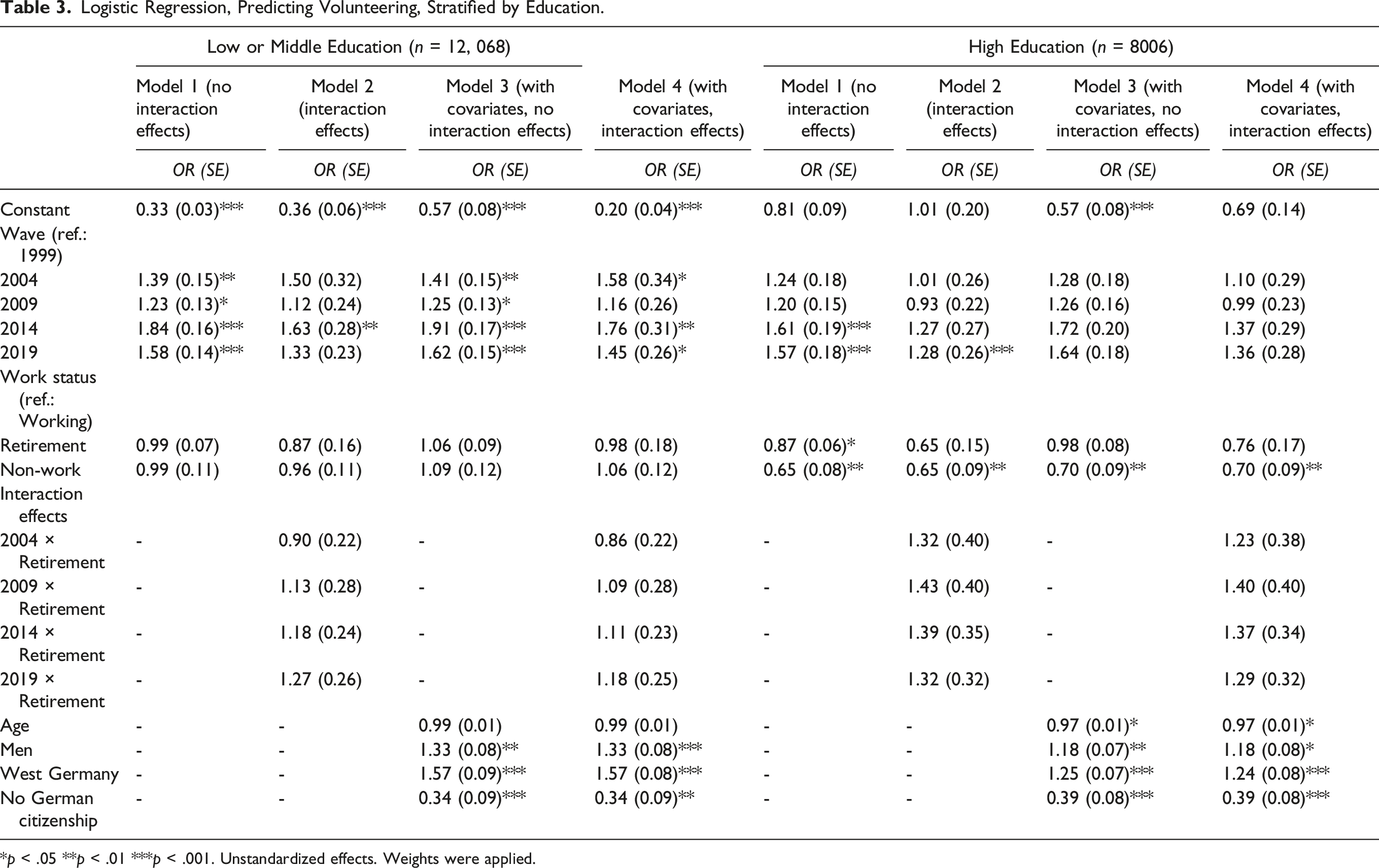
*p < .05 **p < .01 ***p < .001. Unstandardized effects. Weights were applied.
Sensitivity Analyses: Frequency of Volunteering
Logistic Regression, Predicting time in Volunteering (>5 hours/week).
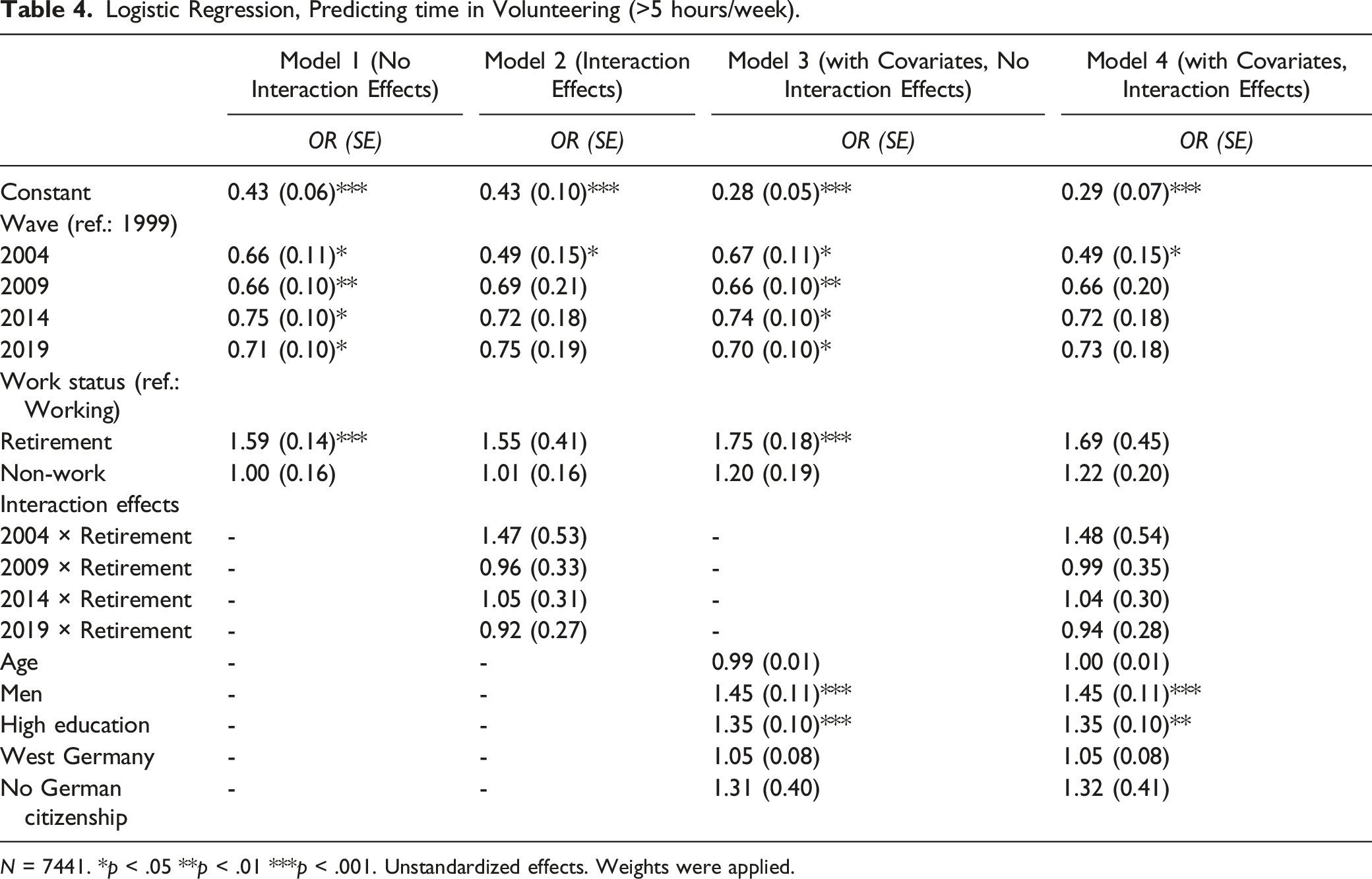
N = 7441. *p < .05 **p < .01 ***p < .001. Unstandardized effects. Weights were applied.
Discussion
For many individuals, retirement offers more time to use according to their own needs and interests, and this means that some individuals will start to volunteer in retirement. The historical context is seldom included when investigating the association of retirement and volunteering, although the face of retirement is changing – older adults today differ in many important aspects from older adults in previous decades. This changing face of retirement may also lead to an increased level of volunteering among retirees, but this has rarely been investigated in previous research (Van Ingen & Dekker, 2011). In the present study, we used five cross-sectional samples of the German Survey on Volunteering from 1999 to 2019 to investigate associations of retirement and volunteering across 20 years for lower and higher educated individuals aged 60 to 70.
The Association of Retirement and Volunteering
Our results showed that, in contrast to our hypothesis 1, retirement was on average associated with a lower likelihood to volunteer, which was probably at least partly because of a negative age effect and socioeconomic differences between retirees and workers: Once covariates (e.g., age, education) were taken into account, the association was non-significant. Our results thus are in line with previous studies showing that in Germany, retirement does not seem to have a large influence on volunteering (Erlinghagen, 2010). A higher socioeconomic status or a history of previous volunteering may play a larger role in midlife and older age. Those unemployed or not working for other reasons, but not retired, were less likely to volunteer, even after controlling for covariates. This may be mostly an effect of health, which was unfortunately not available in the dataset.
Looking at hours of volunteering, we found that retirement was significantly associated with devoting more time (more than 5 hours/week) to one’s volunteering activity. This implies that retirees are not more active in volunteering activities, but if they volunteer, due to their larger amount of free time, they are more likely to spend more time in these activities. However, it is also possible that there is a selection effect and people who spent much time volunteering are more likely to retire, for example because they are less afraid of life in retirement due to alternative roles (Ryser & Wernli, 2017), or because of a higher socioeconomic status, which cannot be fully controlled for in our dataset. A longitudinal design would help to distinguish selection into and change with retirement. Interestingly, previous studies on the relation of retirement and hours of volunteering have been mixed, with some studies finding no effect, others showing positive or even negative associations (Komp et al., 2012; Mutchler et al., 2003; Van den Bogaard et al., 2014).
Historical Differences
Regardless of retirement status, there was a time trend towards higher rates of volunteering, but less time-intensive engagement in later waves in our sample. Such effects have been reported previously elsewhere (Andersen et al., 2006; Qvist et al., 2018). Nevertheless, in contrast to hypothesis 2, there was no evidence that the association of retirement and volunteering has changed with historical time. We had expected that in later waves of the survey, the associations may have increased, as later-born cohorts of retirees differ with regard to important psychological and health factors and may have more opportunities to volunteer.
There are different explanations for the lack of effects. First, retirees may indeed show some historical improvements in psychological, physical and cognitive health (Drewelies et al., 2019), but may not use it to volunteer, and instead engage more in leisure activities or post-retirement work. Second, with latest pension reforms and consequently increasingly complex retirement transitions, people may be too occupied with finding their own way of adjusting to retirement to also start volunteering, although there is little evidence that retirement adjustment has become harder with historical time in Germany (cf. Henning, Johansson et al., 2022; Henning, Segel-Karpas et al., 2022).
Third, our findings may be a result from the cross-sectional nature of our samples. Effects of retirement in our analyses are always a mix of selection into retirement and individual change when workers retire. With historical time, not only the characteristics of people in a certain age are likely to change, but also the selection into retirement. For example, a number of pension reforms in Germany have made it harder to retire before the statutory pension age, which used to be 65 until 2013, and is increasing gradually ever since to become 67 in 2031 (Brussig et al., 2016). Individuals who are retired may nowadays therefore differ from those who are not in other ways than before. Even if older adults have, on average, better resources to volunteer nowadays and thus are more likely to volunteer after retirement than before, (societal) groups that are most likely to volunteer may be less likely to be retired today than they were in the earlier waves of the survey. Taken together, such changes may cancel each other out. However, considering differences in age, education, gender, region and citizenship of retirees at different time points did not affect our results.
Our findings are in contrast to earlier findings from the Netherlands, which found that retirement became a stronger predictor of volunteering between 1975 and 2005 (Van Ingen & Dekker, 2011). This may be a consequence of differences in the period inspected: As time was treated as a linear variable in the Dutch study, it is possible that the most important changes occurred between 1975 and 1999. There may also be differences between the two countries concerning pension reforms and cohort differences, or differences concerning sample compositions. Finally, Van Ingen and Dekker (2011) controlled for further sociodemographic factors that were not included in our analyses.
Educational Differences
Splitting the sample by education (high vs. low and middle) showed that, in contrast to our hypothesis 3, there was no significant association of retirement and volunteering among the lower educated participants, but a negative association among those with high education. It is unclear what drives this difference, which got insignificant once covariates were considered. One possible reason may be an education-specific age effect, as the effect of age was only significant among higher educated, but not lower educated participants, and older participants are more likely to be retired. In contrast to hypothesis 4, which assumed that the historical effects were more positive among higher educated individuals, there were no historical differences in either group. This is a positive sign as with pension reforms disadvantaging lower educated retirees (Hofäcker & Radl, 2016), retirement adjustment may become harder for those with lower education (Henning, Johansson, et al., 2022) and therefore also increase pre-existing educational differences. However, only school education, not later degrees were included at all waves. Results may differ if we were able to, for example, distinguish between individuals with and without university degrees.
Strengths and Limitations
This study is one of the first to investigate historically changing predictors of volunteering (van Ingen et al., 2011), in particular in Germany. With our focus on the role of retirement, we further contribute to the debate around a “changing meaning of retirement” (James et al., 2020). The large, representative samples over 20 years and the differentiation of higher and lower educated individuals constitute further strengths of the paper.
However, our analyses have some limitations as well. First, we only used cross-sectional data at the different time points. It is not clear if the differences between retirees and non-retirees show that retirees have started to volunteer in retirement, or if individuals who volunteer also retire earlier. Future studies could use longitudinal multi-cohort studies to investigate if the prospective effect of retirement on volunteering changed with historical time (Henning, Segel-Karpas, Stenling, & Huxhold, 2022). Second, some important variables were not found in all datasets which limits our possibilities to investigate potential reasons for historical differences. For example, the early waves of the German Survey on Volunteering did not include any measures of health or psychological factors which were expected to partly drive the historical effects. Important covariates (e.g., migration background, marital status…) were missing as well. The first waves of the German Survey on Volunteering only included school degree, not further studies, so we had to rely on type of school degree as an indicator of education. Including more fine-grained measures of education (e.g. ISCED-coding) and job type may provide more information in future studies. We also only contrasted the highest school degree (Abitur) to all other types of school degrees, although effects may differ between different school types. Third, although all waves of the survey targeted the same population and were conducted with similar approaches, there were some differences, for example in the sample size and the response rate in the last two waves, which were conducted by a new research team. Nevertheless, weights were applied to outweigh potential differences in the representativeness, and it is not likely that sampling differences should have specifically affected the relationship of retirement and volunteering. Finally, as mentioned before there were plausibility checks for the voluntary activities after the interview. As the rationale behind the ratings in the earlier waves are not clearly documented, there may also be differences in what the two research teams (1999–2009 vs. 2014–2019) considered as valid types of volunteering. Between 1999 and 2009, more participants who reported to volunteer were rated as non-engaged after the checks than in 2014 (Simonson, Hameister & Vogel, 2017). While this affects the overall rate of volunteering, it is unlikely that this would interfere with the research question of our study, as it is unlikely that this systematically affected the volunteer rate among retired, but not among working participants, or vice versa.
Conclusion
The present study showed that in Germany, in the age group of 50–70 years, volunteering levels seem to have increased while volunteering has become less time-intensive between 1999 and 2019. Nevertheless, the association of retirement and volunteering has been stable. Our results only partly support notions of a new face of retirement, but more research is needed to understand how volunteering in retirement is changing with historical time.
Footnotes
Declaration of Conflicting Interests
The author(s) declared no potential conflicts of interest with respect to the research, authorship, and/or publication of this article.
Funding
The author(s) disclosed receipt of the following financial support for the research, authorship, and/or publication of this article: This work was supported by the German Survey on Volunteering (FWS) was funded by the Federal Ministry for Family Affairs, Senior Citizens, Women and Youth (Bundesminsterium für Familie, Senioren, Frauen und Jugend: BMFSFJ). This contribution is part of the project “Historical Differences in Levels and Predictors of Retirement Adjustment”, funded by the German Research Foundation (DFG, project number 441444293).
Ethical Approval
An ethical approval is not mandatory for general surveys in Germany.
Disclosures
No potential conflict of interest was reported by the authors.
