




Abstract
Global events that prime thoughts of proximity to death (e.g., the COVID-19 pandemic) can compress individuals’ perceptions of future time horizons, and previous studies have found that compressed time horizons can be beneficial for older adults’ well-being. However, findings from recent studies are mixed, and studies of well-being during the early months of COVID-19 show that older adults have fared comparatively well. The current study examines relationships between Future Time Perspective (FTP), COVID-19 impact, and purpose in life (PIL) among older Canadian women (N = 190; ages 59+). We expected that total FTP would be positively associated with PIL but that FTP subscales would be associated with PIL in different ways; COVID-19 impact would not be associated with PIL, but COVID-19 impact would moderate the FTP-PIL relationship. We found partial support for these hypotheses, as well as prevalence of social connection themes in open-ended question responses regarding COVID-19 impact.
The current COVID-19 pandemic—caused by the SARS-CoV-2 virus, to distinguish it from its precursor, SARS-CoV—has engendered research examining the effects of the global crisis on individuals’ health and well-being. During the early months of 2020, before vaccines became available, researchers collected psychosocial data concerning the effects of behavioral modifications, given that these were the only methods of stopping the spread of the virus available at the time. Additionally, research has compared reactions to COVID-19 with reactions to earlier social and historical events, particularly for older adults. The current study examines psychological resources and reactions to COVID-19 in the first months of the pandemic.
Older adults have previously shown relatively high resilience and low distress in response to protracted or sudden and global or local events such as the Great Depression, World War II, the California Northridge earthquake, the 9/11 terrorist attacks, and SARS-CoV (Bonanno et al., 2006; Fung & Carstensen, 2006; Knight et al., 2000; Settersten et al., 2020). Perhaps most pertinent to the present research regarding COVID-19 is Fung and Carstensen’s (2006) study of the outbreak of SARS-CoV in Hong Kong, in which they found that—because their time horizons are comparatively more restricted than those of younger adults—older adults exhibited better well-being than their younger counterparts. The authors describe SARS-CoV as an event that primed the sense of an ending, when “…people came to view their futures as precarious” (p. 261). Research to date during the current pandemic supports previous research about reactions to sociohistorical crises: older adults have been relatively resilient, at least in the United States (e.g., Birditt et al., 2021; Carney et al., 2021; Lind et al., 2021; Young et al., 2021). Given this history, and following recommendations to examine older adults’ psychological well-being based on their beliefs and values (Martire & Isaacowitz, 2021), as well as to better understand the experiences of older Canadian adults (Meisner et al., 2020), we use quantitative and qualitative data to examine well-being among older Canadian women.
Women may be more experienced at adapting, particularly during crises, given their relatively non-linear lives and work histories (Settersten et al., 2020). Recent research during the early months of COVID-19 found that women reported higher levels of stress, anxiety, and depression (Wang et al., 2020), as well as distress over initial physical distancing regulations (Best et al., 2020). For women in particular, having a purpose in life remains crucial to their well-being (Ko et al., 2019).
Theoretical Framework
The present study draws from two theoretical frameworks. The first is the Life Course Perspective (Elder, 1994; Settersten, 2003), which posits that major life transitions are embedded in contexts shaped by personal history and social circumstances. Life course theory links life stages, examines transitions, and explores agency within contexts such as gender (Crosnoe & Elder, 2002). The four central themes of this perspective—the study of lives and historical times, the timing of lives, the idea of linked lives, and human agency—lend themselves to examining COVID-19-related well-being, perhaps particularly for women. The majority of women (85%) in the current study are Baby Boomers embedded within circles of family and friends with varying degrees of control over their lives. As Settersten and colleagues (2020) note, COVID-19 has meant a loss of control for many older adults, that “…could lead to disengagement from important life goals” (p. 3) and a timely reminder that life’s possibilities could be limited. However, given accumulated experience with social and historical events, older individuals might be better able to deal with loss of control. Moreover, men and women differ in the predictability of their future lives, based on gender differences in life histories (e.g., work histories) and social roles (e.g., caring responsibilities); men’s life trajectories tend to be more linear than women’s (Settersten et al., 2020).
The second theory that informs the present study is Socioemotional Selectivity Theory (SST; Carstensen, 1992). SST outlines how age-related social interactions are based on increased selectivity in choice of social partners (Carstensen, 1992); that is, “interaction with a select group of significant others becomes increasingly valuable” (p. 332). While rates of interactions may not decrease, older adults are more focused on emotional goals (and hence, emotional well-being), whereas younger adults focus more on informational goals; additionally, focus on emotionally meaningful goals is positively related to psychological well-being for older adults (Fung & Carstensen, 2006). Perceptions of time, as measured by the Future Time Perspective scale (FTP) are associated with individuals’ motivations and goals, and naturally change with proximity to death (Carstensen & Fredrickson, 1998; Carstensen et al., 1999; Fung & Carstensen, 2006). However, age-related patterns between FTP and well-being can also be altered by priming the sense of an ending, or reminding us of life’s fragility and the importance of those close to us, through events such as socio-political events or pandemics that are out of an individual's direct control. Pertinent to the current study, an earlier opportunity to study the moderating effect of context on the relationship between future time perspective and well-being presented itself in the form of the outbreak of SARS-CoV, which Fung and Carstensen (2006) found prompted people of all ages to rate their perceived time left as limited.
Well-Being in the Time of COVID-19
During the early months of COVID-19, and in line with older adults’ levels of well-being in previous global crises, older adults exhibited lower stress, loneliness, depression, social isolation, and better emotional well-being than younger adults (Birditt et al., 2021; Carney et al., 2021; Carstensen et al., 2020; Ebert et al., 2020; Fuller & Huseth-Zosel, 2021; Lind et al., 2021; Luchetti et al., 2020; Martire & Isaacowitz, 2021; Settersten et al., 2020; Szabo et al., 2020; Young et al., 2021). Much of the research examining older adults (outlined in more detail below) originated in the United States, although researchers from other parts of the world, such as Europe, (e.g., Szabo et al., 2020; Zacher & Rudolph, 2021), Canada (e.g., Best et al., 2020) and New Zealand (e.g., Sibley et al., 2020) contribute to our knowledge of COVID-related psychological well-being among adults of all ages.
Some researchers have focused on responses to social distancing measures (Best et al., 2020; Fingerman & Pillemer, 2021; Luchetti et al., 2020). For example, Best and colleagues (2020) found that Canadian adults (ages 16–100)—particularly women - experienced increased psychological distress as a result of short-term social distancing (between end of March and mid-April, 2020). Luchetti and colleagues (2020) found that adults aged 65+ reported less loneliness during the early months of 2020 than younger or midlife adults. However, living arrangements can be pivotal: Fingerman and Pillemer (2021) found that older adults who lived alone were not only less likely to see others in person, but experienced loneliness after they had socialized via telephone. In terms of coping, Fuller and Huseth-Zosel (2021) as well as Young and colleagues (2021) found that older adults used both emotion-focused and problem-focused strategies (respectively), resulting in comparatively lower stress and negative affect (Young et al., 2021). Other researchers have found that individual differences, such as gender, are associated with COVID-related well-being. For example, Szabo et al. (2020) found that Hungarian women reported more stress, were less trusting of media reports, but were more compliant with government guidelines than men.
Future Time Perspective
Whereas Carstensen and colleagues (2020) continue to find that the perception of less time left in life—given the concurrent focus on emotionally-meaningful goals - is beneficial for older adults’ well-being, other studies have found contrasting results. In a longitudinal study of German adults aged 70–103 (the Berlin Aging Study, BASE; Baltes & Mayer, 1999), Kotter-Grühn and Smith (2011) found that decreasing future orientation was related to decreasing well-being. Similarly, also using BASE, Hoppmann et al. (2017) found that older adults with perceptions of extended futures reported higher subjective well-being. It should be noted, however, that these studies used measures other than the FTP scale (Carstensen & Lang, 1996), and older participants (M age = 85).
However, studies using the FTP measure and slightly younger adults than those in BASE have also found that perceiving a broader time horizon is associated with higher levels of well-being (Brothers et al., 2016; Demiray & Bluck, 2014). Demiray and Bluck (2014) found that middle-aged (47–64) adults who reported a more open-ended perspective also reported better psychological well-being; adults ages 40–98 in Brothers and colleagues’ (2016) study exhibited the same relationship. Additionally, this relationship held for all subscales of Ryff’s (1989) Psychological Well-being scale: autonomy, environmental mastery, personal growth, positive relations with others, self-acceptance, and purpose in life (Brothers et al., 2016). The question of whether high levels of well-being in older adults is related to perceptions of limited time left might be more accurately examined using the FTP subscales outlined by Rohr and colleagues (2017). These authors suggest that use of the full scale or its three component subscales—constraint, extension, and opportunity—depends on the focus of the research question.
Psychological Well-Being
In the present study, we focus specifically on the concept of purpose in life, given the importance of eudaimonic well-being in terms of increased survival (Steptoe et al., 2015), using Ryff’s psychological well-being subscale of the same name. Purpose in Life (PIL) shares conceptual associations with the goal-focused, future-oriented, and agentic theoretical framework we use (Future Time Perspective and the Life Course Perspective). Ryff (1989) defines purpose in life as “having goals, intentions, a sense of directedness, all of which contribute to feelings of meaningfulness and integration about the various parts of one’s life” (p. 43–44).
Purpose in life is central to older adults’ well-being (Irving et al., 2017; Ryff, 1989; Ryff & Keyes, 1995; Steger et al., 2009), perhaps particularly for women. Purpose in life also promotes behavioral consistency and resilience in times of uncertainty, unpredictability, and loss of control (Irving et al., 2017): aspects of the current pandemic that individuals might have experienced. In a review article of studies of purpose in older adults, in which Irving and colleagues (2017) found that Ryff’s (1989) PIL subscale was most often used, purpose in life was associated with positive attitudes to aging, and a range of better health outcomes; additionally, women tended to report lower purpose in life than men (Irving et al., 2017). However, purpose in life remains salient to understanding women’s lives. In Ko and colleagues’ (2019) study examining late midlife women’s narratives of purpose in life, the authors first identified low- and high-scoring women using Ryff’s (1989) PIL subscale and then inductively coded their interviews for themes that included family relationships and the pursuit of agency. The authors found that women with higher PIL clearly demonstrated agency in their narratives, and they were proactive in directing their life course; Ko and colleagues suggest that “having a proactive approach to the world may be salient for a purposeful aging process” (Ko et al., 2019, p. 137).
Older adults’ psychological well-being is related to many factors over and above context (i.e., COVID-19) and FTP. For example, chronic illnesses, such as those prevalent in older age, are related to lower well-being (Steptoe et al., 2015). In addition to chronological age, a lower subjective age—how old one feels—is associated with lower levels of depression, negative affect, loneliness, psychological distress, mortality, and greater ability to pursue goals (Losada-Baltar et al., 2021; Settersten, 2017; Terracciano et al., 2021), particularly during the pandemic. Older adults who live alone often experience poorer mental health, e.g., higher levels of depression and loneliness, and lower levels of happiness (Noguchi et al., 2021); early in the current pandemic, Fingerman and colleagues (2020) found that older adults who lived alone exhibited more positive emotions associated with in-person contact. Thus, we include health, subjective age, and living arrangement in our examination of the relationship between Future Time Perspective and Purpose in Life, and its possible moderation by the impact of COVID-19.
The Current Study
Based on our review of the literature, our main research question was: To what extent might perceptions of future time be associated with psychological well-being within the context of COVID-19 for older Canadian women? Specifically, we examined the association between the Future Time Perspective scale (FTP; Carstensen & Lang, 1996), as well as the subscales derived from FTP (constraint, extension, and opportunity; Rohr et al., 2017) and Purpose in Life (PIL; Ryff, 1989); additionally, we assessed the impact of COVID-19 as a moderator of the relationship, based on Fung and Carstensen’s (2006) previous research during SARS-CoV in Hong Kong. Qualitative data were also included in the study to provide a more fine-grained exploration of responses to COVID-19, such as what specifically was stressful or comforting for older adults (Whitehead & Torossian, 2021). Thus, in addition to our two hypotheses (below), our research question involved the exploration of emerging themes from responses to an open-ended question concerning the impact of COVID-19: We expected that social connection and activity themes would be prevalent, given the biggest challenges identified during the early months of the pandemic have been those to do with constraints on social interactions and activities (Best et al., 2020; Heid et al., 2021). Furthermore, we expected that the themes we identified would be related to the quantitative data (FTP, COVID impact, PIL), although we made no specific predictions.
Hypotheses
1. Based on findings concerning more open-ended perceptions of time horizons and well-being in older adults (e.g., Brothers et al., 2016; Hoppmann et al., 2017), we predicted that high levels of Future Time Perspective (FTP) would be positively related to Purpose in Life (PIL). We also expected that - while the impact of COVID-19 would not be related to PIL given research regarding older adults’ resilience in the face of adversity (Irving et al., 2017), particularly during the current pandemic (e.g., Birditt et al., 2021) - the FTP-PIL relationship would be moderated by the impact of COVID-19 (Fung & Carstensen, 2006). That is, participants with higher levels of the FTP total scale would exhibit lower levels of PIL if they also felt more impact from COVID-19 (thus priming an ending) compared to those experiencing similar levels of FTP but less impact from COVID-19. 2. We expected that the FTP subscales would be related to PIL in different ways: a high level of FTP constraint would be negatively related to PIL, whereas high levels of FTP extension and opportunity would be positively related to PIL.
Method
Survey data were collected between July and September, 2020, with the majority of surveys (87%) completed and returned to the research team in August, 2020.
Participants
Participants were recruited from the Greater Toronto Area (including Kitchener-Waterloo and surrounding areas) from two sources: N = 38 (20% of the total sample) drawn from a database of older women (part of a previous study of retirement), and a sample of N = 152 women (80%) aged 65+ recruited through Dynata.com, a provider of participant panels to researchers. The women were 59–88 years of age (Mage = 70.39, SD = 4.61); the majority self-identified as White (88.3%), lived in large cities/population centers (87.8%), and were unemployed or not working (83.7%). In terms of marital status, 50.3% of the women were married or had a live-in partner, 21.7% reported being divorced or separated, 17.5% were widowed, and 10.6% reported being single. Furthermore, 72.6% had children, and 53.2% had grandchildren; 43.9% of the women in the sample reported living alone, with a median household income of between $40,000-$100,000. The subsamples (database and Dynata) did not differ on any demographic variables.
Measures
Purpose in Life
Purpose in life was assessed using the PIL subscale from Ryff and Keyes’ (1995) Psychological Well-being Scale. The PIL subscale is composed of six items, which range from 1 = strongly disagree to 6 = strongly agree on a Likert-type scale. Participants were asked to rate their level of agreement on items such as “I enjoy making plans for the future and working to make them a reality,” and “I have a sense of direction and purpose in my life.” Reliability was moderate, α = .74, and consistent with previous research (α = .77; Smith et al., 2017), with M = 4.62 (SD = .72).
Perceptions of the Future
Participants’ perceptions of their time horizons were measured using the Future Time Perspective scale (FTP; Carstensen & Lang, 1996), as well as its three subscales identified by Rohr et al. (2017). These subscales measure constraint (barriers to or narrowing of future time), extension (subjective sense of time left in one’s lifetime), and opportunity (remaining possibilities). Participants were asked to select the number that best reflected how descriptive each item was regarding their feelings about their lives on a scale of 1–3, where 1 = not at all descriptive and 3 = very descriptive. Items included “I have a sense that time is running out” (constraint), “Most of my life lies ahead of me” (extension), and “I expect that I will set many new goals in the future” (opportunity). Previous research demonstrates high reliability for the total scale, α = .93, as well as the three subscales: α = .83, α = .87, and α = .92 (constraint, extension, and opportunity, respectively; Carstensen et al., 2020). In the present study, reliabilities were comparable, with α = .88 for the total scale, and α = .80 (constraint), α = .71 (extension), α = .85 (opportunity). In the present study, the mean of the total FTP scale was M = 1.82, (SD = .44); means for the three subscales were: constraint, M = 1.91 (SD = .56), extension, M = 1.55 (SD = .47), and opportunity, M = 1.82, (SD = .53).
The Impact of COVID-19
The impact of the COVID-19 pandemic was measured using a version of Svob et al.’s (2014) Transition Impact Scale that was modified to specifically apply to COVID-19. Participants were asked to rate how much their lives had been affected by the coronavirus by indicating their level of agreement, using a 1 (strongly disagree) to 5 (strongly agree) Likert scale, for 12 statements with the stem ‘This event has…‘; for example, “…changed the people I spend time with” (M = 4.14), “…changed the places where I spend time” (M = 4.44), and “…changed the activities I engage in” (M = 4.55). Svob et al. (2014) reported reliabilities of α = .83 and α = .84 in two samples during pre-COVID times. Although the reliability and validity of its application to the COVID-19 situation is untested, in the present study, α = .81 for the total COVID-19 impact scale, with M = 3.15 (SD = 0.65). While the total scale was used in analyses, participants strongly agreed with some items more frequently than others; for example, 66% of the women strongly agreed (i.e., rated it as ‘5’) that COVID-19 had changed where they spent their time, 68% that COVID-19 had changed the activities they engaged in, and 47% that COVID-19 had changed with whom they spent time.
Few studies have examined qualitative data collected during the pandemic, although its importance for understanding lived experience has been emphasized (Heid et al., 2021; Whitehead & Torossian, 2021). Responses to the question “Please describe how COVID-19 might have affected your day-to-day life in the last few months. For example, what was life like for you in February, 2020, and had it changed in any perceptible ways by April 2020? What is life like for you now?” were content coded for themes using a thematic analysis approach (Braun & Clarke, 2006). The research team scanned all N = 181 responses to the question (95% of the sample responded: N = 36 or 95% of the database subsample, N = 145 or 95% of the Dynata-recruited subsample), developing a rough coding scheme for presence/absence of themes emerging from the data. After coding 20% of the responses and subsequent discussion concerning initial theme clarification, we broke into pairs, with each pair coding half of the responses. The final coding scheme was then developed following further team discussion. Final interrater agreement for each coded theme, calculated using Cohen’s Kappa, ranged from 0.62–1.00, with mean interrater agreement reaching .78, a level generally agreed upon as ‘substantial’ (McHugh, 2012). See Appendix for final coding scheme that includes descriptions and examples.
Covariates
To indicate age, we used both chronological age and felt age. Participants were asked their chronological age, as well as ‘What age do you feel like most of the time?’ (Kaufman & Elder, 2002). Chronological age ranged from 59–88 years (Mage = 70.39, SD = 4.61); felt age ranged from 18–85 years (Mage = 56.49, SD = 11.38). We used the difference between chronological and felt age in analyses. Scores ranged from -20 to 54 (M agediff = 13.90, SD = 10.98) with positive scores indicating that participants felt younger than their chronological age. Participants also rated their overall health using a single item, ‘How would you rate your general state of health in the last 12 months?’ with 1 = poor and 5 = excellent, M health = 3.44, SD = .94, and were also asked to indicate whether anyone else lived with them in their household; 56.1% answered ‘yes’, whereas 43.9% answered ‘no.’
Analysis Plan
In all cases, bootstrapping (1000 iterations) was performed to reduce the occurrence of inference errors (i.e., Type I or Type II). Correlations ascertained basic relationships between continuous variables; bootstrapped t-tests were performed to compare levels of the outcome, Purpose in Life (PIL) and independent variables and other covariates for those who lived alone versus those who lived with someone. A hierarchical linear regression was conducted to examine the relative contribution of both total FTP and COVID-19 impact to PIL, as well as the moderation of the relationship between total FTP and PIL by COVID-19 impact (both total FTP and COVID-19 impact were centered prior to calculation of the interaction term). Health, chronological age, felt age, and living alone were included as covariates in the first step, total FTP and COVID-19 in the second step, and the FTP x COVID-19 impact interaction in the third step. To examine the relative contribution of each of the FTP subscales and COVID-19 impact to the outcome, PIL, we conducted a separate hierarchical linear regression, this time substituting the three FTP subscales for total FTP in steps 2–4; COVID-19 impact was entered in step 5, and interactions between each of the FTP subscales and COVID-19 impact were entered in the final step. Additionally, because of the added richness of qualitative data for our understanding of older adults’ well-being during the current pandemic (Heid et al., 2021; Lind et al., 2021; Whitehead & Torossian, 2021), responses to the open-ended question concerning how life changed during the first months of COVID-19 were coded for prevalent themes. Theme frequencies and select quotations are presented to illuminate quantitative analyses and linked to relevant COVID-19 impact scale items. T-tests were also conducted to explore the relationship between the presence/absence of coded themes and FTP, COVID-19 Impact, and PIL scales.
Results
Relationships between Continuous Variables: Age, Health, COVID-19 Impact, and Purpose in Life.
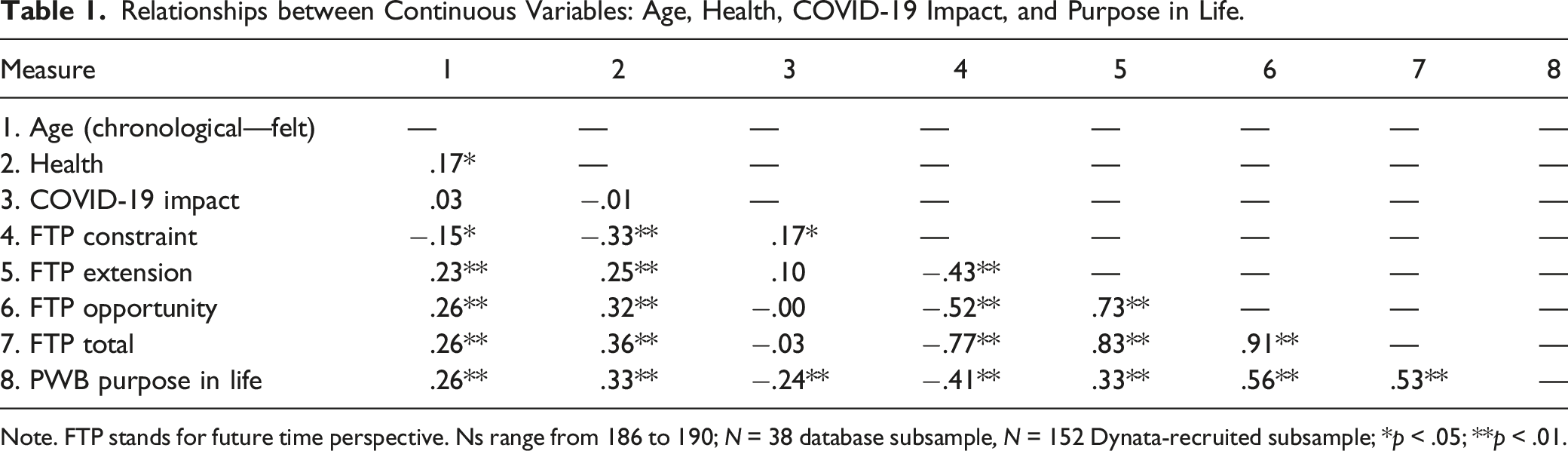
Note. FTP stands for future time perspective. Ns range from 186 to 190; N = 38 database subsample, N = 152 Dynata-recruited subsample; *p < .05; **p < .01.
The Relationship Between Total Future Time Perspective, Impact of COVID-19, and Purpose in Life.
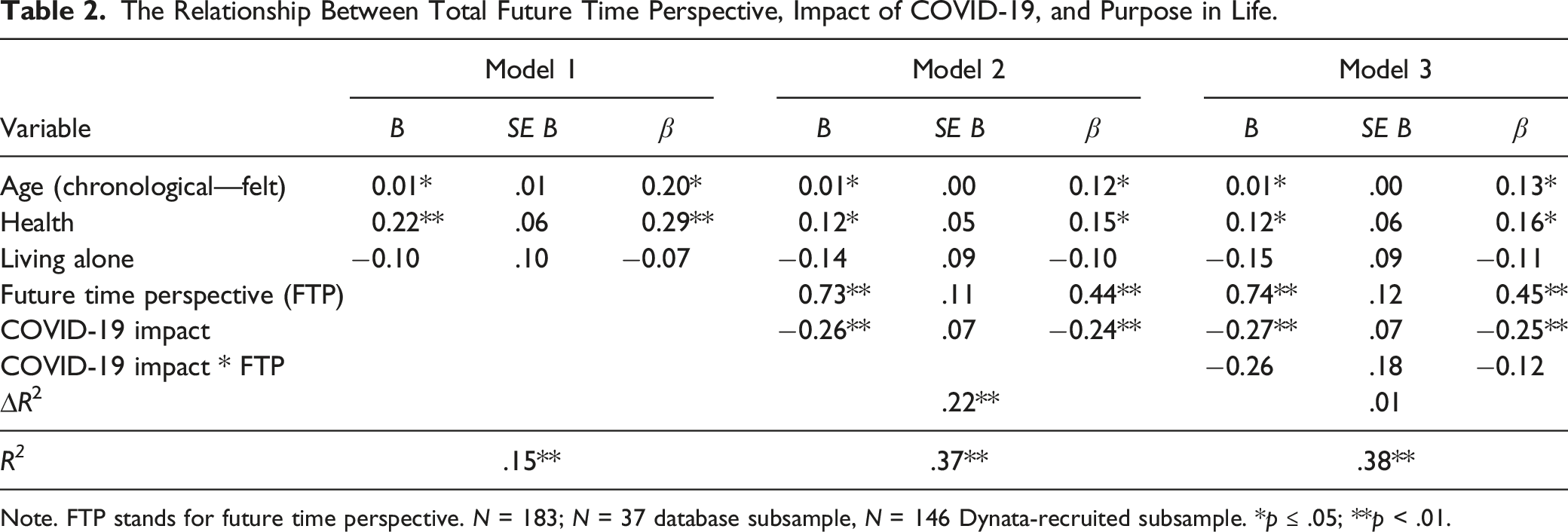
Note. FTP stands for future time perspective. N = 183; N = 37 database subsample, N = 146 Dynata-recruited subsample. *p ≤ .05; **p < .01.
The Relationship Between Total Future Time Perspective Subscales, Impact of COVID-19, and Purpose in Life.
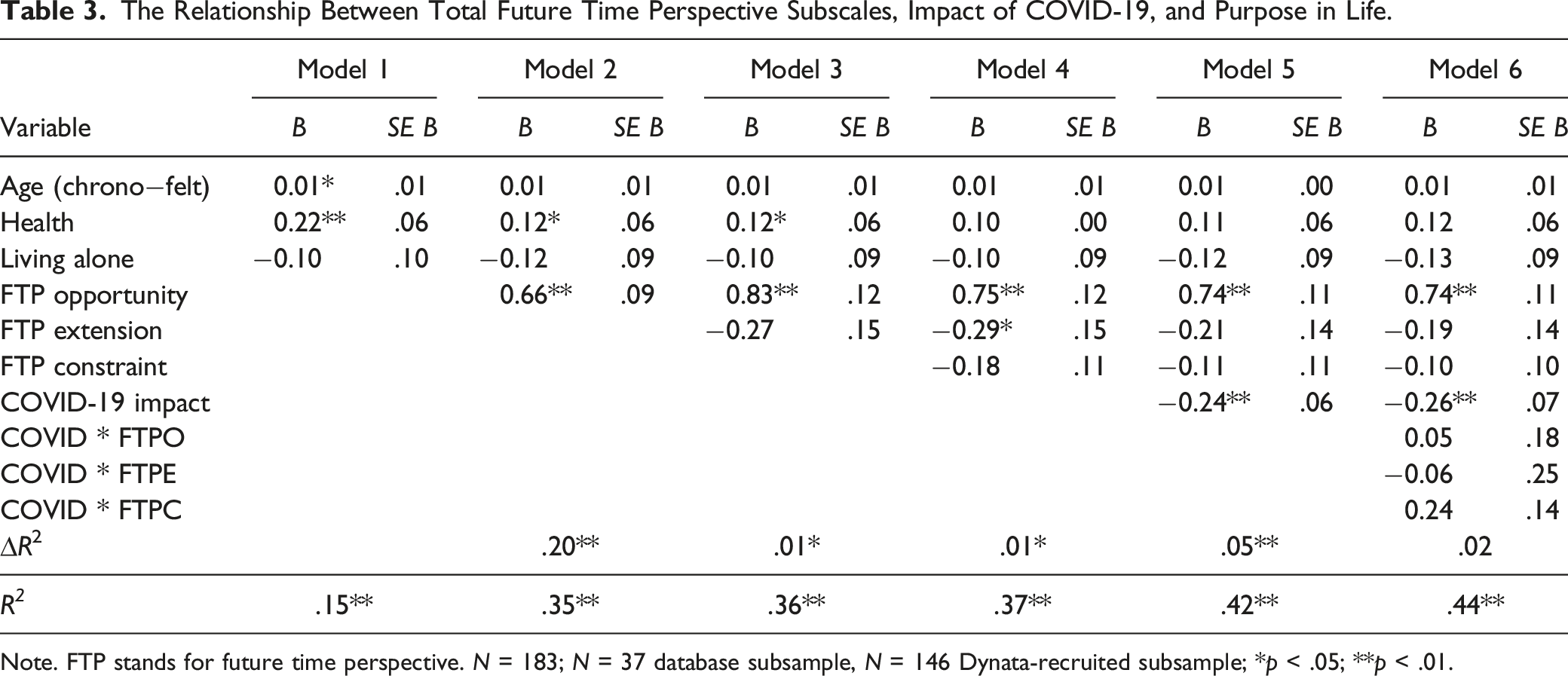
Note. FTP stands for future time perspective. N = 183; N = 37 database subsample, N = 146 Dynata-recruited subsample; *p < .05; **p < .01.
In sum, the quantitative analyses showed that total Future Time Perspective (FTP) and COVID-19 impact (as well as health) were related to Purpose in Life (PIL). In terms of the subscales, only FTP opportunity remained as a main effect for PIL, along with COVID-19 impact.
Responses to the open-ended question concerning COVID-related changes to life during the early months of the pandemic provided support for our quantitative findings. Ninety-five percent of the women responded to this question. We identified eight predominant themes: Few changes to everyday life (7.2% of responses contained this theme); issues of time (11.7%); changes in thoughts/emotions (17.9%); psychological concerns (23.9%); importance of family relationships (32.8%); restricted socializing (43.9%); adaptation (46.7%); and restricted engagement in activities (65.9%). Two of the most prevalent themes—restricted socializing (missing in-person socializing and activities with friends), and restricted engagement in activities (work, volunteer, recreational)—support the highest-scoring items from the COVID-related change measure, i.e., COVID-19 changed the activities in which the women engaged (68% strongly agreed), and the people with whom (47%) and the places where (66%) they spent their time. Please see the Appendix for a complete list of codes, their definitions, and further examples.
For restricted socializing, some women mentioned missing socializing with friends, such as “we no longer get together with friends as we used to do” or “I don't see my friends”; others missed the specific way they socialized, e.g., “I am not...hanging out with my friends in an easy, non-distanced fashion.” Some mentioned changes in generic socializing: “The main thing that changed was loss of social interaction.”
Travel was one activity that many women missed, along with the freedom to shop, dine out, or work out; others specifically mentioned reduction in work and volunteer activities: “Losing freedom to travel, shopping and dining”; “I used to participate in group fitness at the YMCA several times a week, and that option is no longer available”; “reduced my workload”; “I was very active in volunteer activities; a significant part of these are now cancelled.”
However, in addition to these relatively more obvious limitations and reactions that COVID-19 elicited, participants also mentioned more nuanced concerns, such as an increased sense of anxiety and isolation (coded as psychological concerns): “We are very cautious and very anxious about getting Covid-19”; “Isolation for extended periods made me more nervous and apprehensive about life.” The theme of adaptation was also quite common: “I have had to be intentional about finding ways to keep connected,” and “I have had to develop other routines to take [previous activity’s] place, such as going for long walks every morning and spending more time outside.” Some participants reflected on the positives in their lives (changes in thoughts/emotions): “I have very loyal friends, a house and a garden. I enjoyed this period of a quieter life”; “I am lucky that I am healthy with no financial worries”; and “I will never again take the normal daily activities of life for granted.” These responses also reflect the ‘strongly agree’ ratings for the COVID-19 impact scale; 13% strongly agreed that COVID-19 had impacted them psychologically, 20% that COVID-19 had changed their thinking about things, and 17% that COVID had impacted their emotional responses.
Because each theme was coded for presence/absence, we conducted a series of t-tests to explore the relationship between codes and FTP, COVID-19 Impact, and PIL scales. Women who mentioned the importance of family relationships exhibited comparatively higher levels of COVID-19 impact than those with no mentions, t(177) = 2.88, p < .01; mentioning restricted socializing and adapting to the situation were both associated with higher PIL, t(178) = 3.02, p < .01 and t(178) = 2.54, p < .05 (respectively); and women with psychological concerns exhibited comparatively higher levels of FTP constraint, t(178) = 2.11, p < .05.
Discussion
In this study, we examined relationships between Future Time Perspective (FTP, as related to Socioemotional Selectivity Theory; Carstensen, 1992), Purpose in Life (PIL; Ryff, 1989), and the impact of COVID-19. Our first hypothesis was partially supported: having a broader perception of the future was positively related to purpose in life. However, the impact of COVID-19 was (negatively) related to purpose in life, contrary to our hypothesis, and our expectation that COVID-19 impact would moderate the FTP-PIL relationship was not supported. Our second hypothesis concerning the relationship between FTP subscales and PIL was also partially supported, with only FTP opportunity showing the expected relationship to PIL, and COVID-19 impact again exhibiting a significant, negative relationship to PIL.
Our exploration of themes emerging from the responses to the question of how COVID-19 had changed participants’ lives was in line with our expectations, with themes of social connection and activity predominating; however, other important themes included family relationships and more nuanced issues concerning adaptation and psychological concerns. The importance of family relationships was emphasized for women who also perceived more overall impact of COVID-19, whereas restricted socializing and adaptation themes were both associated with higher levels of purpose in life; psychological concerns (anxiety, isolation, loneliness) were related to a comparatively higher level of the FTP constraint subscale. Some participants also mentioned concern for the future; while this might seem to be in line with future time horizons, it was often mentioned in terms of planning – particularly for future travel. Few participants felt there had been little or no change to their lives.
In relating the current study to its theoretical framework, our results add to the already considerable body of research based in the Life Course Perspective (Elder, 1994; Settersten, 2003). Not all participants were similarly impacted by the early months of the current pandemic. Settersten et al. (2020) also make the point that individual differences other than gender—such as personality—need to be taken into consideration when examining adaptation to the current pandemic. In our study, participants’ perceptions of their time horizons differed, as well as their experiences of COVID-19, representing individual differences in both personality and perceived impact. These findings also add further complexity to Socioemotional Selectivity Theory (SST; Carstensen, 1992; Carstensen et al., 1999; Fung & Carstensen, 2006), particularly the themes we identified that are arguably related to SST and the need to spend quality time with close others: importance of family relationships, restricted socializing, and psychological concerns. Whereas the onset of the COVID-19 pandemic could well have primed the sense of an ending for participants and subsequently lowered their levels of psychological well-being, COVID-19 impact did not moderate any of the relationships between total FTP or FTP subscales and PIL. Although Rohr et al. (2017) describe each FTP subscale as related to different age-related factors, the rather large correlation between FTP opportunity and total FTP suggests that FTP opportunity - awareness of what is possible in one’s remaining lifetime – accounts for a large proportion of the FTP construct, at least in the present analysis.
The current study provides evidence that, contrary to the bulk of previous research concerning older adults during the onset of the current pandemic, not all the women in this study are coping relatively well. However, given the cross-sectional nature of this study, it is impossible to ascertain the true impact of the coronavirus on the participants’ well-being, or how the impact might have altered pre-COVID levels of FTP. Nevertheless, the findings provide some indication of the mechanisms by which associations between personal resources and well-being can be altered by contexts that prompt a sense of the fragility of life, such as COVID-19.
Our results also provide mixed support for previous studies of older adults’ future time perspective. The women in the present study exhibited a positive relationship between perceptions of wider time horizons and well-being (see Brothers et al., 2016; Hoppmann et al., 2017). Additionally, this relationship was not altered by priming the sense of an ending, as Fung and Carstensen (2006) found during the SARS-CoV outbreak in Hong Kong, and Carstensen et al. (2020) found during the early stages of the current pandemic: older adults, while perceiving less time left in their lives, experienced comparatively better emotional well-being. Perhaps this is because we use a global measure of purpose in life, whereas Carstensen et al. (2020) use positive and negative emotions experienced during the previous week; that is, purpose in life indexes goals and meaning in life, and as such, might exhibit different associations with perceptions of future time.
The findings from our qualitative exploration of emerging COVID-related themes provides some flesh to the bones of the quantitative findings. The predominance of themes concerned with spending time with family and friends underscores the central tenet of Socioemotional Selectivity Theory (Carstensen, 1992); women in the current study value their relationships (see above and Appendix for example responses). Our findings are also consistent with Whitehead and Torossian (2021), and particularly Heid et al. (2021), whose participants identified the biggest COVID-related challenges as those concerning restrictions on social interactions and activities.
While we found that the impact of COVID-19 itself was directly (negatively) related to having a purpose in life in the quantitative analyses, women who mentioned restricted socializing and adaptation to new routines in their open-ended responses exhibited higher purpose in life. Because the COVID-19 impact scale items tap experiences of change within a certain context, it is possible that its relationship to PIL for the women in our study is guided by their ability to adapt to or cope with disaster-related change (Almazan et al., 2019). Perhaps, as Boss (2022) suggests, coping with change and loss has more to do with one's level of tolerance for ambiguity. Additionally, although Fung and Carstensen (2006) note that individuals can view themselves as lacking agency during such macro-level crises, other researchers note that a loss of control during uncertain times can be ameliorated by having purpose in life (Irving et al., 2017) and that agency is positively associated with PIL (Ko et al., 2019). Thus, research that includes older women’s perceptions of agency and/or tolerance of ambiguity might help further elucidate the mechanisms associated with COVID-related well-being. Taken together, these findings are in line with the Life Course Perspective, and its focus on individual differences.
Limitations and Future Directions
The current study represents one of relatively few studies to date that use both quantitative and qualitative data to examine the lives of older Canadian women during the early months of the COVID-19 pandemic, and the individual differences and mechanisms related to their well-being. While unique, the study also has its limitations. In particular, the participants in this study were all community-dwelling, and predominantly White. Furthermore, the study’s one-time data collection precludes conclusions regarding the longitudinal nature of the relationship between future time perspective and well-being or the comparative nature of this relationship due to age (i.e., younger women vs. older women). The focus on older women was intentional: purpose in life is crucial to their well-being (Ko et al., 2019) and women tend to report lower levels of purpose in life than men (Irving et al., 2017); additionally, their attitudes to COVID-19 and their life paths differ to those of men (Settersten et al., 2020; Szabo et al., 2020). These issues inevitably lead to questions of whether the results would also hold for older men. Future research can remedy these shortfalls. Moreover, comparative data from older adults living in, for example, retirement homes or managed care facilities would provide a broader picture of how the impact of the pandemic might change perceptions of time left and purpose in life.
One particularly interesting issue is that these data were collected before vaccines had been developed and made available for distribution. Perhaps results would look quite different for vaccinated older women, given less reliance solely on stringent social distancing measures. A year or two on, adaptation to protocols might also have changed attitudes to socializing and activities, with subsequent changes to the relationship between perceptions of time horizons and purpose in life.
The current study examined relationships between the conceptually related constructs of perceptions of future time and purpose in life, as well as early experiences of COVID-19. Our findings concerning older Canadian women add nuance to the growing body of research that explores older adults’ well-being during the on-going pandemic. Post-vaccine research examining well-being as we navigate successive years of the pandemic will help to determine if further adaptation to life during COVID-19 has occurred and if perceived COVID-related challenges to well-being have changed or remain the same.
Footnotes
Declaration of Conflicting Interests
The author(s) declared no potential conflicts of interest with respect to the research, authorship, and/or publication of this article.
Funding
The author(s) disclosed receipt of the following financial support for the research, authorship, and/or publication of this article: This work was supported by the Social Sciences and Humanities Research Council (SSHRC) of Canada [grant number: 435-2020-1183].
Author Note
Dr. Nicky Newton is an Associate Professor of Psychology at Wilfrid Laurier University, and led the team of three undergraduates—Hua Huo, Lauren Hytman, and Cara Ryan—on this manuscript. All undergraduates have since moved on to graduate programs in Canada and the United States.
