




Abstract
In this paper, we examine how parental caregiving affects women’s employment in Japan. Drawing on the 2005–2014 Longitudinal Survey of Middle-Aged and Elderly Persons, we estimate logistic regression models for the employment status of middle-aged women in various types of employment as a function of caregiving intensity to examine when and in what context caregivers’ employment may be at risk for Japanese women. The results showed that working women who began providing 5 or more hours of care per week were significantly more likely to leave their jobs than non-caregiving women; those who began providing fewer than 5 hours of care per week did not show this likelihood. Among women in regular employment, those who began to provide 5 or more hours of care per week and those who provided care in the previous year were more likely to stop working or change jobs than their non-caregiving counterparts.
Introduction
As populations age in developed countries, an increasing number of older persons require assistance in their daily lives. In Japan, this number is growing more rapidly amid an accelerated aging of the population. The percentage of the population aged 65 years or older was 7.1% in 1970, and it reached 28.1% in 2018, one of the highest in the world (Japan Cabinet Office, 2019a, pp. 2–6). Currently, 14.2% of the population is aged 75 years or older, and this percentage is expected to reach 25.5% by 2065 (Japan Cabinet Office, 2019a, pp. 2–3).
Traditionally, the Japanese family is expected to take primary responsibility for looking after aged relatives. Although government-provided long-term care insurance (LTCI) was introduced in 2000, families still provide substantial care (Shimoebisu, 2015). As in many other countries, women remain more likely to be caregivers than men, although the number of women in the workforce has increased dramatically in recent years. 1 Reportedly, 66% of primary co-resident caregivers are women (e.g., wives, daughters, and daughters-in-law; Japan Cabinet Office, 2019a, p. 34). Women typically take on caregiving roles in middle to late adulthood (40s to 60s), within prime working age. Consequently, women at this stage of life are particularly likely to have difficulty juggling their work and care responsibilities.
We explore how Japanese women combine parental caregiving with their responsibilities for paid work in this middle age. There is a growing emphasis in Japan on social policies that support people providing care to remain employed, sustaining the national economy in the contexts of the present and anticipated age structure of the population. For example, under the Act on Childcare Leave, Caregiver Leave, and Other Measures for the Welfare of Workers Caring for Children or Other Family Members (abbreviated hereafter as Child Care and Family Care Leave Act; 1999), eligible employees are entitled to 93 days of family care leave for a family member. The LTCI system was introduced in 2000 to socialize the responsibility of long-term care for older-age persons and decrease the burden on family caregivers. The Cabinet (2016) has set the goal of “kaigo rishoku zero” (reducing the number of those who leave work due to caregiving to zero). 2
Nonetheless, national statistics indicate that the number of employees who leave work to provide care has almost doubled over the past decade (from 47,800 in 2006 to 85,800 in 2016; Japan Cabinet Office, 2018, p. 36). This may partially stem from government’s attempts to constrain public expenditures on LTCI, such as the 2006 amendment that reduced benefits for recipients with mild care needs (Fu et al., 2017). Fu et al. (2017) show that the introduction of LTCI had positive spillover effects for family caregivers’ labor force participation, but the 2006 amendment somewhat reversed this, suggesting that the amendment may have had a hidden cost of increasing unpaid caregiving by family members, resulting in caregivers leaving their employment or reducing their hours. Their findings indicate the importance of careful policy making for the provision of LTCI services and other support if the goal is to reduce the number of workers who leave their employment for caregiving. Detailed evidence on caregiving and its relevance to work, such as when and in what context a caregiver’s employment may be at risk, is essential for policymaking.
However, empirical research on this issue remains insufficient. For example, we know of no studies that have examined a threshold of weekly care hours that would increase a Japanese woman’s risk of leaving her employment. Little is known of how far labor market outcomes related to caregiving differ according to types of employment. In this study, we use data from the Longitudinal Survey of Middle-aged and Elderly Persons (LSMEP), a nationwide survey conducted by the Japan Ministry of Health, Labour, and Welfare (MHLW), to explore (1) when (e.g., at how many hours of parental care and at onset or a later stage of care) Japanese female workers are at a greater risk of leaving their jobs (stopping work or changing jobs) and (2) whether the labor market effects of parental caregiving differ by type of employment. Identifying when and in what context female caregivers are at risk of leaving their jobs may inform the development of policies and practices to ensure the provision of necessary services and support for workers who need to assume a caregiving role.
Background
Conceptual frameworks
Role theory may provide a framework to explain the labor market outcomes of adding a caregiving role to a work role (Gonzales et al., 2017). According to role enhancement theory, multiple role occupancy yields both physical and psychological benefits (Sieber, 1974; Thoits, 2003), so individuals may attempt to engage in as many social roles as possible. Conversely, role strain theory suggests that role conflict and role overload could arise from multiple role occupancy (Goode, 1960; Merton, 1957). Given these costs, individuals may limit their number of roles.
More recent studies suggest that the labor market outcomes of caregiving may depend on the nature of the roles of caregiving and work and the conditions in which those roles are embedded. One key context for examining labor market outcomes in caregiving is its intensity (Lilly et al., 2007; Moussa, 2019). Empirically, it has been shown that caregivers in general are as likely as non-caregivers to continue working, but those who provide intensive care are significantly more likely to reduce their working hours or leave employment than non-caregivers (Lilly et al., 2007; Moussa 2019). Further, the caregiving intensity threshold, beyond which the combination of caregiving and work becomes difficult, is generally observed to have a range of 10–20 hours of care per week (Carmichael & Charles, 2003; Ettner 1995; Jacobs et al., 2014; King & Pickard, 2013). Other studies have suggested that caregivers who began to provide intensive care are especially at risk for leaving their jobs because they are still adjusting how they will reconcile competing demands, whereas existing caregivers have often overcome such challenges (Carr et al., 2018; Lilly et al., 2007). Such research is important not only in an academic context but also in practice, as it identifies working caregivers who are at risk of leaving their jobs and how services and support can help (King & Pickard, 2013).
However, prior research has been limited in several respects. First, with few exceptions (Kelle, 2020), research on the labor market effects of caregiving has typically examined either complete withdrawal from work or simple reductions of work hours as outcome variables, often disregarding such substantial changes as moving from a workplace with an inflexible work arrangement to another with more flexible arrangement (e.g., from regular employment to non-regular employment). These substantial changes should be considered formally because they may accompany significant reductions in income or interruptions of potential career advancement if the employee were to continue working in the same position. Second, research has largely been conducted in North American and European countries and may not be directly applicable to other countries. For example, flexible work arrangements (e.g., flexible schedules, shortened hours, family care leave) can moderate the negative effects of caregiving on employment (Fredriksen-Goldsen & Scharlach, 2001; Pavalko & Henderson, 2006). Given that the flexibility in work arrangements differs substantially between countries (Lyness et al., 2012), evidence from one country may not be entirely generalizable to another.
This study addresses these gaps by examining caregiving’s effects on employment (leaving one’s job) in Japan, where flexible work arrangements are not as common (especially in its regular employment system) as in North America or Europe (Lyness et al., 2012; Takeishi, 2010). According to the results of the 2005 International Social Survey Program, Work Orientation III, the percentage of workers who endorsed “Starting and finishing times are decided by my employer, and I cannot change them on my own” was much higher in Japan (60.7%) than in the US (44.4%) or UK (48.4%; GESIS, 2013). Comparative surveys on Japan, the UK, the Netherlands, and Sweden conducted by the Research Institute of Economy, Trade and Industry (RIETI) show that the percentage of permanent employees working fewer than 40 hours per week was much smaller in Japan (17.4%) than in the UK (57.4%), the Netherlands (45%), and Sweden (36%; Takeishi, 2010). The same survey reports that the percentage of permanent employees who have a flexible work arrangement is much higher in UK (flex time 13.2%, discretionary labor 7.5%, telecommuting 8%, short hours 15.4%) than in Japan (flex time 6.8%, discretionary labor 2.1%, telecommuting 0.1%, short hours 0.8%). With rigid work schedules and hours, Japanese female employees (especially regular ones) might experience difficulty balancing even small amounts of caregiving time with their paid work.
We examine “leaving one’s job” as an outcome measure, which captures not only simple withdrawal from work (stopping working) but also leaving to work at another workplace (changing jobs). Employment transition is noteworthy because prior research suggests that regular employees with caregiving responsibilities may reduce their working hours by becoming non-regular employees (Ikeda, 2010). This may happen in Japan because working hours in regular employment are generally rigid and inflexible. Similar to leaving employment altogether, this type of job change is expected to result in a substantial drop in one’s income level because the average pay for non-regular employees is only about 60% of that of regular employees in Japan (The Japan Institute for Labor Policy and Training (JILPT) 2018).
Labor market outcomes of caregiving in japan
To date, empirical evidence produced in Japan on the labor market outcomes of caregiving has been insufficient in two important respects. First, earlier research on caregiving and work has typically relied on cross-sectional data, making the direction of causality unclear (Nishimoto & Shichijo, 2004; Sugawara & Nakamura, 2014). Such work has generally reported negative associations between the two roles, although those associations may reflect causality in both directions, with employment and caregiving affecting each other. It is important to use longitudinal data to understand the direction of causality because the policy implications are different if the observed associations mainly reflect the causality of employment affecting caregiving instead of caregiving affecting employment.
Second, although recent studies have started using longitudinal data to examine how caregiving affects employment with more elaborate estimates, these remain limited in number, and their findings have been mixed. For example, using the Panel Survey on Middle-Aged Persons, Fukahori et al. (2015) found a significant negative effect of having a co-resident family member who needs care on married persons’ employment, while Oshio and Usui (2017), using the Japanese Study of Aging and Retirement, found that parental care in general has little impact on middle-aged women’s employment (see also Oshio & Usui, 2018). Ohtsu and Komamura (2012) found that having a co-resident parent who needs care has a more negative effect on the work status of married women for higher levels of disability in co-resident parents. Yamada and Sakai (2016) observed that the durations and hours of caregiving has negative effect on the work status of caregivers.
Mixed findings may be partly due to variations in the nature and context of caregiver and worker roles among target samples, such as the intensity of caregiving and type of employment. Despite the potential variations in role contexts and resulting variations in difficulties of combining caregiving and paid work by nature and context of these roles, previous studies have not paid sufficient attention to the effect of caregiving intensity, such as the number of hours of care in a week that increase Japanese women’s risk of leaving their jobs. Furthermore, previous studies have not fully examined whether the effect of their caregiving on employment varies in accordance with employment type, although cross-sectional studies have suggested potential variations in the labor market consequence of caregiving across the types of employment (Ikeda, 2010).
This study focuses on parental care that is most typical in middle adulthood, and extends the results of previous studies by investigating two main questions. (1) When does the provision of care affect employment of female caregivers in Japan? In particular, we examine two contexts of caregiving that may impact labor market outcomes: number of hours and onset of care. In other words, is there an intensity threshold (hours of care) beyond which combining the two roles becomes difficult? Are caregivers especially at risk of leaving their jobs at the onset of caregiving? (2) Do the labor market outcomes of caregiving vary by employment type? We examine employment status over a subsequent year (stopping work, changing jobs, or continuing jobs) as labor market outcomes. The type of employment is an important context to consider when examining labor market outcomes of caregiving in Japan because the length and flexibility of working hours substantially differ by type of employment (regular employment, non-regular employment, self-employment) in Japan. For convenience, regular employees are defined as directly hired employees, scheduled for long-term employment, and working full time; those who do not satisfy all these criteria are considered non-regular employees (MHLW, 2012). Regular employees, particularly those who work in large companies, typically work overtime and are hired without restrictions on duties or working location, although this shows some variation (MHLW, 2012, 2013). Non-regular employees (e.g., part-time, temporary, dispatched employees) generally work shorter hours in more flexible arrangements than regular employees. Self-employed people may also have flexibility in their work hours, although may not have lower total work time (Toda, 2018).
Overall, our analyses were exploratory as we sought detailed understanding of the associations between caregiving intensity and work (e.g., caregiving intensity threshold) in Japan, something that prior longitudinal research on this issue has not examined sufficiently. Nevertheless, our analyses were guided by role theory and recent discussions of the influence of role contexts (e.g., intensity of care and flexibility of work arrangements) on labor market outcomes of caregiving. We expected to find a caregiving intensity threshold above which women are more likely to leave their jobs and below which women are no more likely to leave their jobs than non-caregivers. We expected to find a negative association between intensive care and employment, especially among new caregivers, because onset of care may be the key adjustment stage for reconciling competing demands (Carr et al., 2018; Lilly et al., 2007, p. 672). Finally, we expected to find more substantial negative effects of caregiving on employment (stopping, changing jobs) among regular employees than among non-regular employees or the self-employed because the former generally have less flexible work arrangements than the latter.
Research Design
Data
We used the first 10 waves (2005–2014) of the LSMEP, administered by the MHLW. The LSMEP is a panel dataset that provides information on work and caregiving in Japan. For the first wave of the survey, conducted in November 2005, a nationwide sample of Japanese residents aged 50–59 years old was selected in a two-stage random sampling procedure (see Oshio, 2014, p. 122 for details). The first wave had 34,240 respondents (response rate: 83.8%). The follow-up surveys (the second to tenth waves) were conducted with the same sample from 2006 to 2014, with an average attrition rate of 4% for each wave (MHLW, 2015). No new samples were added after the first wave.
The analyses focused on women who were working age (50–59 years old). The study’s primary aim is to examine the effects of their caregiving status over the year between Time 1 (T1) and Time 2 (T2) on paid work at T2 3 ; thus, we pooled each of two consecutive intervals (2005–2006, 2006–2007,…2013–2014) and restricted the sample to women who were under 59 years old at the start of the interval (T1) to avoid including individuals who had reached the mandatory retirement age at the end of the interval (T2). Further, we restricted our sample to those who were in paid work at the start of the interval (T1). For example, women who were working in 2005 but were not working in 2006 would be included in the 2005–2006 sample but not the 2006–2007 sample because they were not working at the beginning of that interval. Those who resumed paid work in 2007 would also be included in the 2007–2008 sample. The resulting pooled data would include up to nine observations per woman. The final analytical sample without missing data for the variables used in the analyses comprised 10,028 women, producing 31,448 observations.
Measures
Dependent variables
Employment status
The key dependent variables were two measures of employment status between T1 and T2. The first dependent variable was a dichotomous indicator of employment status, leaving one’s job vs. continuing one’s job. Respondents were coded 1 if they were working at T1 but had left that job by T2 and 0 otherwise. Job leaving included not only the typical case of ceasing to work entirely but also those who had left the job they had at T1 but had begun working elsewhere by T2. The second dependent variable was a multi-category indicator of employment status that distinguishes these two outcomes. Respondents were coded 1 (“stopped working”) if they had left their jobs and were not working at T2; 2 (“changed jobs”) if they had left their jobs between T1 and T2 but were working at T2; and 0 (“continuing jobs”) otherwise. For both variables, we excluded workers who left their jobs for external reasons, such as corporate bankruptcy or dismissal. 4
Independent variables
Caregiving status
The key independent variables were dummy variables to measure caregiving status over a 1-year interval. We defined caregivers as those who reported providing care for their parents or parents-in-law because this is the typical type of caregiving in middle adulthood. “Caregiving status” was assessed based on responses to three items from the survey. Specifically, respondents were asked, (1) “Do you currently engage in caregiving or childcare for those whom you live with or relatives who live separately?” Respondents who answered “yes” to this question were asked to specify (2) their relationship with the care recipients and (3) the estimated total number of hours they spent providing care per week 5 (on average in the previous month), separately for caregiving and childcare. We identified those who answered “yes” to “caregiving” and then listed at least one aged parent or parent-in-law as the care recipient as caregivers, taking “the hours of caring for the parent” based on their response to the total number of hours for caregiving. 6
This “hours of caring for the parent” variable from consecutive waves (T1 and T2) was used to derive the “caregiving status” variable. Specifically, we first derived three categories: not caregiving (not providing care at either T1 or T2), caregiving at T1, started caregiving (not providing care at T1 but providing care at T2). 7 We further divided each of the latter two categories (caregiving at T1 and started caregiving) into two dummy variables (not intensive and intensive caregiving) using an intensity threshold (in hours per week), producing four dummy variables in total (less intensive caregiving at T1, intensive caregiving at T1, started less intensive caregiving, started intensive caregiving). To assess the potential caregiving threshold beyond which continuing work was difficult, we created four sets of dummy variables for each potential threshold (5, 10, 15, and 20 hours per week). We selected these thresholds because the threshold (intensity levels at which provision of care affects employment of caregivers) reported in the existing research generally ranges between 10 and 20 hours per week (Carmichael & Charles, 2003; Ettner, 1995; Jacobs et al., 2014; King & Pickard, 2013). In addition to three thresholds between 10 and 20 hours, we experimentally created a threshold of 5 hours for robustness.
Employment type
We used an employment type variable (1 = regular employee, 2 = non-regular employee, 3 = self-employed). In LIMDEP, working respondents were asked to choose one of the following categories for their employment status: (1) self-employed worker, (2) family worker, (3) executive of a company or organization, (4) regular staff or employee, (5) part-time or temporary worker, (6) worker assigned through a temporary employment agency, (7) contract or entrusted employee, (8) piecework at home, or (9) others. Employment types were operationalized by grouping responses into three categories: (1) and (2) were grouped as self-employed, (3) and (4) as regular employees, and (5) through (8) as non-regular employees. Responses with (9) were few and not included in the analyses.
Control variables
The control variables, measured at T1, were age (in years), education (three dummy variables denoting the following completed levels of education: junior high, senior high, and college or above), marital status (1 = married, 0 = not married), logged income (in 10,000 yen) in the previous month, living with parents (1 = living with a parent or parent-in law, 0 = others), and health problems (1 = have a chronic health problem or difficulties in one of the 10 activities of daily living [ADLs], 0 = otherwise). 8
Analyses
We used random-effects logistic regression models to estimate the effect of caregiving status on the likelihood that women working at T1 would leave their jobs by the end of the given 1-year interval (T2). Because the data included multiple observations per individual, we introduced a random intercept term to address statistical dependence among repeated observations from the same individuals. Specifically, we used the xtlogit procedure in Stata 14.2 to estimate the models. This procedure uses an adaptive Gauss–Hermite quadrature, which has been shown to work well when the outcome is binary variables and the size of the clusters is small to moderate (Rabe-Hesketh et al., 2002), both of which occurred in our current model. For our first analyses, we used the entire sample of female workers to estimate the effects of four sets of caregiving status dummies, using different intensity thresholds (5, 10, 15, and 20 hours per week) to determine the existence of an intensity threshold among female workers in Japan for leaving their jobs. For our second analyses, we ran two sets of regressions: a random-effects logistic regression of a binary measure of employment status and a random-effects multinomial logistic regression for a multi-category measure of employment status, adding the interaction terms between the caregiving and employment-type variables to test variations in the effects of caregiving by type of employment. We used the xlogit procedure to estimate the first model and the gsem procedure to estimate the second model.
Results
Descriptive Results
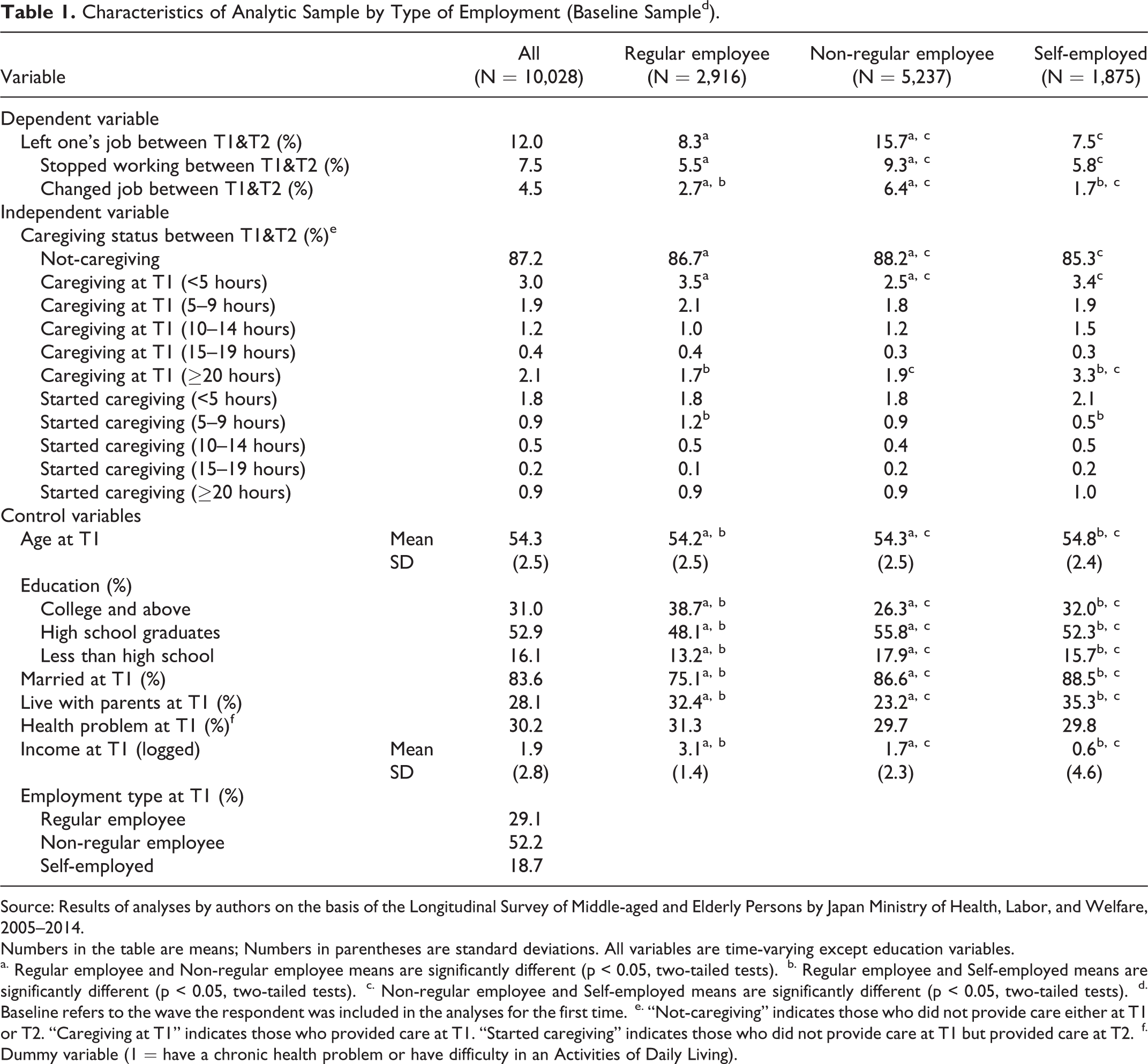
Table 1 shows the analytic sample’s characteristics. The baseline is the wave during which each respondent was included in the analysis for the first time. 9 Approximately half (52.2%) of the respondents were non-regular employees, followed by regular employees (29.1%) and the self-employed (18.7%). Overall, 12% of respondents left their jobs by the following year (T2), and about 13% were providing a form of direct care to their parents at some point during the 1-year interval 10 ; 8.5% (= 3.0% + 1.9% + 1.2% + 0.4% + 2.1%) were providing care at the beginning of T1 (“Caregiving at T1”), and 4.3% (= 1.8% + 0.9% + 0.5% + 0.2% + 0.9%) were not providing care at T1 but had begun to do so by the end of T2 (“Started Caregiving”).
Characteristics of Analytic Sample by Type of Employment (Baseline Sampled).
Source: Results of analyses by authors on the basis of the Longitudinal Survey of Middle-aged and Elderly Persons by Japan Ministry of Health, Labor, and Welfare, 2005–2014.
Numbers in the table are means; Numbers in parentheses are standard deviations. All variables are time-varying except education variables.
a. Regular employee and Non-regular employee means are significantly different (p < 0.05, two-tailed tests).
b. Regular employee and Self-employed means are significantly different (p < 0.05, two-tailed tests).
c. Non-regular employee and Self-employed means are significantly different (p < 0.05, two-tailed tests).
d. Baseline refers to the wave the respondent was included in the analyses for the first time.
e. “Not-caregiving” indicates those who did not provide care either at T1 or T2. “Caregiving at T1” indicates those who provided care at T1. “Started caregiving” indicates those who did not provide care at T1 but provided care at T2.
f. Dummy variable (1 = have a chronic health problem or have difficulty in an Activities of Daily Living).
The intensity level distribution (in hours of caregiving) was highly skewed to the right. For example, of those who began caregiving (4.3% of the total sample), around 42.7% (1.8% of the total sample) were providing <5 hours of care, and the size of each group shrank as caregivers provided longer hours of care. Nevertheless, grouping all those who began providing 20 or more hours of care into one category showed 21.4% of new caregivers (0.9% of the total sample) engaged in such intensive care. The average age of the women was 54.3 years, of which 83.6% were married. Most of the sample had graduated from high school (52.9%) or had college-level education or above (31%), with the smallest proportion (16.1%) having less than a high school education. In all, 28.1% of respondents lived with a parent or a parent-in-law, and 30.2% reported having a health problem of their own. Significant group differences were observed for most variables.
Multivariate Analyses
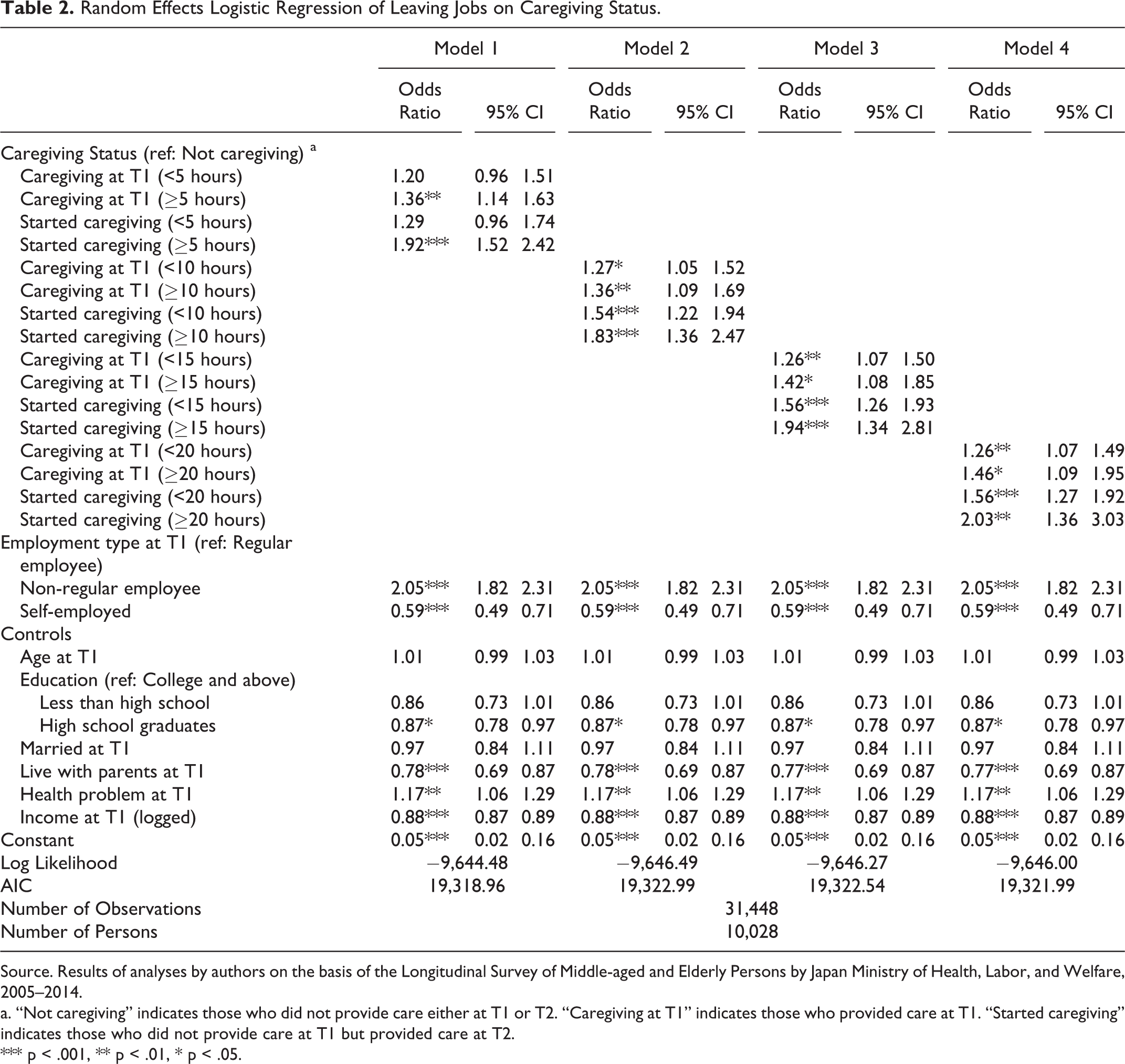
Table 2 presents the estimates of the effects of caregiving status on the likelihood of leaving their jobs. Models 1–4 use different intensity thresholds (5, 10, 15, and 20 hours) for caregiving. In Model 1, where we used 5 hours as the caregiving intensity threshold, we found that those providing 5 or more hours of weekly care were significantly more likely to leave their jobs, and those providing fewer than 5 hours of care were no more likely to leave their jobs than non-caregivers. Specifically, women who began providing 5 hours of weekly care or more had significantly higher odds (1.92) of leaving their jobs 1 year later than non-caregiving women. Similarly, but to a lesser extent, women who were already providing 5 hours of care or more at T1 had significantly higher odds (1.36) of having left their jobs 1 year later. For all other models (Models 2, 3, and 4), which used larger amounts of time (10, 15, and 20 hours) for their intensive care thresholds, we observed a significant positive effect for both the less intensive (less than 10, 15, or 20 hours of weekly care) and more intensive care categories. The model fit statistics (AIC) suggest that Model 1 is the most preferred among all four models.
Random Effects Logistic Regression of Leaving Jobs on Caregiving Status.
Source. Results of analyses by authors on the basis of the Longitudinal Survey of Middle-aged and Elderly Persons by Japan Ministry of Health, Labor, and Welfare, 2005–2014.
a. “Not caregiving” indicates those who did not provide care either at T1 or T2. “Caregiving at T1” indicates those who provided care at T1. “Started caregiving” indicates those who did not provide care at T1 but provided care at T2.
*** p < .001, ** p < .01, * p < .05.
The results in Table 2 suggest that providing less than 5 hours of weekly care is not associated with the employment of Japanese women, although providing additional care does increase the risk of leaving one’s job. However, this pattern may differ by employment type. To examine this possibility, we estimated a model including interaction terms between the caregiving and employment-type variables in addition to the variables in Model 1 in Tables 2.
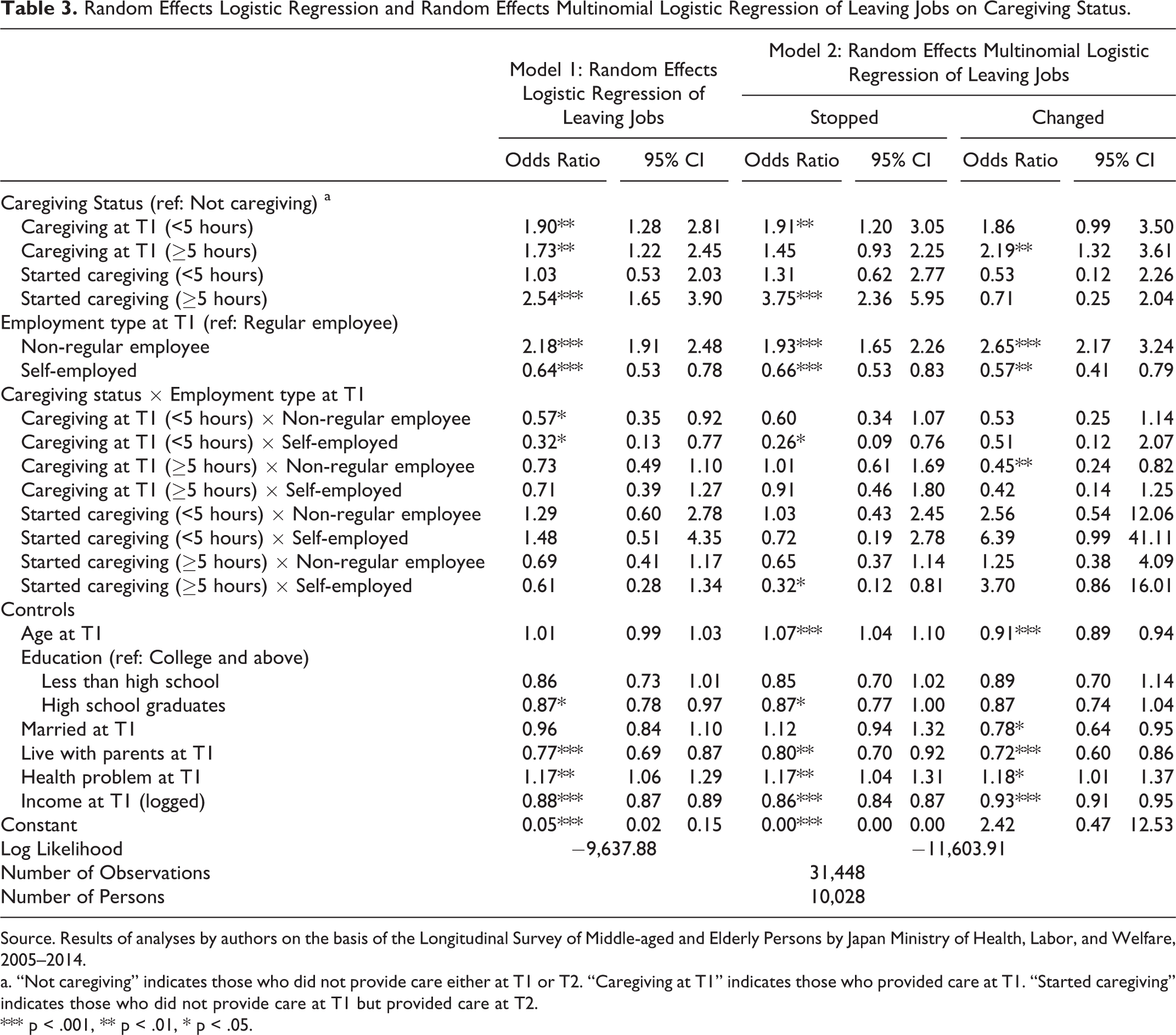
The results for the caregiving variables in Model 1, shown in Table 3, suggest that the odds of leaving their jobs were not significantly higher for regular employees who began less intensive care (<5 hours), whereas those who began intensive care (≥5 hours) and those who were providing care at T1 (regardless of hours of care provided) have significantly higher odds of leaving their jobs than non-caregivers. Nevertheless, the significant interaction terms for caregiving and employment type in Table 3 (Model 1) suggest that the employment effects for low-intensity care at T1 exist only among regular employees. Separate regressions by employment type (result not shown) revealed no significant effect for less intensive care (<5 hours) on employment among women who were non-regular employees or self-employed.
Random Effects Logistic Regression and Random Effects Multinomial Logistic Regression of Leaving Jobs on Caregiving Status.
Source. Results of analyses by authors on the basis of the Longitudinal Survey of Middle-aged and Elderly Persons by Japan Ministry of Health, Labor, and Welfare, 2005–2014.
a. “Not caregiving” indicates those who did not provide care either at T1 or T2. “Caregiving at T1” indicates those who provided care at T1. “Started caregiving” indicates those who did not provide care at T1 but provided care at T2.
*** p < .001, ** p < .01, * p < .05.
Model 2 in Table 3 examines caregiving’s effects on employment in further detail, using a multi-category measure for employment. The result suggests that among regular employees, starting intensive caregiving is significantly associated with stopping working, while pre-existing caregiving is associated with both stopping working and changing jobs, depending on care intensity. The significant interaction effects for caregiving status by employment type in Model 2 of Table 3 suggest that the odds of stopping work for caregiving (beginning intensive care or had provided less intensive care at T1) were substantially larger for regular employees than they were for the self-employed, while the odds of changing jobs for intensive care at T1 were substantially larger for regular employees than they were for non-regular employees.
Discussion
This study’s findings provide new information on the labor market effects of parental caregiving among middle-aged women in Japan. First, we identified groups of caregivers at risk of leaving their jobs. Women who began to provide 5 or more hours of care in a given year were significantly more likely to leave their jobs than non-caregiving women, whereas those who began to provide fewer than 5 hours of care were not. Women in regular employment who began providing 5 or more hours of care and those who had provided any number of hours of care in the previous year were more likely to stop working or change jobs than their non-caregiving counterparts.
Our analyses suggest that the caregiving threshold observed in other countries (Ettner, 1995; Jacobs et al., 2014; King & Pickard, 2013) may also exist in Japan at around 5 hours of weekly care, although it could be lower for existing caregivers working as regular employees. The observed threshold level may depend on the definition of caregiving used in the survey and on other factors (e.g., the sample’s age group); it should be tested in future studies. Nevertheless, the existence of a threshold is consistent with previous research showing a negative effect of the reduction of formal service provision on caregivers’ labor force participation, particularly as observed in Fu et al. (2017). Given the impact of 5 or more hours of care on employment, policies related to increasing amounts of family caregiving beyond this level could result in more people leaving the workforce owing to their caregiving responsibilities. This should prompt caution when considering policy changes that may increase family responsibilities of care by reducing provided services.
The observed variations in the labor market outcomes of caregiving across the type of women’s employment were consistent with our hypotheses. The results showed that less intensive caregiving has most negative consequences for regular employees in the following year. Detailed analyses showed that caregiving’s effects (starting intensive care or providing less intensive care at T1) on leaving one’s job were larger among regular employees than the self-employed, whereas the effects of intensive caregiving (T1) on changing jobs were larger among regular employees than non-regular employees. Although this part of the analyses is quite exploratory, the results may reflect some contextual differences between the self-employed and non-regular employees, with the former typically working most flexible hours but not necessarily short hours, and the latter typically working more flexible and short hours than regular employees. That is, flexibility of work hours may be the important context that moderates the effect of starting intensive caregiving or providing lower intensity care on stopping their jobs by the following year; On the other hand, both flexibility and the length of work hours may be the important contexts that moderate the effect of providing high-intensity care on changing jobs in the subsequent year.
The results of additional analyses of those who changed jobs in our pooled sample (results available upon request) showed that only 44% of regular employees (T1) who provided care at T1 and changed their jobs between T1 and T2 remained regular employees at T2; among the regular employees (T1) who provided care at T1 and changed their jobs, average work hours fell from 40 to 34 hours. Thus, many changes from regular employment show signs of the need to reconcile caregiving responsibilities by moving to a more flexible work arrangement in terms of timing and length of work hours. Those findings are consistent with Ikeda (2010), who showed that female caregivers working as regular employees were significantly more likely to change jobs than male caregivers through cross-sectional analyses, although no such association was observed for female caregivers working as non-regular employees. This provides further evidence that flexible work arrangements are possibly an important underlying context to moderate caregiving’s negative effect on employment (Fredriksen-Goldsen & Scharlach, 2001; Pavalko & Henderson, 2006). 11
In addition to starting high-intensity care, existing care of high intensity was associated with leaving one’s job in the following year. This finding is consistent with other evidence; Yamada and Sakai (2016) found that the duration of care was negatively associated with the caregiver’s probability of working in Japan. Ikeda (2010) observed a larger percentage of employment transitions (especially job changers) among long-term caregivers than among short-term caregivers. According to the wear-and-tear hypothesis (Townsend et al., 1989), caregiving burdens increase as the duration of care increases. Observed association may partly reflect the difficulties arising from such mechanisms although this should be examined further in future research.
Overall, our findings support the recent theoretical discussions on the consequence of multiple roles by showing that the labor market outcome of caregiving depends on the nature and context of these roles, such as intensity of caregiving and flexible work arrangements. Our results suggest that it may be possible to generalize the discussion on intensity thresholds that were based on evidence from Western countries to countries such as Japan where work arrangements have less flexibility. This study also revealed the potential importance of considering different labor market outcomes of caregiving (e.g., stopping, changing, and continuing jobs) than simple withdrawal from work or reductions of work hours, in order to capture the effect of caregiving more fully.
This study is not without limitations. First, the data used were obtained before the 2017 amendment to the Child Care and Family Care Leave Act, so our results cannot reflect this policy change. Under this amendment, companies are not allowed to make caregiving employees work in excess of their scheduled working hours when requested by the eligible employees unless it impedes normal business operation. More recent data are required to determine whether our findings remain valid in the context of the amended act. Second, this study was limited by the survey design behind the data used. For example, the hours of caregiving in the survey included hours of direct caregiving but not indirect caregiving (e.g., watching). The target sample was also limited to respondents in their 50s. Using different concepts of care or data from different age groups could lead to different thresholds. Thus, the current findings should be re-evaluated using data collected by different survey designs. Third, the data limitations did not allow us to examine the effects of flexible work arrangements in a direct manner or to include family structure variables in our analyses as controls. Future studies should include variables such as direct measures of flexible work arrangements (e.g., flex hours, shorter hours) and family structure (e.g., number of siblings) to test if the current findings still hold by incorporating these variables in the analyses. Finally, although we limited our sample to women, with the rapid aging of the population, male caregivers are increasing in number and now comprise one-third of all co-resident family caregivers (Japan Cabinet Office, 2019a). Because the gender-based division of labor is more prominent in Japan than in other developed countries (Fuwa, 2004) and because issues related to caregiving can vary according to gender (Kikuzawa, 2016), future studies should extend the focus to men, examining whether our findings hold for male samples and exploring whether there are issues specific to male caregivers.
Nevertheless, the findings have important policy implications. Our results indicate that employed women in Japan are at risk of leaving their jobs when they begin to commit 5 or more hours of weekly caregiving. This highlights the importance of providing recognition of, and support for, female employees at the onset of caregiving to reduce the risk of their subsequent departure from the workforce. Further, female regular employees who began intensive caregiving and those who were providing any care were significantly associated with leaving their jobs, suggesting that it is particularly difficult to combine caregiving and work in the regular employment system in Japan. Clearly, additional support measures (e.g., flexibility in the timing and length of work hours and public provision of care for older persons as a substitute for family caregiving) are required to reduce the risk of female employees leaving their jobs to care for aging relatives. Finally, additional work is necessary to assess labor market outcomes of caregiving, using data from countries with differing policies. Such studies would help policymakers consider policies that would allow people to act as caregivers without losing their jobs and contribute to sustaining aging societies in coming decades.
Footnotes
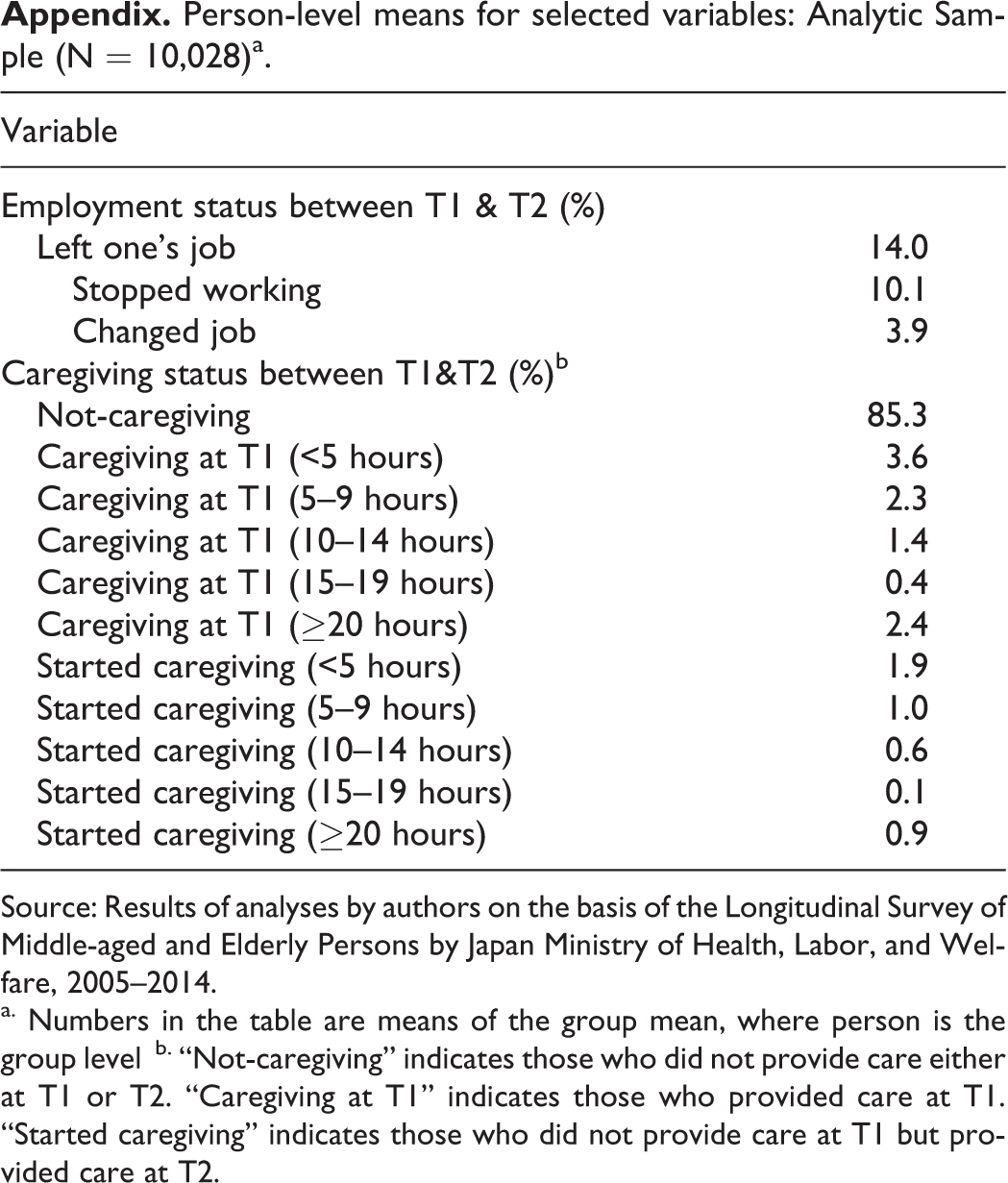
Person-level means for selected variables: Analytic Sample (N = 10,028)a.
| Variable | |
|---|---|
| Employment status between T1 & T2 (%) | |
| Left one’s job | 14.0 |
| Stopped working | 10.1 |
| Changed job | 3.9 |
| Caregiving status between T1&T2 (%)b | |
| Not-caregiving | 85.3 |
| Caregiving at T1 (<5 hours) | 3.6 |
| Caregiving at T1 (5–9 hours) | 2.3 |
| Caregiving at T1 (10–14 hours) | 1.4 |
| Caregiving at T1 (15–19 hours) | 0.4 |
| Caregiving at T1 (≥20 hours) | 2.4 |
| Started caregiving (<5 hours) | 1.9 |
| Started caregiving (5–9 hours) | 1.0 |
| Started caregiving (10–14 hours) | 0.6 |
| Started caregiving (15–19 hours) | 0.1 |
| Started caregiving (≥20 hours) | 0.9 |
Source: Results of analyses by authors on the basis of the Longitudinal Survey of Middle-aged and Elderly Persons by Japan Ministry of Health, Labor, and Welfare, 2005–2014.
a. Numbers in the table are means of the group mean, where person is the group level
b. “Not-caregiving” indicates those who did not provide care either at T1 or T2. “Caregiving at T1” indicates those who provided care at T1. “Started caregiving” indicates those who did not provide care at T1 but provided care at T2.
Authors’ Note
An earlier version of this paper was presented at the 2019 meeting of the American Sociological Association. The data used for this research (i.e., the Longitudinal Survey of Middle-Aged and Elderly Persons) were provided by the Japan Ministry of Health, Labour and Welfare based on Statistics Law Article 33.
Declaration of Conflicting Interests
The author(s) declared no potential conflicts of interest with respect to the research, authorship, and/or publication of this article.
Funding
The author(s) disclosed receipt of the following financial support for the research, authorship, and/or publication of this article: This work was supported by Grants-in-Aid for Scientific Research (Grant number 17K04258) from the Japan Society for the Promotion of Science.
