




Abstract
This study goes beyond a purely financial perspective to explain why single older workers prefer to retire later than their partnered counterparts. We aim to show how the work (i.e., its social meaning) and home domain (i.e., spousal influence) contribute to differences in retirement preferences by relationship status. Analyses were based on multiactor data collected in 2015 among older workers in the Netherlands (N = 6,357) and (where applicable) their spouses. Results revealed that the social meaning of work differed by relationship status but not always as expected. In a mediation analysis, we found that the social meaning of work partically explained differences in retirement preferences by relationship status. We also show that single workers preferred to retire later than workers with a “pulling” spouse, earlier than workers with a “pushing” spouse, and at about the same time as workers with a neutral spouse.
In the retirement literature, it is well known that single older workers retire later than older workers with a partner (e.g., Van Solinge & Henkens, 2014). A large number of studies include relationship status in the analyses even when it is not a variable of primary interest (e.g., Bloemen, Hochguertel, & Zweerink, 2016; Gonzales, Lee, & Brown, 2017; Stansfeld et al., 2018; Tang & Burr, 2015). The effect of relationship status on the retirement decision is often ascribed to financial factors (Finch, 2014), which is not surprising because the retirement decision is driven by financial considerations, and married and cohabiting individuals are generally wealthier than their single counterparts (Lersch, 2017; Waite & Gallagher, 2000).
Alternative, nonfinancial explanations for the differences between single and partnered workers are often ignored. The results of some analyses, however, suggest that the effect of relationship status on retirement remains significant when financial circumstances are taken into account (Raymo & Sweeney, 2006; Szinovacz, DeViney, & Davey, 2001). Moreover, the effect seems to be more consistent for retirement intentions than for behavior (Damman, Henkens, & Kalmijn, 2015). As retirement intentions are generally less financially restricted than behavior, this suggests that other than financial factors contribute to the differences in the retirement transition by relationship status. Factors such as the value of work for older adults’ social lives (Smeaton & McKay, 2003) or the pull that might arise from a spouse at home (Syse, Solem, Ugreninov, Mykletun, & Furunes, 2014) have been suggested but not been investigated systematically.
The current study aims to contribute to the literature by enhancing our understanding of differences in retirement preferences by relationship status. Nowadays, a significant and increasing proportion of adults approach retirement age as singles. The share of single adults aged 60–64 was 31% in the United States (2010; Minnesota Population Center, 2018) and 27% in Europe (2011; Eurostat, 2011). In the Netherlands, the country studied here, the share of adults aged 60–64 who were single has risen steadily from 24% in 2008 to 31% in 2018 (Statistics Netherlands, 2018b). The increase in the share of single people in many countries has fueled a debate about the effects of singlehood on people’s lives and society as a whole. Some scholars are convinced that married individuals are better off than singles in many important spheres of life and that marriage should therefore be promoted (Waite & Gallagher, 2000). Other scholars insist that discrimination explains most of the differences between married and single individuals and that, if discrimination was counteracted, singles would fare at least as well as married individuals (DePaulo & Morris, 2005). With regard to the effect of singlehood at older ages, researchers have investigated diverse issues such as health and well-being (Thomas, Liu, & Umberson, 2017), quality of sleep (Chen, Waite, & Lauderdale, 2015), or the threat of isolation as adults age (Klinenberg, 2012). The special situation of singles with regard to retirement—a major life transition in older age—has been largely neglected in this literature. Given that work can facilitate the social integration of older singles, they might approach retirement differently than their partnered counterparts. Taking a nonfinancial perspective on retirement can provide valuable insights into the differences between single and partnered workers in the retirement transition. Moreover, focusing on retirement preferences as an early stage in the retirement transition can highlight differences by relationship status that might be masked in studies that focus exclusively on retirement behavior but that can nonetheless impact well-being at later ages (Earl, Bednall, & Muratore, 2015).
In this study, we aim to answer the following questions: Do singles indeed prefer to retire later than older workers with a spouse? And if so, can factors in the work domain and the home domain explain why singles prefer to retire later? When looking at retirement preferences from a nonfinancial perspective, we expect that factors in older workers’ work and home domain contribute to differences by relationship status. With regard to the work domain, singles may critically rely on work to fulfill certain social functions in their lives. With regard to the home domain, singles naturally are not exposed to a spouse who might pull them out of the labor force. We base our analyses on data from the first wave of the NIDI Pension Panel Study (NPPS) (Henkens, Van Solinge, Damman, & Dingemans, 2017). The NPPS is a multiactor study of employees aged 60–65 and (where applicable) their spouses. The data allow us to compare the retirement preferences of about 1,200 single older workers to those of partnered older workers.
Theoretical Background
Work Domain
Work fulfills important functions in the life of an adult. This is particularly apparent in the case of job loss, which has been shown to lead to declines in physical and psychological health (Wanberg, 2012). Adverse consequences of job loss are not solely due the financial implications of unemployment. Classic work on employment suggests that besides providing financial security, work also benefits people’s social networks, imposes a time structure, provides common goals and status, and enforces activity (Jahoda, 1981, 1982). More recent research corroborates the idea that work—also of the unskilled, manual type—provides nonfinancial benefits that positively affect health and well-being (Paul & Batinic, 2010; Vander Elst, Naswall, Bernhard-Oettel, De Witte, & Sverke, 2016). Workers experience more contacts, time structure, collective purpose, and enforced activity than people who are unemployed or out of the labor force (Paul & Batinic, 2010). Besides finances, contacts and structure seem to mediate the effect of employment on psychological health (Selenko, Batinic, & Paul, 2011). Thus, work has an important function in assuring a socially meaningful life characterized by regular social contact and some degree of externally imposed structure.
Work is not the only means through which contacts and a daily structure can be achieved. Close family ties, and a spouse in particular, have been suggested to help non-working individuals in compensating for work (Huffman, Culbertson, Wayment, & Irving, 2015; Van Hoye & Lootens, 2013). Originally, work was seen as providing individuals with contacts outside of the nuclear family (Jahoda, 1982). However, one might expect that work will benefit the social contacts of singles in particular because their home situation generally facilitates social interaction to a lesser extent than the home situation of people with a spouse. In line with this reasoning, Smeaton and McKay (2003) explain their finding that singles continue to work longer than partnered older workers by a “desire to leave the house and meet people” (p. 16). Partnered individuals usually interact with at least one person (their spouse) even if they do not engage in any out-of-home activities. Likewise, singles are generally only weakly subjected to an externally imposed structure, whereas the lives of people with a spouse are to some degree structured by their spouses’ activities and the coordination of two lives. Thus, work may have a stronger social meaning for singles than for partnered individuals.
New retirees face the challenge to compensate for the loss of social contacts and an externally imposed structure work provides by creating their own routine (Ekerdt & Koss, 2016). Given that we expect work to be particularly meaningful for the social lives of singles, singles might also have a weaker preference for retirement because they anticipate more difficulties upon retirement. We propose two related hypotheses. Social meaning of work hypothesis: The social meaning that work provides is more important for single workers than for partnered workers. Mediation hypothesis: The heightened social meaning of work for single workers (partially) explains why singles are generally less likely to prefer retirement than partnered workers.
Home Domain
A second reason why single workers may prefer to retire later is that they do not have a spouse who “pulls” them out of the labor market. This mechanism can be examined by comparing single workers to workers with different types of spouses. One relevant difference here is between partnered workers with a working spouse and partnered workers with a nonworking spouse. The argument is that couples tend to spend considerable proportions of their time with one another (Neilson & Stanfors, 2018) and that they do so because they enjoy being together (Van Klaveren & Van den Brink, 2007). The retirement of one member of the couple increases the time partners spend in each other’s company, but it does so most strongly when the other member of the couple does not work for pay (Genadek, Flood, & Moen, 2017). Therefore, workers whose spouse does not work are more likely to be pulled out of the labor market than workers with a working spouse (Pienta, 2003; Radl & Himmelreicher, 2015; Syse et al., 2014; Warren, 2015). Consequently, we might expect that differences in retirement preferences are larger between single workers and partnered workers with a nonworking spouse than between single workers and partnered workers with a working spouse.
Investigating the effect of spousal work status on workers’ retirement preferences is a rather indirect approach to studying spousal influence: It assumes that spouses’ work status is a good proxy of their preference for the worker to retire. However, spouses can have many reasons to prefer a worker’s retirement that are not necessarily correlated with their own work status, such as worrying about the worker’s health (Eismann, Henkens, & Kalmijn, 2019). Investigating these preferences provides a more direct way to study spousal influence. In the presence of a spouse, the decision whether or not the worker should retire is more of a couple-than an individual-level decision. Depending on the spouses’ preferences, their influence might either pull older workers out of the labor market or induce them to stay employed. Naturally, singles are not subjected to any spouse-specific influences. We might therefore expect that the retirement preferences of single workers are similar to those of workers whose spouse takes a neutral stance on the workers’ retirement. We propose a spousal influence hypothesis: Single workers have a weaker preference to retire compared to (a) workers whose spouse does not work and (b) workers whose spouse prefers them to stop working. In contrast, single workers have similar retirement preferences compared to (a) workers whose spouse works for pay and (b) workers whose spouse has no preference regarding their retirement.
Method
Data
This study used data from the first wave of the NIDI Pension Panel Study (NPPS) which were collected in 2015. The NPPS is a multiactor survey of 60- to 65-year-old workers and (where applicable) their spouses. All workers were members of three large pension funds in the Netherlands. A vast majority of Dutch employees (91%) are enrolled in occupational pension plans. These plans are usually of the defined benefit type (94%) and offer high pension replacement rates (around 90%; The Organisation for Economic Co-operation and Development, 2017). The three selected funds together represent about 49% of the wage employed workers in the Netherlands. A stratified sample of organizations was drawn based on organizational size and sector (civil service and education, care and social work, construction). Within the selected organizations, workers of the birth cohorts 1950–1955 were randomly sampled. For more information on the sample and design of the NPPS, see Henkens and colleagues (2017).
An initial sample of 15,470 older workers received a questionnaire which they could choose either to return in a stamped envelope or to fill in online. In total, 6,793 older workers returned a questionnaire (response rate 44%; 753 online; Henkens et al., 2017). We excluded 163 older workers who did not live with their romantic partner. The response rate among spouses was high; 84% of the spouses of partnered workers filled in the questionnaire designed for spouses (N = 4,409). In the sample of 6,630 single and partnered workers, item nonresponse was low in general (2%) with a maximum of 9% for our measures of wealth. We dealt with missing data by imputing 25 data sets (Stata Version 14: mi impute chained) using information from the dependent, independent, and control variables, as well as suitable auxiliaries. Our estimates represent the combined results of analyses performed on 25 data sets (Stata Version 14: mi estimate). We limited our final sample to those cases in which the dependent and mediator variables had not been missing (N = 6,357).
Measures
Older workers’ preferences for retirement were measured based on the question, “What would be your preferred work situation one year from now?” Answer categories ranged from strong preference for not working to strong preference for working on an ordinal 5-point scale. Older workers in our sample tended to have pronounced preferences regarding their retirement—either strongly intending to continue working (33%) or strongly preferring to retire soon (28%; see Table 1 for percentages by gender and relationship status).
Descriptive Statistics of All Variables by Gender and Relationship Status.
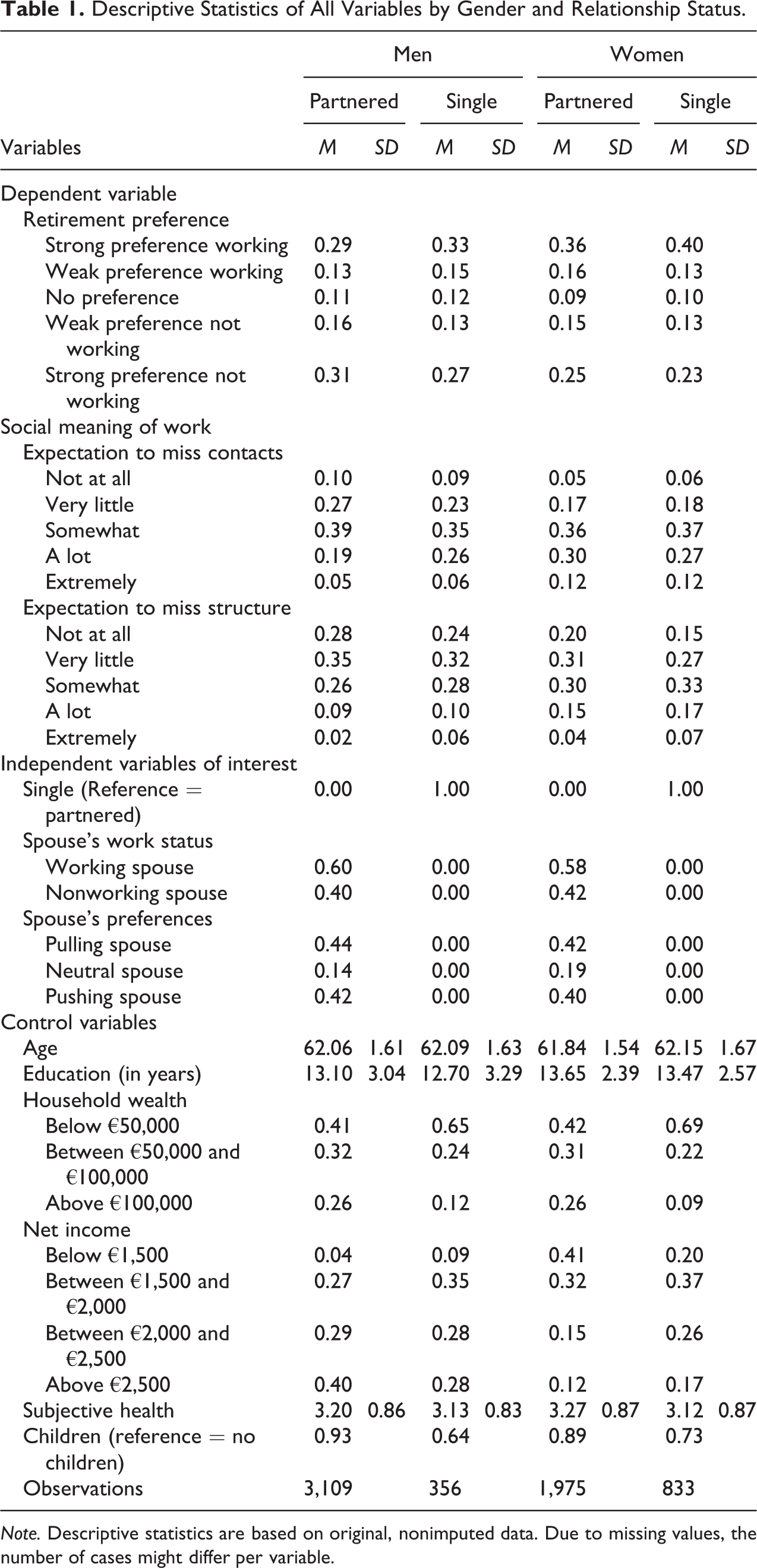
Note. Descriptive statistics are based on original, nonimputed data. Due to missing values, the number of cases might differ per variable.
To measure the social meaning of work, older workers were asked to what extent they expected to miss contacts via work and a daily structure when they stop working. Answer categories to these two questions ranged from not at all to extremely on an ordinal 5-point scale. As can be seen from Table 1, a substantial number of older workers expected to miss contacts or a daily structure a lot or even extremely upon retirement.
We measured relationship status by asking workers whether they had a partner. Those who were married or cohabited were categorized as partnered older workers (81%). Those who had no partner were categorized as single (19%). This dichotomy was extended by information on spouses’ work status to create a variable that distinguished between older workers with a working spouse (48%), older workers with a nonworking spouse (33%), and single older workers (19%). The multiactor nature of our data allowed us to also extend relationship status based on spouses’ answers to the question, “What would be your preference with regard to the work situation of your wife/husband/partner 1 year from now?” Answer categories ranged from strong preference that my partner does not work to strong preference that my partner works on an ordinal 5-point scale, with the midpoint no preference. Spouses who prefer the worker to retire can be called “pulling,” spouses who do not have a preference for the worker can be called “neutral,” and spouses who want the worker to remain in the labor force can be called “pushing.” Table 1 shows that partnered workers in our sample tended to have either a pulling (men: 44%, women: 42%) or a pushing (men: 42%, women: 40%) spouse.
Control variables included workers’ age, education in years of schooling, and subjective health as measured by the question, “How would you characterize your health in general?” with answer categories ranging from very poor (= 1) to excellent (= 5). Workers were also asked whether they had any children. We controlled for two financial indicators: total household wealth and individual net monthly income. This was done to account for financial differences by relationship status which have previously been put forward as the primary source of differences in the retirement transition of single and partnered older workers. Table 1 presents the mean and standard deviation of all variables by gender and relationship status.
Analytic Strategy
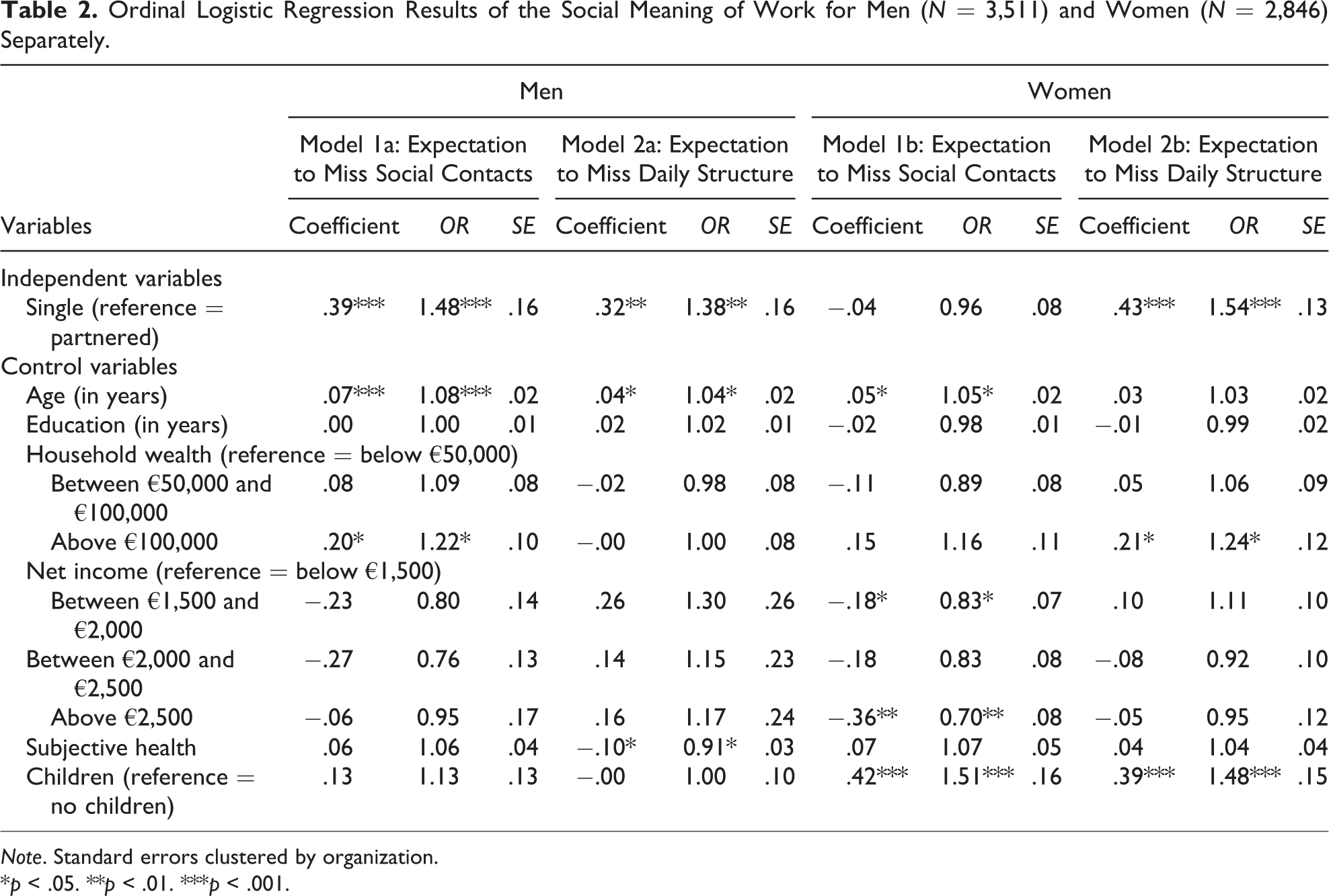
The empirical analyses were carried out in three steps. First, to investigate the effect of relationship status on the social meaning of work, we conducted ordinal logistic regression analyses on workers’ expectation to miss contacts (Model 1) and structure (Model 2) upon retirement (Table 2). We controlled for workers’ age, education, wealth, income, health, and whether or not they had children.
Ordinal Logistic Regression Results of the Social Meaning of Work for Men (N = 3,511) and Women (N = 2,846) Separately.
Note. Standard errors clustered by organization.
*p < .05. **p < .01. ***p < .001.
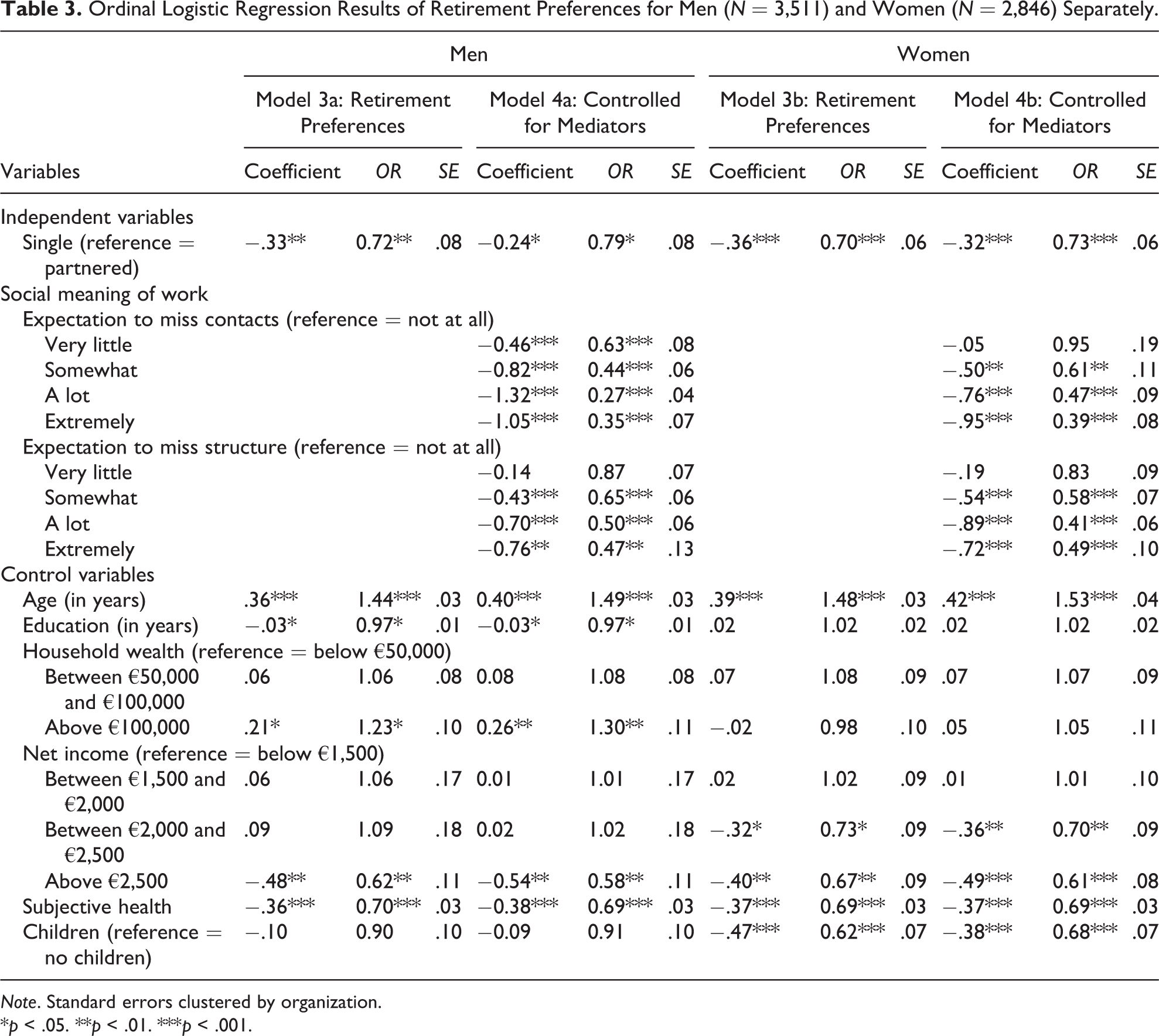
Second, we tested the effect of partner status on retirement preferences and examined whether differences in the social meaning of work mediated differences in retirement preferences of single and partnered older workers (Table 3). In Model 3, we regressed relationship status on retirement preferences in an ordinal logistic regression while controlling for workers’ age, education, wealth, income, health, and whether or not they had children. In Model 4, we added the expectation to miss contacts and structure to see whether the social meaning of work affected retirement preferences. This allowed us to see whether relationship status still significantly affected retirement preferences when taking the social meaning of work into account. We used the Karlson–Holm–Breen (KHB) method (Stata Version 14: khb) to formally test whether the two indicators of the social meaning of work mediated the relationship between relationship status and retirement preferences. This method provides unbiased decompositions of total effects into direct and indirect effects for logistic models with categorical mediators (Breen, Karlson, & Holm, 2013).
Ordinal Logistic Regression Results of Retirement Preferences for Men (N = 3,511) and Women (N = 2,846) Separately.
Note. Standard errors clustered by organization.
*p < .05. **p < .01. ***p < .001.
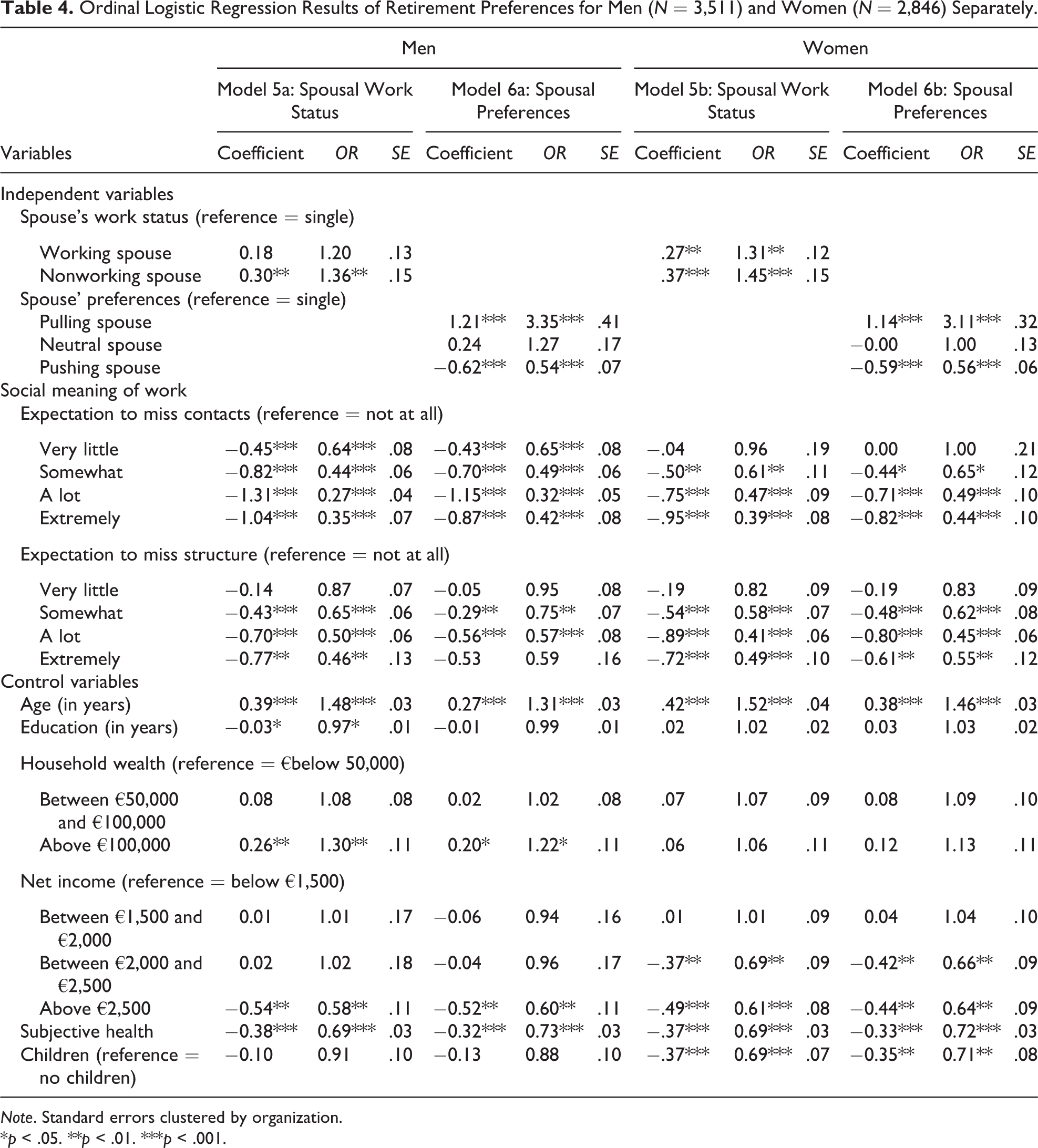
In a third step, we investigated the role of spousal pull in explaining differences in retirement preferences by relationship status in two ways (Table 4). In Model 5, we compared singles to workers with a working and a nonworking spouse. In Model 6, we compared singles to workers with a pulling, neutral, or pushing spouse. In both models, we accounted for the social meaning of work and all control variables. We used these models to test our spousal influence hypothesis.
Ordinal Logistic Regression Results of Retirement Preferences for Men (N = 3,511) and Women (N = 2,846) Separately.
Note. Standard errors clustered by organization.
*p < .05. **p < .01. ***p < .001.
Given that older workers were nested within organizations, we used clustered standard errors in all analyses (Stata Version 14: vce(cluster)). To gain some information about the size of the effect of relationship status on multiple dependent variables, we calculated Cohen’s d based on ordinary least squares (OLS) analyses with standardized dependent variables. Under these circumstances, the coefficient of dummy variables—such as relationship status—can be interpreted as the effect size Cohen’s d. All models are estimated separately for men and women, but we have no a priori hypothesis about how the results may differ by gender.
Results
The effect of relationship status on the social meaning of work is presented in Table 2. Models 1a and 1b show the effects of relationship status on workers’ expectation to miss contacts for men and women, respectively. For men, single workers expected to miss contacts significantly more than partnered workers (Model 1a). The size of this effect, based on OLS analysis, was small (Cohen’s d = .20). For women (Model 1b), we found no significant effect. Additional analyses showed that the effect was significantly stronger for men than for women (z = 3.23, p = .001).
Models 2a and 2b show the effects of relationship status on workers’ expectation to miss structure. For both men (Model 2a) and women (Model 2b), single older workers expected to miss structure significantly more than partnered older workers. The effect size was small for men (Cohen’s d = .19) and moderate for women (Cohen’s d = .25). In sum, our social meaning of work hypothesis was supported in three of the four cases. The exception was that single and partnered women expected to miss social contacts to approximately the same degree.
We now turn to the models explaining retirement preferences, our main dependent variable. Model 3 in Table 3 presents the effects of relationship status on retirement preferences for men (Model 3a) and women (Model 3b) separately. For both genders, relationship status affected retirement preferences in the expected direction: Single older workers were significantly less likely to prefer retirement than partnered older workers even when controlling for important sociodemographic and economic variables. The size of the effect was small for both men (Cohen’s d = .17) and women (Cohen’s d = .17).
Model 4 in Table 3 shows the effect of the social meaning of work on older workers’ retirement preferences for men (Model 4a) and women (Model 4b). The results lend preliminary support to our mediation hypothesis. Generally, workers who attached more social meaning to work had weaker preferences to retire soon. This held for the expectation to miss contacts and for the expectation to miss structure. The effect of expecting to extremely miss contacts and structure versus not expecting to miss these at all was of medium size for both men (contacts: Cohen’s d = .48; structure: Cohen’s d = .32) and women (contacts: Cohen’s d = .42; structure: Cohen’s d = .35). Using the KHB method yielded strong support that the social meaning of work partially mediated the effect of relationship status on retirement preferences. For men, the indirect effect of relationship status on retirement preferences via the social meaning of work was significant (b = −.12, p < .001) and accounted for 34% of the total effect. In Model 4a, the direct effect of relationship status on retirement preferences remained significant for men when adding the social meaning of work. For women, the indirect effect of relationship status on retirement preferences via the social meaning of work was statistically significant (b = −.06, p = .016) and accounted for 16% of the total effect. In Model 4b, the direct effect of relationship status on retirement preferences remained significant for women when adding the social meaning of work.
To test our spousal influence hypothesis, we first distinguished between partnered older workers with a working and a nonworking spouse and compared these two groups to single workers. We controlled for the social meaning of work and other relevant variables. Model 5 in Table 4 shows the results for men (Model 5a) and women (Model 5b) separately. As expected, singles were significantly less likely to prefer retirement than partnered workers with a nonworking spouse. This was true for both men and women, although the effects were small (men: Cohen’s d = .15; women: Cohen’s d = .16). When comparing singles to partnered workers with a working spouse we found, as expected, that the two groups preferred retirement to a comparable degree among men. For women, single workers were significantly less likely to prefer retirement than partnered workers with a working spouse. This effect was small (Cohen’s d = .12).
To investigate our spousal influence hypothesis more directly, we distinguished between partnered older workers with a pulling, neutral, or pushing spouse, based on spouses’ preferences for workers’ retirement. We compared these three groups to single workers, while controlling for social meaning of work and other relevant variables. The results presented in Model 6 in Table 4 support our spousal influence hypothesis for both men (Model 5a) and women (Model 5b). As hypothesized, single workers had a weaker preference to retire than partnered workers with a pulling spouse, but a stronger preference to retire than partnered workers with a pushing spouse. The effect of a pulling spouse was of medium size (men: Cohen’s d = .56; women: Cohen’s d = .54) and bigger than the medium-sized effect of a pushing spouse (men: Cohen’s d = .31; women: Cohen’s d = .28). Moreover, the preferences of singles did not significantly differ from those of workers with a neutral spouse. These results yield strong support for our spousal influence hypothesis: Single workers have weaker preferences to retire because they do not have a spouse at home who pulls them out of the labor force.
In the analyses above, we excluded 163 older workers who were dating but did not live with their partner. It did not seem theoretically justifiable to categorize these workers as either partnered or single because couples can have different reasons to live apart together (LAT; Liefbroer, Poortman, & Seltzer, 2015) which might result in varying degrees of closeness and time spend together. However, additional analyses (not shown) revealed that our mail results hold when categorizing workers in LAT relationships as either partnered or single.
To gain additional insight into the effect of relationship status on the social meaning of work and retirement preferences, we analyzed Models 1–3 while making additional distinctions within the group of singles. It might be argued that singles who are divorced, widowed, or never married differ from one another. We did not initially expect such differences with regard to our hypotheses. For all three groups, work is likely to be an important source of social contacts and structure (work domain) and none of the group has a spouse who might influence their retirement preferences (home domain). We tested these expectations in supplementary analyses and indeed found that likelihood to miss social contacts, likelihood to miss daily structure, and retirement preferences did not significantly differ between the three types of singles (results not shown). Moreover, χ2 tests revealed that the distinction within the group of singles did not significantly improve our models on the two mediators, men:
Discussion
The number of workers who reach retirement age as singles is substantial and increasing. Previous research has shown that single older workers intend to and actually do retire later than older workers with a partner (Van Droogenbroeck & Spruyt, 2014; Van Solinge & Henkens, 2014). Theoretical considerations moreover suggest that retirement is a more difficult transition for single workers than for partnered workers. The present study examines whether and how factors in the work and home domain can explain why singles prefer to retire later than partnered older workers.
We find support for our social meaning of work hypothesis which states that single older workers attach more value to the social context of work than their partnered counterparts and that this contributes to singles’ preference to retire later. However, this explanation applies to men to a stronger degree than to women. Single men, as compared to partnered men, rely on the contacts and structure provided by work more strongly. Single women, however, do not differ from partnered women in their reliance on contacts and only value the structure more strongly. This finding contributes to the literature on singles more generally. It shows that work plays a particularly important role in the social lives of single men. Singlehood is often associated with a disadvantaged position in society among men (Klinenberg, 2012). Our findings suggest that work benefits older single men by providing social meaning through externally imposed contacts and structure. Work might ensure a socially integrated life for single men and thus benefit their overall situation. The finding that singe and partnered women value work for the contacts that it provides to a comparable degree is in contrast to our hypothesis. Perhaps for women, work provides an easy and accepted way to enjoy social connections outside of the family. Upon retirement, partnered women tend to increase the time they spend with their spouse (Genadek et al., 2017) and on housework (Leopold & Skopek, 2018), and this may come at the expense of other social contacts. Therefore, partnered women might expect to miss contacts at work to the same degree as single women, but for different reasons. With regard to retirement, the special meaning of work for the social lives of single men and women plays some role in explaining why they are more reluctant to retire than partnered workers. Differences in retirement preferences by relationship status persist when the importance of work is taken into account, so clearly other mechanisms are at work as well.
The results of this study support our spousal influence hypothesis, which states that differences between single and partnered older workers’ retirement preferences can be explained by the influence from a spouse at home. Single workers do not have a spouse who “pulls” them out of the labor market and this in part explains why they want to retire later. Evidence for this is presented by the finding that the retirement preferences of single workers do not differ from those of partnered workers whose spouse has a neutral attitude toward the workers’ retirement. Interestingly, single workers actually prefer to retire earlier than partnered workers with a spouse who prefers them to continue working. The reason why single workers nonetheless prefer to retire later than partnered workers in general is that the influence of a pulling spouse is about twice as strong as the influence of a pushing spouse.
When interpreting our results, some limitations of this study should be kept in mind. First, due to the cross-sectional nature of our data, we were unable to empirically test the causality of the effect that a pulling or pushing spouse has on partnered workers’ retirement preferences. The results of this study might also be interpreted such that workers select spouses who find work similarly important and thus, at older ages, agree on the worker’s retirement or that, over time, workers influence their spouse’s preference for the retirement of the worker. In both cases, workers are not actually pulled or pushed, but spousal preferences simply reflect worker’s a priori preferences. However, previous research suggests that spousal influence plays an important role in the decision to retire and that at least part of the effect we find in the current study can be interpreted as causal (Henkens & Van Solinge, 2002). When taking workers’ preferences into account, spouses have been shown to be more likely to support retirement when they are concerned about the worker’s health, when the worker has a stressful job or when marital quality is high (Eismann et al., 2019; Henkens, 1999). This suggests that spousal preferences do not simply reflect workers’ preferences but have an additional influence on them. Directly asking spouses about their preferences for workers’ retirement is a key strength of our study, it cannot be ruled out that our results somewhat overestimate spousal influence.
Second, we do not empirically test whether our hypotheses hold for retirement behavior. Previous studies have shown that retirement preferences strongly predict subsequent retirement behavior (Henkens & Tazelaar, 1997; Solem et al., 2016) and that preferences and behavior are partially affected by the same factors (Dal Bianco, Trevisan, & Weber, 2015; Damman et al., 2015). However, preferences—as an early stage in the retirement process—are also important in their own right.
Third, our measures of the social meaning of work do not allow us to distinguish between the importance of social contacts and a daily structure and whether or not these are characteristics of workers’ current job. It is, for example, possible that workers think that contacts and structure are important, but that their own job does not provide these. In this situation, they might not indicate that they will miss these aspects of work upon retirement, because they miss them already or because they found ways to compensate for the lack of contacts and structure in ways that are also available upon retirement. In future research, it might be interesting to investigate the effects of the general importance of the social meaning of work separately from the satisfaction with the social meaning of one’s current job.
Fourth, we assume that the home situations of singles generally facilitate social interaction to a lesser extent than the home situation of people with a spouse. However, singles might live with their children or roommates. Unfortunately, we were unable to investigate the effect of the number of other residents in the household on the expectation to miss social contacts and a daily structure upon retirement. Research along these lines might be able to show whether living with a spouse affects the social meaning of work and retirement preferences differently than living with a child or roommate.
Fifth, any gender differences need to be seen in the context of the special cohort of women in the Netherlands studied here. In 2015, only 44% of the women aged 60–64 participated in the labor force (men: 68%; Statistics Netherlands, 2018a). This suggests that the women in our study are a selective group who are probably more attached to the labor market than the men in our study. Future cohorts of women might participate in the labor force to a similar degree as men. It remains to be seen whether gender differences in the social meaning of work persist under these circumstances.
Despite the limitations, our results provide valuable insights into the lives of single older workers approaching retirement. The prevalence of singlehood at older ages is substantial and likely to further increase in the future. Given that retirement is one of the major life transitions in older age, it is important to understand the context in which singles decide to retire. Our study is the first to look at differences in retirement preferences of single and partnered older workers from a nonfinancial perspective. We unravel the value of work for the social lives of singles. Based on multiactor data, we also show that singles do not only prefer to retire later because they do not have a spouse per se but also because they do not have a spouse who pulls them out of the labor market.
Footnotes
Declaration of Conflicting Interests
The author(s) declared no potential conflicts of interest with respect to the research, authorship, and/or publication of this article.
Funding
The author(s) disclosed receipt of the following financial support for the research, authorship, and/or publication of this article: This research was supported by The Netherlands Organisation for Scientific Research (VICI-grant 453-14-001 to K.H.).
