




Abstract
This paper explores the use of bumper-stickers to commemorate the dead. Commemoration stickers have become a widespread phenomenon in Israel since the October 7 attack and subsequent war: posted on various surfaces in public spaces, they memorialize victims of terror-attacks or fallen soldiers through a photograph alongside short texts, and often a QR code linking to online content about the deceased. Using this medium for this purpose is counterintuitive, because stickers are an ephemeral medium whereas commemoration usually assumes permanency. This tension between the medium and its purpose leads our analysis of the media-logic of these stickers. We argue that these stickers present post-digital commemoration practices, enacting the media-logic of online digital media in the offline realm, concurrently intensifying connectivity as a recursive link between their offline existence and online commemoration content. As commemorative media, stickers gravitate between communicative ritual and transmission, re-entangle time-space biases and reshape contemporary commemoration practices.
Introduction
This paper explores the use of bumper-stickers to commemorate the dead. Commemoration stickers have grown into an extremely widespread phenomenon in Israel since the October 7 terror attack and subsequent war. This violent escalation of the Israeli-Palestinian conflict, starting with Hamas’s invasion into Israeli villages and military bases around the Gaza strip and then the invasion of the Israeli military into the Gaza strip, resulted in the death of over 2000 Israelis and over 70,000 Palestinians. The stickers at the center of this study commemorate predominantly Israeli victims, though Palestinian commemorative stickers are also discussed. These stickers memorialize victims of terror attacks or fallen soldiers through a photograph alongside a short text, and in many instances a QR code linking to online content about the deceased. While they can be found on car bumpers and rear windows, they are even more prevalent on walls and fences, bus stops, train stations and light rail stations, lampposts, street furniture, and almost any other available surface in public space. These stickers have proliferated an integral part of the Israeli urban landscape, but can also be spotted in rural areas—especially around transportation hubs or along hiking trails—as well as outside of Israel. Disseminating visual representation of faces, names, and other personal information about the deceased, these commemorative stickers keep the dead present in everyday life, and as such can be understood as part of individual as well as communal grieving and memorializing processes. However, the choice to use this medium for this purpose is neither intuitive nor self-explanatory, and calls for exploring the use of stickers to serve as commemorative media.
Focusing on repurposing stickers to memorialize the dead, we analyze their media-logic, affordances and associated performances in the commemorative context. We posit that this new functionality is characterized by an inherent tension between the medium and its purpose that comprises a series of subsequent interconnected tensions between traditional and novel, institutional and popular, and communal and individual commemorative practices. Since the 1980s stickers have grown into an internationally popular medium to express opinions and offer a means to identify with causes and viewpoints, spanning a wide a range of topics, including political, religious, economic, and even philosophical themes (Reershemius and Ziegler, 2024). Commemoration is an uncommon and unusual function for stickers, reorienting predispositions in both sticker- and commemoration culture. We suggest that commemorative stickers do not replace traditional commemorating practice nor do they substitute established media for commemoration such as monuments or gravestones. Instead, they intermingle within the multilayered local commemoration culture as a medium designated to particular modes of co-remembrance. These commemorative stickers enact grassroots memory work that weaves digital and non-digital media and links offline with online activities in recursive, intermedial ways. As surface-adhering media, stickers are structurally entangled with mobility, an entanglement reconfigured by the smartphone as a key mediator interfacing multiple modes of participation. We therefore situate commemorative stickers within contemporary theoretical frameworks that foreground the intersections of media, mobility, connectivity, and commemoration.
Connective memory is a term developed by Andrew Hoskins (2011) to describe a shift initiated by digital media in memory culture and as an update to the heavily discussed role of traditional media in shaping collective memory (Cordonnier et al., 2022). Connective memory challenges the binary of “individual and collective remembrance” by perceiving memory “as a process of ongoing connections between people, objects, institutions, digital technologies, and digital media” (Ekelund, 2023: 2). Incorporating insights regarding the status of memory in participatory culture and the networked society (Jenkins, 2006; Van Dijck, 2013), the concept theorizes the memory work done through and by digital media. It reorients memory studies by shifting its emphasis from “major memory actors—such as the mass media and museums—and their production of memories for an audience to absorb” to the everyday memory work conducted by interconnected “individuals and groups” (Ekelund, 2023: 3–4).
Answering to similar digital-era transformations, Anna Reading’s globital memory (2016) foregrounds how remembrance is produced and circulated through infrastructures that are simultaneously global, digital, and mobile—highlighting datafied, platformed, and cloud-based memorial practices. Colin B. Harvey’s (2015) exploration of memory as transmedial and intermedial similarly emphasizes how remembrance migrates across media forms, with each medium’s affordances remediating and reframing what and how we remember. Taken together, these approaches do not disavow traditional, non-digital media; rather, they describe a “new memory ecology” in which hyperconnectivity renders memory a dynamic process shaped by remediation, translation, connectivity, temporality, and reflexivity across media (Hoskins, 2018: 8–9).
As a theoretical cluster responding to changes in media conditions and everyday memory work, these perspectives clarify the stakes of our case. Digital media and online platforms introduced new populations to memory practices and provided novel ways to do it (Ebbrecht-Hartmann, 2021; Navon and Noy, 2023). Commemoration stickers, we argue, further complicate the link between the medium used for commemoration and the rituals it facilitates. They blend characteristics that both perpetuate and problematize the communicative models of traditional commemorative media (e.g. monuments) and online platforms. Read through these lenses, stickers enact post-digital commemoration: they reproduce the circulation logics of online media—immediacy, mutability, and scale—in the offline realm, while recursively intensifying connectivity via QR codes and links to digital memorials; they operate as street-level interfaces to cloud-based archives and online platformed remembrance; and they serve as relay points through which memory moves and is re-authored as it travels between paper, profile, playlist, and memorial site.
Stickers reorient and intensify current memory work beyond its digital online features: while they are not digital media, the QR codes printed on many, act as offline extensions of digital media, sending passersby to visit webpages and online platforms commemorating the dead. In these webpages—a Facebook or Instagram page, a Spotify playlist, or a webpage dedicated to commemorating an individual—viewers find more information about the commemorated person. Commemorative stickers open a virtual trans- and inter-media space-time continuum of memory work that reshuffles key assumptions regarding the traditional role of media in commemoration practices. Stickers reintroduce aspects of offline, independent, not-necessarily digital, and not-always connected mediation to commemoration. Commemorative stickers call for rethinking contemporary memory work, its scope, mechanisms and implications. They are post-digital media because they require a reevaluation of the imagined divide between the digital online realm and the analog offline reality.
Furthermore, we suggest that commemoration stickers exemplify the repurposing of a medium to serve a new, unexpected and seemingly incongruous purpose. Stickers have been and remain researched through various lenses of functioning, from political and social protest to commercial and cultural expression. Commemoration is neither a common nor an established function of stickers, and they have rarely, if ever, been studied as a medium for mourning or memorialization. If commemoration aims at durability and honorability assumed by the value of remembrance, then stickers made of cheap and easily decaying plastic paper—usually serving political or commercial propaganda, and associated with dirt or street life—are not an obvious medium for commemoration purposes. On the other hand, the relatively simple process of producing and disseminating them, and their consequent prevalence, render them suitable for spreading a quick, self-designed, and vastly circulated message. Stickers thus popularize and democratize the act of commemoration as an everyday participatory act that has ethical, political and collectivizing implications. Seemingly simple in form, or marginal in communicative function, commemoration stickers actually embody complicated media relations.
Thus, commemoration stickers offer an avenue to study how repurposing an unexpected medium to counterintuitive context reshuffles some basic presumptions of a field, in this case, commemoration. While challenging its boundaries, stickers also integrate into its existing array of media. What features characterize this highly complicated linkage between stickers and their reassignment to commemorate the dead? How does repurposing this medium change commemoration techniques and the social values they imply?
Commemoration in Israel has been widely studied—including its mediations (e.g. Ben-Amos, 2019; Neiger et al., 2011; Zerubavel, 1997)—highlighting tensions between state-led initiatives and private actors. Stickers are widely used in Israeli public space, particularly in political contexts (Salamon, 2017). Yet their role as agents of memory has received little attention, and until recently they were not used to commemorate the dead, apart from two cases discussed here as predecessors of the current phenomenon. The October 7, 2023 terror attack—experienced by many Israelis as the most traumatic tragedies since the Holocaust—and the subsequent war in Gaza, which has resulted in extensive casualties, precipitated the rapid production and wide circulation of thousands of commemorative stickers. Their density has transformed public space, making commemorative stickers a pervasive feature of everyday life across urban and rural settings. Read in this context, the phenomenon can be understood as a way of working through private grief and collective mourning.
In this article, we first describe methodological challenges that arise with commemorative stickers and detail how we overcome them to structure the corpus and analyze the material. We then explore stickers as media and elaborate on the communication model they embed; this discussion informs the analysis of the current Israeli commemorative stickers and exemplify some of the main communicative aspects they conjure. We then anchor the commemorative stickers in historical context and address their political implications. The conclusion returns to the dual function of commemorative stickers as both message-bearing media and ritual objects. It also proposes commemoration stickers as infrastructures of memory, applicable across cultural, political, and medial contexts.
Studying stickers
Sticker research faces several challenges arising from the characteristics of the medium and its street-level reality. For this study we captured approximately 4500 photos of more than 1000 stickers between July 2024 and January 2025. The fact that the numbers are estimates reflects an essential methodological challenge that is part and parcel of sticker culture: many stickers appear in more than one documenting photo, and many photos document bundles of stickers. We included in this corpus only stickers commemorating named persons, whether as individuals or groups, most of them containing Hebrew texts that ran next to a photo of the deceased, sometimes including texts in other languages as well as symbols, graphic design elements or sketches, and frequently, a QR code. In many instances, several different stickers were created to commemorate the same person. This discrepancy was further complicated by the unavoidable decay of stickers and overwhelming pop-up of new ones that tragically reflected an increase in casualties as the war continued: sampling stickers was destined to always be partial, susceptible to changes in sticker appearance, disappearance, and reappearance of new stickers and their variations.
We embraced these challenges as reflecting both the messy reality of stickers in public spaces and their consumption experience; these guided our method of immersion and documentation by walking the landscapes in which the stickers are distributed (a common method in sticker research. Reershemius and Ziegler, 2024). Methodologically, mobility thus becomes a condition of encounter—stickers are found and apprehended through movement across transit routines, routes, and pauses. This allowed replicating the erratic and changing everyday encounter with stickers. Additionally, prearranged documentation field trips allowed sampling areas that were replete with stickers due to their central location, such as Jerusalem’s Central bus station, the Tel Aviv city center, or locations that connected to the October 7 events (e.g. the Nova music festival site or the outside shelters, where hundreds of people were murdered and consequently became memorial sites). We also received images of stickers from colleagues and friends and included them in our corpus. The combination of these methods allowed accumulating a relatively large corpus with a scope uncommon in sticker research. As such, we believe it covers a very wide range of this phenomenon.
To explore this relatively new phenomenon of commemorative stickers, this article centers on the medium itself. While future research may focus on aspects such as sticker production or content analysis, our aim here is to situate the repurposing of this medium within a range of contexts: analyzing its communicative functions, tracing the historical emergence of its commemorative use and its local social dynamics, and theorizing its role within the evolving landscape of commemoration.
The following dimensions informed our analysis but they are relevant to sticker research more broadly: (a) the sticker as medium, whose material, semiotic and functional qualities enable its operation in relation to other media; (b) the participants involved in the process: those who produce the sticker, place it in public or personal spaces, document it, or respond to it, whether offline or online. This also includes the communicative assumptions embedded in the sticker itself: who is the implied speaker, and who are its imagined audiences; (c) the location and context, which includes not only the sticker’s physical placement (e.g. object, surface, or environment) but also its syntactic relationship to other stickers or media, as well as its degree of mobility or permanence. In our corpus, these dimensions often intersected; accordingly, we present them in ways reflecting their mutual entanglement.
Beyond these general dimensions, our analysis also attends to features specific to the Israeli context, such as the local historical roots of the connection between stickers and remembrance, and the contemporary political stakes embedded in these acts of memorialization. Taken together, these dimensions allow conceptualizing stickers not only as discrete media objects but also as infrastructure for commemorative rituals operating within, and in connection to, a broader media ecology. This is not to deny the singular power of the sticker: encountering a sticker in the street can be a deeply affective and meaningful moment. But contemporary stickers appear to do more than simply signify; they activate, direct, and reroute participants toward other media platforms and modes of engagement, advocating a shared social and cultural imperative: remember.
Sticker culture
The use of bumper stickers is a globally widespread communicative phenomenon that can be regularly found in public spaces as well as on private items such as bags or the back of a laptop (Reershemius, 2019). They are an important, even if sometimes unnoticed, part of contemporary urban life and can be understood as means to communicate on noisy highways or as for a means to “vocally” reclaim public space. Cheap to produce and easy to circulate, stickers are especially popular among students, activists, and campaigners (Awcock, 2021). While associated with grassroots expression, they are often institutionally produced (Bloch, 2000), serving roles from political protest to commercial and artistic use (Vigsø, 2010). Visually striking and rhetorically compact, stickers aim to capture attention and deliver sharp, memorable messages that “stick” in the minds of passersby. Physically fragile and susceptible to damage from vandalism, weather, or neglect, they can nonetheless persist on surfaces long after their intended moment has passed.
Stickers perform a range of communicative functions, including facilitating social discourse and negotiating individual and group identities. Scholars have approached these functions through semiotic and pragmatic frameworks (Bloch, 2000; Salamon, 2017), or emphasized their performative dimension: posting, defacing, tearing, altering, or adding to a sticker becomes part of its meaning (Bodden and Awcock, 2024). While some passersby may overlook them entirely, others engage in diverse ways: honking in agreement, pausing to reflect, peeling them off, vandalizing them, or producing counter-stickers. Their communicative force lies in visibility, numbers, and repetition: stickers speak by virtue of their public presence, and through mass replication and circulation, they amplify the textual and visual messages they carry. Like other forms of street media such as graffiti, they repeatedly “shout out” into the urban environment, both blending into and helping define the visual noise of the city (Vigsø, 2010).
Stickers operate a basic communication model of anonymous announcer spreading the word to imaginary crowds, speaking concurrently to everyone and to no-one-in-particular at all. Yet this model is oftentimes much more complicated: some of the addressers and some of the addressees may be identified whereas others remain assumed and anonymous. This is also the case with some of the distributers: people posting stickers on their car or laptop are identifiable whereas stickers scattered on buildings around the city may not offer any connection to their distributors (Bloch, 2000). These changing degrees of anonymity that surround stickers contribute to their “aura of vox populi,” sounding alternative opinions, outside and sometimes in contrast to mainstream mass-media (Vigsø, 2010: 31). Nevertheless, they are not necessarily produced by zealous maverick citizens but rather may be funded by traceable organizations and corporations. Even their dissemination and posting are not always an act of underground exercise; they may depend on governmental infrastructure (Reershemius and Ziegler, 2024).
The spatial and contextual placement of stickers is crucial to their meaning. From a post-digital perspective, stickers have a reversing and complementary relationship to the “everywhere and nowhere” presences of online websites: while they are bound to a particular place, their dissemination in the “real-world” resonates with an effect of omnipresence. Stickers adhere to the surface they are posted on, but this does not mean that they are not mobile: people and vehicles carry them along, sometimes physically, sometimes emotionally, sometimes both. Using Innis’s terms, stickers are much more space-biased than time-biased: the ability to disseminate them compensates for their structural ephemerality.
However, using stickers as commemoration medium exhibits messier time-space relations. While commemoration aims at durability, as exemplified in traditional commemorative media such as gravestones, this is not one of the strongest features of stickers, leading to the question why do grieving families and friends who want to commemorate their loved ones use this medium for this purpose? Our discussion suggests that using stickers to commemorate widens the range of what commemoration is as well as the ways it may be practiced.
Commemorative stickers
Commemorative stickers afford grieving families and friends new avenues to work through their grief, both individually and communally. Producing, disseminating and posting stickers while concurrently documenting these actions, provide immediate ways to engage in commemoration work that does not strive for perpetuity or even the durability assumed by traditional commemorative media. Instead, stickers serve as affordable, easily produced and vastly circulated publications; they are a quick, mostly grass-rooted, response to a sudden loss. While they do not replace the traditional array of commemoration media and practices, they still integrate into it, enhancing it with new features and reordering aspects of its assumed communicative modes.
A striking example of this integration is the appearance of stickers on or next to the gravestones of those they commemorate (Figure 1). This double-layering of commemorative media marking the burial place may seem excessive; the sticker may seem redundant or out of context. However, the sticker’s colorful presence on a relatively standard, generic, and minimalist design of gravestones, especially in war graves, can articulate a wish to personalize and make the gravestone unique, distinguish it from others. The stickers subtly challenge the state-imposed uniformity of war graves, legally formalized in Israel in a 1950 law, and reflect an ongoing tension between state-sanctioned commemorative traditions and the private interventions of bereaved families (Kats, 2014; Weiss, 1997). Stickers continue a tradition of inscribing personal memory onto official sites of mourning, becoming part of a broader repertoire of commemorative items, including framed photographs or childhood toys placed near the grave. At the same time, adding a sticker to the traditional gravestone bestows the sticker with an aura of sanctity and respectability associated with the gravesite; it joins a chain of mediation of this sacredness that starts with the grave itself and spreads around town like ripples in a pond.
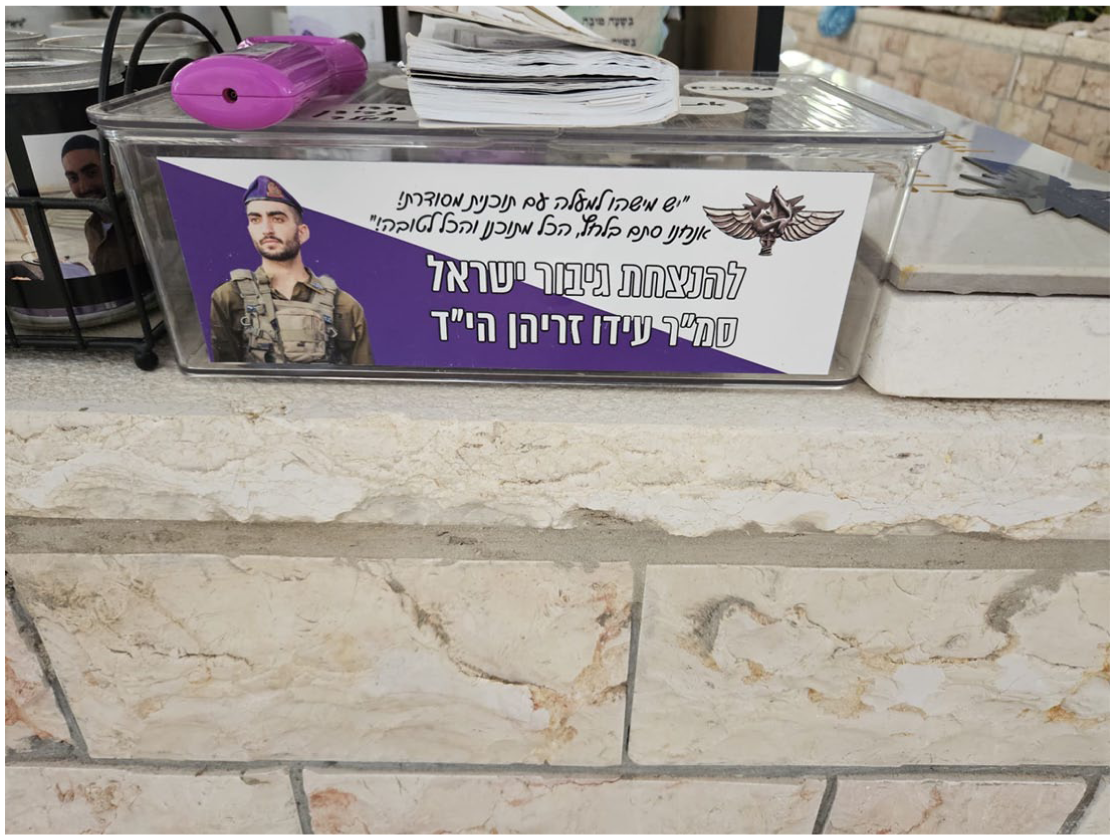
On a gravestone.
Moreover, placing a sticker on a gravestone can be seen as a ceremonial act, echoing the Jewish custom of leaving a small visitation stone. This gesture symbolizes respectful participation in the act of burial, signifies remembrance and marks an ongoing bond between the living and the dead. Stickers amplify this tradition by adding a more personal, colorful, and contemporary element. Though made of different materials and attached with varying degrees of permanence, both stone and sticker are metonymic extensions of the gravestone, symbolically repeating the burial as an act of care. Disseminating stickers across the city spatially extends this gesture, evoking a dispersed necropolis within the acropolis of everyday life.
This act of caring for the dead extends beyond the physical placement of stickers to the words they carry. Commemorative stickers disseminate the words of the deceased in the most literal sense: as part of what grew to be an esthetic and rhetoric convention, many commemorative stickers bear a message in the name of the deceased; some borrow a famous quote or idiom intended to capture the spirit and character of the deceased whereas others are presented with a direct quote, as if the dead is speaking through the sticker, sending a final prime dictum. These texts vary between general statements that become a bit less well-worn when attributed to the dead—for example, “you only live once” (Figure 2) or “smile as if there’s no tomorrow” (Figure 3)—and messages that weave a net of intertextual relations to famous dictums, poems, and pop songs, thereby associating the dead with both general and local cultural references. Other stickers quote the deceased, borrowing from their social media statuses or other texts they composed when they were alive.

“you only live once”.
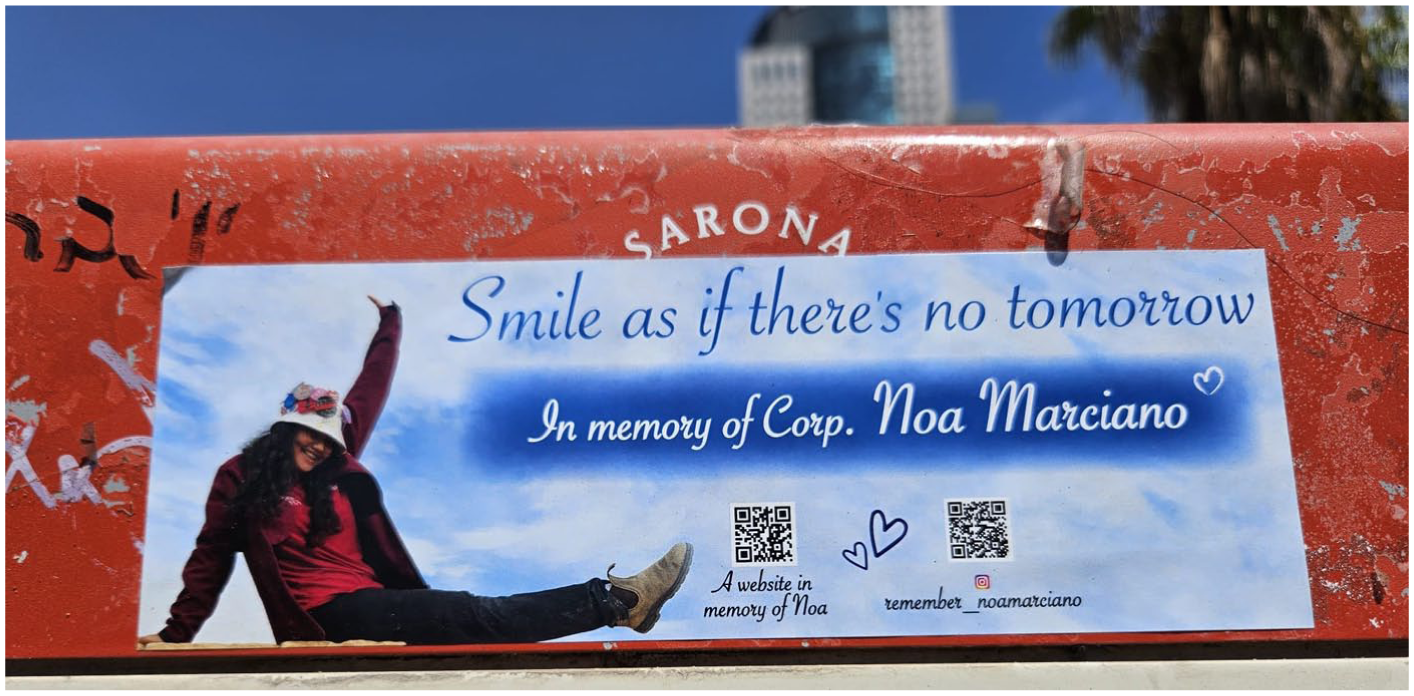
“smile as if there’s no tomorrow”.
The notion of structural anonymity that frequently characterizes stickers as a media is habitually foregone in commemorative stickers because most publicize a name and face of an addresser to whom the text is associated, even when not a direct quote. In contrast to many other sticker genres, they grant a face and name to the sticker’s message. The dead speak to whomever sees their final message. However, these fallen soldiers and victims of terror did not initiate the publication of this text. Nor did they decide on their association with it. They did not choose to become a sticker; others chose it for them. The producers of the sticker assume a significant role in designing it and choosing its message, addressing the public through the sticker in the name of the deceased. They invite passersby to participate in their private grief, join them in commemorating their dead, and even learn something about that lost person. As such, commemorative stickers include both the dead and the living as participants in their communicative act, repeatedly reinforcing media’s longstanding deep commitment to communicate with, for, and as the dead (Peters, 1999).
As for the spectators, the condensed messages in these commemorative stickers require some hermeneutical unpacking: their design in shapes and colors, texts and choice of fonts, the images and symbols they present, and the interrelation between these elements, compel meticulous attention and interpretation. Since an encounter with these stickers is generally an incidental, disrupted, on-the-go experience, such an attentive reading is rarely possible. But stickers may nevertheless “stick” in the memory of passersby who carry with them the visual and verbal message; those passersby may recollect and interpret them later. The ubiquitous nature of the stickers may lead to repeat encounters with them pondering over their messages. Similarly, the QR code on many stickers provides an opportunity to learn more about the person they commemorate, even after viewers continue on their way.
Commemorative extensions
With a complex media history of its own (Nguyen, 2024), the introduction of QR code to stickers augments their communicative potentials. This code rearranges the sticker’s temporality and spatiality by linking the offline sticker to online content associated with the person the sticker commemorates. Its angular black and white pattern is decipherable only by machine vision; it does not disclose the content that awaits the human viewer upon scanning. It involves other media, including a smartphone, its camera and scanner app as infrastructurally mandatory to access the online information linked to the sticker. The QR code transforms the sticker to be not merely a sticker but also a multilayered media experience that enfolds into much more than meets the eye. In addition, or as an alternative to a QR code, some stickers carry usernames of particular websites, such as Instagram or Spotify, encouraging the viewer to actively search the username of the deceased. These usernames and QR codes link the sticker to the online realm, signaling to its offline viewers that there is more to see, hear, and learn about the deceased. Passersby can scan the code or search the websites as they continue on their way, participating in the commemoration act while mobile.
Stickers and smartphones thus function as complementary media within a shared ecology of movement. Stickers are carried and placed “along the way,” especially at transit hubs—spaces shaped by both movement and waiting. The smartphone, carried on the body and almost always within reach, becomes central to documenting stickers and accessing their commemorative content, reflecting an embedded assumption that passersby are always accompanied by their devices and are therefore potential participants in intermedial commemoration work. Commemorative stickers are typically fixed in street-level places, yet rely on passersby and on the smartphone’s mediation to move them between offline and online spaces.
While in most stickers the digital extensions such QR codes are positioned in a corner of the sticker, some integrate them into a unique layout, or exclusively organized around them as their main graphics (Figure 4). These build on the mysteriousness of their design to boost viewer curiosity and entice them to scan the code. Stickers with these features exist on two interconnected communicative levels: their offline existence is strongly felt in public spaces, independent from, and always already interlinked to the online platforms that enrich their content beyond what is representable offline. Spatiality, the QR code, or the username—and by extension, the sticker as a whole—serve as offline promoters for the dead’s online presence and as gates transporting viewers to that online content. They open an augmented expense of mourning and commemoration that stretches between offline stickers and online websites commingling virtual and physical modes of remembrance.
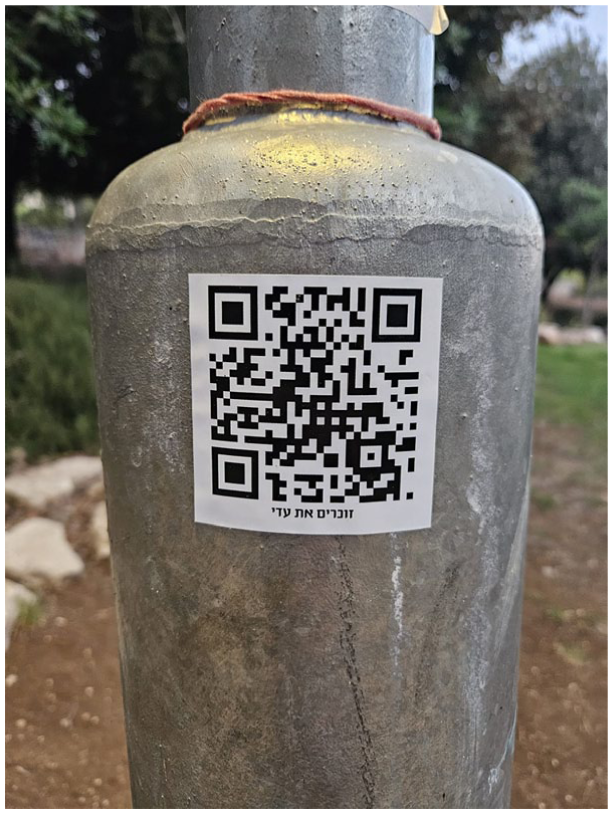
QR code as main graphics.
This blending resonates with reanimating: building on the digital remains of the deceased—pictures, videos, sound recordings and other traces of their online activities when they were still alive (Lagerkvist, 2018)—means revoicing and animating the dead in the most literal sense, using audio-visual content. Innovative scanning apps allow users to “revive” the offline sticker, converting the still photo into a video on the screen, thus enlivening the dead based on live content. Commemorating stickers are post-digital remains of the dead, entangling their online and offline presence with that of the living, drawing a striking contrast between the vivid and animated content, the stillness of the sticker, and lifelessness and muteness of the dead. That the dead will never express themselves again, online or offline, underlays the sticker’s tragic “noisiness” in the public sphere. Simultaneously, the material temporality of the dead is finite, yet the digital content has a “live” running time in which the dead are still moving, smiling, dancing and speaking. Thanks to media’s reanimating power, in these videos the dead are “alive” for eternity (Kopelman and Frosh, 2023). Furthermore, online content habitually continues to evolve: viewers may comment, share, repost and create new content related to the dead, keeping them remembered and the commemorating website alive. Commemorative stickers mediate “continuing bonds” between the living and the dead and the mix of offline and online modes of commemoration (Frankenburg and Oreg, 2024).
Commemoration as recursively intermedial
An invitation to engage with the online content of the dead also means that content never intended to be commemorative and directed toward online circles of followers such as family and friends is now repurposed and shared with strangers who stumble upon the sticker on the street. Undeniably, this appropriation of content as well as reanimation of the deceased have always characterized the relation between media and the dead: for example, when a particular picture decorates an invitation to a commemoration ceremony or when an online video algorithmically reappears as part of a Facebook feed.
Continuing this by-now established repurposing of media-remains, commemorating stickers provide novel types of posthumous encounters that still challenge some basic conventions regarding the honorability of commemoration, be it offline or online. They problematize issues of privacy, publicity, exposure, sharing, and ownership. First of all, most stickers present a picture of the deceased, and the duplication and wide circulation of that picture may surface in surprising contexts such as on trash bins or on the wall of a popular wine-bar. In that respect, stickers are blended into daily life akin to how social media feeds commemorating content after or before funny cat memes. Second, a QR code invites occasional viewers to online content regarding this person’s life that otherwise would have never enjoyed this kind of exposure. Thus, stickers reorient and recontextualize digital remains of the dead while intensifying well-known ramifications of digital social media: they bolster the influence of an online profile posthumously, pushing the boundaries of the social media bubble beyond its regular and contextual scope, to sound out the voice of the dead beyond their online platform’s echo chamber. While most stickers originate within the deceased’s community, their wide circulation, sometimes reaching abroad, can prompt strangers to engage with online commemorations. Some bereaved families publicly indicated this extended reach as a key motivation for creating the sticker (Kan Digital – Israeli Broadcasting Corporation, 2023).
The commemorative expense to which stickers are entryways is also characterized by a recursive relationship between offline and online media: for example, documentations of various performances related to the stickers are uploaded to the commemoration webpage. Friends and family of the deceased upload footage of themselves posting the stickers offline as ceremonial participatory acts in the commemoration community. Commemoration becomes a recursively connected loop of intermediation that links back and forth between an offline sticker and the related online content. This addition prolongs the sticker’s media-life from its structural ephemerality: while the offline sticker may be torn down or fade in the sun, when it is documented online, it remains untouched, fixed and fresh in documenting the (recurring) one-time event of posting it. Nevertheless, it is still subject to online decaying patterns such as broken links, lack of maintenance of websites, or dissolving into the oblivion created by the extensivity of online aggregation and flow of content.
Thus, stickers may be described as gravitating between the place-bias of monolithic statues and the everywhere-and-nowhere of online content, between the timeliness of its offline presence and the temporality of the ever-flowing stream of online content. Similar to traditional commemorative media like monuments, which require ongoing maintenance, and to ephemeral rituals performed around them, commemorative stickers—particularly those incorporating QR codes—depend on intermedial circulation to extend their visibility and reinforce their endurance. Their connectivity conjures durability that is mediation- and remediation dependent.
This infrastructural connectivity widens and deepens human engagement in a similar recursive loop. Uploading documentation of repeated one-time events of posting stickers in public spaces invites followers of the commemoration profile, who did not necessarily participate in its offline dissemination, to join online commemoration practice. Figure 5 presents an Instagram commemoration page in which users commented on a video documenting posting of stickers in Ko Samui, Thailand, a popular tourist destination of young Israelis: “We will remember you forever, bro”; “We will make sure that everywhere around the world you are well-known”; and “You accompany us wherever we go.” These comments reveal some of the motivations behind the production and dissemination of commemorative stickers. They also point to complementary commemorative practices: commenting on, liking, and sharing documentations of sticker-posting extend the offline act through online, post-factum engagement. Not only do this online participation resonates with offline performances such as adding texts to stickers with a marker, it also harnesses social media’s algorithmic rule to grow the commemoration community by increasing online exposure of commemorating the profile. Adhering to the digital like-economy, sharing and liking content related to the deceased primes the commemorative profile and bolsters it up the algorithmic social media ladder.
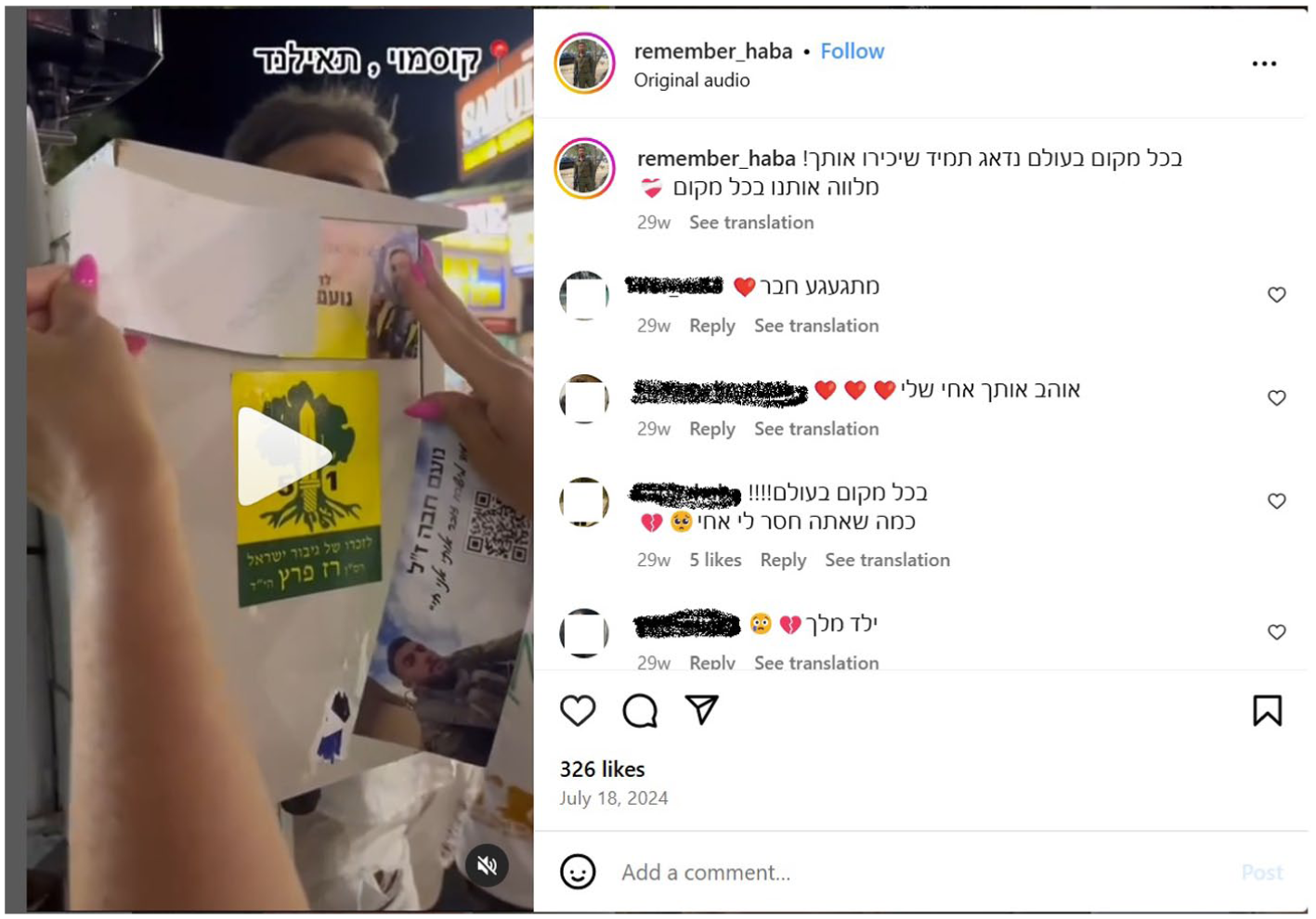
Instagram commemoration page.
These particular comments in which friends and family of the deceased address their dead posthumously are not rare; they exemplify well documented behavior of engagement with media associated with the dead (Navon and Noy, 2022). Similarly, the sticker becomes reminiscent of the dead and a token or symbolic totem of that individual. Referring in particular to journeys abroad, the deceased’s friends carry the commemorating sticker as if they are taking their friend with them on their journey, turning mobility itself into a commemorative ritual. Carrying their loved-one as a sticker, posting the sticker wherever they go, documenting these postings and commenting about them on the commemoration webpage—all of these acts become a circular ritual of commemoration habitually mixing online and offline interconnecting media. It also marks the strengthening of a grieving community to which passersby, whether offline or online, may enter. The connectivity of the commemorative media doubles in the human connections mediated by various means available; commemorative stickers are positioned at the heart of this human-and-media networked community of remembrance.
Indeed, at least in the case of contemporary Israel, stickers are part of wider contexts of commemoration materiality and a visual culture of a society at war: graffiti and posters calling for the release of the hostages, signs and stickers protesting for and against the government, its policies and the continuation of war, and billboard ads aiming at boosting morale; some stickers announce “refuse to become a sticker” (Figure 6), hijacking the attention of passersby and people posting stickers to publicize a political stance (we will return to this point in a later section). Similarly, stickers are part of a plethora of commemorative items: roadside memorials, T-shirts and mugs, artisanal beer or wine bottles, calendars and magnets to put on the fridge among other items, all created to honor an individual and generally connected to their liking, taste, or lifestyle.
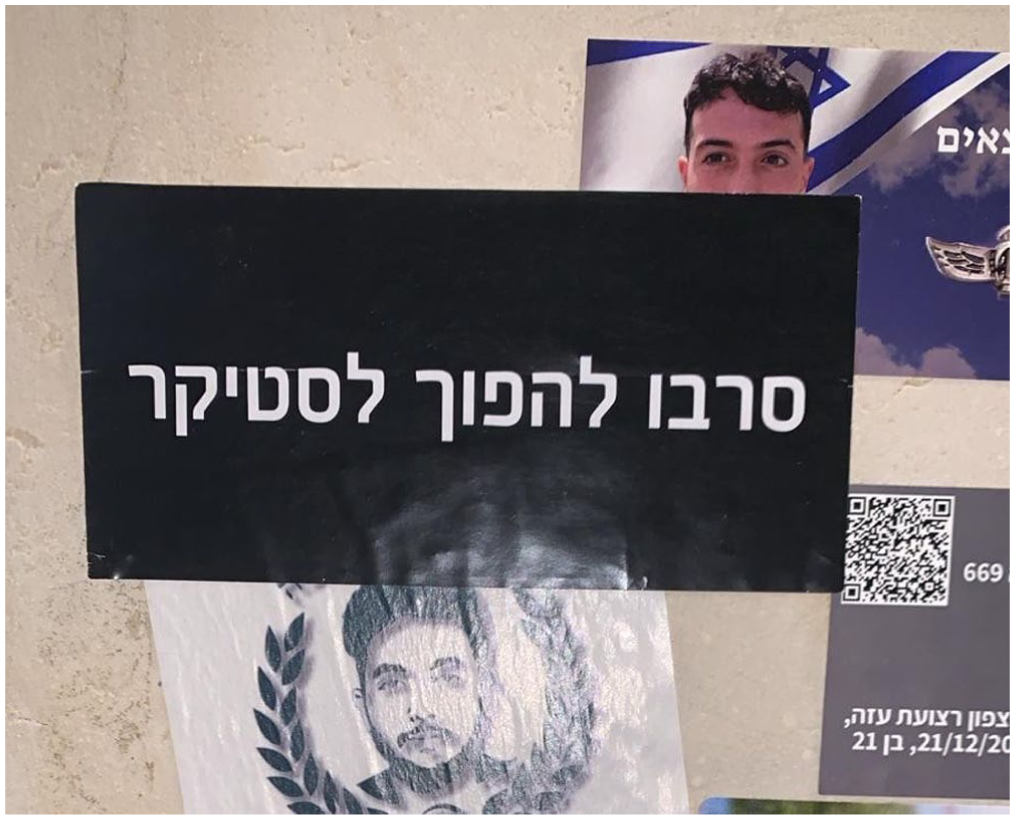
“refuse to become a sticker”.
Nevertheless, commemorating stickers remain the most widespread and visibly prominent medium in the contemporary Israeli context of war and bereavement. Their discernibility is crucial to their communicative potency; as such, they connect with more traditional paper-based mourning postings in Israel such as public death notices or obituaries in newspapers. However, common death-notices are plastered on walls and function as strictly informative posters, letting the public know that a person passed away and when and where the funeral and Shiv’ah observance will take place; newspapers or social media obituaries share more about their personality and life. In comparison, commemorative stickers present an odd mixture of these aspects: they share the news that a person died, adopting a very colorful medium to do so; some commemorate the dead by celebrating elements of their lives, such as the aforementioned quotes, yet deduce these lives into one short sentence or paragraph.
Within all of these contexts of a material and visual culture of bereavement, stickers compete for a passerby’s attention in a very crowded atmosphere, offline and online. The offline presence of stickers resonates with and possibly imitates online competition over attention: stickers compete not only with other genres of stickers and posters (political, commercial, and artistic) but also with other commemorative stickers that may appear bundled together (Figure 7). Posting as many stickers as possible and doing so in surprising locations may increase the sticker’s visibility, especially in areas crowded with stickers. It may also make the stickers fade into the hodgepodge of street life scenery. Designing a sticker that is remarkable and unusual in terms of shape, size or color is another way to stick out.
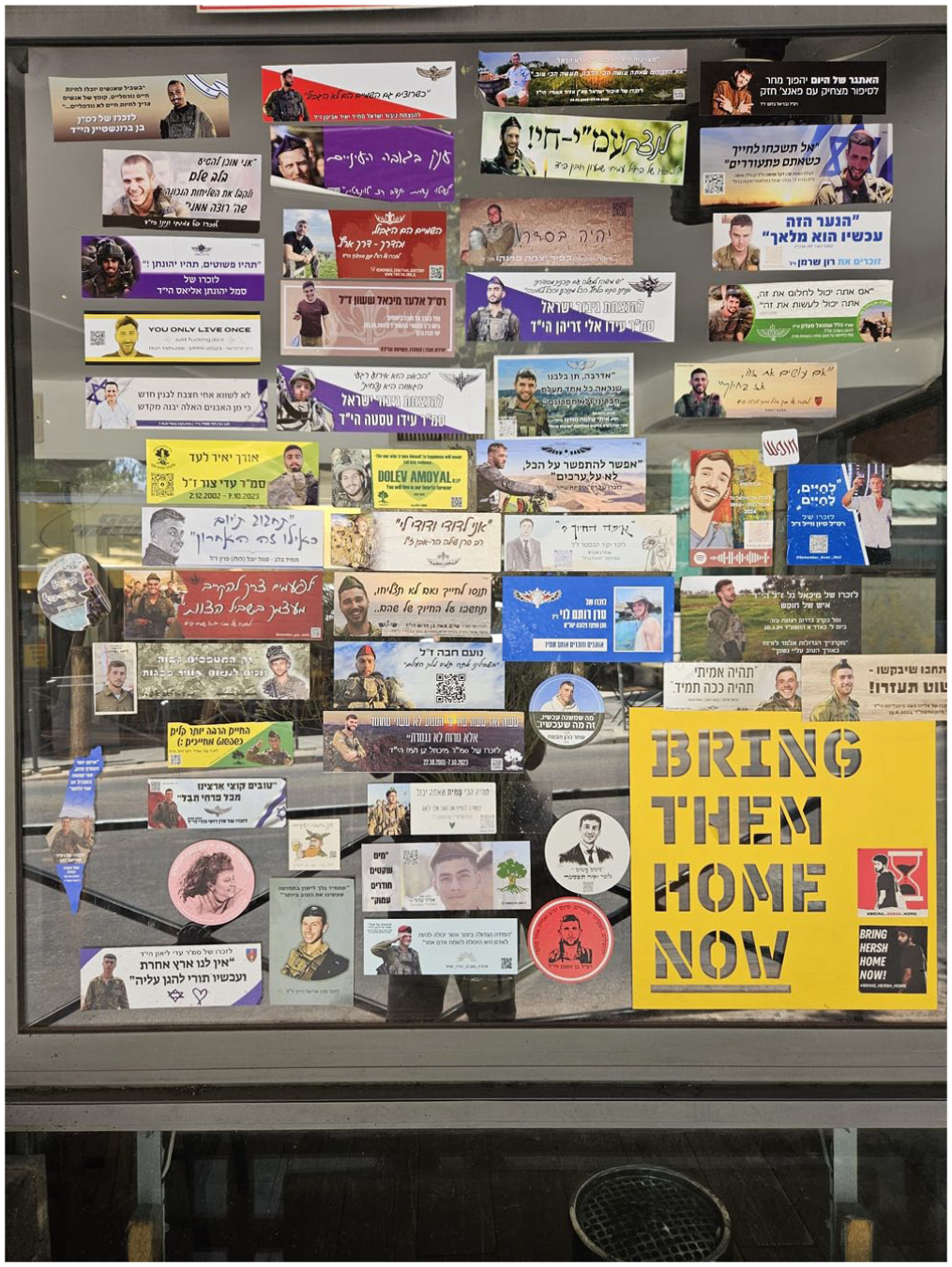
In a bundle.
In their competition over visibility and public attention, commemorative stickers align with long-standing debates about the priming and publicity of memory and its agents (Szpunar, 2010). Many of these stickers share graphic similarities that suggest an underlying infrastructure facilitating their production—such as stationery shops or online printing services offering pre-designed templates. In some cases, companies use stickers to advertise online commemorative platforms, promising to create and maintain dedicated memorial websites and to produce QR codes printed on weatherproof metal plaques that families can affix to gravestones. Formal institutions have also entered this space: for example, the Israeli National Insurance website provides a template for printing commemorative stickers. Because of their media characteristics, stickers both integrate into and contribute to the industrialization of commemoration, joining existing media platforms and inspiring sticker-like memorial ventures.
Between memory and politics
The primary matter that this article seeks to unpack is the tension between stickers as a form of media and their repurposing as a mode for commemoration. The previous sections characterized stickers as media vis-à-vis their functionality in commemorative contexts. The history of Israeli sticker culture provides another angle, linking a contemporary phenomenon to at least two precedents of using stickers for commemoration. The first case is the Yizkor stickers used on Israeli national memorial days, dedicated to the commemoration of fallen soldiers and victims of terror (Figure 8(a)).

(a) and (b) Yizkor stickers.
Since the 1960s, this sticker has been produced in several iterations of a basic design: the word yizkor (remember, in Hebrew) taken from traditional liturgy of commemoration rituals, appears in black next to a red flower, usually Dam Hamakabim (blood of the Maccabees), an everlasting endemic flower that since the 1940s has been associated in modern Hebrew culture and Israeli society with grief over fallen soldiers. The sticker replaced the custom of pinning an actual flower to the shirt, a localized version of the British tradition to commemorate fallen soldiers by pinning a poppy flower.
In contrast to most commemorative stickers in our corpus, the traditional Yizkor stickers are general and symbolic: they do not commemorate individuals nor do they include names or faces; their minimalistic design focuses on the flower and directive to remember, a key concept in Jewish thought and tradition (Yerushalmi, 1982). Yizkor stickers grew to be a popular signifier of participation in collective grief, subsequently influencing the design of some current stickers whether as a variation of their graphics—to which details of a particular deceased are added (Figure 8(b))—or as a motif integrated into another outline. These current commemorative stickers continue the Yizkor sticker tradition and enjoy its aura of dignity and respectability. In fact, commemorative stickers that do not integrate elements from the Yizkor tradition still maintain its media-logic of employing a sticker to memorialize; that their design is generally committed to specific individuals underscores the particularization and personalization of the Yizkor genre.
Another precedent of using stickers as commemorative media is that of the Shalom Ḫaver (“goodbye friend”) sticker, created to commemorate Yitzhak Rabin (Figure 9). Citing 1995 US president Bill Clinton’s memorable dictum, spoken in Hebrew during his first public remark after the Rabin assassination, this sticker was extremely widespread, with dozens of variations over the years, primarily researched in the context of “politics and shared identity” (Salamon, 2017: 18). Commemorating Rabin’s legacy of striving for peace was undeniably a key feature of this sticker, captured in its message: the Hebrew word Shalom denotes both goodbye and peace and the word Ḫaver means friend. Through the years, variations of this sticker moved away from the commemorative function toward political associations.

Shalom Ḫaver.
While this sticker did not start a tradition of using stickers for commemoration purposes, we did trace sporadic instances of commemorative stickers dating to the last decade. Nevertheless, some characteristics of the current commemorative stickers can be traced retrospectively to the Shalom Ḫaver sticker. First is the use of a dictum as a key message, one phrase encapsulating layers of meanings that symbolize values and viewpoints, such as peace or friendship; a major impetus for this sticker’s communicative impact resulted from President Clinton’s quote commemorating his friend Rabin as a fighter for peace. As noted earlier, appropriating an idiom or a saying to capture the spirit of the deceased grew into a convention in contemporary commemorative stickers. However, in contrast to this feature, the “Shalom Ḫaver” phrase was not uttered by Rabin during his lifetime but rather said to him as a farewell after his death. Some contemporary commemorative stickers also adopt this custom, offering a greeting or aphorism addressing the dead as a farewell (Figure 10). In these stickers, the addresser is not the deceased but rather the producer of the sticker. Upon reading this farewell sentence, passersby accept the sticker’s invitation to join the collective act of farewell.
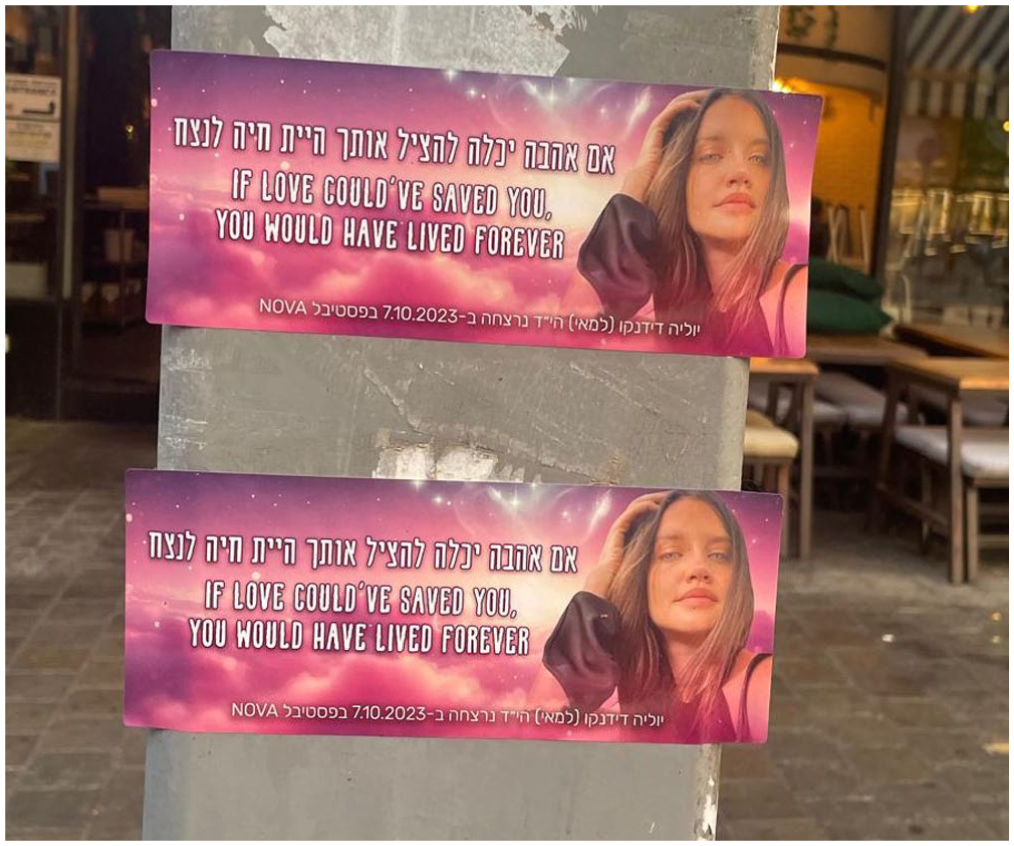
Addressing the dead as a farewell.
A second commemoration aspect inversely ties contemporary stickers to the Shalom Ḫaver sticker and that is their design, or what is absent from it. Rabin’s figure or name did not appear on the original “Shalom Ḫaver” sticker but because he was so well-known, the absence of these details visually resonated his loss and disappearance from this world. In contrast, most of the deceased individuals commemorated in the current stickers were not well-known public figures; their faces were not familiar prior to their death. Their representation on stickers transforms their relative anonymity by making their image and names present in many copies in the public sphere. Tragically, these stickers make the dead famous posthumously. Arguably, disseminating stickers and making their faces and names appear everywhere constitutes an attempt to counter their actual loss and absence. In essence, the current commemorative stickers may be understood as a wish to cling to media-traces of the dead—texts, photos, videos—by multiplying these traces and making them public, whether offline or online.
A third aspect connecting some contemporary commemorative stickers to the Shalom Ḫaver sticker is their political association. While political associations were relatively explicit in the Shalom Ḫaver sticker, they are not necessarily as easily identifiable in commemorative stickers. Only a small, and marginal number of stickers present themselves as commemorating the dead from a political stance. We provide two examples. One is a group of stickers that repeat the message Ad HaNitzaḫon (‘till victory. Figure 11). The group behind these stickers is HaGvura Forum (Heroism Forum), an organization of bereaved families calling “to continue the fight against Hamas and other terrorist organizations with all force until a complete victory is achieved” (HaGvura Forum Website, 2024). These stickers present their message as a designed logo next to changing pictures of the dead (with or without an additional dictum); this format closely imitates other commemorative stickers, employing conventions of a dictum associated with the dead as their last saying to propagate a political agenda, as if the dead support the fighting “with complete force until a complete victory [is attained].” The agency given to the dead by these stickers serves to support the actions of the living, as if this is the dead’s last request. The political overtone of this entreaty contrasts strongly with most commemorative stickers where the dead primarily call for much apolitical and general goals such as the aforementioned “smile as if there’s no tomorrow.”
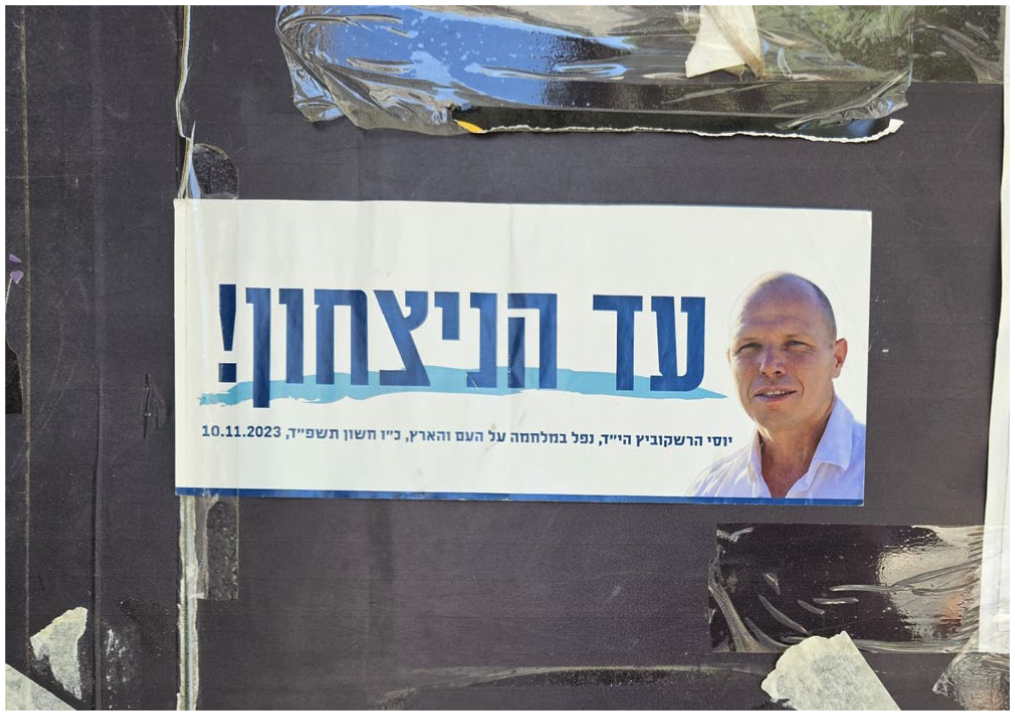
View Ad HaNitzaḫon.
Another group of political commemorative stickers commemorate Palestinian victims (Figure 12(a) and (b)). In contrast to the HaGvura Forum’s stickers, the producers of these stickers are unknown. Many of these stickers share similar graphic elements that suggest that they were produced by organized activists. Some stickers recount the lives of the deceased, others highlight the circumstances of their death, and still others display only a name and photograph. These stickers follow a popular format of stickers commemorating Israeli victims. Two stickers we documented in Tel-Aviv reiterated the slogan “it is mandatory to resist the genocide in Gaza” and on the margins, in vertical was a name of a group we could not trace, “Queers against genocide” (Figure 12(b)). Akin to the stickers produced by Hagvura Forum, the commemorative aspect becomes a vehicle to promote a political agenda in an underground, counter mainstream approach of hijacking the esthetics of other commemorative stickers, competing for attention on the same turf. Posting stickers commemorating Palestinian victims alongside the ones commemorating Israeli victims and fallen soldiers creates a syntax generating a political argument that might be interpreted as a general but intense reminder to the cost of war and the blindness of death in wartime. These stickers expose the implicit political message incorporated in the main corpus, through their scarcity within it.
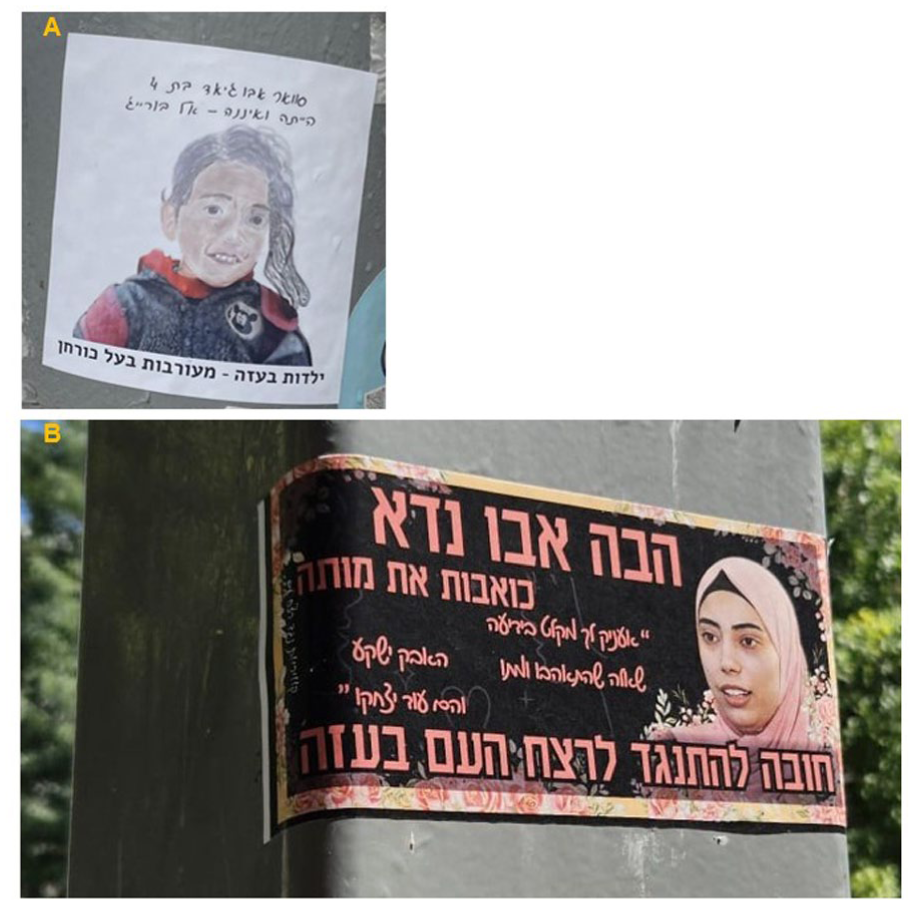
(a) and (b) Commemorating Palestinians.
Although political commemorative stickers constitute a much smaller portion of our corpus, they serve as a reminder to the political functionality of stickers as a medium. Even when their primary goal is commemorative and their messages are presented as apolitical or general, stickers are political by just being. Stickers enjoy a long tradition engaging in democratic expression of opinions, independent from mainstream media (Bodden and Awcock, 2024). Commemorative stickers are inherently political because they amplify the shout-out of grieving families, shaping it as a political scream. Stickers stuck on thousands of surfaces protrude representational puncta (Barthes, 1981), that precede subsequent social and cultural hermeneutics, and remind passersby of the cost of war and terror, not allowing the forgetting of the dead by materially piercing the public sphere with their mediation of ghostly representations (Chouliaraki, 2006). Seen everywhere in large numbers, these stickers keep the war present in daily life and set the frame to every political stance about it. Their ubiquity commemorates not only individuals but the war itself.
The stickers’ salience also draws several kinds of criticism: some argue that using stickers as a means to commemorate is disrespectful to the dead and criticize the banalization of commemoration such practices manifest; others protest against contaminating shared public sphere with eroding plastic, criticizing in particular dispersing these stickers outside Israel. Some municipalities tried to tackle the flood of commemorative stickers by repeatedly pulling them off and cleaning the surfaces on which they were posted; when stickers reappeared on the same surfaces, some municipalities tried to allocate dedicated boards and authorized sticker areas, but this did not limit the reappearance of stickers in urban landscapes.
Conclusion
The model underpinning this study—attending to the sticker as medium, its participants, spatial context, and infrastructural functionality—offers a transferable framework for analyzing stickers across cultural and political settings. Even in commemorative contexts, where the surface message may appear purely memorial, stickers often carry layered traces of political, esthetic, and commercial logics. Such intersections reveal the multifunctionality of stickers and their infrastructural role in sustaining memory across diverse symbolic registers. The model presented here thus invites broader application: to understand how stickers function not only as signs of grief or protest, but as transmedia networks embedded in dynamic, post-digital reality—concerning memory, or otherwise.
In doing so, the study complicates the media-memory relation by showing how connectivity and mobility of commemoration emerge through recursive interactions between material surfaces, digital platforms, and embodied, street-level practices. Stickers, whether commemorative or not, are more than simple, ephemeral media; they are interdependent transmedial infrastructures through which memory, identity, and meaning circulate.
As such, they give rise to a mode of commemoration rooted in immediacy, mobility, dispersion, and visibility rather than durability. Here, remembrance is not carved in stone but scattered in multiplicity, privileging presence in the present over permanence in the future. Yet stickers do not commemorate alone. They operate within a broader media ecology: gravestones, digital platforms, and shared rituals work alongside them, amplifying and extending memory across recursively interconnected formats. In this networked landscape, commemoration becomes provisional and distributed—not a fixed monument, but a process in motion. Commemorative stickers invite us to rethink what memory looks like when it must move fast, circulate widely, and compete for space in both physical and digital life.
Footnotes

Funding
The authors received no financial support for the research, authorship, and/or publication of this article.
Declaration of conflicting interests
The authors declared no potential conflicts of interest with respect to the research, authorship, and/or publication of this article.