




Abstract
The media sector has expanded in the 21st century to encompass a ‘hosted model’ of circulation and ‘simple-professional’ dynamic of cultural production that coexist alongside long dominant ‘complex-professional’ norms. This article begins developing a conceptual frame for understanding these new variations in cultural production that addresses continuities and differences in creative autonomy and relationships with organizations that circulate hosted media goods. A necessary component of this conceptualization is appreciating the ‘micro-media logics’ that largely replace the mass-media logics underpinning the video media sector in the 20th century to create a radically changed context of consumption. Although hosted cultural production is commonly regarded as more autonomous and freer from formal gatekeepers, the continued pursuit of commercial ends maintains constraints of capitalism. The unlicensed relationship with circulation services may introduce greater autonomy in circulation practices in some regards but leaves media makers without the recourse enjoyed under complex-professional dynamics formalized in licensed arrangements. The article focuses on the video sector as one particularly transformed by the capacity for creators across hosted video services such as YouTube, TikTok, and social media but with an eye to more broadly conceptualizing hosted circulation.
We are overdue in developing conceptual maps of media industries that include ‘creators’ and the dynamics of media making and circulation that enable them. The mode of cultural production that dominated 20th-century theory building and was assumed as ‘normal’ of media operation now persists in parallel with newer dynamics. The ‘new media’ environment of the 21st century regarded by some as ‘creator culture’ or the ‘creator economy’ has attracted much interest from scholars but little systematic conceptualization.
Historically, critical scholarship about cultural production (Du Gay et al., 1997) Hesmondhalgh, 2019) has been motivated by building a foundation for understanding the dynamics of production and circulation that produce cultural goods important to individuals and social processes. Much of this work has focused on questions around labor dynamics in making media, though the circuit of culture framework illustrated that critical scholars also understood changes in production and circulation could adjust the features of the cultural goods created, and that the changes in cultural goods could have implications for media’s social function. 1
The expanded capacity for the creation and circulation of media outside of gatekept, legacy, complex-professional dynamics (Hesmondhalgh, 2019) is a substantial development from previous norms of cultural production. Media goods produced by the so-called ‘creator economy’ are not the only cultural goods most users want, but they have become a significant part of media diets and have captured enough attention in the marketplace to redefine the playing field of the rest of the sector. The scope of their use is somewhat hidden by the largely fragmented consumption conditions now typical. A handful of creators or type of content may be somewhat widely known (MrBeast; Logan Paul) but such cases do not capture the depth and breadth of cultural goods produced under dynamics notably different from historical structures and practices. What is generally regarded as the ‘creator economy’ persists without clear conceptualization of its distinction from established practice or internal variation. Its structural disparities from predigital norms of media operation are poorly understood and three differentiating factors from predigital norms are commonly conflated.
This conceptual analysis identifies how long held and well-established norms no longer provide as exhaustive conceptualization of the media sector. A key assumption of what David Hesmondhalgh has usefully theorized as ‘complex-professional cultural production’ was the contractual license between media makers and circulating organizations, which afforded the circulating organizations determinative industrial authority by virtue of their funding and control over circulation. As Idiz and Poell (2025) identify, internet distribution enables the emergence of a ‘hosting model’ that contrasts with the licensed relationship between media makers and circulators – or what they term a ‘commissioning model’. Hosted mediamaking was also initially differentiated by the ability of sole-proprietors to establish mediamaking enterprises that might be considered ‘simple-professional’ cultural production in comparison with existing complex-professional norms. By the 2020s, a select few of those sole-proprietors grew their enterprises into businesses of dozens-to-hundreds of employees that were increasingly characteristic of complex-professional norms even if reliant on hosted circulation.
In addition to adjustments in established norms tied to hosted and more simple-professional operation, the broader context of media operation has changed from mass-media reach and logics of operation to conditions that can be comparatively regarded as those of micro media. Crucially, although micro-media reach is typically assumed of hosted media, by the 2020s, even most complex-professional cultural production also reached an audience scale understandable as micro media relative to past norms.
The feasibility of hosted, simple-professional media creation and the fracturing of mass-media norms reshape the grounds for critical understanding and necessitate investigation of discrepancies in practices of cultural production and their implications for media’s social and cultural functions. To be clear, this investigation does not assert hosted, simple-professional dynamics are replacing commissioned, complex-professional mediamaking; rather, decades of coexistence seem likely.
The article first offers concise explanation of the three differentiating factors, which are difficult to extricate in examining contemporary media operation. These differences in cultural production dynamics and context are commonly conflated into a singular, ‘creator’ economy and culture, which prevents the nuanced analysis needed to build proper critical understanding of this new media sector. The main section of the article then investigates the implications of how a hosted model of media circulation deviates from established licensed, complex-professional conditions, particularly in relation to creative autonomy. The analysis engages primarily with media studies/sociological understandings of cultural production but also incorporates analytic concepts from media economics in arguing the need to break from the hegemony of mass-media logics to understand the political economy of the 21st century environment.
Differentiating changes in cultural production
Abundant research, often referenced as studies of ‘creator culture’, has prioritized in-depth investigation of creators’ accounts of their practices (Cunningham and Craig, 2021). These studies have revealed considerable detail about the production culture and creators’ experience of ‘platform power’ (Poell et al., 2021) but lack systematic conceptualization of the sector, its differentiation from predigital cultural production, or consideration of meaningful industrial subcategories of operation. The focus here on a categorization of patterns and features of cultural production is concentrated at a meso-industrial level and not meant to replace the microlevel analysis of creator culture or creator studies that extends well beyond dynamics of cultural production.
Systematic analysis of the imagined creator economy has been and remains very difficult due to the absence of public data comparable to that gathered by governments or required of publicly traded corporations. Investor-sector hype – driven especially by advertisers and their representatives – offers estimates but tends to conflate quite different businesses and fails to account for the peculiarity of media businesses (Caves, 2000). This analysis draws from the findings of creator-level research and public disclosures of media makers in this sector to conceptualize the implications at a sector level in the absence of comprehensive industrial data to map structural differences in cultural production practices from those of predigital conditions.
Commissioning versus hosting models
The first of the triad of differentiating factors is the distinction of operating with a ‘hosting’ versus ‘commissioning’ model as identified by Idiz and Poell (2025). Although only glancingly noted in an article focused on platform power in screen industries, the authors usefully give name to a key industrial difference: the emergence of services that merely ‘host’ content is essential to enabling this media sector. This is the crucial structural difference, not that it is ‘user-generated’ or internet distributed, as suggested by alternative terminological distinctions that have guided categorization. Historically, media content has been commissioned or licensed through a formal contract involving the exchange of money for rights to circulate content. 2 In a ‘licensed’ media environment, circulation largely required a formal contract-based relationship between the maker and circulator with some level of guaranteed remuneration for content. It also included a negotiated agreement of ownership rights reflected in the remuneration. ‘Terms of service’ typical of a software license are not comparable to how licensing has worked in media businesses.
Hosted media circulate on relatively ‘open’ services such as YouTube, Substack, social media, app stores, or any service that circulates content created independently of the paid (commissioned/licensed) agreement long typical of ‘licensed’ mediamaking. Hosted circulation is very different from how the predigital media sector and what we’ve called ‘legacy’, ‘old’, and ‘corporate’ media work. In contrast, hosted media services require media makers to adhere to uniform ‘terms of service’ that enable circulation on the service but largely absolve it of any responsibility to the media maker or for the content distributed. The terms vary by service but might require makers to: grant worldwide, non-exclusive, royalty-free, sublicensable and transferable rights; require makers give services the right to monetize the content without entitling the maker to payment; and may give services rights to the content even after the maker removes it. As later sections explore, the dynamics of risk and reward differ significantly for media makers operating under hosted versus licensed conditions although they are not wholly unprecedented; similarities in the mediamaking risk profile can be seen among hosted and truly ‘independent’ filmmaking.
Hosted versus licensed is valuable as a binary distinction that immediately signals significant differences in the relationships between makers and circulators and resulting conditions for media makers. Predigital media theory largely did not imagine the possibility of hosted mediamaking; it reasonably assumed that the work of commercial mediamaking or generation of intellectual property would be compensated. Of course a noncommercial sector of hobbyist mediamaking existed in the predigital era and also expands significantly in the 21st century due to the affordances that support hosted mediamaking – but this article focuses on commercial media production.
Complex-professional versus simple-professional cultural production
Simple-professional cultural production categorizes the underlying production dynamics that differ from the ‘complex-professional’ dynamics Hesmondhalgh (2019: 87) highlights as pervasive in 20th-century cultural production norms. Complex-professional structures require a project team working as a unified group with high-skill specialization and division of labor; the sole-proprietor operations of many hosted media makers strongly diverge. Complex-professional cultural production became normalized in the 20th century to an extent its features – including licensed relations between media makers and circulators – have been regarded as inherent to commercial mediamaking.
I pose ‘simple-professional’ to engage with this established frame of understanding and to create differentiation within hosted mediamaking. Hosted and simple-professional mediamaking overlap considerably but are not perfectly aligned, and the possibilities for simple-professional cultural production vary across word-based, audio, and video mediamaking. In the 2010s, hosted, simple-professional videomaking emerged as an enterprise among YouTubers, but by the 2020s, the most established of that hosted videomaking became increasingly complex in its organization. In the case of Beast Enterprises, what began as sole-proprietor, hosted videomaking scaled into an enterprise with hundreds of employees (Shaw and Counts, 2025), with dozens of employees being more common in hosted, increasingly complex-professional operations. This growth into small-to-medium sized businesses is more typical among video makers, with greater opportunity for simple-professional hosted media operation in audio and word-based mediamaking. This difference in operational scale creates variation within hosted mediamaking that must be investigated. Hesmondhalgh’s complex-professional cultural production provides a basis for comparing dynamics of large-scale, hosted mediamaking to explore the varied implications of hosted versus licensed relations.
The discursive and implied conceptual frame of ‘creator economy’ and origins of this mediamaking work as by ‘amateurs’ making ‘user-generated’ content has perpetuated a mythology of sole-proprietor enterprise and encouraged conflation of all hosted mediamaking as a single coherent industrial sector. To be sure, it is difficult to extricate hosted circulation and simple-professional cultural production – the latter largely requires the former – but as the article’s analysis indicates, it is useful to identify hosted and simple-professional as different divergences from previous norms, especially as an increasing number of hosted, complex-professional enterprises develop (Beast Enterprises; Hank Green’s Complexly, Dhar Mann studios) that require a conceptual framework able to distinguish their operation from the sole-proprietor structures connoted by ‘creator’. One further complicating note, these complex-professional organizations increasingly operate in both hosted and licensed mediamaking sectors; for example, Beast Enterprises spans production for the hosted MrBeast YouTube channel and licensed Beast Games for Prime Video. It is most useful to categorize hosted versus licensed at a project level, while simple- versus complex-professional categorizes the scale of enterprises and the implications of that scale for operation.
The categories of hosted mediamaking and simple-professional cultural production are needed because ‘creator’ doesn’t signal any certain structural distinction. Hosted is a very helpful distinction with discernible implications for media economics, and simple-professional usefully allows us to conceptualize differences that don’t tie directly to the hosted/licensed distinction and frees us from the false dichotomy of ‘creator’ versus corporate/legacy media conceptualization.
Mass- versus micro-media logics
The third differentiation identifies a shift in the macro norms of media reach and the underlying strategies that result, described here as the shift from conditions supporting mass-media logics to micro-media logics. 3 Developments tied to digital technologies and hosted circulation are crucial to enabling simple-professional dynamics, but the contextual change that can be described as the ‘end of mass media’ also must be foreground. Most hosted and simple-professional cultural production achieves commercial success by reaching a small fraction of the audience scope typical of 20th century, ‘mass’ media norms. That reach is termed ‘micro media’ here. Crucially, ‘mass’ reach was also profoundly diminished and increasingly abnormal for media produced within licensed and complex-professional dynamics by the early twenty-first century – at least in the US; this transition varies by national context. 4 Table 1 suggests general distinctions across a continuum of mass to micro media based on analysis of historical and contemporary use that indicate changes in US video culture (‘awareness’ figures are indicative suggestions).
Differentiating media scope (US video).
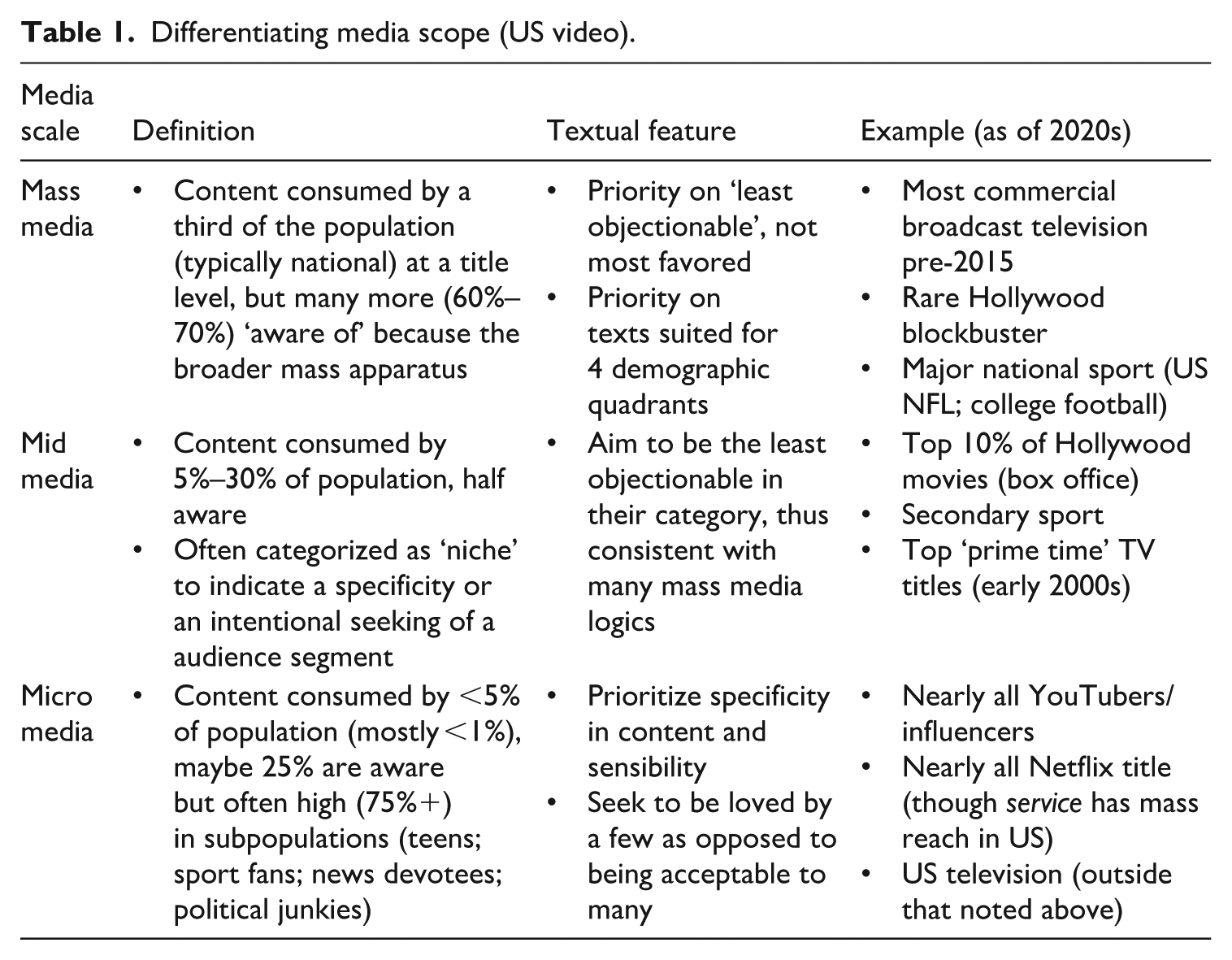
Highlighting the viability and now common operation of commercial ‘micro media’ addresses a crucial contextual change in the scale of ‘normal’ media reach that is part of building a conceptual frame for cultural production by the 2020s. 5 ‘Mass-media logics’ encompass more than a media good’s reach but invoke a set of operating structures that Curtin (1996) suggests is valuably viewed as an aberration rather than the imagined norm they grew into during the mid-to-late 20th century. As used here, ‘mass media’ references the underlying logic that came to support much 20th-century media strategy: a commercial operating structure built on complex-professional dynamics and licensed media that encouraged and discouraged textual features in order to be attractive to a broad, heterogeneous consumer base in a manner that narrowed the range of commercially viable content – or at least perceptions of it. It was also a period in which predigital technological affordances of broadcasting and the costs of physical good manufacture and circulation enabled scarcity that supported the hegemony of complex-professional operation that consolidated media ownership throughout the century.
Most existing understanding of media industry operation in the 20th century was thus built on assuming mass-media logics as ‘natural’ instead of conceptualizing them as structuring complex-professional cultural production. Mass-media logics and complex-professional dynamics of cultural production are not synonymous (see Table 2) although little differentiation was made in the 20th century when both seemed required for optimal commercial return; also both assume licensed circulation. Hosted and simple-professional cultural production emerge after mass-media logics have been in decline for a quarter century – at least in US video culture – and had largely become residual to norms better characterized as ‘mid media’ relative to the mass/micro continuum – or ‘niche’ in the parlance of the time – although the implication of this shift was rarely acknowledged or addressed by industry, journalists, or scholars (see Lotz, 2025).
Contrasting media logics and cultural production dynamics.
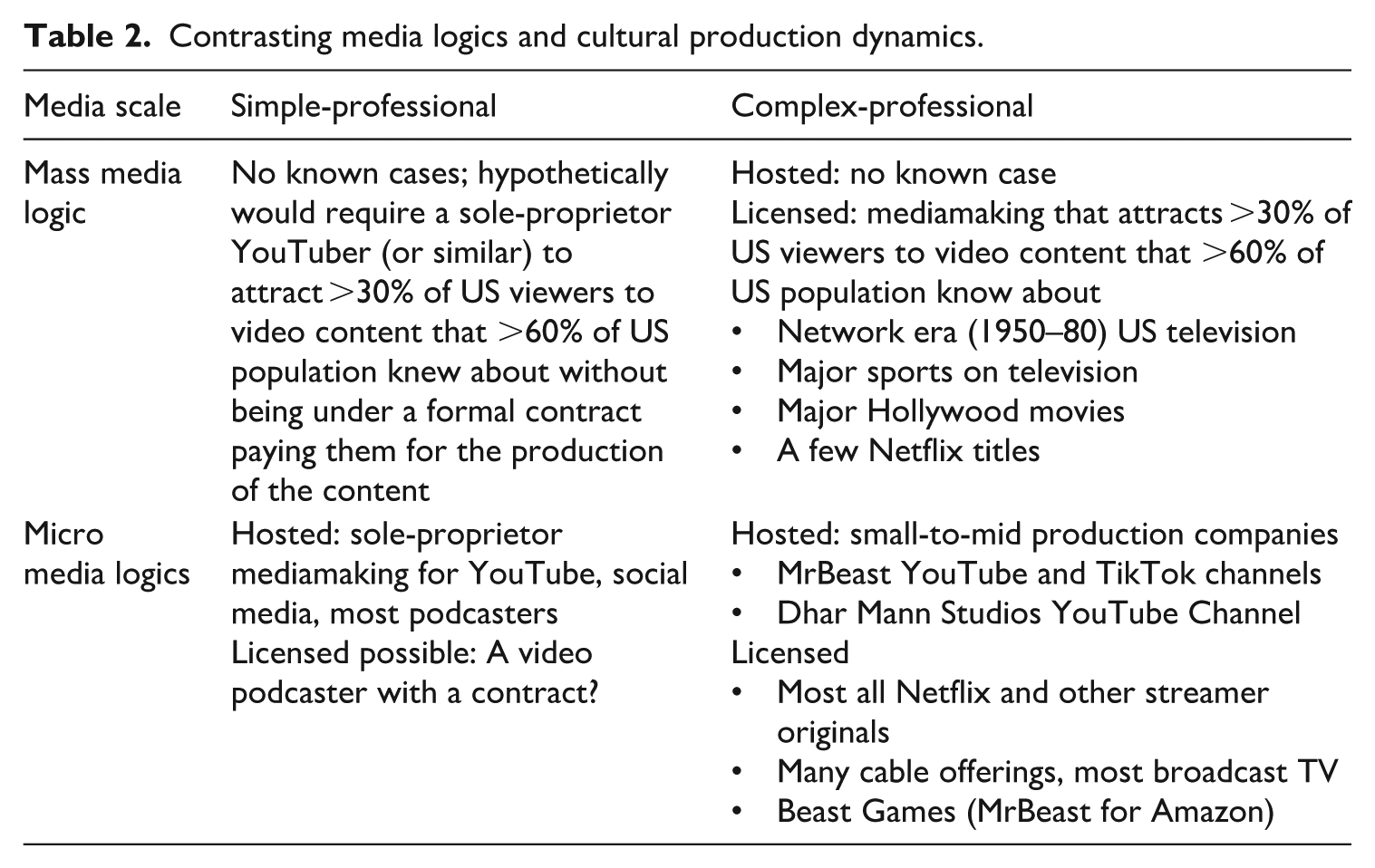
In sum, cultural production has changed considerably in the last quarter century due to connected but distinct phenomena including the demise of mass-media logics and emergence of affordable digital production tools and opportunities for hosted circulation that support a simple-professional dynamic in parallel to continued complex-professional dynamics. At present, there is reason to suggest hosted simple- and complex-professional dynamics as well as licensed complex-professional dynamics may coexist for some time. Though all are commercial models of operation, their structural differences require deeper investigation and theory building relative to critical media concerns such as creative autonomy and various relations of power. Establishing frames larger than cases of individual creators or operations of particular media-monetization services (e.g. YouTube, Substack, via Patreon) that host/circulate them aids conceptualization of both recent change and current operation. 6 Understanding the variation among dynamics of cultural production support deeper appreciation of the opportunities to challenge corporate and state power as well as how that power is reinscribed in new ways.
Structuring conditions of hosted media and implications for creative autonomy
Most of what we ‘know’ about cultural production assumes a complex-professional organization of firms operating in a context dominated by mass-media logics, though a simple-professional alternative has expanded throughout the 21st century and few goods now achieve previously common mass scale. Hesmondhalgh (2019: 84–86) speaks of a complex-professional era in thinking that draws on Williams’ (1981) residual, dominant, and emergent stages of historical change, but the emergence of hosted and simple-professional dynamics may not reproduce the epochal transitions of the past, at least in the near term. Rather, current formations suggest at least an extended period of coexistence among hosted and licensed, simple-professional and complex-professional cultural production that warrants understanding rooted in complementary pluriformity (Uricchio, 2009) rather than a struggle for dominance.
The long pre-eminence of complex-professional dynamics allowed them to become normalized and enabled the simple-professional dynamics that emerged from early in the 21st century to seem far removed and differentiated. Perceived ‘disruption’ tied to technological change often overwhelmed existing frameworks for understanding practices and categories in the sector. This led to confused interpretations of the scale of ‘revolution’ and of what owed to sustainable new technological affordances versus what required unsustainable economics often fueled by irrational venture funding or reliance on non-market conditions. Deviations from complex-professional dynamics of cultural production were often organized as pertaining to a separate ‘digital’ sector or believed to be characteristic of the ‘tech’ industry despite their coherence with the creation and circulation of social meaning characteristic of cultural production and competition in the market for advertiser dollars.
The conceptualization of a hosted model of circulation and its bifurcation among simple-and complex-professional cultural production dynamics counters this weak differentiation attributed to ‘legacy’ versus ‘digital’ media. Rather than regarding hosted media as a wholly separate technology sector, this approach builds on relevant understanding of commercial cultural production, and incorporates awareness of a long history of largely hobbyist (noncommercial) cultural production that expands its reach and, in some cases, commercializes as a result of digital production technology, internet distribution, and their assorted affordances – especially the capacity to access advertiser and consumer funding without a gatekeeping intermediary. 7
Hesmondhalgh highlights that ‘one of the defining features of the complex-professional era of cultural production is the unusual degree of creative autonomy, which has been carried over from preceding eras where artists, authors and composers were seen as working more independently of business imperatives than other workers’ (p. 95). This autonomy in mediamaking is countered with ‘much stricter control over the other stages of making texts after the creation stage’, such as activities tied to marketing, publicity, distribution, and retailing/exhibition/broadcast.
Hesmondhalgh’s conceptualization captures how creative work such as the writing of scripts, songs, or stories and their incorporation of audio and visual symbols remained somewhat independent, and the media maker somewhat sovereign, from the broader industrial ‘machinery’ of complex-professional structures designed to maximize commercial return from cultural goods. Media makers’ autonomy largely ceases once the good is completed in licensed, complex-professional dynamics. Decisions about marketing and how, where, and under what conditions the good is made available to consumers are not part of this creative autonomy but the purview of ‘strict’ circulation management overseen by specialists beholden to the commissioning corporation rather than the media maker.
The licensed media maker gives up control over circulation stages in return for a level of remuneration defined in the contracting of their creative services. The circulator may allow considerable creative autonomy but pays commissions/licenses in pursuit of the creation of content that advances its business and reputation. The contracts enable the circulator to elect against circulation. In licensed, complex-professional cultural production, the circulating organization – a television network, newspaper, movie studio – is typically the entity with determinant industrial authority over the media good made available to consumers.
Hesmondhalgh’s attention to creative autonomy in complex-professional cultural production provides a useful heuristic for exploring differences between hosted and licensed circulation models as well as the variation between hosted simple- and complex-professional cultural production. Following his care in distinguishing autonomy over production from circulation, the next sections consider creative autonomy for hosted mediamaking.
Limits on hosted media maker creative autonomy
A common popular discourse has regarded hosted mediamaking as more autonomous because of the comparative lack of gatekeeping by media-monetization services that host and circulate. Vetting by the circulator is avoided; however, as detailed below, comes at the cost of increased risk to the media maker. Further, the autonomy of hosted media makers remains constrained by structures of capitalism enacted through the priorities of their revenue source – typically brands or a share of advertising revenue from the circulating service. For hosted media makers seeking consumer funding, autonomy is shaped by alignment between a maker’s creative impulse and the goods deemed valuable by their consumer base.
A key difference between hosted and licensed dynamics – regardless of whether the organization is engaged in simple- or complex-professional production – is how risk and reward are allocated between media makers and circulating services. Media makers shoulder the full risk of self-financing in hosted dynamics; circulating services take on no risk and yet commonly take a significant share or even the majority of revenue. 8 Bearing such risk increases the extent that the dynamics of capitalism pressure the autonomy of media makers. They are not ‘free’ to create anything just because there is no vetting or review process from the circulating service (e.g. no notes from ‘standards and practices’), but the creator culture scholarship indicates commercially minded media makers are acutely aware of how their creative choices affect viewer numbers or other metrics being used to allocate revenue.
The imperatives of capitalism circumscribed the field of perceived commercially viable goods relative to mass-media logics and continue to do so even without the strong exertion of selection power in the hosted model. The gatekeepers of licensed media dynamics assert the interest of the circulating firm over media makers, often because the firm invests substantially in the good’s creation, and because that is their role as an employee of the firm. If a television executive turns down a pitch for a slowly paced exploration of the existential reality of a human outside the mainstream (as opposed to a crime drama about a damaged but well-meaning male detective), it likely owes to their awareness that such stories are difficult to promote and struggle to achieve the audience scale needed to justify the cost of production and a primetime schedule slot. That decision owes to the demands of capitalistic media structures, not to arbitrary gatekeeping. Selection can derive from personal biases and preferences, but primarily derives from knowledge based on the features of previous goods that have succeeded and failed in attracting mass scale or otherwise delivering the circulating firm’s aims.
Capitalism constrains creative autonomy in hosted mediamaking as well. For instance, reliance on sponsors constrains autonomy, as does the need to attract more attention. Hosted media makers’ autonomy is disciplined by their own knowledge of what their audience responds to and does not need to be formally articulated through ‘notes’ or requirements from a gatekeeping firm. Rather, such awareness is fed by ever more specific metrics of viewing behavior, likes, and comments, by perceptions of what recommendation algorithms reward, and of what kind of content will more likely deliver sponsorships and other support.
Media makers negotiate such awareness with what they want to make and what is most viable on the monetization service. Indeed, the media maker has the autonomy to choose how to respond to these pressures but optimizing for commercial profit often curtails creative autonomy. Media makers may be more willing to risk defying norms and past standards than decisionmakers in licensing firms.
Digital tools and hosting relationships with media-monetization services may enable a great many more media makers to create and circulate goods, but the path to commercially sustainable activity remains limited and major constraints on autonomy persist. Hosted mediamaking still faces constraints of capitalism, the constraints just may not be enforced by an organizational gatekeeper and may differ because of contextual shifts tied to the normalization of micro-media logics. The only way to diminish capitalism’s constraints on autonomy is to pursue creative production outside of the priority of wealth accumulation.
Circulation power and limits on creative autonomy
Media makers operating within hosted dynamics may face fewer formal restrictions on creative autonomy in production stages than in licensed structures, but the balance of their autonomy within circulation is more complicated and difficult to holistically conceptualize. This owes to variation across media makers’ relationships with the media-monetization services as well as because the services’ practices – and broader competitive and regulatory environments – are so fluid. The assessment of circulation dynamics consequently highlights key factors that mediate autonomy rather than asserting consistent norms of operation or detailing current practices.
Media makers take on many duties that were separately specialized in complex-professional organizations. The primary creative personnel might perform many of the circulation roles such as marketing and determining a circulation and monetization strategy in a hosted, simple-professional context. The capability for an individual to do such specialized tasks is enabled by the extent to which technologies and media-monetization services have replaced technical workers or reduced the complexity of their work. Thus roles spread across different creative management, marketing, executive, and skilled work in complex-professional operations are shared by the media maker and media-monetization services.
That ‘sharing’ has proven contentious given the absence of a contractual basis for the relationship. The monetization services circulate the goods and facilitate the marketing and promotion of the good – to varying degrees – and yet bear no responsibility to the media makers, nor do makers have any capacity to influence the services’ operation. On balance this is difficult to evaluate in terms of implications for makers’ autonomy: they gain control over aspects of circulation they lacked in complex-professional dynamics but wholly lack capacity to enforce any practices of monetization services. This concern has been widely explored in relation to ‘circulation power’ (Hesmondhalgh and Lotz, 2020) and ‘platform power’ that emphasize actions taken by monetization services to manipulate discovery interfaces, recommendation algorithms, or approaches to sharing advertising revenue given standard ‘terms of service’ agreements that makers must accept to access the services (Evens and Donders, 2018; Poell et al., 2021).
As in the symbiotic relationship between parasitic and host organisms, the comportment of this relationship can take different forms. Opportunity for mutualism in which both makers and media-monetization services benefit from the relationship exists. Often the relationship has been more typical of parasitism in which one party benefits (the monetization service) and the other is harmed, or a commensalism in which the monetization services benefit and media makers are not harmed. Dynamics of circulation power have consistently led to monetization services’ benefit in this relationship yet have proven difficult to systematically study because the relationship between media makers and services are highly individualized and held privately. A particular service is often not parasitic to all media makers but can operate with complete disregard for the majority of media makers while cultivating most-favored conditions for those amassing the most attention to the service (e.g. YouTube Partner Program). This makes it difficult to holistically assess or categorize how the services wield circulation power, but media makers’ capacity to drive attention to the service is certainly a factor. To be fair, there has always been such discrepancy between what Caves (2000) references as A- and B- list talent but there were also baseline conditions (‘scale’) assured to all contracted workers. Notably, the ability for ‘anyone’ to become a media maker is in part why this discrepancy is worse for media makers. Many working in simple-professional logics volunteer their labor, enabling oversupply of content/labor relative to what the market can sustain. At the same time though, there is room for critique of the lack of accountability of the services to the media makers and more equitable approaches to volunteer labor are possible.
Although media makers also take on many circulation roles in hosted mediamaking, this involvement does not uniformly lead to greater autonomy over these roles. They have greater autonomy over circulation strategy: deciding when to post, what services to use, what supplementary social media messaging to use for marketing. But this autonomy is a small gain relative to the services’ ability to prioritize or deprioritize content – either deliberately or through algorithmic settings – and the relative difficulty of promotion in an era of such media abundance. Services maintain circulation practices that prioritize their interest in maintaining attention, content pleasing to advertisers and regulators, and serving more ads rather than maximizing consumer experience in a way that would more precisely enact market dynamics. Relationships built on hosting are unlikely to ever offer the mutualism possible through contracts leaving most media makers to pursue endless escalation in efforts to game discovery algorithms and monetization metrics. 9
The monetization services largely operate as lords whose profits are dependent on content-creating serfs, and their benevolence or brutality is often arbitrary. Although hosted media makers do not require ‘permission’ of a circulating service or receive the funding tied to a commission, their access to attention revenue is not well assured (Poell et al., 2021). Many accounts of the pressures on media makers working in hosted structures highlight the unyielding drive to constantly release more content (see Lorenz, 2023). The viability of their creative goods is perpetually insecure as a result of the lack any contractual guarantees. It isn’t a gatekeeper requiring a post daily but the broader logics of micro-media abundance that amplify the sense that media makers must deliver constantly or risk losing audience and, in turn, sponsorship and marketing deals; perceptions of algorithm preferences also feed this concern. This makes discovery, audience maintenance, and relational labor (Baym, 2015) significant challenges and time-consuming circulation work that falls to the hosted media maker, especially in simple-professional operations. To be fair, the abundance of the digital era also produces these stresses for licensed complex-professional cultural production, but many of these organizations have more promotion and discovery infrastructure available to mitigate this challenge, and commissioned work is guaranteed some level of remuneration.
What does it mean to not operate under mass logics?
Predigital conditions also supported the complex-professional cultural production that was normalized in the 20th century. Those conditions led to strategies such as artificial scarcity, windowing, and intentional overproduction that were designed for content scarcity enforced by gatekeeping organizations that were protected by high barriers to entry. Those strategies have become less effective and perhaps wholly ineffective in the 21st century environment. Consequently we must ‘make strange’ the features of complex-professional cultural production and the inherited wisdom of media economics and strategy designed for those conditions, and rethink industrial practices to understand the fragmentation of mediamaking and consumption now common. To be clear, some operation under mass-media logics continues and will continue – sport is the best example across many contexts. But business strategies must now develop that don’t seek to expand reach as their primary aim, and the critical project must engage with such emerging strategies.
The laws of economics have not been dismantled: it remains the case that the high first-copy costs and low-to-no-marginal cost of most media goods make economies of scale highly desirable (see Caves, 2000). But consumers’ access to more personally rewarding media experiences has diminished the disciplining power of scarcity that supported the hegemony of mass-media logics. This increase in supply isn’t mere quantity, but the extent to which hosted media makers violate the programing strategies that relied on constraining variation (e.g. Steiner and Beebe models of program choice, see Owen and Wildman, 1992) and instead offer more differentiated goods that deliver higher consumer satisfaction, albeit with diminished audience scale. This new competitive dynamic was anticipated – though difficult to test and frankly, pointless to develop in a time when mass-media logics were strongly established and effective. As Bruce Owen and Steven Wildman explained in their comprehensive account of Video Economics in 1992: ‘The production of mass media messages involves a trade-off between the savings from shared consumption of a common commodity and the loss of consumer satisfaction that occurs when messages are not tailored to individual and local tastes (151)’. Here they largely acknowledge a reality that could then only be hypothesized using economic theory because the 20th-century US marketplace they studied overwhelmingly worried little of the loss of consumer satisfaction. Indeed, a US executive of the era explained the profound similarity across the three broadcast networks and why ‘most consumers don’t watch what they want’ through a lay business theory of ‘least objectionable programming’ (Klein, 1971: 186–188). Aiming to be least objectionable is contrary to aiming to deliver greater consumer satisfaction.
The peculiarities of media industries have warranted distinct investigation from other industry sectors because of how high first-copy costs and low-to-no marginal cost distinguish their operation from many other commercial good enterprises. This peculiarity was well leveraged by mass-media technologies such as broadcasting that delivered scale and enforced scarcity through a combination of technological affordances and regulatory approach. The sector relied on intentional overproduction, differential promotion, and artificial scarcity – but these tactics aren’t inherent to media goods. Rather they owed their effectiveness to broader conditions that enforced scarcity and supported pursuit of a mass audience through least objectionable content.
Video economics were best protected by scarcity conditions that diminished the need to develop alternatives to mass address until high levels of cable/satellite penetration. For television, where costs of production were quite high and scarcity most tightly asserted, least objectionable similarity was well suited to the revenue model of advertising because advertisers sought the attention of broad, heterogeneous audiences. The fact that much viewing was done in shared household spaces also supported least objectionable content strategies. Notably, print and music sectors have long operated with coexisting mass, mid, and micro-logics (and film somewhat as well). These media sectors also often relied on federalizing when consolidation and conglomeration swept through their sectors rather than centralizing (as Thompson, 2012 identifies in books) or developed portfolio strategies built around discrete ‘genre worlds’ (as Negus, 1999 identifies in recorded music).
Much of the basis for the American hegemony over 20th-century video derived from the extraordinary budgets that could be supported by having such a large and relatively wealthy population underwriting it with attention if not dollars directly. Spending more on production was imagined to deliver great dividends, whether spending on talent or known intellectual property that would aid promotion or to hire top creative talent that had mastered the extremely challenging task of creating content widely ‘acceptable’. The sector relied on extraordinary levels of intentional overproduction with earnings of very few hits offsetting the majority of goods that were commercial failures. Promotion in this era was comparatively easy (again, scarcity); with a high percentage of the population turning to a channel at some point every day, the channel was an effective site for promoting other parts and days of the schedule.
The structural changes to the sector that diminished scarcity, such as on-demand access and emergence of services offering an over-abundance of accessible content, also deteriorated the usefulness of predigital strategies. Contemporary profit margins can no longer support high-budget overproduction; artificial scarcity falters in an environment in which any added friction to access only makes a consumer likely to move on to a more accessible product (unless it is deeply valued, which is rare). Vast, vertically integrated corporations came to be the norm in an effort to maximize the benefit from success and to address the mid-media logics that developed by the turn of the century once cable channels became a significant sector of the US industry.
Micro-media logics require different responses and strategies. Instead of scale, micro-media logics prioritize ‘satisfaction’, per Owen and Wildman, above all else, and hosted mediamaking has enabled content so targeted to ‘individual and local tastes’. The content strategy required to compete in offering satisfaction necessitates media goods richer, more satiating, or fulfilling than ‘least objectionable’. Micro-media logics prioritize content that is most loved by some and otherwise irreplicable across the broad media market. Pursuit of those tastes requires a different universe of practices and expectations than supports mass-media logics and adjusting content to attract more attention/consumers.
Given the hold of mass-media thinking, we don’t have good conceptualization of what satisfaction entails. Many terms are thrown around with little clarity – premium, quality – but they are rarely defined or consistently used. Affinity and resonance are also useful for understanding why audiences find satisfaction – not that we have scales or metrics to well evaluate them. These are assessments made by individual consumers not critics, nor are they tied to budget or textual features – which makes the characteristics difficult to see without the vantage of each viewer. Consumer funding is a stronger revenue model for micro media than mass media because higher levels of satisfaction can motivate payment with money rather than just attention. There is still opportunity for price discrimination in micro-media logics with different levels of love or engagement enabling higher prices for more or ‘deeper’ content, in addition to free levels for promotion and audience building.
The central challenge of micro-media logics is discovery – of connecting with what might be a few thousand true devotees across a national population, maybe tens of thousands across territories (scale required for viability depends on cost of creation). To date, the conversation about discovery begins and ends with algorithms. The concerns about algorithms are well established at this point, including that most aren’t designed to maximize user fulfilment. Discovery innovation remains shackled by mass-media thinking and a failure to engage with how people use media now to deliver what users want rather than what complex-professional organizations built on mass-media logics are primed to provide; but that innovation will come. There also has not been enough innovation in limiting budgets in scripted production or experiments that defy mass-media logics within licensed, complex-professional production. Many of the costliest aspects of mass media production do not deliver the same value in micro media; stars, intellectual property, and spectacle do not outweigh the affinity and resonance derived from ‘individual and local tastes’ – an idea that requires much greater conceptualization and empirical investigation. Strategies for micro-media logics need tuned to deliver higher consumer satisfaction than was historically part of the media value equation.
The circulation strategies of micro-media logics are likely to differ as well. Instead of what has been intentional overproduction of goods aimed to a narrow, middle-range of least-objectionability, that overcapacity can be more strategically allocated to fulfilling a greater range of sensibilities – as illustrated by major record labels that maintain a variety of different genres rather than placing all resources toward the highest-selling genres. An alternative to the few hits/many misses dynamic might also operate so that many goods instead deliver a smaller but steady return. Making specific content may be less risky, even substantially so. Economies of scope – already evident in the case in ownership of many diverse cable channels, magazines, or record labels – may offer tools for scaling a federation of media goods delivering for ‘individual and local tastes’ instead of seeking economies of scale for specific goods.
The fragmentation of micro-media conditions has also changed the role of media goods in society in ways not well understood. The viability of micro-media logics certainly remain untested, and it is unclear that they will support an investor-grade media sector in which constant growth is expected. Micro-media logics may not deliver the profit levels of the mass-media era, but mass-media logics are no longer capable of those returns either.
Concluding point – regarding the exceptional cases
The article expands well established tools for organizing media and cultural production in a dynamic and fluid sector that also contains considerable internal variation. The aim here prioritizes a frame of understanding that works for most cases with the acknowledgment that there will always be exceptions. This is a very general beginning; evidence-based work that helps understand distinctions within hosted and simple-professional dynamics is needed as well as better data on the array of sustainable enterprises that exist.
A further complication results from hyperawareness of the instances best regarded as exceptional: high-profile influencers. As a category of hosted media makers, influencers receive considerable popular, industrial, and scholarly focus, especially those highest earning, whose achievement often derives from the strong commodity alignment between their raison d’etre and the goals of marketers. But these cases do not well represent those working within hosted or simple-professional dynamics as a whole, may not be as important to mediamaking as to advertising practice, and caution must be given to the boundaries between cultural production and general enterprise (revenue generated by companies that sell goods such as makeup, energy drinks, etc). By the 2020s, stardom itself had grown more complicated with more stars from both licensed (Ryan Reynolds, Selena Gomez) and hosted origins (MrBeast, Logan Paul, Hank Green) leveraging their fame into supporting non creative good enterprises (gin, make-up, sports drinks) that they own rather than merely as a marketing or branding relationship. Care must be used in understanding how capital is working in these still-unusual cases, as highly publicized earnings and wealth valuation is based on ownership in non-cultural industry goods that are interesting but less directly relevant to critical conceptualization of media and cultural production. By the time hosted media makers have access to sponsorship, endorsement, and substantive affiliate marketing fees they likely have entered a mode of cultural production that resembles complex-professional dynamics more than simple. Remarkably little evidence exists about their businesses, including the role of mediamaking in them. For example, leaked investor documents for Beast Enterprises showed $20 million of profit (off $250 million in revenue) for the company’s chocolate business and an $80 million loss on its media business (Shaw and Counts, 2025).
As complex-and simple-professional dynamics coexist in parallel, greater understanding is needed of how contracts with marketers might recreate dynamics typical of licensed mediamaking. Systematic evidence is needed exploring how creatives that begin under hosted, simple-professional dynamics achieve sustainability and whether that necessitates transition to operating as small businesses that feature intermediate dynamics that blend components of simple- and complex-professional norms. Much of the media industries literature has focused on examining the large corporations that control a disproportionate scale of consumption, attention, and capital, but small-to-medium size firms have always existed alongside these corporate giants. We need to establish and systematically study different approaches to work within simple-professional dynamics (see Lotz and Havens, 2024) to better understand variation within the category.
Studying patterns within and across hosted, simple-and complex-professional cases will yield better understanding of the structure of the field(s) of cultural production. Other minds can certainly expand this preliminary thinking about simple-professional dynamics and micro-media logics beyond the cases of video and US/anglophone norms used here. Although my focus foregrounds video industries that operated most resolutely under complex-professional and mass-media logics in the predigital era, cross-media thinking remains helpful in identifying existing micro-media logics that have operated in other sectors. An eye to common patterns within simple-professional dynamics that can be identified across sectors expands understanding for all.
A meaningful challenge to media criticism and literacy in these times is the difficulty for audiences to apprehend who now pays for the making of media and to what end – a crucial and basic first inquiry in the critical enterprise. Audiences may assume their favorite hosted media makers ply their trade ‘to make money’ but it is nearly impossible to know if they make a sustainable livelihood and how the multiple revenue streams common shape their mediamaking. And even though industry-minded thinkers may easily parse a distinction between hosted and licensed mediamaking, or simple- and complex-professional cultural production, it is unlikely that most media consumers have much awareness at all of the growing structural variation of the industrial dynamics of the media they consume.
Footnotes

Funding
The author received no financial support for the research, authorship, and/or publication of this article.
Declaration of conflicting interests
The author declared no potential conflicts of interest with respect to the research, authorship, and/or publication of this article.