




Abstract
This article maps the word antisemitism on the pages of The Jewish Chronicle (TJC), the world’s oldest Jewish newspaper, examining first the frequency of the term over a period of 100 years before zooming in to interrogate the ways in which ‘antisemitism’ was invoked during the 9 months before and 9 months after October 7, 2023. The data reveals that TJC has been exaggerating and instrumentalising a Zionist notion of antisemitism to foment moral panic, mobilising the language of trauma and injury to continuously reassert a notion of Jewish victimhood. Building on the work of media scholars who investigate victimhood, I argue that the newspaper puts into motions a justificatory framework that operates by claiming injury and then using the alleged injury to set in motion a series of oppressive actions against individuals, groups and institutions. By way of conclusion, I show how TJC has been using ‘antisemitism’ as a ‘consoling idea’ to consolidate and sustain Jewish group identity while simultaneously invoking the term to shield and legitimise violent forms of racial governance and as a weapon against Palestinian and pro-Palestinian activists.
Keywords
On December 31, 2024, The Jewish Chronicle (TJC), the world’s oldest Jewish newspaper, published an article by the in-house commentator Melanie Phillips (2024), originally titled ‘If you support the Palestinian cause in any form, you're facilitating Jew-hate’. 1 In the column, Phillips writes that ‘Deranged fear and hatred of Jews and the aim of exterminating them define the Palestinian cause—which happens to be the signature cause of the west’s progressive classes’. She goes on to claim that ‘Left-wing governments that ideologically support the Palestinian cause and also kowtow to Muslim constituencies in which Jew-hatred is rife, shockingly recycle the lies about Israel. The worst offenders have been the governments in Britain, Australia and Canada’. Phillips concludes by casting all Palestinian supporters as ‘facilitating deranged and murderous Jew-hatred’. While Phillips’s essay may seem extreme, her column can be read as part of an aggressive campaign mounted by TJC against any demonstration of solidarity with the Palestinians, whereby support for the Palestinian right to self-determination or even empathy for their suffering is presented as a form of virulent antisemitism.
Three weeks later, TJC published an article entitled ‘Did Elon Musk really perform a Nazi salute at Trump rally?’ (Grant, 2025). The subtitle assured the readers that ‘Jewish charities deny it was a Nazi reference’. Moreover, in the article, the Anti-Defamation League (ADL), which was established to monitor and combat antisemitism, defends Musk, stating that his gesture was ‘awkward’ but ‘not a Nazi salute’. The article also presents an opposing view voiced by US Representative Alexandria Ocasio-Cortez, who criticised the ADL for ‘defending a Heil Hitler salute that was performed and repeated for emphasis and clarity’ (Grant, 2025). Given previous coverage on the weekly’s pages (Harpin, 2019), it seems safe to assume that Ocasio-Cortez is no favourite of TJC, and her opinions carry much less weight than the ADL’s among the paper’s readers.
The juxtaposition of these articles—one conflating pro-Palestinian activism with ‘murderous antisemitism’ and the other downplaying the concrete dangers of antisemitism as it manifests itself in a nefarious salute by one of the world’s most powerful people—provides a glimpse into TJC’s universe. Antisemitism in its pages is frequently stripped of its original meaning of discrimination against Jews as Jews and becomes synonymous with anti-Zionism and criticism of Israel. While scholars and commentators have documented how antisemitism in its traditional sense is alive and even increasing in the UK and around the globe—and must be challenged and resisted wherever it appears—in the following pages I demonstrate that the major Jewish newspaper in the UK has been exaggerating, instrumentalising and indeed weaponising a Zionist notion of antisemitism using it to produce moral panic (Cohen, 2011; Hall et al., 2017). Calling something a moral panic, Cohen (2011) explains, does not imply that this something does not exist or that it did not happen, and that reaction to it is based on fantasy, hysteria, and delusion or being duped by the powerful. Given that antisemitism exists in the UK and abroad, my claim that TJC is fomenting a moral panic is meant to indicate that the existence and extent of antisemitism and its significance to the security of Jews has been dramatically exaggerated to advance two key political objectives.
First, TJC has been mobilising antisemitism as a ‘consoling idea’, to use Hannah Arendt’s ironic characterisation. As Arendt (1958: 7) explains, antisemitism becomes ‘an excellent means for keeping the people together, so that the assumption of eternal antisemitism . . . [implies] an eternal guarantee of Jewish existence’. The idea of generating fear and emphasising victimhood to consolidate and sustain group identity by posing a threatening ‘constitutive outside’ is, to be sure, not unique to Jews or TJC, since as Chouliaraki (2024) points out, languages of trauma and injury have been mobilised again and again to create and recreate political communities. In this case, however, ‘antisemitism’ has not only been incessantly invoked on the paper’s pages to consolidate the Jewish community by continuously reasserting the notion of Jewish victimhood but has also been used to disavow the war crimes, crimes against humanity and even genocide that Israel’s military has been committing against the Palestinians. The avowal of Jewish vulnerability and victimhood comes with a pronounced disavowal of Palestinian vulnerability and victimhood.
Second, TJC not only casts Jews as perpetual victims but also weaponises Jewish victimhood against Palestinians and pro-Palestinians, mobilising the antisemitism accusation as if it were an ‘iron dome’ designed to defend Israel’s racialised form of governance and, more recently, the genocidal war in Gaza. It puts into motion, according to Higgins’s (2025) analysis of how victimhood is frequently mobilised by right wing actors, a justificatory framework that allows for the claiming of woundedness without the furnishing of actual wounds and then uses the alleged woundedness to set in motion a series of oppressive actions against individuals, groups and institutions. There is an irony here too. Historically, the fight against antisemitism has sought to advance the equal rights and emancipation of Jews, and yet TJC uses the term primarily to legitimise brutal oppression of another people through forms of racial governance characterised by Jewish domination (Gordon, 2024).
Even though TJC has a relatively small readership, it is important to stress Budarick and King’s (2008) claim that the ‘role of niche media in discursively constructing and deconstructing powerful ideas is often underestimated’. TJC not only impacts the views of its readers but presents itself as the voice of the Jewish community in the UK and commands some moral authority as a source of ‘Jewish opinion’ which then enables it to shape the news agenda on matters relating to Jews and Israel beyond its own pages. Moreover, the strategy of distorting and then exaggerating and weaponising antisemitism to advance political objectives is not unique to TJC and has been adopted by many institutions, politicians and social media influencers, and other media outlets in the UK, north America and across Europe (Gordon, 2024). These actors reinforce each other as they strive to achieve a series of goals, and an analysis of TJC sheds light on some of the strategies informing their operations. In the UK, such strategies have been used to unseat former Labour leader Jeremy Corbyn (Winstanley, 2023), while in the US a similar but less successful campaign was waged against Bernie Sanders during the 2016 electoral campaign (Goldberg, 2016). At the time of writing, the moral panic surrounding antisemitism is being used to hound down pro-Palestinian students and staff across US campuses, and in some cases to imprison them and then to expel them from the country. In a similar vein, della Porta (2024) has shown how numerous actors in Germany have produced moral panic around Jewish hatred to shield Israel from criticism and stifle Palestinian and pro-Palestinian voices. Building on these developments and analyses, this paper aims to reveal the role a single media outlet has played in fomenting moral panic in the UK and to document how it has been weaponising antisemitism for political ends.
I begin by offering a concise overview of the history of the weekly based on David Cesarani’s (1994) book The Jewish Chronicle and Anglo-Jewry, 1841–1991. Next, I briefly describe the methodology adopted in this paper followed by the key findings. I then turn to discuss the way in which the newspaper manufactures moral panic through the mobilisation of two false conflations: between antisemitism and anti-Zionism and harsh criticism of Israel; and between feeling uncomfortable and being unsafe. It is in this context that I underscore the significance of the affective element (Sutcliffe, 2025; Wahl-Jorgensen, 2019) in the accusation of antisemitism and the specific ways in which the newspaper utilises the accusation to silence Israel’s critics.
The Jewish Chronicle, Zionism and Israel
In The Jewish Chronicle and Anglo-Jewry, David Cesarani describes the development of the world’s oldest continuously published Jewish newspaper, tracing the editorial transformations during the paper’s first 150 years, the way the paper reflected the political, social and economic shifts within British-Jewry itself, and how at different historical moments it became an active player in historical events. Originally, the paper’s editors opposed Zionism, but in the lead up to the 20th century one begins to witness a shift (Cesarani, 1994: 86). Cesarani describes how TJC was the first to publish Herzl’s blueprint The Jewish State—1 week before the German publication appeared—and how from 1897 the paper provided weekly reports of developments in the Zionist movement. Simultaneously, the editors managed to establish the paper as the mouthpiece of the Jewish community in the UK, and, by 1917, it had assumed such a crucial role that publication of the Balfour Declaration was delayed until it could be revealed to the world through the paper’s columns alongside a celebratory editorial entitled ‘A Jewish Triumph’.
One of the paper’s concerns has always been antisemitism. Throughout the 1930s and early 1940s it provided broad coverage of antisemitism both at home and in Europe. Following the 1935 passing of the Nuremberg Race Laws, the paper came out against any form of cultural and political contact with Nazi Germany and continuously reported about the scale of the horrific treatment of Jews in Germany (Cesarani, 1994: 149. 147). By mid-1942, antisemitism in the UK had intensified to the point that the paper began campaigning for legislation against ‘community libel’, arguing that antisemitism facilitated pro-Nazi propaganda. And, yet, it failed to centre-stage the murderous assaults on Jews in Europe, so when the Polish Government-in-exile reported that 250,000 Polish Jews had died in the last 6 months at Sobibor, Treblinka and Belzec, and that a plan existed to kill half of Polish Jewry by the end of the year, the paper framed the discussion within the more general context of the war crimes perpetrated by the Nazis. Throughout the first part of 1943, and even at the height of the Warsaw Ghetto uprising, TJC's leading articles dealt predominantly with controversies within the UK (Cesarani, 1994: 178–179).
Meanwhile, when Zionist paramilitary groups in Palestine carried out a series of attacks against the British TJC was generally sympathetic and accused the British forces of carrying out ‘terrorism of their own’ while referring to such Zionist acts as ‘Jewish Resistance Operations’ (Cesarani, 1994: 190). Following the 1948 war, TJC urged the Israeli government to offer some form of reparation to Palestinians refugees, but, as Cesarani (1994: 206-207) notes, beyond such early ideas the paper commented only intermittently on the refugee problem. Immediately after the 1967 war it endorsed east Jerusalem’s annexation and several months later characterised the occupation as one of the most humane in history (Cesarani, 1994: 227). From then on, news from Israel began to dominate TJC, taking over space previously dedicated to local news.
Around this time the paper began to comment anxiously on the need for effective pro-Israel propaganda against the convergence between the New Left, the radical student movement and increased advocacy for the Palestinian cause. If 30 years earlier TJC was concerned about dangers emanating from the fascist right, from the early 1970s the left advocating for Palestinian rights was considered a key threat. The paper strongly condemned the 1975 UN resolution declaring Zionism to be a form of racism and began monitoring British and north American universities where anti-Zionist views were becoming more prevalent among students and staff (Cesarani, 1994: 230).
As the years passed, however, subscriptions fell from over 60,000 during the late 1960s to no more than 12,000 copies at the time of writing. The fall in subscriptions led to substantial financial difficulties, and in 2020 TJC was sold to a consortium led by Sir Robbie Gibb, Theresa May’s former spin doctor. According to an article published in Prospect, Gibb merely serves as a ‘frontman’ and for the first time in the papers’ 185-year history, its owner has become a secret (Rusbridger, 2024). The lack of transparency regarding its ownership appears to have had a direct impact on the integrity of the paper’s journalism. A 2024 exposé revealed that Elon Perry published several articles in TJC relating to the Gaza war based on fake or misrepresented intelligence planted as part of an effort to support prime minister Benjamin’s Netanyahu’s negotiating position over Gaza (Beaumont, 2024). It was only after these incidents that the prominent journalist Jonathan Freedland—who is also a columnist for The Guardian and a well-known voice among British liberal Zionists—ended his relationship with TCJ ‘with a heavy heart’ (Landler, 2024).
Methodology
Using TJC’s archive, I began by examining the frequency of the word antisemitism over a period of 100 years from January 1, 1925, until December 31, 2024. I then zoomed in to examine the ways in which ‘antisemitism’ was used over a period of a year and a half: from January 1, 2023, until June 28, 2024, namely, during the 9 months before Hamas’s October 7, 2023, attacks and the 9 months following the attacks. After coding the articles (n = 1,079), research assistants and I isolated those in which the term antisemitism was used as a concrete accusation (n = 367) and then determined ‘antisemitism’s’ referent object in the sense of the identity of the accused and the precise signification linked to the term. We coded whether the antisemitism charge was directed against an individual or an institution or both, the number of people accused, their gender, ethnicity (white/non-white), religion, and whether the alleged antisemitic incidents occurred in the UK. Regarding the term’s signification, we examined whether the accusation involved ‘traditional antisemitism’ which we defined as abhorrent conspiracy theories about Jewish control of the media, finance, and governments, blood libel accusations, Holocaust denial tirades, and dehumanising caricatures of Jews (Lerman, 2022) or whether it signified what is often referred to as the ‘new antisemitism’ and has been codified in seven illustrative examples attached to the IHRA (2016) working definition of antisemitism, and denotes forms of anti-Zionism and harsh criticism of Israel.
In addition, I contacted the Independent Press Standards Organisation (IPSO), a regulator of the print and digital news industry in the UK. IPSO provided data comparing complaints involving ethical standards filed against TJC with those filed against the Daily Mirror and the Daily Telegraph between January 2017 and December 2024. Finally, I had access to the correspondence the Committee on Academic Freedom of the British Society for Middle Eastern Studies (BRISMES) had with students and staff who were accused by TJC of antisemitism and to the 43 cases that appeared in the report BRISMES published with the European Legal Support Centre (2023) on the impact the adoption of IHRA working definition of antisemitism has had on academic freedom in UK universities. This included Freedom of Information requests submitted to universities which reveals the content of correspondence they had with TJC.
Before providing an analysis of the findings, it is important to stress that following leading scholars (Feldman and Volovici, 2023; Gould, 2023; Judaken, 2013; Klug, 2013; Lerman, 2022; Romeyn, 2020) this article rejects the conflation between antisemitism and anti-Zionism or harsh criticism of Israel that TJC espouses. I assume that in certain instances anti-Zionism and harsh criticism of Israel can and do overlap with antisemitism, but this in itself does not tell us much, since a variety of views and ideologies can coincide with antisemitism. One can be a capitalist, a fascist, a socialist or a libertarian, and even a Zionist and still be an antisemite, but the fact that antisemitism can be aligned with such diverse ideologies tells us very little about either antisemitism or these other ideologies (Gordon, 2023). Nonetheless, many Jews have become invested in this new notion of antisemitism and, as I discuss below, the false conflation it draws between individual Jews and Israel has been internalised and become part of their identity, with far reaching implications on questions of racism and anti-racism (Modood, 2023).
Findings
Before examining the appearance of the term antisemitism in TJC over the one-hundred-year period from 1925 to 2024 one might hypothesise, as I did, that its use would be most pronounced during the years leading up to World War II and during the Holocaust itself when antisemitism led to violent forms of racial governance across Europe and the elimination of six million Jews. The search revealed that during these hundred years the word antisemitism appeared in 21,953 articles or on average in 220 articles per year. The results, however, did not corroborate my hypothesis; rather, they revealed that in 1938, at the height of the Nazi clampdown on Jews in Germany (which unlike the final solution was not shrouded in secrecy), antisemitism was mentioned in 352 articles, substantially higher than its average appearance, but much less than during Jeremey Corbyn’s 2015 election as Labour leader, his 2019 national election bid and Israel’s latest war on Gaza, when the number of articles using the term antisemitism was 506, 675 and 672 respectively. In other words, in 2019 and 2024 TJC invoked the word antisemitism almost twice as much than during the years leading to the Holocaust (Graph 1). Moreover, TJC included substantially more words in the 1938 edition than it did in 2019 and 2024, with an average of 65,000 words per issue in 1938 as compared to 35,000 words in 2019, indicating that in the more recent editions the frequency in which the term antisemitism appears is proportionally much higher. In terms of the percentage of articles in which the word ‘antisemitism’ appears, the ratio in 1938 is about 10% of all articles while in the 2019 and 2024 issues the term appears in about 20% and 25%.
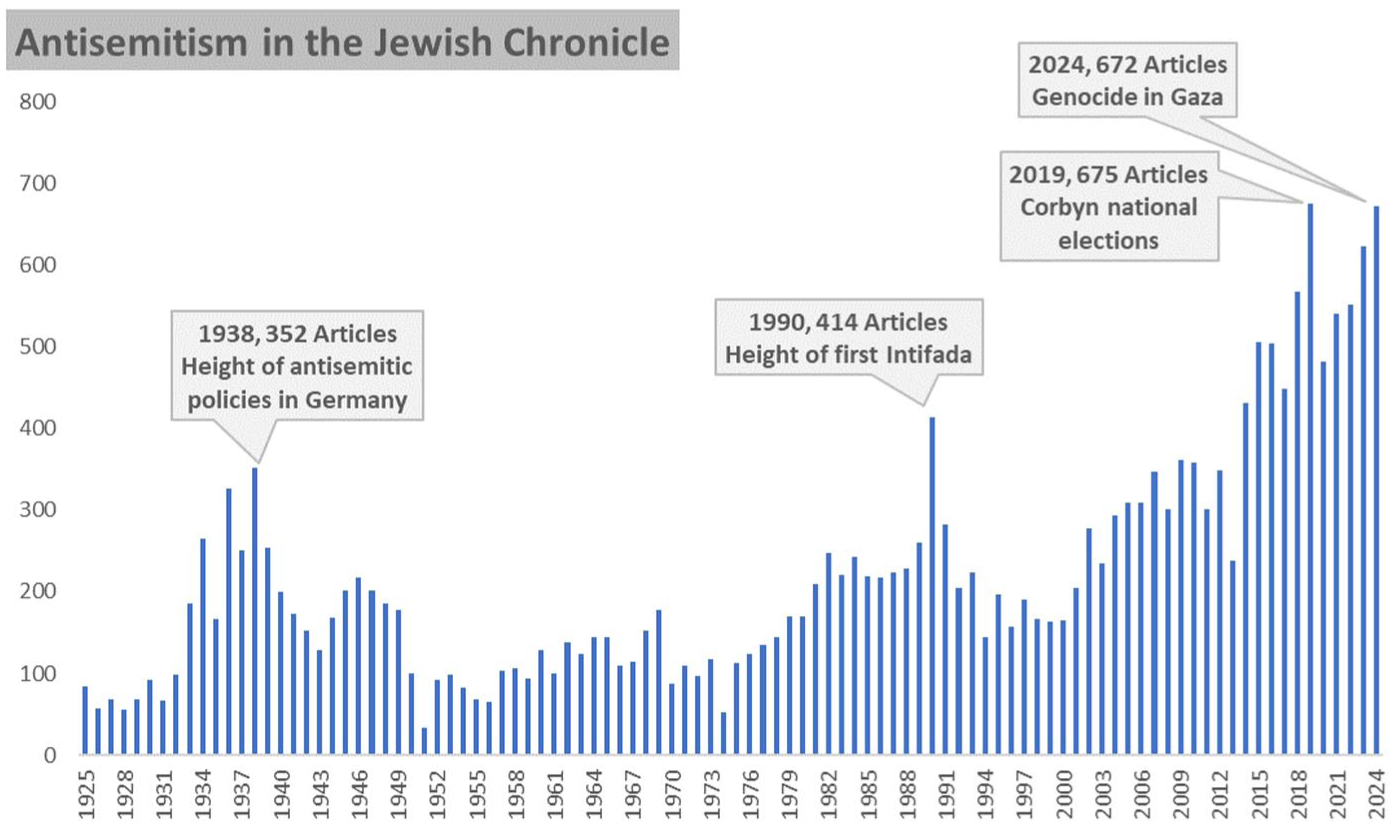
Number of articles that include the word ‘antisemitism’ from January 1, 1925, to December 31, 2024.
The 1967 and 1973 Israel-Arab wars do not seem to have had a significant impact on the term’s use and while there is a small spike during Israel’s 1982 invasion of Lebanon, it was only at the height of the first Palestinian intifada in 1990 that the use of antisemitism reached 414 articles—higher than during the build-up to World War II. The numbers go dramatically down in 1994, the immediate aftermath of the Oslo Accords but then begin to rise again, and from the new millennium one witnesses a gradual rise in the trendline. Notwithstanding this trajectory, during the second intifada, which erupted in September 2000, antisemitism appeared in no more than half the number of articles that it did during Corbyn’s 2019 election bid and following the October 2023 attacks. Obviously, the danger posed to Jews over the past two and a half decades does not compare to what Jews experienced from 1933 to the mid-1940s when antisemitic policies were codified in laws and manifested themselves in violent forms of state-led racial governance and finally in the extermination of European Jewry.
Zooming in on how the term was used in articles that appeared between January 2023 and June 2024, the numbers above the black line in Graph 2 are of articles that included the word antisemitism each month (n = 1079). Given that on average each edition includes sixty articles, in some issues the term appears in one fifth of the articles. This, as discussed in the following section, is an illustration of how the paper foments moral panic. Moreover, in these articles TJC elides the prevalence of racially motivated hate crimes against other groups and thus effectively disconnects antisemitism from the more general struggle against racism and discrimination (on the politics of delinking racisms, see Modood, 2023; Romeyn, 2014).
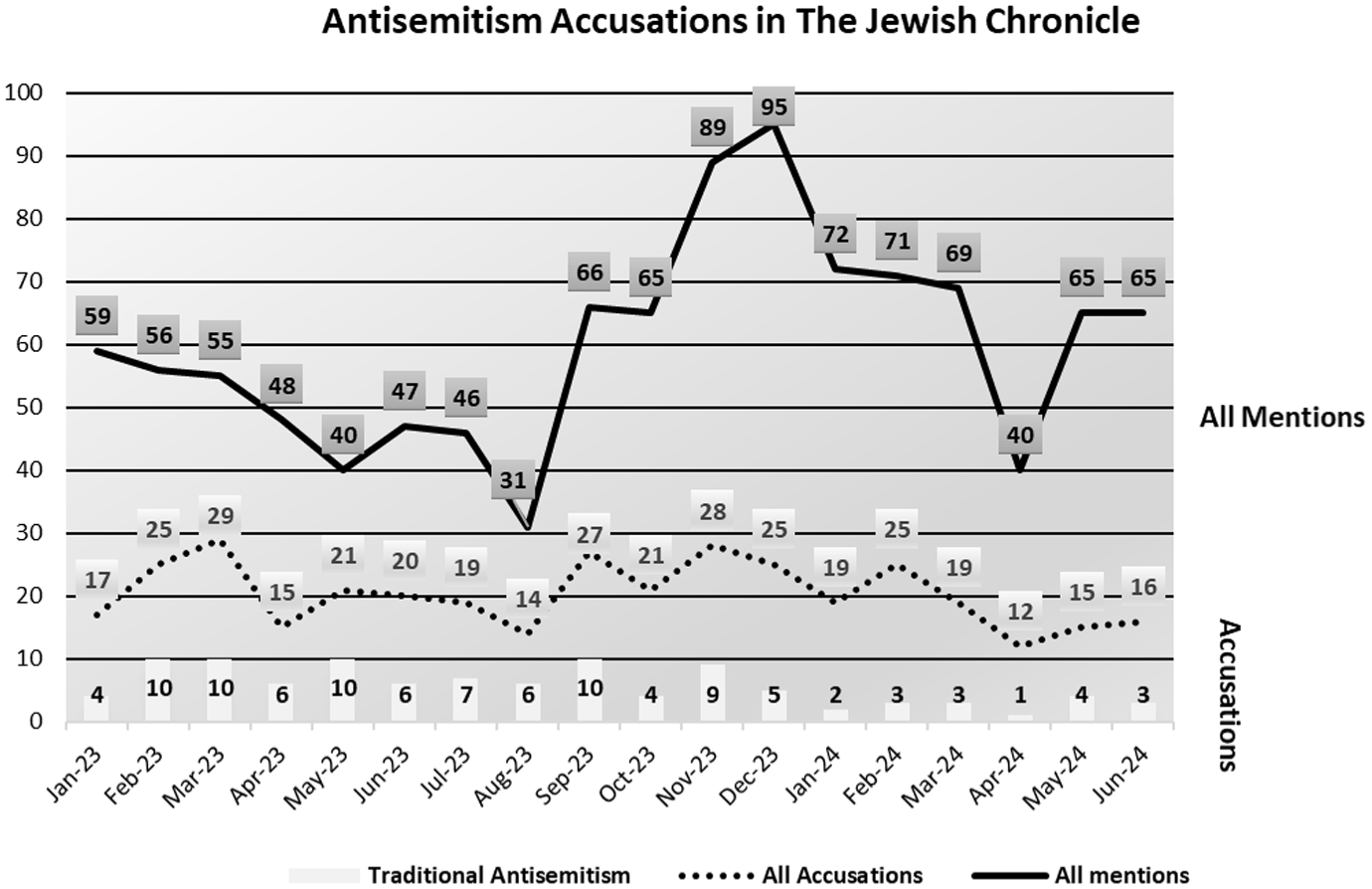
Number of articles that include the word ‘antisemitism’ and accusations of antisemitism January 1, 2023 to June 30, 2024.
The number of times the word antisemitism is used is greater in the 9 months after October 7, 2023 (n = 631 amounting to 58% of the articles) than in the previous 9 months (n = 448 amounting to 42% of the articles). This is to be expected given that Israel’s deployment of eruptive violence against Palestinians usually leads to spikes not only of antisemitism but of anti-Zionist statements or harsh criticism of Israel, which are construed by the paper as antisemitic. Of the 1079 articles containing the term antisemitism, 367 or 35% included either a concrete accusation (n = 264) or an accusation by association (n = 103) against a person or institution (dotted line). 2 Of these 367, 186 were directed against one or more individuals, 127 against institutions and 54 against both individuals and institutions.
The actual act or statement leading TJC to level an accusation is often unclear from the specific article, which in and of itself is significant given the weight of allegations involving antisemitism. Of the 367 ‘accusatory’ articles, 103 (28%) describe an incident involving traditional antisemitism (bottom columns), two thirds (n = 69) of which occur before October 7, and one third (n = 34) in the following 9 months. Put differently, during the 9 months after October 7 the word antisemitism is mentioned in 631 articles and only 34 provide a concrete accusation involving traditional antisemitism. An additional 152 articles (41%) accused a person or institution of antisemitism due to anti-Zionist remarks or criticism of Israel, with two-fifth (n = 61) of these appearing before October 7th and three-fifth (n = 91) during the nine subsequent months. As traditional antisemitism accusations decline following October 7, ‘new antisemitism’ accusations increase. Finally, in 112 articles (31%) it was not entirely clear what kind of statement or behaviour led to the very serious accusation of antisemitism.
TJC identifies as ‘antisemites’ well-known individuals—from Jeremy Corbyn and Sadiq Khan to Roger Waters, Gary Lineker and Naomi Klein—alongside relatively anonymous university students and staff or community organisers and political activists. While articles do not always divulge the accused person’s key identity markers, in 200 instances where we could identify the accused’s ethnicity, whites and people of colour accounted for 50% each. When isolating allegations made against people in the UK, the percent of non-whites goes slightly down to 47%; however, given that people of colour comprise only 18% of UK’s population the accusation appears to be meted out disproportionately. This corroborates Sutcliffe’s (2025) claim that opposition to antisemitism often ‘positions non-western migrants, especially Arabs and Muslims, as responsible for “re-importing” into Europe the heinous antisemitic hatred that white Europeans. . . have largely overcome’. ‘This racialised logic’, he explains, ‘has fuelled the eager embrace of anti-antisemitism not only by the European far right but also by much of the political mainstream’. In terms of gender, over 75% of those accused are men. In most cases the accused’s religion is not stated, but we did identify Muslims in 46 articles. Finally, according to TJC, the two major institutions responsible for spreading antisemitism in the UK are the Labour Party and the BBC, with 59 and 37 accusations respectively.
Even though I only have anecdotal data based on a BRISMES and ELSC (2023) report on ‘The Adverse Impact of the IHRA Definition of Antisemitism’ alongside the correspondence that BRISMES’s (n.d.) had with students and staff who were accused of antisemitism and a number of Freedom of Information requests sent to universities, one can safely say that several investigations at universities and even some of those carried out by the police were propelled by requests for comments from a TJC journalist. Often these journalists had either mined the social media platforms of students and staff in UK higher education institutions on their own initiative or had received information from people or organisations that had carried out the mining, flagging posts considered antisemitic or supporting terrorism even if they were uploaded or liked several years earlier.
The playbook is straightforward. A journalist would send a query to the university about an ‘antisemitic’ social media post or event and request a comment. A freedom of information request submitted to my university revealed, for example, that a TJC journalist asked about a visit of United Nations special repertoire Francesca Albanese to Queen Mary University of London. ‘We will write’, the journalist states in the email, ‘that Jewish groups, and students, have expressed concerns over her appearance given what they claim in a history of deeply offensive comments about Jews and Israel’. After providing a list of Albanese’s alleged offences, the journalist goes on to note The Union of Jewish students say her presence will emphasise an “increasingly belligerent environment” on British campuses and that she has justified the October 7 attack and endorsed conspiracy theories about the so-called Jewish lobby. They believe Jewish students will be negatively affected by her presence. The Board of Deputies of British Jews say it is “deeply worrying” that Albanese has been invited to “spread her poison” on British university campuses.
The journalist concludes the email by asking the university if it ‘wishes to respond to any of the above points’. 3 Similar letters were sent from TJC journalists about posts or likes on social media shared by students and staff from different universities, often propelling the universities to open investigations against members of their community and in one case the university appears to have been in touch with the police after receiving an email from TJC. Hence, the newspaper is not only invested in producing a moral panic, but in propelling action against the ‘folk devils’, an issue I return to momentarily.
In their report, BRISMES and ELSC (2023) examined 43 complaints between 2017 and 2022, some of which were triggered by TJC, showing that even though students and staff were often subjected to months of investigations and disciplinary hearings causing incredible mental and physical stress, not a single case ended up being upheld. Although TJC was not involved in all of these cases, it did play a significant role in triggering an investigation in a few of them, helping to create ‘a chilling effect among staff and students, deterring individuals from speaking about or organising events that discuss Palestinian human rights and Palestinian self-determination out of fear that they will be subject to complaints’ (BRISMIS and ELSC, 2023).
Finally, data from the Independent Press Standards Organisation (IPSO) suggests that TJC is more prone to breach ethical standards than other newspapers. Taking into account that TJC is a weekly and the Daily Mirror and the Daily Telegraph are not only published every day but tend to have more articles in a single day than TJC features in a week, I compared the ratio of complaints that had been accepted by IPSO (namely, not been rejected outright as having no possible breach) with those found to be ‘in breach’ following investigation. Of the complaints that were investigated by IPSO, TJC was found in breach of ethical standards in 51% of cases as compared to 36% for the Daily Mirror and the 33% for the Daily Telegraph. Moreover, a perusal of the complaints reveals many of the grievances brought against TJC involved articles that mischaracterised and/or made false claims about Muslim institutions in the UK and people from Palestinian or other Middle Eastern decent (IPSO Rulings no date).
Antisemitism as moral panic
As mentioned, the signification of antisemitism has changed over the years and according to Israel and major Zionist institutions it now denotes manifestations of anti-Zionism and harsh criticism of Israel in addition to its traditional meaning. Already in 1964, Isaac Deutscher (2017) wrote that ‘Jewish opinion in the West very often equates anti-Zionism with antisemitism’. In a 1973 speech to the American Jewish Congress Israel’s former Foreign Minister Abba Eban (1966–1974) insisted that ‘the distinction between anti-Semitism and anti-Zionism is not a distinction at all’ (cited in Romeyn, 2020) and the following year Arnold Forster and Benjamin Epstein (1974) published a book called The New Anti-Semitism, which is the first study to argue that antisemitism should be extended to include critiques of Zionism and of Israel. Despite this expansion, the number of times the term antisemitism appeared in TJC during the 1960s and 1970s is relatively low.
Lerman (2022) observes that the expansion of the term antisemitism to include criticism of Zionism did not gain traction until the turn of the 21st century, and this was due to a new historical conjuncture informed by the demise of the Oslo ‘peace process’ and the eruption of the second Intifada, the 2001 anti-racism conference in Durban, South Africa, where NGOs accused Israel of being a racist endeavour, as well as the inauguration of the Global War on Terror following the 9/11 terrorist attacks. The term’s use in TJC appears to corroborate Lerman’s analysis, gradually increasing over the past 25 years. However, antisemitism’s use appears to have solidified as a strategy during the year that Corbyn became Labour leader (2015), with a 300% spike in the term’s use compared to its use immediately before the turn of the new millennium. Indeed, TJC construes a world in which antisemitism appears much more prevalent in the UK today than it had been in Germany and Europe more generally in the mid-1930s—and thus intimates that Jews are encountering imminent danger to their lives. The strategy seems to have been effective so that even after Corbyn’s 2019 electoral defeat TJC continued to mobilise the term antisemitism as a political weapon, primarily against Israel’s critics and calls for Palestinian self-determination.
The sheer number of times the term antisemitism is used in TJC, which in certain issues appears in 25% of the articles, suggests, I claim, that the paper is attempting to produce a moral panic among its readers. As mentioned, this does not imply that antisemitism does not exist but that the extent of antisemitism and its significance to the security of Jews has been dramatically exaggerated to advance a series of political goals. In Policing the Crisis: Mugging, the State, and Law and Order Hall et al. (2017) alongside several co-authors examined the moral panic produced around muggings in 1970s Britain. Their claim was that for the urban white middle classes mugging was a concise concept that encompassed a series of fears around which panic was generated to advance the adoption of measures that primarily targeted people of colour (Garland, 2008). While ‘mugging’ was a new word applied to an age-old phenomenon of a person being stopped in the street and robbed, antisemitism is an existing word that denotes an age-old phenomenon encompassing acts against Jews. Yet, as the findings suggest, TJC not only exaggerates the risks to the Jewish population in the UK and elsewhere but also uses a new definition of antisemitism to claim that statements and protests against Israel’s colonial project and against Zionism endanger individual Jews in the UK and around the world.
In line with Cohen’s (2011) original analysis of the role of the media in creating and sustaining a moral panic, it appears that TJC has: (i) transmitted claims of mostly Jews who maintain that they are unsafe; (ii) taken on the role of making the claim and (iii) helped set the agenda by selecting those who it deems to be deviant as well as events it considers socially problematic. The Jewish weekly has played a role in whipping up fear and anxiety primarily through two false and intricately tied conflations—one between individual Jews and the State of Israel and another between ‘feeling uncomfortable’ and ‘being unsafe’—and the framing of anti-Zionists and harsh critics of Israel as ‘folk devils’ or as Phillips (2024) described them on TJC’s pages: people ‘facilitating deranged and murderous Jew-hatred’. As part of this process, Palestinians and pro-Palestinians have been stigmatised as deviant and represented as posing an existential threat; indeed, over time, they have come to be defined as one of the most if not the most acute social problem for Jews. The moral panic, in turn, constitutes Jews as perpetual victims and their victimhood is, in turn, mobilised for two major purposes: to help solidify and consolidate the Jewish community as a group; and to weaponise the alleged hate against this group to attack individuals, groups and institutions who voice a pro-Palestinian position and to shield Israel regardless of the crimes it carries out.
In my writings on antisemitism and Zionism (Gordon, 2023, 2024), I have shown how the false conflation between antisemitism and anti-Zionism or harsh criticism of Israel is socially constructed to encourage an affective attachment between individual Jews and Israel and that this attachment is presented as if it emanates naturally—and thus unmediated—from within each individual and the ‘fact’ of their Jewishness. Here we witness the intricate workings of a media outlet—namely, TJC—and how it helps produce this emotional attachment by incessantly presenting critics of Israel and of Zionism as if their criticism of the State and its ideology is an attack on individual Jews in the UK and elsewhere. The orientation of the affective attachment that TJC helps to produce between individual Jews and Israel is reinforced through the claim to Jewish difference. The notion of a group’s difference is of course not unique to Jews. Other racial, ethnic, religious or cultural groups consider themselves as different and as requiring certain legal protections. The novelty, here, consists not so much in laying claim to Jewish difference and the need to protect it, but in the extension of this claim to a political ideology and to the State of Israel and the idea that criticism of Zionism amounts to an attack on the protected characteristics of individual Jews and is therefore antisemitic. Legally, this position was rejected in Fraser v University & College Union (2013) when an Employment Tribunal found that Zionist political beliefs do not constitute a protected characteristic, and yet according to TJC and, more generally, some of the illustrative examples attached to the IHRA (2016) definition of antisemitism they do.
This false conflation helps explain the dramatic increase in the term’s frequency on the pages of TJC, with a major spike around the time of Corbyn’s rise to power within the Labour Party. Indeed, judging by the number of times the term was mentioned, in TJC’s universe Corbyn is much more threatening than Hitler ever was. Crucially, the rise in the invocation of antisemitism from 2015 onwards is a result of the expansion of antisemitism’s meaning beyond its traditional definition to include anti-Zionism and harsh criticism of Israel. Yet, for this false conflation to gain credibility, anti-Zionism and harsh criticism of Israel must be constructed as posing an actual threat to individual Jews, which is why ‘feeling uncomfortable’ needs to be conflated with ‘being unsafe’.
All of this plays out in a typical TJC article about antisemitism in universities, which appeared on March 1, 2024, just over a month after the International Court of Justice (ICJ, 2024) had issued a series of provisional measures, including requiring Israel to prevent acts of genocide and guaranteeing the provision of humanitarian assistance to Palestinians in Gaza. In ‘Graffiti, Intimidation and Student Mobs: Welcome to the University of East Anglia’ TCJ reported that ‘Jewish students at the University of East Anglia have voiced fears for their safety on a campus where posters about Israeli ‘genocide’ are widespread and Friday-night Gaza protests are a weekly reality’ (Prinsley, 2024). The article goes on to explain that students were particularly frightened after slogans such as ‘Zionism = colonialism’, ‘Zionism ≠ Judaism’, ‘29,000 Gazans killed’, ‘126 journalists killed in Gaza’ were scrawled on campus buildings alongside an allegation that Barclays bank ‘finances genocide’. The article then notes that ‘Jewish students, who wanted to remain anonymous, said they were feeling ‘scared and targeted’ and at least one said they were too frightened to go on campus. The Jewish Student Society at UEA, which comprises 32 members, now meet at the local synagogue—off campus—in a bid to stay safe’. Finally, the reader is told that as a result of the pro-Palestine activism, Jewish students demanded that the university conduct an independent investigation into antisemitism on campus (Prinsley, 2024).
Much can be said about this article, which in many respects reflects TJC’s coverage of ‘antisemitism’ on UK campuses during the year and a half period coded for this project. First, none of the slogans are directed against Jews, but rather describe Zionism, the effects of Israel’s actions in Gaza, and the purported complicity of a large bank in genocide. Moreover, the slogans that the Jewish students described as threatening and as antisemitic are all factual statements. Even though ‘Zionism=colonialism’ is presented as hostile, the founders of Zionism from Theodor Herzl and Max Nordau to Zeev Jabotinsky referred to Zionism as a colonial enterprise (Pappé, 2008). Similarly, ‘Zionism≠Judaism’ is true. Many Jews are not Zionists, and Zionism has numerous traits that are in no way embedded in or characteristic of Jewishness (Klug, 2013). Regarding the killing of Palestinians, United Nations agencies reported in February 2024 that 29,000 Palestinians of whom 126 were journalists had been killed in Gaza (UNISPAL, 2024), while research suggests that Barclays invests over £2 billion in, and provides financial services worth £6.1 billion to, companies arming Israel, which according to hundreds of genocide scholars (Johnson, 2023), including several Jewish and Jewish Israeli scholars, has been committing genocide (Palestine Solidarity Campaign, n.d.). There is, in other words, nothing antisemitic about these slogans.
Obviously, these slogans might make students who identify affectively with Israel and Zionism ‘feel uncomfortable’, but TJC alongside some of the students quoted in the article substitute ‘feeling uncomfortable’ with ‘being unsafe’. Before discussing the ramifications of this substitution, it is important to underscore, even if briefly, the sociality of emotions (Ahmed, 2013) and its significance to this process. A person’s emotional attachment to and identification with Israel (or to any other country for that matter) is not natural but rather, as numerous scholars have shown (Gould, 2023; Sutcliffe, 2025), is socially constituted through numerous discursive operations and speech acts that produce a particular emotional orientation towards and bond with Israel. TJC attempts to transform Jewishness into a familial tie or a form of racial kinship that actively encourages Jews to desire to belong to the Jewish collective and, more importantly, to the Jewish State (Gordon, 2024). TJC presents Israel, criticism of Israel or anti-Zionism as the object of ‘our feeling’ and all those who are part of the collective are encouraged to be moved on behalf of Israel. Once the affective identification between the individual and Israel is solidified, then a Jewish student is likely to apprehend those who criticise Israel and Zionism as antisemitic because the discomfort that arises from their criticism feels threatening and leads to a sense of unsafety.
My point is that TJC uses antisemitism to produce, reorganise and mobilise emotions so as to structure the affective attachment towards and identification with Israel alongside the affective repulsion and fear toward those ‘folk devils’ who are framed as a threat to the Jewish State. Simultaneously, the paper falsely presents the students’ feelings as a state of being, as if Jewish students encounter concrete circumstances constituting an imminent danger to their lives when in fact the cases in which antisemitism is conflated with anti-Zionism do not involve any real danger to students. Despite the impression created by TJC Jewish students in the UK have not experienced bodily harm (CST, 2024).
While Jewish students and the newspaper’s readers might believe that their sense of being victims follows from their personal experiences, they fail to recognise that TJC plays an active role in the way they understand and interpret their experience and indeed their very subjecthood (Scott, 1991). Chouliaraki (2024: 36) reminds us that claims to pain and victimhood are shaped by particular political and media environments and ‘are always spoken from a position that reflects and reconstitutes the systemic relationships of power’. She also stresses the importance of distinguishing between the claim and condition of victimhood and in her book on the weaponisation of victimhood writes that ‘Just like the spread of fake news, which blurs the boundary between fact and rumour, so competing claims to pain blur the line between systemic and tactical suffering: between suffering as a condition. . . that ties the self to the broader circumstances that perpetuate physical or symbolic violence and suffering as a claim selectively adopted by individuals or groups for gain’ (Chouliaraki, 2024: 6).
While the double move from feeling to being and from uncomfortable to unsafe is vital for casting the claim of Jewish victimhood as a condition, Higgins (2025) analysis of far-right vulnerability politics further suggests that the false equivalence between discomfort and unsafety is a strategic leveraging of a hypothetical injury that positions fear of injury—produced by a sense of discomfort—as itself injurious. Discomfort is thus translated into fear of injury and ultimately to injury, which then puts in motion, in Higgens words, a justificatory framework for a series of oppressive actions against individuals, groups and institutions.
Ultimately, the claim to victimhood has two significant effects. As a communicative act it assigns a specific moral value to vulnerability (Chouliaraki, 2024; Cole, 2016; Oliviero, 2018), which is reiterated in an effort to solidify Jews who have different political, economic and cultural alignments as a group. This, as mentioned, is Arendt’s (1958) claim about antisemitism as a ‘consoling ideal’. Concurrently, it produces the ‘folk devils’, in our case Palestinians and pro-Palestinians, casting them not as people concerned with securing basic human rights or ending apartheid and colonialism, but as menacing antisemites. Simultaneously, the move from discomfort to unsafe has legal ramifications, since threats to safety introduce moral and legal obligations on different actors which discomfort does not. It is the alleged threats to safety that have led to cancellations of membership in the British Labour Party, the deplatforming of speakers and cancellation of hundreds of events in universities and other venues, and the opening of investigations, disciplinary actions and arrests against activists and commentators. The made-up harm that harsh criticism of Israel causes individual Jews is politicised to justify intervention and repression against individuals and institutions across the UK and elsewhere.
Clissold Park, Stoke Newington London, April 20, 2025.
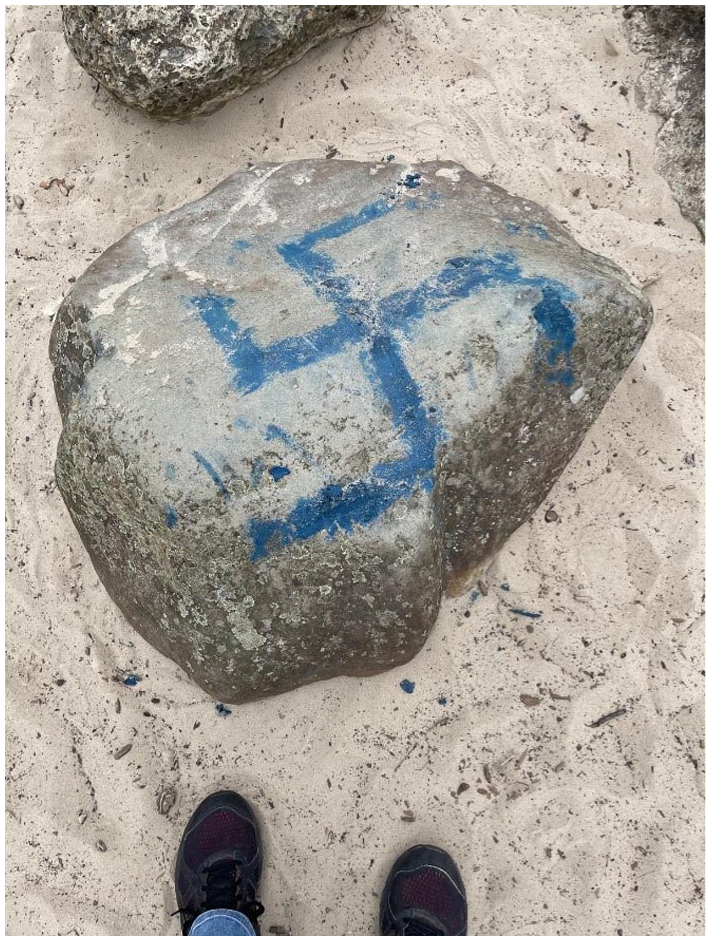
As I was concluding this article’s final draft, swastikas were painted on boulders in a children’s playground near my flat, a chilling reminder that antisemitism exists in the UK and must be continuously challenged. The issue is that even though TJC spouts the term right and left, the way it is invoked and mobilised has paradoxically displaced the risks of the real antisemitism in favour of weaponising the term to continuously threaten and silence all those who dare voice demands for Palestinian equality and liberation. Indeed, the oldest surviving Jewish newspaper has used antisemitism not so much to fight racism but to defend a racist regime and to cover-up horrific violations and genocide it has carried out. It has devalued the term antisemitism and by so doing has harmed the Jews it claims to represent.
Footnotes
Acknowledgements
The author wishes to thank Des Freedman, Kathryn Higgins, Catherine Rottenberg, and Adam Sutcliffe for their helpful comments and suggestions.

Funding
The author disclosed receipt of the following financial support for the research, authorship, and/or publication of this article: The author acknowledges the receipt of financial assistance from the Network for Social Change Charitable Trust.
Declaration of conflicting interests
The author declared no potential conflicts of interest with respect to the research, authorship, and/or publication of this article.