




Abstract
This essay examines how South Asian archivists in the North American diaspora engage with endangered and lost media, constructing informal, vernacular archives that embody narratives of belonging, change, and displacement. Focusing on the preservation of endangered musical media, it reveals how these archivists challenge dominant Western frameworks of categorization and representation. Through case studies of Discostan and Hamnawa, the essay demonstrates how diaspora-led efforts fill the gaps left by insufficient preservation practices in India and Pakistan. Using Critical Technocultural Discourse Analysis (CTDA) and semi-structured interviews, the research explores how digital tools influence social memory. It also examines the “double helix” model of digital cultural memory, where one strand emphasizes remixing and transformation, while the other focuses on preservation. These initiatives blur the lines between creation and preservation, highlighting the evolving relationship between digital culture, memory, and media in diasporic contexts.
Keywords
Introduction
Digital media archives, particularly those preserving lost or forgotten musical media such as album art and videos, play a vital role in constructing narratives of belonging, change, and dislocation within South Asian diasporic communities. These archives, often curated by media-savvy individuals both within South Asia and its diaspora, reflect a labor of love, driven more by passion than profit, and are maintained across both online and offline platforms. The work of these archivists also challenges dominant Western paradigms of categorization and representation in digital archival practices, where South Asian and, at times, broader Middle Eastern media are often marginalized. As these digital archivists excavate forgotten media, they simultaneously navigate and subvert Western biases embedded in digital infrastructures, thus performing the dual role of preserving cultural heritage and shaping digital identities.
The significance of this diasporic archival work lies not only in the preservation of media but also in the way these archivists engage with evolving media technologies and transnational literacies to produce knowledge about South Asian musical media. This aligns with Wegner’s (1987) concept of “transactive memory,” where groups collaboratively store and retrieve knowledge. This collaboration fosters a new kind of memory culture—one where remixing and transformation are as integral as traditional preservation. Abigail De Kosnik’s notion of “rogue archives” further illuminates how these digital archives operate beyond institutional frameworks, challenging traditional power structures by offering access to cultural materials often excluded from conventional archives.
De Kosnik (2016) introduces the metaphor of the “double helix” to describe the structure of digital cultural memory, in which one strand represents memory-based creative practices like remixing and appropriations, and the other strand consists of actual archives that preserve these works. This double-stranded model captures the iterative relationship between archival media and its reimaginings, complicating the binary distinctions between archive and repertoire. Thus, digital archives are not merely repositories but dynamic sites of cultural production and reinterpretation, contributing to an ever-evolving economy of social memory (Paschalidis, 2014). This model underscores how South Asian diasporic archivists, through their engagement with digital media, redefine archival practices, producing not only cultural artifacts but also alternative modes of remembrance that resist hegemonic structures.
Methods and framing
This essay investigates the intersection of digital memory-making tools and the social construction of memory within South Asian diasporic digital media archives. By interrogating these archives through the lens of Critical Technocultural Discourse Analysis (CTDA), I examine how digital tools shape and transform collective memory, questioning the power dynamics embedded in these processes. Specifically, I explore whether the concept of the “double helix” of digital memory—where one strand represents creative, memory-based practices such as remixes and appropriations, and the other strand consists of archival preservation—adequately captures the complexities of diasporic media archives, or if there are epistemic blind spots in this speculative structure (De Kosnik, 2016). To address these questions, I present two case studies: Discostan and Hamnawa, both digital musical archives that focus on preserving South Asian media. These archives are significant not only because they compensate for the lack of institutional support in archiving South Asian musical heritage by states like India and Pakistan, but also because they challenge dominant modes of media categorization and representation (Wegner, 1987). The curators of these archives are media practitioners located both within and outside of South Asia, whose work reflects a broader transnational media literacy that shapes how South Asian musical media is digitally archived and disseminated.
Semi-structured interviews with the archivists of Discostan and Hamnawa were conducted via Zoom to explore their motivations, organizational practices, and the logics that underpin their archival activities. These interviews provide critical insights into how digital archivists negotiate the material and symbolic conditions of digital preservation, and how they engage in practices that reshape global perceptions of South Asian media. CTDA, as articulated by Brock (2018), is essential to this analysis, as it allows for a critical examination of the ways in which technology, culture, and power intersect in digital spaces. This approach frames the interactions between technology (artifact), cultural practice, and belief systems, providing a holistic analysis of how digital archives function as both technological and cultural artifacts.
By emphasizing these dimensions, CTDA highlights both the technological frameworks at play—such as platform architecture and design affordances—and the ways users create, share, and transform cultural content to either challenge or reinforce existing hierarchies. In analyzing Discostan, I coded social media posts, platform features, and curator interviews to show how Instagram’s design intersects with the DJs’ decolonial and transnational orientations. This analysis reveals how sonic curation generates inclusive and counter-hegemonic narratives about memory. For Hamnawa, I similarly examined mailing-list content, embedded music links, and curated posts, demonstrating how these digital elements embody the founder’s focus on regional specificity, local politics, and the constraints posed by global streaming platforms. Synthesizing these insights from both archives through CTDA enables a nuanced narrative about how cultural artifacts—remixed tracks, annotated playlists—gain renewed significance in digital spaces. It clarifies how creative practices and strategic decisions align with underlying cultural beliefs and attachments, ultimately shaping both the imaginaries and tangible realities of diasporic media preservation.
CTDA’s utility lies in its ability to dissect the materiality and semiotics of digital tools, emphasizing how technological design and user discourse co-create meaning (Brock, 2018). This tripartite model of artifact, practice, and belief is crucial for understanding the digital media archives examined here, as it helps unpack the ways in which these archives are not passive repositories but active sites of cultural production. By applying CTDA, I explore how these archives not only store media but also transform the way that media is engaged with, understood, and circulated across global digital networks.
Cultural memory and digital archives
Diana Taylor’s analysis of the “embodied/document divide” is crucial for grasping how digital memory tools function within “rogue archives.” This divide distinguishes between the archive, which safeguards print and material culture, and the repertoire, consisting of embodied practices and acts of transfer. However, digital technologies challenge and blur this distinction. Taylor (2003) raises a critical question: “If the repertoire consists of embodied acts of transfer and the archive preserves and safeguards print and material culture—objects—what to make of the ‘digital’ that displaces both bodies and objects as it transmits more information far faster and more broadly than ever before?” This inquiry highlights the fluidity of digital musical media—samples, remixes, and compositions—that act as evolving archives, particularly within performance-driven cultures, where this fluidity contrasts sharply with the fixity of print-based traditions.
A significant barrier to recognizing this dynamic nature is the erasure of users of color within digital media studies, as argued by Florini (2019). Florini asserts that scholars tend to frame people of color as “technological outsiders” within the “digital divide,” obscuring their extensive engagement in digital archival and creative practices. This lens perpetuates a narrative that fails to acknowledge the role of marginalized communities in shaping digital archives, thus neglecting their contributions to cultural memory production.
De Kosnik’s (2016) concept of “memory gone rogue” addresses these overlooked sites of cultural production, where memory is no longer a static record but an active force in cultural creation. De Kosnik argues that memory has shifted from being a mere record of cultural production to becoming a key component in the production process itself: “Memory has gone rogue because it has come loose from its fixed place in the production cycle. It now may be found anywhere, or everywhere, in the chain of making.” While this fluidity allows for previously marginalized voices to contribute to memory-making, it also opens the door for rogue memory to be co-opted by dominant groups, potentially reinforcing existing power structures rather than challenging them.
The use of metaphors like “archive” or computer-centric terms such as “hard disk” to describe cultural memory introduces epistemic blindspots that risk erasing localized, situated knowledge about recording and remembering processes. Michel de Certeau’s critique highlights the dangers of an archival memory that detaches itself from its source, becoming a “parasitic enterprise” that is “immunized against alterity” (Taylor, 2003). These concerns are particularly pertinent in the context of subaltern digital media, remix culture, and archive production, which remain underexplored in South Asian diasporic settings (van Dijck, 2007).
Mbembe’s (2002) analysis of archives further complicates the notion of “rogue” archives by framing the archival process as not only about memory retrieval but also about conferring “status.” Mbembe argues that archives operate through “discrimination and selection,” privileging certain documents while deeming others “unarchivable.” This selective process mirrors broader power dynamics, particularly in post-colonial contexts like India and Pakistan, where memory institutions serve as “mechanisms for the permanent display of power” (Bennett, 1995). These institutions are not neutral but function as tools of the state, reinforcing hierarchies and controlling the narratives that are preserved and those that are erased.
In post-colonial states, memory-making is deeply intertwined with governance, as these states use cultural technologies to command, order, and control both objects and bodies, living or dead. This macro-level application of state power influences how human agency is conceived within memory practices, challenging the idea that digital archives inherently democratize cultural memory. Instead, power continues to shape which narratives are preserved and which are marginalized, even within ostensibly “open” digital spaces.
To ground these theoretical concerns in practice, I turn to the voluntary digital archival labor seen in South Asian digital music archives like Discostan and Hamnawa. Through semi-structured interviews with their archivists, I examine how these archives navigate the power dynamics of post-coloniality, creating spaces that challenge traditional modes of memory while also contending with the broader forces of state and cultural power that shape their work. These archives not only preserve neglected musical heritage but also offer alternative ways of constructing pasts, presents, and futures within the digital landscape.
Discostan: A transnational digital archive of sound and memory
Discostan (Figure 1), a portmanteau of “disco” and the suffix “-stan” (meaning “land”), serves as both an online music archive and a DJ collective that curates and remixes sounds from South Asia and the Middle East. Founded by Arshia Haq, an Indian-born, Los Angeles-based artist, Discostan is not just a repository of musical heritage but a dynamic platform that bridges historical and contemporary soundscapes across borders (Figure 2). Through its digital archive, Discostan fosters a collaborative space for remixes and reinterpretations, actively engaging artists and listeners in a transnational dialog. Haq’s diasporic digital archival practice exemplifies a creative response to both the colonial past and post-colonial cultural traumas shared by these regions.
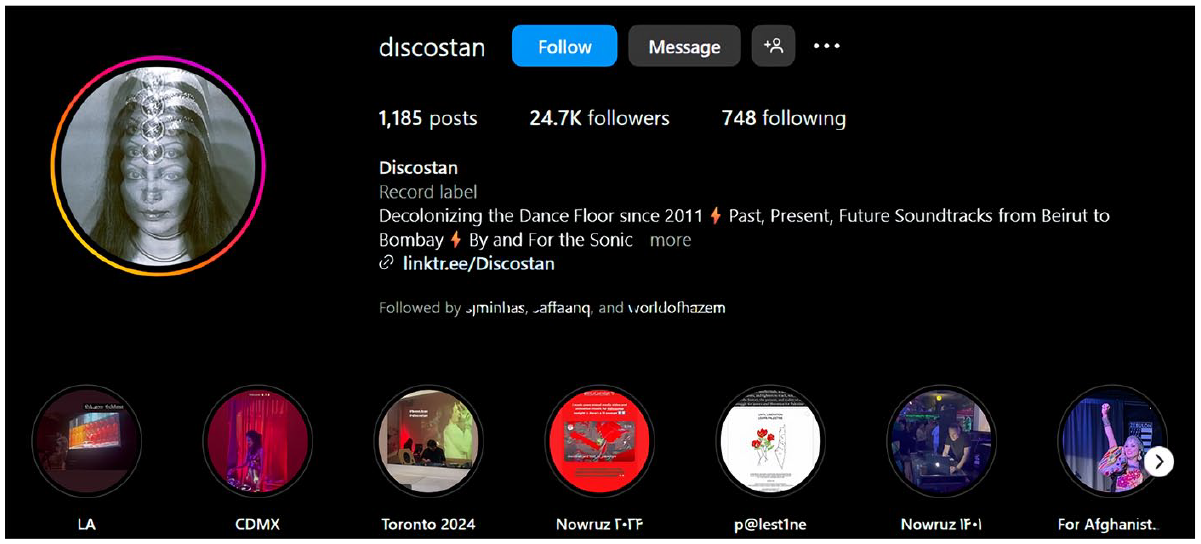
Discostan’s header on Instagram.
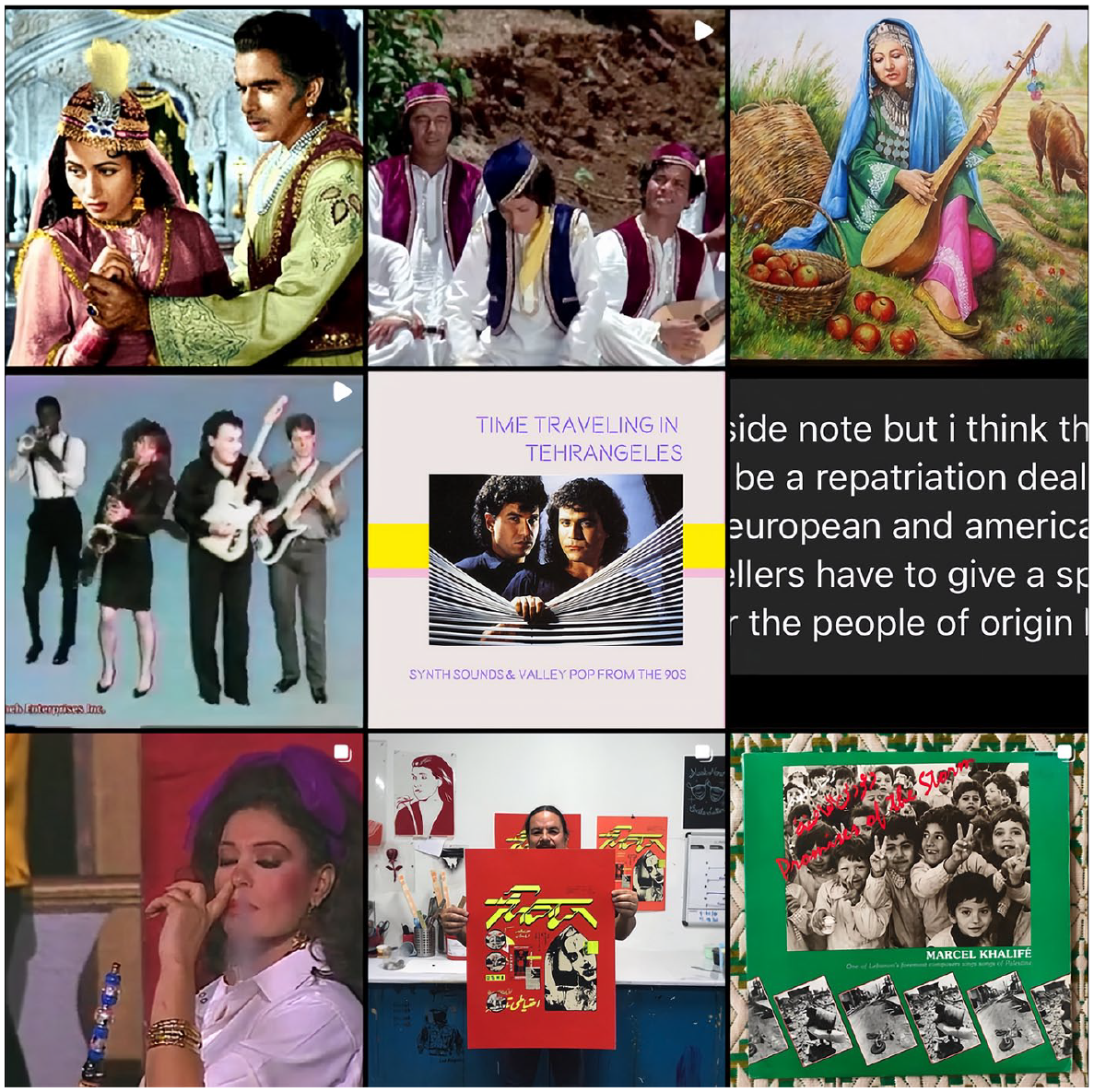
A snapshot from Discostan’s Instagram feed, showcasing a mix of Middle Eastern pop culture, music, and visual art. From vintage film stills and ‘90s Tehrangeles synth-pop to iconic cultural figures and protest music, the feed highlights the fusion of global and diasporic identities through art, sound, and memory.
In an interview with Pitchfork, Haq articulated how Discostan transcends national boundaries, framing it as a “fictional construct” that reimagines the idea of a nation through sound. She states, “Discostan turns the idea [of a nation] inside out. It’s a fictional construct. . . that looks at both pre- and post-colonial history in terms of all the things that make culture rich [in regions] that also share trauma” (Jagota, 2020). This emphasis on sound as a transnational force enables Discostan to subvert traditional geographic and political borders, creating what Haq calls an “imaginary homeland” where music serves as both a bridge and a foundation for cultural memory.
The archive does not merely preserve musical artifacts; it reshapes them into a living, evolving cultural space that encourages interaction and reinterpretation. By featuring various artists and records in their archive, Discostan not only preserves South Asian and Middle Eastern musical legacies but also inspires a wave of remixes, mixes, and reinterpretations (Figure 3). This participatory approach echoes De Kosnik’s (2016) notion of “rogue archives,” where digital archives no longer simply preserve cultural memory but actively generate new cultural productions through remixing and reinterpretation. Moreover, Discostan challenges dominant Western narratives about the East, as seen in their frequent critiques of “orientalism” and “exoticism.” By utilizing album covers from ethnographic song collections, the archive interrogates how these musical traditions have been commodified and misrepresented in the West (Figure 4). Such posts not only serve as a form of cultural critique but also reclaim the agency of South Asian and Middle Eastern artists, positioning them as central voices in the digital archival process (Figure 5).
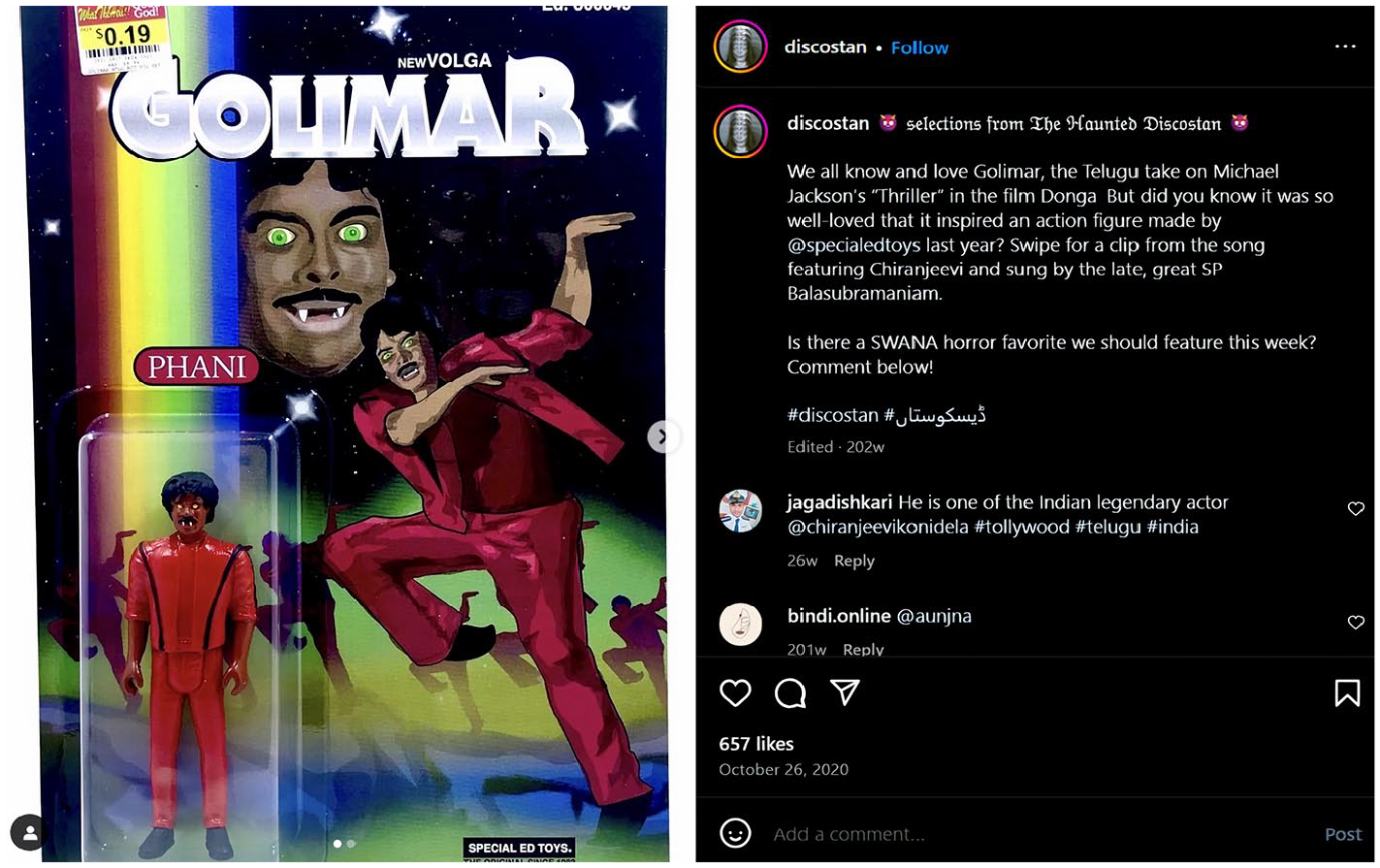
An archival post on Discostan with a nostalgic tribute to the Telugu rendition of Michael Jackson’s “Thriller” from the movie Donga. The figure represents Golimar, starring Chiranjeevi, with striking artwork that pays homage to cult film fandom.
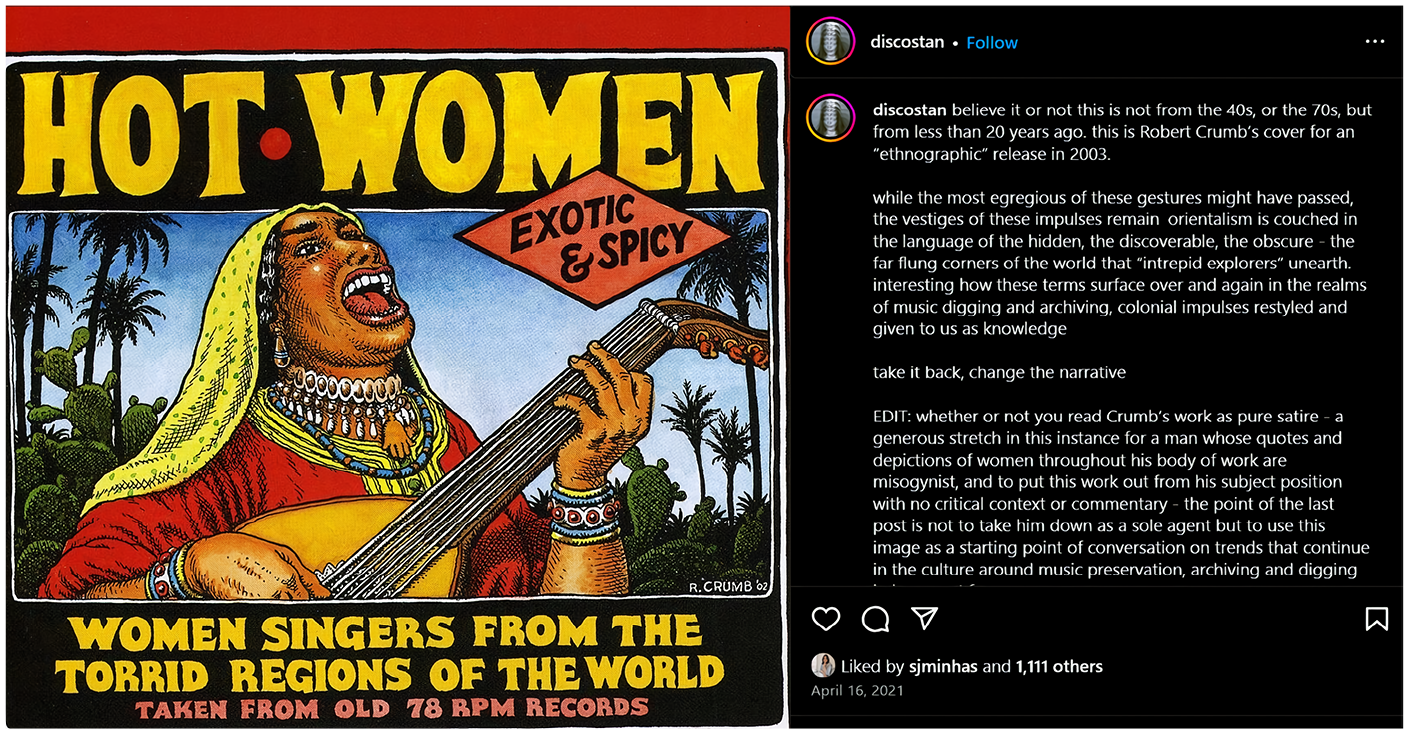
This controversial cover from a 2003 “ethnographic” music release evokes a retro exoticized image of women in global music traditions. Discostan critiques the orientalist gaze embedded in archival music culture and urges a rethinking of these narratives.
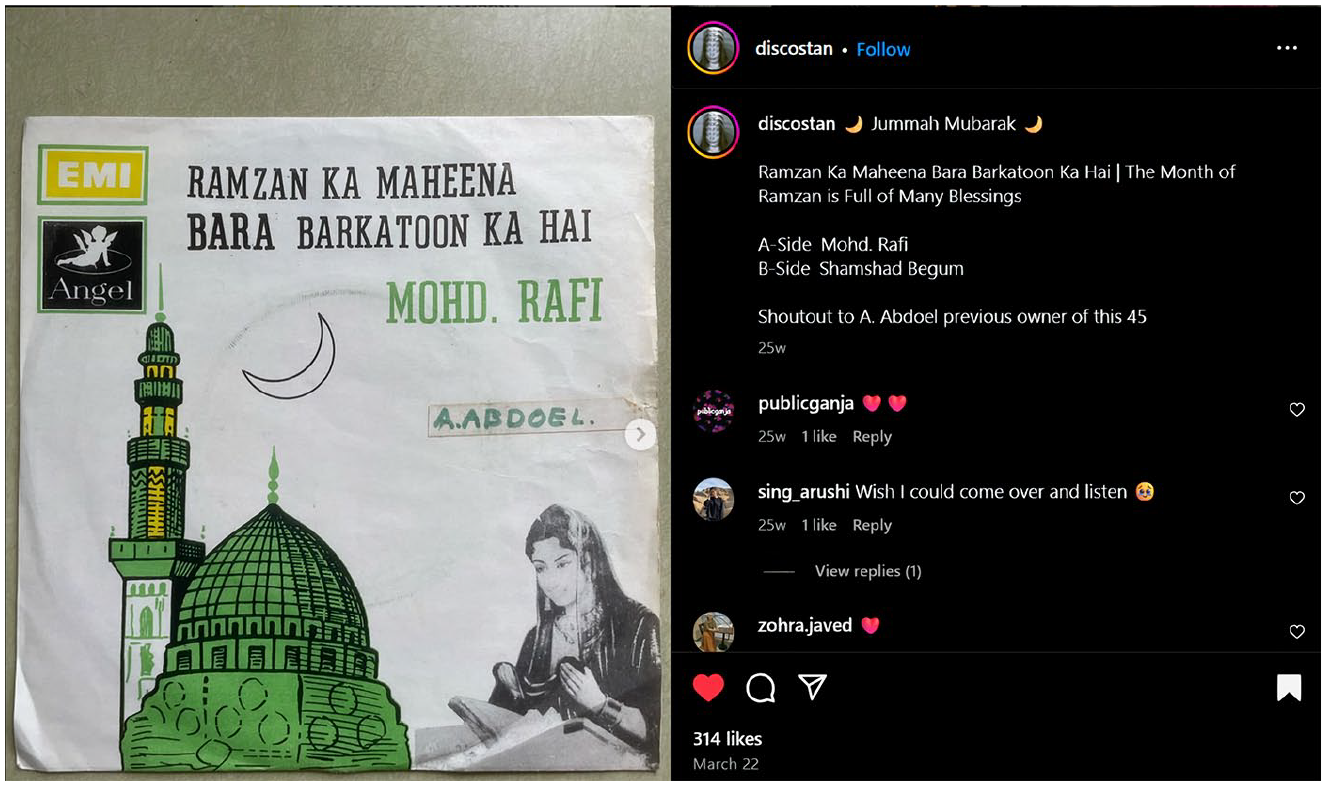
An old EMI record cover featuring the song “Ramzan Ka Maheena Bara Barkatoon Ka Hai” by Mohammed Rafi, celebrating the blessings of the holy month of Ramzan. A classic piece of South Asian Islamic musical heritage.
Hamnawa: Archiving the trajectory of Pakistani music
Hamnawa (Figure 6) (ہم نوا), which translates to “fellow singer” or “companion in song” in Urdu operates as both an online magazine and an archive dedicated to Pakistani music. Founded by Zeerak Ahmed, a Pakistani native now based in Seattle, USA, Hamnawa primarily disseminates its content through a mailing list, offering subscribers access to a curated collection of music, articles, and archival material. This decentralized distribution method emphasizes the community-oriented ethos of Hamnawa’s digital practice, which is focused on preserving and recontextualizing Pakistan’s musical heritage.
Hamnawa’s header on Instagram.
Ahmed views Hamnawa’s work as part of a broader narrative that intertwines music, technology, business, and politics. As Ahmed puts it, “the overarching thesis of Hamnawa is that the arc of Pakistani music is a story not just of music, but of technology, business, and politics. And while various societal factors influence the direction of Pakistani music, it cannot be understood with a global lens only. This particular narrative has a unique historical trajectory. A story of its own to be told” (Ahmed, 2020). This perspective underscores the importance of viewing Pakistani music not merely as an esthetic or cultural product but as a multifaceted phenomenon shaped by local historical contexts, technological advancements, and socio-political dynamics.
Hamnawa’s approach, therefore, contrasts with the dominant global frameworks that often analyze non-Western music through a homogenizing lens, ignoring the local specificities that shape its evolution. By placing Pakistani music within its distinct historical arc, Hamnawa challenges the universalizing tendencies of global music discourse, offering a more nuanced and localized understanding of how music in Pakistan has developed in response to both internal and external forces.
CTDA provides a useful framework for understanding Hamnawa’s digital archival practice. CTDA, which focuses on the interplay between technological artifacts, cultural practices, and power relations, helps illuminate how Hamnawa navigates the intersections of music, technology, and politics (Brock, 2018). The archive functions as more than just a repository of music; it is a site where Pakistani musical traditions are critically engaged, reinterpreted, and re-contextualized for a contemporary audience. By curating and disseminating Pakistani music in this way, Hamnawa actively shapes the discourse around the cultural significance of the music, challenging dominant narratives that often marginalize or oversimplify non-Western musical practices.
Moreover, Hamnawa’s archival posts on platforms like Instagram (Figure 7) serve as digital touchpoints for broader conversations about Pakistani music and its intersections with issues like nationalism, identity, and technology. These posts (Figure 8) not only highlight the richness of Pakistan’s musical heritage but also critique how this heritage has been shaped by and in response to state power, commercial interests, and technological advancements. The platform thus acts as a critical space for rethinking the ways in which music is archived, consumed, and understood in the digital age.
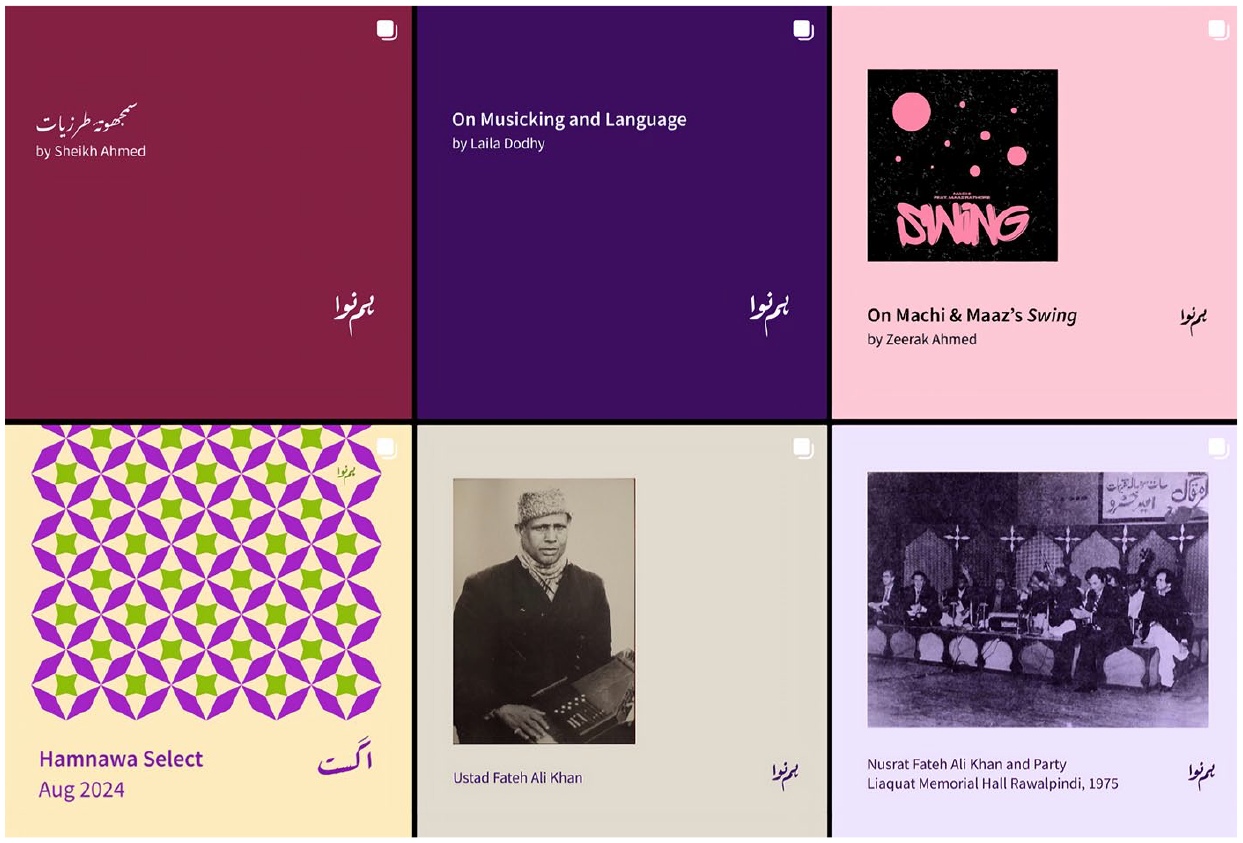
This image displays a curated series of Instagram posts from Hamnawa. Each post, varying in color schemes and design esthetics, highlights specific works related to traditional and contemporary forms of music and cultural reflection. The posts feature titles such as “On Musicking and Language” by Laila Dodhy and “On Machi & Maaz’s Swing” by Zeerak Ahmed, framed against minimalist backdrops that range from rich maroon and purple hues to soft pinks and pastels. Ustad Fateh Ali Khan and Nusrat Fateh Ali Khan are visually honored through archival images, grounding the collection in the history of qawwali music. The recurring Hamnawa logo ties the posts together, emphasizing a cohesive brand identity centered on artistic and academic explorations of South Asian musicology.
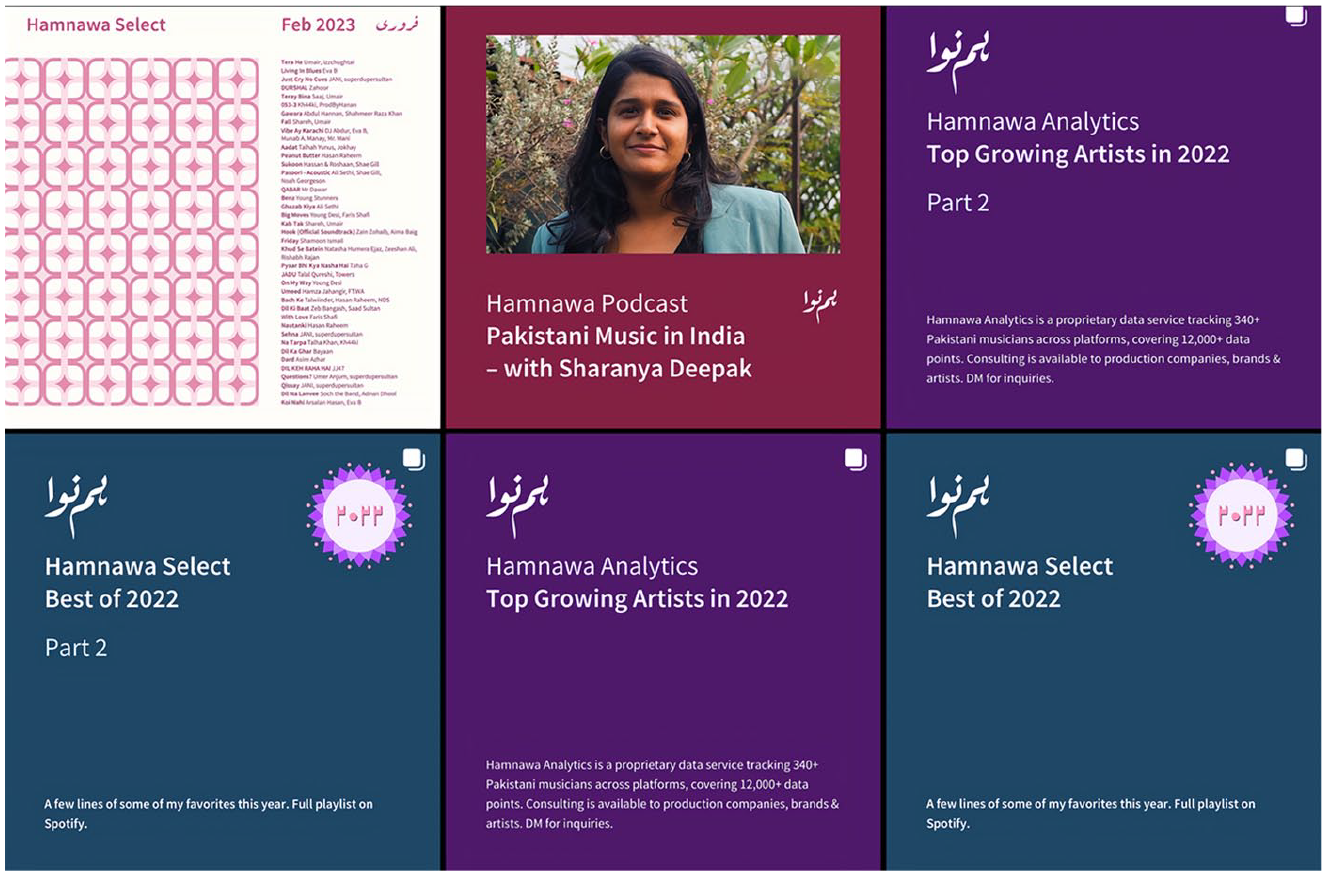
This image displays a set of Instagram posts from Hamnawa, showcasing their curated playlists, podcasts, and data-driven insights. The posts include Hamnawa Select for February 2023 and a “Best of 2022” series, featuring recommendations from various music genres. A featured podcast highlights an interview with Sharanya Deepak discussing the cross-border influence of Pakistani music in India. Posts from Hamnawa Analytics provide proprietary insights on emerging Pakistani artists in 2022, emphasizing the platform’s role in tracking industry data across 340+ musicians and over 12,000 data points. The esthetic is minimal yet vibrant, with consistent branding, bold typography, and modern color palettes, reflecting Hamnawa’s scholarly yet accessible engagement with South Asian music and culture.
Beliefs and meanings
Discostan’s digital and physical presence exemplifies a dynamic reimagining of home, or what its founder, Arshia Haq, calls a “sonic home” (Discostan, personal communication, 31 May 2023). This project grew organically as a space where sound, free from the constraints of national borders and state-imposed narratives, becomes the defining foundation for a community that playfully interrogates the very notion of belonging. The patrons of Discostan’s Los Angeles performance space refer to themselves as the “Republic of Discostan,” invoking a fictional construct that transcends geographical and national limits. This framing echoes a broader decolonial stance within Discostan’s practice, where music is not simply archived but becomes a medium through which the legacies of colonialism and nationalism are challenged.
This critique extends to categories like “world music,” which Discostan argues are entrenched in Western ethnographic practices that dehumanize and objectify non-Western cultures. According to Discostan, such labels reduce entire musical traditions to “specimens” under a quasi-scientific gaze that reinforces Western hegemony in cultural representation (Discostan, personal communication, 31 May 2023). By contesting these categories, Discostan not only rejects Western-centric classification norms but also reclaims agency over how South Asian and Middle Eastern music is archived and circulated. This decolonial intervention resonates with Brock’s (2020) critique of Western technoculture, where digital practices are often framed within a capitalist logic of efficiency, commodification, and control. By disrupting these frameworks, Discostan positions its archival practice as both a site of cultural resistance and a space of creative freedom.
Hamnawa, while similarly engaged in the work of digital archiving, offers a more skeptical view of diasporic practices that center on nostalgia. Zeerak Ahmed, the founder of Hamnawa, critiques the simplistic framing of nostalgia in diasporic communities, noting that cultural practices like building mosques or organizing Eid festivals abroad are often reductively understood as efforts to recreate a lost homeland (Hamnawa, personal communication, 30 June 2023). While acknowledging the importance of memory, Ahmed emphasizes that Hamnawa’s project goes beyond mere nostalgia. For him, the significance of Pakistani music in the diaspora lies in its distinctiveness—its ability to articulate cultural expressions and linguistic nuances that cannot be easily replicated elsewhere. This perspective complicates the idea of nostalgia by suggesting that the desire to engage with Pakistani music abroad is not solely a backward-looking longing for home but also a forward-looking appreciation of the unique ways in which these musical forms resonate in new contexts.
Ahmed’s critique of “world music” further complicates this discussion. Drawing on Scott’s (2008) concept of “legibility regimes,” he argues that the standardization of music into global categories like “world music” reflects a broader Western imposition of order that renders local traditions invisible or illegible. Ahmed points out that these legibility regimes, deeply embedded in Western software development and media infrastructures, create epistemic blind spots that obscure the richness of non-Western musical traditions (Hamnawa, personal communication, 30 June 2023). This mirrors Brock’s (2020) analysis of racial identity and digital practice, where technologies are designed and deployed within cultural logics that prioritize Western ideals of rationality, progress, and modernity, often to the exclusion of minority voices. In this context, Hamnawa’s archival practice can be seen as a deliberate act of resistance against these erasures, challenging the technological and cultural structures that marginalize Pakistani music.
The divergent approaches of Discostan and Hamnawa reveal two distinct strands of digital archiving within the South Asian diaspora. Discostan constructs a shared, imagined homeland, where sound operates as a tool for community-building and transnational solidarity. This practice is grounded in a playful, decolonial engagement with cultural memory, using music to reimagine borders and identities. In contrast, Hamnawa’s approach is more focused on the present, emphasizing the uniqueness of cultural artifacts and experiences that resist easy categorization. For Hamnawa, the significance of archiving Pakistani music lies not in a nostalgic return to the past, but in recognizing and preserving the distinctiveness of these musical forms as they circulate in global diasporic contexts.
Both archives challenge traditional understandings of nostalgia and memory, but they do so in different ways. For Discostan, nostalgia functions as a bridge to an imagined homeland, a digital space where visitors can reconnect with a collective sonic identity that transcends borders. Hamnawa, on the other hand, critiques the simplistic use of nostalgia in diasporic practices, arguing that the value of music lies in its ability to offer something unique and irreplaceable, particularly in a foreign context. This dual approach to nostalgia—both as a backward-looking device and a forward-looking recognition of uniqueness—complicates the relationship between memory, identity, and digital archiving in the diaspora. These differing perspectives illustrate the complex interplay of beliefs and meanings in the digital archiving of South Asian music. Both Discostan and Hamnawa reject the hegemonic structures of Western technoculture, but they do so in ways that reflect their unique orientations toward memory, place, and identity.
Artifact and form
Discostan and Hamnawa, while both engaged in the preservation and dissemination of South Asian and Middle Eastern music, take distinctly different approaches to the form and structure of their digital archives. Discostan operates through a hybrid model that includes both physical and digital components. In Los Angeles, it exists as a physical discotheque where live mixes, often derived from their archival collections, are performed by guest DJs. This creates an immersive space where sound becomes a lived experience. Simultaneously, Discostan maintains a robust digital presence, most visibly on Instagram, where it curates and showcases music from the Global South. This dual presence allows Discostan to operate both as a performance space and a digital archive that resists the dominant Western gaze, actively challenging preconceptions about cultural identity, race, and religion in the music it curates (Discostan, personal communication, 31 May 2023).
In line with Brock’s (2020) analysis of digital technoculture, Discostan’s approach subverts the dominant cultural logics that often dictate how digital spaces are structured and who they serve. By focusing on the Global South, Discostan disrupts the expectations of Western technocultural norms that prioritize rationality, efficiency, and commodification, aligning instead with a more libidinal, affective economy where the value of the archive lies in its capacity to evoke emotional and cultural resonance rather than simply organizing information. This counters the belief that digital archives must conform to the capitalist and technocratic values often associated with Western cultural production (Mosco, 2009).
Hamnawa, by contrast, takes a more minimalist approach to its digital archive, primarily disseminating its content through a mailing list. Subscribers receive emails containing text descriptions and analyses of songs, accompanied by embedded links to music videos. This method reflects Hamnawa’s focus on generating a “second-order information infrastructure” around Pakistani music. Founder Zeerak Ahmed argues that while Pakistan produces a significant volume of music, there is a lack of critical discourse to explain why this music matters on a global scale. This absence of a robust infrastructure for discussing and contextualizing music, Ahmed suggests, is one of the reasons why Pakistani music struggles to gain the same visibility as music from more established markets (Hamnawa, personal communication, 30 June 2023).
Hamnawa’s focus on building a critical mass of information around Pakistani music speaks to a broader critique of how digital platforms—largely designed and governed by Western standards—fail to accommodate the specificities of non-Western musical traditions. This resonates with Brock’s (2020) argument that digital technologies are not neutral artifacts; rather, they are shaped by the sociocultural contexts of their design and use. For example, Western music streaming platforms like iTunes operate on the assumption that music can be attributed to a single artist and neatly packaged into albums. However, this model is incompatible with the realities of qawwali, a Sufi musical tradition where a single performance can generate numerous recordings, none of which can be considered “canonical” (Hamnawa, personal communication, 30 June 2023). This standardization of musical information creates epistemic blind spots, obscuring the diversity and richness of non-Western musical forms.
Both Discostan and Hamnawa challenge these Western frameworks, but they do so in different ways. Discostan critiques the colonial categories used to describe and organize music, opting for the acronym SWANA (South West Asia and North Africa) as a more accurate and respectful alternative to terms like “Middle East,” which are rooted in colonial geography and Western ethnographic practices (Discostan, personal communication, 31 May 2023). This mirrors the broader critique of whiteness as an “unmarked” category that structures how digital content is organized and consumed. As Dyer (1997) argues, whiteness operates as a universal marker of civilization and progress, subtly reinforcing the idea that Western standards of categorization are both neutral and natural. Discostan’s refusal to conform to these categories thus becomes a form of decolonial resistance, pushing back against the hegemonic structures that shape how cultural artifacts are archived and understood.
Hamnawa, while less overtly political, similarly critiques the limitations of Western platforms for presenting non-Western music. Ahmed’s observation that qawwali cannot be accurately represented within the standard album format underscores the broader issue of how digital infrastructures are ill-suited to accommodate non-Western cultural practices. YouTube, with its capacity for video streaming, offers a partial solution by providing some of the contextual information necessary to understand qawwali performances. However, Ahmed notes that even platforms like YouTube are constructed for contexts that are far removed from the places where these musical forms originate (Hamnawa, personal communication, 30 June 2023). This reflects Brock’s (2020) critique that Western technocultural standards often fail to account for the diverse ways in which non-Western communities engage with and produce digital content.
In sum, both Discostan and Hamnawa illustrate the ways in which digital archives are not merely neutral repositories of information but are deeply entangled with the cultural, political, and technological infrastructures that shape how music is produced, categorized, and consumed. Discostan’s hybrid model of a physical and digital archive allows it to challenge Western norms around cultural identity and belonging, while Hamnawa’s focus on creating a critical infrastructure for Pakistani music critiques the limitations of Western digital platforms.
Practice and function
Both Discostan and Hamnawa demonstrate a distinctive internal logic in their curatorial practices, rooted in an instinctual and exploratory engagement with digital archives. As evidenced by Discostan’s process, their work often begins with a visual inquiry, navigating non-English portals in Urdu and Arabic, thus accessing cultural content unavailable to monolingual English speakers (Discostan, personal communication, 31 May 2023). This multilingual approach immediately complicates the notion of archiving, challenging hegemonic knowledge structures that rely heavily on Anglocentric digital frameworks. The idea that “a phrase might open up a whole phrase of poetry or something that becomes the basis around which archival work is organized” (Discostan, personal communication, 31 May 2023) reflects a kind of epistemological improvisation. This mode of curation exemplifies Chun’s (2008) “enduring ephemerality,” as it embraces both the randomness and fragility of digital content, raising questions about the materiality of digital archives.
Moreover, Discostan’s live mixes extend this practice, operating not merely as collections of songs but as cinematic experiences. Their background in film shapes their live performances, allowing them to “think about what it means to put one song next to the other, more than maybe even the songs themselves” (Discostan, personal communication, 31 May 2023). This practice, echoing Shifman’s (2013) analysis of memetic participation structures, underscores the performative and interactive dimensions of archival work. Live mixes become more than ephemeral soundtracks; they serve as dynamic engagements with memory and culture, curated in the kairotic moment (Brock, 2020). The “glitches and chances” in these performances (Discostan, personal communication, 31 May 2023) reflect a resistance to the institutional rigidity that often characterizes official archival practices, aligning with what De Kosnik (2016) terms “rogue memory work.”
Both Discostan and Hamnawa challenge conventional, top-down institutional memory-making by presenting alternative archives that grapple with the incompleteness of state-sponsored historical narratives. In this way, their work aligns with Brock’s (2020) critique of how marginalized groups, such as Black Twitter users, use digital spaces to resist dominant narratives and establish their own cultural presence. In Discostan’s case, the creation of an “imaginary homeland” (Discostan, personal communication, 31 May 2023) through the archive acts as a diasporic intervention, resisting postcolonial nation-state structures that often impose rigid, exclusionary histories. This move echoes the libidinal economy discussed by Harding (1992), where marginalized communities assert their cultural and emotional significance against hegemonic rationalities that often diminish their historical experiences. Digital archives like Discostan and Hamnawa function in the realm of cultural labor that Terranova (2000) describes as “invisible” due to the distance between producer and consumer in digital spaces. The curation of South Asian music, conducted by enthusiasts rather than professionals, operates within this framework of “rogue” archival labor. This aligns with Brock’s (2020) discussion of how Black digital practices signal spaces as Black, despite their small percentage of overall users, by employing racial and cultural signifiers. Similarly, Discostan and Hamnawa use esthetic and cultural signifiers to create an archive that challenges dominant national and cultural narratives, much like how Black Twitter repositions online spaces (Brock, 2020). This act of signification is crucial in the context of digital archives, which often fail to capture the nuances of marginalized experiences when filtered through institutional structures.
Additionally, Discostan and Hamnawa’s reliance on digital platforms highlights the tension between ephemerality and permanence in memory-making. As Chun (2008) suggests, digital memory is inherently ephemeral, and these archives raise concerns about the long-term sustainability of the cultural works they house. This raises pertinent questions about the future of digital archiving as a practice, especially when driven by amateurs or volunteers rather than formal institutions (Baker and Collins, 2017). The lack of state support for such initiatives further complicates the role of these archives, as they must contend with the limitations of digital platforms that often prioritize commercial over cultural preservation (Han, 2017).
Discussion
The archival work undertaken by Discostan and Hamnawa exemplifies how much of digital archival labor occurs behind the scenes, particularly in the ongoing maintenance of digital data in fragile digital ecosystems. De Kosnik (2016) outlines the repetitive tasks involved in these endeavors, including managing server space, processing submissions, debugging, and enhancing automated systems, alongside public engagement and media inquiries. These efforts expose the labor-intensive nature of digital archives, where archivists, even with automation, must perpetually engage with technological infrastructures to preserve digital culture. This digital labor reflects broader trends in fan cultures, where corporations exploit fan archivists’ social networks for publicity in digital spaces (Jenkins, 2006). However, within the Global South, these practices take on a more complex socio-economic dimension, potentially operating in opposition to capitalist and corporate interests by forging informal and community-driven archives.
Rather than dismissing these initiatives as success stories catering to Western notions of international development and heritage preservation, it is essential to interrogate their sustainability. Discostan and Hamnawa predominantly host their archival materials on Instagram, a platform that introduces significant challenges, from media copyright issues to algorithmic politics and the ephemeral nature of digital posts. The notion of “techno-volunteerism” (De Kosnik, 2016) and “infrastructuring” (Flinn, 2019) are pertinent here, as these archives function within the constraints imposed by corporate-controlled digital platforms. Their work, while valuable, raises questions about whether these practices paradoxically undermine the very archival goals they aim to achieve by being embedded in commercial, anti-archival spaces.
Drawing on Ruskin’s (1880) reflections on memory, craft, and architecture, we can further complicate our understanding of how digital platforms mediate memory. Ruskin’s lament for a past in which memory was a natural and deliberate human endeavor contrasts with the contemporary digital landscape, where machine logic and media temporality dominate memory production. The archival work of Discostan and Hamnawa can be seen as both expanding and subverting this machine logic, creating “rogue” archives that resist institutional control while simultaneously relying on the very platforms that embody such control. This duality reflects De Kosnik’s (2016) concept of “archontic production,” where users engage deeply with the dispersed archives of media culture, often filling in the gaps left by institutional or state neglect.
Discostan and Hamnawa’s archival labor becomes a form of resistance to the historical neglect of South Asian musical media by both state and institutional actors, which aligns with Derrida’s (2017) assertion that “the archive is never closed; it opens out of the future.” The lack of state involvement in archiving these cultural materials creates a vacuum that these digital archivists are filling, yet their work is also a critique of the state’s failure to engage in meaningful archival practices. The Indian and Pakistani states, for instance, have largely ignored or even appropriated these rogue archives, using them for tourism and cultural promotion while disregarding the deeper narrative and memory-making processes inherent in such work (Hassan, 2018).
This complex negotiation between memory, technology, and state neglect speaks to the broader dynamics of rogue archives in postcolonial contexts. In many ways, Discostan and Hamnawa’s work reflects a movement away from technological determinism and toward an “affordances” model of digital technology (Benkler and Nissenbaum, 2006), where the emphasis is on how users creatively employ digital tools to reshape access to cultural media. This reconfiguration challenges the “selective tradition” described by Williams (1983), in which cultural elites and state institutions control the formation of cultural canons and what Grossberg (2009) later calls “absent modernity,” the systematic omission of alternative cultural logics. In contrast, rogue archives like Discostan and Hamnawa decentralize this process, enabling new modes of cultural memory-making that are accessible to a broader audience. Auslander’s (2008) notion of the “cultural dominant” further underscores the historical shift away from state-controlled media toward more diverse, decentralized forms of public memory.
Discostan and Hamnawa’s archival work is not just about preserving cultural memory but also about producing new, alternative archives that challenge traditional canons. De Kosnik (2016) notes that rogue archives are inherently opposed to canonicity, focusing instead on the repertoires of digital use and preservation. In the case of South Asian musical media, this anti-canonical approach is both a rejection of institutional neglect and an embrace of the creative possibilities afforded by digital platforms. By constructing their own digital archives, Discostan and Hamnawa are reshaping the landscape of cultural memory in ways that challenge both state and corporate control over media and information.
These efforts, however, are not without their contradictions. While rogue archives subvert traditional power structures, they also remain dependent on the infrastructures provided by corporate platforms like Instagram, which impose their own constraints on the longevity and accessibility of archival materials. This tension between subversion and dependence raises important questions about the future of digital archives. Are these practices sustainable in the long term, or do they merely replicate the precariousness of digital platforms?
In examining the metaphorical nature of these archives, we can return to De Kosnik’s (2016) invocation of the double-helix structure as a metaphor for the intertwined relationship between actual and metaphorical archives. Discostan’s imagination of a “virtual” homeland, as described by Deleuze and Guattari (1987), reflects the inherent tension between the real and the virtual, where the archive always strives toward the real but falls short. This process mirrors the ways in which we curate personal musical repertoires through streaming services, constantly revisiting and reliving memories through songs but never quite capturing the original experience (van Dijck, 2007).
Finally, Discostan and Hamnawa’s work raises questions about the nature of memory, archive, and digital culture. Their rogue archival practices are reshaping the possibilities for cultural memory in the Global South, but they also highlight the challenges and contradictions inherent in working within corporate digital infrastructures. As these archivists continue to navigate the precariousness of digital platforms, they simultaneously challenge traditional notions of canonicity and create new spaces for memory-making in the digital age.
Conclusion
In examining the role of digital archives in shaping narratives of belonging, change, and dislocation within South Asian diasporic communities, it is useful to reflect on Haraway’s (2006) notion of the technoscientific matrix. Haraway emphasizes that individuals engage with this matrix to navigate its structures for personal and communal benefit, while simultaneously being shaped and constrained by the very tools they use. This dynamic is clearly evident in the archival work of rogue archivists like Discostan and Hamnawa. By leveraging the possibilities of digital platforms, they sustain the preservation of cultural heritage often ignored by formal institutions. However, their efforts extend beyond mere self-satisfaction or cultural preservation; they underscore the significant gaps in traditional memory institutions, particularly in postcolonial contexts, revealing the broader failures of these institutions to adequately represent and preserve local heritage.
This subversion of traditional archival systems is particularly impactful in how Discostan and Hamnawa use digital platforms to disrupt dominant Western paradigms of memory and preservation. In their hands, cultural memory is no longer the exclusive domain of state-run or institutionally recognized archives, as these digital spaces decentralize the power of memory-making. By bypassing institutional neglect, particularly in India and Pakistan, these archivists demonstrate that digital tools can offer new, alternative forms of cultural preservation that challenge and complicate dominant narratives. Their work points to a larger global trend where diasporic communities, through digital archives, negotiate both local and global dynamics, maintaining their heritage while adapting it to new contexts and spaces. The work of these archivists goes further, filling critical gaps left by inadequate state-led preservation efforts, particularly through their engagement with endangered musical media. Platforms like Discostan and Hamnawa are not just sites of preservation but also of remixing, as they reimagine and recontextualize cultural materials. This mirrors the “double helix” model of digital cultural memory, where one strand preserves the integrity of the original media, while the other engages in creative remixing. This dual process challenges traditional binaries between preservation and creation, illustrating how digital archives can serve as sites of cultural production as much as cultural preservation. The boundaries of what constitutes an archive, as well as what counts as cultural memory, are constantly redefined in these digital spaces.
By applying Critical Technocultural Discourse Analysis (CTDA), we gain deeper insight into how these practices are not simply neutral acts of preservation. The tools and platforms used by these archivists shape and are shaped by the socio-political contexts in which they operate. Through these digital archives, South Asian diasporic communities are able to create spaces of belonging and continuity in a fragmented global context. The fluidity between preservation and creation reflects the nature of digital culture itself, where the distinctions between media and memory, archive and narrative, are constantly shifting. This points to a broader evolution in how cultural heritage is understood and sustained in the digital age, where the very concept of memory is inextricably linked to media technologies. The work of rogue archivists like Discostan and Hamnawa then opens up critical questions about the role of digital media in postcolonial and diasporic contexts. By addressing the gaps left by institutional neglect, these archives do more than preserve—they reimagine the possibilities of cultural memory. They challenge dominant frameworks of categorization and preservation, creating alternative narratives that offer new opportunities for community formation. The double helix model of digital cultural memory encapsulates this process, where preservation and creation are intertwined, continually reshaping the boundaries of what constitutes memory and media. This raises further questions about the nature of digital memory itself: How do digital platforms reshape our understanding of preservation in a rapidly changing technological landscape? And, to what extent can digital memory truly serve as a repository for cultural heritage when it is inherently mutable and subject to remixing? These questions underscore the need for continued exploration of the evolving relationship between digital media and cultural memory in the digital age.
