




Abstract
This article explores the experience of racism amongst practitioners of colour in the advertising industries in the UK and US, home to some of the world’s largest, flagship agencies and supposed leaders in equality, diversity and inclusion. The research was conducted in two study periods, one between 2013 and 2015, and a second between 2021 and 2023 following the murder of George Floyd in 2020 which saw a rise in organisational commitments to diversity. Semi-structured interviews were conducted with practitioners working in advertising agencies from a range of racial backgrounds, as well as ethnography within two of these organisations. The research reveals how racist discourse has changed overtime and the impact such conversations have on working praxis. In particular, the study argues that racism occurs in both work-based and informal settings, which both ultimately impact on career progression. Lastly, the paper shows how forced EDI secondments can be weaponised to redact practitioners of colour from high profile client work, and used as an exclusionary tactic.
Introduction
Over the past decade, the advertising industry has made various efforts to diversify its workforce (Boulton, 2015; Shankar, 2015). Grassroots organisations in the US have led initiatives, including AdColor and the Marcus Graham Project, both advocating for more practitioners of colour (POC) in the industry, implementing onboarding programmes with some of the largest organisations across the country. Similarly in the UK, Black Representation in Marketing (BRiM) is led by Meta and partner agencies, aiming to mobilise and support Black practitioners in the industry. This advocacy has been widespread, with many questioning if these are genuine steps to improve racial equity or to simply manipulate racial capital and communicate with more audiences of colour.
Notably, the murder of George Floyd in June 2020 has been a driver for improving diversity across the cultural and creative industries (CCIs). In the following year, advertising agencies began to develop positive recruitment practices to diversify their workforce, with many introducing internal networks for Black workers and anti-racism training. Whilst many initiatives exist, this paper uncovers how the industry still has a diversity problem. The focus on advertising as a race-making industry is important, as it is increasing attempts to communicate with racialised consumers, particularly with reports of rising disposable income for Black and Asian consumers (Boulton, 2016; Burton and Klemm, 2011). However, with recent, widespread criticism of high-profile campaigns that miss the mark, the industry is investing in more racialised talent in attempts to improve communication strategies.
Statistics are showing that diversity in advertising has increased, yet attention has recently turned to negative experiences. For instance, the 2023 All In Census which surveyed 19,000 advertising and marketing practitioners found that one in ten respondents identifying as ethnic minorities have been racially discriminated at their current organisation, with the majority being Black and/or Asian (Advertising Association, 2023). The report’s statistics are useful for a general consensus, however, they do not provide context on what constitutes as racial discrimination, the industry’s culture of supporting POC following calls for improved diversity and, consequently, how racial discourse has changed overtime.
This article addresses the experience of racism towards practitioners of colour in the UK and US advertising industries. Whilst organisational approaches to diversity have inevitably changed since 2020, the data uncovers the use of racialised discourse amongst practitioners, how particular groups are excluded or accepted, and the limits of allyship. This form of empirical research is essential as access to organisations persists as a barrier to research. More so, research within advertising agencies is ever more important, as practitioners continue to be cultural intermediaries and shapers of socio-cultural phenomenon (Cronin, 2004; Hodges, 2006; Kobayashi et al., 2018; O’Connor, 2015).
Racism in organisations
Whilst the past several years have seen an obsession with research into anti-racism and organisational diversity, it is not new phenomena. Most notably is Puwar’s (2004) work, which explores how racialised bodies are seen as ‘out of place’ in White majority organisations. Puwar addresses the conflicts that occur when people of colour are in senior positions within organisations, which have historically been ‘reserved’ for White men (Puwar, 2004: 31). Critical race scholars have long investigated this interconnection between race, power and institutions in the post-Civil Rights era in the US (Bell, 1990; Delgado and Stefancic, 2023) and post-MacPherson report in the UK (Holdaway and O’Neill, 2007; Ortiz, 2021). These studies investigate how laws are introduced as liberative ‘pragmatic’ mechanisms, yet continue to legitimise racism and intersectional discrimination (Crenshaw, 1988: 1335).
The supposed ‘post-racial era’ has enabled more overt forms of racism to manifest within organisations, such as microaggressions. These subtleties come out in casual conversations through ‘negative racial slights and insults toward people of colour’ (Sue et al., 2007: 271), where questions to non-White colleagues may intentionally be framed to offend, without necessarily using racist terminology. Instead, such discourse can present through ‘microinvalidations, microassaults, and microinsults’ (Fattoracci and King, 2023). These more subtle occurrences make it difficult to report incidents as they may not break policies surrounding covert racism; another legitimising factor of the limits to the law.
Predictably since 2020, the myth of the ‘post-racial era’ was widely discussed, with examples of anti-Black racism emerging from organisations (King et al., 2023). Prior to this, organisational studies scholars have long addressed the systematic exclusion of Black people (Roediger and Esch, 2012), anti-Black thoughts (Banaji and Greenwald, 2016) and assumptions of Black inferiority (Hoffman et al., 2016). Inevitably, these experiences lead to unfair hiring practices (Pager, 2003; Silva, 2018) and lower salaries (Hernandez et al., 2019). Consequently, there have been several attempts to improve organisational diversity, including the introduction or revision of equality policies (Steimel, 2021) and prompts for cultural change in organisations (Delgado and Stefancic, 2023). Whilst these are positive steps, there have been questions about the reasons why organisations are making such heavy commitments to diversity.
Racism in the promotional industries
Although racism is not exclusive to the promotional industries, there are tendencies which impact the industries’ work. Broadly, many have written on cultural production in creative work, where organisations have been criticised for including Black and Brown faces as attempts to communicate. As Gray (2019) critiques, media industries are too concerned with racial aesthetics as a means of equality, creating a ‘logic of commonsense racial knowledge’ (Gray, 2005: 22), as opposed to interrogating the intricacies of race-making practices. Similarly, Anamik Saha has written extensively on racial production, inequalities and working practices (Hesmondhalgh and Saha, 2013; Saha, 2018; Saha and van Lente, 2022), and the impracticalities of gaining access to conduct such research due to the topics’ volatile nature (Downing and Husband, 2005; Saha, 2018).
Although limitations exist, some have conducted in-depth research with promotional industry practitioners. Lee Edwards has written on the experience of racism amongst POC in public relations (PR). While PR is less driven by the aesthetics of creative work, its activities echo those of advertising in terms of developing promotional strategies on behalf of organisations. Edwards has written on the role of institutional racism in this production process, where POC balance racism from colleagues, limitations with creativity, having to ‘work harder’ (Edwards, 2013: 253) and inequalities in the recruitment process (Edwards and Aulakh, 2024). Similarly, and in congruence with this study, Kasey Windels has examined experiences in the US advertising industry, where workers find ways to navigate the industry’s ‘norms of Whiteness’ (Taylor, 2023; Windels et al., 2024b). Whilst these works are important, they do not address how the profession and experiences have changed overtime, particularly with the sudden pressures for change following the events of 2020.
Quotas as racial governance
A prominent argument suggesting a ‘post-race’ era is that there are statistically more POC working in the promotional industries (Carbado et al., 2008; Edwards, 2023: 5). For instance, the All In Census shows that 18% of participants identified as coming from an ethnic minority background, with lower experiences of discrimination (Advertising Association, 2023). These figures were reported as ground-breaking for improved representation (Bold, 2023) and ‘inclusive’ workplaces (Advertising Association, 2023). However, the details reveal that one in ten POC have experienced discrimination at their current employer, with three in ten Black practitioners likely to exit the industry due to discrimination (Advertising Association, 2023), confirming that the visibility of POC does not equate to equality (Rollock et al., 2011). Thus, it is no surprise that large numbers of POC are voluntarily exiting the field.
There is therefore a meritocratic assumption that doing one’s job well leads to success, although this debased viewpoint has been criticised for aesthetically ‘doing’ diversity (Georgiou, 2020; O’Brien et al., 2016; Saha, 2018; Saha and Lente, 2022; Titley, 2020). The reality is that POC face racism and discrimination in nuanced ways that do not protect them under equality laws or policies, with diversity removing the criticality of equal opportunities and social justice (Nwonka, 2020; Titley, 2020: 1). This is more than just the visibility of diverse bodies, but as this study shows, how those deemed out of place experience racism and are intentionally excluded from opportunities.
The business case for diversity
A likeness of research in this area is how organisations frame only the positive elements of diversity. For instance, whilst the majority of Puwar’s (2004) argument speaks of failed attempts at diversity, she opens by outlining how we are consistently fed the ideology ‘that diversity is good for us’ (Mease, 2012: 1). Rather than being about transformative change, the early end of the twenty-first century showed the performative nature of merely speaking about diversity and this neoliberal discourse has intensified since 2020. The support for workers of colour was immediate through performative statements of support and allyship via the sharing of black squares on Instagram. However, these organisations have been criticised for capitalising from racial trauma.
Advertising is a prime example of an industry which has attempted to promote the aesthetic elements of diversity, without addressing the manifestation of racism. With criticisms of high-profile campaigns, such as Pepsi’s collaboration with Kendal Jenner being devoid of racial justice, the industry has attempted to improve communication with people of colour. This obsession with appearing as racially inclusive is also driven by statistics showing that Black and Asian consumers hold a substantial level of spending power. For instance, the 2023 Black Pound Report revealed that consumers of colour are worth £375 million, with yearly disposable income of £4.5 billion in the UK (Backlight, 2022). As Gray (2013) notes, diversity promises ‘the recognition of social difference’, where ‘racial difference is the source of brand value celebrated and marketed as diversity’ (p. 771). Such figures have incentivised the industry to invest in diversity within campaigns, but also amongst the workforce.
Few researchers have examined diverse workforces in advertising (Eisend et al., 2023). For instance, Windels has co-investigated gender inequalities (Mueller et al., 2024; Windels et al., 2023), ageism (Windels et al., 2024a) and race (Windels et al., 2024b) in relation to the impact on creativity in US advertising agencies. Windels et al. (2024b) reveal that POC are subject to invisible labour, pressure to perform and find difficulties with navigating whiteness. A further under-researched area addresses practices within ethnic owned agencies, such as Chávez’s (2012) project finding that Hispanic advertising agencies are rapidly developing in the US with their ‘own internal logics’ to strategically promote their expertise. Whilst useful, the data is limited by only collecting information amongst practitioners in the US, even with Windels et al. (2023) themselves recognising the statistical problems with the UK industry’s racial diversity. In addition, their findings are heavily focused on quotas for improving racial diversity. This paper provides a holistic insight into the experiences of racism in both UK and US industries, as the synergies of experience between POC is essential to map, particularly when large agencies have their flagship teams within both countries.
Whilst there is use in the empirical focus of emerging research from these fields, there is increasingly less focus on the ‘politics of representation’ (Hall, 1997), a dilution of critical thought into structural inequalities and how ‘the realities of racism and discrimination that minorities face in the everyday are side-tracked’ (Saha, 2018: 21). As Gray (2019) continues, diversity agendas remove the important work of tackling ‘exclusion, invisibility, and stereotypes and reorders it around diversity and multiculturalism as markers of consumer brands, lifestyle choices, and postracial cultural appreciation’ (p. 248). My intention is not present a merely bleak outlook on organisational diversity or suggest that no progress has been made. However, there is increasing evidence of the volatile relationship between structure and agency in media organisations (Hesmondhalgh and Saha, 2013), even when heavy investment is made into diversity initiatives.
Within these examples, there are similar assumptions that doing one’s job well is what is required for success. This paper adds to a growing body of research that is critical of this stance, finding that exploring working conditions uncovers the inequalities within organisations (Hesmondhalgh and Baker, 2011). These assumptions accelerate in advertising, as it is one of the largest and best remunerated industries in the CCIs industries (O’Brien et al., 2016: 128). Whilst the studies addressed are essential, the current paper draws on the persistent racism that leads to intentional exclusion, lack of support and mentorship. In addition, how the casualisation of racism in informal social spaces transcends into the professional sphere, which limits career and networking opportunities.
Method
This study is part of an ongoing area of research into racism and diversity in media organisations. Whilst access still remains problematic, some have addressed the need for more empirical insights into working practices (Gray, 2019). This paper is based on a broader study which involved semi-structured interviews with 32 POC in UK and US advertising agencies between 2013 and 2023. The data collection is clustered into two study periods to show how experiences have changed. In Study Period 1 (SP1), 16 interviews took place between 2013 and 2015, prior to many organisations committing to diversity in their campaigns and policies. The latter 16 interviews took place in Study Period (SP2) between 2022 and 2023, following the events of 2020 and organisations making public declarations of their commitments to anti-racism and diversity. The interview guide covered the topics of experiences of racism, discrimination, working conditions and company initiatives. In addition, ethnography was conducted in four of these agencies in SP1, to observe how casual interactions and discourse take place in both formal and informal settings. Positionality was an essential element due to my own experiences of racism whilst working in advertising agencies in the early stages of my career.
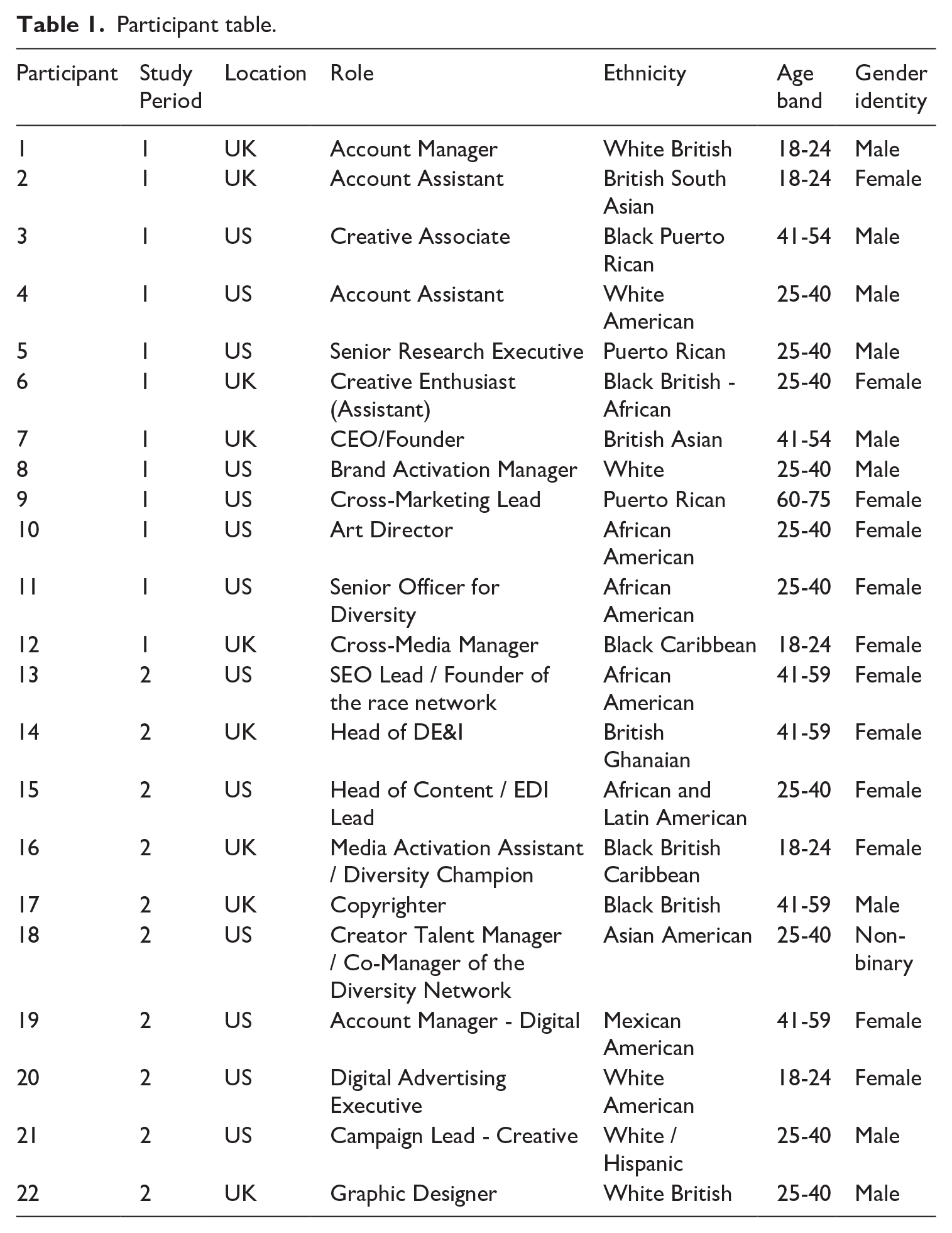
This paper draws on 22 interviews between both study periods and ethnography from SP1, where practitioners from various racial backgrounds spoke of race, experiences of racism and exclusion within their organisations. The participants vary in age between 18 and 62, mixed gender and ethnic identification, agency size and seniority. The intention was to get a broad sense of how attitudes and discourse surrounding diversity has adapted in this critical decade and, if at all, how the experience of racism has changed via thematic analysis (Table 1).
Participant table.
Casual racism, pubs and fitting in
Inevitably, racialised discourse has changed over the past decade with organisations paying more attention to language in documents and increased EDI training. Prior to this in SP1 in the UK, there were examples of racist discourse amongst some White participants, one of whom spoke of successful periods in his career due to trust built with managers.
[. . .] it’s all about trust [. . .] I’ve been lucky, the industry’s tough, but my managers have been mad cool. We head to the pub after work, we even went to Ireland a couple years back. It’s practically like we have the same lifestyle heading there to see family for holidays [. . .] some people just don’t fit in and don’t get in (Participant 1).
Participant 1 explained that this was a non-work or performance related trip, where he was selected amongst two other colleagues, all chosen due to their relationships built whilst working at the agency. He advised that shortly afterwards, he was promoted to a role outside of his existing expertise but given based on ‘potential’.
Whilst this scenario demonstrates how the formation of casual relationships outside of work are beneficial for career progression, the tone towards others was less favourable. His comment regarding colleagues who do not ‘fit in’ referred to a British South Asian practitioner (Participant 2), who he labels as the ‘awkward one that doesn’t come to the pub’ (Participant 1). During the interview, Participant 2 explains that her colleagues let ‘her know about’ being ‘the odd one out in the team’. Outside of this agency, many participants of colour spoke of this similar ‘blasé’ (Participant 6), everyday racism.
One participant spoke of a similar experience where she overheard colleagues speaking about a night out where she was not invited.
Most of the guys in the office usually went Sky Bar or something on a Friday after work, especially if we hit our figures [. . .] Jenny said ‘who’s coming’? And Annette said ‘the usual guys, I asked Vanessa but she’s probably got some kind of African comedy show to go to again tonight’ [. . .] I remember it so clearly when she said ‘I so don’t think she fits in with us’ (Participant 6).
Participant 6 spoke of the experience feeling ‘fresh’ in her mind and feels ‘anxious’ during social interactions with colleagues. She explains that ‘I know that’s because of me, but it’s just nature. I don’t want to seem too Black [. . .] and not seem so British that I’m trying not to be Black’, inducing ‘doubt’ and ‘uncertainty’ about embracing her Ghanaian culture in front of colleagues.
A similar incident occurred during SP1 amongst a team at a US based advertising agency during an informal gathering. Participant 4 (White, Account Assistant) was speaking of an incident the previous weekend where a Shop Assistant mistakenly accused him of leaving a store without paying for an item of luggage. He spoke of being ‘angry looking back’ that he was ‘less aggressive’ than he should have been. In response, Participant 10 (Black, Art Director) reassured him that he took the ‘right approach’. Similarly, Participant 11 (Black, Senior Officer for Diversity) agreed that he made the correct ‘choice’ as it gave more substance to his innocence. Participant 10 attempted to steer the conversation on a ‘lighter note’ to ask what colleagues had planned for the weekend. However, Participant 4 intervened: Thanks a lot guys. I was hoping you’d give me some hip advice like shout back at the lady like an angry Black guy [. . .] isn’t that what you would do? (Participant 4).
Participant 4 assumes that as he is speaking with Black colleagues, their response would be something ‘hip’. However, he also notes that he expected their response to be linked to anger, a historically racist assumption of Black people being aggressive. In response, Participant 10 reintervenes to explain that he ‘cannot go around making blanket statements’ and asserts that he was ‘not right’. In attempts to move the conversation onwards, she then re-asks what the team had planned for the weekend. During interviews with Participants 10 and 11 following this occasion, they relayed their experiences of working in advertising as Black females. They both spoke of the ‘rife’ (Participant 10), ‘roofless, dog eat dog [. . .] every person for themselves’ (Participant 11) environments.
A core insight is that racist conversations are intensified outside of working hours in casualised spaces. Regardless of where or when the conversations took place, POC still reported experiencing exclusion and hostility. These insights provide some context of working conditions and the acceptability of racism in advertising agencies during this period.
Perceptions of race
During the interviews in SP1, some participants touched on conversations about race with colleagues. A US participant spoke of how upfront White colleagues were about not having any friends of colour, which is why they felt ‘cautious’ (Participant 4) of interactions. Similarly, one persisted that they were ‘not racist’, but felt that race and cultural nuances ‘wasn’t important [. . .] and made up anyway’ (Participant 8). There were occasions where participants spoke of not understanding how their colleagues experience racism (Participant 1). Yet, some speak of oblivious statements made in relation to cultural nuances, particularly with the homogenisation of African Americans. During their interview, Participant 7 speaks of their opinion of that: African Americans are just American [. . .] It doesn’t always matter where you’re from or what your background is, particularly for African American people who are part of the majority.
Similarly, Participant 9 speaks of the Person Specification when she was applying for her role at her agency, which desired a candidate with ‘expertise in diverse markets’: She [Participant’s Line Manager] was crazy excited to hear all about my 10 years of experience consulting for different markets [. . .] I told her about my work with Disney and marketing a couple new movie releases, one had a Black cartoon character as the main character [. . .] I went into detail about the different bits I did to make sure the communication was right for Black audiences, but she was like ‘yeh you don’t need to worry about that here, Black people are just part of the mass, right?’ (Participant 9).
Participant 9 expressed that she was not concerned by her Line Manager’s statement, as ‘it’s just how it is’. Similarly, during data collection, I was questioned about my experiences as a Black woman navigating the industry, with assumptions made about my cultural background. A conversation regarding my background arose at the end of an interview with a leader of one of the UK’s largest inclusive communications agencies, who stated: I mean, unfortunately for you, well for the African’s it’s different, but if you had, if the Caribbean’s had their language. I mean, your religion is Christian, you speak English, the only thing is colour [. . .] I mean if you only had your own language [. . .] that’s the only thing that keeps the glue that binds you together (Participant 7).
This dialogue shows the similarities in views towards Black culture in the UK and US, where African Americans and Black British Caribbeans are assumed to have minimal cultural capital. These forms of microaggression were inevitably more commonplace in SP1, where overt racism was more of a commonality and organisations were yet to be pressured into developing EDI initiatives as a result of #MeToo and #BlackLivesMatter. Additionally, the findings so far evidence associations of aggression and inferiority of Black culture in both the UK and US. Such open statements which intentionally homogenise particular racial and/or ethnic groups did not occur to such a degree in SP2.
During SP1, a similarity amongst POC was that they had, overtime, accepted how White colleagues spoke about race. Occasionally, participants from racialised backgrounds spoke of conversations that made them realise how disconnected their White colleagues were of ‘understanding what they’re missing out on’ (Participant 3) in terms of commercial benefits of communicating with diverse audiences. However, nuances of racial and cultural identity were trivialised, particularly amongst practitioners who felt their appearance does not match what others expect their racial background to be.
During his interview, Participant 5 spoke of being called the ‘White dude’ in his team. Being of Puerto Rican heritage and fair skinned, he speaks about being made fun of as he identifies as a Black man. Similarly, a colleague in the same agency speaks about how his colleagues ‘didn’t get’ his cultural heritage due to his fair complexion (Participant 3). Although the topic of fairer complexions was raised amongst participants, they expressed how dialogues with colleagues was ‘light-hearted’ (Participant 5) and without negative intent. This type of parody-intent discourse shows how conversations involving race become casualised, ignoring any forms of subliminal racism. But also, the role that cultural appropriation can play in changing dynamics.
‘Proper’ culture: appropriation, sexualisation and acceptance of Latin American cultures
Scholarship has long addressed how particular cultures are broadly speculated as alluring in comparison to others. This type of appropriation is largely seen in advertisements, where some cultures and ethnicities are visualised as more appealing than others and the damage that this instils in society as an ‘image economy’ (Burton and Klemm, 2011; Schroeder and Borgerson, 2005). Some participants expressed how this onscreen reductionism not only occurs in conversation, but comes to fruition with how ‘worthy’ (Participant 6) and ‘necessary’ (Participant 12) you may be seen amongst colleagues. This was particularly prevalent amongst participants who spoke of Latin American cultures as homogeneously being the most ‘exotic’ amongst practitioners of varying of backgrounds (Participants 3 and 5), but also amongst Latin American practitioners themselves. In an informal conversation prior to a team meeting, Participants 5 and 9 were discussing a classic Jennifer Lopez concert that was replayed on television the previous night:
J-Lo is the epitome of a hot Latina, can you imagine if we could get to endorse the [brand name] campaign
That would be crazy [. . .] but we’ve already got P Diddy on that one. He’ll drape in a good audience
Yeh I guess. But nothing gets the people going like mama Latina [. . .] You just don’t get that with others [cultures].
Within this dialogue, there is an appreciation of the participants’ Latin American cultures and a preference to work with such celebrities as endorsers of campaigns. Some specifically spoke of their experiences with hearing Latin American colleagues speaking Spanish in the office. Participant 8 explains that ‘it’s only when I started working here and heard of the Latina’s speaking Spanish [. . .] then I thought, wow, that’s super hot’. Participant 9 continues to speak about the ‘excitement’ of Latin American women, language and dialects. This sentiment was also shared by Participant 5, who spoke of the ‘strong cultural traditions’ and ‘unique language and dialogue’.
Scholarship has long addressed the discursive meanings of seemingly positive stereotypes. For instance, McFarlane (2014) believes that positive stereotypes are ‘without negative intent’ and that it is acceptable to address both ‘physical and non-physical characteristics’ (p. 127). Amongst participants with Latin American heritage, many spoke of the ‘proper’ (Participant 5) ways to do things in their culture and how being comfortable to embrace their culture at work is important. Participant 5 speaks of his colleague who is also Puerto Rican, explaining that she ‘never fails to come in and give me the double cheek kiss [. . .] this is engrained within our culture [. . .] all of us do it’. Whilst literature addresses the stigma of objectification and sexualisation, the dialogue amongst participants in SP1 shows how the formations of Latina American cultures are broadly linked to strong cultural traditions in both the UK and US. Yet, the experience of Black and Asian participants shows the removal of cultural nuances and exclusion, occurring when there is an omitting of ‘the cultural practices or values of racial minorities’ (Thompson and Neville, 1999: 23) with the expectation of code switching (Boulton, 2016).
Subliminal exclusionary practices
During SP2, organisations across the UK and US were going through periods of transition post-2020. The period that followed saw organisations instantaneously implementing diversity and anti-racism policies. The practitioners interviewed during this period had experienced first-hand not only the changes within their agencies, but how the discourse and ‘tone’ (Participant 15) of conversations ‘immediately changed’ (Participant 14).
It was a difficult time [. . .] 2020 was full on, everyone was talking about race, allyship and wanting to change their attitudes [. . .] there was suddenly a hell of a lot of money and training, it was so intense (Participant 15). What I didn’t prepare myself for, even though thinking back I was so naïve [. . .] was how my White colleagues softened their tone when they spoke to me (Participant 17).
There were also synergies with how POC were being pushed into new EDI secondments and how this limited opportunities elsewhere.
I’m the only Black girl in the team and I was suddenly given support for developing diversity training and comms [. . .] but then I was being left out of everything else (Participant 13). I felt proper supported for a change and lots of flexibility and encouragement and drive to take on the EDI secondment [. . .] it’s only really like been in the past year that I’ve been thinking I made a mistake. Now no one cares about EDI and I’ve invested my all into it (Participant 16).
Whilst the secondments themselves were not problematic, participants reported being unsettled that they felt pushed into these positions. In one instance, colleagues working in the same umbrella agency in the UK and US (Participants 16, 18 and 22), revealed how Black colleagues in particular were ‘approached to do the diversity stuff’ (Participant 16). Within this organisational network, Participant 22 expressed their dismay at being declined the secondment as a White person, as it ‘looks better if a disadvantaged person did it’, even with White colleagues speaking of wanting to be ‘allies’ (Participant 20). One participant spoke of how she was told to feel appreciative that her agency was embedding EDI initiatives: When I spoke about [a] promotion to my boss, he told me he values me and I must be so reassured now we’re talking more about race and inclusion (Participant 18).
These increased conversations around race were seen as the benefit, as opposed to recognising the labour that went into improving the organisation’s approach to anti-racism and diversity. Although SP2 took place after 2020, there were still similar sentiments of being excluded, albeit in more subliminal ways. Another participant explains how she feels there are intentional tactics played against her to hinder her career progression after taking on the role of Head of EDI: I’m not invited into as many client meetings anymore. It feels like no one’s talking about race anymore, so no one cares about my progression, clients aren’t doing woke campaigns anymore, so my visible presence doesn’t matter anymore (Participant 14).
Participant 14 goes on to recall how, from experience, White, middle-class colleagues were called into client pitches for ‘presence’ and how she temporarily took that place when ‘everyone was talking about race in 2020’. However, since race is no longer a priority in her organisation, she feels that she now has ‘no chance to get ahead’. For one participant, this cycle of exclusion continues to extend to informal invites: I’ve definitely experienced racial abuse in agencies back in the day. You just firm up and move on. I don’t get that anymore, its more that I’m not invited places [. . .] if I am, it’s just forced (Participant 18).
This scenario situations how change has occurred in terms of experiencing less abhorrent racism, but the participant reveals not being invited to informal occasions with colleagues, which was also revealed in SP1. Whilst this sentiment was not shared extensively amongst participants, it shows a trend throughout responses of how exclusion has become more subliminal and ‘sneaky [. . .] they don’t shout it as loud as much’ (Participant 19). In addition, some participants disclosed how they felt conversations about race have adapted since 2020. Participant 21 noted that ‘[w]e’re not focused on race as much and being real, 2020 was a while ago’ and another exclaimed: 2020 what? What even was that? Who talks about it now? [. . .] They don’t care when we say we still get racism. It made its moment and now companies don’t care until race is making them money (Participant 14).
In summary, it is clear how overt racism in terms of open dialogue is not being experienced as often since 2020. This may be seen as a development and ‘better than we were and major progress has been made, but I still feel like I’m there as the tick box’ (Participant 16) and there is much to be said as to why this is a shared sentiment.
Solving the race problem
Throughout this study, POC not only experience racism, but consequently, a sense of exclusion and imposter-syndrome. Du Bois’ (1903) prediction that one of the 20th century’s problems would be race has come into fruition, as many scholars have extended into global, diasporic contexts (Gilroy, 1995; Moore, 2005). Whilst Du Bois speaks of double consciousness, that is Black Americans experiencing two, competing identities, some organisational studies scholars have explored how these play out in the work environment. For instance, Carbado and Gulati’s (2013) core argument is not purely that one’s racialised body is a visible presence in organisations, but the ways in which their White colleagues expect them to perform their racial identity. This research has shown that the more one performs their racial identity, they are not only excluded during working hours, but are also at risk of exclusion in informal social settings. These individualised discourses occur during working hours within the hegemonic structures of institutions. Yet, the out of hours and offsite experiences fall outside of any organisational commitments to diversity. This has implications on existing conceptions of racial capitalism (Gray, 2013; Saha, 2016) where governance not only occurs in production or via working conditions, but also creates a double-bind where marginalised workers present as outsiders both within and beyond institutions structures, particularly informal spaces deemed tolerable and without consequence.
Approaching this study via two study periods was important for tracking changes in the experiences of racism in the advertising industry. Expectedly during SP1, there was more reporting of openly racist dialogue and intentional marginalisation. This was prevalent in the US, as they were more engaged with EDI in their working practices. For instance, market researchers may have felt more informed about race as it was actively part of their work. In the UK, racism tended to occur in discussions between colleagues and stating an opinion about a race besides their own. In SP2, there was a change in how race was spoken about and colleagues being more conscious of what they were saying in open spaces. More importantly in this study period is how practitioners in the US spoke about noticing race being addressed less frequently. With the removal of affirmative action and the governmental redaction of EDI initiatives, more recent studies are needed into the effects this is now having on workers.
We are now seeing how senior leaders attempt to reassure junior colleagues, proclaim to have learnt lessons from 2020’s events and argue that diversity is now engrained within organisational culture. These strategies are part of a racialised logic of production (Saha, 2016; Sobande et al., 2023), where practices are repeated if they have previously been successful. Not least causing a consistent blurring between anti-racism and wider diversity discourse, reducing attention paid to real transformative equity and social justice (Ahmed, 2012). Instead, diversity is used as an operative tool to gain new business, particularly clients aiming to tap into marginalised audiences, whilst internal politics remain belligerent and in situ. There is then no surprise that a recent survey by the Black Women in Leadership Network (BWIL) in 2022 found that 68% of the 250 participants reported experiencing racial bias at work (BWIL Survey, 2022).
Racism and the impact on career progression
A similarity across both study periods was how experiences of racism have an impact on working practices and how such exclusion hinders career progression. However, in SP2, some POC spoke of being tagged with EDI secondment positions and creating race networks as a marker of progress. This has been a commonality post-2020, even for those where the role does not align with their expertise or interests. This shows how the onus of dealing with organisational ‘race problems’ are being passed to POC and reframed as supposed opportunities. In addition, those taking up positions with an EDI focus find that they are increasingly declined opportunities for promotion, as this type of work is seen as less important than core business operations. Thus, there were more subtle forms of exclusion in SP2 that still manifested into exclusion and lack of opportunities.
This ties to how many have criticised how EDI work is often seen as the labour of those directly affected, that is POC and becomes a form of racialised cultural work (Saha, 2016). In a parallel field, Saha and van Lente (2022) found that there are increased demands for more writers of colour in the publishing industry, but there is hesitancy with tackling the industry’s structural inequalities outside of quotas.
With wider diversity discourse being more commonplace in organisations, SP2 has shown how many mark the race problem as resolved and a reason for reducing conversations about race. More research is needed into how experiences have changed since 2020 in terms of policy, discourse and praxis in media organisations. Whilst I acknowledge the arguments that we are supposedly in a ‘post-race’ and now ‘post-diversity’ era, organisations are still adapting and longer-term outlooks are yet to be established. Yet, this study has shown the ways that POC are navigating the landscape within these dominating structures. Similarly, Jiménez-Martínez and Edwards (2023) found that PR embed ‘promotional regimes of visibility’, where the activity of practitioners is strategically intentional for being recognised, transient and goal oriented to their benefit (p. 5), but also used against them as a form of racial governance (Saha and van Lente, 2022).
Conclusion
By examining how experiences of racism have changed prior to and following the events of 2020, this paper has contributed to a developing area of media and cultural studies that explore the changing nature of organisational discourse and positionality of race. The discussions have contributed to existing literature on racial capitalism and governance, finding how the nuances of racism differ dependent on the socio-political conditions inside and outside of the workplace. In addition, SP2 has shown how a greater focus on internal diversity policies largely places the onus on POC themselves, which can simultaneously reduce their focus on their core job roles and, thus, potentially limit their opportunities for progression. It has shown how the casualisation of racist conversations are fed through to working practices and the theoretical implications of how this is governed and utilised as an exclusionary tactic in informal settings. The advertising industry was important to explore as an agency’s structural composition and remits have a direct impact on the output of campaigns. For instance, a great focus on organisational diversity is likely to be represented in the composition of imagery, text and delivery.
Rather than solely exploring discourse, further studies observing working practices is needed to track how tactics and strategies for racial inclusion are changing. In addition, it is imperative to track how experiences will further change in the US, following the Supreme Court ruling on Affirmative Action in Education, which is seeing the forced withdrawal of support programmes for underrepresented students. Whilst this does not directly affect organisations, it sets the tone of how social, cultural and political discourse of race transcends between institutions. With this transformation, more research is needed into the practical implications for diverse-owned agencies, which are assumed to be better at diverse communications but are also facing challenges with the industry’s diminishing EDI commitments. It is important to understand how they not only challenging the norm, but also the strategies used for extracting clients from leading media firms.
