




Abstract
In June 2015, amidst soaring temperatures, severe electricity, and water shortages, hundreds collapsed on the streets in Karachi. Emergency wards, morgues, and graveyards became full. Drawing on environmental media studies, infrastructure studies, and urban studies, the 2015 Karachi heatwave created, what I call, “a thermal ecology” that encapsulates shifting material, geophysical, cultural phenomena that comprise life inside a heatwave. I demonstrate that the thermal ecology reconsitutes mediation, as relationships between media forms, systems, and cultures reorganize in response to ubiquitous heat. I examine three instances of such thermal mediation: first, a media assemblage of citizen-led media activism disseminated through public and corporate media platforms; second, a data computation-driven urban governance plan to tackle future heatwaves; and, third, a community-based visual media art project, Of Struggle, which documents and intervenes against the violent loss of human, nonhuman life from urban development. While recent scholarship attends to the tremendous heat expended by digital media, this paper examines the thermal ecology as it conditions forms of mediation, and the social and ecological lifeworlds within which these are embedded. It argues that the thermal ecology – its media actions, governance, imaginaries – need urgent examination as excessive, violent heat is an ongoing condition and marked future for all.
In June 2015, amidst soaring temperatures, severe electricity, and water shortages, and the ban on selling food and water during Ramadan, hundreds – some have estimated 2000 (Haider and Anis, 2015) – collapsed on the streets, in their homes, and on buses in Karachi. Emergency wards reached maximum capacity and the city’s morgues and graveyards became full. On the edges of those morgues and graveyards, the dead were overflowing visibly into public space on the streets, as well as inside ambulances and homes that had electricity. Television news channels and social media platforms mediated this deathly excess across broadcasts and circulated images of the bodies outside morgues and graveyards, while radio and cellular telecommunications carried public health advisories and infomercials. Environmental experts widely attributed the heatwave to the aggravating impacts of climate change (Wasif, 2015). Among the worst affected were poor and migrant communities who relied on daily-wage labor and lived in Karachi’s numerous katchi abadis or informal settlements. As infrastructure technologies of health, water, and energy collapsed, student and civil society groups adopted hospital wards, organized donation drives, and set up relief camps on major road junctions. In response to the horrific death toll, local activists took up new forms of media activism across the city’s billboards, distributed pamphlets in public space, and rallied a range of digital tools, such as infographics, memes, and donation drives on social media platforms to share public health advisories and information about relief efforts. In the weeks and months that followed, the local government in Karachi partnered with international environmental management organizations to create a heatwave management plan that put forward data computation, mapping, and strategic new media communication policies to tackle future heatwaves.
A month after the heatwave in June 2015, I conducted interviews with environmentalists, morgue officials and rescue workers in Karachi. In one interview, Ghulam Hussain, a manager at the city’s largest morgue, reflected: “We’ve been through Benazir Bhutto’s assassination, bomb blasts in Muharram processions where we had to stitch body parts together. . .but this disaster was the most difficult to manage because the dead bodies kept coming but they didn’t leave the morgue.” 1 Crucially, he proceeded to state that while the scale of the June 2015 heatwave was unprecedented, each summer more and more people were dying from heat in Karachi. In fact, during our interview, a Pashtun migrant family (a mother with her children) arrived at the morgue to receive her husband’s body who had died from a heat stroke in his small room in Karachi. Heat continued to kill even after the heatwave had passed. It was only after I saw that mother with her children at the morgue that the “slow violence” (Nixon, 2011) of heat in Karachi became momentarily visible to me.
In this essay, I demonstrate that the heatwave created its own thermal ecology, that is, the heatwave produced thermal effects across the entirety of urban space, mediatic relations, and sociopolitical life. Drawing on Starosielski’s (2018, 2021) powerful analysis of thermal military technologies that weaponize particular “thermal effects” of heat, my argument transposes these thermal effects onto the nature of the heatwave and the violent force of its environmental impact. The heatwave’s thermal ecology builds upon and reconstitutes existing entanglements between media processes, urban infrastructures, and the aggravating impacts of climate change. Karachi’s media processes and practices are tied to the city’s urban development, its heat island effect, as well as its cultures of breakdown, informality, and repair. However, I show that inside the thermal ecology, excessive heat reshapes existing media cultures and processes. Importantly, the heavy death toll also laid bare the role of violence as integral to the reproduction of mediation in Karachi. Under the swell of the heatwave, these forms of violence became starkly visible. As a result, the thermal ecology produced new forms of thermal mediation and these reflected on, resisted, and obscured ongoing histories of violence in Karachi.
In this essay, I follow three instances of such thermal mediation from local citizen activists, state policymakers, and community-based artist projects. Thus, I focus on, first, a media assemblage of citizen-led digital infographics, radio, television, and print media activism disseminated through public and corporate media platforms. Second, I examine Karachi’s data computation-driven urban governance plan, called the Karachi Thermal Management Plan, to tackle future heatwaves. And, third, I explore Of Struggle, a community-based visual media artist intervention against the forced displacement and ecological loss of ancestral lands through urban development in Karachi. The thermal ecology encapsulates shifting material, geophysical, and cultural phenomena that comprise life inside a heatwave. I am tracing a few of these shifts – there have been countless others – and so I am building a significant trajectory that is ultimately limited by the confines of this paper, and further research will surely allow for a fuller picture.
On this heat-stressed planet, attending to Karachi’s thermal ecology has global resonances – it speaks, with urgent severity, to recent, widespread crises of heatwaves and associated wildfires, droughts, floods, and deaths, across Australia, the Americas, Africa, Europe, and Asia. Of course, there have been many devastating heatwaves around the world, especially in the global south, since the one in Karachi in June 2015. Heatwaves occur all year round, affect billions of humans and nonhumans, upend ecosystems, distress local, national, and regional economies, and compound risks for other crises, such as devastating wildfires, etc. In the face of this overwhelming ubiquity, I have returned to the June 2015 heatwave to demonstrate the connections between media technologies, ecological violence, and urban infrastructural development – connections that have not only persisted but deepened, thereby intensifying the long-term resonance and impact of thermal ecologies. Therefore, I see this work as exploring the nature and role of mediation in our emergent global digital societies, wherein heat and the thermal ecology will have growing, transformative, and lasting effects.
A thermal ecology
Figure 1 is a tweet by a prominent Pakistani news television channel. It’s a photograph of a crowd gathered outside a morgue in Karachi. Morgues ran out of space for dead bodies during the heatwave. Figure 1 is a typical news story from the time period of the heatwave. Across such news reports, media attention focused on death and the excess of death because it was unbelievable – the murders of heat and climate change. It was a defining moment when the violence of climate change became so starkly visible, such that its deadly excess became a mediatic portal or temporal frame of reference for the apocalyptic floods of 2022 in Pakistan (see Malkani, 2023a, 2023b). While violence has always underpinned sociopolitical and environmental relations, as well as media ecologies, climate change brings to bold relief how all these processes, relations, and histories are fundamentally intertwined, and therefore must necessarily be examined in capacious and expansive ways.
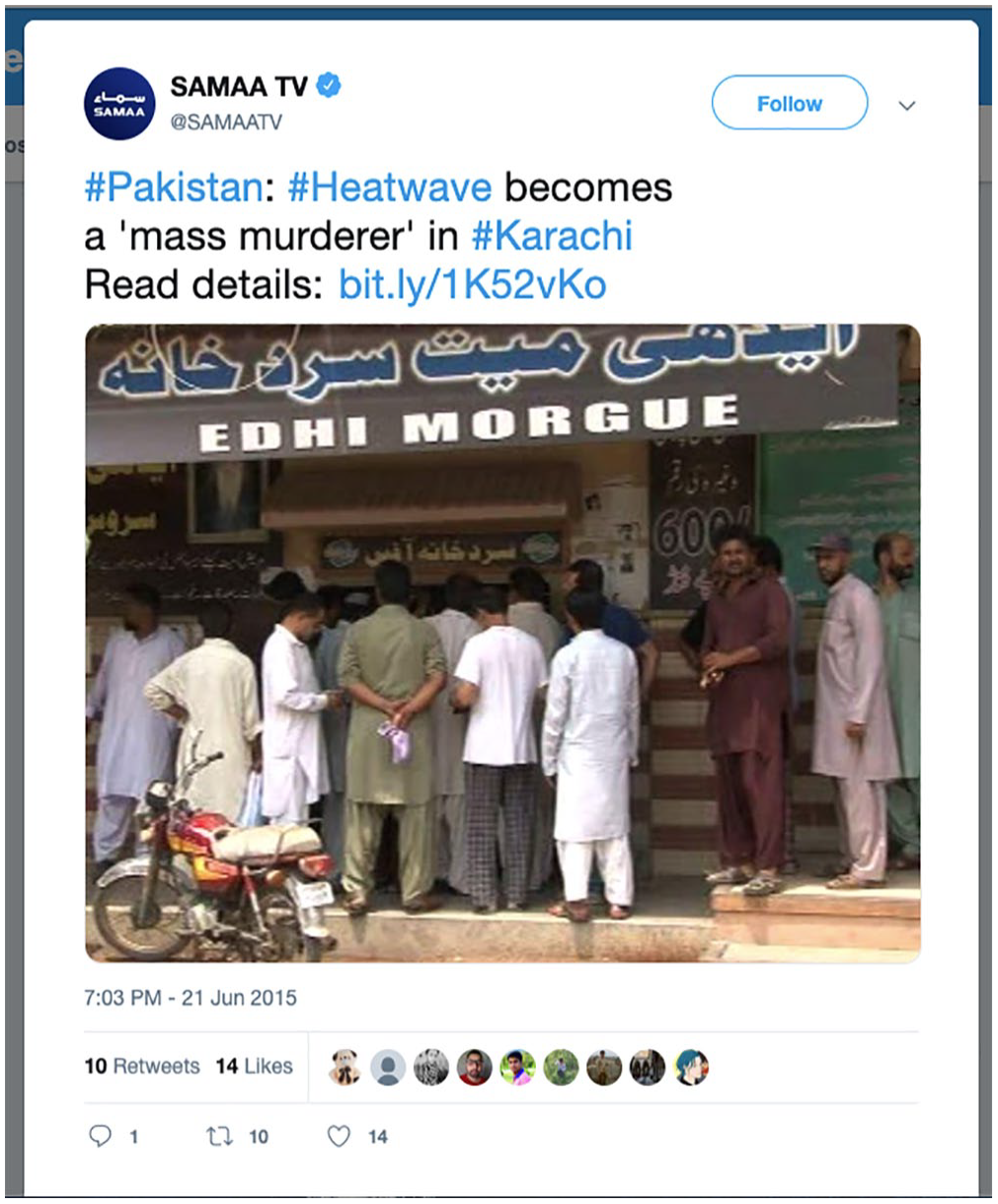
Tweet from Samaa TV on 21 June 2015.
Inside the heatwave, as Figure 1 shows, media attention on the death toll revealed that heat kills differentially. These were dead bodies of daily wage laborers, predominantly migrant workers, as well as those from poor and lower-income households who lived in extremely dense informal settlements or katchi abadis, with insufficient ventilation and no reliable access to electricity. These dense informal settlements are direct results of longer histories of violent urban development in Karachi, as well as in many other cities in the global south. Heat, itself, is conditioned to radiate more intensely when urban development practices rapidly drain groundwater aquifers, raze indigenous ecosystems, and destroy shade cover in public spaces. The critical force of violence binds together Karachi’s media ecology with its violent urban development. Therefore, even as news media focused on dead bodies, the horror and grave injustice underlying the deadly excess pushed forward more responsive forms of mediated practices.
Thermal mediation is a situated response to ongoing violent heatwaves and the crisis of the thermal ecology. Thermal mediation reshapes embodied public action, forms of state power, and even imaginaries of belonging and loss across disintegrating environments. The media objects that I examine in this essay reflect these mediated transformations across the thermal ecology. In doing so, they offer important insights into forms, processes, and effects of thermal mediation: how political subjectivities are reorganized in relation to ubiquitous, resounding heat; how material heat is mediated as a site for articulating power through digital urban governance; and how critical media-making itself centers on tracing new epistemologies of land inside the thermal ecology.
My theoretical approach in this essay draws on the rich field of environmental media studies that has emphasized the materiality of technological objects and human, nonhuman relations – in contrast with the pervasiveness of their digitality. From cloud computing and data centers to carbon mediation; from the mediated representation of the environmental crisis to citizens’ data sensing air pollution across the world, media scholars have pushed digitizing global societies (Cubitt, 2017; Gabrys, 2016; Hogan, 2015; Peters, 2016; Pasek, 2021). My focus on the thermal ecology is informed by the wider shift in media studies toward the thermal politics of energy, waste, and resource extraction that underline all media and digital societies. Starosielski’s (2021) Media Hot and Cold – an expansive, ground-breaking study of thermal media – offers critical insights into the sociocultural entanglements, structures of power, and sensory environments that constitute the thermal conditions necessary for all media technologies. Scholars of digital media have demonstrated the tremendous energy expended by digital media infrastructures and the immense energy required in the regulation of heat across digital technologies (Brunton, 2015; Starosielski, 2014; Velkova, 2016), and even the fundamental thermal techniques necessary to purify matter in order to provide seamless, instantaneous internet connection (Starosielski, 2016).
However, in contrast, despite the ubiquity of heatwaves, media studies scholarship has not sufficiently attended to the reverse: how does aggressive and ever-increasing global warming affect these thermal techniques and reconfigure media relations? Thermal conditions intensify and are scaled up during a heatwave, but also remain influential long past the particular temporal moments of event and crisis, as increasingly warming temperatures persist and are a constant presence in cities like Karachi. Given this ubiquitous thermal excess, my argument in this essay analyzes the forms of mediation that are constituted through and organized around heat and livable futures amidst fatal heat. The thermal ecology calls us to consider the thermal effects of media technologies and systems, but, crucially and urgently, I argue that our analysis must delve deeper into the very material and sociopolitical environments that comprise, conduct, and constitute these media technologies.
In particular, I am influenced by South Asian media studies of materiality and its critical insights into the immense influence and role of the postcolonial state, global financial systems, and material histories of political relations in shaping media cultures, production, dissemination, and audiences (Chakravartty, 2004; Chirumamilla, 2019; Jaikumar, 2019; Mukherjee, 2020a, 2020b). For instance, Debashree Mukherjee demonstrates in her book, Bombay Hustle, that Bollywood’s historical growth is best illustrated through a cine-ecology framework, which tracks a range of social, economic, and material actors and forces that enable processes of mediation (Mukherjee, 2020a). Similarly, scholars have critically analyzed a range of media forms to emphasize the economic, historical, political, gendered, and material conditions and relations that are integral to what media are and how they produce effects in situated contexts.
Relatedly, media studies of Pakistan have focused on the politics of control and representation, including questions about surveillance and censorship, state power and citizen subjectivities, reproduction of gender and religious identities, the political economy of media privatization and ownership, and the colonial and postcolonial trajectories of such media practices (Akhtar, 2019; Dadi, 2022; Mulla, 2019; Vasudevan et al., 2019; Zamindar and Ali, 2020). Across this growing media studies landscape in Pakistan, scholarly attention has been directed towards a few media forms and sites: television, newsrooms, cinema, and journalism – that are pervasive and widely influential, but limit critical engagement to matters of content, representation, production, and distribution. However, my analysis approaches media forms and processes of mediation within Karachi’s entangled social and geophysical conditions and histories. Specifically, I attend to Karachi’s thermal ecology to understand how processes of mediation shifted within and through the June 2015 heatwave.
Media practices in Karachi are conditioned through cultures of breakdown and repair. It is no coincidence that popular television dramas and films commonly present everyday life in Karachi as one where infrastructure breakdown is routine. Disrupted communications are often the subject of news reports and advertisements, and media cultural practices have shaped in response to that disconnection. In Karachi, these practices appear in relation to the popularity of cellphones with long battery life, as well as television viewing cultures accustomed to disruptions when cable operators struggle to keep their generators cool enough during a blackout. Thus, relations to media are already formed in response to the breakdown of other infrastructures – or what Padma Chirumamila describes as “technological instability on display” with respect to cultures of repair shops in South India (Chirumamilla, 2019). Infrastructural breakdown lays bare the constitutive relationality that Karachi’s media ecology has formed in direct relation to heat – both in terms of the material infrastructure of media systems as well as the ways in which heat and breakdown are represented and culturally engaged across various media forms.
Thermal media actions
Turning to the small rooms and informal settlements of this slow violence, the edges of the city come into focus. Here are dense conflations of urban structures, bodily matter, technologies, and ecologies that modulate heat in the city – the land, water, bricks, tin, cement, generators, cellphone towers, pipes, trash, sewage, air, birds, plants, animals, etc. As the June 2015 heatwave pushed Karachi’s media ecology to its limits, it also afforded emergent forms of thermal mediation that reconfigured mediatic relations between existing media forms, bodies, and environments. What is the relationship between a media ecology overwhelmed by heat and the wider mass mediation propelled by death from heat?
We can look at this relationship across Karachi’s television channels that carried infomercials on coping with heat. Animated infomercials described strategies for coping with heat, from positioning legs at an angle to placing an ice pack on areas most sensitive to heat. Newspapers carried printed illustrations with preventative measures against heat stroke, such as refraining from physical labor from 11 am to 4 pm, wearing a head covering, and avoiding sugary and caffeinated drinks. These advertisements and illustrations were shared widely on social media and digital platforms. Moreover, billboards warning of heat stroke and depicting preventative measures were put up across commercial buildings and busy bus stops, while citizen groups distributed flyers sharing heat stroke prevention information and set up water camps in dense neighborhoods (see Figures 2 and 3).
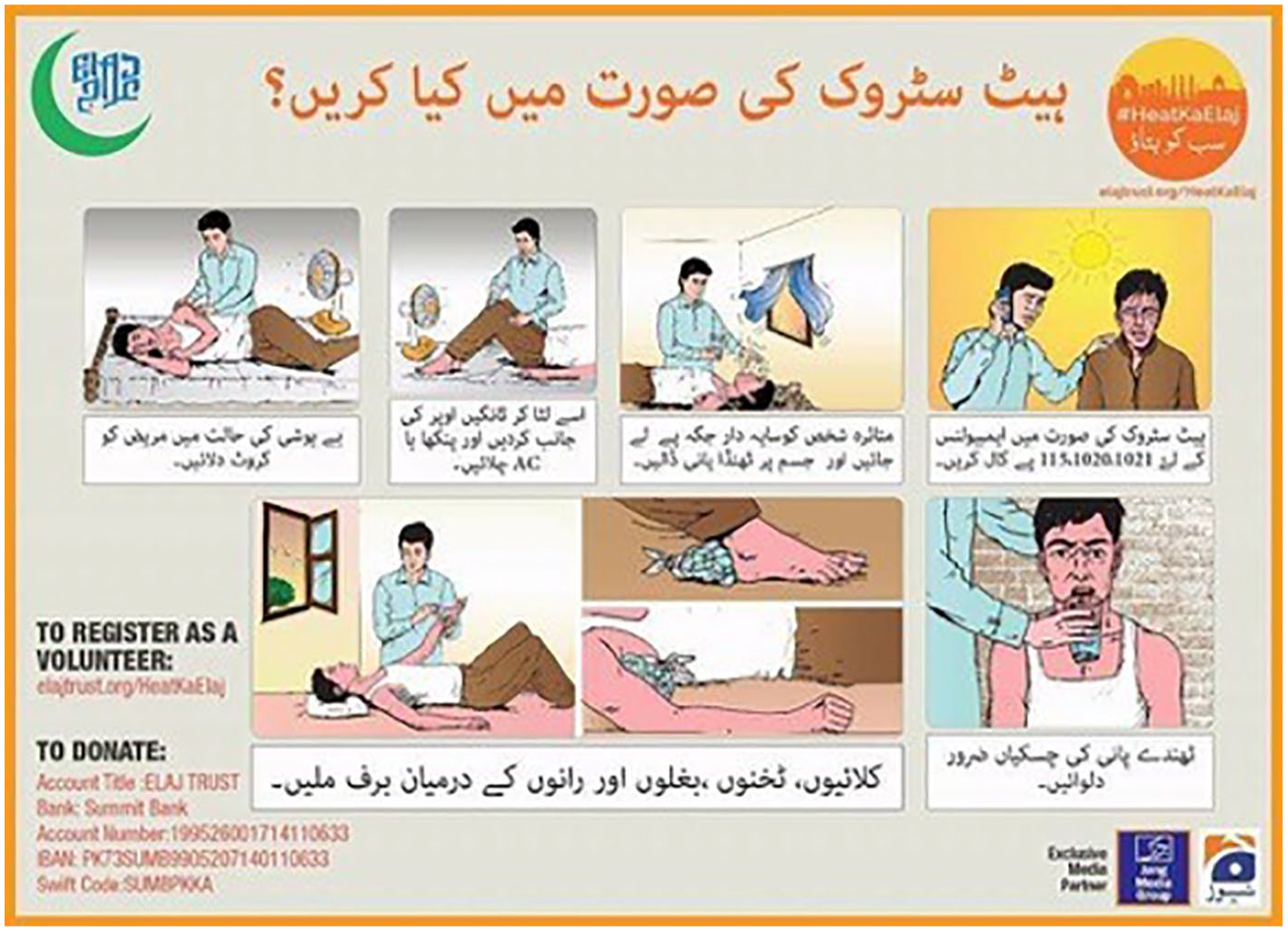
An informercial on preventative measures against heat strokes from 28 March 2018.
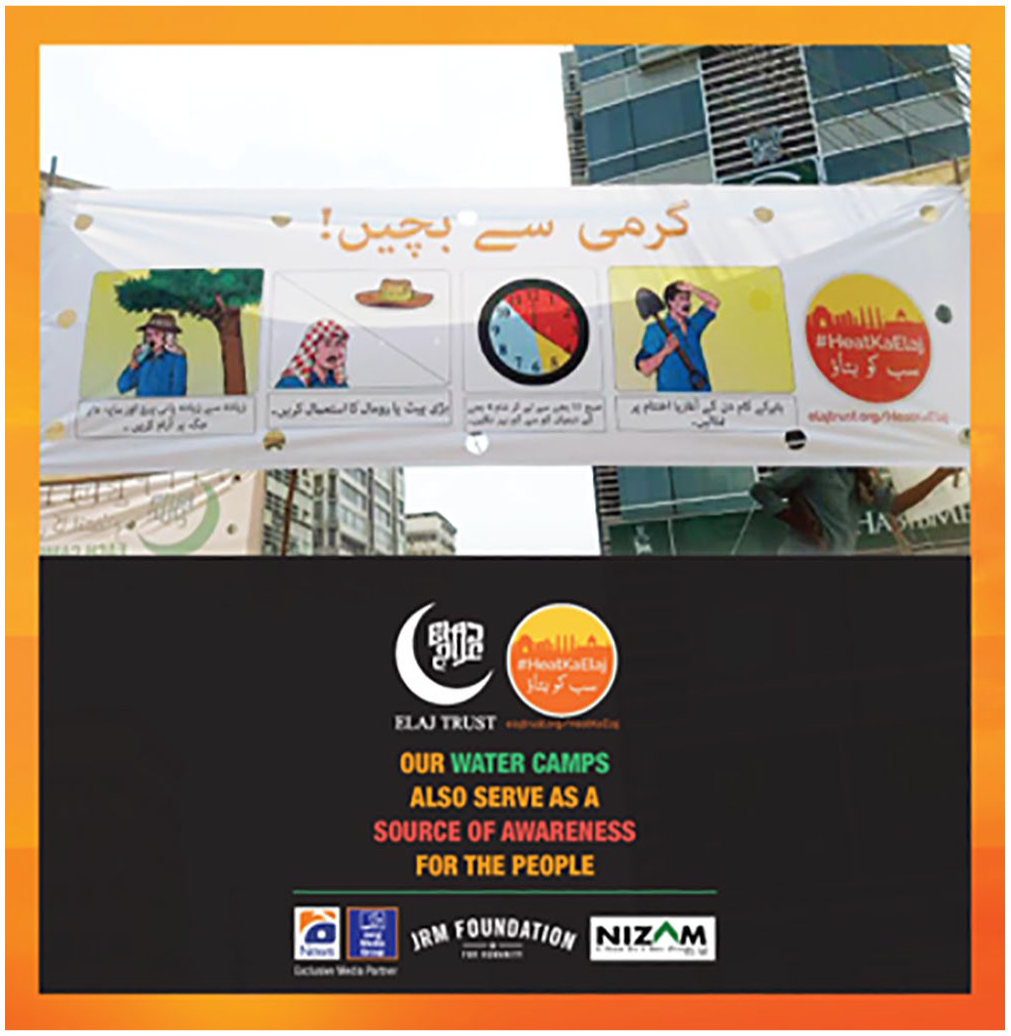
Pamphlets and Billboards such as these were set up across public spaces during April 2016.
From the dead heat stroke body to the mediated animation of a struggling overheated body, the body is at the center of thermal mediation. Marwan Kraidy’s moving work on creative insurgency in the Arab uprisings in the Middle East analyzes the human body as “tool, medium, symbol, and metaphor” (Kraidy, 2017: 5). Kraidy locates the body as the center for mediatic possibilities for radical action, discursive meaning-making, and creative digital practice. Kraidy’s emphasis on the body’s mediatic potential is also evident inside a heatwave, when the dead body reorganizes mediatic attention, mobilizing an assemblage of media objects, actors, and processes centered on preventing death from excessive heat.
Images such as Figure 2 detail and instruct specific processes of caring for the body that run in contrast to the overwhelming volume of images in news media depicting bodies in burial shrouds or bodies under duress from extreme heat. Such animations of relief and recovery are centered on visually recuperating the body, even as these depictions are highly gendered, typically of young and able-bodied men. In these mediations, the subjectification of the overheated body is a visual refocusing away from the horror of its broadcasted death toward sensibilities of care and the embodiment of caregiving. Figure 2 also demonstrates the affective dimensions of caring for the body back to safety. It illustrates the feelings of tremendous worry and urgency that are part of caring for a heat-stressed body, even as it offers concrete steps to return the heat-stressed body to safety. These visual markers of thermal mediation offer affective connections for healing the collective public body from the traumas of fatal heat.
Moreover, these thermal media actions resulted in the transformation of the public space and created new forms of mediated publics, where citizens are acutely responsive to heat and the thermal ecology. Thermal mediations such as Figure 2 were often accompanied by the hashtag #HeatKaElaj (Treatment for Heat) as well as corporate and nonprofit branding. Pamphlets, infographics, TV commercials, and social media posts carried links to register volunteers to support relief efforts, as well as banking information for donations. This mix of messages targeted specific audiences in Urdu with public health information, and others in English for donations, volunteering, and media activism.
Rahul Mukherjee conceptualizes the formation of “mediated publics” around the issue of radiation across media infrastructures and media forms in India. Mukherjee reminds us, “Media operates across scale – bridging the micro-level bodily encounters with infrastructures and the macro-level discourses circulating about them – and thus becomes central to representing and shaping political subjectivities associated with such infrastructures” (Mukherjee, 2020b: 6). In Karachi, this conflation of citizen-led, public, nonprofit groups, and corporate media constituted mediated publics around issues of environmental action, galvanized by the overwhelming excess of death. While such public-private, nonprofit-corporate media partnerships have coalesced around crises and emergencies on several occasions in Pakistan, the deadly severity of the June 2015 heatwave pushed thermal matters at the center of mediated public actions. Thermal mediated publics poured out into urban public space. Their actions reassembled visual meaning across the materiality of urban space, which had been undone by thermal violence.
Crucially, these mediated publics creatively reassembled urban spatiality, such that the same material structures that had contributed to worsening the thermal intensity of the heatwave – as part of the urban heat island effect (Cheema, 2015) – were repurposed for mediated action against heat-related death. Urban infrastructure and its built environment – the material site of deadly excess – had to be engaged, mobilized, and visually reconfigured for thermal media activism to save lives. Hence, these mediated publics became the basis for future mediated actions against heat-related death across subsequent heatwaves.
Urban development and thermal data governance
The deadly heatwave paved the way for state power to be reorganized through thermal data governance. After the heatwave, the Karachi Commissioner’s Office released the Karachi Heatwave Management Plan (see Figure 4) that put forth the city’s roadmap for tackling future heatwaves. It was largely an emergency response based on forms of data computation of the dead, and a new program of communication flows to aid in curbing fatalities from future violent heat. The Plan mobilized particular forms of data analysis, mapping, and governance of urban surveillance based on the dead, as well as new communication programming that integrates partnerships between the meteorology department, the commissioner’s office, telecommunications companies, the ministry of communication, and various private television, radio, and social media platforms.
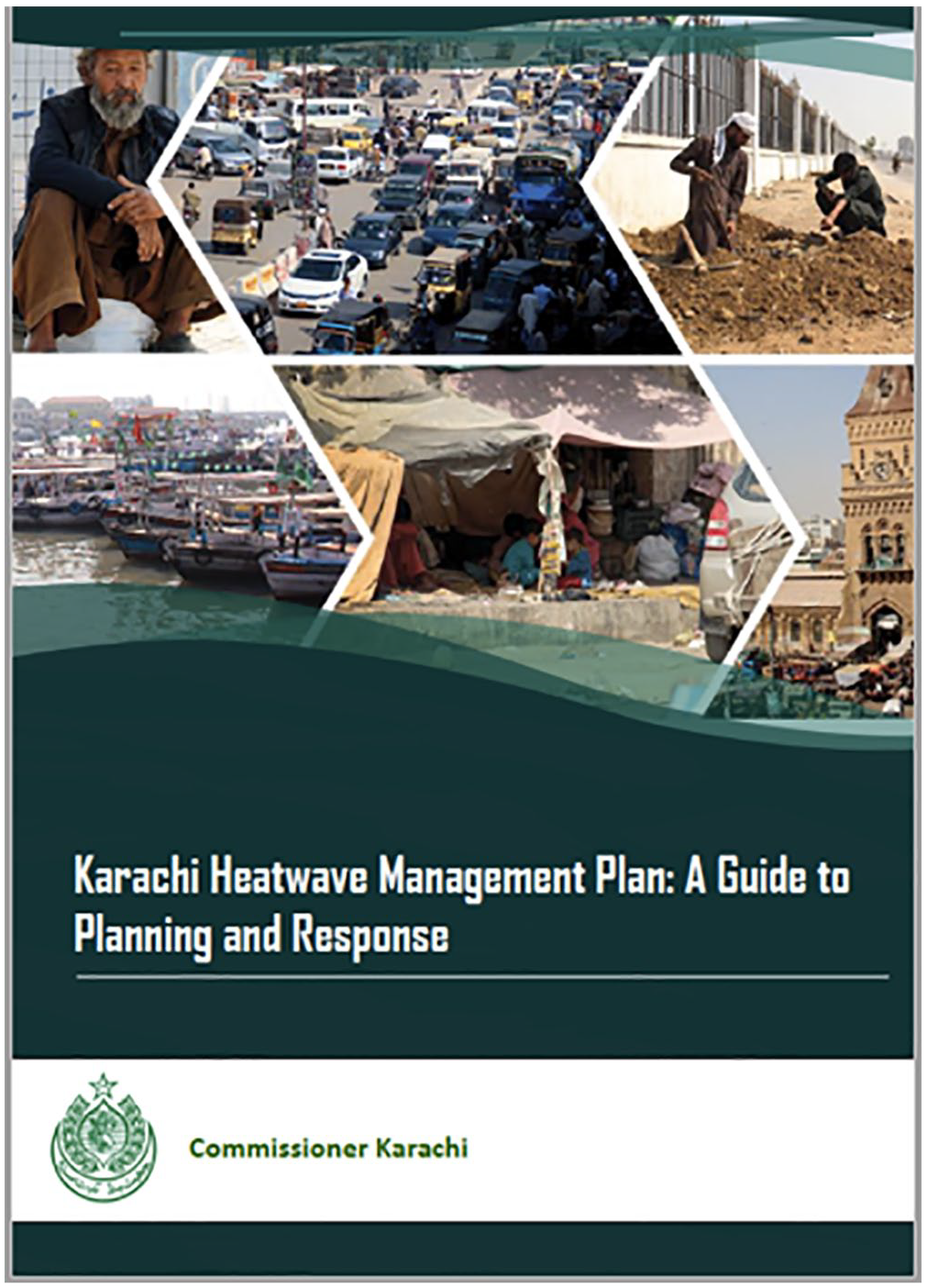
Karachi heatwave management plan.
The Heatwave Management Plan is a form of thermal mediation. It produced a range of media forms and practices – including maps of the dead, social media posts of heatwave warnings, and television commercials – all driving a story about an updated urban governance approach to tackle heatwaves and related deaths in the city. However, the Heatwave Management Plan is not simply a rhetorical mediation. In its deployment of specific media forms and practices about heat and governance, the Plan produces a determination of thermal governance that relies, almost exclusively, on the purportedly corrective role of data and communication in addressing Karachi’s thermal heatwave futures.
This thermal management through data computation, surveillance, and mapping is oriented around death and dead bodies as data points for urban governance in places at risk of thermal futures. Figure 5, for instance, illustrates the mapping of the dead on a spatial scale. Different modes of computing the bodies of the dead (e.g. total numbers vs deaths per 10,000) produced different maps of neighborhood vulnerabilities. Of course, data collection and computation is critical in terms of controlling and managing public health, even as activists, community workers, and scholars have argued for greater government transparency in sharing that data and its intended uses. Crucially, the Plan suggests that decision-makers can choose from among the different data maps of the dead to decide “how to mobilize resources across the city” (64). Thus, the heat management plan is essentially a governance model under the thermal ecology, which relies on data computation and maps of the dead to determine urban policy and resource allocation.
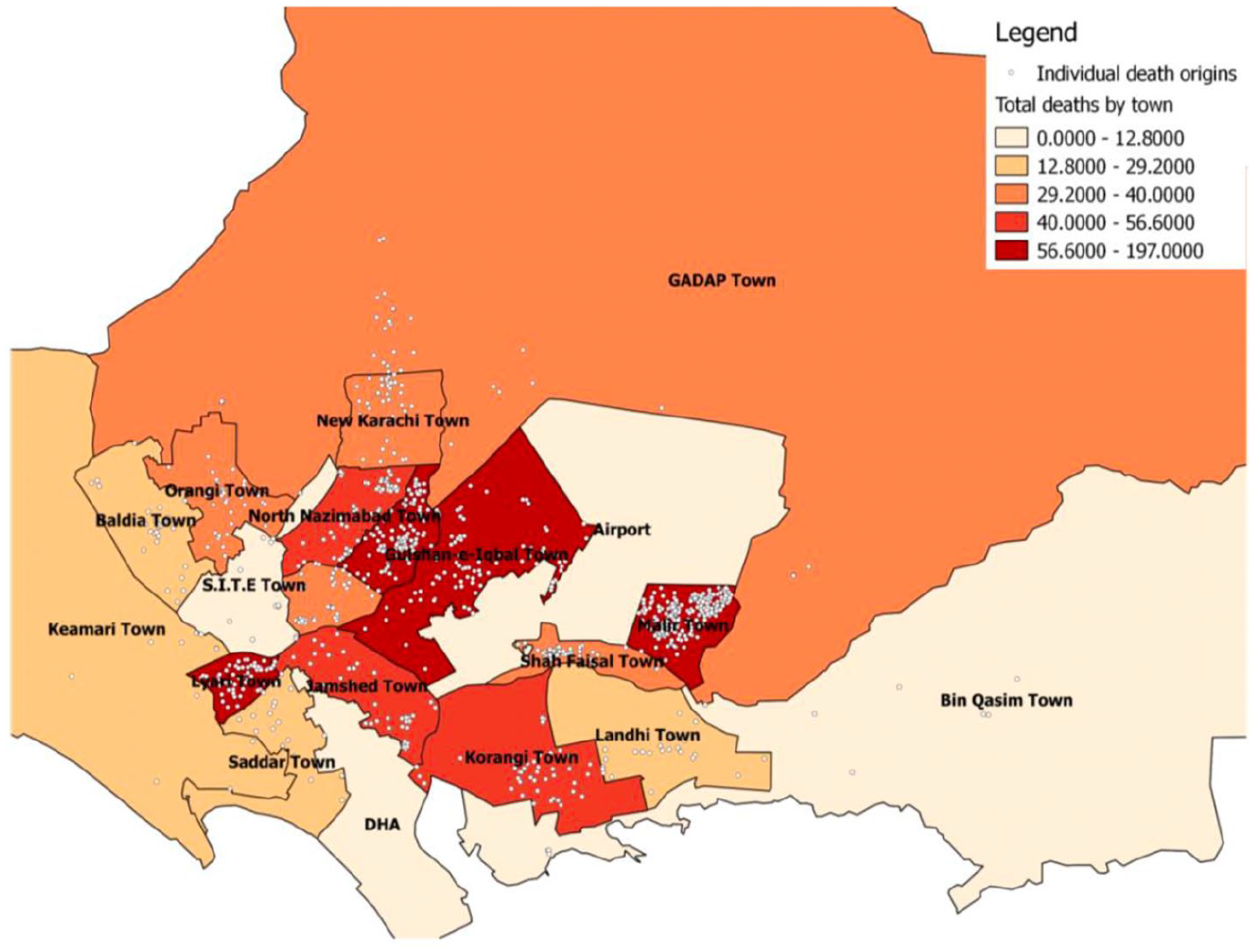
Data maps of the dead.
Moreover, the Karachi Heatwave Management Plan lays out a communications program that focuses on governance through communication between different local municipal sectors and private, media, civic, and nonprofit sectors, as illustrated in Figures 6 and 7. This communication program looks like a flow chart where information moves back and forth between the Commissioner’s office and important sectors in the city. The Heatwave Management Plan notes that communication flows are essential to the effective implementation of necessary policy measures to prevent heatstrokes and related deaths. In other words, communication flows are posited here as the removal of blockages tied to tackling the city’s thermal ecology.
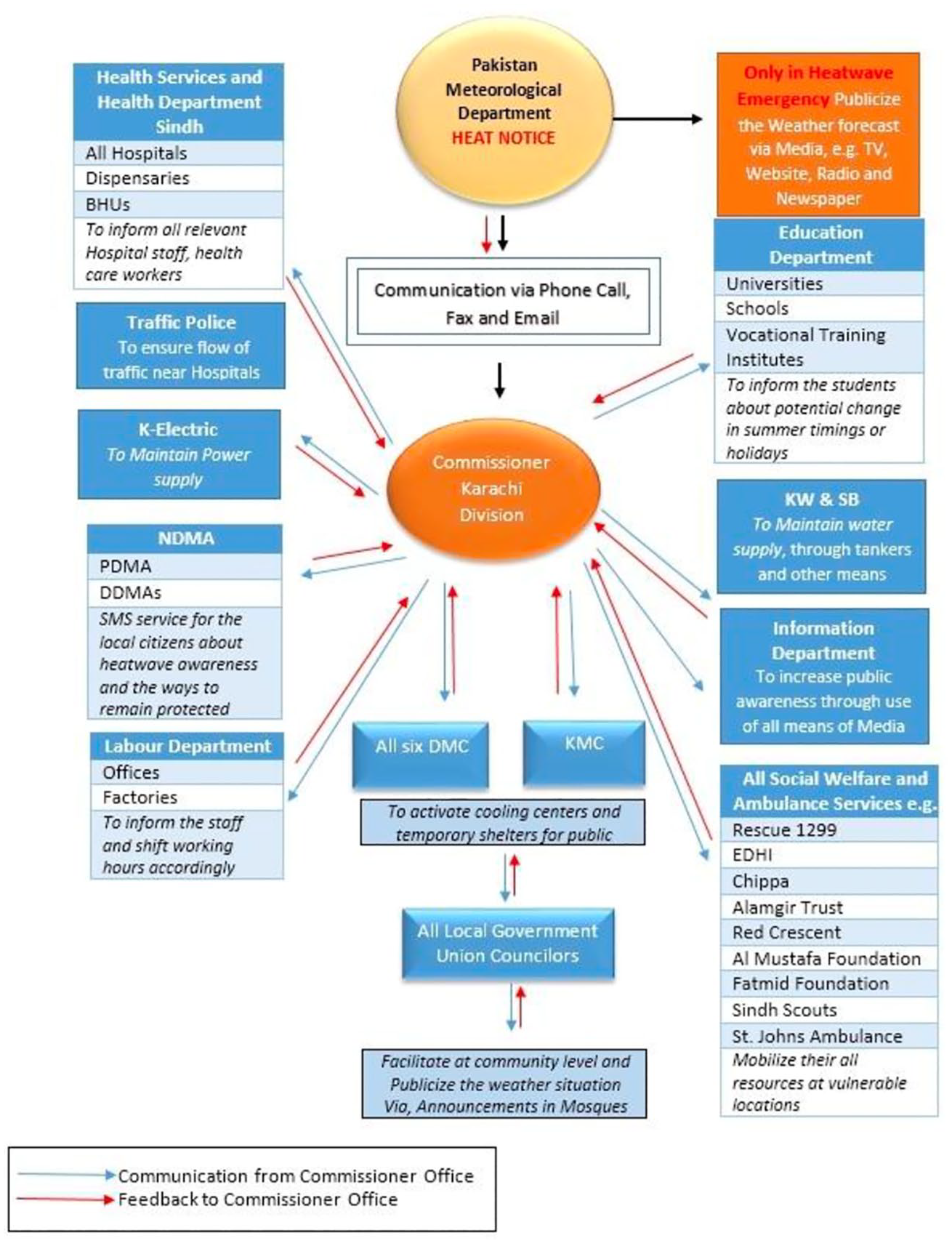
Communication program under the Karachi Heatwave Management Plan.
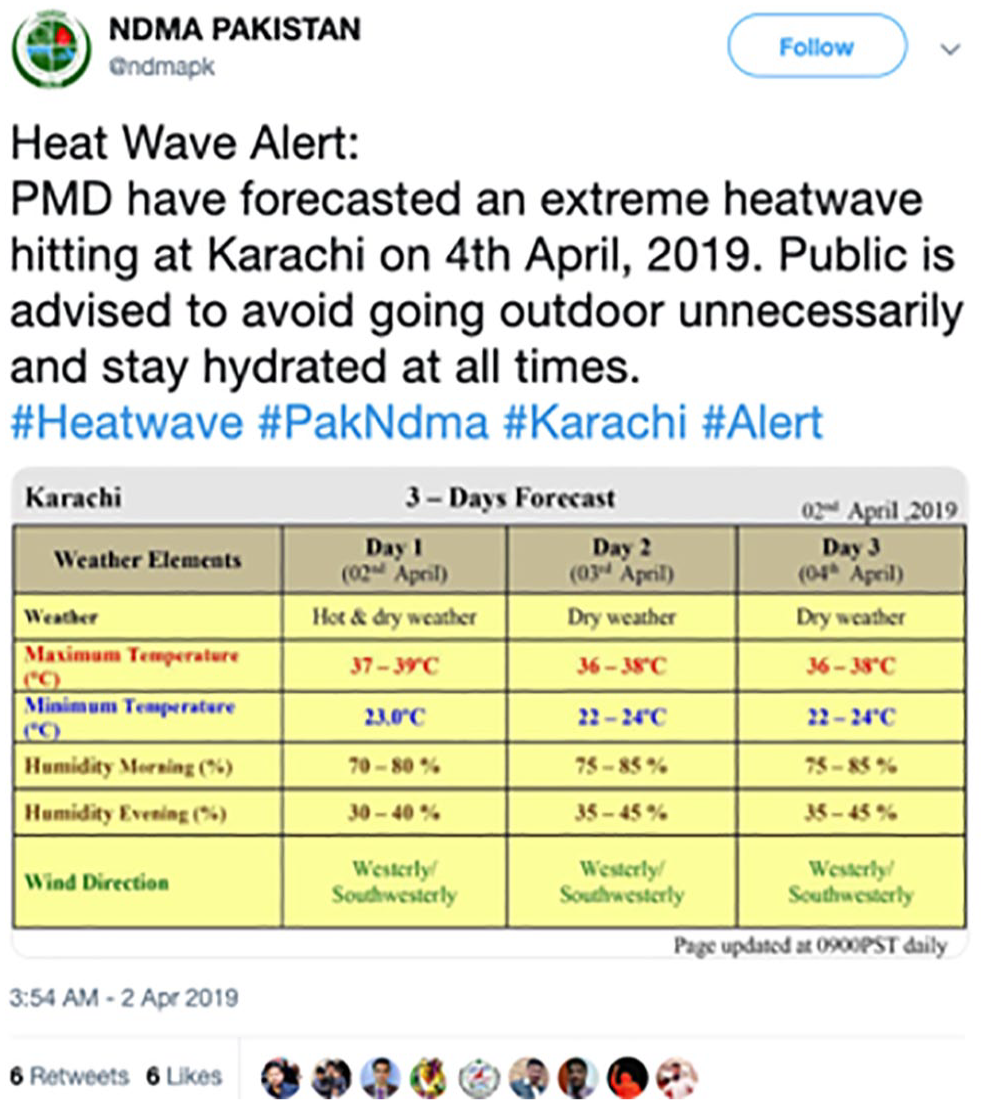
Tweet from National Disaster Management Authority warning of potential heat strokes on 2 April 2019. Tweets like these are part of the Karachi Heatwave Management Plan’s communication program.
Communication flows and data mapping of the dead are certainly a few important practices, among many others, to prevent future fatalities from thermal violence. However, the Heatwave Management Plan proposes that an urban governance model based on data computation and an advanced communication program is a sufficiently singular and wholly adequate approach to the city’s thermal ecology. This approach is not aimed at addressing why the thermal ecology exacerbates fatalalities across the city’s vulnerable neighbourhoods, but at simply containing the leakages of fatal excess across the city. As such, the data mapping and communication flow chart are superficial, cosmetic thermal governance practices designed to ‘manage’ death in an increasingly, fatally hot city built by deep histories of uneven, violent development.
For these reasons, critical urban studies scholars have asserted that heat in Karachi must be studied in the context of an “unequal city” (Anwar et al., 2022). In their vital scoping study, Anwar et al., describe the June 2015 heatwave as a “slow onset disaster” that exacerbated structural vulnerabilities in the unequal city. Critiquing the parameters of how heat (and humidity under the urban heat island effect) in Karachi is defined by the state, Anwar et al. (2022) describe a “top-down” approach that renders heat more violent in unequal ways, and even question whether the Heatwave Management Plan is “in fact, designed to fail in the protection of life.”
Karachi’s thermal ecology intensifies existing inequalities across the city’s violent urban development. Karachi’s indigenous populations comprise 3000 villages, coastal fishing communities, and agrarian frontiers that have continued to be systematically occupied by state and corporate actors through violent legal and illegal techniques. In one of the largest and fastest-growing cities in the world (Dube, 2013), 62% of Karachi’s population – about 13 million – lives in katchi abadis or informal settlements upon land that has been unofficially (and often illegally) divided and converted into dense, increasingly vertical, semi-permanent housing structures. As scholars of urban planning in Karachi have argued (Anwar, 2018; Hasan et al., 2015; Mustafa et al., 2019), developers of illegal settlements exploit its poor, migrant, and displaced communities, continuously threatening them with sudden forced eviction. Inside these dense edges, the thermal ecology mediates particular thermal effects that map onto existing structures of marginality. Urban density in Karachi may turn it up to 15° warmer than surrounding rural areas. These heightened thermal effects disproportionately mediate dense, informal settlements where 6–10 persons can live in a small room with restricted access to water and electricity infrastructures (Hasan, 2015). During the June 2015 heatwave, amidst prolonged electricity and water shortages (and electricity is required to pump water for domestic use,) it became difficult for bodies inside overheated, dense, informal settlements to cool off the surrounding thermal effects.
Infrastructural failure in Karachi’s informal settlements takes the form of disconnection and alterity. Macktoom et al. (2023), examine the notion of “heatscapes” as created through Karachi’s urban design and architectural practices that ineffectively manage cultures of cooling and comfort in the midst of ubiquitous heat – for instance, through deploying air-conditioning systems in a city where energy blackouts are common. State-owned energy, water, health, sanitation, and waste infrastructures are in disrepair in Karachi, wherein technical failures are often attributed to insufficient resources – both financial as well as environmental. In recent years, these discursive claims have paved the way for the neoliberal takeover of Karachi’s electricity infrastructure, as well as the development of state-backed “water mafias” that steal water from the city’s reservoirs and sell it at high prices during the regularly prolonged periods of water shortage, especially in informal settlements. 2 Relatedly, Larkin’s (2008) examination of infrastructural failure that gives rise to alternative technologies and systems of production and distribution in urban Nigeria resonates across many major cities, especially in the global south. However, these alternative, makeshift infrastructure technologies, by nature of their socio-economic alterity, cannot withstand the violent thermal effects of the heatwave. There are no regulatory systems to prevent overheating. In fact, the only regulation system is connected to the restriction of use, such as limiting the use of electricity in the summer months to prevent electricity blackouts. However, in the thermal ecology of the heatwave, regulation of use is impossible because electricity-based cooling affects the material distinction between life and death, literally. The seamless functioning of both public and alternative infrastructure technologies is critical for protection from deadly thermal effects. Crucially, urban cities such as Karachi must shift away from neoliberal control and exploitation and extend access to public infrastructure technologies for its informally settled populations.
These urban inequalities lay bare the significance of an urban governance approach that addresses the future of heat in terms of the protection of social and ecological forms of life. This is an urgent need, given that in the wake of Covid-19, states have instituted widespread data computation and surveillance programs, especially in urban contexts, to monitor, control, and address issues far beyond public health, thereby transforming the nature of urban governance and impacting social conditions of everyday life in a myriad of ways (Kim, 2022). However, inside the thermal ecology, because heat is ubiquitous even when it is unequally compounded within impoverished neighborhoods, data computation of death does not aim to address the thermal ecology, but to institute a thermal governance paradigm for (un)livable urban futures. This is the assumption that tracking and predicting death and its ethnic, geolocation over time will be sufficient to manage death from the thermal ecology. However, this approach is blatantly cruel. It rests on the premise that communications and data technologies will limit excess death during the heatwave, and that, hence, there is no need to address urban inequity and ecological violence. Thermal governance absolves the governance part of the phrase because data computation and communication planning are deemed adequate strategies for the thermal ecology. It reduces governance to the space and time of the crisis, the heatwave. However, as with the Pashtun migrant mother collecting her husband’s dead body, it is starkly evident that death continues beyond the heatwave. Death is enabled because thermal governance is not concerned with addressing heat as an unequal lived and embodied violence in a deeply unequal city.
Thermal media cultures
The thermal ecology has given rise to media cultures interested in exploring the connections between urban development and ecological violence. I follow one particular form of media culture below in order to track how mediated storytelling reimagines place, loss, and power in a violent thermal ecology.
Of Struggle (2016) is a community-driven, participatory art project comprising workshops, community research, and collective art-making led by artists Shahana Rajani, Zahra Malkani, and Abeera Kamran (see Figure 8). The art project documents lifeworlds of the mountains in the indigenous villages of Gadap on the outskirts of Karachi, as they were razed for a mega urban development project called Bahria Town. Violent techniques of urban development have reconfigured Karachi’s ecological strata, rendering it vulnerable inside the thermal ecology. Environmental media studies have approached digital media infrastructures in relation to the spatial and temporal influence these derive from and exact upon the earth’s strata (Halpern, 2018; Han, 2024; Mattern, 2017; Mendelsohn, 2018; Omer, 2021; Parikka, 2015). Techniques of Karachi’s urban development have involved encroachment on the coastal mangrove marshes by urban elite housing developers, the razing of peripheral farmlands that used to provide most of the fruits and vegetable supplies for the city, and the displacement of its farming communities. Moreover, the illegal lifting of 60 billion cubic feet of sand and gravel from seasonal riverbeds for the construction industry has meant that water cannot be contained in the natural drains and that ground aquifers cannot be recharged (Hasan, 2018). Every monsoon, rainfall floods the city because illegal construction upon natural drainage canals has blocked the flow of water. These environmental reconstitutions have paved the way for the thermal ecology to become a dominant force in Karachi.
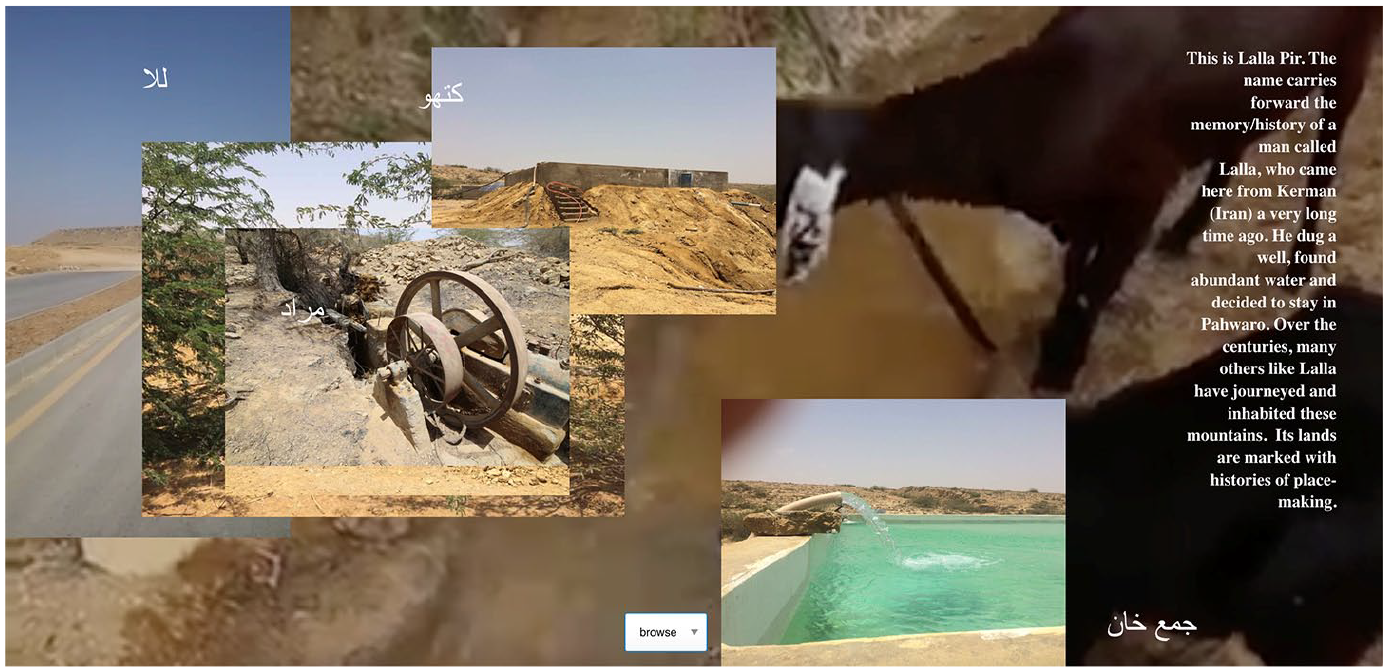
Of Struggle by Abeera Kamran, Shahana Rajani, and Zahra Malkani.
Of Struggle, its website, illustrations, maps, poetry, design, and archive, all demonstrate cultures of thermal mediation. The art project comprises months of community-driven workshops, an interactive website (www.ofstruggle.com), two edited volumes of essays on the city’s development cultures, and a public art exhibition. The interactive website is organized around multivalent visual dimensions: a timeline of the razing of Gadap that is illustrated through the imagery of the wall built by Bahria Town that snakes around the land, as well as the kaleidoscopic imagery of close-ups of shrubs and fruits of the land. Of Struggle creates maps of the missing and erased waterways, mountain passes, and cultural memories across Gadap’s villages that subsisted off of the mountain. Oral recordings are displayed alongside photography of the rooms and indoor spaces where the interviews took place, and these media are juxtaposed with the audio and/or audio-visual recordings of running waters, goats drinking from water wells, and silent videos documenting the developer’s ugly wall intersecting the villages.
Of Struggle is simply staggering in its capacious treatment of issues of violent urban development. Figure 9, for instance, draws us to the intimate spaces of the home, where embodied relationalities of caring for the land and longing for memories of land are discursively produced – memories of childhood, feminist and women’s only spaces of washing clothes, grazing livestock, and looking for wood. Moreover, Figure 10 details a beautiful user-generated digital map of the land that used to be, before it was partially or wholly erased. The map archives the processes of erasure and ecological degradation, while imagining Gadap’s embodied, re-membered lifeworlds that persist across this public, digital, interactive space – itself an assemblage of voices, memories, histories, languages, ecologies. Figure 10 geospatially pins down the cultural archives of family stories and communal memories of the land, missing rivers, and stories about the saints and legends of the land, of mountains, and the feelings of cool shade on hot days. Digital mapping is a mediation of community-based documentation and preservation of multi-generational cultural memories of violent loss.
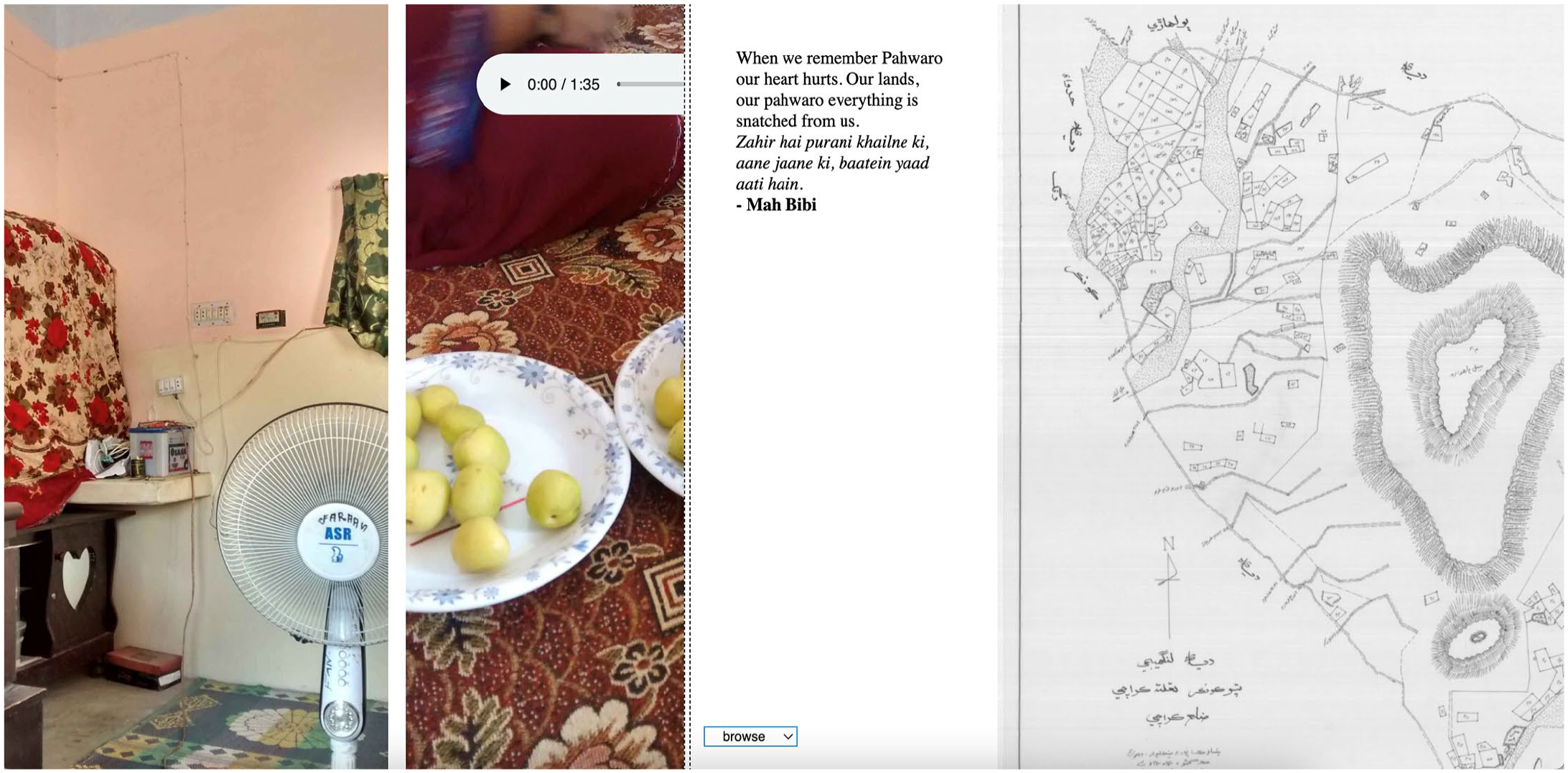
Of Struggle by Abeera Kamran, Shahana Rajani, and Zahra Malkani.
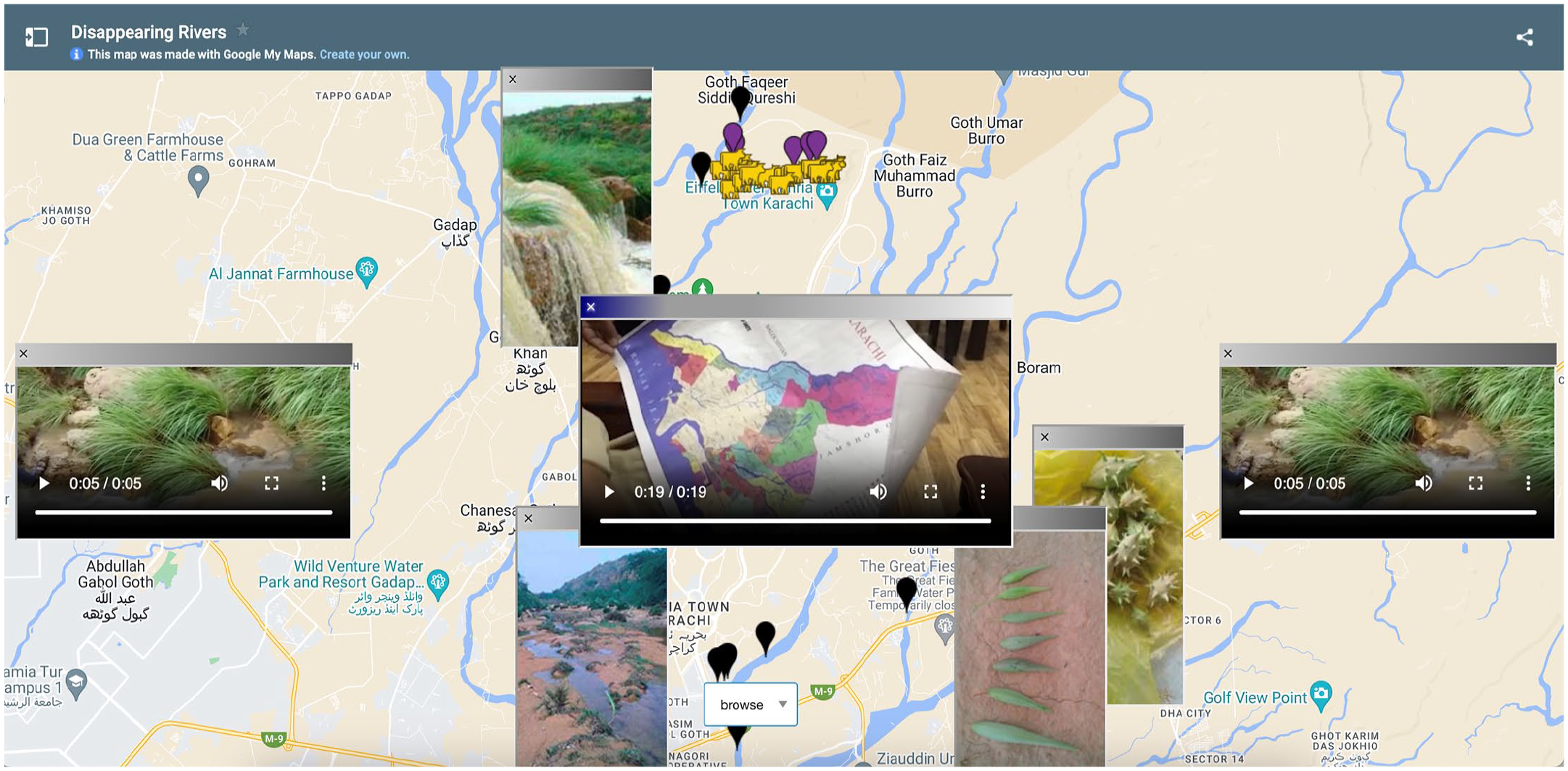
Of Struggle by Abeera Kamran, Shahana Rajani, and Zahra Malkani.
Figure 11 shows the interactive aspects of Of Struggle. Here, interactive web poetry about the embodiment of home gives way to a photograph depicting the fracture of land. A bulldozer is pummeling through farmland, leaving behind tunnels of dug-up earth and clouds of dirt blowing across the land. Clicking on the photograph leads to a video on a loop. Recorded on a moving car, the camera follows and documents acres of razed mountainside but eventually pans out to the under-construction roads and housing scheme. A second interactive web poem frames the video and photographs into perspective. It uses the concept of the Sindhi word “bhagi” and its double meanings (to run and to break) to reflect on the violent fractures of land and embodiments of home, memory, and lifeworlds.
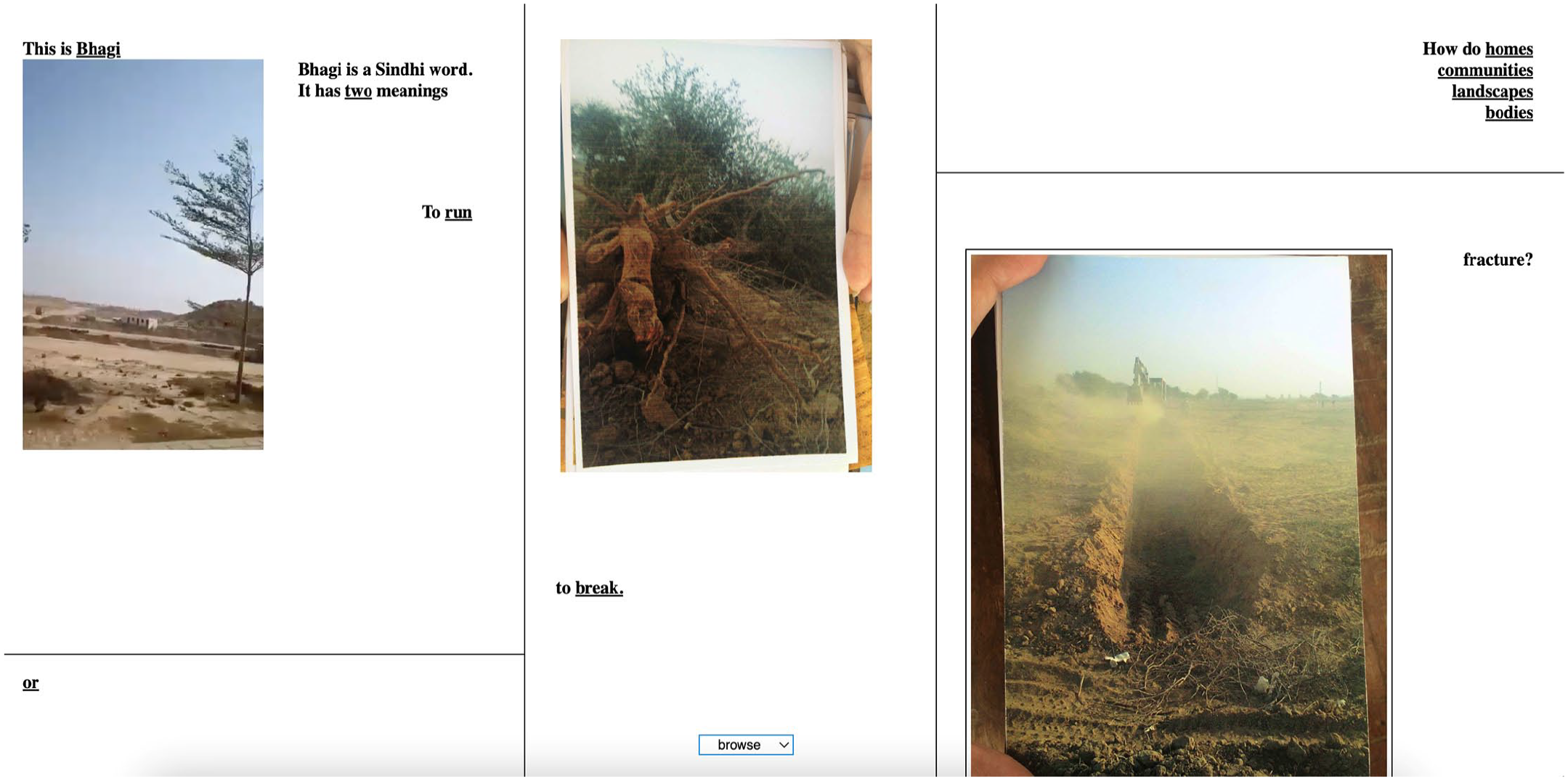
Of Struggle by Abeera Kamran, Shahana Rajani, and Zahra Malkani.
This webpage, titled ‘bhagi’, pulls and ties together many media forms – poetry, photography, video – to visually narrate the running over and breaking of land. In doing so, the artists offer an engagement with the media forms (the still photograph, interactive poetry, and the moving video) and their intermediality, the way these media forms relate to and shape each other. In their arrangement of these distinct media forms, the artists rely on the interplay of intermediality to give form to the physically formless, the space(s) and time(s) of location and dislocation, the place in its becomingness that also holds its pasts – the water wells, the graves, the plants, and memories of these lifeworlds.
Of Struggle is a mediation of the thermal ecology. Here is a mediation in the ways of sensing, calibrating, affecting, structuring, reflecting on the particular relationships between loss and land, violence and development, technology and temporality. It is part of a thermal media cultural response to the heatwave, which forced renewed urgency around exploring the entanglements between development and ecological violence. This mediation is also about bringing new sets of community actors involved in the knowledge-making, critical mapping, and storytelling of Gadap, including through digital tools. Thinking through heat and mediation is thinking through media and mediatic relations as emplaced within structures, cultures, and ecologies, and thermal mediation affects those conditions of emplacement, even as it seeks to reify and reconstruct them. Of Struggle beautifully demonstrates these intertwined forces and, as such, is crucial for tracing through processes of thermal mediation.
Thermal futures
The thermal ecology maps onto histories and regimes of violent urban development in Karachi. Deaths from the thermal ecology are re-mapped onto patterns of violence from urban development and ecological manipulation across human and nonhuman materialities in the city. I have argued above that fatally hot thermal conditions, typified by the heatwave, produce material shifts across infrastructural systems that force relations across media in terms of thermal effects.
Pipes, cables, drains, concrete, sand, rivers, marginal, and dense informal settlements of mostly poor migrants, trees, animal, and plant worlds, are all mediated and recomposed through thermal ecology. Even so, the thermal ecology is predicted as the future of many cities in the global south and around the world (Leahy, 2017; Shaikh, 2018). Here, is the urban coastal city with its edges of soil and water that are eroding, edges of densifying informal settlements that now hold most of the city, and the edges of agrarian farmlands that are illegally razed for yet another mega-housing project. This is a city that is projected to become unlivable as heatwaves are set to become more frequent and more deadly in South Asia and the Persian Gulf (Leahy, 2017; Shaikh, 2018). What does this thermal future mean to the management of unliveability due to heatwaves and associated thermal ecologies? The thermal ecology requires situated thermal management, where ubiquitous breakdowns and overheating infrastructures are reduced and access to public water, energy, as well as alternative, community-based infrastructure technologies are made accessible.
In closing, I return to the Pashtun mother with her children who had arrived at the morgue to receive the body of her husband. In Karachi, the thermal future is raging through the city. Not through the projected magnitude of its “total” unliveablility, but through the production of its thermal ecology. If the thermal future is dense, urban, coastal, informally settled, centered in the global south, and fatally hot, then its thermal ecology as produced through violent urban development, technological mediation, and ecological manipulation becomes critical to address.
Footnotes
Acknowledgements
I want to thank the editorial team at Media, Culture and Society for their support. I developed this article in conversation with several peers and mentors over the past few years. I drew heavily on substantive reflections by Nicole Starosielski, Aniko Imre, Tara McPherson, Nitin Govil, and Aswin Punathambekar. In particular, this paper benefited from a presentation organized by Aniko Imre and Nitin Govil at the University of Southern California, as well as a writing workshop with a brilliant cohort of postdoctoral and doctoral fellows at the Center for Advanced Research in Global Communication, Annenberg School of Communication at the University of Pennsylvania. It rests on the vital research of Nausheen Anwar and the Karachi Urban Lab based at the University of Karachi. I want to thank the anonymous reviewers for their important feedback, as well as Ayesha Vemuri and Woori Han for necessary co-working sessions, and especially my family for all their patience and support.
Funding
The author received no financial support for the research, authorship, and/or publication of this article.
