




Abstract
This Crosscurrent contribution presents programmable politics as an emerging keyword for understanding the complex interplay between technology, society and politics in the 21st century. Programmable politics has gained heightened importance in the aftermath of the pandemic that has sped up digitalisation processes that are the preconditions for programmable politics to emerge. Turning increasingly to engagement online, the pandemic constitutes a catalyst for programmable politics. The concept highlights both the potential for enhancing democratic engagement, and the risks of undermining it through the centralisation of control and manipulation of information flows. We discuss the transition from digital politics, characterised by the integration of the internet and social media into political discourse and action, to programmable politics, a concept that highlights the impact of platform architectures, algorithms, artificial intelligence (AI) and non-human agency on the political landscape. In doing so, we call for a critical examination of how current digital technology reshapes the dynamics of power, control and resistance within the political domain.
Keywords
This Crosscurrent contribution presents programmable politics as an emerging keyword for understanding the complex interplay between technology, society and politics in the 21st century. Programmable politics has gained heightened importance in the aftermath of the pandemic that has sped up digitalisation processes that are the preconditions for programmable politics to emerge. Turning increasingly to engagement online, the pandemic constitutes a catalyst for programmable politics. The concept highlights both the potential for enhancing democratic engagement, and the risks of undermining it through the centralisation of control and manipulation of information flows. We discuss the transition from digital politics, characterised by the integration of the internet and social media into political discourse and action, to programmable politics, a concept that highlights the impact of platform architectures, algorithms, artificial intelligence (AI) and non-human agency on the political landscape. In doing so, we call for a critical examination of how current digital technology reshapes the dynamics of power, control and resistance within the political domain. We argue that the notion of programmable politics contributes to the scholarly discourse on digital political engagement because it pushes the focus beyond the individual, and even human, actors to try to grasp the more profound transformation through which algorithms, automation, AI and non-human agency are currently reshaping political processes at their core. Programmable politics emphasises the increasingly computational logic by which political engagement is becoming redefined as political actions become encoded into software layers and digital processes that interplay with platform architectures. This shift also introduces new power dynamics where the control over political discourse both becomes potentially more dispersed, and at the same time potentially more centralised with the platforms themselves.
Digital politics
Today, it goes without saying that politics has gone digital. No doubt, processes of democratic deliberation and civil society mobilisation have always been entangled with technology, even before the digital era (Winner, 1980). In the age of mass media, newspapers, radio and television were all intertwined with key political events, the shaping of opinion and social movements (Downing and Ford, 2001; Hilmes and Loviglio, 2002; Lazarsfeld et al., 1944; Street, 2021). As a continuation of this, the digitalisation of politics and civil society has been a gradual, if ever relentless, process that has happened alongside technological development during the past half-century. Scholars have conceived of the new emerging context for politics and civic engagement as an ‘information society’ (Bell, 1976) or a ‘network society’ (Castells, 1996). A rich body of scholarship has contributed to the understanding of how digital communication has created new premises for politics and democracy. The move towards digital and online engagement has been re-emphasised and accelerated during the COVID-19 pandemic as our lives moved largely online and physical meet-ups were largely impossible. This moment of acceleration prompted us to rethink the potentials and challenges of digital activism.
In the early days of digital politics, the focus was largely on how the internet was on the rise as a new public sphere (Dahlberg, 1998; Rheingold, 1993; Schneider, 1997). These were the days of Usenet, websites, online forums and email campaigns, where the affordances of these tools came to play an increasing role in political communication by breaking down geographical barriers and enabling more immediate interaction between politicians and the public. The increasing availability and speed of the internet ushered in the Web 2.0 era with its emphasis on social networking, user-generated content and participatory culture (Boyd and Ellison, 2007; Jenkins, 2006; O’Reilly, 2007). In terms of politics and civil society mobilisation, this enabled ‘organising without organisations’ (Shirky, 2008), and the deployment of tech-enabled collective action in spaces where traditional boundaries between public and private spaces are blurred, and where decentralised communication and coordination enable the formation of ‘networked publics’ (Ito, 2008), and ‘ad-hoc publics’ (Bruns and Burgess, 2011). Similarly, Bennett and Segerberg (2013) have addressed the shift from collective to connective action in the wake of social networks becoming important societal pillars or even civic infrastructures as Anne Kaun and Julie Uldam suggested in 2018.
Now we have entered an age of digital automation, where civil society is no longer affected by mere digitalisation in the shape of higher speed and longer reach of public dialogue and mobilisation (i.e. internet communication). Rather, civil society is now affected by technological developments that change society and politics in much more profound ways. Carried by the wave of what has been labeled ‘the Fourth Industrial Revolution’ (Schwab, 2016) – and particularly spurred by developments in the area of AI – automation, alongside datafication and algorithms, have now given rise to sociocultural transformations that cut through all areas of society (Couldry and Hepp, 2017; Lindgren, 2023). It has been pointed out that these developments can potentially revolutionise the way we organise our societies, and changes are already underway in areas such as education, labour and warfare, through, for example, new forms of algorithmic governance (Eubanks, 2017; O’Neil, 2016). So, while digitalisation has lingered on for decades, scholars now claim that we have just recently entered ‘the Second Machine Age’ (Brynjolfsson and McAfee, 2017) where the accelerated development and broad adoption of digital automation technologies do new things to society, with new consequences. The rise of algorithmic automation introduces different dynamics, as programmable platforms of communication are increasingly becoming interfaces between people, governments, organisations and businesses. What we mean here is the increased population of online spaces through bots and other forms of artificial communication that pose the question how much of our political spheres are characterised by synthetic actants. At the same time, there is a higher level of reflexivity of users when it comes to the potential harms posed by synthetic and artificial actants. This, in turn, offers up a range of challenges and opportunities for politics and civil society, as well as for their scholarly understanding.
Politics in an age of platforms
While social media continue to offer functional platforms for large scale activism (see #metoo, (Lindgren, 2019); #blacklivesmatter, (Yang, 2016); #fridaysforfuture, (Francesconi et al., 2021), we have witnessed many examples throughout the last decade of how automation, datafication and algorithms have affected civil society in less positive ways. These cases include instances and debates over ‘filter bubbles’/echo chambers and ‘fake news’/post truth (Corner, 2017; Flaxman et al., 2016), racism and sexism embedded in algorithms (Noble, 2018), scandals surrounding psychometric profiling/Cambridge Analytica (Hu, 2020), data surveillance (Zuboff, 2019) and automated disinformation campaigns (Woolley and Howard, 2019). In addition to these impacts that automation has had on the public sphere, it also affects civil society in more direct ways through the increasing algorithmic governance of citizens. Algorithmic systems for automated decision-making are currently implemented in the public sector including welfare administration and provision, but also in police work, for example through so-called predictive policing but also in the backends of the welfare state (Kaun et al., 2023). This has implications for state-citizen relations and more specifically the possibilities for civic engagement and participation on the side of the citizens. The age of algorithmic automation has brought on significant political and civic consequences through processes that are underpinned by datafication, algorithms and non-human agents, which also impacts the possibilities for resistance against certain algorithmic logics as Bonini and Treré (2024) show in their book Algorithms of Resistance. Here Bonini and Treré explore forms of resistance against algorithms, highlighting small acts of non-compliance by gig workers, creative practices to resist algorithms in cultural production and lastly algorithmic resistance in relation to political practices.
This all plays out within the framework of an emerging and evolving platform society (Gillespie, 2010; Van Dijck et al., 2018), which marks a transformative shift when it comes to how social, economic and interpersonal interactions are mediated. In this context, economic transactions, political deliberation, as well as people’s everyday micro-interactions are largely channeled through a global ecosystem of digital platforms that are, in turn, fueled by data and organised through algorithms. Importantly, this ecosystem is by no means a separate technological space but is rather deeply integrated into our daily lives, affecting a wide range of everyday practices. Platforms are to be seen as programmable digital architectures, that are designed to organise interactions between users with the aim of facilitating the creation, exchange and consumption of goods, services and ideas. This facilitation, however, does not happen in any neutral way. Rather, it is highly influenced by the specific algorithms, features and policies that the platform employs. Many of the platforms we use today are owned and controlled by large technology corporations, such as Google, Amazon, Facebook, Apple and Microsoft. This means that contemporary capitalism is significantly shaped by a few key players, creating a form of digital oligopoly that significantly influences the economy and politics globally. As argued by Gillespie (2010), platforms are not neutral even though they often position themselves as such. Instead, they are actively contributing to shaping public engagement and discourse. Gillespie also emphasises the fact that the term ‘platform’ is multifaceted, as it has developed from referring to physical structures to increasingly pointing to metaphorical spaces for social and political action, and now to its current use in relation to the internet.
Politics, in this society which is characterised by the central role played by platforms in organising and structuring both public and private lives, becomes increasingly affected by the dynamics of digital interactions, algorithms and the dominant ideologies that constitute these platforms. Poell et al. (2019) discuss this development in terms of platformisation, focussing on how the process reshapes infrastructures, market relations and frameworks of governance within a variety of sectors, including politics and civil society. The increased programmability of politics, as a consequence of platformisation, signifies a shift towards more controlled, algorithm-driven forms of political engagement and discourse. The programmability allows for the manipulation of information flows, the targeting of specific demographics with tailored political messages, and the orchestration of public opinion through data-driven strategies. Such developments raise critical questions about the autonomy of political processes and the integrity of democratic deliberations in the platform society. The ability of platforms to program the political landscape not only challenges traditional notions of the public sphere and political participation but also introduces new dynamics of power and control, where platform operators possess unprecedented capabilities to influence political outcomes, while at the same time claiming neutrality. In other words, as digital platforms have been celebrated for their potential to enhance democratic engagement, transparency and participation, the ways in which the platformisation of society happens invites a parallel examination of how the platforms might also reshape democratic processes in other ways, potentially centralising control, influencing public opinion and generally altering the dynamics of political participation as such.
On programmability
Writing on ‘social media logic’, Van Dijck and Poell (2013) cited programmability as one of the key features of social media’s pervasive influence on various aspects of public life, including democratic politics. The authors explain that while in the era of print and broadcasting, ‘programming’ referred to content scheduling to maintain audience engagement, the concept has now evolved to emphasise the interplay between users and code. Programmability is no longer about a one-way flow of content but about a dynamic process.
The kind of programmability that is enabled by the platform society goes two ways. On the one hand, platforms have the technological capability to shape – in ways that may be controlled or uncontrolled, intended or unintended, direct or indirect – the flow of information and user interactions through algorithms, AI and automation. This aspect of programmability allows platforms to curate content, prioritise certain messages over others and influence the visibility of information. This algorithmic curation is central to the functioning of platforms as it allows them to organise vast amounts of data and present users based on different goals or criteria.
On the other hand, programmability also refers to the fact that users can interact with, respond to and manipulate the platform environment through the very same affordances of programmability. In other words, users are not just passive recipients of the platform’s functionality but also active participants in its creation, curation and modification. As users contribute content, engage with others’ posts and signal their preferences through likes, shares and comments, their actions feed back into the platform’s algorithms, influencing future content curation and the overall dynamics of information flow. This interactive dimension of programmability highlights the important point that there is not only top-down programmability but also bottom-up programmability. While the former refers to the capacity of platform owners and operators to dictate the platform’s rules, features and functionalities, the latter refers to users’ ability to shape, manipulate and influence the platform through their interactions and contributions. Both of these types of programmability may be leveraged for political purposes and with consequences for democracy.
The interplay between top-down and bottom-up programmability creates a dynamic and often unpredictable political environment in which the power dynamics of information dissemination are constantly in flux. This environment can empower citizens, enabling grassroots movements and amplifying marginalised voices. Examples include leveraging algorithms for widespread impact through the strategic use of hashtags to amplify marginalised voices and coordinated global advocacy, transforming a simple social media feature into a catalyst for social change (Freelon et al., 2016; Jackson et al., 2020; Lindgren, 2019; Rambukkana, 2015). Furthermore, a range of decentralised movements have particularly benefited from social media’s programmability. To take but one example, the 2019–2020 Hong Kong protests (Ting, 2020) used platforms like Telegram to coordinate actions and disseminate real-time information, showcasing the ability of social media to facilitate agile and responsive organising without centralised leadership.
Similarly, the use of Twitter during the Arab Spring helped amplify demonstrators’ voices, making it harder for governments to suppress or ignore their demands (Lindgren, 2013). Over time, activists have become increasingly adept at gaming social media algorithms to boost the visibility of their content. By engaging with trending hashtags, optimising posting times and encouraging rapid community engagement, they can push their messages to the forefront of social feeds and search results, ensuring wider dissemination and impact (Angeles and Ramos, 2022; Etter and Albu, 2021). However, it can also amplify misinformation, polarise public opinion, facilitate the manipulation of public discourse and pave the way for commercial interests to dominate the narrative, potentially subverting democratic processes. A prominent example of when state and non-state actors exploited the programmability of social media platforms to influence public opinion and undermine trust in democratic institutions was the Cambridge Analytica scandal (Graham-Harrison and Cadwalladr, 2018; Hu, 2020). While these practices and forms of engagement have been discussed in terms of digital activism, we argue that the notion of programmability allows us to grasp the latest developments in terms of algorithmic automation. We hence suggest programmable politics as an additional way to engage with current shifts in civil society engagement.
Programmable politics
Programmability refers here to the move of turning political practices of self-organisation and mobilisation into computational units of data that comes with specific implications. In platform studies programmability has been linked to APIs and how they transform for example websites into programmable entities. Accordingly, as platforms increasingly undergird the economic model of the social web in an infrastructural manner (Poell et al., 2022: 64), they also play a crucial role in politics. Helmond and van det Vlist argue that ‘programmability is what enables a platform to be extended and embedded into other domains’ (Helmond and van det Vlist, 2019: 17). Similarly, politics including social movements, civic engagement and short-term forms of activism have the potential to be extended and embedded into other domains and areas, by becoming programmable. Adapting Rob Kitchin’s (2011) conceptualisation of the programmable city, we can think about programmable politics in the following way (Figure 1).
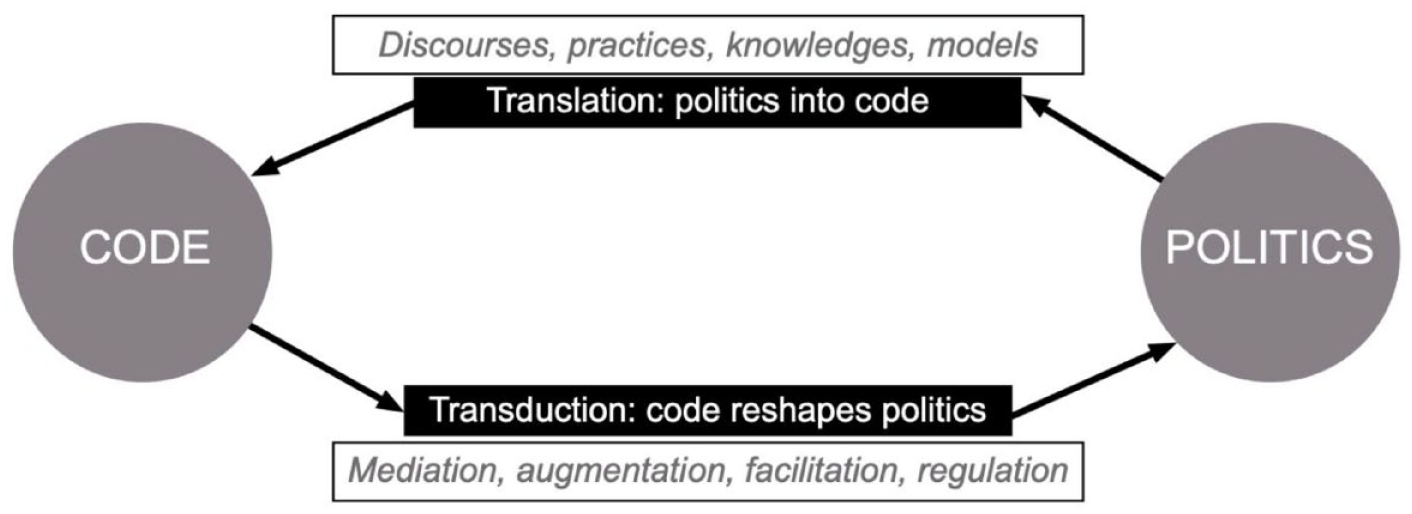
Model of programmable politics, drawing on Kitchin’s model of the programmable city.
Starting with the software of platforms, the model captures the iterative process of translation of politics into code and how code reshapes politics. Following this logic translation is accomplished through discourses, practices, knowledges and models of politics that are essential to the production of software code. In turn, the transduction of code reshaping the political sphere is enabled through processes of mediation, augmentation, facilitation and regulation. In concrete terms that means that software, that is platforms are shaping and are being shaped by politics, political engagement and civil society.
The emergence and proliferation in recent years of political bots, in the form of automated and semi-automated social media accounts, offers a striking illustration of how programmable politics can operate on a concrete level. This manifested, to take but one example, in relation to the events surrounding the 2024 UK riots following the mass stabbing of children at a dance studio in Southport. In this case, bots were argued to have played a role in rapidly disseminating false narratives about the stabbing by falsely attributing the crime to a Muslim asylum seeker [@morley-davies2024]. This misinformation, which was consequently amplified across various platforms, contributed in escalating the situation into widespread street violence. In other words, bot accounts played a significant role in spreading misinformation, inflaming tensions and coordinating actions during the riots. The operation of such bots is also documented in cases such as Russia's war in Ukraine [@breve2024], and not least the COVID-19 pandemic [@declerck2024; @xu2022]. As such, political bots are examples of the increasingly programmable character of present-day politics as they function as interfaces between political goals and computational processes that, in turn, interplay with platform algorithms and user behaviours. Political bots contribute to a transformation of political debate and democratic deliberation into largely automated digital actions that are embedded in the infrastructure that is provided by platforms. In other words, then, political bots are prime examples of how boundaries between authentic participation and automated influence are blurred by the logic of programmability.
Another example that illustrates in what ways programmability is integrated with political actions and engagement in nowadays is blockout2024. The case illustrates the increased reflexivity of platform politics and their programmability. Emerging in the context of the Gaza crisis in Spring 2024 in the aftermath of the Met Gala, an online movement primarily constituted by a loose network of TikTok and Instagram-accounts called to unfollow and block accounts by large influencers that have not spoken out and taken a position in the war. A number of lists with accounts to block circulated in connection with explanatory reels and videos. The focus on unfollowing and blocking expands on earlier forms of digital activism that involved hashtags and the mobilisation of large numbers of followers to post content. Instead, reflecting on the logics of platforms, this movement focussed on maximising economic harm for large influencer platforms by decreasing their visibility through blocking their accounts. This reflects the incorporation of programmability of politics into contemporary forms of engagement.
More broadly, then, programmable politics as a concept can help illuminate and capture the complex interplay between technology, society and politics in the 21st century, offering a lens through which we can understand the evolving nature of political engagement and civil society participation. It suggests that the political arena is increasingly mediated by a computational logic by which the actions of individuals and groups can be encoded into digital formats that influence and are influenced by algorithmic processes. Beyond the established notion of digital politics, introducing the concept of programmable politics, we argue, adds a nuanced understanding of how contemporary political engagement and mobilisation are being redefined by algorithmic logics and automation. Digital politics, broadly defined, encompasses the integration of digital technologies into political processes, communication and the public sphere – such as the use of social media for campaigning, the digitalisation of voting systems and the online mobilisation of social movements. It thus reflects a phase, or mode, where the digital medium serves primarily as a new channel for political discourse and activity, enhancing reach and engagement but largely still operating within traditional frameworks of political action.
Programmable politics, on the other hand, delves deeper into the transformative impact of algorithms, AI and platform architectures on the political landscape. While clearly, there is no clear-cut divide between digital politics and programmable politics, the latter gradually introduces new socio-technical dynamics and complexities into the political matrix. With hashtag activism being a prime example of a hybrid, bridging, modality, newer and emergent forms of programmable politics move beyond the mere use of digital tools for political purposes to consider how political processes themselves are becoming subject to the logic of programming and automation – with key examples being the intensified datafication (Couldry, 2019), the increased automation of public debate (Carlson, 2018; Shorey and Howard, 2016) and the proliferation of AI and non-human agency (Lindgren, 2023; Woolley and Howard, 2019).
The key difference, then, lies in the active role of technology in shaping political outcomes in the era of programmable politics. While digital politics suggests an extension of traditional political activities into the digital realm, programmable politics implies a more profound integration of technology into the fabric of political life. In programmable politics, technology does not just support political actions; they become integral actors in the political process, with the power to influence, direct and sometimes constrain political discourse and action. Their very programmability, as argued above, provides the potential for manipulation, control and the boosting or suppression of certain political ideas or voices, introducing new dynamics and challenges into the political landscape.
Programmable politics highlights the mutual influence between technology, as such, and politics. Political actors leverage digital platforms and tools to fulfill their objectives, but simultaneously, the design and algorithms of these platforms significantly impact political behaviour, strategies and engagement opportunities. This interplay gives rise to a new paradigm of political activity, a dynamic ecosystem where political agency is shared among human and non-human entities, increasingly challenging conventional ideas of power, influence and resistance.
In terms of grassroots politics, activism and bottom-up mobilisation, the notion of programmable politics invites us to consider also the potential for counter-programming through hacktivist tactics (Lindgren and Lundström, 2011; Romagna and Leukfeldt, 2023) that can exploit the programmability through devising strategies that can leverage it for the purpose of resistance and change (Galloway and Thacker, 2007). The key point here is that just as algorithms can be designed to prioritise certain types of content or interactions, they can also be reprogrammed or circumvented through creative practices that promote resistance, diversity, inclusion and fairness (Velkova and Kaun, 2021). This might also involve developing alternative platforms that embody different values, or the use of digital literacy education to empower individuals to navigate and challenge the prevailing digital order.
