



Abstract
Food poverty has emerged as public health issues in the Republic of Ireland (ROI) and Northern Ireland (NI) in the last decade. Concurrently, food poverty has emerged as a significant news story across broadcast media in both ROI and NI. While research has emerged in relation to how food poverty is framed in the media, there is a dearth of literature on this in the Irish context. This article seeks to address this gap by setting out to understand the ways in which food poverty emerges as a news story in broadcast media on the island of Ireland. Through gathering broadcast material from media archives, between November 2017 and April 2023, this article deployed analysis using Entman’s framing theory as the a priori framework. In doing so, much of the media framing tended to orientate food poverty around discursive frames relating to the working poor, the ‘deservingness’ of help through food banks or through government failure. From these findings, the article makes two central recommendations: (i) the voices of those affected by food poverty need to be centrally included in news stories when it is helpful and (ii) news production cultures need to focus on more constructive journalism approaches.
Introduction
On Wednesday 6 October 2021, University College Cork’s (UCC) Students’ Union (SU) put a handwritten sign on the door of the UCC student common room, simply stating: ‘UCC SU, we have run out of food. Sorry’. After just 50 min of operation on that day, a food bank that was set up by UCC’s SU-led foodbank had run out of food, having to turn away students struggling to pay high rents and bills in the midst of an accommodation crisis (Sunderland and Neville, 2021). The UCC case proved to be a flashpoint in Ireland’s national media. That night, most of the main news programmes on television and radio carried the story and over the course of the next number of days, news media across broadcast channels raised awareness and promoted a GoFundMe charity drive to raise much needed funds for the UCC student food bank. The case of the UCC SU student food bank is a significant flashpoint for a number of reasons. For one, it demonstrated how food poverty and food insecurity had reached a critical point on the island of Ireland. Secondly, with an understanding that the media presents events by constructing different frames (Maydell, 2018), it demonstrated the particular modalities of framing that emerged around reporting on the issue in broadcast media. Thirdly, it underpinned the ways in which broadcast news cycles takes up news stories in relation to food poverty. The framing of the UCC SU food bank points to a central broader question: in what ways do broadcast media on the island of Ireland frame food poverty? This article seeks to address this question by setting out to understand the ways in which food poverty emerges as a news story in broadcast media on the island of Ireland, and how it is framed along with identifying whose voices are included (or not) within news stories on food poverty.
Food poverty is defined as ‘the insufficient economic access to an adequate quantity and quality of food to maintain a nutritionally satisfactory and socially acceptable diet’ (O’Connor et al., 2016). Comprising four dimensions – economic access, quantity and quality of food, duration and social dimension – this concept encapsulates the multifaceted nature of inadequate food provision (O’Connor et al., 2016). Additionally, ‘food insecurity’ is characterised as ‘the inability to consume an adequate quality or sufficient quantity of food in socially acceptable ways, or the uncertainty that one will be able to do so’ (Dowler et al., 2001). The Food and Agriculture Organisation of the United Nations expands this concept to include six dimensions within their definition of food security: food availability, food access (physical and economic), utilization, stability, agency and sustainability (HLPE, 2020). Despite variations in definitions and dimensions, food poverty and food insecurity are acknowledged as interconnected concepts (O’Connor et al., 2016).
In relation to the Irish context, food poverty is a significant national issue in both the Republic of Ireland (ROI) and Northern Ireland (NI). In 2023, the children’s charity Barnardo’s released a report noting alarming levels of food insecurity among parents, with 19% reporting insufficient food to feed their children (Barnardos, 2023). The report also noted that concerns about providing adequate food have escalated. Additionally, 29% of parents occasionally express concerns about their ability to provide sufficient food (Barnardos, 2023). These findings underscore a growing issue of food insecurity affecting a significant portion of surveyed parents. The use of food banks has doubled since 2022 in Ireland as a result of food poverty, and since 2021 almost €89 million has been spent by the ROI government through varying schemes to address the ever-evolving issues of food poverty (Dunphy, 2022). Similarly in NI, the Trussell Trust (2023) reported that 16% of all adults have experienced food insecurity. As food poverty has become a significant political issue, its representation as a news story across news and current affairs programming has demonstrably increased. Yet, there is little understanding regarding how food poverty has been framed. Given the fact that food poverty has now become an endemic issue on the island of Ireland, the media becomes a central site of representation where these issues enter the public discourses and are framed in specific ways. To that extent, how such a politically and socially crucial issue such as food poverty becomes framed in the media is vital for understanding the variables contributing towards its construction as a news story. As Chong and Druckman (2007) argue, framing theory enables a consideration of ‘a variety of perspectives’ and has implications for ‘multiple values and considerations’. Specifically, they note how framing theory incubates the development of ‘a particular conceptualisation of an issue or reorient their thinking about an issue’ (p. 104).
To that end, this article seeks to address this gap in the literature by setting out to understand the ways in which food poverty emerge as a news story in broadcast media on the island of Ireland, and how it is framed along with identifying whose voices are included (or not) within news stories on food poverty. While there has been much research on how food poverty is framed in news in the UK and other European countries (Strong, 2022), there is a dearth of literature in the Irish context. This speaks to this gap while noting the dominant frames in broadcast media. A framing approach enables the qualitative meanings attached to pertinent issues to emerge and allows for an understanding of the values embedded in their representation in the media (McMahon et al., 2011).
Literature review
Much of the research on media coverage of food poverty has been focused on print media representation. Knight et al. (2018) have explored how children and families experiencing food poverty are represented in UK newspapers. They report that much of the news coverage centred around food banks, but often varied politically in their reasoning behind why food poverty had emerged as a societal issue. Yau et al. (2021) noted how the reporting of food poverty and food insecurity tended to be prevalent over the summer and leading up to Christmas, with much of the newspaper reportage covering ‘holiday hunger’ among children. Arcuri (2019) argues, in the Italian context, that the framing of food poverty can often ‘lead to a reductionist conceptualisation of the problems and to potentially inadequate solutions’. More recently, Kerins et al. (2023) have conducted a rapid review to examine how food poverty and insecurity are portrayed in news media in high-income countries. The review findings showed research on news media framing of food poverty and insecurity is limited to newspapers only. The findings suggest a lack of nuanced understanding of food poverty and insecurity, with an emphasis on food bank use and a focus on physical health consequences. The discourse often attributes causes to structural or up-stream factors, however solutions centred around ad hoc down-stream measures, such charitable food aid, while a notable absence of individuals’ experiences of food poverty was also observed. The review calls for a shift towards more balanced and critical reporting to provide a realistic and comprehensive portrayal of this issue, including its multi-dimensional nature and the necessity of structural solutions. The authors recommend future research should investigate framing in other news media platforms, including broadcast media.
A tranche of research focusing on the representation of food banks in the literature has become apparent. Strong’s (2022) analysis showed how particular visual frames of food banks have been employed in popular media portrayals of food poverty; specifically, they argued that the motif of the suffering child has frequently become associated with food banks and ‘Food Bank Britain’. Research into food poverty and media representation has also tended to take a more focused approach, looking at particular communities. Wells and Caraher (2014) note that reporting on food banks, and people accessing food from food banks, often relied on data from The Trussell Trust, a Christian charity operating a franchise system of food banks.
Research on food poverty within the Republic of Ireland has seen notable developments in recent years. Drew (2022) has provided an overarching view of the causes and effects of food poverty in Ireland, particularly in light of the COVID-19 pandemic and notes the action points that should be taken to address it. He explores the experiences of individuals using food banks in Dublin, emphasising the interconnectedness of food poverty with broader aspects of deprivation. The book, combining a macro analysis with qualitative testimony, underscores the complexity of food poverty.
The lack of diverse voices, particularly from those most affected by food poverty, was a central theme that emerged from much of the literature. Wigman et al. (2022) investigated how UK newspapers represented food insecure pregnant woman and mothers of young children, finding that while articles tended to be sympathetic, they did not contain the voices of mothers inasmuch as they could have. Mainstream media’s portrayal of individuals facing poverty, particularly concerning food insecurity, frequently fails to directly address those affected by food poverty, as ‘journalists rarely address the poor as their imagined or implied audience’ (Nielsen, 2008: 605). Fleras (2011) and Herman and Chomsky (2002) similarly note that those experiencing poverty do not constitute a lucrative demographic or user base that mainstream media news seeks to attract, resulting in their neglect as an audience. Yet, these portrayals and framing of the ‘poor’, whether stereotypical, sympathetic, or neutral, lack the necessary complexity to educate the public about the root causes of poverty.
Methods
Sampling of broadcast materials
Broadcast materials were gathered from radio and television archives in order to analyse the discourses of food poverty on the island of Ireland. A production culture approach was fostered in sampling the material pertaining to food poverty in both ROI and NI. The media landscape in both the Republic of Ireland (ROI) and Northern Ireland (NI) is characterised by a mix of public and private broadcasters, with a significant presence of both regional and national media outlets. In the ROI, RTÉ (Raidió Teilifís Éireann) serves as the national public service broadcaster, providing a wide range of programming that includes news, current affairs, and cultural content across television and radio. In NI, the BBC (British Broadcasting Corporation) operates alongside local channels such as UTV (Ulster Television), which cater specifically to the NI audience across radio and television. Both regions have access to global media content through satellite and streaming technologies, making dual-reception a common experience. Despite this global exposure, locally produced broadcasting content remains significant as it reflects the specific cultural and political contexts of ROI and NI. This media environment plays a crucial role in shaping public understanding and discourse on issues such as food poverty, making it a valuable area for research and analysis.
Given the situation of dual-reception in both ROI and NI, where the media industries and landscapes are exposed to global media through satellite and streaming technologies, this research focuses exclusively on broadcasting content produced by a ROI and NI production company or broadcaster. In addition to this, the content produced must have been disseminated to a ROI and NI audience. News and current affairs programming across radio and television was targeted to sample materials, given the genre’s inclination to reflect discursive representations and news items around contemporaneous issues. A purposely chosen sample of broadcasters from each region was used and selected for extracting relevant broadcast materials, based on the fact that they have the largest audience shares in both regions (see Table 1).
Selected broadcaster and content sampled from each region.
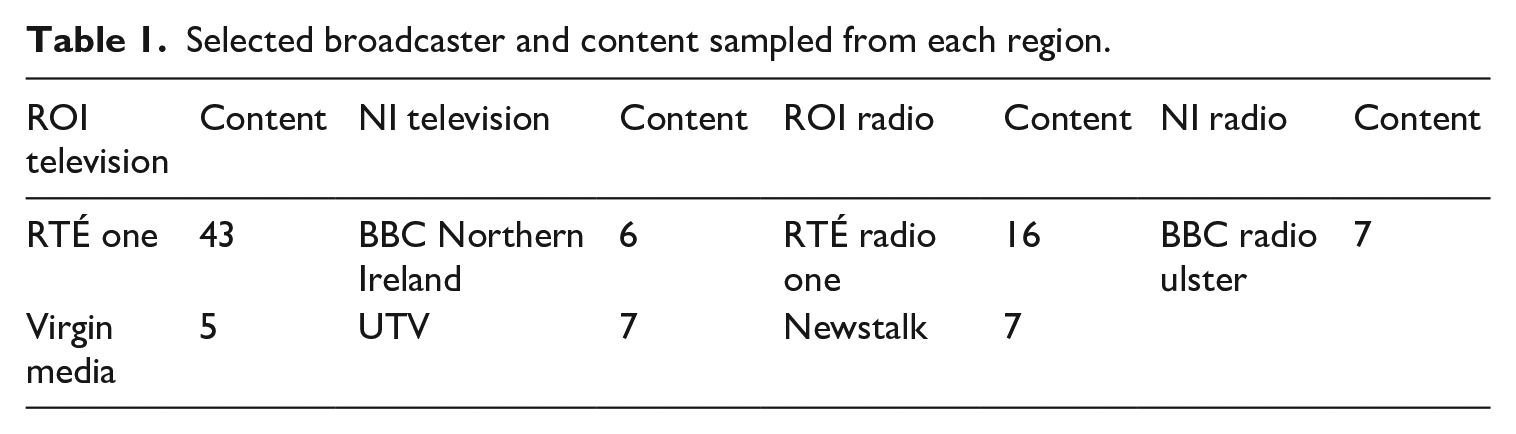
The databases, archives and Google news archives for each of these broadcasters were used to search for relevant materials, to ensure that the sampling strategy was as exhaustive as possible. These databases were searched using the terms ‘food poverty’ and ‘food insecurity’ for content broadcast between 1 November 2017 and 1 April 2023. This search timeframe was chosen to capture broadcast media framing with currency. This included capturing before, during and after the Covid-19 pandemic, the cost-of-living crisis/energy crisis and other geo-political events impacting income and food affordability, accessibility and availability.
Broadcast materials were engaged with to ensure that the main focus of the news stories – following the input of search terms – focused on some aspect of food poverty or food insecurity in relation to ROI and NI. Often, these materials would not have been tagged or given a headline to indicate explicitly the content, so the material was watched once by the researchers to ensure that the content was relevant. The research cross-checked between them to ensure consistency across analysis. The first phase of the analysis identified where food poverty and food insecurity were mentioned. Following this, the second, more in-depth phase of analysis was executed using Entman’s (1993) framing theory as the a priori framework. Framing, as articulated and defined by Entman (1993), involves a process of simplification of an issue in which the communicator selects aspects of an issue to make salient or ‘more noticeable, meaningful or memorable to audiences’. During the deductive coding process in this research, the examination of broadcast media’s framing of food poverty and insecurity was aligned with Entman’s framing theory. Framing, as per Entman’s (1993) definition, involves selecting certain aspects of perceived reality to highlight in textual communication. His approach encompasses defining the problem, identifying causes, proposing solutions, and providing a moral evaluation (Entman, 1993), serving as a valuable framework for deconstructing and analyzing the components of the discursive construction of intricate issues.
Results
A narrative summary of the themes under Entman’s four framing functions is presented below. Key similarities and differences between ROI and NI are considered under each aspect of Entman’s framing functions and this has been presented in two core sections, segregated by media type: 1. Television and 2. Radio.
Television
Framing of food poverty
Problem definition
All of the broadcast television materials defined the problem of food poverty, and often did so in relation to an event or a broader cost-of-living crisis. Food poverty was often framed as a problem in relation to the cost-of-living and as a form of economic dysfunction, which resulted in families having to make choices between essentials for running a household and a family. As one news report notes:
Demand for food is on the rise. The rising cost of living means that many parents have to prioritise how they spend their money. More than half are cutting back on fuel and petrol costs in order to put food on the table (RTÉ News, 22 February 2022).
Endemic to defining this problem was the fact that the issue of food poverty was one that was growing and needed to be dealt with.
Almost 200 more families are in need of this food service. The highest waiting list figure the charity has ever seen (UTV, 11 November 2022).
One of the significant recurring definitions of the problem was the framing of food poverty as an issue that was particularly impacting children. In one instance on RTÉ, ‘holiday hunger’ becomes folded into this, especially in the news coverage around school mid-terms and Christmas breaks:
Schools not only educate children, often they feed them too [. . .] So many of our children are fed here, that we’re worried about them for the next 2 weeks (RTÉ News, 16 December 2022).
Causal interpretation
Lack of government response, along with appropriate measures to offset the ramifications of food poverty at a government department level have been designated as a central factor causing food poverty in both ROI and NI:
[Interviewer:] Do our politicians get the seriousness of the situation? [Interviewee:] I think they’re beginning to get the seriousness of the situation. But I do think that they should have done a lot more before the crisis has erupted in the way that it has or could have done (UTV, 27 April 2022).
The specific situation around a lack of sitting government in Northern Ireland was positioned as a contributing factor towards food poverty. In one instance, a food drive was organised outside of a local football club, where a member of NI food charity Foodstock notes that these kinds of drives are necessary ‘because of political failure at Stormont’ (RTÉ News, 17 November 2022).
Notwithstanding the political context, the economic context was also centred in broadcasts from both regions. In particular, the rising cost-of-living is generally the overarching representational device through which each of these broadcasts frame the causation around food poverty:
The Capuchin Centre said that this year was particularly busy as people are feeling the full effect of the rising cost-of-living (RTÉ News, 20 December 2022).
Some of the coverage in this period also attributed COVID-19 as a central factor in the increasing rates of food poverty nationally in ROI, with this media focus being generated by the release of a Red C poll:
Because of schools’ closures, families would have had to buy digital devices, which would have put strain on the household and then there’s also a greater use of gas and electricity with everyone at home and having people at home all day puts pressure on food (Virgin Media, 13 June 2022).
While there are common trends across each of the regions, more localised factors do also emerge contingent within their own political economies through the frame of political dysfunction. In ROI, the homeless crisis was underlined as a central factor in contributing towards food poverty:
On a national level, the Simon Community says that since the lifting of the eviction ban in Ireland last year, homelessness has been on the increase and that has led to more demands for food (Virgin Media, 8 December 2022).
While the homeless crisis served as a causing factor in ROI, the lack of NI government along with Brexit protocol negotiations was a specific localised feature of the NI reportage:
[Reporter:] Beverley [a foodbank user] believes the money would already be here if Stormont [the seat of the NI Assembly] was up and running. [Beverley:] This should have been done but now they’re too busy working on protocols. . . We need Stormont back (UTV, 11 November 2022).
Treatment recommendations
Varying potential forms of treatment emerge across each of the broadcast materials. Long-term sustainable planning becomes a significant recommendation in managing food poverty and government intervention was flagged as one of the most significant ways through which the issue could be addressed:
Volunteers [in Cork Penny Dinners] are now feeding more people than ever before. The government is being called upon to put measures in place to address the spiralling cost-of-living (Virgin Media, 13 June 2022).
While food poverty requiring government intervention was a recurring theme, how exactly this could be implemented was lacking in the coverage of both regions, with a small number of broadcasts suggesting increases in social welfare payments.
There really needs to be measures brought in through social welfare increases to match the cost-of-living situation we have (RTÉ News, 20 December 2022).
In light of government failure, community interventions were framed in the news reports as a necessary intervention and treatment. In this sense, community food drives, food banks and the charity sector were framed as a form of treatment. These measures are often framed as temporary and not long-term sustainable solutions, as noted by one food bank worker in NI:
And so we are trying to make sure that we look after them as best as we can and support them. . . with food mind you, because we don’t offer any other service than fresh food at this stage (UTV, 11 November 2022).
One aspect that was recurring was the fact that the community and volunteer sector is under significant pressure from the increase in food poverty and accordingly needs to draw on local business to help meet the gaps:
The preparation of over 6000 hampers is a major challenge. We get assistance from a number of company workers in Limerick who help out as part of their corporate social responsibility (RTÉ News, 9 December 2021).
Reliance on community groups, the volunteer sector and local businesses were recurring forms of addressing food poverty, but also not regarded as a desirable long-term solution.
Another thread in terms of treatment recommendations related to solutions targeted at individuals, not so much focused on how to resolve food poverty as a broader structural social issue, but rather how to manage it effectively at a more micro-level through effective choices and awareness of nutrition. In one instance, a paediatrician discussed this:
We give advice as to what to give them [children] to eat, you know, for iron deficiency anaemia for example, you know iron containing foods – green vegetables, red meat but these things are expensive [. . .] But if your choice is between cheap processed food to keep your children from being hungry and expensive nutritious food [. . .] the people that we’re seeing and treating every day, you know, they don’t have those options. . . (BBC Northern Ireland, 10 November 2020).
While these micro-level issues around nutrition were folded into food poverty framing, the broadcast material for the most part was conscious of noting that these solutions are not necessarily sustainable long-term.
Moral Eevaluations
Much of the broadcast content across ROI and NI noted two groups of people who have been accessing food banks: those who have been regularly accessing food from food banks and a growing population of people who have not had to access food banks before, that is, the working poor, who, as the broadcasts suggests, have found themselves having to confront the realities of food poverty:
We are seeing issues within families that we have never seen before and even this week on Tuesday past. . . Sixty-eight percent of the people who come through our door are in paid occupations (BBC Northern Ireland, 14 February 2022). We had a very sad case recently of a man who came to the food bank because he had resorted to shop lifting to try and feed his kids. He had a job and he had an apartment (RTÉ News, 20 October 2018).
There are several things at work in these framings centred around economic dysfunction. On the one hand, there is an emerging narrative of how food poverty can impact anyone and that it is not just something that affects unemployed people who are on benefits. On the other hand, a discourse of ‘deservingness’ emerges that suggests those who work hard but cannot afford to pay their bills deserve the help and good will of food banks, versus those who are on social welfare. This moral schema is recurring across much of the content and suggests that food poverty is now more legitimate because it affects working people.
Much like the previous point, many of the broadcasts deemed the situation of food poverty ‘shocking’ and ‘disgraceful’, especially in relation to what could be read as a framing of ‘innocent victims’ of food poverty. In both ROI and NI, and underscoring the gendered dimensions of food poverty, the situation of carers living in food poverty is highlighted, whereby the carer’s allowance and the time required for looking after a person with additional needs can result in people beginning to live in food poverty:
Carers on low incomes are bearing the brunt of exceptionally high inflation, including a rapid rise in the cost of food and energy pushing them further below the poverty line (RTÉ News, 24 November 2022).
When the voices of those affected by food poverty are featured within news packages, appeals to sympathy form part of the framing:
I put my begging hat on and it takes a lot out of me to actually do that. Begging from family or even friends. ‘Can you sub me to Monday?’ And then Monday comes and you pay that back and you realise you are sitting again with very little or nothing (UTV, 1 August 2022).
These evocations of sympathy, while trying to demonstrate an effective response to the lived realities of food poverty, also underline the stigma and shame with which it is associated.
Radio
Problem definition
All of the radio materials across ROI and NI defined the issue of food poverty. Generally, this was done through the lens of a more local focus, or through a particular food charity/organisation dealing with a crisis at a micro level, with the radio package then panning out to examine the more structural issues at a broader level causing food poverty:
The Trussell Trust saw a record number of children fed over the Christmas period in what their chief executive described as their busiest period ever (BBC Radio Ulster, 7 January 2018).
In these instances, the local surge in demand noted on the radio packages defines the problem of food poverty as one that is developing and growing, while also putting significant pressures on the likes of small charities.
Much of the radio programming also defined the problem of food poverty in relation to time, with Christmas and the winter cold months being centralised as a key issue in amplifying the problems relating to food poverty:
The Christmas rush has brought on a lot of pressures to families. . . (RTÉ Radio One, 21 December 2018).
Causal interpretation
The cause of food poverty is given significant consideration across each of the radio packages. One of the first major issues to emerge, especially from left-wing parties who appear as panellists or feature in radio package reports, is a call for both an increase in social welfare payments along with minimum wage increases. As Ged Nash, a Labour Party TD notes:
To deal with the rising cost of food prices, a simple solution is to increase social welfare payments along with the minimum wage. Without doing either, there really won’t be any effective change (RTÉ Radio One, 8 February 2023).
In the case of BBC Radio in NI the cause of food poverty has similarly been attributed to and framed as economic dysfunction, evident with the wage situation and wage increases not aligning with rates of inflation:
They were getting an annual wage increase, higher than the increase of prices and that stopped happening over the last decade (BBC Radio Ulster, 10 December 2017).
The Northern Irish radio coverage, much like the television coverage above, framed this in terms of political dysfunction with the government paralysis in Stormont as a central contributing factor towards the food poverty crisis:
And at the minute, because of the paralysis of government, we are seeing no help. So that is what I would like to focus on, the fact that we are seeing no help and we are in a complete leadership vacuum and everybody will suffer because of that (BBC Radio Ulster, 13 November 2022).
More specific groups are identified within the radio packages, such as the Traveller community in ROI, who experience particularly acute instances of food poverty due to broader discrimination within the Irish state:
10% of Traveller children are going to bed hungry as a result of poverty and social exclusion (Newstalk, 7 December 2020).
The causation of food poverty with the Traveller community is a result of a lack of consideration in broader government policies. Food poverty is such a broad issue, that has not necessarily been addressed through any significant policy measure, meaning that how it affects specific groups has yet to be addressed meaningfully. The factors leading to food poverty then include a lack of government action, increasing inflation, lack of an appropriate response from retailers along with significant political and economic factors nationally and internationally.
Treatment recommendation
Across most of the radio packages, increased targeted measures and supports were identified as a central strategy in improving the conditions around food poverty:
Additional targeted supports are required for people outside of regular government budgets (RTÉ Radio One, 8 February 2023).
While these measures appeared to vary, they generally encompassed the provision of a back to school allowance to enable families to be able to cut down on costs for school uniforms and books and put it towards their food budgets. Other measures included putting a price cap on food in terms of how much retailers can increase a price along with increasing social welfare payments and the minimum wage.
Community responses were often framed as part of the treatment of food poverty, such as food banks and community centres providing hot meals, but many of the radio programmes tended to frame these community responses as requiring broader structural treatment:
The community centres can only deal with so much of the demand, this cannot be a long-term solution and a better strategy is needed nationally to tackle this (RTÉ Radio One, 6 March 2021).
Pathways out of these community responses then were central to the framing of the treatment recommendations, as much of the radio coverage acknowledged that the current community-based solutions, while honourable, are less than ideal.
The radio packages were unique in comparison to the television broadcasts in that they aimed to treat the problem by encouraging listeners who may be going through food poverty to not be afraid of asking for help and that there is help out there:
And there’s no shame in saying: I can’t afford something right now. I think that possibly needs to become the social norm (BBC Radio Ulster, 6 December 2021).
As these instances demonstrate, the framing attempts to shift attitudes towards seeking help if someone is living in food poverty and looks to remove narratives of shame and stigma. A less commonly expressed recommendation, but one that aimed to provide short-term solutions for people finding themselves in food poverty for the first time, was to provide education in how to manage limited resources:
It’s maybe more so about being clever with how you shop and moving away from big brands to the retailers’ own brands, which can result in big savings for consumers (RTÉ Radio One, 15 September 2022).
What is notable about these treatment recommendations is the fact that the media coverage appears to be mainstreaming and normalising the issues of food poverty to the extent that it has become such a structural issue, additional social supports need to be a significant part of the news coverage treatment. One of the radio packages from BBC NI referred to this as ‘wraparound services’ whereby the food bank ought not to be the only form of treatment that is provided to people living with food poverty:
Wraparound services are education, skills, training, budget planning, cooking programmes. It’s a vast, vast array of various wraparound services. And we feel that is the aim, and that’s how it’s going to work. That’s how it’s going to lead people. . . into pathways, out of poverty (BBC Radio Ulster, 7 January 2018).
The wraparound services and pathways out of poverty approach proved to be a recurring treatment recommendation in both regions:
This is a very real issue for many people and we need to put a pipeline in place to get people out of the dire situations that they are living through (Newstalk, 7 December 2020).
Generally speaking, while these varying treatment recommendations were noted across both ROI and NI, there was a tendency in the news reports to detail the specific recommendations into broader political and economic solutions.
Moral evaluations
The universality of food poverty and the ways in which it could affect anyone at any time was one of the most recurring threads across both regions. This was often conveyed through framing food poverty in relation to households where there is one person or more who is working. A lot of the radio coverage was dedicated to focusing on working people who are affected by food poverty. One headline from BBC Ulster framed this in terms of economic and social dysfunction:
In work, in debt and queuing at a food bank (BBC Radio Ulster, 10 December 2017).
At the same time, there was also use of language that discursively constructed poverty as a natural and arbitrary phenomenon. For example, the use of phrases such as ‘falling into the poverty trap’ implies an accidental and agentless process. It suggests that poverty is a natural hazard to be mindful of, like a cliff edge or a ravine, rather than a state of being that is brought about by the choices and actions of political and economic decision-makers which is imposed on those with less access to power. Similarly in the context of ROI, the discourse of ‘risk’ was employed to describe working people as being vulnerabilised into falling into the ‘poverty trap’:
As working people try to keep their head above water, the rising cost of food prices means that the risk of falling into the poverty trap continues to be a very real threat (Newstalk, 23 September 2022)
Notwithstanding the fact that loaded, emotive language is used here to frame food poverty, in particular, through the use of ‘trap’ and ‘threat’, the report goes some way to frame working people as innocent victims as a result of circumstances far beyond their control:
If you’ve just joined us on Sunday Sequence, I’d just like to remind you that we’re discussing poverty and why even a job offers no protection against it in the 21st century (BBC Radio Ulster, 10 December 2017).
The terms ‘new poor’ and ‘working poor’ emerge as a vernacular of much of the radio reportages’ representational strategy, which develops a moral schema to a degree where the ‘working new poor’ are more respectable or ‘victimised’ than other individuals living with food poverty.
Another significant facet of the framing is centred around societal failure, both economically and politically. This is often framed through the varying actors who participate in the radio coverage, who ask questions along the lines of:
How have we got here? (BBC Radio Ulster, 10 December 2017).
These comments tended to come from politicians, those affected by food poverty along with the actual journalists’ narrations. The narrative of food poverty as a form of societal decline demonstrated how material deprivation is an indicator of the ways in which society has failed to create an appropriate environment for people to live sustainably with choice around food consumption.
As a means of evaluating the magnitude of the problem, disbelief and shock were often expressed. Such expression of disbelief was used by an actor to convey their own shame at being part of a society where this exists and/or their occupying of a high moral ground insofar that they were willing to ‘put their head above the parapet’ to talk about this:
It should be a basic human right to be able to purchase the essentials in life that your family need (BBC Radio Ulster, 29 November 2017).
In one instance on BBC Radio Ulster, one of the participants expressed what he regarded as the unpopular (but regarded by him as reasonably well accepted) point that people need to be educated into living within their means:
There’s an element of behaviour in this. People can sometimes make their own situation worse. . .There’s a sense in which we should all be very careful about taking on extra debt. . . Whereas 50, 100 years ago, certainly people would have said, look, I'll wait before I buy whatever that item is, if it existed then. Now, there’s a sort of feeling of: right, I want it now. (BBC Radio Ulster, 10 December 2017)
In this instance, there is the emergence of a moral judgement of sorts, where the societal failures need to be normalised to the extent that ordinary people most now strategise in their own lives against falling into food poverty.
Discussion
The television and radio coverage of food poverty had much in common in that they both covered the political and social dynamics of food poverty, with both forms of broadcasting framing failing government action and the cost-of-living crisis as central contributing factors. The television and radio coverage have also framed food poverty, less as personal failure as a result of a lack of hard work and a lack of individual motivation, and moreso a significant societal issue that can affect anyone through the discursive construction of the figures of the ‘working poor’ or ‘new poor’. This was reflective more broadly of the core frames that emerged throughout the data, which can be understood through four central dynamics: political dysfunction, economic dysfunction, social dysfunction and individual dysfunction. These framing mechanisms reveal the varied way in which food poverty is treated.
Political dysfunction has significantly contributed to the prevalence of food poverty. This includes issues within the governmental sphere, such as inadequate policies, misplaced priorities, and a lack of response or complete oversight regarding food poverty. Economic dysfunction also plays a critical role, as the rising cost of living, combined with precarious employment conditions and the absence of a living wage, has led many individuals, including working people, to struggle to meet their basic needs, including food. Social dysfunction is evident as people face the reality of living in debt and queuing at food banks. Discussions around food poverty often highlight how specific identities and communities are disproportionately affected and framed. For instance, the issue is frequently portrayed through a gendered lens, and particular difficulties are noted for specific ethnic groups, such as the Traveller Community. Lastly, individual dysfunction refers to the behavioural patterns that some people develop, such as a failure to budget, which can lead them into food poverty. This type of behaviour is often seen as the individual's responsibility to manage. However, there is also an understanding that support should be available, especially for those encountering such hardships for the first time.
In relation to social and individual dysfunction framing in particular, issues emerge in relation to responsibilisation. While the broadcast items aim to help people strategise ways to save money and mitigate against food poverty, there is also a risk in these framings reproducing a discourse that confers responsibility to those in poverty as a result of their precarious positions. This problematic trope aligns with Butler’s (2015) notion of ‘responsibilisation’ which ‘designates such populations as accountable for their own precarious position, or their accelerated experience of precaritisation’ (p. 144). In this sense, the framing of many of the participants moves towards a ‘neoliberal rationality’ that ‘demands self-sufficiency as a moral ideal’ (Butler, 2015) while at the same time, according to Vaughan (2019: 158), ‘effecting policies that diminish the attainability of that ideal’. These findings also align with some previous studies. Iyengar (1990) for example argues that responsibility for poverty, when discussed in general, is assigned to society at large, but when relating to a particular instance of a person living in poverty, responsibility is assigned to the individual.
The media conventions between television and radio lead to some variance around how food poverty is framed and communicated. In the case of television broadcast content, food poverty is usually represented in the context of a news package of around 3 min that generally presents the issues along with commentary from some relevant social actors. It has been noted that television-based news, with its emotional and dramatic emphasis, has a tendency to ‘simplify and exaggerate problems’ (Spencer, 2004: 604). While the television pieces tended to be bite-sized and shaped by the imperatives of programming conventions and the television schedule, the radio programmes offer more space for more complex and nuanced discussions of food poverty as a contemporaneous pressing social issue. This also often includes a multitude of voices, through panel participation, that can shape the discursive site through which food poverty discussions can emerge. On one of the radio packages, for example, on RTÉ Radio One, there was discussion over the necessity for a mini-budget to tackle the issues of food poverty and this encompassed varying politicians and journalists from the Green Party, Labour and The Sunday Times. The format of shows on radio as a result had more flexibility in structure and could include a multitude of voices. In light of this, there was far more variance in terms of the treatment recommendations in the radio packages than there was in the context of television.
The radio broadcasting reportage was somewhat more nuanced, particularly in terms of how community responses were often framed as part of the treatment of food poverty, such as food banks and community centres providing hot meals, but many of the radio programmes tended to frame these community responses as requiring broader structural treatment.
Audio-visual elements also had varying notable dynamics. For one, the inclusion of the voices of those most affected by food poverty was more frequent across radio than it was on television. This could have been down to any number of reasons, but centrally, television is a visual medium and as a result does not confer as much anonymity to potential participants in broadcasting. Often, participants on the television broadcasts were framed through over the shoulder shots, with the camera facing the news reporter. This representational strategy conferred shame and stigma around living in food poverty, aligning with Drew’s (2022) research in relation to food poverty in Ireland and Strong (2022) and Wells and Caraher’s (2014) research on the representation of food poverty in UK media.
Another feature of both television and radio segments was providing information for food insecure households to manage their food budgets and mitigate against food poverty. While food insecurity was not explicitly mentioned, a spectrum of food insecurity was evident, from worrying about food access to children going through hunger and to a lesser extent, the quality of food people eat when experiencing food poverty. What was interestingly absent, albeit with a number of exceptions noted in the findings, was the lack of media coverage framing food poverty with poor health outcomes. This is noteworthy given that food poverty, and poverty more generally, has a detrimental effect on a population’s health. It has been noted that a ‘problem’ in journalism is that while people might become informed about an issue, the content presented to them does not afford a means through which they can do something about the issue (Swart et al., 2017). Indeed, solution-oriented paradigms were missing from each of the broadcast materials for the most part, with the exception of some treatment recommendations in places. In light of this, some constructivist journalistic approaches could be incorporated by broadcast journalists in demonstrating these health impacts but also providing pragmatic tools, measures and solutions for dealing with food poverty.
Constructive journalism is an approach to reporting that goes beyond traditional news coverage by not only highlighting problems and challenges but also focusing on potential solutions, positive actions, and inspiring stories (Hermans and Drok, 2018). The aim is to provide a more balanced and comprehensive view of the news, fostering a constructive and solutions-oriented narrative (Bro, 2019). It is also argued that a constructive approach can enhance the usefulness of the journalistic content to the public which then serves to enhance the perceived value of that particular communication source, such as televised news, more generally (Swart et al., 2017). In the context of reporting on food poverty, constructive journalism can be highly useful. Instead of solely emphasising the dire aspects of the issue, it would allow broadcast journalists to explore and showcase initiatives, programmes, and community efforts that are making a positive impact in addressing food poverty. By highlighting successful interventions, collaborative efforts, and innovative solutions, constructive journalism not only informs the public about the challenges but also inspires and encourages engagement in potential solutions. This approach can help mobilise support, raise awareness, and foster a sense of collective responsibility in addressing the complex issue of food poverty. In addition, re-thinking the framing of news poverty in these ways can also engender more constructive approaches around rights-based framing and health framing.
Conclusion
This article has found that news coverage of food poverty issues has steadily increased on the island of Ireland over the last number of years, in line with the fact that food poverty itself has become a significant societal issue. It was found that while much of the media tend to orientate food poverty around discursive frames relating to the working poor, the ‘deservingness’ of help through food banks or through government failure, an analysis of how food poverty is framed needs to improve in two central ways. Firstly, consideration should be given to the relative merits and demerits of the perceived necessity of including experts by experience in all food insecurity portrayals. There may be occasions when the lived experience helpfully demonstrates exactly the point to be made while at other times it may represent a disservice to the bigger picture where the prevalence statistics should suffice to detail the social policy problem without demoting the issue to an individual experience. To that extent, the inclusion of these voices needs to avoid any association with shame or stigma. Secondly, news production cultures need to focus on more constructive journalism approaches, which will offer a more solutions-focused paradigm in the reporting of food poverty. As the broadcast media plays a pivotal role in shaping public perceptions and influencing policy discourse, the observed framing has implications for public awareness and engagement with the multifaceted issue of food poverty. Future research and journalistic endeavours should continue to explore these frames, considering their potential impact on public understanding and the formulation of effective strategies to address the intricate challenges posed by food poverty.
