




Abstract
The “digital nomad” (DN) neotribe includes professionals who work remotely from different locations. Despite the benefits of digital nomadism (e.g. work flexibility, high mobility, and leisure-centeredness) and opportunities for meeting like-minded people, one of the consequences of the lifestyle may be loneliness. By using 30 in-depth interviews, this study explores the interaction between digital nomadism and loneliness. We conceptualize the DN lifestyle as a continuum that may, but does not have to, lead to feelings of loneliness. External factors such as lack of social support, often related to the capacity to stay in a place long enough to build a network or the social competence skills to connect with others, may contribute to greater levels of loneliness. Conversely, in line with networked individualism, we examine how DNs seek more control over constructing their own social networks in the context of a hyperindividualistic society. Instagram, Facebook groups, Slack, MeetUp, CouchSurfing, and Tinder are identified as key platforms for DNs to connect with people, especially for bridging social capital, whereas WhatsApp is used more for bonding social capital. The paper offers a timely discussion of the way that DNs use different social media platforms to overcome loneliness, forge intimate connections, and build community.
Introduction
The word “digital nomad” (DN) describes a remote worker who travels while working from different locations (Bonneau et al., 2023; Cook, 2020, 2023; Hannonen, 2020; Thompson, 2021). The DN lifestyle experienced an expansion during the COVID-19 pandemic, as many people were forced to work remotely but, at the same time, could choose where to work from. Thus, many white-collar professionals who had not tried digital nomadism before envisioned the COVID-19 pandemic as an opportunity to test this lifestyle (De Almeida et al., 2021; Hermann and Paris, 2020). Digital nomadism is most prevalent among self-employed freelancers and entrepreneurs in sectors such as software development, IT, marketing, the creative industries (e.g. writing, graphic design, and video editing), and social media, where working remotely has been common for a long time (Mancinelli, 2020). However, heightened employer flexibility and work-from-anywhere policies in the wake of the pandemic (Orel, 2023) mean that digital nomadism becomes increasingly attainable for employed and corporate profiles too. Accordingly, Cook (2023) predicts, based on MBO’s (2022) digital nomads report, that “salaried digital nomads could become the fastest-growing category” (p. 270).
Despite the benefits of digital nomadism (e.g. work flexibility, high mobility, and leisure-centeredness), and opportunities for meeting like-minded people (Prabawa and Pertiwi, 2020; Woldoff and Litchfield, 2021), the DN lifestyle has been consistently associated with a heightened propensity for experiencing loneliness (Chevtaeva and Denizci-Guillet, 2021; Lacárcel et al., 2024; Lee et al., 2019; Xiao and Lutz, 2024). Certainly, being distant from family and friends can generate feelings of loneliness among DNs (Nash et al., 2018; Thompson, 2019). This can be exacerbated when DNs visit countries with few other DNs or expats and where the language and culture differ from their home country (Thompson, 2021). Therefore, DNs exhibit a strong motivation to seek out opportunities for social interactions, which often entails attending DN events, and utilizing co-living spaces and co-working offices (e.g. Chevtaeva and Denizci-Guillet, 2021; De Loryn, 2022; Lee et al., 2019). Although these environments foster social contact and support networks, Chevtaeva and Denizci-Guillet (2021) point out that DNs often feel constrained in terms of the diversity of individuals they encounter within these settings. Moreover, DNs face challenges when trying to establish enduring personal relationships due to their networks comprising other DNs, who are constantly on the move (Nash et al., 2018). In terms of finding romantic partners, Thompson (2021) discusses the difficulties of the coordination of travel itineraries and settlement plans among fellow DNs, as well as the lack of willingness to embrace the same nomadic lifestyle when dating non-DNs.
A discussion of the intersection of nomadic lifestyle, digital technology, and social connectedness calls for inclusion of an additional aspect: the long-lasting trend of individualization (Putnam, 2001). In our context, individualization refers to people seeking more control over constructing their own social network, that is gradually moving from “going along” with just one or a small number of groups that are located nearby their place of residence/work, to autonomously creating and/or joining multiple social networks − and engaging with them as they see fit (Chua, 2013; Rainie and Wellman, 2012: 125). In their study about the hospitality exchange network CouchSurfing, Miguel and Medina (2011) argue that hyperindividualism in digitalized societies pushes individuals to the use of social media platforms to meet like-minded people (in the case of the CouchSurfing community, well-traveled and cosmopolitan individuals). Social media platforms allow DNs to express empathy, connect with like-minded people, and address the pervasive experience of perceived loneliness (Nash et al., 2018). DNs often turn to online channels that cater to their specific lifestyle (such as DNs Facebook groups) or career-oriented groups (like Hacker Paradise for those in tech-related roles) with the aim of maintaining social interactions of some form (Gregersen et al., 2023). Social media platforms also serve a crucial role for DNs in maintaining existing relationships and creating new ones via organized meetings and dating apps (Matos and Ardèvol, 2021; Miguel et al., 2023a). However, as observed by Šímová (2023), there is a lack of development in social media research in relation to the DN lifestyle.
While the existing evidence points to the importance of social media among DNs, addressing a variety of user needs from self-presentation and self-branding (Miguel et al., 2023b), to community building (Thompson, 2021), to commercial and entrepreneurial goals such as making money (Bonneau et al., 2023), we lack evidence on how DNs use social media to combat loneliness when traveling as well as to create and maintain personal relationships. Therefore, this study explores loneliness among DNs and their coping mechanisms, with a focus on the use of social media by answering the following research questions: (1) How do DNs experience loneliness in relation to their lifestyle? (2) How do DNs utilize various social media platforms to mitigate loneliness, enhance personal relationships, and cultivate a sense of community? By using 30 in-depth interviews with DNs, this study examines loneliness as an issue that negatively intersects with DNs’ wellbeing, bringing attention to some of the dark sides of this lifestyle that are often overshadowed (Bonneau et al., 2023; Miguel et al., 2023a). Moreover, we explore how DNs use social media to forge intimate connections and build community. By doing so, we connect our research to scholarship that shows the importance of social media in supporting increasingly mobile and leisure-oriented lifestyles, for example in the case of travel bloggers (Azariah, 2016) or diaspora communities (Sobré-Denton, 2016; Uy-Tioco, 2022).
Social isolation and loneliness
Loneliness has been described as a distressing sensation that arises when individuals perceive that their social needs are not adequately met in terms of the quantity and, particularly, the quality of their social connections (Hawkley and Cacioppo, 2010). Within the landscape of loneliness theories, two dominant psychological perspectives have emerged: the social needs perspective (Weiss, 1973) and the cognitive discrepancy perspective (Marangoni and Ickes, 1989). The social needs perspective suggests that the subjective experiences of loneliness are underpinned by objective social deficits (i.e. the person feeling lonely is indeed physically isolated). By contrast, the cognitive discrepancy perspective prioritizes subjective evaluations of social connection quality, independent of objective deficits. This perspective emphasizes the perceived discrepancy between desired and actual social connection as the key driver of loneliness. Under this view, loneliness is a subjective psychological state triggered by a discrepancy between individuals’ actual and ideal personal relationships (Peplau and Perlman, 1979). Research on loneliness emphasizes the distinction between perceived social isolation and objective social isolation (Hawkley and Cacioppo, 2010). Consequently, one can lead a relatively solitary life without experiencing loneliness, while others with active and visible social lives may report high levels of perceived loneliness. Similarly, certain individuals may actively choose to be alone by reducing their social involvement (Russell et al., 2012).
Our research focuses on perceived loneliness rather than voluntary solitude, as previous studies have highlighted the broader implications for wellbeing associated with the former (Boss et al., 2015). Perceived loneliness can be further classified into two types: emotional and social. Emotional-perceived loneliness pertains to the absence of an intimate figure, such as a romantic partner or best friend, while social-perceived loneliness refers to a deficiency in a broader social network, such as work colleagues or friends (Deckx et al., 2018). However, people can experience loneliness even when living with a partner. Indeed, research on couples has found that despite being in a relationship can protect against loneliness (Ermer et al., 2020), loneliness can still occur due to social contagion (i.e. one partner that starts feeling lonely affecting the other), homophily (i.e. people that are prone to develop feelings of loneliness will connect with other people with similar personality traits), and due to a shared environment (i.e. a shared environment affecting the social network) (Cacioppo et al., 2009).
The perception of loneliness not only influences various emotional and cognitive processes but also has different outcomes. For instance, research has linked perceived loneliness to mental health issues, including personality disorders, depression, and psychosis (Badcock et al., 2020; Erzen and Çikrikci, 2018; Liebke et al., 2017). Perceived loneliness not only affects mental wellbeing but also exerts a detrimental effect on cognitive performance, potentially leading to cognitive decline over time (Boss et al., 2015). Evidence suggests that perceived loneliness is linked to an increased presence of suicidal thoughts, suicide ideation, and an elevated risk of suicide (Shrum et al., 2023; Stravynski and Boyer, 2001). Research on perceived loneliness has identified several factors or triggers that might lead to loneliness. For instance, genetic factors linked to personality traits (e.g. neuroticism) (Abdellaoui et al., 2019; Goossens, 2012) may be associated with loneliness. On the other hand, exogenous factors that can lead to feelings of loneliness include a lack of social competence (Vanhalst et al., 2014), insufficient social support (Tan et al., 2016), social withdrawal (Boivin et al., 1995), low social status (Margalit, 2010), or a lack of peer acceptance or exposure to bullying (Sakız et al., 2021; Vanhalst et al., 2014). In addition, there are situations which involve social isolation that may lead to loneliness feelings such as the COVID-19 pandemic (Gregersen et al., 2023), remote work (Becker et al., 2022), migration (Caligiuri and Lazarova, 2002; Djundeva and Ellwardt, 2020; Salway et al., 2020), or solo traveling (Neluhena et al., 2024; Wilson and Little, 2005; Yang, 2021). The study by Walz et al. (2023) on remote-working employees during the COVID-2019 pandemic shows that job demands of remote workers increased workplace loneliness because of heightened work-to-home interference. In terms of migrant workers, Caligiuri and Lazarova (2002) emphasize that the initial stages of expatriation are frequently marked by social isolation, stress, disorientation, and loneliness. However, there is little awareness about the relationship between the DN lifestyle and loneliness (e.g. Miguel et al., 2023a; Nash et al., 2018) since DNs often glorify the positive aspects of their lifestyle on social media while silencing darker aspects such as loneliness or competition (Bonneau et al., 2023).
Between networked individualism and community-building: Looking for connection and community in a hyper individualistic society
In the context of a hyperindividualistic society, the use of social media facilitates the creation of diverse social networks around the individual with a focus on self-gratification (Allo, 2019). According to Rainie and Wellman (2012), this generates a new social operating system, which is labeled “networked individualism.” Networked individualism is characterized by the “tripe revolution” of three interconnected socio-technical developments: (1) the increasing importance of individualism and individual-centric social networking, where people proactively manage their social relationships outside of firm groups such as neighborhoods and kinship; (2) the advent of the Internet and its empowering nature, for example in relation to the use of social media and its affordances for maintaining existing connections across geographic boundaries and establishing new ones; and (3) the rapid diffusion of mobile technology, particularly smartphones, which enable mobility and perpetual contact (Rainie and Wellman, 2012). One’s networks may vary in terms of the membership exclusivity, the need they are expected to fulfil (instrumental vs emotional support), and the importance/position of each network compared to the others. Establishing, but also joining these multiple social media-enabled networks requires employment of substantial personal resources (e.g. outgoingness, talkativeness) (Requena and Ayuso, 2019). In addition, previous studies emphasized the role of (online) social capital (Poecze and Strass, 2020; Williams, 2006). According to Bourdieu (1986: 21), social capital is “the aggregate of the actual or potential resources which are linked to. . . membership in a group” – such as the norm of reciprocity and trust in strangers (Putnam, 2001; Williams, 2006). Depending on the type of social network or desired level of social connectedness, one employs specific elements of social capital to either predominantly “bridge over” or “bond with.” Bridging social capital is suitable for operating loose/peripheral social connections that yield instrumental support, while bonding social capital gets employed when navigating through tightly knitted social networks capable of offering both instrumental and emotional support (Putnam, 2001; Williams, 2006). Furthermore, depending on the predominant type of social capital employed, one selects the social media platform accordingly. For instance, more bonding social capital was found among people who favored Facebook over Instagram (Shane-Simpson et al., 2018) and among Snapchat users compared to Facebook, Instagram, and Twitter users (Phua et al., 2017). On the other hand, Twitter users had more bridging SC compared to their Facebook, Instagram (Phua et al., 2017; Shane-Simpson et al., 2018) and Snapchat counterparts (Phua et al., 2017). Despite the potential for networking and gaining social capital via social media interaction, dystopian authors, such as Sherry Turkle (2011), claim that people nowadays live increasingly alone together. For the optimists, the multiplicity of “sparsely knit, segmented, and specialized personal (virtual) communities” makes each of them less intrusive and the full set of networks more supportive to one’s wellbeing (Rainie and Wellman, 2012: 135).
The connection between loneliness, social media, and networked individualism among DNs must be seen within the specific community dynamics of this group. Compared to other groups at the intersection of mobility, leisure, and work such as working expats, backpackers, and frequent business travelers, DNs are characterized by both frequent mobility (an attribute they share with backpackers) but a stronger work focus than conventional tourists, non-working expats, and backpackers (Cook, 2023). As such, DNs can be adequately seen as a neotribe (Hardy and Robards, 2015; Maffesoli, 1996). Neotribes are more fluid aggregations than subcultures and differ from traditional segmentation approaches in marketing and tourism such as those based on demographics or travel motives. Instead, neotribes are united by behavioral and symbolic elements (Hardy and Robards, 2015). Behavioral elements capture concrete practices, including the physical sharing of space (e.g. events, co-working, and co-living in the case of DNs) and expressions of identity through consumption (e.g. clothing and fashion choices, culinary preferences, and technology use): “Symbolic elements include a sense of community, sharing a lifestyle, and the social centrality of an aspect of life” (Hardy and Robards, 2015: 445). In the case of DNs, extant literature discusses important symbolic elements such as the prioritization of freedom, independence and self-realization, the rejection of traditional life models (e.g. corporate career and sedentary family life), and a sense of self-sufficiency (Atanasova et al., 2024; Hannonen, 2020; Mancinelli, 2020; Miguel et al., 2023b; Wang et al., 2024). Importantly, membership in neotribes tends to be fluid and people can be part of different neotribes at the same time. Thus, neotribes constitute rather loose networks, showing the connection of this concept to networked individualism and liquid modernity. Maybe not surprisingly, some recent research has used Zygmunt Bauman’s (2000) liquid modernity theory to study DNs (Atanasova et al., 2024; Aufschnaiter et al., 2021; Thompson, 2021; Xiao and Lutz, 2024).
To maintain their digital nomadic lifestyle and address the negative aspects of liquidity, DNs rely on a repertoire of coping mechanisms, where digital technologies and social media play a key role. Aufschnaiter et al. (2021), for example, discuss concrete “anchoring” strategies among DNs to deal with the downsides of digital nomadism, including perceived loneliness. These strategies include both physical embodied anchoring (e.g. establishing friendships with fellow DNs and locals, visiting family regularly, see also De Loryn, 2022) and virtual embodied anchoring (e.g. using social media and videoconferencing to communicate with strong and weak ties or establish new connections, thus engaging in social capital management). In the following, we will investigate the intersection of perceived loneliness and social media among DNs based on in-depth qualitative evidence, thus contextualizing the role of technology among this highly specific neotribe and answering our research questions.
Method
The present study follows an inductive and exploratory approach (Bryman, 2016). More precisely, by relying on 30 in-depth interviews it addresses the Why? and How? questions. For example, some interview questions were the following: Do you feel lonely often?; Why do you feel lonely?; Do you think the digital nomad lifestyle contributes to loneliness or, on the other hand, helps you to be less lonely?; How do you cope with loneliness? How do you use social media platforms to manage loneliness feelings?; Does Instagram help you to feel part of the DN community? Why? Purposive sampling was used to gather a sample of people who self-identified as DNs (Etikan et al., 2016). The recruitment process consisted of publishing a call for participants on social media – including open and closed Facebook and LinkedIn groups aimed at DNs – and sharing the call more widely through Instagram, Facebook, and Twitter. The age of our interviewees ranged from late 20s to early 40s. The sample included two (DN) couples who did the interview together but were considered as a single participant due to reporting practically identical experience of loneliness. Three other participants were traveling with their partners, while the rest of participants were single and traveled solo. Two thirds of participants were freelancers and one third were employees. More information about the participants’ characteristics is presented in Table 1.
List of participants.

The interviews were conducted in 2022 via online meeting platforms (most frequently MS Teams) using the same procedure. The researcher(s) first explained to the participants the objectives of the study and the ethical implications involved. Participation agreement was obtained via informed consent and the identity of participants was protected by using pseudonyms. Relying on the work of Naughton-Doe et al. (2024) and Hemberg et al. (2022), to address the sensitivity and stigma behind loneliness, we “normalized” the feeling by consistently not avoiding the term “lonely” and acknowledged distress it may induce by slowing the interview pace when loneliness was discussed. The interviews were consensually audio/video recorded, lasted on average 65 minutes, and were conducted in either English or Spanish. The interviews conducted in Spanish were translated into English by one of the bilingual researchers. The initial transcription of audio/video recordings was performed using automatic transcription tools (i.e. MS Teams and Otter.ai). Afterwards, a research assistant verified the accuracy of the initial transcripts. The final transcripts were fully anonymized by using pseudonyms following the principles of maximizing the participants identity protection and maintaining the value and integrity of the data (Saunders et al., 2015).
The transcripts were thematically analyzed based on Braun and Clarke’s (2006: 79) multi-stage approach for “identifying, analyzing, and reporting patterns (themes)” in qualitative data. The first three stages were done independently by two researchers, whereas the last two stages were done as a (two-person) group effort. In the first stage, before the coding itself, the researchers read all the transcripts to familiarize themselves with the data. Second, using NVivo qualitative data analysis software, generation of initial codes was performed using inductive, data-driven coding. The coders found no major “inconsistencies and tensions” within the raw data (Braun and Clarke, 2006: 89). Third, we searched for themes at a semantic, explicit level, that is, avoided interpreting implied meanings and/or reasonings behind what the interviewees explicitly said. Once discussed, the researchers found no major discrepancies between their analyses/theme identification. On average, in both cases, thematic saturation was reached by the 25th interviewee, whereas recurring information was identified after the 15th interviewee. The final sets of codes discarded roughly half of the initially identified codes. Fourth, reviewing themes consisted of confirming their “internal homogeneity and external heterogeneity” and ensuring that the themes accurately reflected the interviewees’ overarching storyline (Braun and Clarke, 2006: 91). Finally, the stage of defining and naming themes aimed at ensuring that each of them did not address too many aspects of the phenomenon and confirming that their labeling accurately reflected the content of the accompanying codes/quotes.
The digital nomad lifestyle: A continuum of loneliness
Previous studies (Atanasova et al., 2024; Aufschnaiter et al., 2021; Thompson, 2021; Xiao and Lutz, 2024) show how DNs’ neotribalistic and networked individualistic lifestyle is in many ways prototypical of liquid modernity, characterized by mobility and freedom, on the one hand, but also uncertainty, practical constraints, emotional difficulties such as loneliness, and a lack of stability, on the other hand. Our study demonstrates that digital nomadism elicits feelings of loneliness, hinders them, or is not connected to loneliness. Some participants claimed that the digital nomadism lifestyle does not influence perceived loneliness, which might suggest that these interviewees have the necessary social competence to meet their social needs (Abdellaoui et al., 2019). There were several participants who argued that although the DN lifestyle involved being alone they were very happy in their own company, with claims such as: “I don’t have to be surrounded by people 24/7 to not feel alone though to be happy. I can be happy on my own, pretty successful” (Alice). Alice’s reflections show how solitude does not necessarily lead to unhappiness but can be a source of satisfaction, calm or resilience, contrasting this state of mind to one of social overstimulation. This speaks to the literature on solitude more broadly, which argues that solitude is indispensable for self-reflection and comes with “spiritual, religious, creative, and artistic gains” (Long and Averill, 2003, p. 21), as well as to travel- and tourism-related scholarship such as research on solo-traveling (Heimtun and Abelsen, 2013; Leith, 2020). Especially for women, solo travel can be empowering and a means to experience a destination more holistically and deeply (Somasiri et al., 2022).
Moreover, in line with previous research (Prabawa and Pertiwi, 2020; Woldoff and Litchfield, 2021), we also found that digital nomadism can be instrumental in reducing perceived loneliness in cases were DNs could not find supportive and like-minded people in their previous, settled life: I think it makes you less lonely. And that’s because one of my values and why I do love to travel is, like, connection with people. So, I feel more connected with people that are like-minded, people that are DNs or travelers, as opposed to at home, where I feel more disconnected. Because these people are not living the lifestyle that I want to live. So, I obviously have different values. Actually, I’m lonelier when I’m at home. (Teresa)
Conversely, other participants pointed out that digital nomadism can be a lifestyle that increases feelings of loneliness because of absence from long-term and stable social networks (e.g. family, friends from schools, colleagues at the same workplace), leading to lack of sufficient social support due to exogenous factors (Tan et al., 2016). However, only a few participants talked about isolation in relation to remote work and how social loneliness can be perceived when interactions happen online only, highlighting the importance of finding opportunity for offline social interactions too, for example: I used to be a nurse and which obviously I left that when I took my role fully online. So, I’m used to working as part of a team and I definitely missed that. I think entrepreneurship and working remotely can be quite lonely, even though we do have business meetings, they are all online, so I do miss that little bit of connection. And even over here in Bali you can go to coworking spaces, but generally speaking, everyone’s sat there on the laptops. . . very little connection sometimes. (Ruth)
These findings augment research on remote working types. As Walz et al. (2023) found, home-based employees experience loneliness due to the overlap of work and housework demands. Similarly, DNs (a unique remote worker type) seek social interactions through co-working spaces, although interaction quality is often low. The most prominent topic was related to how the continuous mobility inherent to the DN lifestyle restricts personal relationship building (both friendships and romantic relationships). These struggles, previously observed within romantic relationships (Thompson, 2021), seem to extend to social relationships too, as Andino-Frydman (2023) observed in her study of DNs who stay in hostels to make connections quickly to battle the perceived loneliness of solo travel. The findings also reflect a clear cognitive discrepancy perspective to perceived loneliness (Marangoni and Ickes, 1989), as despite the fact that some strategies were adopted to increase actual social activities, the quality of those interactions was reported to be low leading to perceived feelings of loneliness. Another unintended consequence of the efforts to elicit social interactions is that some of our participants also reported experiencing social burnout. For instance: You meet someone and they’re like: ‘I just came here for three months because my visa is three months’. So, it’s hard to establish a group of friends and then after two months it can be that you have no one to speak to anymore. So, it’s like always you need to meet new people. It’s exhausting socially for me also that I met so many people in three months’ time that my social capacity is really low now. I was like: ‘I don’t wanna meet new people’. It’s harsh, you know, to speak about the same things all the time. So, I had like burnout, social burnout. And I don’t even want to go out anymore so much. (Zoe)
The pace of movement, sometimes underpinned by visa constraints and travel modalities (e.g. traveling by bike), affected how DNs could build meaningful relationships and thus influenced feelings of loneliness. An interesting distinction from participants is the identification of degrees of nomadism, and the apparent distinction between fast-pace nomadic lifestyle, and “slow” nomadic behavior, where DNs try to build networks by staying in a place for extended periods of time: If you move too fast too continuously, then you will be lonelier for sure. I think that if you are slower nomad (like we are, because we stay in places for one or two years sometimes), then, it helps you not to feel so lonely because you have time to connect more locally. (Julian)
On the other hand, our findings align with previous literature (Abdellaoui et al., 2019; Goossens, 2012) that identifies that some personality traits might be more prone to feeling lonely. For example: I think it depends on each person. The personality, obviously if you are. . . maybe a shy person and if you don’t relate to others, maybe it can contribute to more loneliness. Really, it’s a point of view, you know. If you go out and relate with people and talk with people it’s OK, but if not, if you don’t do that, maybe it’s more lonely. (Dunia)
Abdellaoui et al. (2019) claim that personality traits (e.g. neuroticism) might lead to perceived loneliness. In addition, other exogenous factors such as lack of social competence (Vanhalst et al., 2014), insufficient social support (Tan et al., 2016), or social withdrawal (Boivin et al., 1995), can contribute to perceived loneliness. Importantly, loneliness perceptions are highly subjective (Hawkley and Cacioppo, 2010) and can also occur when DNs have access to personal and physical contact, as some of our interviewees in couples highlighted. This lifestyle can add to perceived loneliness even if one travels together with their partner – in turn, creating the alone-together feeling. In this case, participants were experiencing social loneliness (Deckx et al., 2018) derived from a shared environment of the DN lifestyle (Cacioppo et al., 2009).
We synthetize the relationship between several external and internal factors, the DN lifestyle and the feeling of loneliness in Figure 1. Our data supports the conceptualization of the DN lifestyle as a continuum that may lead (or not) to feelings of loneliness. Tilting the balance are intrinsic characteristics of DNs, particularly around personality traits and social competence to make friends. External factors such as lack of social support (Tan et al., 2016), which may or may not be related to the capacity to stay in a place long enough to build a network or the social competence skills to connect with others, may contribute to greater levels of loneliness. Conversely, the ability to take part in offline social interactions, often supported by their engagement in online communities on social media, or using co-working and co-living spaces, can lead to lesser levels of perceived loneliness. Another key factor is the ability (and willingness) to stay in a place for longer, the so-called “slowmad” lifestyle, which enables the possibility of building and maintaining deeper social and romantic relationships.
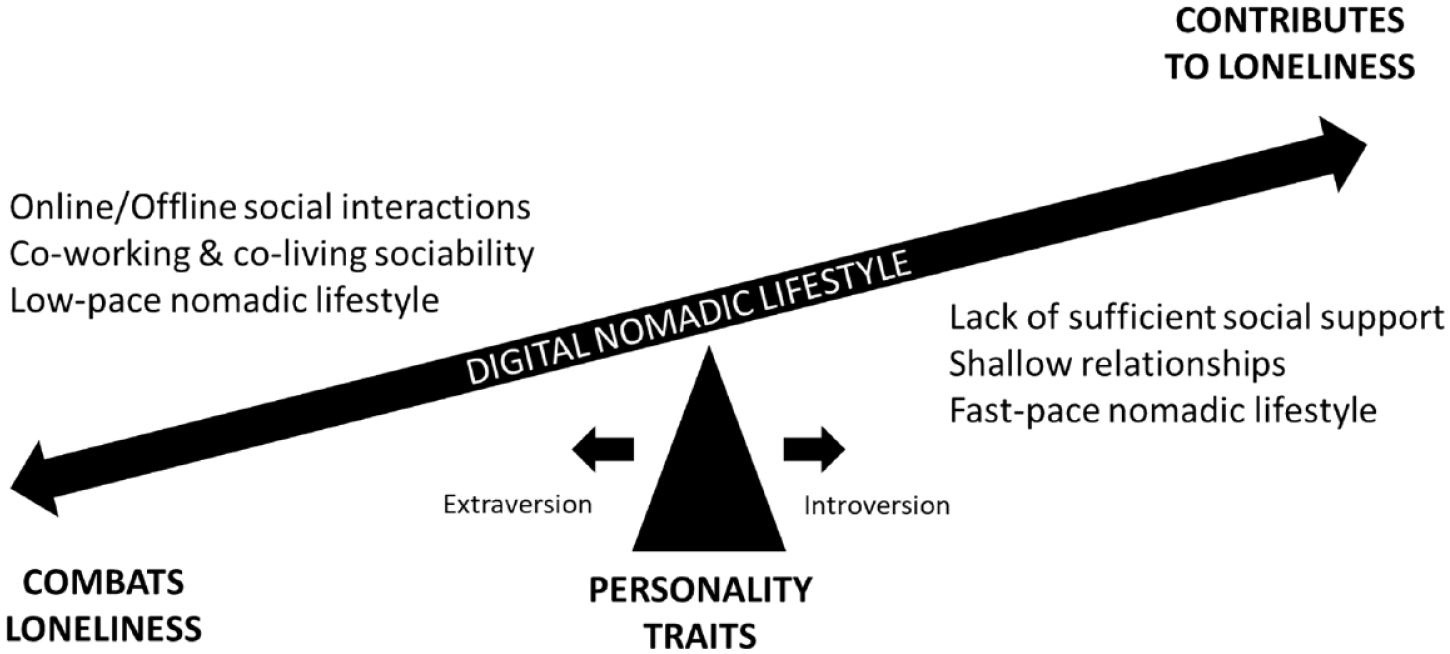
Relationship between digital nomadic lifestyle, personality traits, and loneliness.
DN’s social media use to cope with perceived loneliness and foster community
DNs use a repertoire of personal digital infrastructures, such as social media and mobile apps, to anchor their liquid lifestyle and address negative aspects they face on the road such as uncertainty and perceived loneliness (Atanasova et al., 2024; Aufschnaiter et al., 2021; Xiao and Lutz, 2024). In our study, most of the participants reported using social media to cope with perceived loneliness, yet with a different outcome. For a substantial proportion of them, talking with family/friends (e.g. via Instagram or WhatsApp) or connecting with like-minded people (especially other DNs) decreased the feeling of loneliness, indicating that social media was instrumental in reducing both social and emotional perceived loneliness: If you do have followers (on Instagram), not only your friends, but people that share the same lifestyle or your fellow travellers. . . of course, you feel less lonely because you know you’re not the only one out there. And with every like follower, you feel support. (Monica)
On the other hand, other participants reported that the use of Instagram was detrimental to fighting perceived loneliness since people usually only post about their best experiences, a practice which is particularly prominent among DNs, as Bonneau et al. (2023) observed. Thus, for DNs using social media such as Instagram to overcome loneliness can be a problem rather than a solution − despite being aware of the Instagram versus reality discrepancy: . . .when you’re feeling low, when you’re feeling blue and you go to social media. . . (. . .) usually people do not post when they are lonely, when they are sad, when they are feeling blue. So, everything you find when you’re scrolling down, it’s people being happy, people fulfilling their dreams, people living ‘the life’. And if you’re feeling lonely, it’s like what I mean, it gets you even more down to see that. (Jon)
In any case, the relation between social media and perceived loneliness is context-dependent, including the type of loneliness (ranging from occasional/benign boredom, lacking a sense of belonging when traveling for months, to chronic forms of loneliness), the extent of one’s discontent with involuntary solitude as well as DNs’ expectations from social media-enabled socializing and the fit between the type of social media and the purpose of their usage. To interpret the discussions, we rely on Putnam’s (2001; see also Williams, 2006) “bridging” and “bonding” types of social capital as well as on the third, later introduced “maintained” (sub)type (Johnston et al., 2013) − referring to personal resources required for maintaining long-lasting close relationships.
Regarding the support of one’s core social network, most of our DNs used social media to stay emotionally close to their family members and close friends – indicating that both bonding (Phua et al., 2017) and maintained social capital were activated (see Johnston et al., 2013). The participants found more private social media platforms, such as WhatsApp to be more useful (than e.g. Instagram) for close contacts and strong social ties management (Phua et al., 2017; Shane-Simpson et al., 2018). As the core network gets wider and the conversations less intimate, both the type of platform and social capital change. A few participants explained they inform their family/friends about their whereabouts via Instagram, Facebook, or Snapchat, for example: “I also throw my pictures there to Facebook, so they know that I’m OK. It’s so much easier than reaching out to every single family member” (Monica). Such instrumental support being exchanged with members of DNs’ wider core network indicates that bridging and maintained social capital were activated (Johnston et al., 2013).
Furthermore, in line with Rainie and Wellman’s (2012) conceptualization of networked individualism (i.e. people establishing/joining multiple different (ICT-enabled) social networks, and using them selectively and assertively), DNs used social media to connect with and get support from their more peripheral social networks too, the groups of strangers and acquaintances consisting mainly of other nomads. Participants preferred less private platforms here as well (e.g. Instagram and Facebook) and used them in more passive and consumptive as well as more active and communicative ways (Aichner et al., 2021). In the former case, social connectedness empowers DNs’ sense of belonging to the DN community and is commonly realized in the form of comments on Facebook groups or reacting to each other’s posts and/or mere exposure to like-minded people’s Instagram accounts, as Marian explains: “I have met truly wonderful people on social media, other DNs, other travelers, just people that I’ve connected with that share similar dreams, missions, values.” Unsurprisingly, to be recognized/accepted by the peers as a like-minded, in this solely online setting with very weak social ties, one needs to be skillful in using social media to (accurately) present their DN “dreams, missions, and values” (see Miguel et al., 2023b). Second, in the latter case of using social media in a more active and communicative way, our DNs relied on the platforms to monitor the location of their DN acquaintances. This helped them to arrange offline meetups and strengthen the group’s bridging social capital – presumably even activate certain aspects of bonding social capital (emotional support) (Phua et al., 2017): We are moving frequently, sometimes one posts location ‘Colombia’, and it turns out that another nomad you met along the way also is in Colombia. (. . .) I have a friend who wrote to me: ‘Hey, you’re in Colombia, I’ll arrive in Colombia in a month’. So, the possibility of meeting other people again without having a fixed date, without having talked about it and simply being able to connect again is nice, because in the end they are your friends on the road, right? You don’t have anyone else. (Gemma)
Gemma’s depiction of a flexible sense of community despite the fluidity and (networked) individualism of the DN lifestyle aligns well with the notion of neotribes introduced earlier (Hardy and Robards, 2015; Maffesoli, 1996). Like other neotribes such as recreational vehicle users (Hardy and Robards, 2015) and despite their internal heterogeneity (Cook, 2023), DNs share behavioral and symbolic commonalities that make it easier to connect to each other. The quote shows how a certain flexibility, curiosity and openness facilitates social capital management.
Finally, DNs reported using social media to arrange/join in person meetings (e.g. events, day trips) with new people whenever they arrive at a new location. Using Lee et al.’s (2019) conceptualization, they use platforms to set up the “social infrastructure” required to make the most of their off time and, subsequently, battle loneliness. Such (offline) socializing with other DNs and/or locals relies on the group’s bridging social capital and is enabled by platforms where instrumental support is commonly exchanged: Facebook and Slack groups or MeetUp, Instagram, CouchSurfing, as well as Tinder and other dating apps (Matos and Ardèvol, 2021; Phua et al., 2017; Shane-Simpson et al., 2018; Thompson, 2021): I’m in a lot of Facebook groups with like DNs or like solo female travellers, like I’ve met up with people that way. So, there’s a lot of sources that you can use with different kinds of social media groups that you can meet people (Rossie).
Although Facebook groups emerged as the main tool for organizing meetups, DNs in principle navigate different social media simultaneously − what Madianou and Miller (2013) label polymedia − to increase the odds of finding the people and/or events they like to fight loneliness (e.g. Pittman, 2018). This might also include less conventional approaches like using dating apps to arrange non-dating one-on-one outings (James et al., 2019). Instagram, Facebook groups, Slack, MeetUp, CouchSurfing, and Tinder are identified as key platforms for DNs to connect with people, especially for bridging social capital, whereas WhatsApp is used more for bonding social capital, in contrast to other studies that found Facebook to be the most popular platform to maintain strong ties (Phua et al., 2017; Shane-Simpson et al., 2018), probably because the authors did not consider WhatsApp as social media. Regarding the overall effect of one’s “social infrastructure” being set this way, even though social media platforms such as MeetUp, Facebook groups, or CouchSurfing (Miguel, 2018) provide instant sociality, some participants explained that they did not find deep personal connections at meet ups, and therefore, those fleeting encounters did not help them to overcome loneliness in the long-term. For example: . . . these connections are so short-term that it’s actually really quite lonely because you meet someone maybe once and then never see them again and it becomes draining. It’s almost like dating but with friends and that side of things is very, very draining. (Ruth)
Unlike in Sessions (2010) and Shen and Cage’s (2013) studies where the meet up attendees’ bonding social capital was increased after the meeting (indicated by the within-group post-meeting interactions), our participants reported experiencing emotional loneliness (Deckx et al., 2018). Thus, although they may have an active (offline) social life thanks to events organised via different social media platforms, they miss having closer connections, people they can trust and share intimate information or ask for help if needed.
Conclusions, limitations, and future research
Our research makes several theoretical contributions that span normally separated research fields. Particularly, we add to the literature on digital nomadism and future of work (e.g. Bonneau et al., 2023; Hannonen, 2020; Thompson, 2021) by illustrating some of the challenges that DNs face in this lifestyle and that converge with challenges shared by other remote workers (Walz et al., 2023). Our findings also expand evidence in theories related to perceived loneliness, particularly supporting the cognitive discrepancy perspective (Marangoni and Ickes, 1989) as participants in our sample experienced similar objective conditions, but their perception of loneliness was more related to subjective aspect related to the quality of their interactions. Thus, our contribution bridges disciplinary gaps and enhances the understanding of technology use among a highly mobile and pioneering group. For scholarship on new forms of work and organization, our findings add nuance by highlighting an under-explored dark aspect or side-effect of digital nomadism. Our research reveals that beneath the glamorous facade of digital nomadism lie unseen challenges such as isolation, which can lead to perceived loneliness. Among DNs who participated in this study, loneliness was highly contextual, depending on a range of factors such as personality (e.g. being introverted), relationship status, or destination. In that regard, the fact that DNs must restrict the duration of stay because of visa policies was seen as a barrier to building longer-term relationships that could tackle loneliness, leading to a faster-paced nomadic lifestyle. The insights highlight that adopting the DN lifestyle should not be taken lightly due to its potential unintended hardships.
For media effects research and scholarship on the intersection of social media and loneliness, our study provides important nuance. Social media platforms serve as coping tools when loneliness occurs among DNs, deepening existing relationships and creating opportunities for new ones. However, our participants also highlighted some detrimental sides of social media and loneliness, such as shallow connections facilitated through apps such as MeetUp that reinforce, rather than alleviate, loneliness. Our findings show the significance of mental wellbeing for those involved in interacting with DNs online such as community managers – those managing social media groups for DNs – and content creators like bloggers. It is essential for these individuals to proactively interact with their communities and readers to tackle such mental health issues. Looking for signs of isolation within their groups could facilitate a more embracing approach toward digital nomadism. Moreover, these insights offer valuable lessons for platform developers by prompting them to reconsider the influence their platforms might have on challenges like loneliness. Specific features could be designed for better availability management and initiation of contact that align with DNs’ needs. For example, features that match newly arrived, yet isolated, DNs with readily available companions, or a hotline feature for immediate connection. An algorithmic system, considering the DNs’ status when proposing contacts, could serve as an additional option.
Nonetheless, our study has certain limitations. The long-term impact of the nomadic lifestyle on affective and social relationships remains largely unexplored and the study could not thoroughly consider the impact of external societal and economic factors on the experiences of DNs. Factors like local societal norms, economic conditions, political stability, and technology infrastructure in different countries can significantly affect both the lifestyle of DNs and their experiences of loneliness. In addition, our study did not explore the motivations why DNs might be escaping from long-lasting relationships with the adoption of this lifestyle. Future research could explore in more detail these motivations using quantitative methods to assess the prevalence of loneliness among DNs and investigate salient drivers and outcomes. Furthermore, examining the actual social media usage of DNs, in conjunction with their lived experiences, could provide a more accurate understanding of loneliness within this demographic. Future inquiries could utilize methods such as diary studies or autoethnography to illuminate the specific content formats, communication modalities, and platform features that can effectively counteract loneliness among DNs. From a theoretical perspective, future research could focus on how the balance between work and leisure in DNs’ life affects their experience of loneliness. This could include examining the role of work-related stress and the ability to form meaningful connections while travelling and managing a remote work lifestyle.
Footnotes
Funding
The author(s) disclosed receipt of the following financial support for the research, authorship, and/or publication of this article: Christoph Lutz, was partially funded by the Research Council of Norway project 299178 ‘Algorithmic Accountability: Designing Governance for Responsible Digital Transformations’ while writing the article.
