




Abstract
In 2022, US President Donald Trump and UK Prime Minister Rishi Sunak faced public scrutiny over the background music used in official videos promoting their political agenda. Press articles and social media users claimed that the library (or ‘stock’) music heard in the videos consisted of so-called ‘soundalikes’, and questioned whether this choice was a public endorsement of problematic individuals or groups connected with the tracks in question: namely, conspiracy-theory movement QAnon, and convicted rock singer Gary Glitter. This article explores how library music is used strategically in these videos, highlighting the urgency of inquiring into its fundamental role in the construction and dissemination of political messages in media today, with moral and ethical implications that remain underresearched. Departing from these cases, the article also examines how library music, a once unseen musical practice, is now reaching the foreground of public attention, gaining unprecedented visibility due partly to its use in politically motivated videos. This allows us to rethink longstanding notions of library music as something that lacks a public existence, and to focus instead on what happens when it gains media coverage – prompting misunderstandings that reveal how unfamiliar the wider public is with the workings of this industry.
Introduction
In autumn 2022, two high-profile politicians faced public scrutiny over the background music used in official videos promoting their political agenda. Both former US President Donald Trump and current UK Prime Minister Rishi Sunak were the subject of press articles (and social-media commentary) claiming that so-called ‘soundalikes’ had been used in their videos, and questioning whether this choice of music was a public endorsement of problematic groups or individuals connected with these tracks: namely, conspiracy-theory movement QAnon and convicted rock singer Gary Glitter. Specifically, the Trump case centred around the use of a music track at a rally in September 2022 in Youngstown, Ohio, that was described in the press as ‘virtually indistinguishable from the [. . .] adopted anthem’ of QAnon (Luscombe, 2022), the extremist conspiracy group that ‘posits that former president Trump is fighting the “deep state” to bring down a ring of elite pedophiles, as revealed by an anonymous message board poster called “Q”’ (Marwick and Partin, 2024: 2536). For Sunak, public discourse was concerned with whether an online promotional video marking his first two days in office ‘contain[ed] music by the convicted paedophile Gary Glitter’, who was jailed for sexual offences over multiple decades (Adu, 2022).
These examples – which entered political consciousness only a month apart – both use forms of library music: also known as ‘stock’ or ‘production’ music, library music ‘refers to digital recordings of music [. . .] – created according to commercial trends and organised in online catalogues – which are designed for use in a range of contexts, such as audiovisual media productions’ (Huelin, 2022a: 57). The tracks are categorised ‘using titles, descriptions, and keywords, often linking the tracks to specific geographical locations, moods, narratives, or film genres, thus allowing the users to search for music to suit their needs’ (Durand, 2020: 24). Music libraries also offer soundalikes: tracks that emulate the recognisable style of well-known pre-existing music. Soundalikes can be licensed (or purchased) much more cheaply and quickly than commercial tracks – without requiring the consent of the original composer or artist – and, as a result, the same library tracks can appear in a diverse range of audiovisual scenarios (from pornographic films, to documentaries, and light entertainment, Durand, 2020: 23). These potential reuses of library music, coupled with its usually anonymous and ‘invisible’ presence, means that it can operate quite differently to other kinds of music (i.e. original scores or commercially released tracks) in political contexts. Unlike bespoke scores, library music is not composed for a specific audiovisual situation and thus maintains a degree of independence from any of the contexts in which it is used, which can contribute additional layers of meaning to a candidate’s political message. Equally, unlike pre-existing commercial tracks, library music does not tend to have a public ‘life’ prior to its use in media, and therefore does not (usually) bring with it unintended associations from an existing song. Nevertheless, we argue that the practice of using soundalikes – as examined in this article’s two case studies – complicates these distinctions between different types of music. Instead of library music functioning as a ‘hidden persuader’ (Cook, 2000: 128), influencing public perceptions of a political message without drawing attention to itself, here we examine what happens when the use of library music starts to shape public discourse surrounding political figures.
This article uses the Trump and Sunak cases as a lens through which to investigate the increasingly prominent role of library music in political contexts – and the implications of its use for producers and audiences – structured around two primary research areas:
1) Media production: How is library music used strategically in these examples? Why did these media producers opt to use library tracks over another type of musical content, and what is the impact on the construction of their political message?
2) Audience reception: How and why is library music gaining visibility in public discourse? How does its use in politically themed videos affect public perceptions of this once ‘unheard’ musical practice, and why is it now coming to the foreground of public attention?
Combining qualitative data drawn from an analysis of our two audiovisual case studies with a close reading of associated press articles and social-media posts, this article departs from the dominant understanding of this music as a hidden sonic presence, and approaches it instead as a media element that has gradually become more present in public awareness. In doing so, the research makes two primary contributions to media scholarship. First, it reconsiders the ways in which we theorise library music’s effectiveness in media such as advertising and political campaign videos, highlighting the urgency of paying closer attention to its fundamental role in the construction and dissemination of political messages. Second, it examines what happens when the synchronisation of library music threatens its ‘hidden’ profile, challenging longstanding notions that this music lacks a ‘public existence’ (Godsall, 2019: 6, italics in original). Consequently, this research demonstrates how a library track may counteract the message intended by either its composer or the media producers who use it, by eliciting connotations that, while unforeseen, come to decisively influence the public perception of political figures. Taken as a whole, the article establishes the integral role of library music in political communications, and reveals the practical and ethical considerations that surround its use in contemporary media.
Library music and political media
To date, studies have delved into music’s role in propaganda and activism, its potential to contest (or, on the contrary, reaffirm) political power (Garratt, 2018), the intersections between music genres and the political affiliations (and mobilisation) of their listeners (Doehring and Ginkel, 2022), and the strategic use of well-known commercial artists in rallies and other campaign events (Deaville, 2017). Interestingly, as will be illustrated by our first case study, the near-theatrical stating of these events, complete with music, is increasingly tied to the audiovisual branding and rhetorical strategies of a candidate. Valuable work has also been carried out on the decisive role of music in political advertising (Love, 2015), exploring the calculated use of certain tropes to instil positive or negative reactions in potential voters.
Research that specifically examines music’s ability to persuade in politically driven audiovisual media is still relatively scarce; in particular, scholarly literature on this subject has so far focused on television and other linear channels of broadcast. Christiansen (2017), for example, undertakes a close analysis of US-election campaign spots to unveil the intended meanings behind the interplay of music, images and verbal elements. Where our analysis differs is in its focus on looking beyond the audiovisual objects themselves in order to tease out the unintended connotations of political musical choices. This line of enquiry is especially relevant when we consider more unpredictable and uncontrollable contexts of media reception, particularly with online platforms, where digital videos may evoke unexpected meanings and be riddled with ‘glitches, noise [and] rupture’ (Vernallis and Herzog, 2013: 3). In video sharing websites, professionally produced political advertising coexists with politically motivated content created by amateurs with varying degrees of media literacy.
If videos in online platforms are disseminated, received and transformed in unforeseeable ways, the same applies to library tracks themselves. This music is a source of income for a significant number of composers, and is used by a growing client base of audiovisual creators who lack the necessary budget and time to commission a bespoke score. Consequently, library music occupies a crucial role in constructing a wide variety of audiovisual messages, from news broadcasts to homemade videos shared on YouTube. Existing work on library music has explored its use in amateur video production and television in the 20th century (Czach, 2020; Wissner, 2017); examined the labour practices of its composers (Nardi, 2012); and analysed the well-established musical codes found in library catalogues (Durand, 2020). The manipulative effectiveness attributed to library music is indissociable from these deep-rooted and instantly recognisable formulas: Tagg (2006) and Deaville (2007), for example, have explored how library music can be strategically used in news broadcasts and other media to portray specific individuals or groups in a certain light. Although library tracks go mostly unnoticed by audiences (or, perhaps, precisely because they go unnoticed), they can be extremely efficient in crafting persuasive audiovisual messages.
While political rallies and advertising often feature popular music, soundalikes are also frequently used as a cheaper alternative. In broad terms, a soundalike can be understood as ‘an intentional attempt by a composer to make a musical allusion to a song, artist, or style whilst creating a sufficiently original composition to avoid accusations of copyright infringement’ (Bennett, 2023: 63). A media producer seeking library music could, for example, employ generic search terms such as ‘confident’, ‘majestic’ or ‘passionate’ to find rousing background music for their latest advert (Huelin and Durand, 2022: 149), but it is also possible to search a library with the names of specific artists or bands to find soundalikes that emulate their style. Over the past decade, soundalikes have gained increased public awareness due to prominent legal cases in popular music, including Pharrell Williams v. Bridgeport Music and Estate of Ed Townsend v. Ed Sheeran and others, concerning the songs ‘Blurred Lines’ (Thicke/Williams/Harris Jr./Gaye, 2013) and ‘Thinking Out Loud’ (Sheeran/Wadge, 2014), respectively. In such cases, there is most often an existing public awareness of both the original song and the alleged infringer prior to any legal proceedings, with both musical items having a public commercial release (albeit sometimes decades apart). That is not the case, however, with the library tracks that will be discussed ahead, as they were not known by the general public until their use in political media.
Indeed, despite its ubiquity, library music has remained mostly hidden from the public eye: this ‘invisibility’, which until recently was one of its most defining traits, has undergone significant changes with the transition of this music to digital platforms. With its release on streaming websites, or its reupload onto YouTube, library music attracts direct listeners for the first time rather than being limited to an audience of media creators, further blurring the lines between library music and so-called ‘commercial’ or ‘popular’ music (Durand, 2023). At the same time, however, the logics and criteria on which the library-music industry is grounded remain distinct from established popular-music practices: most notably, in the peculiar invisibility of library-music composers, and the specific licensing practices through which this music is sold to media producers. For example, to ensure that a track can easily be licensed for a wide variety of media, library music is typically governed by copyright mechanisms that greatly limit composers’ control over future uses of their music. This lack of control over the usage (and, consequently, the possible meanings) of their library tracks has been a constant factor since the beginnings of this music industry, and there are notable historical instances of composers discovering that their music had been used to support messages of which they personally disapproved. Examples include Francis Monkman’s dismay upon finding that his album Energism (1978) was used by arms manufacturers (Lomax, 2018: 410); or an incident recounted by composer Keith Mansfield when a fellow composer at the library KPM attempted (unsuccessfully) to oppose the use of his music by the US Republican Party (Hollander, 2018: 52).
These examples do not mean that the moral rights of library composers are not protected in principle: to give a contemporary example, the website of royalty-free library Artlist (2019) states that its music cannot be used in media that advocates ‘violence or incitement, pornography and obscenity, racism or hatred towards any group’. However, applying these restrictions in practice proves near impossible, since, as Carlo Nardi (2012: 80) notes, there is a significant ‘temporal distance between music creation and its use and the physical detachment between the different actors that participate in the entire process’. As will be examined, this issue is further exacerbated by the affordances and challenges of online platforms, as it becomes virtually impossible to monitor every use of a recording and thus enforce its creators’ moral rights. 1 Therefore, the initial intent of a composer for a library track may be entirely contradicted by its future uses in media – and composers risk being associated with social or political movements they do not endorse. As such, when library music attracts unprecedented attention in political media, coming under the scrutiny of a public still uninformed of the rules of this music industry, it can give rise to misunderstandings and misinterpretations, countering this music’s role as a discreet sonic backdrop and interfering with an intended political message.
Method
The research for this project comprised two main methodological strands. The first analysed the audiovisual examples relating to Trump and Sunak: the videos were located online, spoken text was transcribed, and salient locations and scene changes were noted. 2 Next, the music tracks used in these videos were identified, using the music-identification app Shazam and cross-referencing its results with existing press articles and social-media comments. Particular attention was paid to the tracks’ extramusical information available on library websites, such as titles, composers and keywords (following a similar method formulated by Huelin, 2022b). These paratexts were crucial when analysing the relationship between a creator’s (or library’s) initial intentions for where the track might be synchronised, and its subsequent political uses.
The second strand analysed the ensuing public discourse surrounding these political videos in press articles and social-media posts (broadly adopting a process of qualitative media analysis demonstrated by Altheide and Schneider, 2013). Appropriate press articles were found using the keywords ‘“Sunak” and “stock music”’ or ‘“Trump” and “stock music”’ on Google News, within the timeframe of September 2022 to December 2022. Our aim was to focus on key case studies, providing an exploratory study that considered a spread of differing political viewpoints across the US and UK, as well as a combination of national and regional outlets. For our social-media analysis, we carried out the initial search on the platform X (formerly Twitter), using the same keywords and timeframe as for the press articles. In this strand of analysis, we focused particularly on the framing of the stories and the accuracy with which they were presented (e.g. in terms of the identification of library tracks). The data generated from these analytical approaches allowed us to examine the issue of soundalikes from multiple perspectives, situating our findings within the context of other recent examples of library music (and soundalikes) entering public consciousness. These combined methods were vital to explore the precise nature of soundalikes, whilst also examining how these case studies have been discussed in contemporary discourse, raising questions of authorial intent and musical invisibility.
‘They’re playing our song’: Trump and the ‘QAnon Anthem’
In September 2022, an article in The Guardian suggested that Trump had condoned the extremist conspiracy group QAnon by playing in a rally music that was ‘virtually indistinguishable from the cult organization’s adopted anthem’ (Luscombe, 2022). The story spread quickly, with several articles debating whether the Trump team had deliberately used a soundalike of the so-called QAnon anthem. Many recognised the music – which was received with raised-arm salutes at the rally – as the track ‘Wwg1wga’ by ‘Richard Feelgood’. 3 Trump’s communications team vigorously denied this, stating that the music used was instead the library track ‘Mirrors’ by American composer Will Van De Crommert. As Trump’s spokesperson, Taylor Budowich, commented at the time, ‘the fake news, in a pathetic attempt to create controversy and divide America, is brewing up another conspiracy about a royalty-free song from a popular audio library platform’ (in Luscombe, 2022). Seemingly disputing this claim, media watchdog Media Matters stated that the Shazam app identified the track as ‘Wwg1wga’ (Kaplan, 2022).
The coverage of this incident was riddled with contradictory information, with news outlets (including The Guardian) reporting that the two tracks were ‘similar’ (Luscombe, 2022). In truth, however, they are sonically identical. They can be found in several online platforms – from YouTube and Spotify to music libraries – as both ‘Mirrors’ by Van De Crommert and ‘Wwg1wga’ by Richard Feelgood. The track was first published in 2019 by Van De Crommert in library-music sites such as Artlist and Storyblocks. A year later, without the composer’s permission, the same track was retitled to ‘Wwg1wga’ and reuploaded to Spotify and YouTube with the pseudonym ‘Richard Feelgood’ (whose YouTube and TikTok accounts also host content linked to QAnon). The track had therefore already undergone these connections to the QAnon movement two years prior to its use in a Trump rally.
In August 2022, it was featured in a Trump-produced video that was posted on the platform Truth Social, with the title ‘A Nation In Decline’. After the sounds of a storm (which some saw as another reference to QAnon), the sweeping strings and piano of ‘Mirrors’ can be heard under Trump’s speech as he decries a ‘nation that is hostile to liberty and freedom and faith’ and promises ‘greatness again’. Interestingly, the following year, in March 2023, the same music was used once more in one of Trump’s rallies, playing live while the former president gave a speech in Waco, Texas with a very similar message to the ‘Nation In Decline’ video. 4 The repeated use of this track in Trump’s rallies (even after the controversy it had caused some months before) suggests that this track had firmly embedded itself with specific meanings among Trump’s supporters, despite – or, perhaps, because of – its ties with the QAnon movement.
The debates that such uses of this library track sparked in online articles and social media mostly focused on uncovering its origins, and on whether it was a deliberate nod from Trump to QAnon. However, we propose that the most interesting conclusions might be drawn not by ascertaining whether Trump was aware of the music’s links to QAnon, but rather by examining how, regardless of its composer’s intentions (or, for that matter, those of the Trump team itself), it was reinterpreted and appropriated by followers of the conspiracy theory. This track’s association with QAnon has now become indelible, with those in QAnon Telegram channels celebrating its use with comments such as ‘[it] might be the biggest nod they’ve ever given us’ (in Kaplan, 2022), and ‘the Q plan is still in motion’ (in Gilbert, 2022).
Even when this track is reuploaded online with Van De Crommert’s name and original title, the links to QAnon are inescapable: to give but one example, a reupload of the track on YouTube bears the keywords ‘easy listening’, ‘ambient music’, ‘wwg1wga’ and ‘Trump’ (see Image 1), and on the composer’s YouTube and SoundCloud pages, several comments repeat the slogan ‘wwg1wga’ (see Image 2). This music’s rebranding as a QAnon anthem endured despite the composer’s repeated attempts to distance himself from such associations, stating that the track was unlawfully retitled and distributed under the pseudonym ‘Richard Feelgood’ (Jackson, 2022), and that he was opposed to its use in Trump’s rallies.
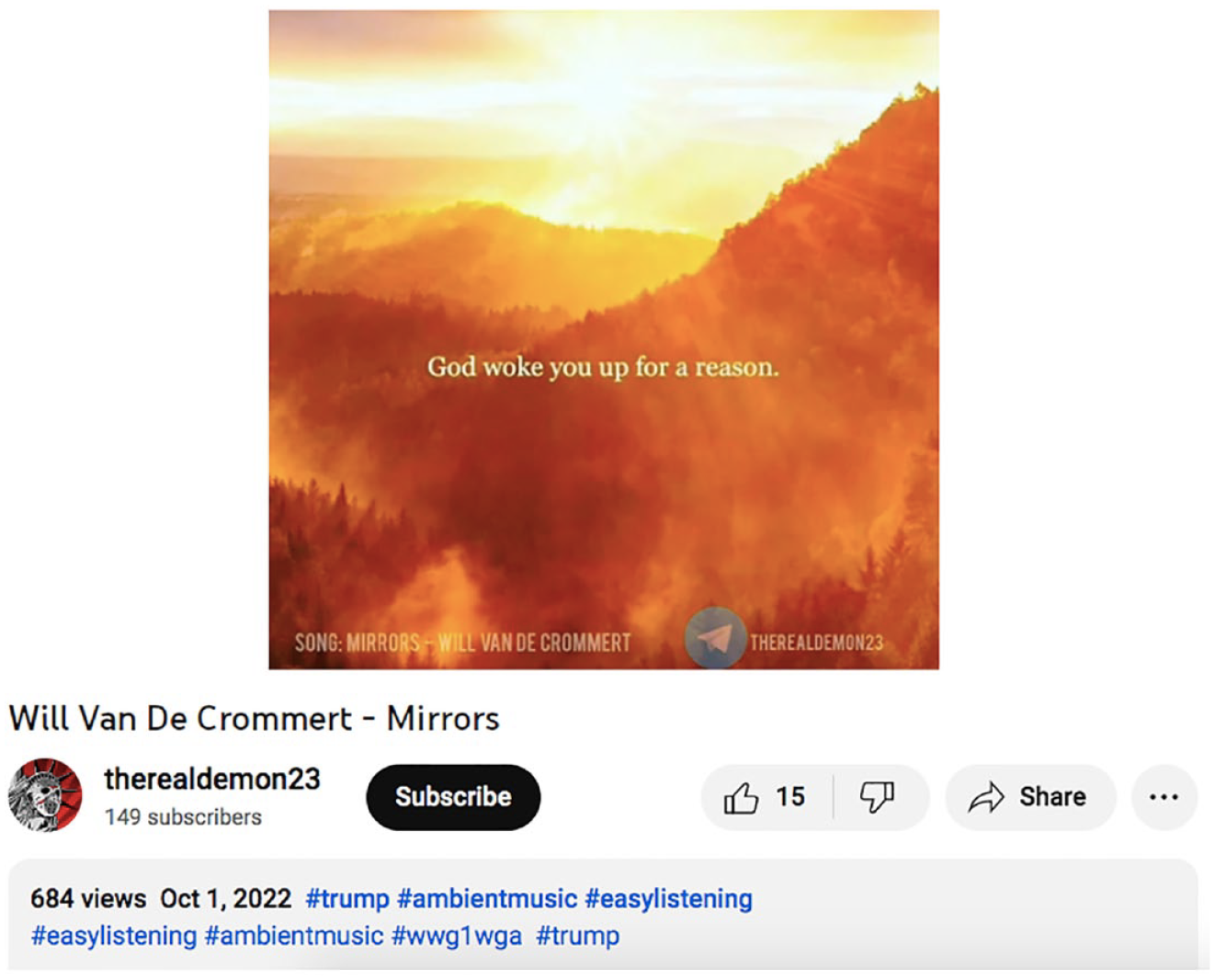
Screenshot of an October 2022 YouTube reupload of the track ‘Mirrors’ (and its associated keywords).
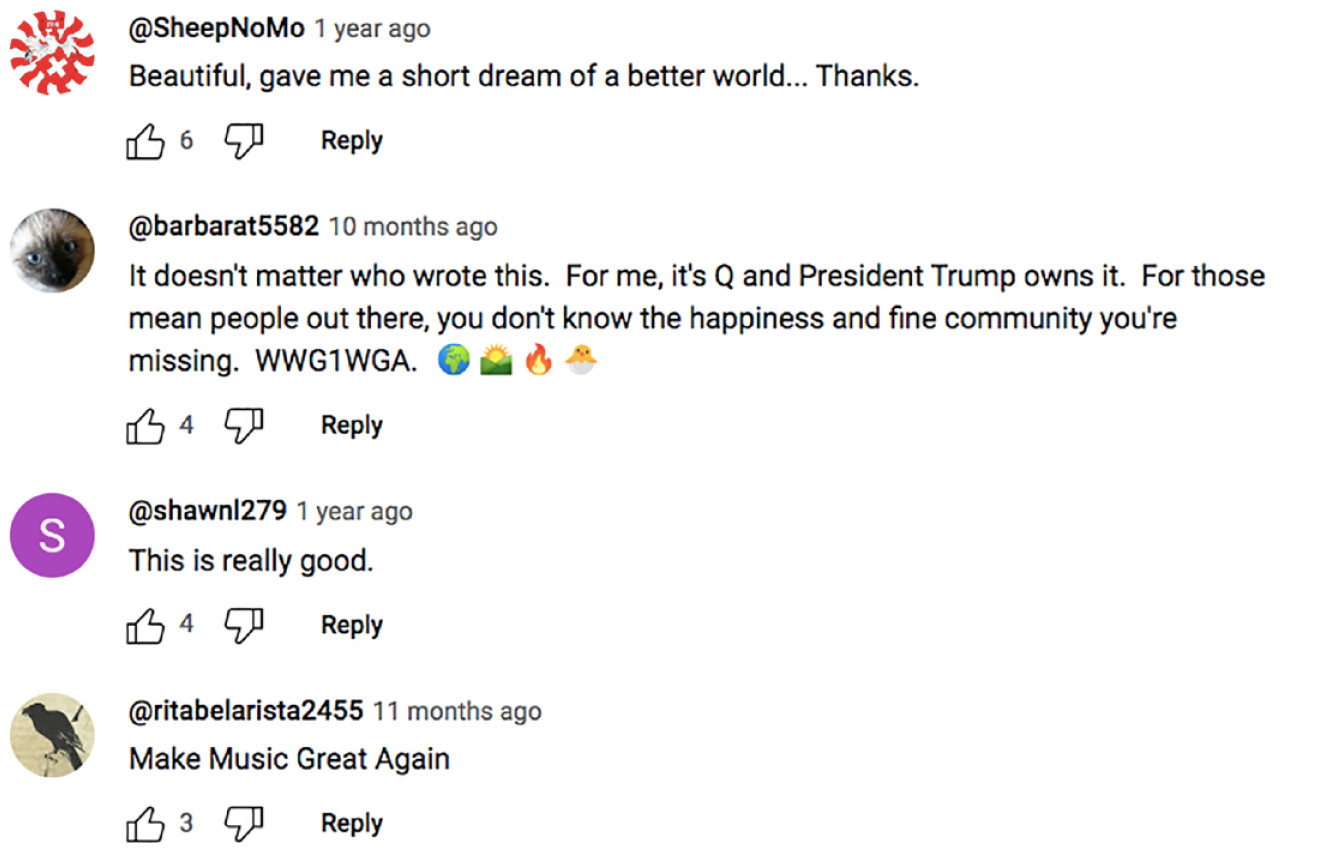
YouTube comments on a reupload of the track ‘Mirrors’.
This example highlights two aspects that are increasingly central to the experiences of library composers, and to the ways in which their music circulates in digital media. While these composers were never truly able in practice to exercise their moral rights to oppose certain uses of their music, in the current online landscape, library tracks (as, indeed, any other cultural object) can be repackaged and repurposed with unprecedented ease, their end-uses thus become near-impossible to predict and detect – let alone control. Publisher Dan Graham (2018) acknowledges that the practice of composers forfeiting their moral rights ‘does open the risk to [their] music becoming launch party music for a new fighter jet, or a diabolical politician’s chosen rally anthem’ (p. 219). Although composers such as Van De Crommert are aware (at least contractually) that their music could be used in contexts which they disapprove of, it is still expected that tracks will be licensed via legitimate channels. Interestingly, Van De Crommert’s publicly stated objections to Trump’s uses of his music seem to stem as much from the fact that Feelgood had ‘unlawfully distributed [Van De Crommert’s] music under their own name’, and that ‘the master was unlawfully retitled, repackaged, and redistributed to streaming platforms by Richard Feelgood’ (in Mishra, 2022), as from the actual synchronisation of this track in Trump-related scenarios. Although it is true that library music can be used in a vast range of unforeseen contexts, the intention for composers writing this music is that they will receive financial royalties, and will remain largely anonymous. The case of Van De Crommert reveals how this arrangement can go awry in a digital context, where the risks of the tracks being divorced from their creator are much stronger.
More broadly, while library music has invariably been described by library professionals as ‘hidden in plain sight’ (Taylor in Phillips, 2019), it is becoming more present in public discourse. This is evident, for instance, with the unexpected popularity that some composers have earned in online platforms. 5 Other cases, however, stem from more negative reasons: namely, when these musicians have to publicly distance themselves from uses of their work which they do not sanction. Among other examples, this happened with Australian composer Scott Buckley, when his free-to-license library music was used in a 2020 government-produced video of Brazil’s far-right president Bolsonaro (Globo, 2020). As Buckley posted on Twitter at the time (@musoscientific, 2020), ‘I definitely don’t support [the Brazilian government’s] political views, nor do I want their money. This is another drawback of releasing my music freely’. It is partly for this reason that some library composers view their anonymity in a rather positive light: should their music come to be used in ways they disapprove of, their name will not (in principle) be associated with certain political candidates or ideological movements.
When library music is made ‘visible’ (either because of its resemblance to well-known songs or its use in a political video), it can give rise to misunderstandings and misjudgements – especially when expectations of public visibility, which usually do not apply to library music and its composers, are transposed to this mostly anonymous art world. A clear example of this is the 2017 incident that became known as the Spotify ‘fake artists’ scandal. Following an article in Music Business Worldwide, several online news outlets accused streaming platform Spotify of ‘adulterating’ some of its popular relaxation-themed playlists with ‘fake music’ (e.g. Ingham, 2017). Its composers were quickly branded as ‘fake artists’ due to their apparent lack of any public existence beyond Spotify. Particular confusion stemmed from the fact that, although these tracks had millions of plays on Spotify, their popularity did not translate to ‘fame’ in a conventional, record-label sense (with practices such as concerts, merchandise, social-media promotion and engagement with fans). As Goldschmitt (2020) writes, ‘calling the music at the center of this scandal “fake” is peculiar and speaks to a limited set of musical values centered around how artists operate in digital music markets and how these conditions have influenced the ways that producers and music industry insiders understand their status in recorded music’ (p. 132).
After suggestions that the tracks had perhaps been generated by artificial intelligence (Bulut, 2017), they were finally identified as library tracks, licensed through Epidemic Sound under various pseudonyms. Unsurprisingly, the composers in question soon objected to these terms, with some openly expressing their preference for the invisibility that library music granted them: ‘I am not and have no intention of ever becoming an artist in any sense of the word. I don’t perform live and hence I don’t need or seek publicity’ (in Deahl and Singleton, 2017).
The specific details of Spotify’s legal agreement with Epidemic Sound involve financial intricacies that are beyond the scope of this article. What is of particular interest here is the clash between two contrasting realities of music production, governed by different logics and values, and the friction that emerges when library music finds itself under unexpected public scrutiny. It is precisely this unprecedented visibility that places some library composers, such as Van De Crommert, in the uncomfortable position of having to publicly distance themselves from certain uses of their tracks to a general public that does not yet grasp the workings of this music industry, and who still fundamentally views musicians as celebrities within a system of fame, rather than anonymous workers who relinquish control of their music – and who could not predict (nor sanction) the future life of their tracks. In this sense, the example of Van De Crommert demonstrates how the signifying effectiveness of a library track in an audiovisual message can come to be misaligned with the intentions of its composer (or even of the media producers who used it), as this musical track shifts away from its initially assigned role of ‘unheard’ sonic presence and instead becomes an impactful element in political media – in this case, strengthening public perceptions of Trump’s connections to the QAnon movement.
‘[A] soundtrack from one of the UK’s most notorious pedophiles’: Sunak and the Gary Glitter soundalike
In October 2022 – just a month after the Trump and QAnon story broke – UK Prime Minister Rishi Sunak was also faced with a library-music PR problem. As The Guardian reported, ‘Downing Street has been forced to deny that a slick new video of Rishi Sunak’s first week as prime minister contains music by the convicted paedophile Gary Glitter’ (Adu, 2022). This video is underscored with a percussion-heavy library track, designed to promote a sense of energy and optimism to an increasingly weary British public (see Image 3). Many social-media commentators, however, noted the soundtrack’s unfortunate similarity to Glitter’s 1972 single, ‘Rock and Roll Part 2’.
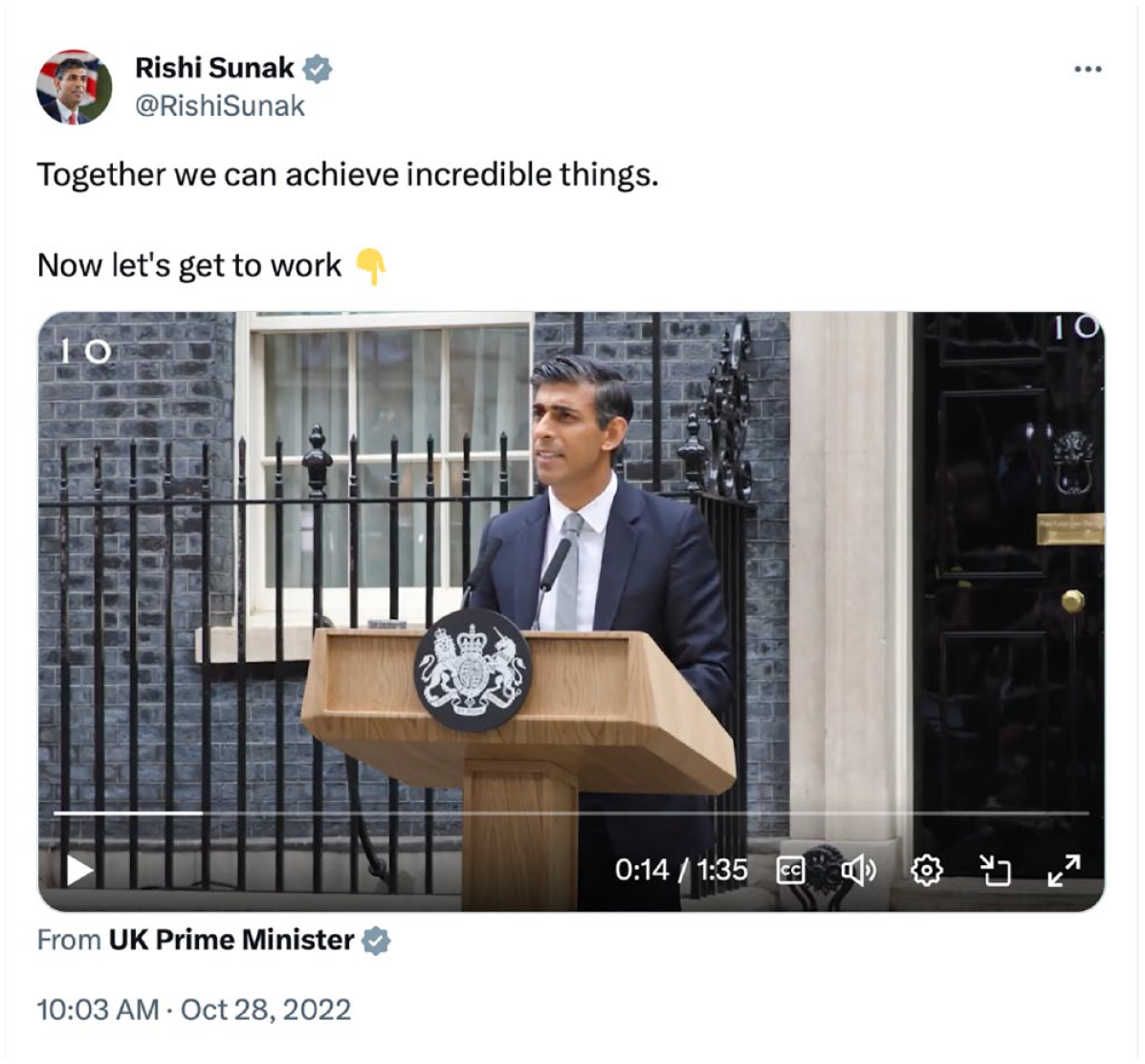
Tweet from @RishiSunak promoting the video that features the Glitter soundalike track.
As with the Trump case, confusions flourished with regard to the precise nature of the similarities between Glitter’s song and Sunak’s soundtrack, with many outlets suggesting that the original song had been licensed. The Daily Star, for example, ran the headline, ‘Sunak slammed for using Gary Glitter song in new promo’, noting that, ‘featuring a heavy drum beat, and clearly on loop, the [. . .] audio clip was actually from disgraced singer Glitter’ (Cailler, 2022), whilst the Dorset Eye (2022) wrote, ‘Sunak chooses soundtrack from one of the UK’s most notorious pedophiles for promo video’. Likewise, various Twitter users either noted that the video ‘has a soundtrack by Gary Glitter’ (@gpchatbot, italics added) or ‘uses a sampled drum beat from Gary Glitter’ (@RaggedTP, italics added). Sunak’s spokesperson came forward to deny any link, stating that the music was ‘certainly not by Gary Glitter’ and that ‘stock music’ had been used (in Simpson, 2022).
The music used in Sunak’s video is indeed not by Gary Glitter: it is a library track entitled ‘Tiger Beat’ by the artist Tigerblood Jewel (a pseudonym for Swedish composer Christian Nanzell), composed for the Epidemic Sound (2022) music library, discussed previously. Epidemic’s website describes Nanzell’s music as ‘gritty, rough-edged rock that will have you thinking of rusty pick-up trucks and roadside bars [. . .]. The music has a definite retro flare to it [. . .] with gnarly guitar riffs, bold drums and thumping baselines’. The selection of this track adds a level of dynamism to the slickly edited video, as we see the new (at the time) Prime Minister ‘get[ting] to work’ and ‘achiev[ing] incredible things’, as part of a broader communications strategy that favours social-media-ready soundbites and percussion-heavy soundtracks. The (presumed) intent behind the use of this library piece is evident: to promote an image of enthusiastic energy and positive change. However, the impact that this track ultimately had on Sunak’s image (and the press interest it sparked) could hardly be further removed from the intention initially driving this musical choice. Whilst the Trump case centred around the repackaging of the exact same audio file, this second example involves a newly recorded library composition whose drum pattern and production are perceived to closely resemble Glitter’s original song. Interestingly, it is not that the entirety of both tracks are similar (or identical), but that the use of one prominent element (the drum beat) is enough to activate a degree of audience recognition, regardless of the composer’s initial intentions.
Once the PM’s spokesperson had issued the clarification that this was not Glitter’s music, attention turned to the question of whether this mattered. Media coverage was divided between those outlets that focused on the potential associations created between Glitter and Sunak – regardless of the sound file that had been used – and those outlets for which the clarification put an end to the matter. The Mirror, for example, wrote, ‘People left fuming over Rishi Sunak’s new video that sounds like Gary Glitter’ (Banim, 2022), whilst the Daily Mail’s headline read, ‘Leftie Twitter users are left red-faced after wrongly accusing Number 10 of using Gary Glitter song on Rishi Sunak promo video’, framing the story as being a problem for ‘left-wing Twitter users [. . .who. . .] delighted in what they thought was a PR disaster’ (Howard, 2022), rather than actually being a problem for the PM. For many, the issue resonated as a continued example of, as Liam O’Dell (2022) put it, another time that Sunak’s government ‘definitely led with “integrity, professionalism and accountability”’ in his first two weeks in office; a period that included the resignation of a Cabinet Office minister facing bullying allegations (Sir Gavin Williamson), a well-publicised U-turn on Sunak’s attendance at the COP climate summit, and the reappointment of divisive Home Secretary Suella Braverman.
This case of Sunak and Glitter brings to light several important ethical issues relating to the composition and synchronisation of library music, and its foregrounding in popular discourse. The first concerns the relationship between composer intention and audience reception: whilst the instrumental track ‘Tiger Beat’ is not the same sound file as ‘Rock and Roll Part 2’, the two are now enmeshed – due to both their perceived sonic similarities and the stated associations between the tracks in public discourse. Whilst in most cases, ‘the same [library] track may come to be heard in radically disparate films’, bringing with it ‘unpredictable meanings’ in each new context (Durand, 2020: 24, 38), here one prominent use of the ‘Tiger Beat’ track actually limits its future uses, effectively ending the track’s ‘shelf life’ (i.e. the length of time for which a track is likely to be synchronised by media producers). ‘Tiger Beat’ is no longer available on the Epidemic Sound website, and has been removed from the company’s YouTube channel. This intervention from Epidemic suggests that, for the library company, the original sonic link between ‘Tiger Beat’ and ‘Rock and Roll Part 2’ was either not recognised, or not problematic: the track was available for around a year prior to its use by Sunak. Instead, the problem comes when ‘Tiger Beat’ is thrust into the political spotlight, and when its public visibility threatens library music’s inconspicuous and unmemorable profile. Accordingly, this example demonstrates how the perceived sonic similarity of a library track to pre-existing music may cause unwanted scrutiny, as well as elicit certain connotations that undermine the intended message and communication strategy of an audiovisual production.
Incidents involving uses of library soundalikes in political campaign videos are not without precedent: a notable example is a 2014 advert for New Zealand National Party that used the library track ‘Eminem Esque’, a soundalike of Eminem’s song ‘Lose Yourself’. The film’s director, Glenn Jameson, noted that he had used ‘Lose Yourself’ in an initial cut of the advert because ‘the beat was a good match with the visuals of rowers’ oars hitting the water’ (Stuff, 2017). The original track was unable to be licensed, and so it was decided that a soundalike would be used. In this case, rather than wishing to align the National Party with Eminem, nor with the lyrical content of ‘Lose Yourself’, the intention behind the use of the ‘Eminem Esque’ soundalike track was seemingly influenced by the manner of its production. The party’s campaign manager noted that the use of the soundalike was ‘pretty legal’; nevertheless, in the ensuing court case, Eminem was awarded damages of $225,000 (in NZ Herald, 2019).
Without similar legal proceedings – which have not come to the fore in discussions of the Sunak case – it may never be possible to know whether Nanzell (or perhaps Epidemic Sound) deliberately intended to evoke Glitter’s ‘Rock and Roll Part 2’ in ‘Tiger Beat’. Unlike the case of Van De Crommert and Trump, Nanzell has capitalised on his status as an anonymous library-music composer, and has not waded into the controversies surrounding his music and its use, aided by his adoption of the ‘Tiger Blood Jewel’ pseudonym for this particular musical output. Nevertheless, such issues raise the question of the ethics of composers and libraries seemingly capitalising on previous music – both in terms of the general copyright claims and the specific associations between the choice of music and Glitter’s criminality – in order to produce new, ostensibly anonymous library tracks.
Another key issue in the Sunak case relates to the musical awareness of his communications team. In their denial that Glitter’s song had been used, the PM’s spokesperson noted, ‘I’m not aware of [this track] costing anything additional to the work that we do in communicating for the prime minister’ (in Adu, 2022). In making this statement, the intention was presumably to underline that a specific popular-music track (i.e. ‘Rock and Roll Part 2’) had not been licensed, and that the use of ‘Tiger Beat’ fell under the government’s subscription to Epidemic’s catalogue, providing full access to its 40,000 tracks. At a time when musicians’ labour conditions are in the spotlight, however, the implicit messaging that ‘Tiger Beat’ was not paid for suggests an uneasy relationship between this music’s high-profile use-context and the problematic industrial conditions that lie behind its production. 6
Equally, for Sunak’s production team to choose this particular track suggests that either they did not recognise the link to Glitter’s original song, or that they did not think this connection mattered. Both outcomes suggest a lack of awareness as to how music can circulate in audiovisual media, especially given the recent controversial use of ‘Rock and Roll’ in Todd Phillips’s 2019 film Joker – creating additional associations that Sunak would surely want to distance himself from – and thus creating a political furore that could have been avoided if another library track had been used. The fact that Glitter does not seemingly receive royalties from the licensing of his music – with the rights now owned and administered by Universal – does little to quell these issues, especially as the licensing intricacies surrounding Glitter’s royalty position also generated headlines back in 2019 (see Appleford, 2019), further bringing these complexities of music licensing to the foreground.
Conclusions
This article has advanced two main arguments: first, we have shown how the communications teams of Trump and Sunak have used library music to heighten the emotional impact of their audiovisual messages, selecting tracks that evoke well-established musical codes for ‘sadness’ (Trump) and ‘positive energy’ (Sunak), through the use of appropriate instrumentation (i.e. strings, percussion) among other elements. At the same time, we argue that the specific potency of such tracks in these political contexts lies not only in their inherent musical features, but also in the intertextual connections with pre-existing aspects of audiovisual culture, and the potential for audience recognition of these links – whether between Trump and QAnon, or Sunak and Glitter – which conflicts with the media producer’s intended message. Although library music is an invaluable element in the communication strategy of audiovisual productions, where it is meant to act efficiently yet discreetly (and with no previous associations to other media texts), its resemblance to pre-existing music may nevertheless impact political advertisements in ways that counteract the original intent of media producers. The (presumably) unintended links created due to the use of certain library music complicate an understanding of any political audiovisual text, especially given this music’s potential to be used in any number of disparate media scenarios. In this respect, while the library music used strategically in these videos was meant to act as an unheard sonic backdrop, subtly influencing audience perceptions, the fact that the tracks in question were soundalikes – and thus carried a set of extra-musical connotations – contributed to an unforeseen turn in public commentary on specific political figures. While this disconnect between media producers’ intent and the meanings that a library track ultimately conveys to audiences can (and does) occur in any audiovisual genre, this phenomenon is especially striking in politically charged content, where library music loses its foremost role of ‘hidden persuader’.
Second, the press coverage and ensuing debate around the cases we have outlined, fraught with misconstructions, reveals both the public’s lack of familiarity with library music, and, at the same time, the attention that is increasingly paid to it. As library music grows more present in public discourse, due in part to the enduring practice of soundalikes and their use in politically driven (and highly scrutinised) audiovisual content, it becomes necessary to revaluate longstanding notions of library music as an invisible, innocuous wallpaper, wholly unnoticed by media audiences. The majority of library composers today can still be thought of as ‘nameless craft workers’, to borrow Smith’s (2017: 237) phrase when referring to 1930s B-movies. But we would benefit from a more nuanced perspective to complement the notion that library music lacks a ‘public existence’ (Godsall, 2019: 6, italics in original). Although that observation still holds true, cases of this music gaining the public’s attention are becoming more frequent. As a result, we argue that political communications teams would benefit from a greater understanding of the implications of the music they are using and its extra-musical associations, in order to harness music’s effects and potentials in a more intentional manner, whilst also acknowledging its unintended circulations (see Tagg, 2001).
Finally, it is important to note that instances of stock material entering public discourse also extend beyond sonic content: in a sense, the use of this stock musical material can be placed within a broader awareness of the use of stock media and its potential negative implications. A recent advertisement for utilities company Yorkshire Water, for example, recently hit the headlines for ‘using stock footage of the rolling hills of Herefordshire and images taken in a Russian bar’ – rather than images of Yorkshire (BBC, 2023). And, in a further case involving Trump’s presidency, an advert for Trump’s re-election campaign in September 2020 was criticised for using stock footage of Russian fighter jets (Sullivan, 2020). These incidents prompt us to rethink the ways in which we theorise library music’s effectiveness (and that of other kinds of stock material) in media such as advertisements and political campaign videos. As the examples here have shown, the meaning-making processes that stem from the interaction of this music with moving images can be far from linear and predictable, as this once discreet musical practice is increasingly brought to public awareness.
