




Abstract
The current study reveals the mechanisms used by both media and news consumers for domesticating distant threatening events. To this end, the study applies thematic analysis to textual and visual content presented in media items (Study 1) and media content reception from the perspective of news consumers (Study 2). Study 1 sample included 209 Israeli media items in Hebrew, covering asylum seekers in Europe from 2014 to 2019. Study 2 is based on semi-structured interviews with 30 Jewish Israeli heavy news consumers. The study was inspired by framing, priming, and media reception theories. The findings revealed the following threat domestication processes: (1) double selection of threatening narratives by media gatekeepers and the audience; (2) simplification of the media narratives to basic “good vs. bad” stories for easy comprehension and extension by news consumers; (3) creation and reception of both immediate threat (violence and crime) and deferred threat (deterministic processes); and (4) generation of a wide range of emotions and emotional processing through double victimhood. The audience actively adds to the domestication of the content through extended hegemonic and negotiated readings, thus finally shaping the framing so that it comes closer to the local contexts and communicates with the consumers’ lives and perceptions.
Keywords
Introduction
McCombs (2003) argued that the news media are the primary source of information about events in the outside world for the general public. In this role, the news media not only inform, but also engage in constructing meaning which might differ from the truth. This latter option becomes more feasible when the described events are geographically distant and consumption of news items is the only exposure to them. Indeed, the technological revolution in communications has opened new avenues that have changed the information environment and facilitated coverage of remote places (Maier, 2020). The formerly sharp division between domestic and foreign news consumption has been blurred by immediate and real-time access to news from other countries thanks to the Internet (Ellis and Muller, 2020; Kopytowska, 2015). Moreover, journalists create links of meaning between physically distanced content and local cultural, historical, social, and political contexts (Cohen, 2002), and in this way overcome the negative force of physical distance. They magnify closeness and proximity by imbuing national or international issues with local emphases or interpretations (Hess and Waller, 2016) – a domestication process in which a foreign news event is framed using a national or local context familiar to the audience (Wang and Downey, 2023).
Although it has long been recognized that media can influence human attitudes and behaviors (Lorenz-Spreen et al., 2023), and create threats and moral panic (Hall et al., 1978), most research has addressed the influence of media exposure to local events. However, evidence also indicates that local public opinions and attitudes may vary depending on the content and nature of local media coverage of foreign events (Jamieson and Van Belle, 2018). Moreover, beyond providing information, the media also enable consumers to experience events and evoke diverse emotional reactions to them, despite geographical distance and the seeming irrelevancy of such events to distant media consumers (Kopytowska, 2015). Foreign information and images depicting threatening situations involving minorities (Dixon and Williams, 2015; Mastro, 2009) have the potential to cultivate negative perceptions (Lissitsa et. al, 2022a), augmenting support for hawkish foreign policy (Matthes et al., 2019). Local public perceptions of a distant threat can play a significant role in influencing attitudes and policies toward local minorities in their country (Bouman et al., 2015), a surprisingly overlooked phenomenon with implications for local intergroup relations (Lissitsa et al., 2022b).
While the media can construct specific framings by adhering to accepted production methods and conforming to specific agendas, the decoding processes employed by media consumers are not the same as the media’s encoding processes, even if they are related to each other (Hall, 1980). The audiences are not passive recipients but actively engage with media messages. The process of decoding involves interpretation and negotiation, and is influenced by various factors such as cultural background, social context, power dynamics, and individual experiences (Morley, 1980; Scott, 2003; Thomas, 2010). Accordingly, the main purpose of the current study is to reveal the mechanisms of distant threat domestication, that is, the mechanisms that link distant threatening events to similar close and familiar situations from the perspectives of both the media and the audience. To this end, two studies are integrated. Study 1 presents a thematic analysis of Israeli media items in Hebrew to reveal how the media which mainly appeals to the Jewish majority population depict asylum seekers in Europe (hereinafter EUAS), with an emphasis on the framing and priming of foreign events. Study 2 presents a thematic analysis of in-depth interviews with Israeli heavy media Jewish consumers and focuses on their reception and reaction to EUAS media portrayals.
Israel is an appropriate but not typical venue for a case study of foreign news consumption for several reasons. First, it is a country that in many ways resembles its EU counterparts, both economically and culturally. However, Israel is also quite distinctive politically and socially due to its Middle Eastern location, making it a venue of intercultural relations and interactions between social groups along a wide spectrum of conflict (Lissitsa, 2017; Peres and Ben-Rafael, 2006). Due to distance and lack of direct contact, media coverage of European asylum seekers (EUAS) in Israeli Hebrew media is a particularly interesting lens through which this unique form of representation may influence internal Israeli discourse. Second, Israelis may be defined as an avid media audience with addicted news consumers (Nossek and Adoni, 2017). Third, Israel is a country in a protracted conflict. Israeli Palestinian citizens constitute 20.9% of the Israeli population, of which 85.6% are Muslim, 6.9% Christian, and 7.4% Druze. Another 0.5% of the Israeli population are non-Palestinian Christians (mostly immigrants from the Americas, Europe, and Africa), 4.7% are people without a declared religion, and 73.7% are Jews (Central Bureau of Statistics of Israel, 2023). Despite being officially recognized as citizens, Israeli Palestinians are socio-spatially segregated in terms of housing, employment opportunities, and residential status (Schnell and Sofer, 2002), economically disadvantaged and feel discriminated against (Kushnirovich and Lissitsa, 2022). Palestinians who are not Israeli citizens reside in the Gaza Strip, the West Bank, East Jerusalem, and other areas. The Israeli Jews and non-Israeli Palestinians are in persistent, violent, and all-consuming conflict, demanding tremendous material and psychological costs on both sides (Canetti et al., 2017). Exposure to continuous violence has increased suffering, danger perception, and conflict ethos in both communities. Israeli media coverage of the conflict emphasizes “our” side’s justice and “the enemy’s” viciousness (Lowenstein-Barkai, 2021), portraying a group of Palestinian Muslims as a threat to the Jewish Israeli population (Lissitsa and Kushnirovich, 2019).
Theoretical background
Media effects theories
In recent decades, public opinion researchers have focused considerable attention on how individuals perceive and respond to media messages through the lens of media effects theories. Framing is based on the assumption that how an issue is characterized in media reports can influence how it is understood by audiences. Frames are “central organizing ideas” that give meaningful insight into an issue; they emphasize certain aspects of a news story while pushing others into the background (Lecheler and De Vreese, 2011) and favoring certain interpretations over others (De Vreese, 2005; Scheufele and Tewksbury, 2007). Media frames are invaluable tools for presenting relatively complex issues efficiently and, by playing to existing cognitive schemas, making them accessible to unprofessional audiences. By emphasizing and selecting certain aspects of reality (and thus, making them more salient), chances are greater that recipients will adopt the interpretations, judgments, and decisions that have been put forward (Entman, 1993; Scheufele and Tewksbury, 2007).
Priming theory argues that media effects depend on preconceptions already stored in human memory. During the priming process media content activates preexisting associated knowledge in the receiver’s mind (i.e. “available” cognitive units or concepts). As a result, receivers are more likely to use these cognitive units when interpreting and evaluating a subsequent target stimulus (i.e. the attitude object). As receivers apply a primed concept to a target stimulus, the media priming effect occurs (Berkowitz, 1984; Moy et al., 2016; Scheufele, 2000).
Framing and priming media strategies may be associated with what Hall (1980) called the media encoding process, which aims to transform the message, meaning, intention, or viewpoint into a symbolic code or information form that is easy to understand and translate.
Media reception theories
Reception of media content is a process based on the premise that the audience is active and aware of the messages being conveyed (Williams, 2003). When encoded media items reach the audience, recipients interpret the code, and/or reconstruct the conveyed messages through decoding processes (Hall, 1980). Stuart Hall’s reception model describes the three prototypical decoding positions, each defined by their relative alignment with and sympathy to the producers’ intention. It is important to note that Hall starts from the premise that ideological-hegemonic messages are conveyed in the production process. Therefore, a direct connection between how a message is framed and how it is received by media consumers is defined by Hall (1980) as a dominant or hegemonic reading. In this case, the audience fully and unconditionally accepts the ideological content conveyed by the “producer” of the message. When the audience understands and partially embraces the message, but feels conflicted about some aspects of its interpretation, instead of completely rejecting it, the receivers will find a way to negotiate or change its meaning to more closely suit their needs. This is defined as a negotiated reading. When receivers understand the literal and connotative inflection given by a media discourse but decode the message in a globally contrary way, “. . . [detotalizing] the message in the preferred code in order to retotalize the message within some alternative framework of reference” (p. 138), this is defined as an oppositional reading.
Although Hall’s encoding/decoding model initially lacked empirical support, over the past decades subsequent studies examining both encoding and decoding processes have provided valuable insights into his ideas. In one of the most influential experimental investigations of audience reception, Morley (1980) found that viewers could be placed into any of Hall’s three readings – dominant, negotiated, and oppositional – and that placement correlated with socioeconomic class. Further studies criticized Morley for his reliance on cultural stereotypes and the lack of inclusion of other social factors beyond class (Sujeong, 2004; Wren-Lewis, 1983). Accordingly, later studies found a connection between decoding and gender (Cooper, 2003), pre-existing attitudes and cultural constraints (Thomas, 2010), religion (Scott, 2003), as well as cultural differences and historical and political background (Katz and Liebes, 1990).
Although Hall’s encoding/decoding model has been widely used in mass media, its potential in social media studies has not been explored thoroughly. The rise of social media has made the decoding process more intricate and challenging, as audiences play an increasingly active role in the cultural construction (Janicke-Bowles et al., 2021; Li et al., 2023). Shaw (2017) explored adapting affordances (“action possibilities”) to Hall’s “encoding/decoding” model to better understand how digital media scholars can analyze the promotion or discouragement of interactivity by new technologies and platforms. She claims that dominant use aligns designers’ and users’ perceived affordances, while oppositional use explores hidden or challenged false affordances, potentially resulting in varied interpretations, and negotiated uses blend perceptible and hidden affordances, akin to negotiated readings.
In an era of globalization, scholars have explored the transmission of media messages across cultural and geographical boundaries. Decoding is no longer confined to local contexts but is influenced by a global flow of information. Audiences engage in transcultural reception, negotiating meanings within a globalized media landscape (Thussu, 2018). Following these developments and changes, the current study will also present how within the three basic reading types, an active audience is able to expand the ideological messages conveyed in the content, also, and especially, within the hegemonic reading, to frame the conveyed topic by itself.
Domestication of foreign events
The influx of immigrants and asylum seekers from African, Middle Eastern, and Asian countries to EU in 2014–2019, fueled mainly by wars, posed a challenge for the receiving societies. The media has referred to this wave of immigration as a “refugee crisis.” Apparently motivated by the so-called “Islamic State,” horrific terrorist attacks in France, Belgium, and Germany brought issues pertaining to Muslim immigrants to the fore in the media (Triandafyllidou, 2018), sparking heated political and public discussions and contributing to an alarming rise in xenophobia and Islamophobia across Europe (Gómez del Tronco, 2023). Foreign media also gave the refugee issue extensive coverage (Aharoni and Lissitsa, 2022; Zhang and Hellmueller, 2017), which instilled fear among many media consumers about the situation and what it might mean for their own nations (Buchowski, 2020). Research further revealed anti-Muslim sentiment, despite the fact that most foreign nationals have never even laid eyes on Muslims (Górak-Sosnowska and Pachocka, 2019).
The likelihood of events from somewhere “far away” seeming “newsworthy” and of interest to local audiences increases if the events are emotionally, spatially, or temporally “close” to them (Kopytowska, 2015). Domestication is a technique and media strategy applied to the manner in which foreign events are communicated and interpreted by the national media (Widholm, 2019). It is implemented by discursively adapting news from “outside” the nation-state in ways that resonate in a local context, making them comprehensible, appealing, and more relevant to domestic audiences (Atad, 2017; Clausen, 2004; Galtung and Ruge, 1965). In this way, the audience can understand and interpret foreign events as if they were domestic (Bielsa, 2016).
Thus, even if the foreign events covered by domestic media do not concern the audience directly, interest in them can still be kindled. This is because recipients are able to perceive a link between the described subject and themselves or their country. To this end, journalists attempt to create links of meaning between physically distanced content and local cultural, historical, social, and political contexts (Cohen, 2002; Galtung and Ruge, 1965). Foreign events may be domesticated through direct and indirect comparisons between foreign and local settings, through analogies and metaphors that link the distant and the local, or by reporting the possible impact of remote events on the country of broadcast and its citizens (Cohen, 2002). This makes the information more understandable to the recipients and consequently closer to them. Previous studies addressed domestication processes generally, focusing on the journalist/media side. As far as we know, the current study is innovative in that it focuses on threat domestication mechanisms by considering both framing and priming media strategies (encoding in Hall’s, 1980, terms) and audience decoding mechanisms (readings).
Methodology
Study 1
To present a comprehensive picture of Israeli media coverage of asylum seekers in the EU, addressing mainly the major Jewish audience in Israel, various media platforms were selected for the sample. The sample consisted of media platforms that provide news in Hebrew, which is consumed by the Jewish interpretive community examined in this study (in Study 2). The sample represents Israel’s news media map, which includes newspapers (print and online), television (commercial and public), radio (regional-commercial and national), and digital media (websites and social networks; Gilboa, 2008; Nossek and Adoni, 2017) (see Appendix 1). The mosaic of Israeli media represents different political wings, each of which considers the others as “having an agenda” and thus not being fully objective (. . .). Despite this, most Israeli media in Hebrew, intended for the Jewish population group, have similar narratives of the Zionist idea and rally around the flag and transmit unifying Zionist-national sentiments (Neiger, 2022).
The sample included 209 news items and reports (text, image, and video) from Israeli TV news, entertainment, and documentary programs, print newspapers, radio broadcasts, online news websites, and social media posts from 2014 to 2019 (see Appendix 2), before the COVID-19 pandemic, when the AS crisis was still one of the most significant issues on the European political agenda (Berry et al., 2016).
The print newspaper sample was culled from popular Israeli newspapers with diverse political agendas – from right to left wing as well as secular and religious orientations. These items were located through a dedicated search engine that allows access to newspaper archives. The television program sample included news broadcasts of popular commercial TV channels (10, 12, 13, and 20) and Israel’s public channel 11, as well as morning programs and a highly rated prime time satire show. TV items were located using YouTube and Mako, a commercial TV site. The sample also included current affairs programs from popular radio stations (see Appendix 1 for more details).
Independent media content was incorporated in the sample to encompass all types of media content to which news consumers are exposed. These included posts pertaining to news items on asylum seekers in the EU that elicited many responses, social media posts (from Facebook) and critical responses to them, which are perceived as news-interpretive content (Aharoni and Lissitsa, 2022) and video news items produced for independent media organizations that were distributed on YouTube and Facebook. All items selected for the sample directly addressed the issue of asylum seekers in Europe. All online media items were located through Google and Facebook using search terms such as “European immigrants” and “refugees in Europe,” and the names of specific European countries with the search words “immigrants,” “asylum seekers,” and “refugees.” Only articles dealing with asylum seekers during the sample period were included. Articles dealing only with the general issue of “Muslim threat to Europe” were excluded.
To identify and analyze patterns of meaning in a dataset, thematic analysis was performed (Braun and Clarke, 2006). This technique focuses on the important themes used in describing a given phenomenon (Daly et al., 1997). The theme-textual-analysis process began by locating a common discourse for all media content (e.g. danger and apprehension), examining the use of repetitive words and phrases (e.g. crisis and Islamization) and their associations, finding images with common characteristics, and similar visual rhetoric (Domke et al., 2002) indicative of key issues such as violence, riots, distant perspectives, and darkness, and then detecting the use of emotional rhetoric and metaphors (e.g. “On the Road to Doom”). Intertextual correspondence with familiar content and stories was also detected (e.g. Holocaust references). The analysis process was inductive, manual, and did not involve the use of computer software. After locating the topics and sub-topics and assembling examples for each one, a purification and refining process was conducted to reduce the topics to major themes on which all the researchers agreed.
Study 2
The research was carried out through semi-structured interviews from October 2019 to February 2020, involving 30 Israeli Jews aged between 23 and 63 years old (see Appendix 2 for details), who are heavy news consumers of different media (TV news, print newspapers, radio news programs, news websites, and social media); that is, they are exposed to various news sources no less than 3 hours a day. The interviewees were selected based on their belonging to the same interpretive community of Israeli Jews who are heavy news consumers. That is, it is a community that consumes the media in a similar way, perceives it in a similar way and uses it in similar ways (Schrøder, 1994). This interpretive community differs from other media consumers, such as those in minority ethnic or religious groups. Those other groups consume and interpret mainstream media content in a different way, applying a strategy of resistance that reflects deep mistrust of the media representing the dominant ethnicity of the nationalizing state. They also seek media spaces that meet their expectations, as was found in the case of the Palestinian minority in Israel (Jamal, 2009) or the Jewish ultra-Orthodox community in Israel (Friedman and Rashi, 2023).
In order to provide a broad ideological perspective and a different approach to the issue from the same interpretive community, interviewees with different degrees of religiosity and from different geographical areas were selected. The interviewees were recruited by word of mouth, personal acquaintance, posting a request on Facebook to participate in an interview, and snowball sampling. All participants gave informed consent before joining the study.
Each interview lasted 1 hour on average. The interview transcripts also underwent thematic analysis to identify recurring patterns, examine blatant aspects of discourse, as well as the use of rhetoric and terminology (Peräkylä and Ruusuvuori, 2008). The analysis process began with the detection of recurring topics or shared discourse by the three authors of this study.
The authors took careful notes and revisited the transcripts several times to ascertain that all important and repeated subjects were identified and considered. In group discussions, each author presented the main themes identified individually as recurring and significant patterns in the transcripts. From these discussions, the most significant themes were selected for which there was agreement that they best express and explain the research questions (Braun and Clarke, 2006).
After the authors located the most relevant themes through a process of reduction and refinement, all the relevant quotes for each theme from all the interviews were gathered. From that list, the quotes which represent the theme well were selected to demonstrate and explain implied and overt meanings of each theme in this article.
After locating themes for all the empirical materials used in the two studies, a final process of distinguishing and purifying common themes was conducted, and at the end of the analysis process, three basic themes were found. Because thematic analysis was used to examine the empirical materials – the interview transcripts and the news items – and to locate common themes, the results section combines the findings of both studies.
Results
Social and cultural generalization: The same known Others
Asylum seekers in Europe are presented exclusively in the Israeli media as Muslims. The focus on the religion of most European asylum seekers allows Israeli media consumers to draw a parallel between them and Israeli Muslim groups. This parallel emphasizes the “Otherness” of European and Israeli Muslims, based on cultural, social, and religious differences between them and the majority population.
The contrast between EUAS and Europeans was orally and visually emphasized in the popular TV current affair program “London et Kirschenbaum” on commercial television (channel 10) in 2018. Following a diplomatic meeting dealing with solutions for the refugee crisis, an expert from academia validated the arguments supporting irreconcilable gaps between AS as Muslims and Europeans. He claimed that the greater the gap in religion, race, beliefs, and culture, the more difficult is the process of social absorption. Behind the interviewer and interviewee, visual images were displayed representing contrasts between asylum seekers and Europeans. On one screen, Angela Merkel, the former chancellor of Germany, is shown with her back to the camera and bowing her head, which may be interpreted as her resignation regarding the difficulty of absorbing immigrants. The AS on the second screen are shown from a distance, so that there can be no sense of personalization – only alienation. They are seen walking in a long line as a faceless crowd. The direction they are heading is away from the position of Angela Merkel in the other screen, representing an unbridgeable gap.
Another example appeared in an online newspaper article by News1 in 2015, dealing with the immigration wave that occurred that week. Its title fingers the culprit in the situation: “Barbaric Islam has caused a global humanitarian disaster.” The article presents ISIS, a recognized and worrisome entity for Israeli media consumers, as the cause of Muslim asylum seekers’ migrating to Europe. The photo accompanying the article also shows contrasts: a two-way road is photographed from a distance. In one lane, moving toward the photographer, is a long line of immigrants while the other lane, moving away, is empty. The domestication strategy for this situation, which associatively activates the connection to the Jews and demonstrates the priming process, is also expressed in a semiotic numerical connection in a shared violent context. A parallel is made between the brutal violence historically directed at Jews – those who lived in and then vanished from Europe – and those who have now entered Europe (as also shown visually in the photo) and will cause violence to be directed at Europeans. The text reads: “Seventy years ago, 6 million Jews were murdered in Europe by the Nazis and their aides. In their place, Europe accepted 60 million Muslims who are upsetting its way of life, conducting terror against it, and taking it over from the inside in stages.”
By examining how EUAS media coverage was received, based on in-depth interviews (Study 2), it was found that Israeli heavy media consumers add a further link of proximity to the social generalization presented in the media. Adding to the media identification of EUAS as Muslims, who constitute a minority in Israel, the consumers link Muslims to the Israeli national and security issue by connecting them to the Palestinians, who are perceived by Israeli Jews as Others. That is, media consumers associatively link the international religion (Islam) to a specific-local group with nationalist aspirations (Palestinians) according to the priming process, which begins with media activation of preexisting associated knowledge in the receivers’ mind. As such, media consumers act as the final producers of the media frame and add another aspect to the social domestication process – a sense of fear, projecting the threat implied by the media coverage. This practice is expressed in Rebeca’s (46) words: “In Israel we have Palestinians who are also Muslims. There is fear in the air that what is happening there [in Europe] can happen here as well - that they will take over our country as they did there.”
This mechanism shows us that the process of domestication of foreign news begins with the media, through priming, highlighting a social and religious resemblance that activates preexisting associated knowledge in the receiver’s mind and creates a dichotomous comparison between the Jewish citizens of Israel and those religious minorities. This ends with the audience’s reaction, which involves a heuristic process (Grether, 1980). In this process, EUAS are interpreted as synonymous with Israeli Palestinians, who are perceived as a realistic threat to Israeli society.
Negative narratives: The same familiar frightening stories
To present the foreign news of EUAS as interesting, intriguing, and familiar to Israeli news consumers, the media utilize basic schemas such as a basic negative inclusive media narrative of conflict between protagonists (“the good” – the Europeans) and antagonists (“the bad” – asylum seekers) to create associations of fear. They include universal and familiar stories and images (mainly from violent fiction movies) which attract viewers, for the priming effect. These are stories about violent and brutal acts of villains in their attempt to conquer districts, using images that include faceless incitement of masses and flag burning wrapped in rhetoric that evokes feelings of fear. The media thus seek to generate interest and make distant news familiar by arousing basic emotions in well-known stories. To that end, EUAS are framed in the media in the context of violence, crime, and disorder. EUAS are often depicted as guilty of crimes such as rape, murder, and injury to innocent people. This coverage is intensified by visual framing, which includes images of flames on city streets, and police struggling with shouting and rioting demonstrators.
For example, in 2017 Israel’s Public Broadcasting Corporation (channel 11) reported on New Year’s celebrations in Europe. The item was entitled “The New Year for Asylum seekers: Fireworks over police officers in Germany, igniting cars in France.” The reporter stated that “In Dortmund, Germany, a thousand AS rioted in the city center. In Hamburg, the sights were similar. In the riot, 14 women were sexually assaulted by AS.” The footage was filmed in the evening, from a distance, showing a large darkened crowd confronted by rows of police on a street, with some of the AS igniting fireworks. More close-up angles were used, documenting a violent struggle between migrants and police officers.
Apart from the interest that these narratives of violent conflict between good and evil evoke, stories of minority violence against the dominant national group are familiar to Israeli media consumers due to similar cases covered in the press in the context of the Palestinians (Ben-Shalom et al., 2020). Through priming, they can arouse interest by serving as a comparison between what is happening in Europe and in the local situation.
The sentiment that accompanies the rhetoric of news items and articles dealing with EUAS tends to be one of fear and danger. Media coverage tries to provoke emotional responses, emphasizing terrifying associations with EUAS, accompanied by references to tragic historical events associated with Israelis and Jews. For example, in 2015, a newspaper article in “Israel Hayom” entitled “Here we hate happily” highlighted the negative feelings generated in Germany by the presence of EUAS. The article refers to Germany’s massive absorption of asylum seekers during this period. As a result, Germany is shown dealing with a wave of hatred and racism unknown since World War II, exposing the country to a new danger posed by unfettered expressions of hatred. References are made to the Holocaust, an especially disturbing allusion whose reference to collective history schemas evokes associations of fear among Israeli Jews, and real dangers are perceived in Germany in response to the waves of immigration. In other words, by means of correspondence with a significant component of Israel’s national narrative, the press creates domestication and evokes a sense of threat.
Fear of a common global enemy is also manifested in a news item (2015, channel 11) pertaining to the immigration policy of Denmark, which does not accept Muslim asylum seekers. The news item entitled “Denmark is afraid of Islam” used thematic framing (which emphasizes the logical and cognitive aspect) (Iyengar, 1994) together with survey findings. The explanation for this fear of Muslim immigrants is provided by videos showing furious AS burning flags in a violent protest, where the symbolic act of flag burning expresses a real threat.
Another key narrative presented in Israeli media coverage of EUAS is that of a deterministic process. That is, immigration is framed as a directionally linear process, which is characterized as negative and as leading toward the deterioration of Europe – in quality of life, social stability, and personal security. The terminology used to introduce and express determinism is associated with the discourse of conquest and expansion (of AS), demographic changes, loss (of European identity), and deterioration (of values). This narrative is usually visualized as masses of AS spreading and crossing boundaries, purporting to be a very real threat to the European way of life. An example of this is shown in an online newspaper, Mida (2017). The article was entitled “Africa is burning, and the flames are consuming Europe.” The article claims, “Western countries, even the richest of them, can no longer afford to absorb the millions of people who are pouring into them and are mostly an economic, social and cultural burden.” The deterministic negative process is presented metaphorically using the symbol that represents the “invasion” to Europe – ships. It is claimed: “In this context, the phrase ‘the ship is full’ is heard more and more. Putting more refugees and immigrants on board Europe could cause mass drowning.” To reinforce this message and the need for immigration policing, the image in the article is of a large ship that is shown along the length of the image, filled with many African immigrants. Perpendicular to it is a small boat from which uniformed military personnel are boarding the ship, probably to stop the immigrants. To make it clear to the Israeli public who those immigrants are, in a morning television program that dealt with EUAS (channel 13) (2019), an academic expert claimed that the Islamization of Europe is happening before our eyes. This use of demographic discourse is a significant domestication mechanism since identical discourse is widespread in Israeli society. It seeks to present Muslims in Israel as threatening national identity through an Islamic takeover of Jewish state institutions.
As the findings of the in-depth interviews (Study 2) show, this generalized narrative, which leads to the domestication of foreign news, is well received by news consumers. They are aware of this tactic and note that it allows them to address the issue, reflect on it, experience it, and even be affected by it, mostly in response to negative EUAS news items. In the words of Shelli (29): “I saw in a TV report how everything becomes Muslim … people see Muslims and it connects them to negative things like crime and terrorism, so it doesn’t matter if it’s AS or Israeli Palestinians, the fear is the same fear.” Shelli adds fear as a factor that links the distant news in Europe to what is happening in the local context of Israel. Media consumers thus consciously respond to the emotional aspects relevant to them. On the basis of their strong emotional reaction consumers make explicit or tacit comparisons of religious and cultural similarities between distant and local Muslim outgroups and start the processes of stigmatizing and generalization.
The deterministic narrative regarding EUAS is also translated into a local reference by news consumers. It is related to the demographics in Israel and the geopolitical environment pertaining to Israel. This is reflected in the in-depth interview with Eti (45 years old): “It causes me a lot of concerns and thoughts because it is happening very quickly. From relatively developed countries, let’s say like Lebanon 35 years ago, which was like Israel, very quickly it is becoming a state of refugees and undemocratic. It’s like a house of cards, from a western and progressive way of life it will eventually lead to our becoming refugees again.”
Thus, media consumers seem to play an active role, as their own process of domestication carries on as they consciously accept the basic mechanism of media domestication of a distant physical threat to their local context. The situation in Europe causes Israel’s media audience to reflect on its own local future, concentrating on what is perceived as the eternal Jewish curse of being in exile without a homeland.
Emotional proximity: Co-identification based on the same ethos of victimhood
Another mechanism of domestication used by the media in Israel is related to a central ethos with deeply rooted feelings that help to shape Jewish and national identity: victimhood (Oren and Bar-Tal, 2006). By framing EUAS as victims, Israeli media consumers will relate to their own generational situation and identity. Thus, alongside coverage of EUAS as a threat, provoking feelings of fear and danger, parallel framing represents them as victims. In these media stories, characterized by death and helplessness, EUAS are portrayed as victims who are not responsible for their fate, as in the case of those who drown at sea because of the unsafe boats and rafts on which they embarked for their desperate voyage to Europe. Such coverage is characterized by rhetoric that presents their point of view. They are allowed to explain why they emigrated and tell their stories about how they arrived in European countries. These visual representations focus on their faces, which usually look directly at the camera in a humanizing plea for mercy and empathy.
A variation on the victim theme presents AS whose request for asylum in Europe is tragically rejected. This was illustrated by a public TV report (channel 11, 2018) called: “The Damned Journey: One Immigrant Ship Facing Closed Gates in Europe.” The story opens with shadowy footage of African immigrants seeking to migrate on a dark night with volunteer help. A voiceover describes the hardships of the 630 migrants who were saved from death and are “now breathing and know they were lucky.” An extreme close-up focuses on a baby girl who is looking directly at the camera. Other images depict smiling immigrant families, although the voiceover then notes ominously that entry conditions have changed in many European countries, prohibiting migrants from entering them. The last footage shows them lying on the deck of a ship, looking despondent and helpless.
Images of helpless migrant families seeking empathy are also part of the print and online media coverage. A News.Walla! Online article (2015) was entitled: “The Journey of Anguish of Migrants Looking to Start a New life in Europe.” One photo shows an African father carrying his baby in a cloth carrier tied to his stomach while looking toward the horizon. This picture was taken at an angle to empower the individual, symbolically expressing human concern for the helpless and those in need of hope. These images of helpless parents with children, a universal theme, are intended to evoke reactions of sympathy. At the same time, these images also allude to the historical and cultural context of Jews, eliciting associations with the Holocaust.
As the findings of the in-depth interviews (Study 2) show, this media strategy of using a founding national ethos (e.g. victimhood), which taps into the wellspring of emotions, is indeed accepted by news consumers. Here too, consumers add and develop the theme by generating their own “receiver framing” as they interpret the identity of the victims on both sides. Apart from EUAS themselves, they also see Europeans as victims, as a result of the threatening aspect of most media representations of EUAS. Thus, the process of proximity carried out by Israeli media consumers is one of imagining a sense of shared destiny. Israeli media consumers see themselves as victims, which is part of the Israeli ethos, and identify with both sides: (1) EUAS in their desperate voyage for asylum and (2) native Europeans, who suffer from crime and terrorism, and also face a clash of cultures and economic consequences because of the refugee crisis.
The first identification process is related to a historical perspective – Jewish refugees as victims of wars, like the EUAS of today. The second identification is linked to a more contemporary perspective – Israeli Jews are like native Europeans threatened by foreigners entering their countries to conquer or change them. Daniel (27) expressed this dualism of consciousness: “As a Jew and member of a family of Holocaust survivors I identify with the AS. On the other hand, we in Israel also experience this [illegal migration] and we are not able to deal with them physically, so I also identify with the local residents in Europe.” That is, Israeli media consumers have to resolve the conflict of identification. In line with personal values and worldviews, different preconceptions and associations become active in receivers’ minds and they choose one or even both identifications.
Conscious acceptance of the media domestication mechanism is expressed in Hanan’s (57) opinion about EUAS. He exposes the tactic of the media and uses it to explain his point of view: “I identified more with the asylum seekers as one whose people until recently also sought asylum from the world. In my opinion, the media tried to link the AS to the Holocaust, a time at which the Jews also sought asylum.” However, Yehudit (51) is more connected to the contemporary news narrative in relation to the plight of native Europeans, where she finds a common narrative of victimization: “There is some pity towards the asylum seekers but in the end the identification is with the local European population because I am in the same situation here. As an Israeli living in Israel, we have a similar problem. We are the same local population who think we do not want refugees in my country.” Yehudit sought to use the idea of victimhood but from the new contemporary perspective which the media did not emphasize openly and clearly – of Europeans as victims.
In examining the two perspectives – of the media and of media consumers – the media seem to seek to create local relevance through the use of a central national ethos and thus also present a liberal appearance of understanding and identification with AS. However, as mentioned before, the process of domestication is taken one step further as news consumers expand this framing. They add international relevance by engaging in a double process of affiliation and appropriation. Israeli news consumers want to affiliate themselves with a global phenomenon and feel relevant and in the mainstream, not on the margins or outside the global movement taking place. This is done by appropriating EUAS to their own narrative and reality. They thus use EUAS to define themselves as a historical part of this refugee phenomenon and also define themselves at present, like native Europeans, as victims of a violent reality. Both share the same struggle.
Discussion
The present study sought to reveal the encoding and decoding mechanisms used by both media and news consumers for domesticating distant threatening events, examining Israeli media representation of EUAS (Study 1), as well as patterns of reception, interpretation, and reaction to foreign news in Israeli Hebrew media among heavy news consumers (Study 2).
When examining the findings of both studies from a more comprehensive perspective, a linear-dynamic and theoretical process (see Figure 1) of conversion was found. It starts with the media representation of EUAS and its domestication mechanisms and ends differently with the active domestication reception of media consumers.
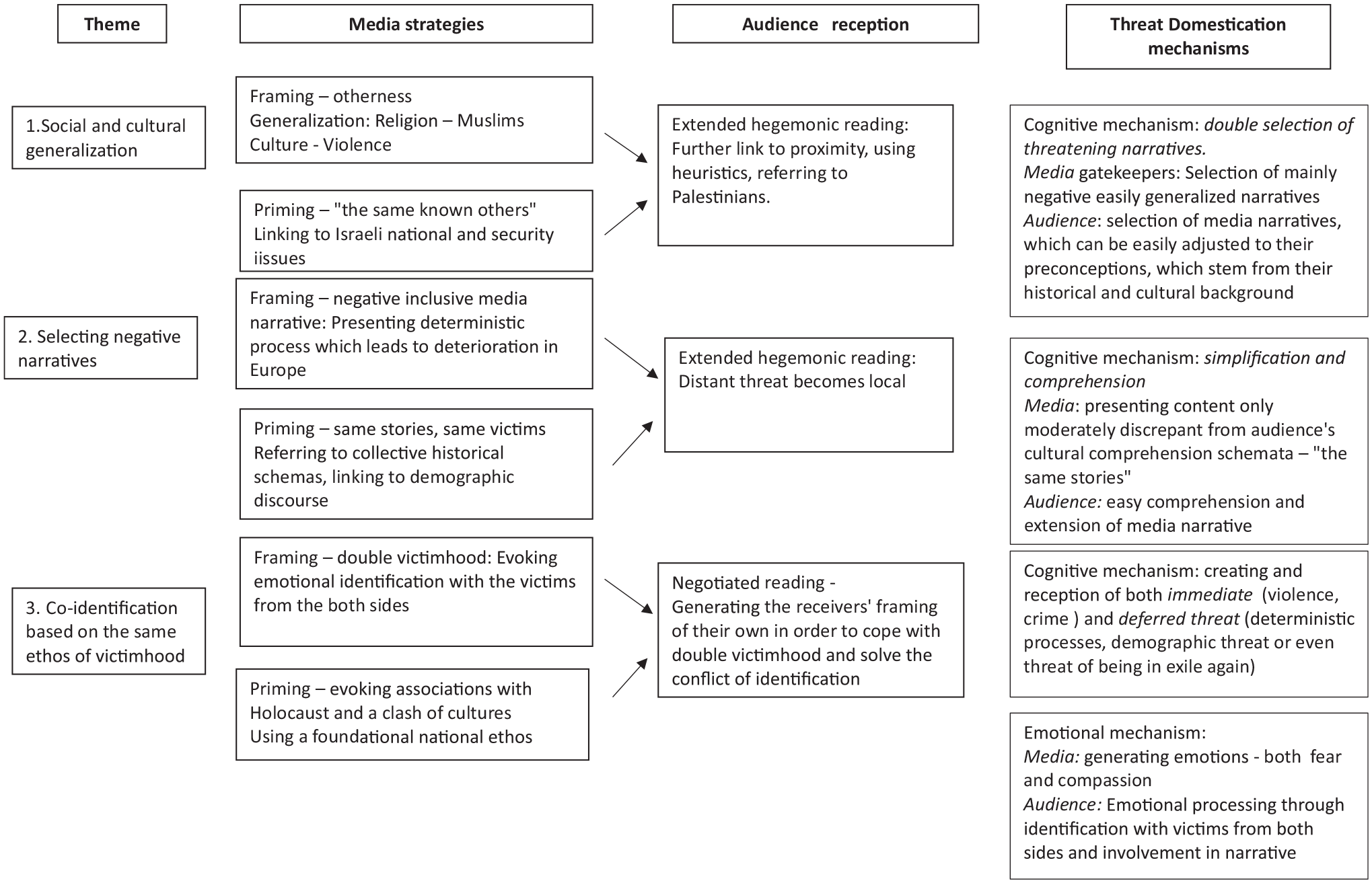
Findings summary and distant threat domestication mechanisms.
First and foremost, there is a double selection of narratives perceived as threatening. From the spectrum of narratives pertaining to the experience of asylum seekers in Europe, media gatekeepers provide the Israeli media audience with stories of crime and violence, underlining their Muslim religion and their unbridgeable cultural “otherness,” compared to European residents. Since Israeli heavy media consumers chose to be exposed to and, over a relatively long interval, were able to recall such narratives from the large variety of media stories, we may assume that such media stories are easily adapted to their social, political, and cultural preconceptions. In other words, the audience is likely to selectively perceive and expose themselves to information that aligns with their pre-existing beliefs and values (Cohen, 1963). In this way, media consumers become the last circle of gatekeepers, making the final media content selection after the politicians and journalists (Alasuutari et al., 2013) by choosing, remembering, and identifying with the events and narratives, and then relating them to their own experience.
What seems apparent is that Muslims from the media narratives appear “as the same known others,” further linking these narratives to the Israeli national and security ethos, which for decades has been a focus of Israeli media and political discourse. Thus, media consumers expand the religious aspect of others (Muslims) to include the national aspect (Palestinians). We suggest defining such a process as “extended hegemonic reading,” as the audience not only fully accepts the media messages as Hall (1980) hegemonic reading, but extends it by further heuristic linking to the local “others” – Palestinians.
The media analysis provides evidence of a simplification of the media narrative, which resonates with Galtung and Ruge’s (1965) criteria of foreign news clarity and one-dimensionality. Presenting simple recurring “good vs. bad” media narratives, which are only moderately discrepant from the audience’s cultural comprehension schemata, facilitates easy comprehension of such media narratives. Moreover, creating both immediate threat (violence and crime) and deferred threat (deterministic processes in European countries) easily evokes schemata of prolonged Israeli demographic discourse on preserving the Jewish majority in the Jewish state. Furthermore, addressing deterministic processes which may lead to inevitable changes in European demography and accordingly make possible political, social, and cultural conversions, provokes deep-rooted Jewish fears of exile. The audience’s reaction to such media domestication mechanisms is full acceptance and expansion by erasing geopolitical boundaries when the distant threat becomes local. Thus, in this case the audience responds with extended hegemonic reading.
In emotional terms, the media confront the audience with a double victimhood phenomenon. The Muslim “invasion” of EU countries is seen through the lens of both the Holocaust and the history of conflict with Palestinians and the Arab world more generally. On the one hand, it challenges the audience to choose with whom it identifies, but on the other, it activates strong emotional reactions, playing on audience preconceptions as they identify either with EUAS as those who fled from mortal danger, or with the European residents, as victims of a clash of cultures. In the first case, the narrative evokes the Holocaust founding ethos – the keystone of socialization in Israel and Jewish identification.
In the second case, the seemingly “bad Muslims” in Europe are understood to be similar to those in Israel and the resulting identification is therefore with the locals. Both identifications provoke two ostensibly opposite emotional reactions – fear and compassion – which stimulate an emotional processing of the media narratives, promote cognitive processes and initiate involvement in the narrative and in the audience’s creating its own framing. Thus, co-identification based on double victimhood provides an example of negotiated reading. The media consumers consciously and actively add to domestication of the content so that it both comes closer to the local contexts and communicates with the consumers’ lives and perceptions. That is, we find that consumers produce their own domestication framing, where the media’s hegemonic framing is accepted, but also negotiated with or added to and expanded to mirror their local lives.
Although the public views reflect ambivalences, by highlighting perceptions of “Muslims taking over Europe” together with some sympathy for the migrant condition, the focus is on the media framing of EU asylum seekers in Israel as a source of threat. However, it’s crucial to recognize that this portrayal is based on interpretation, and the actual threat is contingent. Thus, the real concern lies in the social implications of these threat perceptions.
Considering our findings, it may be concluded that the media available to Israeli consumers present mostly simplistic, one-dimensional generalizations and refrain from presenting the complexity of the subject. As such, it avoids the many perspectives and processes that lead to immigration and its various consequences, positive as well as negative. In turn, the informants provide very reductive, angst-filled and generally stereotypical interpretations of media coverage. Thus, in some cases the domestication mechanisms can be an effective tool for manipulating heavy news consumers and their opinions about the EUAS crisis.
In considering our findings on the domestication of remote threat to local soil, Israeli foreign media gatekeepers – politicians and journalists – should be aware that the manner in which the remote group is described, categorized, and represented is of importance to the Israeli context. Media framing of remote groups and events can have important, long-lasting local consequences, most obviously including social and political implications. Furthermore, the potential exploitation of negative media presentations, especially in contexts where politicians in power may perceive such portrayals as advantageous rather than detrimental, warrants careful consideration.
Although the EUAS crisis might not directly affect Israeli reality, by referencing national and personal security, the economy or other factors, media content creators give people a reason to take more interest in this issue than might actually be warranted. Their stories, in order to pass the newsworthiness criterion, covertly encourage ethnocentrism and entail excessive emotional involvement. In many cases, this reinforces fear, anxiety, and threat, which is generalized by consumers from the distant to the local context and may potentially hurt local intergroup relations. Moreover, if unregulated, such framing of foreign news may fuel further interpretations among media consumers, potentially amplifying the dissemination of media-conveyed ideologies and exacerbating their influence on local culture. In order to maintain the democratic, liberal, and non-biased nature of the press, critical intervention is required. To that end, awareness of these trends should be raised, by alternative and independent media and by the press associations which operate as platforms for media accountability in Israel (Lemelshtrich et al., 2021). They should issue calls for a change in coverage. Strengthening such organizations alongside other regulatory mechanisms, such as implementing media ethics codes, ensuring transparency in media ownership, and regulating social media platforms, can promote responsible journalism and ensure that media representations align more closely with the realities they depict.
The current study provides new theoretical insights and makes several contributions to literature. First, it reveals domestication mechanisms from the as-of-yet unexplored media consumer point of view (Scammell and Bielsa, 2022) and it adds another dimension to the forms of reading outlined by Hall (1980) – the extended reading. In doing so, it reveals that media consumers are the final framers. Second, it focuses on the domestication of threats from distant outgroups to local environments, which are vaguely similar to local minorities (ethnic minority Israeli Palestinians who are not immigrants). In this point it joins the very few studies exploring perceived threat toward geographically remote outgroups (Bouman et al., 2014, 2015), defining and explaining how distant threat from EUAS was carried over to the Israeli media ecosystem. The mentioned studies do not focus on foreign media domestication mechanisms as the sources of intergroup threat. Thus, the current study adds an overlooked intergroup threat source to the literature – media domestication mechanisms of distant threatening events. We assume that with the growing dimensions of globalization and migration as well as technological revolutions in communication, this threat source and its consequences for intergroup relations will receive more significant attention over time.
Study limitations and recommendations for further research
The main limitation is that this study focuses on the media in Hebrew intended for the majority group – the Jewish population – and examined only one interpretive community. Therefore, how Israeli minority communities might respond to news coverage of the asylum seekers in the EU is not considered. As disadvantaged groups are likely to decode the dominant media messages through negotiated or oppositional readings (Scott, 2003), it would be interesting to compare the decoding of the same messages regarding EUAS among Israeli Jews and Israeli Palestinians (Muslims, Christians, and Druze separately). Further studies are needed in this field. In addition, the representation of local outgroups in local media was not considered in this study. Future research should focus on this issue to have a more comprehensive understanding of the variables influencing intergroup relations.
Footnotes
Appendix 1
Appendix 2
Content analysis – sample description (Study 1).
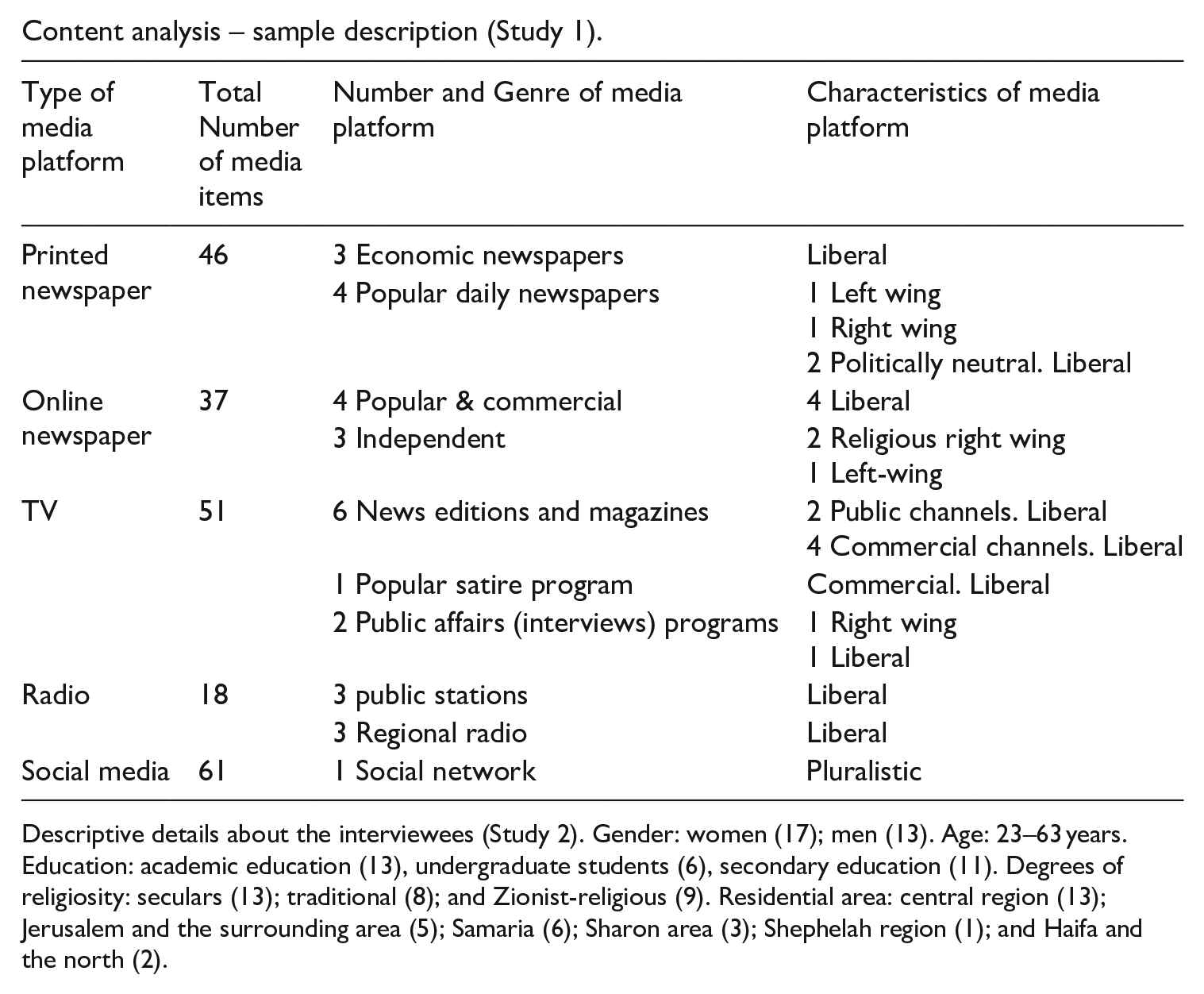
| Type of media platform | Total Number of media items | Number and Genre of media platform | Characteristics of media platform |
|---|---|---|---|
| Printed newspaper | 46 | 3 Economic newspapers | Liberal |
| 4 Popular daily newspapers | 1 Left wing 1 Right wing 2 Politically neutral. Liberal |
||
| Online newspaper | 37 | 4 Popular & commercial | 4 Liberal |
| 3 Independent | 2 Religious right wing 1 Left-wing |
||
| TV | 51 | 6 News editions and magazines | 2 Public channels. Liberal 4 Commercial channels. Liberal |
| 1 Popular satire program | Commercial. Liberal | ||
| 2 Public affairs (interviews) programs | 1 Right wing 1 Liberal |
||
| Radio | 18 | 3 public stations | Liberal |
| 3 Regional radio | Liberal | ||
| Social media | 61 | 1 Social network | Pluralistic |
Descriptive details about the interviewees (Study 2). Gender: women (17); men (13). Age: 23–63 years. Education: academic education (13), undergraduate students (6), secondary education (11). Degrees of religiosity: seculars (13); traditional (8); and Zionist-religious (9). Residential area: central region (13); Jerusalem and the surrounding area (5); Samaria (6); Sharon area (3); Shephelah region (1); and Haifa and the north (2).
Data availability
The dataset is being used for the first time.
Funding
The author(s) received no financial support for the research, authorship, and/or publication of this article.
Ethical approval
The research was approved by The National Institutes of Health (NIH) Office of Extramural Research.
The Certification Number is 2365926.
