




Abstract
Graffiti is widely used in social movements globally, yet media and communication research disproportionately focus on the role of social and new media technologies in protest movements. In this paper I ask why university students – a tech-savvy generation – resorted to graffiti and why campus graffiti were not widely circulated on social media during the Hong Kong anti-Extradition Law Amendment Bill (ELAB) protests. I argue that graffiti enables dispersed resistance and is one way to mobilize, voice dissent, and preserve memory in an increasingly surveilled and evolving repressive media environment. I pursue this argument by analyzing graffiti photographed on university campuses during the anti-ELAB protests. Situating graffiti within protest culture in Hong Kong, I conclude that graffiti are not always circulated on digital/social media to reach a broader audience. In times of crises, not reaching a wider audience is a manifestation of dispersed resistance in a hybrid media environment.
Keywords
Introduction
In November 2019, 9 months after the start of the anti-extradition bill (ELAB) protests in Hong Kong, some universities had transitioned to online classes for a second consecutive semester. (For a chronicle of how the movement progressed and major events see Cheng et al., 2022; Lee et al., 2019.) University campuses, however, remained open with limited access to amenities, and students who chose to, could go onto campus. Walking through university campuses during this time, one could not help but notice the abundance of graffiti comprising texts and images sprawled across walls and walkways. Some disappeared only to be replaced as fast as they were erased. The extensive use of graffiti on campuses raises the question of why the most digital media savvy population – college students – chose to employ the use of graffiti as a manifestation of on-campus protest against the extradition bill? What relationships exist between the use of this age-old form of mediation and students’ simultaneous participation in digital and social media organizing on and outside campus?
This paper takes as its starting point two existing assertions: the first is that popular and media discourses about protest movements and activism largely focus on the justifiability of the cause and the resulting support it garners, its successes/failures, as well as sacrifices made to achieve its ends. This engagement inadvertently results in thinking about social movements in dichotomies that are taken for granted as neat categories. The second assertion is that media and communication research on activism and social movements has largely focused on the role of digital and new media in mobilizing, resisting, and evading censorship and oppression (Bennett and Segerberg, 2013; Christensen and Garfias 2018; Kelly Garrett, 2006; Little, 2016; Mercea, 2012; Poell, 2014). This shifts the focus to media platforms and technologies and how they aid the successes or failures of protest movements (Bennett et al., 2014; Brym et al., 2014; Olorunnisola and Martin, 2013; Tremayne, 2014). Where non-digital forms are engaged with, there is often a signaling of the role of social media in circulating non-digital forms such as graffiti to a wider online audience (Cappelli, 2020; Li and Prasad, 2018).
This paper asks what the Hong Kong anti-ELAB protest and its manifestations on university campuses can tell us about media, the visual, and activism in an evolving repressive environment. The notion of an evolving repressive environment is important for understanding the limited circulation of graffiti to other media platforms. These are locales that are rapidly becoming repressive and thus ridden with both present and future uncertainties of acts of protests, as has been the case in Hong Kong, which has a history of “peaceful orderly civil disobedience” (Lee, 2020). This is to be distinguished from overtly authoritarian or illiberal spaces. In the case of the 2021 Myanmar protest, for instance, the military junta took power in 1962 for 26 years. The return of the junta in 2021 was understood through the historical memory of how they operate. Hence, there was knowledge of what to expect and space to come up with (not always effective) ways to contest the system of repression. The Hong Kong anti-ELAB protest was built on the historical memory of protests from the 1960s to the 2014 Umbrella Movement, which were rarely violent. Protest movements in Hong Kong prided themselves in maintaining public order and hence was regarded as one with a conservative protest culture (Lee, 2020). This is evident in the early days when joining protest movements became, for some, a family event – families with their elderly and children came out to join marches on the streets of Hong Kong. The mass movement received overwhelming public support manifested in various ways. The protest march on June 16 saw an estimated 2 million participants out of Hong Kong’s 7.5 million total population (Griffiths et al., 2019). This support also manifested in the 2019 district council elections, which had the highest voter turnout (71.2%) in Hong Kong’s electoral history, with pro-democracy candidates winning 85.39% of seats compared to 28.77% in the previous election (Lam, 2021). As the protest grew, so did suppression and subsequent clashes, while at the same time, that which one could be charged with became a fluid, indeterminate, growing list codified under the National Security Law. More importantly for this paper is how this growing uncertainty shrouding social media and other public digital media expression, including arrests for social media posts (Amnesty International, 2020), influences media use for expressing dissent. In environments where protests are more likely to encounter state discipline, graffiti serves as both a site and mode for decentralized resistance and, in the case of Hong Kong, anonymity.
University campuses, extensions of this broader mass movement, had become (or were thought to be) safe spaces for expressing views, getting involved, or mobilizing support for the protest. In addition to mobilization and expression on media platforms such as LIHKG and Telegram, creative ways of expressing support for the movement and dissent against authorities included coordinated shouting of protest slogans “Liberate Hong Kong, revolution of our times” (光復香港,時代革命) or “five demands, not one less”(五大訴求,缺一不可) at 10 pm daily through open windows of residential buildings. These means of expression, public or private, have given rise to resistance dispersed across the territory. Based on 317 graffiti images photographed on university campuses by the author and a colleague during the Hong Kong anti-ELAB protests, I examine protest graffiti and ask: what can on-campus protest messaging tell us about media and protest culture in Hong Kong and beyond. This article contributes a nuanced understanding of hybrid media communities, and protests and activism in global media and communication.
Media, activism, and visual rhetoric
Social movements are built on visibility – broadly construed as seen, heard, felt, or experienced in varying ways in different movements. Protest movements are meant to be heard and seen (McGarry et al., 2020); they take the form of “repeated public displays” (Tilly, 1999: 257).The staging of a spectacle affords visibility on which protesters express messages, demands, and concerns. A visibility so uncomfortable that it pushes parties to engage, communicate, and in many instances begin (or go back to) negotiations. “The goal of activism is Action to generate an Effect (emphasis in original, Duncombe and Lambert, 2018: 63). Leaders of movements emerge as spokespersons and sometimes heroes in light of this visibility. This is leveraged in many cases to issue statements that are widely covered by media outlets – domestically, internationally, or both – giving these individuals some degree of stardom regardless of the price on their own lives and livelihoods. Recent social movements in East Asia and the Middle East have, however, shown movements dissuaded from highlighting leadership who, in repressive environments, often serve as scapegoats. Visibility and media coverage serve to bring to bear concerns that trigger these movements for those who are not (actively) participating, thus, cultivating supporters, sympathizers, participants, or otherwise. For those who learn about protests through media, framing of protests as either legitimate or confrontational yield support for protestors on the one hand or police response on the other (Brown and Mourão, 2021). Beyond framing, the (perceived) positionality of media outlets play a role in shaping how protests are presented. A projection of neutrality therefore remains problematic, particularly by established news and media outlets.
Rapid development of new media technologies and platforms offers a layer of democratization of who gets to tell stories about these movements. Although more individuals and groups get to participate in creating narratives around protests, issues of audience reach, and perceived credibility persist in how and whether some people consume these narratives. This fast-paced development has conditioned an interest in media technologies’ impacts on protest outcomes (Hermanns, 2008), leading to investigations into the role of media technologies in mobilizing support, boosting participation, and/or achieving protest outcomes. Viewing media as instrumental to the needs of protest movements, however, places an overemphasis on media technologies and platforms. This emphasis overtly or implicitly suggests a newness and endless growth, one that Kraidy (2013) refers to as the “technological fetish for the new” and goes on to demonstrate historical equivalents of media use. Engaging in forms that precede the internet, such as graffiti, helps us understand the active coexistence of older forms with newer forms of emerging media as complementary. Examining graffiti in the Hong Kong protest allows for a conceptualization of media in protests not in a utilitarian way (i.e. in service of) but opens the possibility of viewing media in and of itself as activism.
In the past decade, nuanced work exploring a hybrid media community has recognized the interconnectedness of different media forms (Baird, 2022; de Ruiter, 2015; Lindgren, 2013; MacDowall and De Souza, 2018; Natale and Treré, 2020; Treré, 2018a, 2018b). This approach shifts away from the notion that media are solely tools for social movements. Treré (2018a: 1) challenges this assumption, contending that social movements offer a rich context for exploring the complexities of communication technologies in digital societies.
In this paper, I pursue two concerns highlighted by hybrid media and activism research. First, I examine the fluidity of the online/off-line and physical/digital divide (Treré, 2018a: 208). Second, I explore the tension between new and old media, emphasizing the strategic deployment of existing media forms amidst rapid adoption of newer technologies. Despite increased acknowledgement, older media forms receive less attention, as seen in research on the Hong Kong anti-ELAB protest, which has predominantly focused on reportage and the use of new media technologies.
Built on visibility, protest movements are in many ways communicative acts (Treré, 2018a: 204). We are reminded not to take for granted the term visual activism because it raises questions about how regimes of the visible and boundaries of activism are defined (Bryan-Wilson et al., 2016). Instances of visibility embody inseparable instances of invisibility and vice versa (Minh-ha, 2016). Research on visual activism has also revealed the evolving landscape of media technologies and platforms that afford access to a potentially wider reach for visual acts of protest. This wider reach, made possible by platforms and digital media, does not account for contexts in which (individualized) visibility does a disservice to the cause of social movements by endangering the lives and livelihoods of participants. In a related study on graffiti in Egypt, de Ruiter (2015) observes graffiti writers circulating their art online, pointing to a hybrid media culture . In the context of the Hong Kong anti-ELAB protests, I argue that the decision of protesters not to circulate graffiti texts online was a strategic one. This choice aimed to achieve visibility while being mindful of the evolving repressive political environment in Hong Kong and the potential repercussions of traceable visibility during that period. Even outside protest movements, graffiti writers grapple with legal considerations because graffiti is often classified as “vandalism” and tend not to be claimed or shared by writers (Baird, 2022). A look at the interstice of digital and older forms of media enables us to better understand recent challenges social movements face; not only do new technologies but also older, non-digital forms of media enable protestors to navigate (un)certain spaces and thus offer a nuanced view of hybrid media and activism.
To be sure, digital media played a major role in the mobilization and narration of the Hong Kong anti-ELAB protests and accordingly have received attention elsewhere (Lee et al., 2020; Reichert, 2021); they have also served to keep alive networks of protests in the aftermath of mass mobilization (Lee et al., 2020). I suggest that other forms of visual media, which have received less attention in this protest movement, have persisted in ways that transgress their symbolic value and deserve attention.
At the proposal of the anti-ELAB in Hong Kong in 2019, protests that started out as peaceful marches turned violent over time. At the violent turn, young people became central to the movement, whereas fewer older people were found at the front lines. Out of 2379 people arrested for participating in protests as of October 2019, 40% were under 18 years old, and 10% were under 15 years old (Reporter, Guardian, 2019). Despite the overwhelming support for the mass movement, rifts surfaced in some familial, professional, and personal relationships over polarized debates as to the direction of the protest movement (Khan, 2019). Like previous protests, the ultimate goal was the democratization or de-Sinicization of Hong Kong. Unlike previous protests, university campuses were among many sites of protest activities. This is also testament to the involvement of the youth in protests, which took the form of an active standoff and subsequent siege at the Chinese University of Hong Kong and the Hong Kong Polytechnic University. As these encounters unfolded, students in other universities barricaded entrances and set up makeshift blockades. The University of Hong Kong, for instance, resembled a wasteland after a zombie apocalypse in anticipation of a siege. These all-too-familiar sights of protests emerged on campuses in various proportions but were driven by ideologies underpinning the broader movement. Campus protests spoke to students through graffiti sprawled on the walls and walkways. These spaces became symbolic of the power of resistance. Contestations over these spaces were evident in the cycle of cleaning and reinscribing of graffiti.
Graffiti served as a space for performing identity and placemaking. They were widespread across the city’s public spaces and at one point in the chamber of the legislative council. University campuses were marked as sites of protests through graffiti slogans, paintings, and circulation of posters that drew on historical and contemporary events in China and around the world to express their stance on the ongoing protest in Hong Kong. Graffiti became territorial markers and have been used elsewhere to claim place (Peteet, 1996) and as space for discourses that would otherwise not make it into mainstream media (Kraidy, 2013). As a media form, graffiti is polyvocal and “a form of communication that is an unedited mirror of culture” (Lovata and Olton, 2015: 14) allowing for various forms of textual and visual expression.
Who is the protestor? Identity without identification
The Hong Kong anti-ELAB movement was different from previous protests in Hong Kong in that although it was a collective action, it sought to remain leaderless. It drew on lessons from the umbrella movement, in which negotiations with the government by representatives did not yield significant achievement of demands. Instead, the anti-ELAB movement put forward five demands: withdraw the extradition bill, drop the charges against protestors, stop referring to protestors as “rioters,” open an independent inquiry into police conduct, and implement universal suffrage. These demands were echoed through slogans, graffiti, and posters plastered on walls with an insistence that all five be met as iterated in the slogan “five demands, not one less.”
Protestors sought to be recognized as a collective. This collective identity was further complicated by the nature of the protest, which sought to be faceless for fear that through negotiations, their demands would be compromised and later on in the movement for fear that protestors might be apprehended. This complicates the familiar progression of protests built on visibility to achieve negotiations. The question of “who is the protestor” remained an important, contested, and performative one. Spearheaded unofficially with the active involvement of student unions, campuses became one of many sites of contestation for modeling the protester. There was neither an individual site, nor person recognizable or identifiable as the face of the anti-ELAB protest movement. On campuses however, emerged the figure of a young female wearing a gas mask, helmet, and protective goggles and carrying a backpack, an umbrella, and a protest banner (see Figure 1). The female body is used as site of contestation. It highlights the valiant female involvement in the movement while at the same time showcasing the female body as site of vulnerability and of all that was being done to the people of Hong Kong. This is reflected in discourses of police involvement in physical and sexual abuse during the protest. It is also traced to a young woman who was allegedly shot in the eye with a bean bag by police. Despite embodying the atrocities and contestations, the face of the figure is undiscernible; it is obscured by the gas mask, helmet, and goggles, reiterating the “facelessness” of the protest. This figure is also laden with references to methods used in the ongoing movement but also to the historical umbrella movement, evident by the presence and continued use of the umbrella both as a symbol of resistance and a tool of protection. This figure was prominent on campuses, with stencils of the figure sprayed on walls. Beyond reproducing this graffito, an impressive sculpture of the figure of the protester, referred to as Lady Liberty, traveled to locations including university campuses, where it stayed on display for a period of time. This sculpture and image, modeled after the lady shot in the eye, was crowdfunded on social media platforms used by protest groups, collaboratively designed by a team, and voted for as the icon of the movement, thus, demonstrating the hybrid use of different media for internal mobilization and external political communication.
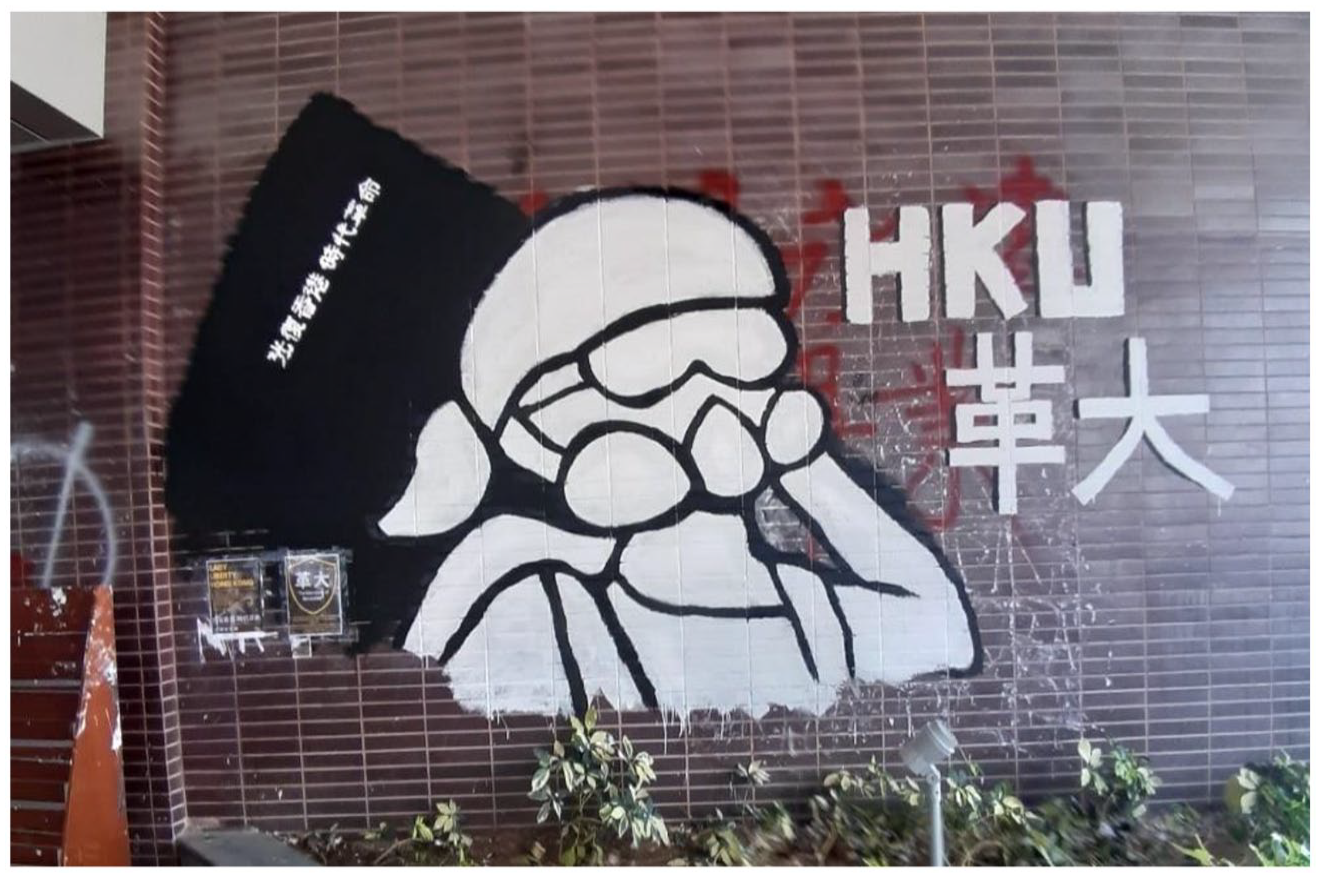
The protester.
Although protestors on campuses sought to build a collective identity, as legitimate participants in the struggle of the times, they sought not to be identified individually but to identify with the icon of the movement. Identifying with the icon of the protest and its manifestation in on-campus graffiti served to mark campuses as sites of protests and to claim control of the university space by overtly displaying spectacles through graffiti. The accompanying text in this graffito sheds light on this space-making. The acronym “HKU” stands for “Hong Kong University,” and its Chinese equivalent is 港大, the short form for the University of Hong Kong (香港大学). The Chinese text in Figure 1, geda “革大,” is the acronym for “university of revolution” (革命大学) and a play on the name of the university. This renaming was found in many sites within this university, particularly wherever the name of the university was officially inscribed. Graffiti was used to mark the university as a site of protest where student protestors claimed legitimacy not as bystanders but as an integral part of the ongoing movement and as one site of this dispersed resistance. This claim does not go unchallenged. In graffiti critical of this branding, the audacity (资格) of claiming to be the “university of revolution” (革大) is contested. This brings to light the internal contestations of how much one should do to be considered an active protestor. Collective identification with the icon also provided flexibility to interpret how one could be involved in the movement. The icon, as opposed to a person, is open to interpretation because it does not and cannot suggest directives as opposed to a leader who might suggest appropriate actions for participants.
Mobilizing through graffiti
Graffiti played a practical role in the mobilization effort on university campuses. They served as signage to direct people to supplies ranging from food and water to first aid and protective gear (see Figure 2). Protest activities led to the temporary closure of businesses, including crucial ones in the service industry. On campuses, universities pivoted to online learning, which resulted in a drop in the student presence; hence, fewer restaurants and canteens were open, whereas others closed out of safety concerns. Supplies for self-preservation such as food and first aid, in addition to those needed to launch a preemptive offensive, such as materials for Molotov cocktails, were mobilized. Graffiti enabled participants to locate these resources in an often-chaotic setting. This obvious and overt signage, available for all to see including university security and authorities, speaks to the conceptualization of campuses as safe zones, even though their gradual erosion was imminent (I will discuss this in the next section). Earlier stages of protests saw students expressing their concerns and rage through graffiti. A dean of students at one university was touring the campus and interacting with students while inquiring about their welfare without attempting to stop them from spray-painting walls. Universities contracted private security forces not to prevent students from this mode of expression but to prevent non-student access to campuses and participation in on-campus protest activities. This points to campuses as the last albeit decaying bastions of accommodating expression of dissent. Students were neither stopped nor fined to fix damage to property, although the idea was considered by some universities.
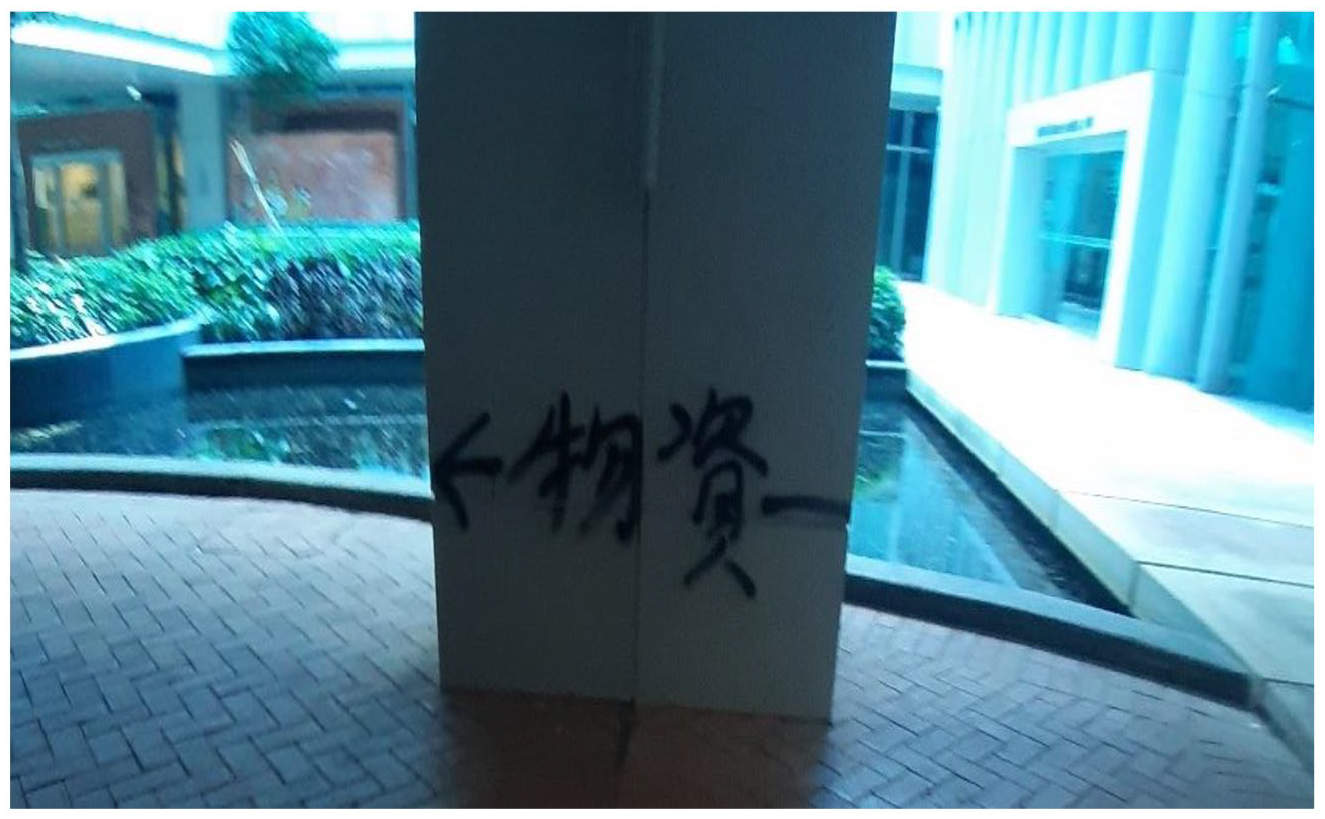
Signage.
Some graffiti messaging was targeted at mobilizing participation in collective action. One of these calls to action was the “three boycotts” (三罢). This was a wider call to boycott classes, work, and businesses across the city. Graffiti were used to take up this call to mass mobilize students to partake in this proposed collective boycott. “Boycott class” (罢课), the call that resonated with students, was the first to be widely circulated on campuses. Universities took the stance of ambivalence; where classes continued, students who did not show up were not directly penalized but were responsible for making up for the content. This call resonated with various students differently. For high-achieving students, who in an overly competitive job market, hoped to make the best grades, and for international and exchange students who had to carry credit, were paying high fees, or had scholarships tied to their grades, this was not the most pragmatic action. Students from mainland China, who were often caught in between discourses driving the movement, and who endured the brunt of anti-China rhetoric and sometimes personified what was being contested tried to stay out of the limelight. And yet there were some who did not see what boycotting classes on campus could achieve. Other calls for boycott, such as “boycott work,” were met with varying views. Some protestors blocked off roads to make it impossible for people to get to work. Protesters used discursive strategies to appeal to colleagues to join the boycott of class. Some appealed to emotions including those that invoked the memory of those killed in the movement to appeal to students (see Figure 3) to boycott classes.
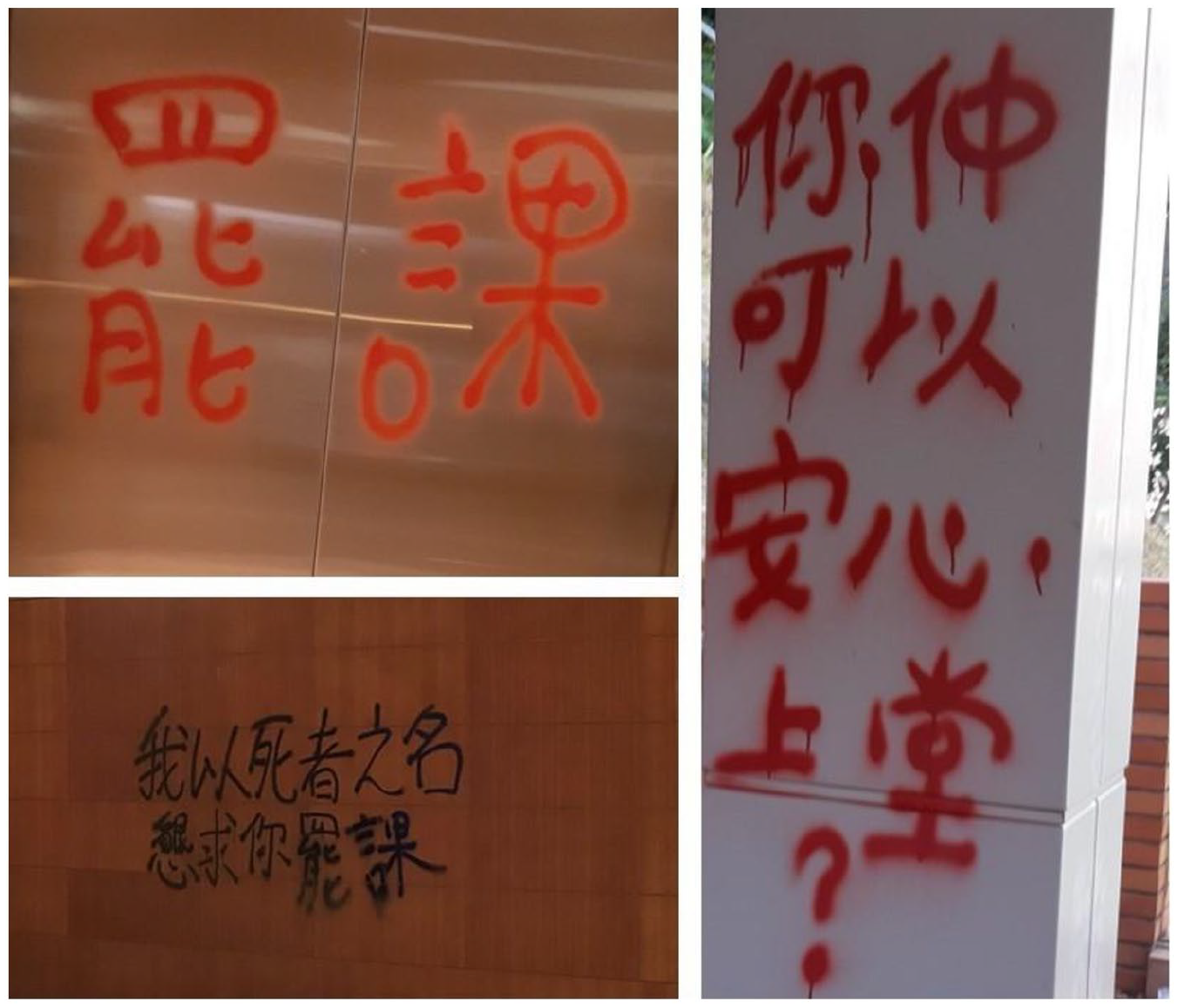
Rallying cry for support.
The graffito to the right of Figure 3 translates “How can you feel safe to go to class?” The color of the paint is red with a bold font that makes the characters legible from a distance. At various points in the sentence, the red paint drips, not so much that it obstructs other characters in the sentence but enough to be visible. This style suggests blood dripping and speaks to one of the major concerns of students, that students had been brutalized and killed by the police, who were supposed to be protecting them. Both the text and the style appealed to the emotions of students; read together, they placed the martyrdom of some in comparison with boycotting classes for the cause and drew on guilt while posing its question.
Erosion of campuses as safe zones
Until the 2019 protest, university campuses in Hong Kong were thought to be safe spaces, spaces of dissent, of freedom of expression, and of thought. This was demonstrated by the presence of “democracy walls” across multiple universities across Hong Kong. These are Lennon walls, where students were free to post their views. They became spaces where both pro-Beijing and anti-Beijing sentiments alike could be posted and responded to. Institutionally, the “Pillar of Shame” at the University of Hong Kong, the “Goddess of Democracy” at the Chinese University of Hong Kong, and the “Tiananmen Relief Sculpture” in Lingnan University, all of which were monuments commemorating the 1989 Tiananmen crackdown, were symbols of this freedom. Topics that could not be publicly discussed in mainland China were offered spaces to be publicly displayed on publicly funded university campuses in Hong Kong. Campuses were thought of as autonomous spaces shielded from law enforcement. The police could not go onto university campuses without the permission of university authorities. In a gradual erosion of these spaces of safety, these monuments became subjects of controversy, and universities took them down without any prior notice or indication, in many places at dawn or midnight. According to these institutions they acted according to the advice of their legal teams to reduce potential legal risks.
The symbolic act of taking down monuments during the protest movement sent a strong signal that universities, the last bastion of freedom of expression, were no longer safe spaces. This was preceded by the entering of the police onto a university campus without the knowledge of university administration, thus breaching existing protocols surrounding police access to university campuses (Un, 2019). With the fear that campuses were no longer spaces immune from law enforcement, students, in anticipation of similar breaches later in the protests, set up makeshift barricades with pavement bricks, chairs and tables, and dustbins among other materials. According to Xi and Ng (2021), “understanding who has access to the action space, how the space is physically and symbolically represented, and what kinds of behaviors are considered acceptable in the space can affect the scale, pattern, and results of the collective action.” For student protestors, police activity on and around campuses was an act of taking over the last sanctuary that provided safety from the central government. During this period, graffiti, among other reasons increased to stake claims on university campuses, that they belong to the students and not law enforcement. This mirrors Doherty’s (2011: 191) observation that graffiti and murals in Bahrain were used to stake territorial claims. They were extensively used at the entrances and blockades leading onto university campuses to question the denial of law enforcement of breaking a sacred bond and defiling the university campus (see Figure 4).
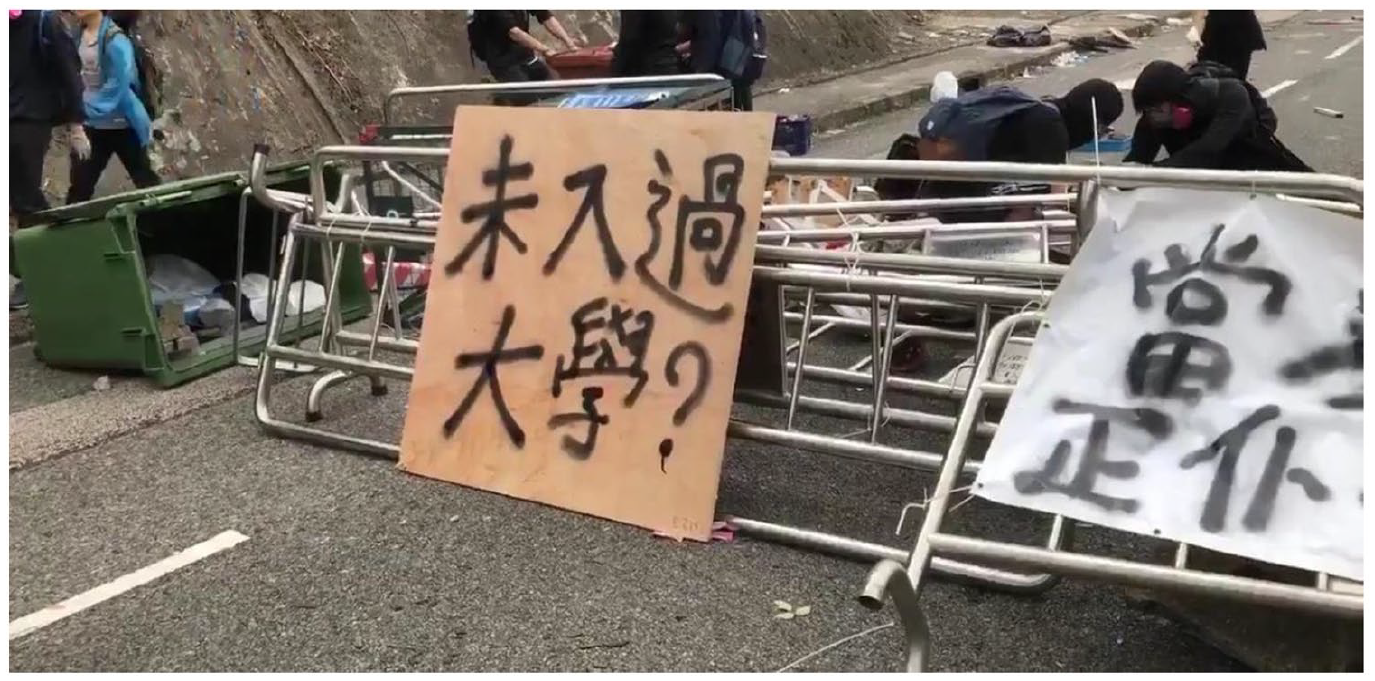
Contested narratives.
Graffiti became one major mode of external political communication on campus. Apart from providing signage to crucial resources, graffiti mobilized students. Despite the growth in graffiti produced on campus, they did not circulate extensively on social media, even though participants of campus protest movements constituted a demographic highly engaged with social media. Indeed, some of these individuals may have been simultaneously involved in mobilization on other digital and social media platforms such as LIHKG and Telegram, but the spectacle produced by graffiti was not, as has been previously suggested (Cappelli, 2020; Li and Prasad, 2018) widely circulated on social media for visibility. The rhetoric in on-campus graffiti was largely consistent with the messages produced outside campuses. Graffiti used in the anti-ELAB protest were not tagged or signed by authors, providing anonymity and a less traceable footprint in the uncertain evolving repressive environment shrouding the protest movement. This highlights the challenge of using digital media in an age of increasing state surveillance and anticipated surveillance of protest movements around the world. What was once perceived as a safe, anonymous space – cyberspace – I suggest has proven to be compromising, regulated, and easier to surveil and track.
Documenting social movements for the present
Visual activism on university campuses served as record keeping. It documented police atrocities through text and images. Discourses of police brutality were central to the anti-ELAB movement, whose evolving violent nature was framed as a response to police brutality on peaceful protestors. Record keeping using graffiti publicly documented police activity surrounding protests as a way of challenging official narratives of protestors turning violent without provocation. Information boards, modeled after the Lennon walls, emerged across the city and could be seen from metro stations to restaurants to malls, creating space for interaction. Most Lennon walls comprised hundreds of sticky notes with growing numbers of messages of support. Lennon walls grew across campuses and meticulously documented episodes of violence, particularly of police heavy-handedness and crimes against often helpless innocent citizens without any provocation. They also provided timelines of major events, (see Figure 5) of police atrocities, and the responses they triggered from protestors.
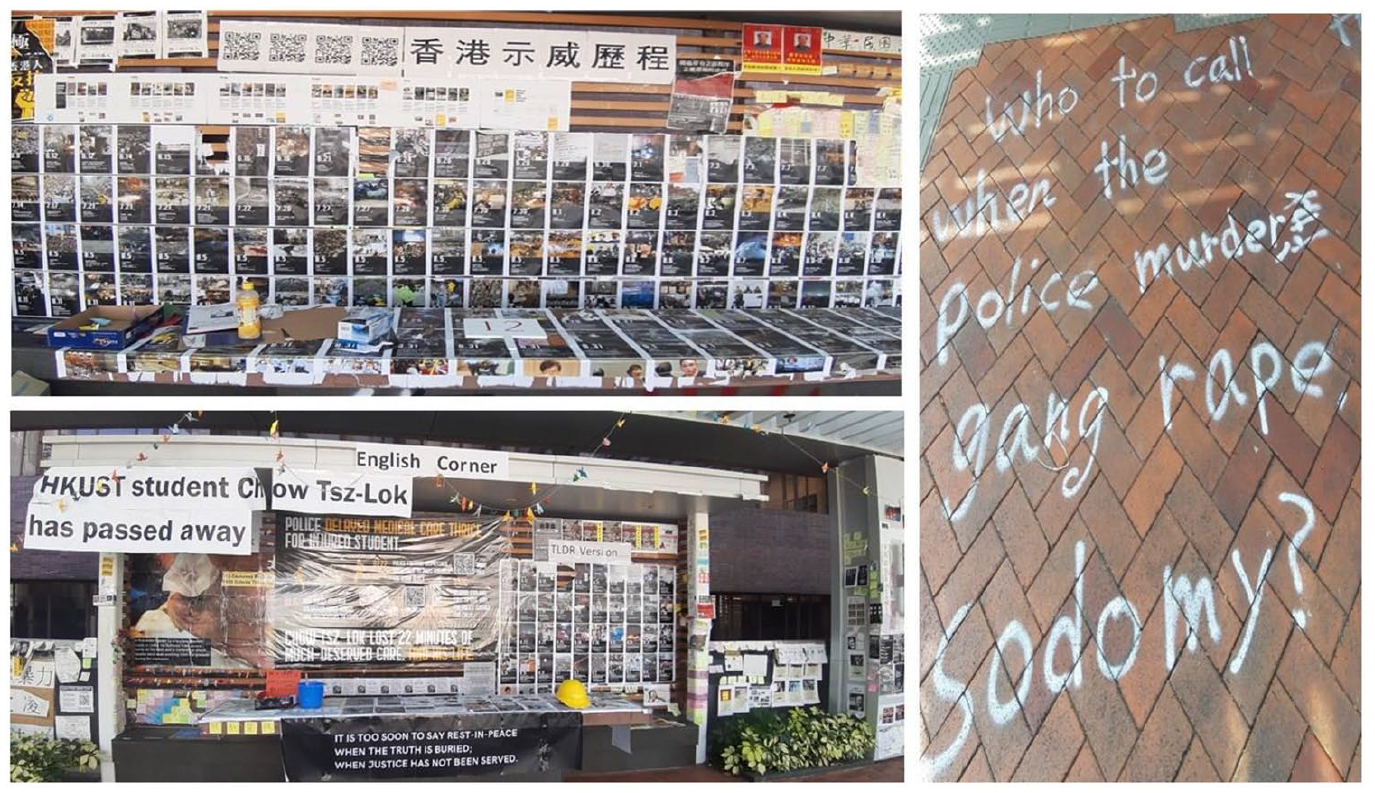
Documenting police atrocities.
Graffiti displayed vivid, compelling, and gruesome pictographic evidence of claims of police brutality. This achieved two things: first, it provided information and backed up calls for students to participate in stopping the ongoing injustice by authorities. The top image of Figure 5 begins a meticulous recounting of major events from June 9, 2019. Some events were so impactful that they deserved a space of their own; one was a monument to a student who was allegedly killed by police, Chow Tsz-Lok. Incidences that led to their death are recounted, and a memorial created for the student. Death is memorialized here – death of people, of freedoms, of liberties – and echoes Sharaf’s (2015) observation of the memorialization of many types of death. For those who thought of the movement as having little to do with them, this was an indication that even innocent students could be victims of an increasingly oppressive system. The right image in Figure 5 highlights frustrations against the police and rhetorically questions what is to be done when those who are supposed to protect commit atrocities.
Meticulous public documentation and framing of police actions contested state-led narratives that sought to delegitimize the protest movement. The first was a change in discourse surrounding participants; this took the form of a rhetorical shift from referring to participants as protestors to rioters. Additionally, police heavy-handedness was framed as a response to the illegality and destruction caused by protests. These messages called on students to remember these occurrences and not forget as the authorities would like them to. Graffiti served as a space for counter hegemonic discourse of the “violent protester” and the “reasonable law enforcement personnel” (Miladi, 2018) by providing visceral imagery.
The Hong Kong protest movement was rooted in the memory of protests in Hong Kong since the 1970s (Lee, 2020), which shaped expectations ranging from government response, changes in organizational practices, and the crucial decision to have a leaderless movement with no room for negotiation with the government. As the movement escalated, notable occurrences were documented not only to preserve them but to boost participation. Remembering was pitted against the government’s quest for the public to forget. The speed at which events occurred made it easy to move from one incident to the next without fully accounting for that which had happened already. The wall of remembrance preserved the memory of the protest for the present. I suggest that the act of remembering is radical in itself, given that the power to frame protest events in mainstream media was heavily influenced by pro-government bodies and contested from the peripheries by live-streaming channels on YouTube from multiple locations. The wall of remembrance chronicling events with text and images (see Figure 5), mobilized members of the university community to “wake up,” be vigilant, and refuse to forget as an act of resistance. Remembering is not only of the past or for its sake, but also an act of forward looking – a precaution, forewarning, and foretelling of what is to come should students succumb to forgetting. Memory is used here to not only preserve the present and recover the past, but to highlight the possible and the probable, all of which are mobilized with the aim of increasing participation (see Figure 6 bottom image).
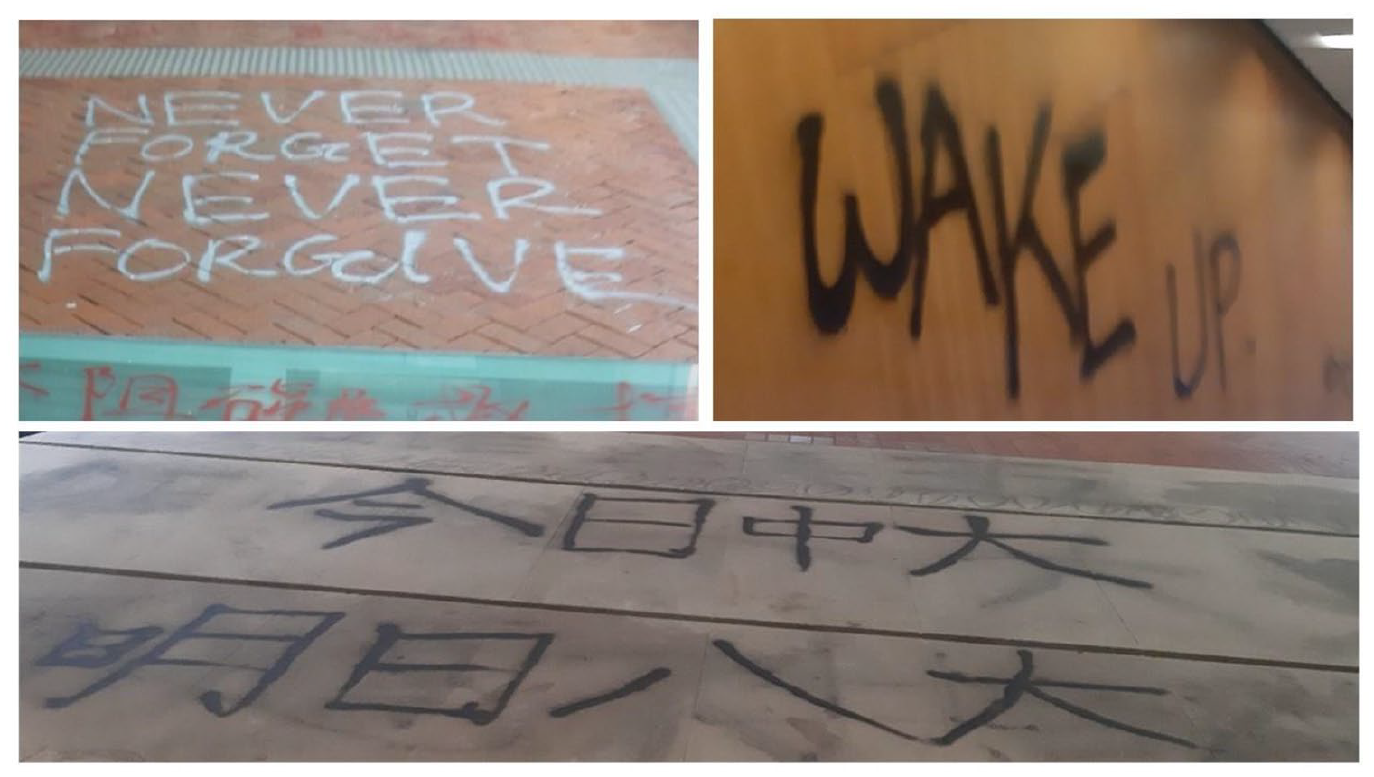
Memory and remembering.
Remembering is mobilized with the intention to drive concrete acts of retaliation and was a dominant way of building support on campus. The graffiti in Figure 7 (top-right image) suggests that those responsible must pay in equal measure, “an eye for an eye,” that action and participation are necessary to hold law enforcement accountable because no one else would. There is also a call for revenge (Figure 7, bottom-right), and for the “debt of blood be paid with blood” (Figure 7, left), which demonstrates a loss of faith in the system and frames it as impossible to seek redress through official channels because these institutions are corrupt, biased, and incapable of seeing impartially in part because they are at the heart of the problem. This echo calls for an independent body to investigate police activity as part of the five demands that the protest movement demanded of the Hong Kong government.
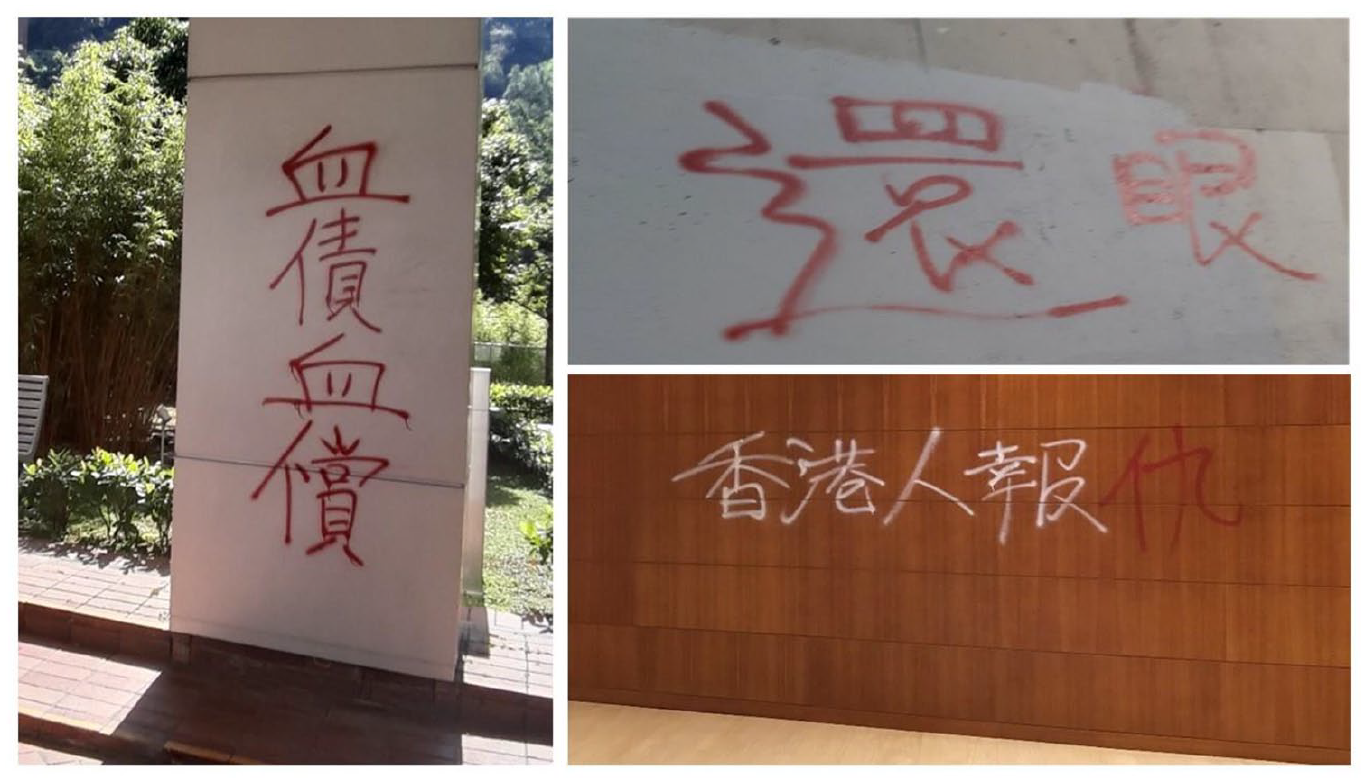
Mobilizing pain.
The costs of freedom
If one were to ask what the aim of the anti-ELAB protest was, the word “freedom” would emerge. What exactly is this freedom? Freedom from and for whom? One of the most common slogans in posters and banners draped across windows in apartments in high-rise residential buildings and shouted out of apartment windows was “Fight for freedom, stand with Hong Kong.” This freedom is, however, fluid and all-encompassing of the numerous concerns and grievances of the participants of the movement. What started as freedom from being extradited to mainland China expanded to echo age-old concerns of universal suffrage, from fears of the fate of Hong Kong after the expiration of the one country two systems arrangement in 2047, to the emerging fear of and freedom from police brutality in the wake of the protest when assemblies were deemed illegal, from freedom of assembly selectively allowed to outright denied and the subsequent clashes with law enforcement. The real and perceived erosion of freedoms was echoed in the need to take action to restore and/or protect these freedoms as well as those freedoms that the territory never had but always desired. This manifested in the outrage at the breach of the autonomy of universities, which had been safe spaces, as previously discussed.
Graffiti inscriptions on this theme took for granted that audiences knew what freedoms were at stake and highlighted the price of these freedoms. Loose wording afforded the elasticity to encompass the range of issues most important to each individual. This was also reflective of the social movement in general, which expanded and meant different things to different people at different times, all the while unified under the banner of “freedom” – a “freedom” that “isn’t free” (Figure 8) but comes at a cost, thus, intrinsically questioning what each individual is willing to sacrifice to contribute to maintaining those freedoms. These messages also point to historical social movements led by older generations such as Uncle Chan (Chow, 2021: 34:00) and more recent events such as the Umbrella movement and Occupy Central movement. All these sacrifices of individuals and groups have made possible the freedoms that were being enjoyed. But also speaks to the urgency of contributing to maintaining these freedoms in the present and for the future.
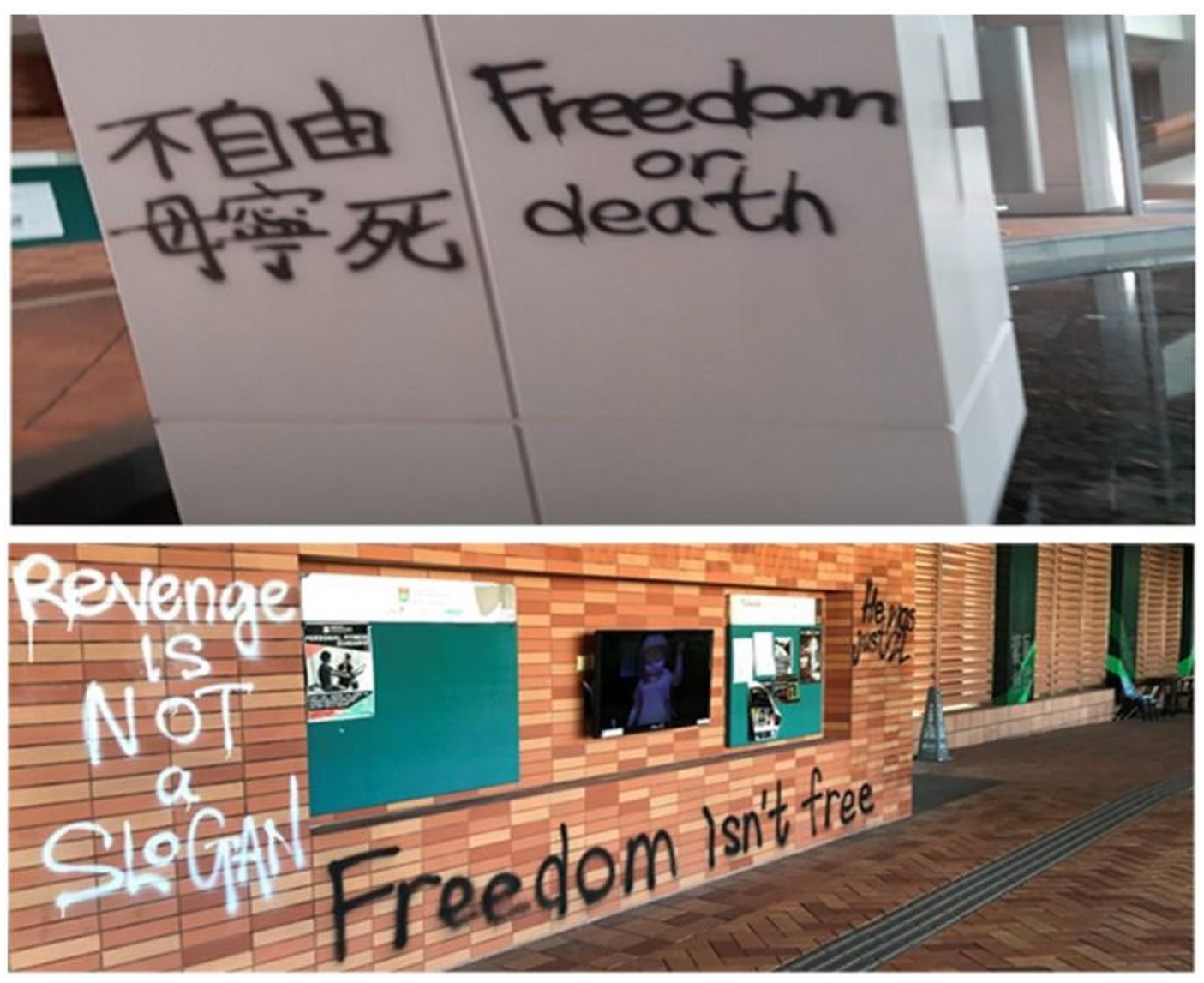
Freedom.
Regarded as one the most fundamental rights, freedom is presented as non-negotiable. The graffiti messages in Figure 8 evoke a sense of choicelessness and present the alternative of freedom as death. The slogan in Chinese next to “freedom or death” evokes a more persuasive and personal messaging; it translates as “I would rather be dead than not be free” or “without freedom, I would rather be dead.” Variations of this slogan, such as “I would rather die than be a slave,” appeared across campuses. Freedom as a non-negotiable right can be traced to movements for the abolition of slavery. Sam Sharpe, an enslaved man, Baptist deacon, freedom fighter, and an instigator of the 1831 slave rebellion in Jamaica said, “I would rather die on yonder gallows, than live in slavery”(Craton, 1983). In the United States, slave raider John Anthony Copeland Jr. remarked at his trial and execution in 1859 “I am dying for freedom. I could not die for a better cause. I had rather die than be a slave” (Lubet, 2015). An earlier iteration of this slogan – “Give me liberty or give me death” – is credited to Patrick Henry’s speech on the American revolution at the second Virginia convention in 1775. The “liberty” that Patrick Henry, a slave owner, referred to was from Britain, even though he held onto the liberties of enslaved people. On-campus rhetoric and discourses that manifested in the form of slogans and messages communicated through graffiti, drew extensively on movements both historic and contemporary from a wide array of causes and geographies: from slave rebellions to the French Revolution, the American Civil War to the Arab Spring, and from protests against political repression from Myanmar to Palestine. These graffiti and posters drew on phrases that resonated with sentiments expressed by people in Hong Kong but do not account for the (problematic) contexts of some of these events and statements. Protestors repurposed slogans for the domestic protest in part to make a broader claim of a wider struggle beyond Hong Kong. Circulation of protest discourse in the 2019 Hong Kong social movement deserves separate treatment given the scale of these borrowed texts. This rhetoric was also seen in anti-COVID lockdown protests in several parts of the world. In in the United States, for instance, a protester remarked, “I would rather die, than be a slave” (KMOV St. Louis, 2020: sc. 1:17) – although for this protester freedom meant nothing like that which Hong Kong protestors referred to a year earlier across the Pacific, nor was the Hong Kong reference anything like that of a slave rebellion or the American Civil War. This expression has morphed into a popular expression for talking about freedom in all shapes and forms, including those that look nothing like what Sharpe and Copeland were referring to in the 19th century. Metaphorical slavery in forms of political repression or public health restrictions have been expressed with the elasticity of the phrase that affords itself to interpretation by the audience. Freedom here is a narrative device that is all-encompassing but also aids in sidestepping “deeper systemic problems” (Fenton, 2018: 334)
Conclusion
The 2019 Hong Kong anti-ELAB movement was and is many things. This paper focuses on the on-campus iteration of the movement and its use of media as dispersed resistance. The dispersal of resistance created a multitude of sites of resistance of which university campuses were a part. These were physical but also multiple media (plat)forms that created a complex hybrid media environment for a multifaceted movement. This is exemplified by the adoption of the notion “be water,” which signals the flexibility of the movement and its participants. Protests manifested publicly in different parts of Hong Kong in different forms. On campuses, one way was through graffiti. Observing social media posts by students and student organizations during the protest revealed that these images were not widely circulated on social media in part due to the uncertain consequences that might pose. This disconnection mirrors Natale and Treré’s (2020) notion of “disconnection-through-engagement.” Student protesters mobilized disconnection from surveilled public social media sites by critically engaging in off-line graffiti practices while at the same time selectively using encrypted media platforms for organizing. This points to a hybrid media activism, blending new and old, digital and analogue (Chadwick 2017) and challenges the idea of graffiti’s linear progression from analogue to digital media platforms to reach a broader audience. In fact, digital memes and posters that emerged on digital media platforms found their way onto walls in graffiti. By tracing the extensive use of graffiti on campuses during the anti-ELAB movement, this paper highlights the need for examining multiple media forms in a digitally saturated media environment. Students mobilizing against institutions that have power over the cyberspace gravitated away from public displays on social media; this explains why most campus graffiti did not make it to online spaces where people were later prosecuted for content posted. Rather they largely remained in enclosed online spaces with relatively less circulation, thus speaking to the spectrum of sociality afforded by various media platforms. Students resorted to graffiti as a mode of public expression while being under the radar, and “staying lowkey” (Wang, 2022) as a strategy for maintaining resistance. The use of graffiti on university campuses during the Hong Kong protests did three things: it was a mode of mobilizing support of the student population for the broader movement; it was a record of memory of events occurring during the movement as a way of contesting narratives; and it was used as placemaking for marking spaces of active resistance in an uncertain political climate.
Footnotes
Acknowledgements
I am grateful to Dr. Mengyang Zhao for comments and suggestions on an earlier draft of this paper, and to Dr. Andrew Park and Dr. Mohammed Rashid for their help during the collecting and processing of the images central to this paper. I appreciate the helpful comments and suggestions from the two anonymous reviewers.
Funding
The author received no financial support for the research, authorship, and/or publication of this article.
