




Abstract
This study sheds light upon how memes about rioting in present-day Belfast are read by their audiences. As such, it answers to a distinct research gap in the meme studies literature, which has mostly shied away from in-depth engagements with audiences, favouring instead the intertwined concepts ‘imagined audience’ and the ideological ‘directionality’ of memes. Drawing on semi-structured interviews with 19 respondents in Belfast, I develop four themes on how they read memes about political violence. The findings indicate that the concept ‘imagined audience’ is reductive at best, which was evident in this study as interviewees did not blindly follow the ideological ‘directionality’ when reading a meme. Moving beyond this reductive view allowed me to unpack how meme audiences place value in the pop-cultural form of the meme; their take on its ‘imagined author’; how they perceived the meme as a site for identity work, and their emotional engagements with memes.
Introduction
In late March and early April of 2021, riots spread across Northern Ireland yet again, as United Kingdom (U.K.) and Irish politicians struggled to preserve the peace agreement in the region. Violence afflicted Belfast for ten days, during which time over 70 police officers were injured from attacks with bricks, bottles, stones, and petrol bombs (The Spectator, 2021). The strife came as Ireland and the U.K. observed the 23rd anniversary of the Good Friday Agreement – a momentous accord which formally ended the three decades of sectarian violence known as ‘The Troubles’. The recent rioting escalated as political leaders scurried to settle on new trade rules between the U.K. and the European Union without subverting the peace agreement (CNBC, 2021). Indeed, longstanding tensions between unionists (Protestant) and nationalists (Catholic) – the main antagonists of ‘The Troubles’ – appear to have been at the core of the 2021 Belfast riots (commonly referred to as ‘the Protocol riots’) with Brexit serving as a catalyst for renewed hostilities along familiar political fault lines (The Spectator, 2021).
While political violence is a recurring phenomenon in physical spaces in Belfast, antagonisms have also increasingly moved online (Hoey, 2018). Amid a public bus being set ablaze by petrol bombs and protestors clashing with police during the April 2021 riots, conflicts also proliferated online: digital clashes which included, among other things, internet memes (henceforth: memes) which engaged with the rioting in various ways. The same goes for the Belfast riots of 2012–2013 – colloquially known as ‘the flag protests’ – which are the first riots in post-conflict Northern Ireland that were heavily mediatised through social media (Reilly, 2021). These protests, which at times involved severe clashes between protestors and police, started in December 2012 and lasted until February 2013. They were triggered by the decision not to fly the Union Jack from Belfast City Hall as often as before. Prior to the decision the flag was flown 365 days per year, while after the decision it would only be flown on specific holidays throughout the year. This unsettled many protestants in Belfast, who felt that Northern Ireland’s connection to the United Kingdom was being (symbolically) threatened (Reilly, 2021). The fact that these protests were politically contentious is also evident in the large body of memes which have been produced about them (Know Your Meme, n.d.-a).
While politically contentious memes have been explored extensively from a discursive point of view (e.g. Baishya, 2021; Gonzalez-Aguilar and Makhortyk, 2022; Ooryad, 2023), we know significantly less about how such memes are received by their audiences. Indeed, the broader meme studies literature has to date mostly shied away from in-depth engagements with audiences (Trilló and Shifman, 2021: 2496–2497), favouring instead concepts such as the ‘imagined audience’ and the ‘directionality’ of memes (Wiggins, 2019: 111–112). This is problematic as we are then stuck with reading memes as discourse and left wondering how they are decoded, and potentially acted upon, by their audiences. This study aims to shed light upon this lacuna through an in-depth exploration of how audiences in present-day Belfast read memes about political violence, focussing on the two cases of rioting mentioned above.
The article is structured in the following manner. First, I present the theoretical framework of the study, which builds upon (and seeks to marry) two distinct literatures: meme studies and audience studies. Second, I discuss the context of the study by narrowing in on Northern Ireland’s political past and present. Third, I give an account of the methods of the paper, that is, semi-structured interviews with audiences in Belfast. Fourth, I present the findings of the study divided into four main themes. Fifth and finally, I conclude the article by way of summarising its main findings and indicating their relevance for future research.
Theoretical framework
This study builds upon – and seeks to reconcile – two distinct academic literatures, namely the meme studies literature and the audience studies literature. My general contention is that these literatures have not been speaking very much with one another to date, which I find problematic and something that I hope to remedy with this article. I will elaborate on these ideas below.
Memes
Building on Shifman’s (2013) foundational work Memes in Digital Culture, I understand memes as ‘a group of digital items sharing common characteristics of content, form, and/or stance, which were created with awareness of each other, and were circulated, imitated, and/or transformed via the Internet by many users’ (Shifman, 2013: 41). A distinct feature of the meme is that it oftentimes fuses humour with political and/or social commentary/critique (Shifman 2013): representing a sort of ‘playful politics’ (Mortensen and Neumayer, 2021). Indeed, Wiggins (2019) and others (e.g. Denisova, 2019) convincingly argues for treating ‘meme-ing’ (i.e. sharing, making, remixing or reading memes) as everyday discursive practices: as a way for people to exercise political (micro-) agency. Memes commonly rely on popular culture references as templates, where remixing is the preferred way to spread and multiply the meme (Denisova, 2019; Milner, 2018). This means that the authorship of memes is generally hard to decipher, not only because they rely on remixing and popular culture references, but also because memes are often posted anonymously by users hidden behind an avatar and a username (Donovan et al., 2022: 181). The relative obscurity of memes’ author enables users to utilise them to express political dissent in authoritarian settings, where the voicing of such opinions may otherwise be fraught with risk (Soh, 2020). Furthermore, the ambiguous position of memes as being both humorous and political digital artifacts means that they can ‘always be subsequently disavowed as humor’ (Soh, 2020: 1115) should the political point embedded in the meme prove troublesome for the individual user.
While the individual user – and their political agency – has been the focus of much previous meme research, there are also several recent studies which highlight how ‘meme-ing’ may create a shared symbolic space which facilitate digital community-building. Ooryad (2023), for example, argues that memes may act as catalysts for the forming of ‘memetic alliances’ (p. 488) – which are defined as the ‘unforeseen and increasing online global alliances forming between seemingly conflicting online and political forces’ (p. 488). In essence, memes have the potential to bring otherwise disparate political forces together by serving as iconic assemblages of ideology (Ooryad, 2023: 502). Baishya (2021) likewise notes that ‘through viral circulation, memes foster a kind of political community centred on shared codes of viewing/reading practices (p. 1116). Here, meme preferences and meme literacy connect individual users with ideological peers who they are laughing with when reading a meme; thus, contributing to the construction of a shared imagination within such political communities (Baishya, 2021: 1132). Importantly, research on the community-building potential of memes tends to stress that it is to some extent contingent on them being able to spark emotional engagement (Baishya, 2021: 1131; Ooryad, 2023: 494–500). That is, the emotional charge of memes is part of what makes them such potent connective digital artifacts. This line of reasoning resonates with Papacharissi’s (2014) concept ‘affective publics’ – defined as the ‘networked public formations that are mobilized and connected or disconnected through expressions of sentiment’ (p. 125). While Papacharissi (2014) does not focus on memes per se, her argument dovetails nicely with the recent work on the community-building potential of memes, seeing as this too is partially grounded in emotional engagement (Baishya, 2021: 1131; Ooryad, 2023: 494–500).
Audiences
Hall (1973/1981) famously noted how audiences may engage in dominant, negotiated or oppositional readings of media texts. From this, we can infer that audiences do not necessarily read media texts fully in line with the intentions of the author (e.g. Hall, 1973/1981; Jenkins, 1992). Thus, we need to explore how audiences read specific media texts in order to understand how they navigate and negotiate their meaning. Hall’s work – while foundational for audience studies – has also been criticised, among other things for over-politicising audiences’ reading of media texts. As such, Michelle (2007) notes how ‘researchers must distinguish between uncomplimentary responses to textual form [. . .] and critical responses to ideological content’ (p. 192). Hence, it is important to bear this in mind when studying audience dis-like (Gray, 2021): to not a priori assume an ideological rejection of the media text in question. In our digital age media audiences often engage in produsage (Bruns, 2008); thereby blurring the distinction between consumers and producers of media texts. Now, perhaps more than ever, audiences are not mere passive receivers of media texts, but rather both negotiate/navigate their meanings, and produce/remix content of their own. The notion of the active audience thus appears especially relevant for meme studies, where remixing and user production of memes is key to their spread (Baishya, 2021: 1114; Milner, 2018).
Having said that, audiences on digital platforms are increasingly being tracked and commodified by media agencies, who advise ‘advertisers on how and where to place advertisements’ (Willig, 2022: 66). Thus, while audiences on the one hand have a significant degree of freedom to produce and consume their own preferred content on digital platforms, they are on the other hand also less free in choosing the content that appears to them in digital spaces, seeing as it is often imposed upon them by advertisers via algorithms (Jones, 2023; Willig, 2022). In this context, attempts at reasserting audience agency often appears as struggles to ‘train’ the algorithm: to make its recommendations more in line with the politics of the audience member in question (Jones, 2023: 1195–1196).
Lastly, we should discuss the role of the author, or rather the ‘imagined author’ (Das and Pavlíčková, 2014: 385–386), in audiences’ engagement with digital media texts. Das and Pavlíčková (2014) – while not discussing memes per se – conceive of the author as one of many paratexts (i.e. ‘those features that surround and subsequently determine understanding of the main text’; p. 386) of media texts. In a nutshell, they argue that having a sense of who the author is contributes – together with several other factors – to audiences’ interpretation of media texts. Acquiring this knowledge was often fairly straightforward in legacy media environments, however, in digital media environments characterised by ubiquitous produsage (Bruns, 2008), the author is at times difficult to pin down, since digital media texts (such as memes) are often posted anonymously (Soh, 2020). Alternatively, digital media texts may be written by an identifiable author but only as a one-off occurrence, which makes it challenging for audiences to develop a lasting relationship with them and thus to determine whether they trust them (Pavlíčková, 2013: 34). This creates a sort of hermeneutic longing for the author (function) amongst digital media audiences, since without it, it is more difficult for them to form a full interpretation of a media text (Das and Pavlíčková, 2014: 386). Hence, Das and Pavlíčková (2014) introduce the concept ‘imagined author’ (p.385, 386) to signify audiences’ desire for – and their various tactics aimed at – familiarising themselves with an unfamiliar author (Das and Pavlíčková, 2014: 388).
Meme audiences?
Considering how well ‘meme-ing’ practices dovetail with notions of the active audience in the audience studies literature, it is surprising how little attention audiences have received in the academic literature on memes. Indeed, as noted by Trilló and Shifman (2021), we still lack ‘a deeper understanding of how photo-based memes [. . .] are perceived by potential audiences’ (pp. 2496–2497). To date, most studies of memes focus on the images, texts, and videos of the memes, as they are read through a discursive-analytical lens. When meme audiences have in fact been addressed, it has primarily been in terms of an ’imagined audience’ (Wiggins, 2019: 111–112) – that is, the individual or community who the ’memer’ has in mind when posting a meme. Here, Wiggins (2019) discusses the ’directionality’ of memes, which implies two ideal-type audiences: those who appreciate a joke/critique and those who it mocks/criticises (p. 112). This is a rather dichotomous take on meme audiences, which reduces them to ideological robots, and moreover, neglects their involvement in produsage (Bruns, 2008). Aside from Wiggins’s (2019) work (which has ample merit to compensate for its somewhat reductive section on meme audiences) there is one survey-based study on young people’s motivations for sharing political memes (Johann, 2022). Simply put, it finds that young people are primarily driven by ideological motivation when posting political memes. There are also several in-depth qualitative studies of the creative labour of meme makers. Galip’s (2021) work, for example, unpacks how niche-memes contribute to the creation of new markets and become locations of online public intellectualism. Qualitative in-depth analyses of audiences, however, are in short supply in the meme studies literature. This is problematic as we are then limited to reading the memes as discourse and lack an understanding of how they are decoded – and potentially acted upon – in everyday life.
Contextualising post-conflict Belfast
Since 1998, Northern Ireland is formally at peace following the three-decade long conflict commonly known as ‘The Troubles’. The root of the conflict can arguably be traced back to the 12th century when England began to gradually colonise Ireland. In 1641, a Catholic rebellion against English occupation started, which in turn led to violent crackdowns from the English military, as well as discriminative laws aimed at Catholics, which restricted, inter alia, their freedom of assembly. This would mark the beginning of several centuries of English socio-political discrimination against Catholics on the island of Ireland (Uppsala Conflict Data Program [UCDP], n.d.). The animosity between Catholics and Protestants peaked yet again in 1919–1921 when the Irish War of Independence was fought, resulting in the division of the island into an English part and an Irish part. This entailed the birth of Northern Ireland as a political entity which was being formally ruled by the United Kingdom (owing primarily to a demographic majority of Protestants on the territory). The English discrimination of Catholics which was evident in previous centuries continued in Northern Ireland, as Catholics were systematically denied jobs in local government functions, deprived of basic rights and freedoms, et cetera (Muldoon, 2004). The Provisional Irish Republican Army (IRA) grew as a direct consequence of this discrimination and found support amongst Catholics who considered that Northern Ireland was being occupied by the UK. In the late 1960s the Provisional IRA set off a violent campaign against UK representatives in Northern Ireland, targeting primarily police posts and army personnel (UCDP, n.d.). The UK army (informally aided by Protestant paramilitary groups) retaliated against the Provisional IRA, and thus began the conflict known as ‘The Troubles’, which is often characterised as following a tit-for-tat logic (UCDP, n.d.). After three decades of sectarian violence, a peace agreement was eventually signed in 1998, owing in part to international mediation, and in part to the tireless efforts of local politicians and civil society actors (Muldoon, 2004).
During ‘The Troubles’ some 3500 people lost their lives. Many of the casualties were civilians, with credible estimates of 52% being put forth (Ulster University, n.d.). It is, furthermore, estimated that some 47,000 people were injured as a direct result of the conflict. Belfast was the main site of the violence of ‘The Troubles’ with roughly 50% of deaths occurring in the capital city (Ulster University, n.d.).
In certain areas of present-day Belfast, the violence of the past has become an integrated part of the cityscape, with intricate – and visually striking – political murals bearing witness to the events that occurred during ‘The Troubles’ (Borthwick, 2015; Goulding and McCroy, 2021; Rolston, 1992). Mural painting began in working-class unionist communities in Northern Ireland as a way to document significant historical events. In the 1980s, unionist murals increasingly started to display support for paramilitaries involved in ‘The Troubles’, while Irish nationalists would gravitate towards painting murals honouring hunger-striking Provisional IRA members. In short, with the escalation of ‘The Troubles’ Northern Ireland’s murals turned increasingly divisive, with the dominant theme now being the glorification of paramilitary organisations on both sides (Borthwick, 2015). While the end of ‘The Troubles’ has brought with it also the creation of murals which celebrate peace in Northern Ireland (Borthwick, 2015), many contemporary murals still rely on polarising language where ‘the other side’ is blamed for the death of civilians during ‘The Troubles’: sometimes referred to in terms of ‘indiscriminate slaughter’ or even ‘genocide’ (see Figure 1). Notably, the murals that celebrate paramilitary organisations are still there (Goulding and McCroy, 2021: 554).
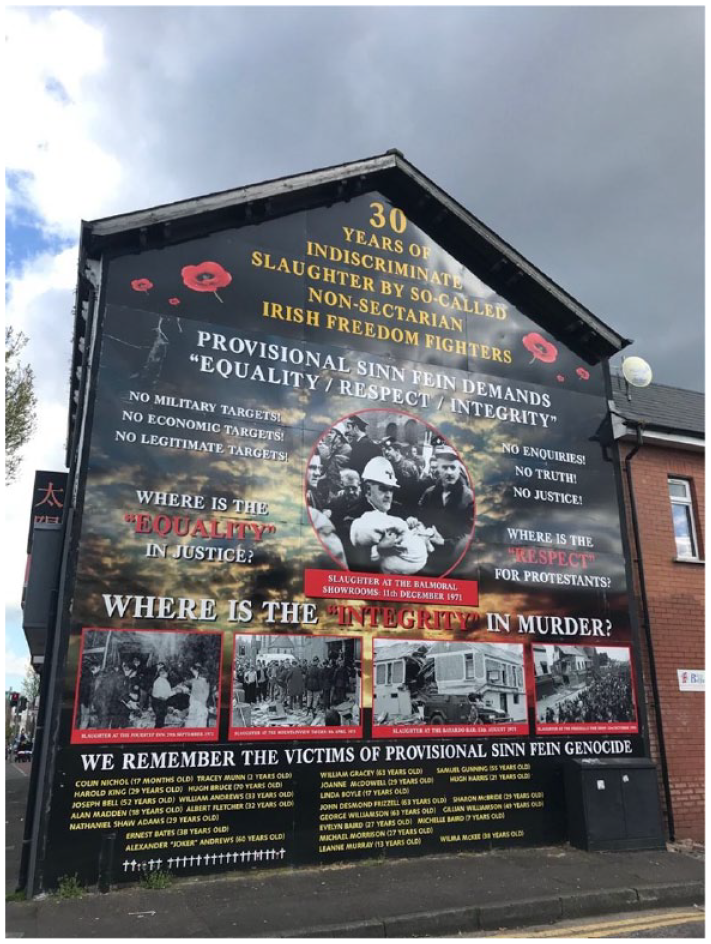
Mural in the Shankill neighbourhood of West Belfast.
Although much has improved in Belfast since the ‘bad old days’ (Hoey, 2018) of ‘The Troubles’, it remains in many ways a deeply divided city shaped by its violent past. As noted by Goulding and McCroy (2021), the city is ‘divided by walls, divided by ethnicity, and even divided by the river Lagan’ (p. 539). The walls referred to here are the (in-)famous peace walls – defensive infrastructure erected at intersection areas in Belfast to keep the peace between the communities. Likewise, since the end of ‘The Troubles’, educational and residential segregation has increased, rather than decreased (Murtagh and Ellis, 2011; O’Dowd and Komarova, 2011). Overall, these lingering sectarian divisions are evident in the politics of present-day Northern Ireland, where parties like Sinn Féin (Irish nationalist) and the DUP (unionist) dominate the political scene. Non-sectarian alternatives like Alliance, Green Party, and SDLP do exist, but they still have a hard time competing with their sectarian counterparts.
Methods
Prior to conducting interviews, I built a corpus of memes which address rioting in contemporary Belfast. To this end, I searched for the hashtag #Belfastriots on various social media platforms, including Instagram, Twitter, Facebook, and Reddit. I, moreover, googled the phrases ‘Belfast riots’ and ‘Belfast memes’. Furthermore, I visited the meme pages Memedroid, Meme generator, and Know Your Meme where I searched for the phrases ‘Belfast’ and ‘Northern Ireland’. Through these methods a corpus of 47 memes was generated. From this corpus I selected five memes that I wanted to discuss with interlocutors in Belfast. The selection of these five memes rested on two main criteria: (a) they should be popular and widespread (as evidenced by the number of likes/upvotes and them being spread on multiple platforms), and (b) they should be representative of a broader theme in the corpus of memes which address Belfast rioting. 1
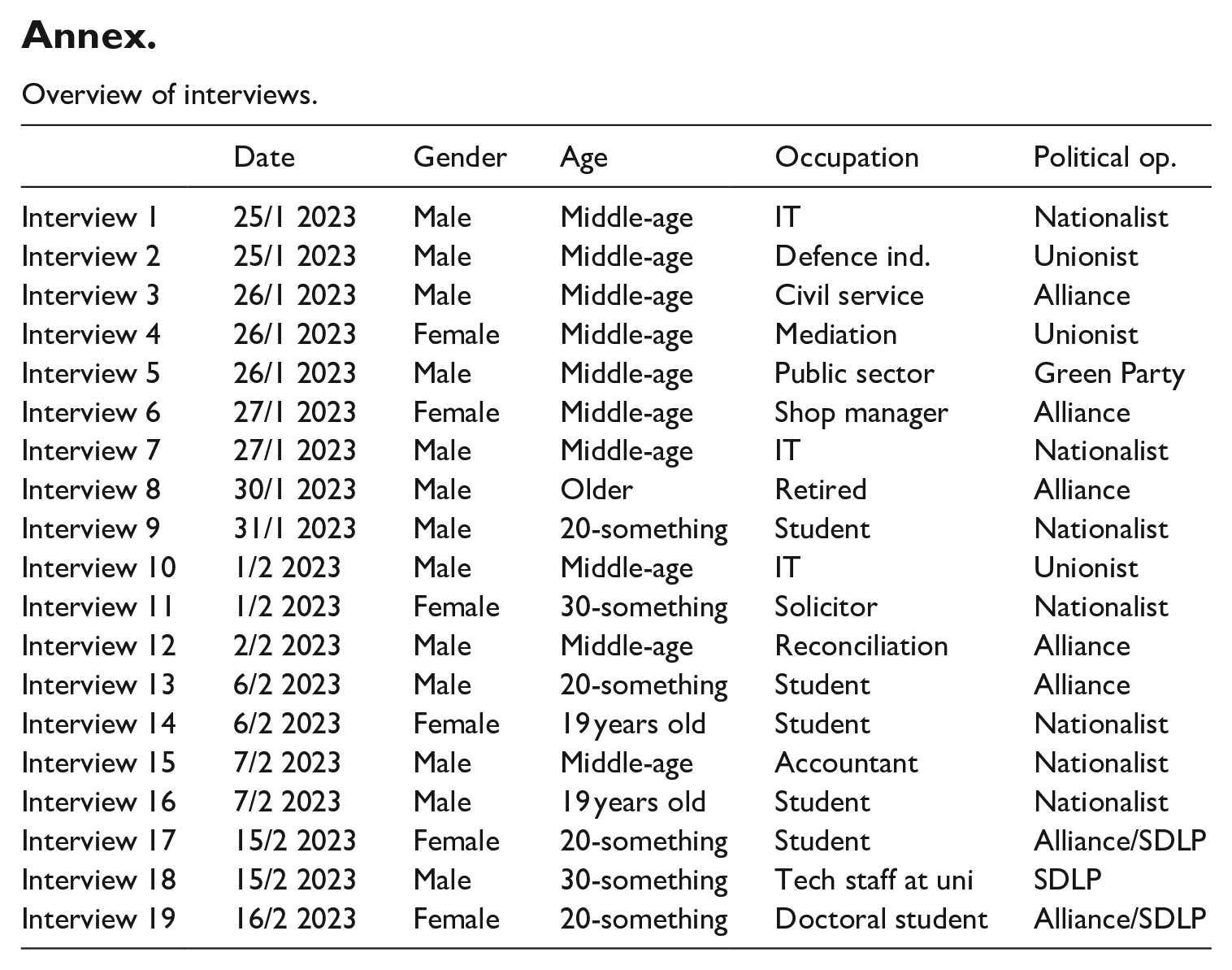
Having selected the five memes to discuss with interlocutors in Belfast, I was ready to start the interviewing. Some interlocutors were recruited through posters that I put up across the city, while other were recruited via my pre-existing contacts at Ulster University, while other still were recruited via the researcher website Prolific. All in all, I interviewed 19 people during my stay in Belfast in January–February 2023. The interviews were recorded using a digital tape recorder and were then transcribed. An average interview took 64, 57 minutes to complete. The interviews consisted of two main parts. The first part revolved around interlocutors’ views of politics in Belfast and Northern Ireland in the post-conflict period. The second part centred on the specific memes covered in this article, as I showed interlocutors the memes in question and asked for their take on them. I managed to secure a rather decent diversity in terms of political opinion and religious background of the interlocutors (please see a table summarising the main characteristics of the interlocutors in the Annex). Having said that, out of the 19 interlocutors, 13 were male and only 6 were female. This means that the sample represents a somewhat gendered selection of interlocutors: which is something that I aim to remedy in future fieldwork in Belfast.
Findings and analysis
As memes are inherently polysemic (Pettis, 2022: 264; Wiggins, 2019: 102) the semi-structured interviews conducted in Belfast helped elucidate what meaning(s) are made by their audiences. In essence, I ask: how are memes about riots in Belfast read by its residents? Here, I seek to answer this research question by visiting four salient themes (represented by an illustrative meme per theme) which are developed from the interviews that were carried out in Belfast in January and February of 2023.
Theme 1: pop-cultural form as a potential mediator against political offence
In this meme (Figure 2) we see Father Dougal McGuire from the beloved sitcom Father Ted state: ‘Ted, you’re not going to believe it! There’s riots in Belfast because of a massive infringement of human righ . . . Oh wait, it’s just a flag’. The meme references the flag protests which enmeshed Belfast for several months in 2012–2013, and as such it has become a widely shared meme which is, inter alia, featured on the Know Your Meme website (n.d.-a) and it also appears in the Facebook group Ulster News (with 215 likes at the time of writing). The tv-series that the meme draws its imagery from – Father Ted – remains a highly appreciated show in contemporary Northern Ireland, even though it was shot in the mid-1990s. The meme in question expresses a bafflement with how massive and destructive the protests of 2012–2013 really were, considering that the issue was the (part-time) removal of a flag from Belfast City Hall.
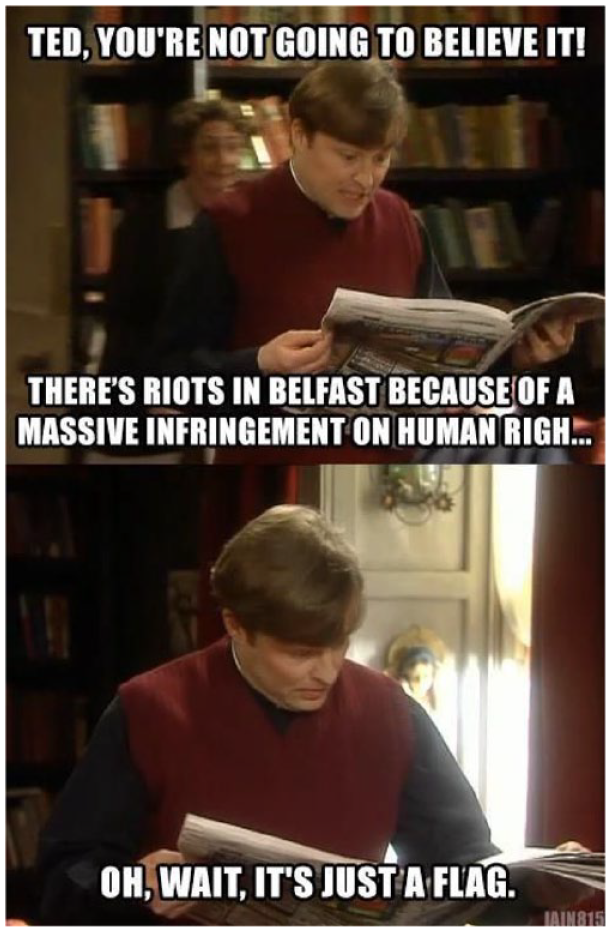
Father Ted meme.
During the interviews in Belfast, interlocutors often spontaneously mentioned how much they like Father Ted when seeing the meme. Several interlocutors talked about the show as a national reference point with cross-community appeal in Northern Ireland. One interlocutor, a middle-aged man working in the public sector and voting for the Green Party put it like this: ’Whenever Father Ted was on I felt like everyone was watching; it was fairly cross-community’ (Interview, 26 January 2023). In many instances, it appeared that their liking of Father Ted overshadowed the politics of the meme in question. In essence, because interlocutors themselves appreciate the show so much – and know that others do too – they thought that it would be unlikely to cause any political offence. This was visible in statements such as: ’Father Ted resonates over here completely. I just see this as silly and funny: I don’t think it would offend anyone’ (Interview, 26 January 2023), as expressed by a female middle-aged unionist working in mediation. It is significant here that this particular interlocutor is a unionist, that is, the butt of the joke in this meme. Still, she was not offended by it, which possibly has to do with the fact that she appreciates the original imagery on which the meme builds so much.
Interestingly, some interlocutors argued from within the logic of the tv-show as to why the meme should not be read as politically offensive. Here, they would mention the specific character Father Dougall and point to to his silly and whimsical nature: ‘My immediate reaction is humour. It is from Father Ted, and that is Dougall, who is known for being a bit silly with his logic’ (Interview, 2 February 2023) as explained by a middle-aged male Alliance voter. A middle-aged female Alliance voter expressed something rather similar in her assertion that: I see it as funny when you first read it. You see it is from Father Ted, and your instant reaction is: ‘this is funny’ and you know it is not going to be anything serious, regardless of the writing, it sets the tone [. . .] I know that anything said in the show shouldn’t be taken seriously (Interview, 27 January 2023).
Taken together, this suggests the possibility that the pop-cultural form sometimes trumps the politics of the meme, as also argued by Michelle (2007) in a broader discussion on the audience reception of media texts (p. 187). When a pop-cultural phenomenon is widely embraced in a society it may mediate against it causing offence, even when its politics are decidedly contentious. The fact that my interlocutors were not offended by this meme may also speak to what Soh (2020) identifies as the inherent ambiguity of the meme, which can always be (dis-) regarded as a ‘humorous artifact’ (p. 1119) rather than as a ‘political artifact’ (p. 1119). Having said that, some interlocutors amongst my sample did believe that this meme could cause political offence with some other group of people, but notably, none of my interlocutors felt offended by the meme in question, regardless of their political opinions.
Theme 2: the author is (not) dead
The ‘Welcome to Belfast’ meme (Figure 3) is a starter pack, which is a vastly popular meme template. Starter packs are intended to ‘illustrate the archetype of a celebrity, company, or subculture through a recommended selection of fashion articles, multimedia and other consumer products’ (Know Your Meme, n.d.-b). In this meme we are presented with images of contemporary riots, a politically contentious mural, various paramilitary groups in arms (both from the past and from the present), as well as a photo of a march by the Orange Order. 2 The meme was originally posted on Reddit in the r/starterpacks subreddit, and then eventually reposted on the r/northernireland subreddit in 2016. In this meme we learn about the persistent sectarian divisions of the city: ‘obviously there is a lot more going on in Belfast, but for what it wants to do it is pretty on point: you have the Orangemen, the IRA, some rioting going on’ (Interview, 31 January 2023) as noted by a 20-something male Irish nationalist. In essence, then, this meme represent life in Belfast as being completely dictated by a sectarian logic. But as our 20-something Irish nationalist interlocutor said, there is a lot more to Belfast than this: a sentiment which the majority of the interviewees amongst my sample agreed with. There was also a strong sense amongst many interlocutors that this meme is today somewhat outdated: that it represents a Belfast (thankfully) long gone: ‘the whole thing is kind of outdated, can we just move on from this?’ (Interview, 15 February 2023) a 30-something male interlocutor rhetorically asked when faced with the meme during our interview.
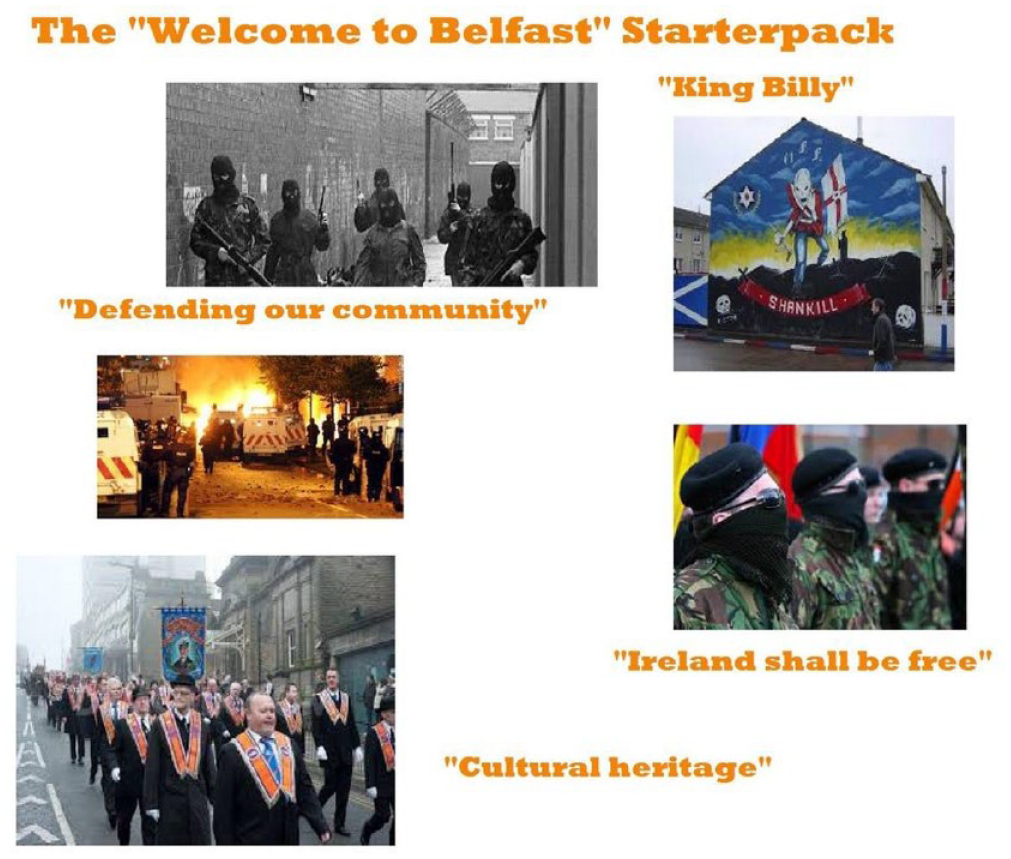
Welcome to Belfast meme.
Even though memes are in a sense authorless seeing as they are often posted anonymously and are composed primarily of remixes (and remixes of remixes, ad infinitum; Donovan et al., 2022: 181), it was still apparent that authorship matters to the Belfast meme audiences that I interviewed. Simply put, my interlocutors generally wanted to know – and speculated wildly about – who made the meme and why. This was evident with several interlocutors, including a 20-something male Irish nationalist, who was puzzled by the meme’s origin: ’it is showing that there are two different sides, but I cannot tell which side the person who made this is from’ (Interview, 31 January 2023). Another Irish nationalist, a 19-year-old female student, was much less puzzled and exclaimed self-assuredly (and with a laugh): ‘an Alliance voter made this!’ (Interview, 6 February 2023). Thus, of course I had to ask an Alliance voter (female in her mid-twenties) about it: ’I find it interesting that it is so even-handed. Maybe someone younger, or someone who votes Alliance or SDLP, posted it’ (Interview, 16 February 2023). In this statement, we find the idea that the meme is on the one hand caught in a sectarian logic – of us vs. them – but on the other hand, it is fairly impartial in its portrayal of sectarian violence in Belfast. It does not take sides, but rather ’it is bringing all the aspects together: bringing awareness of all that we have to put up with and mocking it at the same time’ (Interview, 7 February 2023) as a 19-year-old male student of screen production put it. These interlocutors read the meme as addressing an absent presence in the centre of the meme caught in the middle of the sectarian logic, namely the people who want to leave this kind of division and political violence behind.
Clearly then, while some interlocutors argued that the meme’s content is trying to destabilise the sectarian logic underpinning Belfast society, the preoccupation with ‘telling’ who the author is often remained stuck in a sectarian reasoning: of determining who posted it and what that means in terms of whether a meme is funny or offensive. Interestingly, the urge to know who made a meme (and why) was not something that only older generations – who are typically less familiar with digital culture – expressed, but it was also shared by the young and meme-savvy interlocutors of this study. Although this desire to uncover the identity of the author is not unique to Belfast meme audiences (Das and Pavlíčková, 2014: 388–390), it arguably takes on an added sense of urgency here since it is a post-conflict city with a strong cultural legacy from ‘The Troubles’ lingering on. In such an environment, one must tread lightly with the political jokes, and the act of being able to ‘tell’ what side someone is on can be vital information in avoiding offence, or worse (Mac Ginty, 2014: 557).
Overall, this theme suggests that rather than speaking primarily in terms of an ‘imagined audience’ (Wiggins, 2019: 111–112), the meme studies literature would do well to also incorporate the concept ‘imagined author’ (Das and Pavlíčková, 2014: 385–386). Clearly, this is something that occupied many interlocutors’ minds, especially when trying to decide whether a meme was funny, clever, and/or offensive.
Theme 3: pride and prejudice
This meme (Figure 4) compares how the Baltimore riots of 2015 were seen by people from around the world with how Belfast residents saw them. The meme draws on original imagery from the tv-show Dancing with the stars where the judges give mediocre scores for the performance they just witnessed. Following the logic of the meme, the judges act as a metaphor for the people from Belfast when seeing a riot. Through this metaphor, we learn that Belfast residents have become quite the connoisseurs when it comes to riots and require something more spectacular to be impressed than what the Baltimore riots had to offer. The main point here, then, appears to be that Belfast residents have to some extent normalised rioting: seeing it as something ordinary rather than something spectacular. This meme quickly became popular when it was first made in 2015, and as such, it currently (March 2023) boasts an 85% positive rating on the meme sharing website Memedroid – based on 1832 individual votes. In relation to this meme, audiences in Belfast frequently discussed the notion that there is a continuous evaluation of the riots that occur in the city: somewhat similar to the judges depicted in the meme. One interlocutor, a female 20-something Alliance/SDLP voter put it this way: ‘It is like a thing to laugh at riots and be like ’ay that is not a proper riot’ [. . .] If I were to see a riot and there isn’t one of those big police cars out, I wouldn’t call that a riot: that is a gathering with fire (laughs)’ (Interview, 15 February 2023). A young Irish nationalist elaborated on what he saw as the underlying social mechanisms of this kind of behaviour: If something bad is going on, you at least want to be the worst, you don’t want to be mediocre at rioting, you either want to be very peaceful, or very violent. I feel like a lot of people have a sense of pride, almost, that being from Belfast means being tough, and if other ‘softer’ countries try to act tough, we kind of have to one-up them (Interview, 31 January 2023)
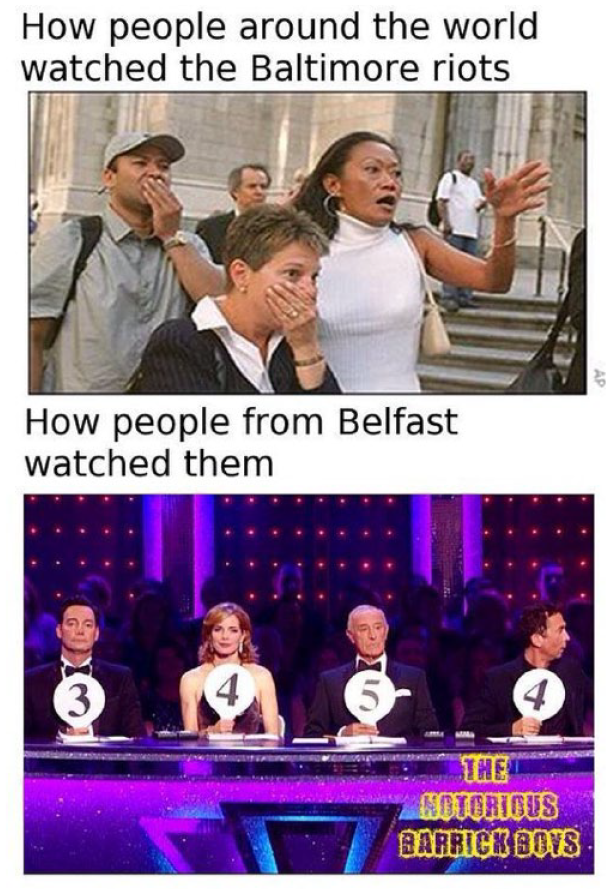
The Baltimore meme.
This interlocutor touches on something that several others mentioned too, namely that there is almost a sense of pride in the recurring riots that happen in Belfast amongst its residents. A middle-aged male unionist elaborated on this idea: ‘We had riots last summer on the Protocol and such [. . .] it is not unique to here, but I don’t think people would be celebrating them anywhere else. There is a sense of pride about them here, it is a bit surreal’ (Interview, 25 January 2023). In this narrative we find an idea of Northern Irish exceptionalism: as a society that is an international outlier due to its intimate relationship with sectarian violence. This is something which several other interlocutors mentioned too, often in negative terms and related to international stereotypes: ‘Northern Ireland is known obviously for unrest and riots, and I think the rest of the world sees us as a pure war zone at times [. . .]. This [meme] puts it out there that we are still a war zone, so this is more offensive’ (Interview, 26 January 2023) as stated by a middle-aged female unionist.
Interestingly, some people that I interviewed found that the continuous sectarian violence served a social purpose in Northern Ireland, paradoxically bringing people together: ‘That is a kind of unifying thing that brings the different communities together [. . .] there is a weird sense of pride in conflict’ (Interview, 26 January 2023) as stated by a middle-aged male Green Party voter. He would then go on to explain how this kind of violence ties the different communities together: ‘It reminds me of football where you have the rival firms, and they need each other – it probably unifies to start with’ (Interview, 26 January 2023). While the views of this particular interlocutor on the unifying qualities of violence are not representative amongst my sample, many people that I interviewed did talk about sectarian violence and rioting as part of their culture, and thus, implicitly as something which binds people and communities together. Indeed, one interlocutor, a female Alliance/SDLP voter in her mid 20s, connected the sectarian violence to a sense of home, which is visible in her statement: ‘I actually followed the local news more when I lived abroad, like, “is someone being kneecapped back home without me knowing about it?”’ (Interview, 16 February 2023). While said in a joking tone, this statement conveys a common sentiment amongst the people that I interviewed in Belfast, namely that sectarian violence is an integral part of their culture, and thus, in a sense it is a part of who they are.
Theme 4: emotional engagements
This meme (Figure 5) appeared on the Know Your Meme and the Meme Generator websites following the Protocol riots of April 2021. In the meme we see a masked person wearing a tracksuit in front of a burning car with the text ‘Belfast Summer Scheme’ superimposed on it. ‘Summer scheme’ is a terminology peculiar to Northern Ireland which designates activities designed to keep young people occupied during the summer. The reference to summer connects with the realities on the ground in Belfast, where the summer months (especially July) are known to be ‘prime time’ for rioting. Indeed, as noted by one of my interlocutors, a middle-aged male unionist: ‘It does seem to be a summer thing: when the weather is better there are a lot more riots‘ (Interview, 25 January 2023). Given its connection to a perceived reality in Belfast, the meme sparked a lot of emotional engagement during the interviews, as several interlocutors said that it made them sad. ‘I can see the humour, but I feel a little saddened by it, you know, that that is something that is related to the country and the place that I am from’ (Interview, 27 January 2023) was how a middle-aged female Alliance voter phrased it. A middle-aged male Green Party voter chimed in: ‘This is kind of sad in a way because it is probably accurate [. . .] people would always say I hope the summer weather is not great, because that would sort of slow it [the rioting] down’ (Interview, 26 February 2023). Several interlocutors, then, agreed that this was a sad way of representing Belfast’s youth. Indeed, many stressed the fact that young people are often out rioting, and that this is what makes this meme especially depressing. As noted by a female 20-something Alliance/SDLP voter: ‘many times there are kids that are being exploited. During the Protocol riots there was one kid who was 12 years old, getting a criminal record for the first time. So that is sad’ (Interview, 15 February 2023). Audience engagements with this meme thus illustrates its ‘ability to allow us to be affected by the issues at stake’ (Baishya, 2021: 1131). Given how common it was for interlocutors to be triggered emotionally by this meme, one may consider whether memes like this contribute to the building of ‘affective publics’ (Papacharissi, 2014) in digital Northern Ireland.
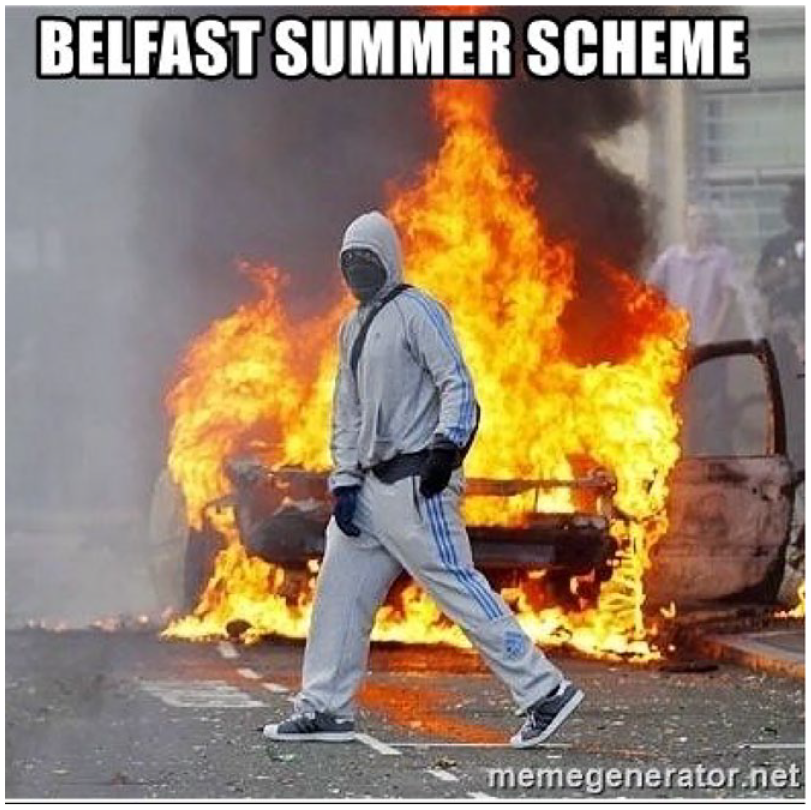
Belfast summer scheme meme.
While there was a shared sense amongst many interlocutors that the meme was indeed sad there was much more divergence on whether it was funny or not. Some interlocutors connected these elements together, as they articulated the notion that it was funny precisely because it was sad (and true) – thus representing a sort of ‘taboo’ or ‘too soon’ humour which is predicated upon a ‘humorous clash’ which occurs when laughing at something which is perceived to be too serious for laughter (Kuipers, 2005). One interlocutor, a female 20-something Alliance/SDLP voter articulated this in the following manner: ‘It is not untrue, and maybe it is a bit morbid to laugh at it, but maybe that is why it is funny’ (Interview, 15 February 2023). Another interlocutor, a middle-aged Irish nationalist man working in IT, however, simply found it good fun: ‘(laughs hard) I would forward this one to my friends!’ (Interview, 27 January 2023). He did, however, add the caveat that he is ‘comfortably numb’ several times during the interview – and thus, he is likely less receptive to the emotional charge of this meme than other interlocutors. Some interlocutors, on the other hand, found the meme to be entirely lacking in humorous qualities: ‘I don’t find this one funny: I think it is in quite bad taste’ (Interview, 26 January 2023) as a female middle-aged unionist argued. While one could suggest that she did so due to her political position, there were several other, non-unionist, interlocutors who agreed: ‘It is a mockery of the youth who live in interface areas [. . .] this meme is just distasteful’ (Interview, 2 February 2023) was the firm opinion of a middle-aged male Alliance voter. Lastly, the preoccupation with deciphering the authorship was also present in audience discussions of this meme. A middle-aged Irish nationalist man working in accounting argued along these lines when faced with the meme in Figure 5: ‘whether or not that is funny depends on what side put it there. It could be offensive if it is done by Catholics [. . .] it is almost encouraging [of rioting] . . . but that depends on who is reading it’ (Interview, 7 February 2023).
Conclusion
This study has sought to shed light upon how memes about rioting in present-day Belfast are read by their audiences. As such, it answers to a distinct research gap in the meme studies literature, namely how memes are received by their audiences. Indeed, the broader meme studies literature has to date mostly shied away from in-depth engagements with audiences (Trilló and Shifman, 2021: 2496–2497), favouring instead concepts such as the ‘imagined audience’ and the ‘directionality’ of memes (Wiggins, 2019: 111–112). Drawing on semi-structured interviews with 19 respondents in Belfast carried out in early 2023, I developed four salient themes on how they read memes about political violence. The first theme suggests the possibility that the pop-cultural form sometimes trumps the politics of the meme, as also argued by Michelle (2007) in a broader discussion on the audience reception of media texts (p.187). When a pop-cultural phenomenon is widely embraced in a society it may mediate against it causing offence, even when its politics are decidedly contentious. The second theme indicates that authorship still matters to meme audiences – even though the meme is in a sense an authorless digital artifact (Donovan et al., 2022: 181). Indeed, my interlocutors commonly wanted to know – and speculated wildly about – who made a meme and why. This indicates that the meme studies literature would do well to incorporate the concept ‘imagined author’ (Das and Pavlíčková, 2014: 385–386) to complement (or replace) the concept ‘imagined audience’ (Wiggins, 2019: 111–112). The third theme demonstrates how audiences read memes as a site for the negotiation of who they are in relation to what is portrayed in them. In this case, such ‘identity work’ (Lamerich and te Molder, 2003: 452) centred on notions of political violence as a part of the culture in Northern Ireland, and thus, to some extent as something that is inherent in the identities of my interlocutors. The fourth theme illustrates how audiences were emotionally engaged by the memes, possibly contributing to the building of what Papacharissi (2014) terms ‘affective publics’. This emotional engagement varied across different audience members, with some being comfortably numb, while many others were deeply saddened by the meme in question, while others still were angered by it, and several (but definitely not all) found it funny.
Taken together the article’s findings have potentially far-reaching implications for the future of meme studies. Perhaps most importantly, the notion of an ‘imagined audience’ (Wiggins, 2019: 111, 112) has been found to be reductive at best, and it needs to be complemented (or replaced) with an in-depth focus on audiences’ meme readings. This study has indicated that there is no clear-cut correlation between the political opinions of individual interlocutors and their reading of politically contentious memes. This was evident in this study as interviewees did not blindly follow the ideological ‘directionality’ (Wiggins, 2019: 112) when reading a meme. Thus, in-depth engagements with audiences allow us to move beyond the ‘ideological robot’-tendencies inherent in concepts like ‘imagined audience’ and ‘directionality’ and lets us explore meme audiences as the complex and multifaceted creatures they (we) are. This may include, but is not limited to, unpacking how they read the pop-cultural form of the meme, exploring their take on its ‘imagined author’, asking how they approach the identity work involved in reading memes, and inquiring into the emotional engagements that audiences develop when doing so.
Footnotes
Appendix
Overview of interviews.
| Date | Gender | Age | Occupation | Political op. | |
|---|---|---|---|---|---|
| Interview 1 | 25/1 2023 | Male | Middle-age | IT | Nationalist |
| Interview 2 | 25/1 2023 | Male | Middle-age | Defence ind. | Unionist |
| Interview 3 | 26/1 2023 | Male | Middle-age | Civil service | Alliance |
| Interview 4 | 26/1 2023 | Female | Middle-age | Mediation | Unionist |
| Interview 5 | 26/1 2023 | Male | Middle-age | Public sector | Green Party |
| Interview 6 | 27/1 2023 | Female | Middle-age | Shop manager | Alliance |
| Interview 7 | 27/1 2023 | Male | Middle-age | IT | Nationalist |
| Interview 8 | 30/1 2023 | Male | Older | Retired | Alliance |
| Interview 9 | 31/1 2023 | Male | 20-something | Student | Nationalist |
| Interview 10 | 1/2 2023 | Male | Middle-age | IT | Unionist |
| Interview 11 | 1/2 2023 | Female | 30-something | Solicitor | Nationalist |
| Interview 12 | 2/2 2023 | Male | Middle-age | Reconciliation | Alliance |
| Interview 13 | 6/2 2023 | Male | 20-something | Student | Alliance |
| Interview 14 | 6/2 2023 | Female | 19 years old | Student | Nationalist |
| Interview 15 | 7/2 2023 | Male | Middle-age | Accountant | Nationalist |
| Interview 16 | 7/2 2023 | Male | 19 years old | Student | Nationalist |
| Interview 17 | 15/2 2023 | Female | 20-something | Student | Alliance/SDLP |
| Interview 18 | 15/2 2023 | Male | 30-something | Tech staff at uni | SDLP |
| Interview 19 | 16/2 2023 | Female | 20-something | Doctoral student | Alliance/SDLP |
Funding
The author received no financial support for the research, authorship, and/or publication of this article.
