




Abstract
This paper proposes that LGBT+ mainstreaming on reality television programme Strictly Come Dancing creates space for audience demand for radical, authentic representations of same-sex desire and intimacy, both of which challenges normative representations of ballroom dancing. Integrating concepts of normativity and authenticity explored in existing scholarship, I argue against the encountering through a defensive stance, of reality TV’s normalization of queer narratives to promote authentic, inclusive representation. Focusing on dance-themed British reality TV programme for family entertainment, I draw on a queer reading of 285 newspaper articles on Strictly Come Dancing’s same-sex dance partnerships and 35 interviews with LGBT+ equality dancers in the United Kingdom, to conclude that active engagement with mechanisms of normalization can open up spaces for a reclamation of queer representation in its authenticity. The article makes a contribution to media and cultural studies and queer television scholarship through a troubling of anti-normativity, proposing a working with normativity to achieve queer inclusivity.
Keywords
Introduction
Prior to 2003 with the abolition of Section 28 in the UK which prohibited ‘the teaching of the acceptability of homosexuality’ within schools, queer representation on television was one of few platforms for young people to learn more about LGBT+ culture and come to terms with their own sexuality. Section 28 made LGBT+ representation on television screens more necessary, witnessed since the 1990s in the United Kingdom (UK) with LGBT+ characters populating dramas, soap operas, sitcoms, documentaries and reality TV shows. Popular reality TV program Great British Bake Off, which started in 2010, had several queer contestants, with gay-identifying John Whaite winning the third series in 2012, before becoming part of the first male/male dance partnership on Strictly Come Dancing (SCD) in 2021. Dating shows such as Naked Attraction and Love Island included LGBT+ contestants and featured queer romances in their recent seasons. To increase queer representation on TV, reality dance shows disrupted their long-running traditional format to include same-sex dance partnerships in later seasons. In 2019, The Greatest Dancer first featured Santra and Piia competing as a female/female dance couple. Dancing On Ice premiered its first male/male partnership in 2020, with SCD following the trend with its first all-female celebrity/professional couple in 2020, following up with a male/male partnership in 2021 and two same-sex dance couples in 2022. This phenomenon requires that we ask how queerness is framed on reality dance shows, its critical reception and the audience’s influence on the construction of LGBT+ narratives. Addressing these questions allows us to understand the extent to which SCD’s portrayal of same-sex partnerships challenges heteronormative understanding, and contributes to increased acceptance of non-traditional ways, of doing ballroom dancing.
Existing scholarship reflect diverse perspectives on queer media representation. Media and cultural studies scholars emphasize its importance for tackling ‘systemic inequalities and exclusions’ (Hogg, 2020), with young people likely to turn to television shows and characters when solidifying sexual identities (Chapin, 2000; Meyer and Wood, 2013). Others caution that the mainstreaming of LGBT+ characters may reinforce dominant discourses (Battles and Hilton-Morrow, 2002; Dow, 2001; Gross, 2001; Shugart et al., 2001; Walters, 2001) through the depoliticization and desexualization of LGBT+ characters on screen (Battles and Hilton-Morrow, 2002; Brady et al., 2017; Doran, 2013; Walters, 2014). Shifting the gaze to audience, some scholars draw attention to the growing demand for realism and authenticity on reality TV shows (Biressi and Nunn, 2005; Hill, 2002, 2014), with a commitment to ‘radical inclusiveness and transparency’ (Kjus, 2009: 281) reportedly increasing the appeal of reality programs to audiences (Papacharissi and Mendelson, 2007). Media scholars also highlighted the increasing power of audience over media production with a shift towards audience participation through vote-in services on reality TV programs (Enli, 2008; Holmes, 2004; Jenner, 2015; Kjus, 2011).
This paper integrates concepts of normativity and authenticity explored in the aforementioned scholarship to argue against the encountering through a defensive stance, of reality TV’s normalization of queer narratives to promote authentic, inclusive representation. Using the case of SCD’s introduction of same-sex dance partnerships, I highlight how active engagement with mechanisms of normalization can create spaces for audience participation in the reclamation of queer representation in its authenticity. Applying a queer perspective to a discourse analysis of newspaper articles on SCD, complemented with 35 interviews with LGBT+ same-sex dancers in the UK, this paper contends that while reality TV continues to frame inclusiveness and authenticity through the lens of normalcy and assimilation, this mainstreaming of queer individuals holds a disruptive force by motivating audience support and demands for further queering, which opens up new spaces for radical representation. This article makes a contribution to media and cultural studies and queer television scholarship in its troubling of anti-normativity, proposing an alternative route to inclusivity which embraces queerness in the familiar, working with rather than against normalization to enable audience engagement in the disruption of heteronormative media representations of ballroom dancing.
Normalizing gay identities on television
Ghaziani (2011: 103) notes ‘a troubling politics of normalization’ in post-gay sensibilities, as inclusivity in media representation is framed through normalcy and assimilation (Duggan, 2002; Ng, 2013). The normalization of gayness on screens, through the strategies of depoliticization and desexualization, as a means to more inclusive representation reinforces rather than challenges normative family and consumption structures which uphold exclusionary practices. This perpetuates a persistent under-representation of gender non-conforming individuals, people of colour and non-lesbian and gay identities, subduing other queer possibilities and sustaining the illusion of equality and inclusivity. A growing presence of queer characters and romances on British screens and a shift towards portraying more diverse gender and sexual identities may imply an acceptance of sexual alterity. However, a queer perspective to media studies looks beyond quantifying the numbers of LGBT+ individuals on screens. It investigates how queer identities are constructed and the complexities behind such constructions (Avila-Saavedra, 2009). Media and cultural studies scholars adopting a queer reading of media texts argue that messages of inclusivity and representation in traditional broadcast television, rather than conferring social legitimacy to LGBT+ individuals, serves to concretize and reinforce dominant discourses (Dow, 2001; Gross, 2001; Shugart et al., 2001; Walters, 2001; Draper, 2012). Desexualization and depoliticization of LGBT+ characters to make queerness less socially threatening to mainstream audience are two key issues identified in existing scholarship (Papacharissi and Fernback, 2008). Such phenomenon draws attention to a pattern of homonormativity on television that governs ‘a privatized, depoliticized gay culture anchored in domesticity and consumption’ (Duggan, 2002: 179, cited in Brady et al., 2017: 61).
A desexualization of LGBT+ characters by show producers stabilizes dominant ideals around heterosexual relationships. Gross (2001: 87) suggests that desexualization ensures that homosexual portrayals pose less of a threat to heterosexuals. Similarly, Shugart (2003) considers the gay man/heterosexual woman friendships featured on television programs to be heterosexist and desexualized, since heterosocial relationships are emphasized as the normalizing force on homosexual relationships. An explicit desexualization of gay identities is observed by Kanner (2004: 36) in an analysis of reality TV program Queer Eye, which depicts five men as ‘gay superheroes’ fixing heterosexual lives and relationships, yet demonstrating no signs of sexual tensions between them. Avila-Saavedra (2009: 12–13) concludes that Queer Eye ‘celebrates heterosexuality’ and fails badly as a reality program in its denial of the five gay men of sexual desires or love lives.
Some media scholars argue that LGBT+ media mainstreaming limits the framing of queerness and sanitizes queer desires to cater to heterosexual viewers. Ng (2013) used ‘media gaystreaming’ to describe developments in media programming towards presenting a narrow set of representations of LGBT+ identities, such that the ‘trope of gay male/straight female affinities for consumption and lifestyle interests’ is prioritized to the exclusion of other queer identities. Gay normalcy extends into lesbian depiction on screen, with McNicholas Smith and Tyler (2017: 317) reporting that lesbianism is tied to ‘ideals of hetero-patriarchal, white, middle-class femininity’ in mainstream drama.
The treatment of gay representation as light entertainment depoliticizes LGBT+ identities in its exclusion of struggles against homophobia and dislocation of sexuality from class, race and gender. Dow (2001: 134) reported depoliticization in ABC sitcom Ellen, which emphasizes Ellen’s gay identity as ‘a personal and relational concern’, at the expanse of highlighting broader political issues of the status of homosexuals and homophobia. On the other hand, Monaghan (2021) demonstrates through MTV’s Faking It that even when diversity is celebrated, sexual and gender norms contested and struggles against discrimination acknowledged, this can be shrouded in a post-gay ideology advocating assimilation into the broader norm as the ultimate goal. While acknowledging the aforementioned issues with normalization, this paper aligns with Harlap (2017: 582) in taking a nuanced stance on representation as occurring ‘through the spectrum ranging from normative to queer’, seeking to identify the liberating, radical potentials offered by normativity.
Reality TV: Authenticity for the diverse audience
Further complicating the representation of LGBT+ individuals on popular media is the construction of the audience. Existing literature highlight a shift in the ‘post gay era’, from the presumption of heterosexuality and heteronormative sensibilities among mainstream audience (Berlant and Warner, 2002; Dow, 2001; Fejes, 2000; Gross, 2001; Walters, 2001) towards a perspective of audience as diverse and concerned with authentic depictions of the lived realities of different characters, regardless of their gender and sexuality (Goldberg, 2016; Monaghan, 2021). Scholars suggest such a shift in audience expectations influence how queerness is framed on television. Lovelock (2019) presents the newer genre of reality TV emerging in the 1990s as addressing an imagined mass audience of diverse and ‘diversity-aware’ individuals, with ‘compulsory authenticity’ driving the representational framework, such that representing show participants for ‘who they are’ is prioritized over heteronormative assumptions about gender and sexuality. This emphasis on authenticity is reported in Hill’s (2002: 324, 2004) earlier work on Big Brother viewers where ‘audiences look for the moment of authenticity when real people are “really” themselves in an unreal environment’.
Media studies scholars examining audience participation in media production of reality TV programs highlight changing audience/producer relationships, with audience increasingly perceived of as ‘players’ or ‘participants’ (Enli, 2008). The trend towards digitization informed another shift towards investigating online spaces as new platforms for participatory television culture (Jenkins, 2014; Jenner, 2015; Sandvoss et al., 2017). Increasing viewer interactivity is economically driven, as reality TV shows’ integrate vote-in-services to generate new income (Enli, 2007; Freedman, 2008; Jones, 2004; Kjus, 2011), attributing power to viewers to influence show outcomes (Ross, 2008), such as in SCD where audience can vote for their favourite contestants. However, Enli (2009) reports that the BBC, as a public service broadcaster, makes editorial decisions on which contestants should remain on the show, conflicting with the move towards attributing more power to audience as ‘participants’. Enli and Ihlebaek’s (2011) comparative analysis of BBC’s SCD with the Norwegian version reports BBC to afford less power to audience than the Norwegian commercial channel TV 2, reasoning that higher editorial control is enforced to uphold program quality and limit economic exploitation.
BBC’s focus on editorial control is particularly evident in SCD’s handling of the discourse on same-sex dance partnerships, with producers’ decision to stick to its 16-year traditional format despite active calls for change from the public, judges and professional dancers on the show. SCD’s format is tied to the traditional beginnings of ballroom dancing from centuries past which is deeply embedded within heteronormative assumptions of normative gender roles and heterosexuality (Wong, 2024; Wong, 2023; Wong et al., 2021). Producers’ response that ‘Strictly is a family show and we have chosen the traditional format of mixed-sex couples’ (Mortimer, 2015) highlights the BBC’s imagination of a traditional broadcast audience described by Ellis (1982: 114) as ‘tak[ing] the form of families’ consisting of ‘two parents, the father working, the mother running the home, together with two children of school age’. Such is attributable to SCD’s early construction as a flagship ‘family show’ (Mortimer, 2015) occupying a primetime slot, setting it apart from the reality shows in Lovelock’s (2019) analysis. Over 16 years, this notion of family functions as ‘the ideological glue that holds it together’ (Needham, 2009: 145), ensuring SCD maintains a traditional format which excludes the representation of LGBT+ ballroom dance cultures. This paper recognizes the taking shape of Lovelock’s (2019) ‘diversity-aware’ audience in SCD, advocating for a disruption to the traditional representation of ballroom dancing. SCD responded with a shift in message towards inclusivity, implementing a stepped approach to the integration of same-sex dance partnerships across its last three seasons, the first female/female partnership in 2020.
Method
This article examines the manner in which same-sex dance partnerships is constructed and contested on SCD, through a queer reading in the discourse analysis of British newspaper commentary on SCD between 2020 to 2023, the timeframe within which same-sex professional/amateur dance partnerships was introduced. Since news reports influence public perceptions of same-sex dance partnerships and its acceptability for airing on SCD, it is important to understand how the topic is constituted through news media. The aim is therefore not to ascertain how accurately these articles reflect SCD’s representations. Rather special focus is given to specific narratives and situations which speak about same-sex dance couples in relation to the traditional dance format, as these discourses produce ‘subject positions’ (Davies and Harré, 1990) made available for viewers to connect with their thoughts, emotions and behaviour about same-sex partnerships on SCD. To identify omissions and normative themes in news media representations, these depictions are juxtaposed against the narratives of 35 LGBT+ dancers in same-sex/equality ballroom dance partnerships in the UK, collected through semi-structured interviews conducted as part of a broader empirical study.
Same-sex dance partnerships can be understood as constituted through discourses since viewers need to draw on discourse to make sense of them (Owen and Riley, 2020). Discourse analysis is employed to identify recurring themes and discourses that guide the construction of same-sex dance partnerships and dancers, with a queer lens identifying normative themes through unpacking the complexities behind media constructions. Miller (1994: 215) draws attention to the effectiveness of discourse analysis in examining issues of gender, sexuality and communication. Media scholars analyzing the media representation of gay males and male/male dance partnerships (Battles and Hilton-Morrow, 2002; Shugart, 2003; Wong et al., 2021) have adopted discourse analysis as a method of approach.
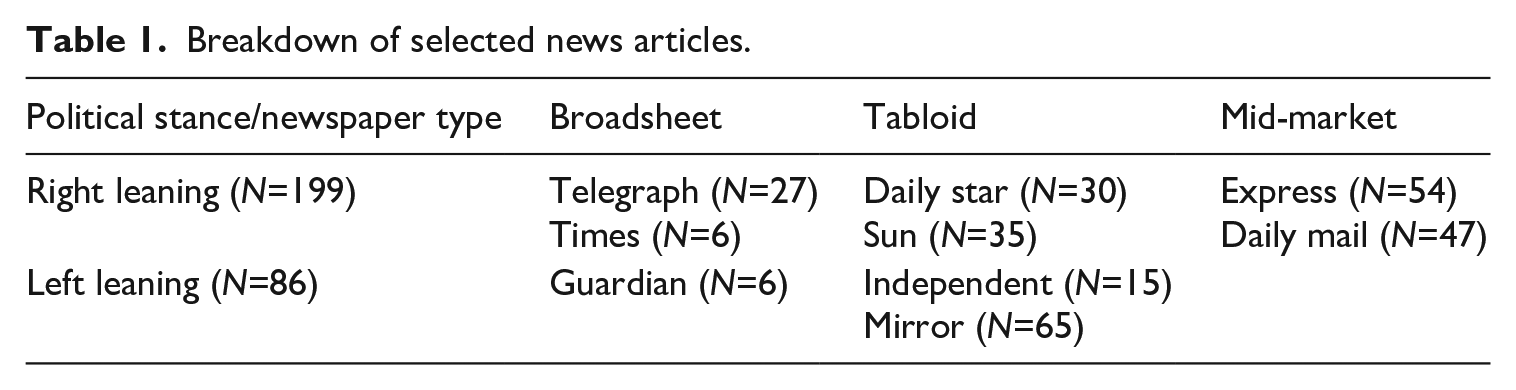
A search on Lexis-Nexis with the search term ‘same-sex Strictly’ was conducted to identify articles using it in the headline or body, between the period July 2020 to March 2023, coinciding with the seasons same-sex professional/celebrity partnerships are included. The trend around media conversations on SCD suggests most activity 2 months before and after, and during each season, with the time period set to capture most articles. A broad range of publication types such as newspapers, news transcripts, newswires and press releases are included, producing 953 articles, systematically edited to a final corpus of 285 articles. 194 duplicates within the same newspaper were removed, 292 rejected for irrelevance or lack of suitability such as summary briefings. A further narrowing excluded local newspapers and selected nine newspapers with national dissemination, ranging from broadsheet to mid-market to tabloid (see Table 1). Broadsheets include The Guardian which is left leaning, The Daily Telegraph and the Times which are both right leaning. The four selected tabloids are Daily Star and Sun (both right leaning), The Independent and Mirror (both left leaning), and two right learning mid-market which are the Express and Daily Mail. Political imbalance across the newspapers is reflective of the UK newsprint media, with these nine selected to provide diverse perspectives across the political spectrum. Articles were closely read for recurring themes and structures and thematically coded on NVivo.
Breakdown of selected news articles.
Normalizing same-sex dance partnerships on strictly
British newspapers construct SCD as an inclusive show following its announcement in 2020 of the first female/female dance partnership. Turning back on a statement made in 2015 that SCD will not be incorporating same-sex coupling as a family show, several articles across the political spectrum (Express, Mail, Mirror, The Independent) quote producers’ statement as: Strictly Come Dancing is an inclusive show and is proud to have featured same-sex dancing amongst the professional dancers in group numbers in previous series. [. . .] Nicola Adams requested and all-female pairing, which we are happy to facilitate. The show is first and foremost about dance, the sex of each partner within a coupling should have no bearing on their routine. (Kirwan-Jones, 2020; Lewis, 2020; Twigger, 2020a; Wheeler, 2020)
Media discourses foreground inclusiveness and normalize same-sex dance partnerships by positioning it within the shadows of its past occurrences among dancers in and beyond SCD. Such a move reminds readers of their past encounters with same-sex coupling and SCD’s role in promoting diverse representations. For example, Sun reported SCD’s plans for a male/male dance partnership in 2021 against a backdrop of ‘historical all-female pairing last year’ and the move having ‘been done on Dancing on Ice’, with ‘Strictly bosses’ adding that the change will enable them to ‘be as progressive and inclusive as possible’ (Hope, 2021).
Britain is promoted as an excellent host for SCD’s ‘history-making’ move through the stories of LGBT+ show dancers. Several right-leaning commentators (Hope, 2021; Newman, 2020; Torode, 2021) presented professional Johannes Radebe, who danced in a male/male partnership with a professional in 2020 and a celebrity in 2021, as expressing gay gratitude towards Britain and SCD for facilitating these partnerships. Radebe was portrayed in Daily Star as ‘from the smallest township in the Free State of South Africa’ and having experienced bullying for his sexuality and his pursuit of a perceptibly female-dominated career, expressing thankfulness for the SCD ‘opportunity [which] gives me time to be grateful for where I am. This country is the most beautiful, most progressive place anyone could find themselves in’ (Torode, 2021).
This politicization of Radebe’s sexuality outside of Britain reinforces the notion of Britain as an inclusive, progressive country, demonstrating a ‘post-gay’ sensibility which Hilton-Morrow and Battles (2015: 257) suggest is ‘based on the idea that gay rights have been achieved’. The Daily Mail clearly articulated a ‘post-gay’ discourse through comedian and television host Graham Norton’s opinion that ‘as you have people who can be openly gay on that show, I don’t particularly need to see a man dancing with a man’, reasoning that it is not ‘a homophobic thing. You just want to be able to compare like with like’ (Rusk, 2020). There is a suggestion that LGBT+ people already have equal opportunities and rights to appear on the show, so same-sex partnerships is not needed for inclusivity. Within this ‘post-gay’ discourse, SCD’s ‘groundbreaking’ move is depicted as well ‘overdue’ (Horton, 2020; Methven, 2020a; Milward, 2020), especially with a program that ‘trades in camp’ (Block, 2020).
Where homophobia in Britain is recognized, this is often positioned outside of the ballroom dance context, with the proposal that SCD can fix the issue with an inclusive representation of ballroom dancing. For example, left learning commentators were less optimistic about having achieved gay rights, arguing that same-sex dance partnerships is integral towards BBC’s development of an inclusive media environment. In Guardian, Bryan (2021) describes ‘homophobia [as] still rife’, adding that ‘the inclusion of same-sex couples on Strictly also skewers the homophobic trope that same-sex relationships are somehow inappropriate for families’. Despite recognizing pockets of homophobia in contemporary Britain, left-leaning commentators failed to contextualize this discrimination within the UK’s ballroom dance scene. In positioning homophobic encounters as episodes outside of the dancefloor or of Britain, media discourses depoliticized LGBT+ identities within ballroom dancing.
Yet, beneath this gay gratitude of Radebe lies the struggles of LGBT+ people in the UK for the right to dance with one another on television and in their everyday lives. An interviewee Cracknell, who identified as a lesbian woman in her 60s, described a time back in the 1990s when she witnessed discrimination on the dancefloor, which led her to create a same-sex dance community: You know in the old days, I keep going back, but I think it is important to see the history of it. I started the Rivoli because a group of same-sex dancers had gone to dance at the Battersea Arts Centre, and the men had been thrown out of a dance for dancing together. They were told that they were disturbing the regular dancers there. And so I wanted to create a gender-neutral space at the Rivoli, and I started that in 1995, and I have been doing that ever since. However, probably 15 years later, at the Festival Hall [. . .] there was an older man who became very abusive to these two men who were dancing together, and they called the management. And the management threw out the old man, rather than throwing out the dancers. [. . .] that is a really good example of how time makes a difference to all these things.
Unlike the picture of an inclusive Britain painted in newspaper articles which depoliticized same-sex dancing, Cracknell highlights a history of homophobia-related struggles in UK dance spaces, before acknowledging that same-sex dancing is now more widely accepted, albeit not forgetting the daily violence LGBT+ dancers continue to face in their everyday lives. This aggression towards LGBT+ dancers also emerges in Bridget’s (lesbian, early 60s) reflection on her Waltzing with her girlfriend in a social scene: We waltz together, and she was leading. And she, her hold was just very slightly different from what it should be, and it was just slightly more intimate. [. . .] I was quite enjoying that feeling. I didn’t think it would be visible to anybody, not that that would have worried me if it had been. But two of the man and woman couples started dancing close to us, and starting saying ‘go home, lesbians’. I was astonished, I didn’t think either of us looked like the stereotypical lesbian. Lots of women were dancing together, which was normal at that Irish [Ceilidh] scene. [. . .] it just showed how strong that antennae is, for spotting anybody who is doing this dangerous thing of not having a man being ‘manly’.
Bridget highlights female/female dance partnerships to be the norm in the context she experienced aggression, suggesting that her performance of lesbian intimacy in the dance was problematized, which leads to the issue of desexualization of same-sex dancers for mainstream acceptance. The show producers’ earlier statement suggesting that the sex of dancers should not influence the dance routines points to the first instance of desexualization, as it frames interpretations of same-sex dancing within the traditions and traditional framework of ballroom dancing. The above is further evident in SCD’s historicizing of same-sex dancing within the mainstream as opposed to the UK’s same-sex/equality dance scene. In Telegraph and Daily Star, Nicola Adams, the first celebrity in a female/female dance partnership, was quoted normalizing her partnership as such: And women actually dance with women all the time in the professional circuit so I guess it’s just showing people that it can be done. (Bird, 2020; Stanford, 2020)
In Express, female/female partnerships were compared to ‘go[ing] to nightclubs and girls dance with girls all the time’ (Masters, 2020), historicizing the intimacy in dancing to ‘the older generation’ of ‘men and women [who] dance together when they were courting’ which led them to ‘see it as a sexual thing rather than a sport’ (Manning, 2020a). These reports mobilize Nicola’s sportsperson image to position same-sex dancing on SCD as a sport devoid of sexual connotations, historicizing the treatment of dance as Nott’s (2015: 299–300) space for meeting potential life partners to suggest that such is not reflective of the contemporary dance scene. Such a discourse deviates from the lived experiences of dancers like Bridget where sexual intimacy is very much part of the dance experience. Similarly, interviewee Laura (female, lesbian, mid 20s) describes her response to normative perceptions, of her dance with her life partner as a coping strategy for the lack of men, by ‘follow[ing] that up with being more physically affectionate’, establishing sexual connection to convey her choice to dance with someone she loves.
Despite being unreflective of LGBT+ individuals’ motivations for dancing in same-sex-partnerships, this discourse of practical choice is reflected in media reports to normalize such partnerships. Narratives of SCD professionals are drawn on to highlight its practicality due to sex imbalance in the dance scene and the commonality of such partnering as part of one’s job as a dance teacher. In Daily Mail, professional dancer AJ Pritchard highlights the presence of ‘same-sex competitions for under 12s and there are usually more girls than boys who want to dance and so there would be all-girl partnerships’ (Wheeler, 2020). In Express, head judge Shirley Ballas ‘urge viewers to look with an open mind’, adding that she ‘had a little girl partner myself, and I feel like it’s movement to music with great technique’ (Manning, 2020b). The sex of dancers was downplayed and the practicality of such arrangements emphasized, with Ballas expressing that ‘there would be 100 girls and two boys so if you got a boy partner, you were extremely lucky!’ (Manning, 2020b). On the professional level, dancer Karen Hauer who was in a female/female partnership in SCD’s 2022 season added in Express that ‘she would feel “comfortable” dancing with another woman as she has performed “a lot” of routines with girls throughout her career’ (Ingate, 2020). Outside the professional sphere, the practicality discourse is reflected in The Independent reporting comedian Jadye Adams’ motivation for dancing with a woman as ‘[the boys] ain’t strong enough’ to perform the lifts (Lewis, 2022), implying she will do the lifting with a female dance partner.
Unlike female/female partnerships, male/male partnerships are historicized within the Tango practice ‘commonly danced by two men in 19th-century Argentina’ (Lawrence, 2020), made practical through Radebe describing his choreographic inspiration for the Tango with John Whaite from ‘researching the history of tango – discovering that, at one point, it would have been routinely danced by two men, “practicing so they could lead with a woman”’ (Johnston, 2021). A media discourse which maintains same-sex partnerships as practical and normative within mainstream ballroom dancing desexualized and depoliticized same-sex dancing, facilitating its screening on SCD such that it has now become a norm for the program. In 2022, the BBC included two same-sex partnerships, with media reports shifting away from debating whether such partnerships should be included to how many same-sex partnerships will be part of the line-up (Ally, 2022; Lewis, 2022; Novak, 2022; Tutton, 2022). The number of newspaper articles discussing same-sex partnerships also significantly dwindled in 2022, with the corpus of articles in this paper concentrated between 2020 and 2021. Professional Karen Hauer commented in Daily Star on the normality of same-sex dancing as: ‘It’s not a taboo anymore. It’s a beautiful thing to be able to show same-sex dancing. It’s normal now, and the way it should be’ (Gleave, 2022). Unlike Avila-Saavedra’s (2009) exertion that the normalization of LGBT+ identities on television is assimilationist, I argue that for SCD, normalization of same-sex dancing is a necessary step towards queering ballroom dancing. Mobilizing Joyrich’s (2014: 136) questioning of queerness ‘outside the binaries of queer theory itself’, I demonstrate how SCD fans created opportunities for the ‘odd operations of televisual logic’ with demands for authenticity, contributing to a queer revision of the traditional meaning of ballroom dancing
Strictly audience and the queering of normativity
Newspaper reports present SCD’s same-sex coupling as well-received by audience, who took to social media to express support for dancers, perhaps in part attributable to its normative representation with little disruption to the ordinary, familiar format of the program. Lovelock (2019: 66–68) highlights ‘a new normativity of authenticity’ on reality TV shows where audience equate being ‘openly queer’ with being ‘real’ and ‘authentic’. Media reports on SCD highlight a quest for authenticity through fans’ demands for queer intimacy in same-sex dance performances. Since SCD audience cast votes to support dance couples, their demands for authenticity opened up new terrains for the disruption of heteronormative representations of ballroom dancing. Mirror reported Nicola Adams and Katya Jones in the bottom two and that ‘fans called on them to stop dancing as “girl pals” and go for “sizzling” romantic routines’, adding that ‘the LGBTQ community had been disappointed by the lack of sexual chemistry displayed’ between them (Methven, 2020b). Returning with a showdance after being axed due to coronavirus, The Sun reported Adams and Jones to respond with a ‘sensual, sexy, raunchy dance in hold with lifts’ (Capon, 2020), while Mirror (2020) added that fans were ‘moved to tears’, quoting a tweet about how the dance made a ‘difference [. . .] to acceptance and inclusivity across the UK’ (Twigger, 2020b).
Ropper (2021a, 2021b), in Express and Mirror, drew attention to audience ‘criticism that they [Adams and Jones] were dancing less like a couple and more like two “girl pals”’, reasoning that next season’s male/male couple Whaite and Radebe’s rumba which, ‘from the very first step we’re very intimate’, ‘should go down well with viewers’. Since both Radebe and Whaite are out on the show as gay, performing intimacy in the Rumba, a sensual dance, not only constitutes an authentic expression of their sexuality, but a realistic performance of the dance in its traditional form. This authentic expression of one’s sexuality through same-sex dance partnerships is reflective of interviewee Alan’s (male, gay, late 20s) comparison of his ease of performing emotions in Latin dancing with partners of different sex and sexuality: It will be easier than with a woman because I think I can always find more beauty in men, as in I am much more flirtatious with men than with women. Like just naturally, that is based on my sexuality. For example cha cha, to get a flirtatious energy with a man will be easier for me than a woman because it’s something I do naturally. So I think like a real life partner, easy. A gay male, like reasonably easy, and then a female less easy.
Responding to audience calls for authenticity enabled a revision of the meaning of intimacy in ballroom dancing and a queering of the televisual repetition of a romantic rumba between a man and a woman. Roper (2021a, 2021b) describes this queering as ‘mak[ing] a point that gay people and same-sex couples should be allowed to dance together’ through dropping the ‘pally’, ‘laddy’ routines. Media articles reported Radebe and Whaite receiving tremendous support from viewers, using words such as ‘leave viewers in tears’ (Allday, 2021), ‘fights back tears’ (Soteriou, 2021; Wynne, 2021) and ‘sobs’ (Soteriou, 2021) in the headings to illustrate the emotional impact of their ‘romantic rumba’.
Being one of three couples to reach the finals is a strong testimony of audience support for Radebe and Whaite’s partnership, since viewer votes are key for progression in the show. In Guardian, Ellen (2021) describes SCD as ‘the UK’s “litmus paper” television shows – an unofficial barometer of public taste and opinion’, adding that ‘Whaite and Radebe detonated the idea that same-sex couples looked “unnatural” dancing together’. Whaite and Radebe performed their finale dance to LGBT+ anthem ‘You’ve Got the Love’, ending the dance showered in rainbow confetti and walking off the dancefloor arm in arm towards a rainbow colored neon heart. The mobilization of queer cultural references to portray queer intimacy in a finale show marks a break away from SCD’s repetitive cycle of mixed-sex partnerships in the past 17 years, since Whaite and Radebe are the first same-sex partnership to have reached the finals. This injection of queerness functioned as Joyrich’s (2014: 53) ‘electrical current that can still give us a jolt’, as the next season’s (in 2022) week 2 results show welcomed another sensual rumba dance in a male/male partnership between SCD’s professionals Carlos Gu and Nikita Kuzmin, to Adam Lambert’s jazz rendition of ‘Mad About the Boy’. Noel Coward, a closeted gay person, composed the original song to express unrequited love and queer longing, often sung by female vocalists to conceal the composer’s expression of queer love. By inviting an openly gay male vocalist to perform the song and a male/male partnership to dance to the rendition, SCD demonstrated an overt queering of same-sex couples through the mobilization of song and dance, highlighting how audience demands for Lovelock’s (2019) ‘compulsory authenticity’ can spark a queering of normalized representations of same-sex dance partnerships. This performance was followed by an intense and emotive Argentine Tango opening the week 3 results show, performed by female/female professionals Karen Hauer and Luba Mushtuk, with background dancers constituting mixed and same-sex partnerships. The featuring of same-sex partnerships leading opening dances in SCD’s weekly results show disrupts the repetitive logic of professional group dances in mixed-sex partnerships, where same-sex partnering are integrated as tokenism rather than highlight.
SCD’s queering of normalized same-sex dance partnerships makes a contribution to queer inclusivity, echoing Brady et al.’s (2017: 82) emphasis on the role of television in shaping ‘gendered and sexual citizenship’. Interviewee Milo (male, gay, early 30s) illustrated how he began dancing in Italy in a mixed-sex partnership before learning about same-sex partnerships through: A video on YouTube, and it was these two guys dancing together in America, in the show So You Think You Can Dance, and that was the first time. [. . .] They did a Rumba at that time, and I was immediately caught. Because it is those model, you know when you grow up and you don’t have models to look up to. All these romantic stories you know, [. . .] it is like everything is straight, or heterosexual-centered [. . .]. So that helped me because the dance in the Rumba that those guys expressed, the love between them was real. And so when I dance, I try to replicate that.
Milo’s narrative highlights the potential for queer inclusivity in ballroom dance participation to be achieved through a progressive disruption to heteronormative media representations of ballroom dancing. The perceived authenticity of the So You Think You Can Dance couple opened up new ways of seeing and doing ballroom dancing which enabled Milo freer expression of his gay sexuality. Newspaper articles highlight such an outcome to be anticipated by professionals and celebrities who described their choice to dance in same-sex partnerships to be ‘doing this for young lads and lasses’ (Johnston, 2021), ‘part of a movement of change, diversity and breaking boundaries in the entertainment industry’ (Bryant, 2020; Kirwan-Jones, 2020) and an ‘important message to youngsters who might be grappling with their sexuality’ (Shakhnazarova, 2020). The aforementioned hopes for change for future generations highlight the power of the audience in calling forth more authentic, diverse representations which disrupt the normative defined by media institutions.
Conclusion
Departing from existing media and cultural studies scholarship which articulate the norm as tyrannical, hegemonic and needing to be contested (Dhaenens, 2014; Wiegman and Wilson, 2015), I propose a rethinking of normalization and an acknowledgement of its political potential in reclaiming space for change. Using the case of SCD, I highlight how audience involvement led to calls for authenticity (Lovelock, 2019: 66–68) in intimate expressions of the dance among same-sex partners, disrupting the 16 year ‘televisual logic’ (Joyrich, 2014: 136) of opposite-sex dance partnerships and heterosexual romance. SCD’s example shows norms to be more dynamic than perceived by queer scholars, suggesting that rather than being defensive against normalization, there is scope to consider encountering normativity through reconciliatory terms and identifying ways in which authenticity can be mobilized towards a queering of the familiar. Working with rather than against normativity requires the recognition of change as non-linear, as vacillating between progression and regression, such that changemakers need to consider taking a step back as a route to progression, demonstrated in SCD where normalization opened up opportunities for media representation of queer intimacies in ballroom dancing.
Footnotes
Acknowledgements
Many thanks to Prof. Carolyn Pedwell (University of Kent) and Prof. Róisín Ryan-Flood (University of Essex) for constructive readings and comments on the manuscript. I also express my appreciation for equality dancers in the United Kingdom who have generously contributed their time towards participating in this study.
Funding
The author disclosed receipt of the following financial support for the research, authorship, and/or publication of this article: The research was funded by the Economic and Social Research Council, United Kingdom (ESRC Case ES/X007014/1).
