




Abstract
Military metaphors have been used intensively and excessively against the COVID-19 pandemic worldwide since its outbreak in 2020. In this article, we consider “war” and “military” analogies as keywords to approach the pandemic culture by examining the use of war metaphors at the time of COVID-19 and its relationship with selective “war” memories in the first year of the global outbreak of the pandemic. Specifically, we underpin the heterogeneity of such use of metaphors and their relationships with geopolitics, collective memory, and nationalism. We examine the contexts in which these war frames against COVID-19 were articulated and their affective and discursive implications to geopolitics outside of a Western-centric context through two case studies in East Asia – Hong Kong’s bottom-up military analogies in the post-Anti-ELAB era and Taiwan’s biopolitical nationalism against China. Our discussion underscores the significance of contexts in considering the purpose and impact of military metaphors against COVID-19, and also other diseases and even disasters of all kinds in the future, by highlighting the geopolitical trajectories outside of North America and Europe, where regional war memories and military tensions are referenced to inform local definitions of security, safety, and securitization practices.
Keywords
Introduction: The function of a “war” on COVID-19
Metaphors are often used to evoke an idea or emotion; they affect how the situation described is perceived by filling in gaps and extending our language and conceptual knowledge (Flusberg et al., 2018: 3). War metaphors and military framings have been used intensively and excessively against COVID-19 across the world since its outbreak (Hanne, 2022). Expressions such as “beat the virus” and “defend our people” have been mobilized in national responses in different countries, serving the political purposes of establishing conceptual and material enemies, as well as provoking a sense of urgency and solidarity (Nerlich, 2020). Military metaphors and war framings were used by leaders and politicians across the globe, such as Donald Trump, the former US president, and Boris Johnson, the former UK Prime Minister, who called themselves “wartime leaders.” Government leaders of BRIC countries (Brazil, Russia, India, and China), Israel, Australia, South Korea, and the Philippines, and world leaders such as the WHO Director-General, UN Secretary-General, and EU officials also employed similar language in describing the pandemic of the century (Connolly, 2020; Musu, 2020). Such metaphors help persuade citizens to accept emergency measures for critical conditions, such as restrictions on movements and surveillance of specific groups (Hodgkin, 1985). Wartime framing has politico-economic implications through legitimizing the categorization of the governed subjects and borders under the sovereign and centralizing measures concerning resource distribution, price control, and consumption reduction (Lee, 2023). Within the psychic realm of “wartime,” political, and economic liberalisms retreat when nationalism and protectionism prevail.
Relatedly, military metaphors have their socio-cultural implications. With their linguistic and affective capacity, such analogies are contextually relevant for those who interpret metaphors at a particular time and space (Oswald and Rihs, 2014). The existence of a well-defined understanding of “war,” which pins on an oppositional framework of competitive and adversarial relationships and provokes collective feelings of danger, fear, and anxiety, makes war metaphors highly effective. These framings are readily available to be processed by the audience because relevant knowledge is prevalent in everyday interactions and all kinds of media (Flusberg et al., 2018). However, military metaphors are also firmly anchored in the intersection of culture and geopolitical trajectories, which should be understood in relation to the audiences and in contexts where war memories are employed and contested (Kövecses, 2005). Scholarship examining military metaphors in the context of COVID-19 often draws from Second World War (WWII) memories, as demonstrated by Steir-Livny (2022) and Brugman et al. (2022). Geographers focusing on the geopolitics of disease typically center their discussions on border and spatiality (Ingram, 2009). However, there is a lack of discussion regarding the intersection of military analogies, memory, and the geopolitics of disease. Moreover, there is a limited exploration of military analogies in societies that either lack a shared relationship and memory of WWII or intentionally choose not to reference it. How are alternative war memories and COVID-19 military metaphors constructed and contested in relation to geopolitical trajectories?
To consider “war” and “military” analogies as keywords to approach the pandemic culture, we examine the use of war metaphors at the COVID-19 time and its relationship with the geopolitics of “war” memories in the first year of the global outbreak of the pandemic in two East Asian societies, Hong Kong and Taiwan. Both Sinophone societies constructed military metaphors by drawing from their struggles with China’s authoritarian oppression and military threat. It is paramount to review the intricate relationship in which military metaphors and selective war memories are mobilized and how geopolitical tensions played a role in these contestations of meanings. Specifically, we want to underpin the heterogeneity of such use of metaphors on both mass and social media and through the official and popular discourses, as well as their relationships with nationalism and the geopolitics of memory. Our focus here is less on the effect of war metaphors in terms of quantifiable behavioral changes; instead, we aim to contextualize the war frames against COVID-19 and their affective and discursive implications to geopolitics beyond the West.
Hong Kong: Bottom-up resistance against disappearance
Although Hong Kong experienced Japanese occupation and its atrocity for three years and eight months during WWII, military metaphors against COVID-19 were not drawn from that period but from more recent geopolitical tensions. While war metaphors against COVID-19 were first imposed by national governments top-down in most countries at the beginning of the global outbreak, those in Hong Kong were produced mainly by its citizens and netizens. In fact, the pro-China Special Administrative Region (SAR) government was identified as one of the enemies in the “war” against COVID-19 from the beginning. The war frames were mostly articulated by Hongkongers who participated in or were sympathetic to the Anti-Extradition Law Amendment Bill (Anti-ELAB) Movement in 2019 (Liu et al., 2022). Such bottom-up articulation of war metaphors is not confined to fighting against the pandemic, the pro-China SAR government, and the authoritarian Chinese government that covered up the outbreak; it is also a “war” against the disappearance of Hong Kong, in metaphoric, cultural, and even physical senses.
Disappearance as both a metaphor and an imminent reality has been the central theme in understanding the post-coloniality of Hong Kong. Abbas (1997) has pessimistically predicted the disappearance of Hong Kong’s culture and identity, which resonates with Australian journalist Hughes’s (1968) iconic description of the city as a borrowed place at borrowed time. In the post-colonial era, Hongkongers have struggled to negotiate the newly imposed Chinese national identity and their “Chineseness,” which is intended to supersede their local Hongkonger identity. The threat from China from political intervention to cultural assimilation has triggered anti-China sentiments and local attempts to preserve cultural autonomy (Ma and Fung, 2007). As the political identification of Hongkongers to China remains weak (Chan, 2014, Chong, 2022), China has tightened its control over Hong Kong, and the most notable move is the imposition of the extra-territorial National Security Law on 30 June 2020. On the other hand, the brutal state suppression of the Anti-ELAB Movement in 2019 and early 2020 has led to the missing or “disappearance” of protestors. The disappearance was widely speculated, especially on social media, to be associated with an unusual surge in the number of dead bodies discovered on the sea and other parts of the city since the mid-2019s (Andersen, 2019). Against this background, while the outbreak of the pandemic in early 2020 seems to have halted the series of protests (Wong, 2020), the SAR government’s delayed response and refusal to impose full border closure between Hong Kong and China were regarded by Hongkongers as evidence of prioritizing the “face” of the Chinese government over its people. The discontent with the government has led to the widespread adaptation of the Anti-ELAB slogan to emphasize the importance of self-reliance. The slogan “Liberate Hong Kong, the revolution of our times” (光復香港,時代革命) was adapted to “Recover Hong Kong, resist against the pandemics of our times” (康復香港,時代抗疫), popularized by comic artist Ah To in early 2020 and then widely proliferated across social media (Figure 1).
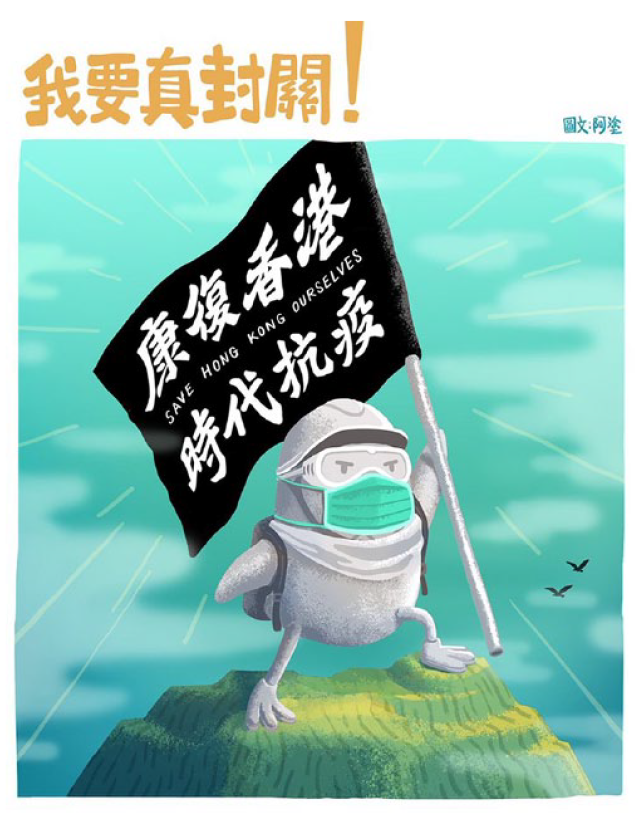
An illustration by comic artist Ah To (2020). The title on the top left reads, ‘I want a genuine closure of the (China-Hong Kong) border,’ mimicking the Umbrella Movement (2014) slogan ‘I want genuine universal suffrage’ (我要真普選). The mascot, whose posture resembled that of Lady Liberty Hong Kong during the Anti-ELAB protest, was holding a flag with the adapted Anti-ELAB slogan “Recover Hong Kong, resist against the pandemics of our times.” Courtesy of Ah To.
In contrast to the Taiwanese government’s prompt decision to close its border in March 2020 (Aspinwall, 2020), the Hong Kong SAR government’s refusal to completely close off the land border with China was perceived as an act of surrendering Hong Kong’s autonomy in pandemic prevention to the Chinese government. As a result, Hongkongers identified another major enemy in their war frames – the Chinese government. The Chinese government’s covering up of the outbreak of COVID-19 in Wuhan in late 2019 has reminded many Hongkongers of the collective memory associated with the outbreak of severe acute respiratory syndrome (SARS) in 2003, as the world’s first reported superspreader of SARS case was Jianlun Liu, a Chinese professor staying in a hotel near Hong Kong’s central business district (BBC News, 2003). Before arriving in Hong Kong, Liu was receiving treatment for SARS-related symptoms in Guangdong, a nearby Chinese province. Hongkongers considered this case and the subsequent outbreak a direct result of the Chinese government’s cover-up – a practice closely linked to the perceived shame in modern Chinese nationalism (Yoon, 2008). The hospital and community outbreak of SARS in Hong Kong that caused 299 deaths – the highest number across the globe – was imprinted as a collective trauma and “war” memory among Hongkongers.
By the end of January 2020, the SAR government’s passivity in tackling local COVID-19 cases had accumulated widespread social discontent to the extent that hospital staff initiated strikes to pressure the government to act (Parry, 2020). Meanwhile, the conspiracy theory that suspected the government’s lack of border control to be a deliberate act of weaponizing the virus to silence opposition voices was circulated on social media (Henryporterbabe, 2020). While it might be impossible to verify such a theory, the emergence of bottom-up war metaphors that adapted the Anti-ELAB movement slogan directly results from the SAR government’s neglect of its citizens’ safety and welfare. Although the SAR government finally introduced quarantine for travelers from China in February 2020, Hongkongers emphasized the significance of self-reliance through maintaining social distance and mask-wearing. The profound mistrust of the government and the perception of China as the enemy in the struggle and resistance against COVID thus fueled these practices of self-securitization.
Taiwan: From biopolitical nationalism to political accountability
On the other side of the Taiwan Strait, although the Taiwanese government also used military metaphors, the employment and connotation of war framings are not the same as how they were used in the West. In Taiwan, various enemies have been identified, including the disease and China, where the first case was confirmed. The war was waged against the Chinese authoritarian regime – which concealed information, prevented Taiwan’s participation in the WHO, and threatened Taiwan with the use of force even during the pandemic (Lee and Kao, 2022). The military metaphors, such as the expression “disease prevention as warfare” (防疫如作戰), was used by the Taiwanese government in the past in response to diseases spread from China, such as the H5N1 Avian Influenza in the mid-2000s, and the African Swine Fever in 2018 (Council of Agriculture, Executive Yuan, 2018). The intensified feeling of individual unsafety and national insecurity has transformed the war frame from “disease prevention as fighting wars” to “fighting wars for disease prevention.” The transformative process has consolidated the solidarity between the members of Taiwanese society and between the self-identified anti-China democracies, making possible the so-called “disease-control community” (防疫共同體), domestically and transnationally (Figure 2).
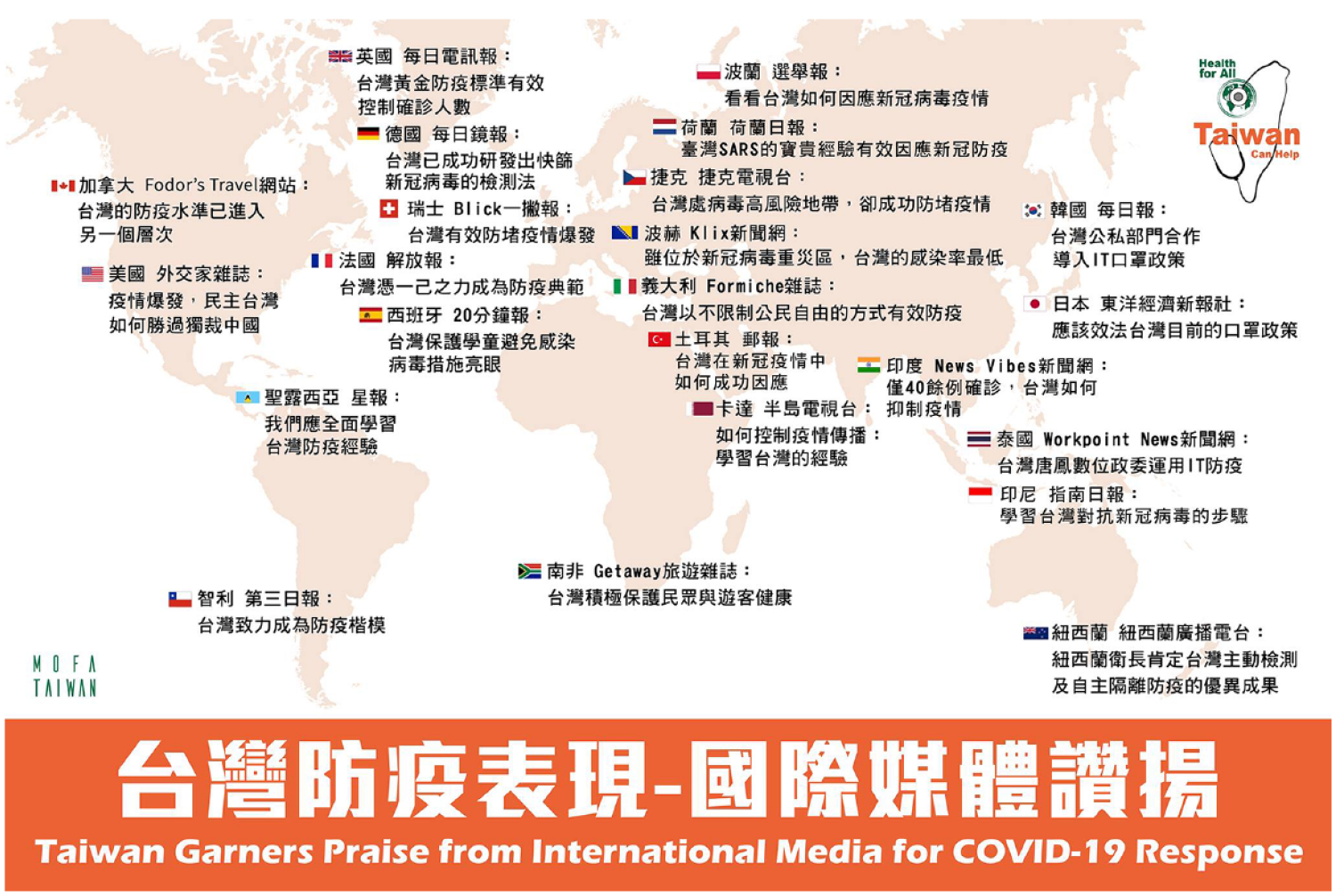
A world map posted by Taiwan’s Ministry of Foreign Affairs (MOFA) on its Facebook page on 10 March 2020 said, “Taiwan’s efforts to curb the spread of the #WuhanCoronavirus have garnered recognition in headlines around the world.” As follows, the bilingual post mentions the WHO’s exclusion of Taiwan as a member in English and that “fighting the pandemic as fighting a war is a do-or-die situation” in Chinese, including a hashtag #advanceddeployment (#超前部署; Ministry of Foreign Affairs [MOFA], 2020a).
Most critics have warned that the rhetoric of war, conflict, and enemy is not helpful for us to understand the situation concerned (Connolly, 2020). Taking Colombia as an example, the “war” on COVID-19 exacerbates the impact of armed conflicts on migrants, women, indigenous peoples, and sexual minorities in the name of “quarantine” and “cleansing” (Avoine, 2020). Such frameworks can also be dangerous to undermine mutual trust and support between communities and between states when global solidarity is needed the most in the pandemic context. Using the wartime discourse – distinguishing the bad/unhealthy/irresponsible from the good/healthy/responsible as well as dividing the governments and citizens into over-simplistic moral and political categories – thus downplays the essential importance of solidarity in public health ethics. However, this does not mean the solidarity discourse is no longer in use. Instead, it has been employed to identify the Us-versus-Others boundary, including in situations where, for instance, countries which are transparent in epidemic information reporting versus those which are not (as seen in Figure 2), 1 or people who have been vaccinated against vaccine-hesitant people – or people who embrace domestically developed COVID-19 vaccine versus those who are sceptical (Yeh, 2022).
A sense of urgency and desperation has been mobilized since the very beginning of the epidemic in Taiwan. Following the wartime framing, a new public discourse of “advanced deployment” (超前部署, as seen in Figure 2) has emerged and prevailed in all aspects of disease control – including border control, containment and prevention measures, vaccine development, digital surveillance, mask-wearing and social distancing policies, and so on. This discourse represents the logic of the necessity to fight this “war” more efficiently and effectively, drawing on the lessons learned from past experiences such as SARS. It has become the foundation of collective morality of self-control and censorship “for the sake of the nation” (Wu, 2020). In this light, the war framings have presented the virus and whoever threatens its national interests as the enemy. For Taiwan’s “survival,” the target is the whole assemblage consisting of various material or symbolic components that have made the Taiwanese weakened and undesired – including the One-China policy.
Reflecting on Taiwan’s example of successfully containing the disease in 2020, which was celebrated by the Taiwanese themselves and internationally, this provides a context in which “biopolitical nationalism” emerged – “the dynamics between body, geopolitics and affect” (de Kloet et al., 2020: 636). A sense of nationalistic, collective pride has thus been linked to its successful “advanced deployment” (Wu, 2020). Rather than replacing medical professionals with military officials, as happened in Brazil (Pfrimer and Barbosa, 2020), India (Das, 2020), and Colombia (Avoine, 2020), the Taiwanese government has armed health officials by authorizing the chain of command. Yet, leading public health experts considered such power not enough to develop “anti-virus weapons” effectively, compared to “wartime effort on a national security level” (Chan and Chen, 2020: 12). The Taiwanese civil society’s confidence in epidemiologists and scientists – rather than politicians – as primary decision-makers has facilitated the redeployment of the authority legitimized through legal measures such as restriction of movements.
Every war has victims, and it needs heroes that arouse “positive emotions such as awe, gratitude, or admiration” and function as “enhancing, moral modeling, and protecting” (Kinsella et al., 2015: 2). The heroes include not only those who command but also those at the frontlines – such as medical doctors, nurses, social workers (Wagener, 2020). Of course, most victims will never be taken as heroes, while some are even to blame for “wasting” attention and resources. In Taiwan, despite the government’s constant warning against coronavirus-related witch-hunts, in the press and social media, individuals are put into the categories of “hero/combatant” versus “enemy/traitor,” as well as “innocent victims” versus “deserving victims” and ‘perpetrators,” particularly regarding the outbreaks related to sex workers and their older clients (Tzeng and Ohl, 2021).
Comparing securitization practices and security discourse
Military metaphors invoked a series of securitization practices and security discourses. For responses to COVID-19, it is necessary to distinguish the purposes of securitization practices based on wartime analogies: sometimes, they are used to justify militarized responses to diseases, such as in Brazil and India (Pfrimer and Barbosa, 2020), and for some, they are used to intensify the desire for security of the “self,” such as in Taiwan and Hong Kong. The nuances of securitization practices reflect the geopolitical landscape in which Hong Kong and Taiwan are situated at the margin of continental China and the ongoing tensions with China.
In the first year of “war” on COVID-19, Taiwanese at home were the “guardians” of their homeland, while Taiwanese coming back home were “refugees” from the more dangerous places. The enemy/friend distinction has determined the effect of metaphors – ranging from the hostility against the Chinese government to international allies who expressed support for and received aid from Taiwan through the #TaiwanCanHelp campaign (as mentioned earlier in Figure 2), between which there was an almost total indifference to other countries beyond the enemy/friend categories (Lee and Kao, 2022). Regarding the debate over border reopening, many Taiwanese citizens (mainly from the younger generations) and politicians, while accepting other foreigners’ arrival, held reservations against the persons of Chinese nationality who have a relationship with Taiwan (e.g. spouses, children, employers, and students). China has long demonstrated constant hostility to shrink Taiwan’s space for international support; in response, the pandemic has pushed forward an anti-China sentiment in Taiwan, reinforcing anti-China security discourses. On social media in Taiwan, the older generations, who recalled the memories of the Chinese Civil War (1927–1949) and the Sino-American “hot Cold War” (1949–1990), had mixed responses with ambivalent attitudes towards demonizing China. For younger Taiwanese, the ongoing threat from China – through economic and diplomatic marginalization and demonstration of the use of force – against Taiwan, where they have lived all their lives, their responses seem more coherent when it comes to the US-China “new Cold War” during the pandemic. Such intergenerational differences also highlighted the shifting geopolitics and how war memories are constructed, negotiated, and polarized (Yeh and Cheng, 2020).
Meanwhile, the “war” against COVID-19 in 2020 Hong Kong was a continuation of the struggle against China’s political and economic encroachment, namely Hong Kong’s disappearance. Apart from social distancing, other bottom-up securitization practices include more than 100 restaurants refusing to service mainland Chinese customers (Ting, 2020), masking-wearing, and mask-manufacturing. Notably, “face mask” was also a symbol of resistance since the Anti-ELAB Movement, as masks and respirators were the iconic uniforms of protest that protected protesters from tear gas canisters fired by the Police force. It was observed that some protesters continued to use their respirators as face masks after the first wave of the COVID-19 outbreak in Hong Kong, even though they acknowledged that such heavy-duty masks were less protective in shielding the virus (Pang, 2021). When it became apparent that the SAR government failed to purchase masks for its citizens, resulting in a local shortage in the first half of 2020, Hongkongers engaged in various vernacular practices mobilized by bottom-up military metaphors against COVID-19. Such vernacular practices included citizens distributing “pandemic prevention supplies” (防疫物資) in stalls adorned with banners and slogans of the Anti-ELAB protest on the street (On.cc, 2020). Some others started small local businesses to manufacture and supply surgical masks for Hongkongers. One of the most notable local surgical mask manufacturers, the Yellow Factory, was known for producing surgical masks embellished with a steel-stamped acronym “FDNOL.” The acronym stands for one of the Anti-ELAB protest slogans, “Five Demands, Not One Less” (五大訴求,缺一不可). 2 Additionally, their mask packaging boxes showcased protest-inspired artwork and slogans – both the original protest slogans and the adapted ones against COVID-19 (Figure 3), and their retail stores in prominent shopping districts were decorated with protest slogans and icons, including the pro-democracy Lennon Wall. 3
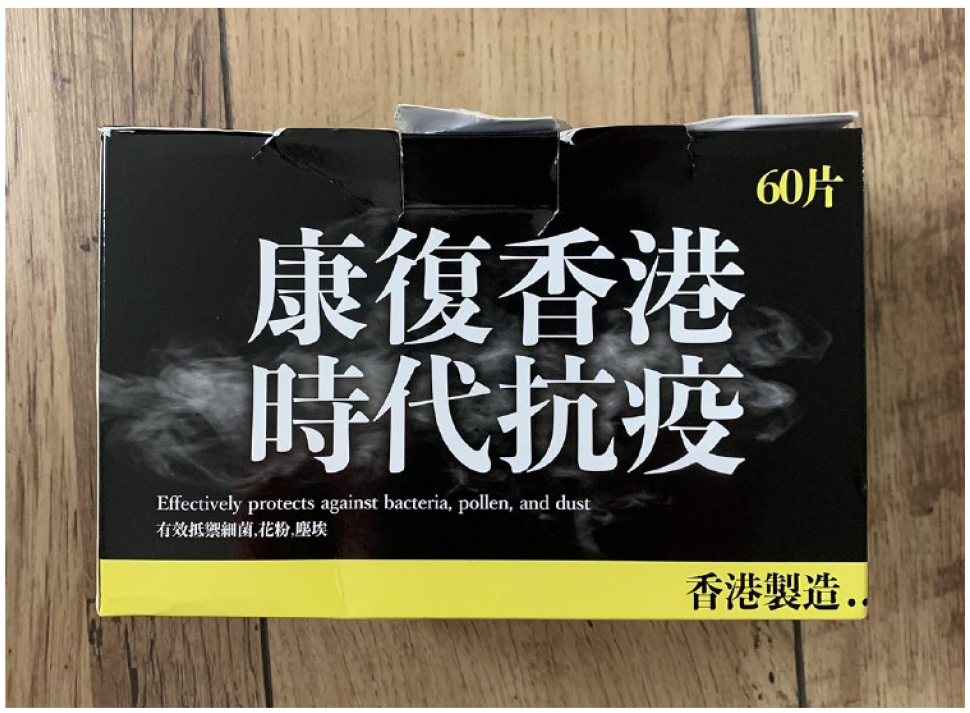
A package design of a surgical mask manufactured by the Yellow Factory, featuring the slogan “Recover Hong Kong, resist against the pandemics of our time” and emphasizing on being “made in Hong Kong.”
Another vernacular practice was to intertwine pandemic-prevention practices with symbols associated with the Anti-ELAB protests. For instance, the Hong Kong Confederation of Trade Unions, which was disbanded in 2021 due to the National Security Law, created a social media poster to promote giving out free hand sanitizers in Yuen Long in July 2020 (LIHKG 2020). The poster advocated self-reliance and self-care by emphasizing the need to wash hands for “7.21 seconds”, invoking the “war memory” of pro-police thug’s attack on civilians and journalists in the Yuen Long West Rail Station on July 21, 2019 (Hong Kong Free Press, 2022; Kuo, 2019). Consequently, the outbreak of COVID-19 further bolstered solidarity against the pro-China Hong Kong government and the Chinese government. This was achieved through various tactics of self-reliance adopted by Hong Kong citizens, despite the tightening political control in the name of pandemic prevention. Most of these vernacular practices were circulated on and communicated via social media, as local printed press and major online news outlets tended to align with the government’s official line on COVID prevention, which was predominantly referred to as “following measures of the (Chinese) Central government.”
The commonality between the military analogies mobilized in Taiwan and Hong Kong lies in the shared distrust towards the Chinese government and citizens, which stems from geopolitical tensions in the last two decades. This distrust shapes current responses and invokes specific war memories, including SARS. However, a notable difference is that Hong Kongers positioned their COVID-related struggles, particularly in the first year, as a continuation of the pro-democratic movement. They emphasized self-reliance, self-support, and maintained a general skepticism towards the government. On the other hand, in Taiwan, there was a consensus among both the government and citizens on a military metaphor framework, though also in the larger context of allying with other democracies. This co-production fostered a discourse of biopolitical nationalism. The second commonality between the two Sinophone societies in their responses against COVID-19 is the role played by the media in shaping, circulating, and disseminating military metaphors. In Taiwan, securitization discourse and practices were orchestrated by news media, active government utilization of social media, and citizens engaging in mutual monitoring and support on various media platforms. In contrast, Hongkongers relied predominantly on bottom-up vernacular practices and participatory culture to continue pro-democracy struggles in the form of fighting against COVID-19, since mainstream news aligned closely with the pro-China government. This resulted in distinct configurations of media and mobilization tactics, blending military metaphors through both mainstream and social media channels.
The decline of military metaphors: A “war” that can’t be won
Looking back at the beginning of the pandemic, when military metaphors were quickly used worldwide, we observed that war framings were effective in mobilizing mass support and morale in the short term to allow governments to adopt lockdowns and legal restrictions for “the public good” and in “defending the nation.” Nonetheless, such framing lost its effectiveness and appeal in the long run when politicians and the public began to realize that the “war” against COVID-19 would last longer than expected. In other words, the decline of military metaphors against COVID-19 in late 2020 across the globe suggested that the “war” had “stalled.” War framings were occasionally used, but it was no longer an effective tool to divert the public urge for political accountability.
Scholars analyzing war metaphors tend to argue that military framing prompts confrontation and precludes the possibility of “resolution” or assumes that resolution is the only ultimate goal or endpoint of war metaphors (Hart, 2017). As war metaphor is bound to specific temporalities in its socio-political purposes, the semantic and affective responses to the pandemic imply the imaginations of a future after the “war.” Metaphors serve the function of transferring schemes or areas of practice (Leezenberg, 2001: 298–301). Suppose the mobilization of war metaphors starts with identifying enemies and ends with evaluating victory or defeat (Musolff, 2016: 30–31). In that case, their use in Taiwan and Hong Kong during the pandemic provides an alternative interpretation of the rationalities and social consequences of “wartime,” which has anchored in their own geopolitical and historical memory frameworks.
The uses of war metaphors against COVID-19 in Taiwan and Hong Kong have respectively refashioned the articulation of Taiwanese nationalism and Hongkongers’ language of cultural and political resistance through self-reliance and self-determination. In particular, young citizens in both societies – who did not experience actual “wars” – have defined collective memories and identities based on (in)security from the virus as well as the threat of Sinicization in East Asia (Chang, 2020). Karl Marx once remarked on the danger of fetishizing security, in which the securitization of social problems obscures political violence by making symptoms the causes of problems (Rigakos, 2020). It is the often-overlooked productive forces of the security discourse, reflecting on the metaphors of wartime and conflicts. Our discussion here underscores the significance of contexts in considering the purpose and impact of military metaphors against COVID-19 (and other diseases and even disasters of all kinds) by highlighting the geopolitical trajectories outside of North America and Europe, where regional war memories and military tensions are referenced to inform local definitions of security, safety, and safeguarding practices. Hence, a blanket statement against a war frame can be as misleading as uncritically embracing it.
Footnotes
Acknowledgements
Parts of earlier drafts were presented, all in 2021, at the British Sociological Association Annual Conference, the Annual Conference of the Taiwan Society for Medical Anthropology, and the Annual Meeting of the Population Association of Taiwan. We appreciate the constructive feedback from the audience.
Funding
The author(s) received no financial support for the research, authorship, and/or publication of this article.
