




Abstract
The article engages with biometric data gathering technologies as part of migration infrastructures for the monitoring and control of migration. It explores power and agency by paying attention to the complexity of readings, interpretations, and storytelling of illegalised migrants in the Moria and Kara Tepe camps, in the Island of Lesvos in Greece, as they received their bureaucratic legal papers and discussed developments in their ‘cases’. Borrowing from feminist and feminist security studies scholarship, the article argues for an understanding of data gathering and sharing infrastructures as material. It suggests that the datafication of migrants’ bodies constitutes a manifestation of power that ‘enacts’ the migrant body as a subject of power but also produces counter self-subjectifications. The article also suggests an understanding of subject agency as the ‘capacity to act’ within contexts of power. Such a position on the agency of illegalised migrants allows us to examine the emergence of solidarities and alliances and to understand and contextualise not only actions that seem to be questioning and rejecting power, but also those that accept it and internalise it as a strategy of survival and of bettering one’s life chances.
Introduction
The control of international migration relies on the use of technologies of governance of mobile populations at both the national and supranational levels. Such technologies include built or semi-built facilities (camps, reception centres) for the reception and registration of illegalised migrants, accompanied by the expansion and proliferation of a network of IT data systems for registering, profiling, and monitoring migrant populations. Various sources of data gathered in the process (life histories obtained through interviews, fingerprints, DNA test results, dental records amongst others) are brought together in stretched screens (Lyon, 2005, 2009), are weighed according to risk profiles, sets of economic, political, or other priorities set by national or supranational administrations and are made part of decision trees that either normalise the status of illegalised migrants 1 or lead to their deportation. (Amoore, 2013; Broeders, 2007; Broeders and Dijstelbloem, 2016; Meijer, 2011). Although it is indisputable that such data systems are central in administering people on the move, it is often claimed by IT experts involved in sustaining and developing the technological infrastructures, migration administrators, and political personnel (Broeders and Dijstelbloem, 2016; Glouftsios, 2021; IOM, 2023; Official Journal of the European Union [OJEU], 2018a, 2018b), that they are in place to and indeed necessary for speeding up the registration process for the benefit of illegalised migrants as decisions on their status can be reached faster. In this article, I examine the embodiment of data-gathering technologies on illegalised migrants. Contrary to claims of the abstract nature of data gathering systems or ‘apparatuses of observation’ as defined in migration studies research (Aradau, 2010; Aradau et al., 2008; Barad 2007; Broeders and Hampshire, 2013; Glouftsios, 2018), I argue for an understanding of data gathering and sharing infrastructures as material. Such technologies are enacted primarily on the bodies of people, and manifest in ‘things’ – in the form of wristbands and bureaucratic-legal papers – that illegalised migrants must wear and carry with them. I take a broad view on the materiality of ‘apparatuses of observation’ for migration management, as encompassing both the abstract units of data gathered and shared through IT data systems and the material manifestations of such abstract information systems for sustaining a migration governance system that works through sorting the ‘deserving’ from the ‘undeserving’ (Ong, 2006) migrants and devising appropriate solutions for governing them (Foucault, 2007). This approach seeks to add to the body of literature that engages with the reconfiguration of citizenship as a result of processes of datafication (Taylor and Richter, 2017) or stress the human rights dimensions of data access (Harris and Wyndham, 2015) by analysing biometric data-gathering technologies as enacting the migrant body within relations of power, and by linking this discussion to broader discussions on rights, citizenship, and agency.
The data discussed in this paper were gathered through observation and repeat conversations with illegalised migrants in the Moria and Kara Tepe camps, on the Island of Lesvos, Greece. By exploring the link between biometric data gathering systems and the end result of such processes that manifest in a series of bureaucratic papers whose purpose is to communicate decisions to illegalised migrants, and assign them specific identities (asylum seeker, economic migrant, deportee), I intent to bring to light illegalised migrants’ own understandings of the datafication of their bodies as they become sites for the articulation of power and control, but also challenge social injustice (Chukwuma, 2022; Parpart, 2020; Rappert, 2020; Wilcox, 2011).
Illegalised migrants, during observation and repeat conversations, focused on the paperwork they were accumulating following different stages of the registration process (from fingerprinting, interviews, DNA tests, to legal procedures and reviews of decisions initiated at different stages of the data collection and decision-making process) as exemplifying state biopolitical power (Foucault, 2007). Although they could not name the information systems used for the gathering and sharing of their biological data, they understood and discussed the link between these and the papers they were holding. As most paperwork was written in Greek, they asked the researcher to translate and explain the decisions taken. They internalised the categories and identities assigned by administrators and discussed the effects of biometric data technologies on their futures. They argued against decisions, compared ‘cases’, and commented on injustices and ‘unfair’ or ‘wrong’ outcomes of cases. They also used their papers to insist on collective rights and to argue against the categorisations imposed upon them. I, therefore, argue that migration technological infrastructures ought to be understood as ‘enacting’ (Butler, 2004; Rappert, 2020; Sinko, 2013) the migrant body within contexts of power. They communicate and implement power that produces the migrant body as a governed entity that both accepts, internalises, negotiates, and resists the power imposed upon it.
Technologies of data mining, migration management and the construction of the migrant body
Within migration and security studies scholarship, technologies of migration management or otherwise referred to as ‘migration infrastructures’ (Broeders and Dijstelbloem, 2016; Glouftsios, 2018, 2021; Mountz, 2011; Pallister-Wilkins, 2017), are understood to not just implicate the people involved in the control of migration (border police, security guards, administrators, humanitarian organization workers, etc.) and the built spaces such as camps or border facilities that are used for the immobilization of mobile bodies (Mountz, 2011), but also the amassing of digital data in shared databases that are at the centre of the current migration management regime across the world. Parks and Starosielski (2015: 4), in their analysis of media infrastructures, understand built sites as ‘situated socio-technical systems, designed to support the transmission of vast amounts of data’. In the same way, modern migration management systems depend increasingly on complimenting ‘secure’ built locations with the deployment and testing of information systems which are designed to gather and share information on the biological data of people on the move for the purpose of administering mobility. Biometric gathering systems for migration control have also been explored as nexuses of material-discursive practices (Broeders, 2007; Glouftsios, 2021; Tazzioli, 2014), ‘apparatuses of observation’ for the governance of specific populations (Aradau, 2010; Aradau et al., 2008; Cleton and Chauvin, 2020; Murray, 2016), and as technologies for the production of ‘otherness’ for the purpose of surveillance and exclusion (Fassin, 2011; McKemmish and Gilliland, 2013; Tazzioli, 2014). Systems such as the SIS II (the new generation of the Schengen Information System) or the VIS (the new Visa Information System) have been analysed as transforming Europe’s borders into the ‘new digital border’ (Bigo, 2002, 2008; Broeders and Dijstelbloem, 2016; Broeders and Hampshire, 2013), as communication channels or communication infrastructures (Glouftsios, 2021; Larkin, 2013) or as ‘connective tissues’ (Edwards, 2010: 8) that gather vast amounts of data on specific categories of migrants and connect the spaces where controls of international mobility are enacted, including data analysis centres, border control facilities, and registration camps (Glouftsios, 2021). One of the main questions that has preoccupied researchers within migration and security studies is the extent to which information systems can be understood to be steeped in and to sustain relations of power and whether one can attribute agency to inanimate objects. To this effect, researchers have explored large information systems as socio-technical settings or ‘technological assemblages’ (Amoore, 2006; Amoore and Hall, 2010; Broeders, 2007; Dijstelbloem and Meijer, 2011; Glouftsios, 2021; Voelkner, 2013) that are comprised of and sustain a multiplicity of relationships between human agents involved in different stages in the process of developing and maintaining the technological infrastructure on the one hand, and non-human actors such as software, servers and the data generated and processed on the other (Amoore, 2006; Bellanova and Duez, 2012; Dijstelbloem and Meijer, 2011). Glouftsios (2021) for example, researching the maintenance labour required for the smooth running of information systems, argues that we should understand the interaction between maintenance workers and the software they maintain as part of complex assemblages of relations between human and non-human actors that sustain and reproduce power. Scholarship within critical security studies has also explored data-gathering systems as material objects, which are utilised for specific political purposes and generate, sustain, or challenge relations of power. Pilo and Jaffe (2020) argue for understanding biometric gathering systems as material objects, mobilized by human actors for political goals and suggest the concept of ‘technopolitics’ as a better way to understand the interaction between human and non-human actors in the pursuit of political goals (see also: Amicelle et al., 2015; Mayer, 2014; Mueller and Richmond, 2023; Mutlu, 2013; Tsekeris and Katerelos, 2008). As a term, ‘technopolitics’, draws attention to the fact that data systems are neither abstract nor neutral. Instead, it has been suggested, we should analyse data systems as impacting and altering the ways in which society and politics function. Questions of power and agency are therefore at the centre of debates on the role and effects of data systems on society and politics. Hecht (2011: 3) argues that agency is embedded in the design of information systems ‘whose features mattered fundamentally to their success and shaped the ways in which those systems acted upon the world’, while others (Broeders and Dijstelbloem, 2016; Glouftsios, 2021; Latour, 1993, 2005) argue for ‘hybrid’ forms of agency when examining the interactions between political and technical personnel and technologies as they impact on the world. It is therefore accepted that technologies of data gathering impact and shape the way(s) that we understand and act within social and political contexts.
Although research within migration and communication studies has engaged with technologies of data mining for identification and profiling of illegalised migrants, the perspectives and understandings of illegalised migrants on the gathering and sharing of their biometric data, and the ways in which they either internalise or accept such practices as a necessary part of the process for the normalisation of their status, has been largely unexplored. It is also the case that the link between bureaucratic objects or ‘things’, issued to be worn or carried by illegalised migrants (wristbands and bureaucratic papers), and the data systems that gather and share their biometric information has not been developed. Research on documentation issued to illegalised migrants as they go through the process of registration, submission of asylum applications, interviews, reviews of decisions taken on their status has focused on legal-bureaucratic papers within the broader perspective of technologies of governance (Bigo, 2008; Bloch et al., 2014; Dean, 2010; Mountz, 2011; Tazzioli, 2014) or papered governmentality (Abarca and Coutin, 2018; Salmenkari and Aldarwoodi, 2023). As my primary concern is to consider and examine the materiality of technological infrastructures and their importance in constructing the migrant body within relations of power, I will draw insights from work in critical security studies and in particular feminist perspectives for a broader conceptualization of the ways in which data systems are forming and (re)forming the migrant body.
To what extent do illegalised migrants understand the impact of data gathering and sharing technologies on their own bodies? Do they accept the categories and identities assigned upon them following the collection of their biometric data? Do they discuss, interpret, or resist decisions taken on their futures? By exploring the link between biometric data gathering systems and the end result of such processes that manifest in a series of bureaucratic papers that communicate decisions to illegalised migrants, I intend to bring to light their own understandings of the datafication of their bodies as they become sites for the articulation of power and control, but they also challenge social injustices (Chukwuma, 2022; Parpart, 2020; Wilcox, 2011).
Feminist security studies scholars have argued for the need to explore the impact of power on the body. They have introduced an understanding of the body as both a site of production of power and of resistance to it and have explored the forming of subjectivities (Butler, 2004; Parashar, 2014; Parpart, 2020; Wilcox, 2011) within social and political contexts.
They insist on understanding the body as central to practices of security for the purpose of governance of populations that are defined as outsiders, as a security threat, or as needing to be protected. Gatens (1996: 23) discussing the exclusion of specific groups from political participation, argues that exclusion becomes possible when the bodies of specific others, such as foreigners, women, slaves, and the conquered, are marked as incapable of fulfilling the duties assigned to specific roles.
Feminists have also focused on the body as a weapon in sites of war (Parashar, 2014; Wilcox, 2011), the body of the rape victim, the starving body (Bray and Colebrook, 1998; Grosz, 1994), and the body of ‘othered’ minorities (Butler, 2004; Parpart, 2020), to explore the ways in which security practices have acted upon categorising, restricting and altering the subjectivities of specific gendered, racialised and marginalised populations. Wilcox (2011) writes that ‘a body that can be killed or tortured is a body that is the product of discursive practices’ (597). She also suggests it is important to study the body and the forming of subjectivities not only as reacting to social and political conditions and contexts but as changeable, fluid, and transformable in its social (and political) meanings.
Rappert (2020) prefers the word ‘enactment’ to embodiment when she discusses the effects of information systems on specific populations. She insists that they are designed to not simply assess and categorise specific populations for the purpose of governance but to also ‘enact them as subjects of governance by constantly modeling them ‘as always in formation’ through constant data gathering, measuring, and updating collected data. (233). For her, the term enactment enables an understanding of subject identities as ‘changeable, fragile and differing from site to site’ (233). The suggestion of understanding the body (and in the case of this article the body of the illegalised migrant) as a field of enactment of practices of governance and its interaction to such practices, allows for a closer examination of the body not only as a site for the articulation of oppression but also for questioning power and as a site for the enactment of counter subjectivities. (Parpart, 2020; Wilcox, 2011).
The approach developed in this article draws specifically on the concept of ‘enactment’. I claim that reacting and acting to governmental practices of the datafication of their bodies, illegalised migrants enacted bodily inscriptions and identity markers (ascribed, internalised and redefined, and resisted) in the process of production of different notions of identity and subjectivity.
Methodology
The data analysed in this article were collected as part of a broader project focusing on illegalised migrants and perceptions of rights. In particular, the project questioned the criteria of ‘deservedness’ as applied by the EU’s migration management system, and as understood by migrants themselves. It engaged with questions of agency and resistance in a system of migration management that enforces ‘graduated zones of sovereignty’ (Ong, 2006), around the principle of the eventual normalisation of the status of those seen as worthy. Competing accounts of ‘deservedness’ were initially not expected by the researcher. It soon became obvious, that while illegalised migrants argued for rights, they also competed on who had more of ‘a case’ to be argued vis-à-vis the criteria set by the EU’s migration governance system for progressing through the different stages from registration to decision-making on their status.
The data were gathered through observation and repeat conversations with 50 asylum seekers in the Moria and Kara Tepe camps on the island of Lesvos, Greece, over a period of 12 weeks in the summers of 2016 and 2017. The Moria camp is one of the ‘hot spots’ in the Eastern Mediterranean migration route. It is highly securitised and run by the Greek Border Police and FRONTEX, the EU’s body for migration control. It is a registration and deportation camp. All migrants arriving on the island are brought to the Moria camp to undergo the lengthy process of registration which involves deploying the EU’s digital firewall (fingerprinting, DNA samples, dental records, and interviews to determine the ‘validity’ of claims to asylum status and issuing ‘case’ paperwork for each migrant). It is after this process, that some migrants, especially families, unaccompanied and vulnerable people, are moved to the Kara Tepe camp, just 30 minutes away from Moria. Although Kara Tepe is run by the municipality of Mytilene and is less securitised, at the time of the research, it was closed to visitors. The initial intention of the researcher was to secure access to the camps and to observe the daily rhythms of life inside the camps. However, access to the Moria hot spot was denied by the police, following communications with the Hellenic Ministry for Migration, while initial access to the Kara Tepe camp was granted by the Lesvos municipality migration office, subject to the agreement of the Director of the camp. Following an initial visit and interview with the Director of the camp, Mr. Stavros Mirogiannis, it was agreed, that further research in the form of repeat conversations and observation would take place in the social spaces just outside both camps, around several kiosks that sold beverages, food and served as places of gathering, socialising and charging mobiles.
The researcher spent most days around these social spaces, conducting what can be broadly termed participant observation combined with long and repeated informal discussions with camp residents and more formal interviews with guards and municipality officials to obtain a more holistic understanding of the operation of, and situation in the camps. Particular attention was paid to understanding the daily rhythms of life and in observing social interactions, friendships, and support networks, as well as antagonisms, and social divisions. The observation and informal discussions, which this paper draws on, involved meeting and getting to know camp residents, opening and sustaining conversations that continued throughout the duration of the fieldwork. Reading and translating from Greek to English the bureaucratic documentation, walks, tea drinking, and visits to the city of Mytilene, were part of the research and were intended to provide the researcher with a better sense of life in the camps. The frequency of the conversations with each of my participants varied, from four with some to almost daily chats with others. Distinctions between ‘legal’ and ‘illegal’ migrants, ‘refugees’, and ‘economic’ migrants were avoided in selecting my interlocutors (also Tsagarousianou, 2023). Instead, attention was placed on developing trust and allowing them to develop their own stories. By the summer of 2016, both camps were overpopulated, with Moria holding triple the intended capacity of the camp, while Kara Tepe held twice its intended capacity. My interlocutors described the infrastructure in both camps as at breaking point, and living conditions as being hard if not impossible to bear. Delays in organising the sorting interviews, the closure of the borders that would allow migrants to continue their journey, (the outcome of the indecision or refusal on the part of some EU member countries to comply with the agreed EU quota system), and a number of court cases won by Greek human rights lawyers against the agreed externalisation of the EU borders as defined in the Turkey/European Union agreement (Migroeurop, 2016) 2 had substantially reduced movement. It is worth noting, that some of my interlocutors had been waiting to hear about their fate for over a year and this had a profound effect on the ways they discussed their journeys, the conditions they lived in and their views on the EU’s migration governance system.
Wristbands, papers, and enacting the migrant body within relations of power
Discussions on waiting for what seemed to be an endless process of interviews, paperwork, the threat of deportation, and reviews of decisions, were a constant concern of illegalised migrants. Their anxiety about interviews, decisions, and acquiring the ‘right’ papers became clear to the researcher as they presented the paperwork they were given and discussed the process they had to go through. Most of my interlocutors, were aware of the restrictions placed upon them, although some were confused with regards to the decisions taken on their status or with regards to the process that would follow. Often the researcher was asked to read their paperwork and to translate decisions prior to having their interviews. Although both the ethics of research and the researcher’s own limited knowledge of the legal process, limited any offer of advice, my interlocutors asked for clarifications on the decisions and then proceeded to discuss the restrictions imposed upon their bodies.
Samir a young Iraqi man, said: We are guarded by police and the army, and we are closed in by barbed wire. We are allowed to walk around, to go to the city or the nearby villages, but are not free to go anywhere else. When I was given this paper, I asked whether I was free to go to Athens, or to travel to Germany and they said I was free to go outside the camp but was not free to go to Athens or to travel anywhere else. So, this means I am not free. (Samir, Moria camp).
3
Others talked about collecting papers. Suria, a young Iranian woman discussed the variety of documents she was given following different stages in the process. For her, the link between the collection of their biometric data and decisions that labeled them as specific categories of people was obvious. She said: We are fingerprinted, asked for our passports, where we lived, why we left, and even to describe the streets we grew up. Then they decide on our fate. We are not able to argue back, to question (Kara Tepe camp)
and Ismael, an Afghani migrant, presented his wrist to draw my attention to the wristband that had his first name and case number on it (Figure 1). He said: ‘It is who we become. We are given a number, we wear wristbands, we carry papers, we are a case’ (Kara Tepe camp).
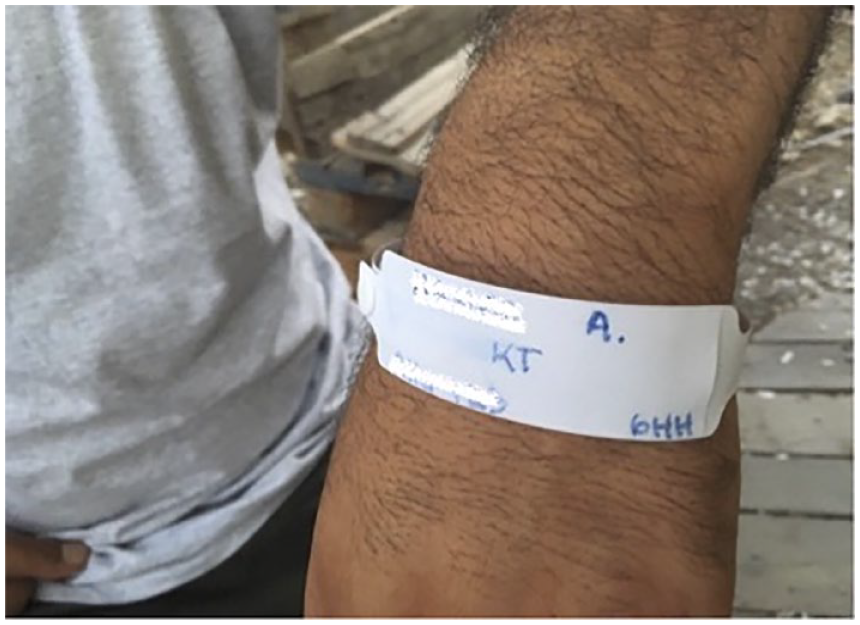
Wristbands worn by illegalised migrants.
Even in cases the writing on the wristbands was smudged or was not visible, illegalised migrants insisted that this did not change their status as people without rights. Aisha, Ismael’s sister, stressed ‘the number might have gone, but the wristband is still on our wrist. We are still cases to be handled with’ (Ismael and Aisha, Kara Tepe camp).
In these exchanges, it became clear that illegalised migrants discussed the papers that communicated their status forming them as specific subjects of power. Furthermore, they made the link between data collection and decisions taken to the ways in which they were enacted as categories of people to be handled and as people whose bodies were administered. They stressed their inability to travel, to move beyond the island, and to decide on their own future. They understood that their futures depended upon fulfilling the criteria of ‘deservedness’ imposed upon them.
Astar, a Syrian, talked about the datafication of his body as at the forefront of shaping his future. Discussing the DNA tests that he and his family (mother, sister, and younger brother) had to go through to prove their family connection to his aunt who had applied for family reunification papers said: We had to go through all these tests to prove we are related. To prove who we are. But in our case, it was helpful. We now have the ‘right’ papers so we can go on with our lives (Astar, Moria camp).
And Mohamed, a Moroccan, who had received deportation papers, argued against a system that collects biometric data based on criteria of deservedness that are outside the control of people whose bodies are mapped. Discussing his 20 years as an ‘economic migrant’ in Europe he argued: I was a 15-year-old boy then and I have been moving around, working, and sending money to my family back home. I am an economic migrant. My data are everywhere. They know who I am, where I have lived.
And then he continued: They make decisions based on some criteria about legitimacy. I do recognize that war kills people [comparing his ‘case’ with ‘legitimate’ migrants, mostly Syrians]. But we are poor. My mother and father are ill and unable to work and buy the medications they need. I had to help my sister with her dowry. Who else would do this? Poverty kills you too (Moria camp).
When they discussed the papers, they had to carry with them and the wristbands they were wearing, they understood the connection between the gathering of their data and their enactment as subjects of power. The datafication of their bodies transformed them into bearers of a wristband and holders of papers that restrict and monitor their rights, identify them as a case number, and strip them of provenance, history, and memories. The categories assigned to them enacted them as asylum seekers, illegals, economic migrants, or deportees. They had become ‘the other’, ‘ο αλλοδαπος’ (the foreigner) as was clearly stated in their paperwork (Figures 2 and 3) stripped of rights taken for granted by political subjects in Europe, identifiable as non-citizens, always visible to those that determine their fate and to those outside the camps such as the local residents, the ‘proper’ citizens.
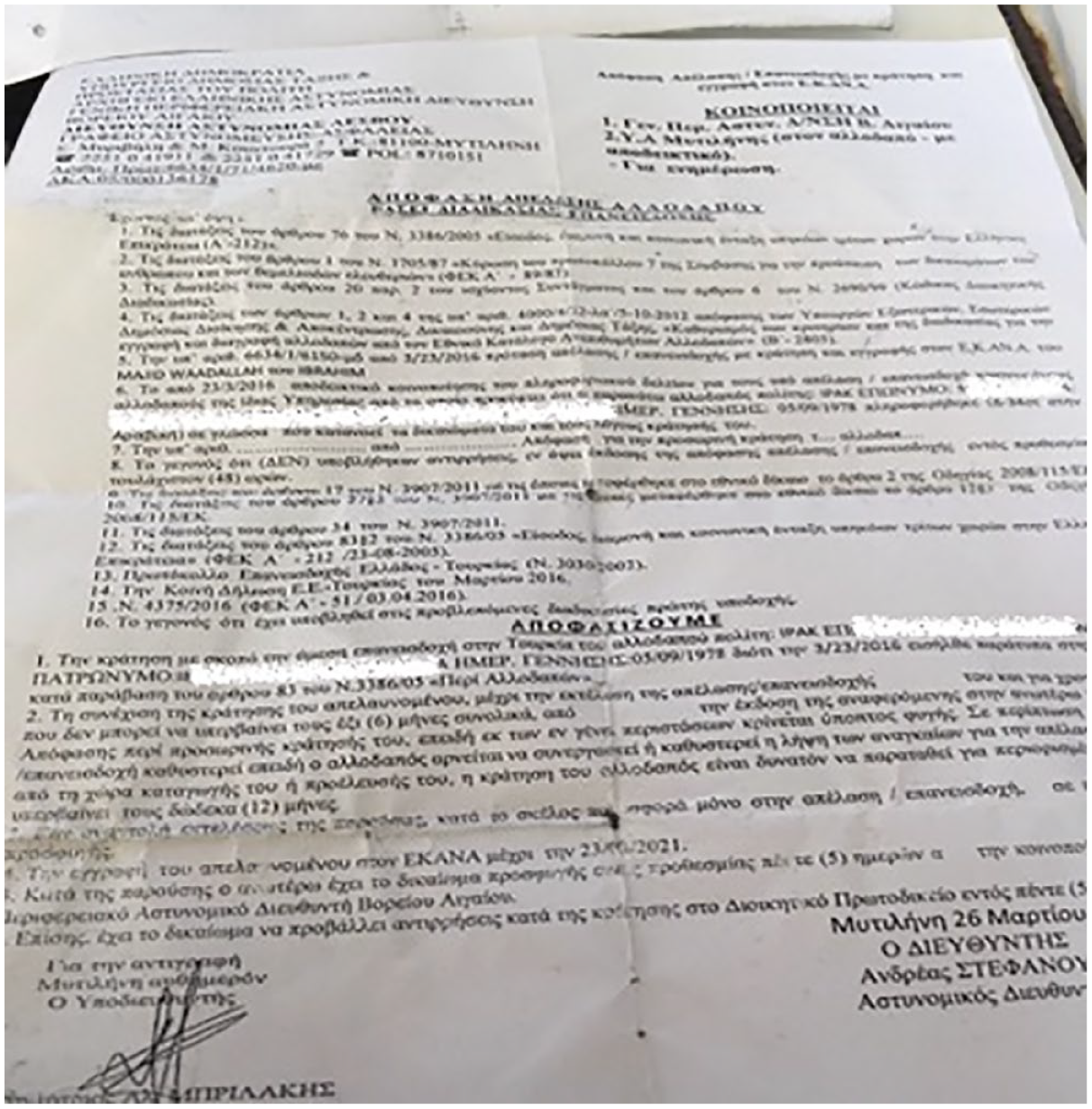
Papers issued after the registration interview.
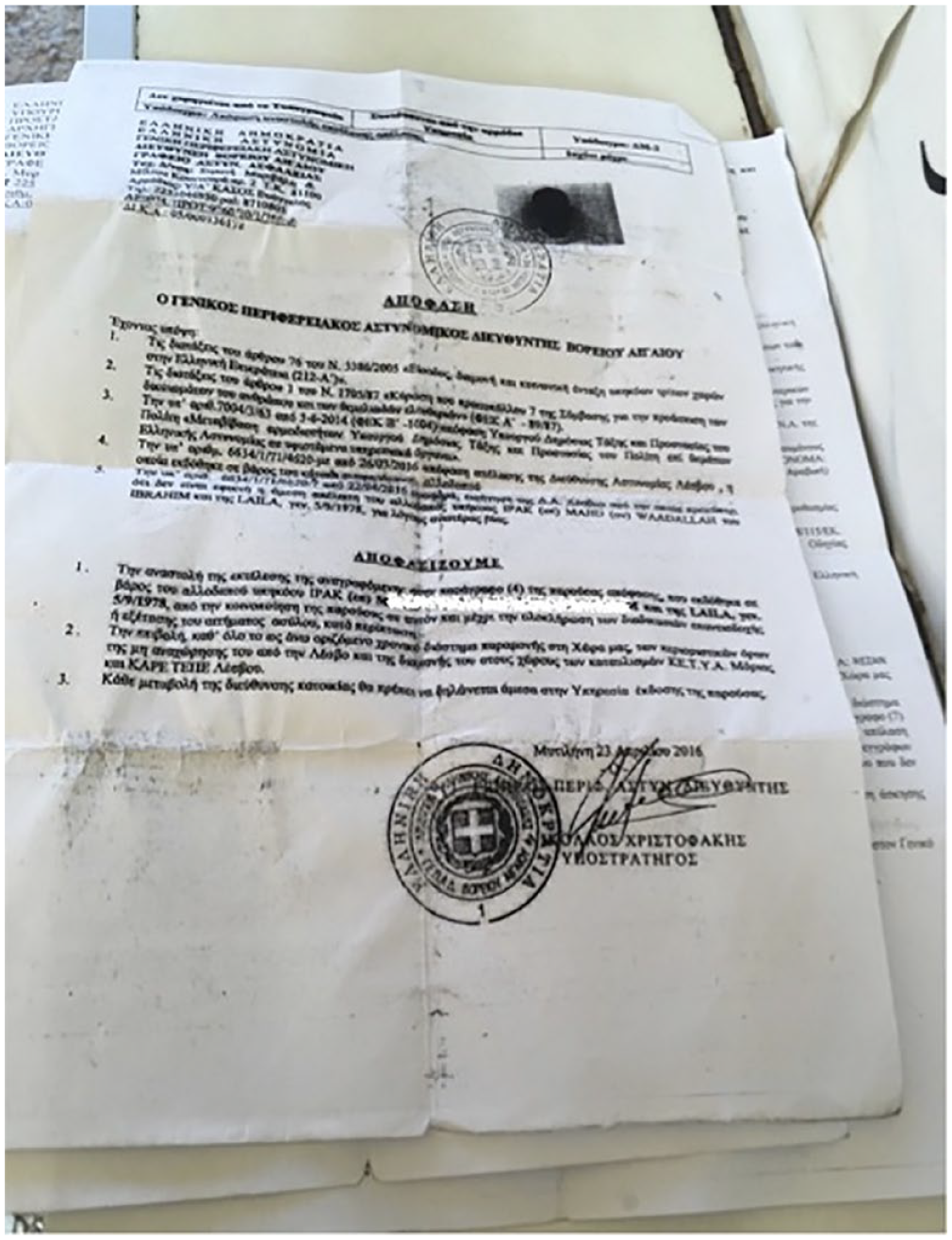
Extradition papers.
For Butler (2004: 64) such technologies of ‘spectral otherness’ become possible only through the enactment of assigned identities on the bodies of those that are monitored (also Wilcox, 2011). The datafication of the migrant body abstracts the person and transforms them into generalised and identifiable units of data. Human beings are dealt through procedures and are de-humanised. Their re-insertion into humanity, becomes the outcome of ruling on ‘cases’ on who will be detained and deported and who will be allowed to move on.
Governmentalising the body of the migrant
Decisions on people’s status were taken by administrators based on the data collected on each individual person that stripped personal stories from communities and collective experiences formed within social and political contexts. Emanuel, an Eritrean (Moria camp) who had escaped the army, said that in the interviews he had to prove his ‘incarceration’ in the Eritrean army, although migration administrators knew that most men in Eritrea end up drafted and spend most of their lives in the army. My interlocutors insisted that data collected during their interviews were considered circumstantial, and subjective (see also Salmenkari and Aldawoodi, 2023) and their ‘deservedness’ to asylum status had to be objectively proven through the gathering of biometric data and their interpretation by administrators that assigned them into generalised categories.
Talk about ‘cases’ and the ‘outcome of cases’ was a frequent past time and the subject of discussions as illegalised migrants in different friendship circles discussed the outcome of their interviews, the few people that were moving on to the next stage of the process, the endless waiting to hear about ‘their cases’ (Tsagarousianou, 2023) and offered advice to each other and to newcomers on what to stress in interviews. They accepted the necessity of the process as it offered hope for getting the ‘right’ papers and therefore being able to move to the next step of their journey. They also discussed ‘special cases’, and argued whether some illegalised migrants were ‘more special cases’ than others.
Yecob, an Eritrean, who was born and brought up in Saudi Arabia, stressed that ‘everyone is a case here. We even talk about my case, your case, you must be a special case, or we question those that are granted more rights, and are seen as more special cases than I am’ (Moria camp).
In an exchange between Mariam, an Iranian young woman, Asif, her Iranian friend, Ahmed, and Ismael, cousins from Afghanistan, the conversation focused on who had valid claims to refugee status. They compared ‘their suffering’ and discussed their legitimate claims to asylum as the outcome of their suffering. They claimed the category of ‘asylum seeker’ and ‘suffering’ justified their ‘legitimate’ claims for asylum.’ 4 (Moria camp).
Others discussed fellow migrants as bogus refugees, while others were quick to stress that the list of ‘preferred’ countries for asylum was just a list, and peoples’ claims and cases had and should be reviewed according to their circumstances and ‘proof they offered’, rather than the ‘whim of Frontex officials’. Elif, a Syrian woman, who with her family had submitted an appeal against the decision to be sent back to Turkey, complained about a Syrian illegalized migrant who in her view ‘was playing the system’. She questioned the basis on which the decision on her and her family’s future was based. 5 Complaining about ‘bogus’ asylum seekers and accusing other illegalized migrants of lying to get the ‘right’ papers, although difficult to understand, speaks to the ways in which administrative decisions acted upon and enacted (along the process) the migrant body within relations of power. It also highlights the ways in which migrants both internalised, questioned, and resisted their assigned identities.
Biometric data, power and agency
Mahmood (2001) writing on gender and agency insists that ‘political and moral autonomy of the subject in the face of power . . . sharply limits our ability to understand and interrogate the lives of women whose desire, affect and will have been shaped by non-liberal traditions’ (203). Following hers’ and other feminist writers’ understanding of resistance and agency within relations of power (Butler, 2004; Parpart, 2020; Wilcox, 2011), allows for a more complex understanding of the contradictory claims on their and others’ rights to move on and to become ‘people with rights’. In discourses designed to doubt or to be critical of the ways that their and other illegalised migrants’ data were collected, and decisions were made on their future, or in discourses such as ‘we too deserve to be considered’, ‘our cases are important too’, ‘we are human beings too’, ‘human rights are human rights’, or ‘we are suffering too’, contradictory claims were made. On the one hand, one can detect the acceptance and internalisation of a system that prioritises some against others, that defines the claims of some as more legitimate than those of others, but on the other hand, one can also detect a language of expansion of rights beyond the criteria imposed on them. My interlocutors were aware that accepting categories that allowed them to move on could be beneficial for them. When Astar criticised the imposition of taking a DNA test to prove his family tree but also expressed relief on the results, he both criticised the logic of the system that abstracts and individualises illegalised migrants in order to manage them, but he also accepted the necessity of allowing one’s body to be mapped in the process and in the hope that their status will be normalised. Illegalised migrants’ counter readings of bureaucratic criteria challenged the objectivity of decisions based on the mining of their data. They presented their ‘full’ stories and blamed decisions on ‘incomplete data’ or ‘simplifications’ of their life stories. They compared decisions to expose what they saw as assigning them to ‘unjust’ or ‘wrong’ categories. They made counterclaims, disputed, and adapted their strategies to resist the identities assigned to them. They also adopted assigned identities as they offered them the opportunities to escape their present and move towards their future. When Mohamed compared dying from bombing to dying from poverty, he was not claiming equivalence of suffering. He was questioning the logic of the current migration system that de-humanises, abstracts, and enacts the migrant body into specific categories for the purpose of monitoring and control. When Astar accepted the need to subject his body to data mapping, he exercised the only option open to him and to his family by enacting the category of ‘legitimate asylum seeker’. And when Mariam and her friends compared suffering, they accepted the identities imposed upon them but also pushed the boundaries of assigned identities, by questioning them and judging decisions and processes.
Salmenkari and Aldawoodi (2023) discussing the decisions taken by Migra (the Finnish Migration authority) conclude that illegalised migrants made counterclaims, disputed, adapted strategies, or adopted governmentalized identities throughout the bureaucratic process that often lasted for several years. In their and my findings, one can detect the formation of subjectivities both as the outcome of a process of internalisation of the logic of the current system of migration management and also, it’s questioning in an effort to open it up to more inclusive understandings of rights. In these debates, what became obvious, is that migrant subjectivities are enacted both through acceptance of and resistance to the priorities set by a system of migration governance that attempts to control and restrict the right of movement, the right of entry, and rights to citizenship to those people that are defined as not ‘deserving’ of care and protection.
This highlights the penetration of biopower (Butler, 2004; Foucault, 2007) into the body of the migrant as she/he is constructed as subjects through technologies of power. It also highlights the friction between decisions that categorise and governmentalise illegalised migrants and their self-subjectification as they both accept and dispute decisions taken through mining their data.
Writing on gender and agency in Egypt, in the context of an Islamic revival that restricted women’s rights, Mahmood (2001), argues against speaking from a position of power – and with this, she criticises Western understandings of women’s agency – on how we should imagine resistance. For her, agency should not be defined as ‘a synonym for resistance to relations of domination, but as a capacity for action that historically specific relations of subordination enable and create’ (203). In a similar manner, I suggest that it is possible to understand the contradictory narratives emerging through repeat conversations with my interlocutors, as both accepting and enacting the categories assigned to them through processes of datafication, but also arguing for the possibility of imagining and enacting different subjectivities within relations of power.
Conclusion
The article engaged with biometric data gathering technologies as part of migration infrastructures for the monitoring and control of migration. It explored power and agency by paying attention to the complexity of readings, interpretations and experiences of illegalised migrants as they received their bureaucratic legal papers and discussed developments in their ‘cases’.
The approach developed in this article draws specifically on the concept of ‘enactment’. I claim that reacting to and acting upon governmental practices of the datafication of their bodies, illegalised migrants enacted bodily inscriptions and identity markers (ascribed, internalised, and redefined and resisted) in the process of production of different notions of identity and subjectivity.
The empirical observations and conversations with illegalised migrants demonstrated that bureaucratic rationalities attempted to control mobility and exercise power by subjecting the migrant body to processes of atomisation and abstraction from social and political contexts, from memories and life histories. Standardisation into cases and categories attempted to make the human invisible (Tazzioli, 2014). Power was exercised both externally through sorting illegalised migrants into categories of populations to be governed, but also internally through the acceptance and internalisation of the subjectivities and categories assigned to them. Power was also productive, in that it both enacted the migrant body as a subject of power to be governed, and it also produced counter self-subjectifications.
As was discussed, illegalised migrants accepted processes of the datafication of their bodies as they generated opportunities, and sustained hopes and aspirations for their future. They enacted the categories imposed upon them as they discussed, compared, and argued about criteria of deservedness, and adjusted their strategies of presenting their cases along the process. They also countered bureaucratic decisions through storytelling, and enacting counter self-narratives that attempted to collectivise their experiences and to counter their abstraction and compartmentalisation into statistically produced and ‘knowable’ populations for the purpose of governance (Foucault, 2007). Scholarship from critical security studies and feminism, and in particular work on the sexed, subjugated, and minoritized body was used as it allowed the researcher to consider the materiality of technological infrastructures and to explore the ways in which the technosocial enactment of alterity is performative of polities. I argue that by exploring the material dimensions of biometric data collection of people on the move, an area under-represented in communication studies, the article attempts to explore data infrastructures as primarily material in forming and reforming identities and as central in current processes of governance of mobility. Insights into the importance of the body, and in particular, the body of the ‘other’ as it is impacted by technosocial arrangements, can complement debates within communication studies that engage with the impact of processes of datafication to questions of rights, citizenship, and agency.
Considering the materiality of technological infrastructures as they impact migrant identities has allowed the researcher to consider both the way(s) that power works but also the possibility of agency. Is it possible to discuss agency when the body of the illegalised migrant is abstracted and re-assembled within categories designed to control it? And if it is, do we need to reconsider our definitions and understandings of resistance and of agency? Borrowing from feminist and critical security studies scholarship, I have suggested, that it is not possible to sustain a position that understands the subject as politically and morally autonomous acting against power. Instead, a nuanced understanding of agency as ‘the capacity for action’ in contexts of power (Mahmood, 2001, 2011), allows us to examine the emergence of solidarities and alliances and to consider not only those actions that seem to question and reject power but also those that accept it and internalise it as a strategy of survival and of bettering one’s life chances.
