




Abstract
This article explores the phenomenon of block talk among Germanspeaking Twitter users, based on a subsample of 1700 tweets from a larger corpus of 380,000 block-related tweets collected between February and December 2021. Block talk refers to users publicly mentioning and conversing about the disconnective practice of blocking, which sometimes stimulates a debate about the legitimate use of blocking while at other times providing an outgroup marker for collective positioning. Through the example of block talk we demonstrate that the platform’s curatorial infrastructure for drawing boundaries between public and private is continuously negotiated, and that this negotiation transforms the meaning of some of the default communicative affordances of the platform but also creates its own routines of making public. On the one hand, we show how users adapt conversational devices such as hashtags, screenshots, and @-mentions in the context of block talk. On the other hand, we present examples of Twitter users’ normative reflections about blocking and discuss them as processes of metapragmatic enregisterment. In the final discussion, we propose to integrate processes of routinized adaptation as well as reflexive enregisterment into a joint process of ‘communicative infrastructuring’.
Keywords
Introduction
Public debates about societal polarization often reference the communicational context of social media platforms as a driver for an increasing isolation and mutual estrangement of different parts of society. The still controversial phenomena of filter bubbles and echo chambers is just one of the common explanations (cf. Dahlgren, 2021). Other explanations hint at a cultural transformation on the level of language use and communicational style, according to which the discursive climate has become not only more ‘toxic’ and ‘uncivil’ (see Anderson et al., 2018) but also affects strategies of ‘selective avoidance’ (Skoric et al., 2018) and withdrawal from cross-cutting communication (see Wells et al., 2017). These explanations have been extended to the use of disconnective platform functions such as blocking, muting, or unfollowing (e.g. John and Dvir-Gvirsman, 2015; Zhu and Skoric, 2022), and they have not gone unnoticed by social media users themselves. While some users emphasize the necessity of disconnective practices to combat online harassment and protect the quality of collective discussions, others frame them as threats to freedom of speech and as signs of a user’s inability to engage in discursive deliberation.
In this article, we seek to investigate such discussions about the use of disconnective platform functions among German-speaking Twitter users. More specifically, we will focus on how users reference the act of blocking in their tweets. The block function allows users to limit who can read and comment upon their posts. Even though Twitter offers a variety of different forms of disconnective action – from muting and unfollowing, to reporting other users – blocking has been the subject of heated debate. The major focus of the present article is therefore not to study the act of blocking itself, but how Twitter users speak about blocking events and how they integrate them into their communicational routines. Following a media-theoretical interest, we will put particular emphasis on how users regularly adapt the interactional and textual affordances of the platform when discussing blocking. Thus, we do not provide insights about the political identities and attitudes of the users whose activities we investigate. Instead, we present and discuss different ways in which the act of blocking is reflexively articulated and how personal blocking events are made public. We will refer to these occasions as block talk.
In the following, we will first summarize some of the existing literature about blocking and the heuristic terminology we use for our own inquiry. We will then continue by outlining the data collection and sampling process on which our analysis is based. Our analysis uses a corpus of tweets that was collected through Twitter’s academic research API between February and December 2021. In the subsequent analysis section, we will first describe the four most characteristic speech act categories that we have encountered in the discourse about blocking, and present selected examples of varying evaluative stances towards blocking. We will then focus on material affordances such as hashtags, @-mentions, and screenshots which organize block talk and which at times become the topic of metadiscursive commentaries themselves. In the final discussion section, we will turn to the more theoretical question of the relationship between communicative infrastructures, presumably operating in the background of block talk, and their reflexive problematization in metapragmatic speech acts. We will argue that the sociolinguistic theory of metapragmatic registration can contribute to existing theorizations of ‘infrastructuring publics’ by emphasizing the reflexive impulse in the communicative culture of social networking sites.
Literature review and terminology
While we have seen several studies about unfollowing or unfriending in recent years (Bode, 2016; John and Dvir-Gvirsman, 2015; Skoric et al., 2018; Yang et al., 2017; Zhu and Skoric, 2022), few have investigated the practice of blocking; even fewer in the specific context of Germany. One early exception is the linguistic study by Dang-Anh (2019) about the intermingling of online and offline protest practices, and who described blocking as an activist practice of ‘selective distribution’ (p. 236). Moreover, Merten (2020) has discussed blocking in the context of personal news curation based on large survey data and across several countries. She categorized blocking as a form of news-limiting curation but also noted that the use of blocking is reported more often by already-engaged users and should not be taken as a sign of disinterest in news consumption. For the context of Ireland, Wheatley and Vatnoey (2019) undertook a detailed analysis of organized blocklists on Twitter and how they had been evaluated by users who tweeted about them. This last approach is the closest to our own as it investigates blocking and blocklists based on user statements published on Twitter itself. Finally, Bozdag (2020) conducted a series of interviews with Turkish Twitter users about their strategies of ‘visible (unfriending, blocking) and invisible (muting, unfollowing, and ignoring) forms of disconnection’ (p. 1). In contrast to studies on political unfriending and unfollowing, the author proposes that network diversity also decreases through disconnective acts by less politically-active users.
Like some of the authors mentioned above, we find it useful to situate blocking on a spectrum between disconnective (John and Dvir-Gvirsman, 2015; Treré et al., 2020) and connective action (Bennett and Segerberg, 2012). The purpose of this framing is twofold: on the one hand, it stresses that the meaning of blocking does not exist in isolation but derives from the practical reality of having multiple actions at one’s disposal to modulate connections on social media platforms. On the other hand, it emphasizes that blocking is not a subtractive act – in the sense of taking away viewing and commenting rights – but that it is also generative. Connective and disconnective practices work in conjunction in determining the way ‘networked publics’ (boyd, 2011) take shape on social networking sites such as Twitter and others. Disconnective acts such as blocking integrate into a larger action complex for access and exposure management that users can draw from and which have long been subsumed under the category of ‘curation’ (Snyder, 2015). Disconnective acts such as blocking or unfollowing are an integral part of what Hasebrink (2019: 412) has called ‘public connection repertoire’ and which summarizes the various ways that individuals connect to publics of different sorts and scope.
Twitter users regularly tweet about particular blocking events or the act of blocking in general. We will refer to instances of speaking about blocking events as block talk. This has become ubiquitous in recent years and blocking events appear to be interesting news in the lifeworld of social media users. This in itself might not be surprising, because blocking events present an opportunity to assert identity and for membership rituals. By referencing an excluded or excluding user, tweet authors mark an extrinsic space against which an in-group of conversation participants can align and bond. Moreover, blocking events are discussed as emblematic: they are taken to show or respond not just to a particular user, but a type of user and a social praxis. This both counts for occasions where users portray themselves as victims of a block and the blocking user as a typical blocker; or where they suggest blocking someone else because the suggested target typically behaves, for example, in an offensive, misogynistic, or racist way. Block talk thus appears to be an almost ideal type of polarized conversation from a social-psychological perspective (see e.g. Iyengar et al., 2012), where in-group identity is ritualistically performed and maintained against a typified outgroup identity.
However, more detailed investigations of this type of speech are lacking. With the present article we seek to partially fill this gap but with a particular focus: we will inquire how block talk adapts existing communicative affordances of conversations on Twitter. This focus is due to our background in media studies and the assumption that these adaptations can point us to latent patterns not just of block talk, but also of Twitter users’ negotiation of the public/private divide. Even though it is exclusionary and potentially polarizing, block talk still occurs in the ambiguous zone of ‘privately public and publicly private’ (Lange, 2007), or ‘semi-public’ (Klinger, 2018) interaction, and might ‘leak’ (Chun and Friedland, 2015) into wider public discussion about the legitimacy of these practices. As our analysis below will demonstrate, users have found different ways to engage with this potential ‘leakiness’; they tease it, try to circumvent it, or openly reflect on it. Block talk is therefore not just exclusive talk, or talk about exclusion, but also metacommunicative talk about the meaning and means of making public on the platform.
For the analysis below, we will therefore mobilize concepts both from sociolinguistics and media studies, most notably positioning and affordances. Through block-related tweets, users ‘position’ (Davies and Harré, 1990; Du Bois, 2007) themselves towards co-participants in an ongoing or interrupted conversation. The target of their positioning might be the person who blocked them or the person they wished to block, or it may be the practice of blocking itself, or a mixture of both. These latter cases are socially reflexive insofar as users interpret the practice of blocking as a patterned behaviour, typical of certain groups or one person in particular. Moreover, speaking about blocking events or the blocking practice of other users can be accompanied with generalizing statements about the mechanics of and expectations towards public discourse. Here, a tweet’s positioning towards blocking becomes a form of metapragmatic positioning (see Spitzmüller, 2015: 130), which may legitimize or delegitimize the act in question, and mobilizes implicit norms and assumptions about the actors involved.
In the context of social networking sites, this turn towards metadiscursive positioning occurs fluently and ubiquitously, as users constantly discuss among themselves the way of using the platform. A metadiscursive conversation about blocking may in one instance be a discussion about how to draw boundaries between private and public on Twitter; on another occasion it may be a conversation about how to converse about a blocked person, and using which conversational devices, without jeopardizing the exclusive context of this conversation and the reason for blocking in the first place. In either case, the act of blocking is simultaneously an interactional offer by the platform and a topical lens through which users debate the usage of the platform; it is also both a boundary-drawing device and conjuncture through which users negotiate different understandings of publicness.
In media studies, the looping back between platform functions and users’ adaptation and understanding of them is sometimes captured by the term ‘affordances’ (Bucher and Helmond, 2018; Nagy and Neff, 2015). We will also subscribe to using this term in the following analysis by concentrating not only on how the affordance of the block function is adapted by users, but also how block talk makes them adapt the platform’s conversational devices such as hashtags, addressivity markers and screenshots. However, we also feel that the term affordance falls short of taking into account that by adapting certain platform functions, users also renegotiate other affordances – such as the use of the above-mentioned conversational devices – and reflect upon the routines of communicating on the platform more generally. Users regularly move beyond the scope of a specific platform affordance towards more extensive forms of communicational reflexivity. In the discussion section below, we will return to this phenomenon and propose ‘communicative infrastructuring’ as an alternative terminology to capture this multi-layered process of communicational reflexivity.
Data and methods
From February to December 2021, we collected German-language tweets that contained the keyword ‘blocken’ (German for ‘block’) and related grammatical conjugations. The collecting of tweets and the following sub-sampling of the dataset were done by using the software DMI-TCAT (Borra and Rieder, 2014). Altogether about 380,000 tweets were collected, excluding retweets, from roughly 107,000 distinct users. The analysis of the tweets happened in two waves: an initial exploration of random tweets during the first month of data collection helped to get a sense of the material and inductively identify repeating use patterns and regularly-used hashtags. For further exploration we performed a series of focal analyses of different subsamples, three of which are part of the present article: the analysis of block-related hashtags, major reply networks, and the use of screenshots. The size of the different samples is given in Table 1.
Samples pulled from the base data (excl. retweets) for focal analysis.
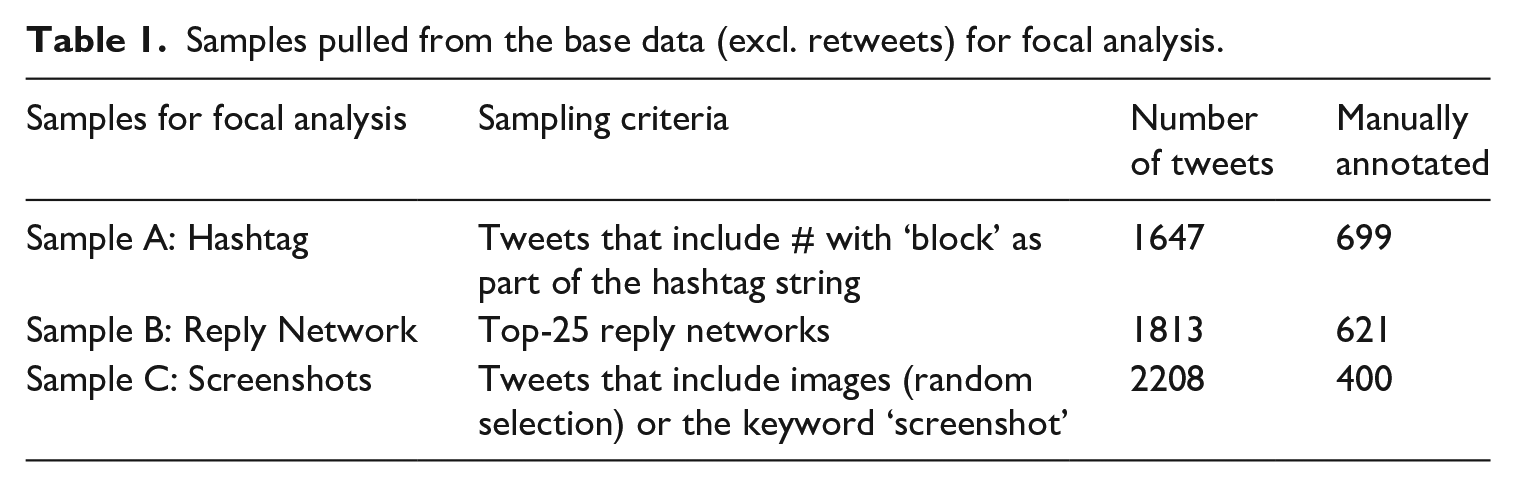
The hashtag-based subsample A consisted of tweets that included hashtags and where the letter string ‘block’ is part of the hashtag itself. In other words, we were primarily interested in how the act of blocking is made explicit through its own type of hashtag. The subsampling for blocking-related hashtags resulted in a data subset of roughly 1650 tweets. We used tweets from the first 5 months (ca. 700 tweets) to identify typical speech acts. Moreover, to guide the analysis of hashtags that attracted debate and diverse viewpoints, we additionally annotated the tweets’ stances towards blocking in general or towards blocking by specific groups. Stances were categorized as either positive, negative, indifferent or ambivalent.
For the analysis of major reply networks, we used DMI-TCAT to generate a graph file from all tweets in the base data and which created a direct link between two tweets if one is a reply to another. As multiple tweets may respond to the same initial tweet, replies cluster and are represented as reply networks. In our case, we confined our analysis to the top-25 reply networks, measured by the number of block-related tweets within these clusters – ranging between 222 tweets for the largest network and 35 tweets for the smallest. For further analysis, we categorized the conversation-initiating tweet and, again, annotated the stance of follow-up replies to determine the positional variance within the reply network.
Finally, the screenshot-oriented analysis was based on two integrated subsamples: the first subsample consisted only of tweets that included images; the second, tweets that mentioned the word ‘screenshot’. Whereas the image sample was confined to 1000 randomly-selected tweets with images, the keyword-based subsample was retrieved in full for the first 5 months of data collection, amounting to about 1300 tweets. For the image subsample we began analysing the tweets by manually checking whether the image was a screenshot and, if so, categorizing the speech act in which they appeared. The same procedure was used for the keyword-based subsample. Altogether, around 400 screenshot-related tweets were analysed in this way, complementing and corroborating chance examples we had collected over the course of the exploratory research phase.
Analysis: the role of material affordances and conversational devices in the context of block talk
Types of block talk can be distinguished according to communicative patterns of varying size. The smallest unit we have investigated was the level of a single tweet and categorized as a certain kind of speech act. Beyond speech acts, there are larger ‘genre’-like (see Luckmann, 2009) communicative patterns of block talk, which adapt communicative genres of online communication and social media more generally (Lomborg, 2011). Relevant examples of the latter are, for example, online gossip (Jones et al., 2011), collaborative recommendations, or comments sections on news websites or blogs. In addition to typical speech acts and communicative genres, the discourse about blocking is materially structured on the text level through conversational devices such as hashtags, screenshots or @-mentions and which are appropriated in the context of block talk. These latter structures are sometimes described as ‘low-level affordances [. . .] typically located in the materiality of the medium’ (Bucher and Helmond, 2018). All of these three structural layers – speech acts, communicative genres and material affordances or conversational devices – represent latent orders of communication, which are routinely activated without needing focused attention. Yet, they can also be adapted and transformed when new communicative challenges arise, which in turn serve as a disruption to otherwise routinized forms of communicating. Block talk is an interesting case in point, because in speaking about blocking events, users adapt and transform existing communicative strategies of making public on Twitter and bring some of these latent orders of communication to awareness. In other words, block talk enforces a certain form of communicational reflexivity and sometimes calls into question existing communicational norms of public discourse or, at other times, the use of certain material affordances. For the following analysis, we will concentrate on users’ adaption of the above-mentioned conversational devices of hashtags, @-mentions and screenshots during block talk. However, before going into the details of this analysis, we will briefly present a rough typology of speech acts to introduce the reader to some of the most common forms of block talk.
Common types of speech acts
Our classification of common types of speech acts in the discourse about blocking is based on existing taxonomies of speech acts for ‘computer-mediated communication’ (Herring et al., 2005) and was appropriated for the present case study. 1 Even though users reference the act of blocking in a number of ways, four distinct forms stand out (see Table 2): firstly, we repeatedly find users documenting an act of blocking that happened in the past. Documenting past blocking action refers either to a block performed by the tweet’s author or to having been blocked by another user. Secondly, users regularly announce that they are committed to blocking certain users in particular, or specific groups in principle. Thirdly, users would often publish advice on whom to block. The distinction between announcement and advice is blurry but one can differentiate between explicit and implicit advice, and, as we will see below, hashtags such as #blockempfehlung (‘block recommendation’) are a means to organize blocking advice and make it explicit. In addition to announcement, documentation and advice, users repeatedly reflect upon the practice of blocking in a more abstract, sometimes ironic way, or they evaluate the general blocking practice of another user or user group beyond a particular instance. These cases were labelled as metadiscursive elaboration in our classification scheme. Metadiscursive elaborations are in most cases longer, include explicit evaluations of the act of blocking or the person who uses blocking, and often justify or delegitimize the practice. The four categories of speech acts are not mutually exclusive. For example, users may document that they have been blocked and in the same tweet announce that they plan to ‘counter-block’. Or authors legitimize their plans to block, or evaluate documented block events, through additional metadiscursive reflection.
Speech act labels.
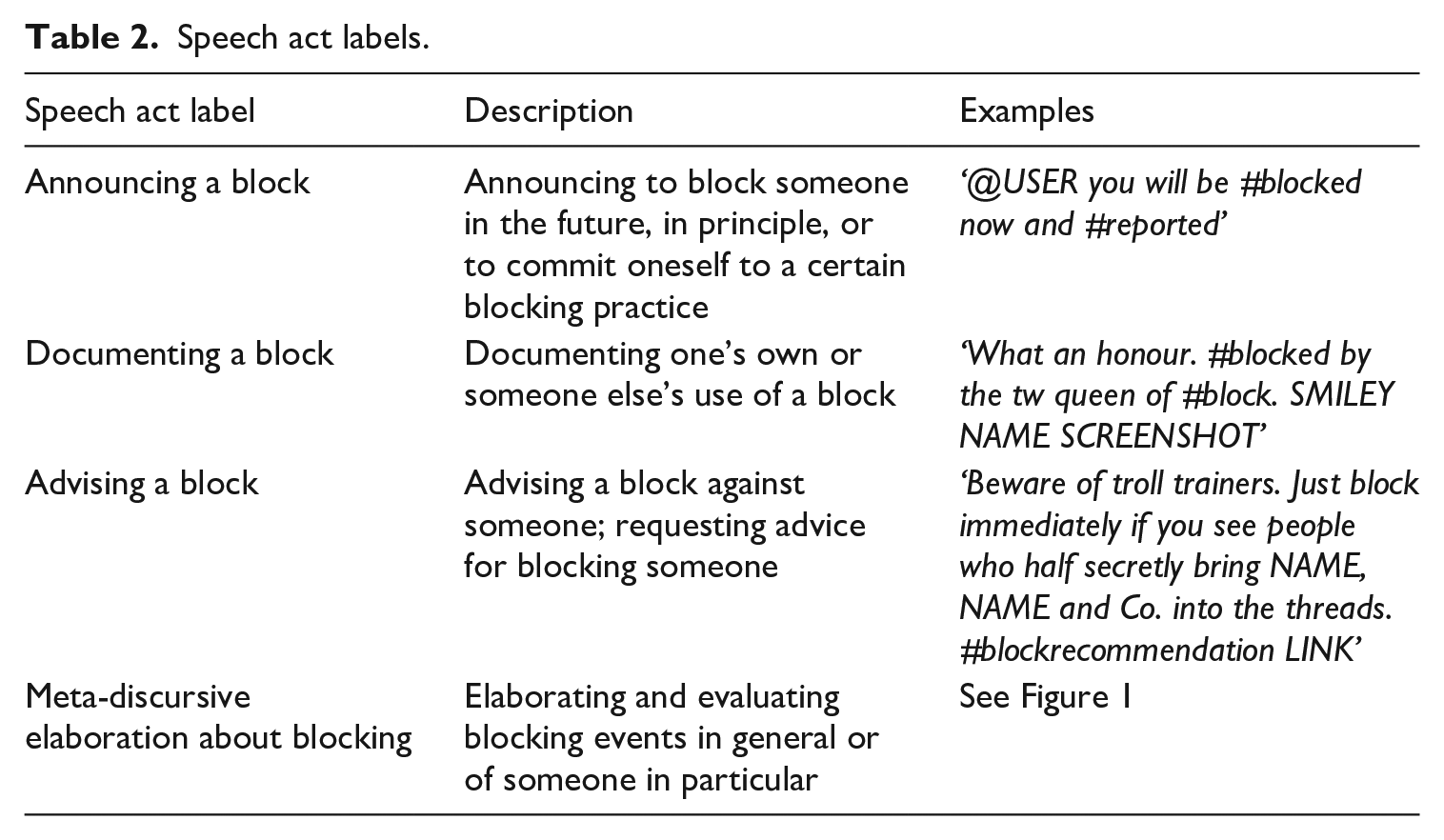
Table 2 sums up our basic taxonomy of speech act types and provides exemplary, anonymized tweets for each of the categories. 2 Moreover, Figure 1 presents a selection of 15 metadiscursive tweets from across our three subsamples. We distinguished the selected tweets along two axes: on the one hand, between pro- and anti-block stances with a few exceptions in the middle that make conditional use of the block function. On the other hand, we divided them based on whether the tweets justify or criticize blocking rather on the grounds of individual freedom or collective responsibility.
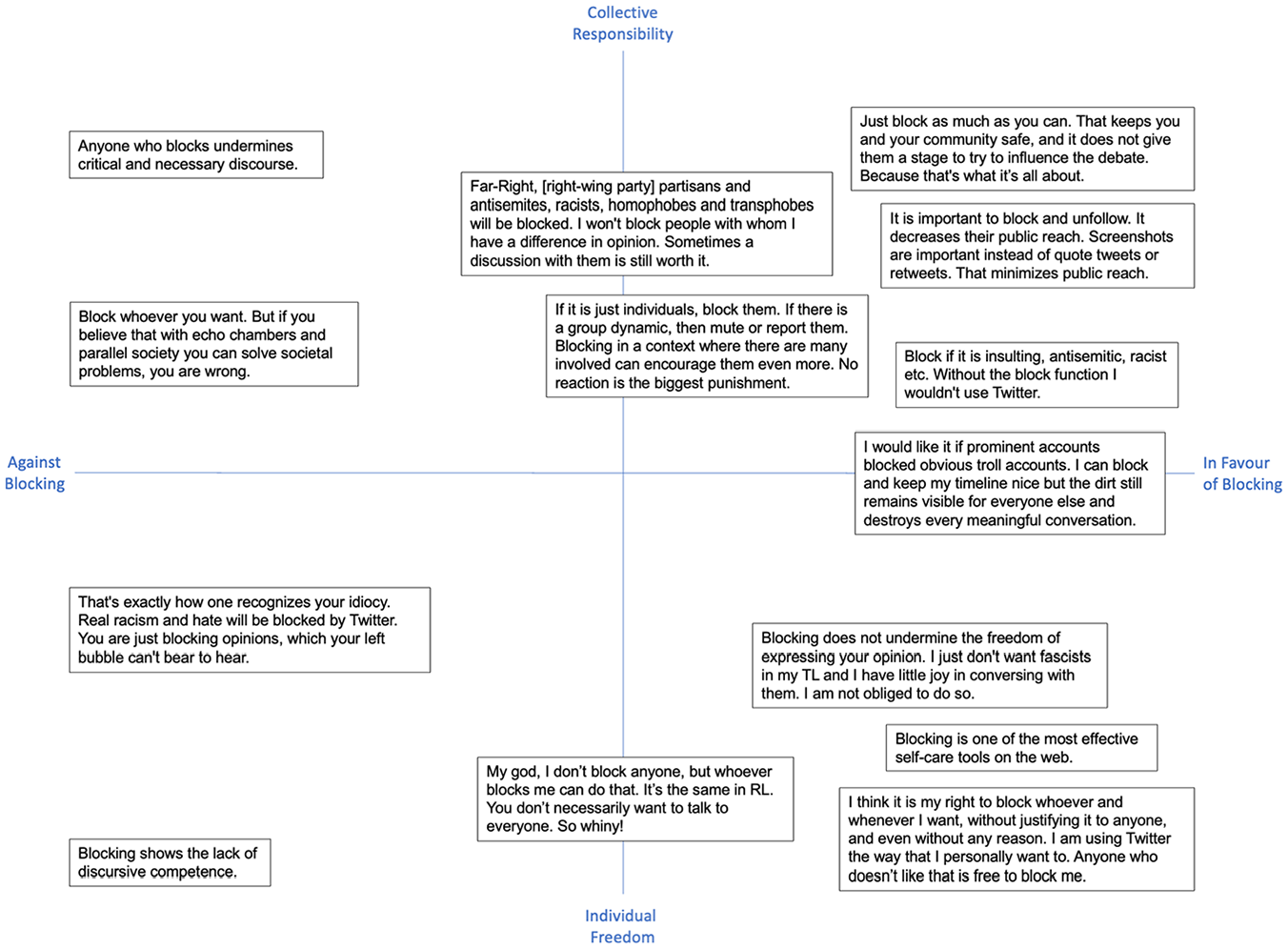
Examples of metadiscursive elaborations about blocking, whether they are in favour or against the use of the block function, and whether they rationalize blocking in relation to individual freedom or collective responsibility.
The distinction between common types of speech acts provides an analytic baseline for the following presentation of the role of different conversational devices in shaping block talk. In particular, we will discuss the role of hashtags, @-mentions and screenshots. On several occasions, we will also consider the tweets’ articulations of stance and how the mentioned conversational devices have been adapted for processes of collective stance-taking and positioning in the context of block talk.
The use of block-related hashtags
Even though hashtags are Twitter’s most prominent conversational device, enabling what has been called ‘searchable talk’ (Zappavigna, 2015), they are by far outnumbered by tweets without hashtags. The same applies to the discourse about blocking. Only 6% of tweets in our overall sample of tweets about blocking events included a hashtag of some kind and an even smaller proportion of these fell into the category of block-related hashtags in the aforementioned sense, where the keyword ‘block’ was contained in the letter string of the hashtag. Nevertheless, hashtags provide an important means for organizing talk across user groups and follower networks.
Block-related hashtags fall into two main groups: (a) general block-related hashtags, which do not include any further reference to a person, group or event; and (b) targeted block-related hashtags that refer to a group or individual who should be or has (been) blocked. Both types of hashtags are frequently combined in a single tweet. Table 3 presents an overview of the five most frequently-used hashtags in the period of February to December 2021 and whether we categorized them as targeted or general block-related hashtags.
List of the five most commonly-used hashtags in the hashtag-based sample A.
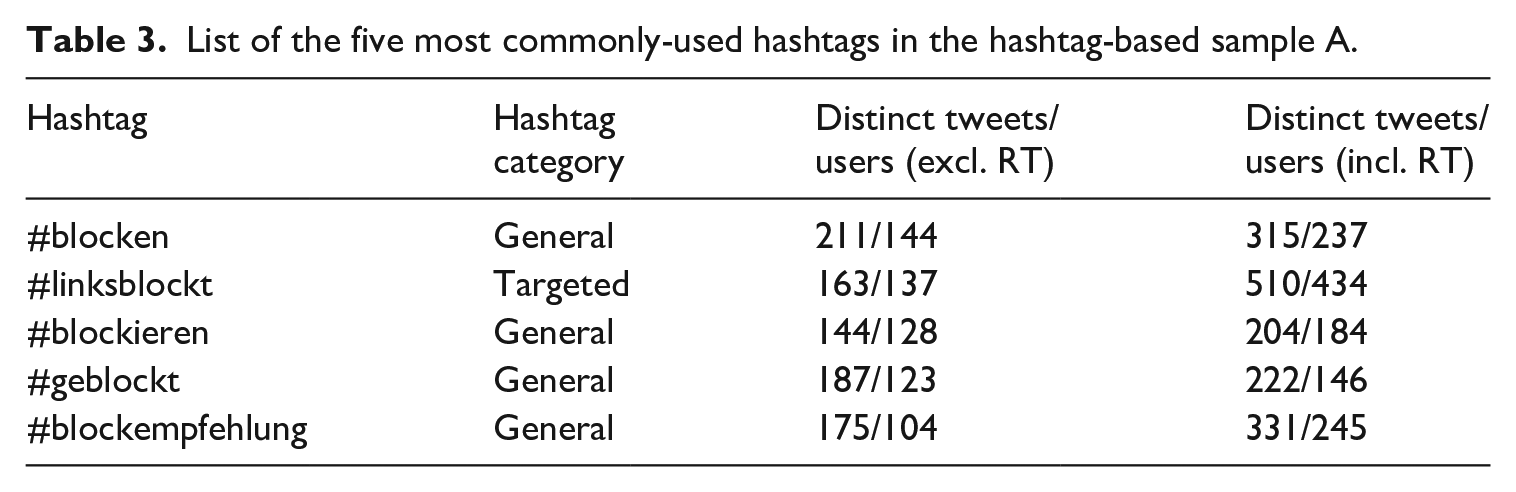
By comparing the hashtags in Table 3 with the distribution of speech act types among them, it became clear that the hashtag #geblockt (‘blocked’) is primarily used for documentation and #blockempfehlung for advice, as might be expected. In contrast, among tweets that contained the targeted hashtag #LINKSBlockt (#THE LEFT blocks) we found a higher number of metadiscursive elaborations. From the naming of the hashtag, one could expect it to be primarily used to document instances where a group of users identified as ‘the left’ is doing the blocking. But most speech acts that have evolved around this hashtag were metadiscursive elaborations that took an evaluative stance towards this claim. In other words, the hashtag organized a metadiscursive and often normatively explicit debate about blocking.
To further assess the variance of the positions in the debate around #LINKSBlockt, we supplemented the prior categorization of tweets for this hashtag by identifying the stance of each statement, that is, the tweet’s stance towards blocking in general and towards blocking by ‘the left’. The results showed that negative stance articulations towards blocking in general or towards blocking by the left occurred slightly more often than positive ones. However, the difference remained smaller than expected, considering that the hashtag was likely initiated to denounce the blocking practice by a supposedly homogenous ‘left’. Instead, the hashtag attracted tweets with both supporting and opposing stances towards the practice of blocking or towards the implied group identification. Together, such decisive stance articulations amounted to 70% of all tweets with this hashtag. In the remaining 30% of cases users did not take a stance for or against blocking by ‘the left’ but they either declared that other groups equally make use of the blocking function; they claimed to be indifferent towards blocking; or they indicated a more ambivalent position, regarding blocking to be justified in some cases while inappropriate in others.
Altogether, the analysis of block-related hashtags points us to different roles that these hashtags may play in block talk, beyond or in addition to their general implication of providing searchable text anchors for wider public participation. Some of the general block-related hashtags help to make explicit the types of speech act they are part of, such as the hashtag #blockempfehlung that explicitly marks a statement as a form of advice. By contrast, targeted hashtags organize block-related controversies by orienting the discourse to specific users or groups and by attracting metadiscursive elaborations. The latter finding aligns with the general assumption that hashtags provide a heuristic entry point for the mapping of controversy. However, these findings also demonstrate that it matters how hashtags are tailored to specific events or people. If block-related hashtags are more generic, it seems less likely that debates will cluster around them and that users with opposing viewpoints will enter the debate. Nevertheless, users still choose these generic hashtags – for example, #geblockt – rather than simply using the word without the hashtag. Even though they might not reach out to a Twitter-wide audience in these cases, generic block-related hashtags might be used for emphasis or to register the disconnective act into what is perceived as a collective ritual or as the communicative genre of publicly announcing and documenting blocking events.
Addressivity techniques in reply networks
Conversations about blocking do not just cluster around hashtags but also in replies to specific tweets and users who have initiated a conversation about blocking or related topics. The result can be long reply chains or reply networks with multiple tweets reflecting on the practice of blocking or sharing their own blocking experience. Measured by the number of block-related tweets, such conversations in the context of reply networks are substantially more characteristic for Twitter than conversations about blocking based on hashtags. About 80% of the tweets in our base sample were replies, and about 500 reply networks consisted of ten or more tweets that make explicit references to blocking. For further qualitative analysis, we concentrated on the top-25 conversations measured by the number of block-related tweets they contained.
Within this subsample of reply networks, about half of the conversation-initiating tweets were documentations of blocking events or statements about the blocking practice of another user. In order to address other users – in this case the users whose blocking practice is documented or commented upon – it is common practice on Twitter to use so-called @-mentions as an ‘addressivity marker’ (Pappacharissi, 2015: 34–36). Theoretically, these mentions notify and potentially invite the addressed user and their followers into the conversation. In the context of block talk, however, the communicative function of the @-mention differs as we will see below.
Among the 25 reply networks we have analysed, @-mentions were part of the conversation-opening tweet in six cases, and five of them were documentation tweets such as ‘I am blocked by @NAME’, which used the @-mention to address the user by which they had been blocked. In these conversations, the positional variance of the replies towards the initial tweet remained mainly homogenous. The majority of respondents mirrored the opening tweet by sharing a similar experience of being blocked or by aligning with the conversation’s overall negative stance towards the mentioned user (Figure 2).
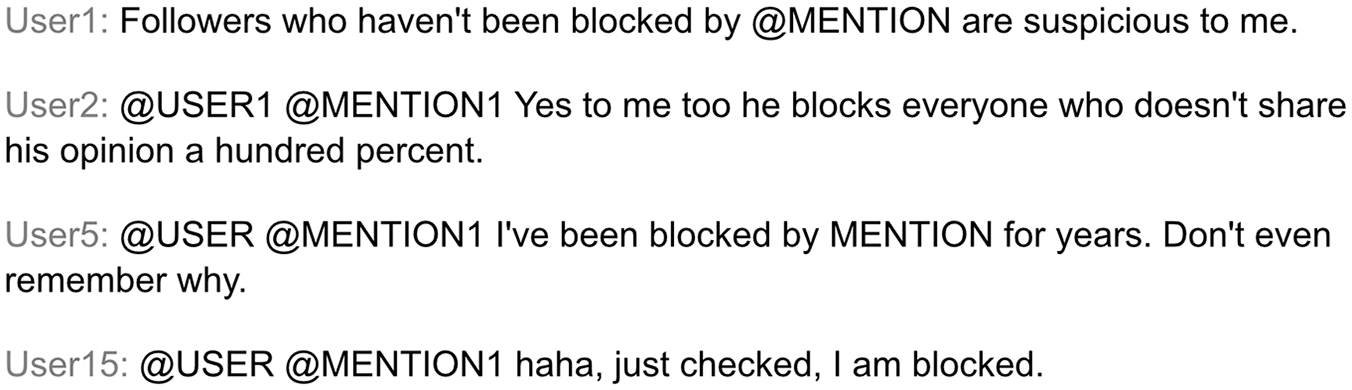
Extract from a reply-based conversation about blocking.
The use of @-mentions in the context of these reply networks indicates a transformation of the communicative meaning of the @-mention. If a user decides to block someone else, they will no longer be notified if the blocked user mentions them. Thus, rather than being an addressivity marker that invites the addressed user to participate, the @-mention in the context of block documentations are primarily oriented towards the audience of the block-documenting tweet; for example, to check whether they have also been blocked by the user in question. In the above sample, the follow-up tweets were unanimously affirmative and mirrored the block experience. It seems that the @-mention served to orient the conversation by marking a member of an outgroup against which the respondents of the opening tweet would be able to unite in their position.
Beyond the adaptation of addressivity markers, the analysis of major reply networks also points us to different conversational contexts. Metadiscursive elaborations were more likely to occur in some than others. As indicated above, most of the top-25 conversations that were initiated by block documentations led to a rather homogenous set of responses, mirroring and affirming the experience of the initial tweet. But in four cases the conversations had either been initiated by a politician, the official Twitter account of a political party, or by a journalist. In these cases, the majority of replies took a negative stance towards the initiating account, but they also elaborated on the legitimacy of using the block function. Respondents attacked the politicians for making use of blocking and the party for hypocritically portraying itself as the victim of blocking, because the party’s individual members had supposedly blocked other users themselves. A similar wave of negative replies was articulated in response to the journalist, who made public his own blocking practice. In both the politicians’ and journalist’s accounts, the more elaborate responses in the reply network disapproved of the targeted users’ blocking practice because of their perceived societal role, which, according to the critics, mandated them to let all voices be heard.
Using screenshots in block talk
Further adaptations of addressivity techniques in the context of blocking can be found when considering the use of screenshots. Screenshots are an intuitive form of evidence in order to display that a blocking event has taken place or to document a previous snippet of a conversation that led to a block. They also allow the saving of tweets in case they are later deleted, and if a user wishes to document a tweet from an account which has blocked them, the screenshot provides an alternative means of redistributing and commenting upon the tweet. Moreover, users sometimes seek to avoid machine-readability to prevent automatic notification of the user under observation and not to ‘amplify’ the visibility of a blocked tweet or user. While there are numerous ways of achieving this, the most common practice is the use of screenshots rather than quoting or mentioning a tweet and user directly.
Furthermore, a closer analysis of our screenshot-based subsample showed that screenshots are important informational resources and social-media-specific ‘gifts’ (see Duffy and Ling, 2020) that are exchanged among followers and which lead to metadiscursive follow-up conversations: on the one hand, users ask for screenshots about tweets they cannot see because of existing blocks in place; they also redistribute screenshots to their followers ‘just in case any of them are blocked’. On the other hand, such usage of screenshots is also criticized, particularly if users feel exposed to content they had initially blocked. Among the 200 tweets with the word screenshot that we annotated and categorized manually, about a third were requests for screenshots, while every sixth tweet criticized their use.
In some cases where screenshots were used to document a blocking event, other users replied with screenshots of a similar block. This image-based interaction demonstrated a shared experience and mostly support towards the previous post. However, we also found examples of shot/counter-shot interactions, where screenshots used images to supplement processes of antagonistic stance-taking in conversations in which members from opposing groups participated. In one such example, the editor of a German newspaper publicized a screenshot that documented a block by another prominent user from a supposedly opposing political camp. In addition, the editor used this communicative event to advertise an upcoming article and accused the blocking group of an ‘inability to engage in discourse’ and of ‘radicalizing in their bubbles’. Given the wide reach of the Twitter account of the editor, the screenshot led not only to supporting screenshots but also to ‘counter-screenshots’, demonstrating that users from the accused group had equally been blocked by users supposedly affiliated with the editor.
Altogether, in the context of block talk, screenshots are primarily mobilized in acts of documentation and recommendation, as pieces of evidence or alternative addressivity devices that avoid the default @-token. At other times, however, screenshots and ‘counter-screenshots’ provide the image-based and mimetic milieu for performances of antagonistic stance-taking to take place.
Discussion: enregisterment of blocking and infrastructuring block talk
To be blocked is an important communicative event in the lifeworld of Twitter users. By documenting an event of their personal online life, the blocked user enacts the social networking site as a ‘witnessable world’ (Frosh, 2019: 83–87). By recommending blocks the user participates in the collective enterprise of collaborative filtering and tagging of content and therefore reproduces an established repertoire of online communication in the platform economy (Gerlitz and Helmond, 2013: 1351). By comparing blocking with other platform functions such as unfollowing, muting or reporting, users contextualize the practice of blocking within a repertoire of dis/connective action (John and Dvir-Gvirsman, 2015; Zhu and Skoric, 2022). These different ways of referencing the act of blocking mobilize the knowhow of communicative genres, whose performative realization also has a phatic social function: they display the users’ participation in a collective ritual and ensure that they know the implicit rules of the ritual, enacting group membership and maintaining social bonds.
The latter aspect becomes even more obvious where these speech acts are not singular statements or one-off reactions to previous statements, but where block-related statements cluster together and become part of larger conversations. We discussed different types of block talk regarding two of the most notable archetypes of larger block-related conversations: on the one hand, block documentations regularly come together in what are ostensibly in-group conversations, where participants mutually affirm each other’s blocking experience against a defined outside. On the other hand, metadiscursive debates seem to cluster around targeted hashtags or in response to politicians and journalists. Even if the initial tweet in these latter contexts was of a documenting or announcement type, it sparked an explicitly normative conversation, where the practice of blocking was evaluated in relation to perceived norms of public communication.
Moreover, as our analysis of addressivity markers has shown, a second type of metadiscursive block talk has revolved around block talk itself and the adequacy of different conversational devices in this context. For example, some users specifically avoid machine-readable addressivity markers such as hashtags, @-mentions, or quotes when recommending blocks, to minimize visibility rather than claiming it. Moreover, while screenshots have become a typical means to circumvent blocks and to distribute and converse about the content hidden behind the block, others criticize this practice for rendering blocking meaningless, as it allows exposure to the content that they wanted to block in the first place.
These latter conversations articulate a common phenomenon of Twitter and social networking sites more generally: a tendency to communicate about the affordances of using the platform. Different normative frames of reference are mobilized in this process, be they registers of how to act on Twitter and social media, or expectations towards contemporary media publics more generally. For our research purposes, this necessitates an additional change of perspective and to treat these normative framings of blocking as communicative practices in their own right. In order to do so, we turn to two different research traditions: to linguistic scholarship about social media’s communicative genres and processes of enregisterment (Agha and Frog, 2015; Lomborg, 2011; Squires, 2010; Staehr, 2015; Wikström, 2016); and to media-theoretical infrastructure research.
In linguistics, Agha (2007: 190) defines enregisterment as the process by which ‘a linguistic repertoire becomes differentiable within a language as a socially recognized register of forms’. Examples could be the collective recognition of a dialect, but also a description of tweeting as being ‘talk-like’ (Wikström, 2016). The concept of enregisterment can be extended to other communicative practices, or social practices more generally, which become metapragmatically reflected in language. It is helpful for pointing out the different categories and normative expectations in articulating the practice of blocking. In the context of block talk, blocking becomes enregistered, for example, as a way of ‘leaving’ unpleasant or threatening situations and conversations – ‘like in real-life’, as a Twitter user from the pro-block camp pointed out (see Figure 1). On other occasions, blocking is enregistered as a form of political activism to modulate the visibility of certain content. Finally, sometimes blocking is framed as a form of censorship, mobilizing general discourse norms and enregistering the practice as (communicative) participation in civil society and in the formation of public opinion. The concept of enregisterment helps to step back from the normative heat of these discussions about blocking, acknowledge the contingency of the practice’s metapragmatic enregisterment, and potentially inquire about the ‘ideological’ underpinning and structural features of these processes of enregisterment (see e.g. Silverstein, 1979; Squires, 2010; Woolard, 2020).
Silverstein (1979: 193) has defined linguistic ideology broadly as ‘any sets of beliefs about language’ – or in our case, beliefs about the practice of blocking – which are ‘articulated by users as a rationalization or justification of perceived language [practice] structure and use’. This definition is arguably quite broad and other scholars have developed a variety of theoretical tools to further qualify and identify language-ideological aspects in the process of enregisterment (see for an overview Woolard, 2020). Indicators of a language ideological process are, for example, the ignorance towards a sign system’s varied social history in favour of its supposedly universal social segmentation; or linking generalized personality traits with a textual, phonetic or otherwise visible sign. Portraying blocking as a sign for discursive incompetence, as mentioned in our analysis above, and ignoring the wide and varied application of the block function since its introduction by Twitter in 2007, point in the direction of ideological enregisterment. In addition, we may also add ethical universalization as a feature of ideological enregisterment: for example, blocking being delegitimized as counter to the universal principle of freedom of speech, which overlooks the particular experiences of invective speech that might lead to a decision to block; likewise, the legitimization of blocking as safeguarding the political participation of minorities equally embeds blocking within a framework of the universal ethical principles of equal participation. Both universalizing strategies might be understood as ideological in the vein of the aforementioned linguistic definition of metapragmatic ideology.
While the concepts of enregisterment and metapragmatic ideology thus help us to point out the different frames of reference and normative contexts that are mobilized in making the practice of blocking explicit, it does not, however, capture the medial specificity of block talk. We therefore propose accompanying the aforementioned perspective on processes of enregisterment with a conception of ‘communicative infrastructuring’, adding to recent debates in media studies about ‘infrastructures of making public’ (see Korn et al., 2019). By communicative infrastructures we aim to encompass, on the one hand, the implicit speech routines and material affordances that undergird block talk and which generate publics around the act of blocking. Block talk is ‘built upon an installed base’ (Star and Ruhleder, 1996: 13) of existing infrastructures: from particular conversational devices on Twitter, such as hashtags, screenshots and @-mentions, over communicative genres such as documentation, gossip and recommendation, to wider metapragmatic registers that encode discursive expectations and norms. On the other hand, the compound verb gerund ‘communicative infrastructuring’ (see Niewöhner, 2015) allows us to emphasize that communicative infrastructures in the context of social media are not simply invisible background equipment, but that they themselves are routinely reflected and negotiated in acts of metacommunication. As initially said, block talk challenges existing infrastructures of making public on Twitter and simultaneously shapes and routinizes its own latent base operations. What is particular about the phenomenon of block talk, is that these base infrastructures of making public are routinely problematized and adapted and thereby their very function as infrastructures for making public are brought to the fore. The concept of communicative infrastructuring responds to this insight by taking into account that the ‘infrastructural inversion’ (ibid.) – making visible what belongs to an operative background – is not only a heuristic for research but a metacommunicative genre of the social networking site itself. Users thematize ‘low-level affordances’ (Bucher and Helmond, 2018) such as hashtags, screenshots and @-mentions, as well as normative expectations towards public discourse, and they sometimes even reflect upon the ritual performance of block talk (see Figure 1). Altogether, block talk serves as an infrastructure for users displaying, probing and negotiating a metapragmatic stance towards dis/connective acts, potentially acting out ideological alignment and disalignment towards other users, as well as committing themselves to certain normative ideas about when and where the border between making public and keeping private should be drawn on social networking sites.
Conclusion and limitations
The present article has discussed how German-language Twitter users speak about particular block events on the platform or about the practice of blocking in general. We have distinguished common forms and genres of ‘block talk’ such as block documentation, blocking advice and metadiscourse about blocking practices in general. We have shown that block talk routinely mobilizes normative conceptions of and expectations towards public communication, and, taking a cue from sociolinguistics, we have discussed these instances of communicative reflexivity as metapragmatic enregisterment. Even though the discursive enregisterment of a practice may imply normative judgments on many occasions, hashtags targeted at groups or individuals, and reply networks in response to politicians and journalists create the conversational context in which this normative registration of blocking is most explicitly articulated. Moreover, we have analysed the role of conversational devices such as hashtags, @-mentions and screenshots and have demonstrated how they were adapted in the context of block talk.
It must be noted, however, that this analysis had to be selective and excluded other infrastructures of blocking, most notably, block lists (see Wheatley and Vatnoey, 2019). Furthermore, while giving space for a detailed analysis of block talk on Twitter, we had to exclude the analysis of other platforms and a comparison between them. Even though all of the top five social media platforms in Germany – Facebook, Instagram, Twitter, Snapchat and TikTok – offer the possibility to block, it remains an open question whether this results in a discourse about blocking across these platforms. Our hypothesis is that the context of Twitter offers certain platform specificities for the emergence of block talk. In contrast to Facebook, for example, Twitter is characterized by what has been called a ‘directed friendship model’ (Hofer and Aubert, 2013: 2136): users can follow and contact other users without waiting for their approval. Even though Twitter also offers ‘protected’ accounts, where approval has to be given, the majority and default mode when signing up for the service has been the non-reciprocal contact model. Moreover, Twitter began offering users the option to remove unwanted followers only in 2021. Before, blocking followers was the only available option for users with public accounts. Thus, it seems likely that these affordances for the management of the follow-follower structure have contributed to the importance of the block function and consequently to it becoming a topic of discussion itself. However, while this difference in friendship model may be true for Facebook and Twitter, it fails to capture a significant difference between Twitter and TikTok, for example. An initial exploration of user discussions about blocking on TikTok suggests that one indeed finds instances of block talk in this context as well, attuning block talk to the affordances of video-based interaction. However, this would have to be assessed more systematically in empirical follow-up research, which is necessary to test these assumptions and to develop what Bucher and Helmond (2018) have called a ‘platform-sensitive approach’ to the affordances of block talk.
Despite such limitations, the analysis of the presented conversational devices and their adaption has offered us the conceptual and empirical basis to mirror our findings with existing theories about material affordances and infrastructures of making public in social networking sites. The degree of metapragmatic reflexivity and the routinized adaptation of Twitter’s material affordances in the context of block talk suggests that the (communicative, connective, curatorial) infrastructures of networked publics do not fit a background model of infrastructure but are rather continuously explicated as part of the communicative economy of the platform.
Footnotes
Acknowledgements
We would like to particularly thank Benjamin Schäfer for his contribution during the initial research and drafting phase of this article.
Funding
The author(s) disclosed receipt of the following financial support for the research, authorship, and/or publication of this article: This work was supported by the German Federal Ministry of Education and Research (BMBF), grant number 01UG2050KY, and by the Centre for Cultural Inquiry (ZKF) at the University of Konstanz.
