




Abstract
This paper examines the significance of On the Wire, a BBC local radio programme, that provides a unique lens through which to examine changes in local radio, music radio in general and public service broadcasting. The paper provides a concise history and an account of the On the Wire, along with an explanation of its impact. The paper offers reasons for the programme’s enduring appeal, including its ability to change and adapt, its emphasis on the local in a global context and its innovative approach to audience participation. The paper concludes by positing that the history of On the Wire provides valuable insights for broadcasters in general, highlighting key aspects that radio programmes can learn from its approach. By showcasing the possibilities of what local radio, music radio and public service broadcasting can be, On the Wire sets a positive example for what radio can achieve.
‘On the Wire is local radio, but not as you know it.’ (Sturges, 2014) he knew, all t’ dub folk know, about Lancashire as heart of Babylon, ‘at’s how Jamaican dub music found its way back to Lancashire, because t’ music ‘at came out of Caribbean slavery tried to undermine t’ beast from within, he that leadeth into captivity shall go into captivity, it makes sense, dub is a flagrantly righteous music, so t’ dub got into t’ red county and invaded th’ airwaves, a Radio Lancashire programme called Up On t’ Wire started to play t’ dub music, it tried to turn t’ terrible tide, and t’ programme started broadcasting in t’ 1980s from a studio a few miles away from Pendle hill, it got t’ dub on th’ air, it tried to drown out sprites like me, drowning out diabolical voices of t’ Lancashire air, and Lee Perry appeared live on t’ programme, he stayed in Clitheroe near Pendle while he were there
On the Wire provides a unique lens on the way BBC Local Radio, music radio and Public Service Broadcasting has developed over a near 40-year period. Since its inception in 1984, On the Wire on BBC Radio Lancashire has pioneered a unique blend of music genres. The program has continued to evolve, featuring new and diverse music each week outside the all-encompassing genre of pop music. On the Wire has constantly transformed and adapted with the times open to emerging styles and variations of popular music. One of the show’s defining characteristics is its aversion to predictability and staid formats. This has allowed it to dictate its own music selection, format and presentation approach on its own terms without patronizing its audience. On the contrary, the program holds its listeners in high regard and often challenges in its selection of so-called ‘outsider music’. On the Wire is a unique and important radio program and is a valuable resource for listeners who are looking for something different and who appreciate the power of music to connect people, expand both knowledge and understanding.
We didn’t really have any expectations as we were so pleased to be doing what we were doing, 3 hours of freeform radio on a Sunday afternoon. The programme got very popular very quickly across the north west and nationally/internationally because there wasn’t anything like it elsewhere. (Steve Barker quoted in Scott-Bates, 2014). I never imagined that the show would last so long, I suppose you could say I just got carried away for the past forty years or so. . . but we have always championed new, experimental and underground music that always seems against the grain when it first appears. (Steve Barker quoted in Martin, 2023).
The ending of On the Wire on BBC Local Radio is linked to the implementation of BBC’s proposals for the future of local radio (BBC, 2022). This strategy involves a reconfiguration of BBC local radio programming, changing content airing after 2 pm on both weekdays and weekends. The sharing of programming takes centre stage with a departure from the previous broadcasting model. The ramifications of this shift are particularly significant. It has triggered a series of reactions that have reverberated across the BBC and sparked employee unrest, exemplified by instances of industrial action. The decision to end On the Wire on the BBC should be seen within the framework of this restructuring. On the Wire is one of many casualties of the change, which has had an impact on numerous other local radio programmes. A mosaic of innovative and valuable programs has fallen by the wayside, leaving a discernible void in the BBC Local Radio landscape.
On the Wire has been on local BBC radio for nearly 40 years and is known for its eclectic music selection and its strong connection to the local community. The program has survived numerous threats to its existence via various BBC programme, organizational and management change initiatives, and it continues to evolve and adapt to the changing times. The success of On the Wire can be attributed to many factors. Firstly, the program has always been willing to take risks and experiment with new music. This has allowed it to introduce its listeners to new and exciting artists and genres. Secondly, the program has always been a strong advocate for independent music. This has made it a popular choice for listeners who are looking for something different from the dominance of the normal mainstream choices. Thirdly, the program has always been committed to its local community. This has made it a source of pride for listeners who feel that it represents their interests and values. These factors that have contributed to the lasting appeal of On the Wire and have provided the program with an ability to endure amidst the increasing commercialization of radio both within the BBC and ‘independent’ sectors.
It might not have an audience of 20 million or trend on Twitter weekly but it’s the kind of show we pay our license fee for. The kind of show that commercial radio just can’t make because it would make no sense at all. It’s precisely that lack of sense that makes it magical. It is radio in its purest form. It is without airs and graces, without ego or showmanship. Radio that simply lets you listen and nothing else. It is just 2 hours of brilliant music, and it has attracted a dedicated global audience, despite never leaving the confines of local radio. (Jones, 2020)
The show’s success can largely be attributed to its presenter, Steve Barker (Figures 1 and 2), who has an undeniable passion for discovering new music and discovering music previously ignored. Barker’s low-key presentation approach and proactive style have been key factors in the program’s appeal. ‘Barker always focused on getting as much music in as possible. . .. Not that he isn’t articulate or passionate in talking about music, but he’s vehemently against personality broadcasting’ (Muggs, 2020).
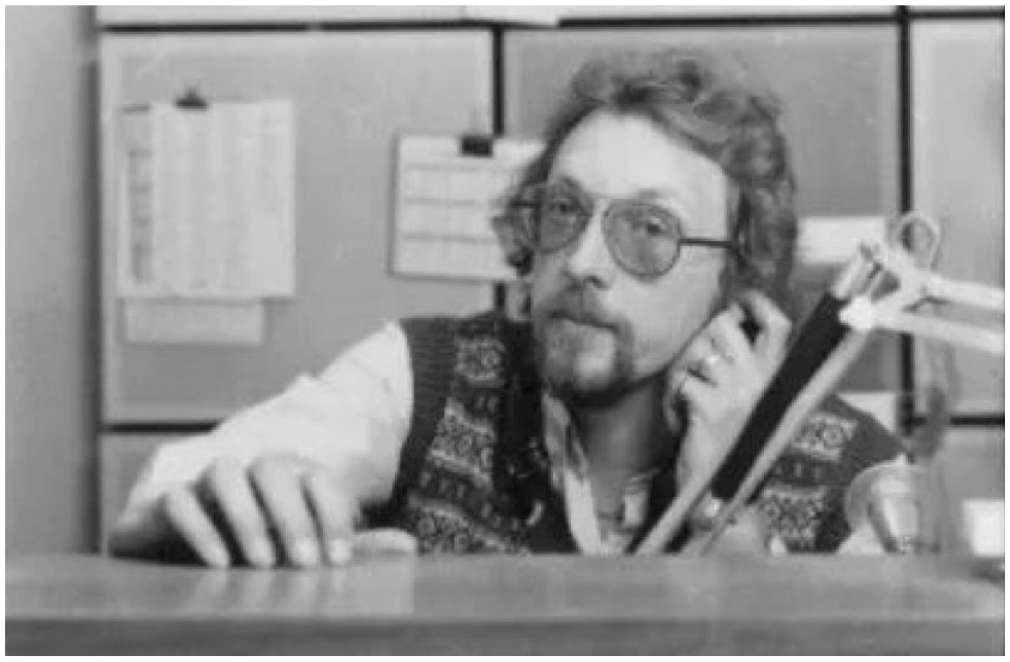
Steve Barker working at BBC Radio Blackburn, 1970s (copyright Steve Barker).
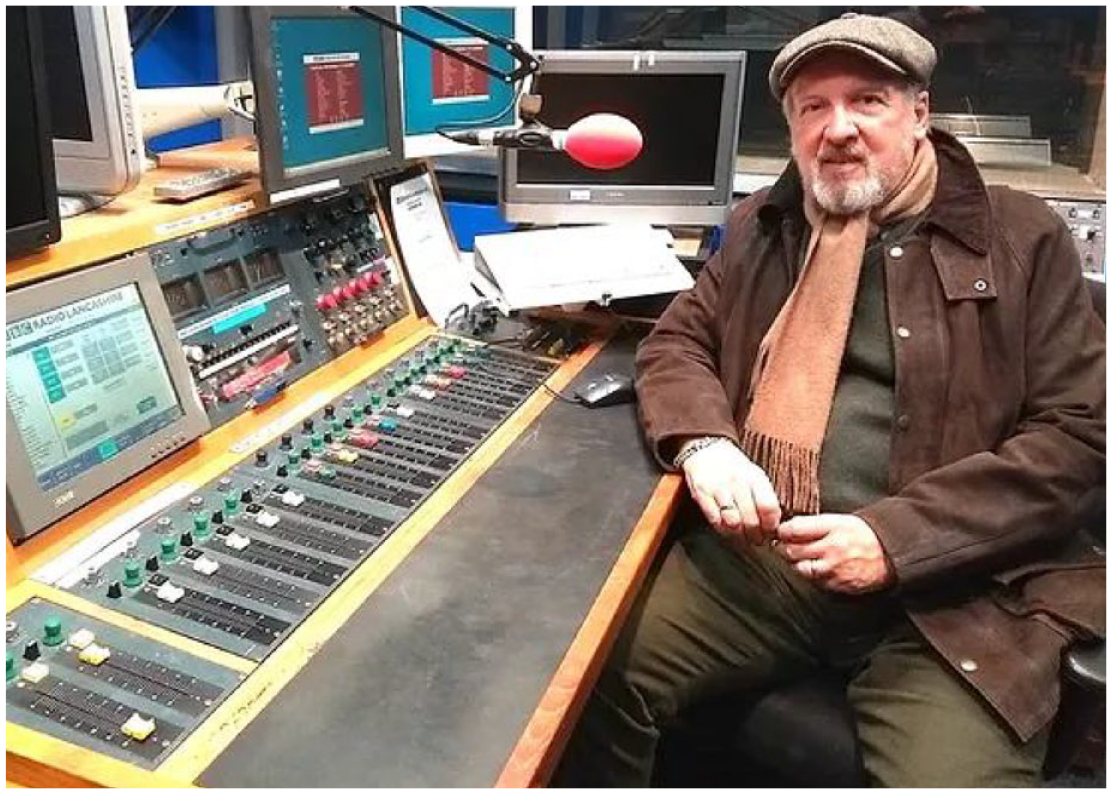
Steve Barker working at BBC Radio Lancashire, 2018 (copyright Steve Urquhart).
There is a commitment to a punk ethos and DIY mentality, a trait that has remained unchanged since its early days. The programme’s roots in the late 1970s music scene have enabled it to sustain its punk ethos and approach, which encompasses not just the music played but also its general outlook. On the Wire has championed music from numerous independent record labels. Barker believed that he could establish a radio program and play whatever music he liked such as dub reggae (Figure 3: Guests Lee ‘Scratch’ Perry and Adrian Sherwood on On the Wire).
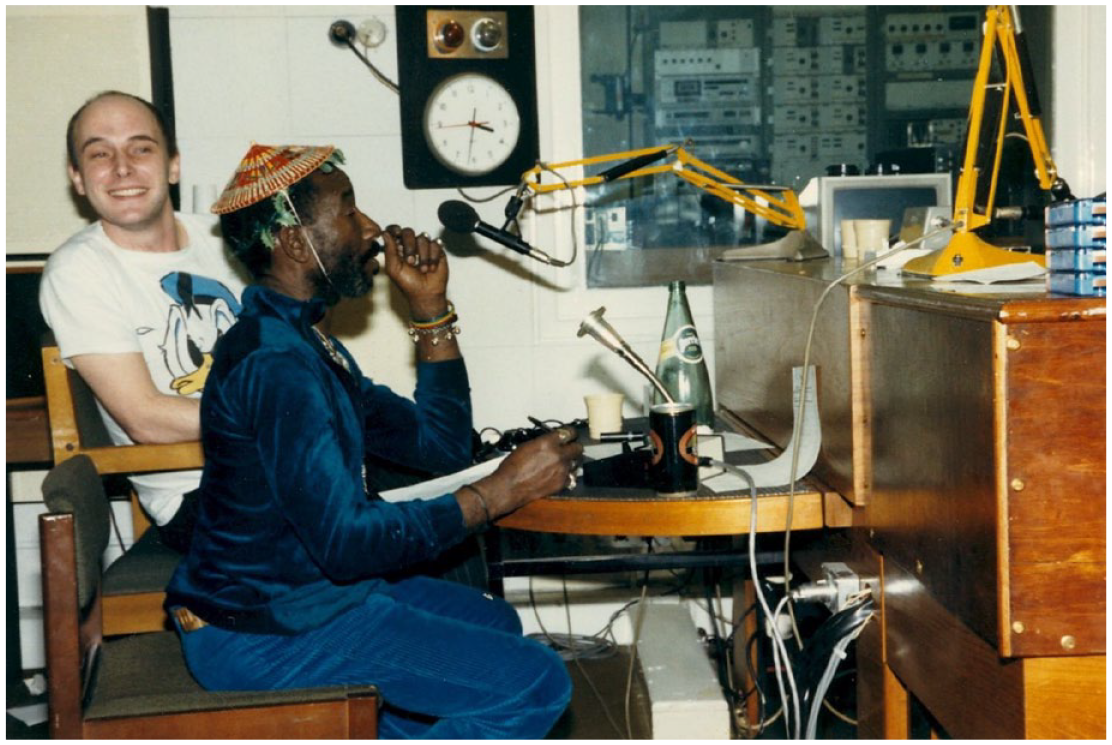
Guests Lee ‘Scratch’ Perry and Adrian Sherwood on On the Wire (copyright Steve Barker).
Barker was recruited to Radio Blackburn in 1978 to work on the music review show RPM. In 1980 RPM became Spinoff which in 1984 mutated into On the Wire. The show is now the longest running continuous underground music show on UK radio. Over the years On the Wire was an early champion of new musical genres such as hip hop, House and Techno. It has also seen many bands and performers who were to become famous passed through the show including U2, REM, The Smiths, Depeche Mode and Joy Division. From 2002 to 2011 whist resident in China, Barker produced part of the show from the BBC’s Beijing Bureau, thanks to Rupert Wingfield-Hays – now Japan editor. Alongside Barker, every week, Michael Fenton (Fenny) presents a slot, where he plays local and global music. Fenny says ‘there should still be room for a bit of eccentricity in the BBC’ (Smyth, 1993). This is exemplified in the range of unusual local artists that Fenny has played and interviewed over the years, including Mrs Cakehead, Hovis Presley, Half Man Half Biscuit, The Ceramic Hobs, Not Sensibles, The Fall and Frank Sidebottom. When BBC Radio 4 wanted to produce programme on the poet Hovis Presley, they had to ask On the Wire for some of the only radio recordings from BBC Radio Lancashire and the On the Wire archives (BBC Radio 4 – Hovis Has Left the Building, 2008). For On the Wire’s 25th Anniversary show there was special input from Lancashire artists who have come to prominence over the years Shackleton, Demdike Stare and Richard Skelton.
On the Wire has never shied away from challenging its audience, despite BBC Radio Lancashire receiving offensive letters criticizing On the Wire’s focus on black music, the show’s hosts remained undeterred. Barker says ‘We did get quite a lot of offensive letters about playing all this black music, but you know, we didn’t care about stuff like that. . . It was just sheer racism. You know, you should be catering for a white audience’ (Urquhart, 2018). It is worth noting that the far-right has had a considerable presence in several towns in East Lancashire, with Blackburn being particularly noteworthy. During the late 1970s, the National Party (1976), a far-right anti-immigrant party that emerged from the National Front, saw its members elected as councillors in Blackburn.
Since 1986 Andy ‘Madhatter’ Holmes and Pete Haigh have provided the once-a-month ‘Funkology’ contribution with a focus on Black Music, well ahead of National BBC’s notion of 1Xtra. This aligns with the policy of the BBC which states that ‘we champion inclusivity’ (BBC, 2017).
On the Wire has always has a strong connection to the local community and the sense of place of Lancashire. Barker takes great pride in playing music from across the North West and not just from Manchester and Liverpool. The program could not be produced anywhere else but Lancashire, and its unique content should be celebrated as a product of the area. Even when Barker recorded the show from Beijing, half of the output still came from Blackburn, Lancashire. The program embodies a Lancashire working-class pragmatism, anti-bourgeoisie sentiments, a counter-cultural outlook with an idea of never being co-opted (Wilkinson, 2017).
Over time the show has expanded its audience, making local and global music accessible to its listeners across the world. On the Wire holds significant value in that it established a network of connected individuals that stretched across the world which in many ways pre-dated certain aspects of the internet. Jethro Binks says ‘On the Wire recordings were sent around the world. People locally in Lancashire, would tape on the wire and sending it to people around the world’ (Urquhart, 2018).
Along with playing music from across the globe, the show has also had a number of correspondents from around the world. Nick Shimmin, has been the Australian correspondent for many years, while Gibby Zobel has been the correspondent from the Amazonian rainforest. As well as Beijing parts of the show have also been produced in Minneapolis St Paul and Phoenix, Arizona (Sun City Girls – Static From The Outside Set, 2005). There have also been collaborations with Radio Libertaire in Paris and also with Seekers International (Philippines & BC Canada). Whilst broadcasting from Beijing 2002–2010 On the Wire introduced many Chinese bands and electronic artists to UK.
Other BBC radio presenters have acknowledged the significance and influence by On the Wire.
I guess I first became aware of Steve and On the Wire it would be in the middle 1980s. I was teaching, I think in Skem at the time. And I think it must have been one of those kids there who told me about this show on Radio Lancashire that he thought I’d like, and I just kind of tried it out on Sunday afternoon. And thought that it was terrific. It was this very cool, very over there in many ways, compared to what was on national radio mixture. (Stuart Maconie quoted in Urquhart, 2018)
While David Rodigan the British reggae DJ and broadcaster who for has worked on and promoted reggae music on various radio stations, including BBC Radio 1, BBC Radio 2, BBC Radio 6 Music and BBC 1Xtra says.
Steve we salute you and we love you because you’ve done so much for the music across the decades. You’ve championed it, you’ve loved it. You’ve done so much for the heritage of the music. Just ask all the great (reggae) artists because they all know about Steve Barker’s On the Wire show. (David Rodigan quoted in Urquhart, 2018)
Over the years On the Wire, has faced several attempts to close it down. In the early 1990, the BBC wanted to remove the show from the schedule in order to compete with local commercial stations. Smyth (1993) explains that this was a result of the BBC’s implementation of the BBC document ‘Extending Choice’. For local radio the aim was to have a ‘mid-range’ approach for ‘mid-range of people’ and to avoid things which were a ‘bit different and might drive listeners away’. The aim was to have ‘broad appeal’ in a ‘diverse county’ with ‘standardised output’ that would ‘extend its reach’. Chris de Burgh’s ‘Lady in Red’ was identified as the ideal record to be played on BBC Radio Lancashire. However, after a public campaign, On the Wire was saved by the BBC Board at the last minute, who recognized it as a ‘unique BBC product’ (Barker, 2014). Nonetheless, the programme was soon moved from its favourable Sunday afternoon slot to a new time slot on Thursday evenings, then Saturday evenings. In 2014, the BBC planned to remove all specialist music shows from local radio. On the Wire was able to continue operating after a public campaign successfully saved it. Finally starting in 2020, the BBC at a national level decided to reduce BBC Local Radio output and for there to be no local content outside of nationally determined set times, as a consequence no ‘specialist’ music programmes were to be retained solely on the basis that their normal times slots would actually no longer exist. In other words no decisions on these shows were made on the basis of quality, relevance, popularity etc. On the Wire was a causality of this policy. The final episode of On the Wire aired at the end of May 2023, marking the end of the show’s 39 year run on the BBC.
The central argument of this paper is that the values that underpinned the creation of BBC Local Radio, as envisioned by its founding father, Frank Gillard, were upheld by On the Wire, but have been abandoned by the BBC. The paper explores the reasons for this and why On the Wire managed to retain these values in the face of the wider shifts in BBC policy. To provide this analysis, the paper begins by contextualizing the creation of BBC Local Radio and the key values that were intended to guide its programming. It will then explore how the BBC has moved away from these values in recent years, resulting in a shift in the programming and content of its local radio stations. This shift has resulted in a lack of diversity in the programming and an increased homogenization of content across different regions. In contrast, On the Wire, has remained committed to the original Gillard principles and values. The paper will examine the ways in which On the Wire has managed to continue, despite the pressures and challenges the show has faced. By considering the example of On the Wire, the paper will show how it was possible to remain true to the original values identified by Gillard and provide a diverse and engaging local radio experience for listeners. As Barker says ‘we did not leave the BBC, the BBC left us’ (BBC axes Steve Barker’s On The Wire show – The Wire, 2020).
Undoubtedly, On the Wire has consistently aligned with the BBC’s public purposes, as set out in its Charter. In particular 3, 4 and 5 of the public purposes: (3) ‘services should be distinctive from those provided elsewhere and should take creative risks’ (4) ‘to reflect, represent and serve the diverse communities of all of the United Kingdom’s nations and regions and, in doing so, support the creative economy across the United Kingdom’ (5) ‘to reflect the United Kingdom, its culture and values to the world’ (BBC, 2017)
BBC management has recently identified ‘Across the UK’ (BBC publishes blueprint for the biggest transformation in decades, 2021) as a top priority. However, this priority should not be limited to news and current affairs but should also include arts and culture.
Currently BBC Local Radio consists of a network of 39 radio stations in the United Kingdom that delivers programming to local areas. Established in 1967, the network was created to address the lack of national broadcasters serving the needs and interests of localities. Local radio has provided a valuable source of news and information while fostering a sense of local identity and community spirit. Frank Gillard believed for this identity to happen the BBC Local Radio stations needed to be independent. For Gillard local radio should have autonomy to produce programming that was locally relevant and distinctive, and that BBC Local Radio should be given the freedom to experiment and take risks in their programming.
[t]he local station manager should have practically, total independence and that there would be no absolutely no compulsion. . . to carry any programmes from London or from the networks. . . It would not become a jukebox station in the way of commercial local stations in the United States and elsewhere. It would be a station which would devote itself wholly to the development of and the encouragement of local interest. . . and that that would be its role in life. (Frank Gillard quoted in David, 2018)
In ‘The American Origins of BBC Local Radio’ David (2018) traces the influence of Frank Gillard, in particular WVPO in Pennsylvania, on the establishment of the first network of BBC Local Radio stations in November 1967. Gillard’s vision was to provide a service where local voices and issues would be aired on bespoke news bulletins and programmes, like the American broadcasting model he observed during his tour of US broadcasters in 1954. Gillard’s mission was to create a platform that would bring the community together and provide them with a voice. This model was in stark contrast to the dominant British broadcasting system of the time, which focused heavily on the centralized control of content and lacked local representation.
Another key inspiration for Gillard was KPFA, a non-commercial FM station based in Berkeley, California, which was established in 1949 as a protest against commercial radio David (2018). According to Gillard, despite its financial challenges, KPFA produced high-quality programming that surpassed anything else on offer in the United States, particularly in terms of its cultural content. Gillard was impressed by KPFA’s live and recorded serious music, which included concerts by the Berkeley Little Symphony, as well as its intellectually advanced spoken word and discussion programs that explored themes around philosophy, history and art criticism. Gillard also acknowledged the station’s commitment to the principle of free speech. Interestingly On the Wire has had strong associations with one of KPFA’s most iconic shows, the ‘Over the Edge Radio Show’. ‘Over the Edge Radio Show’ is known for pushing the boundaries of radio with its experimental sound collages and strange, often surreal, spoken word performances. In the 1980s, On the Wire and ‘Over the Edge’ collaborated on a joint radio show, where they phoned each other live on air. This unique and experimental approach to radio broadcasting was a fitting collaboration between two programs that shared a dedication to exploring the limits of what radio could do. The collaboration was an exciting and engaging experience for both listeners and the broadcasters involved, and it demonstrated the power of community and collaboration in the world of independent radio. This commitment to free expression was something that Gillard would have appreciated, as he saw radio as a powerful tool for giving voice to local communities and issues. The collaboration between these two programs was a testament to the enduring spirit of experimentation and innovation that was the Gillard’s intention for BBC Local Radio.
By giving the stations the freedom to create programming that reflected the unique character of their communities, Gillard ensured that BBC Local Radio was a vital public service, providing a voice for local people and issues at a time of rapid social and economic change. The BBC’s decision to grant local autonomy to its newly established stations was indeed a bold and courageous move, considering the Corporation’s rigid control over its brand and programming at the time. However, once the stations had found their footing, they were able to create a unique and distinct sound that truly resonated with their communities. Barker talks about his experience of the early station managers who held Gillard’s philosophy and approach.
Back in 1984 the possibility of hearing anything other than mainstream music on radio on a Sunday afternoon was remote. But something was stirring in deepest Blackburn, home of BBC Radio Lancashire where the then station manager, Mike Chapman, realised listeners needed a choice in listening and launched On the Wire between 2pm and 5pm every Sunday afternoon – prime listening time. (Barker, 2014)
Many other BBC local radio stations have produced innovative radio programmes. Linfoot (2011) explains how this was very much dependent on the station location, the size of the transmission area and the degree to which the stations were able to represent and embody their communities. The innovation enabled the provision for minority populations in the local radio areas. Linfoot says, ‘provision of output for ethnic minorities was another example of how the local radio structure was flexible enough, through individual autonomy, to allow a range of interpretations of responsibility’ (Linfoot, 2011: 288). However, these innovations were not always seen as competent by the BBC at a national level, in some cases described by BBC management nationally as ‘pure amateursville’ (Linfoot, 2011: 290).
Despite the initial success of BBC Local Radio, the Corporation shifted towards a more centralized management approach to its programming. This has led to a loss of autonomy for the local stations, resulting in a decline in their distinctive characteristics and a shrinking audience. According to Stoller (2018) after its expansion stage in the 1970s and early 1980s, BBC Local Radio has been considered an accessory to either BBC national radio or BBC regions, depending on the prevailing institutional arrangements. The resources of BBC Local Radio have been cut, then restored, cut again, seemingly reinstated and then cut. Despite its significant and valuable contributions to local communities, there is a lingering sense that BBC Local Radio could have achieved much more.
The reduction in local autonomy has been very much connected with a move from public service to a management lead market-oriented thinking. Pickard (2017) explains that the governance of broadcasting in the UK has changed significantly since the 1980s due to policies of deregulation, marketization, competition and adaptation to technological changes in the telecommunications industry. This has resulted in a gradual dismantling of the concept of public service, which has been replaced with market-oriented thinking. The shift towards economic regulation of broadcasting markets was influenced by the rise of neoliberalism as a global ideology. The period from 1979 to 1990 was characterized by market-driven politics as the primary driving force behind broadcasting policy-making. The attempted closure of On the Wire at the early 1990s was a consequence of such an approach. Since 1990 Pickard explains the focus has shifted from broadcasting policy to communications policy, resulting in the application of the concept of public value to public service media regulation, with Ofcom as the main communications regulator.
Ramsey (2017) delves into the regulation of BBC radio services in the UK between 2007 and 2017. The BBC Trust utilized the Reach, Quality, Impact and Value for Money performance framework (RQIV) to monitor BBC radio stations against the ‘drivers of public value’. While the use of the public value approach in the governance of public service radio in the UK is explored, Ramsey argues that the RQIV framework falls short when considering the cultural nature of broadcasting, and that the BBC’s decision-making is increasingly influenced by political-economic factors rather than public value. According to Vanhaeght and Donders (2017), media users can function as both consumers and citizens. When BBC Local Radio was established, it was established through a partnership between Local Government and the BBC. However, since then, the focus has shifted more towards the consumer aspect, and less on the citizen aspect.
Stoller (2021) emphasizes the need for local radio to maintain its traditional values, such as localness, while also adapting to new technologies. While Coleman (2021) highlights the importance of local content and the participation of local people for local radio. For Coleman using digital technologies creatively and innovatively, can mean local radio can remain relevant and enhance local communities. Berry (2020) explains that BBC Sounds reflects the BBC’s recognition of the importance of catering to younger audiences who consume media online. Hallett (2021) says the landscape of radio broadcasting has experienced a major shift due to digital broadcasting, with a growing trend of consuming audio content through internet protocol, and the introduction of smart speakers. The future of radio will largely depend on how it adapts to these challenges and takes advantage of the opportunities presented by these new technologies and diverse platforms.
On the Wire made its content available digitally well in advance of platforms like BBC Sounds. As soon as digital IP radio became possible, On the Wire made its show available via Live 365 in the year 2000. It would be several more years before BBC streamed their own audio. With the advent of podcasting and RSS, the show was made available via Odeo in 2005. Interestingly the founders of Odeo then went onto create Twitter. With the advent of Mixcloud, the show was made available there alongside the BBC Radio Player and BBC Sounds. Digital technology was also crucial in enabling the show to be produced in both Blackburn and Beijing in the early 2000s where audio files were transferred across the internet. On the Wire has therefore always been at the forefront of what (Berry, 2021) explains are seismic shifts in the world of audio, where audio producers are finding success beyond radio, in what can be seen as a ‘new audio economy’.
One could suggest that BBC Sounds is presently the platform for innovative music programming. However, if this is the case and the BBC is committed to showcasing the diversity of the UK’s regions, then locally produced niche music shows ought to be the cornerstone of that, rather than solely music playlists curated by individuals in London. In that vein, On the Wire should rightfully find a place on BBC Sounds, continuing to be produced in Lancashire.
The focus of On the Wire focus has always been new music. On the Wire has witnessed and been part of huge changes in both the music and radio industries. These changes include the convergence of the music and radio industries. Gallego (2022) explains the industries of technology, music, radio and devices have been in a state of convergence with Spotify, Apple and Amazon now leading the way in convergence. Prey et al. (2022) have examined how Spotify, as a leading audio streaming platform, has affected the recorded music industry, investigating whether Spotify is promoting fairness or reinforcing hierarchies between major labels and independent labels. The study found that since at least 2012, Spotify has been heavily promoting the playlist format and using its editorial capacity to promote its own playlists over those created by major labels and third parties. Alongside this Spotify’s (Glantz, 2016) relationship with record labels is not always harmonious. Some labels have criticized Spotify for paying low royalties compared to other platforms or physical formats. Some artists have also accused Spotify of favouring major labels over independent ones in terms of editorial playlists and algorithmic recommendations. Moreover, Spotify has been experimenting with signing direct deals with artists or acquiring music rights companies, which could potentially bypass or compete with traditional record labels. Clearly radio programmes such as On the Wire are required that champion new independent music and musicians who would not get the same degree of support from platforms such as Spotify.
According to Wall and Dubber (2009), one of the justifications that the BBC provides for its role as a public service broadcaster and its allocation of public funds is that its support of specialist music programming. The promotion of local music through specialist music radio is certainly an effective means of strengthening a sense of local identity. Something that clearly has less emphasis with the removal of programmes such as On the Wire from BBC Local Radio. The BBC has implemented various strategies to support local music, in particular the launch of the BBC Introducing program in 2007. This initiative was designed to identify and promote new musical talent throughout the UK, and it operates across all BBC radio stations. It is certainly worth noting that On the Wire has always promoted local musicians. Fenny, a weekly contributor to On the Wire, had been championing local artists since the early 1980s, inviting and encouraging local musicians to send in demo tapes to be played on the show. Prior to the internet, this was the best way for local artists and bands to achieve a wider audience for their music.
BBC Introducing emerged as an initiative across several BBC Local stations during the early 2000s, with an emphasis on showcasing emerging local musical talent (BBC, 2023). BBC Introducing was formallylaunched as a nationwide brand in 2007. The program is geared towards providing support for unsigned, undiscovered and lesser-known musical talents from across the UK. The format consists of artists submitting tracks to the BBC local radio station, which are then evaluated by a team of local presenters and producers. If the track resonates with the evaluators, they stand a chance of being featured on the BBC Local Radio and potentially receiving national spotlight. It could be argued that BBC Introducing effectively replaces a programme such as On the Wire. However, there are many musical styles/Lancashire artists championed by On the Wire which could never fit BBC Introducing’s parameters. On the Wire is more eclectic in nature, with a music selection that is more diverse. It could also be argued that without On the Wire and other innovative BBC local radio music shows, BBC Introducing would not come into existence.
Gálvez (2017) explains local public radio has a crucial role in supporting emerging musicians, highlighting the importance of public service radio in the UK and Spain in fostering local music scenes and live venues, and arguing that supporting emerging musicians is crucial for the survival of public service broadcasting. Emerging artists can showcase their talents and gain exposure to wider audiences. Gálvez goes on to say there can be a strong and powerful link between local radio, local live venues and the supporting of local music scenes. On the Wire has always supported local live music, including music festivals such as Beatherder, Cloudspotting, the Preston Jazz Festival and Darwen Music Festival and music venues across Lancashire and the North West. Other live music events include hosting The Fall at Live at Clitheroe Castle, Lancashire when 2500 people turned up on a Sunday afternoon in June 1985. Another significant live music event was a 1988 live show with A Guy Called Gerald, 808 State, Little Annie, Adrian Sherwood’s On U Sound System and special guest Neneh Cherry which resulted in On the Wire being the only BBC local radio programme to feature in the Guardian’s Top BBC Live Performances of All Time (Naylor, 2022).
One of the defining characteristics of On the Wire is the participation of its listeners to the extent that they are friends of the show. The show has always valued the input of its audience and never condescended to them. It is a collaborative effort between the hosts and their listeners, unlike dedication shows. On the Wire treats its listeners as equals and friends of the show. An example is friend of the show renowned artist Steve Hardstaff (Figure 4) who designed the On the Wire poster.
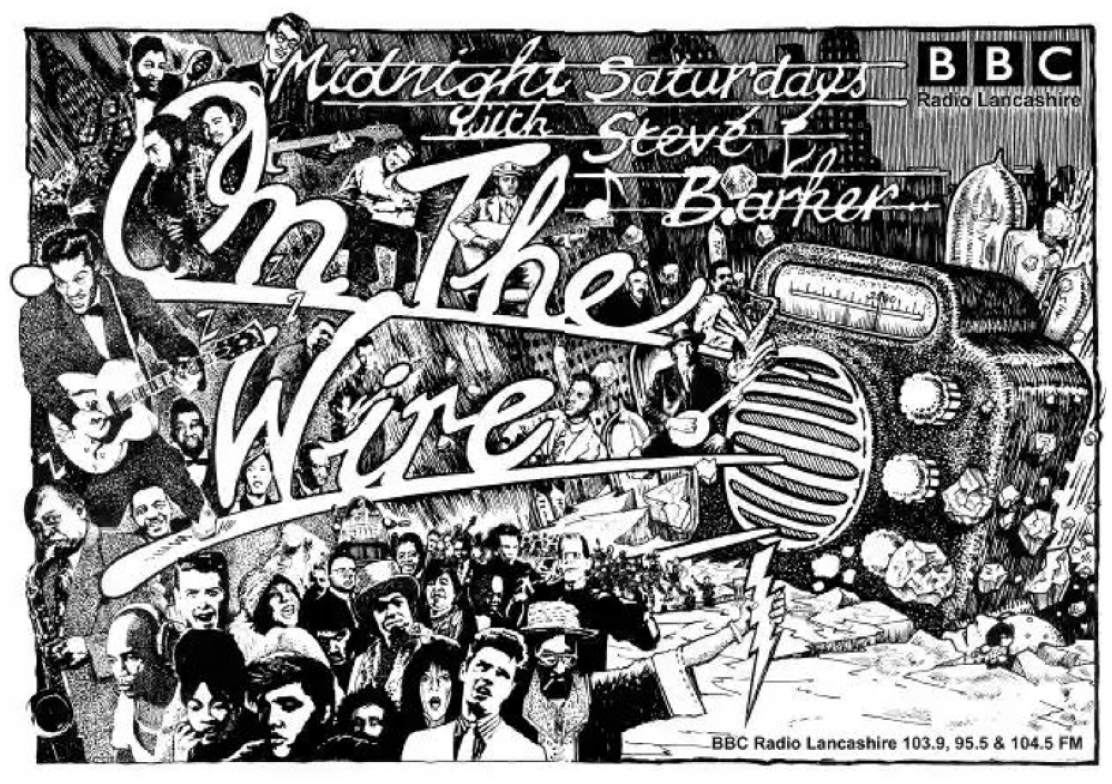
Steve Hardstaff’s on the Wire Poster (copyright Steve Barker and Steve Hardstaff).
Conclusion
The BBC’s success hinges on its ability to recognize and uphold the importance of local autonomy for its stations. The current trend of diminishing local station autonomy has resulted in a loss of distinctive characteristics and a reduction in audience numbers. To thrive, the BBC must recognize the significance of local autonomy and allow its stations to produce programming that accurately reflects the unique needs and interests of their respective communities.
The BBC’s top priority, ‘Across the UK,’ should extend beyond news and current affairs to encompass arts and culture. On The Wire, having run successfully for nearly 40 years, is a perfect example of this. There is no reason why it cannot continue to succeed for another 40 years. In fact, done correctly, it could help the BBC not just to survive, but to thrive.
The radio program On the Wire serves as an informative case study for broadcasters navigating the challenges of a rapidly changing media landscape. Among the key lessons learned from the program is the importance of flexibility and innovation over time. Moreover, On the Wire has created a distinctive network of listeners across the globe while remaining closely tied to its local community. The program’s punk ethos and DIY approach have contributed substantially to its continued relevance and success. Notably, On the Wire’s methods of show archiving and audience engagement represent critical elements of effective radio production.
For academics, On the Wire presents an intriguing illustration of a mediated network that predated and foresaw the internet in many aspects. The program embodies a unique sense of place specific to Lancashire and is closely linked to the region’s counter-cultural movements.
Overall, On the Wire provides a persuasive example of how local radio programs can achieve a global impact while still maintaining a distinct local identity. The program’s unwavering commitment to public service values serves as a significant example for broadcasters seeking to make a positive impact in their communities. Consequently, other radio programs can gain useful insights and inspiration from On the Wire’s adaptable and innovative approach to radio production.
