




Abstract
Since the commercial aviation boom in the 1960s and 70s, the subsea cable industry has relied on global air travel for network development, infrastructure maintenance, and market penetration. However, COVID-19 disruptions forced a shift to remote work, challenging traditional travel practices and presenting an opportunity for carbon emission reduction. This study investigates the industry’s response to the “new normal” and its implications for mobility and sustainability. We employ a media industries approach and conduct open-ended interviews with industry leaders to examine the potential balance between remote work benefits and essential in-person aspects, questioning whether the industry should return to pre-pandemic travel levels or embrace remote work’s ecological and financial benefits. Our findings indicate that remote work suitability varies depending on project stage, involved personnel, and the existing social fabric. To facilitate travel-related carbon footprint monitoring for cable consortiums, we developed a calculator to determine the industry’s emissions when adopting remote work. Our interdisciplinary study also emphasizes mobility’s intricate role in subsea cable systems and broader media infrastructure studies. By scrutinizing corporate cultures, communication practices, and transportation infrastructures, we enhance the scholarly comprehension of the social fabric underpinning global digital networks and investigate potential shifts toward a more sustainable media industry.
Keywords
Introduction
Despite its oceanic roots, the subsea cable industry – responsible for laying today’s global communications networks across the oceans – has long depended on the sky. While workers once traveled around the world via ship to implement and operate submarine cables, since the golden era of commercial and civil aviation in the 1960s and 70s, the industry has relied on air travel to expand these “global underwater data highways,” “out-of-sight arteries of globalization,” and “vectors of influence for companies and states on the global internet” (Bueger et al., 2022; Ranganathan, 2020; Rehman, 2021). By the 2000s, the industry’s air travel had escalated with the deployment of new private subsea networks and the emergence of dozens of annual, global events within the sector. Today, industry workers constantly crisscross the world to sign deals, conduct research, implement new systems, and maintain operational processes, spending millions of dollars each year on airplane tickets.
All of this travel generated a unique organizational culture for the subsea cable industry. Notably, it detached its workers from their geographic surroundings and bonded them to one another. For each month of a given year, it was common for many industry members to spend 2 to 3 weeks away from home. In turn, the in-person component of a cable project became an essential element of a career in this industry, regardless of the unintended burdens travel had on employees’ personal lives. Even as they extended networks between continents that would facilitate virtual communications, following the traditional means of “real-life” and “in-person” activities turned out to be the de facto way to maximize profits and attract new customers as projects increased complexity. From meetings with stakeholders to attending conferences to share technical knowledge with each other, a face-to-face social fabric emerged as the foundation for building, maintaining, and developing digital networks.
However, with COVID-19 the subsea workforce was both suddenly grounded and tasked with upholding the media infrastructures that would support remote work. As recent research has shown, the pandemic and lockdown measures had an unprecedented impact on the global flows of digital cultural content (Vlassis, 2021). Moreover, as was true in many industries, subsea cable companies developed new forms of remote collaboration at all levels of a project – from research to installation – with some companies even going as far as building a fully remote working capability, with 100% of operations and engineering teams going remote from the start of the pandemic (Bannerman, 2020). Subsea cable projects such as Dunant, Jupiter, JGA, NO-UK, EllaLink, and a myriad of regional cables were all carried to completion in this time, though not without difficulty. Overall, the pandemic proved to be both an opportunity for the industry to re-evaluate its historical use of air travel and a significant challenge to its social fabric, which had been so deeply entrenched within the in-person and on-site know-how as well as intercultural exchange.
In research on digital media, there has been little written on the organizational cultures that fuel the expansion of digital networks’ infrastructural base, or on the significance of other infrastructures such as air transport systems in digital networks’ deployment. In this essay, we remedy this gap by investigating the role of air transport and in-person collaboration in constructing a close-knit social fabric among mission-driven industry members, despite geographic barriers. Our study looks into how the COVID-19 pandemic impacted the culture of frequent travel within the industry and how it has changed the industry’s outlook on installing, maintaining, and operating its subsea cable networks. We rely on a media industries approach and discourse analysis of qualitative interviews with senior members of the subsea cable industry. Our analysis draws on a wide range of perspectives, including those from within the industry as well as reports from news media and scholarly literature.
Our work builds on and extends a recent infrastructural turn in media studies, including works that attend to the intersections of the territories, materialities, and political economies of media industries (Hu, 2015; Parks and Starosielski, 2015; Plantin and Punathambekar, 2019). This also includes critical analyses of cloud computing and data centers, as well as their land uses and energy disruptions (Cooper, 2021; Holt and Vonderau, 2015; Velkova, 2021). These kinds of infrastructural accounts extend beyond data centers, 5G towers, and internet exchanges to subsea cable infrastructure as well. Further research illustrates the legal and environmental dynamics of changing subsea networks in the Arctic as well as the geopolitical tensions between the U.S. and China (Burdette, 2021; Middleton and Rønning, 2020; Saunavaara and Salminen, 2020; Shvets, 2018); their political economy importance in Nordic countries (Flensburg and Lai, 2020) and in Sub-Saharan Africa (Cariolle, 2021); and policy recommendations for resiliency (Chapman, 2021), alongside other industry reports and analyses produced or commissioned by over-the-top (OTT) providers such as Meta and Google (Anderson et al., 2021; Google, 2021).
Other studies emphasize how subsea cables are sites where sovereignty is exercised through “infrastructures of control” that are increasingly gaining prominence among U.S. Big Tech companies (Johnson, 2021; Yeo, 2016). Despite the increasing attention paid to subsea cable networks in media studies, there has been a lack of research on the business dynamics and corporate cultures inside this media industry. In particular, these are distinctly risk-averse and come with an emphasis on human capital. As previous research has shown, the subsea cable industry has a tendency of relying on tried-and-true methods when deploying a new cable and stores much of its knowledge in people (Starosielski, 2015). In face of these changes in the field and the fact that it touches upon other socially relevant topics such as that of power, surveillance, and control, our research aims to intervene in our approach to media industries by demonstrating the links between organizational cultures, mobilities, and infrastructural development.
Furthermore, in light of David Hesmondhalgh’s (2021) critique of the overuse of the word “infrastructure” by media and internet scholars, we focus concretely on how industry members involved in the construction of subsea cables have responded to the global air travel restrictions and incorporated new forms of remote work. We thus trace the contours of recently disrupted, and newly reforming, circulations of expertise and coordination, showing they undergird the achievement and character of our oceanic infrastructures. These industry dynamics, we emphasize, also have environmental implications, and so suggest that media studies’ ecological and material turns can be usefully complemented by attention to industry cultures.
Besides the empirical contribution of understanding one media industry’s organizational and cultural shift during the pandemic, our study contributes to several areas of scholarly literature. First, this article adds a media industry analysis to a growing literature on the dynamics of subsea cable systems. Second, it contributes to mobility studies scholarship that explores the material turn and critically examines institutions and structures of power that shape the movement of “things,” “people,” and “infrastructures.” The study’s focus on the subsea cable industry is key, as its networks shape technical-spatial practices, and thus the social orders, capital, and infrastructure for information and power distribution. In particular, this article seeks to situate the core of its analysis in relation to the climate crisis, which sociologist Mimi Sheller (2018) identifies as the first of the “triple mobility crisis” in her book Mobilities Justice. Such a viewpoint of the subsea cable industry offers an empirical case in which a media industry’s reliance on air transport, generation of CO2 emissions, and subsequent imbrication with climate change is being negotiated, the consequences of which will have a material impact on the digital mobilities of countless users.
We also seek to make an environmental intervention. In collaboration with industry partners, and as part of a research project on sustainability therein, our work aims to envision new opportunities for more purposeful travel and environmentally conscious practices within the subsea cable industry and, potentially, the global information and communication technology (ICT) sector as a whole. Media industries are currently facing a debate about their future directions. Should workers continue to travel at pre-COVID levels? Or should they embrace the new normal, with all its ecological and financial benefits? Our work offers empirical insights into possible ways forward.
We begin our inquiry below with an overview of what makes the subsea cable industry a particularly useful case study. We then contextualize the accounts of several interviews with industry professionals, describing how changes in transportation interrupted the close-knit social fabric of the industry. Finally, we explore how the limitations on global air travel and the increase in remote work present an opportunity for reducing carbon emissions, which some cable operators are interested in pursuing. In conclusion, we reflect on how, for one of the very industries that enable remote work itself, travel is paradoxically likely to remain part of the social fabric that binds the network together.
The social fabric of a global-spanning industry
The subsea industry is responsible for the construction and operation of the backbone of the global internet – an infrastructure that enables data traffic between the world’s regions and facilitates more than USD 10 trillion in financial transfers in a single day (Sunak, 2017). From manufacturing to operations, and from research to commercial sales, there are hundreds of teams employing thousands of workers for nearly 500 companies involved in cable development around the world. With a total of 530 active and planned submarine cables with a total extension of more than 1.4 million kilometers around the planet, the global submarine cable industry is set to reach a record market size of about USD 44.30 billion by 2030 (TeleGeography, 2022; Research and Markets, 2022). For a single cable system in place, such as Google’s Cloud’s trans-Atlantic system Dunant, 6,600 kilometers long connecting the United States and France, up to 250 terabytes of data can be transferred per second (SubCom, 2021). The deployment of subsea cable networks will significantly affect the long-term routes for data traffic, opportunities for local development of ICT firms across geographies, and the overall future of the global media economy.
These cable networks have long had an enormous effect on media systems around the world. For example, as early news agencies overcame obstacles of time and place, facilitating globalization (Rantanen, 1997), subsea telegraph network cartels played a pivotal role (Pike and Winseck, 2004). Today, global media likewise depends on subsea systems. Since the late 1980s, the subsea cable industry has observed consistent linear growth in the number of systems deployed – which has in turn shaped media cultures (Bischof et al., 2018). 1 Yet these systems remain largely absent in both media studies and in the public view, unnoticed by most internet users worldwide despite their geopolitical effects and direct interconnectedness with other energy-hungry infrastructures such as data centers. As pointed out by Brodie (2020: 1097), “data and its infrastructures are produced to become environmental circulations, vaporous and invisible.”
The industry that constructs these networks also remains invisible. This global-spanning undertaking is made possible by a relatively small number of organizations often led by experienced industry veterans. Private ownership and consortium systems have become the two most common organizational structures, especially since the waves of liberalization of the telecommunication markets around the world in the 1990s and early 2000s. 2 Forms of financing and market developments are now taking new directions, with OTT providers such as Google and Meta emerging as major players (Clark, 2016; Reverdy and Skenderoski, 2015). However, regardless of the organizational structure or company, there remains a small community of subsea cable workers that direct and operate these systems.
To overcome the engineering challenges and ensure that data traffic remains seamless, cable companies have placed a strong emphasis on human capital. The workforce is often equipped with robust technical training and several decades of industry experience, configured in cross-functional teams. Staff negotiate what even leading OTT companies are referring to as a “traditional industry” that requires not only highly technical problem-solving skills but also invested social relationships with global stakeholders such as vendors, governments, and other actors across the technology industry (Meta Careers, 2021).
In a way, this emphasis on interpersonal coordination is not new. Throughout the history of communication, cross-cultural and cross-political interconnection has been key to setting optimal technical standards for global media distribution. For instance, multilateral institutions such as the International Telecommunication Union (ITU), established in 1865, have been key in what Balbi and Fickers (2020) conceptualize as processes of “techno-diplomacy” which are “deeply embedded into opposing visions of past, present and future media ecologies” (p. 16). This is also true of industrial expertise and interests; private stakeholders of the submarine cable industry are regularly convened through commercial conferences that attract hundreds of industry members, build community, and result in new commercial partnerships and opportunities for research and development.
However, the subsea cable industry’s use and need for transnational social ties are unusually distinct. The planning, development, deployment, and monitoring of a cable system requires several stages that maximize a cable’s resilience over its lifetime (which, due to the regulatory and logistical difficulty of development, far exceed those typical of data centers or most terrestrial internet exchanges). Additionally, unlike satellite operations – where cross-territorial interactions leverage most of the funding and technical know-how for planning and manufacturing from a single national team, especially in terms of technology transfer or payload manufacturing – submarine cables have historically relied on the more tested ways of exchanging information, goods, and personnel amidst geopolitical tensions, often through industry-wide protocols and knowledge exchange (Kennedy, 1971; Sheldon, 2014). For example, operating a subsea cable network system requires the synchronization of a globally-distributed workforce across all phases of development. Staff, vessels, and materials must be transported and coordinated across heterogeneous sites and phases of deployment – from the engineering of fiber, marine analysis of soils and waters, the design of the energy systems at cable landing stations (CLS), monitoring across shores where equipment and personnel must be located, and in the constant business and regulatory negotiations when a new project is set to expand to a developing market.
The submarine cable industry is unique in that it is highly insular, with a concentration of technical expertise in the hands of experienced professionals with global reputation. A survey conducted by Submarine Telecoms Forum (2022), a trade magazine focused on the industry, found that approximately 65% of individuals in the subsea cable industry have been working in the field for over 20 years, with the majority of positions held by senior management (36%) or engineers and technical staff (21%). This high level of seniority has a significant influence on decision-making and commercial agreements within the industry, as well as shaping the direction and goals of the industry as a whole.
These workers are also traditionally configured into small teams. For instance, AquaComms, an Ireland-based independent subsea carrier, is currently operating more than six cable systems with less than 50 employees. Viasat, a leading U.S. satellite company, on the other hand, currently owns five operating satellites in orbit and employs more than 5000 employees worldwide. There are other examples such as HMN Tech, which is one of the industry’s few suppliers, yet has less than 500 employees. At least 60 are described as “qualified and experienced experts on submarine equipment’s manufacturing and integration” (HMN Tech, 2022). When compared to the various sectors that compose the global telecom industry – from equipment manufacturing to service delivery – the subsea cable industry is a small yet ocean-spanning community.
This helps contextualize the close-knit nature of the global subsea cable community. and the long-standing intercompany interactions that foster strong collaboration, even despite market competition. Even in moments of uncertainty for subsea cable development, the industry remained a place of community. These connections preceded the use of the very technologies they built for business purposes, whether telegraph lines or video conferencing. For example, one of our interviewees highlighted, Back when I was working for Cable and Wireless in the mid-1990s, we did have basic video conferencing and used that to coordinate all the cable interests they had around the world. . .because we all worked for the same company, we all knew each other well (and this was not just all Brits but locally based staff in the Caribbean, Gulf, Hong Kong, and Japan). . . This underlines the point of people knowing each other being an important part of virtual networking but it entails some element of face-to-face activity to build around those relationships in the first place.
As this interviewee testifies, the industry’s small size and the likelihood of prior in-person interactions paved the way for a strong sense of identity and ease – and yet also facilitated the uptake of new technologies, which remained a relatively infrequent occurrence. As pointed out by another interviewee, “The close-knit nature of the business developed because it was much the same people at all these events.” Moreover, the comradery also includes a sense of loyalty and mission among industry workers, which helps drive their morale. As a further interviewee noted, “There is some feeling of driving the same mission together.”
Air travel – and the face-to-face forms of communication it affords – undergirds these social and professional achievements. As such, when the pandemic outbreak in early 2020 impacted transnational flights, the mobility norms and needs of the industry were brought into sharp relief. As a consequence, this “traditional industry” has had to transition to far less traditional modes of work and relationship building, with intergenerational implications for its workforce and the viability of its business development.
Pandemic ripples across the industry: adapting to the new normal in a cable-connected world
From its early stages in March 2020, impacts from COVID-19 were felt across a range of industries and prompted a shift in business operations and managerial expectations. While synchronous video platforms had already been in use across many sectors, the pandemic accelerated their near-universal adoption. Almost immediately, this increased demand for bandwidth, especially in Global South countries. This heightened the stakes of the subsea cable industry’s success in adapting to remote operations, at a time when its familiar modes of technical and social coordination were significantly restricted. 3 These disruptions occurred within the office: according to the SubTel industry report (2022), 38% of the subsea cable industry respondents switched to remote work.
It also impacted employee mobility. A further 29% affirmed that travel had been canceled, 28% had their travel reduced, and 6% had to increase travel time to accommodate quarantine requirements (Submarine Telecoms Forum, 2022). This, in turn, impacted the operation of cable and survey ships as well as support vessels, which are critical to the movement of goods back and forth between manufacturing facilities and the cable route (Gordonnat and Hunt, 2020). Across the industry, about 60 worldwide cable ships play a critical role in transporting crews along cable routes as well as in survey and deployment work beforehand. Consequently, delays occurred in ways that disrupted supply chains (Baldock, 2020). Furthermore, some cable suppliers shut down manufacturing factories while others had to increase production to a maximum capacity to meet the requirements of projects underway around the world (Mauldin, 2020).
Finally, disruptions also impacted the maintenance and repair of cables. This was already a challenge faced by industry stakeholders before COVID-19, especially because to repair a cable, operators must obtain special permits from governments to access ports and perform repairs in territorial waters. A few industry experts even go as far as to claim that “laying a cable is the easy part” in a subsea network project, especially because dealing with necessary permits for operations might take several months or even years (Mato and Izaguirre, 2022). Rapidly changing global health requirements, movement restrictions, and reduced state capacity during the height of the pandemic forced the industry to adapt to new protocols to ensure successful completion of network deployment.
The industry met this challenge with determination – and some socio-technical frustrations in how they could communicate remotely. From chat to break-out rooms, industry members were quickly exposed to new forms of etiquette and sociality. Older practices of note-sharing during in-person meetings had to find their way to digital platforms. One senior respondent claimed that video might work well for company talks, where the flow of information is unidirectional and where everyone speaks the same language. However, the subsea cable community brings several communication and language traditions that are not always easily translated via computer-mediated tools, especially in regards to how English is used colloquially or how nuances that could be parsed in person get lost online. “English,” as one interviewee succinctly put it, “is many languages, not just one.” Video platforms such as Zoom, Microsoft Teams, and Skype were not adept at speaking in these varied senses, nor were they able to equally persuade and motivate team members and business partners.
Furthermore, a shift from planes to screens significantly changed the rhythms of the job. While computer-mediated tools enabled communication at any time, they also brought the challenge of synchronous interaction with industry members that are dispersed across drastically different time zones. Across the technology sector, it is often the case that remote work is concentrated with workers in similar time zones. For instance, tech workers across the U.S. West Coast will be in the same time zone, whether operating from Seattle or San Francisco. Similarly, tech companies based in London will be in similar time zones as other offices across Europe or the major emerging IT hubs across the Middle East and continental Africa. Unlike these companies, the subsea cable industry faces a real challenge in establishing connections in often opposing geographies to discuss projects that involve a multitude of stakeholders and levels of operationality. For instance, one interviewee stressed that “you can do a lot on Zoom or [Microsoft] Teams if people know each other. If there are not too many time zones involved.” This was not always the case for projects that, definitionally, span the seas.
However, prior familiarity between workers can vastly improve their ability to overcome the deficits of video. This was often evident in our interviews. The same interviewee stressed, “to develop a kind of a policy or strategy from nothing with people. . . [is] quite hard to do because knowing people is very, very important in this industry.” To another, New projects with known customers can be done with video interactions. But if the persons change or if you need to reach out to new customers, then in-person is much better for the phase where you need to get acquainted and build some level of trust.
In our interviews it became clear that most senior industry members generally believed that, while video calls are a great way to maintain relationships over time, the subsea cable industry is, succinctly, “still an in-person industry.” As one interviewee put it, “a week-long series of face-to-face meetings can be more productive than a series of video calls. . . with limited attention from most participants.” However, the same respondent goes as far as to suggest that being “locked in a room somehow forces stakeholders toward an outcome.” Similarly, another respondent says, If everyone is in the same room, for one or two days, knowing that we shouldn’t part company until the issue is resolved, focused discussions drive towards a conclusion much more effectively. I have experienced this first hand in the last few weeks when we have been able to resume traveling to meet customers.
It would seem that, for this worker and many of his colleagues, a return to the skies has been highly appreciated.
Yet, these conclusions were not universally held across the industry. Some reported that remote work and computer-mediated calls offered the possibility of more organized use of one’s time, since agenda items can be dictated more precisely and purposefully. This consequently requires some work to be done before calls, which can be carried out more effectively across cultures and time zones. We also noted that less senior employees seemed to adopt more readily to video conferencing, and to the non-verbal, parallel tracts of communication that such platforms offer in excess of the affordances of a conventional meeting. To an extent, more effective management practices around ‘new normal’ work practices depend on age group. “Young people are preferring the ease of flexibility that comes with video calls while the older generation much prefers the advantages that come with face-to-face interactions,” claimed one interviewee. The younger generation is more accustomed to using break-out rooms for discussions and chatboxes for opinion sharing or informal responses to what’s being discussed live.
It is also the case that the complexity and stage of a project affect the perceived necessity of air travel. For example, one representative contended that COVID-19 did not have a terrible impact on their project progress. In the case of a new cable procurement, a tremendous amount of the work was done through the development phase without significant travel, made possible by the fact that it had only involved a single purchaser. Nonetheless, when it comes to the deal-making processes and more strategic business development of any sort, face-to-face modalities still present as the best way to develop long-term scenarios that are more economically and technologically optimal.
Moving toward net-zero and more purposeful travel
The pandemic disruptions did more than just bring tacit social norms and strategies into relief. From a commercial standpoint, it did not take long from the first lockdowns until companies began rethinking the enormous financial expenditures of in-person travel. Program management in particular has been deeply affected by the pandemic, as it was the unit responsible for elevating workers’ soft skills. As expressed by leaders in this area, “the pandemic created the perception that everything could be managed remotely” (Perret, 2023). Beyond the subsea community, the movement toward curbing carbon emissions and more meaningful travel is also reflected in the policies of organizations such as Salesforce, Deloitte, Twitter, and Microsoft, which continue to restrict spending on travel.
With that, industry activities have started to indicate an inclination toward more purposeful travel. As the COVID-19 casualties have decreased and countries relaxed rules on international travel, research efforts within the industry by players such as HMN Tech, Meta, and Alcatel Submarine Networks have also started to generate promising results on how to stay with the “new normal” while reducing carbon emissions. These have included expanding real-time monitoring, establishing control centers globally, finding efficient, safe, and reliable methods for data delivery, as well as prototyping new systems during marine route surveys, and deploying goggles and new tools for remote work such as helmets with high bandwidth audio and video streaming (Ma, 2023). These solutions represent new approaches to management through technical innovation and are likely to remain a trend in the future.
These changes are not only occurring at large firms deploying subsea cable systems, but also within smaller companies. For example, Xtera, a turnkey provider of subsea telecom networks headquartered in Texas, successfully completed the NO-UK project in December 2021 by relying mostly on remote work. The project entailed the supply of a 700 km subsea cable system that directly connects hyperscale data centers in Norway and the North of England. Despite the challenges posed by pandemic-related travel restrictions imposed by the European Union and the United Kingdom government, the company managed to efficiently complete the majority of the work without travel. This included remote meetings with customers and contractors via video platforms, as well as demonstrations, factory acceptance testing, and verifications of system capacity. On top of adapting to supply chain disruptions, the teams were able to meet the predefined project timeline, budget, and all technical and operational requirements for delivering a high-capacity system. A top manager at Xtera has recently stated that this experience demonstrates that remote work can be effectively used in lieu of intensive travel and in-person interactions, with no negative impact on project outcomes (Robinson, 2023).
Yet, perhaps even more significant than budgetary savings, a shift to remote work brings with it major potential environmental benefits. Aviation is both a significant, and incredibly difficult to mitigate, contributor to global warming. Until the pandemic, global aviation’s CO2 emissions had been growing faster than those from road, rail, and shipping in recent decades – with the amount of CO2 released into the atmosphere quadrupling since the 1960s, and more recently increasing by 30% from 2013 (IEA, 2022; Overton, 2022). 2019 and 2020 saw an unprecedented drop in the sector’s climate profile, though it looks to be on track to regain lost momentum in the coming years. Aviation is of particular concern to climate mitigation since, unlike network infrastructures and other industrial processes, it cannot be decarbonized through a switch to greener electricity. Because of trade-offs in energy potential and weight in battery technologies, it is unlikely that electric aircraft will ever be viable for more than short-haul flights. Transoceanic travel requires the energy density of liquid fuels. Overwhelmingly, this means fossil fuels. Sustainable biofuels are currently uneconomic and marginal, making up less than 0.01% of the sector’s use in 2018. It is also the case that sustainable fuels cannot be dramatically scaled up without significant land use conflicts. These environmental concerns are made all the more acute by the aviation sector’s exclusion from the Paris Agreement, and by the continued annual growth of its carbon footprint (the early months of the pandemic excepted).
Furthermore, it is also the case that air travel emissions have a greater impact than terrestrial ones. Interactions between planes, jet fuel pollutants, and atmospheric conditions frequently lead to the formation of contrails and other meteorological phenomena that significantly increase the effects of global warming. While there is still scientific uncertainty on the precise effects produced by a variety of aviation conditions, conservative estimates put the overall impact of these factors at two to four times the total amount of the sector’s CO2 emissions. In other words, the problem is at least twice as bad as it first appears. Aviation, as a whole, looks to be stuck without legible and credible pathways out of its climate troubles.
For these reasons, a growing movement of climate advocates has singled out air travel as a uniquely important site of personal and collective climate action. From Greta Thunberg’s famous transatlantic boat travel, to No Fly Climate Sci and the Academic Flying Less Movement (AFLM) more broadly, concerned groups have aspired to reduce air travel in professional and advocacy contexts long before the COVID-19 pandemic (Katz-Rosene & Pasek, 2023; Langin, 2019). Accordingly, cutting in-person travel generates a significant carbon reduction. What’s more, because the subsea cable industry traditionally travels much more often and further than others in the ICT sector, relative to its size, there is a disproportionately large benefit to be found in a flying less strategy.
However, this shift poses significant implications for the industry, given its reliance on air travel. Weighing the relative merits and tradeoffs of such a change requires careful consultation and deliberation. In our larger efforts with the subsea cable industry, we aim to foster such dialog with industry leaders and to provide exploratory tools to evaluate these environmental benefits. Our conversations with key members of many companies clearly suggest that there is no viable way to cut air travel in all circumstances, nor equally across the varied forms of enterprise and technical systems that characterize the industry. Future reductions will have to accord with deep-set social norms and communication needs across this global workforce, as well as its generational and intercultural divides.
Accordingly, using data provided by industry partners, we developed the first exploratory calculator in the industry to measure carbon emission savings in transitioning to remote work. Table 1 provides a summary case study of the tool, estimating the carbon emissions savings from a partial shift to video conferencing within the development of a single consortium system. This hypothetical project avoided emissions roughly equivalent to 154 gasoline-powered passenger vehicles driven for 1 year, or 792,522 tons of coal burned. According to senior employees, its estimated rate of unavoidable in-person meetings corresponds to the anticipated amounts of social difficulties within simple technical and enterprise setups; however, rates will likely be higher in contexts of increased social and linguistic difference.
Remote work carbon footprint reduction calculator for subsea cable systems. ~
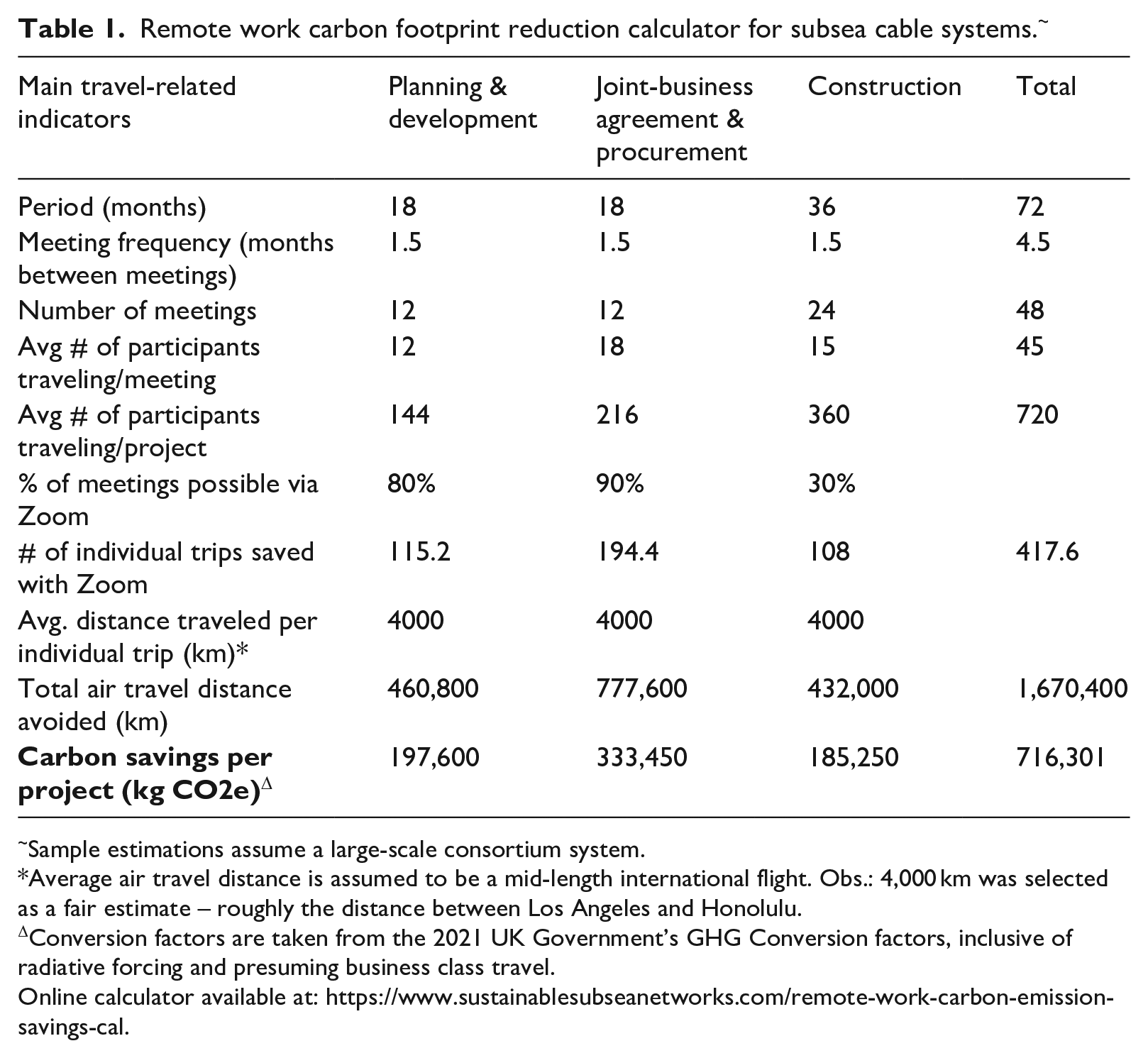
Sample estimations assume a large-scale consortium system.
Average air travel distance is assumed to be a mid-length international flight. Obs.: 4,000 km was selected as a fair estimate – roughly the distance between Los Angeles and Honolulu.
Conversion factors are taken from the 2021 UK Government’s GHG Conversion factors, inclusive of radiative forcing and presuming business class travel.
Online calculator available at: https://www.sustainablesubseanetworks.com/remote-work-carbon-emission-savings-cal.
Conclusion: to Zoom or not to Zoom?
Globally, air travel has for half a century been a key contributor to the functioning of the subsea cable industry as well as the development of the ICT markets that build and operationalize today’s complex networks of data infrastructures. At the same time, the subsea industry – along with other global spanning ICT industries more broadly – plays an essential role in modern air travel, facilitating a range of data transactions through the global internet, including credit card and financial transactions, as well as enabling air traffic controllers to coordinate routes and activities in the skies. The close relationship between the two industries – one operating in the depths of the oceanic environments and the other in lower parts of the atmosphere – emphasizes the need for both to prioritize sustainability in their operations. While global air travel will continue to be a crucial component of the network, companies in both industries have the opportunity to pursue more environmentally friendly practices as they aim to achieve net-zero emissions and meet increasingly strict regulations in the broader ICT sector.
In our many interviews with senior leaders across the global subsea cable industry, we found that the decision whether to travel or not within the “traditional industry” of the subsea cable business is highly dependent on the stage and level of decision involved that may or may not pose economic implications for the client they are serving. In short, it depends on what stage of the process the cable system project is at, the particular people in the room, and the degree to which the social fabric is in place. However, the inherent need to meet face-to-face will likely never go away in its entirety, as inferred by our correspondents. As one interviewee pointed out, it will just be prudent to think through and replan with the question: “If we managed somewhat successfully remotely, can we continue to manage that way since it helps those who don’t like traveling and those who like a decent work-life balance to manage effectively and indirectly result in cost savings as a benefit?”
As our research suggests, in-person interactions are critical during the early stages of a cable project and throughout its execution, as they facilitate the exchange of ideas and details across different locations and stakeholders. However, the importance of in-person interactions goes beyond the delivery of a cable project. For the veterans of the industry, the community has been formed more actively in person, over a set of drinks, or on the golf course. And yet, as another industry member specifies, “in an era where we need to infuse ‘new blood’ into our industry, in-person meetings have a sort of on-the-job-training benefits for new industry entrants as trainees.” Therefore, the very global nature of the subsea cable industry, and the long-standing in-person interactions that have developed over decades across regions, have contributed to a strong sense of identity among industry competitors, which is likely to remain in place in this “traditional industry” with contemporary significance.
The resulting strong sense of identity of such a global-spanning industry is expected to continue as the industry remains relevant in today’s patterns of information spread, especially as more data is produced, new cloud regions are formed, and the demand for data infrastructure increases. As one industry interviewee noted, people tend to bring their habits and energy from one medium to another, whether in person or through video conferencing platforms. In this sense, our research indicates that the medium of communication alone does not determine success or failure, or even foster a sense of community in a vacuum – it is the people involved that do so. Despite that, in a small and geographically distributed industry around the planet, remote work operations are likely to remain a critical component of the networks of the future. As one experienced CEO has told us when questioned about reducing carbon emissions by reducing global air travel, “remote work is the only way that we [the subsea cable industry] can operate effectively.”
In our collaborative research with the broader subsea cable industry, we conducted an interdisciplinary and media-focused examination of a relatively “invisible” industry, aligning with Lisa Parks’s (2020) assertion that “forces of globalization and digitization compel us to think about and situate media within and across various territories, temporalities, and cultures” (p. 646). When examining the mobility of infrastructures and the sustainability aspects of a world influenced by complex systems such as large language models (LLMs), larger and energy-hungry data centers, and new subsea cable routes for data transmission, further critical research is necessary to understand not only the movement of data, but also the infrastructures as well as people involved in their design, installation, operation, and maintenance. Sustainability strategies within media industries represent a largely uncharted area that warrants increased academic focus, collaboration between the private and public sectors, and engagement from the wider civil society.
In sum, localized, industry-specific, and collaborative intervention approaches to the movement of people, infrastructures, and information remain an important area of inquiry, especially when there is now a growing concern bringing social justice to discussions of mobility, communities at the margins, and the threats of climate change. All in all, our contribution here is to foreground the role of worker mobility not only for subsea cable systems but for studies of media infrastructure and industries more broadly. By taking into account how corporate cultures, communication practices, and transportation infrastructures move around the world, we can better understand the social fabric that scaffolds the construction of our global digital networks.
Footnotes
Funding
The author(s) disclosed receipt of the following financial support for the research, authorship, and/or publication of this article: This work was supported by the United Kingdom’s Economic and Social Research Council (ESRC), the Internet Society Foundation, and the Canada Research Chairs Program (grant number 950-233016).
