




Abstract
Digital-era newsworkers in the United States have steadily joined trade unions since 2015. This article examines all 22 collective bargaining agreements (CBAs) of one such union, the Writers Guild of America, East (WGAE), which were ratified between April 2015 and June 2022, with an eye toward better understanding employee digital job and life satisfaction. Bringing together critical political economy of media, industrial relations, and labor research, the article argues that the collective bargaining agreement is a communicative means through which digital newsworker unions express employee resistance to particular labor issues. It is also a legal mechanism articulating solutions to these issues that could provide the basis for employee life satisfaction. Grounded in a content analysis, this article finds that the WGAE CBAs incorporate language on workplace rights, newsworkers’ benefits, and limits on management rights, revealing the relative weight of different union solutions to newsworkers’ digital-era grievances. The CBAs also communicatively constitute the conditions for digital newsworkers’ happiness and subjective well-being. By proposing a relational model of digital newsworkers’ CBAs, researchers and practitioners could better understand the language that is needed to communicatively constitute and facilitate happiness in newsrooms, supporting digital job and life satisfaction among newsworkers.
Keywords
Introduction
Trade unions have long been a strong organizational form and for worker resistance and legal defense, providing workers with collective bargaining power to negotiate with employers over working conditions and professional standards. More than 7500 newsworkers unionized between April 2015 and June 2021 at over 200 internet-only and legacy for-profit and nonprofit media companies in the United States (Cohen and de Peuter, 2020; Fu, 2021a; Salamon, 2023). They have joined the Writers Guild of America, East (WGAE), The NewsGuild (TNG), or Screen Actors Guild-American Federation of Television and Radio Artists (SAG-AFTRA). In the digital era, newsworkers have unionized within a context marked by interrelated structural factors: chain and hedge fund ownership concentration; less advertising revenue and profit margins as Google and Facebook had captured about 85% of online advertising revenue by 2016, rather than go to the publishers creating news content; newspaper closures or downsizing; the prevalence of news websites, mobile applications, and social media accounts; and fewer full-time permanent reporting jobs, including a 26% decrease in US newsroom employment between 2008 and 2020 (Pickard, 2020; Rose, 2022; Salamon, 2022). Yet news industry work has historically been precarious, a condition disproportionately affecting women newsworkers: underpaid; lacking job security and welfare; relying in part on contract or freelance employment relationships; and contributing to excessive workplace stress and burnout depression due to long and irregular hours, high competition for jobs, and intense working conditions (Cohen, 2016; Örnebring, 2020; Reinardy, 2016; Salamon, 2018, 2022).
Since 2020, precarious newswork, industry turmoil, and union organizing have intensified due to the acquisition of local newspapers by private equity firms such as Alden Global Capital, anti-Black racism, and the COVID-19 pandemic (Cohen and de Peuter, 2022; García-Avilés, 2021; Marjoribanks et al., 2022; Steiner and Chadha, 2022). During the pandemic, remote virtual news production has heightened work overload, psychological distress, stress, and anxiety. Some digital newsworkers have lacked equipment to work safely, while others have lost their jobs. Additionally, Black Lives Matter protests have reinforced concerns over racial equities and discrimination in newsrooms. Within this context, digital newsworker organizing is important for understanding how workers respond to and shape industry change, manage their working conditions and lives, and facilitate future sustainability for journalism as an institution in democratic society writ large. By organizing, newsworkers advance “alternative visions for the future” of journalism (Cohen and de Peuter, 2022: xiii), demonstrating that “collective organization in media industries is not just about protecting individual workers, but also about ongoing efforts to democratize journalism” (Cohen, 2016: 22). Employment conditions and newsworker organizing actions arguably have the potential to affect quality journalism and the democratic role that newsworkers serve (Salamon, 2018).
Considering this spread of digital newsworkers’ unionization since 2015, more systematic research is needed to better understand what issues digital newsworkers’ unions resist and the communicative means through which they articulate solutions to these issues, striving for employee job and life satisfaction. This article analyzes the case of collective bargaining agreements (CBAs) of WGAE union-represented digital newsworkers since 2015. A CBA is a legally-binding written contract that sets out the terms and conditions of employment and is negotiated between unions representing employees and the employer (management). The 1935 National Labor Relations Act enshrined in United States law the rights of private sector workers to join trade unions and bargain collectively. Since then, collective bargaining has provided “unions with a powerful institutional basis on which to expand their membership, and to influence workplace relations” (Marjoribanks, 2000: 50). This article is focused on the following aspects of union resistance that systematically remain underexamined in digital journalism and media studies: accounting for how the CBA is, first, a communicative means through which digital news unions express employee resistance to particular labor issues, and second, a legal mechanism articulating solutions to these issues that could provide the basis for employee life satisfaction. Bringing together sociological history of journalism, critical political economy of media, and industrial relations and labor research, the following research questions guide this article:
RQ1: What are the continuities and changes in language that digital newsworkers’ unions incorporated into CBAs, which have constituted and addressed employees’ grievances since 2015 compared to earlier CBAs?
RQ2: How could this CBA language help provide the conditions for employees’ digital job and life satisfaction?
Following, this article critically reviews a longer history of newsworkers’ union organizing, contextualizing key historical features of editorial worker unions’ CBAs in the United States since the 1930s. It also conceptualizes labor unions’ role in facilitating conditions for life satisfaction through CBAs. Following, it presents the results of a content analysis of all WGAE online news media unions’ CBAs ratified between 2015 and 2022 (N = 22) based on a typology of several overarching dimensions (N = 3) and subdimensions (N = 162). The conclusion section discusses the implications of these findings for understanding how CBAs are a legal means through which unions could provide necessary conditions for digital job and overall life satisfaction among newsworkers. It also outlines a relational model of employees’ digital job and life satisfaction CBA language oriented at such job and life satisfaction.
Literature review
Historicizing (digital) newsworker unions’ contracts
This subsection briefly considers sociological historical and critical political economy studies on how unions have organized and negotiated editorial newsworkers’ working conditions in CBAs up to the digital era. Historically, unions have negotiated working conditions of employees they represent, so that CBAs can regulate many aspects of employees’ working conditions, which arguably have implications for newsworkers’ life satisfaction (Bohère, 1984). The International Labour Organization’s (1928) Conditions of Work and Life of Journalists became the first comprehensive international study of its kind, partially addressing the purposes of collective bargaining in determining working conditions and employment relationships between news employees and publishers. A history of newsworkers’ CBAs in international comparison should also include Bohère’s (1984) and Nordenstreng and Topuz’s (1989) studies on journalists’ working conditions and rights, including the scope of application and procedure of negotiations in different countries and the content CBAs cover. Negotiations in some countries have covered multiple professional groups of newsworkers or have been conducted separately (e.g. editorial, administrative, and/or technical staff). These negotiations have taken place at the national, company-wide, or local levels. Regarding content, newsworkers’ CBAs have covered a wide range of subjects. Overall, they list employees’ guaranteed rights and privileges, along with terms of employment, job definitions, employment procedures, and disciplinary processes.
For the purposes of this article, though, it is most important to focus in more depth on the discussion around CBA negotiations that emerged after editorial newsworkers unionized and secured collective bargaining in North America. In the critical historical literature, Leab (1970) provided the first sustained and comprehensive analysis of the American Newspaper Guild (ANG; now TNG). Founded in 1933, the ANG became an early leader in obtaining collective agreement language, establishing a model contract by 1936 that served as the basis of the Guild’s demands, which could arguably improve newsworkers’ life satisfaction. The ANG initially secured language for paid vacations, sick leave, hospitalization plans, opportunities for newsworkers to do outside work, leaves of absence for fellowships, and royalties to reuse journalists’ works (Mari, 2018). The ANG also advocated against gender and racial discrimination and pay inequities (Ayers, 2014). Despite securing base pay for editorial workers, women and Black workers did not attain universal parity with white male coworkers. Additionally, the ANG pioneered CBA language regarding severance and pensions (Rosen, 1951). The 1930s Depression aroused widespread interest in severance pay to soften the effects of unemployment. The ANG launched a bargaining program at its first annual convention (1934), foregrounding dismissal notices and pay according to length of service based on models from foreign journalists’ unions. These models recognized unique features of a newspaper industry in which employers treated editorial labor as a fixed overhead cost and dismissed newsworkers arbitrarily or due to consolidations among newspapers. By the 1970s, TNG had the greatest impact in negotiations on salaries at small newspapers (Fedler and Taylor, 1981). Some unions have also enshrined in CBAs decent pay rates for journalism interns to counter the rise of low-paid or unpaid internships since the 1990s (Salamon, 2015).
Contemporary research has been situated in relational approaches, considering the impacts of institutional, political-economic, and social-historical contexts and newsworkers’ agency on collective bargaining. While collective bargaining had been central to the 1930s New Deal system of industrial relations, legislation was progressively introduced throughout the twentieth century, especially since the 1970s, to limit the scope of collective bargaining (Marjoribanks, 2000). In the 1980s, a series of high-profile strikes across the United States illustrated “the renewed corporate offensive against unions. . .the erosion of collective bargaining, and the failure of traditional legal protections for workers” (Rhomberg, 2012: 7). In the newspaper industry, employers won concessions from unions at TNG-represented newspapers, including the Boston Herald-American, Oakland Tribune, New York Post, and New York Daily News (Marjoribanks, 2000). Concessions included wage cuts, the elimination of indexing wages to the consumer price index, holidays and pension cutbacks, no-strike clauses, and/or two-tiered wage scales. Additionally, newspaper union representation decreased toward the end of the twentieth century, from 21% in 1983 to 10% in 2000, bringing into question the continuing strength of unions’ negotiating power (Stanger, 2002). Newsworkers’ unions have adopted a reactionary “labor convergence” strategy and merged with other unions representing a variety of workers across journalism and communication industries in North America, attempting to strengthen their collective bargaining power (McKercher, 2002: 1). Labor relations in the news industry since 2000 have been shaped by rapid industry change and workplace reorganization, particularly due to digitalization and the rise of digital news startups. During this period, contract negotiations have revealed a “pattern of ‘hard bargaining in hard times’” (Stanger, 2013: 198).
Digital-era newsworkers have still won notable gains in CBAs since organizing in 2015 at companies, including Gawker, VICE Media, Salon Media, Vox Media, and MTV News (Cohen and de Peuter, 2018, 2020, 2022). According to the limited published critical political economy research, digital newsworkers’ unions have adapted universal labor union gains in CBAs around pay, benefits, equity, and worker control. Some CBAs establish fair and transparent pay scales with salary minimums according to job title and guaranteed annual pay increases and put limits on excessive overwork, introducing compensatory time or overtime pay. Additionally, CBAs formalize benefits: for instance, retirement plans; medical insurance coverage; paid time off; paid sick leave; paid vacation leave; paid parental leave; wellness stipends; and cell phone reimbursements. Due to the contingent nature of news work, some contracts even establish a process to convert full-time contract workers into employee status, protect against outsourcing at the cost of layoffs, include benefits for part-time workers, and guarantee interns a minimum wage. Recognizing the unique nature of editorial work, some CBAs also safeguard newsworkers’ right to do outside employment, including freelance work, and earn more income from their derivative works.
Unions negotiate CBAs further to meet another digital newsworker demand: equity (Cohen and de Peuter, 2020, 2022). They contain language protecting against discrimination (e.g. race, gender, disability, immigration status, and other dimensions of oppression, and use of pronouns) and harassment, including online harassment. They also mandate companies to set recruitment criteria, post job openings publicly, circulate job posts to diverse professional networks, and guarantee racial and gender pay equity. At the same time, CBAs affirm the right to a safe and healthy work environment and establish diversity committees to address equity beyond collective bargaining.
Digital newsworkers use CBAs further to leverage control over their workplace and working conditions (Cohen and de Peuter, 2020, 2022). CBAs importantly establish grievance and arbitration procedures, while reinforcing a worker’s Weingarten right: having a union representative present at any meeting they think could lead to discipline. They also incorporate language mandating transparent communication between union members and management, with access to written job role descriptions, regular staff meetings, and standard performance evaluations. Some CBAs contain successorship language, too, forcing a new company owner to inherit a CBA. Moreover, contracts protect job security, including just cause, limiting management to terminate employees for only legitimate reasons. Additionally, they formalize a layoff process, including advance notice, severance, recall rights if a laid-off worker’s job reopens, and the role of seniority in the process, and sometimes nullify non-compete agreements preventing employees from working for a competitor for a set time after their employment ends. Certain CBAs also uphold editorial independence and autonomy, protecting newsworkers’ right to decline work on branded advertorial content. Finally, in addition to diversity committees, some CBAs establish labor-management and editorial standards committees so newsworkers can raise their collective voice beyond contract negotiations.
Overall, CBAs are a communicative means through which digital newsworkers’ unions express employee resistance to issues in the workplace and working conditions (Salamon, 2022). They articulate the “communicative constitution of organizing: contract language is bargaining’s terrain of struggle. The negotiated phrasing of the various articles that constitute a collective agreement produce, in aggregate, the normative framework shaping the material conditions of media labor and governing the power relations of the newsroom” (Cohen and de Peuter, 2020: 57). Unions’ first CBAs are the “communicative device that fuels the circulation of struggles” (Cohen and de Peuter, 2020: 69). Despite the benefits of this literature, more systematic research is needed to better understand the prominence of individual protections across digital newsworker unions’ CBAs. In what follows, more research is also conducted to conceptualize how CBAs could establish conditions for the communicative constitution of digital newsworkers’ happiness and subjective well-being beyond only a “bargaining process to reduce journalists’ precarity by raising standards in media work” (Cohen and de Peuter, 2022: 204).
Conceptualizing labor unions’ role in life satisfaction
In this subsection, it will become clear that a well-developed interdisciplinary social sciences literature has established a solid empirical basis for happiness studies of subjective well-being and life satisfaction. Dutch sociologist Ruut Veenhoven (1984: 7) pioneered these social scientific studies of happiness, defining happiness as “the overall appreciation of one’s life-as-a-whole.” For Veenhoven (2000: 26), “[T]he most comprehensive measure for quality of life is how long and happy a person lives.” Informed by this literature, industrial relations and labor researchers suggest unions can increase workers’ quality of life and boost union members’ life satisfaction (Flavin et al., 2010; Flavin and Shufeldt, 2016). The CBA is a key mechanism through which unions contribute to citizens’ life satisfaction because CBAs can ensure job satisfaction and security for union members. Negotiated CBAs can protect workers against arbitrary dismissals and set minimum pay floors, insulating workers from employers’ financial bottom-line. CBAs have provided employees with basic workplace rights: for example, antidiscrimination protections; respect and dignity clauses; discipline and discharge protections; and grievance procedures (Juravich et al., 2006). In addition to codifying these basic rights and fair and equitable employment standards, benefits in unions’ first CBAs could establish and sustain a “certain quality of life for workers and their families” (Juravich et al., 2006: 104). Key benefits enshrined in CBAs have included health insurance, pension schemes, leaves of absence, pay systems, training, and continuing education. CBAs have also put restrictions on management rights.
By limiting the stress and anxiety of unemployment and relatively low pay, being a union member and the potential benefits of CBAs could arguably contribute to higher rates of job satisfaction and subjective well-being. Data reveal that there has been a positive association between union membership and job satisfaction in the United States since the 2000s (Blanchflower et al., 2022). Union members have also had higher happiness levels and lower stress levels than non-union members. Jensen (1956: 234) reminds us that the value of the institution of collective bargaining “lies in the fact that it generally produces peace and preserves the essence of democracy and enterprise.” Traced back to the mid-nineteenth century, collective bargaining was “founded not, in radicalism or necessarily in militance, but in the desire to be conciliatory, fair, and businesslike. Institutionally, collective bargaining, apart from any need to establish itself or to fight for survival as a process, is completely compatible with the other institutions of a capitalistic or enterprise society” (Jensen, 1956: 234). This traditional institutional role of collective bargaining is arguably compatible with journalism, another institution of American democracy and capitalistic society, and unions like TNG that have long negotiated CBAs to preserve the value of journalism in democratic society. Following, this article examines the significance of these claims, bringing to bear unions’ role in facilitating job satisfaction by examining the content of WGAE’s online media CBAs.
Method
To examine job satisfaction in digital newsworkers’ union contracts, a content analysis was conducted of WGAE’s online media CBAs based on bargaining units that unionized and ratified their first CBAs between April 2015 and June 2022. WGAE CBAs were selected rather than TNG or SAG-AFTRA CBAs, as WGAE launched and initially led the media unionization organizing efforts during this period, focusing on workers at digital-native or digital-first news media companies. By contrast, SAG-AFTRA has tended to organize workers at broadcast news media outlets (e.g. National Public Radio affiliates Minnesota Public Radio, WBUR, and WHYY). While TNG has organized workers at different types of news media companies, including some digital-native outlets (e.g. BuzzFeed and MinnPost), it has tended to focus on newspapers and magazines (e.g. Los Angeles Times, The New Yorker, New York magazine, and Billings Gazette). Additionally, TNG had organized newsrooms at a rapid pace, but about 90 new bargaining units were still negotiating first CBAs during this time (Fu, 2021b).
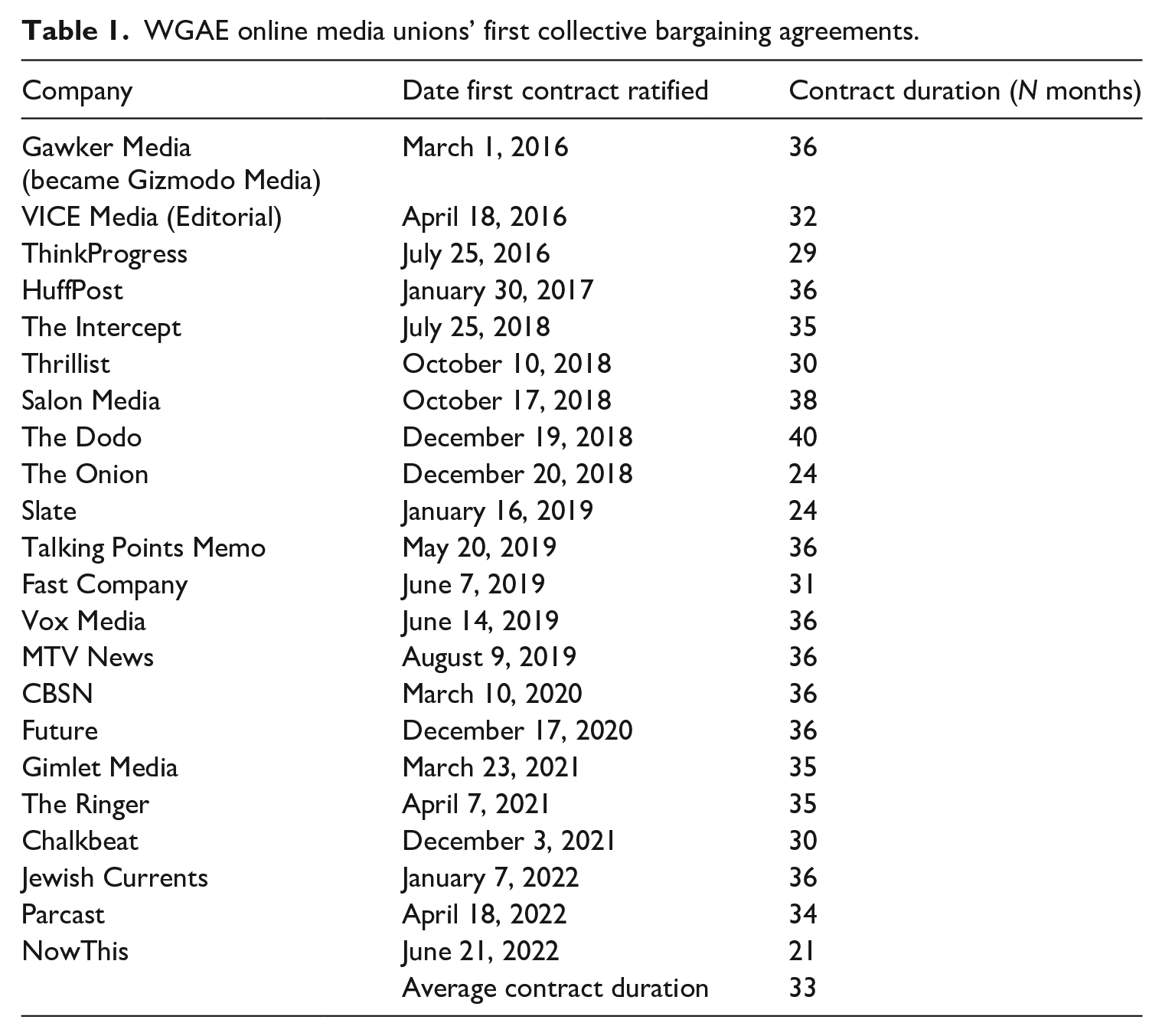
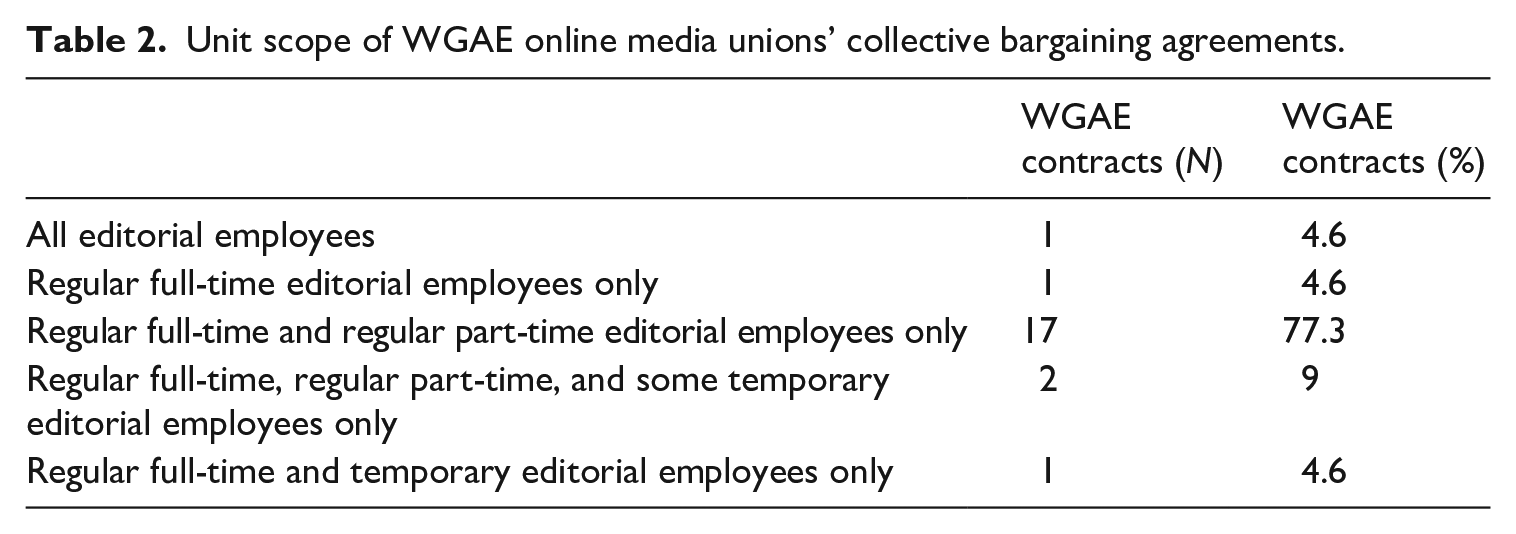
A timeline was created to determine which WGAE union-affiliated publications meet the relevant criteria and the average CBA duration (see Table 1). Data were gathered from the CBAs, the “Online Media Shops” section of the WGAE (2022b) website (e.g. press releases), and WGAE unions’ Twitter accounts and websites. The sample covers the first CBAs of WGAE-affiliated online media publications ratified between April 2015 and June 2022 (N = 22), the average contract duration of which is 33 months. They represent all bargaining units that had attained first CBAs and 73% of the 30 WGAE-organized bargaining units during this period. Table 2 provides baseline data about the unit scope of WGAE online media CBAs in terms of employment relationship type. Most CBAs cover regular full-time and regular part-time editorial employees only, despite exceptions, typically under a CBA’s first clause titled “Recognition.”
WGAE online media unions’ first collective bargaining agreements.
Unit scope of WGAE online media unions’ collective bargaining agreements.
To determine their potential to facilitate life satisfaction among digital newsworkers, the CBAs were initially analyzed deductively, grounded in the multidimensional research typology of unions’ first-CBA provisions (Juravich et al., 2006). This typology includes the following overarching dimensions (N = 3), each of which is addressed in turn: workplace rights, union restrictions on management rights, and worker benefits, as introduced earlier. Subdimensions were added (N = 162), accounting for the distinct nature of (digital) newsworkers’ CBAs, as informed by the relevant literature (Cohen and de Peuter, 2020, 2022) and a subsequent inductive analysis to determine new dimensions. Each dimension and subdimension covers distinct CBA language clauses, which are presented in CBAs as either a heading, subheading, or paragraph. The CBAs were coded in NVivo, computer-assisted qualitative data analysis software. Based on this analysis, this article ultimately proposes a new digital job satisfaction model for newsworkers.
Findings
Workplace rights in digital newsrooms
This subsection is focused on the workplace rights about which digital newsworkers organized and obtained in WGAE’s online media CBAs. These workplace rights include antidiscrimination protections, discipline and discharge processes, grievance procedures, and extensions to temporary workers. While many of these rights are already protected under federal and state laws, CBAs guarantee newsworkers collective representation (Juravich et al., 2006). Table 3 summarizes these basic workplace rights enshrined in WGAE’s online media CBAs. Most CBAs contain common language that sets standards and antidiscrimination protections for digital newsworkers (e.g. union activity, race, color, sex, age, disability, national origin, martial and partnership status, sexual orientation, and creed). Additionally, almost all CBAs include just cause provisions, progressive discipline procedures, and multi-step grievance procedures with third-party arbitration.
Workplace rights in WGAE online media contracts, April 2015 to June 2022.
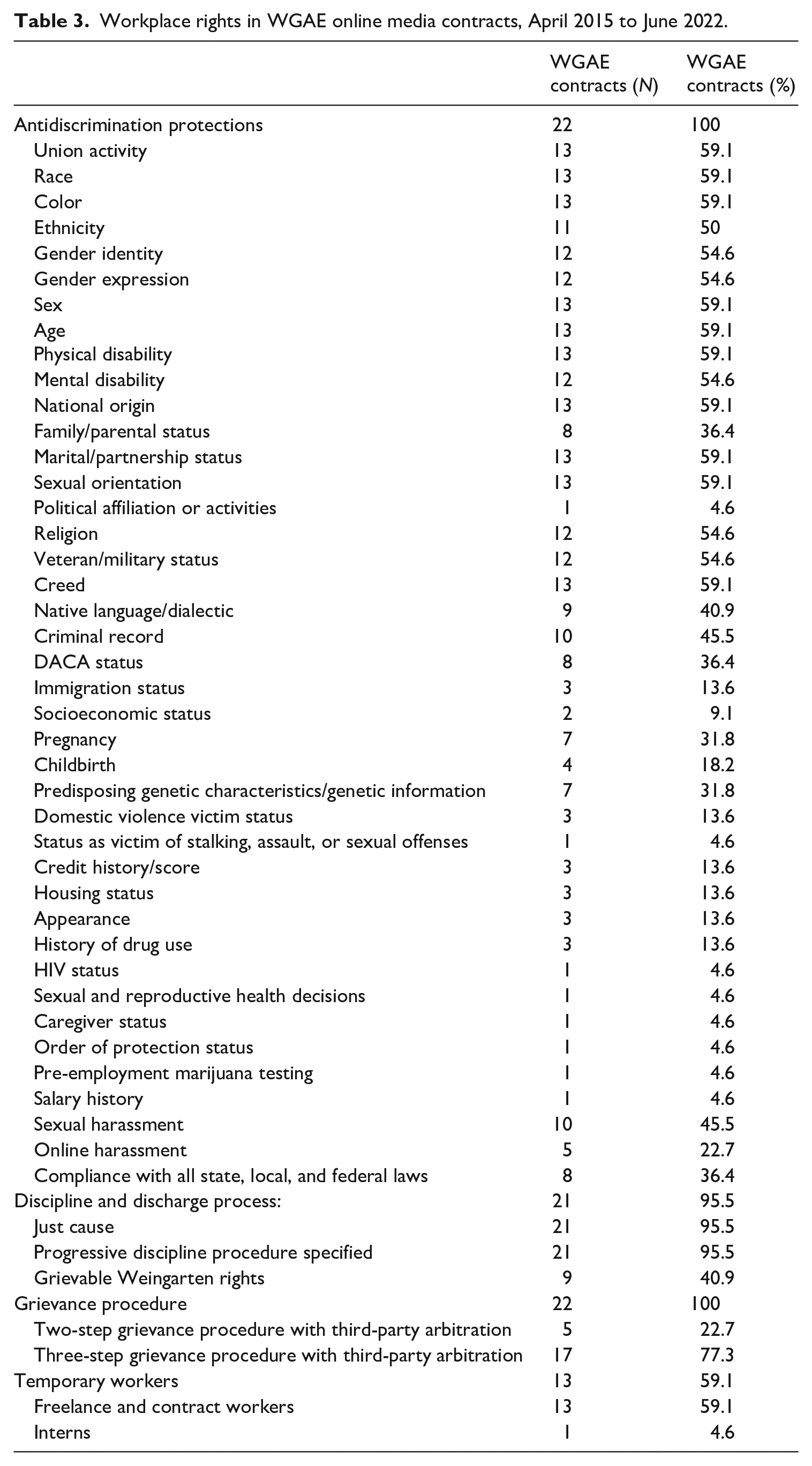
Some CBAs also include innovative language for digital-era newswork, such as mandating an employer to protect workers against online harassment. CBAs mandate employers to create policies against online harassment threatening workers’ personal safety (e.g. doxing and abusive posts). For example, as Salon Media Union puts it, these policies are intended to set “community standards that prohibit online harassment by commenters on the Company’s various websites and platforms, reporting procedures for employees experiencing harassment” (WGAE, 2018b). They also direct the company to take anti-harassment measures (e.g. contract a third-party to take anti-doxxing measures), make training on online security and anti-harassment measures accessible to workers, and provide support to workers (e.g. employee assistance program, peer-to-peer counseling, and short paid leave). Additionally, they mandate the company to provide a service like DeleteMe to protect workers’ privacy.
Tackling the contingent nature of precarious media work, some CBAs also provide freelance, temporary contractors, and/or interns with some protection, despite them typically being excluded from bargaining unit membership. Vox and MTV News are notable exceptions, as temporary contract or project-based workers are bargaining unit members. Another contract innovation is the formation of special management-union committees to address contractors: The Slate CBA mandates the company and union create a Contractor Assessment Committee, meeting once per year to “assess and discuss contractors and their contributions” to the publication (WGAE, 2019a). In some cases (i.e. the Onion, Vox, MTV News, and Chalkbeat), the employer must pay contractors or project-based workers, at minimum, the rate of an equivalent bargaining unit employee. Many CBAs also provide different employment relationship standards in relation to contractors: after a certain period of contract services, some companies automatically consider contractors part of the bargaining unit (Chalkbeat); must end a temporary contract employment relationship (Gawker, HuffPost, the Onion, Vox, Gimlet Media, and Parcast); give a contractor the option of continuing as a contractor (Gawker, the Ringer, and Fast Company); and/or must convert a contractor into a regular bargaining unit employee (the Onion, MTV News, Gimlet Media, the Ringer, and Parcast), if an open position is available (CBSN). These terms typically fall under an article titled “Contractors,” “Third Party Payroll Providers,” or “Day Rate Employees.” While interns are typically excluded from bargaining units, Talking Points Memo’s CBA mandates the company to bargain with the union over the use of editorial interns. Such language is intended to discourage short-term, temporary, and flexible employment relationships.
Restrictions on management rights in digital news workplaces
This subsection is focused on the language in WGAE’s online media CBAs that restricts management from unilaterally making decisions, formalizing a standardized system of workplace rules and procedures. Similar to other unions’ CBAs, WGAE’s online media CBAs set restrictions on management rights around the following issues: the filling of vacancies; schedules, hours of work, and workload; overtime; shift and other pay differentials; health and safety; job security; outside employment and freelancing; and reuse of employees’ work. Table 4 outlines how digital newsworkers’ CBAs have restricted management rights. While some limits on management rights are specific to a particular bargaining unit, others are common across all or most CBAs: for example, the posting of vacancies; editorial independence and standards; severance packages; and career development and performance review meetings (e.g. to discuss raises and promotions).
Union restrictions on management rights in WGAE online media contracts, April 2015 to June 2022.
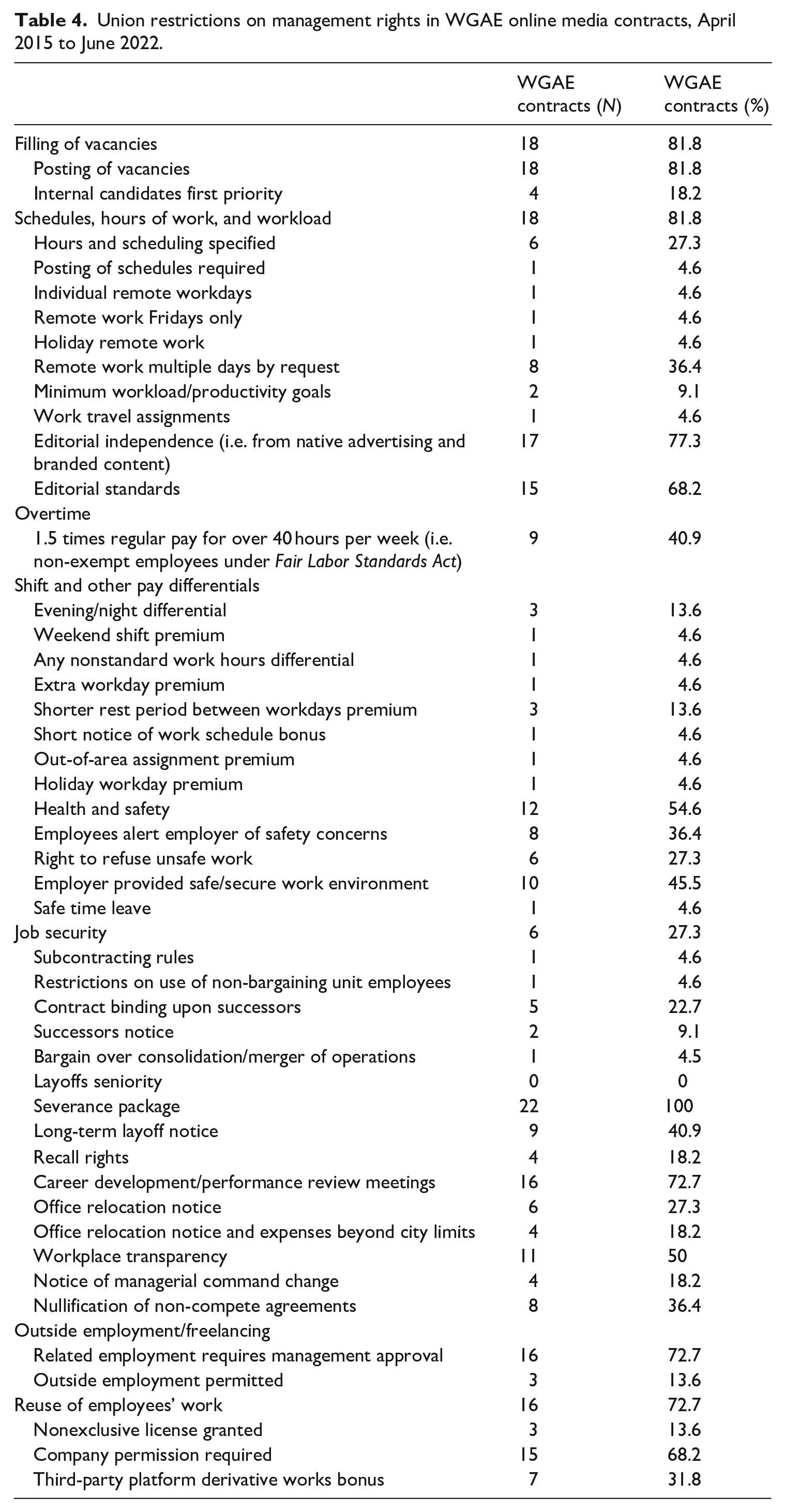
In placing restrictions on management rights, some WGAE online media CBAs also recognize unique conditions of digital journalism work. For instance, CBAs include language regarding remote work on certain days (e.g. working from home on holidays or Fridays) or multiple days by request, while minimum workload and productivity goals are meant to ensure employees have “manageable workloads” (WGAE, 2019b, 2022a). Some CBAs, such as CBSN’s, also mandate the company to bargain over the consolidation or merger of business operations and “notify the Union of its desire to bargain over the effects of the decision” (WGAE, 2020). Considering the potential challenges of moving, some CBAs further mandate a company to provide office relocation notice and (sometimes) paid moving expenses: for example, “[f]or moves beyond city limits. . .the [Onion] shall notify the union at least three (3) months in advance of the move. Employees shall receive moving reimbursements to cover the cost for relocation” (WGAE, 2021). Finally, acknowledging that digital journalism employment can be transitory and relatively low-paid, CBAs create the potential for employees to earn more income by enabling them to leverage their intellectual property: for instance, granting a nonexclusive license for employees to reuse their work and/or a third-party platform derivative works bonus for producing new content (e.g. books/eBooks, films, TV, video games, or digital video programs) based on content originally created for the company. A related CBA provision sometimes grants employees permission to accept outside employment (e.g. freelance writing). By placing such limits on management rights, these CBAs can potentially shift the balance of power between management and newsworkers.
Digital newsworkers’ monetary and non-monetary benefits
This subsection is focused on benefits about which digital newsworkers organized and secured in CBAs. Like unionized workers in other industries, WGAE’s online media CBAs adopt common language that sets standards and establishes monetary and non-monetary benefits for digital newsworkers: health benefits; retirement benefits; leaves of absence; transit and parking plans; pay systems; training and professional development; and employee involvement in company decision making. Table 5 summarizes these benefits. Such benefits typically vary for each bargaining unit, demonstrating union members’ unique interests, but some benefits are standard across all or most CBAs. They include medical insurance, retirement benefits, parental and family forming leave, annual percentage pay increases, job title salary minimums, and labor-management committees.
Worker benefits in WGAE online media contracts, April 2015 to June 2022.
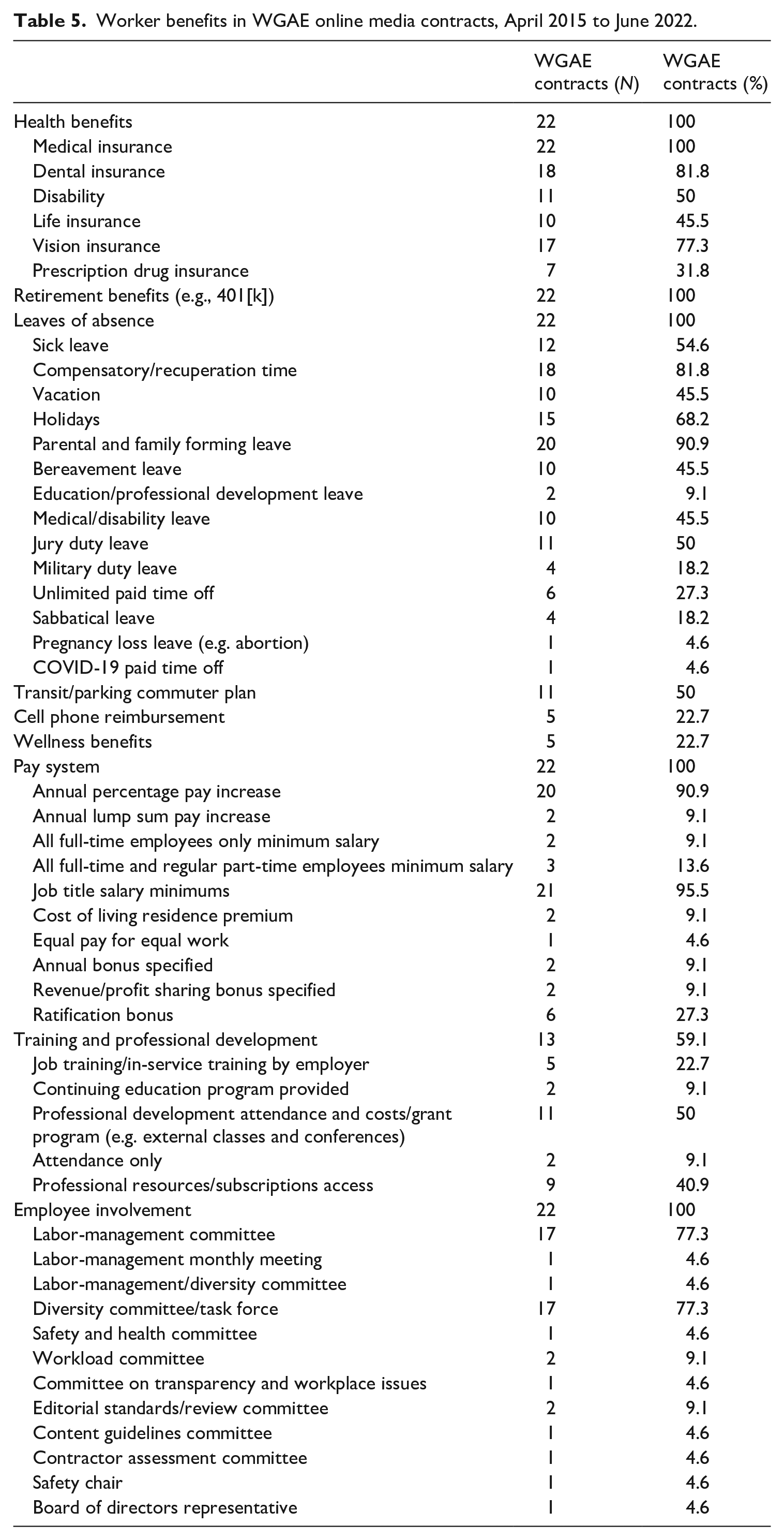
Despite similarities with first CBAs of unions in other sectors, several WGAE online media CBAs still include innovative language, recognizing the distinct nature of digital journalism work, setting standards around paid time off (PTO), and establishing unique committees. Many CBAs adopt an unlimited PTO policy. For The Intercept Union, such a policy is “intended to support a healthy balance between our work and personal lives. We strive to create a flexible workplace where people can achieve great things while also having ample time for their families, rejuvenation, and exploring outside interests,” recognizing the “reality of how the workplace has been transformed by the digital revolution” (WGAE, 2018a). One CBA even establishes provisions for COVID-19 paid time off, recognizing the long-term challenges for newsworkers posed by the pandemic. Other CBAs provide clear frameworks for establishing novel committees with employee involvement clauses. For instance, most CBAs provide guidelines for diversity committees. While unique, other CBAs (e.g. ThinkProgress) formalize a workload committee that speaks directly to employee life satisfaction, the purpose of which was to “improve the quality of life for ThinkProgress employees and increase productivity and the quality of the work produced” (WGAE, 2019c). Such language, in part, could provide the foundation for model CBA language that supports worker happiness and life satisfaction.
Discussion
This article analyzed CBA content of WGAE-affiliated online media workers’ bargaining units to better understand issues digital newsworkers resist within a context of industry instability and precarious work to win workplace rights and worker benefits, while placing limits on management rights. Accordingly, this article contributes new comparative knowledge on how newsworkers communicatively constitute their collective voice and address employees’ grievances (RQ1) and the communicative means through which they offer solutions to those issues that could secure employees’ digital job and life satisfaction (RQ2). It also contributes a comprehensive classification system to examine newsworkers’ CBAs, establishing several key dimensions (N = 3) and subdimensions (N = 162). It develops a relational model of employees’ digital job and life satisfaction CBA language that is attentive to historically-grounded industry and workplace conditions.
Concerning RQ1, WGAE CBAs illustrate how bargaining units incorporate language on workplace rights, newsworkers’ benefits, and limits on management rights, revealing the relative weight of different union solutions to newsworkers’ digital-era grievances. The research suggests that unions extend to digital newsworkers many language provisions earlier generations have gained: for instance, antidiscrimination; a discipline and discharge process; a grievance process; filling of job vacancies; schedules and hours of work; overtime; shift and other pay differentials; health and safety; health benefits; retirement benefits; leaves of absence; transit and parking plans; pay raise systems; training and professional development; and employee involvement in workplace decisions (Cohen and de Peuter, 2020, 2022; Leab, 1970; Mari, 2018; Rosen, 1951). Yet WGAE CBAs also secure new digital-era language protecting workers: for example, anti-harassment online; freelance, temporary contractor, and/or intern support; remote work; minimum workload and productivity targets; job security (e.g. bargaining over corporate consolidation or mergers, office relocation notice and expenses paid, communication regarding managerial command change, authorization to accept outside employment, nonexclusive licenses for staff to reuse their work, and third-party platform derivative works royalties); an unlimited paid time-off policy; a COVID-19 paid time off-policy; and diversity and workload committees.
These findings support a long-historical view of news industry structures, workplace (re)organization, and CBA language, foregrounding continuity and change, from the founding of American editorial newsworker unions’ CBAs in the 1930s to digital-era CBAs. Digital-era CBA language on anti-harassment online, temporary workers, remote work, workloads, job security, paid time off, and diversity committees also support a focus on chain and hedge fund mergers (e.g. Alden Global Capital), ownership concentration, and precarious newswork (Cohen and de Peuter, 2022; García-Avilés, 2021; Marjoribanks et al., 2022; Salamon, 2022; Steiner and Chadha, 2022). They do so within the context of the COVID-19 pandemic and anti-Black racism protests. Such language communicatively constitutes newsworkers’ resistance to grievances over pay, benefits, equity, and attempts to gain more control over working conditions and the workplace.
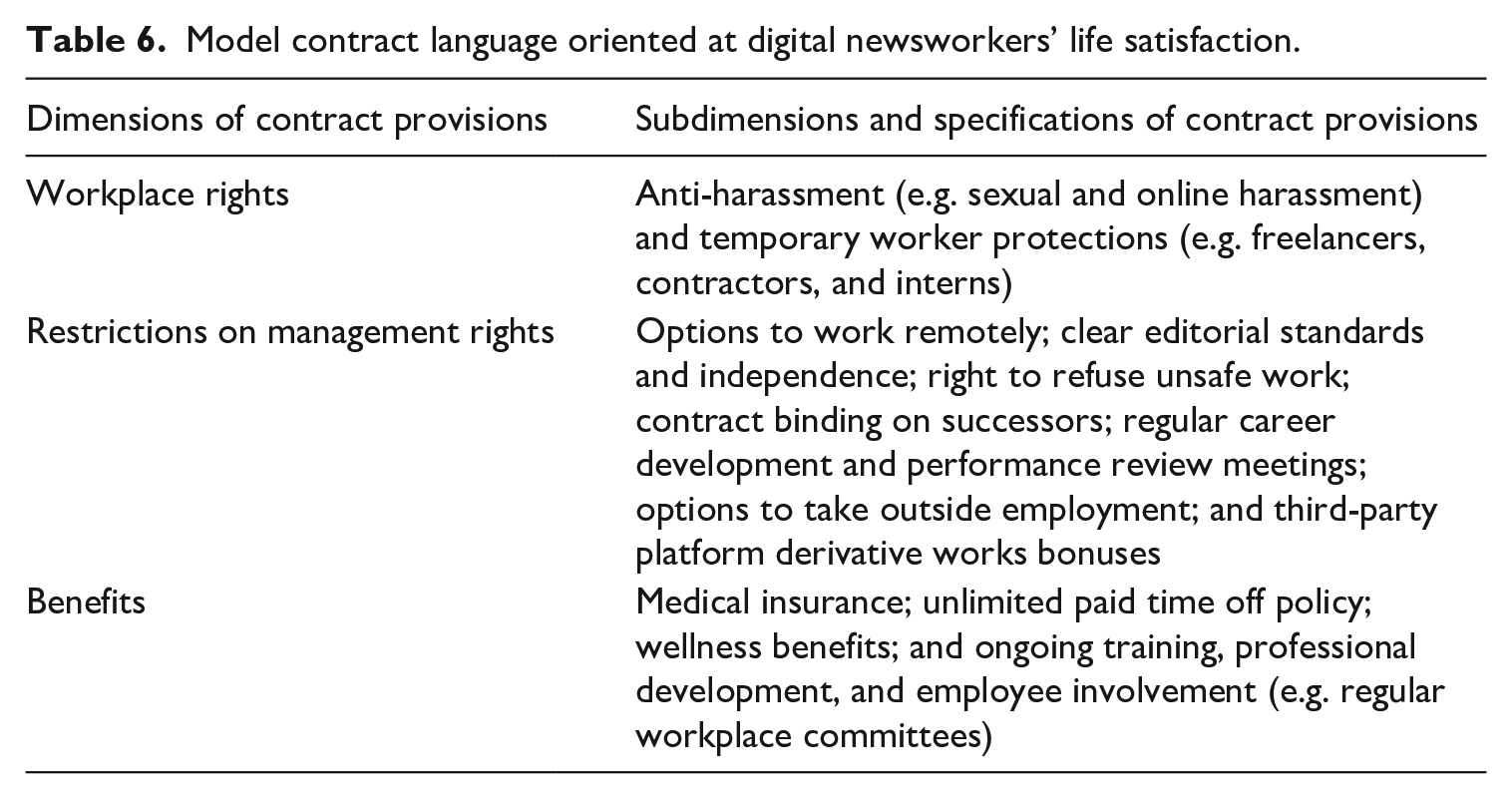
Considering RQ2, researchers have contended that “contract language is bargaining’s terrain of struggle” against precarity (Cohen and de Peuter, 2020: 57). Yet this article maintains that CBA language also communicatively constitutes the conditions for digital newsworkers’ happiness and subjective well-being. This article suggests the following minimum characteristics should be included in a relational model of CBA contract language oriented at digital newsworkers’ life satisfaction, which arguably align with subjective well-being and life satisfaction (see Table 6). It acknowledges that newsworkers may have unique demands based on social-historical and local organizational and industry conditions (Marjoribanks, 2000). This relational model should include CBA language on the following workplace rights: anti-harassment, including sexual and online harassment, and protections for temporary workers including freelancers, contractors, and interns. Additionally, this model should contain these key restrictions on management rights: options to work remotely; clear editorial standards and independence; the right to refuse unsafe work; a contract binding on successors; regular career development and performance review meetings; options to take outside employment; and third-party platform derivative works bonuses. Finally, this relational model would adopt the following fundamental benefits: medical insurance; an unlimited paid time off policy; wellness benefits; and ongoing training, professional development, and employee involvement through committees in between contract negotiations. These findings support a focus on not only precarity but also happiness, emphasizing CBA language that facilitates an “overall appreciation of one’s life-as-a-whole” (Veenhoven, 1984: 7) and “quality of life for workers” (Juravich et al., 2006: 104). Moving beyond only legacy features of CBAs that could facilitate happiness, the above model recognizes CBA language that is unique to editorial newsworkers and the digital-age workplace.
Model contract language oriented at digital newsworkers’ life satisfaction.
Conclusion
Finally, this article raises implications for future research. Researchers could empirically test the claims made in this article about contract language by conducting interview and survey research with members of digital newsworkers’ unions to determine “‘how satisfied’ or how ‘happy’ they feel with their lives ‘in general’” (Flavin et al., 2010: 436). Beyond the WGAE, there is also an opportunity to comparatively examine the CBA language of different digital newsworkers’ unions in the United States and elsewhere to further test and possibly refine the model offered above based on union-affiliated newsworkers’ unique local and national circumstances. By proposing a relational model of digital newsworkers’ CBAs, researchers and practitioners could better understand the language that is needed to communicatively constitute and facilitate happiness in newsrooms, supporting digital job and life satisfaction among newsworkers.
