




Abstract
Ghana is a poster child of the consolidation of liberal democracy in Africa, the signal evidence of which is the freedom of the Ghanaian media as the fourth estate of the realm. However, recent developments in the media landscape of the country, such as sustained death threats, assaults, use of unwarranted brute force, suspicions and murder of journalists seem to mar the democratic image of Ghana. These incidents have raised concerns about the erosion of freedom and independence of the media in Ghana, a situation that is worrying enough to ignite a debate on whether the dark days of the culture of silence are returning to the country under democratic governance. Drawing on qualitative data collected through personal in-depth interviews and grey literature of media attacks and intimidations, the article examines the extent of the erosion of press freedom in Ghana. We argue that media freedom seems to be under increasing threat by elements of the state, despite public rhetoric of freedom of the press. Specifically, the threats are coming from officials of state such as national security operatives, the police and political party supporters. Concluding, the article calls for sustained civic activism against these threats.
Introduction
Since the redemocratisation of Ghana in 1992, in which the presidential and parliamentary elections ended military dictatorship and established a democratic government, the country is ‘held up as one of Africa’s star democratizers’ (Gyimah-Boadi, 2015: 101). A free, independent media is one of the central pillars of democracy, and constitute the basis upon which the press is often referred to as the Fourth Estate of the realm (Adanlawo and Rugbeer, 2021; Curran, 2011). The evolution of media freedom and independence in Ghana since its redemocratisation illustrates this assertion. The promulgation of the 1992 Republican Constitution of Ghana, the main institution on which Ghana’s democracy revolves, promotes media freedom and autonomy. This has engendered media plurality and incrementally formed the basis of the broad participation of the masses in the country’s body politic.
There are a number of studies on press freedom in Ghana since the return to Constitutional rule in 1993. These studies have focused on various aspects of the media including the media and democracy (Dzisah, 2008), the repeal of the criminal libel and seditious laws (Asamoah et al., 2014), journalism aid (Tietaah et al., 2018), the law and media (Karikari and Kumado, 2000), media and election (Braimah, 2017; Temin and Smith, 2002), the press and political culture (Nyarko and Akpojivi, 2017) as well as social media and politics (Dzisah, 2018). Apart from a few recent studies on the safety of journalists (Alhassan et al., 2019; Diedong, 2020; Nyarko & Akpojivi, 2017), scholarly works have mainly looked at the positive side of the media. However, to date, few studies exist questioning why the recent cases of intimidation, unchecked violence, assaults and attacks continue despite the presence of laws that protect the media freedom in Ghana.
This article contributes to the literature on media freedom and democracy in Ghana by exploring this relatively under-investigated aspect of the Ghanaian media. It argues that the emerging threats to press freedom, some of which involve the use of the coercive powers of state, is a signal example of democratic backsliding in the country. There is a sense in which recent developments in the Ghanaian media landscape seem to run counter to Ghana’s much-celebrated media freedom and its mutually reinforcing positive effect on the country’s reputation as a poster child for successful democratization in Africa. As we will demonstrate below, there have been attacks on media freedom, with journalists threatened with death, physically assaulted, arrested with unwarranted brute force, and in some cases, have been killed. Similarly, some media outlets have been closed and their licences suspended (Citinewsroom.com, 2022; Nyarko and Akpojivi, 2017). These incidents have raised concerns about the erosion of freedom and independence of the media in Ghana, a situation that is worrying enough to ignite a debate on whether the dark days of the culture of silence under the military dictatorship of J.J. Rawlings are returning to the country under democratic governance.
In the following pages, we flesh out our arguments in this order in the next section, we formulate the analytical framework of the article through a critical engagement with the state-of-the-art literature on the connections between media freedom and democracy, as well as attacks on media freedom in recent times and the implications of that for the health of democracy in the world generally, and Ghana specifically. The third section is a description of the material and methods used in the article. In the fourth section, we track the evolution of media freedom from the immediate post-independence years through the era of political instability between 1966 and 1980, to the era of political stability under the military dictatorship of J.J. Rawlings and democratic governance under the Fourth Republic constitution. The penultimate section documents and discusses the empirical evidence of the worrying signs of attacks on media freedom in recent times, at paints to elaborate why these attacks represent a spectacular change in the democratic experience of Ghana and why they portray the emerging decline of liberal democracy in the country. The conclusion section pulls the article together to restate its main thesis and then proffer solution to the erosion of media freedom in Ghana.
Media freedom, democracy and democratic reversal
For media freedom to be well-protected, there must be consistent engagement by stakeholders to ensure that the personal security of journalists in a democratic country is safeguarded (Dominick, 2014). Indeed, this should be a major national concern to all citizens, and particularly the government, because of the important role press freedom plays in the quality of democracy in a country. Yet the media space in Ghana is gradually becoming unsafe for journalists because of the attacks and intimidation on them, the evidence of which we document below. This can cow journalists committed to accountability reporting into silence; yet this is part of responsible journalism, which cannot be detached ‘from writing stories deemed critical and controversial’ (Diedong, 2020: 164). Therefore, if legislations and security agencies are used against critical media practitioners in a country, as it is beginning to happen in Ghana, this will have far-reaching negative implications for democracy (Jatula, 2019).
There are worrying signs of this beginning to happen across the world, in tandem with the increasing reversal of liberal democracy and the emergence of autocratic governance in some countries (V-DEM Institute, 2022). In the parts of the world supposed to be the heartland of liberal democracy, for example, in Europe, democracy is backsliding; with infringement of human rights and the curtailing of freedom of expression (Lindberg, 2018). Ghana’s much celebrated democracy seems to be following this pattern, as the virtues of democracy such as media freedom are gradually eroding and critical voices of journalists and social activists are being silenced (V-DEM Institute, 2022). Reporters Without Borders (RSF, 2022) or Reporters sans Frontieres (RSF, 2022) (which are one and same organisation in different languages) has raised concerns about the deteriorating situation of press freedom in Ghana, occasioned by violent attacks and arrest of some journalists in line of duty. The country has been declining in global press freedom rankings because of incidents of insecurity and intimidation of journalists. Redolent of this, Ghana dipped in the global freedom index rankings, from 30th position in 2020 and 2021 to 60th in 2022. This is the worse position attained by the country, an indication of reversal of progress made in press freedom in the decades. This, we argue, is a signal example of democratic backsliding in Ghana.
Materials and methods
This article is based on qualitative data, both primary and secondary. The primary data are made of transcripts of in-depth personal interviews with 10 purposely selected investigative journalists who, by their work, are exposed to the dangers of state-sponsored violence to stop them from raking up dirt in government. These investigative journalists use journalism to promote transparency, accountability and the deepening of democratic ethos. As such, a deeper understanding of their personal experiences with brutalities, molestations, physical attacks and closure of media houses critical of the government constitutes relevant data for this study. The narratives and stories of these journalists can shed light on the gradual erosion of press freedom in Ghana (Bruner, 2020). Yet, to date, their narratives have not been drawn on, to the best of our knowledge, to analyse the decline of democracy in Ghana.
Two criteria were used to select our interlocutors: first, journalists who have investigated and reported stories on corruption, abuse of power and questionable contract awards involving officialdom, or contributed to such stories; second, the willingness of these journalists to participate in the study. After the selection, open-ended interview guides were used to interview the journalists. Each interview lasted approximately 60 minutes. The interviews were recorded, transcribed and thematically analysed in close connection with the purpose and theoretical framework of this study. Four main themes were distilled from the responses and analysed, namely;
Clandestine political intimidation;
Arrest, detention and trial
Death threats and killings;
Self-censorship.
In compliance with the ethics of anonymity and safety of the respondents of our study, we do not identify them by names in our findings and analysis. In place of names, we use ‘A’ to ‘J’ to represent them.
The secondary data were collected through desktop research, encompassing scholarly and grey literature on attacks on journalists. We searched for, retrieved, and pored over scholarly publications such as books and articles, news media reports and reports of civil society organizations (CSOs) such as RSF. These secondary sources of data include, for example, reports related to Manasseh Azure Awuni, a renowned investigative journalist who was compelled to flee from the country because of threats to his life after doing an investigative story on the operation of a secret security agency by the government. Another incident of the suppression of press freedom that has been documented profusely is the threats of Mr. Kennedy Agyapong, a member of parliament (MP) of the party in government, the New Patriotic Party (NPP), against another renowned investigative journalist, Anas Aremeyaw Anas and his team. A member of his team, Ahmed Hussein Suale, was later murdered, and to date, the killers have not been found. We will draw on these secondary sources to complement our primary data.
An overview of the evolution of media (un)freedom in Ghana
Since gaining independence in 1957, Ghana has had a chequered history of media freedom, characterised by upswings and downswings in media freedom, and the alternation between suppression and liberalisation of the media. On the latter, the immediate post-independence years witnessed state monopoly over the media, with content politically biased in favour of the Nkrumah-led Convention People’s Party regime (Karikari, 2007). By some accounts, the excuse for this situation was the need for the media to promote national unity, identity and development (Asante et al., 2013).
During this time, Ghana established newspapers such as the Evening News, Secondi Morning Telegram and the Daily Mail as political mobilisation tools. President Kwame Nkrumah acquired the Daily Graphic and established the Guinea Press to help in disseminating his policies to the people of Ghana with some modicum of freedom. However, that zeal for press freedom was short-lived when the Newspaper Licensing Act was passed in 1963 (Act 189) requiring newspapers to annually renew their licence before operation (Karikari, 2007). This new regulation was condemned by media watchers who thought such acts were oppressive and aimed at gagging the media, especially the private newspapers. Another reprehensive law, the Preventive Detections Act was introduced in 1958 to deal with recalcitrant opponents of Nkurmah and his government, including media practitioners (Anokwa, 1997; Asare, 2009). The ‘culture of silence’ and a state of ‘muzzled’ media with muted independent editorial opinion were therefore, a major pioneering censorship in Ghana during the era of Nkrumah’s rule.
After the overthrow of Nkrumah in 1966, this trend of the suppression of the media did not change significantly during the second and third Republics; between 1969 and 1972 and 1979 and 1981 respectfully. Indeed, it rather worsened during Ghana’s political crisis, the era of military coup d’états and counter coup d’états; namely, between 1966 and 1969, 1972 and 1979, and 1981 and 1992. For example, the period of the last military government, the Provisional National Defense Council (PNDC), between 1981 and 1992, may be considered as the lowest of the downswings of media freedom in Ghana. The leader of the PNDC, Flt Lieutenant Jerry John Rawlings, interfered with press freedom and wrongfully detained and imprisoned journalists deemed critical of his regime (Fleming, 2009; Karikari, 2007). This is the era of the media landscape of Ghana popularly referred to as the era of the culture of silence (Ankomah 1987; Gadzekpo 1997), during which Ghanaian media became docile and domesticated because of the fear of arrest and prosecution (UNESCO, 2023: 84).
The promulgation of the 1992 Constitution of Ghana and transition to democratic governance in 1993 represent the highest upswing in media freedom in Ghana. Because, first, the paramount law of the land, the 1992 Constitution, guaranteed media freedom in the country. A full chapter (Chapter 12) is dedicated to protecting the freedom and independence of the media. Second, and connected to first, the constitution provided for the establishment of the National Media Commission (NMC), an autonomous regulatory body to, among other things, ‘promote and ensure the freedom and independence of the media’ (Republic of Ghana, 1992). The NMC has since been established by Act 449, 1993. Another regulatory body, the National Communications Authority (NCA), has been established by Act 769 (2008) to ‘establish and monitor the implementation of national communications standards and ensure compliance’ (Republic of Ghana, 2008). For example, the NCA regulates ‘wire, cable, radio, television, satellite and any other technology of communications for mass communication or information’ (UNESCO, 2023: 13–14). The repeal of the Criminal Libel Law in 2001 is another measure the democratic Ghanaian state took to liberalise the media and promote freedom of expression (Ahmed et al., 2016; Asamoah et al., 2014; Laryea and Kwansah-Aidoo, 2005).
However, as the UNESCO (2023) report cited above correctly noted, ‘although the media operate in a relatively conducive environment compared to many other countries, there are still infractions on media freedoms by state and non-state actors, including members of security agencies’ (p. 13). ‘There is real concern’, the report states, ‘about a climate of increasing insecurity affecting journalists, despite legal protections for the media’ (UNESCO, 2023: 17). The report also noted a worrying development in which, with the repeal of the criminal libel law, other laws and legal procedures have been used to suppress journalists. A case in point is the use of contempt of court law, which carries a jail term penalty that has been used against journalists. Another example is the invoking of what the report described as ‘colonial era sections of the Criminal Code such as ‘Publication of False News with Intent to Cause Fear and Alarm to Public’ (Section 208), or ‘Infringement of Official Secrets Act 1911 and 1920’, or undermining national security, [which] have been used against persons who publish certain information in the media’ (UNESCO, 2023: 40).
As will be documented below, there is resurgence of disturbing incidents involving murder, harassment of journalists in the line of duty, violent arrest and torture of journalists by security agencies and closure of radio stations. For example, on Friday, May 4th, 2018, a member of the NPP, the governing party, assaulted a journalist at the party’s national headquarters, but has not been sanctioned to date (Citinewsroom.com, 2018). Also, journalists who published stories deemed inaccurate about the spouses of the President and Vice-President were arrested at gun-point by armed police, brutally assaulted, criminally prosecuted, and one of them jailed in February 2022. For Asante (2020), there is a disconnect between the government’s rhetoric on freedom of the media and the reality of threats to the safety of journalists in Ghana. The emerging erosion of media freedom in Ghana, as briefly noted above, therefore, forms the basis of the analysis of this article.
Emerging erosion of media freedom in Ghana: between 2018 and 2022
Public access to reliable, accurate, independent and pluralistic trustworthy information, which form the basis of holding elected and appointed public servants accountable to citizens in a democratic society like Ghana, hinge on the freedom and independence of the press and journalists. Yet, the 2021 World Press Freedom Index notes that journalism has become badly obstructed, restricted and dangerous to practice in no fewer than 132 countries (RSF, 2022). According to the report, violence against journalists and other abuses of media freedom with impunity are on the rise despite efforts by media freedom advocates to combat them. As will be demonstrated in this section, the state of media freedom in Ghana reflects the worrying situation reported by RSF on the erosion of media freedom in the world (see Table 1). And as we have argued all along, this illustrates the emerging backsliding of democracy in Ghana and across the world.
Press freedom ranking of Ghana by Reporters Without Borders (RSF).
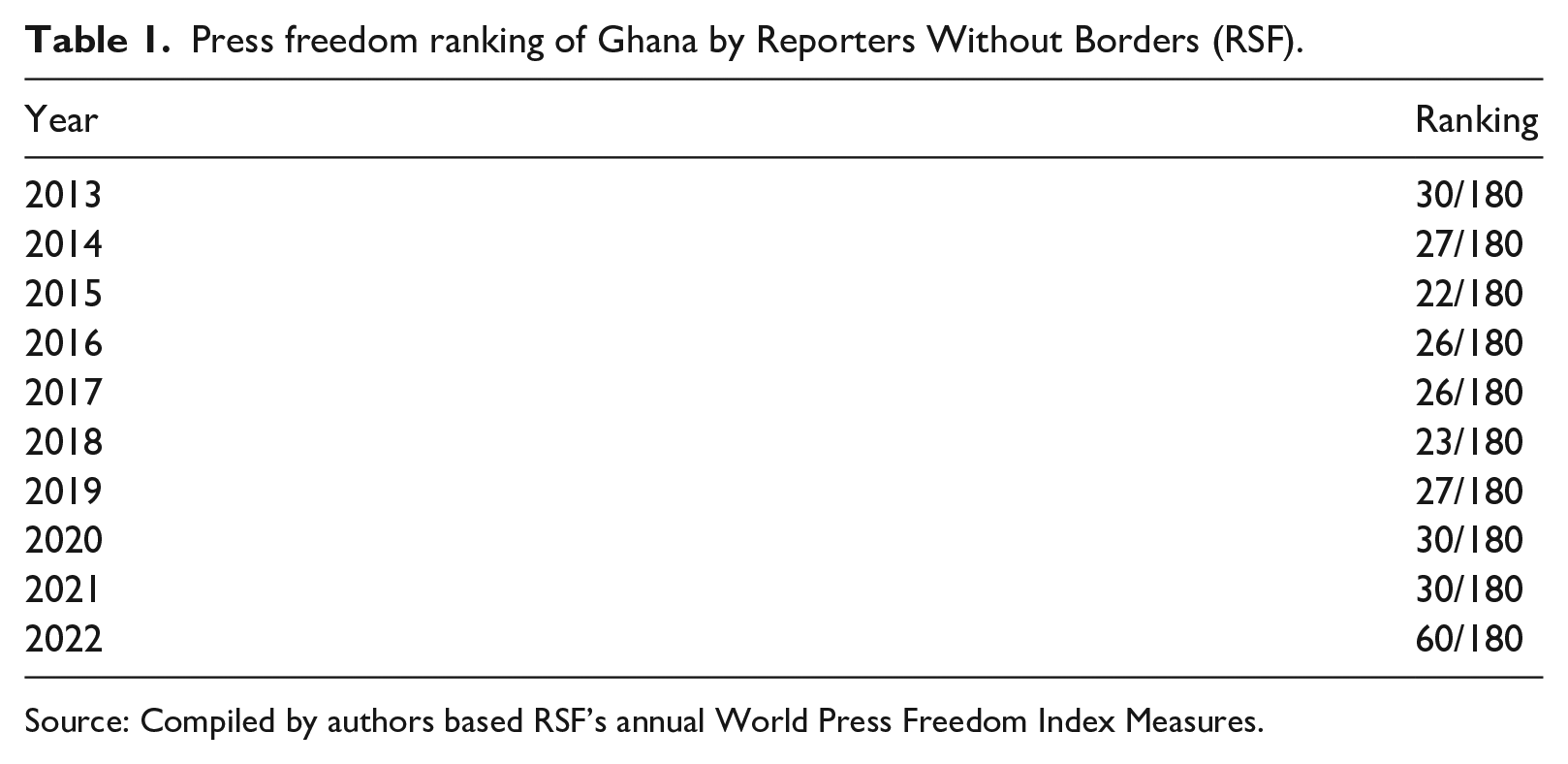
Source: Compiled by authors based RSF’s annual World Press Freedom Index Measures.
The 2021 press freedom report of RSF illustrates that the protection that journalists require from the state to play their watchdog role in a democracy is decreasing in Ghana. Commenting on the erosion of Ghana’s press freedom, the director of RSF’s West Africa bureau, Sadibou Marong, noted that ‘in a country where arrest of journalists had become an exception, these new cases of detention and violence are very disturbing’ (RSF, 2022).
The attacks on journalists in Ghana are evidenced by verbal assaults by some members of the political elites, which sometimes culminate in violent arrests, detention and trial; death threats and killings; and censorship in the form of muted editorial opinion or closure of media outlets in various forms. Thus, Ghana is captured in the 2022 Democracy Report of Varieties of Democracy (V-DEM) as one of the countries experiencing retrogression in democratic governance (V-DEM Institute, 2022: 14). In the rest of this section, we illustrate the increasing threats to press freedom and their relationship to the backsliding of democracy in Ghana.
Clandestine political intimidation of journalists
In public, Ghanaian government officials will declare their commitment to media freedom and may even take measures to protect same. However, if they feel the pressure of accountability reporting, they may take clandestine measures to muzzle press freedom. For example, one of the journalists we interviewed told us of an experience where a powerful minister called his supervisor to stop the publishing of an opinion piece he wrote. On 5 May 2021, Blessed Godsbrain, a radio presenter with Angel FM, was also forcibly taken off air for criticising the government. His employer, Angel Group of Companies, said its managers had received a series of calls from top government officials complaining about the criticisms of the presenter which they claimed is making the government unpopular (Modern Ghana, 2021).
Some of our interlocutors were of the view that, although attacks on journalists are not new, the phenomenon is getting worse:
If you look at recent events, the trend is clear how we are being silenced. Modern Ghana, an online portal published some damaging reports of some officials of this government and the governing party. The national security raided their offices, seized their laptops, their phones, detained them for two days, allegedly tortured them, and all manner of things. The national security in Ghana is not like the normal security setup so those there are like party people recruited and they are more of regime security. (Investigative Journalist A, Accra, 22 May 2021)
Another form of threat is from political communicators of the two dominant political parties, the NPP and NDC, who are responsible for promoting a positive image of their party in the media space. The political parties have emboldened their communication wings across the country to maltreat journalists. And in some cases, they have prevented some journalists, whose work they deem as negative publicity of their political party, from attending their media events, such as press conferences. These attacks on journalists, as correctly noted by Nyarko and Akpojivi’s (2017), illustrate continual intimidation and victimization of critical journalists in Ghana. And as captured in the 2022 Democracy Report (V-DEM Institute, 2022), they batter journalists into submission.
Nyarko and Akpojivi’s (2017) argue that there are three key abusers of journalists in Ghana: security agencies, communities/individual citizens and supporters of political parties. Elaborating on the three categories of abusers, they suggest that attacks on journalists that emanate from security forces sometimes include the destruction of their cameras, with the excuse that the journalists were taking photographs of them. The laws are no respecter, hence journalists who behave outside the confines of the laws cannot escape lawful arrest and prosecution by the security agencies. As such, it should not be a thorny issue when arrest involves journalists who ‘go beyond boundaries set by the security services’ (Nyarko and Akpojivi, 2017: 5). They argued that another group that perpetrates violence against the media are supporters of powerful and influential people in government and political parties, usually to protect their selfish political and economic interests. These attacks on journalists, as some scholars have persuasively argued, have serious implications for the professional autonomy of the media and the sustenance of democratic rule (Asante, 2020; Solis and Sagarzazu, 2019).
Arrests, detentions and trials of journalists
Another signal evidence of the declining freedom of the media in Ghana is the creeping predilection for the arrest, detention and trial of journalists. Even though this is not new, it is on the ascendancy in the period under study (Media Foundation for West Africa [MFWA], 2022). As a result of this, the former President of Ghana, John Dramani Mahama wrote to his successor President Nana Akufo-Addo, to complain about ‘the growing criminalization of speech and journalism in Ghana’ and the state’s inability or unwillingness to act, leaving the police to virtually shelve investigations into such brutal attacks including murder. He noted in his letter:
There have also been several disturbing incidents of harassment of journalists in the line of duty; we have witnessed media establishments closed down on your instructions, despite many appeals to you. Now, in a space of fewer than two weeks, four people have suffered police action, criminalizing their rights to free speech. (Mahama, 2022)
Journalists targeted for intimidation are usually arrested with heavily armed policemen or national security operatives, and doing so deliberately in the evenings. The purpose of the latter is to provide an excuse to keep the journalists arrested in custody till the following day before processes for bail can kick in. For instance, a Radio/TV presenter, Captain Smart, was once arraigned before court; and although he was granted bail, he was detained overnight. Another, critical journalist, Bobie Ansah, a presenter at Accra FM, was arrested, detained and charged with the crime ‘publication of false news and offensive conduct’; charges based on a video the journalist posted on social media claiming that President Akufo Addo’s wife had illegally obtained a parcel of state land (Mahama, 2022; MFWA, 2022). On 13 January 2022, 10 men, armed with guns, attacked, ransacked and beat up two staff members of Radio Ada in the Greater Accra region. The attack is believed to be provoked by the content of one of the station’s flagship accountability programmes (Citinewsroom.com, 2022). Again, on 24 May 2022, Mr. Noah Dameh, a journalist with the same radio station was arrested by the police, detained and subsequently arraigned before court for the offence of false publication; a charge connected to a Facebook post by the journalist accusing the police of abusing a suspect in their custody (MFWA, 2022)
Other cases of intimidation and harassment include the arrest and torture of Mr. Emmanuel Ajarfor Abugri, the News Editor of Modern Ghana, and Mr. Emmanuel Yeboah Britwum, a reporter of the same media organization. Mr. Abugri said they were interrogated on a critical story their organisation published about the Minister for National Security, Mr. Albert Kan-Dapaah, and the NPP’s MP for Effutu constituency, Mr. Alexander Afenyo-Markin (Ghanaweb, 2021). Another case is the arrest of Caleb Kudah, a journalist with an Accra-based CitiFM, who was investigating the abandonment of state vehicles at the Ministry of National Security. He alleged that while he was filming the abandoned cars on May 11, 2021, national security operatives arrested, beat and kicked him in the groin. In addition, armed personnel of National Security stormed the premises of CitiFM arresting Zoe Abu-Baidoo, a journalist of this media organization, who is suspected to have received copies of the videos recorded by her colleague, Caleb (Citinewsroom.com, 2022).
To be added to this gloomy list of arrests and intimidation are the following incidents: Mr. Nhyiraba Paa Kwesi Simpson, a radio presenter with Connect FM based in Takoradi, was arrested by the police on 1 November 2021, and detained for 1-week on a charge of false publication. He and a listener who called into his programme were alleged to have made false publication of a kidnapping incident at Mpohor in the Western Region (MFWA, 2022; MyjoyOnline.com, 2021).
These arrests and prosecutions, especially, the use of the criminal law, section 208 of the Criminal Offences Act, Act 29 as amended, are aimed at intimidating journalists into silence. This law, as noted by one Ghanaian lawyer, ‘sins against both national and international human rights law on freedom of speech. It is draconian and archaic’ (Darko, 2022). In cases where journalists have been assaulted or abused physically by security agents or unknown people, the perpetrators have not been investigated, charged and prosecuted. We are, thus, witnessing the erosion of press freedom in Ghana, and together with it, the backsliding of democracy in the country.
Death threats and killings
Apart from security officials who attack journalists, prominent politicians incite people to attack journalists just because of their work. A case in point is Ahmed Suale, an investigative journalist, who was shot and killed in broad daylight in Accra, after he had gone to the police to assist them in an investigation relating to his work. Mr. Suale was the leader of Tiger Eye PI’s investigation team, whose exposé on corruption in the Ghana Football Association (GFA) led to the reorganisation of the football administration agency. Kennedy Agyapong, a Member of Parliament of the governing party, one of the politicians mentioned in the exposé, ‘revealed Mr. Hussein-Suale’s identity and called on the public to attack him. He also gave information on the neighbourhood where Mr. Hussein-Suale lived’ (The Office of the High Commissioner for Human Rights [OHCHR], 2019). By 2019, the Media Foundation for West Africa (MFWA) had recorded over 31 attacks on 40 journalists over 18 months (Asante, 2020), a big blot on the image of a country touted as the beacon of democratic governance.
Between March and April of 2019, Manasseh Azure Awuni, an investigative journalist, fled Ghana for fear of being killed. This was after a series of threats to his life that followed his exposé on the ‘De Eye Group’, a private security group that was operating from a state-owned property, the Osu Castle, formerly the presidential office and house of Ghana. The leader of the group, identified as Nana Wireko Addo, was a former bodyguard of the incumbent president of Ghana, Nana Addo Dankwa Akufo-Addo. Mr. Azure’s investigative documentary sought to raise the negative implications of the location of De Eye Group for the security of the state (Ghanaweb, 2019a). The National Media Commission (NMC), after investigating a petition by the government against the story, ruled that parts of it were misleading and a misrepresentation (Ghanaweb, 2019b). However, this does not diminish the significance of the threats to the journalist’s life for declining press freedom in Ghana. Another journalist, Edward Adeti and his family, in February 2020, received death threats after producing an investigative video titled ‘Cash for Justice’ (MFWA, 2020). The video shows Emmanuel Otu-Boison, a State Attorney in the Upper East region of Ghana, allegedly taking bribes to set a suspect free.
At the 2019 World Press Freedom Day in Addis Ababa, Ethiopia, UNESCO expressed great displeasure at the rate at which political thuggery is threatening the safety, security and independence of journalism (UNESCO, 2019). Freedom House (2021), while cognizant of the guarantee of freedom of the press by Ghana’s 1992 constitution, is concerned about the harassment, intimidation and arrests of journalists reporting on politically sensitive issues in the country. The journalists we interviewed believe that most of these attacks were linked to the accountability or ‘watchdog’ reportage of the victims.
These examples of threats against the lives of journalists and the actual murder of one of them illustrate the emerging autocratisation of democracy in Ghana, because they are an affront on press freedom and independence, considered as essential touchstones of liberal democracy. If this violence against journalists is not curtailed by the Ghanaian state, it will embolden other powerful people in both the private and public sectors, who may be aggrieved by the accountability reporting of journalists, to use violence to address their grievances.
Self-censorship
Based on the views of our interlocutors, there are disturbing signs of a climate of self-censorship in the media landscape of Ghana, something that can affect the editorial independence of media houses and ‘watchdog’ reporting of journalists. A common thread that runs through the responses of the journalists we interviewed is the fear among Ghanaian journalists in their efforts to hold public servants, both appointed and elected, accountable to Ghanaians who they are supposed to serve. Because journalists are afraid of being attacked or losing their jobs, they restrain their ambitions to serve as watchdogs of public servants. One of our intercalators whose investigative reporting implicated some high-profile government officials in wrongdoings said:
I have practiced for a little over ten years now. I would have said it is ok if I didn’t have previous experiences. Now, I don’t feel very safe because of late, I have had a number of death threats. I know of a colleague who was shot and killed after he was threatened. There are people who have been manhandled by national security operatives and nothing much has come out of it. (Investigative Journalist B, Accra, 20 May 2021)
For fear of being a target of attack, it seems most Ghanaian journalists are extremely cautious when reporting, commenting or discussing political issues that may have electoral implications; such as holding politicians accountable for the promises they made while in opposition. This fear is heightened when the reporting is unfavourable to officials of the political party in government. However, when elections turn the tables and they lose power, they also lose the influence and coercive apparatuses of state they use to intimidate journalists. As illustrated by the quote below, journalists are not afraid of the political elites who belong to the opposition parties;
You don’t care about doing political stories against the opposition party because the best they can do is to talk about it or insult you but doing the same with the governing party, they will come and attack you with armed police or national security. I have been a victim. I live in a community where one day someone who works closely with a former minister and now works closely with the Vice-President approached me and said, we know you, the kind of stories you do, we will come for you very soon if you do not change. (Investigative Journalists C, Accra, 10 May 2021)
However, when they are in government, both the NPP and NDC are similar in their hostility towards and intimidation of journalists doing accountability reporting. They have media attack dogs on standby to be unleashed on journalists whose reporting they see as negative to the image of their government and party. As one of the journalists we interviewed indicated, the methods these attack dogs use include social media insults and abuses;
They monitor journalists’ pages on social media to examine posts that are inimical to their paymasters. Once the post or message does not favour their party, they will say let’s go to his wall and attack him. Sometimes when you read the line of arguments, it is almost like the same thing; some will lie, malign and do all manner of things against you. (Journalist D, Accra, 11 June 2021)
Alhassan et al. (2019: 12) are on solid ground when they noted ‘the existence of an unofficial list of taboo topics’ in Ghana which is prone to attacks, and the media dare not discuss or comment on them.
Accountability or watchdog reporting that rakes up dirt in government and exposes ills in society are part of the ‘taboo topics’, yet is very important to democratic governance. Some journalists may play it safe by doing traditional news reporting, but there are few courageous ones that venture into watchdog reporting, as noted by one of our interlocutors;
If you are a journalist who goes out to report the minister’s assignment, then come and report quotes of the minister, give the minister sound bites, and go home and sleep. I don’t think they really have much trouble with such journalists. The aspect that is scary is the one that you will have to get information about. The kind of journalism that the constitution demands is the one we should hold the government accountable to the people. That kind of work will bring you face to face with the powers of the state and because a lot of times, they act against the interest of the people, if you are to act for the people, your interest and their interests will almost and always clash. (Investigative Journalist E, Kumasi, 20 June 2021)
In effect, topical stories that expose corrupt deals involving top government officials or perpetrators of wrongs in society are among the issues that attract attacks on the media in Ghana. These have not just begun but they are on the increase now than they were a decade ago as remarked by one of the journalists we interviewed:
I have never experienced this kind of fear. I did a bit under President John Kufuor, President John Mills, and President John Mahama. I never had a reason to be afraid for my life and now all of these things are happening. The impunities, the corruption, the bad governance, the policies that are worth criticizing are ‘no-go’ areas. (Investigative Journalist F, Accra, 20 May 2021).
Reminiscent of self-censorship, the intimidation and threats have made journalists very cautious about the choice of stories they report; and as the quote below illustrates, journalists who choose to do accountability reporting in Ghana encounter the dangers associated with it;
Currently, there is a case of a rebranding of a state vehicle belonging to the Ghana School Feeding Programme. The state vehicle has been converted for private use but no journalist is reporting on it in this region because of fear. I wrote a feature article and posted it on social media. I have received two threats in the form of the following words ‘we will show you where power lies’ and another said, ‘we will send you out of this region’. (Journalist G, Tamale, 18 June 2021)
This section illustrates that journalists who do watchdog reporting are at risk of arrest, criminal prosecution and political persecution; with the latter taking the form of closure of media outlets over minor breaches of media regulations. The fear of being attacked, losing one’s job or killed has led to self-censorship, with many journalists fearing to do critical reporting on national issues, to expose wrongdoings in government and society and to comment on atrocities in the society (Neupane and Zeng, 2014; Solis and Sagarzazu, 2019; Stier, 2015).
Prominent Ghanaians are beginning to voice their concerns over these negative developments in the Ghanaian media landscape. Professor Stephen Kweku Asare, a Fellow for Public Law and Justice, the Centre for Democratic Development, (CDD-Ghana), has observed that Ghana is ‘going forward in reverse’ relative to freedom of expression. After ‘we transitioned from one regime where one could not talk and 30 years after experimenting with a system that allows us to talk, people are now being asked to go and explain why they have spoken’ (Asare, 2021: 3). Sir Sam Jonah sees this as the return of the culture of silence in the country (Jonah, 2021). The source of the culture of silence is largely attributed to the brute force against journalists, in an effort to intimidate and scare them from engaging in accountability reporting.
Addressing the decline of media freedom in Ghana
The two major institutions that are supposed to protect media freedom are the Ghana Journalists Association (GJA) and the National Media Commission (NMC). However, based on the views of the journalists we interviewed, journalists have little or no trust in the ability of the GJA to protect press freedom. They were unanimous that the GJA and the NMC are ineffective in fighting to protect press freedom, as they have confined their work to writing statements condemning abuses of journalists and nothing more. Narrating their experience with the GJA, one of them said when he was beaten in the course of his work, it was only the Media Foundation for West Africa that came to his rescue and provided him with a lawyer. Surprisingly, the GJA and NMC did nothing to seek redress for the infringement on his human rights.
Considering the ineffectiveness of GJA and NMC, one of the ways of protecting press freedom and struggling against the increasing attacks on journalists is to enhance the effectiveness of these institutions. Journalists should carefully choose the leaders of their union, the GJA, making sure those who are chosen to lead are scrupulous and unrelenting in their commitment to fighting to protect the interests of their members. Constitutional reforms are needed to make NMC an autonomous organisation dedicated to defending the freedom and professionalism of the media. In its present composition, the NMC seems malleable by the executive arm of government because the Chair person is appointed by the president of the Republic. The police service should be made autonomous by amending the constitutional provisions that give the power of appointment of the Inspector General of Police (IGP) to the president and that make the vice-president the chairman of the Police Council. This will cure a serious defect in the work of the police service as an impartial organisation responsible for protecting lives and investigating and prosecuting criminals. With the Inspector General of Police (IGP) appointed by the president and the vice-president as the chairman of the Police Council, the police cannot be trusted to be firm and bold in investigating powerful government officials who abuse the freedom and threaten the lives of journalists.
The judiciary is one of the arms of government in Ghana that is well placed to protect press freedom and safety of journalists. Using its independence and powers of review, it can interpret the laws used to arrest and prosecute journalists to favour and promote press freedom. For example, the courts can throw out criminal charges against journalists for minor offenses such as false publication of news, and direct aggrieved persons to take civil action against journalists to claim damages for defamation. Rather than prison sentences and heavy fines for contempt of court, judges may consider lighter penalties such as compulsory publications of rejoinders, retractions or apologies. In contrast, security personnel who abuse their powers by arresting journalists unlawfully, detaining and assaulting them physically may be given heavy punishments by the courts to serve as a deterrent to such acts of abuse of press freedom.
Civil society organisations (CSOs), both national and international, especially those engaged in democracy and governance advocacy, can serve as bulwarks against the suppression of press freedom in Ghana. As discussed above, and importantly, these CSOs have taken notice of the entwined declining press freedom and democracy in Ghana, and are voicing their concerns about the situation. For example, in ‘February 2022, four organisations, CDD-Ghana, IMANI Africa, STAR-Ghana and the Africa Center for International Law & Accountability (ACILA), jointly condemned the series of arrests and prosecution of journalists and activists whose statements in the media were said to be false and liable to pose security threat’ (MFWA, 2020: 5). Not only should many more CSOs join in condemning the Ghanaian government for its failure to protect press freedom, but these efforts must be sustained and upscaled to the mobilisation of street protests against the government.
Above all, journalists must unite as a class with the same interest of protecting their profession, which flourishes when freedom of speech and expression are protected. Rather than the present division of Ghanaian journalists along partisan political lines, between NDC and NPP, they must be united by their common interest in the protection of press freedom, regardless of which political party they support or is in government. By doing this, they can mobilise as a class to struggle against the erosion of press freedom, regardless of whichever political party is in government.
Concluding remarks
The centrepiece of the argument of this article is that media freedom in Ghana has been eroding between 2018 and 2022, a development that depicts the backsliding of liberal democracy in the country. A spectre of autocratisation may be hunting Ghana if the declining media freedom is not arrested. Because an efficient, fearless and independent media is paramount in building and consolidating liberal democracy in nascent democracies like Ghana. However, our research illustrates that journalists doing accountability journalism are increasingly being subjected to intimidation, both clandestine and overt, by powerful politicians and national security agencies. Although state actors openly declare their desire to protect journalists, our research revealed tacit support by the Ghanaian state for the intimidation and attacks on journalists.
Drawing on primary and secondary qualitative data, we demonstrate the following threats to media freedom in Ghana:
Clandestine political intimidation of journalists;
Arrest, detention and trial of journalists;
Death threats and killings of journalists;
Self-censorship by journalists.
Thus, we posit that there is no political will to ensure the safety of journalists especially those that are doing investigative/critical journalism and exposing wrongdoings among state officials.
This has stultifying effects on media freedom; because journalists who have seen their colleagues flee to South Africa for exposing the rot in government, killed for doing an investigative work that implicated top political officials, sacked by employers for making comments that some top politicians do not like, and witnessed the uncountable number of assault cases on journalists in the line of duty, are scared to play the media’s role as the Fourth Estate of the realm.
The upshot of all these is the erosion of media freedom in Ghana, which illustrates that Ghana’s much celebrated democracy is on the decline. We have proffered suggestions in the preceding section to arrest this unfortunate development, including making constitutional bodies charged with the responsibility of protecting media freedom to do their work. Politically autonomous bodies such as the NMC, the judiciary and civil society organizations as well as the GJA must work together to protect journalists. Short of this, media unfreedom will deepen in tandem with the reversal of democracy in the country. As work in exploratory research, this article points to areas for further research on this subject, as well as potential interventions to counteract the erosion of media freedom and democracy in Ghana.
Footnotes
Declaration of conflicting interests
The authors have declared no potential conflicts of interest with respect to the research, publication, and authorship of this paper.
Funding
The author(s) received no financial support for the research, authorship, and/or publication of this article.
