




Abstract
This paper aims to contribute to the ongoing discussions on authoritarian populism and the media, from the lens of the political economy of ownership. In contrast to studies that consider the link between media and authoritarian populism by focusing on the discursive structures of populist communication, this study analyses changes in the structure of news media ownership in four European countries that have been subject to authoritarian populism. By employing social network analysis, a methodology rarely used in media ownership research, we reveal how news media ownership concentration as well as changes in ownership structures have provided favorable conditions for the rise and endurance of authoritarian populism. Our study covers ownership developments during the period 2000 to 2020, in Austria, Hungary, Slovenia, and Turkey where authoritarian populist tendencies have been evident, albeit to varying degrees. Conclusions are drawn to illustrate how authoritarian populist actors in the sample countries not only capitalize on prevailing news media ownership structures, but also proactively intervene in ownership relations in order to increase influence over the diffusion of information.
Keywords
What are the structural conditions in the media sector that underlie the rise and endurance of authoritarian populisms? While “all neo-populist movements rely heavily on some kind of indirect (and direct) complicity with the mass media” (Mazzoleni, 2003: 6), communication scholars have so far analyzed this complicity primarily in relation to the dissemination and strengthening of populist discourse through media outlets. However, previous studies have shown that the commercialization of media markets and a related “commercial logic” play a role in the provision of media support for authoritarian populists (Sorensen, 2021). Therefore, the question of who owns and controls these media outlets in commercialized media markets becomes an important issue.
Some studies found a link between the consolidation of “conservative media establishment” and the emergence of “echo chambers” for right-wing populism (Jamieson and Capella, 2008), others highlight the rise of “politically motivated media ownership” in connection with populism in some national contexts (Esser et al., 2017). Similarly, Freedman (2018) suggests that populism can be understood in part as a response to the policy failure of tackling concentrated media ownership thereby fostering “distorted communication systems” that are likely to be exploited by populist right-wing actors. Scholars of political economy of communication have long insisted that media (power) concentration has negative consequences for the democratic state of a country (Birkinbine et al., 2017; Freedman, 2014; McChesney, 1997, 2015; Mosco, 2009). Baker (2007: 10) particularly highlights the link between the rise of authoritarianism and the erosion of “the democratic distribution ownership principle.”
By bringing the issue of media ownership to the center of populism discussions, this paper diverges from approaches that largely consider populism in terms of its discursive and cultural pillars. While we agree that populism can be played out as a “performance,” “style,” or “rhetoric” (Laclau, 2005; Moffitt and Tormey, 2014; Ostiguy et al., 2020) that articulates the opposition between “the people” and “the elite” (Mudde, 2004), we also emphasize the substantive, political economic, and institutional aspects of populist politics (Krämer, 2014; Tuğal, 2021; Waisbord, 2018). Our focus is on the authoritarian right-wing populist politics that seeks “social homogeneity through coercion” (Morelock, 2018: xiii, see also Hall et al., 1978). We thus deploy the notion of “authoritarian populism” originally coined by Stuart Hall for Thatcherism in the United Kingdom (Hall, 1985; Hall et al., 1978) – a period well known for “various kinds of collusion between media corporations and governments” (Birkinbine et al., 2017: 480). As a more recent example, authoritarian populist leadership has been analyzed by Kellner (2016) based on the example of Trump who has been tapping into the unrestrained capitalism of the Reagan era, embracing the corporate capitalist business world, and dominating the news cycle on a daily basis. As the stability of authoritarian populist governments also rests on the support and co-optation of a broad segment of the national capitalist elite (Scheiring, 2021), populists in power tend to enable affiliated business groups to operate on favorable terms in national markets. An authoritarian aversion toward pluralism is a hallmark of authoritarian populism and the strategic manipulation of ownership structures is a key mechanism through which authoritarian populists reduce pluralism in the economy at large (Sallai and Schnyder, 2021).
Consequently, against the background of authoritarian-populist electoral successes of the last two decades, scholarly attention to the issue of media ownership and populism seems timelier than ever. In particular, comparative studies that provide an analysis of cross-country news media ownership and interrogate changes to media ownership structures in the context of the rise and endurance of authoritarian populism are lacking.
In this paper, we undertake this task by focusing on media ownership changes in four countries (Austria, Hungary, Slovenia, and Turkey), over the past two decades, during which authoritarian populist tendencies were evident in all of them, albeit to varying degrees. While Austria and Slovenia have experienced interrupted phases of populist electoral successes as well as periods of governments dominated by authoritarian right-wing populist parties, Hungary (since 2010) and Turkey (since 2002) have uninterrupted and thus firmly established authoritarian right-wing populist regimes. We use social network analysis (SNA) which, in contrast to conventional media market concentration indices, allows us to consider the ties between media companies without focusing on a single medium system (Birkinbine and Gómez, 2020). In contemporary mediascapes, the circuits of information are diversified and multiplied to create a high-choice information environment that could be used by the populist leaders as well as the audience/users (Tóth et al., 2022). This makes medium-specific research highly limited and unsuitable to understand the scale of information control. Moreover, if we can surmise that concentrated ownership structures may result in “echo-chambers” (Sunstein, 2001), it is important to understand the possible relationality between media platforms to form unified information structures. While novel research methods in audience research such as “media repertoires” (Hasebrink and Domeyer, 2012), help analyze the broader media use from user-centered perspective, SNA can help us understand the broader media ownership control from the perspective of the political economy of communication. Applied to a comprehensive dataset on the owners of high-reach news media outlets in the print, TV, and online sectors for the years 2000, 2010, and 2020, the method allows us to determine the centralization and density of the ownership networks as well as to visualize conspicuous changes in the network structures over time.
Our results indicate that over the past two decades far-reaching changes have taken place in all four countries, pointing to the emergence of dominant media actors and increasing polarization between large, dominant media groups and more marginal players. Notwithstanding the fact that concentrated ownership structures have undoubtedly developed historically beyond populist governments, our findings shed light on key structural conditions in the media that are complicit in the rise and persistence of authoritarian populism. Without proposing a unidirectional causal link, we suggest that media ownership structures have evolved in ways that are conducive to the rise of authoritarian populism in all countries studied; and that they potentially contributed to regime persistence in Hungary and Turkey.
Media ownership concentration and authoritarian populism. State of research and theoretical considerations
The crucial role of media ownership concentration for the endurance of democratic governance is well established in media theory. By focusing on the questions of who owns and controls the media, scholars of critical political economy of communication underpinned the relationship between diversity of media owners and the contribution of media to the public life and political deliberations (Bagdikian, 2004; Garnham, 1990; McChesney, 1997, 2015; Mosco, 2009; Noam, 2016). They claim that concentrated media ownership has implications not only for the pluralism of media content, but also for the democratic state of a country: on the one hand, the “democratic distribution principle” – which implies a wide dispersal of power in public discourse – suggests that democracy requires a maximum dispersal of media ownership (Baker, 2007: 7); on the other hand, excessive media ownership concentration inevitably leads to a loss of democratic safeguards – such as “watchdog” functions of media – against abuses of economic or political power (Baker, 2007; Birkinbine et al., 2017; Birkinbine and Gómez, 2020). If media pluralism is essential to the democratic public sphere where different and contesting ideas and information can be circulated and deliberated, the concentration in ownership can have detrimental effects on the public and political realms (Winseck, 2008). Research on media pluralism and diversity (McQuail, 1992) has shown that concentrated ownership reduces diversity, produces uniform content, and accelerates the production of market-driven media formats. While an increased number of media outlets does not necessarily ensure media pluralism, as Murdock (1982) presciently noted, less diversity in terms of participation in media markets is more likely to lead to a more controlled information sphere or “echo-chambers.” In addition, media conglomerates are pushing for a direct relationship between media ownership and political influence, threatening a democratic prerequisite to give citizens a broad choice of media (Bagdikian, 2004). Thus, communication scholars point to the possibility that dominant media companies in concentrated markets can become powerful political actors eschewing democratic control and potentially influencing electoral results as well as their own regulatory framework (Meier, 2007; Trappel and Meier, 2022). Heavily concentrated media ownership therefore also comes with increased risks of corrupting politics for the mutual benefit of media and political actors (Trappel and Meier, 2022). While it has been shown that business elites enter media markets as “strategic investment” to have closer relationship with political parties and leaders (Mazzoleni, 1991), they can also play a key role for the “instrumentalization” of outlets for political purposes (Hallin and Mancini, 2004; Yesil, 2016). Stetka (2012) confirmed this risk in an empirical study for Central and Eastern Europe, highlighting that local business elites rather than multinational companies have gained prominence in media markets and acquired stakes in news media, resulting in increasing entanglements of the media, political, and economic systems in the region.
Consequently, we claim that Baker (2007) and Freedman (2018) have good reason to consider concentrated media ownership as an important factor in the context of rising authoritarianism and populism. Not only do they note that media ownership matters (Baker, 2007), but also that media concentration in highly commercialized markets helps populists by, (a) enhancing the visibility of populist leaders because coverage of populist messages generates more advertising income and other commercial gains, and (b) expanding the impact of populist content by size. Freedman (2018: 611) notes: “size matters, especially in media landscapes where there is a fierce battle for attention and therefore strong incentives for political leaders to accommodate to media power.” However, in line with most of the critical political economy of communication research, the empirical base of such claims remains “somewhat anecdotal” (Sjøvaag and Ohlsoon, 2019). Indeed, as “ownership alone is difficult to isolate as independent variable when it comes to questions about news homogeneity, quality, or concentration,” it is key to contextualizing media ownership changes within the broader social, political, and economic conditions under which they occur (Sjøvaag and Ohlsoon, 2019).
Building on these considerations, we apply a model which is not suggesting a uniliteral causal relation between changes in media ownership and authoritarian, right-wing populism. Rather, inspired by a “critical realist” conception of causality, we study the structural characteristics of media ownership as mechanisms that potentially foster the rise and endurance of authoritarian populism. As the relationship between mechanisms and their effects is not predetermined but contingent, generative mechanisms only operate if they are triggered (Danermark et al., 2002: 55). Thus, we are not claiming that changes in news media ownership structures inevitably lead to authoritarian populism, nor that authoritarian populism cannot occur without these changes. However, drawing on the theoretical work outlined above, we suggest that media ownership structures are particularly conducive to authoritarian populist communication if they are (a) highly concentrated and (b) likely to marginalize media owners that are not well connected to others. These characteristics of media ownership serve the authoritarian-populist interest in limiting pluralism of voices in the democratic public sphere and fostering clientelist business networks that signal the conflation of economic and political power.
Data and methods
Authoritarian populism in the sample countries
We investigate how the structure of media ownership networks has evolved in four cases of varying populist political control. Our case selection is based on two criteria: firstly, the extent of populist dominance over the period studied. We chose two cases of continuous populist control, and two cases with intermittent populist governments, but not complete control. Secondly, we chose cases with relative historical, geographic, and cultural proximity to increase comparability, while varying important factors such as level of socio-economic development and recent history (e.g., post-socialist transition). The sample thus allows us to compare key variables (populist dominance; media ownership networks) across cases that vary on other variables (economic development, post-socialist experience).
With Austria we include the clearest case of right-wing populist backlash in Western Europe (Sauer and Ajanovic, 2016). The early rise of the right-wing freedom party (FPÖ) under Jörg Haider in the 1990s can be attributed to Haider’s “modernization” of the party allowing the FPÖ to play down its Nazi roots and pursue an “Austrian patriotism” (Pelinka, 2020: 96). The rise of the FPÖ led to political turmoil in the 1999 national elections, when the FPÖ became the second-strongest party while the Social Democrats (SPÖ) and the Christian-conservative People’s Party (ÖVP) faced decisive electoral losses (Tálos, 2019: 443). Austria has seen two right-wing populist governmental coalitions between the ÖVP and the FPÖ since, the first lasting from 2000 to 2006 and the second from 2017 to 2019. Austria was governed by Social Democrats from 2006 to 2017, when the ÖVP under its new leader Sebastian Kurz claimed the chancellorship again. The “new” ÖVP turned authoritarian right-wing with a program of securitization, law and order, exclusion of migrants, and strengthening of the economy (Sauer, 2021: 63; Strobl, 2021).
In the Slovenian case, pervasive “extreme nationalist” populism was first observed with the example of the Slovenian National Party and its leader Zmago Jelinčič who during the first parliamentary elections in Slovenia in 1992 advocated for the purification of the Slovenian nation, from Yugoslavs, migrants, and communists (Rizman, 1999: 151). While Jelinčič has remained a visible populist icon, the strongest orchestration of “ethno-national populism” (Brubaker, 2017) and of “firm-,” “nativist populism” (Pelinka, 2013: 15–16) has come from Janez Janša, the leader of the Slovenian Democratic Party (SDS) and close ally of Hungarian Prime Minister Viktor Orbán. The SDS was the party in power between 2004–2008 and 2012–2013, the major party in opposition since 2013, returning to power as leader of its third ruling coalition from 2020 to 2022. During the latter period, backsliding into authoritarianism has brought an intensification of securitization, impoverishment of social sub-systems, cracking down on civil society, and the politicization of the media.
Hungary is often described as one of the extreme cases of authoritarian populism (Ádám, 2019) due to the de-democratization processes over the last decade under Viktor Orbán’s right-wing populist Fidesz Party. Under Orbán’s government, the country passed a new constitution and transformed the old state structure, along with the checks-and-balances systems to form a network of seemingly independent institutions that are all controlled by party loyalists (Bánkuti et al., 2012; Scheiring, 2021). The autonomy of the judicial system and the Constitutional Court was undermined whilst new electoral laws were introduced to benefit Fidesz. The redesign of the mediascape – from ownership structure to policy and institutional change – was integral to the de-democratization processes since 2010.
If Hungary is one of the extreme cases of authoritarian populism, Turkey can be considered an even more extreme case as it presents a longer period of authoritarian-populist governance under the uninterrupted rule of Recep Tayyip Erdogan’s party from 2002. Like Hungary’s, Turkey’s populist regime sought to undermine checks and balances, enhance institutional regulatory control over the media, whilst using state resources for the empowerment of loyalist business and media groups; all the while, implementing punitive apparatuses against the oppositional forces such as critical media outlets, especially since 2010 (Akca and Bekmen, 2013; Çelik, 2020a; Tuğal, 2022; Yesil, 2016). Taming the opposition was integral to Erdogan’s politics in which he considered all oppositional forces as enemy of the people, famously stating “we are the people, who are you?” In 2018, Erdogan’s party won the majority of votes in a referendum for the constitutional change from multiparty parliamentary democracy into Turkish-style presidential system. As President of the country, Erdogan has accumulated all executive powers under his authority from 2018 onwards.
Sampling of media outlets and data collection
The sampling of media outlets and companies included in this study draws, where possible, on standardized media-audience measurements. Consequently, the sampling unit is the media outlet and not the media company. We include all periodical news media outlets from the print (dailies, weeklies, political magazines), online (online-outlets or online-versions of print outlets), and TV sectors (private and public stations) with a national audience-reach (daily) or average annual audience market share of at least 3% in 2000, 2010, or 2020. For each of the 3 years, the data indicate the company owning the outlet at the end of the respective year.
We trace the ownership structure of this company across multiple layers until the ultimate beneficial owner(s) of the outlets are identified. Where outlets or owners can clearly be associated with a particular national or international “media group,” we additionally indicate the media group as an ultimate beneficial owner in order to reveal more concealed group connections. The ownership or group data were collected through national databases, such as commercial registers and economic archives. 1
Social network analysis: network topology and transmission of information
A key insight from SNA regarding the link between the structure of a social network and its informational features concerns the centralization of networks. Studies have shown that high levels of degree centralization led to efficient diffusion of information through communication networks (Ahuja et al., 2003; Barabási, 2002; Cross and Cummings, 2004; Tsai, 2001). Degree centralization is a local measure of node centrality in a network that simply counts the number of connections a node has (Wasserman and Faust, 1995). A highly centralized network in terms of degree centralization is one that exposes a high variance among nodal degree centrality scores (Bienenstock and Bonacich, 2022). In other words, networks where a few central nodes are connected to a large number of nodes that are only connected to few others themselves, tend to allow a given message to reach all nodes in the network without being distorted (information efficiency). In such highly centralized networks, the most central nodes have high control over the messaging.
Yet, Bienenstock and Bonacich (2022) show that, while efficient in terms of diffusing one given message, such highly centralized networks have downsides in that they tend to isolate leaders and make it difficult for the group to “consolidate the opinions and knowledge resident throughout the network” (Bienenstock and Bonacich, 2022: 227–228). In other words, centralized network structures can lead to isolating “elites” from a wider set of group members with relevant information and thus bias information diffusion by “creating an echo chamber that biases the influence on the network consensus,” which is often referred to as “groupthink” (Bienenstock and Bonacich, 2022: 228).
Applying these insights to the case of media ownership networks means that we are not studying processes of gathering and processing information, but rather processes of information diffusion and broadcasting. The problem is not so much biases in aggregating information (although applied to the level of journalists working in these companies, this may be an issue), but one of “biases” in (or deliberate effects on) the diffusion of information. In our context, the key issue regarding information diffusion is the impact network structures may have on owners of media outlets controlling messages and influencing the pluralism of voices.
Measuring media network characteristics
To implement these insights from SNA research in the context of ownership networks of media companies in authoritarian-populist countries, we draw on Bienenstock and Bonacich’s (2022) recent work. In particular, they suggest that the networks’ “principal eigenvector of the adjacency matrix of a graph [is] interpretable in terms of the diffusion of communication in a network, [which is] useful to identify network vulnerability to ‘out of touch’ elites” (Bienenstock and Bonacich, 2022: 228).
Eigenvector centrality is an important concept in SNA, which is defined in such a way that a node is “central, with respect to eigenvector centrality, if it is connected to other positions which have many connections” (Bienenstock and Bonacich, 2022: 232). Importantly, Bienenstock and Bonacich (2022: 232) also show that the conditions that make a node central according to eigenvector centrality are also the conditions “under which an actor will have a large influence on the communications network,” or in other words will have a high “propensity to be heard.”
Aggregated from individual nodes to the network as a whole, eigenvector centralization measures can be used to detect information diffusion bias, because network topology is sufficient to create such a bias. Specifically, high scores of eigenvector centralization at the network level characterize a network in which highly central members have a disproportionate influence (Bienenstock and Bonacich, 2022). Furthermore, in terms of communicational properties, SNA shows that “[r]egardless of the value, beauty, efficacy, or usefulness of an idea, those that originate within a core have a higher likelihood to resonate than those that originate in the periphery.” (Bienenstock and Bonacich, 2022: 238–239). In other words, high assortativity – as measured by eigenvector centralization – implies that fewer actors influence the outcome, while information emanating from peripheral nodes is not being heard.
It should be noted that these reflections are based on cases where the social network is formed of actors (nodes) that constitute a group of interacting entities. The conceptualization of the impact of network topography on outcomes is hence premised on the idea that communication happens among the nodes in the network and outcomes are the result of that communication within the group. Applying the concept to the case of ownership networks amongst media companies therefore requires some modification. In our networks, information emanating from one node can be expected to be transmitted to connected nodes, because common ownership oftentimes implies some level of homogenization of media content due to the shared economic, human, or information resources. This can be for political, ideological, or economic reasons. In cases of politically motivated ownership, media owners may disregard the principle of editorial autonomy and impose their political views on the outlets that they control (Esser et al., 2017; Stetka, 2012). In addition, joint ownership may lead to some level of “rationalization” of editorial functions to achieve economic efficiency gains (Bagdikian, 2004). Such strategies oftentimes lead to sharing of content across outlets, which will have a homogenization effect on content and constitutes another reason why ownership ties can be expected to lead to the diffusion of information along these ties.
In terms of the effects of network topography, the implications are somewhat different from networks amongst a group of people. Our networks represent the media landscape in a given country over time. The network centralization measures in this case indicate concentration of media ownership, which can affect media pluralism (e.g., McQuail, 1992). In this context, the structure described above of high eigenvector centralization can be interpreted as indicating a strong control by central media companies over information content available in the country. Conversely, peripheral actors’ voices may be drowned out in the sense that information emanating from these nodes will be dominated by the highly salient – that is, more central – part of the network. Overall, networks with high eigenvector centralization can be expected to have a lower level of variety of opinion resident in the network. Yet, it is important to note that in our case the information content is not directed at other network members, but toward recipients – media audiences – who are not members of the network (and in fact are of a different type than the nodes in our network). Nevertheless, the basic effect on network structure on information diffusion still holds, because a lower level of variety of opinion in the outlets contained in our network, implies that “consumers” of these outlets will be exposed to a lower variety of opinion as well.
Results
We started by mapping the network of media ownership in our four countries over 3 years – 2000, 2010, 2020 – using standard network visualization techniques in R (igraph package). We then calculated the most common measurements of structural network features, including the number of components, size of major component, and number of marginal actors. We also calculated network density measures as well as the most common centralization measure based on Freeman degree centrality. We then applied the Bienenstock and Bonacich’s (2022) approach and calculated the Eigenvector centralization score distribution for each year and network. Taken together, these measures allow us to comprehensively describe the changes in the network structure and to glean insights into the impact these changes may have on ownership concentration and media pluralism.
Network components and size
An initial look at changes in networks’ structures based on network visualization reveals two trends in virtually all cases (see Figures 1–4): Firstly, more “nodes” are added to the network over the period observed. This is clearly a result of the proliferation of new media outlets, in particularly the emergence of private TV channels and online outlets. Secondly, large components – sub-graphs of connected nodes – emerge in most cases, which indicates a trend toward certain media owners concentrating ownership of various outlets and media companies.
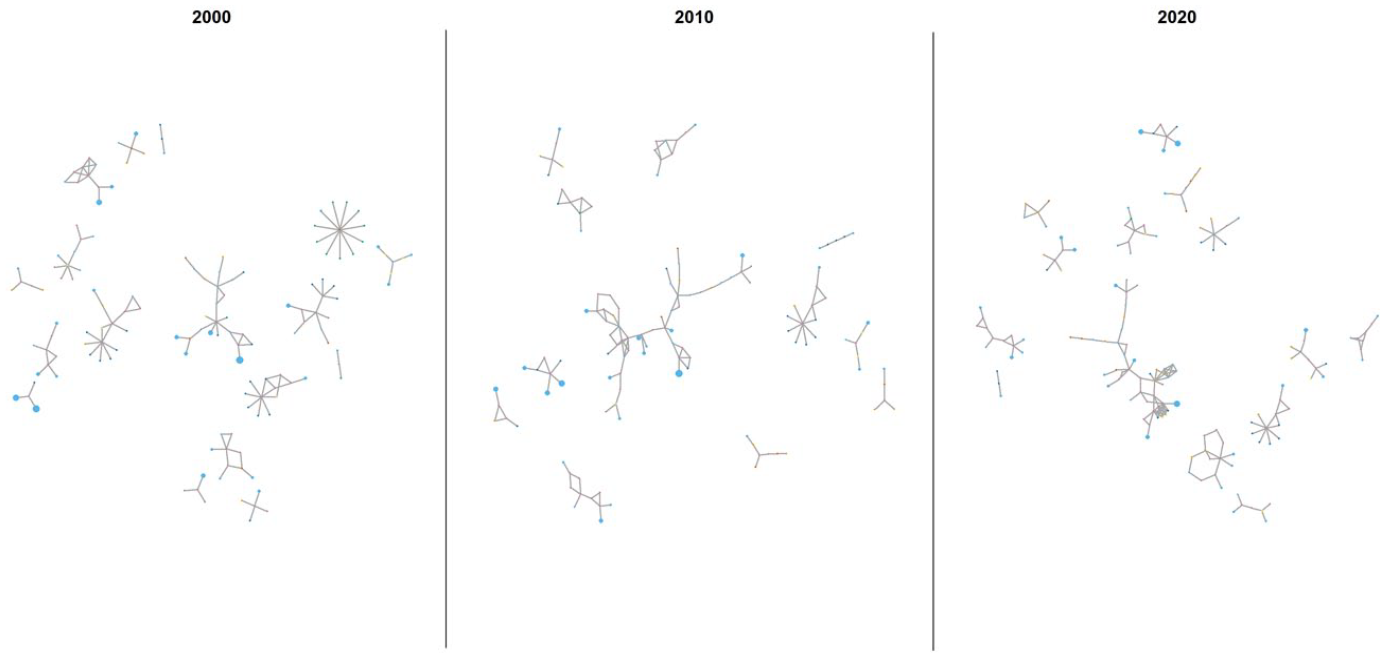
Austria media network 2000–2020.
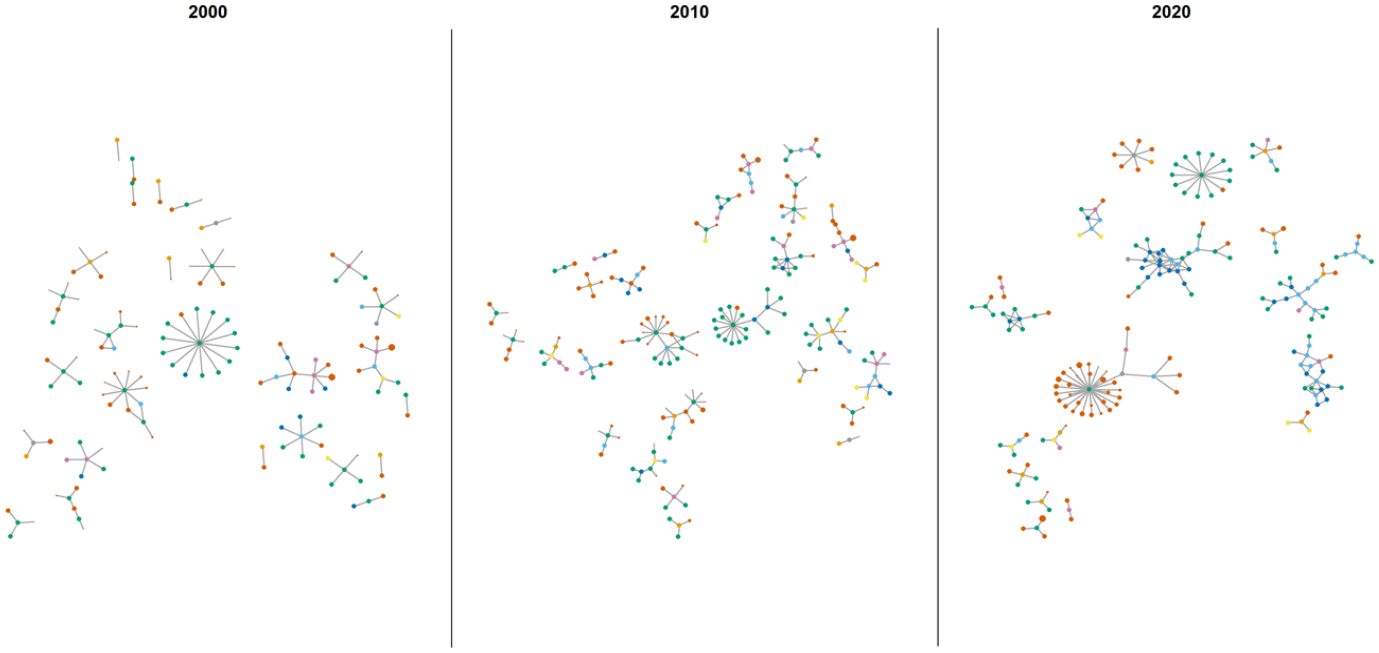
Hungary media network 2000–2020.
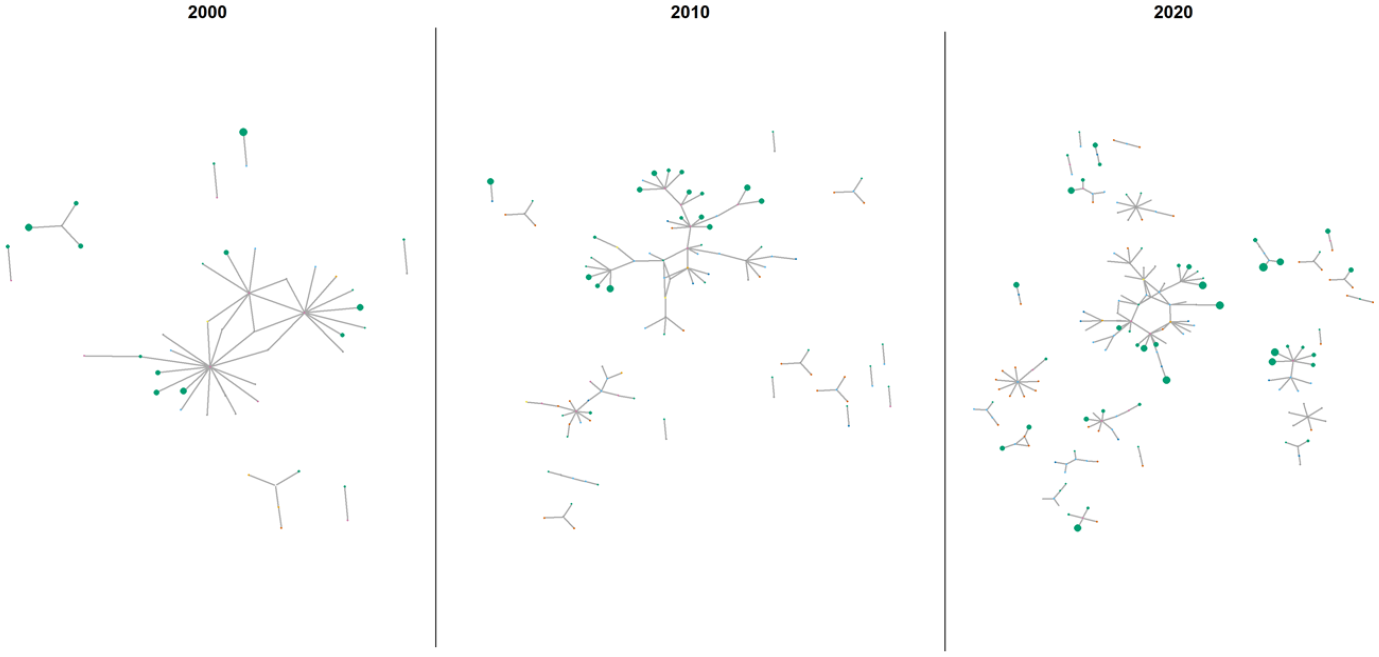
Slovenia media network 2000–2020.
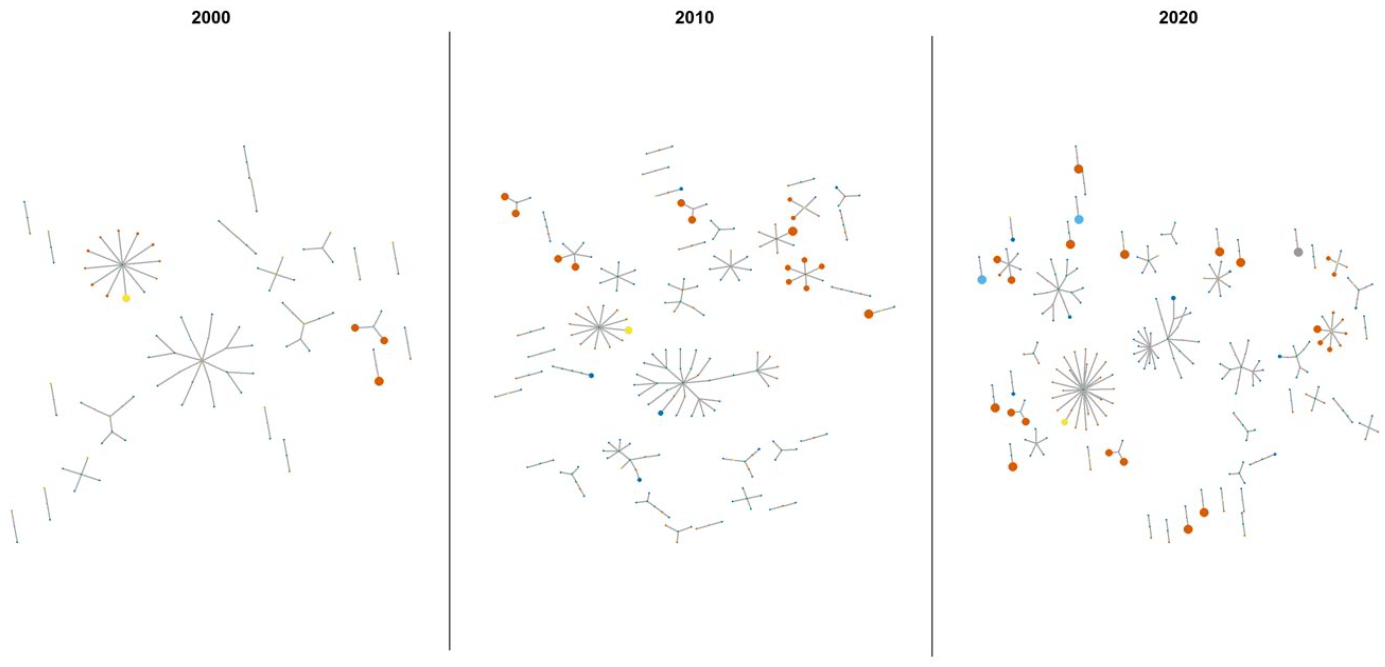
Turkey media network 2000–2020.
The size of the largest component (Figure 5) – that is, the largest connected sub-network – increased in all cases between 2000 and 2010, although in Austria and Turkey it then declines during the decade to 2020. In Hungary and Slovenia, the size of the largest component has increased throughout the period (in Slovenia from 31 nodes in 2000, to 52 in 2010 and 2020; in Hungary from 15 nodes in 2000 to 20 in 2010 and 37 in 2020).
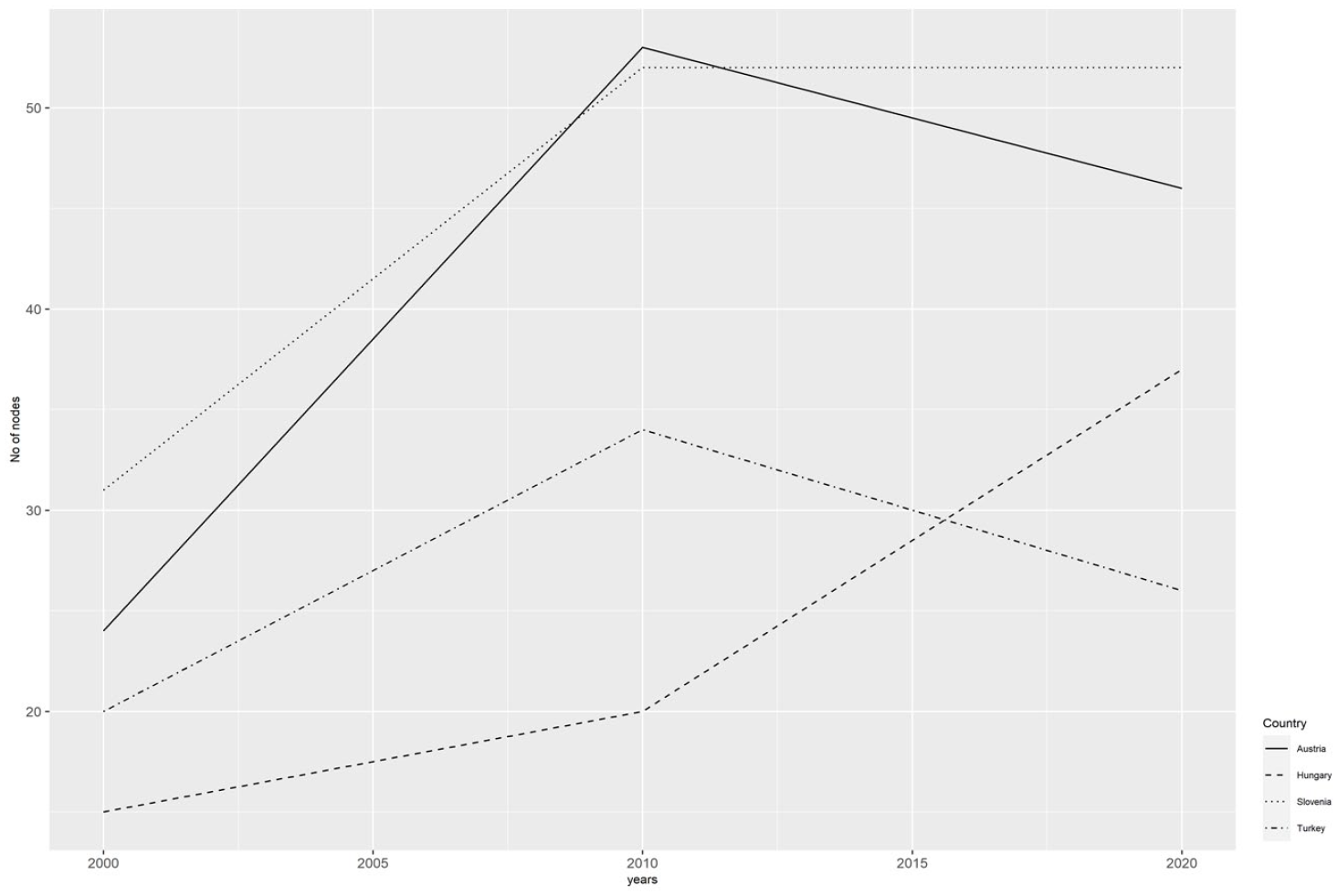
Size of largest component 2000–2020.
The number of components (Figure 6) has decreased in Austria from 17 to 12 between 2000 and 2010, but then rebound to 18 by 2020. In Hungary the number of components first increased (from 28 to 29) then declined to 20, while it increased in Slovenia from 8 in 2000 to 16 in 2010 and 25 in 2020 and in Turkey from 22 in 2000 to 38 in 2010 and 46 in 2020. Prima facie, this may indicate an increased media diversity in the latter two countries, but increased concentration in Hungary, with Austria showing a trend toward concentration in the first decade, but then an increase in diversity in the second.
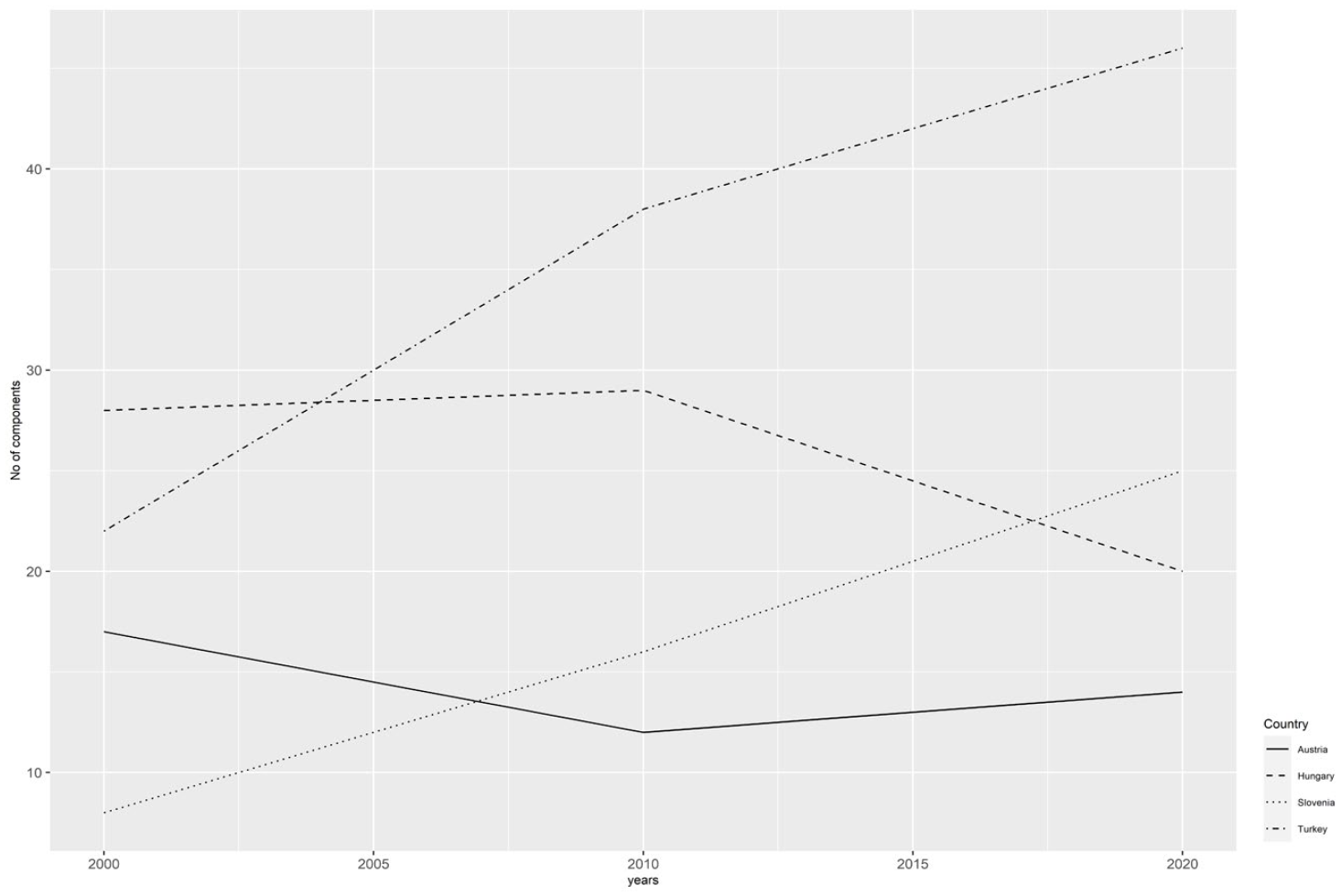
Number of components 2000–2020.
Turning to the percentage of marginal nodes – that is, nodes with only one or two connections –, all countries except Turkey have seen a decrease in marginal nodes, albeit to different degrees and from different starting points. The highest level of marginal nodes was observed in Slovenia in 2000 (88%), which declined to 82% in 2020. We find the lowest level of they in Austria where they declined from 73% in 2000, to 68% in 2010, and 67% in 2020. Hungary falls in between, seeing a decline from 85% of marginals to 79% in 2010 and 74% in 2020. In Turkey the number of marginal nodes has remained relatively stable varying between 88% in 2000 and 2010 and 89% in 2020. Marginality may indicate independence from central nodes. Therefore, the trend toward fewer marginal nodes that we observe in all countries may provide an indicator of increased network integration and hence an increase in the dominance of central nodes over information diffusion.
Mean degree
Next, we turned to investigating more sophisticated measure of network integration, most importantly measures of connectivity. We computed the mean degree (defined as average number of ties of each node) for each network and year (Figure 7). Here the trends vary across countries. While Austria and Hungary have experienced a steady increase in network connectivity from 2000 to 2020, Turkey and Slovenia saw relative stability of the number of ties especially between 2010 and 2020. In terms of absolute levels, the number of ties per node is higher in the smaller sample countries than in Turkey, which is a larger media market. This is a plausible pattern, as larger networks with more nodes, tend to be sparser. Taken together, the connectivity measure can be interpreted as hinting at a progressively more strongly connected networks in Austria and Hungary, but not in Slovenia and Turkey.
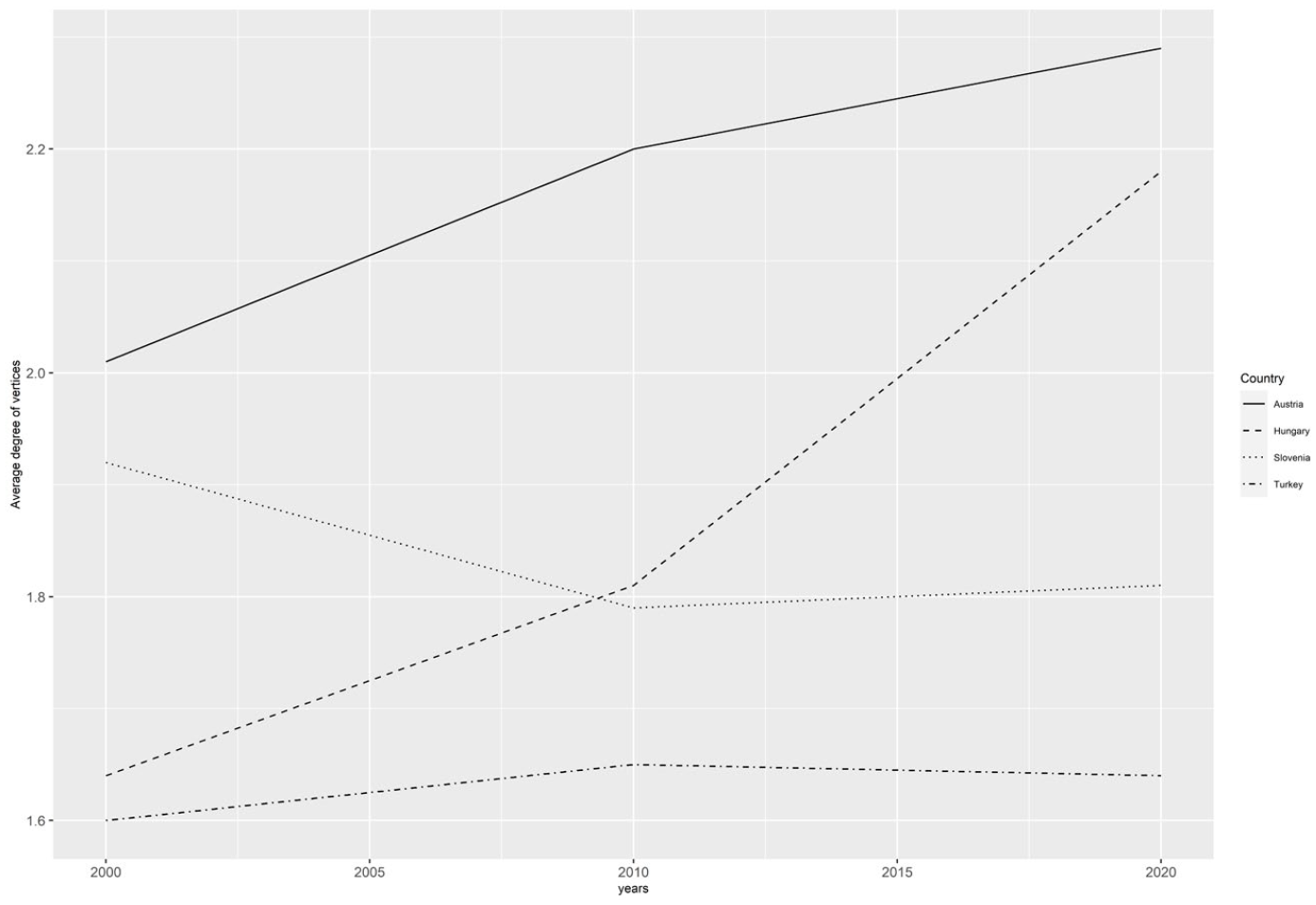
Mean degree 2000–2020.
Assortativity: eigenvector centralization
So far, we have provided basic measurements of the network structure over time. The trend seems to be toward more complex networks with more nodes and more connections. In order to investigate in more detail whether media ownership structures have changed in a way that may affect their conduciveness to authoritarian populist dominance, we apply the approach proposed by Bienenstock and Bonacich (2022).
We first computed the Eigenvector centralization scores for each network. The results reported in Figure 8 shows that between 2000 and 2010, eigenvector centralization was relatively stable (Austria, Hungary, and Turkey), or even decreased markedly in Slovenia. By 2020, however, eigenvector centralization increased in all countries. Most dramatically in Hungary, but also in Austria and Turkey, which by 2020 reached much higher levels of eigenvector centralization than in the previous decades. The increase between 2010 and 2020 was weakest in Slovenia, remaining at a lower level than it was in 2000.
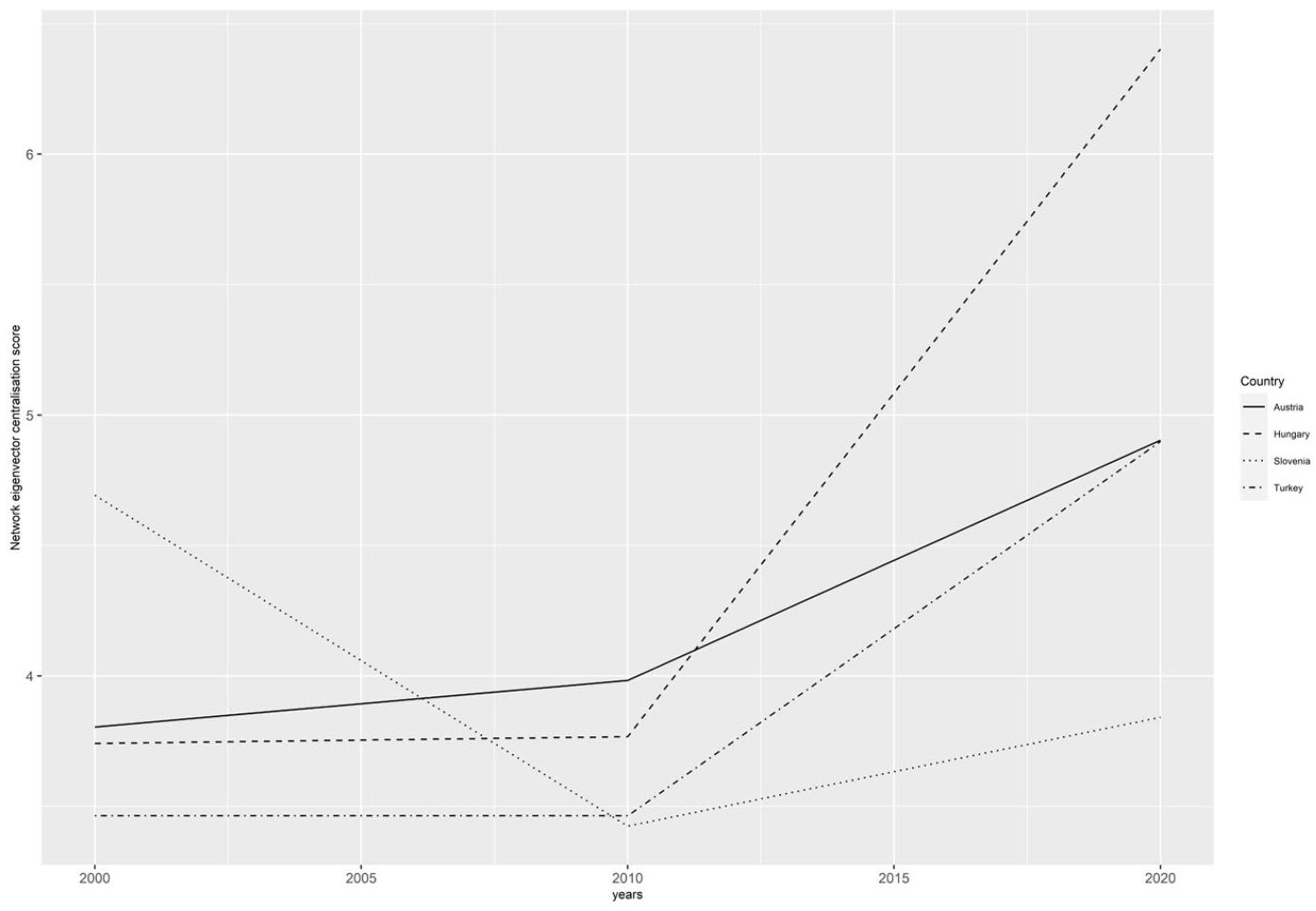
Eigenvector centralization 2000–2020.
The relatively strong changes in scores are most likely caused by the entry of a new type of outlets – online news outlets – which initially may have disrupted the existing structure in the media network, making it more “equal” in terms of core-periphery structure in some cases (Slovenia). Yet, over the next decade, in all cases, the networks have markedly increased in assortativity, which is compatible with the interpretation that the core has consolidated, and more peripheral regions have become less well connected. This may reflect the integration of online outlets into existing media groups. It is interesting to note, however, that the different levels at which disruption and reintegration have taken place. Indeed, in the Austrian, Hungarian, and Turkish cases, the core-periphery division only emerged in the last decade, while in Slovenia, the disruption caused by online media led to lower levels of inequality between the core and the periphery in 2020 than in 2000.
These results indicate that the media landscapes in all four countries are characterized by the emergence of a pronounced core-periphery structure over the past two decades, despite a general trend toward an increase in the number of outlets that people can access.
Discussion and conclusions
Drawing on an extensive body of media literature that highlights the political significance of media ownership (e.g., Bagdikian, 2004; Baker, 2007; Freedman, 2014; McChesney, 1997, 2015; Meier, 2007; Mosco, 2009) in this study we conceptualized news media ownership structures to be particularly conducive to the rise and endurance of authoritarian populism, if they are (a) highly concentrated and (b) likely to marginalize peripheral media owners in a given mediascape. Such structures lend themselves to reinforce the messages emanating from the most central actors and drowning out less central ones. Our research suggests that both these trends have been at work over the past two decades in the four countries studied.
First, the use of measures of the informational effects of network structures suggests that connectivity – measured as mean degree – has evolved in somewhat different ways in Austria and Hungary, where a strong increase in number of connections has taken place, than in Slovenia – where the increase was more limited – and Turkey, where we observe a mostly flat line at a lower level. Yet, in terms of assortativity (measured as eigenvector centralization, Figure 8) and hence the dominance of central nodes over peripheral ones, in all countries network structures hint at an increase between 2010 and 2020. This implies that the most central nodes in the network may increase their control over the message content that are diffused through the media network. This is indicated by the increase in assortativity in virtually all cases as well as by the decline in marginal nodes, potentially describing a dynamic of “drowning out dissenting voices.” The decline in marginal nodes could thus point to a reduction in the range of voices and opinions as well as restricted exchange of competing perspectives within the studied mediascapes. In this context, it is interesting to note the evolutions in Hungary and Turkey – our two strongest cases of right-wing populism where as the increase in core-periphery inequality is largest compared to the situation in 2000. In Austria an increase has taken place as well, but is less steep than in the other two countries. In comparison, in Slovenia we observe first a decline then a rebound, but to a lower level than in 2000. This difference may hint at the fact that strong increases in core-periphery structures go beyond the simple result of the increasing integration of online sources into the mediascapes. While we cannot directly prove strategic intentionality by populist governments, the patterns we observe are consistent with such an interpretation.
Second, despite a presumably general trend toward more diversity and a larger number of media outlets due to the emergence of increasing numbers of private channels and online sources, the networks became more connected in Austria, Hungary, and (to a lesser extent) in Turkey between 2000 and 2020. Only in Slovenia did the network connectivity decline between 2000 and 2020 (Figure 7). From a purely graph theoretical point of view this finding is counter-intuitive, because the entry of new nodes would in general lead to more dispersed networks, as large networks tend to have proportionately fewer ties amongst nodes (Scott, 2017). Thus, we suggest that under political conditions of authoritarian-populism, highly concentrated media ownership structures indicate the ever-stronger connections between economic, political, and media elites potentially preventing the media’s “watchdog” function and enhancing clientelist media-policy relations.
Our study reveals that media ownership structures in all four countries have evolved to provide favorable conditions for authoritarian populist communication. Yet, given Hungary and Turkey’s reputations as extreme cases of authoritarian populism, one might expect the media ownership markets of these two states to be fully concentrated and government-controlled. However, our results show that some form of pluralism in media ownership persists. Thus, the number of components in the networks does not dramatically decline and the size of the largest components does not dramatically increase in any of our countries. In a more extreme case of “Gleichschaltung” of the media, one could have expected a stronger concentration of ownership – in the extreme the disappearance of all but one component controlled by a single owner. The fact that in all countries different components persist may indicate that there are still several media groups present in the country that are formally independent from each other at least when looking at ownership. Indeed, the fact that ownership networks are not fully connected may indicate not only that these regimes have not yet completely succumbed to authoritarianism, but also is in line with the idea that modern authoritarian regimes function differently than authoritarian regimes from previous historical periods. They may not strive to completely abolish institutions of a democratic public sphere but seek to maintain a semblance of democratic competition and can thus be qualified as ‘competitive authoritarianism’ (Levitsky and Way, 2002). Yet, by using more sophisticated measures of core-periphery structures such as Eigenvector centralization scores, our study also shows that complete ownership control may not be necessary for right-wing authoritarians to achieve the intended dominance over public discourse. Graph theory and social network analysis suggest that the strong assortativity – especially in the Hungarian and Turkish cases – may be sufficient to largely drown out dissenting voices; or rather, such structures allow right-wing populists to keep dissenting voices at a level that still allows populists to claim that they respect media freedom, while letting some critical voices persist that can also serve the divisive populist strategy of creating internal enemies, all the while not jeopardising the populists’ control over the media content. As Bruff (2014: 115) puts it recalling Hall’s work on authoritarian populism: “Authoritarianism can also be observed in the reconfiguring of state and institutional power in an attempt to insulate certain policies and institutional practices from social and political dissent.” The consolidation and conflation of political and economic power, for example, in the form of media ownership concentration, signals such authoritarian restructuration. that maintains a semblance of pluralism, but de facto assures the government of control over the mediascape
Although the network analysis per se does not allow us to draw any direct conclusions regarding the intentionality behind the structural changes or their impact on actual media pluralism and discourse, some anecdotal evidence may help to interpret our findings in that respect, as we observe significant variations between the two moderate cases and the two strong cases of populist domination, when it comes to how populists make use of these structures.
In Austria, populist plans to take over shares of the country’s most important tabloid paper were disclosed in the so-called “Ibiza-scandal.” Moreover, fierce attempts to control information flows, allegedly including manipulated opinion polls published in tabloid media supporting ex-Chancellor Kurz, signal what Wodak (2022: 799) called the “shameless normalization of far-right agendas” in Austria. Similar endeavors shape the Slovenian case, where the Janša government exhibited fierce control over the media by adapting media law to serve the party interests, influencing governing boards, limiting finances, reviewing and criticizing the press, or publicly denouncing and insulting journalists (Splichal, 2020). A distorted understanding of media pluralism has pushed Janša to praise and financially support own party media, turning independent media into enemies of “the people.”
The cases of Austria and Slovenia may exemplify how authoritarian populists strive to control the media landscape in economic and structural terms. However, in both cases their control over governmental power has been relatively short-lived and intermittent. The cases of Hungary and Turkey make plausible a clear link between the endurance of the regime and the increasing concentration of ownership structures. Orbán and Erdogan have not only been able to capitalize on concentrated media ownership structures but also actively sought to redesign the mediascape to have full information control throughout their time in office. In Hungary, almost 80% of the entire news and public affairs segment of the media industry is part of the pro-Fidesz portfolio (Mérték, 2019), whilst in Turkey 90% of the mediascape is said to be controlled by politically loyal business groups (White, 2018). This excessive level of concentration where the communicative power is concentrated in the hands of politically loyal media elites transform the mediascape into a grand echo-chamber serving for Orbánism and Erdoganism. Fidesz-affiliated media outlets (mostly regional but also national ones) have been known, for example, to publish identical headlines and content both in print and online (Rényi, 2019). This has been made possible by Orbán’s “strategy aiming at extracting from the media resources such as airtime, frequencies, positions and money, and channeling them to party loyalists in order to reward them for various services” (Bajomi-Lázár, 2013: 76). Similarly, Erdogan used all punitive and rewarding mechanisms available to punish the adversarial media owners (such as tax fines or by way of the judicial system) and rewarded the loyal media owners through mobilizing state resources for their financial rents. As a result, the most popular outlets, regardless of whether they are owned by the same owners, serve for Erdoganism by often producing, circulating, and multiplying the same affirmative messages (Çelik, 2020b).
While we provide important evidence in this study that media ownership structures have evolved favorable for authoritarian politics in Austria, Hungary, Slovenia, and Turkey, future studies will have to look more closely into deliberate strategies, motives, and techniques of distinct actors to reconfigure media ownership. As news media ownership concentration is a global trend (Noam, 2016), researcher should pay more attention to national political contexts in terms of the driving forces of media concentration. Moreover, as our data merely captures formal ownership relations, disregarding informal ties such as political or familial affiliations, further research is needed to qualitatively uncover informal ties between media owners and authoritarian populists as well as editorial consequences of these affiliations. Ultimately, due to the inclusion criterion of 3% national net-reach, our results are likely to underestimate levels of news media ownership concentration that play out on regional (outlet) level. Thus, we see ample need for further developing innovative methods capable of examining media ownership (concentration) in a multi-level and cross-media information environment, which is permeated by political interests. Social Network Analysis constitutes a promising tool to further this agenda.
Supplemental Material
sj-docx-1-mcs-10.1177_01634437231179366 – Supplemental material for Theorizing and mapping media ownership networks in authoritarian-populist contexts: a comparative analysis of Austria, Hungary, Slovenia, and Turkey
Supplemental material, sj-docx-1-mcs-10.1177_01634437231179366 for Theorizing and mapping media ownership networks in authoritarian-populist contexts: a comparative analysis of Austria, Hungary, Slovenia, and Turkey by Gerhard Schnyder, Marlene Radl, Fanni Toth, Melek Kucukuzun, Tjaša Turnšek, Burçe Çelik and Mojca Pajnik in Media, Culture & Society
Supplemental Material
sj-tiff-10-mcs-10.1177_01634437231179366 – Supplemental material for Theorizing and mapping media ownership networks in authoritarian-populist contexts: a comparative analysis of Austria, Hungary, Slovenia, and Turkey
Supplemental material, sj-tiff-10-mcs-10.1177_01634437231179366 for Theorizing and mapping media ownership networks in authoritarian-populist contexts: a comparative analysis of Austria, Hungary, Slovenia, and Turkey by Gerhard Schnyder, Marlene Radl, Fanni Toth, Melek Kucukuzun, Tjaša Turnšek, Burçe Çelik and Mojca Pajnik in Media, Culture & Society
Supplemental Material
sj-tiff-11-mcs-10.1177_01634437231179366 – Supplemental material for Theorizing and mapping media ownership networks in authoritarian-populist contexts: a comparative analysis of Austria, Hungary, Slovenia, and Turkey
Supplemental material, sj-tiff-11-mcs-10.1177_01634437231179366 for Theorizing and mapping media ownership networks in authoritarian-populist contexts: a comparative analysis of Austria, Hungary, Slovenia, and Turkey by Gerhard Schnyder, Marlene Radl, Fanni Toth, Melek Kucukuzun, Tjaša Turnšek, Burçe Çelik and Mojca Pajnik in Media, Culture & Society
Supplemental Material
sj-tiff-12-mcs-10.1177_01634437231179366 – Supplemental material for Theorizing and mapping media ownership networks in authoritarian-populist contexts: a comparative analysis of Austria, Hungary, Slovenia, and Turkey
Supplemental material, sj-tiff-12-mcs-10.1177_01634437231179366 for Theorizing and mapping media ownership networks in authoritarian-populist contexts: a comparative analysis of Austria, Hungary, Slovenia, and Turkey by Gerhard Schnyder, Marlene Radl, Fanni Toth, Melek Kucukuzun, Tjaša Turnšek, Burçe Çelik and Mojca Pajnik in Media, Culture & Society
Supplemental Material
sj-tiff-13-mcs-10.1177_01634437231179366 – Supplemental material for Theorizing and mapping media ownership networks in authoritarian-populist contexts: a comparative analysis of Austria, Hungary, Slovenia, and Turkey
Supplemental material, sj-tiff-13-mcs-10.1177_01634437231179366 for Theorizing and mapping media ownership networks in authoritarian-populist contexts: a comparative analysis of Austria, Hungary, Slovenia, and Turkey by Gerhard Schnyder, Marlene Radl, Fanni Toth, Melek Kucukuzun, Tjaša Turnšek, Burçe Çelik and Mojca Pajnik in Media, Culture & Society
Supplemental Material
sj-tiff-2-mcs-10.1177_01634437231179366 – Supplemental material for Theorizing and mapping media ownership networks in authoritarian-populist contexts: a comparative analysis of Austria, Hungary, Slovenia, and Turkey
Supplemental material, sj-tiff-2-mcs-10.1177_01634437231179366 for Theorizing and mapping media ownership networks in authoritarian-populist contexts: a comparative analysis of Austria, Hungary, Slovenia, and Turkey by Gerhard Schnyder, Marlene Radl, Fanni Toth, Melek Kucukuzun, Tjaša Turnšek, Burçe Çelik and Mojca Pajnik in Media, Culture & Society
Supplemental Material
sj-tiff-3-mcs-10.1177_01634437231179366 – Supplemental material for Theorizing and mapping media ownership networks in authoritarian-populist contexts: a comparative analysis of Austria, Hungary, Slovenia, and Turkey
Supplemental material, sj-tiff-3-mcs-10.1177_01634437231179366 for Theorizing and mapping media ownership networks in authoritarian-populist contexts: a comparative analysis of Austria, Hungary, Slovenia, and Turkey by Gerhard Schnyder, Marlene Radl, Fanni Toth, Melek Kucukuzun, Tjaša Turnšek, Burçe Çelik and Mojca Pajnik in Media, Culture & Society
Supplemental Material
sj-tiff-4-mcs-10.1177_01634437231179366 – Supplemental material for Theorizing and mapping media ownership networks in authoritarian-populist contexts: a comparative analysis of Austria, Hungary, Slovenia, and Turkey
Supplemental material, sj-tiff-4-mcs-10.1177_01634437231179366 for Theorizing and mapping media ownership networks in authoritarian-populist contexts: a comparative analysis of Austria, Hungary, Slovenia, and Turkey by Gerhard Schnyder, Marlene Radl, Fanni Toth, Melek Kucukuzun, Tjaša Turnšek, Burçe Çelik and Mojca Pajnik in Media, Culture & Society
Supplemental Material
sj-tiff-5-mcs-10.1177_01634437231179366 – Supplemental material for Theorizing and mapping media ownership networks in authoritarian-populist contexts: a comparative analysis of Austria, Hungary, Slovenia, and Turkey
Supplemental material, sj-tiff-5-mcs-10.1177_01634437231179366 for Theorizing and mapping media ownership networks in authoritarian-populist contexts: a comparative analysis of Austria, Hungary, Slovenia, and Turkey by Gerhard Schnyder, Marlene Radl, Fanni Toth, Melek Kucukuzun, Tjaša Turnšek, Burçe Çelik and Mojca Pajnik in Media, Culture & Society
Supplemental Material
sj-tiff-6-mcs-10.1177_01634437231179366 – Supplemental material for Theorizing and mapping media ownership networks in authoritarian-populist contexts: a comparative analysis of Austria, Hungary, Slovenia, and Turkey
Supplemental material, sj-tiff-6-mcs-10.1177_01634437231179366 for Theorizing and mapping media ownership networks in authoritarian-populist contexts: a comparative analysis of Austria, Hungary, Slovenia, and Turkey by Gerhard Schnyder, Marlene Radl, Fanni Toth, Melek Kucukuzun, Tjaša Turnšek, Burçe Çelik and Mojca Pajnik in Media, Culture & Society
Supplemental Material
sj-tiff-7-mcs-10.1177_01634437231179366 – Supplemental material for Theorizing and mapping media ownership networks in authoritarian-populist contexts: a comparative analysis of Austria, Hungary, Slovenia, and Turkey
Supplemental material, sj-tiff-7-mcs-10.1177_01634437231179366 for Theorizing and mapping media ownership networks in authoritarian-populist contexts: a comparative analysis of Austria, Hungary, Slovenia, and Turkey by Gerhard Schnyder, Marlene Radl, Fanni Toth, Melek Kucukuzun, Tjaša Turnšek, Burçe Çelik and Mojca Pajnik in Media, Culture & Society
Supplemental Material
sj-tiff-8-mcs-10.1177_01634437231179366 – Supplemental material for Theorizing and mapping media ownership networks in authoritarian-populist contexts: a comparative analysis of Austria, Hungary, Slovenia, and Turkey
Supplemental material, sj-tiff-8-mcs-10.1177_01634437231179366 for Theorizing and mapping media ownership networks in authoritarian-populist contexts: a comparative analysis of Austria, Hungary, Slovenia, and Turkey by Gerhard Schnyder, Marlene Radl, Fanni Toth, Melek Kucukuzun, Tjaša Turnšek, Burçe Çelik and Mojca Pajnik in Media, Culture & Society
Supplemental Material
sj-tiff-9-mcs-10.1177_01634437231179366 – Supplemental material for Theorizing and mapping media ownership networks in authoritarian-populist contexts: a comparative analysis of Austria, Hungary, Slovenia, and Turkey
Supplemental material, sj-tiff-9-mcs-10.1177_01634437231179366 for Theorizing and mapping media ownership networks in authoritarian-populist contexts: a comparative analysis of Austria, Hungary, Slovenia, and Turkey by Gerhard Schnyder, Marlene Radl, Fanni Toth, Melek Kucukuzun, Tjaša Turnšek, Burçe Çelik and Mojca Pajnik in Media, Culture & Society
Footnotes
Acknowledgements
The authors would like to thank Compass-Verlag for providing access to the Austrian Business Register. For useful comments and guidance, the authors are grateful to the editors and the anonymous reviewers, Birgit Sauer and Marko Ribać from the POPBACK project, as well as to participants in the “Media and the Illiberal Turn” conference organized by Sabina Mihelj and Václav Štětka at Loughborough University. Special thanks to Matthew Smith (Edinburgh Napier University) for advice and discussions about the application of Social Network Analysis to multimodal data and to Thomas Corrigan (California State University, San Bernardino) for suggesting the critical realist lens to us at the 2022 IAMCR conference.
Funding
The authors disclosed receipt of the following financial support for the research, authorship, and/or publication of this article: This work was supported by the NORFACE-funded research program “Democratic governance in a turbulent age (Governance)” grant no. 462-19-080 (POPBACK project) supported in Austria by the Austrian Science Fund (FWF), project no. I 4820, in Slovenia by the Slovenian Research Agency (ARSS), project no. H5-8288, and in the UK by the Economic and Social Research Council (ESRC).

Supplemental material
Supplemental material for this article is available online.
Notes
References
Supplementary Material
Please find the following supplemental material available below.
For Open Access articles published under a Creative Commons License, all supplemental material carries the same license as the article it is associated with.
For non-Open Access articles published, all supplemental material carries a non-exclusive license, and permission requests for re-use of supplemental material or any part of supplemental material shall be sent directly to the copyright owner as specified in the copyright notice associated with the article.
