




Abstract
This paper focuses on the radio’s novelty years in 1920s Turkey to examine how the functions of wireless technology as a material artifact are negotiated in ways that fashion a national auditory. Most studies on radio’s history prioritize sound, eliding people’s tinkering with the wireless as a technical object. Based on archival research and oral history interviews, I suggest that early radio as a material object required as much of its listeners’ attention as did the broadcast content. In young Turkey’s war-torn economy, the only affordable way to listen to radio was learning how to assemble a receiver. Few owners of manufactured radios also learnt how to fix frequent problems. To form a passive national auditory, the state monitored the cultivation of these technical skills by banning transmitter-construction while encouraging assembling/fixing receivers. In addition to the body’s visceral/affective capacities, then, nation-states also discipline technical skills while forming a national auditory.
Introduction
In their initial years, new technologies go through a phase of instability as their meanings and functions “are worked out over time” in the context of cultural, political, and economic transformations (Gitelman, 2006; Larkin, 2008: 3; Stöber, 2004). In its novelty years in the early 1900s, the radio has gone through a similar phase of instability before it was normalized as a medium of broadcasting. Naming the device as wireless telegraphy, in the beginning, the inventors and the proponents considered it a technology for two-way communication (Butsch, 1998) that eliminated “the most expensive component of telegraphic networks,” the wires and the cables (Balbi and Natale, 2015: 29). A group named radio amateurs emerged in this context of “epistemic instability” (Larkin, 2008) and enjoyed tinkering with this new medium by assembling their own transmitters and receivers (Sawhney and Lee, 2005). In time, radio is globally stabilized as a broadcast technology while radio amateurship continued its existence as a separate domain of communication. When examining radio’s history, most scholarly accounts discard the instability phase of the wireless technology and mimic this separation by focusing on the course of either radio amateurship or radio broadcasting in various cultural, political, and economic contexts. Such a separation, I argue, prioritizes aurality or sound in the history of radio broadcasting (Biocca, 1988; Cardiff, 1980; Lacey, 1994) in a way that renders the ear as the primary addressee of this new medium. By exploring radio’s novelty years in Turkey in the 1920s and the 1930s, in this paper, I suggest that early radio listeners’ engagements with this technology did not only involve ear but also hands and technical skills since tinkering with early radio devices was a necessity in that era beyond amateurship.
The success of the wireless transmission in the early days of this technology in part depended on listeners’ technical knowledge to assemble, repair, and adjust their own wireless receivers and radio sets. In Turkey, manufactured radio devices in the 1920s and the 1930s were most of the time too expensive for people to afford so for many, listening to the broadcasts was only possible if they assembled simple radio receivers. Many people, either through magazines or through their neighbors, learnt basic technical skills about how to put together receivers with small budgets. Moreover, even for the listeners who were among the few people owning a manufactured radio device, radio carried both signal and noise and the devices broke down as often as they worked due to the technical incapacities of the early radio technology. Radio listeners needed some technical knowledge about how to adjust their antennas to receive a clearer signal, how to assess and fix simple problems such as burnt lamps, or how to prevent small accidents such as electrical leakage. Hence, contrary to the contemporary image of the radio listener who forgets the device while being immersed in the sound, early radio listeners constantly tinkered with the device – either by assembling, repairing, or adjusting – so as to be able to continue hearing radio sounds. Unlike what Friedrich Kittler observes for the later days of radio, in its early days, radio was not “understood as always already there, like ‘water from a tap’, a naturalized convenience and absent to consciousness” (Fisher, 2015: 155).
When examining radio’s novelty years, one, therefore, needs to focus on the radio as a material artifact because with its scarce availability and insufficient sound transmission capacity, the wireless as a material object required as much of its listeners’ attention as did the broadcast content. In this paper, instead of examining sounds or voices circulating on the radio, I explore legal and socio-political processes through which the meanings and functions attached to the wireless technology as a material artifact “are worked out” (Larkin, 2008) in Turkey in the initial years of this technology. Radio’s normalization in Turkey took place in a period of nation-state formation after the demise of the Ottoman Empire. Since both the new nation and the new technology were part of a process of construction, adjustment, and contention, I, therefore, examine these legal and socio-political processes to understand how a nation-state in the making informs the ways that “people structure beliefs around” what technological objects can and should do (Dunbar-Hester, 2014: xii) and how these beliefs help fashion a national auditory.
Radio’s initial years were critical for negotiating the symbolic meanings of the wireless technology’s material components in ways that would not threaten the sovereignty of the new nation-state. The founders of the Turkish Republic supported the launch of the first radio station in Turkey in 1927, 4 years after the establishment of the nation-state in 1923. The foundation of the radio station accelerated the circulation of technical knowledge about the wireless that steered the anxieties of the state elites. Since the wireless allowed individuals not only to receive but also to send signals, the officials aimed to have a strict control over who would have access to sending messages. Through legal regulations, the state established a monopoly over the use and construction of transmitters that officially reduced the wireless into a one-way broadcast medium. This ban legally enforced a distinction between the receivers and the transmitters – a distinction that informed the contrasting ways the public made sense of these two media tools. Whereas public accounts in the 1920s depicted transmitters as uncanny objects built by experts and used by trained people, they portrayed receivers as easy for everyone to assemble and use. This legally enforced and socially reproduced distinction between the receivers and the transmitters worked to regulate the public’s approach to transmitters in a way that partly created the community of national listeners well equipped to receive – and only to receive – official signals in Turkey in the post-1937 period.
Shifting the analytical focus from the voices on the radio to the wireless as a technical object is crucial to highlight how the formation of the nation-states requires controlling not only citizens’ listening habits but also their technical knowledge and skills. Most research on the radio and the nation-state pays attention to how sounds or voices on the radio either affirm or contest the discursive and affective space constructed by the colonial states or postcolonial nation-states (Fanon, 1965; Hirschkind, 2008; Neiger et al., 2011; O’Sullivan, 2005; Spitulnik, 1994). Resonating with this approach, the scholarship on Turkey’s radio history also explores the content of the radio broadcasts and concludes that in its initial years radio was mostly received as a medium for entertainment than a tool to discipline citizens into the terms of nationalist modernization (Ahıska, 2005; Kocabaşoğlu, 2010). By paying attention to how people engaged materially with radio, I, however, suggest that these years were in fact critical in Turkey for the formation of a national auditory as it helped equip the public with tools (i.e. receivers) and skills necessary to receive official messages later when the government launched a state-owned radio station in 1937 as a tool to imagine the Turkish nation. Symbolic descriptions of transmitters in this era worked to limit honing of these technical skills to the realm of receiver-assemblage, preventing citizens to disturb the state-controlled nature of the national soundscape by rendering them proper receivers of official messages.
If fashioning a national auditory is partly a process of producing listening as an act of passive receptivity, wireless technology’s novelty years in Turkey, therefore, show that monitoring the circulation of technical knowledge and controlling the cultivation of technical skills is an essential part of producing such passivity. In order to discipline people’s mode of listening or their listening practices, as Hirschkind (2008: 26) shows, it is crucial to understand that listening is more than just a cognitive act as there are styles of listening that “recruit the body in its entirety” through its visceral and affective dimensions. The case of the wireless’ technology’s early days adds another layer to this bodily engagement by highlighting the practice of tinkering with the receivers and transmitters as material objects. Regulating the discursive and affective dimensions of such bodily involvement with technology through tinkering – or how people “acted on” (Kubitschko, 2018) the wireless mostly through fine motor skills – emerges as a way of crafting passive modes of listening essential to form a national auditory. Legal regulations and public accounts about transmitters and receivers in the early republican Turkey in part worked to regulate such discursive and affective dimensions of tinkering with a new medium whose course had yet to be determined.
In order to address these points and questions, I follow “the paper trail” (Sterne, 2003: 12) left by the wireless technology in Turkey and base my analysis on archival research at major newspapers, such as Cumhuriyet (Republic) and Milliyet (Nationality), and radio periodicals that were published in the 1920s and 1930s, such as Telsiz (Wireless), Radyo Amatör (Radio Amateur), Ses (Sound), Radyo Programı (Radio Program). I also examine oral history interviews with people who were radio amateurs in the 1940s, 1950s, and 1960s. Among the radio magazines, Telsiz or Wireless, has a special place in my analysis since as one of the first radio magazines published in 18 issues between June and November 1927, it is an important witness to Turkey’s early encounter with the wireless technology. The editorial line in this magazine about the type of technical information to be circulated is repeated by other radio magazines published later in the 1930s.
Assembling receivers: constructing the national radio audience
The historical course through which radio or wireless technology has been normalized in Turkey as a broadcast medium reflects the Turkish state elites’ aspirations as well as anxieties in a newly founded nation-state, the dire situation of a public trying to make ends meet in a war-torn economy, and the unsettled nature of a new communication device whose functions were yet to be determined. The Turkish Republic was founded in 1923, after the demise of the Ottoman Empire, amid contestations among multiple groups struggling to have an influence over the newly established nation-state. Although Mustafa Kemal with his People’s Republican Party (Cumhuriyet Halk Partisi) was the leader of the new nation-state, this leadership was not without contestation. There were resistances to his rule, such as the cliques within the People’s Party who were critical of Mustafa Kemal’s top-down attitude, and the Kurdish groups in eastern Turkey whose discomfort with the new state culminated in the Sheikh Said Rebellion in 1925. In fact, this rebellion created a ground to pass a law on the maintenance of order, named the law of Takrir-i Sükun (Zürcher, 1993). Between 1925 and 1929, the government had the right under this law to ban any organization or publication that disturbed the public order. Before Takrir-i Sükun, in 1924 the government had passed the law regulating the telegraphy, telephone, and wireless communication that established a state monopoly over the use and construction of transmitters (İlaslan, 2017).
It was during these Takrir-i Sükun years, which fortified the authority of the single party in Turkey, the government gave the right to carry out wireless broadcast to a private company in 1927, namely the Turkish Wireless Telephone Company (Türk Telsiz Telefon Anonim Şirketi hereafter with its Turkish acronym, TTTAŞ) for 10 years, until 1937. With the permission of the government, the company established Turkey’s first radio station in 1927. Although TTTAŞ was a private company, it was heavily subsidized by the state. Seventy percent of its initial budget came from state institutions, with the remaining 30% from individual entrepreneurs who were close to the state (Kocabaşoğlu, 2010). The government also had the right to surveil the program content by appointing commissars (komser) who were responsible for inspecting the programs (Kocabaşoğlu, 2010).
Despite such control mechanisms that were in place, during the 10 years in which the company was active, radio was not considered to be the voice of the nation. Ahıska (2005) highlights that state officials rather criticized radio in this period for prioritizing citizens’ entertainment over their education. Newspapers similarly complained about “the company radio” for not sufficiently prioritizing national values. On March 25, 1933 pro-government Cumhuriyet newspaper publishes a column titled “Radio Has Come to Reason (Radyo Yola Geldi)” with the subtitle “It started playing the national anthem (İstiklal Marşı’nı çalmağa başladı)” (Cumhuriyet, 25 March 1933). The column refers to a previous opinion piece published in the newspaper some time ago, inviting the company radio to play the national anthem. “The radio responded to this invitation,” as the author describes, “finally last night.” The column ends with a paragraph cynically celebrating the company: I am not sure if it is necessary to thank Radio İstanbul (company radio) for responding to the desires and wishes of the youth and the newspapers by playing the national anthem on the radio? (Cumhuriyet, 25 March 1933).
The cynical tone of the column implying that the company take “too long” to broadcast the national anthem is a warning for the radio to order its program content along with the national norms, especially coming from a newspaper siding with the republican government. Such critiques also strengthen the image of the company radio as not well equipped to be the voice of the nation, in this case because of its location, which is İstanbul. The company radio had two radio stations, one in Ankara, the capital of the new republic, and one in İstanbul, the capital of the deceased Ottoman Empire. The emphasis put on Radio İstanbul (İstanbul Radyosu) in this passage also stems from the early republican tensions attributed to these two cities. For the republican regime, İstanbul, as the capital of the deceased empire, represented the backward past; whereas Ankara, as the capital of the young nation-state, opened a “clean” page for building a modern future. The company radio’s failure to play the national anthem, therefore, resonated with this portrayal of İstanbul as tethered to the backward past of the empire. As a station broadcasting from the old capital, the company failed to represent the new nation (Ahıska, 2005; Kocabaşoğlu, 2010).
After the end of the 10-year period, the government did not extend its contract with TTTAŞ and instead established a completely state-owned national radio station in Ankara. As Ahıska (2005: 82) eloquently shows, unlike the company radio, this national radio in Ankara since 1936 was designed to be the voice of the nation, providing “the necessary conditions for experimenting with the contents of ‘authentic Turkish culture’, including music.”
The company radio broadcasts may have failed to be the voice of the nation in terms of its broadcast content but its 10-year sway was in fact critical for accelerating the circulation of technical knowledge about assembling and repairing wireless receivers. The circulation of technical instructions during the 1920s and 1930s helped equip the public with tools and skills necessary to receive official messages later, in the post-1937 period. When the first radio station was established in 1927, only a few people were aware of this new technology. Hayrettin Hayreden, one of the founders of the company radio, narrates how, just after starting the enterprise, they noticed they did not have an audience. Hayreden gave a 3-week course on wireless technology to make, in his words, “the public to understand what [wireless] was . . . and assemble receivers and antennas for their friends in the neighborhoods” (Ahıska, 2005: 108, Kocabaşoğlu, 2010). Notice how Hayreden highlights assembling receivers as the quickest or the easiest way to create a radio audience. As mentioned, Turkey at that time was a new nation-state, establishing a radio station 4 years after the period of war that led to the founding of the new republic. The company owners knew that they were addressing an economically impoverished citizenry, trying to survive in a war-torn economy. Most citizens would not have been able to afford radio devices, which cost around 200–300 liras; therefore, teaching them how to assemble receivers was the easiest way to popularize radio.
In order to popularize radio, TTTAŞ also started publishing a magazine called Telsiz, or Wireless in 1927. The editors continued teaching the public how to assemble receivers through this magazine that spared an important portion of its pages to sharing technical knowledge about the wireless technology. For example, in its third issue, Telsiz, gives instructions for assembling a simple receiver, with the title “The Cheapest Handset Can be Made for About 5 to 5.5 Liras” (Telsiz 3, 1927: 2). At the time, one issue of Telsiz cost 6.5 liras. The word handset refers here to a receiver with a telephone, that is the earphones, indicating that this cheapest device was for individual listening only. The article’s paragraphs describe in detail how one could build a receiver with three basic parts: a detector, a telephone, and an antenna. In the sixth issue, the magazine explains how to build a receiver with one electric lamp (Telsiz 6, 1927: 4), and the eighth issue provides detailed schemes of electric circuits and a montage for building machines with two electric lamps (Telsiz 8, 1927: 10). Radio devices with lamps have more power to receive signals from more distant places, thus long antennas are no longer required. Other radio magazines published in the early 1930s continue this editorial line of sharing technical knowledge about assembling wireless receivers. The magazine, Ses, or the Sound, started in 1932, for example, publishes information about how to assemble bobbins, with titles such as “You Can Build Your Own Bobbins Yourself” (Ses 2, 1932: 4).
Through the mid-1930s, the information in the radio magazines becomes much more theoretical and elaborate. In the late 1920s and very early 1930s, the instructions are mostly about how to assemble radio receivers using essential components such as a bobbin or a detector. These instructions do not explain how when they come together those components can transmit sound. However, in the mid-1930s, the radio magazines start sharing more basic information that explains the logic behind radio technology. In 1934, the first issue of another radio periodical, Radyo Alemi (Radio World) addresses the very question of what radio is in a column that begins by explaining electrons (Radyo Alemi 9, 1934: 3). Another volume from the same magazine details the laws of electric circuits (Radyo Alemi 7, 1934: 1). In 1938, the periodical named Radyo Amatör (Radio Amateur) gives information about electrical circuits in radio devices (Radyo Amatör 3, 1938: 4).
Although these magazines sometimes openly address radio amateurs, the language of the technical descriptions is very emboldening in that invites all the readers to follow the instructions to put together their own receivers. A passage from the fifth issue of the Telsiz magazine from 1927 is a case in point: The wireless telephone that just gained traction in our country raises questions for many. We are sure that so many of you have been asking questions about this astonishing scientific invention. It is clear that the invention of devices such as telegraphy and wireless telephone is a work of genius. Yet, the devices we have can be explained very easily even to the ones who have no idea about electrical sciences. . . . In order to give a good description of how to put together a handset, we will of course share with you the instructions about the most simple and primitive handset. If you are good with your hands, you can put together a working handset immediately after you read our instructions and listen to the Osmaniye [the town in which the transmitter was located] concerts. The reason why we write this column is that we would like to show you how this mind-blowing invention (that is radio) in fact consists of very simple components (Telsiz 5, 1927: 7).
Such descriptions are very empowering, inviting even the readers with no knowledge of electronics to assemble receivers. The Telsiz magazine editors are adamant in showing that although a technology such as radio that transmits something elusive such as sound might seem mysterious and beyond comprehension, the device itself consists of simple parts that can be put together by anyone who is good with their hands.
Almost each issue of the Telsiz magazine has a “Reader Letters” section and the sample reader letters included in this section confirm that the public needs such technical information to be able to use this technology. Telsiz magazine sometimes directly publishes audience letters under the title “Letters” and sometimes publishes only the editor’s responses without publishing the original letter. In order to understand how citizens relate to radio technology, I closely examine both the editors’ responses and the readers’ letters. It is of course hard to judge the actual readership of the magazine based solely on these letters. To what extent these letters were original, if they were modified, or were there any letters that the editors penned themselves to lure interest are questions hard to address convincingly given the scarcity of archival sources. However, it is also possible to examine these letters to understand “the imagined audience” (Dornfeld, 2002) of the editors that bring together both “real” and “presumed” radio listeners, giving some sense of the demand of the actual radio audience in that era.
On the 11th issue the editors pen a collective answer to the frequently asked reader questions, titled, “Our Readers’ Questions” that start with the following words: Since wireless telephone is new in our country, many of our readers have technical problems and questions and they send their questions to us. Yet, given the limited space we have in our magazine, it is impossible for us to respond to each and every question immediately, so we postpone responding to some of our readers’ questions to the next issues. Our readers should know that they will surely receive a response either in the most recent issue or in the following one (Telsiz 11, 1927: 2).
Here, the editors highlight the voluminous questions they receive from the audience about technical matters and invite their readers to be patient to get a response. This response shows that radio listeners frequently encounter technical problems and need some guidance to fix them.
Looking closely to the responses the editors prepared for individual readers, one has a sense of the kind of technical knowledge needed for radio listening in that period. One reader wants to find out about the prices of radio lamps, and another wants to learn how to position these lamps when assembling a receiver (Telsiz 7, 1927: 4). Another reader seems to be asking if they can listen to the radio on Ankara with a particular device that they put themselves together, to which the editors respond “without seeing the electrical circuit scheme of your device we cannot really tell if you can listen to the radio in Ankara” (Telsiz 7, 1927: 4). In these letters, people also let the editors know about their technical achievements. Below is a letter from a reader named M. Rauf: The other day, I was able to listen to your program with a crystal but do not think that this crystal detector is a working handset. I attached the antenna directly to a crystal detector. After attaching a microphone of two thousand worth power, the powerful wind also helped me to catch your station’s sound with a clarity that I would get only with a radio device with six lamps. This is astonishing (Telsiz 3, 1927: 12)!
This is an obvious praise to a self-produced receiver, attesting to a rising trend among radio listeners to assemble their own receivers.
Oral history interviews with radio amateurs reveal that this trend of assembling radio receivers rather than purchasing manufactured devices continued in Turkey into the 1940s and the 1950s (see also İlaslan, 2017). Especially in Turkey’s peripheries, buying radio sets was not affordable. An amateur named Ali who was born in 1935 in Çorum and lived there until his university years said that his childhood household’s first radio was the radio with galena (crystal as receiver), or galenli radyo, his father put together. When I asked him how his father learned about assembling a radio device, he said it was from neighbors and added: It was not very affordable for everyone to buy a radio device for their homes in those days so there was this trend of assembling radio devices. People showed the success of becoming a part of technological world by putting together a radio with galena.
Ali described his father and the neighbors’ ability to put together a receiver with galena a “success” that was not that hard to achieve in those days’ technological world. Most amateurs refer to radio with galena as the easiest device to assemble and the one that mesmerized them with its ability to receive wireless signals. As Ali’s words illustrate, the circulation of technical knowledge through radio magazines took another form later as people themselves taught each other how to assemble receivers. Another radio amateur who grew up in a village of Rize in the 1950s states that his village had only one radio device, and everyone in the village gathered in the evening to listen to the news hour. He could own a personal radio after assembling his own receiver as an amateur teenager and he and his friends in boarding school listened to the radio programs through this device together at night.
In addition to teaching how to build receivers, the radio magazines published manuals about how to determine and repair the frequently encountered problems. These steps included checking out the lamps, a step that requires the listener to open a device and examine its inside, an act in itself grants the listener some knowledge about the radio’s technical features. In response to the column on Telsiz’s fourth issue about how to reuse the burnt lamps (Telsiz 4, 1927: 6), a reader shares their specific way of dealing with burnt lamps on the fifth issue (Telsiz 5, 1927: 2). One of the radio amateurs during our interview also stated that he opened his parents’ radio device so often that he memorized its electrical structure. When he was away at the university, his parents reached out to him 1 day stating that the radio was broken, and they needed the electric scheme of the device for the mechanic to fix it. He drew the scheme by hand from his memory and sent it to his parents. These accounts reveal the grasp of the radio listeners’ technical knowledge about the medium.
As amateurs’ narratives and the content of radio magazines highlight, before the voices on the radio broadcasts took an undeniably nationalist form in 1937 with the foundation of the state radio, Turkey’s public encountered the wireless technology as an object requiring certain technical knowledge and skills. Radio devices were more accessible when they were assembled rather than purchased. The cultivation of sufficient technical skills to assemble and repair receivers in the 1920s and the 1930s played an important role in the emergence of the community of national listeners. If the national radio was able reach out to more people after 1937, it was due in part to this initial period of people’s familiarizing themselves and tinkering with wireless technology.
Negotiating and fixing the symbolic logic of transmitters
Radio magazines in the 1920s and the 1930s, especially the very early ones such as Telsiz, contributed to the control imposed by the transmitter ban by sharing technical knowledge about receiver construction only. As the examples noted above illustrate, these magazines offered an abundance of instruction about how to assemble simple and more elaborate receivers. What was lacking in their pages was the information that people or amateurs similarly tinkered with transmitters. In a similar way to the receivers, “an amateur radio enthusiast could easily set up a radio station with inexpensive transmitters, often homemade, and a microphone” (Sawhney and Lee, 2005: 396). Sidelining this convenience, when transmitters were mentioned, they were rather represented in the periodicals as large constructions produced by experts such as engineers. Telsiz, for example, represents transmitters mostly as grandiose structures. In the section “Wireless Telephone News,” the editors usually inform the public about the new radio stations built in Europe, in news columns that usually emphasize the large size of these transmitters with titles such as “The New and Grand English Station” (Telsiz 9, 1927: 6). When describing a newly built station in Germany, the editors give detailed information about how engineers built this large structure that also includes a picture of the station’s long antenna (Figure 1). Turkey’s Osmaniye station is also represented with multiple pictures that reveal the grandiosity of these constructions (Figures 2–4). One of these photographs was taken underneath the “135 m long” antenna (Figure 2). The reader experiences the transmitter’s large size from the viewpoint of a person looking up that fortifies its grandiosity.
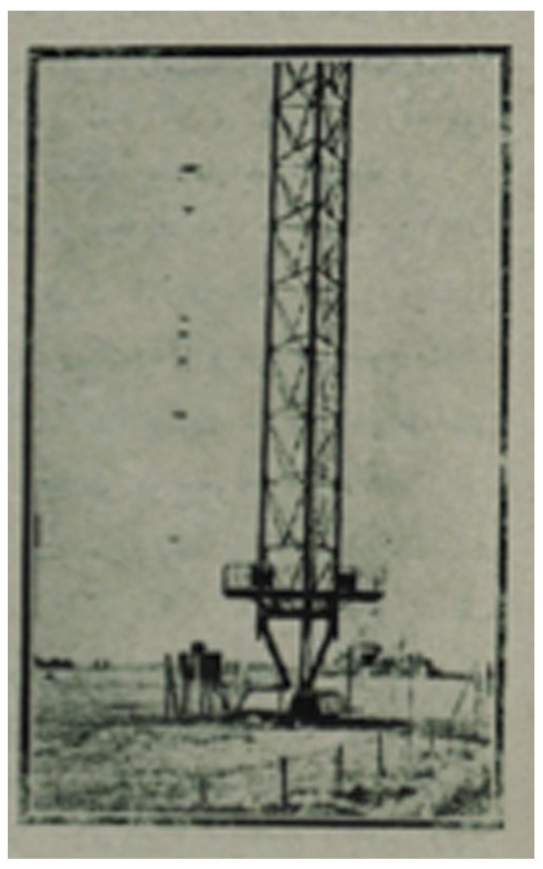
Radio transmitter in Germany (Telsiz 7, 1927: 5).
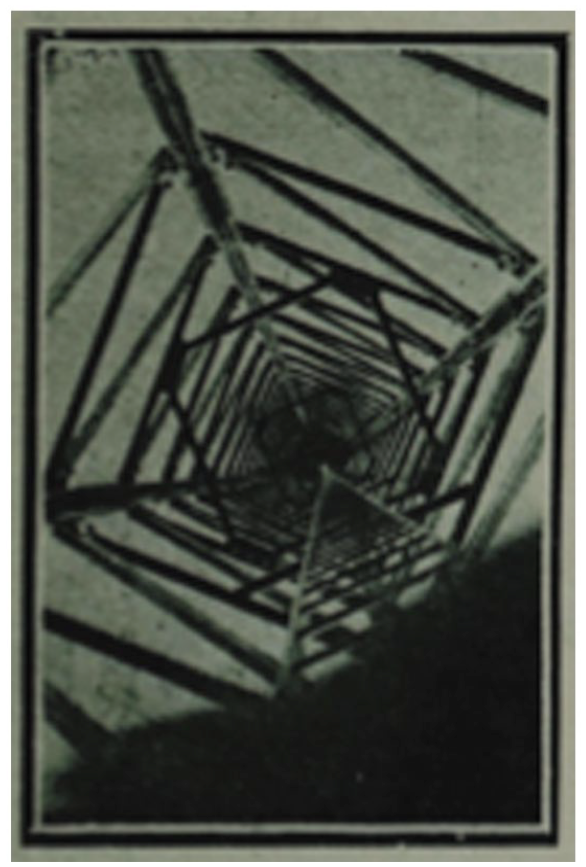
Transmitter in Osmaniye, İstanbul (Telsiz 3, 1927: 5).
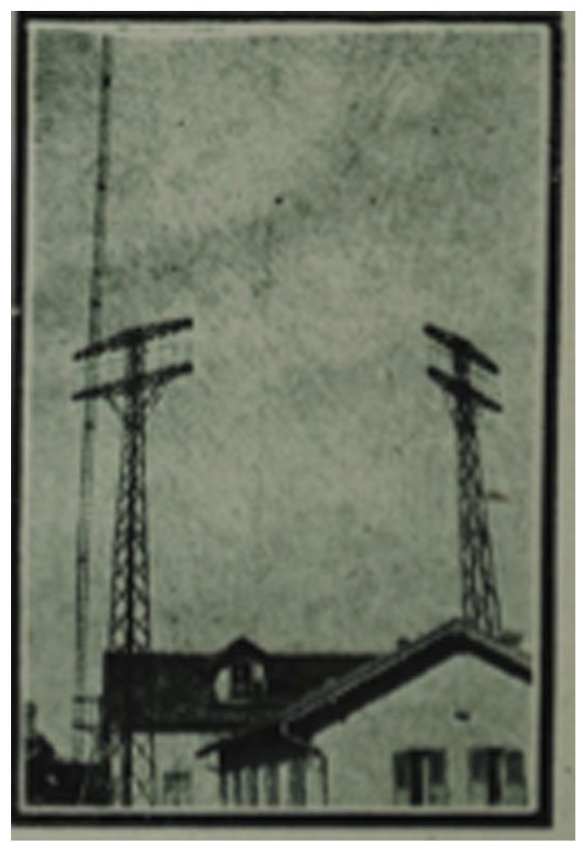
The strut holding the Osmaniye station (Telsiz 3, 1927: 5).
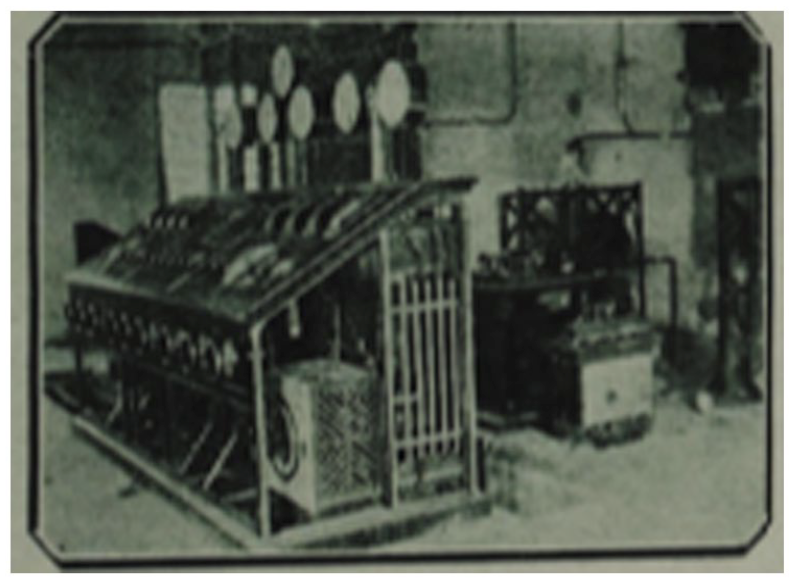
Osmaniye manipulation tube (Telsiz 3, 1927: 5).
Larkin (2008: 3) suggests that “the meanings attached to technologies, their technical functions, and the social uses to which they are put are not an inevitable consequence, but something worked out over time in the context of considerable cultural debate.” These pictures and other depictions published in Telsiz points to a similar cultural debate that assigns a particular image to the transmitters. The implication here is that transmission is done through grandiose constructs that require the expert knowledge of engineers. When describing the station in Germany, the editors add that “engineers required in the construction of these transmitters are not wireless engineers but engineers of a different sort,” probably referring to civil engineers (Telsiz 8, 1927: 5). Unlike the emboldening tone that invites everyone to assemble their own receivers, the editors represent transmitter construction as requiring technical expertise of multiple sorts and something that only specially trained people like engineers could accomplish.
Telsiz helps to “fix the symbolic logic” (Larkin, 2008: 10) of the transmitters by also portraying essential components of broadcasting, such as microphones, as uncanny. A passage from the magazine describes the microphone to the audience in the following way: - Shut up! Shut up! - Shut up! Shut up! Shut up! - !!!!!!! - ??? - !!!! This weird exchange is not between two people who were deprived of God’s biggest grace of speaking. The people who embrace this voluntary speechlessness are souls like you and me. These are people who do not have any difficulty in saying everything on the tip of their tongues. - So? you will ask. - I tell you only this much. You guess what device I am talking about. - Who knows what you will think and you will arrive at least to this conclusion. - This is a sick person whom people are afraid to wake up or this is an exchange taking place in a room where someone who is a light sleeper is sleeping. No, you are wrong. You are getting closer but you could not discover the truth completely. In fact, it is impossible for you to guess what I am talking about so let me tell you what it is before you get too impatient. Yes, there is someone people are afraid to wake up. This someone’s sleep is very light. They wake up immediately. Yet, what I am talking about is not a human being that can be either a man or woman. This is something you wouldn’t expect: Radio microphone! Even when it is preoccupied, it hears the strongly taken breath, even if it was only one breath, and immediately transfers it to faraway places so the people working with the microphone speak to each other this way [described above]. They have become speechless unwillingly. In fact, the warnings on the studio walls constantly warn and summon these people to do so (Telsiz 3, 1927: 5).
McLuhan (1964) famously defined media as “extensions of man” but in Telsiz’s account, the microphone is described as something that silences its users rather than extending their voices. In fact, by its capacity to extend people’s voices the microphone invites people around it to be silent. For the Telsiz editors, the microphone is a very sensitive device, a dangerously neutral mediator that conveys anything that it catches. The nature of the microphone then obliges people to behave, rendering the microphone something that controls rather than is controlled. The microphone, then, is not for everyone. It is only for those who have sufficient capacity to discipline themselves around it, as the warning signs on the wall also imply. When the issue at stake is sending sound, the emboldening tone embraced for assembling receivers is replaced with a tone that invites everyone to be cautious, to be careful, and to be disciplined, and more importantly to be silent. Unlike the receivers, the transmitters are uncanny due to their such uncontrollable capacity of conveying sounds.
Through detailing radio accidents, short stories published in Telsiz show what happens when people do not follow the radio microphone’s rule of silence. One story describes a woman named Naciye who is unhappy with her husband (Telsiz 6, 1927: 11). In order to initiate a separation, Mrs. Naciye comes up with a plan and arranges two men to speak behind her back in front of the radio microphone. Men on the microphone describe Mrs. Naciye’s flirtatious behavior with other men and make it look like it is just another broadcast accident. Mrs. Naciye’s husband listening to the broadcast – and thinking that he is accidentally finding out his wife’s infidelity – gets furious immediately and abandons his wife. The story ends by celebrating Mrs. Naciye’s genius in turning a common occurrence of her time – microphone accidents – to her advantage. The story entails a clear line between the proper radio speech and that which is considered an accident. One easily notices unprofessional, uncontrolled speech and as the story implies, never questions if what seems like an accident can in fact be planned. Such stories fortify the impression that any uncontrolled utterance that escapes one’s mouth around a microphone can only be registered as an accident – since it is at odds with the type of disciplined speech people used to hear on the radio.
Such descriptions of transmitters were necessary to control the circulation of technical knowledge about the wireless. Encouraging the public to gain basic knowledge and skills about receiver assemblage also opens a door for the individuals to involve in putting together transmitters. The narratives of Turkey’s amateurs show that despite the ban on transmitter construction, their involvement with receivers in time cultivated a curiosity for putting together their own transmitters. The oral history account of the amateur Emin reflects this course: I started amateurship in the late 1950s by using a manufactured device to catch amateur broadcasts, but I was not very successful because the device I had was not very powerful. I then found a receiver from a military junkyard and started using this device to listen to other amateurs. I became interested in speaking to other amateurs but during those days it was forbidden to buy or use wireless transmitters, so we were usually putting together our own transmitters.
Because the law forbade purchasing transmitters, some amateurs turned to assembling their own devices with parts they found from junkyards. In addition, some managed to bring kits from the US, and others could afford to buy some components from the local markets. Tinkering with the wireless technology then initiated a process of assembling not only receivers but also transmitters and it is this latter effect that the Turkish state wanted to control by banning the construction of transmitters in the early years of wireless technology.
The rise of radio amateurship in Turkey in the realm of not only receiver but also transmitter assemblage shows that the ban could only so far prevent people from tinkering with transmitters. Yet, the ban and the initial public representations of the components of wireless transmission point to a process that prepare and equip people to receive messages while at the same time inviting them to be careful and at times silent when it comes to sending these messages. Monitoring the circulation of technical knowledge, then, emerges as a key way of regulating people’s bodily involvement with the wireless technology and how they cultivate (fine motor) skills to assemble, repair, and adjust their devices to tune into the national soundscape. Such monitoring is a part of disciplining one’s listening practices through disciplining the body – not only through affective/visceral dimensions but also in terms of the honing of technical skills. When understanding how listening turns into passive receptivity, it is important take into consideration the body not only with its affective/visceral aspects but also as a capacious vehicle to craft/modify material objects.
Conclusion
It is now a well-established trend in communication studies to historically analyze the ways that new media forms were constructed as “novel” at the moment of their introduction and how they become “old” over time. Resonating with Frederich Kittler’s famous Gramophone, Film, Typewriter, some of these works examine digital media – the new media of the contemporary moment – in relation to the history of cinema (Manovich, 2001) and phonograph (Gitelman, 2006). Others explore the historical connections among older technologies such as the post office, the press, and the telegraph (Starr, 2005), telegraph, radio, and film (Czitrom, 1983) and portable camera, phonograph, and telephone (Lauer, 2012). With the exception of a few scholars (Aouragh, 2022; Larkin, 2008; Stein, 2021), however, most of these works explicitly focus on Western contexts. As Armbrust (2012: 162) underlines, historical accounts about how the countries in the Middle East “experienced successive waves of new media over the past 150 years” is almost absent.
By exploring the history of new media forms in a “non-Western” nation-state such as Turkey – which is at the intersection of Europe and the Middle East – my work shows that in its initial years, wireless as a material artifact became the locus of official control and a key arena of nation-state formation. If listening “involves making an effort to hear something” (Rice, 2015: 99), that effort in the early days of radio technology in Turkey involved tinkering with the technological artifact. People tinkered with the wireless technology to assemble simple receivers from scratch, reflecting the scarcity of affordable manufactured radio devices. The more affluent few also tinkered with their manufactured radios – for example, to adjust the antenna, or to fix frequently encountered small problems. Still in the process of advancement, early radios frequently broke down and sometimes conveyed distracting noise, rendering these skills essential to being able to listen to the broadcasts. The introduction of the wireless technology in Turkey thus initiated the circulation of technical knowledge about the device, encouraging people to hone basic technical skills to become radio listeners.
Given the capacity of the early wireless technology’s initial material design not only to receive but also to send signals, disciplining such technical skills became the precondition for the Turkish state elites to discipline the ear in line with the terms of modern nationhood. The state monopoly over transmitter construction drew the boundaries for legitimate knowledge and skills that could be publicly built around the wireless technology. Such regulation also drew a boundary between two components of wireless technology – transmitters and receivers – which were default parts of the initial wireless design. With radio’s potential to reach to the masses, encouraging citizens to craft skills about receiver assemblage was a major way to equip people with devices for tuning in the emerging national soundscape. In addition to the legal ban, the public representation of the transmitters as either uncanny or grandiose objects requiring certain skills and training both to build them and to be around them strengthened the state’s control over this nascent soundscape. This symbolic construal of the components of the wireless technology then informed people’s “beliefs around” (Dunbar-Hester, 2014: xii) what transmitters should do – that is, conveying utterances of disciplined and trained radio professionals who knew how to behave around these objects without conflicting the norms of the nation-state. Such reasoning also determined what receivers should do – that is, to receive the disciplined national messages.
Focusing only on the broadcast content – and the ear itself – to understand how states discipline citizens discards these contentions around wireless as a material artifact. If creating passive listeners requires disciplining the body in its entirety – by paying attention not only to cognition but also affective and visceral dimensions (Hirschkind, 2008) – I forefront the materiality of the wireless technology in order to highlight the body’s capacity to craft tools with hands. In addition to affective and visceral dimensions, then, technical skill formation emerges as a bodily arena of official control. Cultivating a mode of passive listening required first that people limit their engagement with the wireless technology to the realm of experimenting with receivers only. This situation also determined the course of radio amateurship in Turkey which was initially limited to tinkering with receivers only (İlaslan, 2017). As radio has globally become a broadcast technology that forefronts listening for the masses, examining the early course of this technology in different national contexts, such as that of Turkey, highlights the conditions unique to these contexts that have informed the global course. In Turkey, it was through the anxieties of a newly established nation-state that the citizens’ material engagement with the wireless was limited to the realm of receiver-assemblage, an engagement that laid both the symbolic and material infrastructures necessary to construe a national auditory.
