




Abstract
This article examines the rising Farsi ‘manosphere’ of Iran and the case of online misogynistic, anti-feminist and anti-queer mobilisations across social media platforms and messaging applications. It focuses on memes and memetic figures that are circulated on Iranian social media and proposes the term ‘memetic alliances’ to convey complicated and unforeseen mutations of today’s internet meme culture and online hate culture. Moreover, it unpacks the increasing convergences of seemingly conflicting online and political contexts. Drawing on digital ethnographic fieldwork on selected platforms as well as visual and conceptual analyses of memes, the article theorises that online figurations of hate have memeto-(micro)political qualities that allow for their propagation across numerous contexts. Furthermore, the case of Iran’s emergent Farsi manosphere is arguably not a totalitarian exception unique to the Middle East but is reconfiguring and standing in alliance with the global rise of the right and its online culture wars.
The rise of online misogyny as well as anti-queer and anti-trans violence in recent years and across various contexts proves the emergence of a global network of gender hate both online and offline (Ging and Siapera, 2018, 2019). Although the increase in hatred towards women online and the associated academic debates have mainly focused on the Global North, there has been an ongoing urge for intersectional approaches to the issue to introduce transnational insights (Ging and Siapera, 2019). Increasingly, misogyny, anti-feminism and queerphobia are being literally ‘copy-pasted’ throughout multiple suppressive contexts and supporting a hate-spreading, globalised and networked internet meme culture online. However, the rapid spread of misogyny and hate towards feminists and the LGBTQI+ community beyond Western contexts in recent years, such as through the utilisation of memes and memetic figures as a newly adopted form of communication and (anti-feminist) mobilisation in the Iranian context, and its entanglements with the global rise of right-wing discourses are both understudied topics that require urgent investigation and expansive critique. Notably, the case of Iran evidences a broader transnational and cultural phenomenon of (trans)misogyny and queerphobia alongside the rise of the (alt-)right and its fluid and ambivalent digital (micro)fascism (Bratich, 2022; Fielitz and Marcks, 2019: 17). In addition, given the disputes between the U.S. and Iranian online and political spheres, it can provide a particularly illuminating context for exploring the intertwinements and complexities of the global rise of the right and gendered hate online.
This article focuses on memes and memetic figures circulated on popular Farsi social media platforms and messaging applications and draws on theorisations of today’s digital cultures, online misogyny and the alt-right to develop insights into what I call ‘memetic alliances’. I argue and exemplify how this concept is useful for revealing the relation between conflicting forces that are increasingly enabled in contemporary global digital cultures through their circulation of affective figurations – particularly between alt-right figurations of hate and the authoritarian figurations they inspire. 1 In addition, I conceptualise the term ‘memetic alliances’ to convey ongoing convergences of transnational internet meme culture and further unpack the complicated, unforeseen, and increasing online global alliances forming between seemingly conflicting online and political forces, such as those in the (predominantly) North American and Iranian online contexts. It is important to note that Iran’s online sphere and the severe internet control therein are contextually distinct from the North American online sphere, and such distinction is precisely a reason for the urgent need to address the propagation of these hateful (re-)figurations in a global study and provide a critique of what I see and will elaborate as the rising global affinities between multiple suppressive discourses that are increasingly uniting online.
The scope of this study includes the emergent and expanding Farsi ‘manosphere’ 2 on Iranian social media and, more specifically, three of its Telegram channels – We Don’t Let Masculinity Die (est. November 2019), Toxmi-memes (est. March 2021) and Supporting Men’s Rights (est. May 2020) as well as one now-suspended Twitter account, @Toxmi-memes. I argue that online figurations of hate have both ‘affective economic’ (Ahmed, 2014) traits and memeto-(micro)political qualities that allow for their propagation across numerous contexts and amongst seemingly distinct online and political spheres. Specifically, by emphasising these memeto-political qualities, I highlight how such memetic figures – and the alliances they form – create similar discourses and affects across multiple political contexts and continents and integrate them into their local vernacular. I analyse how this practice further reveals an internationalisation of hate that combines several political ideologies and micropolitical forces and has worrying impacts on marginalised communities online.
Notably, these developments unsettle previously dominant understandings of the internet in Iran, which assume that the internet is controlled by Iranian authorities predominantly through a ‘Soft War’ rhetoric and censorship (Article 19, 2017) and is a thoroughly anti-Western, anti-US sphere that opposes the ‘Westernisation’ of the internet. Nonetheless, the systematic spread of hate towards feminists and queer communities on Iranian social media, the involvement of Iranian ‘state-aligned trolls’ (Kargar and Rauchfleisch, 2019), and the expansion of online Farsi men’s rights activism (MRA) groups – alongside these forces’ excessive employment of Western-centric alt-right memes and videos – are multi-layered; crucially, I argue that these developments undo and complicate the oversimplified presupposition that Iran’s online and political sphere is an old-fashioned, dictatorial, totalitarian exception unique to the Middle East and totally isolated from the global rise of the right and its ‘new online culture wars’ (Wark, 2019: 245). This article situates Iran’s rising Farsi manosphere and the online coordinated (memetic) hate mobilisations across social media platforms as embedded and materialised in the global rise of ‘digital hate culture’ (Ganesh, 2018).
In the following sections, I examine the aforementioned channels and their visual posts to explore how certain memes and memetic figures (of hate) have travelled across platforms, contexts and political forces. Specifically, I consider the following questions: Which (intentional) design limitations affect how Western ICT platforms handle the internet rights of marginalised, non-Euro-American-language users? How have internet memes and memetic figures contributed to the internationalisation of gendered hate online and complicated current understandings of the online sphere? And which insights do memes offer into global alliances across seemingly distinct online political forces and contexts?
Internet meme culture and online misogyny of the manosphere
Over the past years, studies have increasingly explored the normalisation of misogyny through internet meme culture, which has led to a vast array of empirical and theoretical literature in the field (e.g. DeCook, 2018; Ging and Siapera, 2019; Massanari and Chess, 2018; Ryan Vickery and Everbach, 2018). Such research provides invaluable evidence of how these memes are indeed cases of online misogyny and harassment despite their attempts to appear humorous (Drakett et al., 2018: 122) and of how a ‘monstrous femini[nity]’ is deployed by alt-right communities through memes that target ‘social justice warriors’ (SJWs) in the U.S. context (Massanari and Chess, 2018: 519). The development of an expansive online network of like-minded MRA groups from numerous contexts in the last decade has fostered a shared memetic practice characterised by online misogyny and anti-feminism (Cockerail, 2019; Ging, 2019; Hodapp, 2017).
Such MRA groups in the expanding manosphere (Ging, 2019: 653) are not simply homogeneous groups of men with ideologically misogynistic and queerphobic viewpoints; rather, their members have diverse social and political backgrounds (Hodapp, 2017). According to various scholars (Ging, 2019; Massanari, 2017; Semenzin and Bainotti, 2020), the digital affordances of social media have facilitated a rising online presence of hegemonic masculinities and online harassment. For instance, Massanari (2017) has illustrated how the design and marketing politics of platforms and forums, such as Reddit, reinforce a ‘toxic technoculture’ that benefits anti-feminist and racist groups.
Nevertheless, in theorising masculinities of the (anglophone) manosphere, the current literature does not sufficiently address the expansion of the manosphere – and particularly of MRA groups – beyond Western and anglophone contexts. The current literature engages with only limited, specific aspects of the manosphere and concentrates mostly on Reddit and 4chan (Ging, 2019: 641). There has been a recent call to adopt intersectional approaches to the issue by introducing transnational insights from across the globe and beyond anglophone Western contexts. The latest edition of Gender Hate Online: Understanding the New Anti-Feminism (Ging and Siapera, 2019) as well as the book Social Media and Hate (Banaji and Bhat, 2022) include chapters on intersectional hate (speech) in other contexts, such as those of Russia, Pakistan, India and Brazil. Such valuable and contextually significant contributions elaborate on the problem by attending to contexts beyond the Global North; yet, scholarly debates have not sufficiently addressed the unforeseen convergences of gendered hate online and the rise of the right globally and via internet meme culture, particularly from a comparative perspective and specifically between conflicting online and political contexts, such as those of North America and Iran.
Iran’s internet control and the emerging Farsi manosphere
Soon after the introduction of the internet in Iran, the nation became a leading regional internet provider and subsequently commenced the development of a national infrastructure to limit the freedom of expression online (Article 19, 2017: 7). The fraudulent 2009 election incited large-scale protests that were prominent on social media platforms (Article 19, 2017: 7). The international audience referred to these protests and others in the Arab world as a ‘Twitter Revolution’ or ‘Facebook Revolution’ (Faris and Rahimi, 2015: 199), as these platforms were optimistically viewed as aids to these movements and their organisation online (Akhavan, 2013: 83). Soon after, the authorities mobilised their own Iranian Cyber Army (ICA) to suppress dissent online and promote the rhetoric of a Soft War (of and against the West) that was devised to protect the country’s online sphere and the broader religious establishment from the ‘cultural invasion’ of the West and its ideals (Article 19, 2017; Ganji, 2013: 7). Since then, the state-affiliated members of the ICA have escalated their promotion of state-sponsored content and have not only hacked, censored and attacked dissident campaigns but also facilitated the harassment and imprisonment of individuals who have expressed their opposition on Farsi online platforms (Article 19, 2017; Kargar and Rauchfleisch, 2019).
Amid the restrictions on the internet and extensive securitisation of the online political climate, debates on the issue of internet control in Iran as part of the state’s Soft War strategy have thus far focused mostly on how state censorship functions by blocking data and access to platforms to hinder further Westernisation and silence dissident voices. For instance, scholarly analysis of internet control in Iran has suggested that Iran’s longstanding conflict with Western ideals – and particularly those of the US – has ultimately enabled the state to employ the ‘foreign threats’ rhetoric to strategically stabilise its legitimacy and conduct more intensive internet surveillance and censorship (Michaelsen, 2018: 3868). Yet, the more subtle and creative convergences of Iran’s state forces in utilising Western content remain unexamined. As this study uncovers, various social media platforms have exhibited an unprecedented systematic outpouring of content produced by misogynist, anti-feminist and anti-queer groups who are inspired by alt-right, US(-centric) public figures and online communities over the past three to four years. This phenomenon complicates current straightforward debates and particularly the discourse around internet censorship and Iran’s strategic use of Soft War rhetoric to implement additional surveillance of online data and thereby combat the ‘Westernisation’ of Iran’s online sphere in all aspects and forms.
Since late 2019, an increasing number of channels, Telegram groups and Twitter and Instagram accounts have emerged with the intention of publishing and disseminating anti-feminist and anti-LGBTQI+ content. The Telegram channels We Don’t Let Masculinity Die and Supporting Men’s Rights have gained over 15,000 and 3700 members, respectively, and engage in mutual support by reposting each other’s activities as well as those of similar pages on Telegram, Instagram and Twitter. The emergence of these channels and accounts reflects an unprecedented, organised online hate movement targeting women and queers in Iran as well as digital activists outside of Iran who participate in queer, feminist and women’s rights activism in Farsi. Notably, the majority of these channels’ activities revolve around content that has been copied, subtitled and translated from international alt-right white supremacist online figures and subcultures – especially the online subculture in the US – which these channels employ to justify their claim that feminists and queers must be eliminated.
Moreover, as this ethnographic research evidences, members or affiliates of the ICA are most likely present in Telegram and Instagram groups, such as We Don’t Let Masculinity Die and Supporting Men’s Rights, which previously offered a chatroom link that directed users to a discussion group entitled ‘Fadaeeyan-e Rahbar’ (‘Self-sacrificers of the Supreme Leader [of Iran]’ 3 ). A previous study has evidenced that state-aligned trolls use profile pictures of Iran’s supreme leader and abundant religious language on their Instagram accounts while systematically spreading disinformation and engaging in harassment to suppress dissidents (Kargar and Rauchfleisch, 2019). I similarly observed that participants in MRA groups and channels included numerous accounts with profile pictures of top military and political leaders of the country. Religious content that is affiliated with state-led propaganda was also regularly shared within groups, and, ironically, one account with a profile picture of the supreme leader frequently posted the sentence, ‘do not come to the digital spaces only for fun; you are soldiers of a soft war [with the West], so act like it’.
Methodology
This research extends the concept of ‘affective economies’ (Ahmed, 2014) of hate to consider internet meme culture and its online global circulation. In Cultural Politics of Emotion (2014: 44), Ahmed theorises that hate is not the property of only one figure or body and does not remain static; rather, it has an economic quality, as it ‘circulates between signifiers in relationships of difference and displacement’. Circulation is the essential characteristic of hate that renders it volatile and constantly moving across various bodies, objects, figures and signs. I extend the notion of ‘affective economies of hate’ to internet meme culture to demonstrate how memetic figures of hate circulate ‘online’ and flow across multiple surfaces and platforms to propagate hate towards otherised bodies.
For this research, I conducted 1 year of digital ethnographic research (Postill and Pink, 2012) within the selected online channels between January 2021 and January 2022. This method included routinely checking updates from these channels and accounts, observing their multiple changes over time, archiving memes and visual posts, viewing videos shared by the channels, capturing screenshots of meme content and images, and creating a fictive account to anonymously follow the channels and join their public group chats. These groups were all public, and anyone could join by clicking the ‘join’ button. In the groups, I participated in direct discussion with the anonymous members on two occasions to monitor their responses. All of the channel and group members used anonymised accounts, and their profiles did not display their own personal information.
My year-long online ethnographic research is thus in line with the current literature (Askanius, 2019; Møller and Robards, 2019) on ethical and ethnographic considerations in conducting online fieldwork in ‘risky research areas’ (Marwick et al., 2016, qtd. in Askanius, 2019) where anti-feminist, racist and antagonistic exchanges are prevalent. As I observed, the emerging MRA channels and pages on Farsi Telegram, Instagram and Twitter assume the main mission of attacking feminist and queer individuals who are active online with their own profiles. In addition, the groups’ dynamics predominantly revolve around a discourse of ‘male victimhood’ (Manne, 2018) that centres on the context-specific issues of compulsory military service, Mehriye (dowry) money that (divorced) husbands must pay in Iran in cases of legal demands, and, more recently, the #MeToo movement. The content that is shared and discussed within these channels – and the street protests organised accordingly – have mostly targetted the aforementioned themes.
It requires extensive emotional labour (Askanius, 2019) to fully immerse oneself in a world of such hostile online environments and the dynamics of their manifestation. Therefore, I constricted my fieldwork to occasional monthly observations of only public platforms, channels and chatrooms, and I particularly focused on the memes circulating amongst these channels and chatrooms. Given the prescribed conventions of digital ethnography, it may seem ‘insufficient’ to focus on only certain elements in the field of study; however, this article precisely attempts to highlight how such seemingly insignificant elements of memes and memetic figures lie at the core of the activities unfolding within these rising channels. Hence, it is equally significant for a ‘remote ethnographer’ to focus on the specified elements.
I also conducted a visual (Rose, 2016) and conceptual analysis of selected memes and images. In my analytically informed thematic analysis, I identified overlaps and recurrent themes, observed group activities, and examined the captions and memetic figures that were repeatedly featured in the memes shared in the channels. Thereby, I ascertained the affective and aesthetic themes of these materials, which reflect – if not directly reconfigure – the global memetics of the alt-right while adapting the rhetoric and applying ICT tactics to localise it within the Iranian authoritarian context. A total of 199 memes and 1290 items of mixed visual content were observed in this research, and a selection of 10 memes and visuals were subsequently subject to analysis. Of the several dominant themes that were identified from the memes, this article bases its analysis on two main themes: the first is the circulation of (hateful) memetic figures (e.g. Big Red, [Withered] Wojak, Pepe the Frog) with a strong, recurrent presence in these channels, while the second is the use of localised Farsi captions for the memes that (re)produce local/global misogynistic, transphobic, racist and queerphobic sentiments in an attempt to appear ironic and humorous (Drakett et al., 2018) or systematically attack feminists.
In addition, the platform and ‘manipulation tactics’ (Krafft and Donovan, 2020: 200) inform the article’s primary exploration of how groups and account administrations from two of the aforementioned Telegram channels have thrived visually and continued to harass (feminist and queer) minority groups by manipulating the platform designs of Telegram and Twitter to postpone their suspensions. These platform-enabled tactics are important to consider – to the extent possible in a single article – because such manipulations are part of ‘platform politics’ (Gillespie, 2010) and reflect how platforms implicitly facilitate patterns of ‘toxic technoculture’ (Massanari, 2017: 330).
The mobilisation of hate by manipulating the affordances of platforms
In approaching the emerging anti-feminist and queerphobic channels on Farsi Telegram whose members predominantly identify as MRA supports and ‘men going their own way’ (MGTOW), it is crucial to consider the ways in which some of these channels have flourished by taking advantage of the affordances of the platforms through multiple manipulative tactics. Massanari (2017: 330) has illustrated how the toxicity of certain online spaces, such as Reddit, is reinforced by the platform design, which creates fertile grounds for ‘misogynistic activism’ and ‘toxic technoculture’. In addition, by studying the case of non-consensual intimate image circulation across covert groups on Italian Telegram, Semenzin and Bainotti (2020: 2) have discovered that lax regulation, anonymity and the gendered affordances of Telegram and other platforms have facilitated online practices of hegemonic masculinity and harassment. Accordingly, I contend that the gendered affordances and loose regulation of Telegram have allowed for the propagation of numerous MRA, anti-feminist, anti-LGBTQI+ and misogynistic Farsi channels and public Telegram groups over the past years.
The intended audience of the memes circulated within and beyond these channels consists of Farsi-speaking communities in and outside of Iran. By including feminist and anti-racist symbols that derive from English-speaking contexts at the top of memes and anti-feminist and (trans)misogynistic content in Farsi within those memes, the meme creators and channel participants presumably seek to evade removal from these platforms and thus thrive there for longer periods of time. This phenomenon further demonstrates the (intentional) limits of such platforms and applications in confronting hateful content that is not produced in English or other Euro-American languages, which further normalises harassment and misogynistic culture online (Semenzin and Bainotti, 2020: 9).
The case of one Farsi account on both Twitter and Telegram involves additional complications. Several months after it began posting predominantly racist and misogynistic memes with Farsi captions, the @‘Toxxmi_memes’ Twitter account was suspended for posting hateful content in English as well. Soon after, the account administrator(s) migrated to Telegram, where they created a channel of the same name and uploaded all of the same memes. The Telegram channel was still active until end of the ethnographic research in January 2022. Moreover, a new Twitter account connected to the Telegram channel was created under a different username to continue circulating the memes on Twitter. Such multiple online migrations to and from Twitter and Telegram prove Noble’s (2018: 171) argument that digital technologies are indeed ‘implicated in global racial [and Western-centric] power relations’ with an (un)intentionally limited agential capacity for detecting and eliminating hateful (visual) content concerning minorities (Mutanga et al., 2020).
As another example, the description of the Telegram channel Supporting Men’s Rights contained the sexist word madarjendeh (motherfucker) in Finglish (the Farsi transliteration of words in the Latin alphabet) while addressing the founder of Telegram, Pavel Durov, in English to emphasise that the channel does not violate Telegram’s rules; meanwhile, within the channel, hateful anti-feminist and queerphobic posts were circulated and discussed daily (Figure 1).
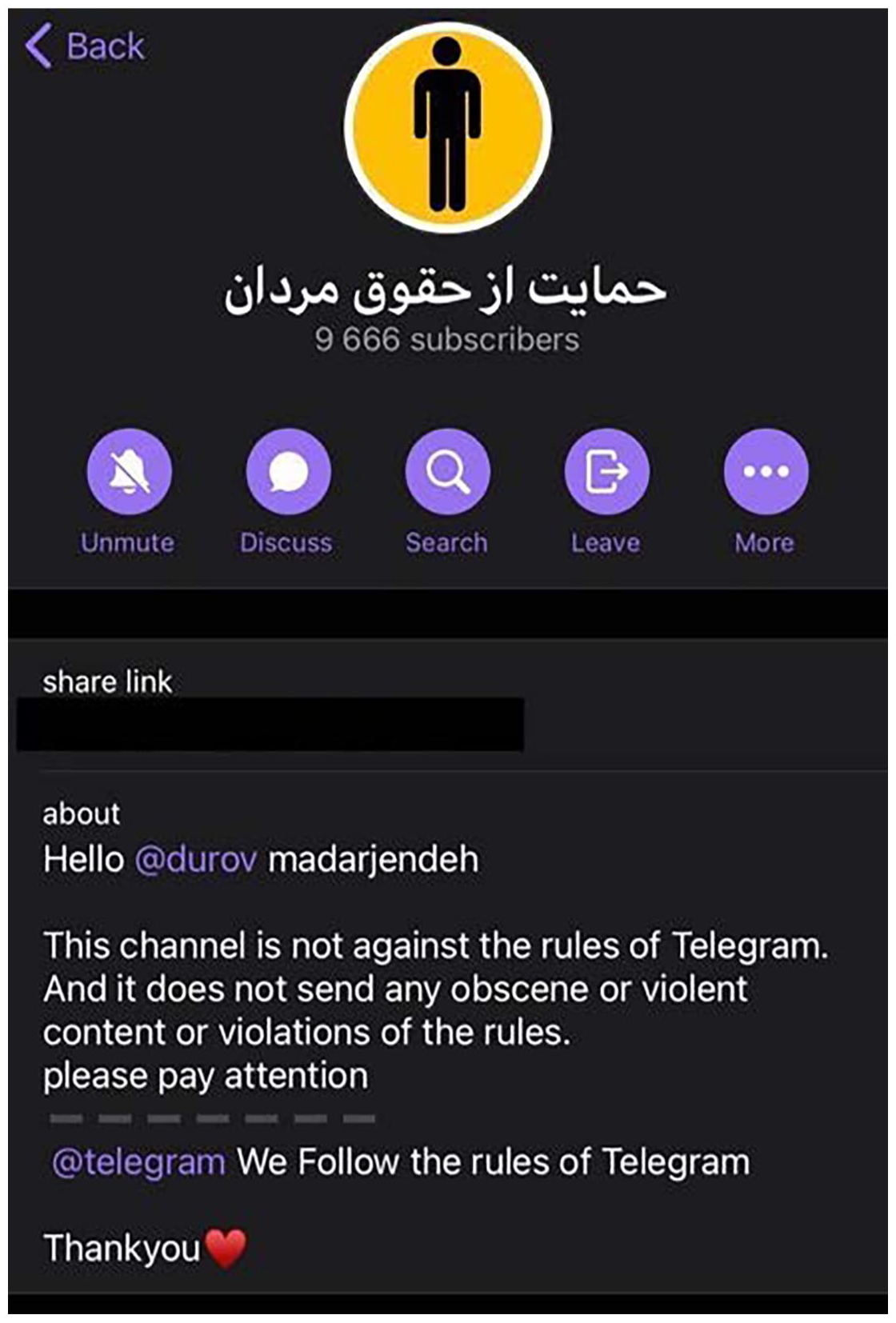
Supporting men’s rights channel description.
In addition, this anti-feminist channel seemingly adopted a feminist username (feminism–iran) to either deceive the platform(s) by presenting as a feminist channel or convey a sarcastic insult. While these groups appropriate visually queer and feminist usernames, the Farsi or Finglish captions of their memes express anti-feminist, transphobic and extremely racist sentiments (Figure 2). Crucially, such appropriation of feminist symbols and usernames could facilitate their discovery by Iranian queer, feminist and ethnic minority groups, whose exposure to the hateful content may eventually affect their well-being.
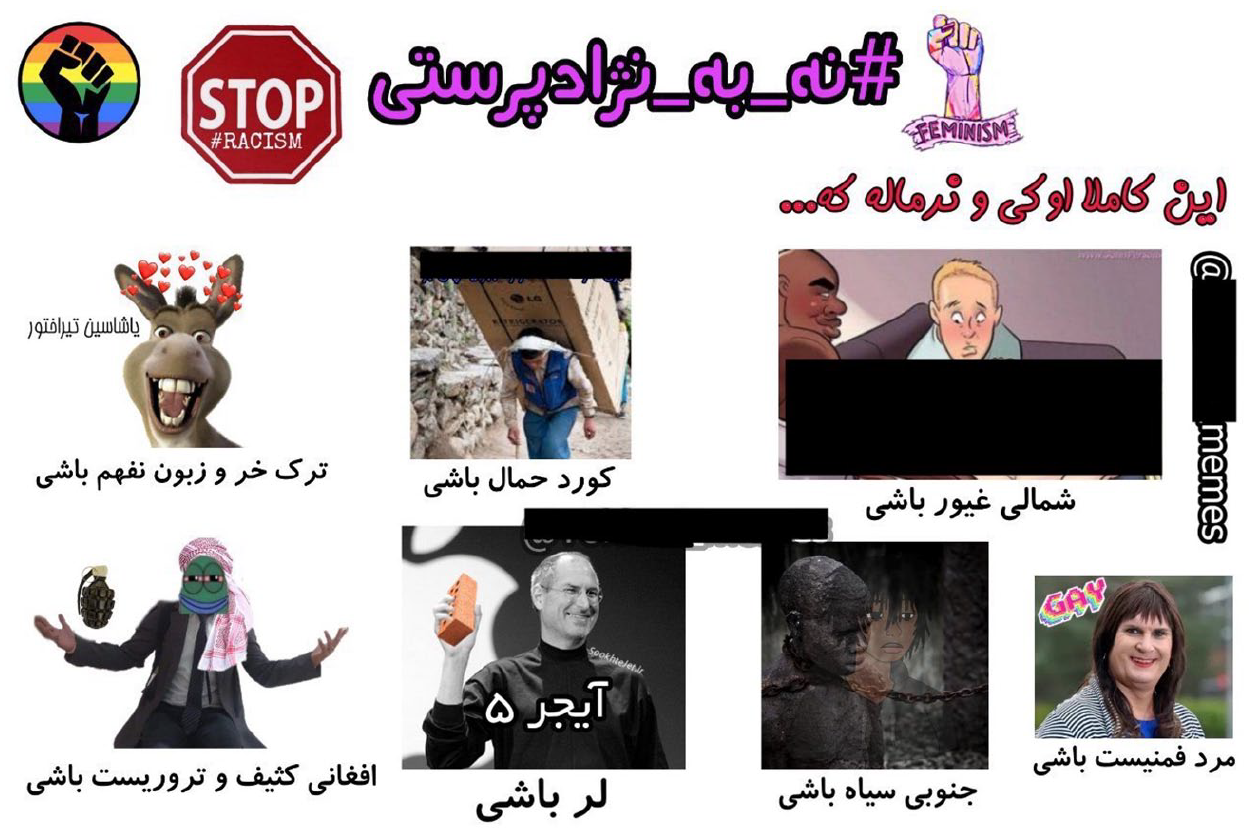
Farsi meme exhibiting a full range of hateful content while incorporating feminist and antiracist symbols.
In view of these manipulative platform migrations and obfuscations, which certainly warrant a more detailed investigation than is possible within the scope of this study, I assert that the ‘toxic technoculture’ (Massanari, 2017) of the MRA manosphere (Ging, 2019) – when coupled with the gendered affordances and intentionally loose regulation of platforms such as Telegram as well as the dominantly Western-centric design of platforms such as Twitter (and their policies; Brock, 2020) – has provided numerous possibilities for the production, circulation and propagation of hateful memes and memetic figures on Iranian social media and beyond.
Memetic figures (of hate) in affective global circulation
To enrich our understanding of the global circulation of memetic figures within the expanding network of the anti-feminist manosphere (Ging, 2019) on Iranian social media, it is imperative to attend to the affective qualities of such circulation and remain alert to the very process of ‘memes in circulation’ (Wark, 2019: 26); hence, we can take neither ‘circulation’ nor the affective forces therein for granted. Internet meme circulation within the manosphere exemplifies a type of online practice that is best illustrated by the Ahmedian concept of ‘affective economies of hate’ (Ahmed, 2014: 55). In an analysis of racist hate crimes, Ahmed has explained that hate operates by ‘sticking “figures of hate” together, transforming them into a common threat’ (Ahmed, 2014: 15). When extended to the sphere of internet meme culture, I argue, Ahmed’s notion of ‘affective economies of hate’ reveals complex relations of objects and affects that circulate online, particularly where organised MRA members wield extensive alt-right visual rhetoric while using the affordances of social media to spread hate towards women and other marginalised communities.
Just like the intense feeling of hatred, a meme neither assumes a fixed object nor is restricted to one digital space. Rather, it circulates across signs, figurations and platforms and accumulates ‘affective value’ (Ahmed, 2014: 45) with each circulation. The anti-feminist memes produced by MRA supporters ‘stick together’ multiple affective figurations of hate online by being in circulation within and across the manosphere. As I discuss in detail below, over the course of my ethnographic activity within various public MRA channels, I observed how an abundance of collaged images and videos featuring viral memetic figures (e.g. Karen, Big Red, Pepe, Wojak, Nazi symbols) were being circulated within channels and across platforms at a much faster pace and with greater engagement intensity in terms of receiving reaction emojis and shares. I argue that, in this sense, an internet meme functions in the same way as hatred itself: they both have affective economic qualities, precisely when in circulation through bodies, signs and sites. Notably, I do not claim that internet memes have an inherently ‘hateful’ quality or condemn internet memes simply because of their functional similarity to the intense emotion of hatred. Rather, I seek to highlight that both the strong feeling of hatred and internet memes have an ‘affective economic’ quality in the Ahmedian sense of the term, and this quality intensifies when internet memes and hateful figurations of them converge online. In addition, inspired by Ong’s (2007) theorisation of neoliberal logic as a space of assemblage, I argue that a similar logic is at play regarding the global mutation and circulation in today’s internet culture, which cannot be approached simply based on nation-states; rather, they should be seen as a ‘global assemblage’ emerging ‘in a space of assemblage’ with a capacity to ‘collectively engineer content to produce large-scale effects’ (Ong, 2007: 7; Wark and Wark, 2019: 308).
Moreover, ‘circulation’ does not refer merely to the circulation of any online material from ‘here’ to ‘there’ but is in fact a fundamental feature of ‘our postdigital media situation’s indeterminacy’ and the involvement of a certain ‘excess’ in the mobilisation of ‘negativity and antagonism’ in the ‘new online culture wars’ (Wark, 2019: 246, 266). I argue that such excess is further mobilised through two strategies: first, by entering memetic figures into circulation to produce seemingly nonsensical but affectively charged collages of implicit hate and misogynistic ridicule; and second, by explicitly mobilising negativity and antagonism (Wark, 2019: 252) through what I call – and will explicate in the next section – as ‘memeto-political’ travels and semi-coordinated hate movements.
A manifestation of the first strategy for the affective circulation of (implicit) hate via memetic figures and collages is the Iranian version of the ‘Karen’ meme collaged with the ‘Skull Cow Isn’t Real, It Can’t Hurt You’ meme (Figure 3). This meme, which seemingly lacks any immediately obvious sexist visual content, depicts an Iranian cinema and television actress, Maryam Amirjalali, who is photoshopped wearing a cropped blonde wig. The upper caption says, ‘My therapist: Karen Amirjalali does not exist and cannot hurt you; and the Karen Amirjalali who appears in my dreams every night. . .’, while an English caption in the lower part of the image indicates that, as usual, Karen is looking for the manager; however, this statement is followed by a vulgar Farsi slur, koskesh (pimp).
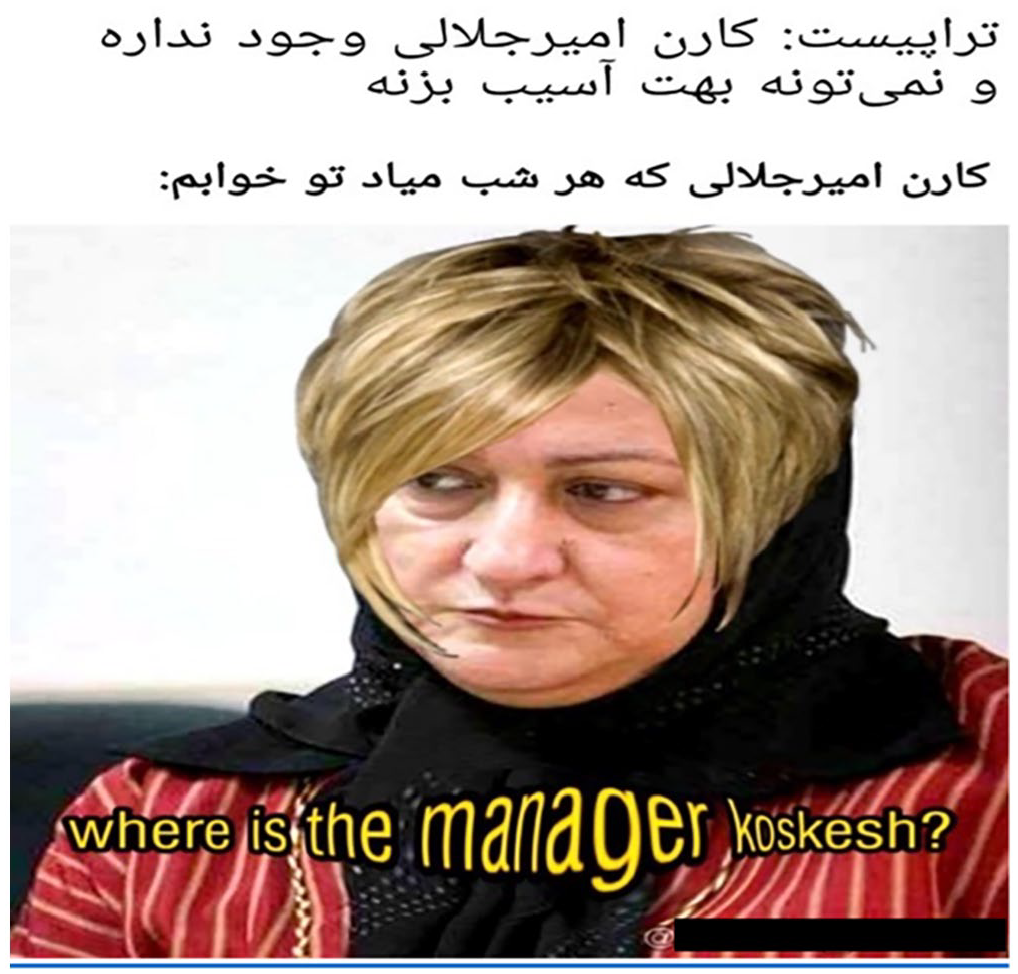
Karen meme.
The seemingly nonsensical caption is meaningful only to those who are involved in the universal, shared world of internet memes. The blonde wig and the woman’s name are references to the famous internet meme figure ‘Karen’, who represents annoying and entitled middle-class white women. The name Karen and the related memes have been ‘broadly applied to a swath of white women who had been filmed harassing people of color, including dialing the emergency services on them for no criminal reason’ (Know Your Meme, 2019). Some feminists have criticised the excessive misogynistic and ageist deployment of Karen memes by white men, even in the U.S. context, because such usage decontextualises the meme, which was originally employed by Black women to critique female white privilege (Freeman, 2020).
Besides its apparently nonsensical and irrelevant use, a striking aspect of iterations of the Karen meme in the Iranian context is its resemblance to the sexist and ageist usage of the Karen meme online in the US. In the former context, an anonymous Iranian meme generator created a random Karen meme that mocks the middle-aged Iranian actress Maryam Amirjalali by implicitly depicting her as an annoying middle-aged woman for no clear reason. The meme creator, who is a human behind a device, is not the sole agent responsible for this unexpected cut-and-paste image of a North American internet meme adapted to the Iranian context. Rather, the responsibility extends to the fundamentally ‘networked’ nature (Åkervall, 2016) of internet memes, which enables such memetic figures to travel across contexts and platforms, hence becoming challenging and often problematic ‘agents of globalization’ (Shifman, 2014: 151).
Moreover, I argue that the cropped wig and other similar memetic figures are ‘affective’ meditated tools for mobilising a memetics of hate within the increasingly fluid ‘networked misogyny’ (Banet-Weiser, 2018) that generates a global shared sentiment which mocks women, especially those who are famous or public figures. In addition, I observed in Farsi MRA channels that coordinated, hate-driven attacks against both marginalised and famous Iranian queer and feminist online activists were arguably more forceful when combined with recent globally viral collaged video clips and GIFs of multiple memetic figures. Such affective combination resulted in hateful content being abundantly shared and circulated within and across MRA pages to disparage and threaten women activists. Hence, these memetic tools, I assert, gain more ‘affective value’ (Ahmed, 2014: 45) through their circulation across contexts and platforms and are visually sensical only when situated within the global circulation of memes and their interconnected meaning-making moments.
Other mediated memetic figures exemplifying such affective circulation of hate are those in the ‘angry Big Red’ and ‘Feminazi’ memes, which have been re-created, photoshopped and circulated on many platforms and modified with Farsi captions, such as a caption which translates to ‘I need feminism a therapist’ (Figure 4). In 2013, a video went viral on Tumblr and YouTube featuring Toronto resident Chanty Binx passionately arguing against MRA (Know Your Meme, 2013). This event inspired the sexist meme ‘Big Red’, which circulated across multiple media platforms with a variety of captions.
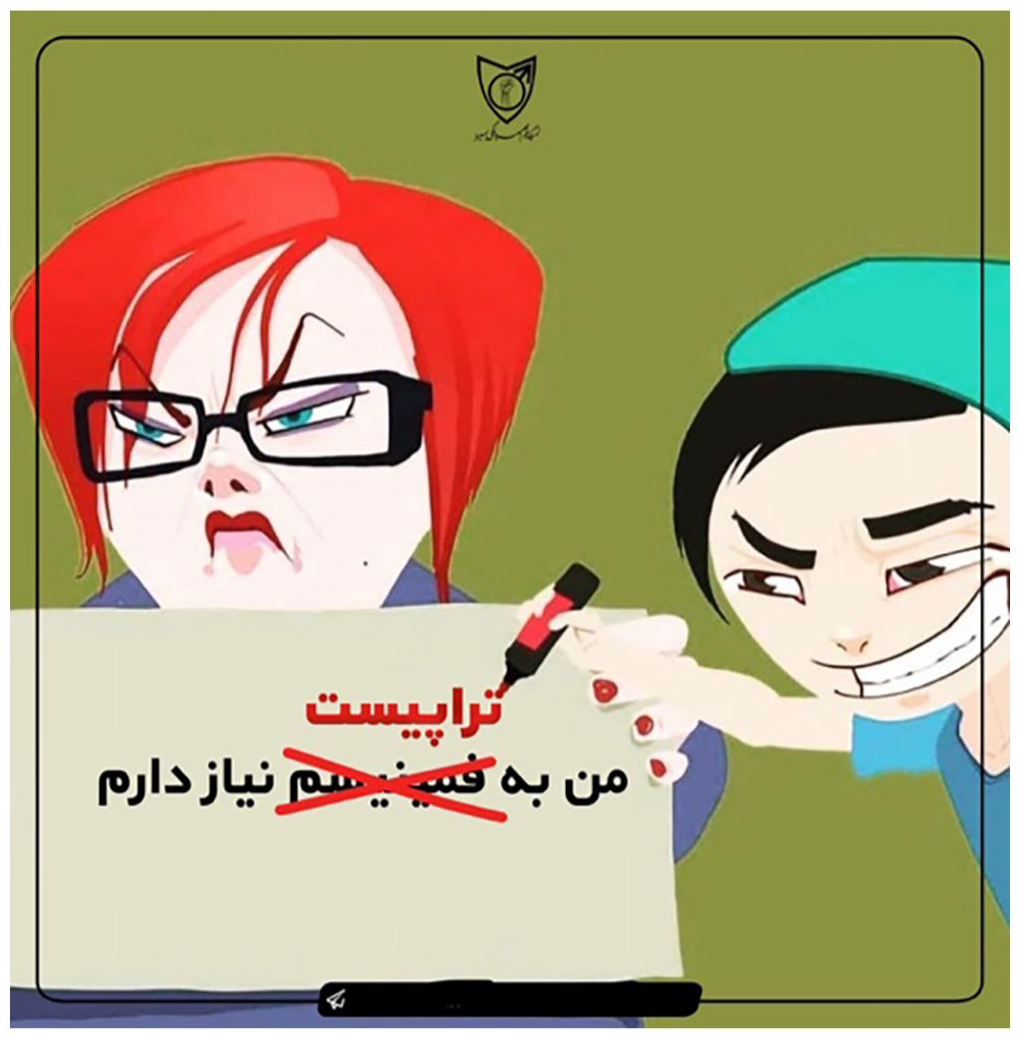
‘I need feminism a therapist’.
The Iranian Big Red meme continuously reproduces the frozen, angry face of a white woman – here, a feminist – of whom numerous misogynistic memes have been produced. According to the meme’s caption, feminists claim that they need feminism when they in fact need therapy. This message indicates that all feminists are hysterical and require mental and clinical help rather than feminism. At the same time, it further stigmatises mental health and the choice to seek therapy. According to Woods and Hahner (2019: 48), ‘memes are powerful rhetorical images insofar as they help fashion a discursive reality’. In this case, the mythical ‘reality’ of pathologising women as constantly ‘hysterical’, ‘illogical’ and ‘unreasonably angry’ is ascribed to the red-haired woman by means of various ICT tools and re-created through memes. Specifically, the repeated presence of the emotion of anger within anti-feminist memes, such as the ‘Big Red’ and ‘Feminazi’ memes, is a discursive tool for visually mobilising anti-feminists by claiming that feminists are illogically angry and not worth arguing with. Massanari and Chess (2018: 534, 536) have shown how alt-right communities deploy memes, such as those concerning SJWs, to villainise feminists as ‘monstrous feminine’ individuals who are constantly ‘unruly, angry and visually less human’ and can be ‘ignored or attacked, but never reasoned with’.
In the Farsi versions of the Big Red meme and the Feminazi meme (see Figure 5), the emotion of anger is ascribed visually to the animated red-haired woman (Binx) and the infamous anti-feminist memetic figure of the Feminazi, respectively (Dafaure, 2020: 10). Hence, it is combined with the emotion of hatred through either the animated person correcting the Farsi caption with a malicious, ridiculing smile or the juxtaposition of feminism with Nazism.
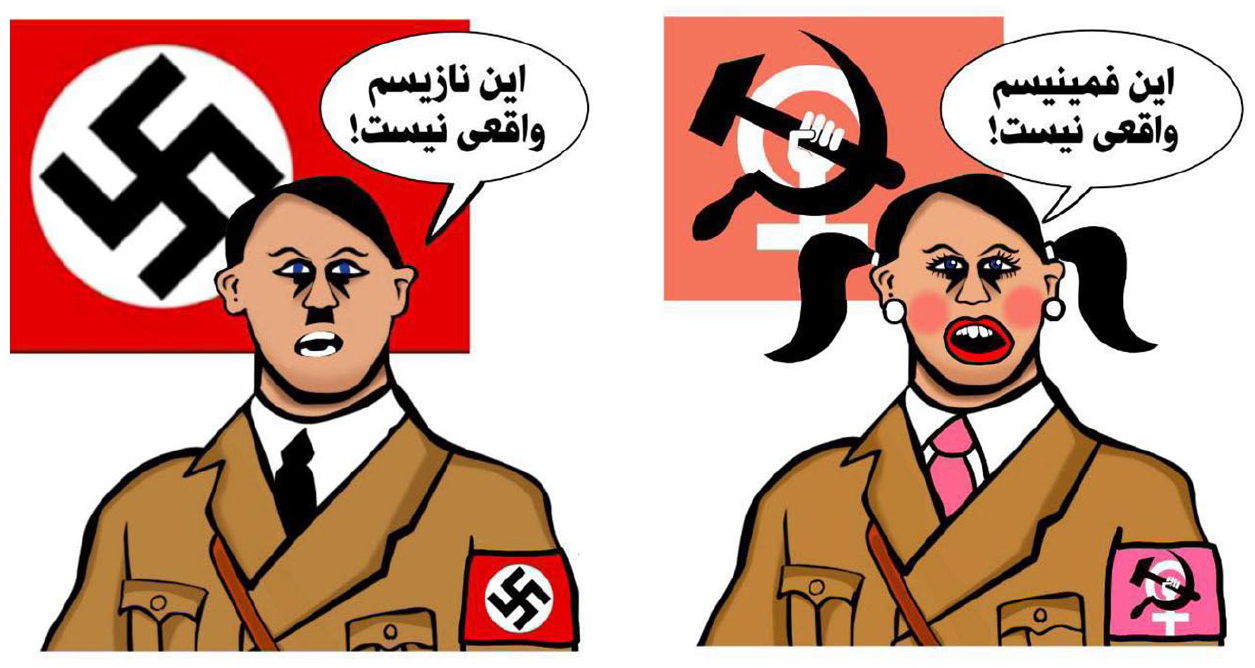
Farsi Feminazi meme.
The outcome is a strong affective memetics of misogyny that intends to simultaneously pathologise and villainise (feminist) women. While it visually promotes such rhetoric by adopting memetic figures that are deployed by the numerous MRA (sub)groups in the Western context, it further mobilises and internationalises hate towards feminists by capitalising on the affectivity of internet meme culture and its capacity for global circulation. Therefore, the Farsi versions of these memes are by no means detached from the increasingly uniting forces of the online culture wars and are instead embedded within, copying, and contributing to them.
The Iranian versions of Wojak and Pepe the Frog: Memeto-political global alliances
In addition to the previously discussed affective economic qualities of hate in circulation via internet memes, the second way in which hate and antagonism are mobilised within the expanding Farsi Manosphere is, as noted above, through the memeto-political global travels of infamous hate figures from alt-right online subcultures. Such travels, I assert, create a global politics of memetic alliance between these distinctive online-political contexts and across multiple media formats. Pepe the Frog and Wojak (or feelsman) are amongst the most explicitly infamous memes and, according to an EU report, are symbols that have been appropriated by far-right meme culture (Fielitz and Ahmed, 2021).
My digital ethnographic observation of channels and chatrooms (e.g. the Supporting Men’s Rights chatroom ‘Self-sacrificers of the Supreme Leader’) revealed that members circulated Pepe the Frog, Wojak and other memes, symbols, and clips from the U.S. alt-right online sphere while simultaneously – and contradictorily – heavily promoting the Soft War rhetoric and tactics of the ICA and facilitating systematic hate campaign(s) against feminists or digital activists. For instance, in most cases, queerphobic content utilised memetic figures such as Withered Wojak (Know Your Meme, 2018). In the meme in Figure 6, Wojak explains that queerphobic people do not know that Iranians were accepting of non-heterosexual individuals prior to the Westernisation of the country during the Qajar era. In an effort to undermine and ridicule Wojak’s argument, Withered Wojak cites Wikipedia to highlight all of the draughts and calamities that occurred during that time period. This seemingly off-the-cuff meme does not immediately appear queerphobic; however, the memetic mobilisation of queerphobic rhetoric can be inferred by contextualising alt-right utilisations of the meme and its multiple reconfigurations (here, the Farsi localised and historicised argument in the caption).
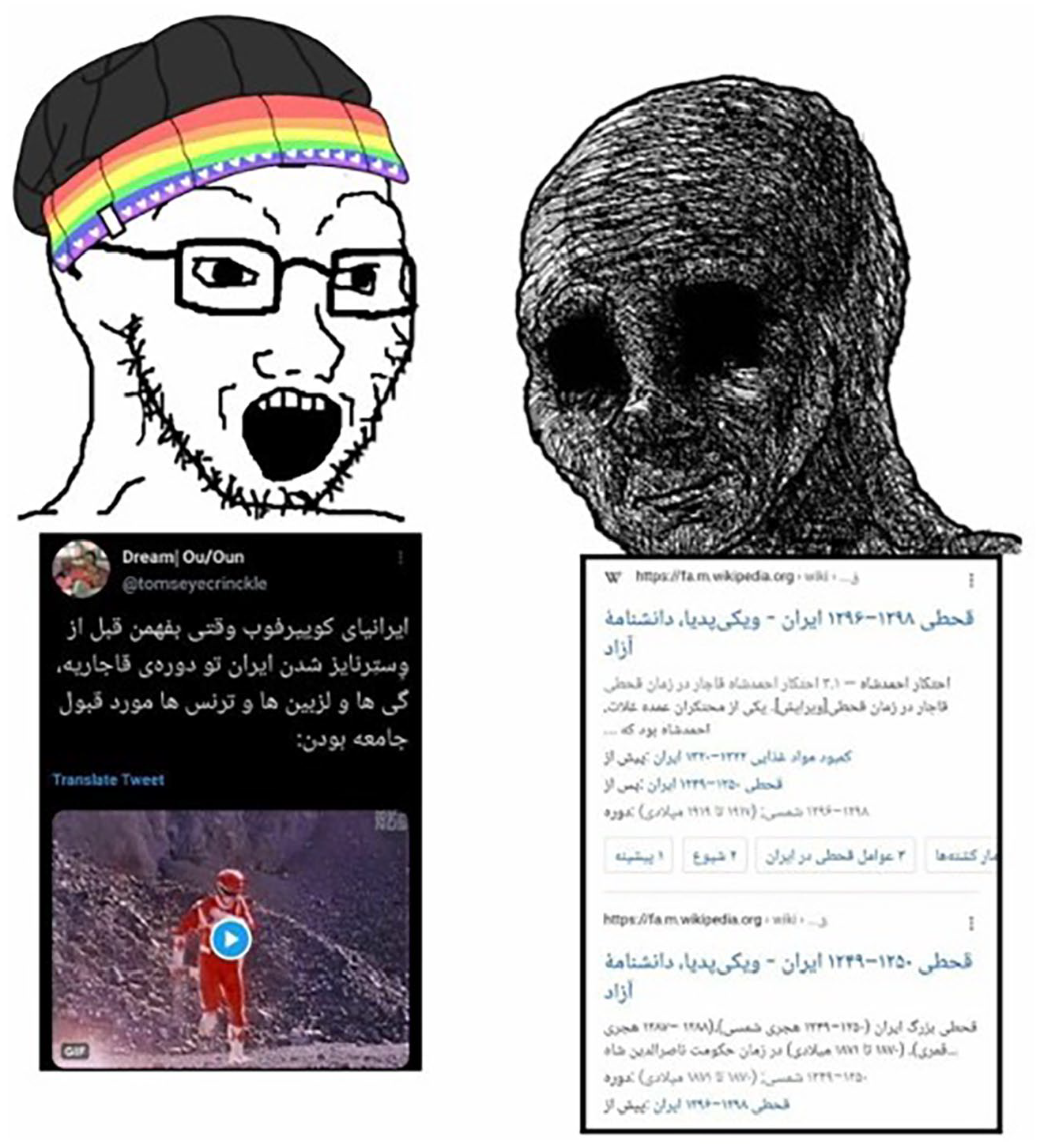
‘Wojak Discussion’.
Another memetic figure – who is perhaps the most notorious and ubiquitous of all, is Pepe the Frog. I argue that Pepe is a prime example to illustrate my argument regarding memetic alliances between Iran’s expanding MRA (and the authoritarian and state-affiliated ‘digital soldiers’ present therein) and the alt-right 4chan and Reddit troll army. De Seta (2019: 389) has observed a ‘thick layering of interpretive frames and indexical elements accruing around the “Pepe the Frog” character’ in recent years that vividly ‘captures the construction of digital media cultures in platform times’. This anthropomorphic frog originated in Matt Furie’s comic series Boy’s Club on MySpace in 2005. In the 2010s, the peaceful comic character gained popularity amongst online image boards, including 4chan and Reddit, and quickly became an almost universally recognisable internet meme with a life of its own. In 2016, Pepe the Frog was claimed to be responsible for ‘memeing’ Donald Trump into the U.S. presidency after Trump tweeted the image of the character with the caption, ‘you can’t stump the Trump’ (Know Your Meme, 2015; Woods and Hahner, 2019). Consequently, during and after the 2016 U.S. election, Pepe was adopted as an icon by white supremacists in the US and was soon perceived by internet users as a symbol of hate (Cohen, 2020).
Since then, Pepe the Frog has evolved into more than a simple, popular meme and has been widely adopted across numerous contexts and platforms. The international adoption of Pepe the Frog reveals not only how internet memes act as ‘agents of globalization’ (Shifman, 2014: 151) but also how Pepe’s ‘elasticity’, which ‘stitches together audiences in and through the travels of the image’ (Woods and Hahner, 2019: 86), can render it an agent of globalising hate through its capability to unify seemingly conflicting political forces. Following Woods and Hahner (2019: 92), I view Pepe as an ‘iconic assemblage’ that is not inherently a hate icon but became one through its travels and ‘repeated articulations that suture Pepe to the [alt-right groups]’. The alt-right itself should also be considered an ‘assemblage’ which shapes desires and discourses via images, travels and repetition (Woods and Hahner, 2019: 89). In this regard, I argue that the recent circulation of figures such as Pepe in the Iranian digital sphere should be addressed within such assemblage of not fixed or authentic significations of the alt-right but through their multiple circulatory travels. While these travels are inspired by and embedded within the memes’ usage in alt-right online subculture, they reconfigure the meme at the new destination and, together with the meme itself, act as agents of such global reconfiguration.
Crucially, the extensive usage of the Pepe meme and sticker set in the Iranian context reflects a bizarre juxtaposition and, more significantly, a manifestation of how the most suppressive and misogynist forces find memetic alliance in each other’s visual and iconic assemblages. The example of a particular Iranian MRA Telegram chatroom can further clarify such alliances. The memes and sticker set of Pepe the Frog (Figures 7 and 8) have been heavily circulated amongst MRA groups within and beyond Farsi Telegram, including in the sub-group previously named ‘Self-sacrificers of the Supreme Leader’. While Pepe the Frog is at once an ‘iconic assemblage’ within the memetic ‘machination of the Alt-right’ (Woods and Hahner, 2019: 92) and a ‘vulgar, irreverent, ironic, and goofy’ representation of the alt-right in the U.S. and other Western contexts (Hawley, 2017: 2), it has a multi-layered presence in anti-queer and anti-feminist MRA groups and sub-groups on Iranian social media, where state-aligned anonymous accounts have been heavily active. For instance, in Figure 7, one such account uses the homophobic Farsi term (hamjensbaz 4 ) to apparently ‘warn’ other ‘digital soldiers’ and members that a homosexual person is in the group. Immediately above this message, a Pepe sticker is shared. In other instances (Figures 8–10), the anti-feminist and transmisogynistic Pepe appears in memes with anti-trans and anti-feminist Farsi captions and threats involving, for instance, ‘militaristic strategy’ (O’Donnell, 2020: 656), which was a phenomenon similarly observed amongst Gamergate chatroom users. Other times, Pepe is deployed to disparage feminists and ridicule queer symbols.
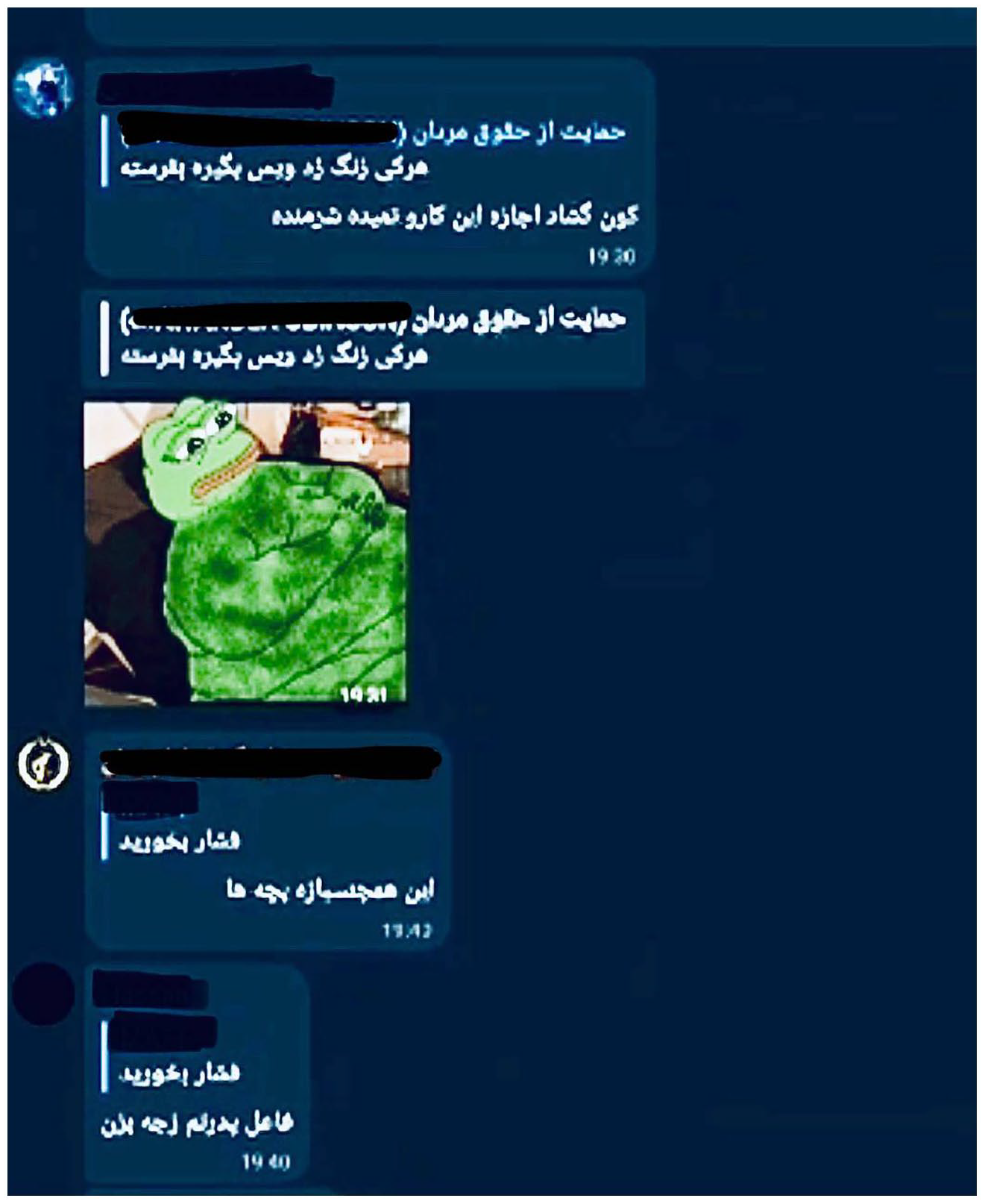
Pepe sticker widely shared in various Farsi MRA public chatrooms.
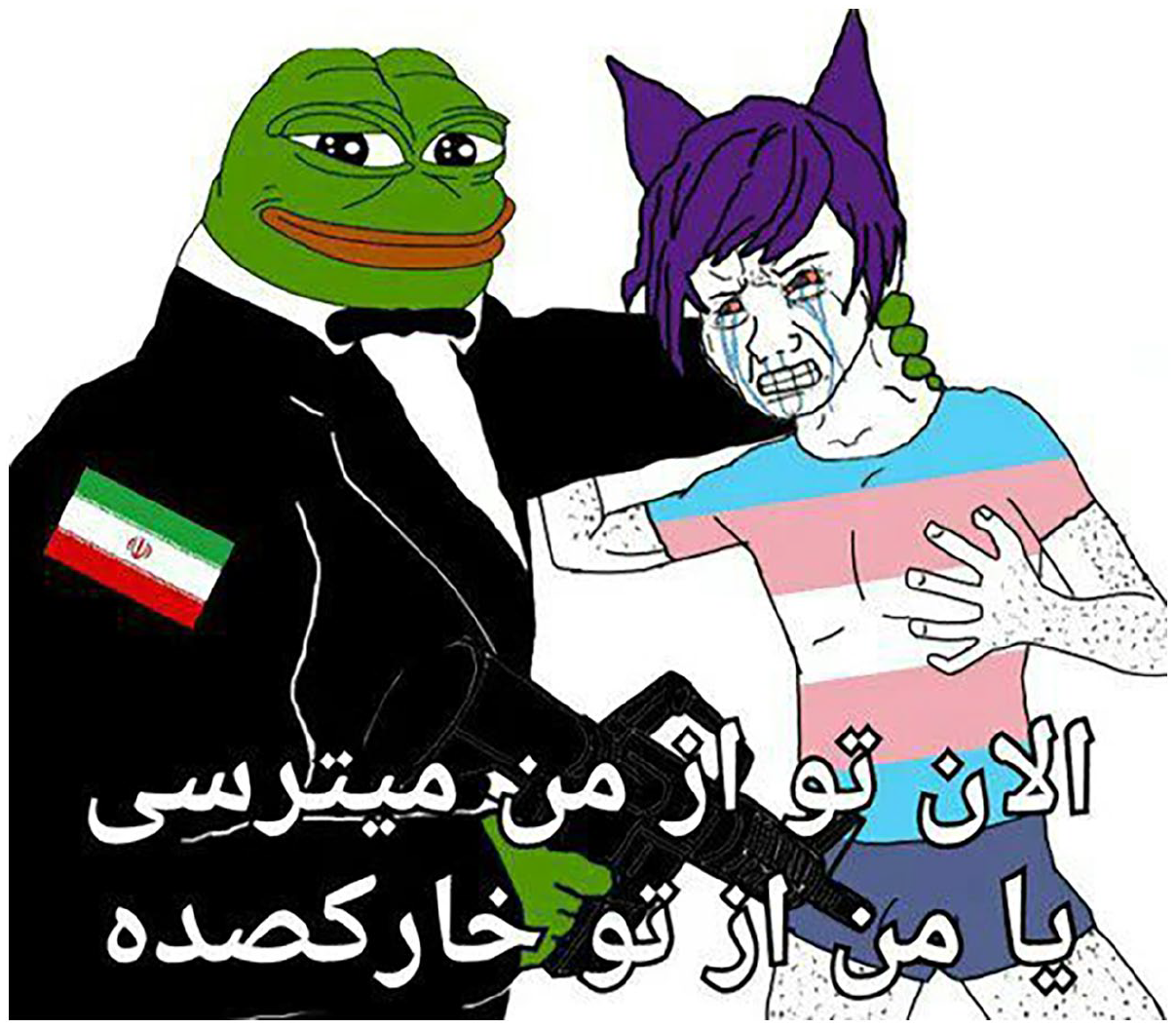
Pepe’s transmisogynistic reaction meme of an Iranian official pointing a gun at a trans* person with the caption, ‘Who is afraid now, Kharkosdeh [sexist Farsi slur]? Me of you, or you of me?’
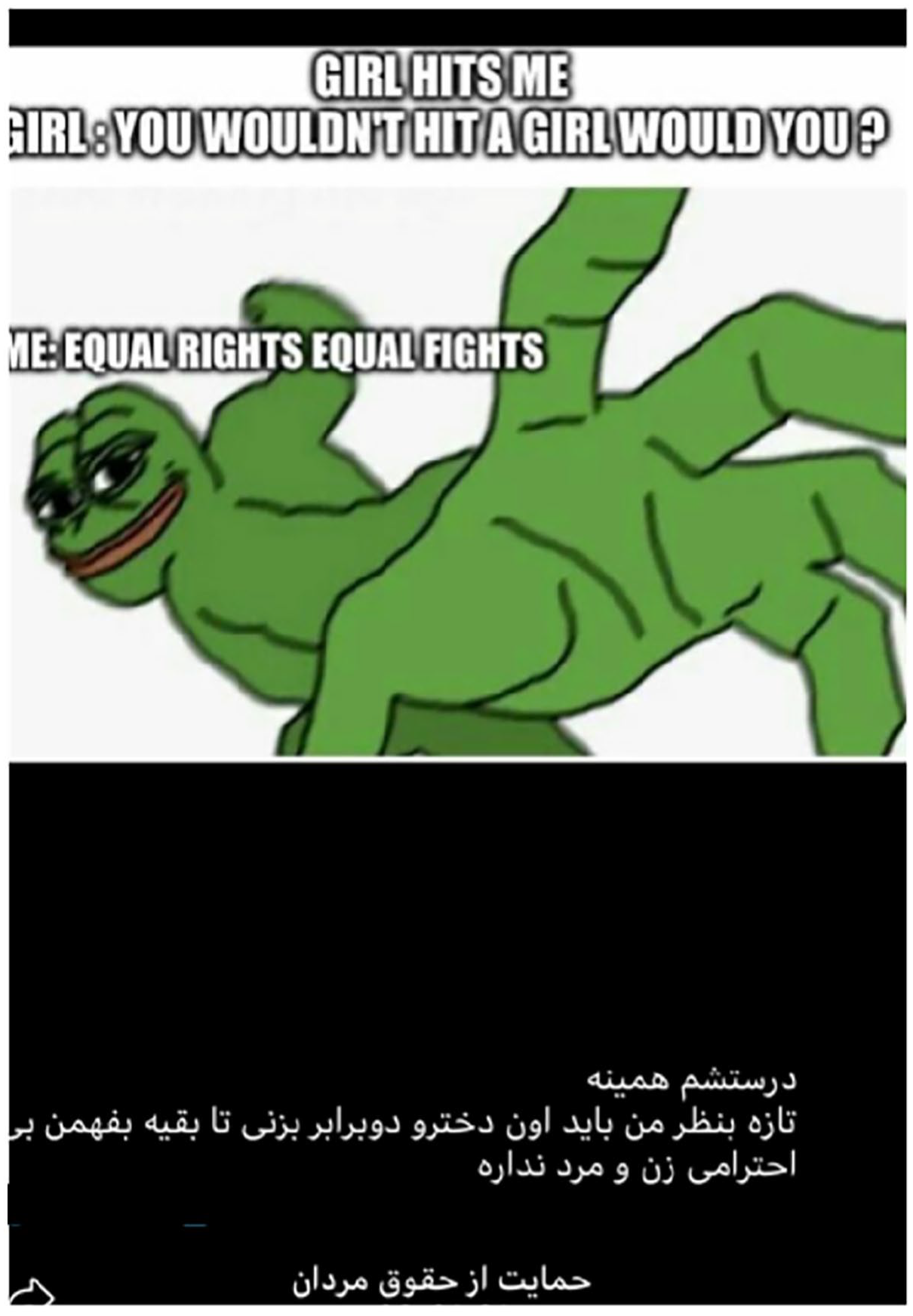
Pepe the Frog with a Farsi caption translating to ‘the right thing to do is this [to hit], and I believe you must hit such girls even harder so that others realise disrespect has no gender’.
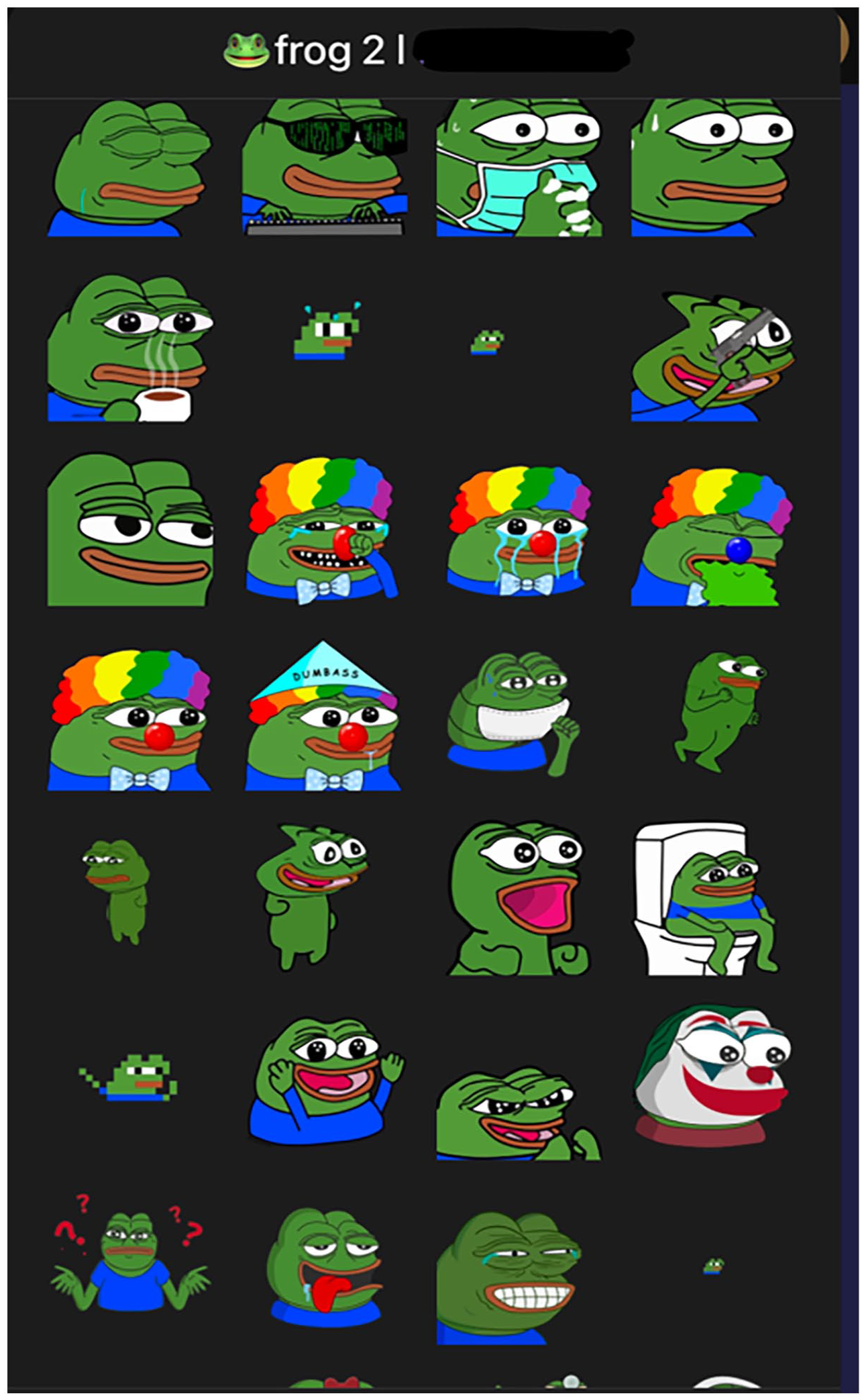
Pepe the Frog sticker set.
A question that may arise is why the ICA and various MRA members, who use anonymous usernames alongside profile pictures of Iran’s political and military leaders and take pride in being ‘digital soldiers’ against the West, are translating and employing white supremacist videos and symbols and, in this case, an iconic assemblage of hate to convey their opposition to all aspects and forms of Westernisation. Following Bratich’s (2022) conceptualisation of ‘microfascism’ as a mediated culture and collective action, I assert that such seemingly contradictory affinities between the Iranian and U.S./Western online cultural politics are the result of a globalising ‘networked misogyny’ of the escalating ‘[m]anospheric microfascism’ (Banet-Weiser, 2018; Bratich, 2022: 47) that is mediated, networked, in constant circulation and mutation, and founded on a global ‘social desire’ that is located both ‘in archaic [misogynist] tradition and contemporary media production’ (Bratich, 2022: 148). Therefore, this seemingly contradictory practice within the emerging Farsi manosphere can arguably be clarified by two key aspects of such memeto-(micro)political emergent global body: first, the multiple agential adaptability of digital aesthetics that certain memetic media assemblages carry; second, and more crucially, the growing mediated affinities amongst an ever-emerging collective body of what Sarah Banet-Weiser has called ‘networked misogyny’ (Banet-Weiser, 2018) and what Jack Bratich has called the ‘microfascist masculinity’ (Bratich, 2022: 51) and desire that centres ‘gendered eliminationism’ (Bratich, 2022: 148) through the (everyday) promotion of misogynistic, racist, transphobic and queerphobic dogmas. Thus, such memeto-political affinities are most effectively united by their intense hatred of women and other otherised bodies.
In this regard, I contend that Pepe and similar memetic figures have a political capacity to reveal such rising global alliances – here, between the online activities of the state-sponsored ICA and various MRA groups of Iran and the broader alt-right’s assemblage of visual ‘microfascist’ machinery precisely in how these forces co-constitute each other’s dogmas and myths. Specifically, the visual objects of memes and their presence in Iranian MRA groups do not innately carry a message of hate; rather, they gain such affective flexibility through their loaded capacity to co-produce and mobilise multiple forces – here, through Farsi captions, mobilisations and translations – while simultaneously feeding from and reconfiguring global assemblages of authoritarianism and alt-rightism.
Therefore, it is crucial not to (un)intentionally dismiss such increasing memetic pact by simplistically disregarding it as vulgarly insignificant or hauntingly impossible or by discursively isolating authoritarian and restrictive contexts, such as Iran’s suppressive digital politics, from the global rise of the right and its gendered, mediated microfascist hate culture.
Conclusion
This research has examined Iranian anti-feminist and anti-queer MRA groups within the broader phenomenon of the growing global manosphere as well as analysed their memetic practices and highlighted the palpable presence of Iran’s seemingly anti-West ‘digital soldiers’ (ICA members and state-affiliated trolls) within such groups. It has developed the concept of ‘memetic alliances’ between the contentious and conflicting online political contexts and analysed alt-right memetic figures and their vast presence in the Iranian manosphere and the MRA groups therein. This analysis illustrates that seemingly trivial yet extremely political memetic figures can travel across numerous contexts and, with each travel, re-configure and globalise mediations of gendered hate online through, for example, captions, collages and juxtapositions. Such memetic travels and tactics illuminate the agential shortcomings of (Western-centric) platform designs, which consistently dismiss the protection of marginalised communities online.
Moreover, this article has examined selected memes in affective global circulation within the rising Farsi manosphere and across social media platforms as a case that illuminates a wider phenomenon. Thereby, it has demonstrated that implicit forms of hate are globally activated through affectively charged memetic figures to perpetuate gendered myths of feminine illogicality via an online global shared culture of misogyny. It has also identified the substantial usage of Western-centric content, which, as explained, has accumulated ‘affective values’ in each new context and internationalised hatred and misogyny. The article contributes insights regarding the global rise of the right and its complicated entanglements with gendered hate online, which have resulted in an escalating mobilisation of MRA and anti-feminist groups at the global level and, more urgently, the circulation of popular alt-right memes and white supremacist iconic assemblages (e.g. Pepe the Frog, neo-Nazi symbols) and content within the rising Farsi manosphere.
These insights allow for mapping out the manifestation of the convergence of highly suppressive forces at the juncture of the digital affordances of contemporary internet meme culture. Notably, the case of Iran’s authoritarian forces and the rising Farsi manosphere, including the online/offline MRA activities that those forces support, is not an exception unique to the Middle East but is in fact reconfiguring and standing in global alliance with the ‘digital (micro)fascism’ of the (alt-)right and its online culture wars. This research therefore supports nuanced studies of global unity at the juncture of internet meme culture while encouraging more scholarly debate on existing but less examined common global strategies and tactics of propagating hate online. Such analyses should also consider the ongoing struggles of targeted marginalised groups and possibilities for generating transnational queer and feminist discourses and resistance to the multifaceted gendered hate online.
Footnotes
Funding
The author(s) disclosed receipt of the following financial support for the research, authorship, and/or publication of this article: This research has received funding from the European Union’s Horizon 2020 research and innovation programme under the Marie Skłodowska-Curie grant agreement No. 861047.
