




Abstract
This study aims to map out the popular phenomenon of misogyny in the specific techno-social configuration buttressed by China’s state-market nexus. With a case study of a controversy involving the standup comedian Yang Li and the luxury car brand Mercedes-Benz on the microblogging platform Weibo, I highlight the ‘platformization of misogyny.’ The conceptualization refers to the way that a platform is evoked as tools to manufacture and amplify misogyny. Weibo has this effect both through its design, features, and algorithmic shaping of sociality and through its users’ appropriation of its affordances. On top of that, the platform also engenders a form of governance that is deeply enmeshed in the commercialization of internet opinion, suggesting a techno-nationalist mode of state control that is exercised from afar and deeply imbued with patriarchal and misogynistic characteristics.
Keywords
Chinese standup comedian Yang Li appeared in a short video for the luxury car maker Mercedes-Benz (henceforth ‘Mercedes’) on October 14, 2021, that immediately drew intense criticism. The complaints focused on Yang herself, who rose to fame for making sarcastic comments about men in online gigs. Responding to the video, some self-identified men netizens attacked her and called for a boycott of Mercedes, though other netizens praised the Yang-Mercedes team-up. The controversy was especially prominent and heated on China’s most popular microblogging site, Sina Weibo (henceforth ‘Weibo’). Yang was already accustomed to controversy. Earlier in 2021, Intel pulled a Chinese laptop ad featuring her in response to backlash from mainly men who advocated boycotting the company for collaborating with a woman who ‘insulted’ men. As transnational companies, both Intel and Mercedes have found it difficult to please Chinese consumers amid competing accusations of sexism. In this case, Chinese men criticized the companies for using an allegedly misandric figure to sell their products while Chinese women interpreted the decision not to collaborate with Yang as capitulation to and conspiracy with a sexist culture.
The Yang-Mercedes controversy, as a case of popular misogyny, to use Banet-Weiser’s (2018) term, highlights the entanglement between the national specificity of platforms and their cultural values and practices of misogyny in what I term the ‘platformization of misogyny.’ This conceptualization (1) demonstrates how a platform is evoked as tools to manufacture and amplify misogyny both through its design, features, and algorithmic shaping of sociality and through users’ appropriation of its affordances and (2) accounts for the status of platforms’ governance as deeply enmeshed in the commercialization of internet opinion, suggesting a techno-nationalist mode of state control exercised from afar and deeply imbued with patriarchal and misogynistic characteristics. This understanding aligns with scholarly and public concerns about the role of the platform’s techno-social configuration in shaping the cultural production of racism, sexism, anti-feminism, and toxic masculinity, while remaining attentive to Chinese government’s information management and cyber control through implicit platform features and policies that afford and constrain communicative acts (de Kloet et al., 2019; Hou, 2020; Massanari, 2017; Matamoros-Fernández, 2017; Nakamura, 2015).
The essay focused on analyzing primary and secondary sources. I first examined Weibo official documents, industry reports, technology press reports, and government regulatory papers, and I carefully reviewed the studies of China’s international and domestic information control and public opinion management through techno-nationalist and patriarchal practices. This analysis allows me to map out the political economy of Weibo, emphasizing the commercial and ideological shaping of the platform which led to its market success and changes in its discursiveness. I then conducted a case study of the Yang-Mercedes controversy to show how Weibo’s design, features, and policies afford and constrain interactions and communications to nourish the production, manifestation, and amplification of misogyny. I contextualized the case by reading the online discussion of the controversy, collecting 2,922 comments on October 20 at the height of the controversy through ‘Yang Li Mercedes’ keywords search on Weibo, and by interviewing a company representative. My primary focus is the discursiveness of the controversy on Weibo rather than the individual texts that are constitutive of the discursive space. By highlighting Weibo’s technological and discursive affordances, I analyze the digital platform as it is used and discussed by various actors.
Weibo’s evolving business: Commercialization in the attention economy
Launched in 2009, Weibo is part of a human-centered attention economy where the key opinion leaders (KOLs) are the main attraction and distribute content via sociality (Fuchs, 2013; van Dijck, 2013). In its fledging days, Weibo relied on journalists, media professionals, and celebrities as KOLs to address contentious events and emerging social issues. It amassed many users as an elite-oriented platform that activists also exploited to mobilize, strategize, organize conscious-raising campaigns, and advance claims, including in support of feminist causes, thereby encouraging public participation and nurturing civil society (Deluca et al., 2016; Wang, 2018; Yang, 2009). To be clear, women’s issues and gender topics remained on the periphery of early Weibo discussions since the KOLs tended to be men and, though ‘socially liberal’, either uninterested in or opposed to feminist activism (Guancha.cn, 2012; Li, 2020). As the state tightened oversight of digital platforms and KOLs, Weibo increasingly avoided social issues (Buckley, 2013). Since 2013, while keeping its influential news and events feeds, the platform has undergone a transformation to expand its commercial user base, developing multiple vertical marketing sectors (Kanchaiwang, 2015).
Over the years, Weibo has significantly changed in its technological features and discursiveness. On the one hand, it has continuously improved its KOL-driven business model, which relies on multi-channel networks (MCNs). MCNs, also referred to as KOL agencies, have been thriving in China since the mid-2010s, helping KOLs to boost their influence and monetize their content through advertisements, sponsorship, and merchandizing. Platforms expand their technological features developed by third parties and operate multi-sided markets to forge computational and economic connections among software developers, MCNs, KOLs, businesses, and end users that confer competitive advantages and economic benefits through synergy (Nieborg and Helmond, 2019; Plantin and de Seta, 2019; Poell et al., 2019).
Weibo has developed extensive multi-markets with features and third-party services and tools that enhance the platform ecosystem. Besides standard microblogging sociality features, such as information feed, post, like, repost, search, and topic discussion, Weibo has also introduced a Quora-like feature called Weibo Q&A, a live streaming function, and a Top Article section that allows the creation and presentation of long-form content to be built into users’ posts. Weibo’s open application platform also helps third-party developers to access users while simultaneously enabling the platform ‘to acquire shared content from other apps and platforms’ (Weibo Corporation, 2022: 78). Brands are launching Weibo accounts in various sectors to market directly to target audiences. Through the institutionalized power of production and distribution, MCNs continue to breed new KOLs who ally with established ones, directing audiences’ attention to these influencers through reposts, coproductions, and mentions of the inhouse KOLs in each other’s posts (Liang, 2022). Weibo strategically consolidates these practices by offering paid advertising and marketing services such as automated engagement boosting and management of fan communities, which constituted 88% of its revenues in both 2020 and 2021 (Weibo Corporation, 2022).
On the other hand, Weibo is increasingly retrenching its discursive space to serve the primary purpose of commercialization. As of December 2021, Weibo averaged 573 million monthly active users and 249 million daily active users, and its revenues exceeded US$2.25 billion in 2021 (Weibo Corporation, 2022). Weibo promotes a certification system (CS) that incentivizes users to create content and become KOLs (Weibo, 2022). The CS recognizes certified content creators by displaying an orange letter V – for ‘VIP’ – after their handles, granting certification in specific categories, including 32 interest-based areas (arts and entertainment, beauty and cosmetics, gaming, military matters, digital news, travel, and so on), super-topic discussions, vlogs, Top Article creators, and Q&A bloggers (Appendix). Individual users can also be certified as KOLs with a ‘Golden V’ logo, indicative of the quality and popularity of the content that they create. In addition, Weibo certifies MCNs, businesses, media outlets, NGOs, educational institutions, and government agencies and officials, recognizing them with a ‘Blue V’ logo after their handles and offering them paid marketing service packages for content promotion, fan management, and traffic support. To incentivize content creation and distribution further, Weibo calculates for each certified user a ‘V-influential Index’ based on factors such as creative content, popularity, and engagement with fans, and it updates KOL Lists in 34 categories based on the index weekly. 1
Weibo’s CS has, in effect, expedited the consolidation of the profit-driven attention economy, with its revenues coming primarily from the advertising and marketing services provided to certified users, companies, and organizations. The platform’s design and technological affordances privilege commercial activities derived from the relation-rich KOLs, who are usually backed by MCNs, in order to direct even more attention to especially profitable topics such as beauty, pop culture, and celebrities. Weibo’s 2020 User Development Report indicated that most users were born after 1990 (78%) and women (54.6%) and tended to follow multiple KOLs across various sectors (Weibo Data Center, 2021). This general user profile also emphasized pan-entertainment topics such as beauty, pop stars, entertainment gossip, TV shows, and travel. Essentially, women-centered content that offers apolitical or conservative viewpoints has flourished on Weibo. With its CS, Weibo also provides governments and official outlets (such as state-controlled media) ways to conduct propaganda through marketing tactics, manage online opinion by manipulating and exploiting the platform’s affordances, and cultivate users as collaborators on thought work.
Weibo and state control: Patriarchal governance near and far
Clearly, the discussions of sexism, gender-based violence, and discrimination in the workplace have attracted attention over the years, with the stories about the #MeToo movement shared on Weibo beginning in 2018 heralded as a feminist victory, albeit short-lived. In the entertainment sector, prominent cases of women’s fan groups inflating their idols’ visibility and popularity online by exploiting Weibo’s algorithm (Yin and Xie, 2021) have led members of the government and public to condemn these fans as irrational based largely on their gender (i.e. women), though these critics have been reluctant to acknowledge that their activities have created tremendous profits for the platform economy. Overall, Weibo has provided a platform for many users, not all branding themselves as feminists, to share visions of gender equality and justice and increase the volume of women’s voices and visibility amid the deepening divisions among Chinese women regarding the key problems that they face and the best solutions to them.
However, Weibo’s design, features, and culture easily serve to limit feminist discussions. In the first place, topic segmentations through vertical marketing in the CS accompanies arbitrary regulation of the platform to recognize appropriate content and content creators who can be certified. Second, Weibo is obliged to remove and/or mitigate the influence of social topics with the potential to cross the state’s ‘red lines.’ Third, because the state is both a crucial part of Weibo’s multi-sided markets and its regulator, the combined weight of the Blue V accounts of certified government agencies and officials on Weibo can effectively manage public opinion and curtail serious conversations. For example, in analyzing digital campaigns against sexual harassment in higher education, Liao and Luqiu (2022) found that a Chinese university was able to influence Weibo content by leveraging its ample resources. While news media, especially state media, can bypass the universities and cover the sexual scandals associated with them, their relative administrative rankings in the political system impact the outcome – that is, the higher the ranking, the greater the power to indoctrinate Weibo to censor content.
From 2011 to 2018, the percentage of political and social topics in the Weibo’s annual trendy topic list dropped from 75% to 23% while that of entertainment rose from 20% to 48% (Jia and Han, 2020). Rather than ad-hoc reaction to gender discussions online, the state-controlled accounts on Weibo actively set agenda regarding gender issues. In September 2021, for example, Health Times, an offshoot of the state newspaper People’s Daily, launched a crusade against several internet influencers, blaming them for seeking attention and selling products by faking illness, propagating the sexist term bingyuan (病媛, ‘sick lady’) online that contributed to the backlash against women (Zhuang, 2021). In addition, the Chinese Youth League Weibo account initiated online discussions denouncing and censoring supposed ‘extreme feminist’ positions on practical issues related to marriage, property, relationships, and reproduction, eroding digital spaces for feminist movements and activism (Jia, 2022). Weibo’s policing of feminist topics and gender politics has closely followed the state’s tightening grip on feminism and its discrediting and criminalization of vocal feminists (Liao, 2020; Yin, 2022; Zheng, 2015). Since Weibo’s guiding strategy is to profit within the context of the state’s ideologies, it has worked to prevent vocal feminists and dissents from receiving certification and recognition and thereby gaining visibility, popularity, and influence.
The state’s influence on the operation and discursive affordances of digital platforms is part and parcel of its wider effort of public opinion management in the digital era. Repnikova and Fang (2018) identified three trends in the state’s substantial but subtle efforts of information control: (1) the digital revamping of news outlets, (2) the expansion of e-governance on Weibo and WeChat, and (3) the encouragement of patriotic bloggers as thought-work collaborators. I suggest the addition of two more trends to this list: (4) the active creation and propagation of pro-regime media productions characterized by paternalist, patriarchal, and sexist themes, such as mapping the image of young women as xiao fen hong – patriotic fans of the nation (Comrade, 2016) – and (5) the state’s creation of its own platforms such as the Xuexi Qiangguo app for indoctrination and propaganda (Liang et al., 2021). Though some of these efforts have received a chilly reception, the synergy effects of them amount to the exercise of governance near and from afar, with the complicity of platforms, to ensure a masculine techno-nationalist environment conducive to the commercialization of gender topics but hostile to feminist movements and discussions of labor justice, minority rights, and other topics that are arbitrarily branded as threatening to social stability, national security, and regime legitimacy.
By the end of December 2020, Weibo had 177,437 certified e-governance accounts, including 140,837 institutional accounts and 36,600 accounts of civil servants (People’s Daily, 2021). On top of employing paid online commentators, sometimes referred to as its ‘fifty-cent army’ (Han, 2015), the Chinese government has quickly adopted tactics suited to nuanced governance, harnessing the influence of patriotic KOLs, state-controlled media outlets, and e-governance accounts to sell its nationalistic message and dilute anti-regime comments. In this techno-national context, Weibo amplifies government-sanctioned and commercial-friendly gender discourses while nominally highlighting gender equality – usually through the policing of women.
The Yang-Mercedes controversy: How Weibo as tools and a form of governance manufactures and amplifies misogyny
Weibo’s design, features, and algorithmic rankings built around the CS have cultivated a commercially welcoming environment for women-centered content. Yang Li became one of the powerful voices on Weibo with witty and sharp comments about gender issues in her online comedy gigs described earlier. Her sarcastic question, ‘How can men who look so average be so confident?’ introduced the term puxinnan (普信男; ‘average yet confident men’) to the popular lexicon in 2020 and elicited fierce pushback from men (May, 2020). Some of Yang’s critics went so far as to refer to her fans as ‘the Ta-li-ban,’ playing on the homophony between her given name and the middle syllable of the English transliteration of the name of the Afghan political party strongly associated with terrorism. Such a comparison of women seeking basic rights to militants and terrorists is suggestive of the rampant toxic misogynist culture in which the controversy surrounding Yang played out, as is the polemical use of ‘women’s fist’ for the phonetically same term ‘women’s rights’ in Chinese. 2
The Yang-Mercedes controversy opened a fresh chapter in the conflict between supporters and critics of the comedian’s provocative stand-up routines. The highly visible controversy is unmistakable evidence of the visibility and popularity – and thus, again, profitability – of women-centered topics on Weibo. Yang herself is a certified Golden V KOL with an active fan base of over 2 million, and her agency, Yang Li Studio, also operates a certified Blue V account for business inquiries and collaborations. The Weibo discussions of her display the strongly misogynistic tone of censure and antagonism. Through hashtags such as #BenzYangLi#, and #BenzYangLi_short_video_controversy#, the sharing, commenting, and liking practices on Weibo have magnified the misogynistic discourse. Within half a day after the original short video has been posted, it had been played over 160,000 times, and some comments had been retweeted and liked thousands of times, metrics that were critical to assigning relevance to this incident and that influenced the ranking of the content through Weibo’s algorithm, thus further increasing the visibility and intensity of the controversy.
For example, when searching ‘Mercedes Yang Li,’ a top comment by @diguaxionglaoliu (n.d.), with 1,564 comments and 12,593 likes, reads, ‘#BenzYangLi# Rolls-Royce invited online celebrity Wanwan [for an endorsement]! And Benz got Yang Li! Yang rose to fame because of puxinnan. But everybody knows that her gig ridicules some losers who are overconfident, those who are so-so but have big egos, thus pudanan [da refers to “big ego”]. If she said so, not so controversial, but also not so popular! #Vlightproject#.’
3
The user, a Golden V KOL, claimed to be ‘the head of the patriotic squad’ (@diguaxionglaoliu, n.d.), who is one of the patriotic bloggers that the state has encouraged and monetize their patriotism as a business (Xiaoshan, 2022; see also Lianhe Zaobao, 2022). The post, while not overtly sexist or misogynistic, suggests that commercial collaborations between luxury car brands and women influencers may be controversial because of men’s negative impressions of women such as Yang. It was argued that Yang deserved these attacks because her popularity is a product of her own controversial comments about men. This comment further intensified and escalated the controversy through discussion threads based on the commenter’s fan base of some 650 million users, making it a crucial node of sociality and relation-based content distribution amplified by Weibo’s ranking and filtering mechanism. The prevalence of the type of misogyny and antagonism exemplified in this discussion lent it a certain legitimacy as a trendy topic. Many certified Weibo accounts quickly chimed in.
@DouCar: Benz seems [to be] giving up on men customers and targeting women? #Mercedes-Benz# #Luxurycars# #YangLi# @AIFinance: #MercedesYangLi# Luxury car brands have anxiety over the attention economy. @CarObserver: #YangLi# was attacked every time she collaborated with a car brand. . .. Knowing clearly Yang Li will be attacked, why do car brands do this all the time?
By tagging, sharing, and commenting, these users strategically appropriated Weibo’s affordances, exploiting the controversy for individual gain and, thereby, driving traffic and attention (Liao and Xia, 2022). The practice aligns techniques of optimizing, or gaming, the algorithm for visibility (Bucher, 2012; Gillespie, 2017). While Mercedes has been paying substantial advertising and marketing fees to Weibo for services such as social display ads, promoted feeds, and engagement boosting, it is also largely confined by Weibo’s commercial solutions and services that treat KOLs, MCNs, and other businesses as equal partners. For example, my Mercedes informant spoke of having worked with Weibo to limit traffic to this topic – a practice usually conducted under the table to reduce the possibility of a post being seen – but the traffic management is inapplicable to other certified V accounts, including the Golden V KOLs and Blue V organizations. Precisely because Weibo provides a range of marketing tools to individuals and businesses eager to attract viewers and expand their influence, other users’ comments and posts offset Mercedes’s effort to reduce the visibility of the video and mitigate its influence – which is also a design issue for Weibo’s governance.
Four days after the video with Yang debuted, the controversy had become the fifth-most-searched topic on Weibo’s trendy list under the arts and entertainment sub-category. Weibo users became even more polarized when Mercedes restricted the post to its followers and showed only select comments. Yang’s supporters vented their anger at what they interpreted as Mercedes’s surrender to Yang’s largely men opponents, further fueling the controversy. The discursive space was thus enlarged, but the result was merely to leverage the algorithmic visibility while reinforcing gender stereotypes within this space. For example, when men attacked women for their supposed ignorance about motor vehicles, promoting a vision of the automobile industry as a masculine domain, the latter posted sarcastic comments about the former lacking the status to afford a luxury car, thus using a class-based rhetorical strategy rather than targeting the gendered assumptions as problematic. In this regard, both supporters and critics of Yang avoided engaging in any meaningful exchange that would have challenged the conservative assumptions relating to gender; rather, they reinforced the social stereotypes at the intersection of class and gender that feed the platform’s attention economy.
Weibo’s policies and approach to governance encourage borderline content such as the antagonistic discussion in the Yang-Mercedes controversy. Users distribute such content to game the algorithm – through which the platform can profit from the paid marketing services offered to users who want to manage internet traffic (Mercedes in this case) – and the platform also relies on them to manage and report controversial content. At other times, when Blue V media and government accounts join the discussion, the platform regulates content according to the official attitudes and narratives, as in the bingyuan and the ‘extreme feminism’ cases. Following the state’s regulatory policies and guidelines, Weibo solidified its governance in the Weibo Community Contract, which established a three-layered, self-regulatory body consisting of a Community Expert Committee, Community Committee, and Supervisory Committee to deal with violations and punishments (Weibo, n.d.). Yet, the mechanisms of reporting, filtering, backlisting of words, and suspending accounts are largely hidden in the proverbial black box. For example, feminism-related topics are constantly subject to reporting and feminist accounts to suspension, with Weibo CEO Wang Gaofei even offering tips to users for removing accounts that share feminist views by reporting them as inciting hatred and gender discrimination (Wee, 2021). Misogynistic content such as the ‘Ta-li-ban’ pun, pastoral feminism claiming that Chinese women are fooled by Western feminism, and references to ‘women’s fists’ punching men – all highly visible features of the Yang-Mercedes controversy – appear repeatedly yet are only reluctantly moderated, banned, or deleted by Weibo administrators. Such uneven governance is a design choice intended to incentivize certain activities through the platform’s discursive affordances, especially the posting of content consistent with the state ideology on gender politics, and to manage internet opinion as discussed above.
Discussion and conclusions
The Yang-Mercedes controversy epitomizes the production and amplification of mediated misogyny in mundane but nuanced ways in the techno-social configuration of contemporary China. By investigating the platformization of misogyny, I strive to show the careful yet implicit collaboration of the state and market in evoking the platform as tools to manufacture and amplify misogyny while also emphasizing the intertwining of platform governance with patriarchal state control from afar. This case is representative of the ongoing cyberbullying and public censure of feminists, domestic violence against women public figures, sex scandals involving pop stars and celebrities, and countless other acts of sexual violence in the country that connect with broader social issues such as human trafficking, the abuse of women and girls, the mental health of rural women, and reproductive rights. These highly visible and heated issues and incidents have renewed public attention to feminism and gender, as the proliferation of diverse groups and efforts to address such issues demonstrate. The public discussion of gender has also included rampant expressions of misogyny and sexism and coordinated witch-hunting and online trolling efforts targeting women. The state’s stigmatization of feminism has co-opted commercial media into promoting its agenda and framing of gender issues, leading the public to stigmatize feminism as a radical misandric discourse rather than a set of social practices to counter sexism, discrimination, and misogyny. The profit-driven platforms, operating within state structures, drive the traffic for misogyny and, with their design, features, and algorithms afforded to users to practice their values.
The platformization of misogyny, then, is a product of the politics of the platforms, state ideologies, and users’ practices as well as cultural values that combine to spawn pervasive violent discourse and nurture the formation of a digital manosphere. Accordingly, researchers exploring feminism and digital activism in China, first, must fully appreciate platforms as a constitutive force in the cultural production of misogyny by scrutinizing the role of their institutional and governance practices in shaping sexism and toxic technocultures. Second, there is a need to locate the techno-social dimension of media culture within China’s powerful and complex state policies and governance. The state plays the pivotal role in shaping the platformization of misogyny in the country’s walled digital ecosystem with its self-contained media juggernaut. Such an approach can facilitate critical responses to the theoretical and intellectual call for epistemological agency in the de-Westernized knowledge project (Chen, 2010; Chen et al., 2022; Mohanty, 1988; Shih, 2005). The approach can also reveal the implications of interconnectivity and the friction between regional and transnational digital media ecosystems and enrich theoretical and practical efforts to combat anti-feminism by renewing attention to the challenges and problems associated with existing feminist campaigns and sociocultural policies.
Footnotes
Appendix
Weibo’s certification system for individual users.
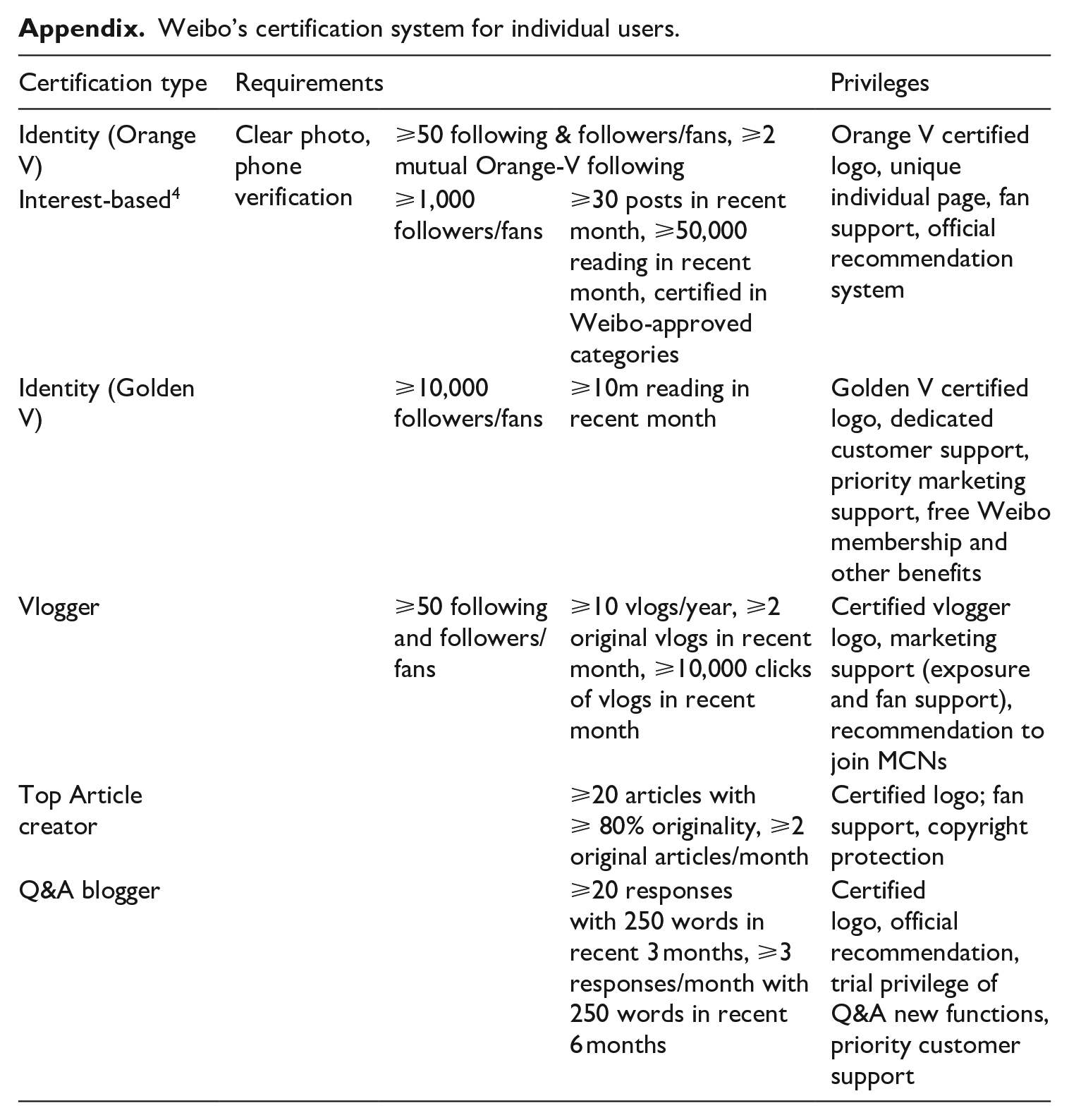
| Certification type | Requirements | Privileges | ||
|---|---|---|---|---|
| Identity (Orange V) | Clear photo, phone verification | ⩾50 following & followers/fans, ⩾2 mutual Orange-V following | Orange V certified logo, unique individual page, fan support, official recommendation system | |
| Interest-based 4 | ⩾1,000 followers/fans | ⩾30 posts in recent month, ⩾50,000 reading in recent month, certified in Weibo-approved categories | ||
| Identity (Golden V) | ⩾10,000 followers/fans | ⩾10m reading in recent month | Golden V certified logo, dedicated customer support, priority marketing support, free Weibo membership and other benefits | |
| Vlogger | ⩾50 following and followers/fans | ⩾10 vlogs/year, ⩾2 original vlogs in recent month, ⩾10,000 clicks of vlogs in recent month | Certified vlogger logo, marketing support (exposure and fan support), recommendation to join MCNs | |
| Top Article creator | ⩾20 articles with⩾ 80% originality, ⩾2 original articles/month | Certified logo; fan support, copyright protection | ||
| Q&A blogger | ⩾20 responses with 250 words in recent 3 months, ⩾3 responses/month with 250 words in recent 6 months | Certified logo, official recommendation, trial privilege of Q&A new functions, priority customer support | ||
Acknowledgements
I appreciate the constructive comments offered by the reviewer and the insightful feedback provided by Ji-Hyun Ahn, Jinsook Kim, Karen Lee and Suri Liu. These suggestions significantly helped me strengthen the arguments.
Funding
The author(s) disclosed receipt of the following financial support for the research and/or authorship of this article: The research is supported by the International Research Travel Award in the Center for Global Studies and the Research in Democracy Support Grant in the McCourtney Institute of Democracy from the Pennsylvania State University.

