




Abstract
This article explores how smartphone videos produced by migrants during border crossings challenge Eurocentric visualizations of borders. Implementing video analysis and iconographic interpretation, I explore three interrelated aspects of the smartphone videos: (1) By circulating videos via digital platforms, migrants create a countervisuality of border crossing that destabilizes the visual politics that shape current border regimes. (2) Unlike journalistic, humanitarian, or surveillance-oriented visual images produced from above, from a safe distance, from rescue or patrol ships, migrants’ smartphone footage puts their own narratives at the center of visualization. (3) Whereas Eurocentric visualizations of migration and borders aim to elicit affects and emotions such as pity, empathy, fear, or panic, migrants’ smartphone videos depict emotions such as joy and happiness after successful border crossings. These affective visualizations of individual migration stories confound binary representations of migrants as either victims or invaders. I argue that the shaky smartphone videos with their wandering focus and disordered mode of vision create a productive vantage point for seeing and sensing a world that is unimaginable for the normative, focused lens that structures views projected by journalism, humanitarian appeals, political mobilization, and surveillance technologies.
Introduction
In June 2021, the UK Home Secretary Priti Patel called for the removal from social media platforms of migrants’ videos that “glamourize”’ the crossing of the Channel. Patel claimed that such videos were promoting illegal migration across dangerous borders as well as helping smugglers to attract more migrants (Shearing, 2021). They allegedly depicted successful and joyful border crossings and thereby constituted a threat not only to migrants’ lives but also to border security. The smartphone videos that migrants had created to record their personal memories were, in her view, unacceptable, dangerous, and even threatened national security. I propose that the smartphone videos circulated via online platforms posed a countervisuality of border crossing that disrupted familiar visual regimes of imagery showing migrants crossing borders such as the Channel, the Mediterranean Sea, or the forests between Poland and Belarus.
My argument in this article will be threefold: first, the smartphone videos made and uploaded to digital platforms by migrants create a countervisuality of border crossing; a visual political challenge to contemporary border regimes between Europe and the Global South. Second, I suggest that this countervisuality is an effect of the witnessing gaze from the viewpoint of undocumented migrants, which stands in contrast to the external, distant surveilling gaze that more usually defines how they are seen. My last argument focuses on the affectivity of such videos, which do not portray migration in order to evoke emotions such as fear, pity, or empathy among non-migrants, but instead represent border crossing as a joyful experience whereby migrants show agency, not victimhood – producing a countervisuality that is at odds with both humanitarian and racialized imagery of migration.
In other words, I trace countervisualities of migration that locate migrants beyond the binary of victims or invaders. In general, European media tend to portray border-crossings in one of two ways: either as a humanitarian crisis, as in the example of the image of the dead body of Alan Kurdi (Bozdag and Smets, 2017; Fehrenbach and Rodogno, 2016; Olesen, 2018), or as an invasion that is threatening to destabilize the social and economic order of the Global North – a long-established view of migrants and refugees, which has often been reiterated by those seeking to pass anti-immigration policies (Greussing and Boomgaarden, 2017; Horsti, 2003; Lünenborg and Maier, 2017) and “demonize” migrants (Castro Varela and Mecheril, 2016). While these two contrasting narratives are put forward by agents of divergent political interests, they share a noteworthy commonality: They define and limit how the West sees and imagines migrants crossing its borders. Migrants’ smartphone videos, on the other hand, contest this Eurocentric gaze. While migrants’ and refugees’ use of smartphones to develop coping strategies to navigate global inequalities has already received attention by researchers (Bayramoğlu and Lünenborg, 2018; Emmer et al., 2016; Gillespie et al., 2018; Leurs, 2017), the political significance of the visual impact of smartphone videos circulated online showing border crossings as experienced by migrants themselves has yet to be addressed.
In the following, I first outline theoretical discussions relating to the dualistic visuality of migration portrayed as either an invasion or a humanitarian crisis, which then leads me to propose the concept of countervisuality as an alternative to this binary. Before elaborating the manifold meanings conveyed by migrants’ smartphone videos, I will briefly summarize the theoretically informed video analysis methodology that I deploy to analyze the videos that I downloaded from YouTube. Based upon this material, I will present my central arguments concerning the politics of visualizing border regimes and how they shape ways of showing, viewing, and sensing the crossing of borders. I will then summarize the key points in my conclusion, in which I argue that by disseminating a countervisuality of border crossing migrants position themselves as political subjects center stage, in contrast to established visualizations of border crossings viewed from within borders that mark them as either victims or invaders. Individual motivations for uploading such videos may vary, but their collective effect is to render visible the diverse and complex ways that individual lives are entangled with displacement and precarity: thereby shattering the simplistic view of a normative, Eurocentric lens. These videos do not simply threaten security by encouraging dangerous crossings, rather, they destabilize simplistic renderings of borders and border regimes per se.
The visual politics of migration and borders
The interrelationship between power and visibility is a much-debated topic within media, communication, and cultural studies. Mirzoeff (2011), for instance, contends that visuality has always been an essential tool of oppression, and explores how surveillance has been operationalized over the centuries from colonialism to slavery to contemporary digitalized border surveillance and remotely controlled military interventions. Mirzoeff’s genealogy of visuality begins with the sugar plantations on Caribbean islands, where overseers, as representatives of the colonial power, were tasked with keeping watch over slaves and controlling procedures. The eyes of the overseer were key to securing the productivity of the plantation complex; moreover, he was also the only one who had the “right to look” across and over the entire plantation from a high vantage point (Mirzoeff, 2011: 53). In other words, the overseer was an early embodiment of the complex colonial power of visuality that strategically withdrew from its object of vision in order to observe from a distance for the purpose of domination and surveillance (Mirzoeff, 2011: 17). In today’s world of anti-immigration politics and “border panic” (Bayramoğlu, 2021), we can discern a similarly angled gaze on migration: a perspective that observes, interprets, and seeks to control migrating subjects from a distance. As an exciting growing body of literature on media and borders is beginning to show, mediated visualizations of borders, border crossing, and migration play into such surveillance regimes. For example, Madörin (2019) explores how the extensive deployment of remotely operated drones in the surveillance of Europe’s borders transforms the corporeality of refugees from “faceless and nameless masses” into digital data. The entanglement of visuality and the digital, which the author terms postvisuality (Madörin, 2019) represents the other end of the genealogy of visuality that started with the plantation complex and has always been about keeping the subaltern under surveillance. Digital technologies that are used at borders, and visualizations of migration circulated in digital media raise a new “digital border” (Chouliaraki and Georgiou, 2019) intended “to protect” European citizens from migrants.
While digital technologies are used extensively in borderscapes, visuality in older forms of media continues to function as a tool of bordering. Studies show, for instance, that political parties seeking to stoke anti-immigrant sentiments continue to make wide use of billboards and posters to depict immigration as an invasion (Wintzer, 2019). Furthermore, the image of migration as a threat to Europe’s economic and social order remains an essential part of journalistic representations of border crossing (Drüeke et al., 2021; Holzberg et al., 2018; Ibrahim and Howarth, 2016; Lünenborg and Maier, 2017). Motivations for migration are rarely mentioned in such journalistic representations; instead, the subject of deliberation is the impact of migration on European economics and security (Holzberg et al., 2018: 539).
While the problematic implications of such simplistic imagery depicting migration as a danger to the nation are clear, the ethical issues associated with visualizations of migration intended to provoke humanitarian sympathy might be less obvious. One major ethical problem of humanitarian visuality is its effect of muting subjects while failing to induce real changes to benefit them. Chouliaraki (2013) points out that mediating images of human suffering does not necessarily bridge the gulf between a viewer and a suffering other; on the contrary, it often creates an inauthentic sense of shared reality that incites personal emotional responses rather than political action (p. 37). Chouliaraki (2013) argues that disseminating the spectacle of human suffering risks dehumanizing the suffering others and thereby preventing “the possibility of political community of solidarity to extend beyond the West” (p. 42). In a similar way, Ticktin (2011) criticizes humanitarians’ publicity strategies, which often only make suffering migrants visible as the objects of European white humanitarian missions (p. 82). Scholars argue that humanitarian visual strategies reinforce colonial perceptions of the Global North as the “supranatural” performer of life-saving missions (e.g., Musarò, 2011), even while at the same time European military forces seem more concerned with defending borders than with saving lives (Musarò, 2017). Furthermore, visual portrayals of suffering and vulnerable migrants such as Syrian gay refugees (Saleh, 2020) often reduce the complexity of migration trajectories to a simple teleological narrative from repression to liberation, with the West constructed as the ultimate goal of fulfillment.
While the two narratives “migration as invasion” and “migration as a humanitarian crisis” continue to shape the majority of current visual representations of borders in the Global North, there are also examples that transcend such dualism. To explore this, Mirzoeff’s analysis of the genealogy of “the right to look” provides another useful point of departure. Mirzoeff (2011) coins the term countervisuality to denote the visualization of insurgency produced by indigenous, oppressed, colonized, and subaltern communities that demanded the right to look for themselves and to produce a form of visuality that was often seen as unacceptable for the West-centered gaze. One of the violences of colonial/imperial visuality was therefore the erasure (or attempted erasure) of such countervisuality of insurgency (Mirzoeff, 2011: 292). Returning to my example of Priti Patel’s comments, the videos produced by migrants that depicted joyous and successful border crossings represent a countervisuality considered unacceptable, threatening, and in need of erasure by the state, because they document border crossings that reveal the weaknesses of current border regimes. Furthermore, Mirzoeff’s concept of countervisuality can be understood as a visual strategy by which oppressed subjects can engage in self-empowerment (Falkenhausen, 2015, 217).
“The right to look” brings authorship and agency in the production of the visuality of migration to the fore. Leurs et al. (2020) observe, for example, that images of migration produced by different actors such as journalists, artists, activists, or migrants each tell a different story of migration, and thereby represent different visual politics. With the visual language of the current Western mediascape relating to border regimes dominated by the distanced gaze, diversification of visuality is needed to allow for critical engagement with postcolonial legacies and continuities. Indeed, a number of scholars (Souiah et al., 2019) have already explored the visual politics of images made by undocumented migrants as postcolonial cultural products. Ponzanesi (2017) sees a new visual politics expressed in the documentary films On the Bride’s Side and Fire at Sea, which both successfully reject dualistic representations of migrants as victims or invaders by shifting the narrative to include solidarity and optimism, featuring emotions, strategies, and stories that are rarely told in the mainstream media.
As I will elaborate in the following pages, migrants who cross borders sometimes use their own smartphones to document their migration story, and later upload material to digital platforms such as YouTube, Instagram, and TikTok in order to share their important moments with the world. Such videos are sometimes called harraga, an Arabic word for “those who burn.” This poetic phrase references not only the burning compulsion to emigrate and to cross borders but also the practice of burning documents, which many migrants from North Africa do before they cross the Mediterranean Sea by boat. Some migrants literally burn their personal documents to hinder a deportation based upon their identity if they are apprehended by border police or coastguards; others simply do not bother to apply for visas, knowing they would never be eligible for one (M’charek, 2020). While the term harraga has generally been discussed as a cultural form that encompasses video clips, mashups, and music (see Souiah et al., 2019), I will trace how their visual politics defy current border policies and the ways borders are visualized in mainstream media.
Smartphone videos and meaning-making processes
I took the term “harraga” as a starting point for my research. The videos discussed in this article were found by entering the term as a keyword in YouTube’s search engine. As mentioned above, the tag harraga is generally applied to videos and music created by undocumented migrants from North Africa as they cross the Mediterranean Sea. However, videos with the title harraga can also be found that depict migrants from other Middle Eastern countries such as Iraq and Syria, which indicates that the term is being appropriated by migrants with different histories. Although there were also a few harraga videos shot from a distance, for this article, only the raw or minimally edited smartphone videos filmed from within boats were taken into account, as these present the perspectives of migrants themselves as they undertake crossings in boats. The material gathered was then analyzed by implementing a theory-led qualitative video analysis, in which the camera perspective was considered particularly significant. Cameras do not simply record action, they create meaning (Reichertz and Englert, 2011: 11). While video analysis is often deployed in order to deconstruct the meanings conveyed by professionally produced audiovisual material such as television reports, I use it here to analyze the raw footage of harraga smartphone videos, most of which have not been edited and show just a few minutes of border-crossing journeys. Like all audiovisual material, videos shot with smartphone cameras create meaning through their author’s direction of the camera toward an object or event. Often, smartphones are used to record moments that have personal significance, to create a “digital memory” (van Dijck, 2007) that can be subsequently re-watched to rekindle memories of certain events, objects, and people. When such personal videos are shared publicly, however, they become part of sociopolitical meaning-making processes. Migrants’ videos showing crossings of intensively controlled borders such as the EU’s external borders enter a contested field of complex political, historical, social, and cultural meaning-making processes that gain significance far beyond the realm of personal digitalized memory practices.
Inspired by iconographic interpretation (Panofsky, 1932), my analysis followed a three-stepped interpretation of the smartphone videos: (1) identifying the objects, events, actors, etc. visible in each video, such as “a Spanish marine guard,” “the coast of Greece,” or “victory sign hand gesture,” (2) linking the identified objects, events, and people to known narratives and events; for example, a “victory sign” made by the migrant video author as a gesture indicating happiness, success, etc., (3) interpreting the context of the video. The interpretation of context requires relevant knowledge. Reichertz and Englert advocate a hermeneutically based approach, in which the researcher’s knowledge is an essential part of the analysis that enables videos’ contexts to be taken into account (Reichertz and Englert, 2011: 31). A researcher’s knowledge resources are entangled within every aspect of the interpretation process; in this case ranging from the simple recognition that the affordances of smartphone technology are what enable video-making to less well-known information about the political pressure exerted on digital platforms to delete certain videos from video-streaming websites. Hence, my iconographic interpretation of the smartphone videos was supported by extensive literature research on borders, migration, and postcolonial theory. In order to protect the anonymity of the people shown in the videos, I collaborated with an artist who produced the illustrations representing sequences of the smartphone videos analyzed in this article (Figure 1).
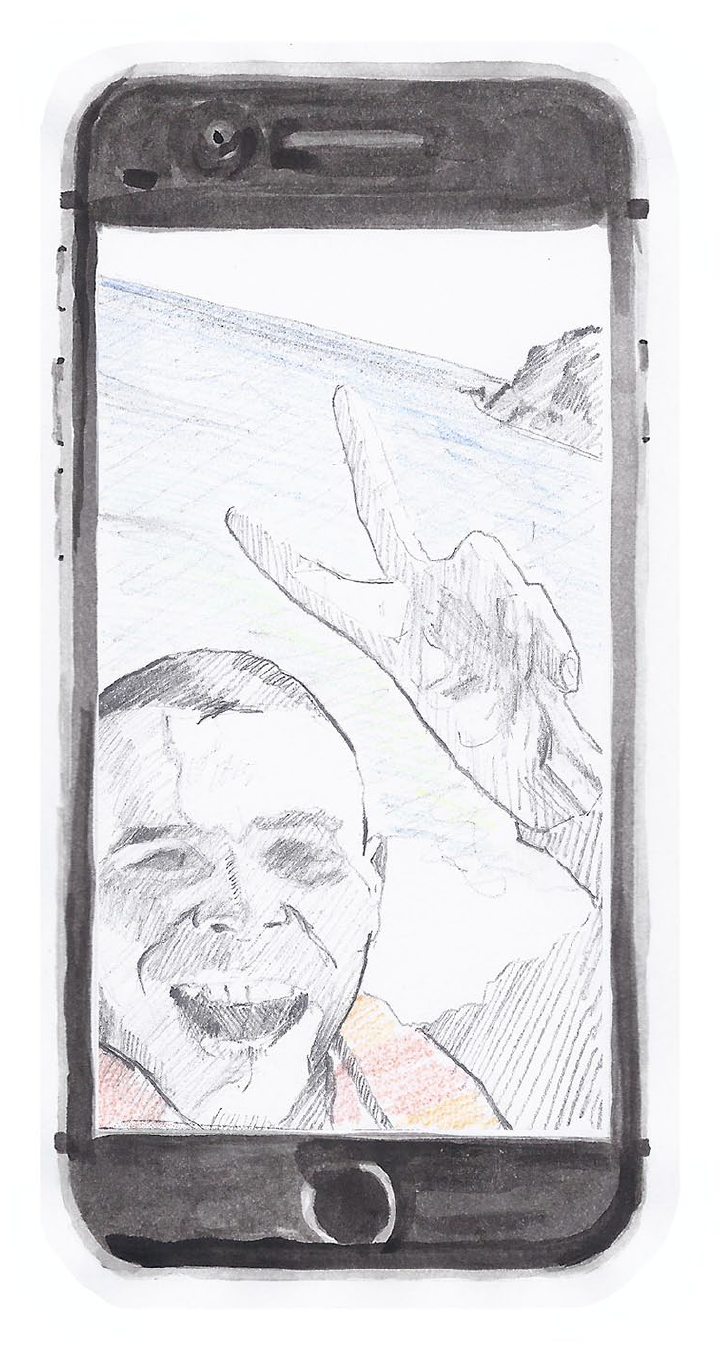
When migrants arrive in Greece.
Undoing borders
A smartphone video made by a young man shows a group of Iraqis arriving in Greece in a rubber boat. He is one of about 15 passengers; it is hard to count exactly how many people are on the boat. While previous research on harraga videos has suggested that their creators tend to depict young male migrants (Figge, 2017: 26), this video shows a diverse group. There are women, children, and older people. When they arrive in the bay, they all look toward the beach with happiness and joy. They smile as they shout Elhamdrallah (Thank God!) and gesture victory signs to the lenses of their smartphones. Nobody can be seen on the shore. The beach is strewn with deflated orange life jackets and a deflated grey boat that looks similar to the one on which these migrants are arriving. The deflated life jackets look like the ones they are wearing. The objects on the beach have apparently been left by people who arrived here previously. It looks as though this boat is not the first to successfully cross the Aegean Sea.
Deflated life jackets and other found objects from undocumented migrants have been featured in the work of a number of artists – such as Mohsen (M’charek, 2020: 426), and Ai Weiwei (Barry, 2019) – created to draw attention to the humanitarian crisis and death toll in the Mediterranean Sea. Such artworks poignantly visualize the hostility and inhumanity of border regimes, while reinforcing the idea that the borders cannot be crossed. Unlike the objects featured in such artworks, the deflated boat and lifejackets seen on the Greek coast in this video do not seem to symbolize death, but a successful passage. Furthermore, the beach they lie upon represents a border that lacks the typical apparatus of a fortified European border, such as coastguards, checkpoints, customs, and passport controls. It appears to be an open border marked with the traces of other migrants, a place where people arrive by boat, leave the life jackets they no longer need, and enter European territory with a sense of relief and happiness.
Borders visualized in such ways in harraga videos stand in stark contrast to stereotypical imagery of borders demarcated by fences, guards, and treacherous waters. In the videos people film of themselves on boats, singing and smiling, the Mediterranean appears in the background as a smooth, gentle sea, which, rather than dividing Europe from the Middle East and Africa, binds the continent with the rest of the world for people who are “not supposed to be there.” They defy Europe’s anti-immigration policies and regulations by taking alternative routes. M’charek (2020) argues: this makes harraga into an activity that interferes with the way states imagine the relations between states and individuals. It makes harraga into an activity that burns state-rules: rules that stipulate that this border can only be crossed in this way and not in another; or that papers are only legal in this way and not in another. (p. 422)
Even in harraga videos in which marine guards can be seen, the aesthetic impact of the shaky smartphone recordings contrasts starkly with that of footage shot showing borders from the stable vantage point of the coast, a rescue ship, or aerially. For instance, in one of the videos that were uploaded in October 2021, a group of young men can be seen in a wooden boat. We hear the men talking and shrieking with excitement as a Spanish coastguard follows the boat from behind. The men’s shrieks apparently express their exhilarated delight that the coastguard seems unable to apprehend their boat, which is already very close to the beach. The video inverts the typical narrative and visuality of border crossing by showing not only the authorities’ ineffectiveness but also the defiant faces and voices of undocumented migrants flouting the border regimes. With the faces and voices of the migrants occupying center stage in this video, the coastguards, even when they come dangerously close to the migrants’ boat, appear as faceless and voiceless shadows. The video ends with a sequence showing the migrants’ successful arrival: they jump from the boat onto the beach and run happily into the empty streets between the fancy beach houses.
The countervisuality of such videos represents the desire for a world in which the currently dominant meaning and function of borders is overturned. Depicting the Mediterranean Sea or the shores of Europe as permeable borders seems irreconcilable with the harsh reality of ever stricter European border regimes that have become more or less a “state of exception” since 2015 (Hess and Kasparek, 2019). Border policies, despite the EU’s much-celebrated political ideal of freedom of movement, are designed to prevent and control the movement of certain migrants across the EU’s external borders (Karamanidou and Kasparek, 2018) as well as its internal ones (European Commission, 2020). Even for refugees and asylum-seekers fleeing violence, persecution, and war, it is extremely difficult if not impossible due to obtain a humanitarian visa that would allow legal entrance to Europe to seek safety (Human Rights Watch, 2015). Policies such as article 26 of the Schengen Convention, which states that airline carriers that bring persons without a Schengen visa into Europe are guilty of the same offence as “migrant smugglers” deny migrants the possibility of legal entry into the EU. In response to the increased migration that followed the outbreak of the Syrian civil war, the EU has fortified its external land borders with fences and walls to prevent migrants from crossing them (Banco, 2015). Such anti-immigration policies and measures have left thousands of people with no alternative than to cross the Mediterranean Sea by boat. Over time, border regimes have gained complexity: external countries such as Turkey and Tunisia have become the outer posts of European border control in a process described by scholars as the “externalization” of borders (Hess and Kasparek, 2019).
In the light of this, harraga and other forms of smartphone videos that depict successful border crossings can be interpreted as mediated forms of visual resistance in the face of border regimes that violently dictate who is allowed to cross which borders. Moreover, they can be seen as a new means of mediated political action against the colonial legacy that is entangled with current border regimes. Indeed, some videos, as Kuster (2018) also observes, include nostalgic franco/Arabic music of exile, evoking the historical passenger ships that linked Europe and Africa in colonial times. Crossing the Mediterranean Sea as undocumented migrants in inflatable boats inverts the cultural memory of the colonial past. The fact that these videos are made by migrants from formerly colonized countries is highly significant: the visual resistance to global inequalities that the online circulation of these smartphone videos represents cannot be fully grasped without taking into account the legacies of violent colonial histories.
Witnessing the unseen
Migrant smartphone videos witness moments, persons, and stories that would otherwise be kept in the realm of the invisible: hence they make the invisible visible. They shift the perspective on borders from a distant and/or aerial one to a witnessing gaze from an unsteady shaky boat. In order to understand the political meaning of this witnessing, we need to look closer at one recurrent detail in the videos: the smartphone itself. Harraga videos are not only filmed with smartphones, they also show other people using their smartphones to document the border-crossing journey. Often, we see people filming themselves, the people on the boat, the sea they are crossing, and the beach they arrive at. By showing people using their smartphones to document, the videos make it clear that this is a moment worth documenting. As they witness and experience being on the boat, migrants document that experience with their smartphones, and, in turn, their documentation becomes a public witnessing when the videos are shared via online platforms.
Sometimes, people on the boat document unexpected events. In one of the YouTube videos that shows a group of young men in a boat crossing the Mediterranean Sea, the viewpoint initially shifts unsteadily, sometimes showing passengers’ faces, sometimes their feet, sometimes the sea. The boat glides across the smooth waves; the weather is pleasant and sunny. Two men are asleep; one on the floor of the boat, the other on a bench at the side. One man is looking at his smartphone, perhaps texting or looking at photos. As the camera turns toward the sea, dolphins suddenly start leaping in the distance. Soon they come closer to the boat and even swim underneath it. Sometimes they appear in front of the boat. The men enjoy the spectacle: they watch the dolphins and start making videos of them. They laugh and look at each other with happy faces. One man puts his arm around another’s shoulder as they watch the dolphins together. This gesture creates an intimacy, suggesting friendship and solidarity. Ambient electronic music has been added to the soundtrack, so we cannot hear what they are talking about, but it seems likely that they are talking about the dolphins. The relaxing music, leaping dolphins, and the happiness of the people on the boat create a very different audiovisual representation of migrants crossing the Mediterranean Sea to the kinds of imagery presented in mainstream media (Figure 2).
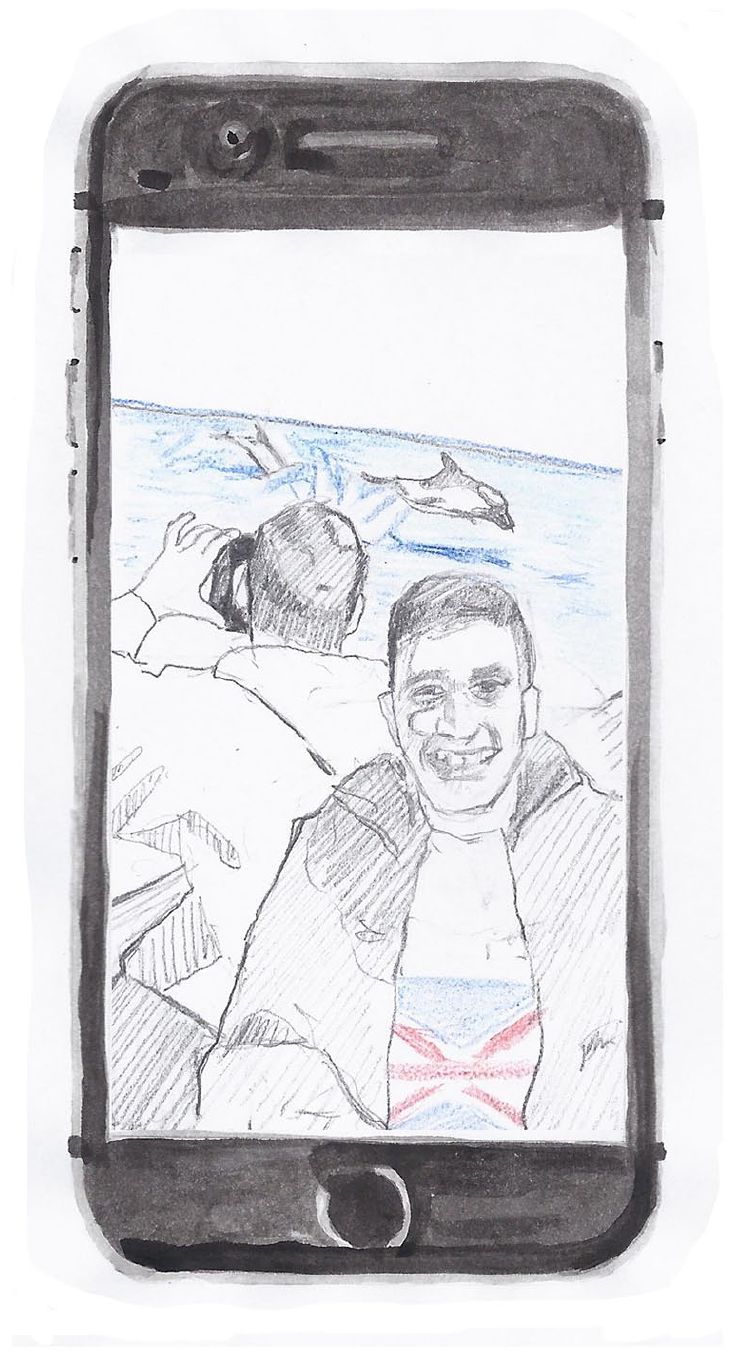
When dolphins appear.
Figge (2017) writes that the unedited raw smartphone videos that are uploaded to YouTube render audiovisual material visible that would otherwise never be publicly seen (p. 28). Harraga videos thus turn an invisible reality, an invisible story, into a publicly visible border-crossing act. By documenting the border-crossing movement and then uploading and circulating that documentation online, migrants leave their traces in the realm of the visible and intelligible. In this sense, the videos create a countervisuality of an insurgency – the breaching of borders – which, in Nicholas Mirzoeff’s (2011) terms, is seen as unacceptable by the powers that be and therefore needs to kept invisible or erased from the public realm. Friese’s (2018) ethnographic work on Lampedusa, an Italian island that became one of the important crossroads of migration in recent years, provides some further theoretical insights into the political meaning of rendering something visible that has been kept invisible. Friese observes that immediately after their arrival, immigrants are detained in the reception center, which is at the periphery of the island – away from the public eye. Furthermore, Friese (2018) notes that they are not allowed to leave the reception center, which in turn is inaccessible to the public (p. 50).
The migrants’ smartphone videos, which show the hitherto invisible from a witnessing standpoint, are unsteady. Unlike the stable, safe, surveilling point of view that targets migrants from a distance, the focal point of migrants’ smartphone videos keeps shifting. The shaky hand-held lens is always moving, taking in migrants’ faces, bodies, objects, and surroundings. The unstable gaze without a clear focus opens the way for two interrelated meanings. It brings the audience on board, onto the boat, disrupting the reassuring distinction between “us” and “them” deployed in journalism (Lünenborg and Maier, 2017). Moreover, the shakiness of the smartphone videos resonates with other forms of deviant visuality that counter forward-looking, normalizing, and controlling forms of vision. Writing about (queer) diasporic visuality, Gopinath (2018) argues that the disordered, chaotic, multi-focused, and unruly mode of vision creates a productive vantage point for seeing and sensing a world that is unimaginable for the normative and focused lens. Such a multi-focused visuality does not strive for normalization but instead aims to render visible the precarity of lives that suffer dispossession and displacement (Gopinath, 2018: 174). Relating these ideas to the shaky smartphone videos; the latter do not ask for normalization or permission for people to cross borders with unsafe boats, but simply bear witness and render visible the shaky and precarious lives of migrants who have no alternative than to do so.
The political impact of shaky smartphone videos that bear witness has been extensively discussed, particularly in relation to political protests such as Occupy Wall Street (Brucato, 2016), and “Black witnessing” (Richardson, 2020: 114; Stern, 2020). Smartphone videos of undocumented migrants crossing borders have a similar political potential. In recent years, the audiovisual technology of smartphones has vastly improved, making it easier for undocumented migrants to put their precarious stories entangled with dispossession center stage; stories that were hitherto all too easily lost, never seen, or suppressed. In some cases, undocumented migrants even use smartphones to document the illegal pushbacks enacted by European coastguards. In the summer of 2020, migrants crossing the Aegean Sea filmed Greek coastal guards attacking rubber boats in an attempt to stop their progress (Felden and Jawad, 2020). The smartphone recordings, which may initially have been made as personal memory documents like other harraga videos discussed here, subsequently became potent tools as evidence of the violent pushbacks. Smartphone videos of the pushbacks were not only disseminated online by the migrants themselves, but also sent to journalists who reported the coastguards’ brutality. In this case, the migrants’ smartphone videos became part of journalistic visual representations of injustice in borderscapes.
Disrupting humanitarian affects
Media and communication scholars who explore affects in digital media observe how the circulation of images that document abuses, human rights violations, protests, or pushbacks generate “affective publics” (Lünenborg, 2020: 12) that aim to inspire solidarity and empathy with distant suffering and uprising subjects. However, the visuality of suffering others that is deployed to mobilize emotions such as empathy is a two-edged sword. Sontag (2003) was one of the first to point out problematic aspects of journalistic images that expose violence and suffering. One reason why such images can be counterproductive is the numbing effect of their proliferation: “Flooded with images of the sort that once used to shock and arouse indignation, we are losing our capacity to react” (Sontag, 2003: 94). Criticizing Sontag’s contention, Butler (2005) wrote that it is not the visualization of suffering that needs to be critically re-adressed, but people’s inability to take political action in response to certain injustices (Butler, 2005: 826). I would like to intervene into this discussion by turning to the affective visuality of smartphone videos created by migrants, which so starkly differs from the familiar visuality of borders and immigration deployed by humanitarians hoping to evoke emotions such as empathy and pity for the suffering subjects (Figure 3).
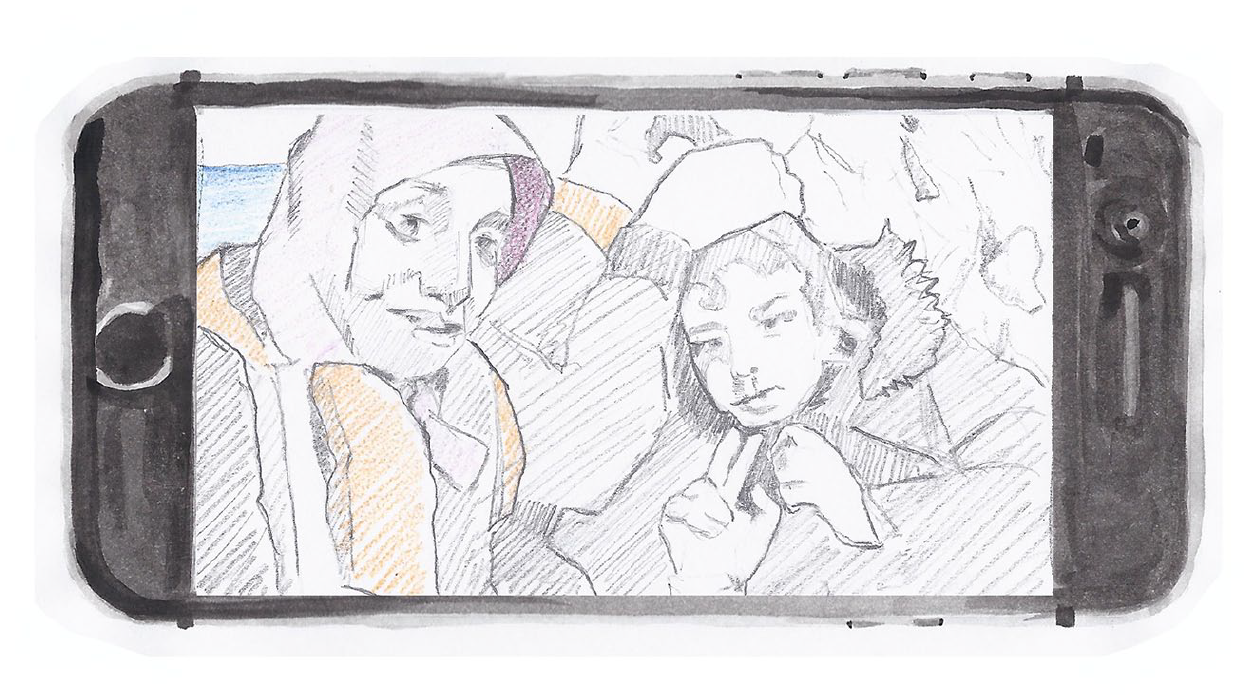
Filming a selfie.
A very short YouTube video from 2018, which lasts just 16 s, shows families crossing the Mediterranean Sea. The video was made by a woman and begins with images of the people inside the boat. Unlike most harraga videos, in which young men dominate the scene, here we mainly see women, children, and babies. After showing the people in the boat, the camera turns toward the woman herself as she continues recording. There is a slight smile on her face. Maybe she is happy to be together with others in the same boat, maybe she is happy because they are finally crossing the border, or maybe there are other reasons for her smile. We are left to speculate; she does not speak. And yet, this short video includes many hints to suggest that she is documenting a joyful trip. The most emotionally powerful moment is when she turns the camera toward a small girl sitting on a woman’s lap. The girl is sleepy, her eyes are almost closed. The woman holding her is trying to tie back her hair. The author of the video comes closer to the little girl until they are suddenly both in the same frame, filming a selfie. When the little girl realizes that she is being recorded, a smile takes over her face, she opens her eyes and then, looking directly at the lens, gestures a victory sign. The woman filming turns the camera again to her own face, showing that her own smile has grown even wider – it is unmistakable now.
Unlike the visuality of migration and border crossing that dominates Western journalism, the countervisuality of the short video described above is shaped by its producer’s position as the author of her own story, as well as by its representation of affects and emotions that do not convey a tragedy. This and other videos show migrants singing, clapping, gesturing victory signs, joyfully screaming, whistling, embracing each other, and showing solidarity. In this sense, harraga videos evoke emotions that stand in opposition to the panic, fear, compassion, anger, or despair mobilized in other contexts in which borders are mediated (Bayramoğlu, 2021; Chouliaraki and Musarò, 2017: 536). The affective moments brought forth in harraga videos diversify the imagery of migration to encompass more than just suffering, death, and desperation. Following Sontag, the danger of repeatedly inciting affects like pity and empathy is that viewers become numb to their impact. Moreover, such visuality often denies the agency of migrants. Even before the smartphone era, Malkki (1996) observed in the 1990s how dramatic media representations of humanitarian crises cause refugees to “stop being specific persons and become pure victims” (p. 378). Harraga videos, in contrast, are stories told by refugees and undocumented migrants themselves, from the center of their own narratives, and are not predestined to end in misery or failure. This affective countervisuality of migration proposes ways of being and existing in the world that are not simply doomed from the outset.
Conclusion
Studying smartphone videos recorded by migrants crossing European borders can contribute to ongoing research in several ways. The exciting growing body of literature on the visual politics of media and border crossing tends to focus on of racialized, anti-migrant border regimes, or on the mediation of migration as a humanitarian crisis. While smartphones have received attention in studies that explore how they are entangled in the everyday practices of navigating, communicating, and network-building of people on the move, the visual political intervention achieved by the online circulation of smartphone videos made by migrants themselves has not yet been addressed by other researchers. Such videos refuse to fit in with academic, activist, journalistic, and political tendencies to cast border crossing as an inevitably tragic or threatening specter, instead offering a productive vantage point from which to question the literature and its inherent assumptions. Further research within media, communication, and cultural studies on this topic would benefit from an exploration of the perspectives of migrants who author such videos, as well as of those who watch them. Needless to say, all research is shaped by the researcher’s own positionality. Although I am a migrant myself, I did not have to migrate to Europe by boat. I can thus only speculate how such videos are experienced by persons who have made similar experiences themselves or are personally connected to such people. Nonetheless, by uploading these videos to digital platforms, their authors invite us as spectators to watch and interpret them.
Nonetheless, studying theoretical work and the existing literature have provided me with helpful tools to unlock the sociopolitical meaning of this specific form of visuality and its online circulation. By borrowing Mirzoeff’s term “countervisuality,” I emphasized the political significance of the smartphone videos as I considered how they are intertwined with borders, postcoloniality, affects, authorship, and ways of showing. Indeed, the political weight of these videos is already signified in the decision of the migrants who made them to upload them to digital platforms and make their stories visible. In Mediating Migration, Hegde (2016) points out that despite the increased risk of deportation that visibility brings with it, many undocumented migrants choose to use media to raise their voices, to publicize their situation, and to position themselves as a subaltern collective. Thus, they use media to assert themselves as political subjects (Hegde, 2016: 26). These remarks could just as well be applied to the many harraga videos circulated online. Although they document an act that in the eye of the EU is considered “illegal,” and therefore risk their documentation being used as evidence against them, the migrants who make and share these videos insist on making visible their insurgent acts of resistance against border regimes. By doing so, they not only take the stage as political subjects raising their voices, making their precarious lives visible; they also symbolically and literally disrupt European border regimes. If we understand border regimes as a process of doing that incorporates various forms of surveillance strategies, including the mediatization of borders, the videos that I have discussed in this paper create a visual digital insurgency that undoes border regimes. The short clips advance an alternative way of seeing, a countervisuality, which transcends the familiar boundary between “our” gaze and “theirs” – if “we” are the ones viewing from within the borders. The affordable, accessible, transportable audiovisual technology of smartphones has made it possible for such views to be shared digitally. With their unrefined aesthetics, including shifts between horizontal and vertical framings, they upset the familiar order of a normative, controlling, forward-looking visuality. Rather than rendering border crossings in unsafe boats in understandable, familiar visual language, this countervisuality disrupts the Eurocentric clear-cut visuality of migration that mutes migrants, and instead offers glimpses of a utopian world in which borders become blurred visually and semantically, and their processual nature becomes visible as the ever-shifting perspective refuses to settle on a solid object.
Footnotes
Acknowledgements
I would like to particularly thank Tanja Maier for our fruitful discussions on the videos analyzed in this paper. Several of the arguments of this paper are an outcome of our ongoing dialogue on borders and media, which I appreciate very much. I express my gratitude to Pip Hare as well for her careful reading and editing of the article. Thank you, especially, to Natis, for inspiring discussions on the central arguments of this article.
Funding
The author(s) received no financial support for the research, authorship, and/or publication of this article.
