




Abstract
In the past decade, there has been a significant rise in urban women-themed TV dramas in China, some of which have generated substantial public discourse on femininity. While Western women-centred TV and cinematic productions have been discussed intensively, much less attention has been paid to Chinese TV series and their audience reception. This article highlights the usefulness of studying audience response to the women-centred TV series produced in China over the past decade, especially those focusing on single women as main characters. By examining these widely-viewed TV series and their audience interpretation, this article aims to investigate the ordinariness and everydayness through which a postfeminist sensibility manifests in a non-Western context. As the research shows, these women-centred TV series reveal the diverse dimensions of urban women’s everyday lives. However, Chinese audiences express strong opposition to masculinised hypercorrection and the fetishisation of the gynandroid in such TV series. Many Chinese viewers prefer to see a realistic representation of Chinese women who have autonomy and the right to be imperfect. The findings shed light on gender-related debates in China today and contribute to discussions about the everydayness of postfeminism from an audience’s perspective.
Keywords
Introduction
Postfeminism has been central to discussions of contemporary feminism. With its ongoing relevance, postfeminism ‘maintains a strong grip across culture and media’ (Butler, 2013; Gill, 2017: 620; Gill and Scharff, 2011). Postfeminism brings to the fore a strong sense of female autonomy, choice and agency, while downplaying gender politics, as evident in prevailing media discourses (Gill, 2017). As a sensibility, postfeminism has intensified and become a taken-for-granted, common-sense way of operating within gendered neoliberalism (Gill, 2017).
While the research on postfeminism in media studies has been remarkable, three of its current limitations are worth addressing to foreground our discussion in this article. First, little attention has been paid to the ordinariness and everydayness through which postfeminism manifests. Postfeminism has become ‘the new normal’, whose importance resides in ‘its ordinariness and everydayness’, indicating that sense and meaning-making about gender happens through the lens of taken-for-granted neoliberal ideas (Gill, 2017: 609). Therefore, it becomes crucial to explore how postfeminism is recognised, experienced and negotiated within everyday life in the context of media.
Second, what postfeminist texts mean to ordinary audiences remains understudied. Scholars have discussed well-known postfeminist media texts such as Sex and the City (Arthurs, 2003), Ally McBeal (Dubrofsky, 2002; Ouellette, 2002) and Girls (Nash and Grant, 2015), etc. However, it is also important to understand ‘what different people do with the products of the cultural industry’, which includes understanding the way that audiences interpret postfeminist performances (Brooks, 2015: 67).
Finally, more noticeably, the majority of the existing studies on postfeminism centre on white, middle-class Western girls and women as their primary subjects (Banet-Weiser, 2018), and scholars have not sufficiently researched the possibility of postfeminism in non-Western contexts (Dosekun, 2015). Since postfeminism is ‘a fundamentally mediated and commodified discourse and set of material practices’ (Dosekun, 2015: 961), postfeminism is readily transnationalised and needs to be studied in different cultural contexts. ‘The contradictions and disjunctures of globalisation’ can lead to certain cultural contradictions (Dosekun, 2015: 967).
To address the ordinariness and everydayness of postfeminism in a non-Western context, this article advocates for examining female characters in Chinese women-centred TV productions, as well as responses to and comments on those representations from local audiences. While Western women-centred TV and cinematic productions such as Sex and the City, Ally McBeal and Bridget Jones’s Diary have been discussed intensively (e.g. Arthurs, 2003; Dubrofsky, 2002; McRobbie, 2004; Ouellette, 2002), Chinese women-centred TV series have received insufficient academic attention. These women-centred TV series often represent middle-class women in urban China, which is an expanding group comprising over 77 million people (Iresearch, 2019). In this regard, we highlight the usefulness of studying audience response to women-centred TV series in China, and especially focus on TV series from 2010 onwards. We argue that the study of audience response to these TV series can enrich our understanding of the everydayness and ordinariness of postfeminism by highlighting audience expression of strong opposition to masculinised hypercorrection and the fetishisation of the gynandroid. TV dramas in particular represent relatively comprehensive sociocultural settings that women experience in their everyday lives. These representations have the potential to stimulate nuanced discussions about gender issues that may not otherwise be had. By analysing audience reviews and comments, we investigate whether these audiences are aware of, reproduce or fight against certain gendered discourses and thereby seek to enrich the understanding of gender-related debates in China today.
Postfeminist media culture and audience research
Scholars have approached postfeminism in various ways, describing the time ‘after’ (second wave) feminism, engaging with the ‘post’ movements (postmodernism, poststructuralism and postcolonialism) and situating postfeminism within the third wave (Gill, 2016; Rivers, 2017). In the past decade, there have been some concerns about whether postfeminism remains a useful critical term, given the greater visibility of feminism and especially social media-based feminist activism. Despite a changing context, Gill (2016) suggests the increasing visibility of feminist discourse and activism does not necessarily mean an ‘end’ to postfeminism, as postfeminism is considered an object of analysis. More importantly, contemporary feminism and postfeminism entangle with each other in complex ways (Gill, 2016; McRobbie, 2009; Rivers, 2017). Some popular mediated feminism is distinctively postfeminist in nature (Gill, 2016, 2017). Therefore, postfeminism remains a powerful term when feminism is increasingly promoted. Echoing this viewpoint, scholars appreciate the value of the term postfeminism for analysing the presence of feminism in popular culture and mediated feminist discourse (Banet-Weiser et al., 2020; Rivers, 2017). Stressing that postfeminism is not a static term, Rivers (2017) points out ‘the need for continued interrogation’ of postfeminism (p. 4).
Many studies have built on the understanding of postfeminism as a sensibility. Gill proposes the influential notion of a ‘postfeminist sensibility’, addressing postfeminism as a set of ideas, images and meanings (Gill, 2007, 2017). This concept can bring notions such as affect, public mood and atmosphere to the fore unlike approaches focusing on language (Banet-Weiser et al., 2020). It shifts understanding from that of a fixed ideology towards ‘a more fluid, less coherent, affective set of ideas about femininity’ (Riley et al., 2017: 3). These ideas depict ideal femininity circulating in postfeminist media culture. Given the influence of an ideal of femininity in everyday life, women are likely to work to conform themselves to that ideal. In media culture, Gill (2017) identifies the repetitive features of the postfeminist sensibility that include an emphasis on individualism, choice and empowerment, the dominance of a makeover paradigm, a reaffirmation of gender differences and required psychic dispositions of being positive and confident.
Among the studies that draw on postfeminist sensibility, several studies have focused on audience readings and sense-making (e.g. Agirre, 2014; McClearen, 2015; Paris and Uyheng, 2021; Robinson, 2011; Swink, 2017). For example, studying female audience responses to the TV series Mad Men can reveal how women deal with feminist issues in their everyday lives (Agirre, 2015). Media representations of gender may parallel some of the postfeminist pressures and anxieties that women experience today (Agirre, 2015; Robinson, 2011). Therefore, studying audience interpretations of postfeminist texts provides opportunities to understand the everydayness of postfeminist sensibilities as the audience experiences, negotiates, reinforces and challenges them. However, most studies on audience interpretation through the lens of postfeminism have been conducted in Western contexts. Thus, in addition to a growing number of studies focusing on postfeminism in the global South and East (Dosekun, 2021), it is also necessary to attend to audience research in other cultural contexts.
The Chinese parallel of postfeminism and local complexities
In recent years, an increasing number of studies have discussed the applicability of postfeminism in the Chinese context. While some scholars apply the framework of postfeminism in China (Guo, 2022; Liao, 2021), other scholars have discussed trends in China as being similar to postfeminism in Western cultures (Peng, 2021b; Yang, 2020). For example, Yang (2020) puts forward the term ‘consumerist pseudo feminism’ as the Chinese equivalent of postfeminism, focusing on the consumption practices and the rhetoric of freedom of choice among middle-class women (p. 2). Peng (2021b) points out the widespread pseudo-feminist discourse in today’s China as similar to post-feminism in Western cultures. The rise of such pseudo-feminist discourse is greatly associated with gender representations in the market economy. Gender ideology from the Maoist position downplayed biological differences between men and women to exploit female labour for nation-building. Chinese women were encouraged to participate in economic production. From the post-Mao position, biological differences between men and women were naturalised to ‘meet the demands of labour reduction for a market economy’ (Yang, 2011: 335). Meanwhile, with the trend towards consumerism, femininity and especially femininity associated with beauty, youth and sexuality, is celebrated. Gendered representations, such as the nennu (meaning ‘tender’ younger women and feminine youth) and shunu (meaning ‘ripe’ older women and feminine maturity) (Yang, 2011), compel women to consume in order to transform themselves (such as transforming from ripe women to tender women). In suggesting a means to women’s empowerment through consumption and enhancement of feminine beauty and youth, such representations exemplify pseudo-feminist discourse in China.
Discussions about gendered representation and the Chinese parallels to postfeminism increasingly present complexities in local contexts. In this article, we would like to highlight socio-economic and gendered structural situations, which have a profound impact on society. At the socio-economic level, China has experienced the emergence and explosive growth of the middle class, with many people having made impressive economic progress in one or two generations (Li, 2010). ‘The vanguard of consumption and the rear-guard of politics’ characterise the values and behavioural patterns of the Chinese middle class (Zhou and Chen, 2010: 85). Consumption has become a key means for the Chinese middle class to construct their self-identities and seek social recognition (Zhou and Chen, 2010).
At the structural level, Chinese society has witnessed a revival of patriarchy, encouraging traditional gender ideologies and traditional Chinese female virtues (Li, 2014; Luo, 2017; Peng, 2021a). Patriarchal values for women, such as selflessness, marriage and bearing children, seem to persist. Women’s roles are often regarded as that of the potential reproductive unit and caregiver in a family; the view that men oversee the outside world while women oversee the household (‘nan zhu wai, nü zhu nei’ in Chinese) is still prevalent in Chinese society (Gui, 2020; Ji, 2015). In terms of marriage, men are more likely to pay particular attention to traits including physical attractiveness, youth, docile temperament and obedience (Chang et al., 2011; Gui, 2020).
As an increasing number have become educated and financially independent, women in China today are encountering tensions and pressures due to traditional gender ideologies. Single, educated, professional women in urban China are a good example in this regard. Their educational background and achievements in the workplace make them less likely to fit traditional gender norms. By postponing marriage and presenting their own ideas of egalitarian marriage, they renegotiate womanhood and implicitly challenge patriarchal constraints (e.g. Gaetano, 2014; Gui, 2020; Yu, 2021). Since the mid-2000s, China’s media has paid much attention to the trend of postponing marriage and has negatively depicted single women of marriageable age as ‘leftover women’.
Noticeably, in the past decade, there has been a significant rise in urban women-themed TV dramas in China. Some of these widely-viewed TV dramas have generated substantial public discourse on femininity. However, the array of urban, Chinese (single) women being represented on TV, as well as the audience reception of such shows, is presently under-researched. Studying such TV representations and the audience response to them can be particularly relevant for the following two reasons:
First, Dosekun (2015) has invited scholars studying divergent local femininities to consider divides such as the rural/urban, traditional/modern and so on. These dimensions are indeed frequently represented in women-centred TV dramas in China. Investigations into such TV representations make it possible to understand how postfeminism is localised and meaningful in the particular context of China (Dosekun, 2015).
Second, since women’s choices are subject to social expectations (Budgeon, 2016), understanding social expectations via audience reviews becomes an urgent task for research on gendered media representations. The audience accounts of urban women-centred TV dramas can shed light on the manifestation of postfeminist sensibility, the public discourse on gender roles and the everydayness of postfeminism. As a result, it has the potential to deepen our understanding of gender-related debates in China today.
TV representations and audience reception of female characters in China
Over the decade following 2010, China has witnessed an increasing demand for women-centred TV dramas. In these dramas, single urban women are frequently situated within social and family discourses. Based upon our archival research on women-centred TV drama from 2010 to 2021 on Douban, one of the biggest websites for movie and TV reviews in China, we selected 21 widely-viewed Chinese TV series focusing on single women as main or leading characters. In the past 2 years especially (2019–21), single women have become key players in Chinese TV production and have drawn the attention of audiences. We have made a table (Table 1) of these TV dramas and chronologically categorised them according to year of release, number of episodes, leading characters and actresses, ratings on Douban and number of viewer ratings at the time of the study. Table 1 facilitated us discovering common features of these series. Each of these series examined different aspects of single women’s everyday practices and amplified the everyday setting of Chinese women’s personal narratives. Their producers adopted a realistic approach to reveal the diverse dimensions of urban single women’s ordinariness, foregrounding their family affairs, working difficulties, etc. By examining the ordinariness of Chinese women, these TV dramas present their personal growth and increasing social responsibility, as well as a masculinised female ideal derived from social expectations. These female characters attempt to overcome different obstacles in their lives and eventually achieve a balance of work and life. Ordinariness and everydayness have been reformed to present masculinised excellence in terms of the mental strength, doughtiness and perseverance of the women depicted.
Widely-circulated Chinese women-centred TV series focusing on single women as the main/leading characters from 2010 to 2021.
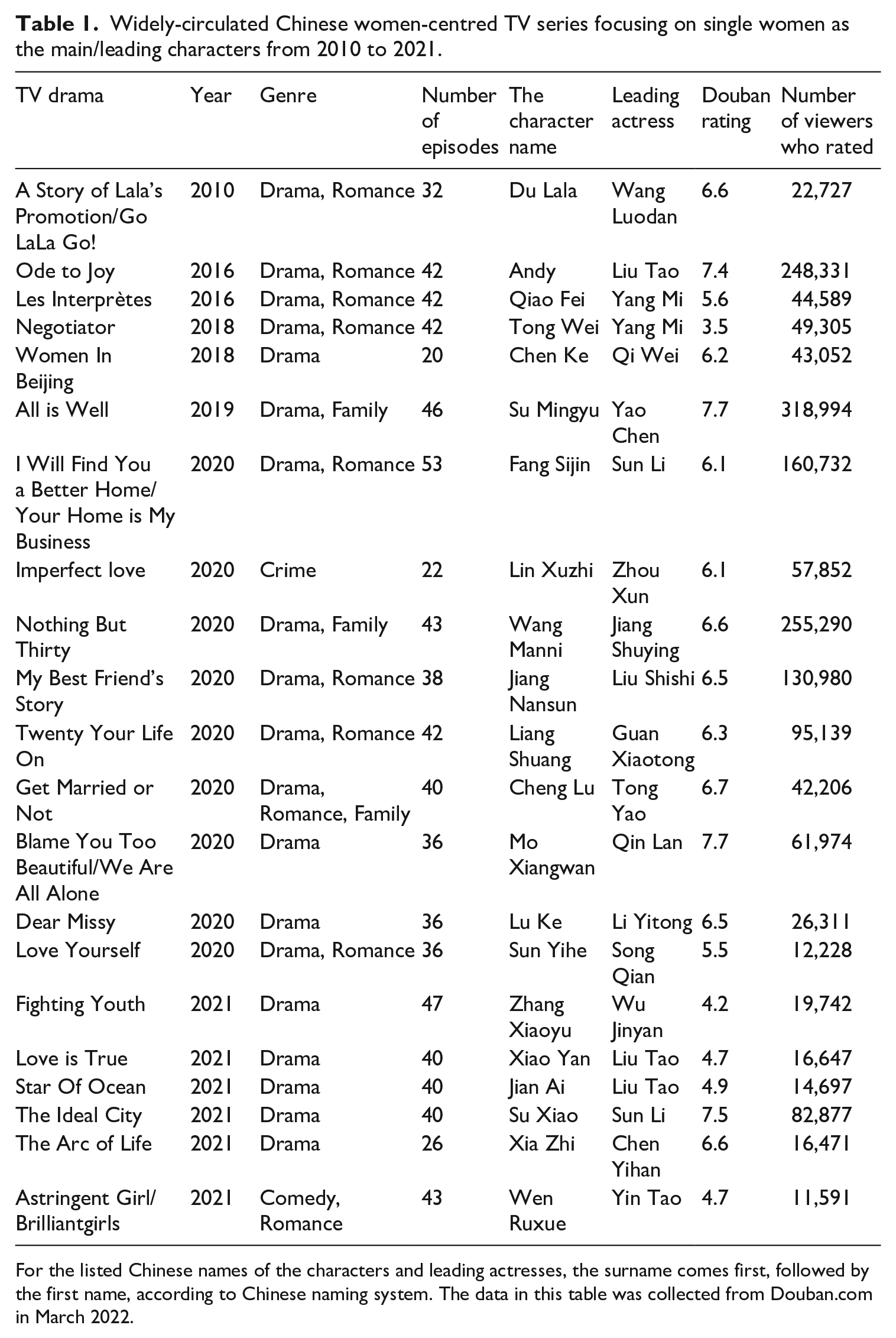
For the listed Chinese names of the characters and leading actresses, the surname comes first, followed by the first name, according to Chinese naming system. The data in this table was collected from Douban.com in March 2022.
In Table 1, we see that the TV dramas with the highest audience ratings are All is Well (2019) and Blame You Too Beautiful (2020), which have been scored at 7.7 in the Douban rating system. When we scrutinise the specific contexts of these two TV series, we find both series offer a vigorous and independent female figure as the main character. The main female character has shouldered the burden of family affairs whilst simultaneously serving under a prominent leader in her industry. In place of their fathers and/or male partners, these women have also become the pillar of their families – both TV series include single women who take care of their sick fathers while also progressing in their careers and romantic relationships. The popularity of these female figures largely reflects the more modern social expectations of Chinese society. On the one hand, these female characters serve as caregivers in a family and/or kinship relationship that adheres to the traditional view that men are in charge of the public landscape while women are in charge of the household (‘nan zhu wai, nü zhu nei’ in Chinese), which has been ingrained in Chinese history (Gui, 2020; Ji, 2015). On the other, they have progressed past the traditional view of patriarchy that subordinates women’s gender roles and reinscribes men’s dominant social and familial positions (Luo, 2017) – these female characters not only take control of the world outside their families but also balance family care and their careers, which is appreciated by certain Chinese audiences. The close attention to daily life and the balance of household/public affairs reforms the everydayness of postfeminism, as TV producers not only commit to revealing the real-life conditions of ordinary women, but also validate their responsibility and capability as being equivalent, or even superior, to men’s.
However, when we scraped the highly ranked reviews that had the greatest number of follow-up comments on these two series on Douban and subsequently analysed the data, we discovered that more than half of the Chinese audience voiced discontent with the female characters to differing extents. With Blame You Too Beautiful (2020), the most popular review, with 832 likes and 103 comments, speaks out against the over-independence and the over-competence of the female character Mo Xiangwang 1 (hereafter ‘Mo’), who works as an agent for stars and celebrities. The review ‘Four ingrates were raised in less than ten years! Blame you for being too capable’ criticised Mo’s capability, which resulted in over-dependence on her from the people around her, including her brother, subordinates, as well as her line manager, etc. In this review, the author thought poorly of Mo, who devoted herself to matters from family issues to client complaints, and was, nevertheless, taken for granted. Her line manager seldom showed her any appreciation and/or empathy, whilst her younger brother relied on her to tackle all kinds of his daily affairs, no matter how big or trivial. Because of her extraordinary leadership, Mo was capable of balancing her work, life and interpersonal relationships, which upset a certain number of Chinese viewers. In the follow-up comments, many audience members took unkindly to Mo, as her capacities and the demanding requirements put on a single woman in a TV series spoke to a negative trend in society: that women are expected to reach a ‘perfect’ status, even beyond that of their male counterparts. One female audience complained, ‘I need to stop being told I can do everything. How can I manage that?’ The extremely high expectations for women presented in the Chinese TV series result in a different view of (post)feminism. As TV creates an expectation that it is acceptable to make excessive demands of women, and especially single women, audiences start to reflect on and become disturbed by that representation. Based on the collected reviews and comments, audiences longed for women to be treated with fairness rather than being met with exorbitant demands and requirements from society. Ordinariness, as a progressive understanding of everydayness, becomes a new normal for postfeminism without masculinised hypercorrection.
The reviews of another high-rated TV series All is Well (2019) on Douban echoed the audience’s attitude to Blame You Too Beautiful (2020) to some extent. The most popular review ‘Please do not give me a happy ending of big reunion’, with 1693 likes and 774 comments, criticises the seemingly happy ending of the series. Su Minghu (hereafter ‘Su’), the main female character in the series, experienced psychological trauma from patriarchal parenting, a low-quality education because of her parents’ extreme preference for their male children, and little financial or emotional support from the family despite having to eventually shoulder the heavy burden of providing for the aged. The harsh reality of this single woman was criticised by Chinese audiences: ‘Get rid of the so-called happy ending which is unfair to Su who has gotten hurt in the family’ and ‘For those who made enormous and ridiculous demands on Su, I wish you the same’. The following comments made cracks about the patriarchal view of Chinese women’s everydayness and the exorbitant requirements made of women. Chinese audiences equate the TV representation to the common social expectations put on Chinese women, since Chinese women, and especially single women, are often overcorrected and overcriticised for not adhering to traditional Chinese values that prioritise families, partners and childcare (Li, 2014; Yu, 2021). The character presented in the series more or less alludes to the set of social expectations for women in China today.
In other words, these TV representations deliver a masculinised hypercorrection as ordinary – women are not only expected to become male-equivalent in their independence, capability and determination, but to go even beyond men. What Chinese audiences express in response is a desire for a fair and reasonable status for women, rather than the fetishisation of the gynandroid. Audiences have deconstructed Chinese postfeminism with a wish to pursue an everyday depiction of women’s ordinariness, without comparison to male counterparts or a masculinised female ideal – they are in favour of a general female figure, instead of public figures or well-known celebrities (cf. Kanai, 2020). The imposition of traditional virtues in an idealised female figure has been criticised and cast aside, for the sake of social harmony and Chinese TV production.
Conclusion
The article aims to interrogate the ordinariness and everydayness through which postfeminism manifests in a non-Western context by examining women-centred Chinese TV series and their subsequent audience interpretations. On the one hand, the increasing representation of independent female figures in Chinese TV series denotes the recognition of and emphasis on Chinese postfeminist narratives. This has transpired as Chinese urban women have become a focus of social attention, with more than 77 million middle-class women in China by the end of 2018 (Iresearch, 2019). A growing number of TV producers have devoted themselves to adopting a realistic perspective on the diverse dimensions of urban women’s everyday life, advocating for women’s equality, freedom and autonomy. However, TV representations that root themselves in traditional Chinese values have overly reinforced the excellence and perfection of Chinese women to ingratiate viewers to gendered neoliberalism (Banet-Weiser et al., 2020), which Chinese audiences feel creates characters that are too capable and thus unrealistic. From their reviews and commentary, Chinese viewers’ responses prove more complex than a pure appreciation of the gynandroid and perfection. Instead of engaging in the ideals of femininity as prescribed by the male gaze, Chinese audiences prefer to view representations of women as ordinary people who meet reasonable social expectations and responsibilities. For the audiences, ordinariness stands for women’s autonomy and their right to be mediocre and imperfect. Such an audience standpoint does not follow the white western idea of imperfection, which has close proximity to the perfect in a postfeminist frame (McRobbie, 2015) with ‘a potential capacity for perfection’ (Kanai, 2020: 7). Instead, it is a renegotiation of the perfection associated with traditional Chinese values and masculinised female ideals in the Chinese context. The audiences’ accounts therefore also negotiate the trend of ‘the perfect’ and (mis)representation of women’s everydayness and ordinariness on Chinese TV. This finding is thus worth noting for both academics and those in industry as it reveals and clarifies Chinese featured postfeminism by studying an audience understanding of female ordinariness that enriches the studies of everydayness with regard to postfeminism (cf. Kanai, 2020).
Given the significant hybridity of contemporary postfeminist culture (Rivers, 2017), it is academically necessary for scholars to understand audience criticism of highly-rated women-centred TV products in a non-Western context. Chinese viewers fight against the masculinised hypercorrection and fetishisation of the gynandroid by engaging in the shows’ scenarios and developing critical reviews/comments in the digital sphere. They have meanwhile perceived and advanced an everyday ordinariness which zooms in on the value of postfeminist ideas and independence. We have scrutinised the nuanced manifestation of everydayness among Chinese audiences to shed light on their updated sense-making of ordinariness with regard to Chinese women in popular culture in China today. Chinese viewers’ increasing engagement with postfeminist narratives in serial TV can be considered a consequence of the development of the postfeminist spirit in China, or an unconscious way of approaching feminist issues that, nevertheless, can become a viable tool for more critical discourses of feminism in some cases (cf. Agirre, 2015). With the under-developed scholarship on audience reception of cultural products concerning postfeminism in a non-Western context, we hope this study provides inspiration, insights and possible directions for the continued examination of Chinese postfeminist sensibility from an audience perspective, especially given that Chinese TV has become progressively more permeated by female figures and narratives in recent years.
