




Abstract
The male-male romance web series The Untamed reached a height of media interest in the summer of 2019 in China. Numerous Chinese young women were obsessed with the drama centred on the relationship between the two male protagonists, and many fan followers identified themselves as ‘The Untamed Girls’. Through online observation of young female fans of the male-male romance web series, this study articulates how they were self-organised as a counterpublic and utilised strategic ways to negotiate with the party-state censorship. Drawing upon the conceptualisation of ‘ambivalence’, the study analyses a dual ambivalence in their collective actions. It is argued that The Untamed Girls’ participation as a popular feminist project is, however constantly intertwined with an assumption of heteronormativity and an internalised misogyny, where these seemingly empowered women are simultaneously reaffirming a heterosexual regulation of sexual desires and devaluing women when they celebrate the male-male romance embodied in such a drama series.
The summer of 2019 witnessed the great popularity of the Chinese web series The Untamed (Mandarin: Chenqingling, Tencent Video, 2019) across mainland China, Hong Kong, Taiwan and other regions of Southeast Asia. This drama, with elaborated articulations of male homoerotic romance, is adapted from a Chinese online boys’ love fiction Modao Zushi (Grandmaster of Demonic Cultivation, henceforth MDZS) by Moxiang Tongxiu. Before the release of the web drama, the original novel which was serialised on Jinjiang Literature City (www.jjwxc.net, hereafter Jinjiang), the largest website publishing boys’ love fiction in China, from October 2015 to March 2016, found a large readership and was the first fiction obtaining over a million subscribers on Jinjiang. Boys’ love (BL) fiction, also known as danmei, portrays male-male romantic and/or erotic relationships and is predominantly produced and consumed by women in mainland China since the 1990s (Feng, 2009; Yang and Xu, 2017; Zhang, 2016). From 2010, an increasing amount of BL fiction has been adapted into manga comics, animations, audio dramas and web series. As a consequence, such a BL culture has gained wide currency among young Chinese women. For example, The Untamed as soon as 2 days after its release on 27th June 2019 reached 200 million views and when the finale aired on 14th August 2019, the overall views exceeded 4 billion (En Entertainment Data, 2020). This web series shaped the popular cultural landscape of that summer and was typified as the ‘summer special’ or ‘phenomenon’ of 2019. According to statistics from En Entertainment Data (2020), over 77% of the series audience were female. This study then pays its attention to the predominant female fans of The Untamed web series, and the possible reasons for the gendered emphasis arising out of such an interest.
The Untamed series maintains the narrative of the original novel, although the minor changes made can be attributed to either the considerations of visual representation in the adaptation or the need to pass state censorship. For instance, and most importantly, with regards to the latter reason, as explicit representations of homoeroticism remain a taboo in official state-party regulatory discourse (Bao, 2020), such representations, including kissing or sexual activities evoking homosexual desire and behaviour or even explicit love confessions between the two male protagonists were completely erased in the adaptation. Moreover, many settings and elements which could be seen as against ‘positive values’ embraced by the Chinese party-state such as the Ghost Sect (Mandarin: Guidao) created by the protagonist Wei Wuxian was reinvented as the Deviant Sect, with the same pronunciation as Guidao. The story is set in a fictional xianxia generic. Xianxia, which means ‘immortal heroes’, is a genre of Chinese fantasy where protagonists seek to become immortal, attaining eternal life and supernatural powers. This genre is influenced by Chinese mythology, Taoism, Confucianism, Buddhism, Chinese martial arts and many other Chinese traditional cultural elements (Ni, 2020). In the setting of MDZS, a powerful hero can be resurrected in the cost for another person’s life. Wei Wuxian (henceforth Xian), due to a series of incidents, is misunderstood by his close friends, and hated by millions for crimes he was accused of. Thus, in his first life he was stabbed by his brother Jiang Cheng, and was killed accidentally by ghosts he seemingly controlled. After 13 years, Xian is resurrected by Mo Xuanyu who sacrifices his own body to raise Wei from the dead and urges Wei to get his revenge. It is through this revenge journey that Xian realises his best friend Lan Wangji’s (hereafter Wang) genuine affection for him and the two form a special bond and together discover the truth behind many tragic events which resulted in innumerable deaths, including Xian himself.
In the web series, there is little dialogue expressing the love relationship between Wang and Xian. However, fans of The Untamed online actively construct their own discourse about their romance, through their ‘reading’ of the romantic relationship and then enhancing what has been displaced, censored or in effect repressed. This male-male romance of the Lan Wangji/Wei Wuxian couple (abbreviated as Wangxian) thus has become the hot topic on Chinese social media platforms, expressed through publishing posts and comments, fan-art and various other interactions under certain tags. Simultaneously, these fans are constantly worried about certain sweet scenes being banned or rectified to delete by the state censorship, which would directly threaten female fans’ pleasure of watching and imagining the male homoerotic romance. Consequently, they have actively generated several strategies to circumvent the censorship.
This study employed online ethnography to explore how female audiences of The Untamed self-organised as a counterpublic to challenge the heteronormative discourse in contemporary China by playing with censorship, and circulating reflexive homoromantic discourse on various social media platforms. Consequently, I suggest that these female fans collectively claim online social spaces via their vibrant actions on social media. Thus, they have established their temporal collective identities as The Untamed Girls (Mandarin: Chenqing Nuhai) and began to conduct collective actions, including circumventing the censorship and resisting interference from heterosexist regulation of film and television adaptations of boys’ love fiction. However, through drawing upon the conceptualisation of ‘ambivalence’ (Banet-Weiser, 2018), I illuminate how The Untamed girls’ collective actions as a popular feminist project is constantly intertwined with heteronormativity and an internalised misogyny, where these seemingly empowered women are simultaneously implementing heterosexual regulation and devaluing women when they celebrate the male-male romance.
Counterpublics and global boys’ love culture
The very term ‘counterpublic’ invented by Warner (2002) has been widely used to discuss participants of global BL culture. Wood (2006) explored the ways in which American fans of Japanese BL work with and against animation industries and sociocultural values as they access, consume and produce male homoerotic content, hence these fans gradually forge a counterpublic. Similarly, Martin (2008) used this term to emphasise the resistant nature in Taiwanese fandom of Japanese BL comics. Yang and Xu (2016) also borrowed this concept without further explanation and then suggest that there emerges an online public sphere in a Chinese BL forum, which offers pleasures, specific meanings and identities to Chinese BL fans. The notion of counterpublic has also been adopted to analyse the BL-adapted web series. Hu and Wang (2021) analysed how Chinese fans of the online drama S.C.I Mysteries (Youku Video, 2018) employs the bromance device as a masquerade to resist state censorship and increase the visibility of BL subculture. However, the term counterpublic proposed by Warner (2002) is not carefully examined enough in order to explore how it is self-organised and expanded and circulates a distinct discursive expression to counter the oppression of a dominant culture. For Warner, counterpublics are ‘counter’ as regards participants trying to supply different ways of imagining stranger-sociability; and as ‘publics’, they orient to stranger-circulation in strategic ways and set its boundaries with outsiders (Warner, 2002: 121–122).
In a different way, through observing the objection to real-person male-male pairing texts in the Taiwanese online forum, Chiang (2016) suggest Taiwanese BL fans is counterpublic but obedient at the same time. Although they are addicted to producing and consuming male-male romance, they tend to maintain their private and individual readings, and they do not wish to dispute with the heteronormative public in real life. Chiang’s argument offers insights to rethink the very term of counterpublic and its productivity in explaining the collective online space created and maintained by Chinese BL fans. Thus, in this article, I further elaborate on how female fans of The Untamed were self-organised as a counterpublic to orient strategic ways to circumvent censorship but at the same time, heterosexism and misogyny is embedded in their collective activities.
Online ethnography on Weibo: lived experience of fans of The Untamed
As Hine (2013: 8) suggests, ‘our knowledge of the Internet as a cultural context is intrinsically tied up with the application of ethnography’. Through online observation, I intend to provide detailed analysis and contextualised accounts of the lived experience of audiences of The Untamed web series. I do not claim a distinct difference between the online/virtual and the offline/real, while I argue that online experience is part of people’s daily life, and especially for audiences of The Untamed who enjoyed this web drama, and posted, commented and interacted largely online. Therefore, I draw on online ethnography as an examination of their online lived experience.
Weibo is a major Chinese social media platform, similar to Twitter. The anonymity and openness of Weibo provide fans with a relatively platform to communicate and form online subcommunities. Consequently, Weibo functions as one primary site for the fandom of The Untamed to assemble, form communities, including releasing fan-made art and writing posts and comments under related hash tags. I chose the official Weibo page of The Untamed (Mandarin: Chenqingling Guanwei, henceforth The Untamed Official) as the major observation site. On the one hand, this Weibo account representing the producer side, is a primary official channel to publish updates of the web series, behind-the-scenes footage, trailers and music videos based on episodes and to hold interactive activities with audiences. On the other, audiences have used this site to communicate and negotiate with the producers concerning their demands as regards the series, and effectively collaborate with them as regards bypassing the regulations of governmental censorship. The Untamed Official had over 5 million followers after the finale of the series released in August 2019, compared to 0.2 million followers in June when The Untamed series first aired. From 27 June to 14 August 2019, I observed all the Weibo posts of The Untamed Official and examined fans’ comments and interactions under each post by 30 September 2019. Overall, this study offers a discourse-oriented ethnography to understand the complexity and particularity of the young female fans of The Untamed in the digital space.
Figure 1 shows the basic interactive mode on Weibo. Comments are presented under every post and can be ranked by the ‘heat’ attracted (the comments that received the most likes being listed first) or by chronology (the latest comment listed first). Each user can reply to or like comments that attract their interest. Apart from the textual content of posts, I also paid attention to avatars, usernames, punctuation and fan-made memes.
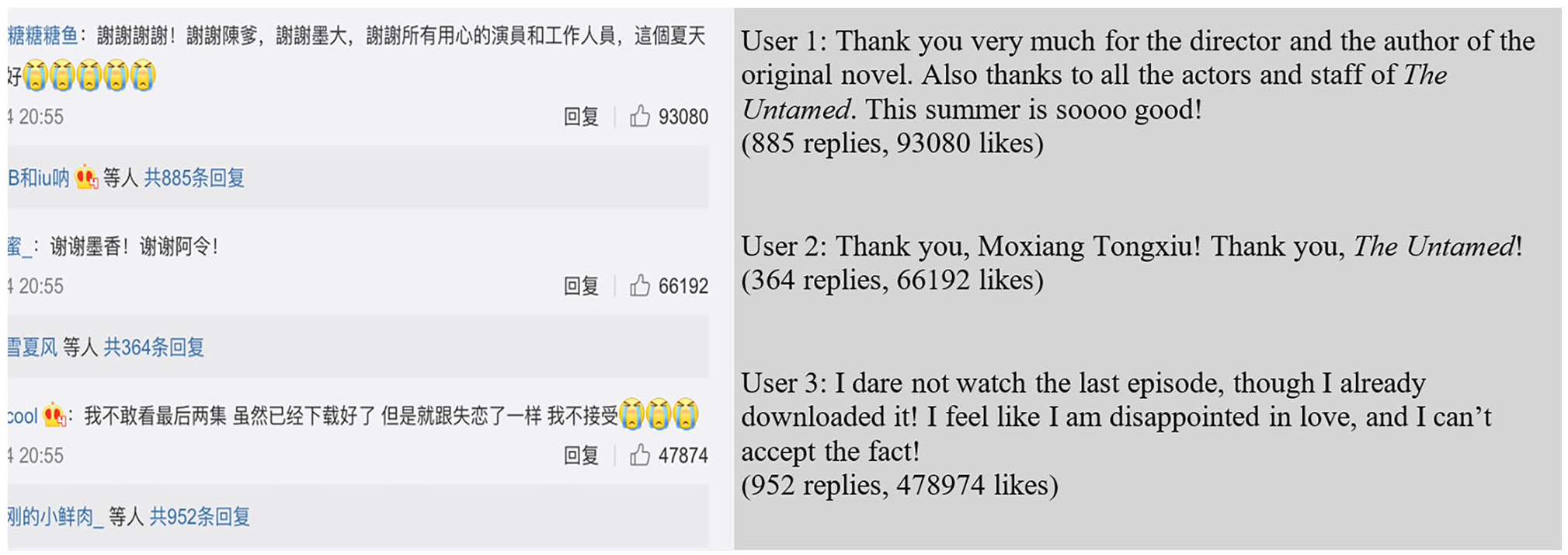
Comments under The Untamed Official’s post published on 14th August 2019, accessed 30 September 2019.
The self-organisation of The Untamed Girls
The Untamed web series did not gain much popularity at the very beginning partly because there was an inadequate promotion on different social media platforms. However, a more crucial factor is that 1 year ago before the web series came out, when numerous fans of the original novel MDZS heard the news that there would be a new love story line between the female character Wen Qing and the male protagonist Xian, fans of the book as well as other fans of BL culture expressed their outrage at such a development. Consequently, when The Untamed Official published a trailer in June 2018, fans posted over 370,000 negative comments to condemn the producers (and the actress involved) for introducing the heterosexual romance plot. Such sharp reactions mounted by fans shocked the producers, and The Untamed Official stopped updating for almost a year until The Untamed’s release on 27 June 2019. After the first week of its release, the book’s fans tended to judge that the female character was found not to interfere or disrupt the intimate relationship between two male protagonists and many of them also started to enjoy and promote this web series online.
Before the web series, there were comics, animations and audio dramas adapted from the fiction MDZS. The original fiction and related transformative works had already gained a large number of fans. Based on my observation of comments under The Untamed Official posts in 2018, the major contributors were girls who have either read the novel or watched adapted works of MDZS. It is noteworthy that these fans constituted a crucial base for the potential audience for the series and in addition, the fan voice adds weight to any comments of approval or disapproval. Apart from MDZS as the original novel with over 1 million readers on Jinjiang, the animation views, for example, in June 2019, exceeded 2 billion (from a stan of MDZS, personal communication, 30 September 2019). Consequently, these fans’ positive comments and promotional recommendations exerted considerable influence on the increasing popularity of the web series.
The first climax in audience comments is built on 3rd July 2019, following the episode when Xian and Wang are trapped in a cave and then kill a monster together. This is the scene when Xian and Wang establish a clear intimacy whilst confined in the cave. Xian carefully looks after Wang who has an injured leg. The readings of male homoerotic intimacy stimulated enormous responses among female viewers. It was also at this time that the name The Untamed Girls (Mandarin: Chenqing Nuhai) becomes frequently mentioned by fans on Weibo through posting original content with the hashtag #The Untamed and giving likes, commenting and reposting The Untamed Official posts which contained video clips of moments from this scene. A short video posted on 3rd July 2019 by The Untamed Official received over 350,000 reposts, 50,000 comments and 90,000 likes (by 30 September 2019), which largely exceeded the data of its previous posts.
When the collective identity The Untamed Girls was pervasively employed among fans, they began to make self-organised collective actions to increase the popularity of the web series. First, they created and maintained the The Untamed super-topic page, a function on Weibo which allows users to create and join interest-based community pages. They soon elected page administrators, drew up rules to regulate this page and prohibited posts deemed irrelevant to The Untamed web series. The super topic page was regarded as the homeland for The Untamed Girls, where they often discuss and publish calls for collective action. For example, both in the super topic page and comments on The Untamed Official, these fans constantly appealed to other user-viewers to give five-stars to the series on the Chinese film and television series review aggregator Douban, and to publish original posts with tags of The Untamed and names of protagonists to increase the series’ visibility and online ‘heat’. Moreover, numerous fan-made memes based on screenshots of the web series and re-clipped short videos were produced by The Untamed Girls to emphasise, enhance and elaborate on the intimacy between Xian and Wang. Also, through these actions, these fans intended to convert more casual viewers into active fans, and signify that transformation through sharing the same affects and pleasures and to jointly take collective action to promote and protect their right in and spaces for enjoying the pleasures of the homo-romantic fantasy.
Struggling for social space, negotiating with the state censorship
The Untamed Girls tactically formed a coalition with the producers of the series and collectively invented discourses circulated online to circumvent the state censorship. I identify two tactics employed by these fans and illuminate how they play with the state censorship and which functioned to preserve this male-male romance web drama and challenge the prevalent heteronormative governance.
Tactic one: claiming the homoerotic love as socialist bromance
Figure 2 shows the fan-made meme widely spread among audiences of The Untamed on different social media platforms. The panda-headed character is teasingly smiling, and the text below says that ‘We first pander and say it (the relationship between the two male heroes) is bromance. But in fact, we all know it is fucking love!’. The text highlights how fans oriented and circulated discourses to protect The Untamed from being banned or rectified by the state censorship. Thus, they pervasively used this meme in comments to claim this drama is ‘socialist bromance’, which is about the male homo-social bond between the two heroes and their adventure in a fictional world. Such a term de facto was already widely used by their predecessors The Guardian Girls who were fans of the BL-adapted web series The Guardian (Youku, 2018). This very term as well as the meme reveals the fact that these fans are aware of the vulnerability of upholding or ‘justifying’ a male-male romance in Chinese society and which is easily targetted by censorship. The fans are aware that explicit male homoerotic images and representations are not allowed on Chinese social media and the wider cultural landscape. In other words, sexually explicit scenes of male homoeroticism are completely prohibited on screen and images and any plotting that may be thought to directly signify a male-male love is also rigorously censored. Thus, the male-male romance drama is presented in an implicit way throughout, although there are semi-explicit romantic scenes such as the frequent lingering eye contact between Wangxian. Notably, it is these semi-explicit romantic scenes that The Untamed Girls endeavour to protect from the state censorship. For example, the plot of two protagonists’ gazing at each other with lingering looks and narrative excuses for close physical contact has become the meta-source for many fans to create fan-made video clips, cartoon posters or long comments which emphasise the love between the two. At the same, in the comments area of The Untamed Official, there were fans constantly appealing to other fans not to over-publicise the male-male couple and the homo-romance, which may attract the notice of governmental censors. This phenomenon also resonates with the argument proposed by Chiang (2016) - The Untamed Girls are counterpublic but obedient to some extent; they are both untamed and tamed by the heteronormative censorship.
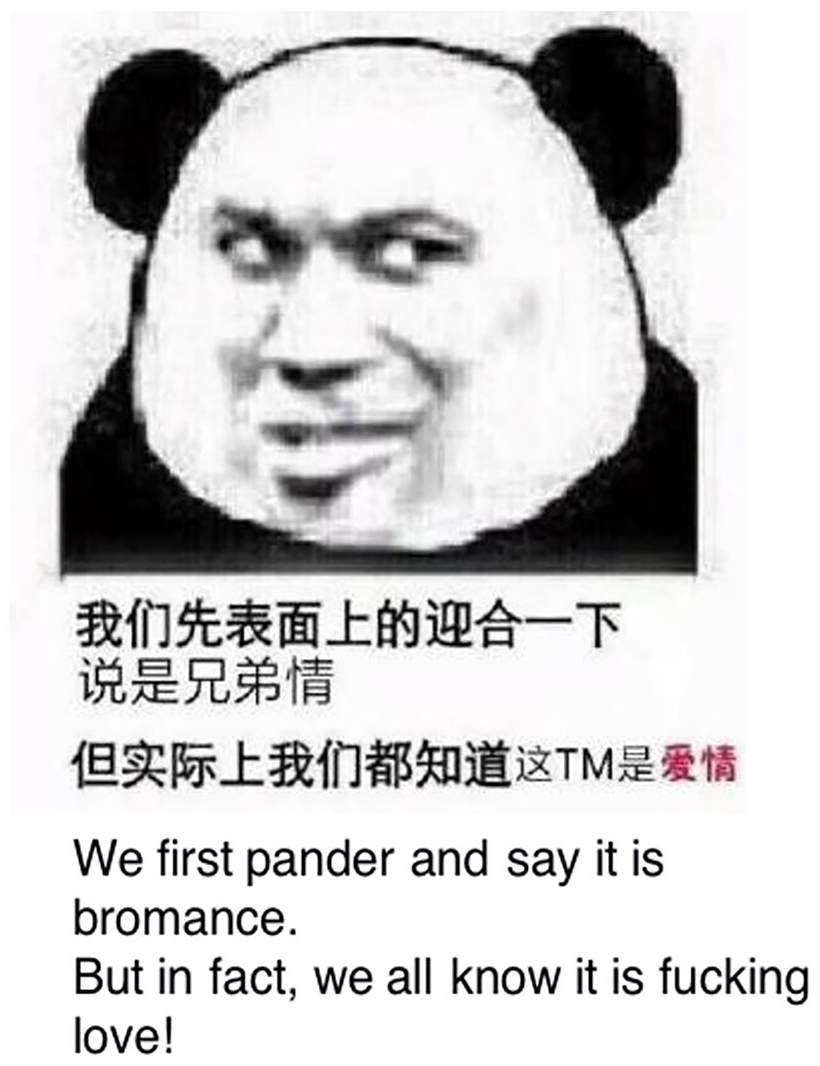
An example of an online fan meme.
The Untamed Girls are enjoying consuming the male-male romance which is sensitive to the state censorship, while at the same time, throughout the broadcasting of the web drama these fans were continually worried about this web series might be banned because of its sensitive content. Thus, a first ambivalence lies in these fans’ paradoxical thoughts. They wished The Untamed to gain more popularity, yet they are afraid that a greater popularity will bring danger to this male-male romance web drama. Moreover, The Untamed Girls are deeply aware of the overarching power of the state censorship. They are largely unsatisfied and annoyed with the increasingly rigorous censorship against BL culture, and they organised a series of activities including claiming this drama is about a socialist homo-social bond, and homoerotic love, to circumvent the censorship. However, they would not or dare not directly challenge the censorship as they are deeply aware that both the web series and their own power are vulnerable in the face of party-state power. What underlines such ambivalence is these fans’ internalisation of a censorship sensibility. When they collectively made actions to circumvent the censorship, they are already self-censoring according to what is (not) allowed.
Tactic two: connecting with the party-state values
Consequently, these fans then consciously make up comments about The Untamed to pander to the party-state, to post content related to the normative values that the Chinese government embraces and upholds. Thus, the second tactic employed by fans is to connect with the party-state values, in other words, the ‘core socialist values’, the official interpretations of Chinese socialism promoted since the 18th National Congress of the Chinese Communist Party in 2012 (Gow, 2017). The 12 values are ‘prosperity’, ‘democracy’, ‘civility’ and ‘harmony’ for the nation; ‘freedom’, ‘equality’, ‘justice’ and ‘the rule of law’ for the society; and ‘patriotism’, ‘dedication’, ‘integrity’ and ‘friendship’ for individuals. However, for The Untamed Girls, the ‘core socialist values’ are drawn upon merely as signifiers for catering to the party-state values. For instance, the top-ranking comment under The Untamed Official page reads as: The content tonight is very much in accordance with the core values of socialism, and could bring positive values to the young. At the same time, what was shown tonight also represented Chinese traditional chivalrous feelings and heroism which are required by contemporary society. (178 replies, 3894 likes, data accessed on 15 August 2019) [Comments from one The Untamed Girl, My translation]
Other fans of The Untamed tacitly know that the false flattery or absurd gloss placed on the narrative is for the censorship administrators of the platform and the government [good]. Via glossing the web drama as a representation of core socialist values and its implied positive influence on youth, The Untamed Girls attempt to emphasise the ‘positive’ side of this web drama, referring, of course, to the values cherished by the Chinese party-state. The ‘hidden text’ behind the gloss is of course, the ‘secret’ pleasure taken in the male-male romance, as they know the homoeroticism runs counter to the ‘positive’ of the heteronormative party-state or even ‘queers’ it. As noted by many intellectuals researching LGBQT + communities in China (see Bao, 2020; Engebretsen, 2014; Kong, 2010), the official policy of the Chinese government regarding sexual minorities is ‘not encouraging, not dis-encouraging and not promoting’. However, such a toxic policy constantly and viciously requires sexual minorities to live in a grey area as, precisely, such seeming neutrality about their legal rights and positions means they are not clearly defined. In Chang and Ren’s (2017) view, the official policy is keeping gay men and lesbians silent and sinful. The Untamed Girls have internalised the marginalised status of the male homoerotic culture. Again, here comes the aforementioned ambivalence, that what The Untamed Girls have done to circumvent the de facto censorship is not challenging the censorship or reverse the heteronormativity, but rather employs a strategy of retreat in masquerading the web series with socialist bromance and core socialist values and consuming the male-male romance secretly and privately. The Untamed Girls are countering heteronormative censorship, yet in a soft way and under the premise that they have internalised the heteronormative censorial regulation of male homoeroticism.
Countering the hetero-patriarchy and internalised misogyny
The Untamed Girls genuinely and feverishly embrace the male homoerotic love between Xian and Wang via establishing their collective identities and taking collective actions to circumvent censorship so as to preserve the male-male romance through which they can fulfil their desires and pleasures. Previous research on BL fiction (see Feng, 2009; Yang and Xu, 2017) and culture in mainland China tend to emphasise female participants’ challenging of the hetero-patriarchy via the constructing and positioning of an eroticising female gaze in their consumption of the male-male romance (see also Zhang, 2016) and overemphasise the ‘subversive power’ of BL culture (Chang and Tian, 2020). However, this part of the study suggests a second ambivalence among The Untamed Girls: countering hetero-patriarchy while internalising the misogyny.
The most salient example is the fans’ attitude towards the female character Wen Qing in the web drama. As discussed earlier, when fans learned that the introduction of Wen Qing as a female protagonist who falls in love with Xian, they collectively organised to post over 370,000 negative comments on The Untamed official to condemn the producers and even abuse the actress Meng Ziyi who played Wen Qing. Such a conflict extended to the whole broadcasting of The Untamed. I noticed that when one episode had more scenes of Wen Qing, fans’ anger mounted through the posting of comments attacking both the character and the actress. For example, as already calculated by fans, in Episode 9, there are about 6.5 minutes out of 44 minutes 16 second scenes of Wen Qing which include her close-up shots and her presence in the ensemble that in some ways include her character. Fans posted their furious comments under The Untamed Official, such as, ‘Miss Meng, please behave yourself. If you start a love affair with Xian in the drama, I will definitely group with my sis to swear at you three days and three nights’ (2179 likes, 209 replies. Data accessed on 15 August 2019. (My translation)).
Thus, The Untamed Girls strongly disapproved of any elements of heterosexual romance to be introduced and that may displace or disrupt the love story between the two male protagonists. They cherish the male homoeroticism as an expression of their own sexual desires through consuming the spectacle of the male bodies and the narration of male-male romantic love stories. On the other hand, these young women showed great hostility towards the actual actress playing the role (rather than the actual character, or even ignoring the character entirely, making the misogyny even more overt). Seemingly in contradiction to insisting on an undiluted male homoeroticism depicted in the original story setting as a way of The Untamed Girls to challenge regulatory heteronormative power, the hatred expressed by some and, precisely, directed at the actress as much, if not more, than at the female character threatening to disrupt their fantasy, exhibits an internalised misogyny, even a negative stereotypical jealousy that ‘divides’ women, as they stigmatise any ‘female’ in interfering in or hampering the romantic love between the male protagonists. Only women as supportive characters who support the two boys’ love such as Xian’s elder sister Jiang Yanli are admitted (i.e. literally admitted ‘into’ the fantasy) and appreciated by fans and thus affirming in some way a further internalisation: the marginalisation of women’s agency to ‘do’.
At this moment, it is crucial to critically reflect on the ‘subversiveness’ of the heteronormativity claimed by previous BL researchers both in China and Japan (see McLelland, 2000; Welker, 2006). As intelligently illuminated by Banet-Weiser (2018), popular feminism is constantly intertwined with popular misogyny. Here I suggest Chinese BL culture is a popular feminist project in which young women are more empowered as better economic subjects as they can enthusiastically and freely consume the male-male romance, but not feminist subjects. The misogynist sensibility is interpenetrating among these young women. When The Untamed Girls furiously abused at the actress and the female character, they are also implementing a popular misogyny, systematically devaluing and dehumanising women and instrumentalizing women as mere objects, as supportive roles for the male-male romance.
Conclusion
Through online observation of The Untamed Girls’ activity in the summer 2019, I articulate how they were self-organised as a counterpublic and proposed strategic ways to negotiate with the party-state censorship. Moreover, perhaps more importantly, I identify dual ambivalences in The Untamed Girls’ discursive behaviour. First, although they worked collectively and strategically to circumvent censorship and to preserve the male-male romance drama they cherished, they had already internalised the heterosexual discourse that underpins the regulatory censorship and regards the male homoeroticism as marginalised. Second, despite the celebration of the so-called subversive power in BL culture claimed by many scholars, The Untamed Girls are embracing the male-male romance while implementing or affirming a certain misogyny at the same time. The popular feminism is interrelated with a popular misogyny, and both of them are networked in these young women’s practices.
However, by employing the term ‘ambivalence’, I am not suggesting the foreclosure of the Chinese BL culture and The Untamed Girls. Rather, I intend to illustrate the genuine and ‘real’ tensions in The Untamed Girls’ collective activities, in that they are operating in a contradictory material reality not of their own making and thus I wish to shed light on the possible openings hidden in the ambivalences. The very active production and consumption of male-male romance offers a space for active production and the expression of women’s empowerment in the economics and visualisation of women’s desires, that are not clearly or dominantly or stereotypically heteronormative, though they remain largely heterosexual, expressed through the increasing visibility of male homoeroticism. However, visibility is crucial but it is not an end.
