




Abstract
How do we evaluate the value of a medical mask? And how does the mask acquire its meanings? In this paper, I approach the mask as a media entity: a mediated and mediating thing whose meanings and values arise from within a complex network of relations. The recent political divide regarding mask-wearing has roots in the ambivalence and confusion about their efficacy in the first few months of the pandemic. It remained unclear for some time whether masks protected the wearer or those around them, but nonetheless a global mask-making cottage industry emerged, shaped by DIY and citizen science. The DIY community cleverly leveraged this core ambivalence, foregrounding multivalence, and thereby feeding into a binary ethical obligation: for whom does one wear a mask? The mask was thus baptized into regular usage by the ‘I/You’ utterance that we are now familiar with: ‘I wear my mask to protect you, as you wear your mask to protect me’. This paper reframes the facemask as a complex media entity, one that absorbs its presuppositions, while also being placed into new arrangements by its arrival through an emerging relational network.
Introduction: between you and me
This article asks how we can account for the processes through which a media entity becomes embodied, by virtue of the many presuppositions that it absorbs. Particularly, I examine here the becoming, being, and relations of the cloth facemask in the early days of the COVID-19 pandemic. The mask has emerged as a singular, if not the singular, cultural and scientific icon of the community-protective measures of the COVID-19 pandemic, a ubiquitous gesture of caring. But it is also an ongoing means of making actual the virtual – not just of the virus, but the strategies for fighting the virus. Further, it instantiates a trusting gesture, in which an individual’s actions are connected to ‘flattening the curve’. Warwick Anderson (Anderson, 2021) has recently described such gestures and adherences to statistical compliance as ‘a reductive mechanism for making rapid decisions’ and, ultimately, a ‘crisis technology’ (p. 168). Indeed, we could think of the mask as a participant in this crisis technology. But the mask is, more importantly, an example of how a medical object must become a medial object to be incorporated into a cultural logic, thus transcending its status as a crisis technology. It must enter an economy of signs and meanings, and within these, articulate a new set of meanings so that it is embodied and used according to an emerging value set. A media entity thus becomes embodied by virtue of the ritual it participates in, as well as the norms that such ritualization upholds.
The rituals work to embody the media entities, in that they originate the values that are performed through these entities. The COVID-19 pandemic has also ritualized a range of other embodied mediators that screen us from the SARS-CoV-2 virus. After all, a ritual reflects a set of historical conditions that necessitated the convergence of diverse material entities; together, in their repeated assemblies, these entities come to stand for a belief. Repetition, in turn, layers and builds our belief regarding the importance of the ritual. The material entities, the distal mediators, of COVID-19 are an assorted lot of crude things that perform in such a manner: barrier tape, floortape, arrows, Plexiglas, hand sanitizer, and new assemblages of gestures for greetings such as bows and waves, ad hoc and elementary sign language and air hugs. And, of course, the mediator of the body’s most proximal and most distal extremes: masks. Distal mediators are the daily reminders of abstract principles that approximate our distance: six feet apart. They are thus both proximal and distal, simultaneously.
This proximal/distal public health model is not without its challenges. But it is a primordial way of visualizing how some factors in someone’s life distally affect their health ‘upstream’, such as their level of income, while also proximally affecting their health ‘downstream’, such as how their level of income may determine the neighborhoods in which they can reside (see Krieger, 2008). Granted, this is an oversimplification of a richly complex public health model. But its simplification is deliberate. As I will explicate throughout this article, the simplicity of the proximal/distal paradigm mediates and makes comprehensible the widespread implementation of the medical facemask.
For rituals to become meaningful, they must situate the body of the performer between the material things they are and the virtual thing they represent. As Day (2011) has written, belief is ‘believing in belonging’ to a representation, which itself is rooted in an unexpected event that, in turn, necessitates the ritualization. If masks constitute a component of the ritualization of COVID-19, they are liminal, in that they perform between the proximate/distant divide through a ritualized performance of such utterances as the ‘I/You’ phrase (‘I wear my mask to protect you, as you wear yours to protect me’). Medical masks are a simple, immediately understandable, communicatively rational gesture – as such, they dramatize public health in their simplicity and their ubiquity.
Whereas masks, in anthropological studies, are traditionally connected to religious symbolism and to an interstitial space between the material and spiritual worlds (Lévi-Strauss, 2008; Richards, 1994), I posit in this particular case that the mask emerges in a mythical relationship with public health, insofar as it intertwines with the science of proximate distance. Our mask performances are built on the faith that they have a direct bearing on the rate of transmission of the SARS-CoV-2 virus, even as they also participate in a broader ‘crisis technology’. We are thus returned to the original question of how media entities become embodied. Media entities achieve embodiment in this recursive process: they are vehicles to make sense of a historical event even as they contribute to the mediation and communication of the entities’ core values (their becoming), ritualized through a belief that is edified in repetition (their being). They therefore create a community of media entities, expressed through these embodied repetitions (their relations).
This paper does not proceed by research design and method. Instead, the paper explores a four-part pathway that is laid out as a theoretical model for understanding the becoming, being, and relation of the mask. In the sections below, I explore this process by way of the COVID-19 cloth facemask through four key aspects: (1) tracing the cultural legacy of the medical facemask, both in the West and as it permeated the viral history of Asiatic countries; (2) unpacking its initially ambivalent framing in medical journals and media communications, such as the World Health Organization’s (WHO) early decision not to recommend a mask; (3) reflecting on the DIY reaction, the multivalent citizen science that resisted these ambivalences by taking a stance of certainty with the Czech-based hashtag #Masks4All, and my own ethnographic participant observation of DIY mask communities (such as in the Open Humans Network and Safecast, early proponents of the mask); and (4) theorizing the ‘I/You’ mask utterance that dramatizes the proximate/distant public health model.
Between the face and the mask: scientific, anthropological, and Asian mask trajectories
The mask has emerged as the preeminent cultural and scientific icon of the body in its public health relation in the COVID-19 pandemic. We are all familiar with it as a caring gesture, one with the embedded belief that wearing it contributes to ‘flattening the curve’. Before COVID-19, scientific literature had rather consistently held that masks significantly slow the spread of airborne viruses. One review article, predating the COVID-19 virus by over a decade (Jefferson et al., 2008), concluded that N95 and surgical masks effectively slowed the spread of infection, with even stronger evidence for mask-wearing than for handwashing. Significantly, their study did not emphasize self-protection, but community protection. A later review study (MacIntyre and Chughtai, 2015), closer to the COVID-19 pandemic, similarly concluded that wearing N95 masks was the most effective means of slowing the spread: masks, the authors wrote, ‘may prevent infection in community settings, subject to early use and compliance’ (1, emphasis added). Research on cloth masks, in particular, had concluded that simple household objects could be converted into masks, yielding a 40% to 90% protection rate against particles between 20 and 1000 nanometers (see Rengasamy et al., 2010); the SARS-CoV-2 virus is between 60 and 140 nanometers. While wearing a mask was not a sure thing to prevent the spread of infection, the research pointed toward the homemade facemask’s efficacy in slowing the spread of transmission. In other words, the mask had a long-established history of offering community protection.
Facemasks have recently held an especial interest to sociologists and anthropologists, who have studied the mask in the context of its usage during times of crisis, viewing it as a kind of technology of crisis (Eli, 2020; Harms, 2020; Kendall and Ariati, 2020; Leone, 2020; Lynteris, 2018; Makovicky, 2020; Qiaoan, 2020; Steyer, 2020; Tateo, 2021). The process of getting citizens to comply with mask-wearing is not a medical one but a sociological one, as it involves engaging with the attitudes people adopt and the values that are ingrained in the people or in their attitudes. This is complicated when public officials express conflicted attitudes and recommendations about the practice. This occurred in the West with the COVID-19 pandemic, despite the overwhelming success of mask-wearing in Asia and the Middle East, where not wearing a mask in many places could evince a sign of disrespect for the community. The mask policy in China, for instance, required that the entire population wear a mask to slow the spread, a practice adopted into China’s regular routine after the first SARS virus in 2002. Peng (2020) writes that masks were incorporated into Chinese society in the early 20th century under a ‘modernizing’ narrative of sovereign nationhood, a ‘deeply-rooted collectivism’ incorporated into new health education movements. She traces the incorporation to Malayan public health physician Wu Lien-teh, who invented and spoke to the importance of the mask in slowing the transmission of the Manchurian plague (1910–11). Masks also served, then, as crucial distal mediators that were key in reducing the spread of transmission.
The mask has certainly participated as a key technology in a crisis, evidenced in the above historical example. Nevertheless, historically, incorporating the everyday usage of masks has not been easy, with its increasing political associations, along with whatever medical issue it is related to. A further example is found in Japan, where the mask had been adopted for centuries, originally as a luxury item; however, when the Spanish Flu killed 450,000 Japanese citizens in the early part of the 20th century, masks lost their luxury status and came to symbolize community and national protection (Burgess and Horii, 2012). Today, however, the mask now stands in most Asian countries as a means to fend off the effects of air pollution and cold weather, as well as to socially insulate oneself in a manner similar to wearing headphones or earbuds in public (Zheng, 2020). In Hong Kong, the population was encouraged to wear masks during the 2002–2003 SARS epidemic, so that its usage became entangled in politics (Sin, 2016). In Asia, it has become so customary to wear a mask out of respect for communities that it is has also been incorporated into youths’ fashion sense (see Leone, 2020; Leung et al., 2020).
Importantly, the mask is not simply protective: it mediates realities as they are experienced by their wearers, and thus they are as much medial objects as medical objects. Masks, therefore, are not simple objects: They are polysemic, a point of translation between the value of community and the value of individual, making community itself a complex notion. For Japanese culture, even at the level of individual health, masks are intended to maintain a cosmological balance ‘in nature between dry winter air and a person’s inner moisture’ (Marsh, 2020). Masks, in this reading, extend beyond mere crisis technology; they take on a new valence, recursively embodying emergent meanings and values, which they signify and affirm through usage, and which reflexively affirm them.
A media entity, such as the mask, is thus embodied by becoming part of a persistent ritual. But, a mask is a cultural as well as a scientific object. Plenty of evidence already exists that supports masks as purely health-related, positioning them specifically as entities that speak to the logic of health and scientific research, which has readily concluded that masks protect individuals. It was in light of this background, and of China’s mask policy, that Dr. George Gao (qtd. in Cohen, 2020) lamented the failure of many parts of the world to forcefully mandate a mask policy. As director-general of the Chinese Center for Disease Control and Prevention (CCDC), he had responded to an interview question in the journal Science by emphasizing masks’ role in disrupting the spread of droplets from the wearer’s mouth, which could carry the virus whether the person is aware of it or not (since they could have asymptomatic or presymptomatic infections). About this, he wrote, ‘Many people have asymptomatic or presymptomatic infections. If they are wearing face masks, it can prevent droplets that carry the virus from escaping and infecting others’ (Gao, qtd. in Cohen, 2020).
But he wrote this on March 27, 2020. This was some time after the first article about asymptomatic spread was published (30 January 2021), amended (3 February 2021), and corrected (5 February 2021) in the New England Journal of Medicine (NEJM). It is to this ambivalence that I will now turn, for it is when the value of the mask – its double-identity – emerges, rooted in uncertainties about the mask’s efficacy. Gao’s comments foreground that the mask puts people into a direct relationship with a commons idea of health, but it overlooks that they also absorb cultural values. In essence then, the mask is a complex global media object, an embodied mediated technology that transforms the Western body from a site of individuated expression to one of community protection.
The ritualization of ambivalence
Media entities are embodied by the rituals that iteratively generate and perform their associated values. However, not all rituals originate in the same way. In this section I will discuss first of two pertinent ritualizations, namely, the ritualization of ambivalence.
When writing this section, masks had been announced as a nationwide policy in the United States, but they had been so announced to much mixed reaction (Flaskerud, 2020). While the mask has today become a universal symbol of public health, it has also become a symbol of distrust among a faction of American individuals and elsewhere – a signifier, even, of the emerging governmental oppression. Citing scientific research that counters mask-intelligence, these movements are based in science that had seemed legitimate in the early days of the pandemic. The big story related to this thin piece of fabric was a tangled web of facts and fears in those early months. The facts highlighted several aspects: the worldwide shortage of masks (Rubio-Romero et al., 2020); and the emergent research, which concluded that COVID-19 could possibly spread through asymptomatic carriers (Al-Sadeq and Nasrallah, 2020). In opposition to this, several fears were voiced by numerous people, among them that widespread knowledge about asymptomatic carriers could well lead to a full-scale global panic, so that the already dwindling supplies in masks would be completely overtaken and exhausted (Feng et al., 2020). In turn, hospitals would run out of medical supplies (Tarfaoui et al., 2020), and the result would be the total collapse of the global medical system (Legido-Quigley et al., 2020).
Because of these factors, medical masks were downplayed by the WHO and various medical journals, thus making other embodied mediators take precedence, such as handwashing and wiping surfaces. This strategy was, in part, because of this growing concern over mask shortages. The evolving maskscape surfaced within this specific context and was thus characterized by the becoming, the being, and the complex understandings of the mask as a new data entity in ongoing mediated social relations and in everyday life.
Every ritual gives life to the factors that brought it into being; each iteration affirms both the importance of the ritual and the beliefs that underpin it. As the pandemic picked up speed, the world looked to the WHO for guidance on which rituals to start. The WHO was held as the central authority for advice regarding safety during the pandemic, but its public statements were also the most contentious, by explicitly downplaying the usefulness of masks and masking. In late January 2020, the WHO had emphasized through a series of press conferences that it would be worse for public health to wear a mask than to not wear a mask (WHO, 2020a). They speculated that masking would give people a sense of false confidence, summing up masking practices in other nations as expressions of ‘local cultural habits’, and even explicitly writing that ‘Cloth (e.g. cotton or gauze) masks are not recommended under any circumstances’. Their early infographics consistently recommended that people wear masks only if (a) they exhibited breathing difficulties, (b) cared for someone with respiratory troubles, and (c) worked on the frontline as a healthcare provider, but (d) not to wear one as part of a daily practice among the general public. The infographic for this list of recommendations has been since removed but can be found in cache files (Figure 1; WHO, 2020b). These communications showed that the WHO integrated proximal/distal public health measures but did not recommend the one distal mediator that was the most preventive, according to established research.
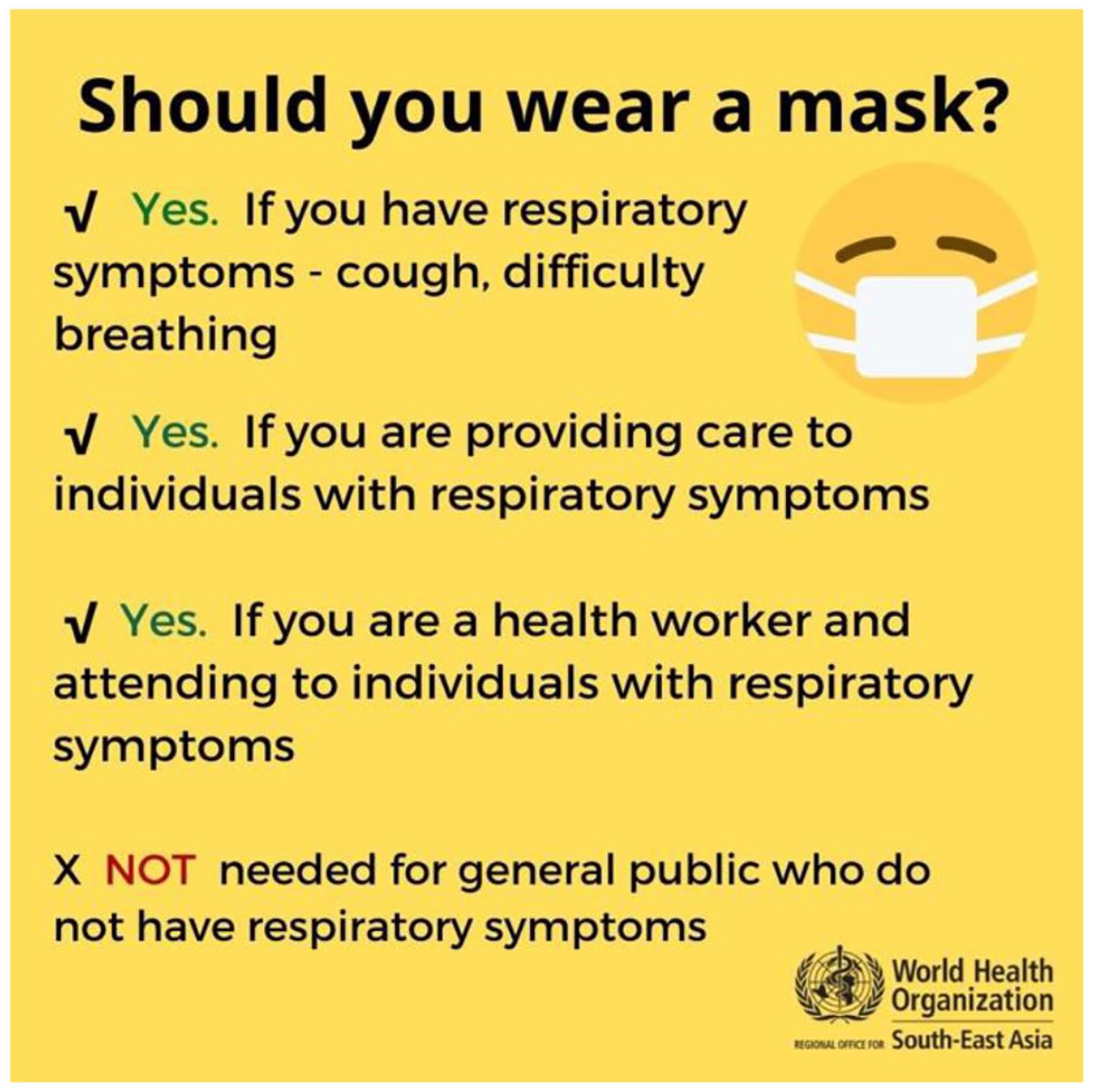
Early mask infographic for the World Health Organization.
It became clear, however, why they were slow to recommend mask-wearing: In early February, health authorities were learning that a global shortage of masks was imminent, even though at that same time, global facecloth manufacturing had risen by over 40% (WHO, 2020c). Taking cues from China’s sudden mask shortage and price inflation, the WHO predicted that the entire medical system could collapse should frontline workers not be properly protected (Chan, 2020). Given the urgent global need for masks, the WHO therefore decided that recommending mask-wearing for the general public was not worth the risk of this shortage (WHO, 2020d). Thus, this organization placed a heavy, if not unwarranted, emphasis on handwashing over masking – even though extant scientific literature (e.g. Rengasamy et al., 2010) showed that facemasks offered more protection against the transmission of a virus than handwashing. By late February, the WHO acknowledged some underlying community customs pertaining to facemasks, stating that, ‘Historically, populations and communities in Asia have used masks for pollution purposes in cities and others, so it’s become a cultural norm as well. So we have to take that into account’ (WHO, 2020e). Nonetheless, the organization still asserted there was little evidence that masks protect a community. Clearly, the WHO had yet to embrace the proximal/distal ritual of masking, which did not emerge for many months more.
Meanwhile, the public was still being warned about keeping a proper distance from others, one of several distal mediators the WHO began promoting. This led to some other decisions related to the facemask, such as the general silence in the early months about the potential for the virus to be spread asymptomatically. On January 30, the NEJM published a paper on the possibility for asymptomatic transmission of the virus, something virologists expressed concern over earlier in the pandemic (Rothe et al., 2020). The article cited the story of a Chinese businesswoman who had met with a German industry leader, who was later discovered at have contracted the SARS-CoV-2 virus, but did not exhibit symptoms until after the meeting. The businesswoman soon thereafter tested positive for the virus, which led researchers to publish their speculation that it could be spread through positive, but asymptomatic, people (see Figure 2). Dr. Anthony Fauci (Director of the American National Institute of Allergies and Infectious Diseases) soon thereafter publicly cited the study, expressing concern over its implications for containing the disease; he stated on CNN that the ‘study lays the question to rest’ as to whether the SARS-Cov-2 virus could be transmitted from asymptomatic carriers (Cohen and Bonifield, 2020).
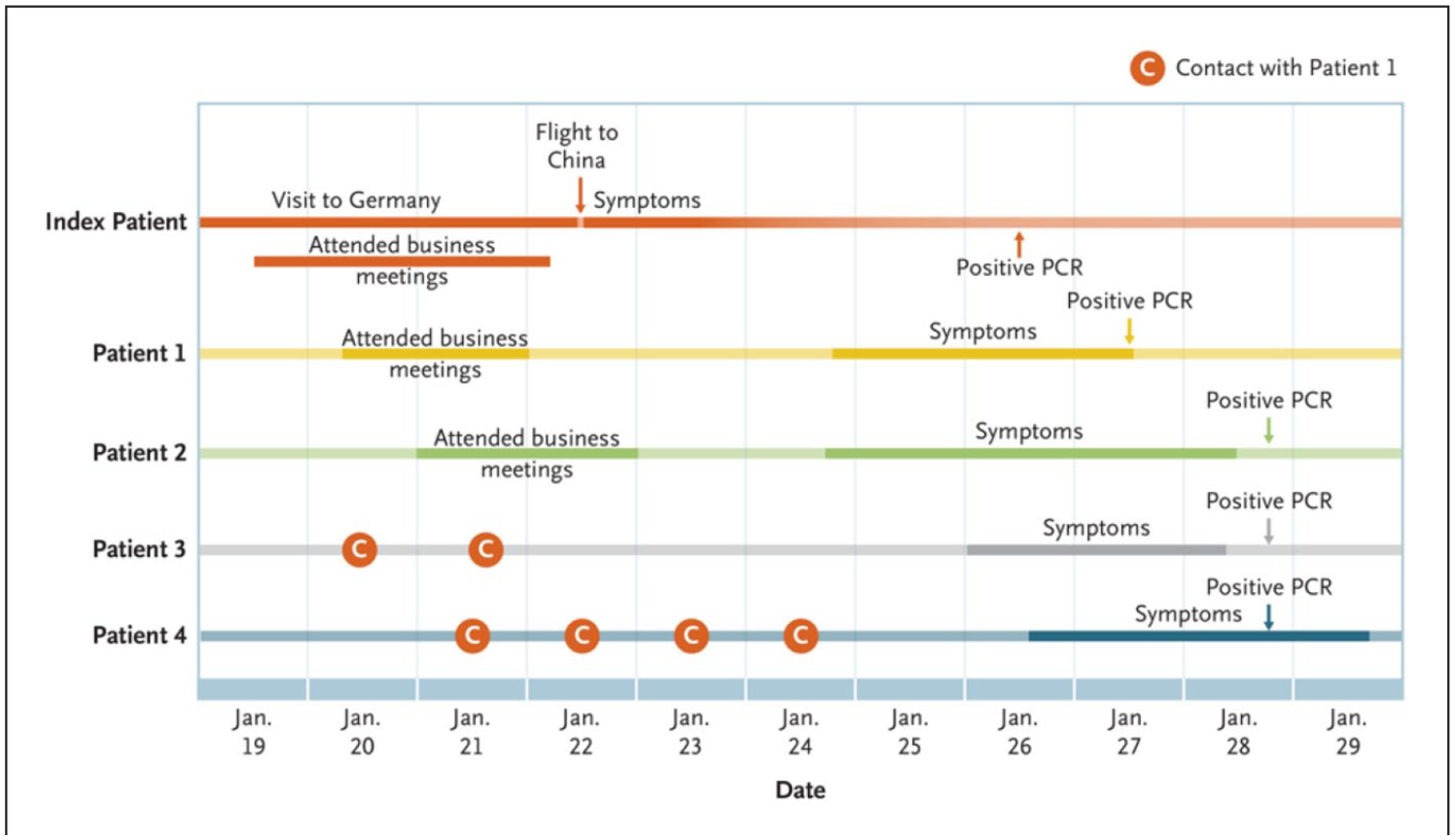
Potential for asymptomatic spread of the virus.
However, on February 3, the NEJM added a comment to their article about asymptomatic spreading, pointing to a lack of conclusive research supporting the hypothesis that the virus could be spread through presymptomatic or asymptomatic individuals (Wilson, 2020). A subsequent rebuke of the NEJM in the journal Science stated that the article was full of flaws, that the authors had not, in fact, talked to the infected person before concluding she had contracted the disease from someone asymptomatic (Kupferschmidt, 2020). The global medical community agreed that the article lacked proper tracing or followup, and that it was in need of an addendum. Interestingly, the Science article would be flagged later by the anti-mask movement as a seminal article supporting the anti-mask movement, even though it clearly asserts the real possibility for viral transmission from infected, but asymptomatic individuals. The same day the article was addended, the Journal of the American Medical Association published commentary stating that wearing a regular facemask has little value (del Rio and Malani, 2020). The tone for policy was established, at least in the United States, where the U.S. Surgeon General Tweeted the following (Figure 3), nearly a month later (on February 29, 2020):
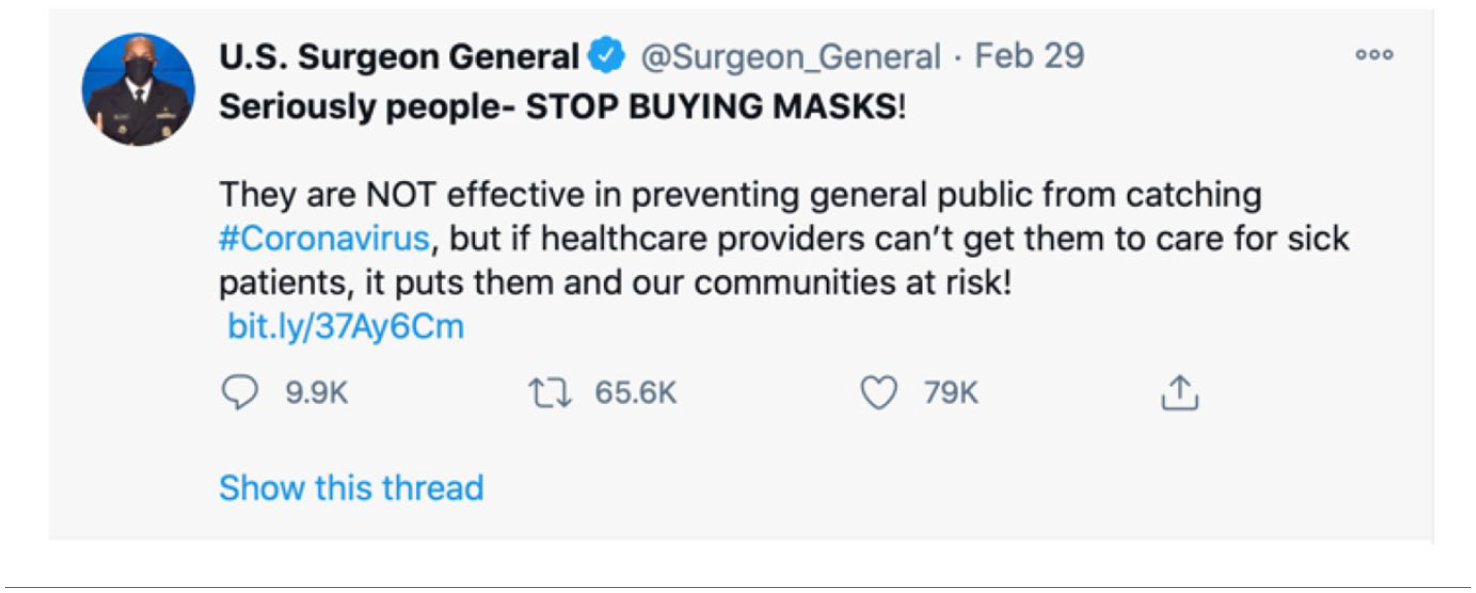
Tweet from the department of the U.S. Surgeon General, late February 2020.
This unclear messaging about mask-wearing arose from efforts to balance triage ethics and protection. One result was an overemphasis on handwashing, but another was skepticism even among the scientific community about the use of masks for self-protection. Some people touted that since so many people wore masks incorrectly, they were unconvinced that they were of much use at all.
Against this complex and resistant background, images of the mask’s efficacy were subtly filtering through to readers of scientific journals. The emerging message was that wearing a facemask protects more than the self. For example, the journal Nature had the most confusing messaging about masks: They published very little about masks during the early days of the pandemic, but regularly featured images of Wuhan citizens casually wearing facemasks in public throughout their other articles on COVID-19. While making brief, sometimes curt, mentions of the possible risk of asymptomatic spreading and the emerging science on mask-wearing, the images of people wearing cloth or surgical masks in public – riding a bike (Stoye, 2020a), perusing markets (Ribeiro et al., 2020), and distributing masks at schools (Mallapaty, 2020) – created cognitive dissonance between the global messaging about masks and the images of those for whom masking seemed a normal part of life. One story in particular drove home that (a) Asian citizens abroad were facing an alarming and rising discrimination for their masking practices and (b) masks were about community- and not self-protection (Stoye, 2020b; see Figure 4).
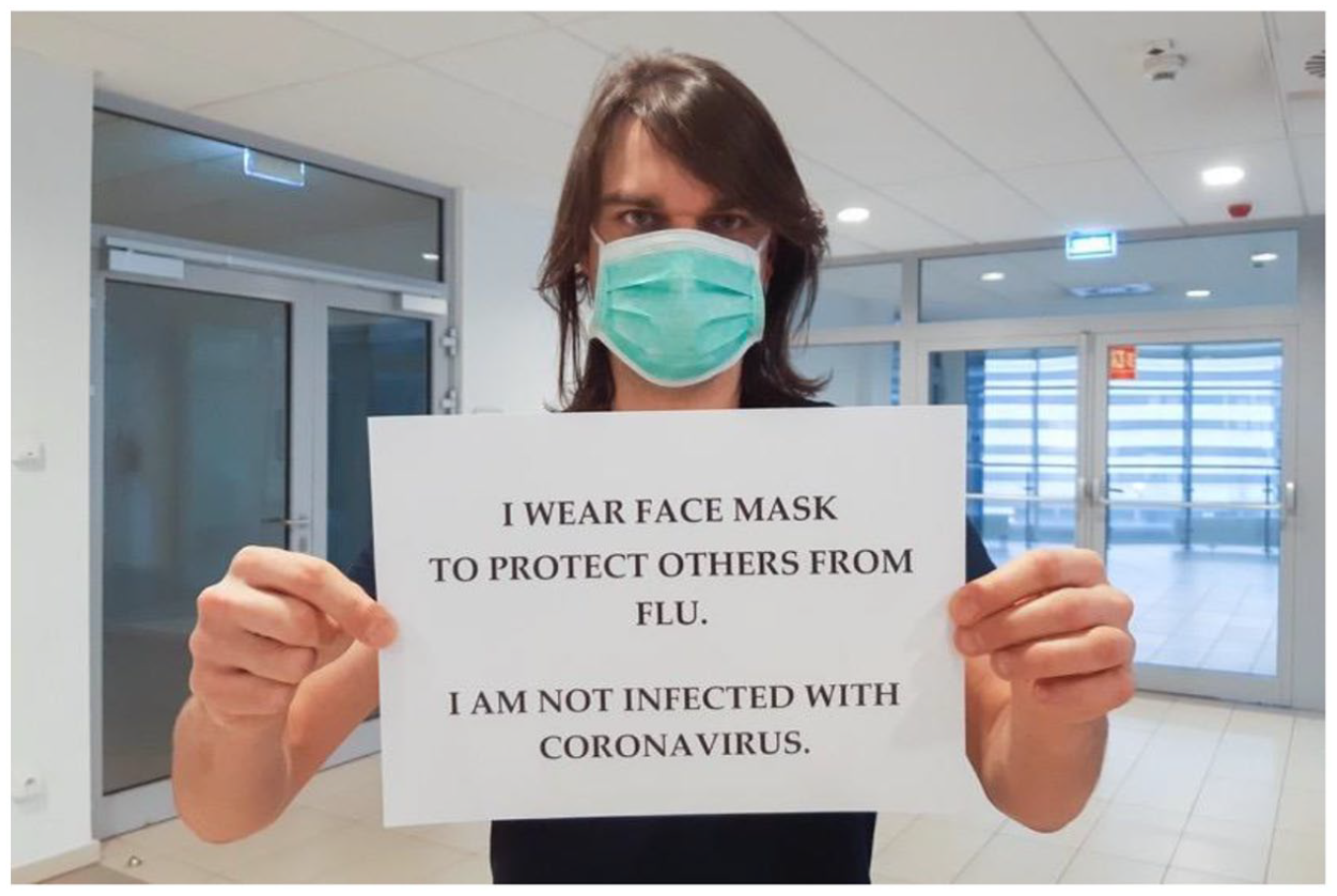
Public declaration about the use of a facemask.
The person shown in the image, Piotr Rzymski, had the following comment about his use of a facemask: I work at a medical university in Poznan, Poland, and we have students from Asia who typically wear a face mask between October and March to guard against air pollution and seasonal flu. Over the past few weeks, I have observed panicked reactions to Asian students in the city: on the street, on the bus and also, sadly, at my university—for example, people deliberately stepping away from them or opening doors with a tissue. This is despite there being no confirmed COVID-19 cases in Poland, and authorities taking care to release information about it on a daily basis. (Poznan University of Medical Sciences, Poland, qtd. in Stoye, 2020b)
The ambiguity about facemasks in the early days of the pandemic was reflected in a commentary in the British Journal of Medicine. Arts and communication scholar, Aileen Lai-yam Chan, along with colleagues in community and public health, analyzed WHO’s position on masks, arguing that people should be educated on proper mask usage, on making homemade cloth masks, and understanding that masks protect communities and not individuals, writing: Evidence points to surgical masks as the superior option, but with their critical shortage and the need to prioritise them for healthcare workers, the public’s use of a cloth mask could help to limit the spread of infection, even if there are only modest benefits in both self-protection and source control. Cloth masks are reusable and there is greater potential for their mass production. It is untested in this context, but so are some of the other social distancing measures being taken (such as the closures of schools) and cloth masks are arguably more practically feasible. (Chan et al., 2020)
It is striking that the public health model was being subtly and simply revealed through imagery of people wearing masks in Nature, while also slowly crawling out from within the commentary section of the British Medical Journal. The simplicity of this public health directive was helping to make the medical facemask something the average person could comprehend, even though it remained ambiguous. For its successful integration, it nonetheless still needed to be presented as something that mediates a value.
The ritualization of multivalence: DIY mask communities
If the WHO and other professional medical venues ritualized ambivalence toward the facemask, the DIY community ritualized its multivalence, introducing images of the mask that contradicted the dominant narrative that masks were self-protective. Rituals offer people a means to enact belief, symbolically linking material reality and virtual representation through the body of the performer. The facemask exemplifies this dual identity – announcing its presence as well as its function. Relevant here is that something happened to turn the focus away from the possible benefits to the individual and toward those for the community. A DIY community of mask manufacturers and maskmakers, social media influencers, celebrities, and the like began to converge around the efficacy of wearing masks. This was especially evident in the Czech Republic, although examples can be found elsewhere on the globe. However, in that country, YouTube influencer Ludwig (2020) posted a video referring to a University of Cambridge study that recommended people wear homemade masks in a viral pandemic to reduce the spread from carriers – emphasizing that masks were intended, in such a situation, to protect the community and not the masked individuals themselves (see Davies et al., 2013).
As people were on stay-at-home orders and perhaps paying more attention to social media, they heard the call to start making masks at home. Turning again to the Czech Republic, influencers donned the mask and spread the message with the hashtag, #Masks4All, which spread globally to ‘sewing circles’ in a matter of days (see van der Westhuizen et al., 2020). The #Masks4All hashtag resulted in a national and then international call to build masks, to convert factories into workstations, and to share mask design instructions between users (Stalp, 2020). They began making masks, delivering many to frontline workers and leaving them hanging in public on ‘Mask trees’ (Figure 5) for people to take in case they forgot theirs at home.
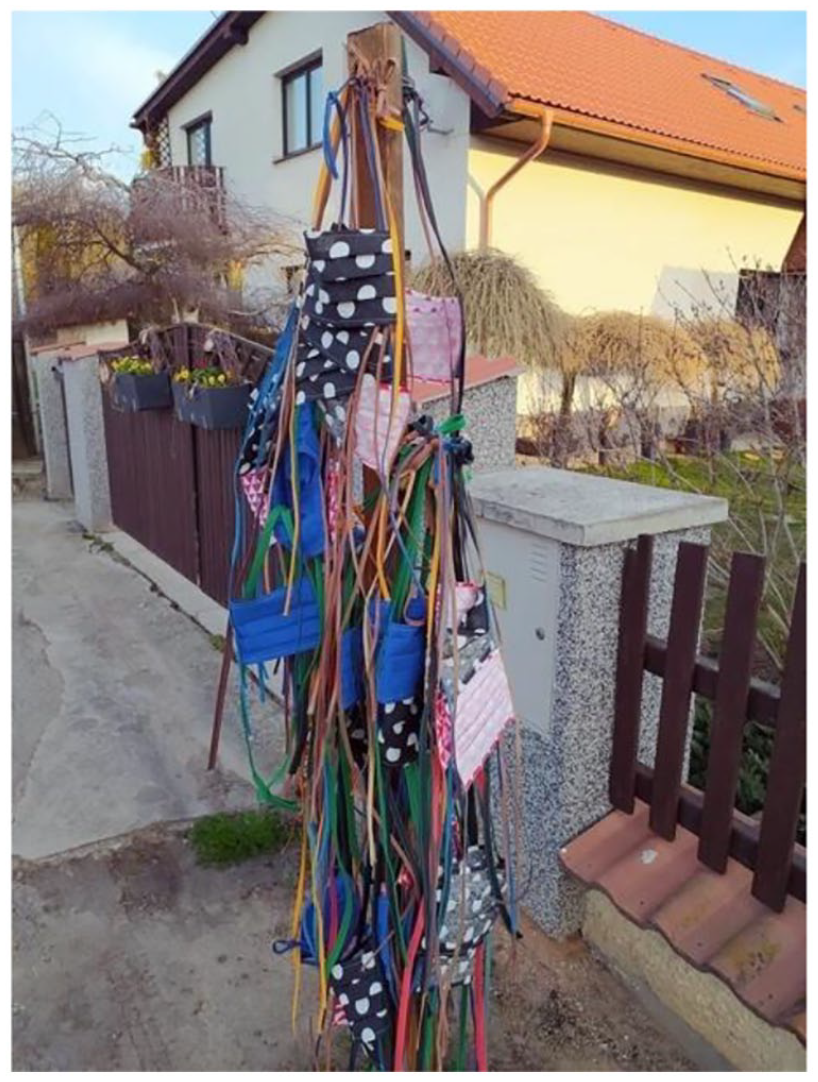
Mask trees, like this one in the Czech Republic, with publicly available, free masks for anyone to take and use (masks4all.org).
Czech celebrities joined the effort, even releasing a music video on YouTube, ‘Put on a mask’ by pop group Mirai (2020), which featured selfie videos of people wearing a wide variety of masks. This mass effort was aimed at mobilizing all citizens to wear masks. On March 18, the Czech Republic government announced their official mask policy, with officials wearing masks on TV, following the social media campaign efforts (Hutt, 2020). However, commentators speculated that no governmental directive would have been successful had the government not had the masks to distribute. It took about a week for the #Masks4All hashtag to go online, but by then mask ‘portraits’ began to appear online in the Czech Republic, as various people posted their homemade mask images. Following Venezuela and Vietnam, this was the third nation to adopt an official mask policy based around DIY homemade masks. Within weeks, other nations that had adopted similar policies, including North Korea, Uzbekistan, Thailand, Slovakia, Slovenia, Austria, and Bulgaria. In April 2020, 36 countries followed suit.
What is notable in this sea change is the liminality of this ritualized performance of the mask; it manages to bind the two poles of the public health model, the proximal and the distal, reflected in the now well-worn I/You phrase. Thus, people were now advised to wear cloth masks to slow the spread, to flatten the curve, as opposed to protecting themselves directly. This change in the public health advice from the WHO and many global health directors finally came when new research emerged on the transmission modes of the virus, especially that asymptomatic carriers transmit it (Bai et al., 2020; Kimball et al., 2020; Rothe et al., 2020). Several asymptomatic spreader events also encouraged this move. The measure was further framed as important to keeping the statistical rate of infection low to not exhaust the resources of the medical system. Thus, the American Surgeon General reiterated, in accordance with the changing science, the following Tweet in early April (Figure 6):
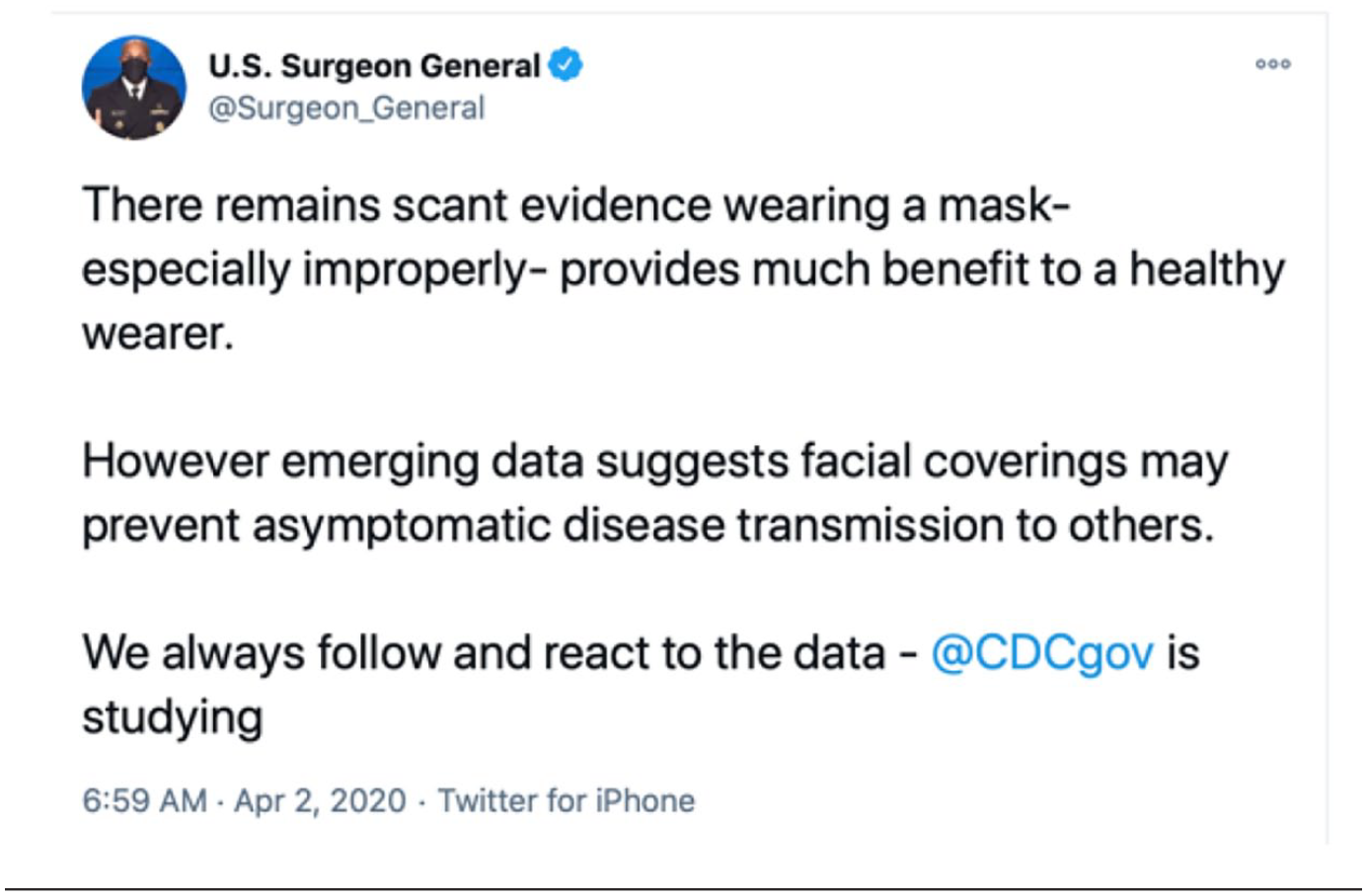
Tweet from the department of the U.S. Surgeon General, early April 2020.
This messaging marks a distinct shift: It not only signifies a medical purpose, but puts citizens, the general public, into direct relations with a new definition of community responsibility, as the mask-wearing now becomes directly correlated with the curvature of transmission.
In April 2020, my then ethnographic research had to be put on indefinite hold due to the pandemic constraints. After attempting to do things normally, I changed gears and began an ethnography of the Open Humans network, a group of citizen and professional self-researchers based out of MIT, regularly Zooming as part of a tech-enabled ethnography. In the background of one of our regular Zooms, one of the participants had put on loop the video of a 3D printer laboring away at something white, small, and functional: a homemade facemask. He spoke with grace and ease about the project he was currently taking part in, to distribute thousands of masks across the United States. This ‘Free and Open Source Hardware’ (FOSH) (Pearce, 2014, 2020) is part of an initiative to counter the ambiguous messaging from medical agencies, journals, and the WHO about the efficacy of masks (Maia Chagas et al., 2020). Masks, this informant told the group, are essential to our survival of the pandemic. He hand-delivered homemade masks to nursing homes, citing that in a few months we would all have masks in our medicine cabinets, the same way we store Band-aids.
His actions, and those of the general public who took this advice to heart and performed mask-wearing in their daily lives, unquestionably dramatize how easy, how pervasive, this public health guidance is. What is crucial in this analysis, however, is the long interval that passed between the announcement of the pandemic and the recommendation to wear masks. During the early days of the pandemic, the Open Humans network became participants in the global circulation of mask construction instructions. At the height of the shortage of masks – in the midst of a confusing mess of miscommunication seemingly spinning from the WHO, medical journals, and other organizations that created immense ambiguity about whether we should wear masks or not – the Open Humans network sought a way to distribute plans to make them.
The opening months of the pandemic were, therefore, a particularly permissible time of mass data-sharing. At a time when great ambiguity existed about the efficacy of masks, such ‘DIY science’ held an especially important role in distributing masks and situating them where they ought to be: as central actors in the reduction of the spread of the COVID-19 pandemic. These DIY masks marked a space between public health and public action. Open Humans had started their own ‘Quantified Flu’ forum, a citizen science initiative to get users to upload information about their symptoms. They were also one organization of thousands around the world that took to making masks and distributing them to people in need. In particular, their task was to distribute masks across the United States, mainly to nursing homes that did not carry them, and to hospitals as well.
The Open Humans community was and remains hopeful that masks, as a crisis technology that people can easily perform in their own daily lives, are taken up by the entire U.S. population even as masks have become technical objects. Open Humans and Safecast, an environmental monitoring news site, exemplify the FOSH movement that networked blueprints through 3D printing. This small, simple DIY object has now become part of an established and thriving market of mask manufacturing, a commodification of the mask ethos. In fact, when South Korea confronted a mask shortage, the country turned to ICT technologies and open data to overcome it. Incredibly, sensationalist news reports about the world’s anti-mask advocates proffered accounts of how they believed the masks were a step toward a global conspiracy. We have now even entered an age of mask detection software. So it is that the mask, a lowly piece of fabric, is entangled in data, the internet, public health, forecasting, modeling, and more. However, these aspects have been slipping from center stage, as we enter into several mask politics: mask waste, mask resistance, mask knowledge, mask stigma.
Between the body and the mask: the logic of I/you
The mask did not enter a pre-existing order. The alarming mask shortage in the opening months of the pandemic determined a fierce initial debate. The mask and the body entered into a manifold, emerging entity, one with many perspectives and conflicting ideas, making it nearly impossible to find unity or harmony in the unfolding months of the pandemic. Certainly, few, if any, epidemiologists would claim that the pandemic was handled well at the outset. To establish the mask as effective, public debates framed the body in terms of its primordial relations with other bodies – that its simple presence as a body affected other bodies, observable in models, forecasting, and contact tracing. Crucially, through this lens, the body was not a thing, first, but a relation. The primacy of the body was its effect on other bodies, generating a very simple but profound media ecology of the body: the proximal/distal order of the body.
Ultimately, the cloth facemask denied the Western body its individualist assumptions with a gesture that pointed to the forces between the ‘I’ and the ‘You’. We return here to the issue of how such an entity as the mask transcends its status as a crisis technology or a medical object, to be pursued instead as a medial and sociological one: indeed, it has become ritualized as a media entity, the second crucial ritualization in this COVID landscape. In particular, the mask is revealed through its suppression by the WHO, and an already established science of the mask, as a community-protective tool for the prevention of the transmission of disease. But it took some time to get there. The masked subject found the ritual prescribed by the DIY community helped them to make sense of the mask; it gave it meaning, foregrounding that it protects the ‘You’ and not the ‘I’. In so doing, the mask gestures toward the ethical proximity of the two aspects of the self – as co-emergent and co-existing entities. Thus, to wear the mask, its wearer must transcend the mask and enter into a dialogic dramatization. The mask emerges at once out of what it negates and what it affirms.
Through the repeated emphasis from the WHO that the mask is unhelpful to individual wearers – linked to resultant social media reactions that the mask is community-protective – the individual must be sacrificed and the co-existent identity must be admitted. This latter amorphous idea, impressed through hashtags and viral videos, became integrated with the former because a matter of care came to be understood as a matter of fact. Masks became an empirical generalization between the direct and indirect matters of fact: the matter of fact is simply wearing the mask, whereas the relation of ideas is that the mask may affect the rate of transmission (thus being a matter of care). It is not that the individual is a priori and co-existent identity is a posteriori; rather, the relationship of concepts is more complex. The mask is the daily reminder of a belief in the conjunction between cause and effect, that my mask flattens the curve for everyone (see Siu, 2016).
Rituals edify belief through their repeated iterations, and the more they are repeated the more they dramatize a data entity’s relations with the other entities that form the historically contingent data substratum. Masks are liminal mediators because they perform between private and public bodies, proximal and distal relations, and are key in the liminal heightening of everyday interactions. The mask resolves the law of non-contradiction because its presence embodies both the proximate and the distant all at once. Not only must believers believe that they belong to what the ritual represents – actions that flatten the curve – but that the facemask is an embodied mediator reflecting a deeper belief in the causal connection between social distancing and slowing the spread. All masks are effective if we think of masks as relational; in being relational, they become data entities that constitute ecologies of relation, mediating social relations.
What is the becoming, being, and relation of a media entity? And how does it become embodied, to the extent that it is worn by a body while integrated into a larger social body? The position adopted here is that a media entity at once enters and creates a situation, driven by an unforeseen historical event infused with ambivalence. Significantly, it finds its niche as a multivalent entity when it is framed in relational terms. The mask’s entry into and transformation of the COVID-19 pandemic arose out of the articulation of established scientific research from within DIY communities. This unique unfolding of events demonstrates that pre-existing theoretical positions cannot be counted on to offer an understanding of a media entity’s entry into or participation in the composition of an event. Certainly, the model for this new COVID body, mediated through a network, was a novel re-assemblage of extant entities: It is hard to dispute that floortape, modeling, breath, and masks had little in common before COVID-19.
Indeed, during the opening months of the pandemic, the many ambiguities and reversals of opinion by key players were ubiquitous, oriented to the origin of the disease, its means of transmission, its potential for infection, and the possibility for a cure. The tireless effort of the medical and scientific communities to publish any and all data, knowing that much of it would be retracted, tested the peer-review system and the provisional, uncertain, and tentative work of science. These processes were laid bare for the world to see. To make sense of what embodiment embodies and meaning means in this passing era we must consider entertaining new provisional models of the body. Sociologists of the body and media theorists alike may seek to empirically situate the masked body, between you and me.
