



Abstract
This study explores a case of public service media finding itself in a predicament between adhering to its civic mission to serve the public interest, and prioritizing its self-preservation by bowing to political power. Contrasting the media coverage with epidemiological data, the study suggests that the COVID-19 risk in Tokyo was cut from the news agenda by Japan’s public broadcaster NHK ahead of the official postponement of the Olympic Games in March 2020. This case highlights the challenging balancing act of a semi-independent media organization between following a political agenda, that is, pushing a mega sports event, acting in its own economic interest as a media stakeholder of the Olympics, and at the same time protecting public health. On a methodological level, this case study aims to provide a showcase of how the agenda-cutting concept is concretely operationalized and how it can contribute to the analysis of various contexts, such as the complex relationship between public media and politics in times of a global pandemic.
Keywords
Introduction
While there is only little dissent on the normative imperative of a self-regulating, independent press for the functioning of deliberative politics (Habermas, 1996, 2006), empirical reality yields a more ambivalent picture – one that often challenges idealistic presumptions of what the media’s role in democratic systems should actually be like. In their analysis of what they believe represents a semi-independent, symbiotic relationship between the mainstream press and politics, Bennett et al. (2008) come to a sobering conclusion: In sum, as a result of failing to engage creatively with public standards for press accountability, mainstream journalism has come, however unwittingly, to let the government [. . .] define the range of public debate. [. . .] The degree of critique (the watchdog ideal) and the breadth of debate (the marketplace ideal) that can be found in the news are spurred less by the press’s deliberate, consistent ‘scrutiny of government’ than by the occasional disruption of the power balance or the eruption of unexpected news events, which offer some of the few regular paths through which the contemporary media fulfill either journalistic standard. (pp. 188–189)
This ‘self-imposed yoke’ (Bennett et al., 2008: 12) to government narratives was richly detailed in Hallin’s (1986) account of the US mainstream media’s role in Vietnam. Besides, Entman (1990) attests a ‘puzzling inability of a powerful press to hold government to account’ (p. 4). These ‘inadequacies of journalism and democracy’, however, are due less to an incompetency inherent to the press, but are rather ‘the product of a process, of a close and indissoluble interrelationship among the media, their messages, their elite news sources, and the mass audience’ (Entman, 1990: 10).
As challenging as it is for commercial news media to gain and maintain journalistic autonomy, this seems to be even more true for public service media (PSM). Although the original notion of public broadcasting provides for theoretical independence from political or economic pressures due to its funding through licence fees (Curran, 2002: 240–247; Hendy, 2013; McCauley et al., 2002), contemporary public media are exposed to various pressures in most democracies (Benson and Powers, 2011; Benson et al., 2017; Cushion, 2019a; Hanretty, 2011). These pressures derive from the debate about and actual cuts of its funding, at times misused by politicians to exert influence, and from legal and administrative measures that threaten to curtail the self-regulation of the newsroom. They also derive from its civic, but demanding claim to adhere to certain editorial standards in an increasingly competitive environment with commercial and digital media (Donders, 2019; D’Arma et al., 2021; Van Den Bulck and Moe, 2017), and last but not least they come from ideological attacks both by policymakers and aggressive online critics (Cushion, 2019a; Polonska and Beckett, 2019; Powers, 2018).
Although the shift towards digitization and frequent calls for media privatization and defunding have begun to question the legitimacy of public service media, voices remain that stress PSM relevance not only for informing citizens’ knowledge of current affairs (Curran et al., 2014; Cushion, 2019b; Soroka et al., 2013), but also for enhancing democratic principles such as public deliberation, social inclusion and pluralism – and this even more so in times of a deepening social divide and polarization (Cushion, 2012; Freedman and Goblot, 2018; Hendy, 2013; Vaccari and Valeriani, 2018).
This study explores a case of public service media finding itself in a predicament between following its civic mission to serve the public interest on the one hand, and prioritizing its self-preservation by bowing to political power on the other. It analyses Japan’s public broadcaster NHK in a highly politicized context, that is, in the run-up to the 2020 Tokyo Olympic Games, which coincided with the beginning of a global pandemic, the spread of COVID-19. By applying a content analysis and contrasting news coverage on NHK television with epidemiological data, this study seeks to illustrate a case for the politics of press coverage amidst a health crisis. It demonstrates how the epidemic risk is portrayed in a highly ambiguous way, first diminished, later emphasized, contingent upon a political agenda and detached from the actual risk. On a theoretical and methodological level and based on the conceptual and operational groundwork by Buchmeier (2020) the study thereby aims to demonstrate how the concept of ‘agenda-cutting’can be operationalized and how it serves as a tool for the critical analysis of media-manufactured realities and the silencing of politically undesired issues. Last but not least, this study wishes to highlight the vulnerabilities of public service media, but at the same time emphasize its necessity for the public interest and its potential as ‘vox populi’.
Conceptualizing and operationalizing ‘agenda-cutting’
In communication research and political science much attention has been paid to the questions of what issues are picked up by the press and how these are dealt with – a media function that has come to be known as ‘agenda-setting’. As much focus has been on the media’s agenda-setting role (McCombs, 2014; Scheufele and Tewksbury, 2007; Weaver, 2007) as little focus has been given to the media’s role in omitting, diminishing, or removing issues in the news (Colistra, 2018). While missing content in the news has been parenthetically and sporadically mentioned in past studies, there has not been any systematic inquiry into the media’s ‘agenda-cutting’ role (Buchmeier, 2020). However, as much as the public’s views and perceptions are shaped by what is on the news, we may assume that these are as well influenced by what is absent on the news. As people receive most of their information about the world from the media, marginalized news topics very likely result in low levels of public knowledge and issue awareness. Amidst a pandemic, misleading or incomplete information pose a serious risk to public health.
Despite its theoretical plausibility, there have been only little advancements in conceptualizing and operationalizing the agenda-cutting function of the press. This is thought to be due to obvious grounds: It appears much more challenging to prove that something is absent than demonstrating that something is there. This results in an ‘epistemic dilemma’ in which agenda-cutting finds itself: First of all, the systematic investigation of content missing in the news obviously poses a challenging empirical endeavour. Therefore, research findings on absent information in the media has usually been a random by-product in the context of larger studies rather than something which has actively been looked for. As a result, the empirical basis for any form of issue omission or diminution has rather been fragile which, on the one hand, has not promoted any further significant theorization. On the other hand, the fragmentary theorization, that is the lack of a concise definition of technical terms and a clear-cut differentiation from cognate concepts, has hitherto hampered the development of prolific empirical research in this direction. It is this ‘epistemic dilemma’ – a thin base of empirical evidence to begin with as well as the lack of a conceptual base to build on – why agenda-cutting has remained a blind spot in communication studies (Buchmeier, 2020: 2007–2010).
Instead, the notion has persisted that agenda-cutting is a subset to agenda-setting. The problem with this unquestioned assumption is that on methodological grounds agenda-cutting cannot be identified with a generic agenda-setting research design. Whereas a conventional agenda-setting study requires an inductive approach asking for the existing issues in the news, the quest for agenda-cutting demands a deductive approach starting with the hypothesis that a particular issue is omitted on a specific agenda. For raising an idea of a potentially cut issue, the researcher needs some kind of a reference to an alternative data set, be it another media agenda or extra-media data such as official reports or statistical data. Thus, an agenda-cutting research design has to be contrastive by nature (Buchmeier, 2020: 2010–2011).
When deploying the agenda-cutting concept, another point needs to be kept in mind – one that distinguishes it from agenda-setting and underlines the essential differences between these similar sounding concepts. This is the inherently normative nature of the agenda-cutting concept. A proposition that claims a case of agenda-cutting implies that the omission of information does not happen by chance, but is deliberate and intentional. Otherwise it would constitute a case of mere regular news selection. A research design will therefore have to substantiate a claim of purposiveness. Why is a specific news item left off or marginalized on the agenda? Who would have a potential interest in keeping an issue off or removing an issue from the news? These questions need to be addressed with adequate, intersubjectively plausible context information (Buchmeier, 2020: 2013–2014).
Not every issue qualifies for being cut from the agenda. There are two major characteristics which make an issue predispositioned to become a target for agenda-cutting, that is significance and controversiality. Significance means relevance in social, political or economic terms; this comprises what is generally considered ‘hard news’. Controversiality refers to issues whose coverage would be disadvantageous to particular persons or groups, for example political malfeasance in office or corporate fraud; it also spans ethical issues that possibly divide public opinion, such as foreign migration, religious issues or abortion (Buchmeier, 2020: 2014–2015).
This study deploys Buchmeier’s operational model for agenda-cutting analysis with the terminological ‘toolkit’ outlined above and aims to apply it to the case of Covid-19 related television news on Japan’s public broadcaster NHK in the run-up to the postponement of the Tokyo Olympic Games 2020.
The 2020 Tokyo Olympics, the emergence of a global pandemic and Japan’s public broadcasting
The 2020 Tokyo ‘Recovery Olympics’
With the 1964 Olympics in Tokyo, Japan had celebrated its arrival on the world stage as a developed country after its resurgence from the ruins of World War II. The nation’s technological prowess was showcased to the global audience and the Games succeeded in promoting a more international and modern image of Japan (Abel, 2012).
The 2020 Olympics in Tokyo, more than half a century later, were to be held under less favourable historical conditions. Since the burst of the real estate bubble at the beginning of the 1990s, Japan had experienced decades-long sluggish economic growth. Since then, the widening social inequality and the fierce global competition had taken their toll on the country (Holthus et al., 2020). On top of these macrosocial and -economic trends came the 2011 tsunami, earthquake and nuclear disaster in Fukushima, which left more than 18,000 people dead, caused the relocation of almost half-a-million people, and made a whole region uninhabitable – leaving a nation disenchanted with the firm belief in technological almightiness. In this light, the 2020 Tokyo Olympic Games were supposed to be more than a mere mega sports event that would attract foreign investments, enhance the nation’s tourism industry, and promote infrastructural development throughout the country. ‘Tokyo 2020’ was to become the overall frame for a new official narrative of (yet another) resurrection of the East-Asian nation. ‘Japan is back’ 1 and – referring to the damaged nuclear power plant – ‘the situation is under control’ 2 were Prime Minister Abe’s strong messages to the international audience in the run-up to the IOC (International Olympic Committee)’s selection of the host for the 2020 Olympic and Paralympic Games (Soble, 2013). The so-called ‘Recovery Olympics’ were supposed to serve as a symbolic medium to give back hope to the Japanese people and unite the public in times when many people felt that the nation was drifting apart. In addition, the mega event was intended to become a part of the economic programme of ‘Abenomics’ and, in doing so, a communicative backbone to ensure political longevity in a country whose voters were fed up with electing a new government every 1 or 2 years.
The COVID-19 pandemic
The hopes placed in the ‘Recovery Olympics’ were suddenly at stake when a novel coronavirus began to spread rapidly in East Asia at the start of 2020. What seemed like a regionally limited epidemic on Chinese mainland in the beginning, was soon in the ports of Japan. As Japan had been relatively untroubled by previous epidemics such as the 2003 SARS outbreak or the 2009 swine flu pandemic, the authorities and health infrastructure appeared to be unprepared to face the epidemiological risks. Whereas the first few COVID-19 cases in Japan in January were scattered across the country, the epidemic situation was to become more severe very soon with the events on the Diamond Princess, a cruise ship anchoring in the Yokohama port in February. It soon turned into the largest outbreak of the virus outside China (Rich, 2020). At the end of a mass infection almost every fifth passenger had contracted the virus, several health officials had got infected and 14 people had died. Of those who had been allowed to disembark the ship and partly used public transportation to return home, dozens of people developed fever symptoms shortly thereafter. By that time, masks were out of stock in retail, and in hospitals a shortage of medical equipment was looming. Furthermore, PCR tests were neither accessible nor widely applied in the first few months of the pandemic, fuelling the concern that the spread of the virus remained undetected among the population (Crump and Tanimoto, 2020).
The COVID-19 situation in Japan, at the end of February 2020, can be described as becoming increasingly tense. From around middle of February, when the first coronavirus dead in Japan were registered, a possible cancellation of the 2020 Tokyo Olympic Games emerged on the news agenda. Needless to say, a cancellation of the Games would have been a ‘worst-case scenario’ for the Abe administration, not only from an economic point of view considering the sunk costs for what would turn out to be the most expensive Olympics so far (Wade, 2020), but also from a political one as national morale would suffer as expectations had been pushed up to unsustainable levels. Up until the postponement of the Games was announced on March 24, government and IOC officials would indefatigably reaffirm that the Games would go ahead as planned despite surging voices calling for alternatives (Denyer, 2020). At the same time, it was clear to everyone that a successful containment of the pandemic was the precondition for operating the Olympics – which was becoming more and more questionable.
Another crucial aspect for the viability of the Summer Games was to keep domestic public opinion in favour of the sports event. With the pandemic gaining momentum both in Japan and abroad, the Japanese public became increasingly sceptical if the Olympics should actually be held in July (Kim and Takenaka, 2020).
It should be noted here that the psychological hurdle for postponing or cancelling the Olympics had been extraordinarily high prior to the actual decision to postpone since, as a matter of fact, historically the Summer Games had never been postponed, only cancelled, but in wartime only. Hence an actual postponement had in fact been a very difficult decision to make – though in hindsight, and with today’s knowledge of how the pandemic unfolded in the rest of 2020, it might appear to have been the most obvious step to take.
Japan’s public broadcaster NHK’s ambivalent position between serving the government as well as the public
The public broadcaster NHK with its news programme via television, radio and the internet is essential for official communication and public opinion building in Japan. With a total operating income of 720 billion JPY (about 6.55 billion USD, FY 2020) (NHK, 2021) NHK is not only one of the largest public media in the world – next to the British BBC and the German ARD/ZDF – but also one of the largest news corporations to begin with. Needless to say, it takes up a dominant position among Japanese media in general and Japanese news media in particular. Among the 10 most viewed Japanese television news programmes, more than half are usually broadcast by NHK. 3 Together with the newspapers NHK is considered the most trusted media in Japan – trusted more than the private broadcasters or the radio, and significantly more than the internet or the weekly magazines. 4
However, NHK’s standing as an independent ‘public broadcaster’ has not been undisputed. Its proximity to political power has been pointed out (Krauss, 2000, 2017) and cases of political interference have repeatedly been reported (Hayashi, 2014; Matsuda, 2014). Besides, the media behemoth has also been criticized for its news coverage and cases of agenda-cutting (Itō, 2012; Snow, 2019). In particular, NHK’s reporting of the Fukushima nuclear crisis in March 2011 has come under scrutiny. On NHK television news, it was avoided to show the footage of the exploding reactors while the term ‘meltdown’ was not allowed to be used (Hori, 2013a: 147–149, 2013b: 16–19). News coverage of the situation at the nuclear power plant closely followed the official narrative of the government and the plant operator Tepco, thereby reiterating that the situation was nothing to worry about (Itō, 2012: 47–160). The coverage by NHK and the domestic mass media was in stark contrast to international media who were assuming a ‘worst-case scenario’ very soon after the accident (Imtihani and Mariko, 2013).
In fact, one decade after the devastating accident, topics around the Fukushima nuclear plants are still widely tabooed in the Japanese mainstream media (Reporters Without Borders, 2020).
Research design
Applying the operational model for agenda-cutting analysis (OMAC)
Against this background – a politically strained situation of increased public health risk ahead of the Tokyo Olympics, and the ambivalent position of Japan’s public broadcaster – this study asks (RQ1) how NHK communicates the rising COVID-19 risk in its television news coverage. Based on the expectation that there will be some form of agenda-cutting in relation to the pandemic risk due to the confluence of factors mentioned above, it is hypothesized (H1) that the virus risk is cut in the coverage on Tokyo. Methodologically, this study aims to reproduce the operational model for agenda-cutting analysis (abbreviated as OMAC going forward) (Buchmeier, 2020) and test its applicability to a concrete case.
According to the OMAC, the issue in question needs to be both significant and controversial. The issue ‘COVID-19 risk in Tokyo’ seems to be well suited since a public health risk in the most populous metropolitan region in the world with a high density and an ageing, that is vulnerable, population poses undoubtedly a significant issue. At the same time, the issue involves a high level of controversiality due to the political reasons revolving around the upcoming Olympic Games outlined above. Both policymakers, press organizations and businesses in Greater Tokyo have a strong interest in the sports event to be held as planned. The situation is even aggravated since the public health situation in Tokyo in March 2020 is not only in the focus of domestic stakeholders, but Tokyo’s role as the venue for the Summer Games later in July is also watched by a global audience. As a consequence, the pressure to successfully keep Tokyo a safe place as well as communicate Tokyo as a safe place both to internal (domestic) and external (international) stakeholders is considerable.
The claim of purposiveness will be elucidated in the discussion section.
As potential agenda-cutting can be presumed in the news coverage regarding the pandemic risk in Tokyo, a deductive research design is established. The OMAC furthermore requires a contrastive framework, hence this study deploys two ways of contrasting: first, by contrasting three variables of mediated risk on a macro-, meso- and micro-level; and second, by contrasting the level of salience of the COVID-19 risk with the actual epidemiological risk as reflected in health data.
Following these conceptual preconditions for the study, the content analysis can be set up concretely.
Outlining the content analysis
The study conducts a content analysis of NHK television news, namely the evening news programme News 7 (daily from 7 to 7:30 pm). It chooses News 7 as it is NHK’s flagship news programme, draws the highest viewer ratings and is generally considered to have the strongest impact on the national news agenda. The time period of the investigation is March 2020 as it represents the most critical point in the developments around COVID-19 with regard to the question whether the Olympics should be held or not. The content analysis is contrasted with the epidemiological risk, that is concretely with the trend of the so-called effective reproduction number (Re) of the coronavirus in Tokyo. Re indicates the average number of infections caused by a single infected individual, providing a parameter of how fast the infection is spreading among the susceptible population. For the content analysis, News 7 is coded for those days on which Re is rising (21 days in total) in order to examine if and how the pandemic risk is reflected in the news.
It should be noted that deploying content analysis for Japanese television news is a particularly challenging endeavour since Japan’s media organizations continue to keep their news content extensively to themselves. In recent years they have begun to make selected parts of their television news available on the internet. These, however, constitute merely single news items, not complete news programmes. In addition, their television news archives are basically closed for academic inquiries, let alone the general public. This also applies to NHK – a problematic stance on the democratic principles of transparency and openness of public service broadcasting. This is very different from, for instance, Germany’s public broadcaster ARD where television news content is freely accessible for anyone from any place in an online archive which goes back to as far as 2007.
The closed shop of the Japanese media system was portrayed 20 years ago (Freeman, 2000), but very little has changed. The insufficient scrutability for third-party investigations can be considered one major obstacle for the development of mass communication and journalism studies in Japan as most of the news media content is not retrievable. Two inquiries for this study also remained unanswered by NHK. This means that for this project all television news content was recorded autonomously.
For this study, 21 news programmes of NHK News 7 accounting for 233 news items were coded. Thereby, the following variables were coded: (1) All news items related to COVID-19 (COVID-19 TOTAL); this includes all the news in which COVID-19 is explicitly mentioned but also includes news where the consequences of the epidemic are shown without explicitly mentioning the virus. (2) All the news items related to the domestic risk, that is the spread of COVID-19 in Japan (COVID-19 DOMESTIC RISK); this covers status updates and reports on recent (cluster) infections, the current infection numbers and the locality of the spread; it also comprises official announcements (orders, advice, recommendations etc.) or expert opinion (or advice) which display an increased level of alert to the domestic virus risk. (3) All the news items related to the pandemic risk in Tokyo, that is the spread of COVID-19 in Tokyo (COVID-19 TOKYO RISK); this covers status updates and reports on recent (cluster) infections and current infection numbers in Tokyo; it also comprises official announcements (orders, advice, recommendations etc.) or expert opinion (or advice) which display an increased level of alert to the virus risk in Tokyo. These three variables are not mutually exclusive, but are conceived to span the macro-, meso- and micro-level of the mediated risk narrowing the analysis down to Tokyo on the micro-level: This implies that variable (1) covers (2) and (3) whereas (2) covers (3). Variable (3) is the one that is hypothesized to get cut so its relative salience in the news is of particular interest for this study.
With the selection of these three variables the following sub-research questions are addressed moving from the macro- to the micro-level:
RQ1a How much weight does NHK News 7 assign to COVID-19 related news in total?
RQ1b How much weight does it assign to the domestic risk of COVID-19?
RQ1c How much weight does it assign to the risk of COVID-19 in Tokyo?
For this study, weight is measured in share of the total coverage time and is thus an indicator for the relative salience of an issue on the news agenda. Besides, weight is quantified on minute level, not on news item level as the duration of news items widely differs from half a minute up to several minutes. The average duration of a news item is 2 minutes 49 seconds for the examined sampling unit.
In contrasting the three variables above the relative salience of the communicated risk becomes manifest.
Next, the level of salience of the pandemic risk is confronted with the actual epidemiological risk, that is the effective reproduction number (Re) of the coronavirus, in Tokyo. This figure is retrieved from the Toyo Keizai Online ‘Coronavirus Disease (COVID-19) Situation Report in Japan’ based on data provided by the Ministry of Health, Labour and Welfare (Tōyō Keizai Online, 2021). By contrasting the mediated risk (seen in the news) of COVID-19 in Tokyo with the statistical risk (seen in public health data), potential discrepancies can be observed.
For measuring intercoder reliability, one independent coder was instructed and trained in the coding procedures for the above mentioned three variables. The coding of 18% of the total sampling unit yielded a percent agreement of 0.996 and Krippendorff’s α of 0.991.
Findings
RQ1a. The weight of COVID-19 related coverage on NHK News 7 during March 2020 accounts for a substantial weight with a mean 72% share of news time for the sampling unit. A steady rise of COVID-19 related news coverage is found from initially 55% (March 3) up to 93% on March 25 (see Figure 1). This trend does not come as a surprise since the epidemiological dynamics were gaining momentum not only in Japan at that time, but also abroad with the exploding infection cases in the US and in Europe, particularly in Italy, which led to an overall growing emphasis on the news agenda.
RQ1b/c. The analysis of the news reporting of the domestic COVID-19 risk (including the risk in Tokyo) yields a more remarkable pattern. The announcement of the postponement of the Olympics on March 24 late night (JST) marks a clear watershed (see Figure 1). While only little news time is allocated to the domestic virus risk prior to the postponement (a mean 8% share of news time for the sampling unit), there is a drastic change after the postponement as average share of reporting goes up to 25% (for March 25 to 29). What is even more striking is the absence of the virus risk in Tokyo in pre-postponement news (variable ‘COVID-19 TOKYO RISK’). Whereas the coverage of the domestic COVID-19 risk before March 24 takes up 22 different prefectures, sometimes repeatedly, Tokyo is almost completely omitted (except for a few reported cases stemming from returnees from abroad on March 15 and March 21). After postponement is announced, not only does the weight of coverage of the domestic pandemic risk start to mount sharply, but also the focus of coverage entirely shifts to Tokyo as a centre of the epidemiological risk within Japan. This means that reporting on the domestic risk now basically equals reporting on the virus risk in Tokyo while other places in Japan are mostly ignored. However, as the contrast with the effective reproduction number (Re) of the coronavirus in Tokyo (see Figure 1) indicates, the COVID-19 risk in the Japanese capital has not significantly changed, but has been prevalent from the beginning of March, if not even earlier. This sudden shift in reporting the virus risk in Tokyo, which coincides with the postponement of the Summer Olympics, strongly suggests a case of agenda-cutting, confirming the hypothesis H1.
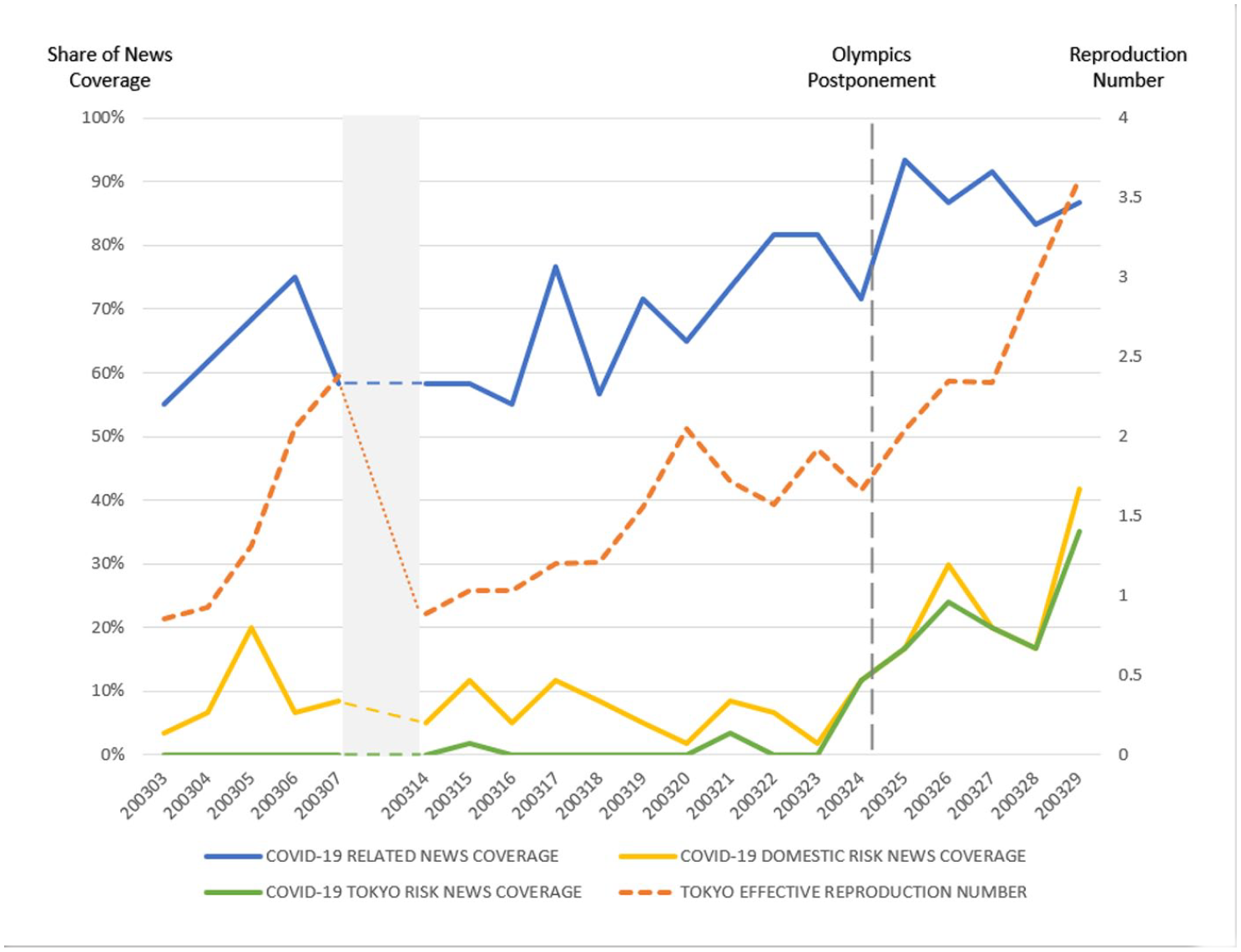
Contrasting news coverage and Covid-19 risk in Tokyo in March 2020.
By applying the agenda-cutting terminology of the OMAC, this case can be classified as issue omission considering the conspicuous relative absence of Tokyo in pre-postponement reporting. Besides, the distribution of positive coronavirus cases across the regions in Japan does not justify the ignoring of the Tokyo cases as the capital has naturally been among the cities with the highest COVID-19 numbers due to its sheer magnitude. In spite of an unchanged epidemiological risk in Tokyo, news coverage notably and abruptly switched after the ‘political burden’ of the Games was removed.
Discussion
The minimal salience of the virus risk in Tokyo on NHK television news prior to the postponement of the Summer Olympics had also been striking from the perspective that the Japanese capital in non-crisis times usually plays a central role in news reporting. Therefore, the silence on the pandemic situation in Tokyo raised questions as major parts of the public were well aware of the risk, above all since the cruise ship debacle had happened in the port of Yokohama, located right in the front yard of Tokyo. However, there is evidence to believe that at the beginning of the pandemic in Japan there was if not the intention to conceal, but at least a strong unwillingness by the authorities to communicate the COVID-19 risk in a transparent and comprehensible manner. It was frequently reported that people who were in urgent need of testing were rejected. Consequently, the bureaucratic hurdles towards PCR testing and the continuously low testing capacities raised concerns and criticism (Wingfield-Hayes, 2020). Furthermore, statistics became the object for window dressing: For instance, the 712 positive coronavirus cases from the Diamond Princess were first treated as domestic cases but were soon excluded from the national statistics and from then on presented separately to the public. This also applied to NHK news.
In this light, public broadcaster NHK found itself in a triple dilemma as it was facing multiple conflicts of interest, which in the end suggests a purposive editorial decision to cut the virus risk: First, in a highly politicized context that saw the Olympics at stake official Japan was determined to save the Games at any cost – a situation which repeated itself in 2021. 5 For this goal, the government would not shy away from intimidating the media and exerting pressure as occurred at the beginning of March 2020 with Communication Minister Sanae Takaichi who requested from NHK to ‘communicate the latest information correctly to the world so that a correct understanding of our country is fostered’ (Nikkei Online on March 6, 2020).
The agenda-cutting on NHK in relation to the Olympic Games recurred in 2021. During the livestream of the Olympic torch relay on April 1, 2021, voices of a citizen group protesting the Olympics were muted. This blunt form of editorial intervention appeared even more bizarre as the demonstrators were initially audible, then abruptly cut off while the footage remained silent for almost half a minute (Kimoto, 2021).
Political pressure on Japan’s public broadcaster is nothing new as the reporting of the Fukushima nuclear accident has demonstrated (see above). It seems, however, that NHK is exposed to increased political pressure particularly in crisis times. Hence, it may be assumed that it was a combination of overt and subtle government pressure together with forms of self-censorship deriving from preemptive (or: anticipatory) obedience (Buchmeier, 2020: 2015–2017) that resulted in the agenda-cutting of the COVID-19 risk in Tokyo in March 2020. NHK refused to comment on inquiries for this study.
The finding that Japan’s public broadcaster appears more susceptible to political interference in times of crisis is contrary to research results on the US press by Bennett et al. (2008) who found that press-government dependence is weaker in ‘event-driven moments’ (p. 58) and catastrophic events (p. 60). While both the Japanese and US mainstream press are described as ‘semi-independent’, their actual workings in crisis communication seem to be quite different. Inquiring why this is so remains a task for future research.
In fact, what complicates NHK’s position is that, second, it is itself involved as a media stakeholder of the Olympic Games. The so-called ‘Japan Consortium’ including the public broadcaster and the commercial broadcasters paid a record ¥66 billion (about $660 million) for broadcasting rights to the IOC of which 70% are said to be carried by NHK (Manzenreiter, 2020). Thus, as seen from NHK’s perspective, it appears obvious that ‘the show must go on’.
Third, NHK’s institutional proximity to political power and its involvement as a major Olympic broadcaster are in conflict with its role as a public service broadcaster. Originally designed for the mission of serving the citizens in a democratic system, the idea of public broadcasting is based on principles such as universality, diversity, distinctiveness and particularly independence. Its licence fee-based financing model is supposed to grant the broadcaster independence from commercial pressures and political interference (UNESCO & World Radio and Television Council, 2001). Paragraph 1 of the Japanese Broadcasting Law also confirms NHK’s commitment to freedom of speech and political independence. Besides, the latest business plan again underscores the public broadcaster’s mission ‘to strengthen a news reporting that protects people and their lives’ (NHK, n.d.).
However, in the case of the COVID-19 risk in Tokyo during the critical phase of the early pandemic and prior to the postponement of the Olympics it seems that due to its various conflicts of interests NHK compromised its civic commitment to nonpartisan risk communication. As a result, political interests and its own interest as a media stakeholder of the Games weighed heavier than public health.
After all, there is another indicator that the virus risk for Tokyo had been underreported. As it is reported later, significant excess mortality was recorded for Tokyo beginning from middle of February until late March (Maemura and Takahashi, 2020). The excess fatalities amounted to about 200 cases and derived from pneumonia and flu-like illnesses and suggest a link to the spread of the coronavirus in Greater Tokyo around that time. These figures stand in stark contrast to the official COVID-19 death count of 16 for that period.
Another report points at increased mortality in Tokyo at the height of the first epidemic wave in April 2020 (Reidy and Katanuma, 2020). Deaths were up to about 1000 for April which accounts for an increase of almost 12% compared to the average of the previous years. Although deaths from all causes are included in this data set, the overlap in timing suggests that there might have been more than the just over 100 deaths from the coronavirus officially reported by the Tokyo government for April.
From a global perspective Japan might, all in all, have come through the coronavirus pandemic relatively well so far. It is still too early to make final judgements though since, first of all, the health crisis is still ongoing in many countries around the world. Second, when assessing Japan’s performance in handling the COVID-19 crisis, it is often overlooked that despite a relatively low number of infections its health system has been on the brink of collapse during the pandemic (Du and Katanuma, 2021). Limited testing, a lack of specialist doctors, missing flexibility in the medical system, and a high number of nosocomial transmissions have put a strain on the health care system (Crump and Tanimoto, 2020).
The burden on the medical system had long expanded to the society as a whole, and by the time the second wave arrived around July/August 2020 the nation’s morale had reached an all-time low – and so had Prime Minister Shinzo Abe’s approval ratings. The Olympics for that year, which had served the government as a motivational programme for the nation’s electorate, had ended up in smoke, and the government’s handling of the health crisis was increasingly perceived by the public as inconsistent and flawed (McCurry, 2020). Under the growing public disapproval and his own worsening health condition Abe resigned later in August after a record-long tenure as Japanese Prime Minister.
Conclusion
The study has pictured a case of the precarious standing of a public broadcaster that finds itself in a multiple conflict of interest between following a political agenda, that is the promotion of the Olympic Games, preserving its own economic interest as a media stakeholder of the Games, and finally serving the citizens’ interest by protecting public health amidst a global pandemic. The content analysis of NHK television news has revealed a case of agenda-cutting of the virus risk in Tokyo ahead of the official postponement of the Summer Games in an attempt not to flaw Tokyo’s image as a safe host city and keep public opinion favourable towards the sport event. In doing so, however, NHK compromised its mission as a public broadcaster, whose original task is to serve the public interest. This laid bare the fragile standing of Japan’s public broadcaster and its lack of independence from political interests which reportedly resulted in a wide-spread organizational atmosphere of self-censorship (Kingston, 2017). Major reasons for this are to be found in its inadequate governance structure – the NHK board members are nominated by the prime minister –, the budgeting process in which its annual budget is regularly taken hostage by the governing party, usually the LDP, and the frequent informal interventions in the news editorial, deriving from the closed shop of the NHK management, beat reporters and political power (Krauss, 2017; Matsuda, 2014).
On a methodological level, this study aims at advancing the operationalization of agenda-cutting, a media phenomenon mostly neglected in communication and political research so far. While the agenda-setting role of the press and lawmakers has generated an abundance of studies, the omission and diminution of content in the media has received only little interest. As the author hopes to have shown, however, missing content matters just as much as does what is found on the agenda. This case study surrounding the Covid-19 risk in Tokyo ahead of the Olympic Games represents an initial attempt to outline an operational model for agenda-cutting and thereby make absent content visible.
Therefore the operational model for agenda-cutting analysis (OMAC) proposed by Buchmeier (2020) was applied. Thereby it became apparent that while the variables and the procedural method proved helpful for analytical means, the model needs a concrete adaptation to the specific requirements of the particular case and its research questions. It is most notably the setup of a contrastive research design and the selection of the objects of comparison that require considerable attention. In this case, television news content was contrasted with epidemiological data, but objective extra-media data are not always easy to get at.
By exploring the predicament of public media in a specific environment, that is Japan’s public broadcaster amidst a global pandemic prior to the Olympic Games, it is the eventual goal of the study to emphasize the importance of an autonomous public journalism for an intact media democracy. Particularly in times of advancing digitization and an accompanying affluence of (mis)information, a trusted and open public media is needed more than ever. In Habermas’s notion of deliberative democracy, public media provides reliable information, critical perspectives (the watchdog ideal) and a public forum in which ideas and opinions can compete and consensus can form (the marketplace ideal). This role would be crucial all the more in an epidemiological crisis as the ongoing one, when it is all-important to bring political, expert and civic voices together. However, the basic prerequisite for public media to fulfil this role is its independence from political power.
Footnotes
Acknowledgements
The author would like to thank the German Institute for Japanese Studies in Tokyo (DIJ Tokyo) for enabling him to stay in Japan and do research work on this study.
Funding
The author received no financial support for the research, authorship, and/or publication of this article.
