




Abstract
Media policymaking is often regarded with suspicion by stakeholders, with the result that policy can lack legitimacy and be difficult to implement effectively. This paper reports on a UK-based, collaborative and impact-oriented project where we engage stakeholders in a process of meta-deliberation, aimed at producing a stakeholder-centric, systemic understanding of copyright consultations and a strategy for change. Based on the findings, we propose a framework of purposes and principles that provides both a means of critical evaluation of copyright consultations and a guide for their reform. We conclude that shifting focus from policy outcomes to policy process is a constructive way to move debate forward in intractable policy areas like copyright, characterised by polarised and seemingly intransigent stakeholder positions. While changing the policymaking process would face significant institutional barriers, the framework we present here supports those who are concerned with taking the policymaking process in more democratic directions, whether they are officials within public authorities or activists outside them.
Media policymaking is notoriously contested, as different groups compete to shape policy outcomes in line with different interests and values (Freedman, 2008). Copyright policy has been particularly fraught, prompting intense debates about the appropriate balance between private reward for creative labour and public access to creative work. With the internet, these debates have become more complex, as producers, rightsholders and users have used technology to pursue their interests and new digital intermediaries have affected the landscapes of copyright policy and practice. The case of copyright is a stark example of how decisions about media policy today have to be made in the face of ongoing and sometimes vociferous disagreement between the groups affected.
Democracies are able to institutionalise conflict effectively in so far as participants support processes even after they produce outcomes they may not favour (Haugaard, 2003). However, if the processes are seen to be flawed, conflict may remain unresolved. Correspondingly, the legitimacy of media policy decision-making processes is especially important and perceptions of fairness and effectiveness are critical. However, policy consultations are often regarded with suspicion by stakeholders. In the case of copyright, for example, civil society organisations fear that large rightsholders unfairly influence decisionmakers, while large rightsholders suspect civil society organisations of manipulating public opinion (Aufderheide and Jaszi, 2018). The result is that policy emerging from consultations can lack legitimacy, and be difficult to implement effectively.
How then do participants evaluate consultation processes? Can they, despite disagreeing about policy outcomes, find common ground when it comes to thinking about how the process should be structured and, if necessary, reformed? Such questions call for ‘meta-deliberation’: that is, deliberation on the shape of political processes, rather than on the specifics of policy itself (Dryzek and Stevenson, 2013; Landwehr, 2015; Thompson, 2008). This article reports on a UK-based, collaborative, impact-oriented project where we engaged stakeholders in a process of meta-deliberation, aimed at producing a stakeholder-centric understanding of copyright consultations and a strategy for change. The project took place from 2019 to 2020 with participants from the Intellectual Property Office (IPO – the UK government agency responsible for intellectual property rights and charged with leading copyright consultations), representatives from a wide range of sectors engaged in or affected by copyright, and members of the public.
Our participants expressed a variety of views, reflecting their different positions in relation to the policymaking process. Nonetheless, their contributions converged around a shared framework of purposes and principles to guide the design and conduct of consultations. In so far as consultation falls short of achieving these purposes and principles, the framework provides both a means of critical evaluation and a guide for reform. We first provide an overview of current literature on copyright policymaking and describe our methodology, before presenting the findings and framework. We conclude that shifting focus from policy outcomes to policy process is a constructive way to move debate forward in media policy areas like copyright, characterised by polarised and seemingly intransigent stakeholder positions. While changing the policymaking process would face significant institutional barriers, the framework we present here supports those who are concerned with taking it in more democratic directions, whether they are officials within public authorities or activists outside them.
Debating copyright policymaking
Groups affected by copyright policy – rightsholders, technology companies, creative producers, cultural and educational organisations, users and amateur creators – take different and sometimes opposing positions on what policy should be (Aufderheide and Jaszi, 2018; Edwards et al., 2015a, 2015b). With conflicting interests and values at play, the outcomes of policymaking are often disputed. Decisions can appear zero-sum, with clear winners and losers, and a tendency towards stronger enforcement of copyright favouring large commercial rightsholders (Mansell and Steinmueller, 2013; Popiel, 2018).
Where there is dissent over policy decisions, the legitimacy of the decisionmaking process is especially significant. Haugaard (2003) argues that a democracy manages to institutionalise conflict because its structures and processes are supported by participants even when they do not generate outcomes those participants favour. As he puts it, ‘participation in democratic politics entails a commitment to accepting your own defeat’ (Haugaard, 2003: 92–93). While a group may not achieve their desired outcome, they remain committed to democratic institutions and processes, waiting for the next opportunity to persuade others to think differently. The democratic process is therefore supported by all participants – ‘losers’ as well as ‘winners’. But this ‘consensus with respect to structural reproduction’ (Haugaard, 2003: 92) hangs on the perceived legitimacy of the process.
To strengthen the legitimacy and effectiveness of media policymaking, academics and governments have emphasised the importance of engaging with ‘stakeholders’ affected by policy decisions. ‘Multistakeholderism’ and ‘multi-stakeholder governance’ is most often associated with internet governance organisations, such as the Internet Corporation for Assigned Names and Numbers (ICANN) and the Internet Goverance Forum (IGF), where civil society groups, experts, private companies and governments play a role in governance processes (Hofmann, 2016; Raymond and DeNardis, 2015). But consulting and engaging stakeholders in media policymaking more widely has long been embraced by national governments, regulators, and by the European Union (Donders et al., 2019; Freedman, 2008: 80–104).
Yet, despite a rhetorical commitment to stakeholder consultation, concerns are expressed frequently about whether it works in practice. In the case of copyright policymaking, questions about the democratic quality of the process are consistently raised by stakeholders and academics alike (see, e.g. Bridy, 2012; Erickson, 2014; Quintais et al., 2019). Large rightsholders are perceived to have excessive influence, shaping outcomes through formal consultations, and as ‘insiders’ with privileged access to decision-makers (Vertulani-Cegiel, 2015). Activists and creators feel they have less influence and their dialogue with rightsholders is limited, so that agreement or consensus is almost impossible (Keller, 2020). 1 There is limited transparency about consultation processes and decisions, bias in the selection of evidence and reliance on stakeholders with issue-specific technical and legal expertise (Kretschmer and Towse, 2013; Vertulani-Cegiel, 2015). Conflicts over policy decisions tend to be resolved, as Freedman (2008) suggests, ‘not by members of a dispersed policy “network” but by a small decision-making elite’ (p. 87). Donders et al. (2019) also note that a lack of influence results in certain stakeholders suffering from ‘consultation fatigue’ and withdrawing from the process.
Furthermore, the public are often excluded from copyright consultation processes, visible only as ‘a largely peripheral force’ (Freedman, 2008: 91). Certainly, public activism has been directed at a number of policies, including SOPA (the Stop Online Piracy Act) and PIPA (Protect Intellectual Property Act) in the United States, the international agreement ACTA (the Anti-Counterfeiting Trade Agreement) (Baraliuc et al., 2013; Breindl and Briatte, 2013; Lee, 2013; Levine, 2012; Matthews and Žikovská, 2013; Sell, 2013), and the European Copyright Directive (ECD). For example, the ECD was preceded by 2 years of intense scrutiny and debate among a wide range of stakeholders, focussed particularly on the legitimacy and legal viability of a new press publishers’ right and the introduction of automated online filtering (Articles 11 and 13/17). Petitions, industry lobbying, street protests and online campaigns indicated the strength of public feeling about the two issues and the implementation of the ECD in member countries remains variable and subject to continued debate (CREATe Centre, 2020). Clearly, public activism to challenge policy decisions is significant in democratic terms. However, there is a difference between campaigning against a policy you do not favour and being involved in shaping policy (Couldry, 2010: 143). Rather than a democratic cure, such activism might be viewed as a symptom of problems with processes of policy formation, and in particular with consultations, in the first place.
In light of such concerns, a key question is how consultation processes can be improved for stakeholders in practice. One approach is to encourage a process of ‘meta-deliberation’ among stakeholders who participate in the policy process: that is, deliberation on the shape of political processes, rather than on the specifics of policy itself (Dryzek and Stevenson, 2013; Landwehr, 2015; Thompson, 2008). Meta-deliberation is enacted based on deliberative principles, but enables participants to step back, reflect on a political process and consider how it might be improved. Crucially, meta-deliberation allows us to take account of the context and perspective of participants, because their experiences are central to understanding the limitations of political processes and the viability of potential improvements. As Dryzek and Pickering (2016: 11) explain, ‘Meta-deliberation about institutional architecture must inevitably be context-specific, as there are almost certainly no right answers that apply across all issues, times, and places’. In a context like copyright, where consultations face clear challenges to their legitimacy, opportunities to reflect on the process rather than the outcome are unusual. However, we argue that they could be democratically productive if the consequence is a more widely-accepted approach to consultation and so a lowering of conflict around this policy issue.
Methodology
Process
Since the main aim of our project was to foster meta-deliberation about the copyright consultation process, we designed our activities to facilitate the maximum opportunity for stakeholders to share their experiences, but also provide a ‘safe’ space for divergent perspectives to be heard. We wanted to avoid reproducing institutional perspectives of consultations and instead facilitate a stakeholder-centric approach, from which new insights and learning could emerge. Our objective was to co-produce a more legitimate framework for designing and evaluating copyright policy consultations, as well as to engage in observation of the deliberative process.
We needed to ensure that a wide range of perspectives was included in the meta-deliberation. Because copyright has such expansive effects, this was a potentially challenging task. We invited stakeholders who (a) could speak to its implementation and impact in different spheres of life; and (b) had already participated in previous copyright consultations, and therefore had some knowledge of consultation processes.
Our participants all responded to individual invitations to participate in the project. The final group covered key stakeholder positions, as evidenced in previous consultations, but was also innovative insofar as it included members of the public (usually largely absent from consultation processes) and public sector officials charged with running copyright consultations. As such, it permitted a deliberative exercise that facilitated dialogue across a wide range of positions in the copyright debate.
The participants were:
- Ten members of the public 2 ;
- Thirty-four representatives of stakeholder organisations from the following groups: Education Organisations & Libraries (5); Creative Industries (4); Licencing & Collecting Societies (5); Public Bodies (5); Politicians (2); Creative Producers (6); Civil Society organisations (3); Technology Companies (3); Academics (1).
- Two senior officials from the IPO.
We conducted two data-gathering exercises: individual interviews and a one-day workshop during which the meta-deliberation between 28 of the interview participants took place. Participants were provided with an information sheet and a consent form before participating. The background and purpose of the study was explained at the beginning of each interview and again at the workshop.
The interviews were 1–1.5 hours long, conducted face-to-face or through video calls, and focussed on participants’ understanding, experience and evaluation of previous consultations. Reflecting key themes from media policymaking literature (Freedman, 2008: 80–104, 2010), we asked questions about who should participate in the process, how disagreements are resolved and decisions reached, and how transparent the different parts of the process are. Both researchers conducted an in-depth reading of a selection of interview transcripts to develop an initial coding frame. The coding frames were compared, revised, then applied to a second set of transcripts by each researcher. The results of this second independent coding were compared, discrepancies identified, and a final coding frame agreed upon.
The interviews revealed strongly-held and often divergent points of view among participants, and gave us a detailed picture of the various stakeholder perspectives of copyright consultations that needed to be taken into account during the meta-deliberation. However, time limitations meant it would not be possible to discuss each of these positions in detail during the workshop. To ensure the meta-deliberation was appropriately focussed and worthwhile for participants, we combined our thematic coding of the interview data with insights from academic literature (e.g. Mansbridge et al., 2012; Smith, 2009) to identify an initial framework of underlying purposes and principles that connected all our participants’ responses (see section 2.2). This provided a general structure for the workshop.
The workshop functioned as a space of meta-deliberation for participants to generate ideas on how to improve consultation. Not all the original interviewees were able to participate, but the final group still included officials as well as stakeholders from different sectors. 3 Members of the public were given a pre-workshop briefing to set their expectations and ensure they felt comfortable engaging with more experienced stakeholders. During the opening session, we presented the initial framework for consultations that we had identified from the interview analysis, and discussed it with the whole group. This allowed us to clarify our interpretations, listen to participants’ reflections on our ideas, and ensure that a positive and welcoming space for deliberation was created. Participants were then allocated to small, mixed-sector groups, facilitated by a moderator, to participate in breakout sessions for the rest of the day. These 75-minute sessions focussed on improving consultations based on the following general questions: (1) who should participate in consultations, (2) how should they participate and (3) why should they participate. Detail from the interviews provided prompts for discussion. The breakout discussions were transcribed and analysed in the same way as the interviews, to identify participants’ reflections on the purposes and principles, as well as their specific recommendations for improvements.
Analytical approach
Two guiding ideas were central to our analytical approach. The first was to focus on common principles that underpinned participants’ evaluations of consultations, which might facilitate agreement and structure recommendations for improvements. We expected participants to express a range of views about consultations, and to disagree about how to prioritise problems and improvements. Focussing on fundamental principles that connected their different views allowed us to find a path towards a basis for agreement rather than expecting participants to agree equally on all recommendations. This meant identifying principles that could not be ‘reasonably rejected’ by participants, rather than searching for ‘pure consensus’. Central here, as Forst (2014: 5–6) explains, is the criteria for ‘reciprocal and general justification’.
In contrast to a pure consensus theory, the criteria of reciprocal and general justification make it possible in cases of dissent (which are to be expected) to distinguish better from worse reasons: the criteria serve as a filter for claims and reasons that can be “reasonably rejected”. Reciprocity means that no-one may refuse the particular demands of others that one raises for oneself (reciprocity of content), and that no one simply assume that others have the same values and interests as oneself or make resource to “higher truths” that are not shared (reciprocity of reasons). Generality means that reasons for generally valid basic norms must be shareable by all those affected.
We aimed to identify key principles about how consultations should run that participants could not deny to others (since they themselves expected consultations to adhere to those principles) and that could be shared by all participants. The principles arrived at through the process are likely to act in practice as what Mansbridge et al. (2010: 65) call ‘regulative ideals’: they are not necessarily fully realisable, but provide a yardstick against which to critically evaluate current practice and guide practical reforms. In practical terms, they allowed us to align problems with appropriate solutions, which made participants’ recommendations easier to follow and potentially adopt.
The second guiding idea was to think about consultations in ‘systemic’ terms. Theorists have emphasised the need to think systemically about how deliberative-democratic ideals are realised in a distributed manner, considering the contributions of different types of actors and practices, the division of labour between them, and the overall result of their interactions at a macro level (Bächtiger and Parkinson, 2019; Mansbridge et al., 2012). This perspective allowed us to recognise copyright consultations as a system of different but interconnected engagement methods, enacted between different actors and across different times and places. Each method contributes to the overall legitimacy and effectiveness of the process. This permitted a move away from a vain attempt to design a single, ideal model of consultation, which would be impossible, given the range of participants’ experiences, and would inevitably mean choosing between particular purposes and principles. Instead, our challenge was to create a framework that would enable the identification of the best range and mix of practices in any consultation context.
Below, we discuss the purposes of consultation that participants identified, the barriers to achieving those purposes, and the principles that underpinned the improvements that participants suggested for better consultations.
Consultation purposes
Participants agreed that consultations should have a clear purpose, and should not take place unless there was a genuine intent to learn something new. As one official noted: ‘I have worked in many other government departments where sometimes the answer is known before the consultation begins. That’s not something we support here’ (O1 4 ). This view was echoed by stakeholders, who pointed out that some consultations might be a reaction to current political priorities, where the desired outcome is already decided: ‘Well, they often set out to provide stuffing for an already determined position. That’s clearly not the best kind of consultation’ (SH29).
Participants identified two main purposes for consultations.
5
First, consultations were understood as an epistemic exercise in gathering stakeholder evidence to understand the impact of policy and support more informed policymaking. This generated a focus on evidential quality and relevance as a basis for assessing the value of contributions. While quantitative evidence tended to be valued most highly, officials recognised the importance of a ‘varying spectrum’ of evidence, including case studies and qualitative data. Balancing different types of contribution was recognised as part of the purpose of copyright consultations, as one stakeholder noted: Copyright, they always say, is a balance between the rights of the author, the creator, to get some kind of remuneration and the ability for other people to use their work without being overly restrictive. I think they’re doing them [consultations] to try to ensure that we end up with laws that are balanced. It’s quite a delicate balance, to get it right. . . (SH24)
Second, consultations had a democratic purpose, enabling stakeholders to contribute to or help shape the direction of policy and decisionmaking. This happened in a more open-ended fashion than gathering specific forms of evidence: for example through ‘calls for views’, informal discussions and one-to-one meetings.
The epistemic and democratic purposes of consultation were linked through the connections between different types of stakeholder engagement. One official noted that high-quality, formal stakeholder contributions were facilitated by informal discussions: ‘So, actually getting people engaging, I think it works well if we’ve had the opportunity to do those kind of pre-conversations, you get a much better response’ (O1). Stakeholders also recognised how different elements of consultations served different purposes, some focussed on more general reflection on policy direction and some more engaged with the specifics of policy impact. All contributed to epistemic and democratic outcomes, but to differing degrees.
Barriers to achieving the purposes
The purposes of consultation were widely agreed upon, but our participants also identified various barriers to achieving them. First, the broader political context meant that neither the quality of consultations nor their impact on policy could be guaranteed. The officials emphasised that consultations needed to be understood in the context of the broader political system. Policy consultation operates in a ‘ministerial environment’, where important decisions about consultation processes and outcomes are ultimately made by elected political representatives. Like the officials, participants recognised that consultations are only one step in the process of policy-making, and may be divorced from the locus of decision-making. However, they noted more readily that this could easily lead to symbolic consultations, with no material effect on policy outcomes. Political structures can distort or obscure the relevance of consultation responses, while recommendations can easily be dismissed by politicians if they had already made up their mind or had their own political agenda.
You say, “We’ve run this consultation, Minister. This is what the people said, and this is what we are going to do with it.” Then the minister goes, “It’s against everything I believe in.” It all falls apart. (SH15)
There were other barriers to achieving the desired outcomes in practice. For example, the open nature of the more informal, earlier parts of the process are most suitable for public engagement and realising democratic purposes, yet they tend to be more exclusive and less transparent in terms of their effect on consultation outcomes. As one official put it, ‘when there’s not a live consultation, the level of dialogue probably goes to [. . .] our regular stakeholders, if people want to call them that’ (O2). Relatedly, some stakeholders were unconvinced of the desire to take their views into account, believing that more influential actors set the agenda in meetings that were often held ‘behind the scenes’.
A variety of reasons were identified as the cause of this inequality. First, some industry stakeholders were more vociferous, better organised and resourced, and more regular participants than others. Because their perspectives aligned with the dominant economic view of copyright, they were easier to deal with. One official echoed this point: There is an awful lot of emphasis on functioning markets and so on, and so those stakeholders that fit into that mould are much more. . . The conversation with them is much more straightforward (O2)
In contrast, stakeholders who advocated an alternative view and had fewer resources, had less influence on the process.
If you are challenging received wisdom, it’s always going to be a lot harder at every level. [. . .] always, the inertia is going to be towards the status quo. If you have all the people from the status quo coming and tell you that the UK as a central place in the world for creative industries, is going to disappear, then you’re going to listen to them. (SH23)
Familiarity with the consultation environment and its unspoken expectations of knowledge and behaviour, also differentiated stakeholders’ capacity to influence. One participant explained her discomfort attending her first stakeholder ‘round table’ with more experienced rightsholders.
I really didn’t know what the copyright holders had submitted. I just knew they were in the room. They came out with some key points but as it was my first ever consultation round table, I wasn’t quick enough on my feet to ask follow-up questions. In fact I didn’t even know whether I was allowed to so I had no ground rules. (SH28)
The obscure language of consultations and copyright also allowed some participants to engage effectively while excluding others, including members of the public: All consultations that ask for broad, argumentative input are much easier to stomach for bigger organizations and for professional associations that are built around advancing policy interests. They’re generally very difficult to grasp by practitioners. (SH21)
The officials were not complacent about unequal participation, but they struggled with structural challenges of reaching stakeholders that were more dispersed, less well-organised and less well-resourced.
It’s whoever thinks that this may have an impact on them [. . .] but that is difficult in itself to identify [. . .] the potential community in its broadest sense. (O1) It is notoriously difficult to get the consumer voice in the conversation and really hard to get the small-business voice in your conversation. (O2)
In response, both officials and stakeholders emphasised the idea of achieving balance in consultation practices: If you’ve got a particular sector or particular industry that are very vocal, you need to balance that up with, “Okay, there may be areas that aren’t as vocal, but why is that? Is it because it doesn’t impact them or is it because, actually, it’s just a lot harder to engage with them and it’s a lot harder for them to take the time to respond?” (O2)
Nonetheless, achieving a balance of voices was a challenge because of the dependence on high-quality, relevant evidence. This meant that in practice, achieving the democratic purpose of consultations was secondary to the realisation of epistemic objectives. Incorporating the public voice, for example, was particularly difficult, because petition-style contributions, each replicating the same view, had limited evidentiary weight: If it is a form response with no evidence or anything in it, then they can’t carry any weight, because they have nothing in it to demonstrate. . . they’ve just copied this thing that has been put out. [. . .] it’s the evidence that’s provided, to say. . . to demonstrate that this particular thing is not working, or if you do X it will have this impact etc. Those are the things that really make the difference. (O1)
These barriers generated the kinds of inequalities in consultations other research has identified (Freedman, 2008: 80–104, 2010), but they were exacerbated by the context of the polarised copyright debate. The vast differences in resources of rightsholders, platforms, creative workers and users was reflected in the money, time and expertise the different parties had to invest in consultations. Those who could do more were perceived to be more readily listened to, able to build influential personal relationships and conduct much of their influence behind the scenes rather than in formal arenas.
The discussions of barriers revealed the connections between epistemic and democratic outcomes. Our participants recognised that an unrepresentative process endangered the quality of evidence underpinning policy, while an epistemically weak process often meant consultations did not include all stakeholders in the debate. Any attempts to overcome the barriers therefore had to address both purposes and work systemically, across various stages of the consultation process.
Improving consultation processes
The interviews provided valuable background information for the meta-deliberation that took place in the workshop, which was focussed on how to improve consultation processes. An important objective was to deliver practical tools for change that policy-makers and stakeholders could use. Participants proposed many different solutions for the shortcomings they identified, but we wanted to avoid presenting a ‘list of options’ to decision-makers, and instead offer some general principles that could guide strategies for improvement and be tailored to specific consultation types. Our aim was not to eliminate the rich variety of stakeholder ideas, but to ensure those ideas could be more readily understood and implemented. Identifying principles would also address the systemic nature of consultations, because it enabled us to show how different solutions could facilitate different principles, and to show how interactions between solutions might also generate positive changes.
In the workshop, we began by discussing with participants the problems and barriers identified in the interviews, and the ways they clustered around specific purposes and principles, to confirm that the general agreement we had observed across our interview discussions was accurate. In breakout groups, we then gave participants tasks to identify improvements, providing a summary of the barriers relevant to the topic under discussion. Their discussions addressed both specific measures and overarching goals for improvements, and in our analysis we used these insights to identify the underlying principles that drove agreement between and within the breakout groups. The result was a set of four principles that could be used to guide consultation practice: consultations should be inclusive, well-informed, balanced and accountable. 6
Inclusive
Being inclusive addresses the uneven ways in which different stakeholders were involved in consultations. Participants argued that anyone with relevant knowledge about a policy area and/or potentially affected by the policy should benefit from two aspects of inclusion. ‘Access’ addresses stakeholders’ awareness about consultations taking place and ability to use the available channels of engagement. ‘Participatory parity’ (Fraser and Honneth, 2003: 26) addresses stakeholders’ need for the appropriate resources to participate and their right to be respected by other stakeholders and by consultation leaders as a valued contributor.
Assessments of access and participatory parity were complex, dependent on the method of engagement in question and the stage of the consultation. For example, in principle all groups have access to formal, written consultations, but access to more informal consultation processes such as multi-stakeholder workshops, roundtables or one-to-one interactions, is more uneven. Participatory parity, on the other hand, picked up issues of resource and respect common to all engagement methods in the consultation process, such as jargonistic language, differences in knowledge about consultations and copyright, and consultation formats that were not disability-friendly. As such, participatory parity was required to improve engagement across the whole of the consultation system, to ensure different stakeholders would be treated with the same level of respect and engagement throughout the process.
Thus, realising inclusivity involved addressing both fundamental, system-wide problems, and problems relating to specific methods or a particular stage of consultations. For example, fundamental changes included using more accessible language throughout. As one workshop participant put it, ‘It’s important we use language and terms the user knows, or the end user knows. Very, very simplistic language. We’ve got to patronise a little bit. Plain English’ (Participant Group C). To address the widespread lack of knowledge about copyright and consultations, and resource imbalances, participants proposed running public information campaigns; integrating relevant content into the school curriculum; providing more support for resource-poor stakeholders to participate (e.g. training in consultation processes, additional background information); making it easier to find information about consultations; and using stakeholder mapping to identify and address gaps in responses that might suggest accessibility barriers.
Well-informed
Being well-informed has two components: the need for robust, wide-ranging and rigorous evidence; and the need for mutual understanding, where stakeholders can reflect on views different from their own, in order to develop thoughtful contributions.
The need to expand the range and quality of evidence arose from the barriers created by the emphasis on quantitative data. Participants argued that this meant consultations did not capture the social and public value of copyright, and marginalised some stakeholders’ views. The issue was exacerbated by inequalities between stakeholders, difficulties assessing the value of qualitative data, and challenges to the independence of data used. Suggestions for making evidence broader and more inclusive included formally analysing and incorporating qualitative evidence into the decision-making process (e.g. as a way of understanding trends/views/exceptions), providing support for stakeholders with fewer resources to do research; improving trust in evidence by using independent bodies to conduct and audit research; and opening up evidence and analysis to stakeholder scrutiny.
Enhancing mutual understanding addressed the ways in which the lack of dialogue and low trust between different actors in the copyright debate were carried through into consultation structures and discussions. Like participatory parity, mutual understanding had the potential to improve the whole consultation system because it had multiple benefits. Participants suggested that fostering mutual understanding might offer a way to reach compromises, because it presented a potential route to discovering commonalities as well as differences. As one workshop participant put it, ‘it’s important to understand each other, to understand the different viewpoints, and then you can start to moderate your views and try and – you know, they can start to try and bring things together’ (Participant Group D). Better mutual understanding would also help stakeholders recognise the trade-offs associated with their standpoints (e.g. when public views do not recognise the trade-offs involved with different policy options), and thereby enhance the value of their participation. Ideas for improving mutual understanding included holding regular ‘information exchange’ meetings among stakeholders to facilitate relationship-building outside the formal consultation process, and building in opportunities for dialogue and deliberation, such as workshops, mixed stakeholder meetings, or creative tools such as games, voting software or sliding scales showing trade-offs.
Balanced
Balance focussed on the need to achieve a fair compromise between different stakeholder positions and ensure that the interests and values of all stakeholders are reflected in policy outcomes.
Achieving balance was a truly systemic issue, with a range of contributing factors across all aspects of consultation processes, some of which overlapped with other principles. They included treating different stakeholders with equal respect; addressing evidentiary standards to make them more inclusive of all contributions; ensuring equal access to all parts of consultation processes and to policy makers; being more transparent about informal forms of engagement (e.g. informal or invitation-only meetings); removing jargon; and finding ways to address the inequalities arising from decision-making that happens beyond the actual consultation itself, as part of wider political processes. Similarly, achieving compromise also required a systemic approach to improve dialogue and awareness of compromise among stakeholders; and to develop a structure for consultation meetings and submissions that would encourage stakeholders to genuinely consider other positions, rather than only defend their own.
To realise better balance, participants proposed setting expectations about the fact that consultations must take a range of views and information into account, and require compromise; changing the structure and composition of specific engagement methods, such as using indicative votes in stakeholder meetings to arrive at a compromise; balancing public and private discussions to encourage stakeholders to share information and negotiate on a genuine basis, but also ensure scrutiny and transparency 7 ; and involving politicians earlier in the process to ensure they take stakeholder views into account in decision-making, thereby reducing perceptions of a purely symbolic process.
Accountable
Two components contribute to the final principle of accountability: transparency and justification, reflecting the problems associated with a complicated and sometimes opaque consultation system. Based on their understanding that consultations take place within a democratic system and should work in the interests of stakeholders, participants argued that transparency should be sufficient to allow scrutiny by stakeholders. Justification related to the obligation both on policymakers to explain the consultation process and outcomes, and on stakeholders, to explain the positions they adopt. The ultimate objective was to ensure that all consultation participants understood how contributions were considered and balanced, decisions made and final outcomes arrived at.
Improving transparency could generate benefits throughout the consultation system by reinforcing the integrity of the whole process. Better transparency would improve trust in consultations, and would help demonstrate that what is being said is also actually being done. As one participant argued: ‘“I’ll tell you who funds it. I’ll tell you who owns it. I’ll tell you where my money comes from.” If you have got nothing to hide why should anyone be frightened as to [saying] why and how they function?’ (Participant Group D). Transparency was important for making explicit the roles of existing and ‘new’ players, such as platform operators, in the fast-changing technological landscape for copyright implementation. It would also reduce concern about how decisions are made and how different types of evidence are weighed up, which participants felt was currently unclear: Often in these consultations they say evidence-based policymaking, but we don’t get to see their methodology for actually analysing the evidence or weighing it or comparing different types of evidence. So it’s not clear that the promise of evidence-based policymaking is fully met. (Participant Group E).
Transparency facilitates accountability, but the latter also has more practical dimensions. Participants suggested that explanations of process, decision making and outcomes needed to be readily available, easy to understand and should incorporate feedback loops, to allow stakeholders to communicate their experiences and ask questions of decisionmakers. Participants also proposed mechanisms for scrutinising, discussing, and challenging the justifications stakeholders provide for their contributions, reflecting the need to improve mutual understanding. On a more basic level, participants pointed out that there was a need for an in-built process to acknowledge participation and explain what would be done with submissions.
Conclusion
Our findings show that, despite their differences in relation to policy content, the stakeholders involved in this project oriented towards fundamental purposes and principles for consultations on which they could all agree. The barriers identified in the interviews indicated a lack of certain desirable characteristics, which in turn pointed towards both specific solutions and a set of underlying principles that connected the stakeholders’ views and are difficult for stakeholders to ‘reasonably reject’ (Forst, 2014). For example, more powerful stakeholders with better access to consultations may find inclusivity less pressing than others, but will find it hard to deny others the access and accessibility they demand or the types of recognition they enjoy. They might contest efforts by government to use resources that would equalise opportunities for influence (given that they do not demand such resources themselves), but it is nonetheless difficult for them to claim influence for themselves alone. The result is a set of purposes and principles that provide a framework for decision-makers to use when discussing and deciding on possible improvements to the copyright consultation process (Table 1).
Consultation purposes and principles.
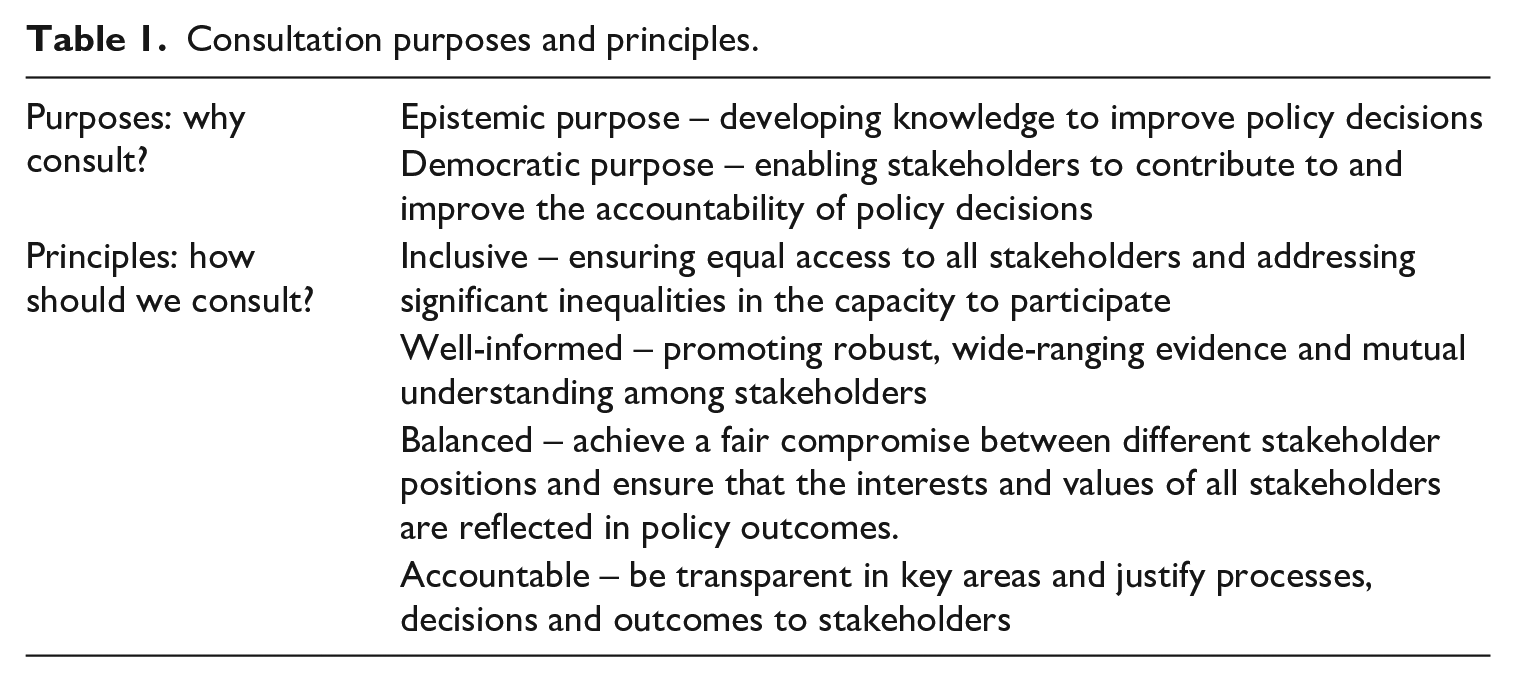
The stakeholder-centric perspective we adopted reframes consultations in important ways. It revealed that all participants recognised the importance of a consultation process that had integrity and was an authentic attempt to engage with stakeholders for both epistemic and democratic purposes. A crucial factor was not the extent of their disagreement about copyright policy outcomes, but the extent to which they agreed that existing consultations could reinforce the inequalities that already characterise the copyright landscape. Even privileged stakeholders could not reasonably disagree with the need to structure consultations in ways that might address the unevenness of voice and recognition among different groups.
Inevitably, this led to a reframing of accountability for the IPO. The IPO is formally answerable to government for delivering recommendations based on evidence, but the stakeholder-centric approach revealed how stakeholders also demanded accountability, in their capacity as citizens of a democracy and authoritative sources of information that could inform policy. Implicitly, they sought a re-balancing of consultation purposes away from the epistemic and towards the democratic. For consultation officials, this may be a risky option: more inclusive approaches to participation may conflict with gathering evidence underpinned by robust data, and promoting transparency may endanger the potential for compromise if it means stakeholders are less willing to be honest about their negotiating positions. Nonetheless, the demand for better integration of the democratic purpose is clear, and the principles offer one way of exploring how this might be achieved.
The stakeholder-centric approach also revealed the many different standpoints from which stakeholders engage with consultations, underlining the need to evaluate them using a systemic approach. Consultations do not operate in isolation; they are porous, and context is fundamental to understanding how they are structured, received and understood by stakeholders, all of whom have a vested interest, as citizens and collaborators, in delivering effective policy.
Thinking about consultations in systemic terms, as an ongoing engagement with stakeholders across multiple sites and involving multiple practices, also focuses attention on the connections between different methods and their contribution to overall legitimacy and effectiveness. Consultations are made up of many moving parts; each may be examined and addressed individually, but the outcome of any intervention will always include an effect on the system as a whole, and will be a function of the interconnections between different elements. All the principles in our framework are connected: sometimes they enhance each other, but sometimes their co-existence generates tensions and a balancing act is required in consultation design and execution. Exactly what kind of balancing act depends on the context: the relevant policy debates and specific aspects of media policy being addressed in a consultation. This means there is no one-size-fits-all solution to create the ‘perfect’ consultation process. Instead, the framework enables designers to evaluate current practice, identify areas of improvement, and consider the best range and mix of practices to satisfy the situation. The existence of principles that can act as regulative ideals means that such changes need not be made completely ‘blind’, but can be designed to maximise the achievement of generally desirable outcomes with which stakeholders find it difficult to disagree.
Based on our findings, we argue that media policy consultations should be explained and justified clearly in light of the purposes and principles discussed in this article, with ongoing opportunities for participants to reflect, provide feedback and challenge the process if necessary. While elected representatives are the ultimate decision makers, it is critical that they take into account the perspective of stakeholders who participate. Of course, barriers to such a stakeholder-centric approach may remain, including resource limitations as well as institutional understandings of consultations as a ‘top-down’ practice. Moreover, even when the principles are implemented as regulative ideals, consultation processes may still fall short in practice. Still, this kind of meta-deliberation with stakeholders can build the ‘reflexive capacity of those in the deliberative system to contemplate the way that the system itself is organized, and if necessary change its structure’ (Dryzek and Stevenson, 2013: 233).
Finally, we recognise that our research is firmly located in a Western, and specifically UK context and the principles are derived from our participants’ experiences with the way consultations are designed and run by the UK government and its agencies. In other political and national environments, the precise ways in which the principles take shape and the details about how they might be effectively enacted, will likely differ. Nonetheless, governments in all geographies have to grapple with intensely contested media policy challenges such as copyright. We suggest that adopting a stakeholder-centric, systemic approach to policymaking might be a constructive way to move complex media policy debates forward, even when they are characterised by polarised and seemingly intransigent positions. We hope this framework might support those who are concerned with reimagining and reforming media policymaking in more democratic directions.
Footnotes
Acknowledgements
We are grateful to our research officer, Dr Lynne Nikolychuk, for her contributions to the project, and Dr Kris Erickson, for providing comments on an earlier draft. We would also like to thank all our participants for so generously giving their time and ideas to the project, and our supporting organisations, CREATe, the Intellectual Property Office and Ofcom.
Funding
The author(s) disclosed receipt of the following financial support for the research, authorship, and/or publication of this article: The authors would like to acknowledge the support of the AHRC for funding this project (grant ref AH/S007075/1).
