




Abstract
The recent discussion on mediatisation prompts questions about how it arises and how social spheres are marked by it. In this article, we use business as an example of a social sphere to show that the production of normativity by and through the media is a central aspect of mediatisation. The empirical case of the article is the Deepwater Horizon disaster. Six specific techniques were used by the media to construct the case as an instance of corporate misbehaviour that met public recognition. The techniques are instrumental in forming the predicament of a modern mediatised business sphere, it is argued.
Introduction
In recent years, the mediatisation of society has become a topic of increased interest and debate (i.e. Deacon and Stanyer, 2014, 2015; Hepp et al., 2015; Hjarvard, 2013; Lunt and Livingstone, 2016). Mediatisation has been described ‘as an approach or unifying heuristic concept for a range of media-embedded processes of social transformation’ (Ekström et al., 2016: 1097), through which it is possible to understand how media, culture and society interact (Hepp et al., 2015). Frequently, it connotes a process through which ‘society to an increasing degree is submitted to, or becomes dependent on, the media and their logic’ (Hjarvard, 2008: 113).
Mediatisation evolves over time (Lundby, 2016). It is a ‘very subtle form of influence, where the media affect the structure of operations of other actors, simply because these have to some degree become dependent on the media and have accordingly adapted themselves to the “rules” and “logics” of the media’ (Schillemans, 2016: 79). Understood in this sense, the media become integrated into the operations of other social institutions (Lövheim, 2016), while retaining the status of an institution in its own right (Hjarvard, 2008).
An open question, however, is how mediatisation ‘works’ and which underlying processes or techniques that drive it (cf. Deacon and Stanyer, 2014). Critics of mediatisation theory (e.g. Couldry, 2008) point to the difficulties of explaining social transformation through the rather wide concept of mediatisation, which risks missing out on other important aspects and contextual realities that explain social change. Partly for that reason, mediatisation must be examined and articulated in relation to its functional aspects and dimensions.
In this article, mechanisms that to some extent drive mediatisation as a process of social transformation will be studied. Our aim is to understand how specific media techniques operate and sustain mediatisation in one specific societal sphere, business. Central to our argument, based on the Deepwater Horizon case, will be that certain techniques shape and promote normativity that sustains the construction of what a social sphere should be and how it should behave, according to the media logic. We proceed through describing business as a mediatised arena, followed by a methodology section. The case is then presented, followed by an analysis and conclusions section.
Business as a mediatised arena
One field that has been understood as particularly marked by the process of mediatisation is business. Following the growth of business journalism (Grafström, 2006), a steady increase of public attention to corporate issues and managers has been noted (Clemente and Gabbioneta, 2017; Kjaer and Slaatta, 2007). Business activities and managerial work tend not only to be influenced by values and ideas presented in the media, but are also adapted to the logics and practices of media (Ihlen and Pallas, 2014; Strömbäck, 2008). Awareness of media coverage and scrutiny has affected the way that companies present themselves and relate to their environment. Companies have become ‘edited’ (Engwall and Sahlin, 2007), and many corporate activities are responses to media visibility.
The media circulate and create ideas about ‘appropriate’ organisational behaviour (Grafström and Windell, 2011; Breit and Vaara, 2014; Einwiller et al., 2010). The media also serve as carriers of general models for conceptualising corporations, management and governance (Engwall and Sahlin, 2007; Mazza and Alvarez, 2000). In this respect, the media become a legitimating body and agenda-setter in corporate life (Carroll and McCombs, 2003; Vaara et al., 2006), and constitute a key arena where normative opinions about organisations are formed and spread (Deephouse and Heugens, 2009). The often symbolic and value-laden descriptions of companies are images against which the public forms a moral judgement (Einwiller et al., 2010). Which issues and events that are given attention and how they are presented is framed according to the media logic – professional norms regarding newsworthiness, content and format (Altheide and Snow, 1979; Schillemans, 2012).
The media logic can be understood as a ‘logic of appropriateness’ guiding choices about ‘who and what to cover and how to cover it’ (Cook, 1998: 61). It relates to what is considered interesting and valuable content and appropriate formats and techniques. Media presentations of corporate (mis)conduct therefore follow certain patterns and formats. Large, well-known and consumer-oriented companies are, for example, always more on the journalistic radar compared to others (Grafström and Windell, 2019).
More specifically, storytelling techniques frame the content of the news media and include for example simplifications, human-focus, dramatisations and highlighting moral aspects (e.g. Breit and Vaara, 2014). On television, entrepreneurial activities of companies have become orchestrated entertainment (Boyle and Kelly, 2012). In addition, events and issues have a higher chance (or risk) to develop into news stories if they are extraordinary, close to the audience in time and space, contain conflict and are entertaining (Strömbäck, 2019).
Importantly, such techniques are vehicles that further the process of mediatisation through their use by the media and reception among constituents in society. They are tools through which the media can bring about change in understandings. That also includes the rearranging of dependencies, and it affects thinking and action within societal spheres (Schulz, 2004). Identifying how such techniques function when framing and constructing social events is one aspect of making mediatisation analytically relevant and useful for explanatory purposes (cf. Ekström et al., 2016). To that task, the article now turns.
Methodology
We focus on the BP case following the disaster of the oil rig Deepwater Horizon in the Mexican Gulf, 2010 and onwards. The case was chosen for illustrative purposes, to exhibit how media techniques were operative when constructing an understanding of a disaster within an environmentally sensitive business, oil extraction. A two-stage procedure was chosen. First, a more general description of the BP case (a ‘story’) was constructed by the researchers on the basis of publicly accessible media material. The years covered were 2010 and 2011. Articles were collected through media databases with the ambition to include various perspectives. Local and international perspectives were of interest, as well as sources where ‘images’ were shown. News articles from the Times Picayune (local), The Guardian (international UK) and Svenska Dagbladet (international Swedish) were selected. Of relevance for the choice of the international perspective was the UK connection (and ownership) of BP and the nationality of top executives, to exclude potential national bias. To relate the case to visual media, information available on Youtube was also used. However, the texts (and clips) were used instrumentally to get an overview of the story which could be analysed in accordance with the ambition of the article. The analysis was complementary rather than comparative. Through the media texts, a more general picture of how the case unfolded was possible to tease out. Second, based on this general case description, an analytical ambition of the article was to further understand how the media used specific techniques to describe the issue. We set off from techniques already defined in the literature; (1) simplification, (2) personification, (3) polarisation, (4) dramatisation, (5) stereotypisation and (6) visualisation.
Simplification
All kinds of events and information need to be simplified to some extent in order to be told about. It is therefore a natural part of the journalistic work to develop a story out of a complex reality. The simplification process follows certain norms in which some aspects recurrently tend to be valued at the expense of others. Breit and Vaara (2014) showed that the representations of a corruption case were ‘black and white’ – as ‘controversial activities are moralised out of proportion (while others receive little or no attention)’ (p. 58). Simplification involves presenting straightforward stories and answers – where things are made less complicated.
Personification
The personification of corporate misconduct places the manager frontstage (Chen and Meindl, 1991); a development that has been understood as corporate leaders turning into celebrities (Hayward et al., 2004). As the media convey an individualised view of the company, the qualities and deficiencies (or the virtues and vices) of managers, symbolise business in general and companies in particular. This suggests that ‘the CEO becomes a powerful locus for sense-making by stakeholders’ (Sinha et al., 2012: 226; see also Breit and Vaara, 2014). CEOs, or other top managers tend to play leading roles as villains, regardless of their own involvement or actual transgressions.
Polarisation
Part of telling a good story is to have two sides debating. In this way, conflicts and polarised world views tend to be enhanced in the media. To develop an interesting story, the journalistic format therefore requires suitable actors to play leading roles in the media narrative; roles that are recognisable by the audience. The set of roles most often includes villains, victims and heroes. From the perspective of a media scandal, the person or organisation being criticised ‘. . . becomes part of a story about The Good and The Bad, the Perpetrator and the Victim’ (Allern and Pollack, 2012: 187). Such news stories provide ‘cognitive ordering of events for the audience and a moral ordering of responsibilities’ (Schudson, 2003: 181).
Dramatisation
One common way to create interest in news content is to dramatise. Media scandals have been called ‘social dramas’ (Kantola and Vesa, 2013), containing a set of key actors, an audience and a corresponding script (Jacobsson and Löfmarck, 2008). In these social dramas, narratives are generated and familiarities are constructed. Schudson (2003: 181) describes how dramatisation is interrelated with journalistic storytelling as for example ‘the investigative story seeks to evoke moral outrage’. In this way, the ‘outcome will reinforce the common moral order’ (Schudson, 2003: 181).
Stereotypisation
Stereotypes relate to well-known understandings and characterisations. Things that persons are expected to represent are reflected in the stereotypes. Through stereotypes, an audience can expect a specific kind of behaviour, representing a pre-defined course of action following from the characterising traits. Examples include ‘heroes’ or ‘villains’ that are pre-defined and given support (or resistance) according to current moralities (Hartz and Steger, 2010). Frequently, the stereotype is constructed according to some pre-notion of the intentionality. The ‘hero’ is expected to find a solution to problems whereas the ‘villain’ wants power, maximises self-interest, or tries to achieve other suspect goals. Stereotypes may also be used to attract attention and recognition. Not least the image of female top executives is constructed according to stereotypes (Kroon Lundell, 2012).
Visualisation
Various ways to visualise social phenomena are increasingly highlighted as important for constructing meaning (Höllerer et al., 2013; Meyer et al., 2013). One example is corporate misconduct, that can be visualised in provoking and compelling ways, for example through the use of symbols. Visualised issues are more likely to be turned into media stories. Visualisations can even be argued to be cornerstones in journalistic storytelling techniques and a necessary ingredient for telling ‘good’ stories. Journalists tend to focus on something that is possible to visualise – for example individuals with certain obvious or ascribed traits – such as the CEO of a company (Chen and Meindl, 1991).
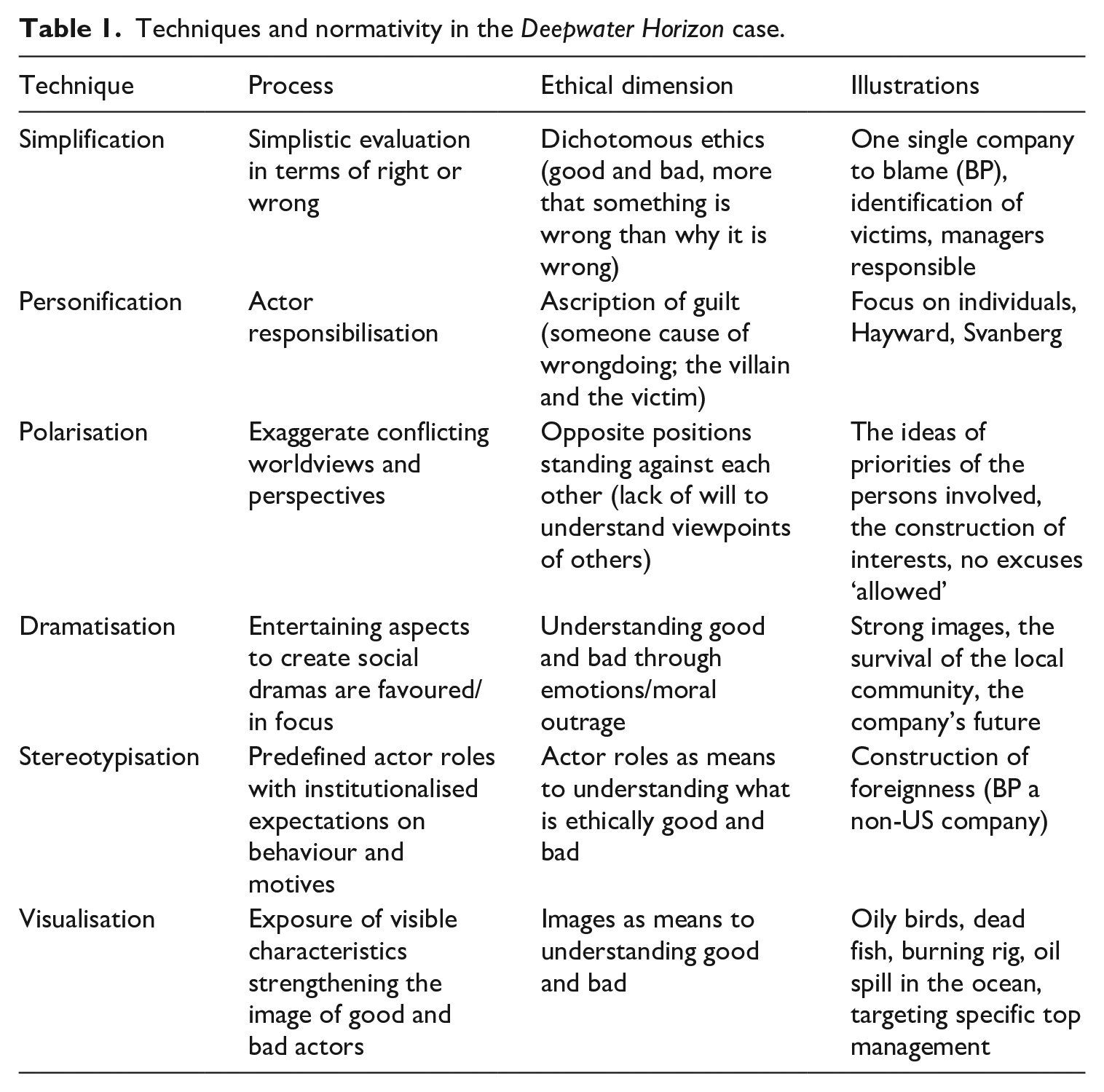
The issue was to find out how these techniques were operative in and used by the media (see Table 1). The case functions illustratively. Case studies performed in this way – when a ‘story’ is analysed through a theoretical lens – usually illustrate aspects or perspectives of theoretical or conceptual kind. Functionality is of interest rather than complete coverage of media reporting of the case. How something worked (the techniques) was more interesting than, for example, how much or how often it occurred. Arguably, the Deepwater Horizon disaster has been discussed elsewhere and is relatively familiar to a general audience (e.g. Matejek and Gössling, 2014). After a short introduction, we focus on the analytical aspects of the case rather than reporting (and repeating) the entire course of events.
Techniques and normativity in the Deepwater Horizon case.
The construction of morally right and wrong in the Deepwater Horizon disaster
On the 20th April 2010, the oil-rig Deepwater Horizon exploded in the Mexican Gulf, killing eleven people. Two days later, the rig sank. It had been rented by BP, the multinational oil giant. 1500 m below the surface, a blowout preventer, the last barrier to a gigantic oil leak, was out of order. In harsh weather conditions, the attempts to mend it failed. Almost 5 million barrels of oil gushed out from the oil field Macondo before the leak was secured almost 3 months later. Over that period, BP attempts to cover and seal the leak failed. It soon became obvious that the Deepwater Horizon affair was the worst environmental disaster in US history. The summer of 2010 became the ‘lost summer’ of southern Louisiana.
The consequences for the environment, the local economy and for BP were disastrous. As an example, BP shareholders saw their stock lose some 102 billion dollars of worth in a short time (Henriksson and Lindahl, 2011). Direct consequences of the disaster were experienced by, for example, local fishermen, while indirect consequences hit hundreds of thousands of people within the oil extraction, tourism and the alimentary industries. Legal issues followed, related to which company that should bear the ultimate legal responsibility for the catastrophe. As for (potential) guilt and legal responsibility, several main actors were involved; BP (the operator of the Macondo field), Transocean (the owner of the rig), Halliburton (the cementing contractor on the well) and Cameron International (the manufacturer of the blowout preventer). Federal and state claims on BP were settled in July 2015. In total, BP had to face almost 400,000 cases relating to the Deepwater Horizon incident. In 2018, it was estimated that BP’s total cost for the Deepwater Horizon disaster amounted to some 65 billion US dollars (Bousso, 2018), and this without having settled all the claims of the disaster.
The media exposure was enormous. To illustrate this, a quotation from an interview with the BP chairman Carl-Henrik Svanberg a year after the disaster is telling (Zachrison and Lindahl, 2011): This was perhaps the worst crisis occurring in the world since we got a 24 hour news society. At the time of the terrorist attacks of 11th September 2001, most people had hardly sent an e-mail. Now it was an entirely different situation with 20,000 articles each day about BP. I felt it like standing there shouting in a hurricane. We said some things 100 times but no one listened.
In the following, the various techniques used by the media will be illustrated.
Simplification
Two aspects of simplification stand out. First, the concrete ascription of guilt in the case. BP got the blame and others were portrayed as victims. That is, the ‘story’ is typically reduced to two relatively distinct positions. Second, a significant number of stakeholders were involved in the Deepwater Horizon case. BP was the operator, but Transocean owned the rig, Halliburton was the contractor on the well and Cameron International the manufacturer of the blowout preventer. One aspect of simplification was therefore the apparent reduction of the number of culpable stakeholders in the case. Basically, BP was targeted, the largest and most well-known company. This did not imply an acquittal of the other companies involved, but, once again in the media dramaturgy, a simplification of the actor context. Strikingly, in the summer of 2010, The Guardian put together a list of all the less fortunate remarks and statements that had been made by the top representatives of BP. The list was quite long. Criticism against BP was voiced because of perceived unwillingness to take full responsibility for the accident. Even though fully correct in principle, arguing that ‘this was not our accident . . . This was not our drilling rig . . . This was Transocean’s rig. Their systems. Their people. Their equipment.’ (Hayward, 3rd May 2010, as quoted in The Guardian, Macalister, 2010c), was not seen as adequate from a responsibility perspective, to say the least. One commentator argued: ‘It was – almost – the most foolish thing BP’s chief executive said in the wake of the tragedy, since few hard facts were available at the time’ (Pratley, 2010).
That other companies were also involved made the case more complicated from a media perspective. Attempts to make the story more complicated, and perhaps to do it more justice, stood against the media logic of simplification. ‘But even if BP’s finding of ‘multiple causes’ is accepted, that does not tell us whether the company will be found grossly negligent or merely negligent’ (Pratley, 2010). That is, BP, the largest and most well-known company, was the one of interest. The story was simplified into exposing one culpable company represented by managers ’evading’ responsibility. Pointing to joint responsibility was interpreted as an attempt to escape responsibility. In particular, BP’s own investigation was targeted. Edward Markey, a Massachusetts Democrat, claimed that the report of BP had the ambition to protect the company’s interests rather than finding the causes of the disaster. ‘BP is happy to slice up blame, as long as they get the smallest piece’, he was quoted in The Guardian (Goldenberg, 2010b).
Personification
Another important aspect was the focus on the managers and the personalisation of corporate activity, primarily in terms of identifying individuals worthy of blame. One aspect was the stepwise change, from describing the Deepwater Horizon issue as an environmental disaster and lethal accident to moralising and targeting individuals within the company. One example was early articles (e.g. Henriksson, 2010) that contextualised the issue as one of several environmental incidents, and portraying the CEO, Tony Hayward, as active in finding the reasons for the accident and securing it would never happen again. Only a few weeks later, the image had changed. BP did not seem to acknowledge the magnitude and severity of the case when events unfolded (Lindahl and Henriksson, 2010). Another aspect was that more attention was paid to what Hayward and other BP officials actually did and did not do (or say). Within short, these persons became the targets of the media (e.g. Cervenka, 2010). The story was ‘personified’. However, this was not only about personalised moralisation. It was also a way of making the Deepwater Horizon case a unique one. Through finding persons to blame, unique identification and distinction compared to other accidents was possible. Managerial action was under meticulous media scrutiny and coverage.
During the crisis, a central issue became how BP executives and the chairman of the board communicated and acted. The then CEO of BP, Tony Hayward, got his share of the blame, and as time went by obviously also from his employer. A couple of months after the disaster, he was replaced by Bob Dudley. The chairman of the board, Svanberg, got severe criticism for not speaking out in public until a month after the disaster. In a column by Julia Finch, she brought up Svanberg’s lack of experience from the oil industry and that he – at the time of being appointed – had admitted that ‘he was surprised to be offered the BP job’. Therefore, she argues, it is ‘tempting to suggest that he may be out of his depth with BP [. . .]’ (Finch, 2010). When Svanberg finally spoke in public, he was accused of doing this in a symbolically unacceptable way (see below, visualisation). The positive media image that Svanberg had enjoyed changed. Clear and straight communication had been one of his qualities, but now he was questioned.
The image of the manager that developed over time was essentially value-laden. Through personification, the executives were visualised. Personification involved strong moral demands on the top managers. It was never enough that the moral issues were taken care of at arm’s length. The manager should involve himself wholeheartedly.
Polarisation
The oil industry has been questioned for a long time. And, as stated in one of the headlines in The Guardian (Webb, 2010), the accident put the ‘bad boy’ industry in the spotlight again. The industry was ‘typically bad’, and (in particular) its executives could be targeted. As one commentator put it: ‘The people in the rarefied atmosphere of the boardroom; how many of them have actually put on a hard hat and visited a rig? Executives spend too much time speaking to accountants and lawyers and need to get their hands dirty more.’ (Webb, 2010). Portraying opposites is an aspect of polarisation. Pointing to the lack of ground contact and reality understanding was part of this. For example, Hayward’s contention that ‘BP’s response to this tragedy has been a model of good social corporate responsibility’ (Macalister, 2010a), was fodder for criticism and ridicule by reporters and analysts. The issue was apparently one of conflict. The top managers were attributed significantly opposing interests compared to others. Also, close to stereotypisation (see below), strong irreconcilable positions were described, involving a specific characterisation of the presumed interests, primarily of the managers.
The CEO Hayward got the hardly flattering epithet ‘the most hated and most clueless man in America’ (originally coined by the New York Daily News, but echoed numerous times, see Macalister, 2010c). For many, Hayward’s remarks about wanting his life back and the Mexican Gulf being such a big sea that the environmental effects would not be that bad made commentators furious, including President Barack Obama. Obama summoned Hayward and BP’s chairman Svanberg to a meeting in the White House on 19th June 2010. The blame and remorse against BP echoed around the world. Hayward was a person who, according to Obama, certainly would not be given a job considering the remarks he had made. Democratic congressman Anthony Weiner accused BP of not telling the truth, and the chairman of the house energy, and environment subcommittee, the previously mentioned Edward Markey, ‘claimed that BP was “either lying or they are grossly incompetent” when it came to the explosion on the Deepwater Horizon’ (Macalister, 2010c). The ‘bad company’ role that BP played, was cemented. Voices in support of the company, such as Republican congressman Joe Barton, who apologised to BP for the treatment of the company, got criticised from all angles. Barton soon retracted his excuse (Adams, 2010).
Dramatisation
Dramatisation adds an element of ‘entertainment’ or ‘excitement’. Images of oily birds, devastated shores or burning oil-rigs (see visualisation below) spur reactions. Such was the case in the Deepwater Horizon disaster too. One example, relating to the rescue work of BP, was the reports on turtles being killed. ‘Endangered sea turtles and other marine creatures are being corralled into 500 square-mile ‘burn fields’ and burnt alive in operations intended to contain oil from BP’s ruptured well in the Gulf of Mexico, the Obama administration confirmed yesterday.’ (Goldenberg, 2010a). Symbolic evaluation also related to the persons involved. Images of Hayward on a luxury yacht and of Svanberg, casual and laughing, and going on holiday shortly after the accident (Lindahl and Henriksson, 2010), contrasted strongly with the severity of the situation that media sustained. Even though some behaviours of the top representatives could hardly be subject to substantial moral criticism (e.g. in a later BBC interview, Hayward mentioned he was on the yacht for 6 hours – one reason being that he had not seen his son for 3 months, see Lindahl, 2010), the images and the drama were already established. The media signalled that the executives distanced themselves from the case.
True or not, such symbolic images were channelled through the media and became the basis for moral evaluation of the top representatives’ behaviours. One way of dramatising was through visual comparison, for example with the Titanic disaster: ‘A century ago, disgrace had a different effect. The chairman and managing director of White Star Line, J Bruce Ismay, felt the full force of American contempt when the Titanic went down in 1912, and he never recovered.’ (Jack, 2011). The BP representatives did recover, and the image of Titanic was held against them. The images and the ‘plot’ of the media were to a high degree a construction of what the story was about, created to generate emotions and reactions. The contrasting of a dying and damaged coastal landscape – and its human beings – against a corporate luxury life without self-remorse was obvious.
Unfortunate remarks like the ‘very, very modest’ implications of the disaster and caring about ‘small people’ (see below) were, of course, not media creations as such. But reasonably enough, such less sophisticated comments came to be part of the soil of which media created its images. In a sort of spiral, the symbolic value of everything that the CEO and the chairman of the board did rose to new peaks.
Stereotypisation
The chairman, Svanberg, got his share of criticism when saying that BP cared for ‘the small people’ at a press conference on June 16th. The provocation was unintentional. Quoting Svanberg, he actually said that ‘I hear comments sometimes that large oil companies are greedy companies or don’t care but that’s not the case with BP. We care about the small people.’ (Clark, 2010). This was, according to one reporter (Sunderland, 2010), his ‘Marie Antoinette moment’. Svanberg’s words were seen as condescending and a sign of corporate arrogance (Chancellor, 2010). However, as a non-native English speaker, Svanberg probably meant that ‘ordinary’ people without resources were also BP’s concern. Whatever the case, the interpretation of the remark was fundamentally negative.
Things did not turn to the better for BP when Hayward was seen spending a Saturday on his yacht a couple of days later. The imagery of a CEO enjoying himself on a private yacht in the JP Morgan Asset Management round the island race on the Isle of Wight prompted a White House representative to conclude that Hayward should better not consider a second career in PR consulting.
What was evident was the stereotypisation based on the notions of ‘big’ and ‘powerful’ on the one hand and ‘small’ and ‘insignificant’ on the other hand. The construction was to some extent an ascription based on the remarks by the chairman. It signified a kind of intentionality or mind-set that the media attributed to the top manager(s), although this was not necessarily true. Another aspect of this was obvious, at least in the US case. BP was a foreign company. The main characters (executives and chairman) were foreigners, most victims, however, were Americans. To quote congressman Weiner: ‘Whenever you hear someone with a British accent talking about this on behalf of British Petroleum they are not telling you the truth. That’s the bottom-line.’ (Macalister, 2010c). Stereotyping also involved the construction of otherness in national terms, as recognised by the media. The change of CEOs that occurred in 2010 was also portrayed in national stereotypes: ‘Dudley had been called in to try to soothe the US public and political establishment, who had taken against Hayward’s very British manner.’ (Macalister, 2010b).
Stereotypisation meant an exposure of visible characteristics that people instinctively see as negative given the situation. That is, smiling and laughing when you should not, talking about yourself when you should talk about others, making remarks that may be correct but nevertheless misplaced, etc. These images strengthen the understandings of good and bad actors within the dramaturgy.
Visualisation
Through the media and its images, personal responsibility for causing the problems was possible to identify. Managers are at the heart of such a process. To take Hayward as an example, referring to the yacht and other images, very few of the people disliking Hayward had any personal experiences of him or suffered direct consequences of his actions. But the understandings were reasonably based on the visualisations of him. Within a couple of weeks, Hayward was also accused of downplaying the importance and significance of the accident by saying ‘It is impossible to say and we will mount, as part of the aftermath, a very detailed environmental assessment but everything we can see at the moment suggests that the overall environmental impact will be very, very modest.’ (Hayward interviewed by Sky News 18th May 2010, quoted in The Guardian 27th July 2010). On May 30th, his unfortunate remarks about wanting his life back were made on a Louisiana beach in front of reporters.
Images strengthened the harsh evaluation of Hayward in particular, but also of Svanberg. At the annual meeting of BP in 2011, Svanberg was criticised for not being visible during the crisis. He commended CEO Hayward for having done a great job and pointed out that Hayward was the one in charge of BP’s attempts to deal with the crisis (Henriksson and Lindahl, 2011). Even though the silence was according to an internal distribution of tasks (Hayward being the spokesperson), it was taken to be a sign of lacking transparency and a bad PR strategy. For the media, Svanberg had ‘refused to comment on the oil disaster in the Mexican Gulf. The hero from Ericsson risks becoming the environmental crook of the entire world’ (Almgren, 2010).
The first interview Svanberg gave was over a month after the accident. He wanted to avoid misunderstandings, he said. The distribution of responsibilities between him and Hayward was relatively clear (Zachrison, 2010). Svanberg was strongly criticised and ridiculed. Silence was not deemed to be morally justified. Visualisation paradoxically went hand in hand with perceived invisibility, which was considered worse than trying to take visible action. However, worse than the silence was the way he broke it. During a panel debate he was observed being relaxed and laughing, telling the panel and the audience how he had counted on a ‘smoother ride’ when joining BP. He also emphasised that BP was ‘in a bit of a good process’ as to handling the disaster, but never mentioned the diseased workers. The clip was soon distributed on Youtube (2010). Both timing and style caused frustration. As one Swedish business journalist wrote: ‘suddenly, Carl-Henric Svanberg’s patented smile looked like a callous grin—that may prove just as difficult to wash off as the oil on the birds’ plumage’ (Cervenka, 2010). Another example was a Svanberg remark one year after the accident claiming that only five percent of the shores were actually affected. It excluded the fact that not only shores were hit by the consequences of the oil spill. Many of the effects of oil spills remain within the sea and affect various species and life in general for decades. Later, however, Svanberg expressed deep concerns about the disaster and the families of the diseased.
The visualisations fuelled strongly negative evaluations, not necessarily related to behaviour as such, but to the idea of what a manager should be in a crisis situation. The images themselves visualised qualities such as presence or non-presence, concern or carelessness and so on, loaded with moral content or preferences. Through conscious visualisation, the symbolic value of acts or omissions was conveyed.
Analysis
The techniques used by the media conveyed an essentially normative image. In Table 1, we point more specifically to the ethical dimensions that framed the case.
Importantly, as the Deepwater Horizon case was constructed over time, its character partly changed. From being an accident, it turned out to become an issue of responsibility. As time went by, the use of the techniques ‘produced’ strong normativity. Politicians, local residents, other journalists, to mention some, reacted and integrated the images into their evaluative frames. Alternative stories or explanations were, over time, excluded from the attention of media. Among examples one finds the fact that the meeting between President Obama and BP’s top representatives took place after repeated requests from BP. And Svanberg’s ‘silence’ was only a media silence, not personal inactivity, since his focus after the accident was on communication with stakeholders (mainly other than the media) (Zachrison and Lindahl, 2011).
What the media did, however, was to provide moral meaning to the Deepwater Horizon case, giving it a normative frame that was apparently shared by many others in the unfolding context of the disaster. The result was not just a ‘story’. Rather, and relevant to the issue of mediatisation, it was a way of moralising a social sphere, business in the form of the oil industry. This was done in a context, together with politicians and others. A normative understanding of what being a company within the industry actually demanded was formulated, including responsiveness to moral demands and responsible managerial behaviour.
Conclusions
This article shows that the media play an active role in paving the way for changing the predicament of being a company in an environmentally sensitive field of business. Even if we do not present any full story of how the business sphere becomes mediatised, we conclude on the basis of the case that this process is essentially actor-driven. The actors – the media but also all others that are taking active part of creating the story over time – are involved through an ongoing and complex interplay. The conditions for how this interaction plays out are shaped by the media logic and the techniques of storytelling. Through the techniques, strong normativity about good and bad is developed, whom to blame is defined, and what it means to take responsibility is shown. Mediatisation of a social sphere such as business cannot be reduced to a coincidence or a consequence of, for example, technological development. It is not something ‘external’ or an inevitable development. Rather, it is driven by actors and must be understood in the light of an ongoing interplay between media, companies and other actors that shape understandings of normativity over time.
In claiming this, we are also aware of the pitfalls of assuming too strong roles for specific actors in causal processes leading up to change and mediatised social spheres (cf. Deacon and Stanyer, 2014; Witschge, 2014). However, we are not arguing that a specific case and the actions within it ‘result in mediatisation’. Rather, this is just one example where the media have a strong role in reconceptualising what it means (or should mean) to be a company within the oil industry. Such a conceptualisation is essentially contained within a broader discussion of sustainability, the role of business in society and the socially accepted nature of business activity, a discussion with plenty of other actors, such as politicians, NGOs, consultants, the public and business itself. It is a history with many actors, dependencies and relationships. Importantly, the techniques are not exclusively used by journalists but by all communicative actor groups. The presence and joint acceptance of these techniques as ‘rules’ for how and what type of stories to tell are an essential part of forming and shaping the understanding in a direction which is essentially ‘mediatised’. Part of this is also an audience that accepts and participates in the ongoing construction of right and wrong.
Our analysis contributes in two ways. First, we point to the nature of a specifically ethical evaluation of business activities through the use and acceptance of the storytelling techniques for media stories. We also illustrate the relational dependency characteristic of mediatisation – and relate it to the constructed normativity of the drama. That is, the space of action of an actor such as BP is defined by the normativity created through the techniques. And the relational context that unfolds is unthinkable without the media and the logic that the drama builds on. It is a case of interaction (Hepp et al., 2015) with the media as a central part. In defining right and wrong within the field of business activities, such a relational staging of roles and responsibility also drives social transformation as companies are made aware of expectations on how to be sustainable and which roles to enact (cf. Ekström et al., 2016; Hjarvard, 2008). The ‘appropriateness’ of business cannot be understood without the framings in the media, at least not when it comes to a large oil company (Grafström and Windell, 2011; Cook, 1998; Einwiller et al., 2010).
Second, and partly in agreement with the more critical discussion on mediatisation (Deacon and Stanyer, 2014), we claim that mediatisation as a process is not a given, a buzzword, or something that should be assumed as a self-evident predicament of our time. Rather, to count as a relevant concept, one must identify and understand the actions and approaches that trigger and sustain mediatisation. It is true that the techniques can be illustrated in themselves, without linking them to the concept of mediatisation. It is more difficult, however, to understand the predicament of companies in the oil industry without reference to a complex mediatised context in which they must present and defend themselves against or in line with a self-understanding created through the images of others. From a more theoretical perspective, it is reasonable to argue that the techniques are means through which institutionalisation takes place (cf. Hjarvard, 2004). Mediatisation entails the communicative construction of socio-cultural reality (Lövheim, 2016). The means or tools through which mediatisation ‘comes about’ require explanations, however. The use of the techniques as illustrated in this article is at least a partial description of process characteristics necessary to understand to make mediatisation more than a general claim.
Admittedly, our case covers a crisis and a specific business field, the international oil industry. One may, however, interpret this in line with the observation that some industries are more likely to be portrayed more dramatically and critically than others. We have chosen to study the case through the lens of media. In the analysis, we rely primarily on print media, but reasonably enough, television, social media and other channels do not in any sense contradict the idea of staging and shaping dramas (cf. Boyle and Kelly, 2012). Rather, they deserve further attention in research.
